• Category Archives Music and Concerts
  • Deaf Jam


    Some years ago, I learned of a harmonica festival in New Jersey. This was to be a major event and I was very excited. The schedule was noon to midnight – a full twelve hours of the top players in the country with legends such as Jason Ricci and Howard Levy. Upon arriving, however, my companion and I were greeted with recorded music that was LOUD. So loud that we feared that we would actually have to leave before any performances even began. Desperate, I suggested that we ball up pieces of paper napkins and put them in our ears. It was so uncool, but we survived.

    Following the festival, I discussed my experience with a working musician, who said that excessive sound levels were common and often the fault of the sound crew, even against the wishes of the performers. Regardless of where the fault lies, LOUD and very loud seems to be part of the milieu of amplified music in performance. The most disturbing thing, however, was that in speaking to rock musicians, all admitted to noise induced hearing loss.

    I am happy to report, however, that in my experience, I see a change in climate, and the stereotypical self destructive lifestyle of the musician is not necessarily a badge of honor. Awareness is growing of the irreparable damage done to hearing by excessive noise.

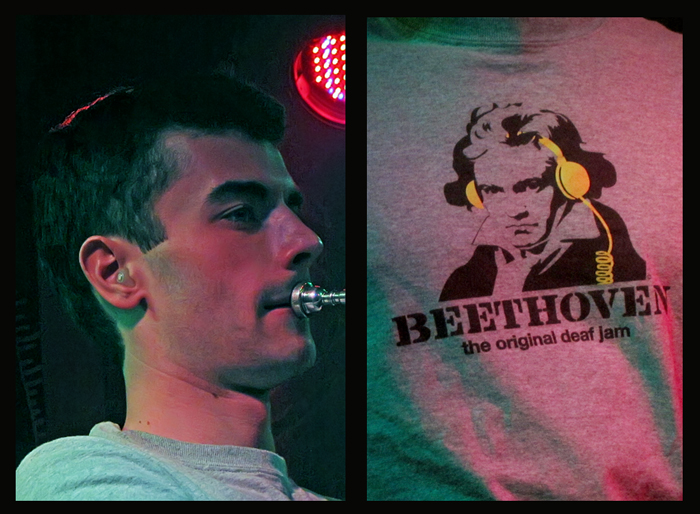
    Recently, I visited Shrine NYC, a music club located in Harlem. During the performance of the Body Electric Afrofunk Band, I moved up to the group’s staging area. I noticed that nearly all the musicians had hearing protectors. I had a good line of sight to the trumpet player, Will Healy, whose ear can be seen in today’s photo.
    Last night I called Will to discuss this. The conversation was short – Will was celebrating his 21st birthday. He did tell me that he had already suffered some hearing loss and was working with Dunshaw, an audiology center in New York City. Dunshaw Audiology and Hearing customizes musician earplugs – an actual impression of the ear is taken and custom molds made.

    This morning, I spoke to Dr. Rhee Rosenman AuD, an audiologist at Dunshaw. I learned many things in our conversation, including the fact that the use of portable music devices like the iPod, at full volume, can deliver 100 db of noise – equivalent to an industrial environment or loud live music. Playing portable devices at full volume is common in New York in order to effectively mitigate ambient noise. This practice will result in hearing loss. Dunshaw works with many musicians and their specialized musician earplugs can attenuate sound by 25 db, but still allow music to be heard clearly with no muffling.

    Early in the performance of the Body Electric, I also noticed Will’s t-shirt with its very clever and ironic tagline: Beethoven – the original deaf jam*. Many things can be learned from Beethoven, and one is that there is no romance in loss of hearing – it is one of the great tragedies that befell this man, one of the greatest composers of all time. By the premiere of his Ninth Symphony, he was completely deaf. During the end of his performance, he had to be turned around to see the tumultuous applause of the audience – hearing nothing, he cried. Sadly, it was the Original Deaf Jam 🙁

    *Deaf used here is a play the older slang term, def, to describe a person or thing that is cool.

  • Think Big

    In 1979, Think Big opened in SoHo. This shop was started by Phyllis Prinz and Robert Malkin, who created a product line of oversized replicas of a variety of products – tennis rackets, Crayola crayons, paper clips, pencils, postage stamps, toothbrushes, etc. I frequented the shop often and was once gifted an oversize Bayer aspirin. The shop was a roaring success, closing in 1994 (and later rejuvenated as an online shop by Jeff Bruette as Great Big Stuff). There was a man, however, where the concept of the oversize had also been brewing for a much different reason: Fred Garver (aka Fred Garbo) of South Paris, Maine.

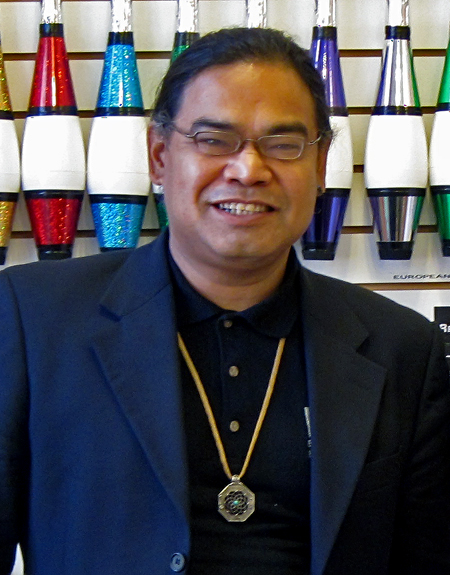
    I have known Fred Garbo for 35 years – he is, in fact, one of my oldest customers and quite a unique individual. His credits, like his talents, are myriad. I do not say this lightly. In 1980, Fred auditioned for the Broadway show Barnum. The part called for acting, dancing, singing, acrobatics, playing an instrument, and juggling – Fred was chosen over 500 auditioners.

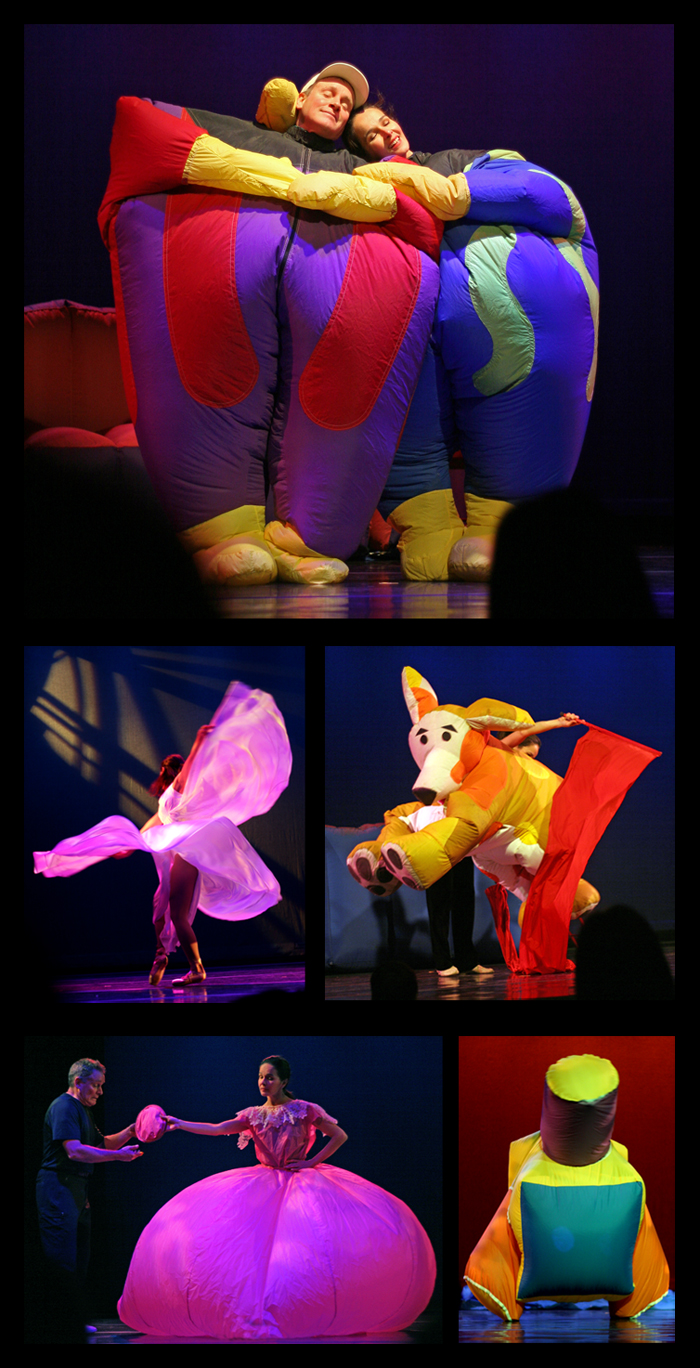
    Since our very first interactions, I became aware how Fred has always been very focused on the VISUAL impact of any stage prop and its SIZE. This became a virtual obsession, explaining the evolution of his show of 18 years and his invention and utilization of large inflated props/characters. His character, Led Zeplin, and his inflated suit have been the envy of many a performer and have also spawned a few imitators.

    His partner in his show is Daielma Santos, who was born in Sao Paulo, Brazil, and is a graduate of the Royal Academy of Dance in London. She has worked as a professional ballet dancer and teacher. Having met while Fred was touring, Daielma became fasicnated with his inflatable suit. A partnership soon followed. A number of pieces in their act showcase Daielma’s dance talents. Her grace, fluidity, and charm are arresting both on stage and off.

    Last week I was called by a friend who informed me that the Fred Garbo Inflatable Theater Company was performing on Saturday, January 8th, at Symphony Space in New York City. She invited me to accompany her, her husband, and their 3-year old child to the show.

    Fred is a resident of Maine, where he originally moved to study and train with his mentor, the late Tony Montanaro of Celebration Mime Theater. He railed against the stereotypical and overdone illusions of mimes at that time and developed his own unique brand of physical theater, incorporating his skills and training in juggling, mime, acrobatics, and clowning.

    The Inflatable Theater show involves juggling, dance, and a large variety of inflated objects and characters moved through the acrobatics of Fred and Daielma inside. The show is highly polished and very successful, a great pleaser of children and adults worldwide.

    During the time that Fred worked in Barnum, Fred lived in New York City. We formed a closer relationship at that time – in addition to his performing, Fred became a teacher of juggling in my studio. A lover of nature and Maine, I was astonished at how quickly Fred adapted to New York, navigating its shoals undaunted and learning about it so quickly. In 1983, Fred, along with Bob Berky and Michael Moschen, created Foolsfire, an Obie Award winning 3-man show, which I had the privilege of seeing. He was also the man inside Sesame Street’s Barkley the Dog. I have always considered him to be an honorary New Yorker. It’s seems so appropriate for a man who adapted to city life so readily and whose life’s philosophy has always been to Think Big 🙂


  • The Real Peel

    David Peel’s website consists of one page, however, much can be gleaned from a quick read –

    Favorite Band or Musician: David Peel & The Lower East Side
    Favorite TV show: The Simpsons
    Favorite movie: West Side Story
    Favorite book: 1984 by George Orwell
    Favorite sports team: Bonghitters
    Favorite food: Ice Cream

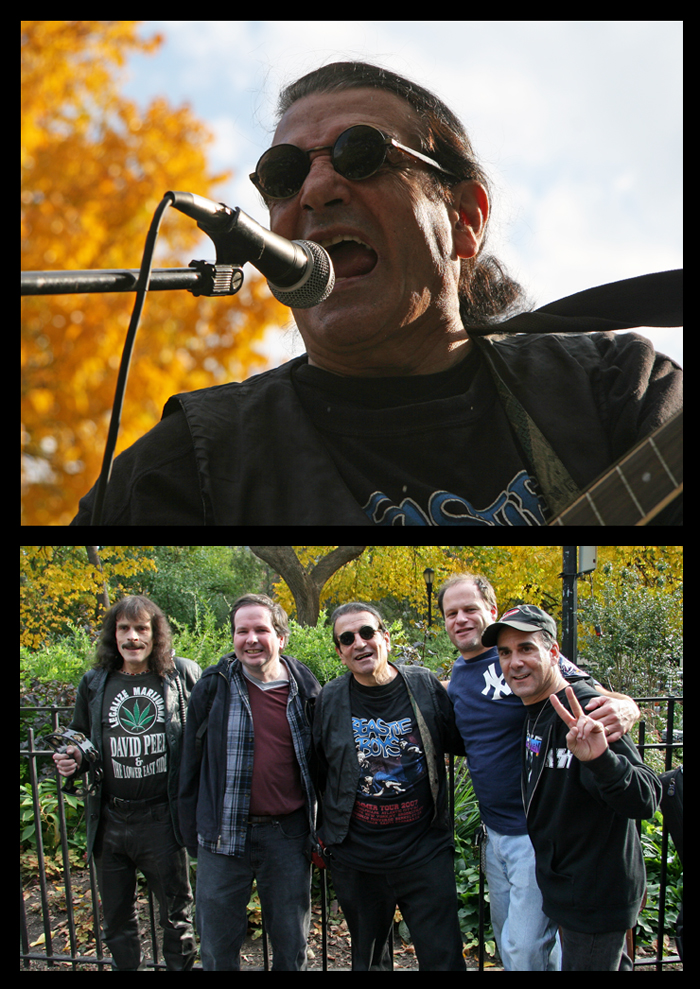
    Take equal parts of self absorption, political activism (with a hint of conspiratorialism), punk rock, marijuana, and maniacal energy, and you have David Peel. Born David Michael Rosario, the New York City-based musician and activist began recording with his group as David Peel and the Lower East Side in the late 1960s. He is credited with being one of the early performers of punk rock. A tireless advocate for the legalization of marijuana, Peel’s first album in 1972 was entitled Have a Marijuana. His discography is over 20 albums. He has been closely associated with the Yippie movement, Smoke-In concerts, and the annual Marijuana March.

    David Peel’s close association with John Lennon propelled him to celebrity status and helped pave the way for him to perform with top acts, such as Alice Cooper, Doctor John, Stevie Wonder, Dave Brubeck, Herbie Mann, Rod Stewart, Emerson Lake and Palmer, BB King, the Chambers Brothers, Joan Baez, Frank Zappa, Iggy Pop, and countless others.

    Lennon recalled first seeing David Peel, and his street assembled version of the “Lower East Side Band,” performing in front of a large crowd in Washington Square Park, in 1971. “He was shouting, why do you have to pay to see stars?” says Lennon. “I was embarrassed. I thought surely he must know I’m here. Yoko and I loved his music, his spirit, and his philosophy of the street.”

    Ignoring the objections by “certain” former members of The Beatles, John and Yoko still signed Peel to Apple Records. Peel’s first effort for Apple was an album entitled “The Pope Smokes Dope,” which immediately set off an international furor. The record was banned in nearly every country of the world, except for the United States, Canada, and Japan.

    In a memorable appearance on the nationally televised “David Frost Show” in 1972, John and Yoko let David Peel and his Lower East Side Band take the spotlight, choosing instead, to perform behind the group. John noted that Peel always wore round sunglasses that were a perfect duplicate of the glasses that had become John Lennon’s trademark, and Lennon took to wearing Peel’s black leather jacket.

    I have known David for years and see him frequently – his is a habitue of Washington Square Park. Always on a rant or rave, Peel’s energy is truly maniacal. His lyrics can be caustic, angry, and often spew hatred. The song he was performing in the top photo had a constant refrain, I Hate You. But do not be fooled by the theater, lyrics, or politics. Underneath you’ll find a warm and fuzzy, benign human being. That’s the real Peel 🙂


  • Abandon All Preconceived Notions Ye Who Enter Here

    The continuing story of Gaby Lampkey with new surprises and a live broadcast.

    I have written numerous stories about remarkable New Yorkers, many whose accomplishments are hidden beneath an unassuming or unlikely exterior. But all of these have been images captured at one moment in time. The timespan of this website has not typically been conducive to multipart stories showing an individual’s changing life. Until today.

    On July 7, I had a remarkable experience meeting Gaby Lampkey, an Alaskan Indian who had been on the road for 10 years without a home. However, our chance encounter also had a amazing twist – we had a previous connection 26 years prior which we were both unaware of. If you have not read my story, you can find it here.
    A regular reader from Kansas, familiar with the individuals featured here, paid a visit to New York City and, in another twist of fate, met me and also Gaby. See that story here.

    Since that first meeting on July 27, in a short 3 months, Gaby has found a home, met a woman, gotten a job, and is working towards his goal at becoming a professional musician. Gaby has a positive aura and has endeared himself to everyone who meets him, including virtually all the local musicians who play regularly in Washington Square Park. I envisioned a part 2 to Gaby’s story, but only a farewell as he continued his life on the road, certainly no reincarnation that would qualify Gaby for my “Abandon All Preconceived Notions Ye Who Enter Here.”

    He has proven to be quite ambitious, rising at 5 AM, resume writing, job hunting, etc. On Friday, November 12, he made a surprise visit to my office. I had not yet arrived at the office and was called at my home. I sped to the office to meet a man in a sport jacket who now had limited time – he was on his lunch hour. We joked at the irony of his waiting for a business owner not yet at work by a man who, 3 months prior, had all the time in the world. When I asked if my story had any influence on his life, he said yes, it was a mirror. “I read it and said, hey, that’s me.”

    I asked if he would return to play and sing for our staff. He readily agreed. This casual suggestion turned into an event, as I saw this as the perfect opportunity to record a live performance before an audience for a demo DVD that we had discussed making for Gaby to pursue music gigs.

    I have equipped the showroom with a webcam and will be broadcasting the performance live with an audience of fans and friends. Join us in this celebration of this man who is transforming his life before our very eyes.


  • Africa

    I was standing on the base of a light post on Broadway, looking for breaks in traffic to get a good photo of the Cable Building (see here), when a man driving in the rush hour traffic shouts out to me. It took a few moments to place him. It was Michael Ahuja, the owner of Shona Gallery, a SoHo business owner whom I had befriended and written about with a shop selling African art objects and furniture. On my way home from my office, I would often drop into his shop and chat, usually about Africa.

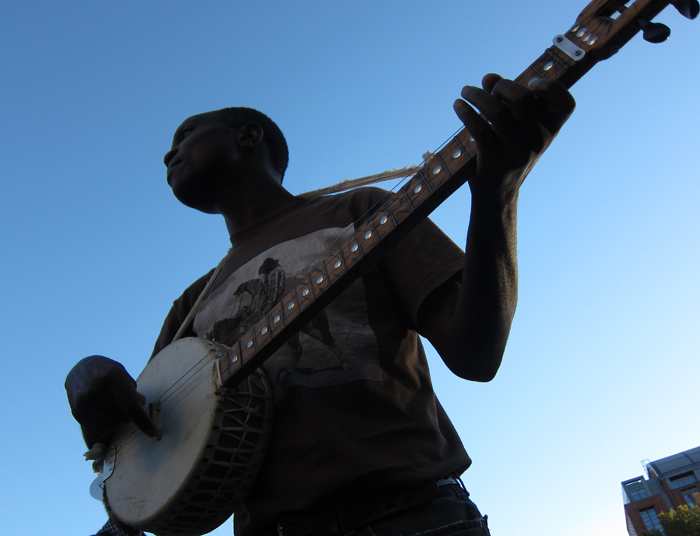
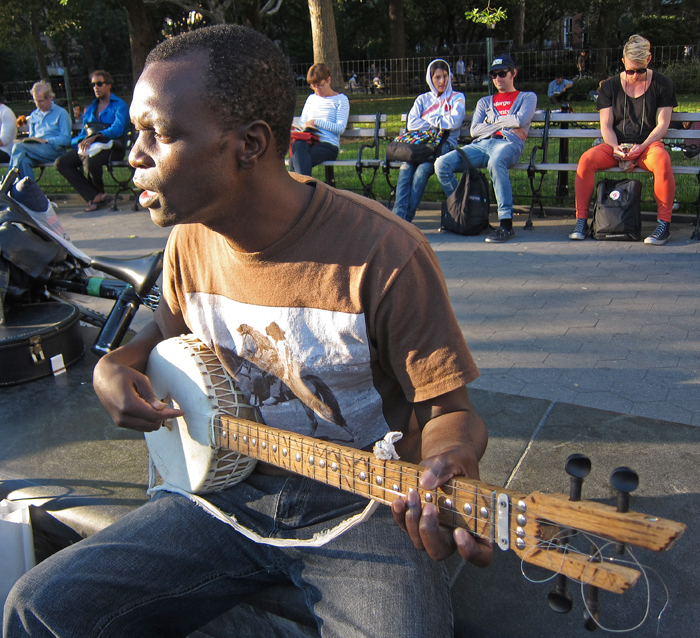
    When I met Essau Pwelle and found out he was from Tanzania, I was quite excited and eager to tell him of my passions for Africa. Essau, who hails from Yenzebwe Village, has been a resident of the USA since 2003 and currently resides in New York City. He is a 4th generation banjo maker and, in conversation, told me of the African roots of the banjo. He has played banjo since he was 14 and is also a singer, songwriter, performance artist, and event organizer.

    Even in a place as large as New York City, it never ceases to amaze me how many acquaintances in common there are between people that I encounter. In conversation, I found out Essau knew Michael Ahuja. I told Essau that all with all this passion, it was still unlikely that I would ever go to Africa. “Why?,” he asked. “Fear of the known and unknown,” I answered. There is an aura of mystery surrounding Africa, fueled by books with titles like Heart of Darkness and phrases like Henry Stanley’s “Dark Continent.” He assured me, as did Michael Ahuja, that I would find Africa to be to my liking.

    When I had occasionally spoken to Michael in our chats about any of my business difficulties or stresses, he suggested that I liquidate and move to Africa. Surely this was insanity, but he assured me that I would find it the palliative I needed. He described an idyllic life in various places, as did Essau, who spoke of those he knew who found great joy in Tanzania and made their residence there.

    When I asked to photograph Essau, he was quite accommodating, moving into various positions. Unsatisfied with the various conventional shots I was getting (see here), I crouched down, shooting upwards for a silhouette. After all, as I told Essau and others around us, we need some drama – this is not a man from New Jersey, this man is from Africa 🙂


  • Curse of the Mouth Trumpet


    It was September 25, 2005, and and I had the good fortune to be told about the first annual Bluegrass Reunion in Washington Square Park.

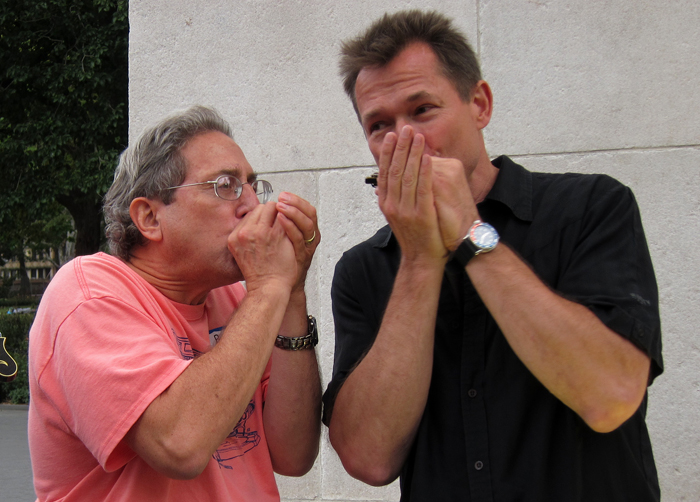
    I was astonished to see the “mouth trumpet” technique of Bob Gurland. As an added bonus, I learned that, unbeknownst to me, the woman he began to engage with in a duet was Maria Muldaur. Conveniently, my point and shoot digital camera at the time had video capability. What an opportunity to capture a bit of spontaneous music history! Or so I thought.

    I noticed just before they had nearly completed their duet, that I was not recording at all. I immediately enabled the video recording but only got 15 seconds of them together. This was also the total video footage of Bob :

    I did get to chat with Bob and complemented him on his unique and amazing skill. He told me he had performed and recorded with a number of music bands, including one of the earliest heavy metal groups, Blue Cheer. His name appears on the credit list for their album Oh! Pleasant Hope.

    I am, however, very tenacious, and I never forgot my aborted video. So it was with great pleasure that after 5 years, I saw Bob again at the recent 6th Bluegrass Reunion. Here, I was quite confident. I had much more experience with photo equipment and had several cameras, including a Sony HD camcorder, which I did not bother bringing. The video function of today’s point and shoots is excellent, and I was lazy, sure that I was adequately prepared with my new Canon S90. Or so I thought.

    I was very relaxed, shooting Bob in a number of segments, and even introduced myself and got him to do a short video clip alone. However, there appeared to be a peculiar tinting to all the video. No time to research this now, as I was sure it was a screen display issue. It was not. In making this Canon camera very user friendly, some functions are much too easily changed by brushing against a small function wheel. I had accidentally changed the mode from standard to color accent and color swap. In my panicky state, I tried to find the functions settings for video, to no avail. Once I was home, I learned how childishly simple the mode change is. Too late.

    So, if you would like to enjoy Bob and his fellow musicians in a variety of lurid skin tones and other color abominations, here is my video montage:

    Next time, I am determined to prevail over the Curse of the Mouth Trumpet 🙂

    Photo Note: Bob Gurland is on the left with Trip Henderson on harmonica on the right. Both are New York City residents.

    Related Posts: Izzy and Art, Bluegrass Reunion


  • New York is Bluegrass Country

    I was once discussing prominent blues musicians struggling to make a living with a jazz musician, who concurred and told me that he had often seen world-class jazz musicians playing to near empty bars. So, if you like meeting and mingling with life’s movers and shakers in music, just shift your interest from mainstream popular genres.

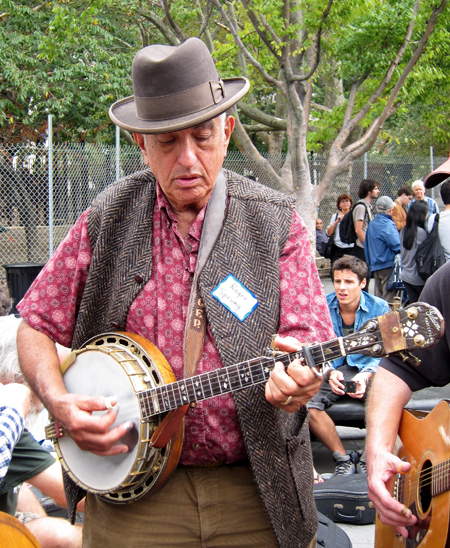
    In rock music, a man like Roger Sprung would be most likely layered with security and screeners with little hope of a meeting. At the 2010 annual bluegrass reunion on Sunday, September 26, in Washington Square Park, Roger was easily approachable between sets.

    Roger was born in Manhattan in 1930. A pioneer and the father of Newgrass banjo, he is credited with introducing authentic banjo music to the North. He was introduced to piano at age seven by his nanny and took lessons at age 10. Subsequently, his interest turned to guitar and then banjo, which he taught himself by listening to recordings of legends such as Earl Scruggs.

    Starting in 1947, Roger was introduced to the folk country scene in Washington Square Park by his brother George. In 1950, he made the first of what was to be many trips to bluegrass country, starting in Asheville, North Carolina. In Folk Songs of Greenwich Village in the 1950’s and 1960’s, bluegrass historian and performer Ralph Lee Smith wrote, “Banjo player Roger Sprung almost single-handedly introduced Southern bluegrass music to New York through his playing in Washington Square.” Roger has performed with a myriad of legendary musicians in a number of venues as well as on television. He is currently a resident of Connecticut, and his website can be found here.

    Interest in bluegrass music has been growing in New York City with local players like Sheriff Bob, who has run the weekly bluegrass jam for years (formerly at the Baggot Inn, now at the Grisley Pear), Gene Tambor of Minetta Creek, and guitar virtuoso Scott Samuels, who in recent years has added more bluegrass to his repertoire. New York City is ripe with bluegrass activities in various clubs, bars, parks, and outdoor festivals. Classes can be readily found, along with equipment in various shops.

    Bluegrass aficionados, performers, and enthusiasts abound, and for those who want a taste or a full meal of bluegrass music need not look further afield than than this city. With a feather in your cap like Roger Sprung, it is easy to aver that, along with all the other great things about this city, New York is bluegrass country 🙂

    Postings featuring Bluegrass: Sheriff Session, Bluegrass Reunion, Paddy Reilly’s, Pockets of Joy


  • On The Road

    If you are not familiar with what I do for a livelihood, click here before reading this story. Also see the related links at the bottom.


    Note: Please click and play the audio link to accompany your reading of this remarkable tale.


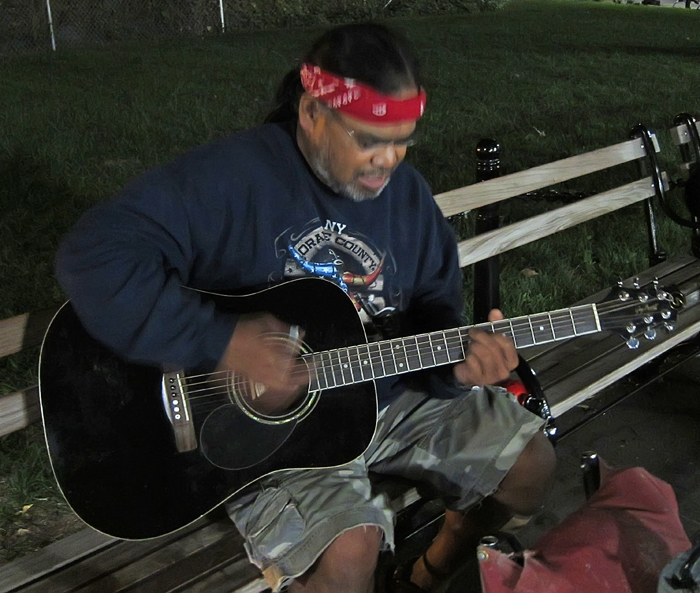
    In a typical evening ritual, I circumnavigated the central plaza of Washington Square Park looking for a music jam. I had a number of choices, but I was drawn to this particular man who I had never seen before. He looked like a man passing through.

    His voice was very good, his playing style confident and his repertoire quite extensive. The more I listened, the more I liked him, so I decided to make a commitment and sit down. I took a few photos.

    Between songs, a number of friends and I learned a few things about him – he was a native Alaskan on the road. A broken G string offered the opportunity to dig deeper.
    He seemed extremely accommodating, and as we spoke, I took out paper and pen and began making notes about the details of his life. I slowly began to feel that there is a good story here. But nothing as good as what was to come.

    At one point, I told him that I hoped he did not mind, but he was going to be the subject of the next day’s story. He appeared pleased, and I was also, so now with a green light, I filled in the details of his life.

    Gaby Lampkey is 54 years old and was born in Juneau, Alaska, to a Filipino father and a Tlingit mother* who busied herself raising nine children. Gaby is a member of the Raven Tribe, Seagull Clan. His family moved to Los Angeles when he was young. He served in the Coast Guard for 6 years, where he worked as a captain’s cook, and was married for 13 years and has two girls.

    Gaby has been on the road for 10 years, with no real home, living by his wits and sleeping wherever he can (he plans to move into the Manhattan hostel on the Upper West Side). His income of tribal dividends is supplemented by work as a street musician playing guitar. We spoke of hobos and trains, which was not his preferred mode of travel – he is an itinerant hitchhiker. Gaby described himself more as a traveling hippie, a participant in the annual Rainbow Gatherings and a recent attendee of the 41st anniversary of Woodstock, where he performed. He said he was an avid reader and read everything he could get his hands on, including the sides of iodine bottles.

    In a very surprising shift, he said he was a juggler and spoke of how juggling changed his life with anecdotes. I acknowledged his experiences, only half hearing them, my mind intoxicated with the possibility of the obvious connection. If this was going were I think it was, it would be as astonishing as Walid Soroor .

    But play your cards slowly, I thought – don’t reveal them now, go for the knockout punch.

    I have a hard time keeping a secret or containing my enthusiasm, but while Gaby spoke, I contained myself and very casually reached into my bag for a stack of business cards.
    I handed him one and asked him if he had heard of the company. He immediately responded, yes indeed, and that Brian Dubé was the person that made him his first set of juggling clubs.

    He recounted how, for most things in Juneau, he had to order from a catalog. He had poured over the Dubé Juggling Equipment catalog as a boy and ordered his first set of juggling clubs. He also told me, that unlike most other products that did not live up to catalog imagery, when his new clubs arrived, they were just like those pictured, and he worshipped those objects which he kept in his room. I was beaming.

    You have him now, I thought, no need to belabor this any longer. Deliver the one-two punch.

    I asked offhandedly if he knew Brian Dubé. He answered that he had never met Brian personally. I said, “Yes you have, you have been talking to him for the last two hours.”

    Gaby and a handful of friends around me who were privy to this conversation were just stunned and burst into a virtual applause. This was a connection just too amazing to believe, and we spent quite some time exchanging more notes, anecdotes, mutual friends, and acquaintances. I expect to see him again and give a copy of this story. Only in New York with a fortuitous set of circumstances and an intersection in time and space with a man who is on the road

    *The Tlingits are a matrilineal indigenous people from the Pacific Northwest Coast. You can read more about the Tlingits here.

    UPDATE: For an update on Gaby’s life, go here.

    Related Posts: Supercute!, Signature, Juggle This, Spinning, Artiste Extraordinaire, Fish and Ponds


  • Supercute!


    My first formal exposure to cuteness was an introduction to the website cuteoverload.com by a friend. The mere mention of the website by name, and I knew this had to be successful. I was immediately very irritated or, better said, jealous that I had not thought of it first.
    Kittens, bunnies, snorgling, puppies, and the whole panoply of obvious and non-obvious subjects qualifying as cute populate the blog, which receives over 40,000 visits per day.

    Some may bristle at cuteness, particularly in New York, a city that prides itself on being a center for sophistication and edge, with many self-appointed curators. But cuteness lovers will not be dissuaded, and even in New York City, lovers and embracers of the cute, cuddly, and adorable abound. And what does one do when hyper cuteness becomes deliberate and, in a way, with a splash of self-mockery, redefines what is edgy?

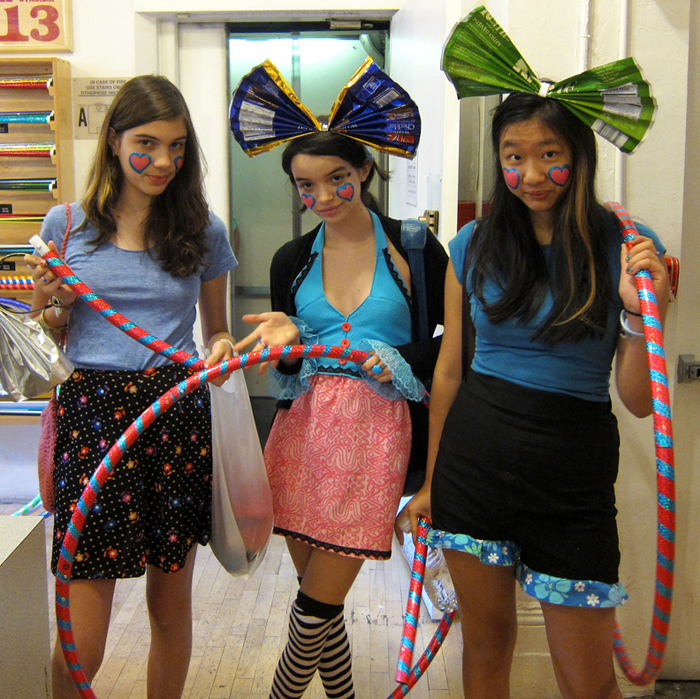
    When a colleague who does the social networking for my business discovered and brought to my attention the indie-pop band Supercute!, I was much more favorable to their brand of cuteness, as was everyone in our office. Was it that they redefined and remarketed cuteness in a novel way, or was it that I recognized the marketing potential of Supercute! for a product we all they were manufacturing, hoops?* Both.

    Learning also that Supercute! were residents of New York City, I immediately asked a staff member to contact them, acting out fantasies of the agent and power broker finding and signing the unknown talent and sleeping giant. Laughable in the age of the Internet, and also since these girls already had presence online and an active career with accolades from the public and press.

    Supercute! (Rachel Trachtenburg, June Lei, and Julia Cumming) was easily approachable, and a meeting was set up to discuss the possibilities of a mutually beneficial relationship, particularly with their hula hoop song.
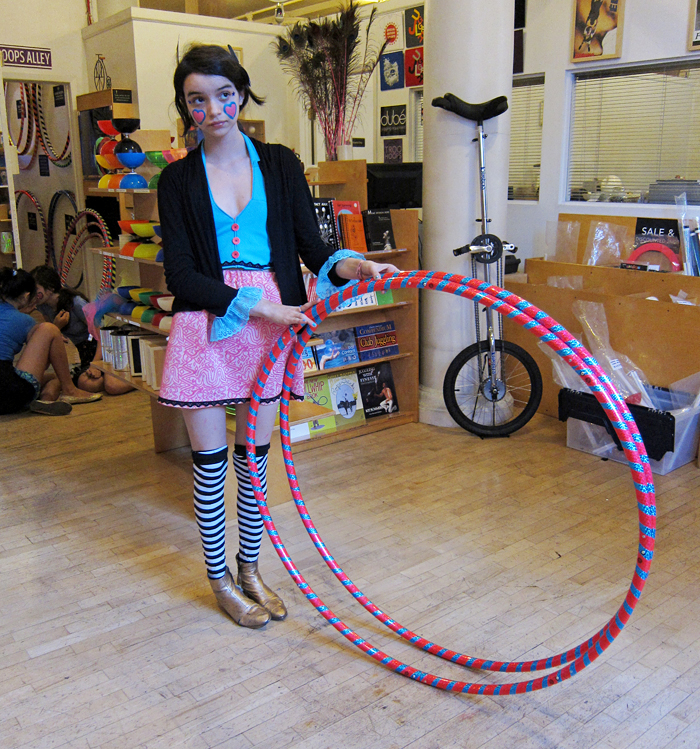
    Seeing them arrive in costume and character was a big and fun surprise. They were accompanied by Rachel’s mother, Tina, and June’s father and photographer, John Lei. The photo was from a recent visit, where we customized a set of hoops for the girls in their signature colors of pink and blue. Always the charmers, the girls arrived again in costume. While waiting for their hoops to be made, the girls busied themselves primping up in our showroom for a performance in a variety show that evening at the Bowery Poetry Club (see photo here).

    Supercute! was formed in 2009 by Rachel Trachtenburg, who has been performing since the age of six with her mother, Tina Piña, and father, Jason, as the Trachtenburg Family Slideshow Players. These girls are getting invaluable guidance from their parents’ professional careers and experience in a world where success is neither easy nor durable, even if you are Supercute! 🙂

    *You can find our website here and here with posts about what I do here: Signature, Juggle This, Spinning, Artiste Extraordinaire, Fish and Ponds


  • Pockets of Joy

    Unless you are a saint, someone who has achieved nirvana, satori, or samadhi, or perhaps one of those individuals who is blessed as an eternal optimist, emotional life is an up and down affair. Life is good, but not always that good.
    For those of us mere mortals, it is more reasonable not to expect a life of constant euphoria and bliss, even in New York City, which has so much to offer, but rather, to look for pockets of joy in a less than perfect world.

    One of the unique things about New York, which I have never experienced anywhere else, is that no matter what your interests, passions, ethnicity, color, creed, or education, if you look, you can find others of a similar persuasion. Immerse yourself with these people, and you may find one of New York City’s many pockets of joy.

    For those who love music, this is an easy task. Head to Washington Square Park, and often you will find numerous groups playing at the same time – make the rounds and sample the goods. The New York Times has recently done two articles on the activities here.

    As of late, the park has been invaded by a large group of drummers. Although the experience is rather entrancing to the participant and has added musical variety, it has, however, made the rest of the central plaza difficult for other musicians to play and be heard, such as regulars like Joe Budnick or guitar virtuoso Scott Samuels. Regular street performers add to the din. Hence, splinter groups form on the lawns, on pathways, or tucked away in the folds of foliage. The musical entertainment seeker is well advised to circulate a bit, as I did on Saturday.

    A great number of musicians here are professional, some playing in the park for unstructured musical fun, others looking to play or rehearse outdoors on a beautiful day.
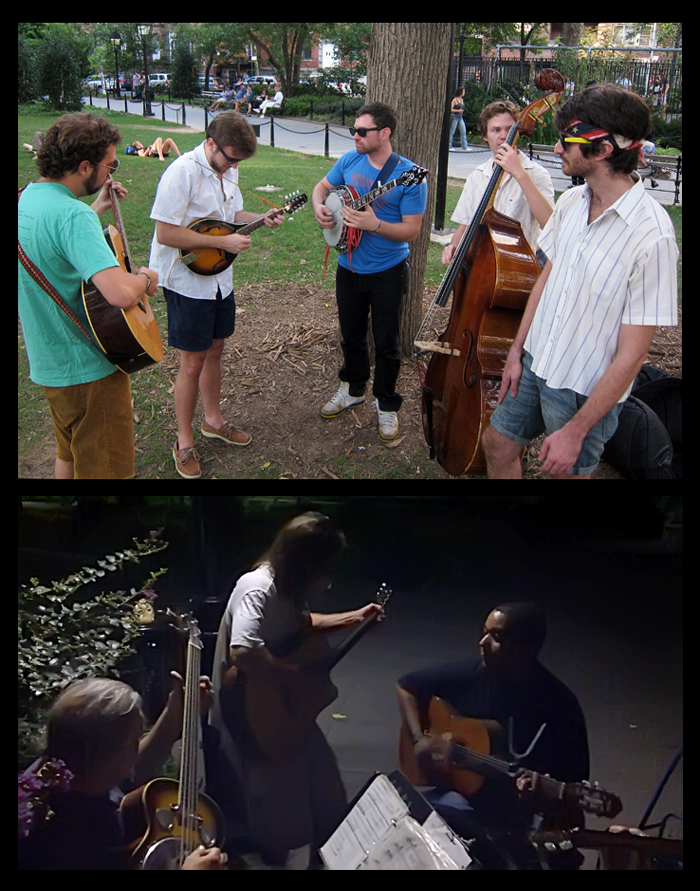
    Some form spontaneous groupings, some play together regularly, and yet others have established bands and work together professionally outside the park. The latter was the case with a bluegrass group, the Bella Boys, whom I encountered on one of the lawns, away from the central plaza hubbub. These boys were quite bella, and their command of repertoire was astounding to me, as was the familiarity of several members with numerous instruments. At various junctures, the mandolin, banjo, and guitar were passed around like musical chairs. I learned that one of the members was leaving for Europe for four months, so I had fortuitously run into them on their last get together for quite some time.

    Later that night, I ran across another grouping (Sage, Peter, Jimmy, and Joe – bottom photo), which included regulars I have known for some time. The singer, Sage, has a masterful, trained, and natural voice, and his occasional forays into the park are always a welcome addition to any group (Sage plays a dozen instruments and has a collection of 100). I had the good sense to record video of these events:

    At one point during the bluegrass jam, I noticed the hair on my arms standing up – a clear sign that life was indeed good and that I had found one of the city’s many pockets of joy 🙂

    Related Music Posts: Sieve of Darwin, Music Speaks for Itself, Sounds of Summer, Police Riot Concert, Bluegrass Reunion, The Conductor


  • I Must Confess

    I grew up as a Roman Catholic (no longer practicing). One of the most painful things to go through as a young person was the process of confession.

    For those unfamiliar or not experienced with the Sacrament of Penance, let me assure you that spilling all your sins in detail to a priest (and having him ask questions) was an extremely unpleasant experience, riddled with shame, guilt, anxiety, and embarrassment. Sins were to be listed from mortal to venial. In retrospect, I am sure that the sins of a young child pale to those committed by adults, but nonetheless, it was excruciating.
    At the time I grew up, at least confession was private and anonymous. I understand that at one time confessions were public – ouch.

    Recently, on a brutally hot Sunday, I decided to attend a Gospel service in Harlem. I did this with trepidation, knowing full well that going to a religious service with the intent of enjoying gospel music is problematic and controversial. Tour groups have been frequenting these churches for some time. In 1996, Newsweek ran an article called Soul Voyeurs Invade the House of God. On March 3, 2010, I wrote about this in With All Due Respect.
    However, curiosity still got the better of me and overruled my better senses. I intended to be as respectful as possible and, reading that shorts, T-shirts, etc. sported by many visitors were frowned upon, I dressed in my Sunday best, in spite of near 100 degree temperature.

    In selecting a church, articles all pointed to the Abyssinian Baptist Church as having one of the most renowned choirs and a history of well-known preachers. However, it apparently has been overrun with tourists, and experienced Harlem churchgoers recommended staying away. If this was true, my presence would only make things worse. So I chose Mt. Neboh Baptist Church, which I featured in With All Due Respect.

    Entering the church, I knew I had already made a big mistake, as a man stationed inside immediately made eye contact and barked, “Upstairs.” My companion and I hastily made our way upstairs to the balcony, along with other “tourists.” The place was dreadfully hot and oppressive, there were no seats to be had, and waves of embarrassment and guilt began to pass over me as I realized that coming here was one colossal mistake. Hordes of tourists gawking (and marveling) at spectacular architecture such as St John the Divine or St. Patrick’s Cathedral is expected and well tolerated, but gawking at parishioners trying to participate in a religious rite is another thing.

    We left the balcony hastily and lingered in the church vestibule, observing the service through the glass of closed doors. The same gatekeeper we met previously had followed us down and commanded us to go back upstairs or leave. In this environment, it was too clear that we were not part of the congregation, and although the very spirit of the Christian church is one that welcomes all, under the current circumstances, it is perhaps best that non-participants just avoid the whole thing.

    Before leaving the neighborhood, I did pass by the Abyssinian Baptist Church (bottom two photos). Evidence of the crowding I had read about was everywhere to be found – there were mobs, traffic jams, and general mayhem. We did, however, finally stop into the Mount Moriah Baptist Church, one of the oldest churches in Harlem. There, we were greeted very cordially and given hand fans. There was a plethora of available seating, and we quickly and quietly took our places in the pews. The singing was superb as to be expected, but the heat and a nagging guilt drove me away, I must confess…


  • The Redeemer

    Posted on by Brian Dubé

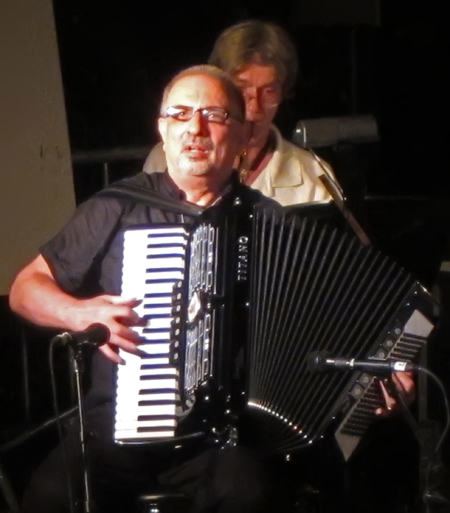
    I played accordion for approximately seven years and practiced every day for exactly one hour. By exactly one hour, I don’t mean 61 minutes – a clock was always nearby to ensure that I played for the time required – never more, never less. I never wanted to play the accordion but was corralled into it – I had a childhood best friend who played the instrument, so I was destined to follow suit.

    My joyless experience was fueled by my instructor, who groomed me in a repertoire of the grim and joyless. I worked diligently on songs like the Marine Corps Hymn, the Beer Barrel Polka, and Song of the Volga Boatmen. I still recall the illustration on the music of a man along side a river, pulling a boat – an apt metaphor for my musical experience.

    Lawrence Welk did nothing to endear me to the instrument. His schmaltzy polka extravaganzas only further cemented the feelings I had, adding to the perspective of the accordion as an instrument of torture and embarrassment for all.

    At family gatherings, somehow it became de rigueur for me to play, even for an entire afternoon. No one really listened, and only when I stopped did someone bark, “Don’t stop, Brian, keep playing.” I never understood why. Recently, my cousin caught me off guard by chiding, “Hey Brian, take out your accordion.” A good laugh for both of us, but I still felt a twang of pain on a raw nerve.

    Later, things began to change. In my first cello lesson as an adult, my instructor asked if I had ever played a musical instrument. I replied, yes, kind of, but it was an instrument that did not really count. Rather annoyed, she asked, “What instrument would that be?” When I told her the accordion, she said that it was a fine instrument and spoke of the world of serious players and organizations. My mind opened briefly, only to be closed again by the famous Farside cartoon.*
    As time passed, my exposure to the instrument in New York City was invariably positive. Innovative styles and players and traditional music all began to sound better and better.

    This was the 3rd performance of this summer’s Washington Square Music Festival, in its 52nd year (their website here). The repertoire for this festival ranges widely (typically classical), and not knowing what to expect, I was surprised to find that every piece on the program included accordionist William Schimmel.

    I was riveted from the first piece. It was everything that great music should be. I later learned in my reading that Schimmel, a New Yorker, is a major heavyweight in the world of accordion. With a doctorate from Juilliard School of Music, Schimmel is credited as being one of the principal architects in the resurgence of the accordion. Regarded as the world’s greatest accordionist by National Public Radio, he has performed with virtually every major symphony orchestra in America (and the Kirov). Schimmel is a virtuoso accordionist, author, philosopher, teacher, and composer. The accolades for his playing are seemingly endless. You can visit his website here.

    I do not typically enjoy music that bills itself as inventive or innovative. But I found William Schimmel’s interpretations and quirky style not only refreshing but also purely enjoyable.

    I need no further evangelical exposure to the instrument, because in every sense of the word, when it comes to accordion, I have been saved, and William Schimmel is truly the Redeemer

    *A classic Far Side cartoon shows a split panel, one side showing St. Peter greeting people entering the pearly gates, saying, “Welcome to Heaven, here’s your harp.” On the other panel, the Devil greets at the gates of Hell, saying, “Welcome to Hell, here’s your accordion.”

    Posted on by Brian Dubé

  • Sticky

    Posted on by Brian Dubé

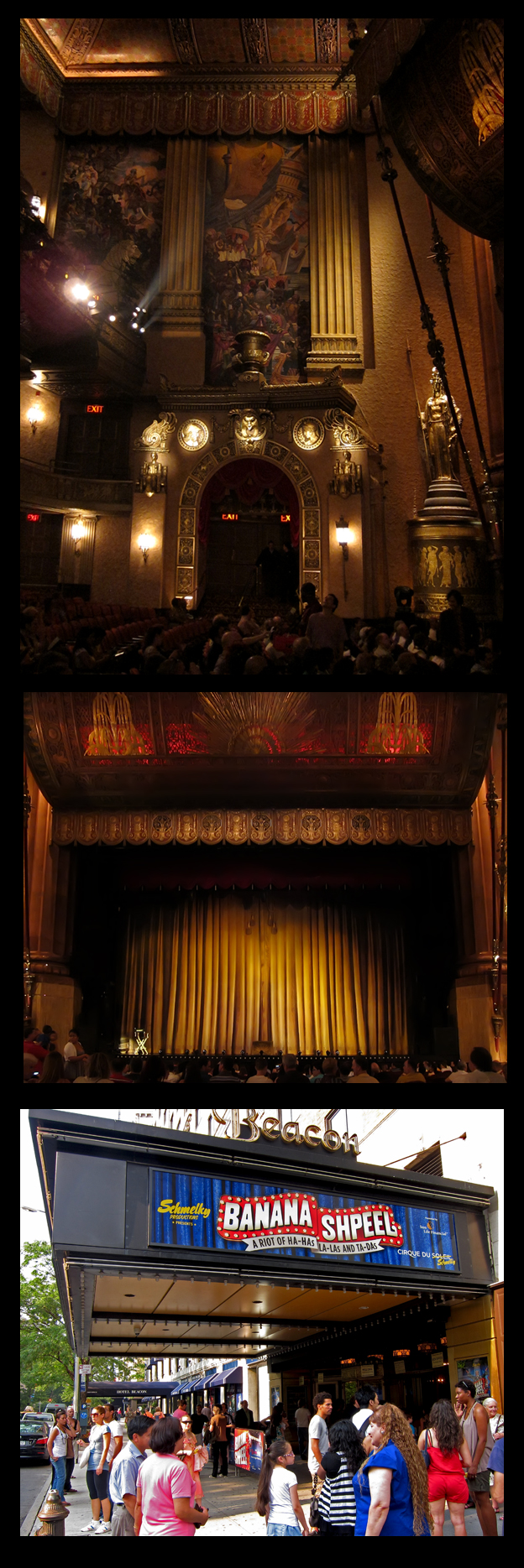
    Skip the exterior. It’s the opulent interior, second only to that of Radio City Music Hall, that counts. Go in, even if you must attend a concert that deafens you – the interior is Greco-Deco-empire with a Tudor palette. -AIA Guide to New York City

    In 1982, I saw the elite Japanese taiko drumming troup Kodo’s first American performance in New York City. My group of friends was absolutely astounded. My last visit to the Beacon Theatre (prior to this Sunday) was a big mistake – to see Kodo a second time and to introduce a friend to the group.

    The Beacon had taken a beating after decades of rock concerts. The balcony seats were filled with people talking, cell phones ringing, and, to add insult to injury, one heavy man repeatedly taking bathroom breaks. The floors were so laden with the sticky residue of spilled drinks that there was a loud ripping sound when lifting his foot after every step.

    We noticed the same effect as we lifted our feet while seated. This whole phenomenon became a source of great amusement and an exercise in controlled laughter. However, the whole experience was extremely disappointing – Kodo requires a quiet listening environment and complete attention to their nuanced performance, not all manner of noise, hilarity, and contained laughter.

    On Sunday, I went to the final performance of Cirque du Soleil’s Banana Shpeel. I was pleasantly shocked to see the Beacon Theatre’s decor after a recent renovation. See more photos here.
    I was able to enjoy the opulent interior in all its former glory without seeing a “concert that deafens you” or listening to feet ripping away from sticky stuff 🙂

    Note about the Beacon Theater: The Beacon was designed by Walter Ahlschlager and opened in 1929. In 1979, the historic venue was designated a national landmark and is on the National Register of Historic Places. Many of the greatest names in music have played the Beacon including the Rolling Stones, Jerry Garcia, Aerosmith, Michael Jackson, James Taylor, Radiohead, and Queen. The Allman Brothers hold an annual rite of spring concert series at the Beacon Theatre known as “The Beacon Run.” Since 1989, they have performed 173 shows at the Beacon.
    Read more about the Beacon here and here.

    Posted on by Brian Dubé

  • Whet Their Appetites

    Posted on by Brian Dubé

    For two weeks, ending July 5, 2010, 60 pianos will be located in the public parks, plazas, and streets in all five boroughs of New York City. All are welcome to play. I visited a number of these and witnessed all manner of players, listeners, and playing skills.

    Play Me, I’m Yours is an art installation resented by Sing for Hope. The idea was created by British artist Luke Jerram, who has been touring the project globally since 2008 (London is being presented simultaneously with New York).

    The comments on forums online vary wildly – some individuals are in love with the idea and its efforts to bring music to the people. Others are infuriated or just highly cynical. Why are they located primarily in affluent areas, where they are least needed? What about vandalism? Who will tune them? How will chaining them to a cinder block prevent theft? Why did they allow painting of the keys themselves, which will affect playability? Some see its approval by the Bloomberg administration as posturing to feign support of street artists.

    There are certainly worse things to do with people’s time and money. In the few instances I watched at various locations, there were a number of highly skilled pianists and children with audiences. Learning to play a musical instrument is a long process requiring substantial time on a consistent basis. I wish these could be permanent installations, indoors and out, installed in all communities, particularly where there is a real need. The availability of these instruments would go a long way to making an impact and fostering musical interest.

    For those who can already play, this installation provides for many impromptu performances and summer fun. For those who don’t play, perhaps some moments with all that ivory will whet their appetites 🙂

    More about the installation: The 60 pianos will be available to play across New York City from 9am-10pm each day. The pianos are attended by individuals who lock and unlock the keyboards daily. Plastic tarps are on hand for protection from rain. On July 5th, to celebrate the culmination of the Play Me, I’m Yours, the street piano at Lincoln Center’s Damrosch Park will be brought to life by some of New York City’s most talented artists. A map with locations can be found here.

    Posted on by Brian Dubé

  • 17 to 1


    I had a close friend who really had the nerves and blood of a gambler, truly cut from a different cloth. If we both went to the racetrack with $20, I was inclined to place $2 bets on favored horses over 10 races; my friend was completely comfortable putting his entire stake on a 17 to 1 long shot in one race to win. Not even a place (2nd) or show (3rd) bet, just the whole thing on one horse to win.

    It is not that I didn’t like the thrill of winning at such long odds. It is that I hate losing, especially my entire stake in one bet. In finance, terms like risk averse, risk tolerance and the risk/reward ratio are frequently used. Brokers of investment products are forever promising above average returns at what is represented to be little risk. Investor’s folly.

    To some extent, risk/reward applies to entertainment and services. People who can afford it will spend more for a greater likelihood of better entertainment – a $100 ticket at the Metropolitan Opera will usually buy an evening of superb talent.
    But often, established theater becomes too risk averse and, in order to not disappoint, becomes more formulaic, relying on standard repertoire or remakes of older successful shows. Enter the world of Off-Off Broadway, experimental theatre, improv and open mikes. Here, however, one must often suffer the slings and arrows of the outrageously bad performance. Nearly every successful performer started somewhere, but not everyone that starts somewhere goes anywhere – a fact one is likely to reflect on while passing time watching painful acts.

    However, rules don’t always apply, and one of the great things about New York City is that there are plenty of great values and even free lunches. But, as the costs for everything rise, the edgy and offbeat become more difficult to find.

    At 94 St. Marks Place in the East Village, you will find a small underground theater, literally and figuratively. UNDER St. Marks is run by Horse Trade, a self-sustaining theater development group that also runs Kraine Theatre, The Red Room, and Frigid New York. It was founded in 1998 by Russell Dobular, Kimo DeSean, and Erez Ziv, three former Central Park horse-drawn carriage drivers. UNDER St. Marks has been an experimental theatre space since the 1970’s.
    The theater is home to a variety of performances – Tuesday nights feature Penny’s Open Mic where anyone gets a 7-minute shot at stardom. See their website here.

    UNDER St. Marks is one of New York City’s last stands in independent theater. Take a chance down those steps at 94 ST. Mark’s, and for a small $3 wager I am sure you will find the odds of a good time much better than 17 to 1 🙂

    Note: The term “Broadway theater” refers to a group of 39 theaters defined both by size (minimum of 500 seats) and location in the theater district. Off-Broadway and Off-Off Broadway theaters are defined by size, not location: Off-Broadway has between 100 and 500 seats and Off-Off-Broadway fewer than 100 seats.


  • dinamic_sidebar 4 none

©2026 New York Daily Photo Entries (RSS) and Comments (RSS)  Raindrops Theme