• Category Archives Music and Concerts
  • The Bitter End

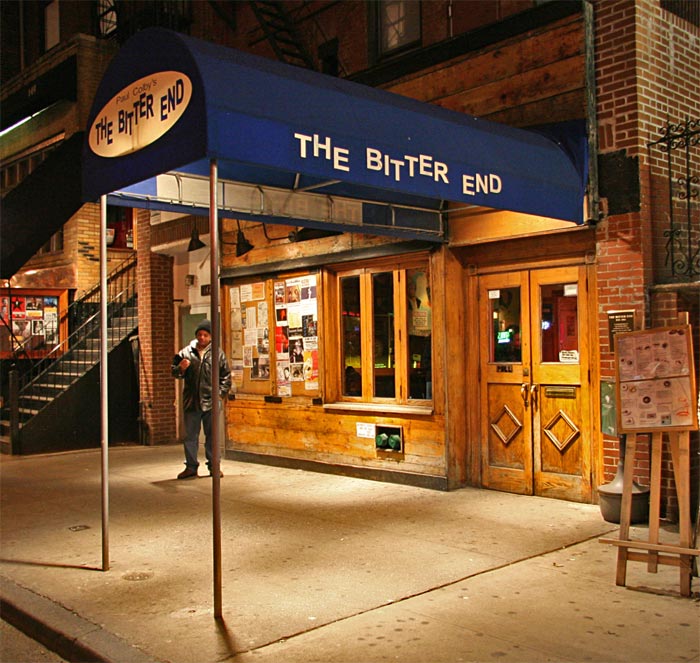
    This is the Bitter End at 147 Bleecker Street, one of the classic heavyweights in NYC music clubs. With the demise of many legendary clubs (CBGB, The Bottom Line, Village Gate), only a handful of older clubs remain, and this is one of them. It is now the oldest rock club in New York, established in 1961 by Fred Weintraub. The current owner, Paul Colby, has been involved with the club since 1968.

    The club is located on a strip of Bleecker Street with a number of music clubs: The Back Fence, Kenny’s Castaways, Terra Blues, and The Red Lion. At the Bitter End’s website, you can see a partial list of the roster of people who have played there (e.g. Bob Dylan, Billy Joel, Neil Young, The Indigo Girls, Joan Baez, Van Morrison, Joni Mitchell, Odetta, Bill Cosby, Woody Allen, George Carlin) – click here for a history. Typically several groups perform each night – last night I caught Girls Don’t Cry.

    Small clubs which showcase new talent are absolutely critical for the music world, so for patrons and musicians alike, the closing of clubs is often seen as a benchmark of the negative impact of over-gentrification, and the survival of older (and newer) clubs is fiercely defended…

  • Terra Blues

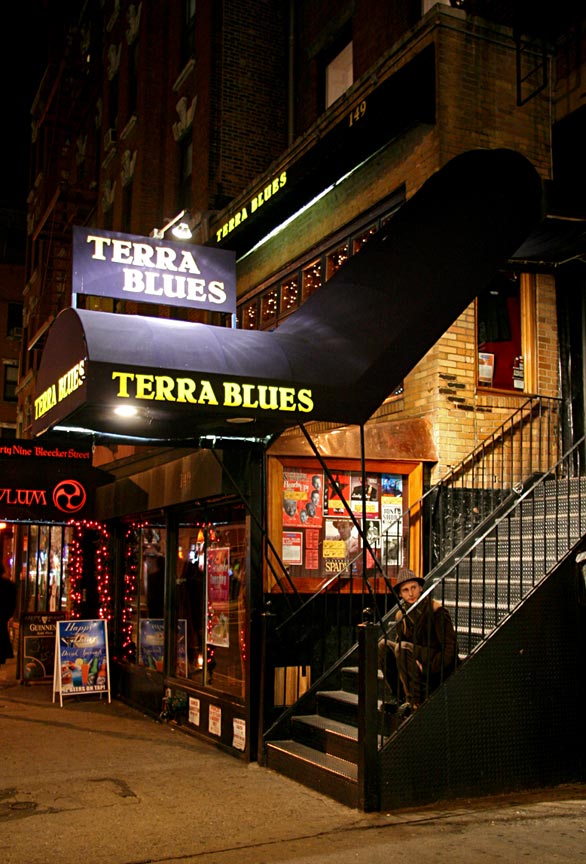
    Many small music clubs have closed down over the years – rising rents in Manhattan is certainly one of the major factors. And hit hardest are those clubs which feature less popular genres, such as the blues. Important venues such as Chicago Blues and Manny’s Car Wash have closed. The only real blues venue left in Manhattan is Terra Blues (although B.B. King’s at Times Square has a blues room).

    Terra Blues is one flight up at 149 Bleecker Street (click here for 2nd photo), one of the most touristy and well-known streets in the Village. However, this club is authentic and gets serious acts. And, unlike many remaining music clubs in the city, it is quite reasonable – the cover charge varies, and on many weeknights, there is no cover or minimum. If you like blues at all, I highly recommend it. Check the calendar on their website.
    One of my favorite blues musicians is harmonica player Jason Ricci. Here’s a link to his myspace site. Jason has started playing at Terra Blues – keep an eye out for him…


  • CBGB

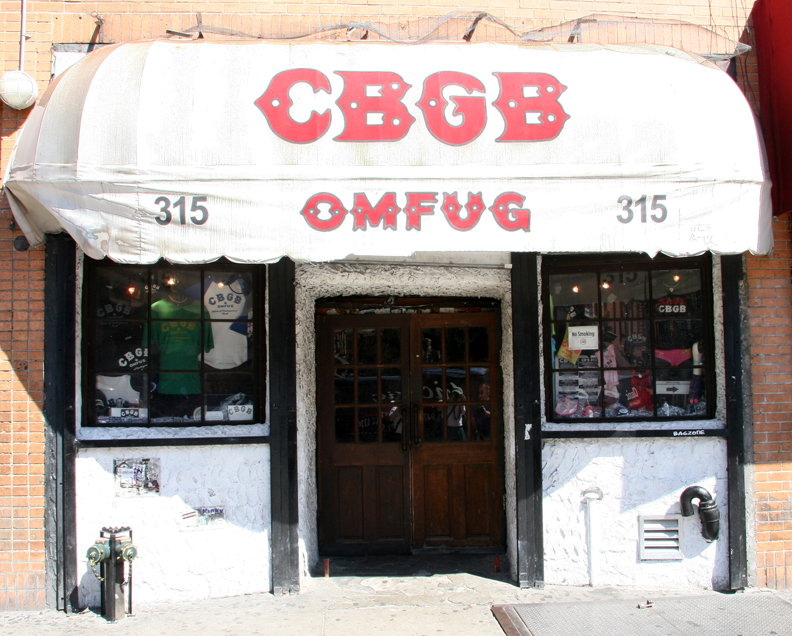
    Beautiful, isn’t it? This is the interior of CBGB, photographed before it closed. After a rent dispute, much speculation, and attempts to save the rock club, they finally closed their doors on Halloween. A final concert with Patti Smith was given on October 15. My request to take photos was welcomed – the employee at the door said that the owner has always encouraged photography, so I was free to wander throughout the club.

    The club owner, Hilly Kristal, is looking to move the club to Vegas, as I mentioned in a previous post (in which I included a photo of the bathrooms). They are aggressively marketing their brand, online store, and a retail shop, which will be opening in prime East Village at 19-23 St. Marks Place on November 24th. Click here for their website. They have a Myspace site, and on November 15th, there will be an ebay auction of their club fixtures and furniture. I think in an era of imaging and branding, nostalgia can generate more business than the original product…


  • Bargemusic

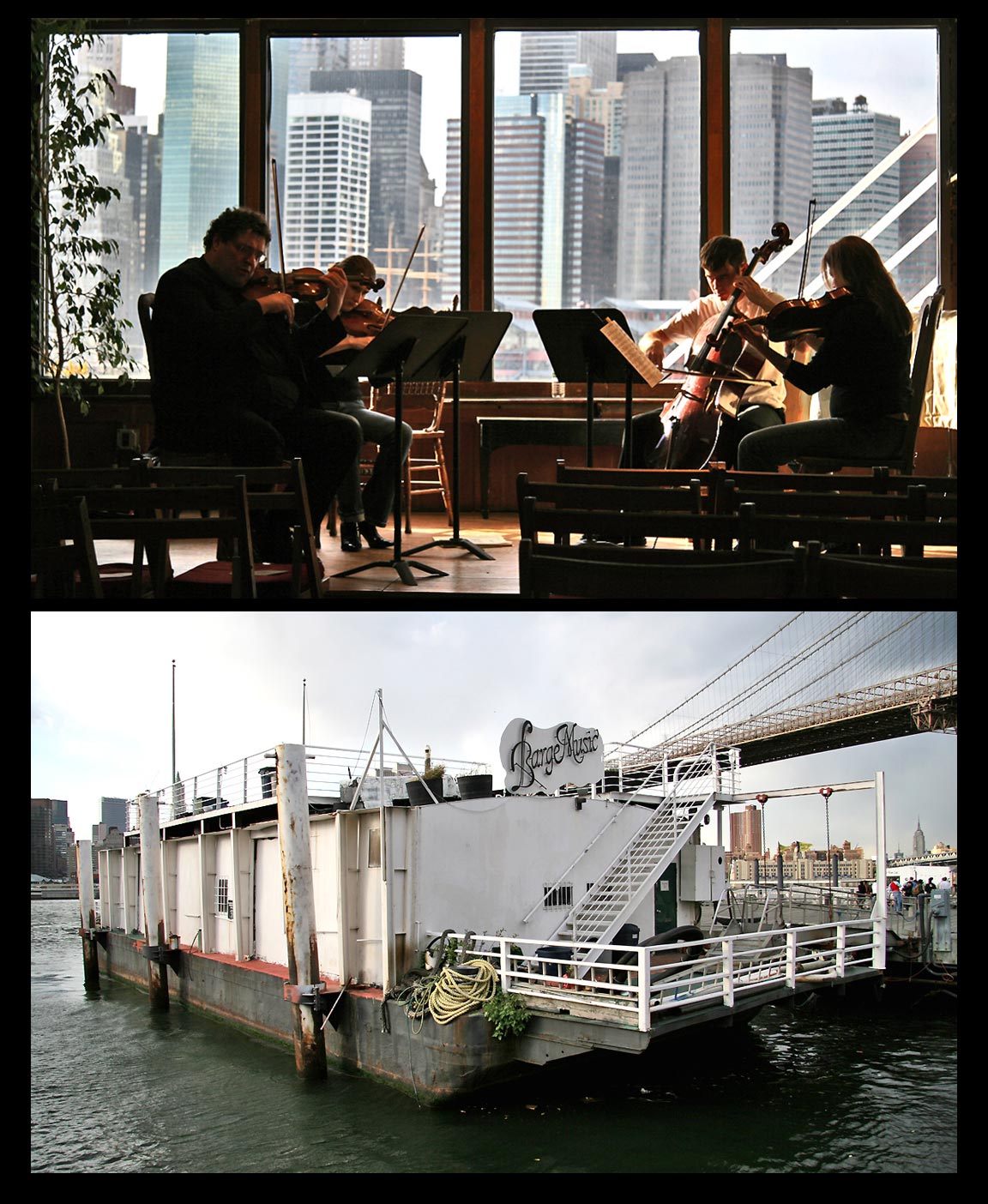
    Bargemusic, a small venue for classical music with its roster of internationally renowned musicians, is one of the true gems of NYC and is still relatively unknown to most New Yorkers. The 102-foot barge is docked in Brooklyn in the East River at the Fulton Ferry Landing. Founded by Olga Bloom (now 87) in 1977 (update: Bloom has passed away as of November 2011), she is still at the helm as its chairman. Bloom, originally from Boston, was a professional violinist, as was her late husband Tobias; she playing under Stokowski, he under Toscanini. After her retirement as violinist, Bloom purchased this 108-year old coffee barge (originally used by the Erie Lackwanna Railroad)for $10,000. The space, with cherry paneling and fireplace, seats 125.

    Perhaps its most distinguishing feature is the magnificent view of the Manhattan skyline through the picture window behind the stage, providing a spectacular backdrop during performances. (Note: The performers in the photo who graciously allowed me to photograph during their rehearsal were: Mark Peskanov, violin, Bracha Malkin, violin, Anat Malkin-Almani, violin, and Clancy Newman, cello). During intermissions, audience members are free to go outdoors and atop the barge itself, enjoying the sea air and views of water, city, and bridges. As so aptly stated on their website, “Our present cargo in this small floating room is sound: potent, ephemeral, and magical.” I don’t know of a space with more ambiance, more intimate, and better suited for chamber music…


  • One-Man Band

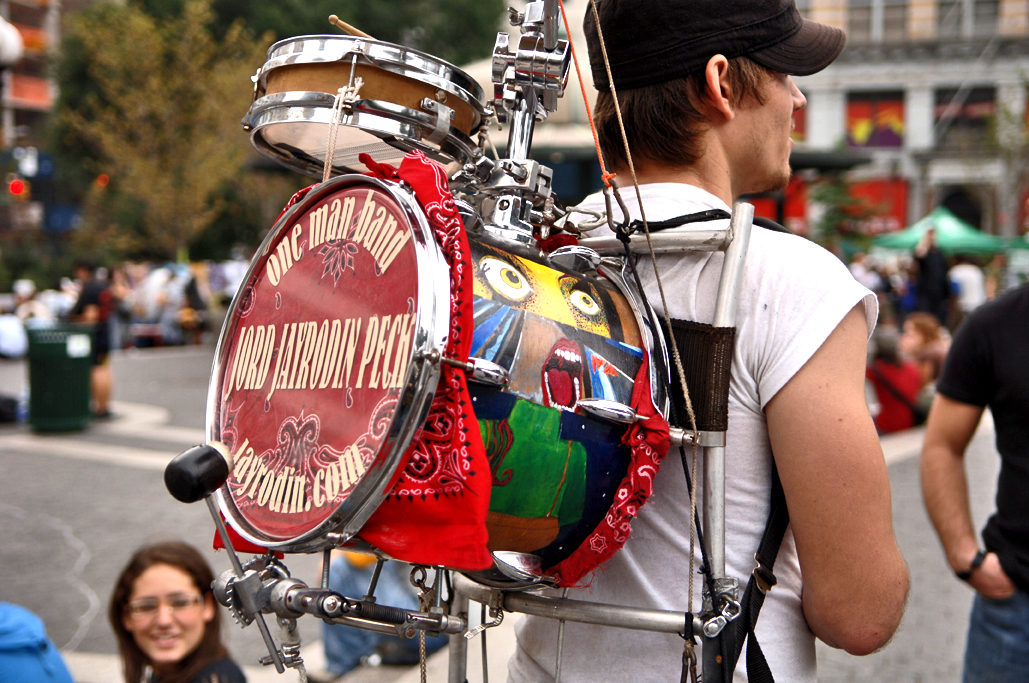
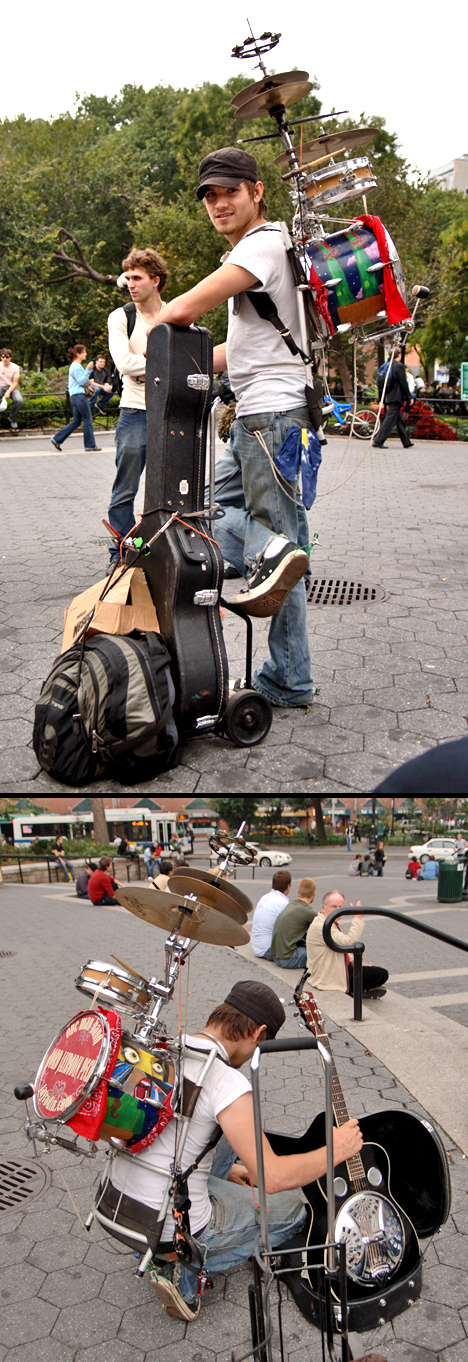
    Jord Jayrodin Peck is an itinerant one-man band. I was fortunate to meet him twice,  the first time at night (with no camera). This photo was taken in Union Square, where he was discussing his run-ins with the law. Click here for more photos. He was prevented from playing, having been told that his drums were amplified instruments (?). It’s sad in the city to see people like this ticketed while drug dealers sell their wares with impunity because they know how to work the system.

    He plays several instruments simultaneously – two drums, each connected to the back of one foot via a cord, cymbal sets from his arm and wrist, harmonica, and guitar. I did get to see his street performance on the first night – everyone was really impressed with his talent. The expectation was that his show would be gimmicky, but his musical interpretation and performance were excellent. I recall a nice rendition of a Dylan song. I was told that his repertoire is somewhat limited – quite understandable. Jord has to work out the arrangement for all of his parts. I wish him luck in his endeavor and that the raw, untamed, unbridled energy of youth will keep him going in the face of adversity…


  • The Public Theater

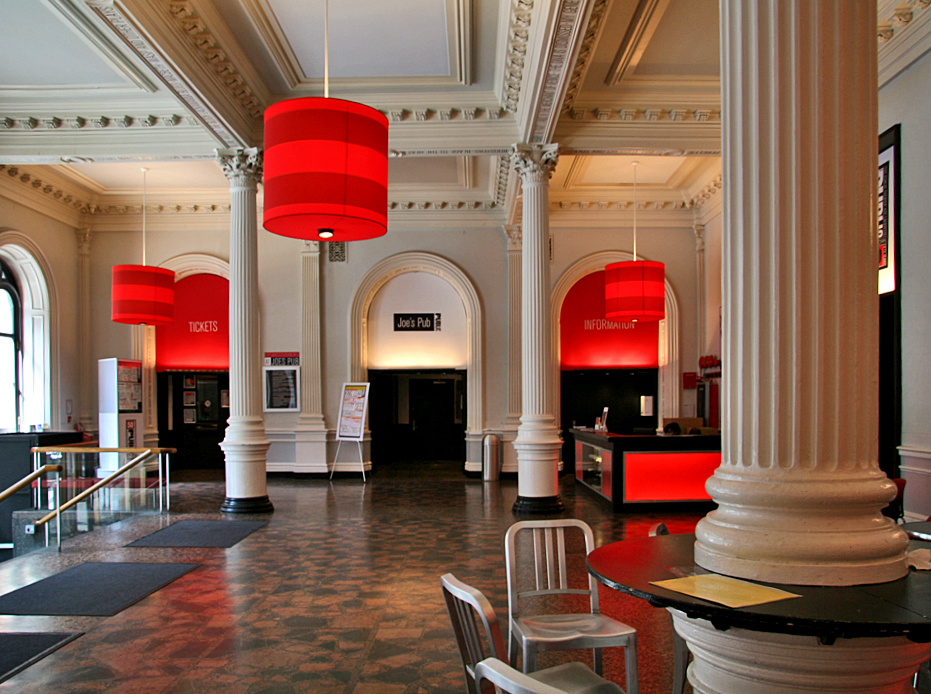
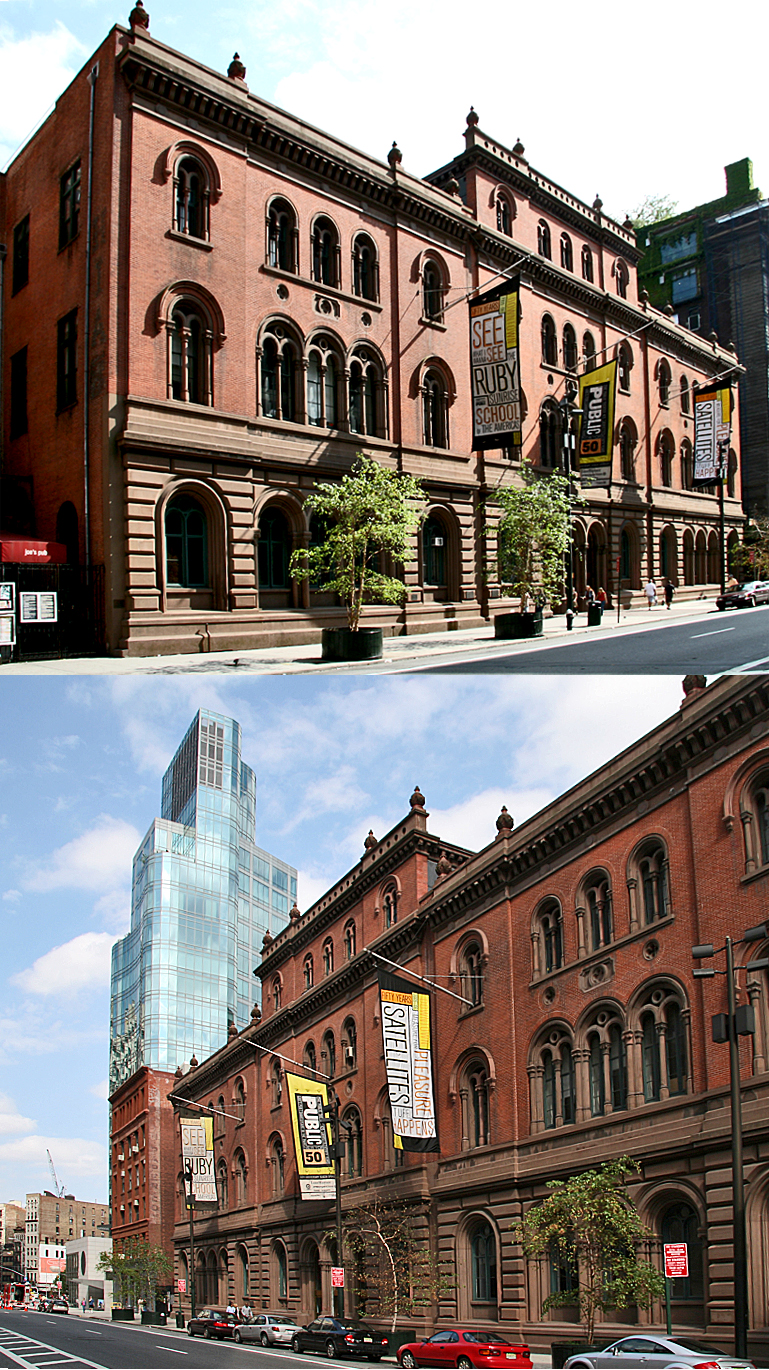
    Just south of Astor Place on Lafayette Street lies the Public Theater (both the organization and building name). The photo is of the interior lobby (click here for exterior photos of the building – the glass high-rise is the Gwathmey). The performing arts organization was founded in 1954 by Joseph Papp as the Shakespeare Workshop. It found a permanent home in the former Astor Library in 1967, when it premiered Hair. The 1854 building, considered by many to be the finest example of Rundbogenstil – a German variant of Romanesque Revival – was actually slated for demolition before being rescued by Papp. Click here for an excellent NY Times article on the building.

    The Public Theater has won over 200 awards (Obie, Tony, Drama Desk, Pulitzer); 49 shows originating here moved to Broadway. They produce new plays, musicals, Shakespeare – many of their productions tend to be more avante-garde. They also operate the free Shakespeare in Central Park, a summer actor training intensive (the Shakespeare Lab), and Joe’s Pub, a venue for musicians and other performers. Every time I walk by, I admire the building and also remind myself that I should make an effort to attend their performances…


  • Cello

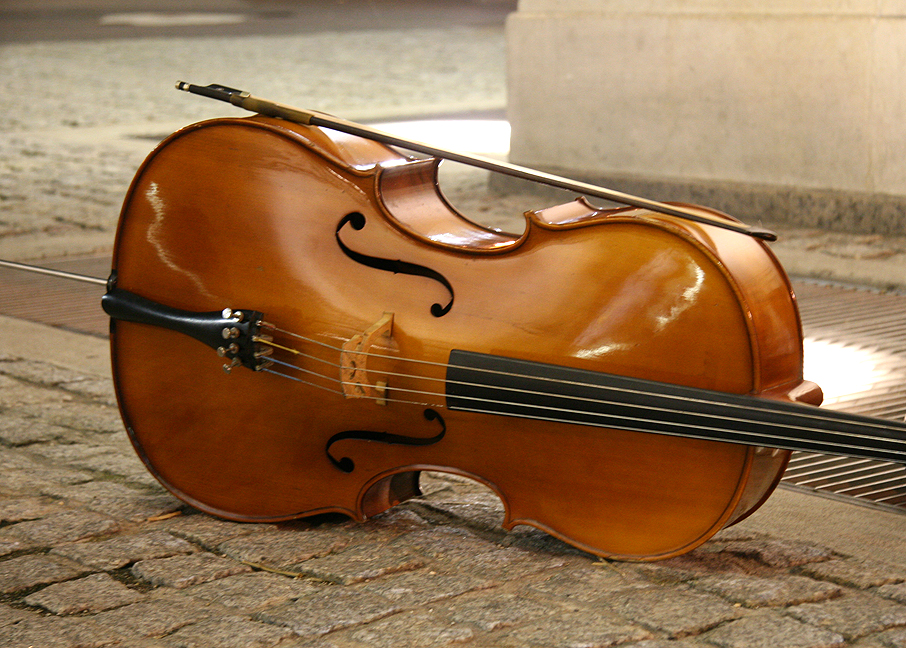
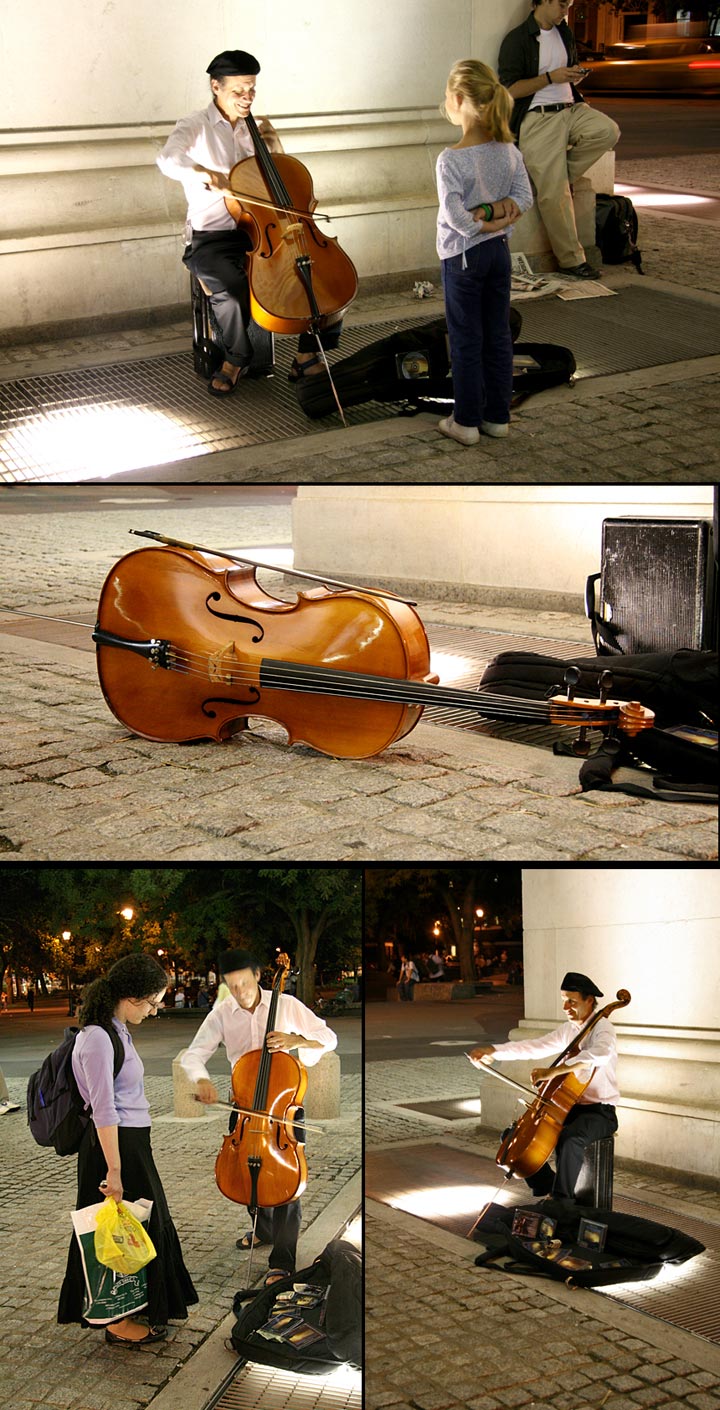
    The cello is a beautiful instrument, not only in the sound it produces but also in its graceful design. I have some bias here – I do own one and did study for a very short time. But just mentioning the instrument always seems to elicit the cliched response, “Oh, I just love the cello.”

    Peter Lewy plays the streets regularly in New York, and these photos of his cello and his playing are the result of my chance encounter with him again in the evening under the Washington Square arch. If you are interested in learning about the instrument, click here for an in-depth article. Peter is an accomplished professional – check out his website here. The cello is very close in range to the human voice – perhaps this is part of its appeal…


  • The Amato Opera

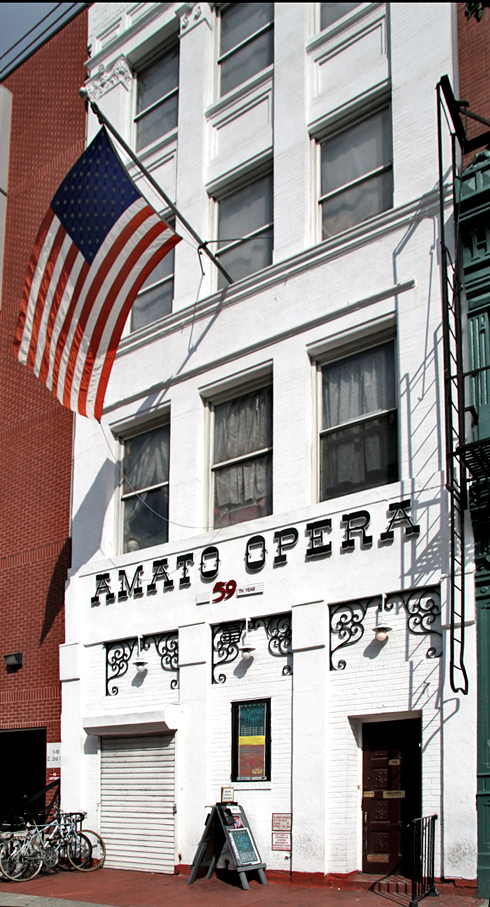
    It’s hard to imagine a small opera house surviving in NYC 1) for 59 years, 2) as a self sustaining operation, and 3) on the Bowery! And keep in mind that, although the Bowery is somewhat gentrified now, for much of the 20th century (and Amato’s history), it was considered quite a poverty-stricken, crime-ridden area, home of the infamous Bowery bums. This small gem is one of those NYC “secrets”; it certainly is not on the tourist radar and currently does not even have a listing at Wikipedia.

    The Amato Opera has been permanently located at the small white building at 319 Bowery since 1964 – prior to that, it had a number of venues and a prior permanent home on Bleecker Street (click here for a complete history). The opera company, started and run as a husband and wife operation by Tony and Sally Amato, has been a training ground for thousands of young performers, many of whom have gone on to perform at leading houses. They perform well known and lesser-known operas by major composers and also do Operas-in-Brief, an educational program. Ticket prices are far less than at major opera houses.

    Characteristic of NYC’s style as a study in contrasts, Amato Opera is next door to the rock club CBGB. If you are at all favorable to opera, I would recommend it as a refreshing alternative to the larger opera houses…


  • Park Night

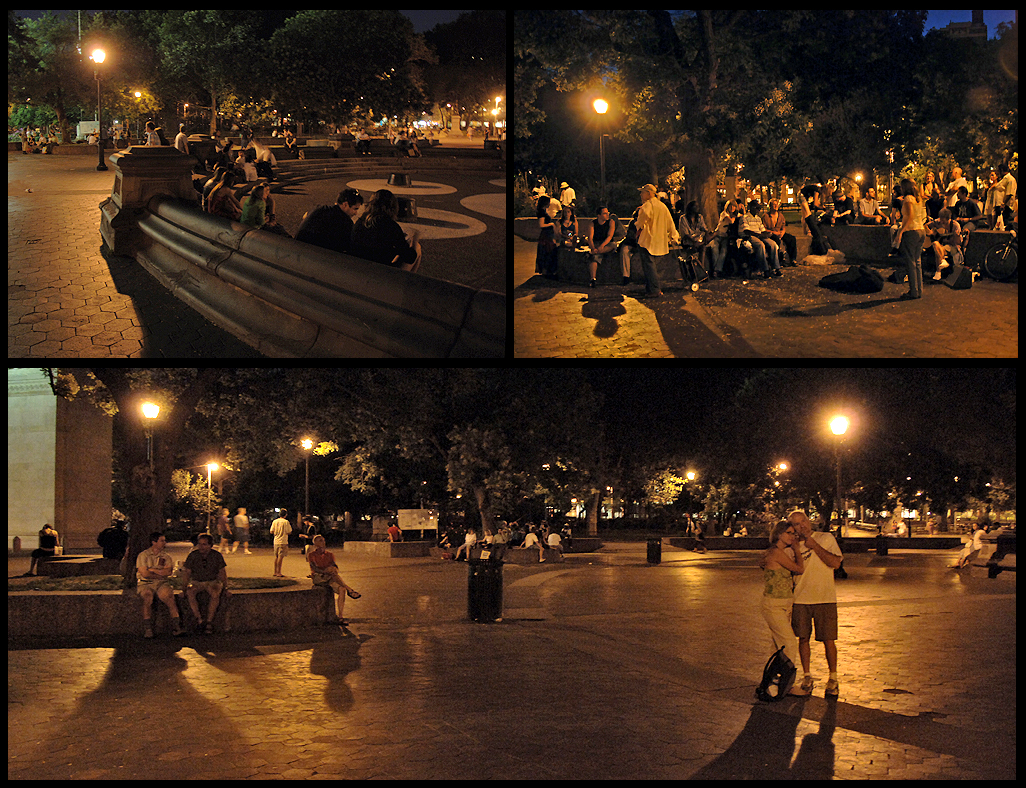
    This is a typical weekday night in Washington Square Park, where hundreds of people gather to enjoy the evening and local culture. On the upper left photo, we have the fountain area, with its stepped seating – this also forms a mini amphitheater for performers. On the upper right photo, we have a classic music scene with park regulars, many of whom have become virtual fixtures. The design of the park has eight islands in a center circle, forming coves where musicians play and audiences gather.

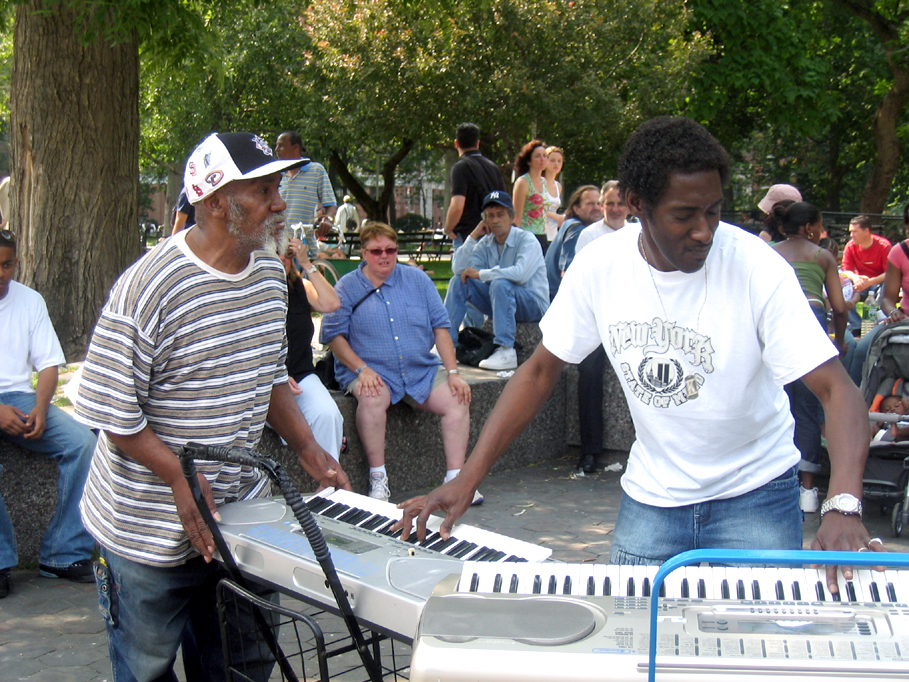
    The music styles and instruments (both acoustic and electric) vary considerably: guitar, keyboard, banjo, sax, drums, bass, violin, mandolin, harmonica, singers, etc. The experience is intimate and participatory more than that of street performance. Audience members frequently participate in the singing. It is not unusual on a good night to have several music groups going on at the same time. We make the rounds and sample the various groups.

    If you are in NYC, I recommend checking it out, particularly on weekend afternoons or evenings – if the weather is good, the crowds are large and the energy is high. On the bottom photo, we see about one-quarter of the circle. The couple on the right was watching music – apparently it was having a positive effect…


  • Gotta Go?

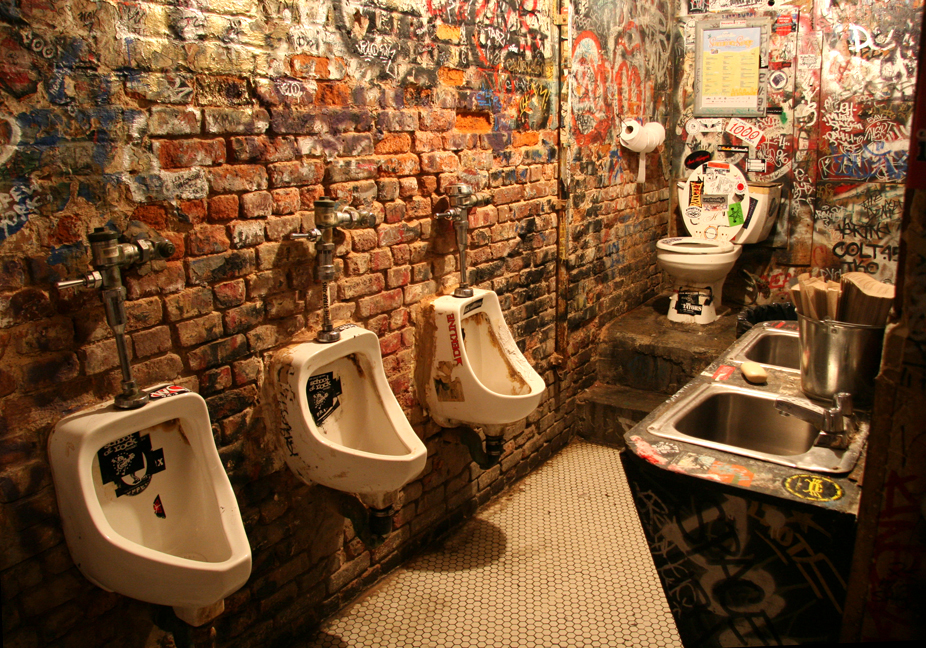
    This is the downstairs bathroom at CBGB. And, yes, it appears to be official: after 32 years, CBGB has gotta go – they are closing and moving to Las Vegas. Opened in 1973, they are the oldest rock club in continuous operation in NYC. The punk mecca has showcased the Ramones, Talking Heads, Blondie, the Patti Smith Group, Iggy Pop, etc.

    In a city of rising rents, closings of clubs is becoming standard fare – Wetlands, Fez, Luna Lounge, and Chicago Blues have all closed. Numerous efforts to save the NYC landmark have been made, including a festival in 2005, attended by the mayor. But economics rule – with a reported doubling of rent from $20,000 per month to $40,000 (and $80K per year liability insurance), it is just not economically feasible to stay open. For many, the closing is more of a disappointment than a real loss because it is emblematic of recent trends of displacement and gentrification.

    According to owner Hilly Kristal, they are taking everything with them to Vegas: “I intend to take everything out of there that represents CBGB. We’re going to take the bars, the toilets, the urinals, even the doors. We want to re-create the essence of the club.” But for me, looking at that bathroom, I’m not so sure I gotta go 🙂


  • Singing Bowls

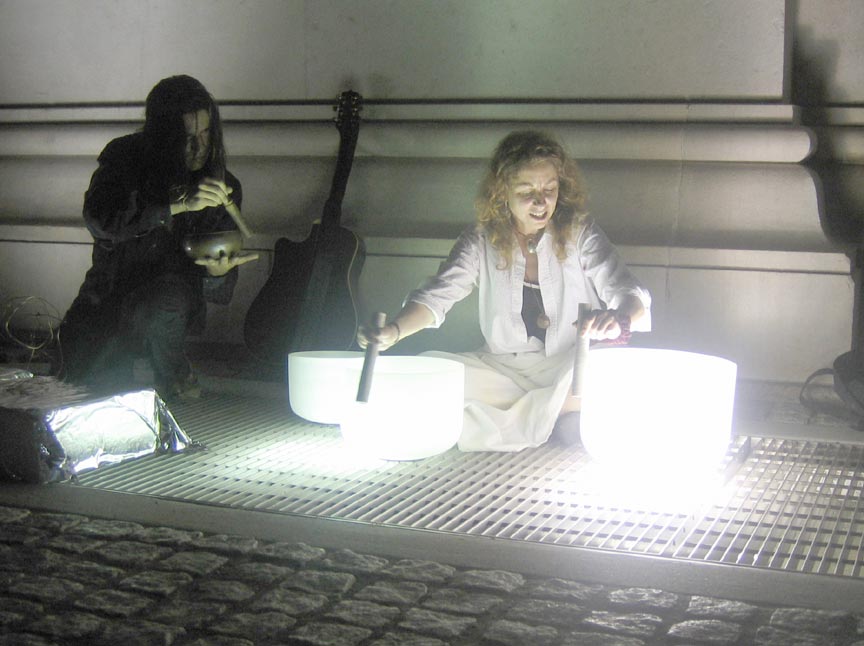
    Perhaps you have rubbed your finger around a wine glass and created a tone? There is an entire world and ancient history of “glass music” with a class of instruments called idiophones. These include musical glasses (Verrillon/Seraphine), glass harp, glass armonica, verrophone, etc. (if you are unfamiliar with these, I highly recommend reading some of the links – the entire world is just fascinating). Included are various types of singing bowls – Tibetan singing bowls are typically made of metal, but glass/crystal ones are also used.

    An entire renovation of Washington Square arch was recently completed, including the installation of some huge, high intensity ground lights. These create a unique environment for performers at night. I recently saw Wendy and Aaron performing there (using the name Dievolve). The illuminated crystal singing bowls created a beautiful effect.
    I have included a video; the first part is of Wendy on the crystal bowls and Aaron on a metal one, and the second part features Aaron playing guitar with an aggressive, angry style with Wendy producing her haunting tones. I thought the combo was quite nice in person – I hope it translates in the video clips I have provided…


  • Matt Umanov

    Posted on by Brian Dubé

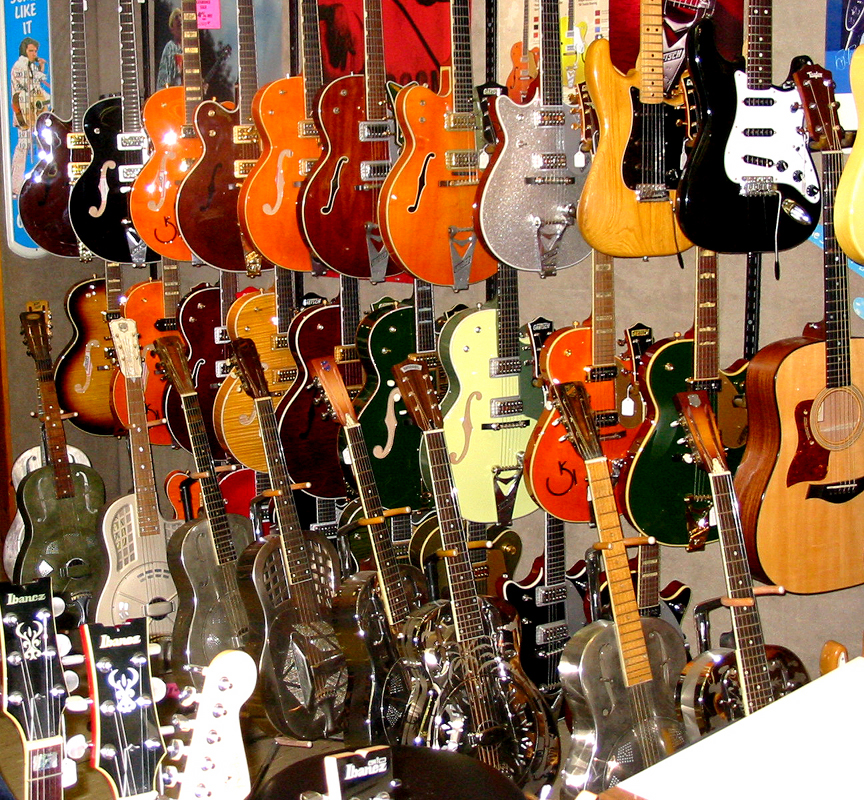
    Here’s another one of those truly authentic NYC places – Matt Umanov Guitars, in business since 1965. And, like many of the serious places in the city, it’s not always so obvious to the casual visitor. They are renowned worldwide and used by many professionals, including celebrity guitarists.

    Located on Bleecker Street in the Village, they only sell guitars (new and vintage) and have a very highly regarded repair shop on the second floor. Unlike chain stores, there is zero pressure to buy anything – you can spend all day there trying equipment out- and all the sales people are musicians. I wanted to take some video of someone playing in the shop, but it was not allowed. I love the all-steel acoustic resonator guitars made by National – see them in the lower part of this photo. If you go there, ask for Zeke and coax him into playing some blues slide on a National for you…

    Posted on by Brian Dubé

  • New York State of Mind

    Posted on by Brian Dubé

    I saw these two people (Kevin and Danny) for the first time last summer – people just stopped in their tracks, astounded by the tremendous natural quality of the singer’s voice. I have been looking forward ever since then to seeing them again, so when I caught them recently, I took the opportunity to take photos and a video of one entire song they did: 634-5789 – an old standard covered by many such as Wilson Pickett. Some of the singer’s renditions of classic soul were really awesome.

    I understand that they are regulars in the subway system at Times Square (a popular venue for many musicians). Appropriately, they are calling themselves New York State of Mind. I hope they get “discovered”…

    Posted on by Brian Dubé

  • Not So Kleine

    Posted on by Brian Dubé

    One of the great strengths and joys of NYC is the music scene. Home to some of the greatest and most diverse venues in the world: from the Metropolitan Opera, Carnegie Hall, and Madison Square Garden to small clubs like the Village Vanguard, the Blue Note, Irving Plaza, CBGB, the Knitting Factory, and the Mercury Lounge. And then there are the music schools, some of the finest in the country: Juilliard, Manhattan School of Music, Mannes School, Third Street Settlement…

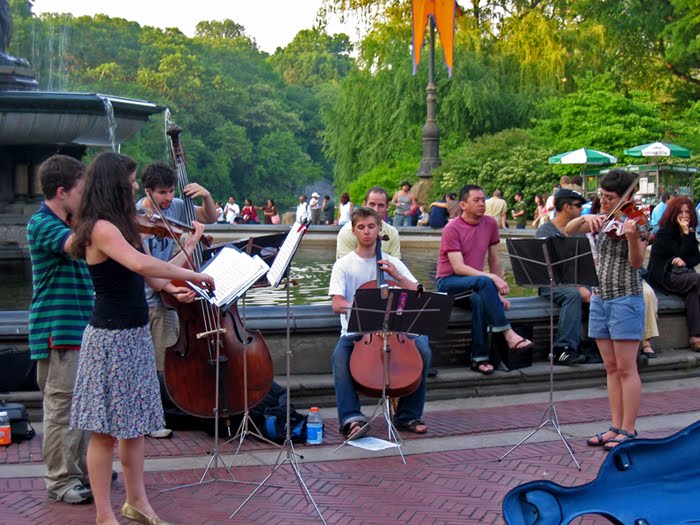
    And then there are the streets and parks. I am constantly amazed at the quality and sophistication one can find right on the street. Many are students from the fine, aforementioned schools, which I imagine these in the photo are. This was shot at Bethesda Fountain in Central Park. I included a short video of them playing Mozart’s Eine Kleine Nachtmusik.

    Many, many musicians move to New York just for the opportunities, but be forewarned, the competition is very tough and the city harsh – New York spits artists out as fast as it sucks them in.

    Posted on by Brian Dubé

  • Arlene’s Grocery

    Posted on by Brian Dubé

    Arlene’s Grocery doesn’t have anything to do with groceries – not since 1995, when a Puerto Rican bodega was turned into this bar/music club on the Lower East Side. Considered by many to be one of the best small clubs to hear live music in the city, its many patrons include celebrities such as Clive Davis, Mick Jagger, Bowie, Natalie Portman, Joaquin Phoenix, Mel Brooks, William Dafoe…

    It’s a very eclectic mix -Rock and Roll karaoke one night per week, indie, punk, and country. Good music and cheap cover charges help fuel its popularity.

    Posted on by Brian Dubé


  • dinamic_sidebar 4 none

©2026 New York Daily Photo Entries (RSS) and Comments (RSS)  Raindrops Theme