• Category Archives Homes and ‘Hoods
  • Big Secret on Little Street

    Streets, surprises, and secrets come in different sizes. What better combination is there than a big surprise and secret at the end of a little street? And what if that street is literally named Little Street?
    There is nothing wrong with the beautiful or wonderful that lies in plain view. But somehow it’s the secret discovery that really piques one’s interest and makes it even more special and its secretness feel like it is yours.

    When traveling in Europe, I was often astounded when finding major historical sites located in the midst of contemporary suburban settings. This is common there and, I imagine, is not seen as particularly shocking. When I first visited Versailles, I could not get over the experience of driving through an ordinary town, turning down a street, and seeing something as extraordinary as the palace of Versailles. Or the windmill in the neighborhood of Montmartre in Paris.

    One does get inured to the juxtapositions one lives among, and here, too, in New York City, I tend to overlook the outstanding architecture that I see daily – period homes dating 200 years old intermingled with buildings of every imaginable style and period. This city has a rich historical past, and the evidence is everywhere to be seen. 

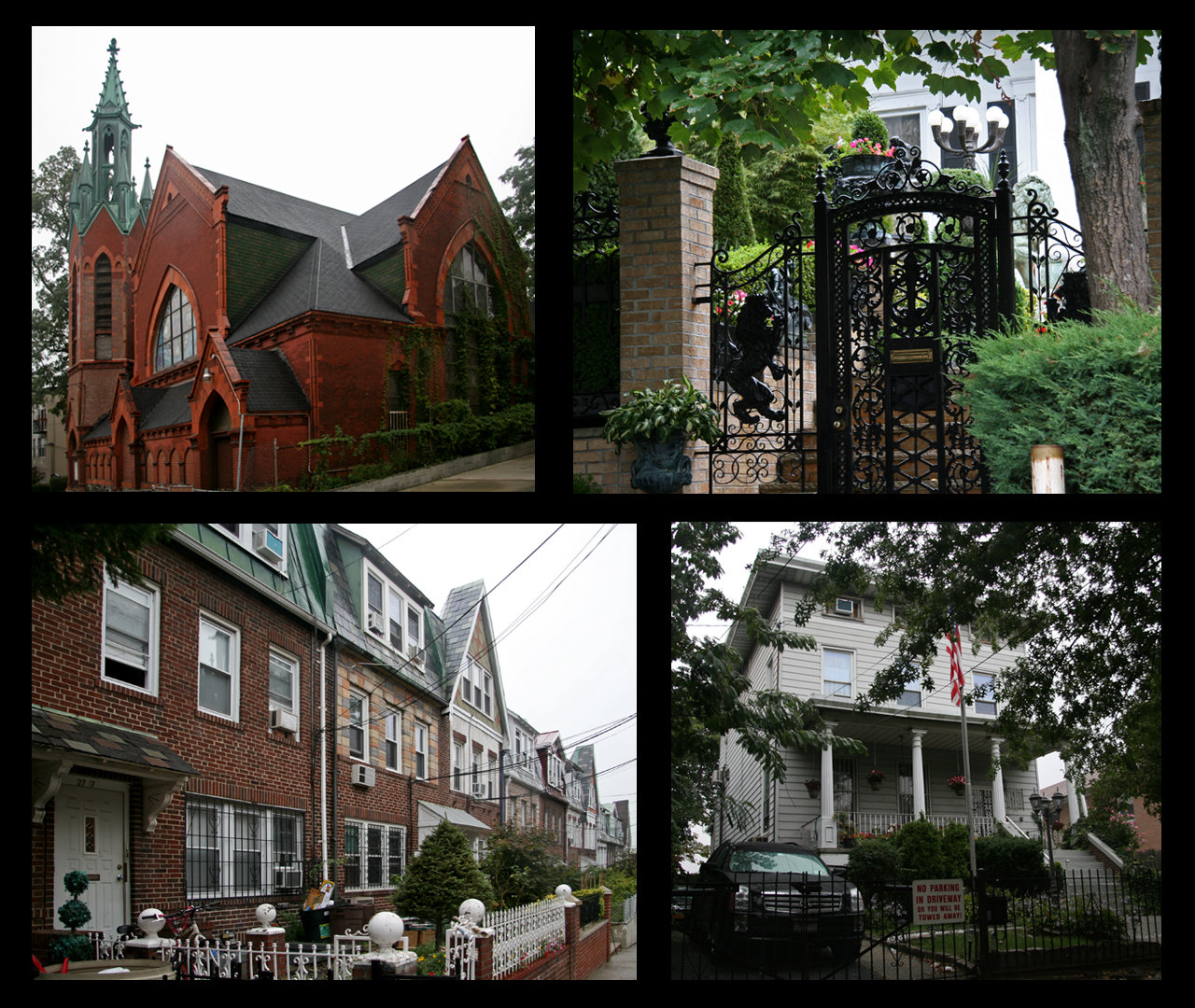
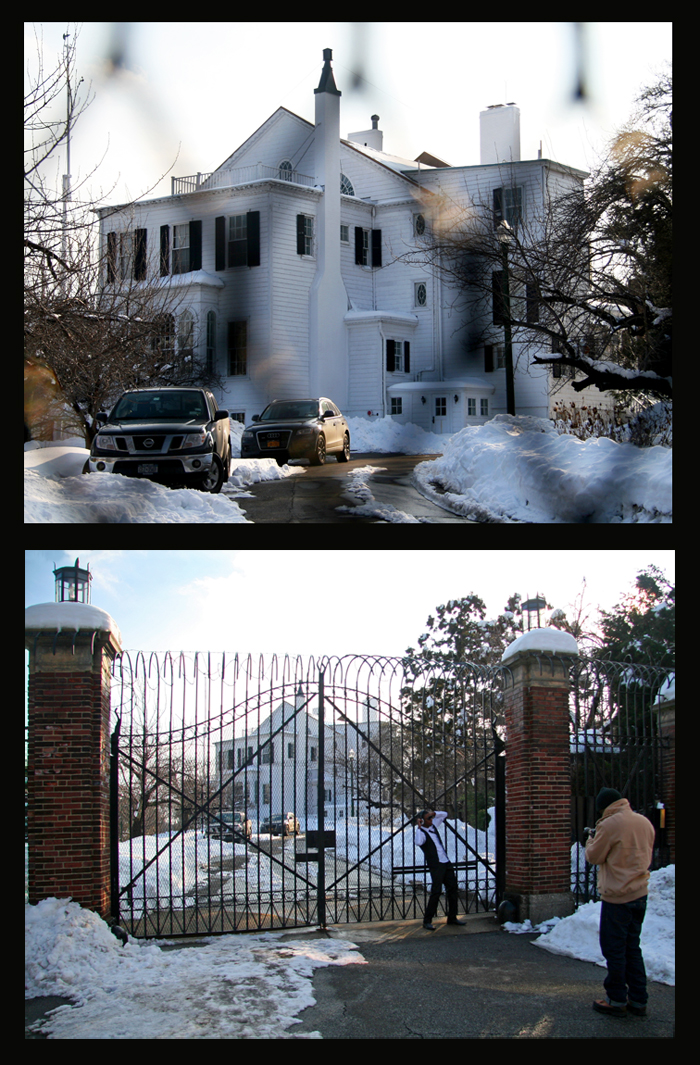
    While carousing through Vinegar Hill, Brooklyn, I plied my way to what appeared on my map to be the outer limits of the neighborhood. I was quite shocked to make a final turn from Evans Street at Little Street and be confronted with a gated mansion. A photographer and male model were busy at work, using this little known cul de sac as backdrop for their photo session. These streets abut the Brooklyn Navy Yard and the large white Federal style residence is Quarters A, the former residence of the commander of the Brooklyn Navy Yard, home to Commodore Matthew C. Perry at the time of his opening of Japan. In 2006, Christopher Gray did a story on the home in Streetscapes for the New York Times. From the article:

    In a New York of secret delights, the Commandant’s House at the Brooklyn Navy Yard is a secret secret. Built early in the 19th century, the big white house, formally known as Quarters A, is the yard’s oldest surviving structure, with exquisite Federal-style detailing.

    In private ownership since the Navy Yard closed in 1964, the three-story house can be glimpsed only in bits and pieces — over walls, through gardens and, distantly, past high gates. Its broad lawn offers a summer fantasy above the East River.

    Just don’t spread the news – that in Vinegar Hill, at the end of Evans Street, there’s a Big Secret on (a) Little Street 🙂


  • New York Rockies

    110 York Street – Part 2 (See Part 1 here.) (see complete photo gallery here)

    For years, on return trips home from Brooklyn to Manhattan via the Manhattan Bridge, I have observed this rooftop structure both by day and night. I promised myself that one day I would get to the bottom of this – a literal pursuit since this structure was atop a building located in Brooklyn, meaning I would literally have to venture down and explore under the Manhattan Bridge.
    What was particularly compelling about it was the four exposed white steel truss system on the roof of the building which was illuminated at night, bathed in blues, greens, purples, and reds.
    Recently, this came up in conversation with someone familiar with the structure – he told me that it was occupied by architects and located on York Street. This rekindled my interest to bring this mystery to a close. On my first excursion, I did a cursory drive-by to confirm its location – 110 York Street.

    On Sunday, I made a trip to Vinegar Hill, Brooklyn, with the intent of returning to Manhattan by foot over the Manhattan Bridge and taking a series of photos. I intended to time my afternoon so that I would cross the bridge after dark when the rooftop was illuminated. My return, however, was too early.
    But I was on a mission, and I decided that I would return the following day after work when dark to cross the bridge again by foot. I had a burning desire and intention with my own mantra: Neither snow, nor rain, nor ice, nor gloom of night stays this courageous ambassador from the swift completion of his appointed rounds.*
    There was snow and ice and gloom of night. But was I courageous?

    There are two pedestrian pathways on the Manhattan Bridge – the one the north side is for bicycles – this is the side I needed to view the York Street building. However, a chain link fence obstructs a clear line of sight most of the way, so I found it necessary to climb and stand on a railing for the taking of photos. The roar and vibration of vehicles and the elevated subway was bad enough, but worse was having to use two hands to stabilize the camera while balancing atop a 4″ wide steel railing which may or may not have been icy. See this in better detail at my photo gallery here.

    The building at 110 York Street serves as the offices for a number of construction firms and, most notably, Robert Scarano Architects, who originally occupied the top floor of this 100-year-old former factory building in Vinegar Hill. For a needed expansion, a 5,200-square-foot rooftop two story addition was designed by a member of the Scarano firm, Dedy Blaustein. The addition was completed in 2005. The lights used are a Color Kinetics LED system.

    Blaustein’s inspiration for the rooftop structure was the bridge: “We’re not the main thing here,” he says, gesturing toward the bridge. “That is the main thing here. It’s so dynamic. I had to do something crazy.” Some have referred to it as the “Jetsons Building.” In response to critics, he said: “I didn’t design it for people to like it, I designed it for people not to be able to ignore it.” The project received a 2005 Design Award from Metal Architecture magazine and a 2005 Certificate of Appreciation from the Brooklyn AIA. From the Sarano website:

    The Manhattan Bridge is the most visibly striking element of the site, running parallel to it only 20 feet away. For this reason, we designed an exposed steel truss system for the skeleton to intensify the dialogue between the structures. The design embodies a strong sense of dynamics. The structural axis is separated from the building exterior finish, providing a sense of movement, which is enhanced by the flying roof, sharp angles, and horizontal texture on the surface.

    My affair has finally come to a close. I feel quite worn, perhaps not unlike the mountain climber who finally tastes the bittersweet success of arriving at the summit. Driven by an illuminated outline not unlike that drawn by a friend to describe the mountains of Colorado (see Part 1), I found this journey’s end at 110 York Street in the foothills of the New York Rockies…

    *The original seen on the General Post Office building reads:
    “Neither snow, nor rain, nor heat, nor gloom of night stays these courageous couriers from the swift completion of their appointed rounds.”
    The sentence appears in the works of Herodotus, describing the expedition of the Greeks against the Persians under Cyrus, about 500 B.C.
    Note: The firm of Robert Sarano is the subject of much controversy – both acclaim and official censure. Robert Sarano is a New York City native, born in Brooklyn. He became a registered architect and started his own firm, Scarano Architects PLLC, in 1985. His academic credentials and awards are many. The firm has been responsible for over 600 buildings in New York City. However, sometimes referred to as the bad boy of architecture, Sarano has also seen a loss of self-certification privileges, loss of filing privileges, numerous lawsuits, and worker deaths on 3 of his projects and has been charged with violation of zoning or building codes on 25 projects in Brooklyn.


  • The Porter House

    Branding existed long before it became a studied concept in business or a buzz word in the vocabulary of marketers. And, rich or poor, there are many words that in and of themselves connote exclusivity, privilege, wealth, and the special.

    This was an explanation I have read as to why those of ordinary means often buy a very expensive gourmet food product, such as artisanal ice cream. Because, at least for a brief time, they can enjoy the best of something. This certainly was the case growing up on the poor side, when we would occasionally “splurge” on a food item. For my parents, this might mean a porterhouse steak, ordering, “I’ll take the porterhouse,” as if “the” (as opposed to “a”) conferred even greater scarcity or mythic status, leaving a child to wonder – was there only one porterhouse steak back in the kitchen?

    I have noticed the structure atop another building in today’s photo for some years now, always wondering about its raison d’être. This is the Porter House, a residential building which consists of both a conversion of an historic building and an expansion sitting atop the the historic yellow-brick building. The property abuts the Old Homestead Steakhouse in the meat packing district. From the New York Times:

    The Porter House, a new condominium rising 10 stories above the rapidly changing area known both as Gansevoort Market and the meatpacking district, takes its name from the cut of steak. Completing the circle, that cut of meat had, long ago, taken its name from a type of building.

    The 22-apartment luxury development on the corner of Ninth Avenue and 15th Street offers high ceilings, large layouts and asking prices of $1.1 million for the smallest two-bedroom apartments.

    The lower part of the $22 million project is a careful restoration of a brick Renaissance Revival warehouse built for Julius Wile, wine importers, in 1905. Until recently the building was owned and occupied by a furniture manufacturer.

    The old part of the condominium is topped with four new sleek full stories with a facade of zinc and glass that cantilevers eight feet over the top of an adjoining building, and two partial floors that wrap down on the back of the old six-story structure. The zinc panels are to be laced with vertical lights that will glow softly in the evening light.

    The project will have 5 one-bedroom apartments; 13 two-bedrooms, some with studies or terraces; 3 three-bedrooms and a four-bedroom duplex with a private rooftop deck. Prices range from $735,000 for one-bedrooms to $4.15 million for the penthouse. Taxes and maintenance on a typical two-bedroom costing $1.3 million are about $2,700 a month.

    The Porter House was named after the porterhouse cut of steak to link the marketing of the building to the Gansevoort Market, according to Bruce Ehrmann of Stribling Marketing Associates, which is selling the condominium units. The name of the steak, in turn, is widely attributed to porter houses, coach stops that served steak and ale in the 1800’s.

    Much as the restaurant patron who has saved for that dinner splurge, I’m guessing the developers were hoping that prospective buyers would be thinking, I’ll take the Porter House 🙂


  • Friends – Part 2

    (see Part 1 here)

    Meet Su Jung and read about our serendipitous adventure together. See my complete photo gallery here.

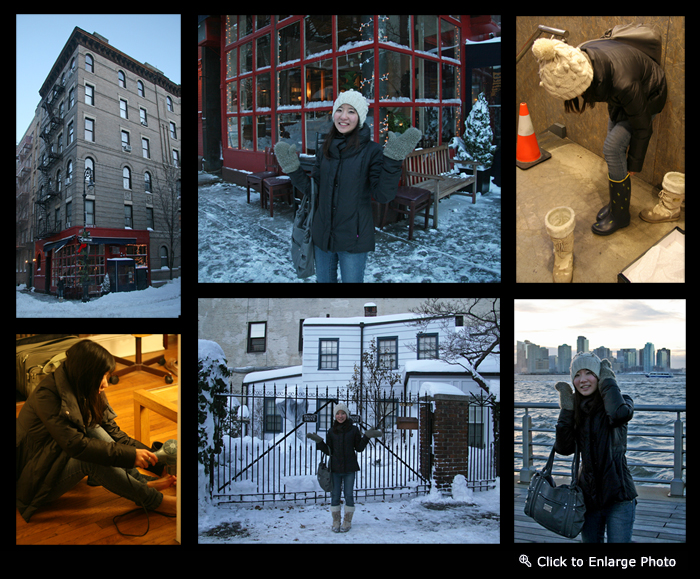
    A young woman approached me, asking if could I take a photo of her in front of the building at the corner of Bedford and Grove Streets. As a photographer I always relish the opportunity to do this for a visitor. My puzzlement as to why this building was soon answered when she asked was this in fact the building used in the popular TV series Friends? I answered that I did not know (it turns out it is) but if so, it would certainly only be for the exterior shots only and that the balance would have been done in a studio. She appeared to be somewhat disappointed. This type of thing is a common quest and also the type of thing tours often feature. However, just seeing a building or location without the characters can often be a bit of a let down.

    My second question as to why she was alone, deep in the West Village in one of New York City’s biggest blizzards in history was also soon answered. Su Jung is a 22-year-old engineering student from Korea who was studying for one year in California, was visiting New York City for the Christmas weekend, and had been trapped in the city due to a cancelled plane flight. She did have friends in the city with her, but they were uninterested in making the pilgrimage in a blizzard to accompany her.

    Seeing an opportunity to brighten her day and at the same time have a companion, I explained my day’s mission and asked if she would like to come along. I got a resounding yes, so off we were into the streets and storm. I also told her of this website and asked if she would like to be a story. She was delighted, so my time with her also included photos punctuating our adventure.

    I now switched gears, turning this much more into a private tour, knowing full well that for me, any route would take me through snow laden environments and plenty of photo ops. I showed her my favorite spots, including Commerce Street, Cherry Lane Theater, Grove Court, and Washington Mews.
    However, I had planned to go all the way to the Hudson River, truly insane in this weather. Was she game? A resounding yes again. She did ask how far, and I explained that in Manhattan, the river was never that far, with the entire island being only 2 miles wide, and we were in fact only a few blocks away.

    We went to the Christopher Street Pier. The wind was howling with gusts over 50 miles per hour – absolutely frigid, cutting your face like a knife. The sun was setting, and the lighting and atmosphere was dramatic. I pointed out the Statue of Liberty, the Verrazano Bridge, the financial district, and New Jersey across the river where snow was being blown, looking like a sandstorm (see gallery). Su commented how waves were rolling in like the ocean. Even though she had a wool hat and mittens, she often felt it necessary to cover her ears.

    On our return, I took Su Jung by 121 Charles Street, on of my favorite anomalies in the entire city (lower center photo) and then down Bleecker Street, stopping in renowned guitar shop Matt Umanov and Murray’s Cheese. I followed with a jaunt through Washington Square Park, which she had not yet visited with its Christmas tree still up.

    I had a nagging problem, however – a girl with soaked, cold feet. Like many, she had purchased Ugg-styled boots not realizing these were not waterproof. In fact, they operate more like sponges than protective footwear in wet weather. The situation desperately ns eeded to be dealt with, and she said she would try to find a place to buy new boots. In this weather? I asked. Most stores were closed, and she did not know the city. If she liked, I could take her up Broadway toward Union Square, where most likely David Z or Shoemania would be open. Shoemania was living up to its name – it was a veritable zoo, with hundreds with the same dilemma shopping for footwear, appropriate for the storm.

    Su Jung made a quick decision but showed concern about my time waiting. No matter – I was committed to seeing her through this and out of those wet boots. She made her selection quickly but was worried that she was taking the last size 4 and another woman after her expressed interest. No matter, I replied. You were first and your feet are cold and wet. There were no appropriate socks, however, so back out into the cold in wet feet, with Su Jung saying she would deal with this at her hotel on the Upper West Side.

    I was bothered by this – my home was just a few blocks away, and I agonized about suggesting the obvious, which could certainly be misconstrued. But I asked – did she want to stop at my home, warm up, dry off, change her socks, and then go to her hotel? I was surprised to get the same charming yea that I had gotten the entire afternoon. Arriving at my home on Washington Square North, I explained my good fortune to live in such an historic building overlooking a park (and my reason for living in the same apartment for 30 years).

    Once inside, I attended to the first order of business: I gave Su Jung a selection of several pairs of socks and a hairdryer, suggesting she use it to dry her feet. She seemed very much at home, sitting in the center of my living room on the floor. When I suggested she could use a chair, she responded that she was quite comfortable there – she was Korean.

    Afterwards, we spent some time perusing my website. It was 8PM and we had been together nearly 4 hours. I suggested she may want to return to her hotel and friends. Another yea, and off we were to the subway, where I told her that she was to take the C train only. A parting hug and off she went.

    Overall, it was a remarkable day. Su Jung’s incredible trust as a newcomer to New York City gave me an unprecedented sense of responsibility. Her joyous and adventurous spirit was truly disarming. No need to find a special building on Bedford and Grove or watch a TV series if you’re looking for Friends

    Note: Here is the email I received from Su Jung the following day:

    It was the most awesome day in the last 3 days in NY. I couldn’t ever imagine I would meet Brian and have fun looking around the real NY life that I could ever get by myself. I was kind of deseparate from the calcellation of the flight to LA cause I’d been thinking Cali was much better than NY. It seems like Californian in spacious and quiet area by oceans can afford to enjoy their life more than New Yorkers in the packed city. The 3days’ itinerary was too short that I was traveling around only the main landmarks like Times Square and Wall street just crowded by tons of tourists around so I couldn’t reveal the charm of New York. However, yesterday’s journey changed my mind and I gotta love staying more days in NY thanks to the snow storm and it was ‘no pain no gain’:D. My feet were frozen by the watery ugg boots.

  • Friends, Part 1


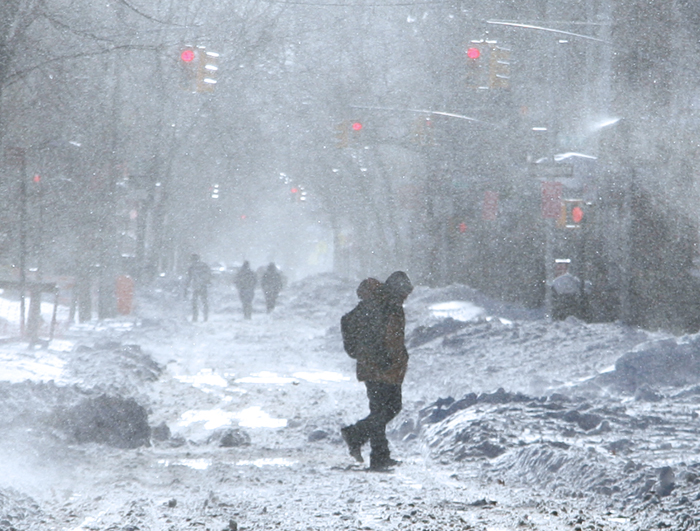
    I learned many years ago that recruiting a companion to go out into a blizzard was an exercise in futility. Although many can perhaps be persuaded to see the reasons behind such a venture, apart from children, very few are going to voluntarily leave the cozy confines of one’s home to subject themselves to a blizzard. On one occasion, I had tried to persuade a girlfriend to go out into a blizzard with blinding wet snow, so strong it required goggles. The response was a very confident “no way” – understandable, I suppose. Arguments aside, the facts speak for themselves – there are good reasons that the city looks like a ghost town in these conditions.

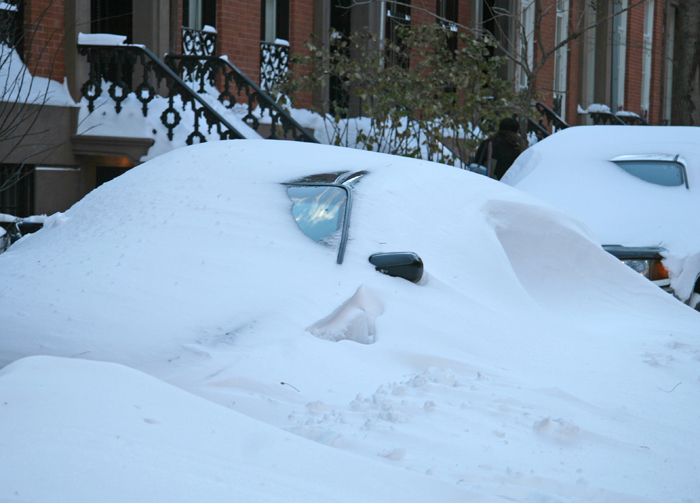
    But my office was shut down, and although I had things to do indoors, this record-breaking snowfall really begged for some photography – a greatly added incentive to bundle up and venture out. A snowstorm this crippling is a rare phenomenon in New York City. Deserted streets. Even as a I write this, I have not heard a vehicle pass by in over one and a half hours.

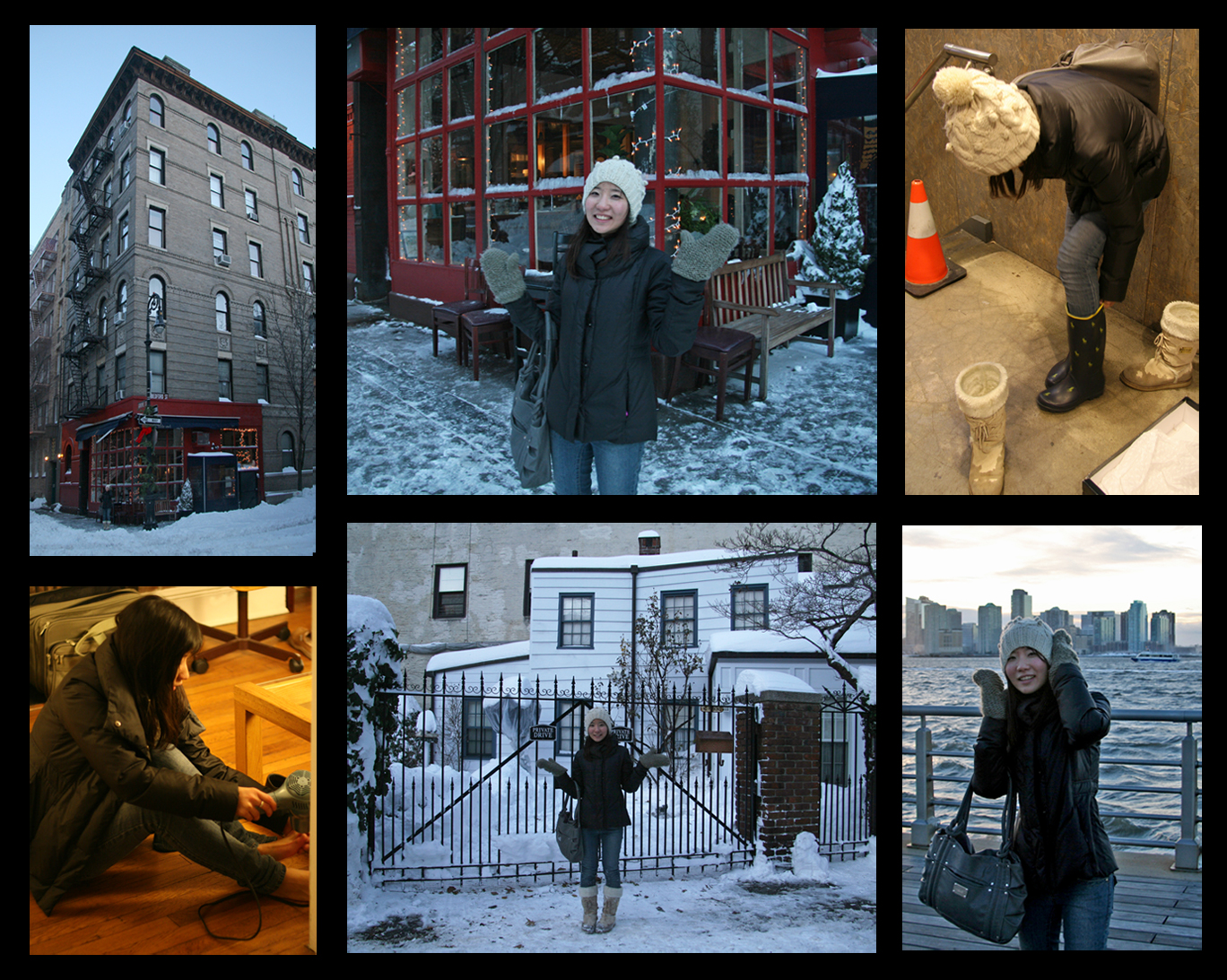
    I headed into the West Village, where I knew I would find the least adulteration of the snowfall. I was amply rewarded with sites that rivaled anything I have seen here in a long time. Cars completely buried and row houses so beautifully framed and adorned by snow, some still with Christmas decorations. See my photo gallery here.

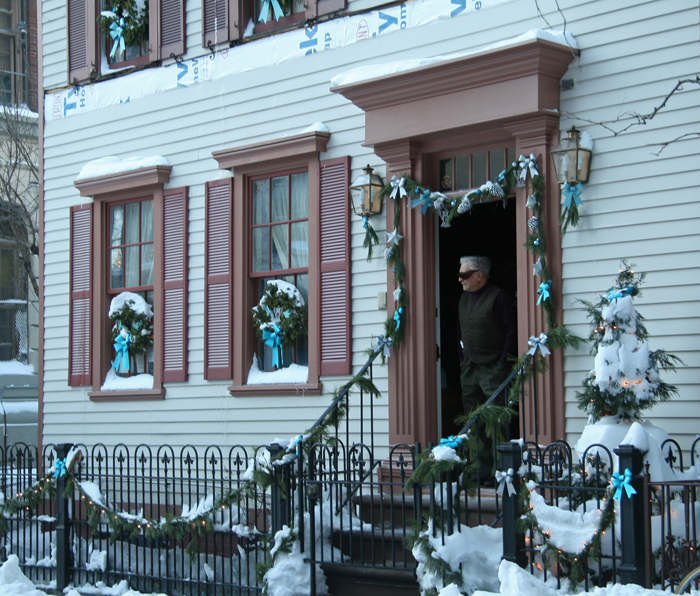
    At the corner of Bedford and Grove Streets, I stopped to take a photo of 17 Grove, which was so exquisite with its wreaths in every window adorned with blue bows, each frosted with snow. As an added bonus, the owner had taken a moment to open the doorway and admire the winter wonderland outside his home. We spoke briefly in a way that bespoke of two people meeting in a small rural town. I so love this part of New York City, and the snow just gave it an extraordinary ambiance.

    But this was not to be the day I thought it would be. Not at all. Across the street lies the building whose exterior was used for the filming of the TV series Friends. It is here that I would meet a lone traveler who would change my day (see Part 2 here)…


  • Wherever You Go, There You Are

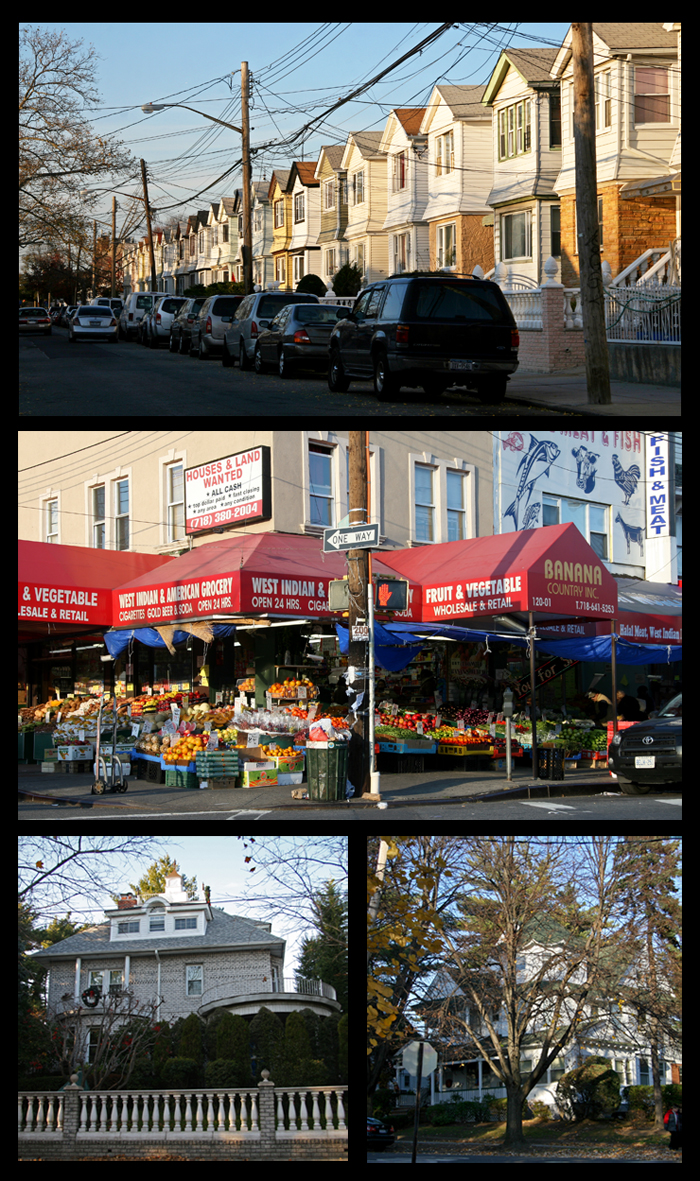
    There are many distinct neighborhoods in the five boroughs of New York City each with its own flavor, architecture, and often a concentration of one or more ethnic groups. Many of these, however, can appear to be rather nondescript and uninteresting to a visitor just passing through. The numbered Streets, Avenues, and Places of Queens connote nothing, and row houses are virtually indistinguishable from one another.

    A little homework, i.e. reading, goes a long way. I always look to the New York Times, which has done a series entitled If You Are Thinking of Living In... on virtually every neighborhood in the city. This is a great launching point, along with some other online reading – Wikipedia typically has an entry for all the New York City neighborhoods.

    The formation of Richmond Hill came about as a result of the 1869 purchase of the Lefferts and Welling farms by one Albon Platt Man, a prominent New York attorney. Cookie cutter row houses dominate Richmond Hill, but the neighborhood has a small number of Victorian homes located in a newly proposed historic district. The neighborhood is home to a large number of Indian immigrants from the West Indies and Guyana, evidenced by the merchants on the main shopping thoroughfares – Liberty, Jamaica, and Atlantic Avenues.

    Ideally, having a native or former native is a great way to get a real feel for a place, and on this journey to Richmond Hill, Queens, I had a friend who had grown up there. So, this expedition was both an exploration for me and simultaneously a walk down memory lane for my friend. There is always such a vicarious thrill taking someone by their old home. The featureless and anonymous comes alive with the recounting of memories of people and activities and gives the lifeless set a cast of characters.

    One of my destinations was to be Jahn’s, an ice cream parlor with several locations – their first establishment was in the Bronx, dating back to 1897. I had assumed that the Richmond Hill location was still in operation. Sadly, however, I discovered that it had closed in 2007.

    A number of notable individuals hail from Richmond Hill. Jack Kerouac lived from 1950-1955 at 94-21 134th Street in Richmond Hill, NY, and also in Ozone Park with his mother where he wrote On the Road. Kerouac included Queens subject matter not only in On the Road, but also in The Vanity of Duluoz.
    The Marx Brothers lived on 134th Street during the 1920s. Fred Gretsch, Jr. manufacturer of Gretsch Guitars, attended Richmond Hill High School, as did comic Rodney Dangerfield. New York columnist and Pulitzer Prize writer Jimmy Breslin attended St. Benedict Joseph Labre School in Richmond Hill. Anaïs Nin, known for her erotic writings, lived in Richmond Hill prior to moving to Paris in 1924. Jacob A. Riis was also a resident.

    Although the value of the cultural breweries of New York City’s well-known neighborhoods such as Greenwich Village or SoHo can not be discounted, a place like Richmond Hill and the notables who lived there demonstrates the diversity of places that not only are home to many, but also from which greatness incubates. Perhaps there is truth in the old cowboy adage – wherever you go, there you are 🙂


  • Paused and Poised


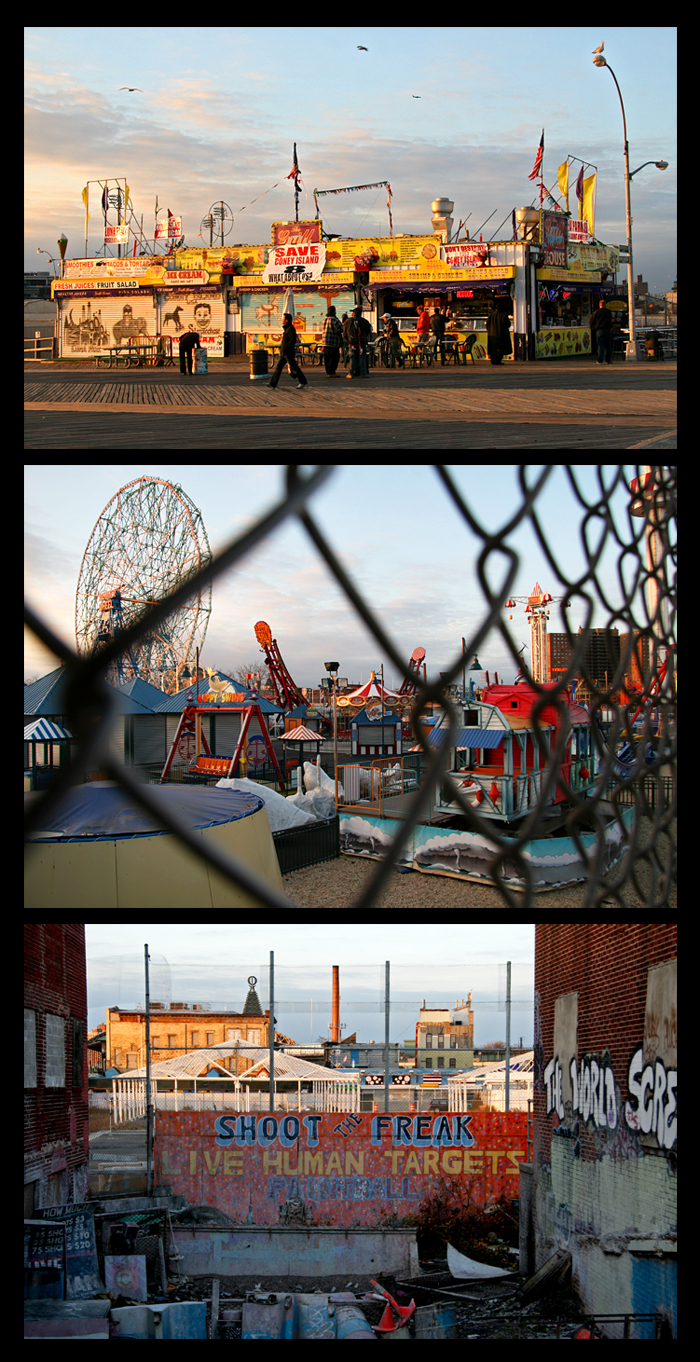
    I read articles, one after another, and yet I still have no idea what exactly is planned for Coney Island or what will actually come to fruition. Apparently, wide-scale development is coming. And, as might be expected, the sentiment is all over the spectrum – the detractors, the disgusted, and the hopeful.

    The passions are completely understandable. Coney Island is a very important piece of real estate, and it is amazing that beachfront property in New York City can sit fallow in such a disgraceful state for decades.
    You are also not just dealing with a piece of real estate here. Coney Island is, for many, a world of nostalgia, childhood memories, sights, sounds, smells, play, a world-renowned boardwalk, and for some, a neighborhood to call home. Many have memories of it as a world-class resort. And this is New York City, where multi-generational family is heralded and neighborhood pride runs deep.

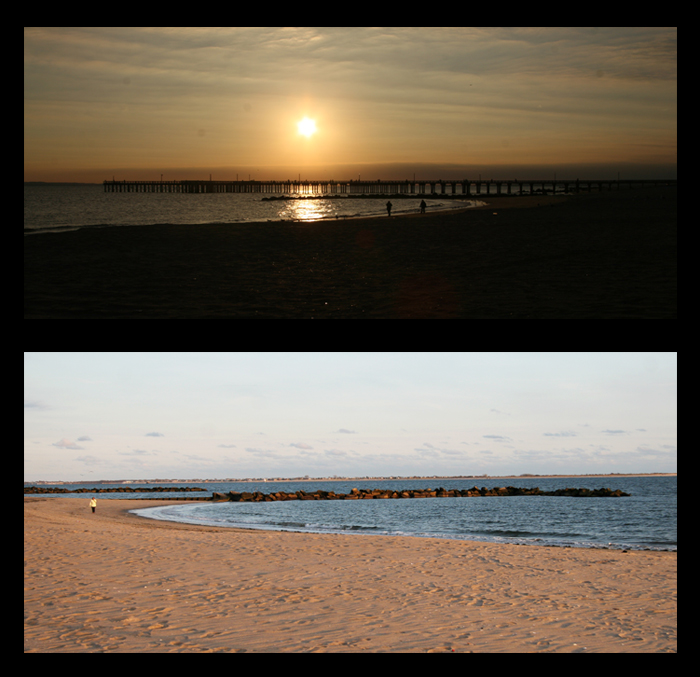
    I visited yesterday, a somewhat bleak but clear November afternoon. It was like a ghost town before sunset. A few photographers were setting up tripods for a sunset shot. Seagulls soared overhead. A few food concessions were open with a handful of patrons. The boardwalk was free of debris. The beach was empty as far as the eye could see, less one woman. The rides were eerily quiet – the various parks closed, the Cyclone and Wonder Wheel idle. Everything paused and poised…


  • Pillowcases


    I have many good childhood memories of Halloween. However, with some, it was a time of opportunity and greed. Some of the kids I knew at the time approached the night as a virtual legalized form of looting, going out very aggressive and focused, on a mission. They were typically much older, and their costuming was minimal – seen only as a necessary nuisance to legitimize their door knocking and collection. After their high-speed tear through the neighborhoods, they bragged to others of booties that were a pillowcase full – that’s a lot of candy.*
    Others of us with more modest goals, counted and compared tallies on number of candy bars collected. Fruit and other assorted sundries were looked down upon. And as the growing number of incidents of fruits and other non-packaged items being laced with drugs, chemicals, or razor blades became greater in number, we had further reason to dismiss these trick or treat gifts.

    It was not until I became an adult living in New York City that I began to experience Halloween as an opportunity for creative costuming, parties, and decorations, with the annual Village Halloween Parade as the pièce de résistance, with millions attending.

    There is a limited amount of door-to-door prospecting for goodies by children in the city, but it does exist. In larger buildings, particularly in Manhattan, children often go trick or treating in their own buildings (or to their friend’s buildings) from apartment to apartment. Often signs will be put on apartment doors indicating whether or not the occupants are participating.

    In the outer boroughs, children still make the rounds to private homes, much as they do in the suburbs or countryside. However and wherever you do it, I hope parents will help children measure the fun in ways other than pillowcases…

    *I found a science project online that proclaimed:

    When it comes to Halloween, greed is most definitely good. And there’s nothing like an old pillowcase – sturdy, voluminous, reusable, and environmentally conscious – to hold your epic stash. But you must have wondered – exactly how much candy could you possibly collect in a standard pillowcase? How many houses would you have to visit and how much ground would you have to cover to achieve that that elusive goal?

    The project went on to calculate not only the amount of candy that would fill a pillowcase (48 lbs, 1690 pieces) but also how much time, area and walking would be needed. In Campbell, California, it was estimated that you would have to visit about 1352 houses to fill a pillowcase, and walk about 11 miles, covering .42 square miles.

    Photo Note: Today’s photos were taken in Brooklyn Heights, one of the most pristine, bucolic, picturesque, and cloistered neighborhoods in the entire city of New York. See my posting here.


  • Enjoy These Photos

    A visitor or even long-time resident may be puzzled by the reason for nursery or garden centers in Manhattan or for gardening supplies in hardware stores. One of the secrets of New York City, particularly Manhattan, is that there is a lot more green than one might imagine. This world will rarely be seen unless one has access to a view.

    The impression one might get while walking the streets is that the city is a fusing of buildings. The Concrete Jungle is an apt description for much of Midtown Manhattan and the Financial District, where steel, glass, and concrete is the norm. Any green space is limited and in plain view such as pocket parks, atria, etc.
    However, in residential neighborhoods, particularly those dominated with rowhouses such as the Village and Chelsea, gardens spaces are located behind every house. These backyard gardens abut each other, often resulting in unbroken green space for an entire city block from avenue to avenue. The best way to see this is using the satellite view of an online search engine’s mapping feature. Locate a neighborhood such as Greenwich Village (try zipcode 10011, e.g.), zoom in, and pan around. You will see a surprising amount of green space. Note the interior garden spaces behind the buildings.

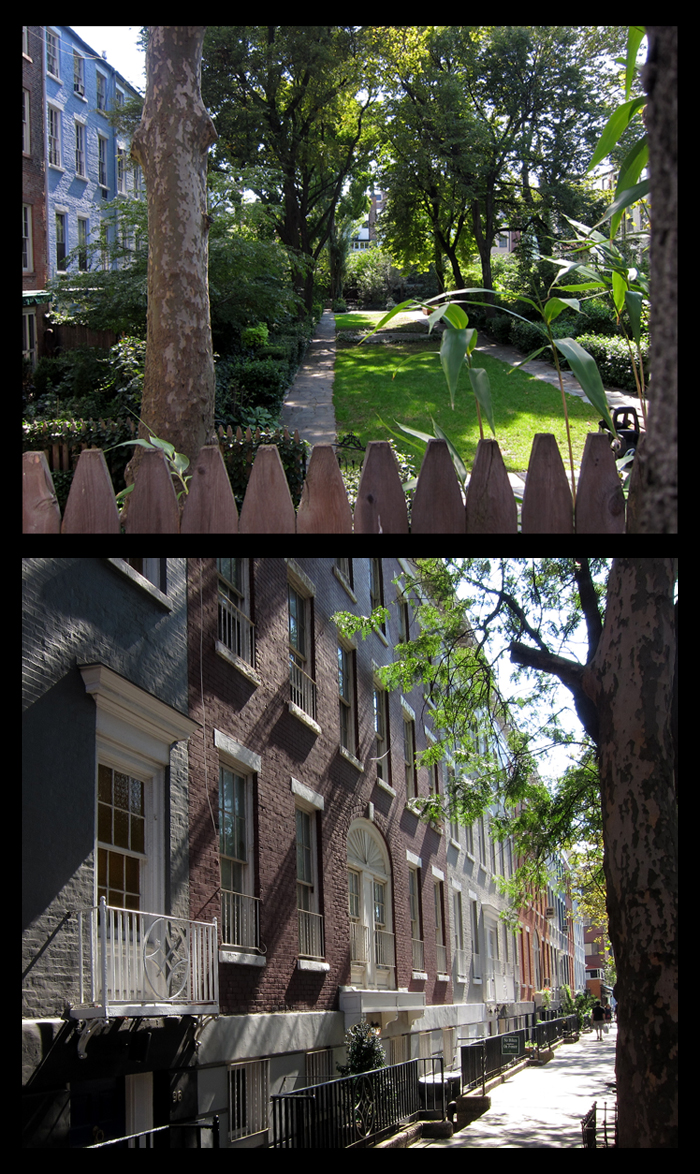
    The lush green oasis in today’s photo is a rare view of the communal greenspace behind the Macdougal-Sullivan Garden District. From the website of the Greenwich Village Society for Historic Preservation:

    This small enclave planned around a private central garden became a prototype for related developments of the 1920s. In 1920 the Hearth and Home Corporation purchased 22 deteriorated Greek Revival Row Houses, built between 1844 and 1850. It commissioned a rehabilitation from the architects Francis Y. Joannes and Maxwell Hyde who removed the stoops and gave the two street facades a Colonial Revival appearance, as well as communal backyards.

    The development served as a model for several other redevelopment projects in the South Village in the 1920’s and 30’s, where older buildings (often tenements) were joined together to create communal spaces and more “modern” appearances for their buildings. This was in many ways reflective of the changes in the neighborhood in the inter-war years: foreign immigration had subsided, but the area was increasingly of interest to Americans of a creative or bohemian bent.

    Older housing, such as rowhouses and tenements were considered by some obsolete. However, this communal style of redevelopment reflected a valuing of the neighborhood’s quaint features, even as landlords and new residents sought modern amenities and collectively enjoyed light, air, and open space.

    These gardens are not open to the public, so unless you have the rare privilege to know a resident, you will have to enjoy these photos 🙂


  • Love Is All Around, Part 2

    (see Part 1 here)

    On cursory examination, such as on one of my drive-by shooting expeditions, where one does not engage with people and local culture, it is easy to dismiss a place or form a very distorted impression. By the time I had toured Astoria by car on a gray, drizzly, deadly quiet Sunday, spent time exploring the streets around the Con Edison Power Plant, and taken photos of folding chairs on a deserted street, I was already forming an opinion about Astoria. Or, perhaps, it is better said that in finding a bleak street and thinking about a story idea, much as I have had occasions to squeeze my feet into shoes that are too small, my image of Astoria was being jammed into a very narrow mind.

    Of course, I have known many young artists who lived in Astoria and called it home. Like anywhere else, I knew that behind closed doors and in restaurants and shops, there were real people with lives, hopes, joys, and aspirations. But that would require getting out of my car and meeting some people.

    I did plan to eat in a Greek restaurant and had done research. In my pocket, I had names and addresses of two places that were well-reviewed, both on Ditmars Boulevard, one of the central arteries of Astoria. So, an interaction with humanity was in the day’s plans. I ended up choosing a local favorite: Agnanti on Ditmars Boulevard.

    On my last swing down Shore Boulevard flanking Astoria Park on the way to Agnanti, I was taken by an extraordinary sight – an Islamic wedding party. Wedding parties being photographed in New York City parks are a common sight.
    Here, however, the dominant black clothing theme, the only variants being a white wedding dress and young girl in turquoise on a misty green hillside, was very dramatic and evocative. Certainly worthy enough to stop my car and take a few photos from my window. Although there were those among them that were taking photos with point and shoot cameras, I had a better vantage point and had photos of the entire group.

    Come on, don’t be so lazy. Get out of the car, run up the hill, give them your card, and offer to send them the photos you have taken. This is not an ordinary occasion, and they will appreciate the offer.

    I got out, strolled across the green lawn and met the party briefly, gave my card, and took more photos. I told them that if they contacted me, I would be happy to send them photos. They were very exuberant and asked me to take a few more posed shots. I obliged.

    One of the group has since contacted me by email and said there was no rush for the photos. She also commented that she looked over this website and liked it. I’m very glad I met them – my mental images of Astoria will always include the newly married couple and family on the hill. And it will always be another reminder that, with a small effort to connect with people, or at least stop and look out your car window, it is easy to see that in Astoria, like anywhere else, love is all around 🙂


  • Love is All Around, Part 1


    We are living in a time in New York City where the housing options are becoming more and more grim. The borough of Manhattan is not an option for most newcomers or young people – there are no edgy, affordable neighborhoods. Gentrification is like a big iron, and all the edges and wrinkles have been pressed out.
    Neighborhoods in the boroughs with dramatic buildings and setting, such as DUMBO , have also been gentrified beyond affordability. Areas with historic homes, such as Park Slope and Brooklyn Heights, have been pricey for many decades – certainly nothing that anyone would consider affordable. Willamsburg and Red Hook, with its industrial buildings, are going the way of SoHo.

    For the young and/or the artist desiring to be immersed living among those of like mind and spirit, this can be discouraging. The only options left are extremely blighted or working-class neighborhoods. Places that have no particular cache. This sometimes means living in an ethnic enclave where, although readily accepted, it is easy to feel like an outsider. More and more, I have seen younger people move to neighborhoods where they feel isolated.

    However, many adapt and embrace these areas and welcome the change, new foods, and cultural mix. Some revel, in the absence of the trendy and chic, in places that are real working-class neighborhoods, such as Astoria, Queens, which has has attracted artists for decades. See my photo gallery here. Many looking for reasonable rents and proximity to Manhattan have found a home in Astoria. On October 9, 2009, the New York Times ran a story of how “a thriving hive of comedians has affixed itself to Astoria, perfectly suited to the particular microclimate there.” From the article:

    In 2003, ASTORIA, across the East River from Manhattan on the northwest tip of Queens, always has been a neighborhood of affordable beginnings. William Hallet, a 17th-century English immigrant, is said to have secured his 1,500 riverside acres in exchange for 7 coats, 14 kettles, a blanket and some beads. Waves of Germans, Czechs, Irish, Italians and Greeks followed, working-class folk who bought into the American dream and local real estate.

    Today, the immigrant pool includes Russians, Arabs, Middle Europeans, South Asians, East Asians, Latin Americans and young Midwesterners who think they have discovered Europe in the coffeehouses and bakeries. Few neighborhoods, even in New York City, have such ethnic diversity.

    The slogan ”only 15 minutes from Bloomingdale’s” describes location, not shopping habits. As the essence of a working-class neighborhood in the 1970’s, at the height of Greek immigration, Astoria was home to TV’s Archie Bunker. Despite an influx of young professionals, musicians and actors seeking refuge from Manhattan prices, and a nudge toward the chichi with two Starbucks with wireless connections, shops like Victoria’s Secret and a vibrant night life, Astoria still has blue-collar roots. 

    Best known for its Greek population, Astoria is named after John Jacob Astor, who was persuaded to make a small investment there but never lived in Astoria. Its working-class roots go back to Steinway & Sons, home there since 1853. Astoria is also home to the American Museum of the Moving Image and Kaufman-Astoria Studios. You can read more about the area here and here.

    But be not misled by a working-class neighborhood, a couple of dreary photos, and a few plain looking homes, because in Astoria, as you will see in Part 2, Love is All Around…


  • Just Around the Corner

    Nooks and crannies are not only the obsession of urban jungle lovers and explorers. They are also big business – Thomas’ has built a $500 million dollar business around the famed nooks and crannies of their English muffins. Chris Botticella is one of only seven people who knows the entire secret process to produce the legendary muffins with signature air pockets marketed as “nooks and crannies.”*

    Finding nooks and crannies in a city like New York is just as delightful as a Thomas’ English muffin. However, unlike the muffin which can be found in any grocer, special pockets of the city are much harder to locate. I have explored many of these on this website.

    The financial district is the oldest area of New York City, and remnants of Nieuw Amsterdam still exist amid the towering structures. In tandem with the areas, extremely narrow streets create a uniquely cavernous feel. The area is largely overlooked by visitors and residents, excepting for the more obvious spots such as South Street Seaport, Ground Zero, and Battery Park.

    It is remarkable that places like Mill Lane and Stone Street were completely unknown to me until Sunday, while combing the streets of the financial district in the rain. Temporary scaffolding on Mill Lane provided the necessary shelter and an opportunity to see a bit of this historic area in a deserted state. Mill Lane is one of the shortest alleys in New York City. It lies between South William and Stone Streets.

    I love turning a corner to a pleasant vista, like coming around a hairpin turn on a mountain precipice that opens to a jaw-dropping panorama. Looking around the corner at Stone Street from Mill Lane was a throwback in time. The restored street is a beauty, what the New York Times called “Turning an Alley into a Jewel.”

    Stone Street was originally known as Brewers Street by the early Dutch settlers. In 1655, when the street was paved with cobblestone, it became known as Stone Street. In the 1980s, the street was divided to make way for the Goldman Sachs building. The short historic block, “a back alley filled with graffiti, a garbage pit; used for low-level drug dealing”, was completely restored with redone buildings, New York bluestone sidewalks, new Deer Isle granite paving blocks, and period street lights. Most of the buildings date to 1836, rebuilt following a fire in 1836. In 1996, the eastern portion of the street and surrounding buildings became protected by the New York City Landmarks Preservation Commission as the Stone Street Historic District. It is pedestrian-only.

    I look forward to going back in better weather. I recommend taking a stroll down the narrow streets of the area, exploring the nooks and crannies, and looking for that surprise just around the corner 🙂

    *Thomas’ was purchased by Bimbo Bakeries USA in 2009. In January 2010, Botticella left the company to work for Hostess Brands, who had been trying to learn the secrets of Thomas’ muffins. Bimbo, however, was successful in getting a court order barring Botticella from taking the new position. See the article here.


  • Roode Hoek


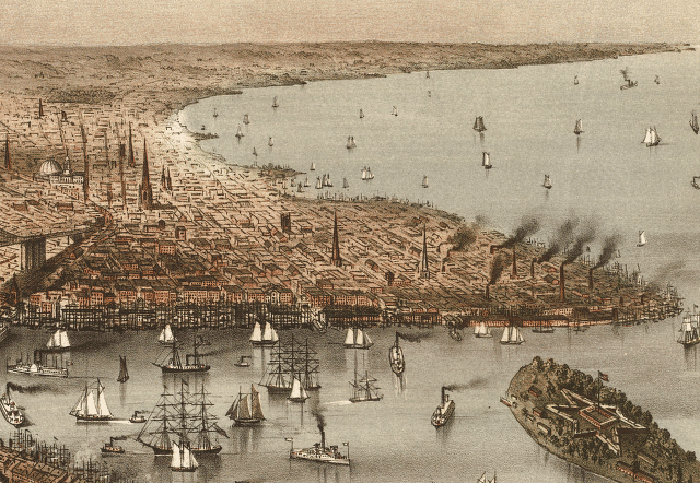
    Red Hook circa 1875I have had so many conversations, ad nauseum, that there is no life after Manhattan and that I did not move to New York City to live in Brooklyn or Queens. I have had many close friends in Brooklyn, the Bronx, and Queens, and I have traveled there hundreds of times.

    I have seen the merits of the boroughs, as readers of this website can attest, yet I have remained steadfast in my resolve that Manhattan is the ne plus ultra of the known universe and that the outer boroughs may be nice places to visit, but I wouldn’t want to live there.

    Until recently.

    This is a city that is still exciting and dynamic, particularly if you are of the generation that has grown up with Blackberries, a six-figure income in your 20s, apartments that sell for over one million dollars or rent for for over $3000 per month, and rapid gentrification of neighborhoods.

    However, Manhattan is losing its character and rapidly becoming the Singapore of the United States. Websites feature forgotten New York, vanishing New York, disappearing New York, and lost New York. For the special and unique, you must dig deeper and look further afield.

    Like Red Hook, Brooklyn.

    Red Hook was settled by the Dutch in 1636 and named Roode Hoek (“roode” for the red clay soil of the area and “hoek” meaning point or corner). The neighborhood is really a peninsula, cut off from the rest of Brooklyn by the BQE and Gowanus Expressways. Public transportation is a vital part of New York City life. Red Hook has no subway service to the neighborhood – this relative isolation is one of the key elements that has kept the neighborhood from developing as rapidly as other areas, such as DUMBO. Even as recently as the 1990s, the neighborhood was considered one of the worst neighborhoods in the USA and the “crack capital of America.”

    On June 18, 2008, IKEA opened an enormous store in the neighborhood, amid huge controversy (replacing a 19th century dry dock) and concerns over an increase in congestion.

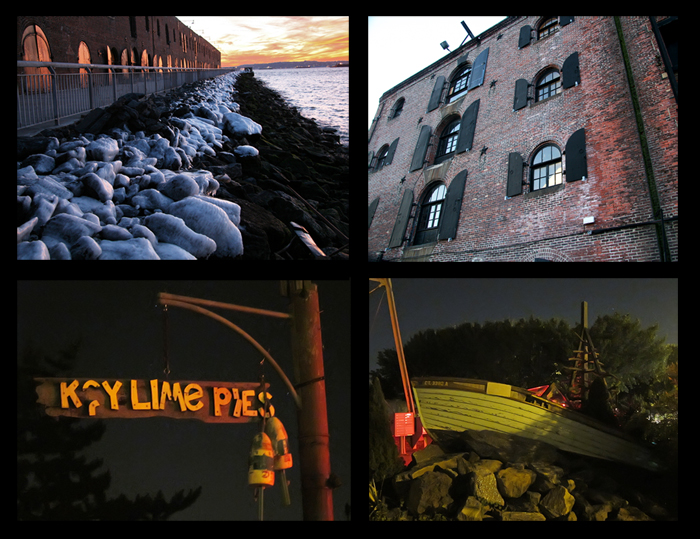
    The older warehouses, waterfront vistas, and isolation are exactly what makes the neighborhood so desirable and have attracted artists and small businesses for some time. See my photos and story, Fire and Ice. If you have a chance, visit Roode Hoek…


  • Grisly Business

    Gino Galestro, a member of the Bonanno crime family, ordered Rober McKelvey to be killed. McKelvey had committed crimes with the family but also angered Galestro and owed him money. Former marine Joseph Young was to make the hit, but things did not go well. From the New York Times, 2006:

    The victim was lured to a secluded landmark, a Victorian mansion on a hilltop on Staten Island, but he proved hard to kill. When an effort to strangle him failed, he was stabbed, then dragged to a nearby pond and drowned. His body was dismembered with hacksaws and incinerated in the mansion’s furnace.

    Since that time, all manner of ghostly and poltergeist phenomena have been claimed (and some prior to that murder, where legend has it that a cook killed himself in the kitchen).

    The mansion was built in 1885 as an estate home by New York City brick manufacturer Balthazar Kreischer, a Bavarian immigrant. Two other homes like it were built for his two sons, Charles and Edward, who were partners in the company B. Kreischer & Sons. Only one home remains, shown in the photo and located at 4500 Arthur Kill Road, Staten Island.
    The area, settled by the Androvette family in 1699, was originally known as Androvetteville in the 1700s. It then became known as Kreisherville, a factory town built by Kreischer, who had been attracted by the natural clay deposits in the region*. From the New York Times:

    At the height of its operation in the late 1890’s, B. Kreischer & Sons employed more than 300 workers and turned out more than three million bricks yearly. Kreischer brick, which continued to be produced until the 1930’s, was used on major building projects throughout New York. Kreischer decorative terra cotta was used in the building of Barnard College around 1900.

    The brick factory was built in 1854, destroyed by fire in 1877, rebuilt, and finally closed in 1927. Kreischer brickwork can be seen in neighborhoods as far away as Ridgewood and Astoria, Queens.

    With the anti-German sentiment after WWI, the town name was changed to Charleston, after Kreischer’s son, Charles. In 1996, the home was a restaurant. Currently vacant, there are plans to build a 120-unit senior citizen housing near Kreischer Mansion, which may be used as a center. I hope we are finished with all the grisly business…

    *The 260-acre Clay Pit Ponds State Park Preserve is located on the site that once provided the white kaolin clay in the 19th century for the manufacture of bricks and terra cotta.


  • White House of Ill Repute

    The White House has had its Presidential scandals. Much has been well documented, and the home can be seen in photos everywhere.

    However, there is another White House riddled with much darker doings in the past, located at 177 Benedict Road in Staten Island, NY, the former home of the notorious crime boss Constantino Paul Castellano. I journeyed to Staten Island to see the place for myself, and I believe these are the only photos you will find of this home.

    In 1976, Big Paul Castellano succeeded Carlo Gambino (after his death) as head of the Gambino crime family, the largest Mafia family at the time in the United States.

    Paul was born in Brooklyn in 1915, the youngest of three. He dropped out of school in the eighth grade and learned to be a meat cutter in his father’s butcher business. His life of crime began early – Paul also ran numbers for his father.

    In the 1920s, Staten Island was sparsely populated and isolated – an ideal dumping ground for mafia victims as well as a place for bootlegging, extortion, loansharking, gambling, drug-dealing, and smuggling, activities which emerged on the waterfront. By the mid-20th century, Staten Island became a residential enclave for Mafia dons, providing the seclusion they needed. In the 1980s, law enforcement officials estimated the number of “made” Mafia members living on Staten Island at around 60, with names  such as John Gotti, Aniello Dellacroce, Salvatore Gravano, Frank DeCicco, Thomas Pitera, Costabile Farace, and many others.

    Castellano’s enormous mansion, a replica of the White House of the United States, was built in 1980 in Todt Hill on Staten Island.
    At the time Castellano moved into this estate with his family, a Columbian housemaid, Gloria Olarte, began working. A full-blown love affair between Paul and Gloria developed under the eye of Castellano’s wife, Nina. Although Mafiosi are known to keep a goomatta on the side while married, Castellano’s behavior became more overt and problematic.

    Knowing that Castellano conducted business from his home, the FBI planted bugs in Castellano’s home in 1983 with the help of Olarte, who had been upset with the way her affair with Paul was going. Olarte let an FBI agent into their home, posing as a repairman. Over 600 hours of conversations detailing the Gambino family business were recorded.

    Others in the organization were also not pleased with Castellano and his more mainstream business approach. On Dec. 16, 1985, Castellano and his driver, Thomas Bilotti, were murdered outside of Sparks Steak House at 210 East 46th Street, between Second & Third Avenues in Midtown Manhattan. The hit was ordered by John Gotti, who controlled the family until his 2002 death in prison. The gangland-style murder was particularly shocking, occurring as it did during rush hour, in midtown Manhattan, and in modern times.

    Not to be upstaged, New York City is proud to be home to its own White House of Ill Repute 🙂


  • dinamic_sidebar 4 none

©2026 New York Daily Photo Entries (RSS) and Comments (RSS)  Raindrops Theme