• Category Archives Homes and ‘Hoods
  • I Must Confess

    I grew up as a Roman Catholic (no longer practicing). One of the most painful things to go through as a young person was the process of confession.

    For those unfamiliar or not experienced with the Sacrament of Penance, let me assure you that spilling all your sins in detail to a priest (and having him ask questions) was an extremely unpleasant experience, riddled with shame, guilt, anxiety, and embarrassment. Sins were to be listed from mortal to venial. In retrospect, I am sure that the sins of a young child pale to those committed by adults, but nonetheless, it was excruciating.
    At the time I grew up, at least confession was private and anonymous. I understand that at one time confessions were public – ouch.

    Recently, on a brutally hot Sunday, I decided to attend a Gospel service in Harlem. I did this with trepidation, knowing full well that going to a religious service with the intent of enjoying gospel music is problematic and controversial. Tour groups have been frequenting these churches for some time. In 1996, Newsweek ran an article called Soul Voyeurs Invade the House of God. On March 3, 2010, I wrote about this in With All Due Respect.
    However, curiosity still got the better of me and overruled my better senses. I intended to be as respectful as possible and, reading that shorts, T-shirts, etc. sported by many visitors were frowned upon, I dressed in my Sunday best, in spite of near 100 degree temperature.

    In selecting a church, articles all pointed to the Abyssinian Baptist Church as having one of the most renowned choirs and a history of well-known preachers. However, it apparently has been overrun with tourists, and experienced Harlem churchgoers recommended staying away. If this was true, my presence would only make things worse. So I chose Mt. Neboh Baptist Church, which I featured in With All Due Respect.

    Entering the church, I knew I had already made a big mistake, as a man stationed inside immediately made eye contact and barked, “Upstairs.” My companion and I hastily made our way upstairs to the balcony, along with other “tourists.” The place was dreadfully hot and oppressive, there were no seats to be had, and waves of embarrassment and guilt began to pass over me as I realized that coming here was one colossal mistake. Hordes of tourists gawking (and marveling) at spectacular architecture such as St John the Divine or St. Patrick’s Cathedral is expected and well tolerated, but gawking at parishioners trying to participate in a religious rite is another thing.

    We left the balcony hastily and lingered in the church vestibule, observing the service through the glass of closed doors. The same gatekeeper we met previously had followed us down and commanded us to go back upstairs or leave. In this environment, it was too clear that we were not part of the congregation, and although the very spirit of the Christian church is one that welcomes all, under the current circumstances, it is perhaps best that non-participants just avoid the whole thing.

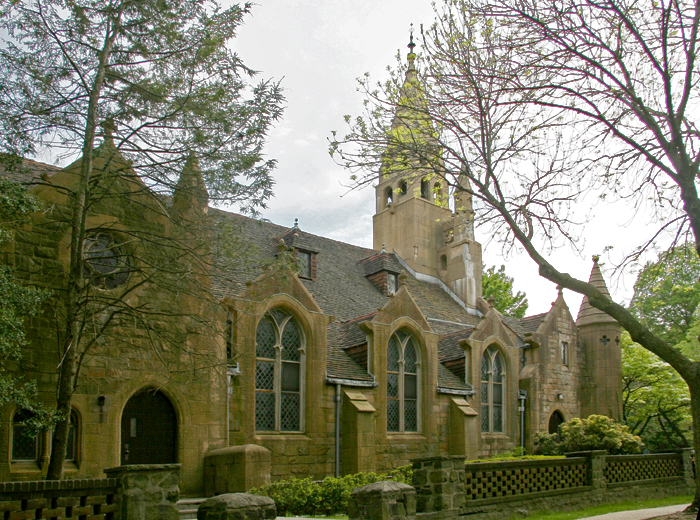
    Before leaving the neighborhood, I did pass by the Abyssinian Baptist Church (bottom two photos). Evidence of the crowding I had read about was everywhere to be found – there were mobs, traffic jams, and general mayhem. We did, however, finally stop into the Mount Moriah Baptist Church, one of the oldest churches in Harlem. There, we were greeted very cordially and given hand fans. There was a plethora of available seating, and we quickly and quietly took our places in the pews. The singing was superb as to be expected, but the heat and a nagging guilt drove me away, I must confess…

  • All Is Not Lost

    Posted on by Brian Dubé

    Much of the art and music world in New York City has disappeared, but all is not lost. In the East Village and the outer boroughs, the arts live on, the product of tenacity and resourcefulness. If you are looking for arts on a smaller scale than the major museums, or for music on a smaller scale than Lincoln Center, then you will have to look a little harder and concentrate your efforts in neighborhoods such as DUMBO and Williamsburg in Brooklyn and the East Village and Lower East Side in Manhattan.

    The East Village still has a substantial number of community gardens, art galleries, music clubs, and other small venues. I have featured a number of community gardens here, and more recently, the Nuyorican Poets Cafe. These types of places are virtually nonexistent elsewhere in the city.

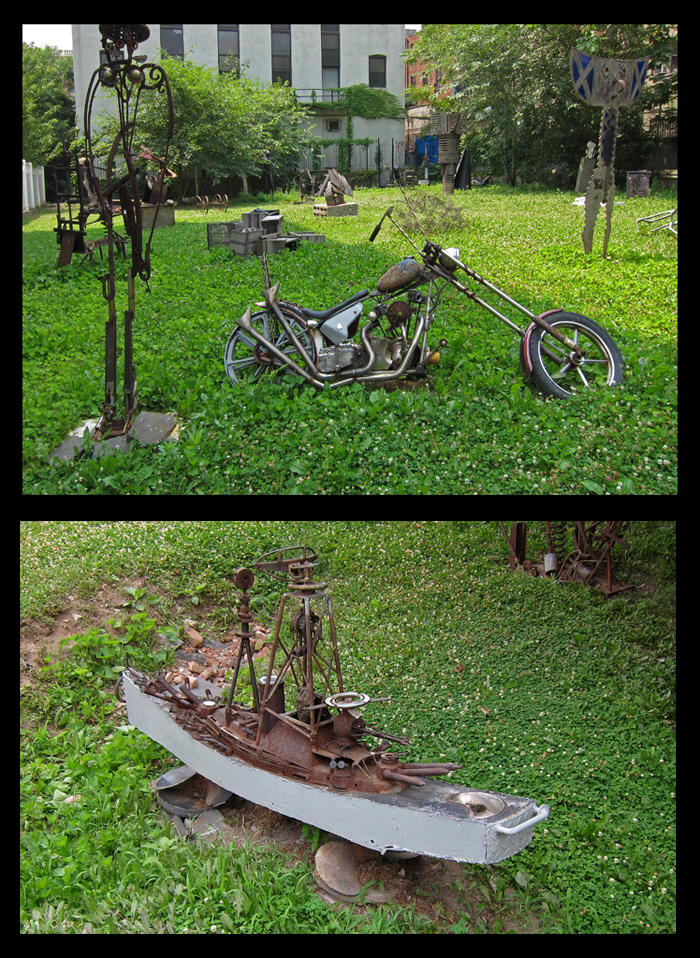
    The KenKeleba House Sculpture Garden spans an entire city block from East 2nd and 3rd Streets.

    Kenkeleba House Garden has an extraordinary mix of large African sculptures as well as local sculptures made out of scrap, or bricolage, a specialty of the Lower East Side art scene since the 1970s. Situated in a large plot, the net effect is that of viewing an outdoor museum with both permanent and temporary pieces on exhibit. Some of the outdoor pieces on loan are from local artists who used to belong to the much beloved Rivington Street Sculpture Garden, which had two incarnations in the neighborhood before it was pushed out by a new apartment building.

    Double back to Avenue B, continue south for one block, and turn left onto to East 2nd Street. Since the whole garden runs from East 3rd to East 2nd between Avenue B and Avenue C, closer to Avenue B, it needs to be approached from both sides. The separate planted garden area, can be accessed from the East 2nd Street side entering during the designated posted hours when the garden gate is open. At other times, take a look around to see if anyone is in the gallery at 219 East 2nd Street who could open the garden for you. It is worth trying to gain entry to the planted garden, particularly since this also allows entry to the sculpture garden.

    All is not lost…

    Posted on by Brian Dubé

  • Micronations

    Posted on by Brian Dubé

    I purchased a book some time ago called Micronations. I was very intrigued yet disappointed. The book was entertaining but somehow did not fulfill the dreams I had as an armchair traveler. Perhaps I needed to look closer to home.

    The newsstand in today’s photo, taken in Bay Ridge, Brooklyn, is not an uncommon sight in New York City, particularly in the boroughs such as Brooklyn or Queens, where there are large concentrations of ethnic groups. Bay Ridge has a population which is 11% Arab and 5% Greek.

    On May 12, 2009, I wrote Salad Bowl about the failure of the metaphor of New York City as a melting pot to accurately describe the discreet ethnic groups. There are many people in New York who get along speaking virtually no English who are so prevalent here. Chinatown is a good example of a very insular neighborhood, with so many services and products catering to the Chinese community that many residents never have to leave or learn another language.

    These ethnic enclaves have places of worship, books, periodicals, schools, parades, festivals, restaurants, markets, and foods and products imported from their homeland. Doctors, lawyers, accountants, and other professionals have established businesses in these communities, providing services and working in the native languages of the residents. There are often tiny pockets of immigrants of ethnicities rarely seen in the United States. No need to leave the Big Apple when looking for Micro Nations 🙂

    Posted on by Brian Dubé

  • Paint by Number

    Posted on by Brian Dubé

    There is nothing that seems to make an artist bristle more than paint by number* or anything remotely resembling it. It is useful to know what is best left to subjective human judgement. However, it is also good to know what is best done by using numbers, as well as where using numbers is more efficient and does not degrade the human experience.

    I recall a documentary on the illy coffee company of Italy. What really impressed me was the balance between the subjective and objective in their coffee production process. There are things better done using science and technology and things better done by the human senses, and the illy family knows when to use what.

    Numbers lie behind most things, and ultimately, given fine enough resolution, many analog things can be reduced to a digital file with satisfying results. Music is a good example. Most musicians have embraced digital recordings. Whether or not they are absolutely identical to an analog recording and whether there are any audible differences are moot points for most – the digital files communicate well the feelings intended by the composer and performers, the primary feature being the ability for flawless reproduction.

    There are things that appear to resist reduction to digital reproduction and are controversial. Stradavarius, Guarneri, and Amati violins are a good example – these instruments are highly coveted by violinists. However, tests have been done using antique and new instruments, with mixed results as to the ability of some of the world’s greatest musicians and experts to distinguish the old from the new by listening alone.

    Along with music, imaging and photography have been most greatly impacted by the digital process. The fact that a scene like that in today’s photo can be effectively communicated with a digital file is remarkable. I stumbled upon this exquisite little gingerbread cottage while driving through the Lighthouse Hill neighborhood in Staten Island. The home, at 298 Lighthouse Avenue, neighbors the Tibetan Museum and shares the same hillside and vistas (see second photo here). Built in 1899, the house is only 968 square feet. Its diminutive size and idyllic charm is communicated easily, whether you take photos, brush by instinct, or paint by number 🙂

    *About Paint by Number: The 1950s in America saw a rise in prosperity and leisure time. “For critics, the paint-by-number phenomenon provided ample evidence of the mindless conformity gripping national life and culture. The making of the fad is attributed to Max S. Klein, owner of the Palmer Paint Company of Detroit, Michigan, and to artist Dan Robbins, who conceived the idea and created many of the initial paintings. Palmer Paint began distributing paint-by-number kits under the Craft Master label in 1951. By 1954, Palmer had sold some twelve million kits. Popular subjects ranged from landscapes, seascapes, and pets to Leonardo da Vinci’s The Last Supper. Paint-kit box tops proclaimed, ‘Every man a Rembrandt!’ ” Read more here.

    Posted on by Brian Dubé

  • Todt Hill

    Posted on by Brian Dubé


    If you enjoy exploring New York City, then Todt Hill is a must. This residential hilltop neighborhood is certainly one of the most, if not the most, exclusive, secluded areas in the five boroughs of New York. Todt Hill, with an elevation of 410 feet, is the highest natural point on the Eastern Seaboard of the United States south of Maine.

    Staten Island is also the least populous of New York’s five boroughs, with under 500,000 residents. This much lower population density and its very hilly terrain create some very rural and remote feeling areas.

    I love hill and mountain tops, and Todt Hill had been on my list for quite some time, having only passed through the area once before a long time ago. On this trip, I explored the backroads and (along with Forest Hills Gardens, Bayside, Queens, and Dyker Heights, Brooklyn) found it to have some of the most extraordinary private homes in New York City – McMansions abound with topiary, bricked semicircular driveways, and fountains. See my photo gallery here.

    Most of Staten Island has a decidedly suburban feel – driving there is more akin to nearby New Jersey than New York City, with much of the developed areas of the borough revealing a plethora of strip malls and other visual clutter.

    Do not be misled, however. Staten Island has some of the most beautiful natural and historic environments in New York City – places like St. Andrews Church, historic Richmond Town, Snug Harbor, the Museum of Tibetan Art, the Kreischer Mansion, The Crimson Beech (residence designed by Frank Lloyd Wright), yacht clubs, waterways, and estuaries, the Latourette House (1836), Staten Island Botanical Garden, and the Fresh Kills landfill. This massive landfill, opened in 1947 and closed in 2001, has been cleaned up and is now undergoing development into a park larger than Central Park – plans include a bird-nesting island, boardwalks, soccer and baseball fields, bridle paths, and a 5,000-seat stadium.

    But, if like me, you really like lofty pursuits, head for Dongan Hills, Grymes Hill, Lighthouse Hill, and Todt Hill 🙂

    Posted on by Brian Dubé

  • Pink Flamingos

    Posted on by Brian Dubé

    I was once gifted the book The Encyclopedia of Bad Taste, many parts of which I found hilarious. The writers, Michael and Jane Stern, have selected the most egregious infractions on good taste in American culture. There are chapters on Easy Cheese (in a spray can), Spam, Velvet Paintings, Chia Pets, celebrity death cars, lava lamps, etc. One article highlighted lawn ornaments.

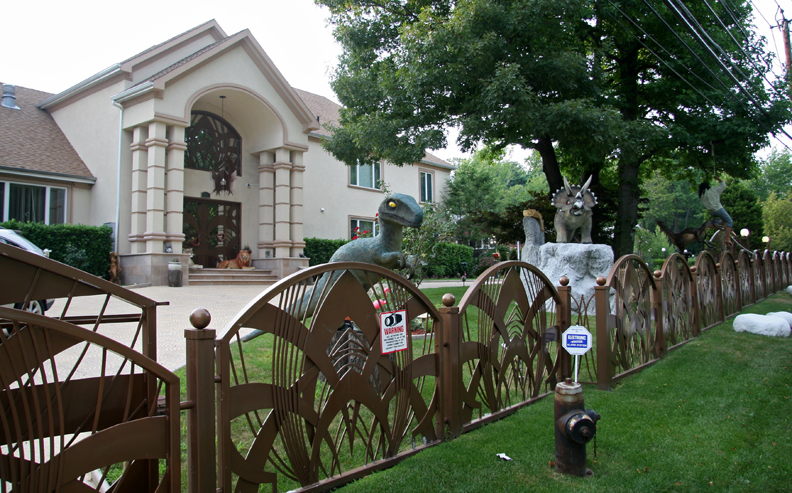
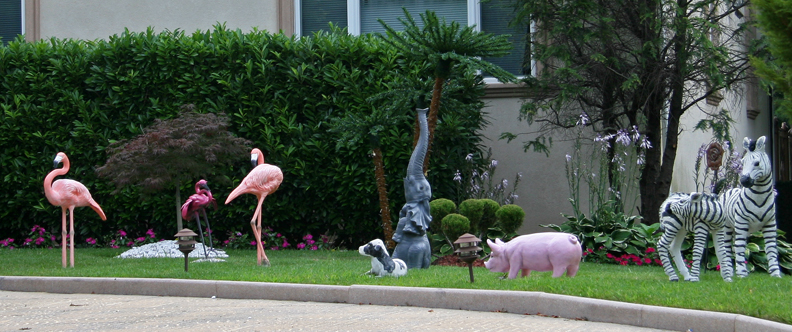
    Most of us have seen a lawn display featuring classics such as the plastic flamingo. I thought I was well-versed in lawn displays (particularly after seeing the Dyker Heights Christmas displays). That is, until I saw the display in front of the mansion of Alla and Alex Shchegol at 724 Todt Hill Road, Staten Island.

    I was happy to find a little information online about the house and the Shchegols, who have been collecting these lawn statues for years. However, I was not prepared to find a small uproar in Dongan Hills/Todt Hill, Staten Island, one of the wealthiest communities in New York City. An article in SI Live voices the concerns some have about the danger of distraction to motorists. It certainly comes as very startling to drive by this property and encounter Tarzan hanging from a tree over a lawn full of statues in a loosely themed jungle and Jurassic Park. There are dinosaurs, jungle animals, and other creatures.

    The many comments to the SI Live article range the gamut – see the article and comments here. Some say the huge ornaments are terribly distracting and dangerous, while other locals say the concerns are exaggerated. The vast majority of naysayers are just horrified at what they consider to be one of the supreme examples of tacky, bad taste.

    Actually, I was very surprised to read about the congeniality of the owners. Apparently, many passersby stop, some even knocking on the door for information about the display. Others ask permission to take photos with their children on the various animals, which the owners typically grant. A number of people, like the Shchegols themselves, just see this as harmless fun and encourage the outraged to lighten up.

    Most will agree, however, that no Encyclopedia (or lawn) of Bad Taste would be complete without Pink Flamingos 🙂

    Posted on by Brian Dubé

  • Miracle Garden

    Posted on by Brian Dubé

    In the 1960s and 1970s, the East Village was one of the most dangerous neighborhoods in Manhattan. Even the most brazen college student, carousing with reckless abandon, would think twice before strolling the East Village. Being mugged, even in broad daylight, was not fanciful paranoia; it was reality. I always traveled with at least one other person.

    On one occasion, a very aggressive panhandler, to whom we refused to give money, became extremely menacing, wielding a baseball bat and threatening us. This incident occurred at a pizza parlor on 3rd Avenue and St. Marks Place, a major intersection. Only by begging the shop employee for refuge were we spared a possible battering.

    Alphabet City was truly a no-mans land. The neighborhood was filled with drug addicts – there are only a few ways of feeding a drug habit. Unable to keep a job, most turn to theft or prostitution. For the male heroin or crack addict, a source of income comes down to robbing for money or stealing goods and fencing them. Many Village residents have had their bike stolen, only to see it being sold on the streets of the East Village. Rather than provoke an incident and risk the opportunity of getting it back (by calling the police), some have even resorted to buying their own bicycle back.

    So, in one way, it is surprising to see so many beautiful oases in the form of community gardens in the East Village. On the other hand, it is not surprising at all. This area has had a history of homesteading, squatting, and community takeover of buildings and empty lots. The neighborhood was extraordinarily blighted and largely abandoned by the city. Without the passion, grassroots efforts, and activism of community members, it is doubtful that this neighborhood would have been inhabitable at all. Even with all the gentrification over decades, the East Village still has a decided grittiness.

    Miracle Garden is located at 194-196 East 3rd Street between Avenues A and B. It was founded in 1983. According to New York Songlines, this urban garden was built on the site of a former crack house. What better name than Miracle Garden?

    Note: I have written about and photographed some extraordinary community gardens. See the related links: Shangri-La, Devil’s Playground, La Plaza Cultural Garden, Grapes, Stay Lean Stay Hungry, Urban Oasis, Alberts Garden, West Side Community Garden, Bird Country, Hua Mei Bird Garden, Paraiso

    Posted on by Brian Dubé

  • Fire Island

    Posted on by Brian Dubé


    With only one exception, all the photos on this website were taken in one of the five boroughs in New York City. I do not vacation or travel out of the city or post photos and stories of my exurban adventures or vacations.

    But Fire Island is a special case, and if you don’t include it in your discussions about New York City, then you do not have a complete picture of this city. Like the Hamptons and Montauk, Fire Island is a summer playground dominated by New Yorkers, particularly Manhattanites. There is a level of urbane sophistication – if you spend time there, you quickly get a real sense that this is a virtual microcosm of New York City.

    Fire Island is a barrier island, only half a mile wide and 31 miles long, off the south shore of Long Island. It is accessible by bridge at either end with public beaches – Robert Moses State Park at the western end and Smith Point County Park at the eastern end.

    However, the real allure are the 22-some odd private communities that dot the interior of the island, which are only accessible by ferry from Long Island. These communities span an entire range of environments and people, from conservative to wild. Point of Woods has the character of a New England town, while Fire Island Pines has roller coaster boardwalks tunneling through trees. Cherry Grove is dominated by the gay community, with a party atmosphere. Seaview is sedate. Ocean Bay Park sees many vacationers sharing homes. Water Island has the character of a remote outpost. See my photo gallery here.

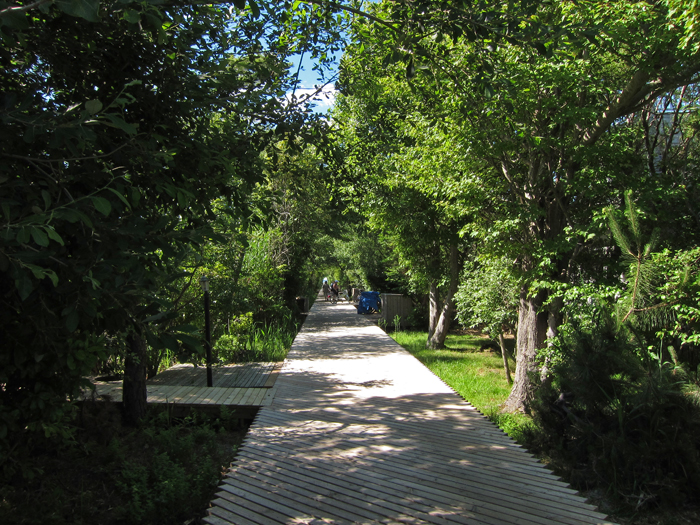
    My romantic love affair with Fire Island started on a day trip in the early 1970s. I immediately was swept away. There are many charms to Fire Island – the pristine beach and dunes, protected as Fire Island National Seashore, Sailors Haven, the Sunken Forest, and the Fire Island Lighthouse. But there is one big factor that defines everything – there are no automobiles.

    This is an extraordinary world where streets are often wooden walkways, transportation is by foot or bicycle, and goods are frequently carted by wagons left in town. Here, you can find the occasional little girl with a stand selling shells. Deer roam freely and can be easily hand fed. Less than 40 miles from New York City, and the quiet is just shocking.

    Sound like paradise? Yes it is. If you have a chance, visit Fire Island 🙂

    Posted on by Brian Dubé

  • Cast Iron Stomach

    Posted on by Brian Dubé

    I recall my roommate in 1970, telling me that he was moving to a “loft in SoHo.” My first question was, of course, “Where is SoHo?”, the second was, “What is a loft?” and the last was, “Why?” It may be hard to imagine, but when I first moved to New York City, SoHo was quite undesirable – an industrial backwater with little residential appeal.

    Remarkably, I lived in the Village, and SoHo was just a stone’s throw away – south of Houston Street – yet I had never been there. A visit quickly revealed an industrial neighborhood with little charm at all. Regarding the term “loft”, I was told that this term derived from the large, upper floor “lofty” spaces. And the “why” was simple – cheap rents.
    In hindsight, the explanations of why a New York City neighborhood was “discovered” always appear obvious. However, the individual is rare who will recognize this before it is “discovered” – early adopters are often artists who see the merits shining through the demerits, which are typically many.

    Becoming a pioneer of an unpopular neighborhood is now much more difficult – everyone is looking for the next place, and news moves with extreme rapidity.
    More importantly, all the reasons why a neighborhood looks undesirable and shows little promise are what really prevents most from getting in early. Successful stock investors know this well and have the ability to go against human nature and buy when stocks are going down, much as the pioneer, in spite of popular sentiment, moves to neighborhoods that are downtrodden.

    Another huge issue in “buying in on the ground floor” is waiting until an area improves. This could take decades. Worst of all, many areas never fulfill their promise. I have always felt that housing stock was a key element. This is no guarantee either – areas such as Bedford-Stuyvesant, Brooklyn, and Harlem have beautiful row houses yet have not seen the rapid gentrification that other areas have.
    Despite the improvements in these communities, they often continue to be stigmatized by a lingering public perception left from the rougher times of the past.

    If you believe that you are a person who really can see past a place’s obvious detriments, go to Brooklyn and visit the Gowanus Canal. Some tout this as the future Venice of New York City.
    Once a tidal inlet of creeks, marshland, and meadows, Gowanus Canal was built from Gowanus Creek and completed in 1869. The Gowanus Canal became a hub for Brooklyn’s shipping activity to service the factories, warehouses, tanneries, coal yards, machine shops, chemical plants, flour mills, cement factories, and manufactured gas refineries lining its shores. Industry thrived in the area, and with it, pollutants.
    The area has had an acknowledged problem with industrial pollution for over a century, with cleanup discussions going back decades. On March 4, 2010, the EPA announced that it had placed the Gowanus Canal on its Superfund National Priorities List.

    Gowanus Canal and the surrounding neighborhood have a much greater impasse and many hurdles to becoming a viable residential enclave, much less a charming Venetian-like waterway. There is little charm in oil tanks or scrap metal yards, and improving an area like this is a taller order than cleaning up the cast iron buildings of SoHo or the beautiful brick structures of DUMBO, Brooklyn.

    But a bright future could be in store for those with a long vision and, like anyone waiting out the transformation of an industrial neighborhood, a cast iron stomach 🙂

    Posted on by Brian Dubé

  • Brighton Beach

    Posted on by Brian Dubé


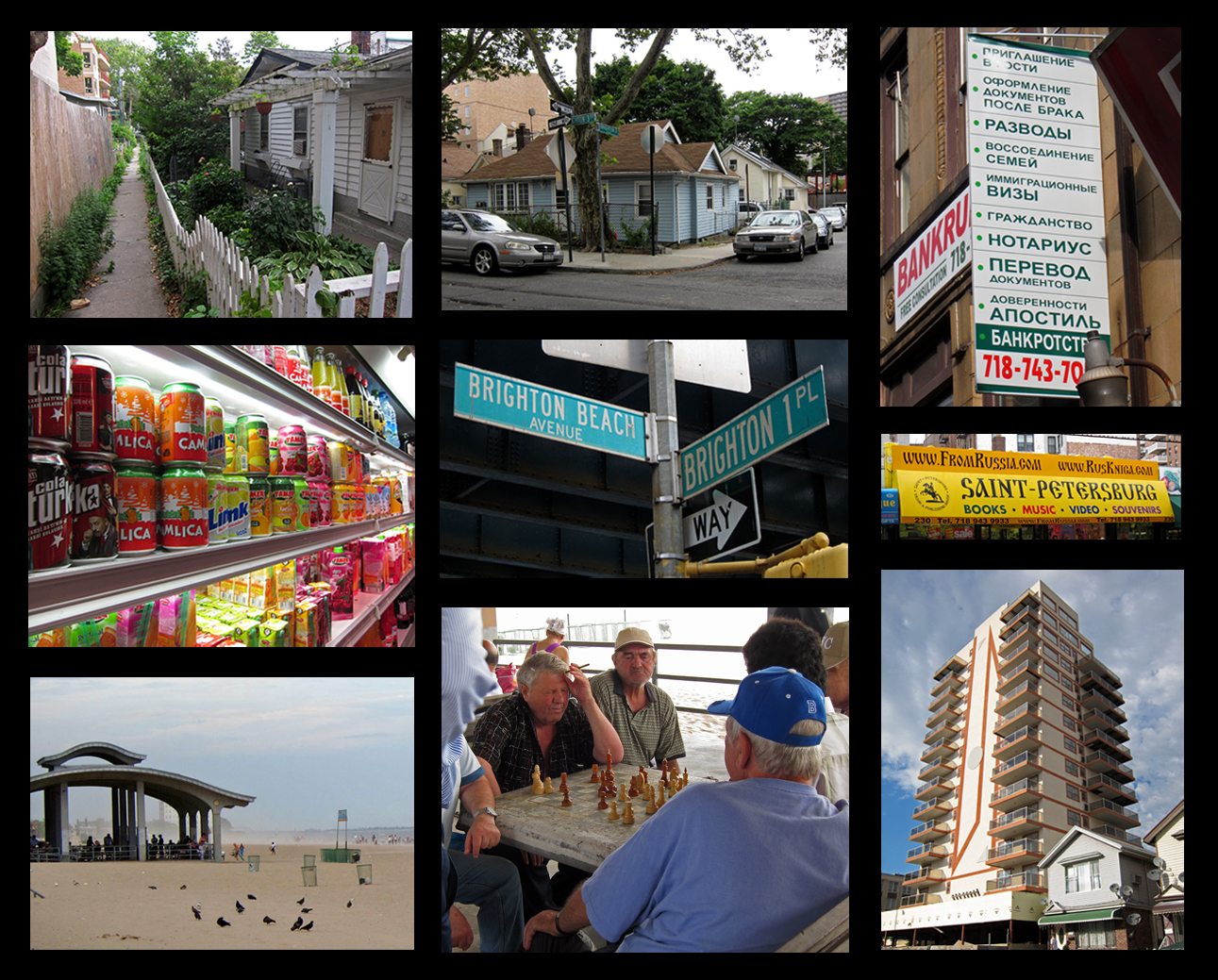
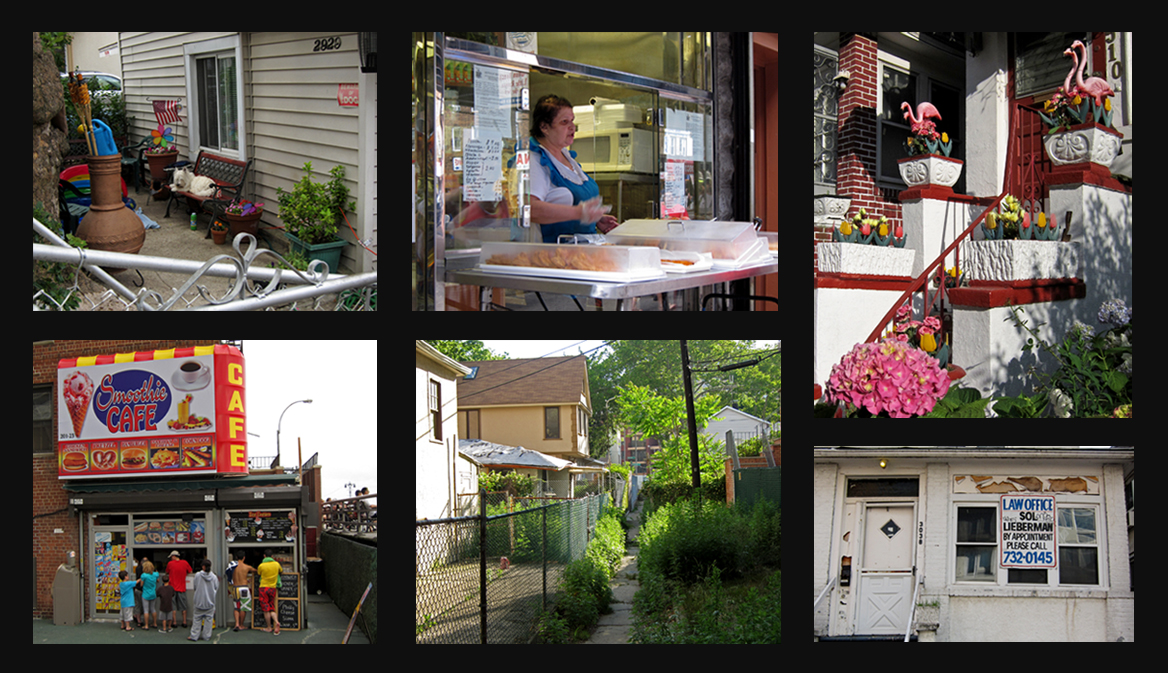
    New York is a city of contrasts. And contrasts within contrasts. Brighton Beach is a community sharing the Coney Island peninsula with Sea Gate, Coney Island, and Manhattan Beach in Brooklyn. See the photo gallery of my recent visit here.

    I took a long walk through the neighborhood and met a long-time local resident having a smoke in his front yard. He was quite friendly and informed me how neighborhood changes have been drastic in the last five years and how he anticipates more of the same. According to him, the biggest change and factor in escalation of real estate prices has been a rapid infiltration of Russian-organized crime. Small bungalows are purchased, leveled, and transformed into large private homes or apartment condominiums. He pointed out developments all around us, sprouting up amidst small homes. This resident was offered $1 million for his small home. Certainly the Russian influence is felt in the shopping areas – many signs are in Cyrillic alone. Many articles have been written on the problem, which goes back decades (see a New York Times article here).

    Cottages, high-rises, condos, luxury homes, gated communities, buildings in disrepair, organized crime, ethnic enclaves, alleys, lanes, weeds, flowers, the boardwalk, and the Atlantic Ocean. That’s Brighton Beach…

    Posted on by Brian Dubé

  • The Feeling Passes

    Posted on by Brian Dubé

    “Whenever I feel like exercise, I lie down until the feeling passes.” ~ Robert M. Hutchins

    I feel similarly about moving out of the city. I have entertained the notion as often as the couch potato thinks of all the benefits of exercise but somehow hopes to achieve results without exercise. I hope to have the benefits of a home in the country or suburbs (a big unattached home, yard, parking, basement, lots of storage, washer, dryer…), but without giving up any of the things the city has to offer.

    My quest for utopia has known no bounds. Fantasy haunts my travels – I have entertained living in every beautiful travel destination: the hilltop villages of France and Italy, the coast of Maine, the mountain towns of Colorado, the towns of New Mexico and Arizona, the isles of the Caribbean, Key West, Cape Cod, Martha’s Vineyard, Nantucket, Vermont, the Connecticut countryside, Eugene, Oregon, and nearly everywhere in California.

    Closer to home, I have toyed with areas such as Manhattan Beach, the hills of Staten Island, and other enclaves in the outer boroughs of New York City. Of course, many of these areas have had a much stronger allure than others.

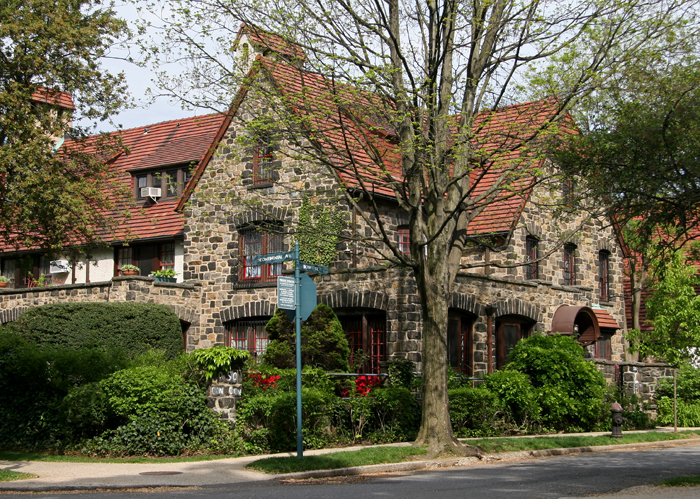
    I have discovered a new fantasy home: Forest Hills Gardens. This Queens neighborhood, founded in 1909, consists of about 800 homes, townhouses, and apartment buildings, mostly in Tudor, Brick Tudor, or Georgian style. I recently made my first voyage there. See my photo gallery here.

    Forest Hills Gardens is one of America’s oldest planned communities and is the leading example of the Garden City movement, an urban planning concept founded in 1898 in the UK by Sir Ebenezer Howard, popular at the time in England and Germany. Garden cities were intended to be planned, self-contained communities surrounded by greenbelts, containing carefully balanced areas of residences, industry, and agriculture. How could I have missed this actual experiment in utopian urban design, sitting right in my own backyard?

    The neighborhood’s parklike setting was commissioned by the Russell Sage Foundation and designed by Frederick Law Olmsted, Jr., son of noted landscape architect Frederick Law Olmsted, who designed Central Park.
    The community’s central square abuts the Forest Hills railroad station. A theme of towers, half-timbered Tudors, brickwork, red-tile roofs, large chimneys, and off-white stucco walls is found throughout the 142-acre neighborhood. Exterior changes must be approved by a property owners’ association.

    I was very impressed with this extraordinary place. No worry that it is a late discovery – it is also one of the most exclusive and expensive areas in New York City.

    I have been very fortunate to live in Greenwich Village for most of my adult life. This is also an extraordinary neighborhood with many historic buildings and a bucolic charm. And I have learned the remedy for the obsessed, unrelenting fantasy mover. Whenever I feel like moving, I lie down until the feeling passes 🙂

    Posted on by Brian Dubé

  • The Hamptons

    Passion for living in New York City is perhaps only bettered by the passion of many residents to get out come summertime. At one time when I was taking music lessons, I was forewarned by my teacher (a Manhattan resident) that she refused to be in the city in the summer – if I really wanted to, I could travel to her summer cottage outside the city. She had stressed that it was not fancy at all, but it was out of the city.

    I have heard many extol the benefits of being in New York City in the summer – that it is easier to get tickets to many activities, things are less crowded, and there is an enormous number of summer events throughout the 5 boroughs. This is all true – I have spent most summers here, many without the occasional weekend getaway.

    But there comes a time when it is so hot and humid that all this chatter about the benefits of summering in the city seems like cheap talk. I recall one summer night after an opera performance standing on a subway platform. It was so sticky that it made my skin crawl, and clothes just seemed to be an insult to injury. Yes, I had procured great New York City opera tickets easily and inexpensively, but those who were enjoying ocean breezes certainly must have made a better decision.

    Getting away for the summer is not unique to the city – our suburban and rural brethren often take to the hills or the beach. And summer homes for the urbanite is a practice going back in time around the world. A good case in point are the Medici villas around Florence, Italy.

    In New York City, the Hamptons (along with Montauk and Fire Island) are virtually synonymous with summer getaways. However, having made a decision where to go and the financial means to do so is only part of the solution. Getting there becomes another hurdle. For those who have selected the Hamptons, traveling 100 miles from Manhattan is now the challenge. There are a number of travel options: car, bus, train, plane, or helicopter. Few can afford flying, and traffic congestion on the limited number of roadways out can be a nightmare.

    In 1974, Hampton Jitney was founded with a single van by James Davidson, a resident of the Hamptons. Train service was and still is available from New York City but has limited frequency, with delays and service complaints. On the other hand, the Hampton Jitney has service as frequently as every half hour, leaving from multiple locations on the Upper East Side. I have never summered on the East End, but if I did, I think the Jitney or train would be the way to the Hamptons 🙂

    Note: The Hamptons are a group of villages at the east end of Long Island. The area is a long time seaside resort known for its affluent residents and celebrities from New York City and around the world. You can read more about them here.


  • A Place Called Home

    When I drove a New York City taxicab in my college years, West End Avenue was just WEA on my trip log. A quiet, safe destination, with easy, traffic free driving along the wide, 4-lane, two way boulevard, and lots of big buildings.

    If you read about West End Avenue, you will encounter words and phrases like “quiet”, “convenient”,” stable”, “safe”, “community,” or “Park Avenue of the West Side.” This grand boulevard is an extension of 11th Avenue and runs north-south from 59th to 107th Street on the Upper West Side, parallel to Riverside Drive (and Riverside Park), which lies one block West. Upper Broadway, with its plethora of shops and transportation, lies one block east – hence the “convenient” part of the equation. The tenancy is very stable, with many families living here from generation to generation.

    Like its East Side analog, Park Avenue, West End Avenue is strictly residential, with virtually no businesses or commercial traffic except for trucks making local deliveries. There are no attractions here, and located so far west that very few, other than residents, ever find themselves here.

    The neighborhood, however, was not always the genteel place it is today. From the New York Times:

    For nearly 60 years in the middle of the 20th century, parts of West End Avenue were ”déclassé,” Mr. Salwen said. S.R.O. hotels, prostitutes and drug addicts became common on some cross streets. But by the 1980’s, the street had begun to recover its grandeur.

    Like Park Avenue, the street is dominated by large apartment buildings. Most buildings here are prewar and over ten stories tall, dating back to the early 20th century.

    From the Wikipedia entry for WEA: “The street is noteworthy for its almost unbroken street wall of handsome apartment buildings punctuated by brief stretches of nineteenth-century townhouses and several handsome churches and synagogues.”
    I agree, but do find the “almost unbroken street wall” of these large apartment buildings rather imposing. Having spent all of my adult life downtown in Greenwich Village, I find these hulking structures to be somewhat intimidating.

    However, prewar apartments are typically larger than average – once inside these solid buildings, the spaces are quite comfortable and make very pleasant, quiet residences. And although the buildings feel so out of scale with humans, a home is more than just a space in a building – it’s a personal place created by people. New York City has tremendous variety of residential structures, and whether small or large, short or tall, bright or dark, lavish or lean, in the Village or on WEA, inside every building in every apartment, for someone, there’s a place called home 🙂


  • Living With Legends

    Virtually every New Yorker has heard of the Hotel Chelsea, more commonly known as the Chelsea Hotel. The hotel is most well known for its roster of well known long-term residents – many living at the hotel for years. The hotel has been a home to writers, artists, actors and film directors.

    A short list includes: Mark Twain, O. Henry, Dylan Thomas, Arthur C. Clarke, William S. Burroughs, Arthur Miller, Quentin Crisp, Gore Vidal, Tennessee Williams, Allen Ginsberg, Jack Kerouac (who wrote On the Road there), Simone de Beauvoir, Robert Oppenheimer, Jean-Paul Sartre, Thomas Wolfe. Stanley Kubrick, Ethan Hawke, Dennis Hopper, Uma Thurman, Elliot Gould, Jane Fonda, The Grateful Dead, Tom Waits, Patti Smith, Dee Dee Ramone, Henri Chopin, Edith Piaf, Joni Mitchell, Bob Dylan, Alice Cooper, Janis Joplin, Jimi Hendrix, Sid Vicious, Leonard Cohen, Madonna, Robert Mapplethorpe, Robert Crumb, Jasper Johns, Willem De Kooning, and Henri Cartier-Bresson.

    From the Hotel Chelsea website:

    The hotel has always been a center of artistic and bohemian activity and it houses artwork created by many of the artists who have visited. The hotel was the first building to be listed by New York City as a cultural preservation site and historic building of note. The twelve-story red-brick building that now houses the Hotel Chelsea was built in 1883 as a private apartment cooperative that opened in 1884; it was the tallest building in New York until 1899. At the time Chelsea, and particularly the street on which the hotel was located, was the center of New York’s Theater District. However, within a few years the combination of economic worries and the relocation of the theaters bankrupted the Chelsea cooperative. In 1905, the building was purchased and opened as a hotel.

    Owing to its long list of famous guests and residents, the hotel has an ornate history, both as a birth place of creative modern art and home of bad behavior. Bob Dylan composed songs while staying at the Chelsea, and poets Allen Ginsberg and Gregory Corso chose it as a place for philosophical and intellectual exchange. It is also known as the place where the writer Dylan Thomas died of alcohol poisoning on in 1953, and where Sid Vicious of the Sex Pistols may have stabbed his girlfriend, Nancy Spungen, to death on October 12, 1978.

    Hotel Chelsea is also architecturally significant. The Victorian Gothic red-brick structure with its wrought iron balconies, located at 222 West 23rd Street in the Chelsea neighborhood of Manhattan, was listed on the National Register of Historic Places in 1977. One of the main attractions here is the art that graces the lobby and the 12-story stairway. The stairway is off limits to walk-in visitors (there is a monthly tour), however, the lobby is open to all.

    I cannot speak to the rooms here – I have never been in one, but the place does has a reputation for shabby chic. People stay here for the history and artistic clientele and ambiance, not for the ultimate in luxury or slick room furnishings. At the current time, there are approximately 250 rooms in the hotel – roughly half are still occupied by permanent residents. Long-term residency is no longer granted to newcomers, and as rooms of long-term tenants are vacated, they are converted to hotel rooms.

    The Hotel Chelsea is one of the most unique residences/hotels in New York City, if not the USA. For most of us, its past residents are a who’s who of American culture. For those who were fortunate enough to have stayed there in the past, it was living with legends…


  • Viva ViVa

    Posted on by Brian Dubé

    There are barometers for New York City. Things that can tell you about a neighborhood, that it is on the move and has a new identity. Perhaps a catchy acronym that real estate brokers and their customers can wield as a balm to soothe any fears of investment or as a location to actually live in.

    A Fairway market is also a good barometer. This store is well loved in the city. It is a large operation, and it is doubtful that they are going to make an investment in a neighborhood with no promise of growth and development for residential use. And I would go as far to say that they are a contributing factor in the livability of an area, particularly a neighborhood transitioning from commercial/industrial use to residential, such as Red Hook in Brooklyn – places that are somewhat remote and have a dearth of services.

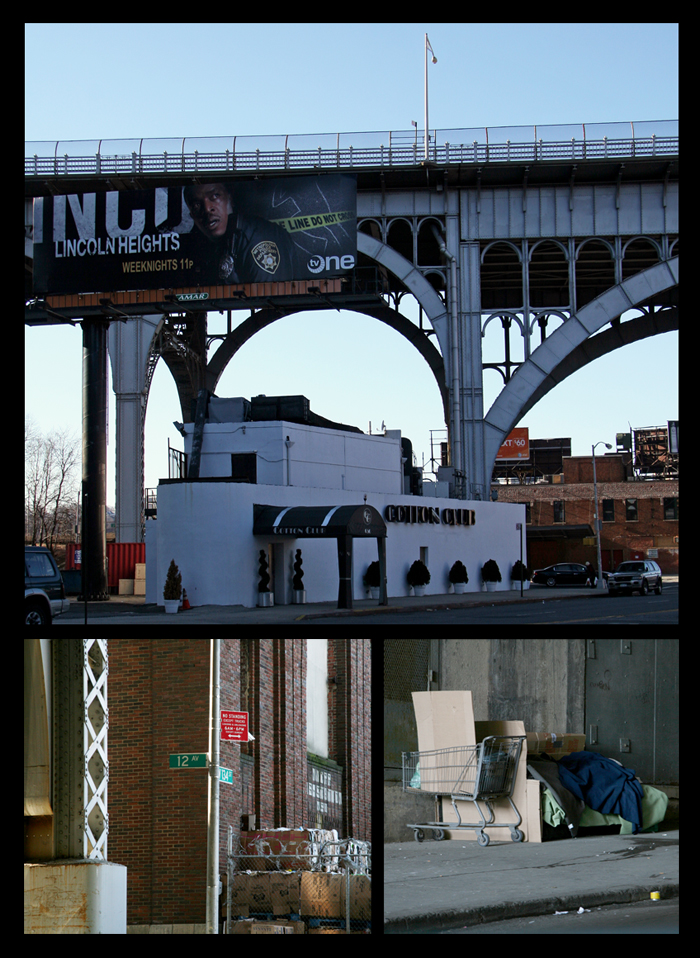
    Manhattanville, an area of West Harlem stretching from 125th to 135th Streets was an independent village in the 1800s. The area furthest west against the Hudson River along 12th Avenue is called ViVa, for Viaduct Valley. The tiny neighborhood sits under the Riverside Drive viaduct, built in 1901. The area includes West Harlem Piers Waterfront park (from 125th to 132nd Streets), which was opened in 2008 and includes a fishing pier, a kayak launch, and water taxi landings.

    ViVa, at one time a meat packing district and more recently a manufacturing and warehouse district, has taken some time to gain momentum – Fairway has been in the neighborhood since 1995. Restaurants have led the renaissance, and 12th Avenue has become a restaurant row – see article here.

    Columbia University is the big player here, with a major expansion planned; property has been acquired for their new 18-acre campus – see map here.

    Of course, not everyone has the assets of real estate developers, new residents or Columbia University. Depending on who or where you are, I imagine many, but not all, are cheering, Viva ViVa

    Note: The Cotton Club shown in the photo has no historical connection to the original club, which was located in Harlem.

    Posted on by Brian Dubé


  • dinamic_sidebar 4 none

©2026 New York Daily Photo Entries (RSS) and Comments (RSS)  Raindrops Theme