• Category Archives Homes and ‘Hoods
  • Montmartre and Peillon


    I love my places high and my neighborhoods charming – bucolic and oozing with character, history, fine architecture, and artists. My neighborhood in New York City, the Village, certainly has many of these attributes. But to get the full package, I go to France.

    My favorite indulgences are the village perché (perched villages) in the South of France – small, hilltop medieval villages. I have been obsessed with these places, at one time compiling a database of 269 of the most wonderful and cross-referencing them with my collection of books on French villages. I created database entries for comments and checkboxes to note which books recommended which villages.

    Too small to find in the Michelin Map index, I laboriously located all of the villages through map exploration, tagged them in the maps, and added the map coordinates to my database for future reference. I included the official French département. The printed result became a guide for my travel to Provence, the Alpes-Maritimes, and Vaucluse.
    I visited dozens of these villages, often to the chagrin of my travel companions. On one family trip, my sister was completely befuddled as to why I would do this and why anyone would want to travel that way. I think she saw it as analogous to painting by number. I like numbers, and my desire to accumulate villages visited knew no bounds. My favorite is Peillon, perched in the hills, with stone houses clinging to a cliff face at 1000 feet.

    There is still some artistic flavor to Greenwich Village, but most of its art history is in the past. Its legacy of beat poets, artists, musicians, writers, dancers, actors, and performers reads like a who’s who of the American arts. The neighborhood has become much too expensive to really qualify as any type of artistic bohemia. However, musicians and performers are common, and occasionally, one may still see someone painting in the streets or parks of the Village.

    Today’s artists here typically either travel in and out of the city or are some of the few remaining beneficiaries of rent controls, living in below-market rentals.
    Much of the Village has been commercialized and is heavily touristed, but no one has taken away the charm of many of the neighborhood streets and its collection of hundreds of 19th century row houses. The West Village is particularly beautiful.

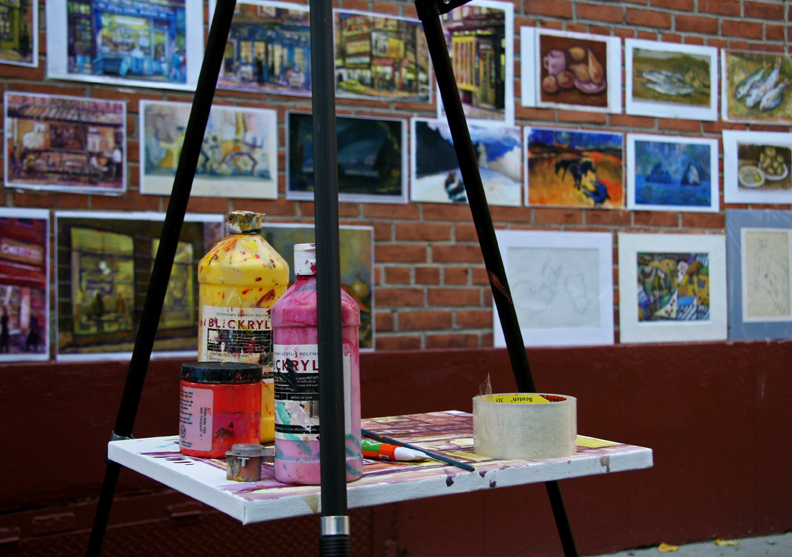
    In Paris, I get all this with hills (over 400 feet) in Montmartre, an area also known for its history of artists. Those who worked in or around Montmartre include Vincent van Gogh, Picasso, Salvador Dalí, Modigliani, Claude Monet, Raymond Duchamp-Villon, Henri Matisse, Renoir, Degas, and Henri de Toulouse-Lautrec. Somehow, street painters there today still seem to have a little more authenticity, but I would imagine a Parisian might see them the way we see painters in New York City – as exploiters and sellers of an artistic past to tourists.

    As I stroll the Village, I head for the hills. In the distance, I think I see Montmartre and Peillon…
  • Zena


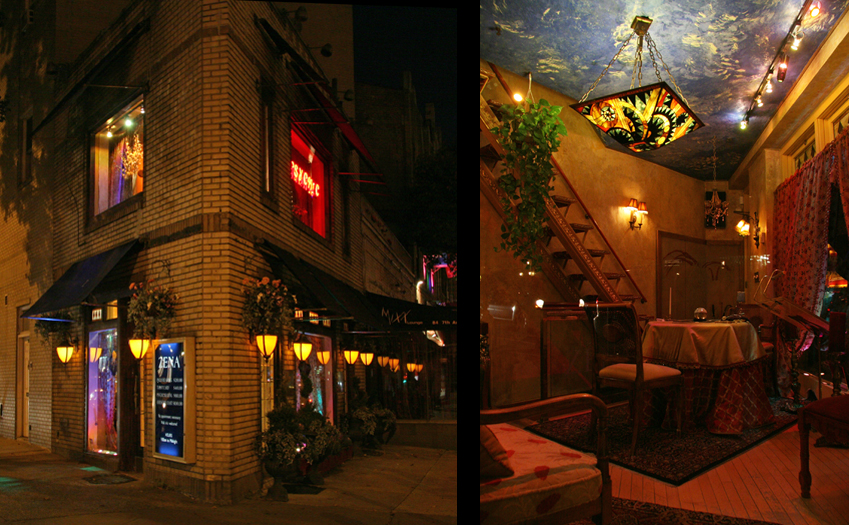
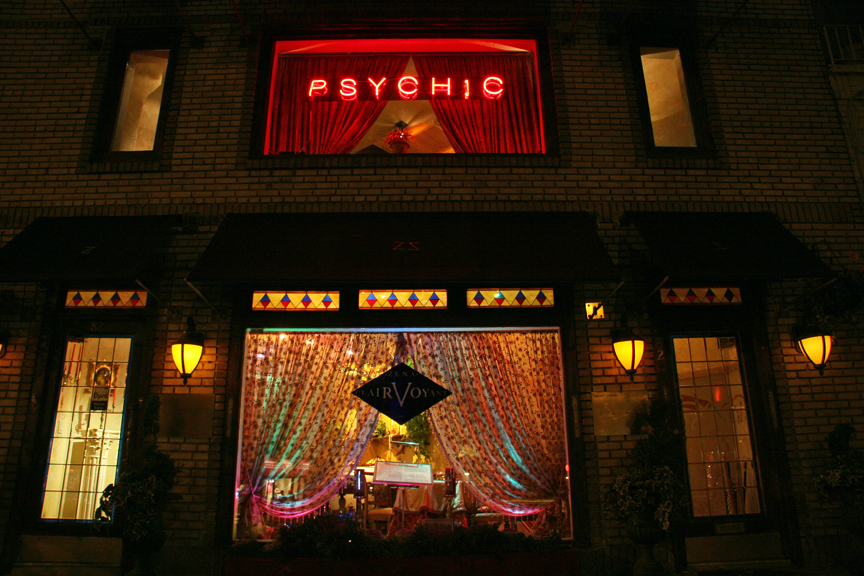
    I love small buildings and small mysteries. Here, at 82 7th Avenue and 301 Bleecker Street in the West Village, there is a remarkable, tiny, two-story building occupied only by Zena and her daughter, Sylvia, who practice their trade as psychic readers. The triangular building dates from 1910 and is only 468 square feet, 234 per floor. The place just exudes charm – windows face both Bleecker Street and 7th Avenue South and allow easy viewing of the interior from the street. A brass placard on the exterior wall says “Zena, New York & Cannes.” See the gallery of photos here.
    I have passed by this shop for decades. It is quiet, with its glowing interior beckoning to me. Last night, it was time to probe this mystery. As fate had it, while shooting from the outside, pressed up against the beveled glass windows, Zena came by to enter her shop and asked if I would prefer taking photos from the inside. I accepted the invitation and entered for the first time.

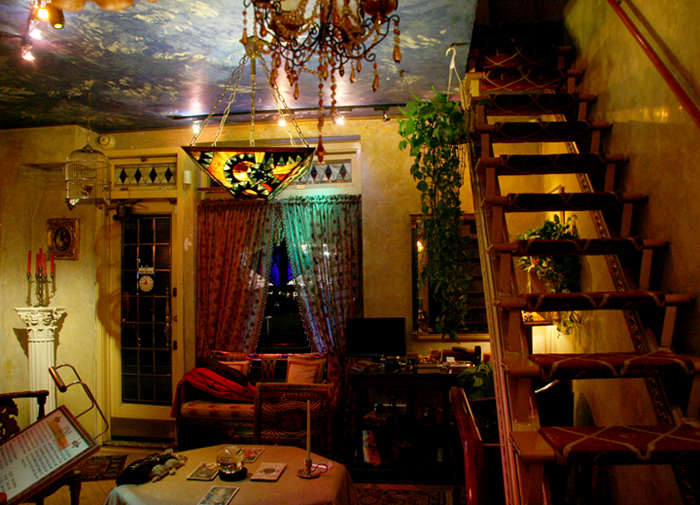
    This is one of the most comfortable small spaces I have ever been in. Everything is arranged and appointed just so. Soft fabrics, lighting, and warm colors are everywhere. There are stained glass lamps, solid brass finishes, and hardwood floors. A small stairway leads to the second floor, where more plush furnishings could be found, including a sofa. Zena told me that Architectural Digest had visited to do a story illustrating what can be done with small spaces.

    I always wondered how such a small enterprise could support a shop in a high-profile, high-rent district. There are many possible answers, but Zena gave me one that made the most sense: she has owned the building for the last 25 years.

    An elegant diamond-shaped sign hanging in the window proclaims “Clairvoyant.” A promo piece with a price schedule below lies below it. I cannot speak to claims of psychic abilities, and I have no experience with Zena or her daughter. For me, it was the mystery of the place that drew me to Zena’s…


  • Alchemist’s Corner

    Occasionally, demolition affords a rare opportunity to see something previously hidden from street view, such as fading vintage mural ads. The opportunity can also be limited in time, when new construction replaces old, as is the case here at 133-139 MacDougal Street, former home of Provincetown Playhouse (which will become NYU law offices). A friend and neighbor called my attention to a small rooftop house now visible from MacDougal Street. There are a handful of these small rooftop dwellings in New York City, and I’m fascinated by them.

    The small house is on the roof of 132 West 4th Street (photo right). The exquisite Greek Revival rowhouse was built in 1839 and was renovated in 1917 by Josephine Wright Chapman, one of the first successful female architects in America. The exterior was left largely intact, with the addition of casement windows to the parlor floor and a sloped studio window to the attic level where, in the same year, actor John Barrymore rented an apartment.

    Barrymore did extensive work and interior decoration, which included papering the walls in gold and building a rooftop garden. In an amazing twist, playwright Paul Rudnick leased the “medieval duplex” apartment in 1987. Here is Rudnick’s story from a New Yorker article in 2007:

    The apartment in question consisted of the full, narrow top floor, and I was smitten. The theatrical plasterwork continued throughout, and there was a bay window with a window seat, flanked by portholes of thick, leaded Mediterranean-blue stained glass, all overlooking the leafy corner of Washington Square Park where fanatics play chess. There was a micro-kitchen, one tiny closet, and a cramped, nineteen-seventies-vintage Pepto-Bismol-pink tiled bathroom, but none of this mattered, thanks to a vaulted skylight, a fireplace, assorted archways, and a hidden, winding staircase. The stairs led to the roof, where I found a large deck. A sun-bleached oak ship’s wheel, six feet in diameter, leaned against the outer wall of a hobbit-scale cottage-—one room, with a beamed ceiling. The broker was chatty, and she mentioned that the apartment had once been the home of John Barrymore.

    Learning of the history of the rooftop aerie, he was moved to write something set at the address, which eventually became I Hate Hamlet. Upon investigation, here is what Rudnick learned about Barrymore’s rooftop abode:

    As I settled in, I researched my new home. Barrymore had taken up residence in 1917, just before he began performing his legendary Hamlet uptown. His film career at that point was limited to locally shot silent movies, including an early take on “Moby-Dick,” which may have been the source of the ship’s wheel. Barrymore had remodelled the apartment as a Gothic retreat, christening it the Alchemist’s Corner. He had installed all the false beams, monastery-inspired ironwork, and stained glass, which made his lair resemble a stage set for an Agatha Christie whodunnit in summer stock. The rooftop had been his masterpiece, and had at one time included a garden, with cedar trees, a slate walkway, and a reflecting pool. Tons of soil had to be hoisted up by pulley, and eventually caused a collapse into the rooms below. Of Barrymore’s vision only the cottage remained; he’d likened it to a roost overlooking the spires of Paris.

    Make a trip soon to MacDougal Street if you want to see the cottage at the Alchemist’s Corner…

    Note: Frank Jump has built a website around fading ads – a photographic project documenting vintage mural ads on building brickfaces in New York City spanning nearly a century. Many of these gems are also uncovered in the process of New York City construction with demolition of structures which had prohibited views of the signage. See his website here.


  • Nondescript

    I think many people have a favorite phrase or word and often overuse it, use it inappropriately, or are unaware that they use it as much as they do. And, of course, the power of words or phrases are diminished by overuse, so this can be quite torturous. A fine balance needs to be achieved – the desire to brandish the word at every appropriate opportunity must be reigned in and evaluated by the worthiness of the situation.

    So titling an article such as this one using one of my favorite words, nondescript, is, likewise, a big consideration. It can really only be used once this way, so its application subject must be considered carefully, like a job applicant for a top position.

    The first time I became acquainted with the word nondescript was in an architecture article regarding a building in New York City. I was so very pleased – it was exactly a word I had being looking for. Nothing fits the bill so well when needed, and I was glad to replace descriptives such as dull, boring, or no character.Fortunately, avoiding the overuse of the word nondescript in New York City is not too difficult – there is much character and interest in most any given vista. For a fine use of the word nondescript in Manhattan, you need to take a trip to the Upper East Side, along Second or Third Avenue. Here, you have a parade of tall, postwar, nondescript apartment buildings, as far as the eye can see.

    Perhaps this is why Neil Simon chose to use the title Prisoner of Second Avenue for his play (later adapted as a screenplay for the film of the same name). After all, Prisoner of Park Avenue has a rather disingenuous ring, doesn’t it? In the play/film, protagonist middle-aged Mel Edison has lost his job, and the situation is exacerbated by a litany of city problems. What better insult to injury than to set the whole thing in a nondescript high-rise building on a characterless Second Avenue?

    In keeping with the title of this story, today’s photo is on a strip of Second Avenue of no particular interest, with buildings which are, shall we say, nondescript? 🙂

    Movie note: If you have not seen Prisoner of Second Avenue, I recommend it, as I recommend any of Jack Lemmon’s comedies, particularly those set in New York City: The Apartment, The Odd Couple, and one of my personal favorites, The Out-of-Towners (1970). These films, like many of Woody Allen’s, dig deep into the urban neuroses of New York City life. The Neil Simon scripts crackle, and Jack Lemmon plays the quintessential New Yorker at wit’s end.


  • Commitments

    Even with peer influences, I was never able to bring myself to get a tattoo. I entertained the idea briefly – some tattoo work was and is quite impressive.

    However, there is the issue of an ever present statement being made to others, and then there is the near permanent commitment. That’s the real horror for me – what if I change my mind?
    In a 2008 Harris Poll, 84% of those with a tattoo say they did not regret having a tattoo. That leaves 16% who do regret it, and I’m sure I would be one of those. Laser removal is an option, but with no guarantee of 100% success. Plus, the whole thing is such an ordeal. Better to admire the body art of others and marvel at their bravery (or reckless abandon).

    I recently happened upon this building in the East Village at 324 East 4th Street between Avenues C and D while visiting the community garden El Jardin del Paraiso. I found it stunning. There is much public art in New York City, large and small, both graffiti and sanctioned work.

    What’s unusual here is that we have the face of an occupied residential building in Manhattan fully painted with a mural. One of my first reactions when I saw the facade of this building was, “Wow, that’s a serious commitment.” Of course, unlike a body tattoo, a change can be more easily made – the building’s surface can always be repainted or stripped, but I would guess that this is unlikely in the short term. Nonetheless, a statement and a commitment have been made…

    About the mural and its artists: This mural was done in 2005 by two artists from Chile: Cern and Cekis. Their work can actually be seen all over New York City.
    If you examine the painting closely (click photo to enlarge it), you will notice at its base a cluster of tall buildings with birds, both perched and in flight. At the top, the main figure (with blue toenail polish matching her blouse) appears to be carrying a suitcase, while being watched by a cat. A tree frames the right side of the building, extending onto the cornice. Any interpretations?


  • ReWarded


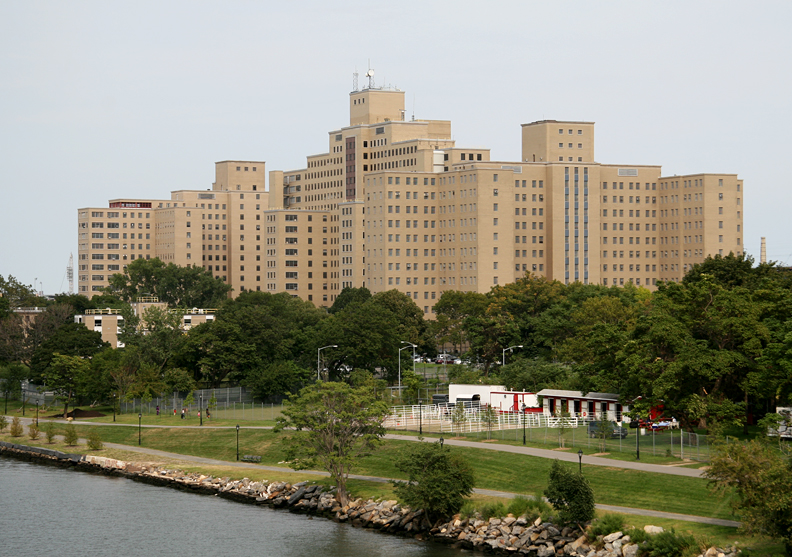
    Traveling over the Ward’s Island Bridge, in sapphire blue and emerald green, leads to an island of contrasts, an amalgam of environments and elements. Here you will find beautiful vistas, Ward’s Island Park, viaducts overhead from the Triborough and Hell Gate bridges, Little Hell Gate bridge (providing vehicular access to Manhattan), ball fields, the Manhattan Psychiatric Center, Kirby Forensic Psychiatric Center (which serves the criminally insane), one of the city’s largest homeless shelters (the Charles H. Gay Center with 960 beds), and a New York City Department of Environmental Protection wastewater treatment plant.

    On February 19, 2008, I wrote Sin of Omission about Ward’s Island Bridge (although I had not yet crossed it). On this occasion, I crossed the bridge and visited the island (see my gallery of photos here). Crossing the foot bridge is a wonderful experience, owing to its very human scale and the complete lack of motor vehicles (open to pedestrians and bicycles only). Your first steps off the bridge bring you to Ward’s Island Park, which wraps around the island along the waterfront. The day I arrived, families were picnicking and barbecuing. Walking the waterfront park affords vistas of Mill Rock Park, Manhattan, Queens, the Harlem and East Rivers, and the numerous aforementioned bridges.

    Leaving the park, however, and making a foray into the hinterlands gives a much different experience. The omnipresent Manhattan Psychiatric Hospital looms and is visible from nearly everywhere. Opened in 1899, it was the largest psychiatric hospital in the world. Knowing the nature of its occupancy was rather sobering. A stroll by the Charles H. Gay center was unsettling. Fenced off, the entrance was guarded by police while I observed a handful of rather threatening-looking individuals. At the time of my visit, I did not know that the facility was a homeless shelter. City buses provide transportation to and from Manhattan. The standard fare for bus is charged for the homeless (see article here).

    If you enjoy exploring the lesser-travelled corners, then Ward’s Island is your place. If not, crossing the Ward’s Island Bridge will provide a unique experience. On this visit, by crossing the bridge and visiting the island, rather than just taking a photo from afar, I found myself well reWarded…

    Note: Ward’s Island (along with Castle Clinton in lower Manhattan) was the original point of entry for immigration into the United States prior to the use of Ellis Island. For a history of the island and park, see the NYC Parks website here.


  • Electrical Outlets, Part 1

    I recall a report card as a child where my grade school teacher commented, “Very curious child.” Being curious has its pluses and minuses. Like investing in stocks, there is a risk/reward ratio.

    I paid handsomely once when, curious about the nature of electrical outlets in the wall of our home, I decided to explore the receptacle with a set of my father’s keys. The result was quite shocking. I have been told that I spent some time running around the room fanning my fingers, exclaiming “whew” repeatedly. No additional punishment was necessary – a lesson concerning electrical outlets was learned.

    At other times, I have been well rewarded for my curiosity. My meeting with Walid Soroor in Jackson Heights is a great example, providing not only a story and photos but also a life experience I will remember and retell.
    I have an obsession at times with leaving no stone unturned and pressing myself to the edges or top of a place, uneasy with the thought that in not doing so, something might be missed. At the top of my must-do list were places such as Montauk, Cape May, Provincetown, Key West, the Eiffel Tower, the Washington Monument, the Empire State Building, and the last address on Fifth Avenue.

    Avenue D is the easternmost north/south avenue in Manhattan. The next stop going east is the the FDR drive and the East River. That made traveling to Avenue D in the East Village, of course, de rigueur, and my mission was completed soon after moving to New York City.

    The 1970s, however, was no time to be exploring Alphabet City. This was truly one of the most dangerous areas of the city, so my initial visit was toe-dipping at best. Risk/reward played a strong hand here. Rents were extraordinarily cheap, and I knew many who sought housing in this neighborhood. Residents, however, found themselves sharing not only the neighborhood but also, almost assuredly, their buildings, with drug addicts. Muggings were not just some abstract statistical risk but something that occurred with regularity to residents, both night and day.

    So my true exploration of this area came much more recently. Since the inception of this website, I have uncovered many a gem here, particularly the community gardens. For someone seeking a broad range of eating options, both in food and price, the East Village (and Lower East Side) is hard to beat.

    If you have not visited the far East Village, I would heartily recommend it. The area is ripe with nightlife, music, clubs, and bars. There are things of interest even as far east as the streets between Avenue C and D, but as far as Avenue D itself, it is perhaps the least interesting in Alphabet City. There is no need to actually visit Avenue D unless you have a history of exploring electrical outlets with your father’s keys 🙂

    Note: Tomorrow, we explore the ultimate in electrical power in Part 2.


  • Affront To Dignity

    If there was a God of New York City, wasting space would be a mortal sin. In this city, we are obsessed with space. To find a convenient parking spot is considered a major achievement – worthy of announcement, with an expectation of hearty congratulations. Floor space, whether commercial, industrial, retail, or residential, is one of the key features of a place. For the city dweller, a visit to a museum is often as much about indulgence in space as it is about the art collection. In our homes, most of us optimize for efficient use of limited space. This is not a world known for foyers, entrance hallways, garages, basements, attics, and extra guest bedrooms. We even sell air rights in New York City – every cubic inch of 3D space is accounted for (see my story here).

    I recall having a conversation once with a relative who owned an industrial space in the suburbs and needed to expand. The solution was simple: tear down a wall and just build out. That seemed miraculous and inconceivable to me at the time, like a suprahuman act of creation.

    A terrace or garden is the ultimate spacial luxury in this city, as we add nature and the outdoors to sweeten the pot. Many high-rise apartments in New York City have tiny concrete slabs which, for the purposes of the real estate sales and promotion, are called “terraces.” This is laughable – you can see thousands of these affronts to human dignity dot the skyline of New York City. I’ve never seen anyone on them; often, they are used for storage and become aerial eyesores. It would be hard to argue that lack of use of these terraces is a wasted resource.

    However, in today’s photo, I submit to you evidence of a real space wasted. This wood-decked terrace is as large as many apartments, overlooks a quiet alley, and has good light, trees, plantings, and views of the Empire State Building. The terrace is attached to a two-floor apartment in an 1837 landmark brownstone. I know the tenants of this apartment and was told many years ago by the husband of the couple who lived there that he had not set foot in the space for 14 years.
    This outdoor space is still infrequently used. Most New Yorkers just drool at the prospect of an outdoor garden like this and fantasize about all the wonderful uses they would make of it. Some may argue that all outdoor terraces or gardens subject the users to a fishbowl effect -that there is virtually no privacy from the prying eyes of other apartment dwellers within eyeshot. I think in this case, many a New Yorker would welcome this invasion of privacy and find it no affront to dignity  🙂

    Related Posts: Seven Deadly Sins, Air Rights


  • The Hole

    Do you really want to be a pioneer? Find a place that may not quickly become overbought or overhyped? Then welcome to the Hole, a “hood” which I can assure you will not become the “next neighborhood” or be dotted with interesting cafes and nightclubs, like in Williamsburg, Brooklyn. See the photo gallery of my excursion here.

    I recently was forwarded an article by a friend on a small, virtually unknown area on the Queens/Brooklyn border known as the Hole. A handful of articles have been written, with features on sites such as Gothamist, Impose Magazine, Satan’s Laundromat, and Forgotten New York, which referred to it as “the true New York, this is NYC with pretense and artifice stripped away.”
    This wasteland certainly lived up to my expectations. I anticipated spending considerable time there, walking around, and photographing the area, but a few minutes there and I realized this did not have the charm of an abandoned ghost town in the West. This place truly was blighted, with outsiders clearly seen as outsiders.

    The Hole is a small triangular neighborhood bounded by South Conduit Boulevard, Linden Boulevard, and Drew Street, an area roughly five blocks by three blocks, surrounded by the neighborhoods of East New York, Ozone Park, Spring Creek, and Howard Beach. The area straddles Brooklyn and Queens, hence the reason the New York Times, in an article in 2004, said, “It is the closest thing New York has to a border town.” Ironically, the Hole also contains the “jewel” streets: Ruby, Emerald, Amber, and Sapphire Streets (now 78th Street).

    There are a handful of houses, inhabited and uninhabited, strewn across an area of weeded open lots, flooded streets with stray garbage, and no sidewalks. At one time occupied by farms and horses, this was also the former home of the Federation of Black Cowboys.

    The term “Hole” has a literal meaning in this neighborhood, which lies below grade and only a few feet above the water table. It is built on landfill over Spring Creek and is subject to frequent flooding – you can see this in today’s photo. The area is also not incorporated into New York City’s sewer system – the handful of homes here use cesspools.

    Any apprehension or creepiness you may feel here is not unfounded – the area is most notorious as a dumping ground for bodies in mafia mob wars for over 50 years. There are stories of 200 bodies being found. According to the New York Times, a lot of Ruby Street between Blake and Dumont Avenues was a suspected Gambino family burial ground. Alphonse Indelicato, Phillip Giaccone, and Dominick Trinchera, of the Bonnano family mob, were murdered and buried in a vacant lot in the Hole.

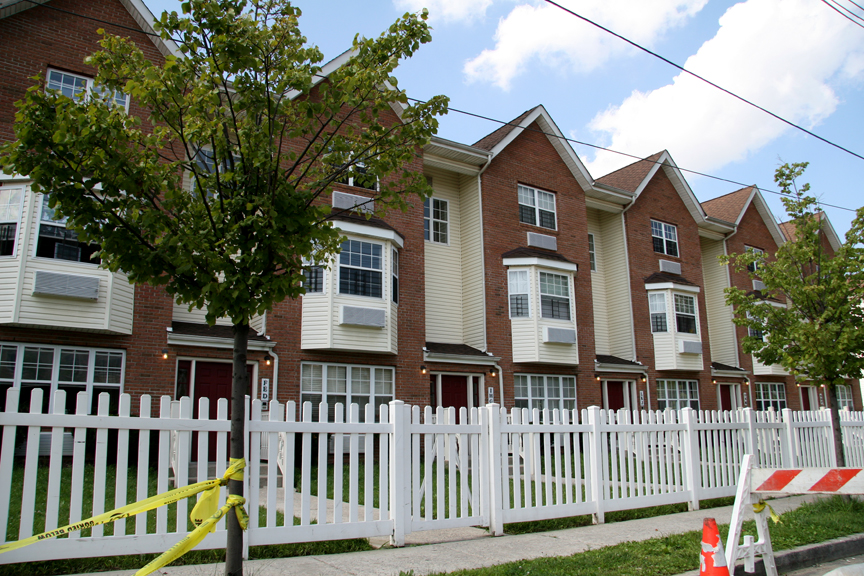
    There has been real estate speculation here – see the new row houses here on Ruby Street. However, projects here have stalled. The mountain of rubble in my photo series is an 8-acre plot which was slated to become Cobblestone Estates, a gated community. It is now in limbo – you can read about it here.


  • Eldridge Street

    In my story on January 12, 2009, Small Achievements, I wrote of those small, nagging, unresolved questions, not quite big enough to aggressively pursue, but not quite small enough to completely forget. They raise their head when a particular situation recurs, whereupon, enthused by the moment, you promise yourself that this time you will absolutely put the mystery to rest as soon as you get home.
    Of course, it is either then forgotten or put off to another time, unless you have a photo of the mystery you would like to feature on a website about New York City and, in fairness to your readers, you really must get to the bottom of this. Now you have that added impetus to get the doing done.

    One problem, however, with sharing a vista like this one is how you would go about taking a photo while driving in a moving vehicle. It’s easy when you return from Brooklyn on a beautiful day, everyone is on the road, and your vehicle is not moving because traffic is at a standstill, briefly interrupted with some inching forward.

    The bridges across the East River – Williamsburg, Manhattan, Brooklyn, and Queensboro – afford spectacular vistas of Manhattan, Brooklyn, Queens, Staten Island, and Roosevelt Island, along with streetscapes, waterscapes, the Statue of Liberty, Governor’s Island, and an articulation of buildings of the skyline of New York as far as the eye can see.

    Somewhere in all of this, there will be a glorious accident of perfect alignment. So it is with the vista from the western end of the Manhattan Bridge looking north, straight up this narrow one-way street, where you have a classic New York City juxtaposition: an unobstructed view of the Chrysler and Citicorp Buildings, framed by rooftop graffiti and the jingle jangle of the Lower East Side with a spattering of Chinatown. But the question for me has always has been, which street is that, so conveniently aligned?

    A little online forensic work identified the mystery thoroughfare, which runs eight blocks from Division Street at the base of the bridge to Houston Street and is wholly contained within the Lower East Side: Eldridge Street.

    Note: if you look carefully at the photo, you will notice a church on the right side – this is the Eldridge Street Synagogue, built in 1887 and a national historic landmark. It is one of the oldest synagogues in the United States built by Eastern European Jews. It is also home of the Museum at Eldridge Street, which presents the culture, history, and traditions of the great wave of Jewish immigrants to the Lower East Side with tours, exhibits, and public and educational programs.


  • The Rockaways

    Just a subway ride away on the A train, you will find not a bay, inlet, or river, but rather, the Atlantic Ocean. This is the Rockaways, a peninsula, most of which lies within the borough of Queens, New York.

    The beach has an active surfing community – there are three surf shops in the area. The approach of hurricane Bill was seen by most as worrisome, but surfers heralded the storm as a joyful rare opportunity to surf the big waves. So, this seemed the perfect time to take a trip out to the Rockaways to catch some waves with a camera. Beaches were closed to bathers but open to surfers. See more photos here.

    The 6.2 mile boardwalk is a huge feature of the area, extending from Beach 9th Street to Beach 126th Steet. The central area of Rockaway Beach is fronted with large, hulking public housing projects, many of which became riddled with crime. There are new apartment condominiums newly built and in the works. Strings of closed stores line 116th Street, the main shopping district.

    Driving from one end of Rockaways to the other through the varied communities – Belle Harbor, Far Rockaway, Arverne, Neponsit, Rockaway Beach, Rockaway Park, Breezy Point, and Edgemere – is one of the most shockingly diverse demographic ranges of humankind I have seen, from lower to upper middle class. Driving amongst the virtual mansions in Belle Harbor, the ramshackle nature of central Rockaway seemed a flawed memory.

    I missed many of the interesting areas, such as the historic bungalows off the boardwalk at Beach 108th St. that have become summer rentals and the scenic area at the end of the boardwalk from 121st to 126th Streets. I intend to return and explore more of the area on foot.

    This is truly the land of the haves and have-nots, but the ocean and the boardwalk looms large and mitigates much of the area’s depressed pockets. The ocean is a curative for the human soul, and I believe all feel fortunate to have such a fine strip of ocean, sand, and boardwalk…

    NOTE: The Rockaways have a rich history: from 1902 to 1985, there was a large amusement park called Rockaways’ Playland. See a photo history here.


  • Mulberry Street


    I so looked forward to my visit to Aix en Provence in the South of France. Everything I had read spoke of it as the quintessential cafe society experience. In New York City, there is a limited amount of quality street side cafe or restaurant seating. In most cases one must suffer the slings and arrows of anything and everything that passes by. Often, tables are placed on sidewalks much too narrow for adequate separation; the sense is that you really are eating on the street. Diners are often accosted by panhandlers and the like.
    So for a New Yorker, Aix was paradisaical – wide sidewalks and a clean environment. However, this is Mulberry Street in the heart of Little Italy. Beginning in 1996, three blocks from Broome to Canal Streets are closed to vehicles during the summer months, turning the street into a pedestrian mall. In September, the street is closed for the annual Feast of San Gennaro festival.

    Outdoor seating for restaurants and cafes line Mulberry Street. Restaurant barkers solicit business from passersby. Add heat to the equation, and it will take a certain je ne sais quoi to enjoy eating in this zoo-like atmosphere.

    A visitor to the area will also find the surrounding area dominated by Chinese merchants. Neighboring streets (such as Mott Street, one block east of Mulberry) have seen the encroachment of Chinatown. Little Italy has become essentially a small pocket of nostalgia, a virtual postcard snapshot of this historic neighborhood.

    I cannot heartily recommend any particular restaurants here (or eating on the street). If you choose to try something on the street, I recommend eating guides such as the Zagat Survey or Yelp. Many residents pan the eating establishments here, but there are endorsers – in 2004, Mayor Rudy Giuliani cited Da Nico as his top pick for Italian in Little Italy. And yes, there has been Mafia mob presence on the street, as well as scandals.

    If you have not been down Mulberry Street during the times it is closed to traffic, I do recommend a summer evening stroll where you can walk among the teeming masses. For an online virtual walking tour of Mulberry Street, go here to New York Songlines…

    Photo Note: There is a very enjoyable book, New York Then and Now, which shows specific New York City locales using two photos, one earlier in time and one taken at the time of the book’s publishing. In this spirit, today I have added a second archival photo showing a stretch of Mulberry Street, circa 1900.


  • Slummin’

    Posted on by Brian Dubé

    Slumming is a peculiar phenomenon. People work hard to improve their lives economically and socially, yet once they are established, some work just as hard to find and frequent the type of places which they endeavored so desperately to leave behind.

    Or so it appears. There is a cache to slumming. The act of dumbing down ones choices for eating and playing somehow confers authenticity and coolness. But I think what is actually happening is that this type of activity is limited to areas where others of like mind and age have settled. How many actually want to live among the poor, isolated in a neighborhood with none of their peers? There are some, of course, who did move into uncharted territory, paving the way for others. I have always admired the spirit of these early pioneers.

    In fact, it is debatable whether there can be any real slumming in Manhattan. Virtually every neighborhood is fully gentrified, partially gentrified, or populated by some variant of the downtown hipster. There are few neighborhoods left which are strictly the domain of the common, working-class man or woman.

    In the final analysis, a person of means can never really experience the life of the poor or the common man. If nothing else, knowing that one has options and is only a tourist in a disadvantaged world makes all the difference.

    I was surprised to learn that slumming dates back to the late 1800s. According to a recent fascinating New York Times article, When ‘Slumming’ Was the Thing to Do, the practice started in London and had versions in urban America, centered in Chicago and New York City.

    In 1884, a headline in The New York Times proclaimed: “A fashionable London mania reaches New-York. Slumming parties to be the rage this winter.”
    It was one of the early indicators of what grew to be an entertainment phenomenon that lasted decades: well-off white New Yorkers exploring black, Chinese, gay or poor working-class communities. Popular neighborhoods for this voyeuristic pastime included Chinatown, Harlem and the Lowest East Side tenements, home to the “Hebrews.”

    More recently, a new industry has been built around the practice, coined “slum tourism” or “poorism.” The practice is controversial: is it tourism or voyeurism/exploitation? See an article here about the phenomenon.

    Hector’s Diner is authentic. Located at 44 Little West 12th Street under the High Line, it is still patronized by workers from what remains of the local meatpacking industry. The meat packing district was truly the quintessential working-class neighborhood and one which required some intestinal fortitude to visit. Carcasses hanging on hooks, barrels of entrails, and meat refuse was the reality here. I rented storage space here at one time, and early morning visits required a little mental preparation for the visual assault. The neighborhood is now quite ultra chic, but vestiges of the original meat industry still exist, as I explored in Fresh Meat.

    I have not eaten at Hector’s or been inside, but judging from the food reviews (which have been quite favorable), I expect that at the right time of day, along with the common man, you will find some others slummin’ 🙂

    Related Posts: Pastis, Old Homestead, Men Making Noise, Western Beef

    Posted on by Brian Dubé

  • City Island

    Posted on by Brian Dubé

    There are places which are a writer’s dream subject. If your reader is unfamiliar with the locale, it makes you look like a brilliant explorer who has uncovered a real gem. And visiting for the sake of a writing assignment is a real perk. The only real difficulty is avoiding the cliches which have been used ad nauseum.
    In this case, the place is City Island, Bronx, and the cliches are words and phrases such as “look and feel of a small New England fishing village,” “more like Cape Cod than New York,” “Nantucket,” “less Cape Cod, perhaps, than a tiny, Stephen King-like town on the lonesome Maine coast,” ” a constant reminder that this idyllic spot is not Nantucket but an island in the Bronx,” and “an active fishing village with a 718 area code.”

    The beauty of City Island is that it does live up to all the cliches, metaphors, and comparisons. I suggest a visit – you won’t be disappointed. If you don’t have access to a car, it is serviced by public transportation. However, you will need to take both a train and bus to get there.

    You are never more than a few blocks from the water. City Island is quite small – at 252 acres, it is only 1/3 the size of Central Park with 4520 residents. It is accessible to the Bronx mainland via the City Island Bridge. As would be expected, everything is defined by the ever present water – fishing, boating, shops with a maritime focus, and the Nautical Museum. We spent a pleasant time with proprietor and long-time resident John at Trader John (upper photo), 239 City Island Avenue, which specializes in new, used, and antique marine and nautical supplies.

    Seafood and seafood restaurants are abundant. We chose Tony’s Pier Restaurant at one end of the island (1 City Island Avenue), a fast food-styled place on the water (across the street from Johnny’s Famous Reef Restaurant). We ate our food to the sounds of the ocean and a huge population of seagulls. See my gallery of island photos here.

    I find a comfort and restorative experience being at the ocean. Instinctually, we all recognize its constancy and tremendous power – surrender to it and in that surrender, find comfort. Like being in the hands of a vigilant, caring doctor…

    Posted on by Brian Dubé

  • Williamsburg

    Posted on by Brian Dubé


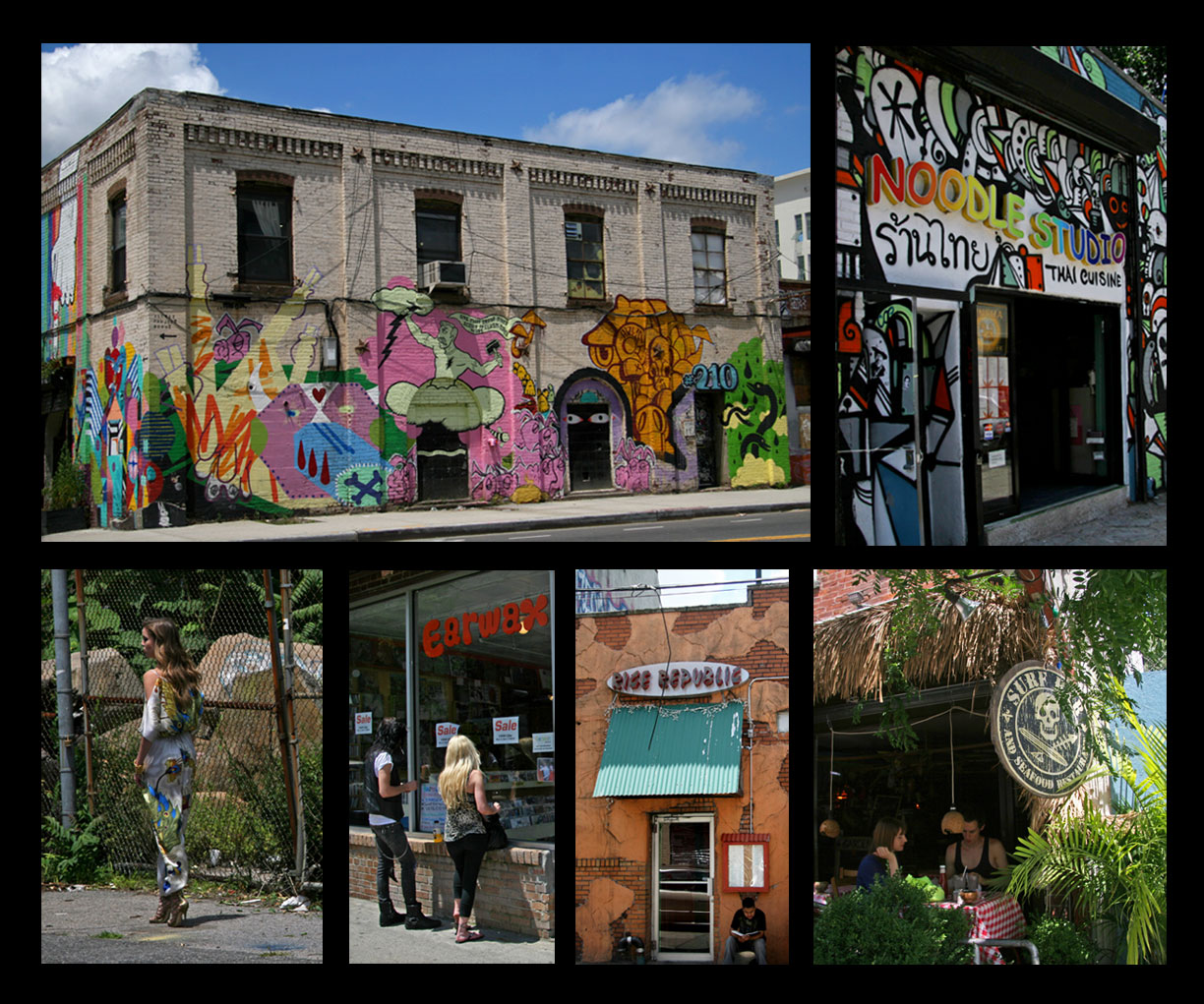
    If you live in New York City, Williamsburg, Brooklyn, as well as its resurgence as a vibrant community, comes as no secret. The press/media and its readers love stories about the next SoHo, the Next Neighborhood, the American version of Le Marais, and other analogies intended to drive sales of newspapers, magazines, and real estate properties.

    Many changing neighborhoods have been over-hyped, later to miss the mark on the predicted trajectory. Williamsburg, however, appears to be living up to its expectations. Domination of conversation about these new burgeoning neighborhoods should not be interpreted to mean that prime real estate in New York City’s finest neighborhoods are now out of favor and can be had for a pittance. There’s just little excitement and buzz about neighborhoods whose future have long been a fait accompli and where prices are now stratospheric. Everyone is looking for the next new place.

    It would be difficult to overstate Williamsburg’s importance; its history is quite remarkable. The neighborhood was once home to Corning Glass, Pfizer Pharmaceutical, Esquire Shoe Polish, and the iconic Domino Sugar factory.

    From 1827 to 1855, Williamsburg became its own incorporated town/village/city, later annexed into the city of Brooklyn. It was home to mansions owned by Vanderbuit, Fisk, and James Pratt, who founded Pratt Institute. The area became an American industrial powerhouse, and at one time in the 19th century, it had 10 percent of the wealth in the United States. This is an enormous subject – read more here.
    The area is also very ethnically diverse, with many groups including Hispanic, Italian, and Hasidic Jews – over 70,000 Satmar Hasidic Jews live in Williamsburg.

    Since the 1970s, as rents escalated in SoHo and the East Village, Williamsburg became a magnet for a growing community of artists and musicians. The trend has continued, but as to be expected, the cost of real estate has forced those shopping for less expensive alternatives to look further afield. According to a New York Times article, Old Europe and New Brooklyn in Williamsburg, there has been an enormous influx of Europeans to the neighborhood, with shops to service their needs.

    One feature of the neighborhood has always been convenience; Bedford Avenue (the heart of the area) is only one subway stop from Manhattan. However, it should be noted that this stop is serviced by the L train, which only travels crosstown on 14th Street in Manhattan.

    There is a enormous number of shops, clubs, cafes, restaurants, and galleries catering to the wave of newcomers in the last few decades. To anyone unfamiliar with this neighborhood, I would highly recommend a visit to Williamsburg…

    Posted on by Brian Dubé


  • dinamic_sidebar 4 none

©2026 New York Daily Photo Entries (RSS) and Comments (RSS)  Raindrops Theme