• Where Sleeping Giants Lie


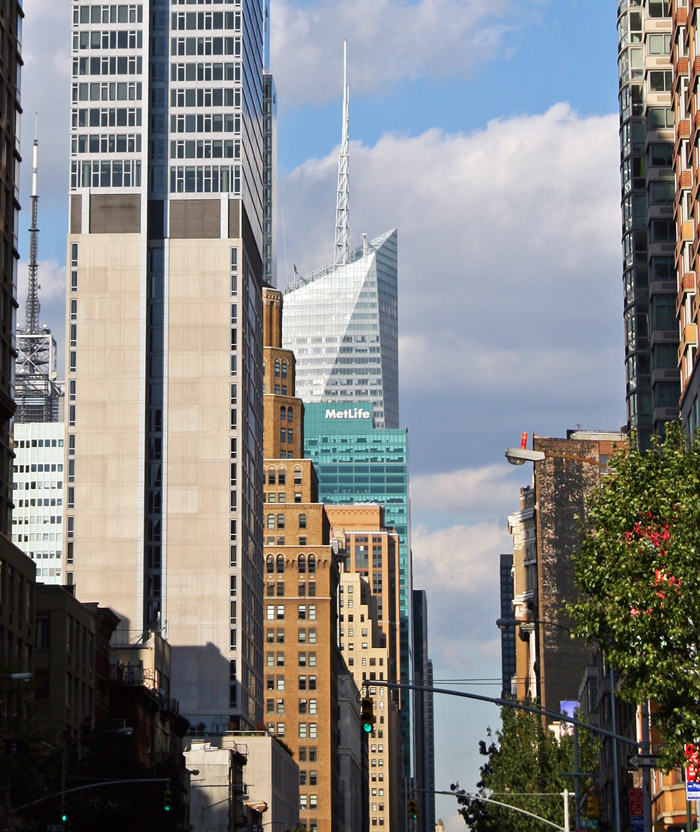
    How absolutely absurd and embarrassing. A small group of us were on a building rooftop admiring the spectacular views of Manhattan when someone asked about the identity of a spired skyscraper. A few of us briefly deliberated and offered our conclusion, which was not called into question – after all, we were New Yorkers speaking and there with natives among us. Why do I say absolutely absurd? Because this is the second tallest building in New York City after the Empire State Building and we misidentified it. In our defense, however, depending on the vantage point and perspective, many a tall building can be out sized by a shorter one, as is the case in today’s photo.

    The Bank of America Tower at One Bryant Park is located on 6th Avenue, between 42nd and 43rd Street. The $1 billion project, completed in 2009, was designed by Cook+Fox Architects and is one of the most efficient and ecologically friendly buildings in the world. It was the recipient of the 2010 Best Tall Building Americas award by the Council on Tall Buildings and Urban Habitat.

    The tower received LEED Platinum certification on May 20, 2010. This is the first time in U.S. history that a high-rise commercial office building has attained the highest LEED green building rating for environmental performance and sustainability. Here are just a few of its green features (see more here from the Bank of America press release):

    Air filtration removes 95 percent of particulates. Most outside air is taken in at 800 feet above street level.
    Water savings of approximately 7.7 million gallons per year are achieved through graywater treatment and reuse, waterless urinals, and low-flow plumbing fixtures. Graywater system captures and reuses nearly all 48 inches of annual precipitation.
    Structural materials include steel made of 87 percent recycled content and concrete made from cement containing 45 percent recycled content (blast furnace slag).
    Ninety-one percent of all construction and demolition waste was recycled or otherwise diverted from landfill.
    On-site co-generation system provides approx. 65 percent of building’s annual electricity requirements, and reduces daytime peak electricity demand by 30 percent.
    The Urban Garden Room provides green public space, reinforcing building’s street-level interactions as well as its connection to Bryant Park.

    How could a number of Manhattan residents not be acquainted with a structure 1250 feet tall? Where could a world renowned, cutting edge, award-winning, 55-story building hide and a resident not even be familiar with its existence? In New York City, of course. Whether it is an Afghani rock star eating at a nearby table, a regular in a park wearing tattered clothes who is a concert pianist with two PhDs in pharmacology (see here), or one of the world’s tallest and greenest buildings – hidden in the crowds of people and buildings among us, this is where sleeping giants lie


  • In His Hand


    In the 1970s, I used to frequent the neighborhood Brentano’s Bookstore, located in the Village at 20 University Place and Eighth Street. On one occasion, I met a man who astounded me – he read entire books in one afternoon while standing or slowly ambulating in the shop. I doubt he was reading the likes of Ulysses, but this was still particularly remarkable, not just in the reading feat itself, but also given the nature of bookstores at the time. Even though bookshops have historically been liberal in their reading policies, it still was not a time with bookstore’s cafes, various seating areas, or where one could find customers researching while virtually camping out on the floors and tolerated by the management. And, apart from libraries, it was not a world of free content, just a few keystrokes away.

    Ebook readers have been around for much longer than many might imagine* – since 1998, with early pioneers in portable eBook readers, such as the eBookman by Franklin and the Rocket eBook. I was given one of these devices over ten years ago. It sat unused. Issues of content, moving files in and out, lack of wireless Internet, low-contrast screens, and other technical shortcomings of the devices all conspired against the wholesale adoption of ebooks and readers. But ebooks appear to be ready for prime time, fueled by the eInk technology with its high contrast paperlike readability, lightweight devices, low power requirements, and Internet integration. Devices like the Barnes and Noble Nook, the Amazon Kindle, and Apple’s iPad are selling well and can be seen throughout the city.

    In my own business here in New York City, we publish a small selection of highly specialized books. With some titles, this necessitates inventorying print runs for years. Recently, we made the big decision to go digital with some of our titles. One of our first candidates was Circus Techniques by Hovey Burgess (you can read about him in Fish and Ponds). We dragged out a copy of the printed book from my library as well as the original film flats, all shown in the photo – this is how printers worked and prepared books for offset printing. After evaluation, we decided that it would be easier to OCR scan the entire text, so the flats are back in storage, a relic of a time gone by.

    New York is book country, and arguably the epicenter of publishing in the United States. I doubt that printed books, magazines, and newspapers are going to diminish as quickly as did music CDs or that bookstores will disappear like CD merchants did. The development of electronic media is, however, sure to impact New York. Recently, Barnes and Noble announced the closing of their massive store near Lincoln Center. The company itself is for sale.

    I’d love to meet that reader from Brentano’s now. Although the end of an era is close at hand, I am sure he would be overjoyed with an eReader and a few thousand titles in his hand 🙂

    *The earliest digitization of a document was that of the United States Declaration of Independence by Michael Hart in 1971, then a student at the University of Illinois who had obtained access to a Xerox Sigma V mainframe computer in the university’s Materials Research Lab. Hart then went on to establish Project Gutenberg, a voluntary effort, now with over 33,000 titles available free, primarily public domain books.


  • Halloween Parade 2010


    Each year since 2006, I have attended and photographed the annual Village Halloween Parade and posted photos here. The event continues to overwhelm in every way – size, creativity, and attendance with every imaginable costume theme – fanciful, whimsical, horrible, ghoulish, political, or inspired by current events or products. It is only possible to see a tiny fraction of the myriad of costumes even when present. I have selected from the over 400 photos I took at this year’s parade – additional photos are located here. See the links below for the previous years – these postings have parade information, photos with the posting, and additional galleries for each year.

    Previous postings on the annual Village Halloween Parade: Halloween Parade Preview 2006, Halloween Parade 2006, Village Parade 2007 Preview, Village Halloween Parade 2007, Village Halloween Parade 2007 Part 2. Halloween Parade 2008, Halloween Parade 2008 Part 2, Halloween Parade 2009


  • 5 Pointz


    Note: Please see my full gallery of photos here.

    I recently showed my posting, Unconditional Love, to a coworker*, who commented, “Do you know that building in Long Island City, Queens, with all the graffiti?” To which I replied, “What building?” A search brought up the building in question immediately: 5 Pointz.

    I visited on a Sunday morning virtually alone. I was told by the manager of the property that I was fortunate because tour buses frequently make the a visit, bringing massive crowds. Painters were already on the scene, however, at various locations.

    I was astounded by the work, brilliant color, and mammoth size. All the surfaces of the block long, 200,000-square-foot (19,000 m2) factory building complex, are covered. The building itself is owned by Long Island real estate developer Gerald Wolkoff, who sanctions the work.
    The property was the vision of Jonathan Cohen, aka Meresone. Originally Phun Factory, the property is now known as 5 Pointz: “The Institute of Higher Burnin’ ”

    In chatting with the manager, he made an important and valid distinction between graffiti and what is being done here, echoed by Cohen: ”Graffiti is a label for writers who vandalize. Aerosol art takes hours and days. It’s a form of calligraphy.” Signature tagging is typically unsanctioned. What goes on at 5 Pointz goes through an approval process. New work goes over old. The length of time a piece stays up is at the discretion of the managers, with considerations for quality of work and time in creation. From the 5 Pointz website:

    The name 5Pointz signifies the five boroughs coming together as one but, because of its reputation as an epicenter of the graffiti scene, the industrial complex has actually united aerosol artists from across the world. Legendary writers from Canada, Switzerland, the Netherlands, Japan, Brazil, and all over the United States have painted on the building walls.

    5 Pointz is also in use as a location for work by photographers, filmmakers, musicians, and artists. See my gallery of photos here. If you want to see the last word in aerosol art in a New York City industrial setting, take a trip to 5 Pointz 🙂

    *Thanks to Naomi D for making me aware of 5 Pointz!


  • In Industry


    I recently was designing carrying bags for my product line. Outsourcing for a small business in small quantities is not viable, so we turned to domestic sources. This process was also getting us nowhere, so I decided to go local. If you want to understand the beauty of a manufacturing district, than go through the design development to production phase of a product where all your suppliers are within walking distance of each other. The ease and speed is astounding.

    Within a span of two New York City blocks, I was able to procure fabric, hardware, sewing accessories, visit a sewing contractor, and get pricing. If you have a pattern and materials, you can often even get a finished sample while you wait. If you are designing new products, this typically requires many revisions. Once you have gone through this process within the garment district, any other way becomes almost unthinkable.

    The networking and referrals also greatly accelerate the sourcing process. Rather than hunt through the myriad of vendors for a particular piece of hardware, one supplier gave me the name and address of a specialty house one block away. A quick walk and I had exactly what I wanted.

    The garment industry is really one of the last industries New York City has left where the entire supply chain is located in one area, from design to production of finished products. We’ve lost enough in New York City, and anyone with any history and familiarity with New York sees the danger in losing the garment and fashion industry. There is concern over this matter, and efforts are being made to keep the industry in the city.

    Step into one of those spartan, all-stainless steel elevators in the west 30s. Step off and find your way down a dimly lit hallway to a sewing factory, buzzing with machines. This is not the New York City of movies, entertainment, architecture, glamour, glitz, or fine dining.
    This is New York at work. In Industry 🙂


  • Pillowcases


    I have many good childhood memories of Halloween. However, with some, it was a time of opportunity and greed. Some of the kids I knew at the time approached the night as a virtual legalized form of looting, going out very aggressive and focused, on a mission. They were typically much older, and their costuming was minimal – seen only as a necessary nuisance to legitimize their door knocking and collection. After their high-speed tear through the neighborhoods, they bragged to others of booties that were a pillowcase full – that’s a lot of candy.*
    Others of us with more modest goals, counted and compared tallies on number of candy bars collected. Fruit and other assorted sundries were looked down upon. And as the growing number of incidents of fruits and other non-packaged items being laced with drugs, chemicals, or razor blades became greater in number, we had further reason to dismiss these trick or treat gifts.

    It was not until I became an adult living in New York City that I began to experience Halloween as an opportunity for creative costuming, parties, and decorations, with the annual Village Halloween Parade as the pièce de résistance, with millions attending.

    There is a limited amount of door-to-door prospecting for goodies by children in the city, but it does exist. In larger buildings, particularly in Manhattan, children often go trick or treating in their own buildings (or to their friend’s buildings) from apartment to apartment. Often signs will be put on apartment doors indicating whether or not the occupants are participating.

    In the outer boroughs, children still make the rounds to private homes, much as they do in the suburbs or countryside. However and wherever you do it, I hope parents will help children measure the fun in ways other than pillowcases…

    *I found a science project online that proclaimed:

    When it comes to Halloween, greed is most definitely good. And there’s nothing like an old pillowcase – sturdy, voluminous, reusable, and environmentally conscious – to hold your epic stash. But you must have wondered – exactly how much candy could you possibly collect in a standard pillowcase? How many houses would you have to visit and how much ground would you have to cover to achieve that that elusive goal?

    The project went on to calculate not only the amount of candy that would fill a pillowcase (48 lbs, 1690 pieces) but also how much time, area and walking would be needed. In Campbell, California, it was estimated that you would have to visit about 1352 houses to fill a pillowcase, and walk about 11 miles, covering .42 square miles.

    Photo Note: Today’s photos were taken in Brooklyn Heights, one of the most pristine, bucolic, picturesque, and cloistered neighborhoods in the entire city of New York. See my posting here.


  • Abandon All Preconceived Notions Ye Who Enter Here

    The Story of Driss Aqil

    There should be a sign at every tunnel or bridge approaching New York City, at every NYC airport, bus, and train station, and on the door of every New York City taxicab, which boldly proclaims:
    Abandon All Preconceived Notions Ye Who Enter Here.

    If you are unwilling to heed this admonition, be prepared to have all your stereotypes, biases, racial or ethnic profiling, and distinctions made by class or job seriously challenged.
    Of course, generalities do generally apply. Typically, you don’t find an adjunct professor of Mathematics and Ph.D candidate driving a taxi. But I said typically, not a very useful word in New York City.

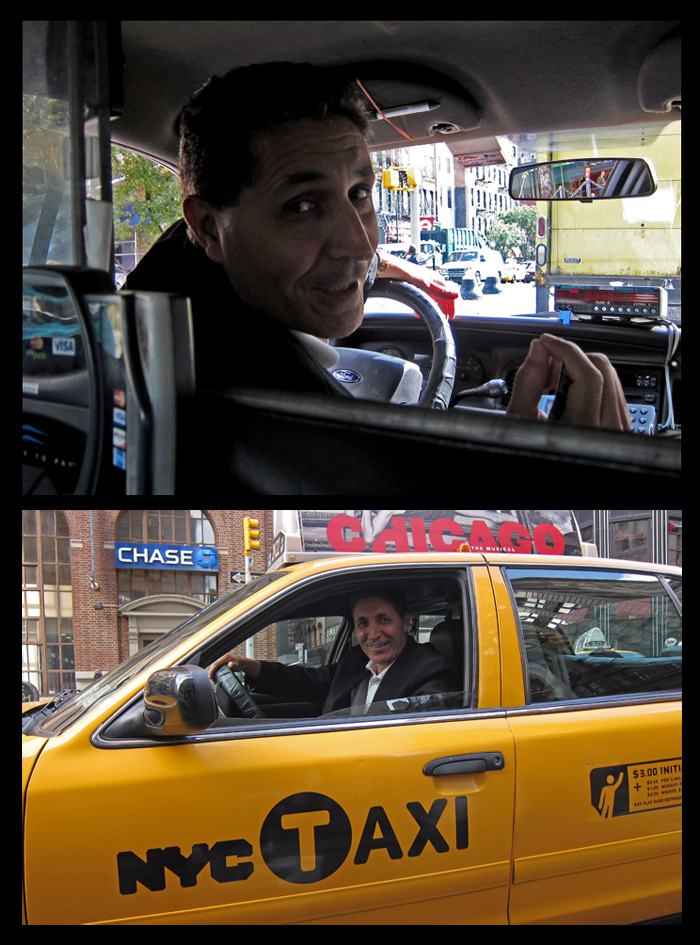
    I rarely take taxis these days unless I have to transport heavy objects or loads, which was the case on Thursday, October 14th. I often strike up conversation with drivers, and this driver seemed particularly astute. There was attention and intention when he listened to my destination address. I had the sense that his whole demeanor was saying – Ok, I know where you are going and the best way to get you there. Like an expert surgeon performing a routine task, lie back and leave the cutting to me. We cut through traffic as we conversed.

    I became engrossed with the details of his life and accomplishments in the United States of this Moroccan immigrant. We were both excited to meet – he commented he had more conversation with me in a few short minutes than he had in the last 10 years. However the taxi ride was very short, so we agreed that he would follow up with the details of his life by email – he wrote his name, Driss Aqil, and email address clearly on a receipt.

    I was very disappointed when my first email to him was bounced back. A number of friends examined his name and concluded that I misread the q as g in Aqil. However, although the following emails were not bounced, they were not answered either. Until last night. They had gone into his spam box. He answered the questions I had outlined. Here are some bullet points of the bio Driss emailed me:

    Born in Fquih Ben Salah a small town situated about 3 hours from Casablanca. Worked in Morocco in oil drilling and exploration for about 8 years. Came to the USA in 1989. Lived in the YMCA on 34 street in Manhattan for a few weeks. Worked at LTR Jeans as a stock boy, became warehouse manager and store manager shortly after.

    Moved to Bay Ridge (Brooklyn), Astoria (Queens), and finally moved to Bensonhurst when married.
    Drove a a New York City taxi since 1996 till now.

    Education in USA:
    – Associate in computer Sciences( Honors) Phi Theta Kappa, NYCCT, CUNY. Bachelor in financial applied mathematics. Magna Cum Laude, Tau Sigma Honors NYCCT,CUNY. Masters in Applied Mathematics, Queens College, CUNY. Post- Baccalaureate program from Queens College, certified as secondary school mathematics teacher. Currently an adjunct professor of mathematics.

    Of course, there were tales of various celebrities Driss picked up and other stories while driving a taxi. He also had two articles published in the inaugural issue of City Tech Writer: A Thought on “The Struggle for Existence from the Point of View of the Mathematicians” and The Anchor Effect Discussed in A “Mathematician Plays the Stock Market”

    And finally, Driss says in his email:

    “Driving a Taxi allowed me to accomplish my studies. My goal is to get my PHD in mathematics in the near future, write a book about my experiences in driving the taxi in NYC.”

    Another installment in New York City’s live drama, Abandon All Preconceived Notions Ye Who Enter Here 🙂


  • The Point of Impact


    It was December 1983, and I was with my sister and brother-in-law in Nevis, West Indies. I was completely dumbfounded when, in renting a car at the tiny airport, I was only asked when I would return. There was no paperwork or contracts; the only requirement was to show a drivers license. The owner of the vehicle confirmed our agreement as to the rate ($25 per day), asked when I would return the car, and just handed me the keys.

    Upon arriving at my inn, the first question I had was to the inn owner about this car rental transaction – the most puzzling and lackadaisical I have ever seen in my life. He said to be assured, the owner would know my whereabouts at any given moment. I asked how that was possible. He told me that Nevis was a very small place (the island nation only has a population of 12,000), and everyone knew everything. I asked how any problems would be resolved. He assured me that everything would be fine, just don’t have an accident. This was not comforting at all.

    Equally discomforting was a comment made about the safety of motorcycles by a good friend I had in high school who owned many bikes. I have written about him before in Pork and Power. My impression of motorcycles was that of a vehicle which left the driver incredibly vulnerable, sheer lunacy to travel on vehicular roadways completely unprotected. I asked his opinion about the safety of riding such a thing, and his answer still rings in my mind whenever I see a biker on the road: “A motorcycle is the safest vehicle on the road up to the point of impact.”

    Up to the point of impact. What the hell did that mean? What it means, quite simply, is that the prospects for those in a motorcycle accident are indeed grim and, like renting a car in Nevis, the best advice is just don’t have an accident.

    On Sunday, on returning from Queens in a car on the Long Island Expressway, I witnessed the most outrageous and terrifying display of motorcycle mania I have ever seen. Hundreds of bikers, many in costumes, absolutely clogged the road with every manner of maneuvers imaginable. Screeching, squealing, weaving only inches between vehicles, driving between lanes, and jettisoning sideways across lanes with no margin for safety. The smell of burning rubber lingered in my car after the episode.

    I desperately wanted to tell them two very important things I had learned: just don’t have an accident and, although they appeared extraordinarily skilled, their skills would only be good up to the point of impact


  • Fashion Trash

    I was getting a sewn product from Asia and was looking to do a variety of colors. The prospect of getting samples and small production runs was not good, and I decided to try a novel approach – buy fabric samples in the garment district and get a recommendation for a local sewing factory. Armed with my pattern and fabric, I made a visit to a factory at 38th and 8th Ave.

    The owner quickly assessed the situation, asking for the pattern and fabric and if I had time to wait. I had samples within minutes, something that would have taken weeks sourcing outside the country. I now fully understood the beauty of local sourcing and manufacturing, at least for the sample phase. And in my case, this man’s prices were actually competitive to do production for us.

    Many worry that there is less being created or produced in the United States and that the country is becoming more and more a service economy. With soaring real estate costs, New York is even more in danger of becoming a place defined by tourism, consumption, and little production. Where, as said, we are in danger of becoming a place where we sell one another ice cream cones or rent one another motel rooms.

    Fashion is one of the surviving industries, not just the design, showroom, and sales side, but there are still factories and production in the garment district. New York City is the fashion capital of the world. There are more than 5,000 active showrooms (more than any other city in the world), over 6,000 wholesale and design businesses, 58,000 industry workers, and annual sales of $38.7 billion. There are educational institutions with well-known design schools – Pratt Institute, Parsons New School for Design, and Fashion Institute of Technology (FIT).

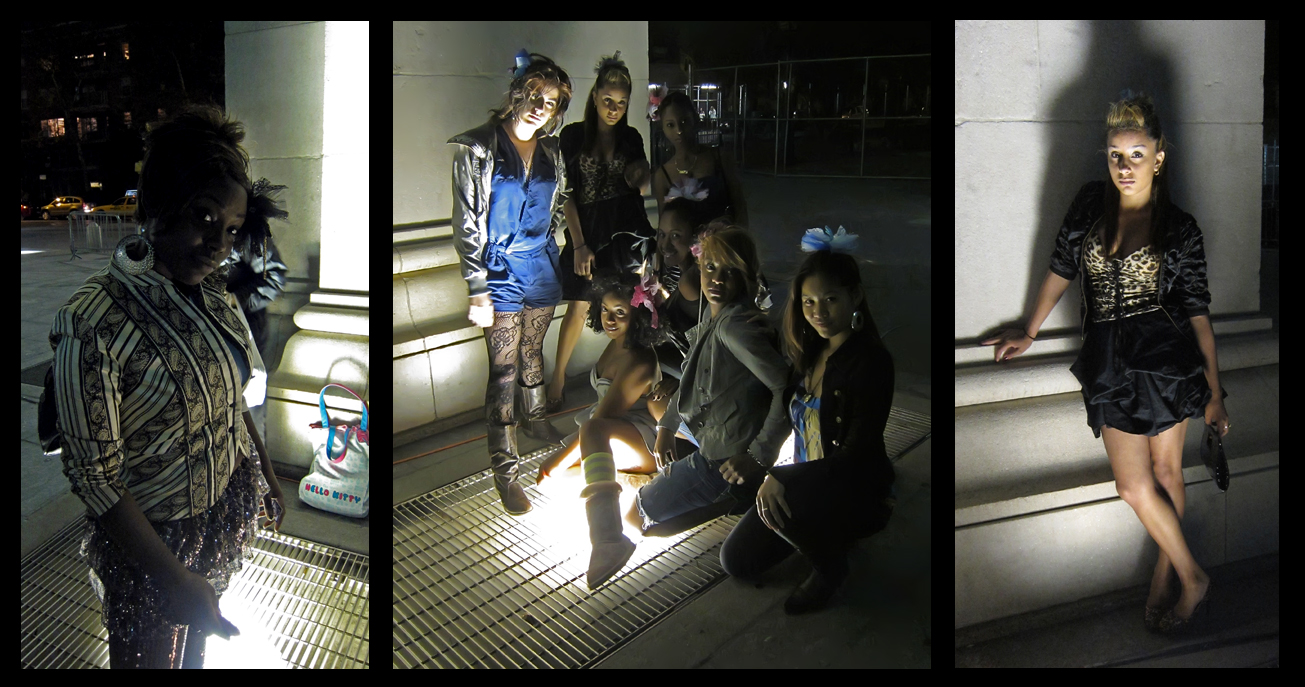
    As I wrote in Creative Expert, I am forever running across people who identify themselves as fashion designers. Recently, I ran across a group of women modeling at night in the harsh spotlights used to illuminate the Washington Square arch. I once posted a story about an amazing couple performing singing bowls under the same light.

    This group was the model entourage of Latesha Pryer, a designer from Jersey City, with her company Fashion Trash and clothing lines such as Dumpster Rags.
    I was encouraged to see young people interested in production of goods, even if they are not the engines of industrial manufacturing. Rather than selling one another ice cream, better to see some Fashion Trash 🙂


  • The Little


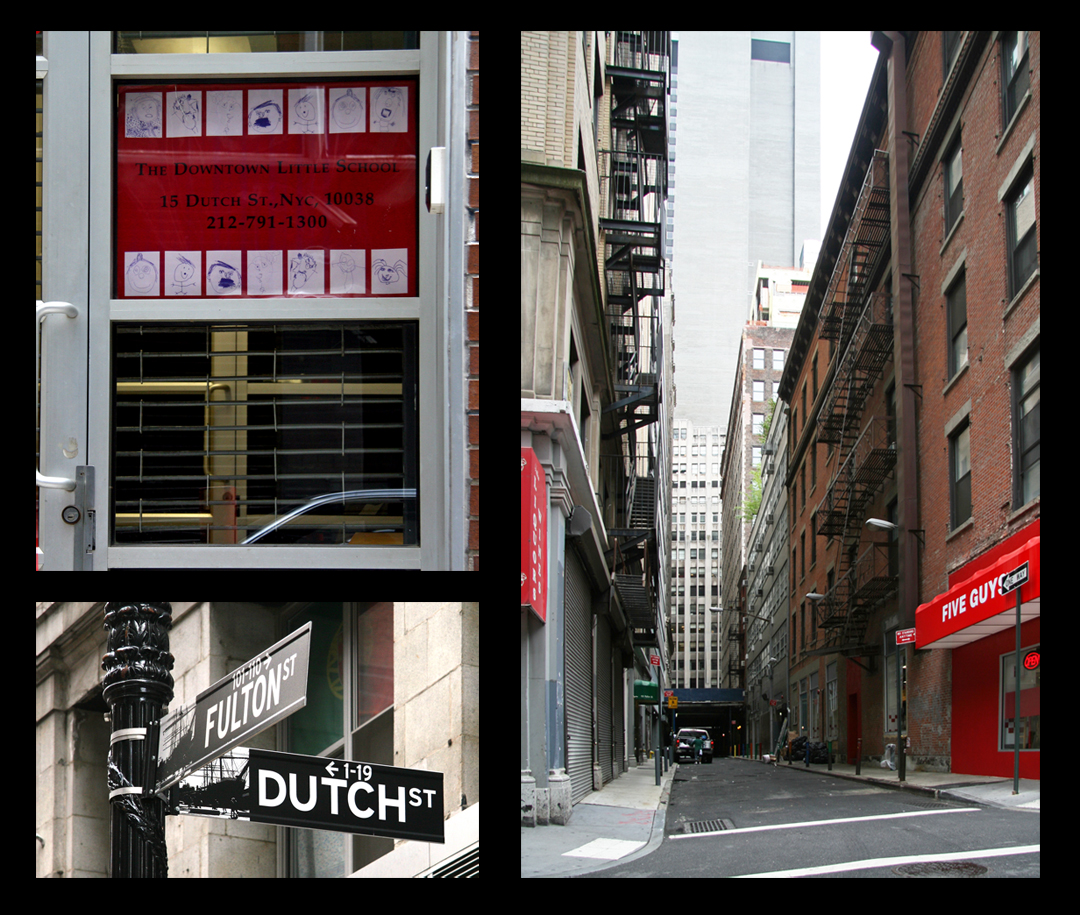
    Here, in lower Manhattan, way under the radar and not touristed at all, I discovered a little school on a little alley. In New York City, this is how I find solace, in the diminutive. A little alley, a little crook in the street, a little shop, a little building, a little garden. Feeling a little tired, because one can never really become exhausted from exploring the little, and if it is a beautiful day, perhaps one may enjoy a little rest and a little snack. This is why I choose to live in Greenwich Village, because the scale is so much smaller and so much more human.

    I have been in many high-rises, and there is nothing quite like the ambiance of a classic prewar building and, if one is so privileged, the views that may come with a residence on an upper floor. Icons like the Waldorf Astoria Hotel or the Plaza just exuded charm. And there is nothing quite so noble as the Chrysler Building at night. But for me, when it comes to a place I call home, I choose the small townhouse.

    I have not been to the new Vegas, and I imagine I will get there at some time. And, like Dubai, I also imagine that there will be some shock and awe. However, living in New York City for the last 40 years, I do not seek out the mammoth or the overwhelming when it comes to man-made environments. And although I live in the country’s largest city, in my business life I have carved out a little niche. It is much easier to succeed in the proverbial small pond.

    At 15 Dutch Street, I was very surprised to find the Downtown Little School. From reading, parents rave about this nursery school, and I think the word Little (like the Little Red Schoolhouse on Bleecker Street) is a signal that this place emphasizes caring, personal attention, and the human touch, embracing all that was good in the old school.

    I was also very surprised to learn that the huge multinational giant, Colgate-Palmolive, had its roots on Dutch Street. In 1806, at 6 Dutch Street, William Colgate opened up a starch, soap, and candle factory, a reminder that not only the good, but also the big germinates from the Little 🙂


  • Brooklyn’s Got Magic


    The bad news is that all the clocktower residences at One Hanson Place have been sold. The good news is that there are still a few residences left on the lower floors, and they will not set you back the $3-6 million dollars that the tower residences would have.

    The Williamsburgh Savings Bank Tower is the major visual icon and arguably the best-known building in Brooklyn. At 512 feet, it towers over the low-rise structures that dominate the borough and is visible from various locales throughout Brooklyn.

    The 1929 landmarked structure is located at one Hanson Place, on the corner of Flatbush Avenue, a major artery. Formerly the home of Williamsburgh Bank, it was designed by the architectural firm Halsey, McCormack and Helmer in a Romanesque-Byzantine style.

    The Williamsburgh Savings Bank Tower features a gilded copper dome, and its signature four-faced clock 27 feet in diameter, with colored hands designed to be visible 30 to 40 miles away. Carved lions, turtles, and birds grace the exteriors granite surface. The major attraction here is the extraordinary marble banking hall on the ground floor, with 63-foot vaulted ceilings, limestone and marble walls with elaborate mosaics, and 40-foot windows containing silhouetted iron cutouts a thrift motif: beehives, squirrels storing nuts, wise owls, Mercury (the god of commerce), and lions whose paws protect the bank’s lockbox. There are two abandoned public observation decks with signage describing the Battle of Brooklyn.

    The building was converted to condominiums in 2006 in a partnership between Dermot Co. and Canyon-Johnson Urban Funds – a joint venture between Canyon Capital Realty Advisors and basketball star Magic Johnson.

    There’s a lot of hype surrounding any real estate development in New York City. But, no borough resident needs to be sold, since they always knew, as everyone else now does, that Brooklyn’s got Magic 🙂


  • Flailing and Hailing

    One of the most frustrating things for me to observe are people in the streets uselessly trying to hail a taxi, either by a) standing with an arm outstretched a la Our Lady of Liberty or b) frantically flailing their arms, when there is either no taxi in site or there are no taxis which are both unoccupied and on duty. I am convinced that very few understand the roof light system in use and its permutations. However, most have better things to do than study the New York City Taxi and Limousine Commission (TLC) rules and regulations files, which run hundreds of pages. So, as a former New York City taxi driver, let me extract the most salient pieces that actually impact the use of taxis, including roof lights.

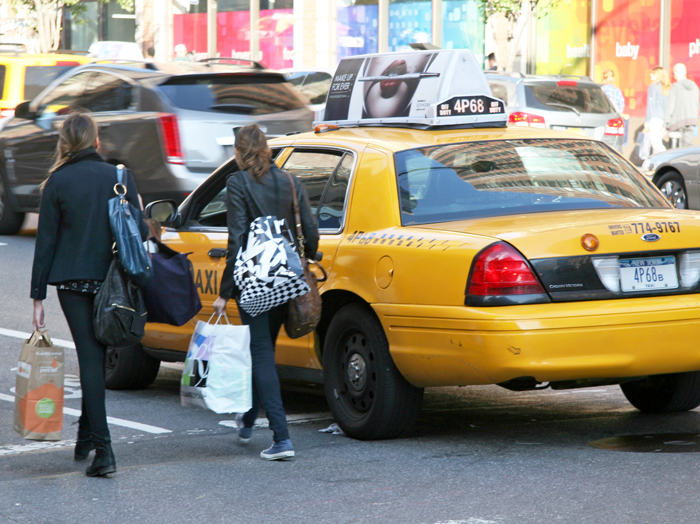
    On the roof of every taxi, there is a 4-digit taxi license number. When lit, the taxi is available, when unlit, it is occupied. On either side, there are the words “off duty.” When lit, technically the cab is off duty, typically heading back home; when unlit, the cab is available for hire or hired. What no one explains is that these lights can be lit or unlit in all four combinations and their meanings. So in the spirit of Pascal’s Wager, I offer:

    1) Number lit, Off Duty unlit: This is your main target. The taxi is on duty and unoccupied/available.
    2) Number lit, Off Duty lit: Off duty and unoccupied. This is the thorny one. Technically the driver can pick you up if your destination is on route to his garage or home. If you are aggressive and approach a driver who is headed roughly in your direction, he may oblige. However, this is also the scam setting – many drivers will do this in order to be selective about who they pick up and where they will go, a violation of TLC rules.
    3) Number unlit, Off Duty lit: The taxi is occupied as a result of condition 2.
    4) Number unlit, Off Duty unlit: Typical occupied condition. The taxi is on duty and has a passenger.
    Rule of thumb – keep an eye out only for taxis with the center number lit, and in the case of those also with the Off Duty lit, try to grab their attention and negotiate.

    Another important thing to understand is that a yellow medallioned NYC taxi must take you anywhere you want to go in the five boroughs of New York City and by any route you choose. The women in the photo were heading to Brooklyn. The first cab they approached turned them down after they indicated they wanted to go to Brooklyn. It is not necessary to ask a driver on the street if he or she will go to your destination. Get in and tell him where you want to go. In the event of any refusal or other problem, make a note of his ID number, call 311, and report him.
    From the TLC website:

    §2-50 Refusals.

    (a) A driver shall not seek to ascertain the destination of a passenger before such passenger is seated in the taxicab.
    (b) A driver shall not refuse by words, gestures or any other means, without justifiable grounds set forth in §2-50(e) herein, to take any passenger to any destination within the City of New York, the counties of Westchester or Nassau or Newark Airport. This includes a person with a disability and any service animal accompanying such person.

    I hope this mini taxi guide will keep you from unnecessary flailing and hailing 🙂

    Cool Taxi Posts: Taxicab Fever, Garden in Transit, Insults to Injury, Jersey Girls, What numba Kissena, Sea of Yellow


  • Up in Smoke

    It is said that in hard times, people turn to small luxuries and vices. Historically, companies dealing in alcohol, tobacco products, and gaming/gambling have fared quite well during recessions or depressions. There is even a vice fund, VICEX, that invests in so called “sin” stocks. Candy and chocolate manufactures also flourish – many of the household names in candy started during the Depression years: Snickers in 1930; Tootsie Pops in 1931, and Mars Bars and Three Musketeers in 1932.

    A close friend who lives out west and visits from time to time is a cigar smoker. Part of his agenda on trips to New York City is always a visit to a cigar shop. On October 10, 2008, I wrote about a wonderful retail excursion in New York Moment.
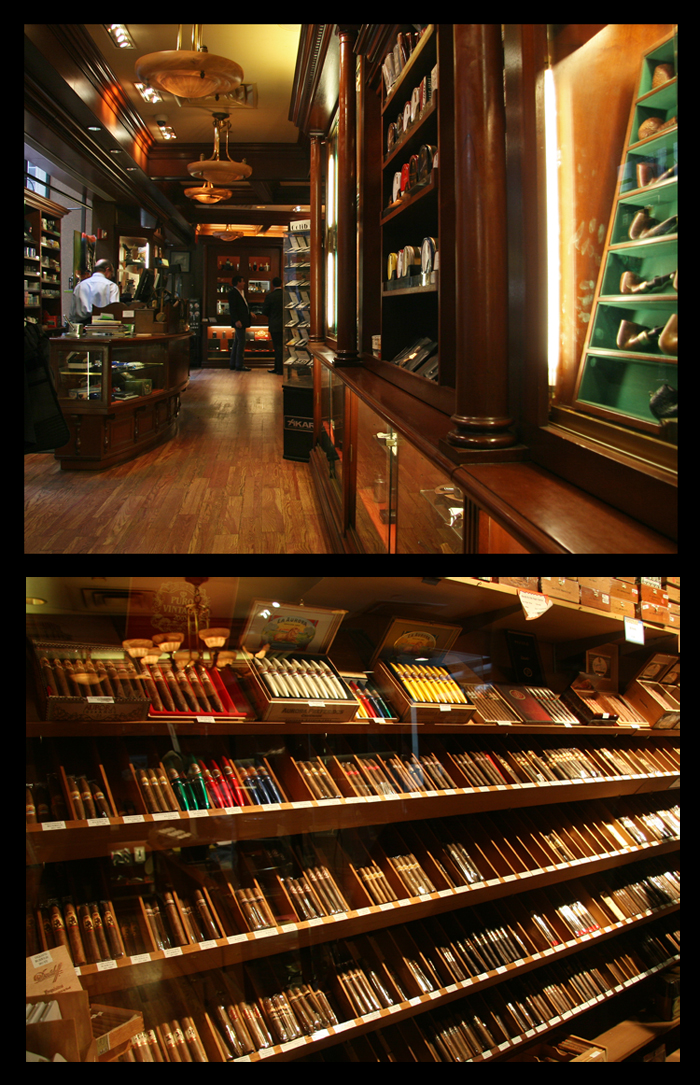
    On his most recent trip, we visited Barclay Rex on Broad Street in the Financial District, new to both of us. As a non-smoker, these establishments are very foreign to me – going there is entering an alien world. Barclay Rex has been in business in New York City for 100 years. The original founder was Vincent Nastri, a pipe maker from Salerno, Italy.

    The store was opened on Barclay and Church Street and taking the cue “a dog is man’s best friend”, Nastri, with his Great Dane Rex in tow, set out to create Barclay-Rex. This partnership was a touching testimonial to Mr. Nastri’s character as he was rarely without his faithful companion Rex, who also served as an ingenious way to advertise the store. The Great Dane wore an emblazoned blanket with the name Barclay-Rex and drew the curious and potential customer.

    The company has three locations in Manhattan and is owned by Vincent Nastri III. You can read more about Barclay Rex at their website here.

    The flagship store at 75 Broad Street is exquisitely done, with a classic, mahogany paneled library and polished cherry oak floors. There is a humidor on site, as well as a smoking lounge.

    There is a tradition, history, and its own vocabulary in the world of cigars. There is also a greater defiance and rebellious spirit to smoking, in a world which is postured against smoking with increased taxes and a very limited number of environments where one is permitted to smoke.

    Good times or bad, when it comes to vices, dollars are found to feed the appetites, whether things are eaten or go up in smoke 🙂


  • When Brian Met Sally…

    A Tale of the Fortuitous, Serendipitous, and a Late Night Offer


    Sally Darling is a regular reader of this website and is one of the most effusive, ebullient individuals who has graced these cyberpages. She lives in Kansas, a virtual metaphor for all that is not New York City.
    On September 9th, 2010, she commented:

    Me again. Sorry, I’m your new stalker now 🙂 I literally can not stop reading your posts. I can’t explain how there is something in my bones that has always, my whole life, made me feel like I belong there, that I should be living there, but life’s events didn’t see it that way. Thank you so much for letting me have my little NYC Oasis right here in Kansas!

    On September 10th she commented, announcing her upcoming visit to New York City:

    Thanks Brian! I stayed up last night and read almost all of your 2010 posts. Not quite through with them, but I’m enjoying every second! I hope you know, my passion and thrill for your fascinating city is only getting fueled by your incredible photos and writing! I can’t wait until we arrive on September 25th! My mind is racing a mile a minute with my itinerary selections!

    But the Plot Thickens.

    On September 24th at 12:41 PM, the day before leaving for New York, Sally commented:

    I just love all your adventures that you have in your splendid park! I can’t wait to be there Saturday! All I want to do is sit, watch, enjoy, and take in all the wonderment WSP [Washington Square Park] has to bring. You are so lucky that you have it at the tip of your fingertips! I’m counting the minutes until I walk through that wonderful Arch!

    A fortuitous turn of events started as a dishwasher disaster at Sally’s home in Kansas the night before leaving for New York City. Read the entire story here in her own words. Prompted by or nearly prevented by this accident, at 4:30 AM with 6 minutes left at home before leaving for the airport, Sally decided to make a quick examination of the comments on the blog with no expectations. She was surprised to find my late night offer posted at 11PM:

    Sally – welcome to our world. Ask for me if ur in the park.

    You’re way ahead of me, I am sure, but the devil is in the details.

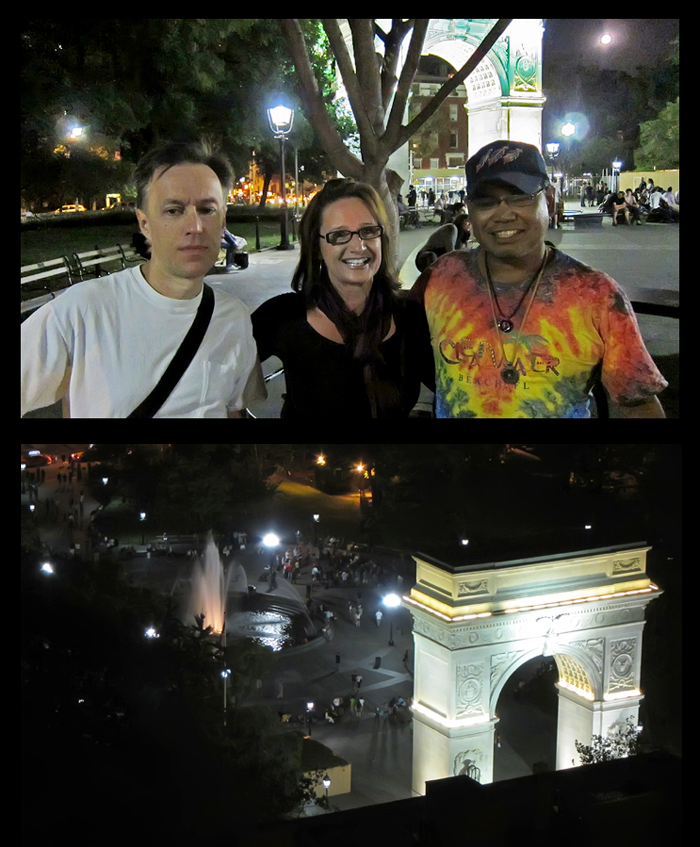
    On Saturday night, September 25th, I was in Washington Square Park. The weather was superb and the evening glorious. Music was everywhere to be found, and the park regulars were all there. Jeff, one of the habitués, approached me and said, “Brian, you have some visitors looking for you.” And there was Sally with her husband and daughter! After a mutual round of OMGs, I told them how they had picked the absolute best night.

    I gave them a tour of the plaza, introducing them to all the important regulars, some of which have appeared on this website. Gaby, who was featured on September 8th, 2010, was also there. His story is another tale of the serendipitous (read On The Road and Part 2 of his story here). A photo was taken of the three of us, which you see here today.

    Two friends, Hellen and Harvey, a married couple living in a nearby high-rise, met Sally and her family and made a spectacular offer – to take them up to the roof deck on the 26th floor of their apartment building. The views from there are spectacular, a virtual unobstructed 360 degrees, including south views directly to Washington Square Park (lower photo). Sally was, of course, just brimming with enthusiasm. When it was time for our guests to leave, Hellen, the ever gracious hostess, insisted on walking them right to the subway platform.

    On September 28th, after Sally’s return to Kansas, I got this email:

    Hello Brian I hope this is your email, and I hope you don’t mind that I’m sending you this note. I just want to thank you for one of the most amazing evenings I’ve ever experienced. It was literally one of those unexpected moments that one might never experience in their lifetime. Please, Please, pass along my thanks to Harvey & Helen, for opening up their home and allowing us to see something my eyes will never forget! How can I ever repay you and them! And I thank you for not only introducing us to them, but for introducing us to your other wonderful Park friends. Sandy Vitamin, Hans, Gabby…..what a wonderful night! I wish we could have all sat down over a cocktail someplace and continued our visit. I knew my daughter was getting tired, and was not feeling good, so unfortunately we had to end our evening. I only hope that one day our paths will cross again, and we can continue where we left off. Your friend, Sally

    ‘Twas a case of the Fortuitous, Serendipitous, and a Late Night Offer, When Brian Met Sally…*

    Please Note: All correspondence between Sally and myself were reproduced here only after obtaining her permission. Thanks Sally.

    *When Brian Met Sally is a play on the award winning 1989 comedy classic When Harry Met Sally…, starring Billy Crystal and Meg Ryan. Read more here.


  • Guns or Big Heads


    Generally speaking, a man with a head this large playing chess would command quite a bit of attention. The big-headed character, a mascot for Emmy award winner Ted Greenberg’s one-man show*, was available for any players while promotional free tickets for the show were being distributed. The chess playing mascot, however, got little attention for three reasons:

    One, this is New York City, where anything goes and a lot is usually going. Two, this area of Washington Square Park, currently used for chess, is dominated by chess hustlers who are set up for business and playing for money. Three, the best candidates to find interest in chess are chess players. However, serious chess players (or hustlers) really could not care less about anything apart from a player’s skill, and the mascot had mediocre playing ability. Perhaps a joke best illustrates this attitude, common to players and known to those very familiar with the game:

    In a park, people come across a man playing chess against a dog. They are astonished and say: “What a clever dog!” But the man protests: “No, no, he isn’t that clever. I’m leading by three games to one!”

    This character trait of players is the theme in the short story The Chessplayers, about a trained chess playing rat, who, though remarkable on the face of it, leaves players in a club unimpressed because the rat’s playing ability is not that good.

    New York City is a mecca for chess, and anyone who lives here will see this illustrated in many ways. On August 6, 2009, I wrote a true story about a shooting I witnessed in Washington Square Park, where chess players only ducked and hid long enough for the bullets to stop flying before resume their games. See the story, Chess Monsters, here.

    Only good playing will will impress good players. Gimmicks, novelties, Emmy Awards, or non-human players will not. And neither will men with guns or big heads 🙂

    *Ted Greenberg (sitting to the right of his mascot) is an award-winning comedy writer who has written for the David Letterman show. Information about his one-man show, The Complete Performer, can be found here.

    Other Postings on Chess in New York City: Good Fortune, Chess Monsters, Solid as a Rock, Marshall Chess Club


  • dinamic_sidebar 4 none

©2026 New York Daily Photo Entries (RSS) and Comments (RSS)  Raindrops Theme