• Water Taxi

    I love the island and aquatic nature of New York City. The waterways of New York are a great way to experience the city with unobstructed unique vistas. They offer a nice respite from city traffic and crowds and give a real feeling for New York City’s historical importance as a strategically located harbor.

    Ferries were, at one time, one of the most important methods of getting around New York City, particularly from borough to borough. From the New York Times:

    Before the completion of the Brooklyn Bridge in 1883 and the opening of the first trans-Hudson railroad tunnels in the early 1900’s, ferries were a huge business, crowding the rivers like cars on rush-hour highways. By 1904, according to Brian J. Cudahy, the author of ”Over and Back: The History of Ferryboats in New York Harbor,” there were 147 ferryboats carrying 200 million passengers a year.

    When Anthony Trollope visited the city in the 1860’s, for example, he noted that ferries left from Brooklyn as briskly as every three or four minutes, like the subways that were to replace them in a generation.

    But by 1955, with countless trains and the automobile in its ascendancy, the number of ferries had dwindled to 57. By 1975 there were only 9 left, most of them part of the city’s aging Staten Island fleet.

    Although the idea of ferry travel may be romantic, recent attempts at resurrecting ferry service in New York City have been plagued with problems. Reading through past articles about New York Water Taxi, you will find one story after another about service suspensions, inadequate ridership, funding problems, and an aborted start in 1997.

    One difficulty with water taxis is that stops are at water’s edge, and thus, for many travelers, particularly in midtown Manhattan, this means either a long walk or a second method of transportation to get to their destination. In other cases, such as the free ferry to Ikea in Red Hook, Brooklyn, and to Wall Street, Dumbo, the Chelsea Piers, or South Street Seaport, the ferry stop is right at the doorstep of the destination.
    I do hope that New York Water Taxi survives and that the water taxi services flourish 🙂

    Photo Note: This is the storage area for New York Water Taxi’s fleet in Red Hook, Brooklyn. The boats sport the classic yellow checker cab motif. The company, started by Tom Fox and Douglas Durst, offers sightseeing and commuter service. For a map of their service, see here.
    During the summer they offer a Hop-on/Hop-off service on weekends, with unlimited travel for a flat daily fee. Private charters are also available. In 2008, the company purchased Circle Line Downtown.


  • New York is Tennis Country

    New Yorkers are accustomed to finding amenities in the most unusual places. Virtually every piece of real estate is utilized and maximized. In Little Stuff, I wrote of New York City’s very broad range of products and services, including those things providing the everyday needs most visitors rarely notice and often ask about, such as gas stations and supermarkets (see American Express here).

    Many of the services and establishments catering to residents who do not need prime real estate locations are sometimes located off the beaten path and shoehorned into whatever space works. They become destinations, and they can be found here and there, if not everywhere.
    The most challenging services to provide are activities which require a lot of SPACE to be utilized by a few at one time. Like tennis.

    There actually are 500 public tennis courts across the five boroughs run by the City of New York, and the costs are extremely nominal. However, demand is great and permits and scheduling are necessary. Using them requires patience, planning, and the ability to deal with limited times/availability and the occasional disappointment.

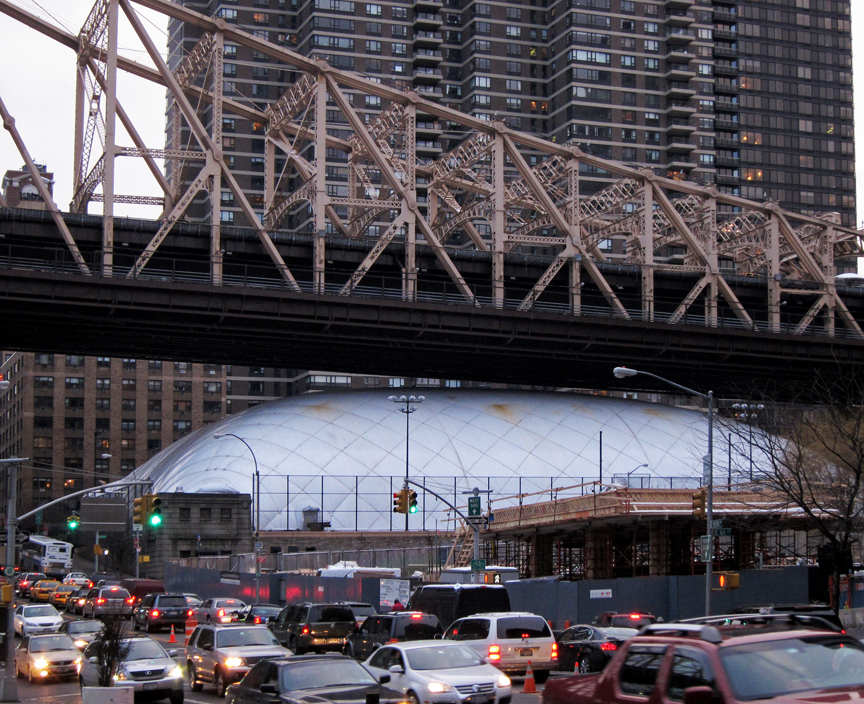
    Money buys convenience, and for those with lots of money, there are a handful of private tennis clubs in Manhattan (rates can run $100 per hour.). One of the largest facilities in the city, shown in the photos, is the Sutton East Tennis Club at 488 East 60th Street. An inflated bubble encloses the club and is located under the 59th Street Bridge – see additional photo here. The courts are open year round, 7 days a week, from 6AM to 11PM.

    Lest we forget, New York City is also home to the USTA Billie Jean King National Tennis Center at Flushing Meadows–Corona Park, Queens, the world’s largest public tennis facility and also the official venue of the U.S. Open. Everything considered, and in spite of the relative invisibility of all the tennis facilities the five boroughs has to offer, it would not be unfair to say that New York is Tennis Country 🙂

    Note: Thanks to Sutton East Tennis Club for their graciousness in allowing these photos to be taken. For their website with information about the club, classes, rates, etc., see here.


  • Tanoreen

    While my friend and I waited for our meals, we spoke about home cooking. There are often food dishes common to a region or group at home which do not find their way to restaurants. The region of northern Maine where I grew up has a number of food dishes which we absolutely loved, yet I have never seen any of them on a menu anywhere. And there are twists on traditional dishes unique to a particular kitchen. There are places, however, where the restaurant style is true home cooking, and that’s the secret to Tanoreen.

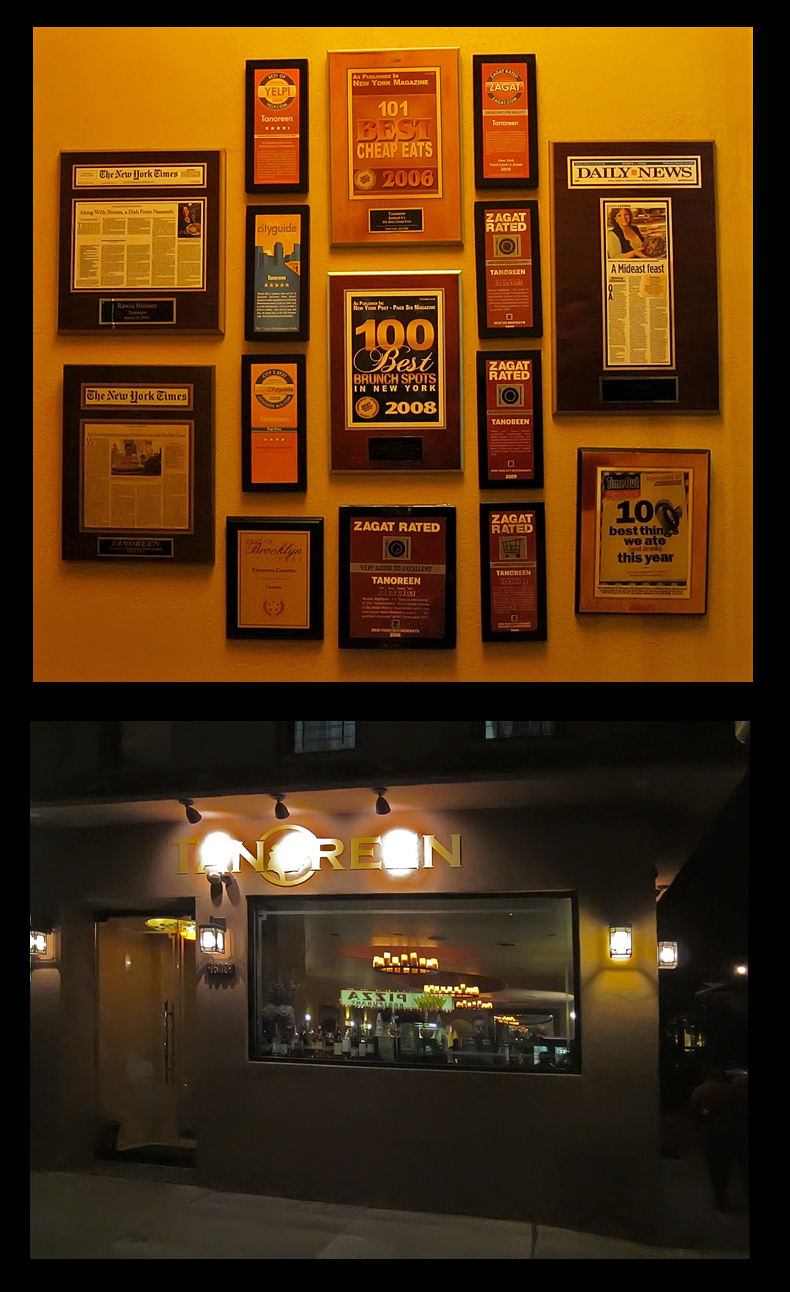
    However, we were prepared for a letdown. How could any place live up to all the buzz and an entry vestibule covered in awards? Plus, this was my third visit. The first two, I was turned away – there were no tables available at all. I was told that reservations were best for any night. But for a Middle Eastern restaurant in Bay Ridge, Brooklyn? Clearly it made sense to lower one’s expectations and abandon all hope for those who enter here.

    Talking to diners next to us and glancing around the room confirmed that this place is a destination – we were not the only patrons who had traveled to come here.
    The food selection was truly exotic – I have been eating Middle Eastern food for decades, but most of the menu was completely foreign to me. I decided to go for the fisherman’s special made with red snapper.

    In a rare preemptive strike, our waiter assured my friend that if he did not like his dish (new to him), it would be replaced with something else. That shows some extraordinary confidence, and we were beginning to raise our expectations.

    We had heard much about the owner/chef, Rawia Bishar, who hails from Bethlehem and whose Palestinian home cooking was inspired by her mother. I hoped to get a glimpse of her, but I had already ruled out the possibility of meeting her – the place was packed. But, in an unexpected coup de grâce, Rawia not only entered the dining room but also made table rounds. I had an opportunity to compliment her on the superb cuisine and chat. I gave names of other owners of Middle Eastern restaurants where I had eaten over the years, past and present. She knew them all.

    Most Middle Eastern restaurants serve up the standard fare – hummus, falafel, baba ghannuj, etc. Some, such as First Oasis Restaurant or Moustache, go much further. Tanoreen was a real dining experience and exceeded my expectations and met my hopes 🙂

    Note about Tanoreen: The restaurant is located at 7523 3rd Avenue in Bay Ridge, Brooklyn. The name is from a song, Tanoreen, by Lebanese singer Fayrouz. See the Tanoreen website here.


  • Someone is There

    If today’s photos look rather unassuming, welcome to another episode of Content is King. This is one of New York City’s best examples of all work and no fanfare.

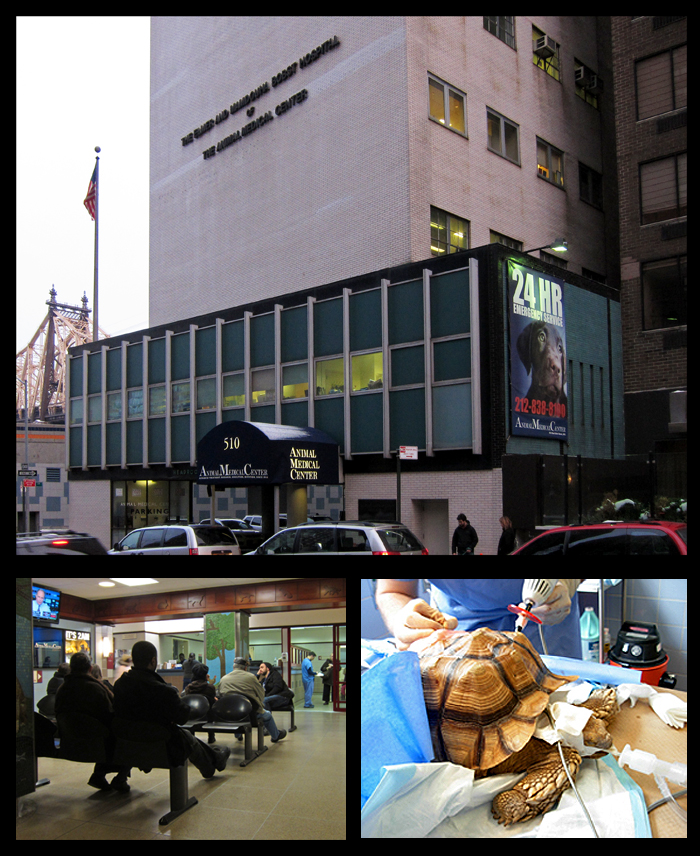
    This nondescript, 9-story building at 510 East 62nd Street, sandwiched between the back of the Bentley Hotel and the FDR Drive, is home to the Animal Medical Center, a place that for the last hundred years has been “the place to go” for emergency animal care and treatment of exotic pets. It has been best known for those who want to treat their pets and for whom money is no object.

    The Animal Medical Center is not just a veterinary clinic. It is is a full-blown hospital with MRIs, CT scans, radiation therapy, cancer treatment, hemodialysis clinic for pets with kidney disease, and a rehabilitation clinic with an underwater treadmill. There is a full range of specialties – dermatology, diabetes, endocrinology, hematology, neurology, oncology, radiology, etc. There is an Avian and Exotic Pet Service, which treats birds, rabbits, ferrets, guinea pigs, turtles, snakes, lizards, and small rodents.

    One of the huge pluses here is that the hospital is open 24/7, and anyone can walk in for emergency care at any time without an appointment. Until very recently, the center has essentially been the only game in town. But recently, competitors have entered the arena: NYC Veterinary Specialists and Fifth Avenue Veterinary Specialists, both offering a 24-hour emergency room and high-tech equipment. See a New York Times article here on the competition.

    Experiences at Animal Medical Center are extremely varied – pet owner reviews range the gamut. Many feel that the center has rested on its laurels a bit too long. Some are furious, while others sing nothing but the highest praises. With so many vets, interns, and patient load, it can be expected that patient experience will vary. A frequent complaint is the high fees generally incurred there. However, it should be understood that many of the procedures taken are not typically done for pets at all and have the same costs as those done for human patients. Ironically, I also see many negative reviews and similar complaints for the NYC Veterinary Specialists, surprising for the new man on the block.

    Pet owners are a very touchy bunch. Many are intolerant of anything less than the best care and attention. AMC is a large facility and definitely has a bureaucratic feel, with layers between the pet owner and doctors. Long hours in the waiting room, a more impersonal reception, and surprises at the cashier’s window, although not excusable, are also not surprising with such a large operation in a big city and an international reputation. News has it that there will be a campaign to improve patient relations.

    Everything said and done, it is still comforting that places like this exist and that day or night, when there is an emergency, someone is there…

    Photo Note: The photo at the lower right is from the AMC website.


  • Guastavino

    Would you like to do your grocery shopping in a space with the grandeur of a cathedral? Welcome to the Food Emporium at Bridgemarket, nicely tucked under the Manhattan approach to the 59th Street Bridge.

    The Bridgemarket was originally an open air market in the early 1900s until the the 1930s, when it became a New York City Department of Transportation facility. The vaulted space was designed by Austrian-American architect Henry Hornbostel and engineer Gustav Lindenthal. It languished unappreciated and unloved until 1977, when Hardy Holzman Pfeiffer Associates first presented plans for a market. Renovations were begun in 2000. It is now occupied by the Food Emporium (seen in the photo), Guastavino restaurant, a Conran furniture shop, and a public plaza.

    The real pièces de résistance here are the vaulted ceilings covered with Guastivino tiles. Rafael Guastavino (1842-1908), an architect from Barcelona, came to New York with his son in 1881 and, in 1889, founded the Guastavino Fireproof Construction Company. It was initially run by Rafael and later his son, with its final contract completed in 1962.

    The Guastavino tile arch system uses a timbrel, or Catalan vault of self-supporting arches and architectural vaults with interlocking terracotta tiles and mortar. The Guastavino company eventually held 24 patents for the system.

    Hundreds of historically and architecturally important buildings use his system – Grand Central Terminal (particularly the Oyster Bar), Grant’s Tomb, Carnegie Hall, the Cathedral of St. John the Divine, the Elephant House at the Bronx Zoo, and the Ellis Island Great Hall. Guastavino’s first major project was in 1888, when he was hired by McKim, Mead & White to produce the vaulting for the Boston Public Library.

    Using publicly available and architecturally beautiful structures for day-to-day tasks is one of the unique things about New York City – shopping in the old Scribners Bookstore on 5th Avenue, dining in a former bank with high ceilings the Blue Water Grill at Union Square like that occupied by Balducci in Chelsea, staying in historic hotels like the Waldorf Astoria or the Plaza, walking across the Brooklyn Bridge, or just catching a train in Grand Central Station. There are many things to see and do in New York City, but as I explore, I’m keeping an eye out for one name: Guastavino 🙂


  • El Barrio

    One defining characteristic of New York City is its ethnic neighborhoods, some indelibly stamped with the signature of one or more ethnic groups.

    And acronyms for neighborhoods are the clearest sign of gentrification. Once you have a catchy name, such as SoHo, you can hear it used as the real estate broker’s refrain. The utterance of all those wonderful little neighborhood nicknames – NoHo, SoHo, Dumbo, Tribeca, NoLita, RAMBO, GoCaGa, BoCoCa, etc.- are meant to give comfort to the prospective property buyer or renter that the neighborhood has arrived and is now officially hip.

    In Spanish Harlem (SpaHa), it is not so clear that the ship has yet come in. This area is still plagued with lack of services and crime, even though there has been an influx of tenants seeking cheaper pastures and the neighborhood is sporting a number of upscale shops. There is a lot of tension here as gentrification threatens low-income and long-time residents. Read an article about the neighborhood here.

    An irony in this city is the abutment of neighborhoods with very different demographics and household incomes. The Upper East Side is one of the wealthiest neighborhoods in New York City and in the United States. Its northern boundary is generally considered to be 96th Street, where, ironically, Spanish Harlem begins. As one approaches 96th Street, you can feel things change quite rapidly, and passing through it is like crossing a continental divide into a very different land. Shops, amenities, foods, and signage cater to the Hispanic community, easily seen once you enter El Barrio…


  • Benefactors of History

    Although black and white photography is clearly a result of the historical/technological development of photography, it is interesting to note that its continued use has not been solely related to the momentum of historical precedence or the cost. Color photography dates back to 1861, black and white to 1822. Black and white continued to dominate even after color film was readily available. Cost was a big factor, but there is a classic look preferred by many photographers for certain applications,  such as portraiture, and for its use in film or TV, such as film noir or Rod Serling’s Twilight Zone.

    There is certainly a cult phenomenon around black and white and those who shun color for what they believe is an artistic superiority of the media. Many devotees find color a distraction from the subject and that the lack of color forces the viewer to look at other elements more closely – form, line, etc. Also, many see black and white as more dramatic and better at capturing a mood than color. Portraiture, weddings, and head shots are areas where black and white still continues to have an important role, often supplementing color.

    Of course, many of those hope that the use of black and white will immediately confer a sense of authenticity and historical significance to their photos.

    Typically, advancing technology improves a craft. Sometimes, however, the early limitations of a technology conspire for the greater good. People hearken back to that early technology, not only for romantic reasons but also because under certain conditions, the older tools and techniques produce a superior result to newer technology. This can be seen in many areas. I am certainly not saying that black and white is superior to color – I love color and prefer to shoot in color. The world is in color. But there is a place for black and white, and we are the benefactors of history…

    About the Photo: Pylones is a gift shop featuring housewares, inspired by the elements of childhood – bright colors, bugs – with a strong cuteness factor. Here you will find an creative selection of items for the office, kitchen, beauty, decoration, jewelry, tools, and, of course, for children. Pylones is a small international chain founded in France in 1985 by Alan Ceppos and Frédéric Rambaud. There are 5 shops in the US (all in New York City), as well as locations in Brazil, Asia, and Europe. They also distribute their product to other shops. You can see their website here.

    I don’t think Pylones or its products work in black and white 🙂

    Related Postings: Coup de Grâce , Tale of Two Colors, Hispanic Day Parade, Color Brigade, Flamboyant,Building Gone Wild, That’s Quite a Briefcase, Fashion Forward, Taste, Krishna Festival, Police Riot Concert, Narcissism Gone Wild, A Colorful Life, Who See the Red


  • Tangerine Dream

    It was rumored that there was a little underground coffee house in the basement of a church. Inconceivable. Where high school students could actually go and “hang out” without supervision. Inconceivable. My best friend told me about it and even gave me its name – Tangerine Dream Coffee House – so perhaps it could be true.

    I had to knock on a hatchway door – he opened it. Down I went, and sure enough, there was a place I never imagined could exist in a blue-collar factory town. There were no Starbucks at that time and certainly nothing resembling a cafe. The only place to take a girlfriend was a parent’s home or the parking lot of a fast food restaurant.

    The coffee house was atmospheric and darkly lit. Teenagers were everywhere on comfy couches and chairs. A few were even kissing. Appropriately, the Moody Blues were playing.
    This was my introduction to cafe society. Even if only for a brief moment, the romance of it all was so overpowering and so absolutely cool. However, it would be some time before I would live in a world where there were as many cafes as any man or woman could desire.
    New York City.

    Ironically, I never spent much time in cafes once I got here. Initially, as a younger person, there was the money. Romantic as it might be, many of us could not justify paying to sit in a cafe. And the city had so many free things to offer and still does. Also, cafes were less relaxed regarding long use and small expenditures. There were no self-service cafes, so waiters had to be contended with. Starbucks and the Internet changed the landscape. Like it or not, it is difficult to compete in the cafe business today without being extremely lax regarding a patron’s usage. Some have rules about power usage, hours for laptops etc. to limit excessive parking.

    I have, more recently, embraced the cafe and savor the ambiance I once felt that night in the church basement. I encourage you as well to enjoy a special part of New York City. And you can enjoy them any night at all in hundreds of places. I am very glad to have them, because that basement coffee house is long gone and I need more than a Tangerine Dream …

    Note: The shop in the photo is Doma Cafe at 17 Perry Street in the West Village. Doma means “at home” in Czech. The atmosphere is casual if a bit busy, crowded, and understaffed. But there are lots of books and reading. They have a food and beverage menu.


  • Really Smart Guys


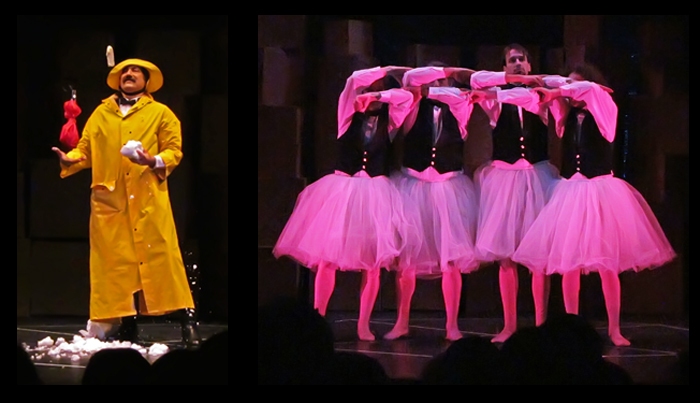
    The big secret about the Flying Karamazov brothers is they are a bunch of really smart guys. I am privy to many of their offstage accomplishments and academic achievements, because [disclaimer here] – they have been customers of mine for over 30 years (see my connection here and here.) Knowing this about them, it will come as no surprise to see an old tag line: “Juglito ergo sum” – I juggle, therefore I am.

    What is no secret is that they are also very talented performers. They are not brothers, they do not fly (only the objects do), and they have no connection to Dostoyevsky, although their character names are based on the novel: Alexei (Mark Ettinger) is their resident musician, composer and conductor. Pavel (Rod Kimball) is the master juggler. Dmitri (Paul Magid) is the writer, director, and founder. Maximov (Nick Flint) is media savant. Zossima (Stephen Bent) is exceptionally tall.

    The show is well-crafted, and the members are highly skilled jugglers as well as musicians/composers and writers. This has been the case throughout their long career, which has included a number of cast member changes.
    The troupe was formed in 1973 on the streets of Santa Cruz, California. Paul Magid is the only remaining original member. The other original members were Howard Patterson, Tim Furst, and Randy Nelson. Read more about them at their website here.

    The award-winning troupe has performed internationally, with credits too numerous to list here, including Lincoln Center, Broadway, the Brooklyn Academy of Music, TV, and film. They have produced a number of shows, all built around their juggling and musical skills. One show, built completely around music, Sharps, Flats and Accidentals, was performed at Lincoln Center.

    One routine which builds throughout the show is known as the Terror Trick. Over the course of the program, nine objects are introduced (a cleaver, a torch, a salt shaker, a ukelele, a skillet, a fish, an egg, a block of dry ice, and a bottle of champagne) and juggled as the finale – with the fish and the egg ending up in the skillet and the pouring of the champagne into glasses.

    The other perennial favorite is the The Gamble, in which “the Champ” (Dmitri) will attempt to juggle any three items provided by the audience. This challenge is well known to many attending their shows – they have seen just about everything, and the Champ is rarely stumped. The three objects are chosen by the audience’s applause from the collection on stage. There are rules, however. The object:

    Must weigh more than an ounce (28 grams)
    Must weigh less than 10 pounds (4.5 kg)
    Must be no bigger than a breadbox
    Must not be a live animal
    Must not be able to stop the “Champ” from being a live animal
    The Champ is also permitted to make up to three modifications to the selected items (in total). If The Champ can juggle the items for ten continuous throws (in three tries), he wins a standing ovation from the audience; if he fails, he gets a pie in the face.

    Their routines are peppered with wordplay and clever references, because, as we know, they are a bunch of really smart guys 🙂

    Note: The photos are from their current show, 4Play, which is playing at the Minetta Lane Theatre in the Village. It runs until March 7, 2010.


  • Snow Play

    A child provides one of the best excuses to play in snow, and I often wonder whether adults may be more excited by the prospect of building snowmen and sledding than their children. But it is of no matter, because no law is being broken by adults who want to partake in this perennial rite of winter and enjoy all things snowy in New York City.

    As I wrote in White By Design 2, tracts of unadulterated snow are few and short-lived here, so those wanting to reenact their play days of childhood must, unlike our country brethren, act quickly with no deliberation.
    As I passed through Washington Square Park in the early morning after our recent heavy snowstorm, families had already been busy with their handiwork. Snowmen were everywhere to be found.

    Growing up in New England, playing in snow was one of our favorite activities. As a child, I was bundled in a snowsuit and, thoroughly insulated, was sent out into that white winter wonderland for endless hours of frolicking. I would make snow men, snow angels, and igloos, ride a sled, or I would just run, jump, and throw myself with reckless abandon into nature’s plush, deep, white cushion.

    All my antics and creations were applauded by family members who remained indoors, watching behind windows in their cozy habitat, signaling with gestures of encouragement and approval over any small thing or act. As I grew older, I became an audience member for my younger sisters, enjoying their play from the warmth of our kitchen.

    Certainly, snow is inconvenient and troublesome, particularly its removal in a large city such as New York. But I am going to put those practical thoughts aside for now, because as I write this, I am watching a parent pull his child in a sled through my window, from the cozy comfort of my home, as I secretly encourage them in all manner of snow play 🙂


  • Anywhere You Want

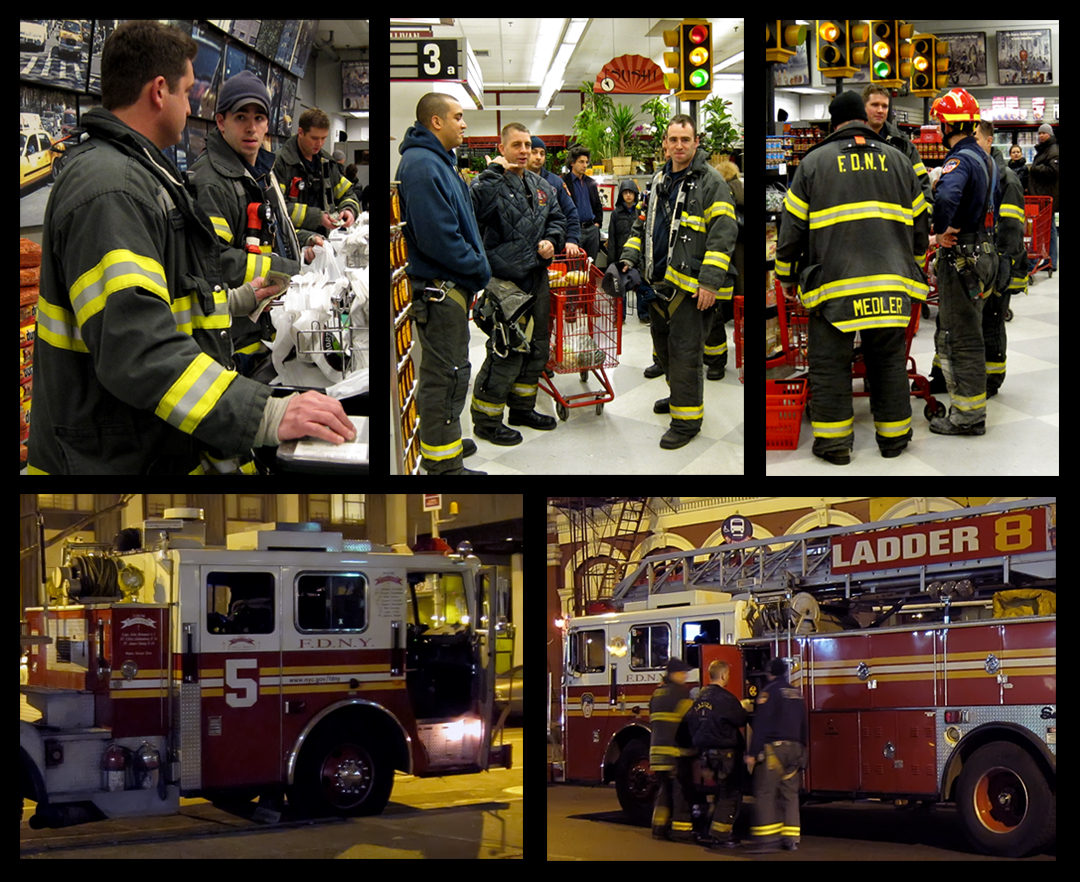
    Sometimes you get what you want, and on rare occasion, doubled. For a long time, I have waited for an opportunity to photograph members of the New York Fire Department on one of their supermarket shopping trips.

    At a neighborhood supermarket, Morton Williams on LaGuardia Place in Greenwich Village, I had noticed that one company drove and parked a full-size firetruck outside the store on a regular basis, did their shopping as a group, and drove back to their station. The first time I sighted a group of firemen with their uniforms in the aisles, it was quite startling – everything about them seemed so large and imposing. The men are big, further enhanced by the bulky, protective clothing.

    Post-9/11, photography is a much more delicate issue, so, rather than try a clandestine approach, I gave out a few cards and asked them directly about taking photos. They were very accommodating and told me that there were two companies shopping, not just one. I had really hit the jackpot.
    There was a lot of joking and jibing between companies, particularly when I asked about the firefighter wearing a red helmet and whether it was standard gear. I’m not sure if I got a straight answer – there was a lot of inside humor that I was not privy to.

    Firehouse dinners are an international tradition. Long shifts and lots of down time between calls has resulted in many unique rituals. However, like any tradition, there are rules and protocols – who shops, who cooks, who pays, what to cook, etc., with variations depending on the particular firehouse.

    With a job providing such a vital service, there comes a few privileges. For the FDNY, it’s a nice home-cooked dinner and easy parking. Where do you park a full size hook and ladder in Manhattan? When you’re the FDNY, the answer is anywhere you want 🙂


  • No Squares Down There

    I was so excited as I eagerly awaited my copy of City Planning According to Artistic Principles, by Camillo Sitte, to come up at the main branch of the New York Public Library. I must admit, however, that I really had no intention of reading the whole thing – it was not available for circulation. I just needed to see that it really existed, touch it, and peruse it.

    Sitte was an Austrian architect, painter, art historian, and city planning theoretician. He studied what made a place charming. In his book, he extols the virtues of the irregularity of the medieval city. I have had numerous thoughts and conversations about what makes a city or town interesting. One element for me was the lack of order in the street layout. Nooks and crannies to be discovered, like an old bookshop where, upon entering, you cannot determine its layout, and wandering through it becomes an adventure.

    I relish neighborhoods or towns with the lack of a grid. I love meandering the streets of Florence, Montmartre in Paris, medieval villages of France, or the streets of West Village. Sitte’s book was the validation for everything I loved in a town or city and gave the reasoning behind why I find Greenwich Village one of the most charming areas in the United States.

    The West Village is part of New York City predating the Commissioner’s Plan of 1811 (see here). The maze of streets defy any real order – there are angles, triangles, bends, streets once parallel that now intersect, and even a street that splits and retains the same name (Waverly Place). Perhaps somewhat vexing to the driver or visitor navigating, its character is one of the things which drew me to this neighborhood long ago.
    On top of all this, in 1917, the city cut a swath, 7th Avenue, through the existing neighborhood, shearing sections of over 200 buildings, leaving many triangular shaped structures (see Northern Dispensary and Zena for two examples of triangular buildings).

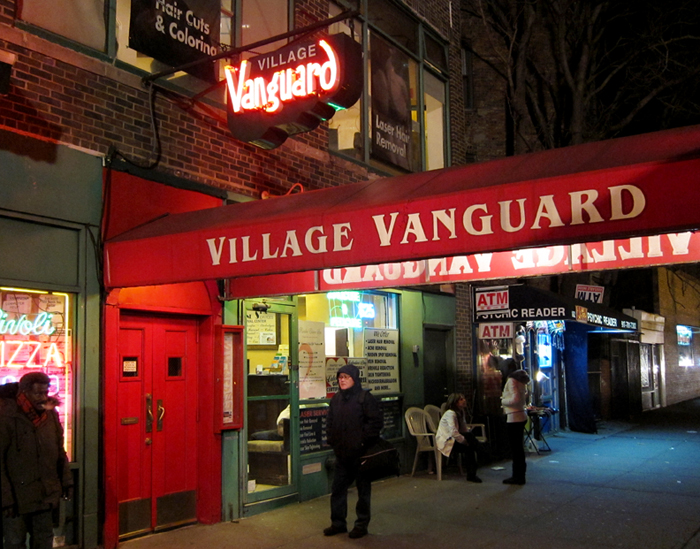
    We have become the benefactors of yesterday’s victims. In the case of the Village Vanguard, its superb acoustics have been attributed to the triangular space. Some recording engineers and musicians say it is the finest acoustic space they know of.

    The Village Vanguard is legendary and, on February 23, 2010, celebrates its 75th anniversary. The club was opened in 1935 by Max Gordon. Originally it featured many other forms of music and entertainment, such as folk music, comedy, and beat poetry. In 1957, it became an all jazz venue. All the jazz greats have performed there – Miles Davis, John Coltrane, Sonny Rollins, Charles Mingus, Keith Garrett, et al. The club is also noted for its Live at the Village Vanguard sessions. The Vanguard still enjoys a reputation as a place to hear the finest jazz in the world. Through the red door and fifteen steps down to the triangular basement space. No squares down there 🙂


  • World of Gray

    If you want to experience the gritty side of New York City, ride the subway – the ultimate test of will, fortitude, and tolerance. Better yet, try it on a hot summer day, where the non-air-conditioned subway platforms are suffocatingly hot and virtually intolerable.
    And it is gray.

    You can spend your time waiting on the platforms by reading or, perhaps, observing your surroundings in various shades of gray – the concrete, chewing gum, or perhaps the charcoal gray of the subway tracks themselves and the occasional rat in camouflage gray.
    In this world of gray, we have brightly lit subway cars, each with its own captive audience trapped for periods of time in steel boxes, subject to all and any who want to sell goods, rant, beg, preach, or perform in any number of ways.

    The appearance of singers is met with a variety of responses. Some riders, bored with the everyday grind, welcome music as a pleasant break from the monotony. Others, perhaps engaged in reading, listening to music of their own, or just enjoying some “quiet” time, resent the intrusion, analogous to cigarette smoke in public/common spaces.

    And, of course, there is the issue of quality and selection. There is no standard of quality for subway entertainment, and unlike any other media delivery system, it can’t be turned off or the music selection changed.

    I found the a cappella group in the photo to have been much better than average. However, I had the feeling that I was in the minority who enjoyed this band of wandering minstrels, who timed their routine, moving from car to car after each number and collecting money. Perhaps I was just in the right mood at the right time, because for a moment, I found a little relief in a world of gray…


  • BAPE, Wangsters and Hypebeasts

    A story was already forming in my mind as soon as I saw this Billionaire Boys Club shop in SoHo at 456 West Broadway. I was going to write how, in my experience, you can not manufacture or create a cachet, a sense of exclusivity, or a cult following. These things have to develop organically over time, with proven product or content.

    The name of this store reminded me of Members Only jackets and the belief that the mere proclamation of exclusivity was enough to confer it. Ironically, I have learned that there is a cult following for Members Only jackets.

    But perhaps the nature of time itself has changed, as well as the definition of natural evolution. There is a lot of talk online amongst marketers about creating BUZZ – i.e. the very thing that traditionally was something that came naturally as a product, service, or company proved itself over time. But no one has the time or patience for natural evolution. And there is the reality of an extremely dynamic world market with rapidly changing tastes, global competition, love of new things, and technologies to display everything instantaneously.

    Can you brand, market, and, with enough muscle, jump start an image and reputation? It certainly has been tried, with varying degrees of success. One big key, of course, is the leverage applied using notable figures, either as customers or as the company ownership. Another technique is to limit quantities and sell at high prices. These ingredients obviously do not guarantee success, but as a business model, it makes more sense than a me-too approach and competing on price against established merchants.

    Billionaire Boys Club and Ice Cream are two lines of high-end sportswear established in 2005 by Pharrell Williams of The Neptunes and Nigo, designer of the clothing line BAPE and founder of the company in 1993. So, to further complicate this story, we do have some legacy here, not just overnight buzz.

    In reading reviews about the Billionaire Boys Club and Ice Cream, I became lost in an endless chain of hypertext links of brands, products, stores, people, and words unknown to me. A review from Yelp.com:

    Yes folks, this even outdoes the BAPE toilet paper as an all time low. … A virtual ghost town of hypebeast products and overstaffed employees was all I witnessed.

    So I need a new vocabulary. I learned that BAPE, A Bathing Ape, is a clothing line, SoHo store and an adjective, and I learned the meaning of hypebeast, but my education is far from complete. Looking up BAPE in the Urban Dictionary returns seven definitions, including:

    A Played out Brand by Nigo from Japan, rocked by wangsters and hypebeast.

    Now I had to learn what wangsters are. Fortunately, I have review sites, forums, blogs, and the Urban Dictionary. I have a lot of reading to do 🙂

    Note about the store: The ground floor features Ice Cream, and the second floor, which resembles the interior of a space ship, carries the Billionaire Boys Club line. The prices are extremely high – Tees for $80-$100, hoodies for over $200…


  • Martin Luther King, Jr.

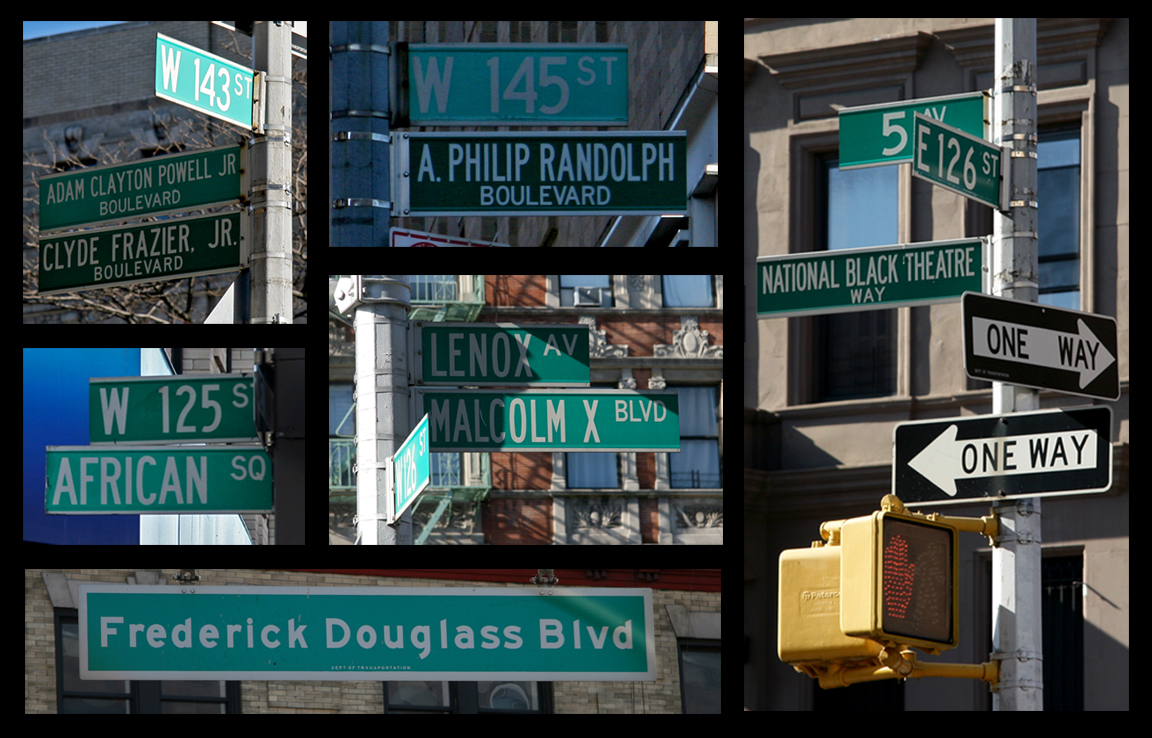
    If you travel through Harlem and observe the street signs, you will notice a number with dual names – an older and more familiar on top and a newer below. The city renames streets for a variety of reasons. Subsequent to 9/11, many streets were renamed to honor those firefighters and police officers who lost their lives in service to the city during that tragedy.

    Other streets are renamed for groups or individuals who are honored for their lifetime accomplishments. This can be most readily seen in Harlem, where many major thoroughfares have been renamed to honor prominent black Americans. These names include major black activists and entertainers. On my recent excursion to the neighborhood, I caught some of the heavyweights and photographed the signs.

    On December 29, 2008, Mayor Bloomberg signed legislations renaming 49 streets and public places in the five boroughs. Some of the prominent blacks include James Brown, Drs. Kenneth and Mamie Phipps Clark, Zora Neale Hurston, Samuel J. Battle, Ella Baker, Charles Hamilton Houston, Billie Holiday, Paul Robeson, Count Basie, A. Philip Randolph, Susan Smith McKinney-Steward, Shirley Chisholm, and Marcus Garvey.

    There is one glaring omission in today’s photo collage. While traveling down 125th Street, Harlem’s main crosstown street, I was distracted while observing all the people, places, and things, and neglected to look up and photograph a street sign conamed with a man virtually synonymous with African-American civil rights: Martin Luther King, Jr.


  • dinamic_sidebar 4 none

©2026 New York Daily Photo Entries (RSS) and Comments (RSS)  Raindrops Theme