• A Different Dictionary

    I was prepared for the worst. I had been told that Willets Point was what Mayor Bloomberg called “another euphemism for blight” or what Robert Moses once described as an “eyesore and a disgrace to the borough of Queens.”

    But these were understatements of what I saw when I actually paid a visit by car. As I turned onto Willets Point Boulevard from Roosevelt Avenue, I felt like I was entering another world. Willets Point is far and away the worst-looking neighborhood I have seen in the five boroughs.

    I initially also found the place menacing, as I was immediately accosted by gangs of men who blocked my travel, at first not realizing that these were efforts by workers to negotiate deals for auto repairs.
    I was, however, not in need of repairs but of photos. The Hole, which I wrote about in September 2009, was a pastoral sleepy backwater in comparison.

    I pressed onward through the neighborhood – the absolute grit of it all just drew me in, and there was no way to turn around, anyway. The streets are heavily rutted and flooding is common. Even on a sunny day when it had not rained for two days, the potholes were filled with water, making navigation akin to walking a minefield.

    There are no sewers or sidewalks. I saw roosters walking the streets. The area is highly polluted with the buildup of years of oil spills, which has also contaminated Flushing Bay and Flushing River.
    The neighborhood is dominated by 225 auto parts and repair businesses, many of them operating out of shacks built from corrugated metal or cinder-blocks. There are over 1,200 people employed in those businesses. The area is unique in its concentration of vehicle repair shops, and people travel from afar for parts and/or repairs.

    Efforts to revitalize the area have been proposed and thwarted for decades. There is a redevelopment plan for the area, an extensive ten-year project. This will, of course, require relocation of all of the businesses, if suitable places can be found. The most recent plan was also fraught with difficulties and threats by the Bloomberg administration to use eminent domain, if necessary, to remove the businesses. Things appear to be on track now for the project. “After a century of blight and neglect, this neighborhood’s future is very bright indeed,” Mr. Bloomberg has said.

    The area has only one resident, Joseph Ardizzone, who has lived in the area since his birth in 1932. He is opposed to the new plan. I sympathize with Joseph Ardizzone’s nostalgic feelings of his youth growing up in the area, but his claims that blight is not the correct word puzzle me a little. I guess he must be using a different dictionary…

    Note about the areas location: Willets Point is part of Corona, Queens, and is sometimes known as the Iron Triangle. It is bounded on the north by Northern Boulevard, to the west by 126th Street and Citi Field, to the south by Roosevelt Avenue and Flushing Meadows-Corona Park, and to the east by the Flushing River.


  • Surrounded by Fur

    In the 1980s, I was a strict vegetarian. One day, I met a friend and his girlfriend on the street. I am sure my friend’s girlfriend anticipated a chilly comment as I stroked her fur coat and asked what it was. It was not a rhetorical question at all nor meant to be sarcastic. I really had very little experience with fur, and this was the most remarkable thing I had ever felt.

    She told me it was seal. I don’t recall how I responded, but I said very little and tried to be as diplomatic as possible. I am sure that she was well familiar with the the anti-fur sentiment and did not need any education concerning animal rights on 8th Street in Greenwich Village.

    It could be worse. During the same period, I met a woman at a vegetarian restaurant who showed up in a full-length fur. I was aghast – this was the closest I had ever come to testing the limits of free expression. I warned her to be prepared for some form of verbal assault by any of the customers who would certainly find the wearing of fur offensive. Fortunately, and to my surprise, there were no accusations or wars of words.

    Furs and the fur industry are a highly contentious matter. I recently photographed an anti-fur protest outside Max Mara in SoHo, but I decided not to post them on this site because the posters being displayed were so disturbingly graphic.

    Kaufman Furs is located at 232 West 30th Street in the heart of the fur district and is one of the larger and older furriers in the city. On their website, I see a “Dare to Wear” link soliciting models. One way to handle the fur controversy at this point in time, I suppose, is by offering a challenge to models willing to brave public anti-fur outcry. In the August 2008 issue of French Vogue magazine, there was an anti-fur backlash editorial piece called “Fashion Reality,” featuring sexy and semi-nude models in furs, apparently echoing the “fur is back” campaign of the 1980s.

    Some countries, such as the United Kingdom and Austria, have banned fur farming altogether. A lot of fur farming has moved to China, where there are essentially no regulations. Some reports appear to indicate that fur sales are on the rise and are at all-time highs. One way or another, I feel surrounded by fur…

    In 2006, I took a photo of a series of Barbie dolls in furs on Houston street in SoHo.


  • Released from Captivity

    There is a book I enjoyed very much – French or Foe, written by Polly Plat, an American expatriate living in France. The book is oriented towards those who will be in France for extended periods, living or working there. However, it is of value to the armchair traveler as well or to those who just want a window into the French culture, much like the Culture Shock! series of books. In French or Foe, each chapter examines and explores a different facet of French culture.

    In one section, Platt explains how to navigate the bureaucracies of France, which can be quite vexing. The secret, according to her, is to develop a relationship with an employee. Individuals in those positions can certainly pull strings and make things happen.
    In many ways, the concept is applicable on this side of the Atlantic anywhere you have a public agency or in the private sector, where you have a captive audience. How can that be in New York City, with so much competition?

    In Manhattan, the business environment has become very difficult, even prior to the economic downturn. Vacancies are everywhere. However, there are still plenty of merchants in many sectors – there is no shortage of clothiers or restaurants. Where there is a particular dearth of merchants, however, is in essential services, where markups are limited and luxury pricing is not doable (laundromats, shoe repair shops, lumber yards, and hardware stores), and in industrial supplies, due to both real estate costs and lack of customers, since most industry has left the city.

    With industry gone, many industrial/commercial supply houses have also left or gone out of business, such as Tunnel Machinery, Commercial Plastics, Space Surplus Metals, Victor Machinery, and Zelf – a fascinating place in SoHo that offered rental of heavy machinery.

    But industrial/commercial suppliers are still needed by the trades. Ordering online is not always desirable; often repairs and work cannot wait for shipment. As I wrote in No Students After One, most suppliers to the trade in the city operate at street level and are subject to patronage by retail customers, many who are very unfamiliar with the product line and would be better suited shopping elsewhere. Compound this with the dwindling number of these places, and you have all of the basic ingredients for a captive audience with impatient salespeople and brusk, occasionally abusive, service.
    The solution is much like dealing with the French bureaucracies: develop a relationship with someone there, earn his/her respect, and you can be treated like a customer.

    This area was once home to forty dealers of machinery, now gone when the last dealer, Grand Machinery Exchange, relocated to Long Island in 2006. Some suppliers to the trade remain, such as Faerman Cash Register and Lendy Electric Supply, located at 176 Grand Street in Chinatown/Little Italy (seen in the photo). Lendy’s atmosphere is unmistakably one to the trade. There is no self-service or browsing aisles – the customer takes a number and waits in line to be served. Products are brought to you as you ask for them, so you need to know what you want and what it is called. At times, the place can become quite crowded, but here you will find a knowledgeable staff with products you can trust – the bulk of the customers are contractors. You will get honest dealings and no-nonsense recommendations. Upselling is not going to work here.

    I found my recent visit there quite pleasant and my salesperson very informative and accommodating. Lendy’s has a broad range of hardware and electrical items, including many unique specialty products which are nearly impossible to find in the city. However, they do not take advantage of their captive audience and punish the customer. If you go there, you will find, as I did, a French tutorial will not be needed. At Lendy Electric, you are released from captivity 🙂


  • All the Way…

    Today is Black Friday, the start of that period which most retailers have waited for all year.
    However, dealing with the constant onslaught of customers can be wearing. The vast majority of people are decent human beings, but there is a percentage that can be unreasonable, and that number can test the nerves of even the most patient.

    I had a close friend who was a New York City native and had been in retailing for all of his adult life. His father had also been a businessman. He was a nice person, but, as is typical of many New Yorkers, he was a no-nonsense person who will only tolerate so much. That limit is easily met any day in retail. His conclusive statement to stories of others or his own about the horrors of the business was a sarcastic “Welcome to retail.”

    One thing you learn quickly in business is the sense behind scheduled breaks and lunch. If you don’t take them at preappointed times, you will most likely find yourself eating lunch on the run at 4:30 in the afternoon.

    On a morning sometime in the 1970s, said friend was eating his croissant fifteen minutes prior to the store’s opening in the morning at the health food store he was managing in Queens. Being the seasoned retailer that he was, he had established a firm rule of eating before opening. On this occasion, a woman with an unusual sense of urgency appeared banging at the door, insisting that she be let in before the official opening hour. I don’t recall the specific reason, but she added fuel to her plea with the statement, “But I came all the way from Bayside, Queens.” This refrain was repeated ad nauseum emphasizing the words “all the way from Bayside, Queens.” My friend’s response was, “I don’t care where you come from, lady, I am finishing my croissant and I am not opening this door before 9 AM.” The war across the pane of glass continued and, as you might expect, the door was not open until 9 AM.

    Since that time, I have had the nagging need to visit Bayside and achieve closure. It has been only a small nagging need, however, so it was not until one week ago that on my visit to Flushing, I decided to go all the way to Bayside, Queens, and see what the neighborhood was like.

    I really had no expectations, but I was completely astounded at how beautiful much of this neighborhood was. Bayside is in the extreme eastern section of Queens, abutting Little Neck Bay and Nassau County, Long Island. This accounts for the more suburban feel – there are many unattached homes, porches, and yards. Although Bayside is not that familiar to the outsider, it is one of the most expensive housing markets in the United States and is considered one of the most desirable communities to live in New York City, with great schools and a very low crime rate. The main shopping district along Bell Boulevard has a charming ambiance. At one time, many celebrities lived in Bayside and strolled Bell Boulevard. From the New York Times:

    Houses with water views, although separated from Little Neck Bay by the Cross Island Parkway, are likewise one of a kind.One of these is said to have belonged to W. C. Fields, who, like Gloria Swanson, Charlie Chaplin, Rudolph Valentino and Norma Talmadge, lived in the area when Astoria Studios was in its heyday. Miss Swanson is said to have once walked down Bell Boulevard with a pig on a leash.

    So, if you have a car and you are interested in exploring the outer reaches of New York City, perhaps after a harrowing visit to the Hole or Willets Point, try going All the Way to Bayside, Queens 🙂

    Related Posts: I can not so much as hear “Bayside, Queens,” without this incident coming to mind, much like hearing “Kissena Boulevard” or “comin’ up.”


  • Thanksgiving 2009


    This is the first year since the inception of this website that I have attended the annual Macy’s Thanksgiving Day Parade. In prior years, I have visited the inflation of the balloons the night before (see here and here). These photos were taken this morning.

    The weather today was quite balmy – one of the better years. It is a great family outing for visitors and residents alike. This year’s parade took a different route. Although many arrive early to stake out a good viewing spot, the parade can be seen quite well from Central Park, where these photos were taken. The street level displays and performers are difficult to see from the park, but the floats are easily visible from the park with no large crowds at all. If you want to enjoy the spirit of the parade and don’t require seeing all the performances, than Central Park is where I would recommend viewing from. Happy Thanksgiving!


  • Perfect Hostess

    Looking at today’s photos, you might reasonably conclude that I left for New England early and am using Thanksgiving as a foil to justify the use of a photo from outside New York City limits.
    If I tell you that this building is from within the five boroughs, you might then reasonably conclude that this is in some outer corner of the Bronx or deep in the rural areas of Staten Island.
    However, nothing could be further from the truth. In fact, this Quaker meeting house, over 300 years old, is located at 137-16 Northern Boulevard in Flushing, Queens. See more photos here.

    Northern Boulevard is a major thoroughfare in Queens, and this particular location is just around the corner from bustling Main Street in the heart of the largest Asian neighborhood in the United States.
    Walking by this building, perhaps on the way to dim sum, you will either be extremely startled or, given its ancient character, perhaps not even notice it, as I am sure is the case with many passersby.
    A sign welcomes visitors, but the place looks completely devoid of human activity. On my visit, I tried opening the doors, really just to confirm my feelings that this place was closed.

    I was, however, extremely surprised to find the door unlocked, and I was greeted enthusiastically by two women dressed in a manner befitting some centuries gone by. When I asked if I could take photos, expecting a negative all so common, I was instead welcomed to do so and was escorted through the entire two-story dwelling. Lights were turned on for me, doors were opened, and every manner of accommodation was made to my photographic interests.

    Built in 1694 by John Bowne and other early Quakers, the Old Quaker Meeting House is, by all known accounts, the oldest house of worship in New York State, the second oldest Quaker meeting house in the nation, and one of the three oldest continuously active sites of religious activity in the western hemisphere. It was declared a National Historic Landmark in 1967.

    A lovely graveyard planted with indigenous trees and flowers is part of the Meeting House’s grounds. The house is the only surviving example in the New York State of a typical 17th-century ecclesiastical frame structure of medieval design, with beamed ceilings and handmade benches. Read more here at the Old Quaker Meeting House website.

    Lest the cynics among you think that all of this was a precursor to the hard sell with a biblical assault or, perhaps, the soft sell, in fact, nothing of the kind occurred. Discussions centered around the structure itself. I took some literature of my own accord.

    I can not speak to Quakerism per se, but I can tell you that I have visited many places in this city, and my requests for taking photos have been received with a broad range of responses, mostly negative. Here, at the Old Quaker Meeting House, I found the Perfect Hostess 🙂


  • Vlissingen

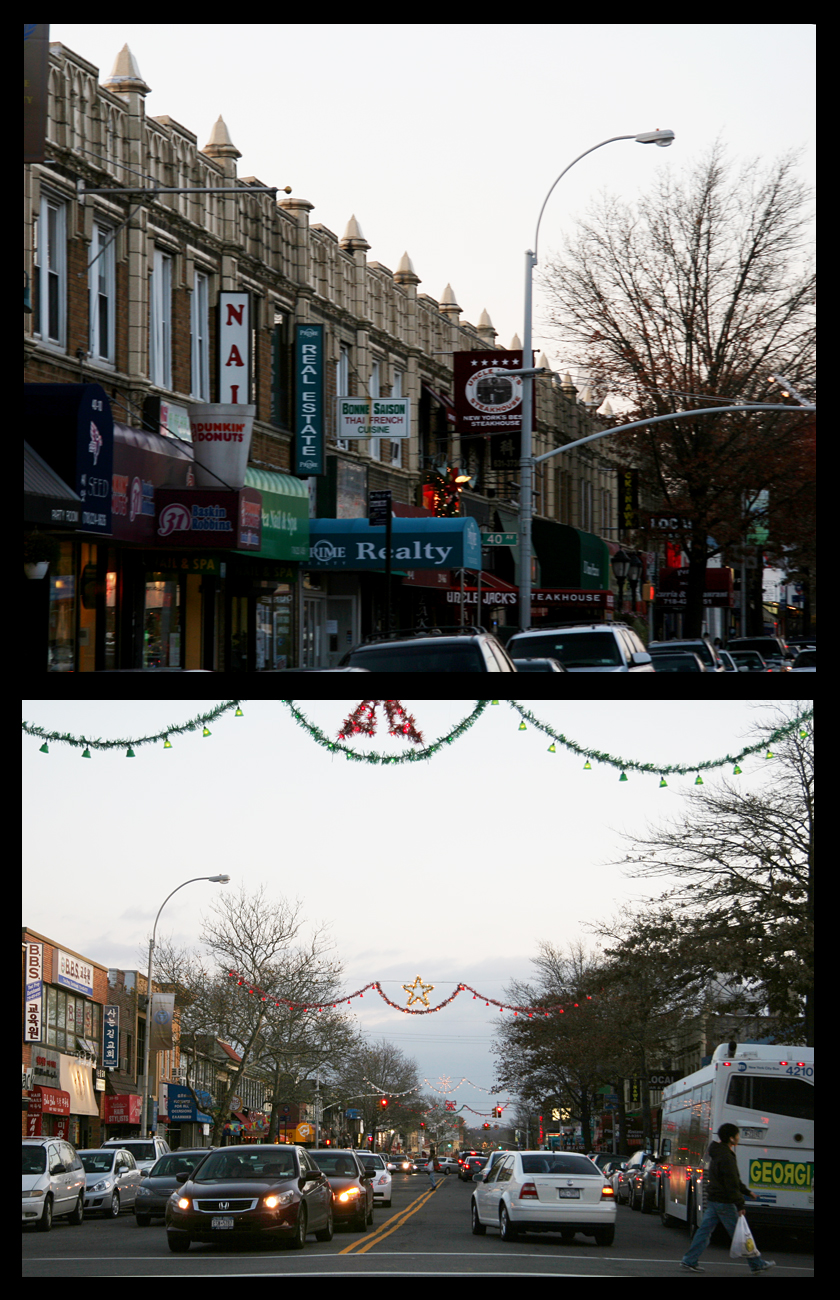
    If you look at the census figures for a place like Flushing, Queens, you will find that, like many areas of New York, this is more of a small city or town than a neighborhood. Flushing has a population of 173,826 and a demographic makeup that is 43% Asian, 19% Hispanic, 6% black, and 39% white. The range of services is broad enough that you could easily never leave the neighborhood, and I imagine that many who live and work in Flushing do not leave often.

    Flushing now rivals Manhattan’s Chinatown as a center for Chinese community, making it the largest (or second largest) in the United States and outside Asia. Flushing, however, unlike a typical Chinatown, has more Asian diversity, both in its residents and businesses/services, with many Asian groups including Korean, Taiwanese, Malaysian, Thai, Vietnamese, and Japanese.

    Flushing has become a model for religious pluralism in America, according to R. Scott Hanson, a visiting assistant professor of history at the State University of New York at Binghamton and an affiliate of the Pluralism Project at Harvard University. There are over 200 places of worship in a neighborhood of only 2.5 square miles.

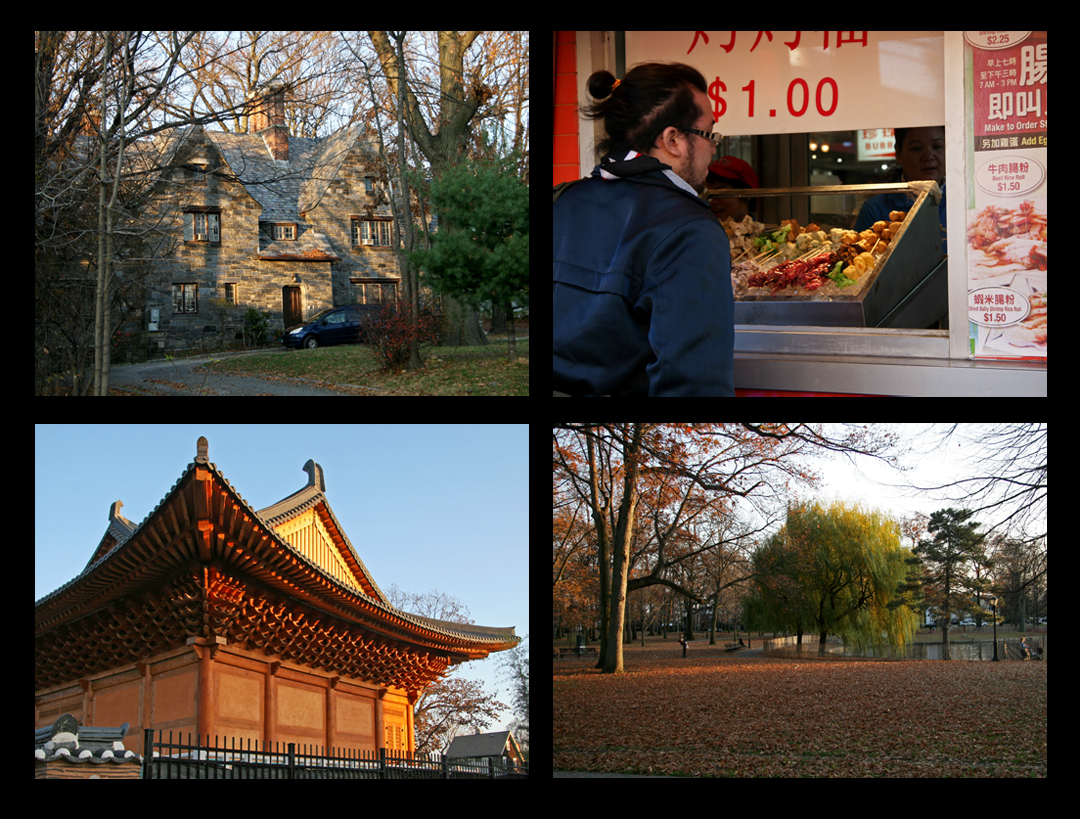
    On my recent excursion, I explored the area by foot and by car and was amazed by the diversity of people, commerce, architecture, and residential enclaves that I found. I was particularly impressed with North Flushing’s absolutely exquisite single family homes, just a short way from the hustle and bustle of Main Street, Roosevelt Avenue, and Northern Boulevard. You can see, for example, the Fitzgerald-Ginsberg Mansion in the upper right of the photo collage.

    There is a botanical garden, Flushing Meadows-Corona Park (site of the 1964 World’s Fair), the Queens Museum of Art, art galleries, tea shops, herbalists, dumpling stands, Queens College, the Old Quaker Meeting House, and the historic Flushing Town Hall (headquarters of the Flushing Council on Culture and the Arts, an affiliate of the Smithsonian Institution). Flushing is home to the Queens Borough Public Library – the Flushing branch is the busiest branch of the highest circulation system in the country.

    I would recommend a visit to Flushing (along with Jackson Heights), both for the New Yorker and the out-of-town visitor. Here, you will get a slice of ethnic life in New York City in a real working neighborhood which caters to its residents and not so heavily to tourists, as in Manhattan’s Chinatown. And there are plenty of restaurants to satisfy and shops to peruse.There’s a vibrant feeling in this place. Flushing is a city on the move…

    Note about the name: From the New York Times: “Flushing’s early settlers were mainly English families who came via Vlissingen, a port city in the Netherlands. In 1645, these folks named their community Vlissingen. The area remained known as Vlissingen until about 1663 when the name was changed to New-Warke or Newark, according to documents from the Queens Historical Society. In 1665, however, the name Flushing, an English version of Vlissingen, was adopted and stuck.”


  • Footprints

    There are still many good reasons to visit or live in New York City, and food is one of them. Certainly the world has changed, and many food specialty products once only available in places like New York are now available elsewhere.

    At one time, it was difficult to find cappuccino outside big cities such as New York. As recently as the 1980s, a coffee aficionado I knew bemoaned his fate when leaving the city to return the suburbs. Now, of course, a cappuccino is only as far away as the nearest Starbucks.

    Visitors to New York City as well as residents look for those special things unique to the city. If this is the type of thing you seek, something unique and authentic, look to New York’s ethnic foods. The large pockets of immigrant groups left many of their cultural roots behind when resettling here, but food was not one of them.

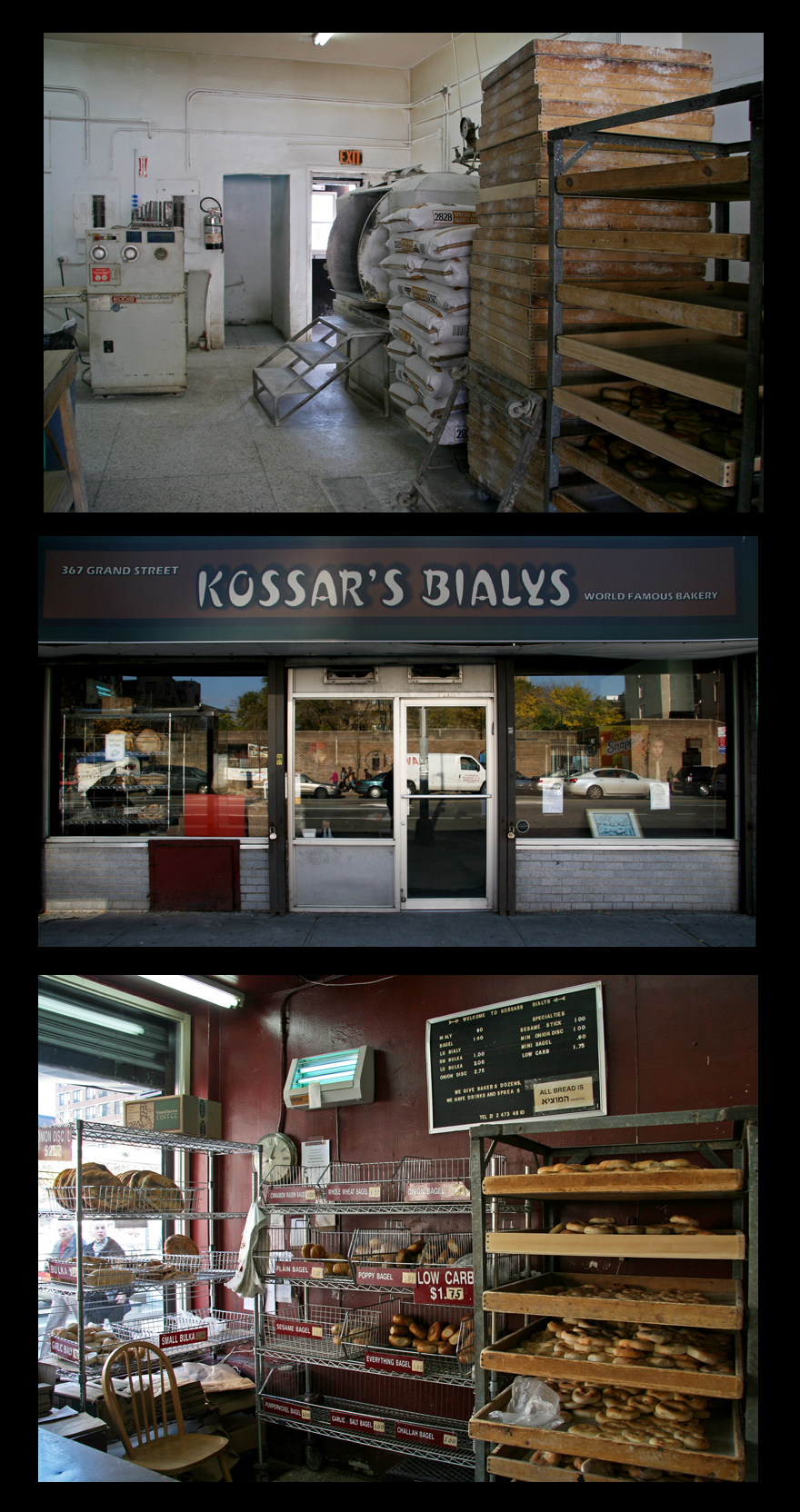
    The bialy is still relatively unknown, even in New York City. The bialy is a bagel-shaped roll. There is no hole in the center, however – only a flattened depression, typically with onions. It is much lighter than a bagel – many prefer it and its onion flavor. The word bialy is a shortened version of bialystoker kuchen, a traditional bread item in Polish Ashkenazi cuisine from Bialystok, Poland. It was introduced to the United States in the late 19th century and was first marketed in New York State by Harry Cohen in the early 1900s.

    Kossar’s Bialys is the oldest bialy bakery in the USA. It was founded in 1936 by Isadore Mirsky and Morris Kossar and is located at 367 Grand Street in the Lower East Side. Everything is done right on the premises – the flour, ovens, and machinery are all in plain view – no pretense or nonsense here. See more photos here. Kossar’s also makes bagels, bulka, sesame sticks, and onion discs. See their website here.

    The history and study of this food is literally a book in itself. In 2002, a book was published, The Bialy Eaters: The Story of a Bread and a Lost World (2002), by former New York Times food writer Mimi Sheraton, who used Kossar’s as a base for her research.

    The Jewish population is huge in New York City, and they have left large, indelible footprints in many spheres of our lives. I’ve enjoyed walking in those footprints, and I am following them right to Kossar’s for some genuine bialys 🙂

    Note: How curiously appropriate that the bakery is under the kosher certification of Rabbi Shmuel Fishelis, just a few blocks away at 25 Bialystoker Place.


  • Skame

    If you want to work in a clandestine manner, don’t hire the CIA. Hire an underground graffiti artist.
    I am astounded at how long some of these individuals have kept their identities secret, even after working for decades, interviews with the New York Times, or having been arrested, as Revs was in 2000. These men are not hiding in the hills of Afghanistan. They are living in the most populous city in the United States and tagging prominent public spaces in high-traffic neighborhoods.

    In the 1980s and 1990s, Revs teamed up with artist Cost, and they became two of the most well-known graffiti artists in New York City. Cost and Revs gave a rare interview in 1993 with New York Times reporter Michael Cooper. In 1995, Cost was arrested and his identity finally became known: Adam Cole of Rego Park, Queens.

    Revs’ identity, on the other hand, even after his arrest in 2000, is still unknown.
    In 2004, in an interview for ArtForum magazine, Revs said, “We think art should be dangerous. Everybody’s into safe art, doing safe things in their studio. We’re bringing danger back into it. It’s got to be on the edge, where it’s not allowed.”
    In 2005, he was interviewed again by Times reporter Randy Kennedy (article here). “To me,” he said in a rare interview, “once money changes hands for art, it becomes a fraudulent activity.”

    The work in the photo is on Canal Street, one of the most trafficked crosstown streets in the city. How access is had and these things are done without being apprehended is a mystery to me. I had hoped to get some information of any sort on the artist who tags himself as Skame, but I could find nothing.

    According to the Urban Dictionary, s.c.a.m.e. is an acronym utilized by the Psyop Community. “It is conducive to ‘counter-propaganda,’ in that, it eludes to source, content, audience, media used, and effect of the propaganda. To s.c.a.m.e. propaganda, refers to one’s attempt to analyze the content of said propaganda using techniques taught at the JFK Special Warfare Training Center.” I don’t know if there is a connection to the tag Skame, and perhaps I will never know…


  • What numba Kissena?

    I have previously written here of my experience as a New York City taxi driver when I was a university student. Nothing beats cab driving for a crash course in New York City and learning about its geography, boroughs, and people. There are many taxi cab stories which I have exchanged with others. In the course of driving nights, a driver will inevitably run across some outrageous situations. This has been the subject of the film documentary Night on Earth and the TV series Taxicab Confessions.

    I was introduced to driving by a college friend, an interloper into our university lives who was a native New Yorker and a few years older than we were. He was not a student, and to us at that time, he was a man of the world. He introduced me to many things in New York City, such as Wo Hop, the legendary Chinese restaurant at 17 Mott Street.

    I was new here and very naive and innocent. I was wide-eyed and easily impressed. On one particular night while driving a taxi, I was lost in Queens, looking for a particular address on Kissena Blvd. I was tired, it was dark, and the print on my borough map was getting too small and painful to decipher. An older driver was standing outside his cab – if I recall, he was eating a sandwich. He looked seasoned, so I asked, “Do you know where Kissena Blvd is?’
    To which he replied in classic New Yorkese, “What numba Kissena?”

    Wow. Can you imagine? This man did not only know the location of Kissena Blvd, but apparently, he was able to give specific directions to a particular address based on its street number alone! This seemed to be an incredible feat to me at the time, like some brilliant memory act using mnemonic devices. Or perhaps he was a savant with special abilities to know everything about street addresses.

    In hindsight, however, nothing of the sort is necessary. In fact, Kissena Blvd uses the block numbering system common to Queens and developed in 1911 by Charles U. Powell, a chief engineer in the topographical bureau, who modeled it after the Philadelphia grid system. There is a method to the madness or what the New York Times referred to as the “vexing vortex of the Queens street system.”

    Plan or no plan, however, the system is still vexing. Any number may exist as an avenue, road, place, lane, street, drive, or any combination. Even Queens residents are often helpless and resort to just asking for directions. If they are lucky, they get someone who is a street savant and can retort with something like “What numba Kissena?” 🙂

    Related Posts: New Yawk Style, Sea of Yellow


  • The Last Taboo

    In New York City, I have been privy to many conversations on a subject that is quite taboo: childlessness, i.e. the adult or couple who, for one reason or another, chooses not to become a parent. At best, one hopes for at least civil tolerance between parents and nonparents regarding the subject. But discussions can become quite hostile, quickly escalating to character assassinations.

    Many are driven to the city to pursue careers and take advantage of an environment where the American Dream looms large. Child rearing is often put on the back burner until later in life. Often, couples leave the city for the suburbs when a decision has been made to raise a family.

    Economics also make it difficult to have a family here. It is doable, but the cost of real estate is extraordinary.
    And there are those who just never wanted children. For these, the city provides a level of social possibilities and a density of human interaction which is hard to find elsewhere.

    There is such a stimulatory environment in New York City that any children that are here almost become lost in a sensory assault of people, places, things, and activities.
    And there are those who actually do hate kids. The childless who like children but have just chosen not to have them often must defend themselves against being child haters. In 2005, the New York Times published an article, Supersize Strollers Ignite Sidewalk Drama.” In it, the discussion of childlessness is described as the last taboo:

    Not having children “doesn’t mean I hate kids,” she said. “But I do hate the parents who somehow have decided that they are superior to everyone else because they have kids.”

    It might help, Ms. Felcher and others said, if parents and nonparents could talk about their feelings toward one another. “It’s the last taboo in this culture,” Ms. Felcher said. “You just can’t talk about it.”
    Ms. Anderson agreed, “We’re a bit afraid of expressing our opinions for fear of being labeled as people who hate children or who do not support women.”

    I neither champion the life of the childless nor dislike children. The negatives of being childless become greater as individuals age. Parents pass away and often, only siblings, if there are any, remain as the only close family. Even a minimal level of care taking or assistance becomes unavailable. Holidays can become times of sadness. Many are terrified at the prospect of aging alone – even with money, a social safety net needs to include people, something money doesn’t buy.

    It is easy to live a life in New York City with virtually no interaction with children at all. Childless individuals and couples are common and easy to befriend. Some may feel that this is an impoverished life. Others see it as merely a lifestyle choice and a realization that not everyone is cut out to be a parent. We should be capable of rational, calm dialogue about the subject without character assaults. It should not be the last taboo…

    Related Postings: Little Burnt Out, Heart Warming, Warm and Fuzzy, Mary Celeste


  • White by Design

    In the beginning, I would take the conversations seriously. By seriously, I mean attentively, with a reasonable expectation that I would get different responses regarding suggestions for color. Soon, however, I realized that each of my best friend’s answers would be presented and argued differently but the preferred color in almost any situation was the same: white.

    It became a private joke between this long-time friend and other close friends. Her design choice appeared to always be white. Drapes, wall color, clothing – anything that was available in white was usually chosen or recommended.

    With absolute serendipity, many years later, I discovered a hardcover book: White By Design by Bo Niles (published in 1984 and still in print). It was a virtual tribute to white and its use for interior decoration. The perfect gift. But, alas, I was too lazy to purchase it. One of life’s small regrets.

    White is so important to visual artists. It is the color of light itself, and artists love and need light – it is one of their primary tools. I remember how surprised and disappointed I was when Apple Computer went from their six-color rainbow logo to white in 1998. Eventually, even their pioneering success in translucent color iMacs gave way to white. Now I love the white that dominates the color theme for Apple’s packaging, graphics, and product line.

    White has an elegance when used well as a decor choice. It not only gives a clean look but also allows other objects to shine. Used badly, white can be a horrific choice – everything is mercilessly revealed with white. It is also deliberately and conspicuously impractical, making a statement about luxury and the ability and willingness for maintenance. The decision to use white in an unforgiving city such as New York makes a particularly strong statement.

    White has cultural significance and is associated with purity, freedom, and cleanliness. There is a litany of positive associations in so many areas of life. We have white sugar, pure sand, snow, cotton, clouds, milk, white uniforms, white rooms, the White House, the white dove of peace, white robes of clergy, white bridal dresses, and white magic.

    This shop in SoHo, the Cyrus Company, was arresting in its use of white. I was reminded, however, of the book I never purchased. But then, as now, there is always time, because the world never tires of white. In many ways, much of our world is White by Design 🙂

    For more White by Design, go here and here.

    Related Postings: That’s Quite a Briefcase, Who See the Red?, Coleur du Jour, Tale of Two Colors, A Colorful Life, Color Brigade, Eye Candy


  • No Lipitor

    If you live in New York City, sooner or later you are most likely going to end up enjoying a ride on the Long Island Expressway (aka the L.I.E.) and learning why this roadway has become known as the world’s largest parking lot. Many also feel that the acronym LIE is appropriate for a thoroughfare that represents itself as an expressway.

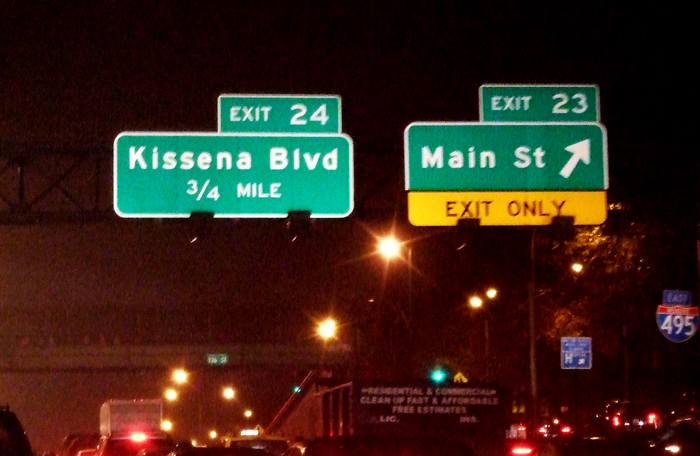
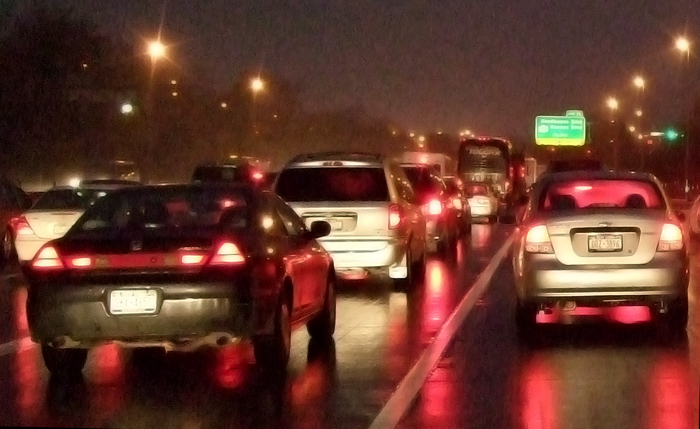
    The photo was taken during my recent journey to visit a friend in Roslyn, Long Island, a distance of under 20 miles from Manhattan. What could, under ideal conditions, have been a 30-minute ride, turned out to be a painful 90- minute crawl.

    This highway is the major artery running east from Manhattan (via the Queens Midtown Tunnel) and servicing the Long Island suburbs of New York City. It extends 71 miles, going through Queens and nearly the entire length of Long Island.

    We have the largest island in the contiguous United States and the largest city in the US, all serviced by essentially one major highway. And that means trouble. Compound this with the fact that we are talking about islands, and that means limited access. For the traveler who is experienced with all of the alternate routes and is able to assess the situation based on conditions, time of day, weather, etc., the expressway can be avoided. There are various alternate routes which parallel the LIE for various distances – the Northern State Parkway, the Southern State Parkway, and Sunrise Highway. Others who are particularly averse to traffic can resort to local routes, such as Northern Boulevard.

    But not everyone has the stomach for tactical maneuvering, and most will just take the simplest route and travel the clogged artery. For this one, we have no Lipitor…


  • Winter Walks

    Here is something I like best about living in New York City: winter does not subsume us. There are a number of reasons for this. The city is a pedestrian place, and our mobility is not so strongly influenced by seasonal weather. Walking goes on, relatively unfettered by rain, cold, or the occasional snow. We stroll to restaurants and window shop in virtually the same manner all year. Subways run primarily underground, so, there again, we do not deal with Mother Nature. Also, the city which we see daily is primarily man-made, so in many areas and neighborhoods, the appearance of the city changes little or not at all.

    I grew up in New England, and the coming of winter really changes the collective mindset. The visuals change dramatically, with denuded trees and withering grass. Out come the rakes and snow shovels. Snow tires are checked, gutters cleaned, storm windows positioned, deck furniture put away, swimming pools drained and covered – an entire litany of annual rituals and chores indelibly imprinted in our minds, emblematic of the season. And these changes are not reversed in a warm spell – pools are neither filled with water for the day nor are picnics planned. Apartment dwellers do not have to deal with any seasonal preparations or chores. For most of us, we just put on a heavier coat.

    The worst part of New England winters was that feeling of being shut in. There are seasonal activities for those who partake – bike riding, hiking, skiing, apple picking, etc, but after childhood’s end, I found it really too cold to want to do much outdoors.

    I found comfort that I am not alone in these thoughts and feelings; I came across an article in the New York Times, Winter Walks on Country Roads, written in 1879 about New England winters. Here is the first paragraph:

    Even the faintest gleam of sunlight, and the shortest period of freedom, are inexpressibly welcome to a prisoner. Now we are all prisoners; we are shut in doors by an inclement season; we live six months in fear and trembling; we dread the Winter air as we ought to dread the wrath to come. To a certain extent this feeling is justified, for our Winter storms are both disagreeable and exhausting. But we are generally our own jailers in this confinement; for the dread of the bad days lingers over the good ones, and keeps us from the freedom and sunshine that we can safely enjoy during nine-tenths of the Winter days. The injury this confinement works on our national health is certainly worth consideration; and every amusement that tends to bring us out-doors in the Winter should be practiced with persistent enthusiasm. Walking is without question the exercise that is the best, the safest and the most practicable, for everybody. Anybody who can walk can dissipate the gloom of Winter, enliven his blood till it tingles, and secure buoyant health and vigor. In a word, the walker can enjoy all the benefits of out-door life on the snow just as well as on the turf or gravel.
    C.H.F. The New York Times, 1897.

    In New York City, if there is a spate of atypically warm weather in the winter, people respond instantly, and for a brief period of time, it’s like winter never existed. Out come the people in the dress and with the accoutrement of spring and summer. Street performers, vendors, sitting on park benches, sunbathing, picnicking, reading, Frisbee – virtually every warm weather activity can be found.

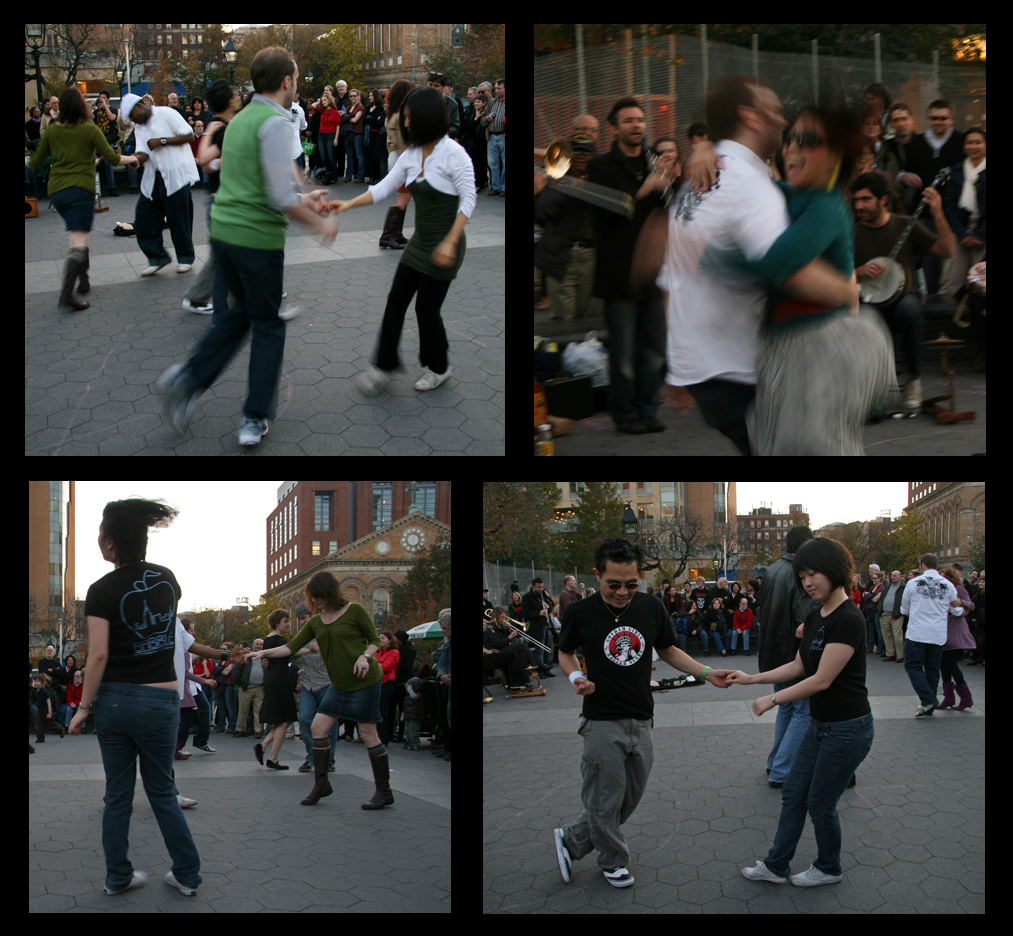
    On our recent run of warm weather last weekend, the Baby Soda Jazz Band appeared, performing their eclectic street jazz with influences ranging from New Orleans brass bands, jug music, southern gospel, and jazz. The music was infectious, and people took to literally dancing in the streets (or in the park).

    Of course, there are wonderful winter activities and holidays, and the prudent person does well to embrace the season rather than resist it. For now, though, I choose to resist as long as possible and join the dancers in the streets 🙂


  • Montmartre and Peillon


    I love my places high and my neighborhoods charming – bucolic and oozing with character, history, fine architecture, and artists. My neighborhood in New York City, the Village, certainly has many of these attributes. But to get the full package, I go to France.

    My favorite indulgences are the village perché (perched villages) in the South of France – small, hilltop medieval villages. I have been obsessed with these places, at one time compiling a database of 269 of the most wonderful and cross-referencing them with my collection of books on French villages. I created database entries for comments and checkboxes to note which books recommended which villages.

    Too small to find in the Michelin Map index, I laboriously located all of the villages through map exploration, tagged them in the maps, and added the map coordinates to my database for future reference. I included the official French département. The printed result became a guide for my travel to Provence, the Alpes-Maritimes, and Vaucluse.
    I visited dozens of these villages, often to the chagrin of my travel companions. On one family trip, my sister was completely befuddled as to why I would do this and why anyone would want to travel that way. I think she saw it as analogous to painting by number. I like numbers, and my desire to accumulate villages visited knew no bounds. My favorite is Peillon, perched in the hills, with stone houses clinging to a cliff face at 1000 feet.

    There is still some artistic flavor to Greenwich Village, but most of its art history is in the past. Its legacy of beat poets, artists, musicians, writers, dancers, actors, and performers reads like a who’s who of the American arts. The neighborhood has become much too expensive to really qualify as any type of artistic bohemia. However, musicians and performers are common, and occasionally, one may still see someone painting in the streets or parks of the Village.

    Today’s artists here typically either travel in and out of the city or are some of the few remaining beneficiaries of rent controls, living in below-market rentals.
    Much of the Village has been commercialized and is heavily touristed, but no one has taken away the charm of many of the neighborhood streets and its collection of hundreds of 19th century row houses. The West Village is particularly beautiful.

    In Paris, I get all this with hills (over 400 feet) in Montmartre, an area also known for its history of artists. Those who worked in or around Montmartre include Vincent van Gogh, Picasso, Salvador Dalí, Modigliani, Claude Monet, Raymond Duchamp-Villon, Henri Matisse, Renoir, Degas, and Henri de Toulouse-Lautrec. Somehow, street painters there today still seem to have a little more authenticity, but I would imagine a Parisian might see them the way we see painters in New York City – as exploiters and sellers of an artistic past to tourists.

    As I stroll the Village, I head for the hills. In the distance, I think I see Montmartre and Peillon…


  • dinamic_sidebar 4 none

©2026 New York Daily Photo Entries (RSS) and Comments (RSS)  Raindrops Theme