• Tired of Life?

    “Why, Sir, you find no man, at all intellectual, who is willing to leave London. No, Sir, when a man is tired of London, he is tired of life; for there is in London all that life can afford.” — Samuel Johnson

    Now that’s a strong assertion, but I think many New Yorkers feel the same way. Certainly there are things that one would not find here, but for most city dwellers, those things are either of no interest or are compromises they are willing to make. And there are ways to satisfy many exurban or country experiences here. Want a walk through rustling leaves in the autumn? Take a stroll through Central Park’s Ramble.

    Yearning for the beach? There is always Brighton or Rockaway. Aquatic nature? Try the Jamaica Bay wildlife refuge. Of course, Central Park is not Vermont, and Rockaway is not Cape Cod. And for those requiring extreme sports and dramatic natural landscapes, perhaps they are best living out west. For we have no real mountains to scale, only buildings.

    But for those of us who want to be immersed in culture and a soup of human diversity and intellectual stimulation, living out of the city is untenable.
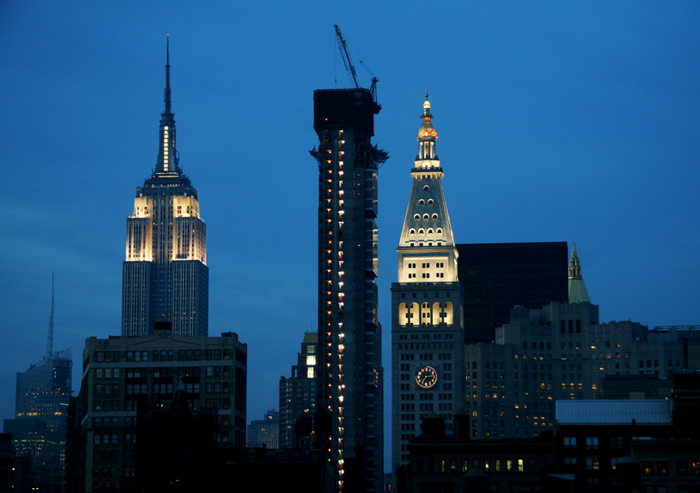
    I was reminded of the Johnson quote while enjoying the vista in the photo and realizing I had seen this same panorama so many times but did not tire of it. For if I tire of this grouping of Manhattan icons, so beautifully lit at dusk on a late summer’s eve, perhaps I have tired of life itself…
  • Joe’s Dairy

    When I was a child, blue laws did not permit most retailers to open on Sunday. But business has changed dramatically and is so competitive that for most retailers, being closed on Sunday would be suicide. Some find the laws antiquated and draconian. Others find these old blue laws to be a blessing to laborers, insuring at least a day off.

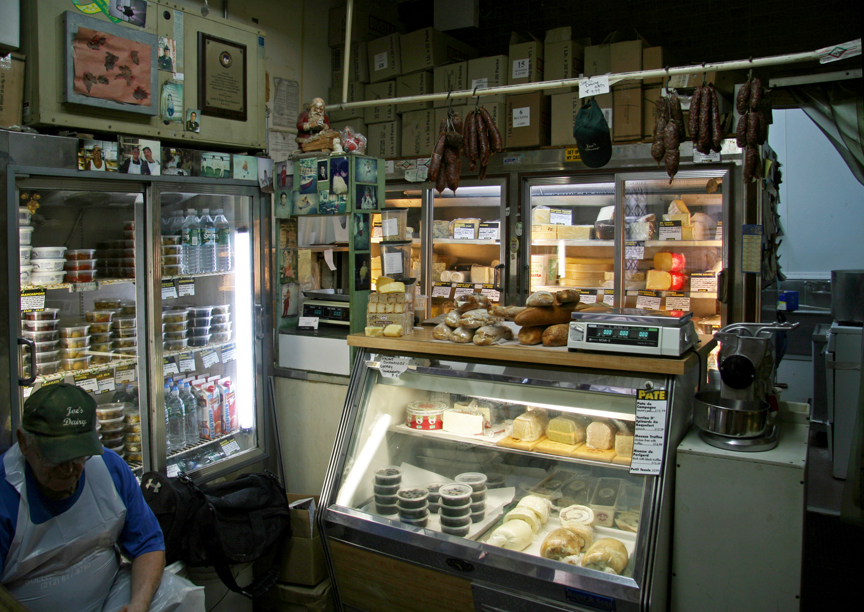
    When you run across a business that does any retail and is closed on Sunday, you know that they have a very niche business, an off-the-beaten-path location, or are very old school. The latter is the case with Joe’s Dairy at 156 Sullivan Street in an Italian area of SoHo/South Village, nearby to Raffetto’s, another wonderful Italian food store.

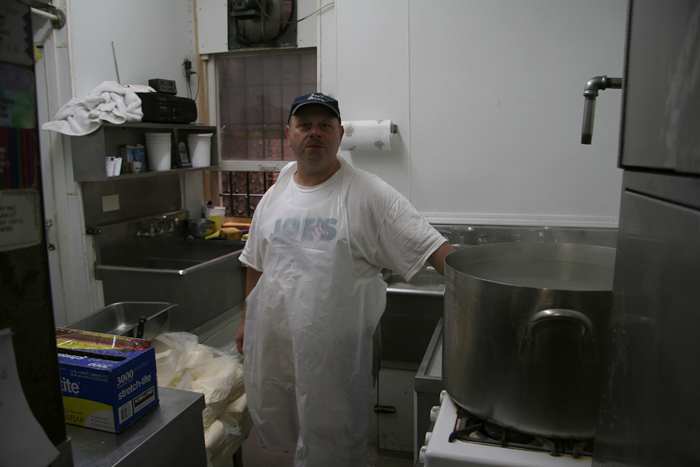
    I have been waiting to do a story on Joe’s for some time. The right opportunity presented itself recently, and I strolled in to find a congenial and accommodating staff. I was extremely pleased to learn that the owner, Anthony Campanelli, was on premises making his renowned mozzarella.

    A few paces into the tiny back room, and I found Anthony surrounded by huge cauldrons of boiling water, working his magic for customers citywide. He stopped to speak to me, taking the brief meeting quite seriously. With no objections, he allowed himself and the kitchen to be photographed. See photo here.
    He buys his curds in bundles from a supplier in Buffalo, New York, receiving deliveries three times a week.

    Each bundle weighs 45 pounds, and Anthony runs through 25-40 bundles a day – nearly a ton of cheese. Most consider this to be the finest mozzarella in New York City, and it comes in a number of flavors. The shop also sells a variety of Italian food products – imported cheeses and other goods.

    Afternote: In writing about Buffalo, NY, the word “buffalo” spurred me to make a follow-up phone call to Anthony and enquire whether he made buffalo milk mozzarella. He does not, assuring me that buffalo milk curd is not available in the United States (all his mozzarella is from cow’s milk). Mozzarella di Bufala Campana is imported from Italy. Many consider it to be the finest tasting – it is featured on many restaurant menus.


  • Conflux

    Some try to find beauty in all things or aspire to love everyone. Now although these are admirable goals, if you live in New York City, dead rats are not endearing. Personally, I do not like rats, and try as I may, I do not find beauty in them yet. So for this reason, I did not want to feature the dead rat (with a tiny blue triangular icon near it), which appeared that it might have been part of the Conflux festival, and have this image haunting me and disgusting you in perpetuity. So if you want to see the dead rat which was located on LaGuardia Place, you can see it here.

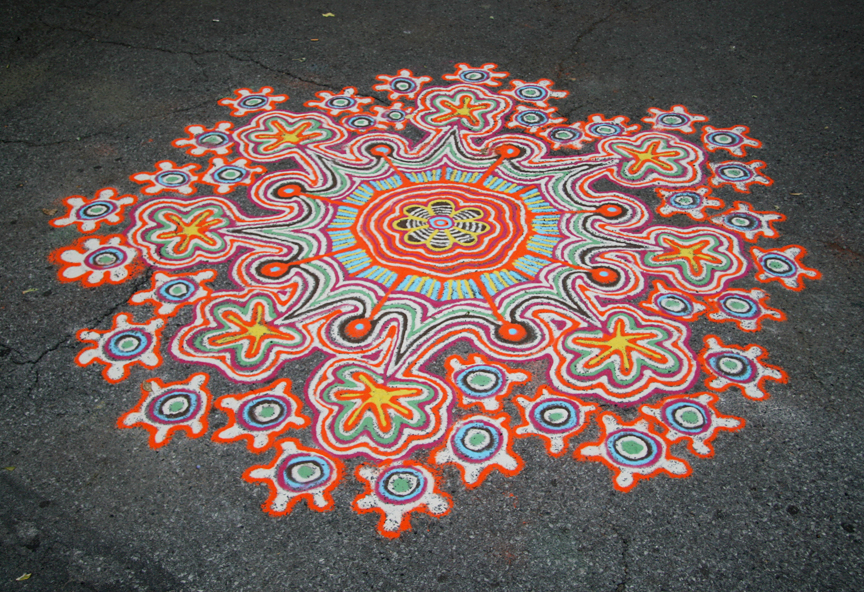
    On the other hand, if you want an easy task of finding beauty, I recommend that you fix your sight on the work of Joe Mangrum, whose work in the photo graced the pavement in Washington Square Park for the last few days. It was a showstopper and appeared to please every passerby. See a second photo here. These sand paintings were created in brilliant colors – unprotected like sandcastles, their slow dissolution a necessary feature of this type of installation. See more of his work at his website.

    Unfortunately, this was a 4-day event which I only became aware of in its last few minutes. A jog over to the AIA headquarters on LaGuardia Place found me looking at a locked door at 5:04 PM – their exhibit had closed 4 minutes earlier.

    There were indoor, outdoor, and offsite events. From the Conflux website:

    Starting September 11th, over one hundred local and international artists will transform New York City streets into a laboratory for exploring the urban environment at the Conflux Festival. Located in Greenwich Village at the Center for Architecture (a.k.a. Conflux HQ), the four-day event includes art installations, street art interventions, interactive performance, walking tours, bicycle and public-transit expeditions, DIY media workshops, lectures, films and music.

    Read more here (update 1/10/12: Link no longer works) and find complete listings with all the participants and photos of their work.

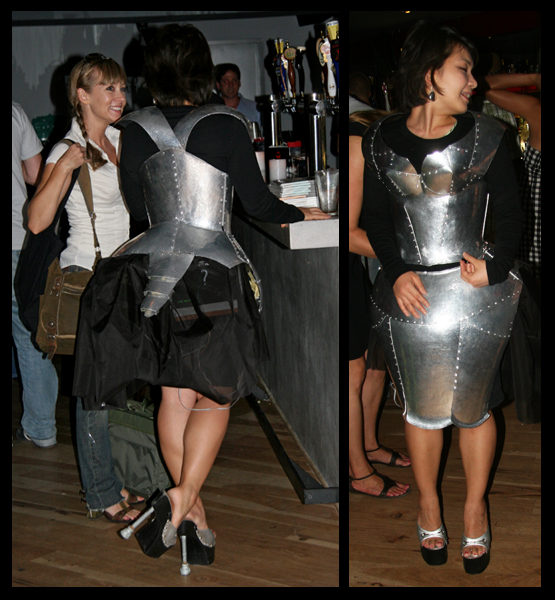
    I did catch just a couple of other art works. One was the extremely ambitious project, Compli-mum (complete woman), by computer artist Hyojin Ju. Her motorized skeletal structure, appearing as feminine armor, changes through the use of microcontrollers and features two video displays. See a photo of Hyojin displaying her work here. Many of the projects seemed quite imaginative. You can see them all at the Conflux website…


  • Sense of Humor

    I had a small inkling that Judson Memorial Church was atypical and involved in community works. But I had no idea of the extent of this involvement nor the radical nature of the social programs it has supported. In fact, I am puzzled as to how some of the causes they have supported are even congruent with the tenets of the Protestant Church. Christian churches do have a history of outreach and social programs, but Judson really takes it much further and in unexpected directions.

    Founded in 1890 by Baptist preacher Edward Judson, the church was established form the beginning to serve the growing immigrant community in lower Manhattan (the Church is located on Washington Square South, immersed in the NYU “campus”).

    They ran a free medical/dental clinic and a settlement house at 179 Sullivan Street. At times, they allowed homeless men to sleep on their pews. Beginning in the mid-1960s, Moody and associate minister and composer Al Carmines (1962-81) brought Judson first a city-wide and then a national reputation, opening the church to experimental, avant-garde artists from many genres such as dance, painting, and theatre. They have organized politically around issues of civil rights, free expression, abortion rights, and the decriminalization of prostitution (in the 1970s they established a Professional Women’s Clinic for women engaged in prostitution). Judson Church trains future clergy in public ministry and has taken a leading role in the New Sanctuary Movement for immigrant rights. They are “gay-friendly.”

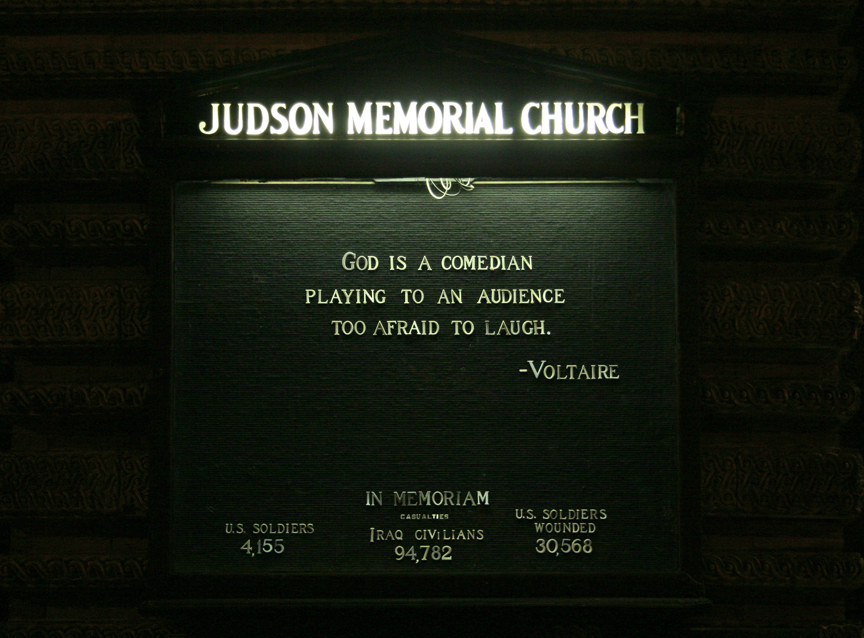
    Regarding the quote currently displayed outside the church: Voltaire was a major figure in the French Enlightenment, and his works are a huge subject matter – he was a prolific writer, having penned over 20,000 letters and over 2,000 books and pamphlets. He took many controversial positions and was exiled from France a number of times. Voltaire distrusted democracy, which he saw as propagating the idiocy of the masses.

    Voltaire is often mistaken as an atheist – some attribute this view to a quote from one of his poems that translates, “If God did not exist, it would be necessary to invent Him.” Actually, Voltaire was a leading Deist – his criticisms were more of organized religions than of religion itself.

    I’m not being evasive, but space on this blog does not allow for a proper distillation of the various thoughts about Voltaire’s quote, “God is a comedian playing to an audience too afraid to laugh.” Suffice it to say that many feel it has been misinterpreted and taken too literally. Any theologians or philosophers who want to posit an interpretation of God’s sense of humor?


  • Universal Impact

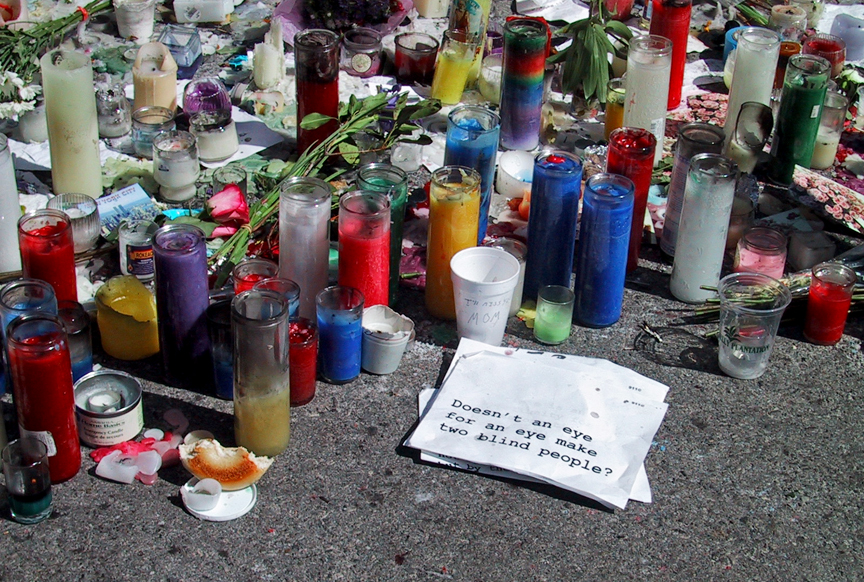
    I lived in New York City during the 9/11 disaster. In fact, my apartment had unobstructed direct views of the Twin Towers. I viewed the impact of the first Tower minutes after the first plane struck it. I live and work in lower Manhattan in close proximity to Ground Zero, and like other downtown residents, elements of the aftermath lingered for months. Smoke, fumes, restricted areas, emergency vehicles, vigils, and memorials were part of everyday life.

    I have a series of photos taken during that period, none of which I have posted before. There has so much coverage, imaging, and activity surrounding the disaster that I have limited my participation. Any contributions sometime feel virtually gratuitous.

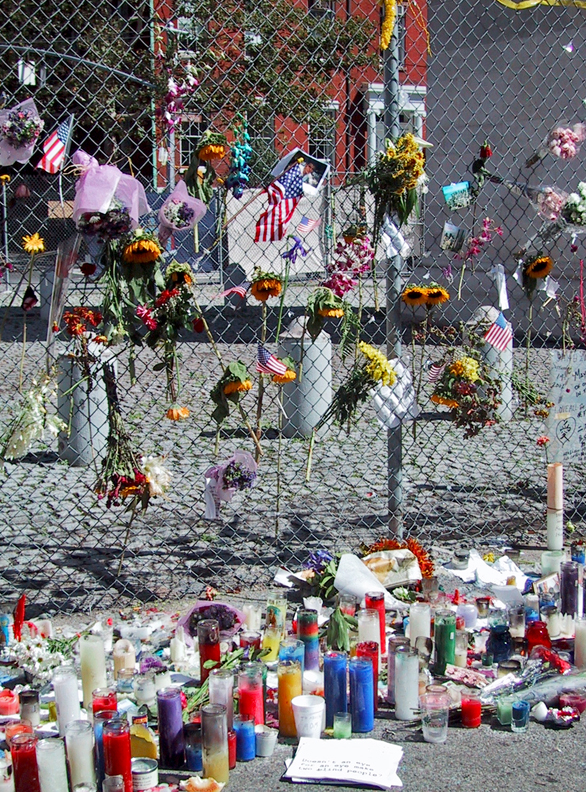
    Today I have opted to post one of my original photographs of a memorial site against a fenced-in area surrounding Washington Square Arch in the Village, taken in 2001 (see second photo here). This site was one of many spontaneous occurrences throughout the city. One remarkable thing about all of these sites was the universal regard they were shown for the long periods of time that they remained. Like the ghost bikes around town, these displays of candles, flowers, and personal notes were left unprotected but remained unaltered.

    There were a small number of sales of inappropriate 9/11 “memorabilia” immediately after the event, but most of this was squashed quickly and mercilessly by mayor Giuliani. There was zero sympathy for anyone trying to capitalize in such a heartless manner.

    No graffiti or vandalism, and little exploitation – extremely rare in this city to have an event of such monumental impact that it is paid such universal respect…


  • Camperdown Elm

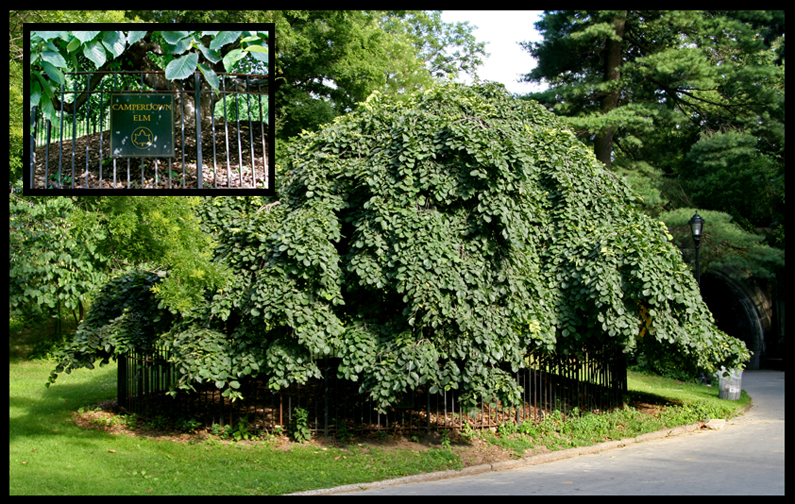
    In New York City, we have a surprising variety of flora and fauna. A myriad of trees introduced from other countries can be found in the major parks, such as Central Park and Prospect Park. Varieties are often identified with plaques (look for these identification plaques on the trees themselves). In Prospect Park, Brooklyn, one can find the notable 136 year-old Camperdown Elm tree. This cultivar can not reproduce from seed. From the Prospect Park website, we have a description of the species, propagation, and history:

    The Camperdown Elm, planted near the Boathouse in 1872, has developed into a stunning specimen. No more than 12 feet high, it resembles an over sized bonsai. It is the most famous specimen tree in Prospect Park. The weeping shape of this elm is extremely attractive and a peek under the canopy reveals an amazing branching structure. The many cavities in the branches and the size of the trunk show that this is an older tree.

    Between 1835 and 1840, the Earl of Camperdown’s head forester, David Taylor, discovered a mutant contorted branch growing along the ground in the forest at Camperdown House, in Dundee, Scotland. The Earl’s gardener produced the first Camperdown Elm by grafting it to the trunk of a Wych Elm (Ulmus glabra) – the only elm species that the Camperdown will accept as a root stock. Every Camperdown Elm in the world is the product of a cutting taken from that original mutant cutting and is grafted onto a Wych Elm trunk, usually 4-6 feet above ground.
    Suffering from severe decay a century after its donation to the Park, the elm’s fifteen minutes of fame arrived in 1967 when Marianne Moore’s poem about it helped raise funds to pay for its treatment. 

    There are park maps and other information available in Belvedere Castle in Central Park and the Boat House in Prospect Park. Both parks are highly recommended any time of year; there are a plethora of environments and activities…


  • Fluff

    When viewed in the grand scheme of things, and in light of life’s serious problems, fashion, trends, and style can seem very unimportant, fluffy, superficial, so temporal, and perhaps even boring. I watch runway models on television and I am incredulous that people take fashion so seriously and that there is an enormous industry built around what a few have decided will be next, draping it on walking sticks and then parading the result for admiring hordes who hang on every crease.

    But then, we are not always looking at the grand scheme, and it’s not healthy to only live indulging in life’s serious problems. And a world without style would be a more boring one. We don’t want our lives to be guided strictly by utility and designed by bookkeepers. We need style just like we need flowers and parades, as I wrote about in Gratuitous in Nature and Let’s Have a Parade.

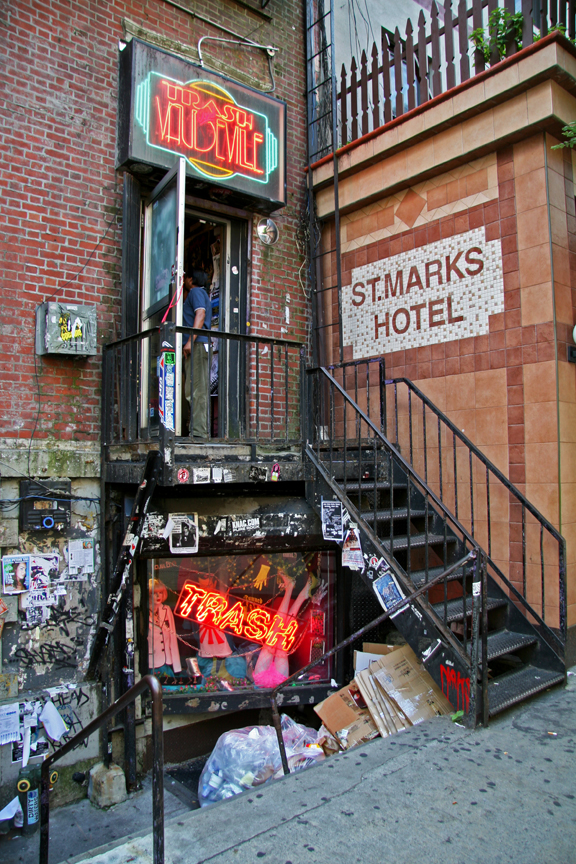
    I have only been into Trash and Vaudeville once, many years ago. I considered it a must-do since I have walked by it literally hundreds of times and it is a landmark retailer, located on the major thoroughfare in the East Village: St. Marks Place. It occupies two floors (Trash upstairs and Vaudeville in the basement) at number 4 St. Marks, an 1831 Federalist-style building. I only vaguely recall the visit and did not spend much time. The store’s origins goes back to 1971 and has been a destination for punk and goth clothing and shoes, with a history of selling to celebs such as the Ramones. Perusing various online review sites, I see that the place is still looked on quite favorably by many, so I imagine this place would be fun for those disposed to the punk/goth genre.

    I remember being with a friend one night who was on an absolutely hysterical rant over Marshmallow Fluff. His central point was that when it comes to fluff, only America could invent and successfully market such a product, one that he saw as emblematic of much that he hated about America. But I must confess – as a child, I just loved Marshmallow Fluff…

    Photo Note: I originally took this photo because I thought the pile of trash in front of Trash was so appropriately ironic. But my posting took its typical twists and turns in the course of writing.


  • Balsamic Vinaigrette


    This scene was so evocative of childhood summers – bathing suits and sprinklers. This woman was, of course, not running through these sprinklers, but sunbathing at 10 AM on a weekday with lawn sprinklers in the background was both unusual and suggestive – the scene begged for a photo. Soon, sunbathing will be a distant summer memory. Although it is technically still summer, the collective mindset changes greatly after Labor Day and the start of the school year. The reality of summer’s end is further reinforced by cool clear days, a presage to autumn.

    I am surprised at how universal the practice of cooling off by running through a sprinkler is. I always assumed that only the desperately poor resorted to this summer heat cooling solution. But in speaking to many people over the years from different social strata and countries, running through sprinklers appears to be a play activity that transends class and nationality. Children will generally eschew concerns regarding image or status. The size of a pool or the particular location of a summer house is not of much concern to a child on summer break. Of course, there are exceptions – children who have been raised at an early age to appreciate the “finer things,” which frequently translates as snobbery. I find that this can be quite disturbing.

    Children should be taught about quality and not be brought up as classless boors, but one must be careful to not end up with children intolerant of the ordinary – the world is comprised predominantly of ordinary people and ordinary things. Arrogance, snobbery, elitism, and one-upmanship are not endearing qualities in children, and all should remember that the world is populated with haves and the have-nots, primarily have-nots.

    I am reminded of a frightening occurence in a restaurant. A young child was essentially having a temper tantrum. The reason? His preferred salad dressing was not available: balsamic vinaigrette…


  • Property Owner

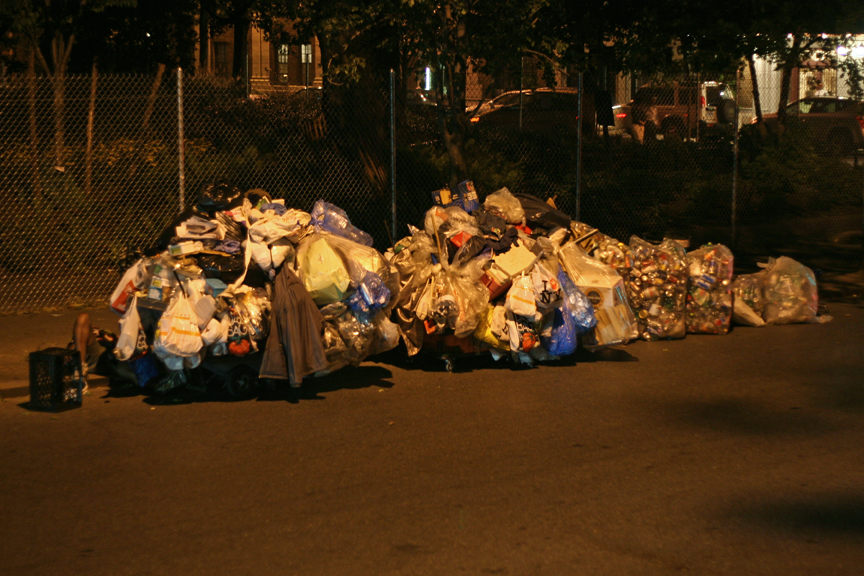
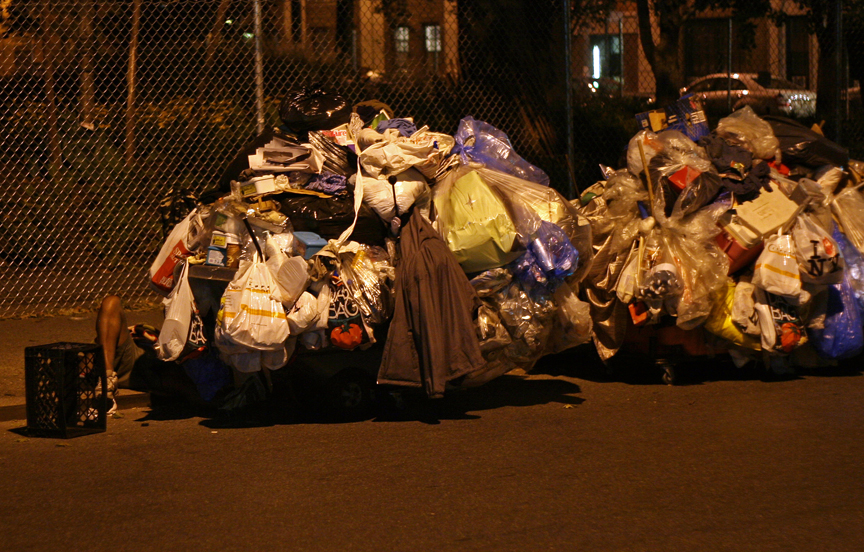
    On April 5th, 2007, I posted Caravan of Dreams, showing a man wheeling a mattress and couch down a busy Village street. But I should have saved that title for today’s posting, because this is what I was really searching for when I used the word caravan. I have seen these processions of trash before, but they are not an everyday occurrence, and my last attempt to photograph one with a small point-and-shoot camera was met with an angry, hostile outburst by the homeless owner, essentially accusing me of exploitation. So I refrained at that time.
    The indignant attitude of those on the fringes of NYC may come as a surprise to some, but this is typical New York Style – pride can been seen at every strata of local society. Although homelessness is not a crime per se, many of the activities of the homeless are, frequently necessitated by the lifestyle. The rights of the homeless and the legality of their activities is the subject of endless debate.

    Last night, I witnessed the caravan in the photo on Washington Square North (the owner can be seen sleeping on the left near the milk crate). See closeup photo here. Early this morning, he was on the move again.

    There is an apparent element of lunacy here – acquiring and moving mountains of what appears to be trash. Plus, tending to this cache is a full-time job. Belongings are affixed typically to shopping or hamper carts. These wagon trains of carts ala trash are then moved incrementally and sequentially – a tedious job. But then again, work can be therapeutic. And much of the booty are bottles to be recycled for cash. Perhaps this monumental nomadic enterprise is exactly what keeps their owners sane, giving their life meaning and making them feel like members of New York society with real property ownership (frequently overnighting in the best of neighborhoods). On the other hand, I’m still just a renter…


  • Big Buddha

    If you are looking for surprises, head to Manhattan’s Chinatown, generally considered the largest or one of the largest (depending on whose counting and how) outside China. The main attractions here are primarily restaurants, indoor and outdoor food vendors, and shops carrying Chinese tourist items and heavily discounted consumer goods, including copies of brand-name merchandise.

    So I was quite startled while walking by the ticket office to the Fung Wah bus company to find the Mahayana Buddhist Temple, an enormous place with a faux pagoda front and lions, prominently located at 133 Canal Street and the Bowery – in no way an out-of-the-way location. Yet I have been by the intersection hundreds of times and never noticed this place.

    Whimsically, I entered the place with no expectations. I was even more surprised to find a huge room with this 16-foot-tall Buddha, the largest in the city.
    Until 1995, this building was occupied by the Rosemary Theater. In 1996, it was converted to the Mahayana Buddhist Temple by Annie Ying, who established the first storefront temples on the East Coast and a temple/retreat on a 114-acre site in South Cairo, New York. Her husband, James Ying, operated a chain of gift shops in Chinatown and the neighboring suburbs.

    But the most interesting twist is that their son, Dr. Nelson Ying who runs the temple, has a Ph.D in nuclear physics and is adjunct professor at the University of Central Florida. He was the first Buddhist preacher to perform Buddhist weddings in New York State. He is not a priest, however, as he does not meet the requirements of being vegetarian or unmarried. He and his parents hail from Shanghai, which they left in 1955 to come to this country. Only in New York…

    Related Postings: Ridiculous, Hallmarks & Earmarks, Tea Time, Durian, Pearl River Mart, At Arm’s Length


  • No Radio

    I have a very strict policy of only using photos taken of or in the 5 boroughs of New York City. And being away on vacation is no excuse to use photos of another locale. I prepare for this in advance.
    However, the mini-event that occurred on Saturday was so outrageous to me, from a New Yorker’s perspective, that I have to break my rules and tell this tale.

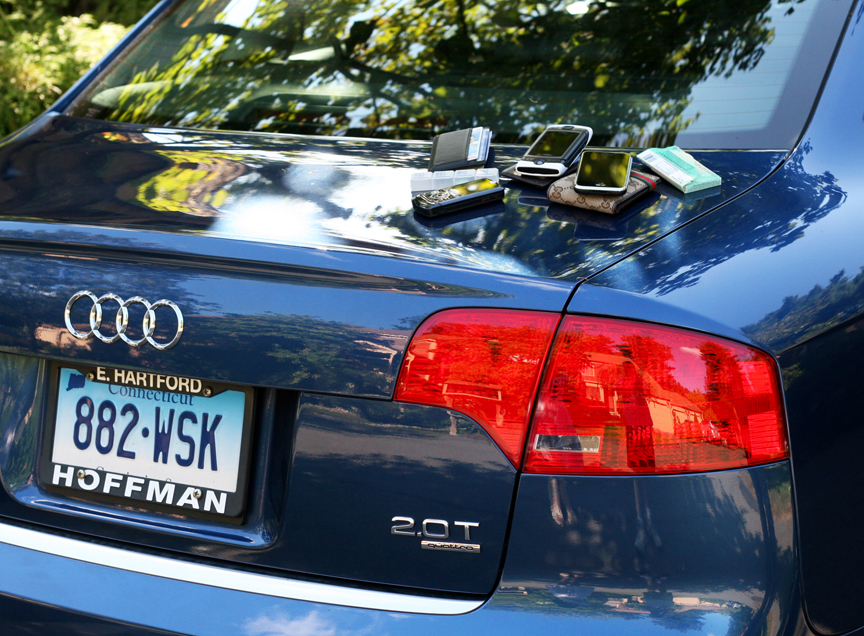
    While away this weekend, my two nephews and a friend decided to go for a short canoe ride in a river at my parents’ gated condo community. They asked if I suggested wearing shorts rather than pants in the event that they get wet. My response was that if they were to fall into a river, shorts versus pants would not be a consideration. But I DID highly recommend emptying their pockets of valuables, particularly knowing that they were affluent boys and that the value of the contents of their pockets was probably greater than that of many 3rd world countries. They saw the sense of this and immediately concurred.
    So out came the iPhones, cellphones, a wallet with credit cards visible, and a Gucci wallet. They placed all of these items on the BACK OF THE CAR IN PLAIN VIEW (appropriately on the hood of one boy’s Audi). I was incredulous. “You guys are going to leave all this outside in plain view?” I asked. They responded, “Whose going to take it? There’s only a bunch of old people here.” That was not strictly true, and I am still absolutely floored by this occurrence.

    Now admittedly, this cavalier attitude was largely due to a lifetime of privilege and never knowing need. And it was a gated community. But there was also an element of TRUST that is just nonexistent in New York City. You cannot leave anything of value unattended. I have heard stories of thefts that are unfathomable; a UPS driver once told me of a man who ran down the street with a large projection television stolen from his truck! The driver was unable to catch him in the ensuing chase.

    In New York City, a vehicle should always be locked, and nothing of value should be in plain view. This process is so automatic to me that it has become a reflex action – I even lock my car in the driveway of my parents’ home in the suburbs.

    Every seasoned New Yorker remembers a time when auto break-ins for radios were common. At one time, I recall seeing broken glass somewhere on the streets on nearly a daily basis – a telltale sign of a recent break-in. Soon the ubiquitous “NO RADIO” signs in the windows of cars started to become a common sight – a plea to the would-be thief that a particular car was not a worthwhile target.

    We live in a time where disposable income seems to be greater with youth, a generation that would never grasp the idea of placing a sign in the window of their car that says “NO RADIO”…


  • Crustie

    I really wanted a full ensemble of crusties, but not knowing when or if I may have the opportunity to photograph a group, I present you with a lone crustie girl.

    I did actually have opportunity some time ago for group shots, but a photographer friend and I both found them rather menacing, and we were unsure as to the reaction we would get if we fired away with professional-looking photo equipment. So we abstained. However, since that time I have been yearning to capture crusties for this blog. The woman in this posting was photographed in Tompkins Square Park, where groups of crusties can sometimes be found.

    What is a crustie? A contemporary nomadic bohemian. Anti-authority with varying politically nihilistic values such as anti-work, anti-government, anti-war, anti-religion, anti-vivisection, and anti-civilization. Of course, there have been many other subcultures that loosely fit this definition, such as hippies, with whom crusties have much in common.

    The countercultural incarnation known as crusties have their own brand with signature characteristics, the most apparent being the rejection of bathing, dirty clothing in drab brown, greens and black, and dirty dreaded hair – hence the term “crustie.” A dog is a common accessory, as seen in the photo. Other accoutrement are butt flaps, tattoos, clothing patches, punk rock hair styles, bullet belts, and sleeveless jean jackets.

    Fundamentally homeless, crusties survive using various means, such as dumpster diving and begging. They are sometimes associated with crust punk (or crustcore), originally known as Stenchcore, founded by the bands Amebix and Anitisect in Britain in the 1980s. In the USA, crust punk began in NYC with Nausea from the Lower East Side.

    I’m fascinated by subcultures so wide and deep, with a long history and about which I was completely uninformed…


  • Work

    Labor Day is celebrated as a day off for the working class. We live in a country where entrepreneurism is extolled and promoted in media to the extent that to be a member of the working class almost implies failure in the American dream. But society only needs a very small number of chiefs, and very few have the unique combination of skills and temperament to be one. So an appreciation and recognition of those soldiers who are the foundation and engine of the economy is welcome.

    I come from a working class background and from an extremely austere area in a part of the country synonymous with the work ethic: New England. In my family’s case, northern Maine. In my family, work defines a person, personal wealth much less so unless acquired through very hard work.

    In such an environment where survival is virtually the only concern, the need for every able body to work imposes an egalitarianism. In a way, women’s rights were old news for us – no time or place in this world for sexism. In fact, most families were quite matriarchal, with wives controlling the finances and major decisions. My father was taken out of school at age 12 to work full-time as a woodcutter in the north woods of Maine in winters with temperatures as low as -40 degrees. Potato picking was the only other industry – grueling work with 12-hour days. Workers lived in camps onsite for the duration of the the picking season – everyone picked, even children. The school year was adjusted to accommodate this important time, one of the few opportunities to make money.

    So I have been indelibly stamped with the importance of work, and it has become part of the fabric of my being. As I grow older, the importance of work has become greater. Try as I may, I cannot shake my intolerance for lack of ambition and hard work in others.

    I am reminded of a family trip to Versailles, one of the most remarkable testaments to lavish, opulent excess in the world. We entered one of the King’s bedchambers with woodwork which had been exquisitely and painstaking hand-carved. My father’s comment should have come as no surprise (although it did at the time) and left a lasting impression of how a man like him sees the world. After scanning the room and reflecting on it, he said, “There’s a lot of work in here.”


  • Nuance

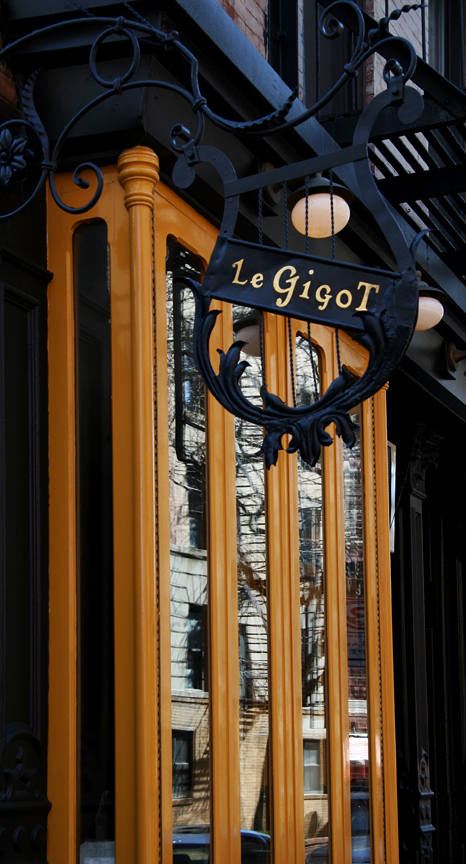
    Today’s posting is more about a personal frustration than something that is strictly related to New York City. I have had this photo for quite some time – I always loved this small, elegant sign hanging outside this fine tiny French restaurant, Le Gigot on Cornelia Street in the West Village.

    But how to use this photo? There really isn’t anything about it which is particularly remarkable, but it is quite elegant. Ah, there’s the source of my irritation – subtlety, nuance, and understatement.

    I recall years ago having a conversation with an acquaintance regarding the perpetual debate regarding Apple vs. Windows-based PCs. Ease of use, graphics, or music professionals do not explain much of the large user base – there are plenty of scientists, business people, attorneys, and computer geeks who use Apple.
    At one point, I stated that many of the differences were due to nuances in the interface, such as subpixel font smoothing, and that customers are willing to pay for that difference. My friend concurred and made the statement that subtlety and nuance were things all too underappreciated in this country. But nuance is the very thing that typically separates the ordinary from the finer things in life, whether it is clothing, food, wine, cameras, or furniture.

    So in light of a culture dominated by bigger is better, deep discount big box stores, reality TV shows, gratuitous violence, and other extreme, in-your-face manifestations of a utilitarian, dumbed-down world, let’s celebrate nuance today…


  • OTB

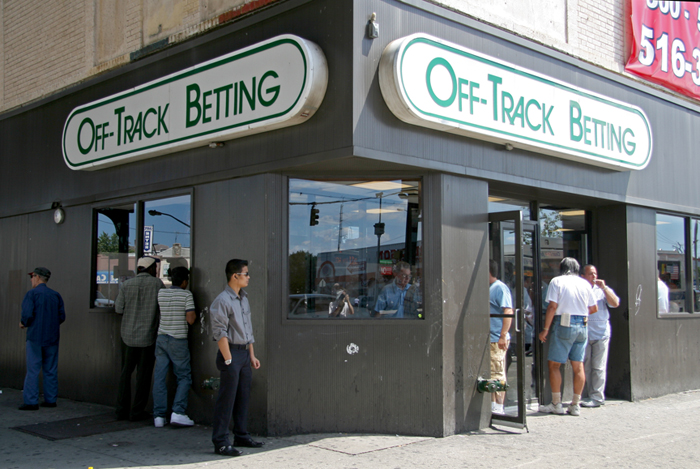
    OTB is a rather invisible enterprise, lurking in the underbelly of New York City. This is the type of place that caters strictly to a niche clientele, and those not seeking to place bets through the city’s Off Track Betting parlors will probably never notice their existence.

    This is one of the few things in New York City which I do not consider a must-see. In fact, the atmosphere is rather unsavory, perhaps seedy. Unlike racetracks themselves, which have the added elements of horses, paddocks, jockeys, and an outdoor environment, OTB is stripped of all these human and equine elements and has reduced horse racing to a betting experience. Although one can feel some excitement at the close of a race, there is the distinct sense that the excitement is largely predicated on winning money with a leveraged bet. Unfortunately, it is also the home to many disenfranchised hoping to hit it big with a longshot or perhaps a gimmick bet like the exacta or trifecta.

    At one time, these parlors were smoke-filled, adding insult to injury but certainly providing a sense of authenticity – a smoky haze conjures the right images for this type of place, evoking the feelings one might have in a pool hall or a dart area in the back room of a bar…

    History of OTB: Approved by voters in a 1963 referendum, the official history of the New York City Off-Track Betting Corporation began on April 22, 1970. NYCOTB was designated to operate as a public-benefit corporation, a relatively new form of governmental entity run along the lines of a private enterprise whose profits accrue back to the taxpayers in the form of public revenue. The mission given us was three-fold: to raise needed revenue for the City and State, to combat organized crime’s hold on gambling by providing a legal alternative, and to help New York State’s racing industry.

    Update: In December 2010, New York City’s OTB closed operations.


  • dinamic_sidebar 4 none

©2026 New York Daily Photo Entries (RSS) and Comments (RSS)  Raindrops Theme