

I’ve never been in prison. I never want to be in prison. And I certainly don’t want to be in a New York City prison called the Tombs.
I visited the Tombs on Sunday at midday. Why I would do such a thing is a different story: I was in the neighborhood.
No one looked happy at the detention complex, and there is no way to give this place a happy spin. I spoke to several corrections officers – all polite – but I could sense an air of incredulousness of why I would be there on Sunday, taking photos and asking questions. Virtually every New Yorker has heard of the Tombs, but why would anyone really need to know exactly where or want to visit? I had never seen the buildings and was curious. So after numerous inquiries (and incorrect directions), I finally arrived at 125 White Street, the home of New York City’s Manhattan Detention Complex, aka The Tombs.
Like many New Yorkers, I assumed that the colloquial name was given perhaps because the jail facilities are underground or some other grim reality. This is, in fact, not the case. The complex was nicknamed the Tombs after its first structure, built in 1838, designed by John Haviland and based on an Egyptian mausoleum. This complex occupied a full city block and was called the New York Halls of Justice and House of Detention.
The Tombs has gone through several incarnations: the original from 1838 was replaced with a new building in 1902 and connected to the neighboring Criminal Courts Building by the Bridge of Sighs. That building was replaced in 1941, and in 1974, due to health and security problems, part of the building was taken down and replaced with a new structure. The current complex consists of two buildings connected by a pedestrian bridge: the North Tower from 1990 with 500 beds (seen in the photo) and the South Tower which incorporates part of the original 1941 building.
The various warnings to visitors posted on the entrances made clear the harsh realities and no-nonsense atmosphere inside:
POSSESSION
OF
CONTRABAND
(WEAPONS)
RAZORS KNIVES SHANKS SHIVS BULLETS
And any other weapon capable of causing injury and/or
otherwise endangering the safety of the institution
WILL RESULT IN YOUR IMMEDIATE
ARREST
Other prohibitions include chewing gum, electronic devices, camera, mirrors, aluminum foil, pencil sharpeners, glass, and mace. I got the message, loud and clear.
Many believed, as I did, that this is strictly a detention center, housing those arrested until arraignment. However, I was told that many are here for months or years and that this complex operates as a prison.
My advice to residents and visitors: stay on the outside…
Note: As one might expect, services for those apprehended were next door on Baxter Street. I found it interesting that sandwiched between three bail bondsmen and a law office was a whiskey tavern. See photos here.
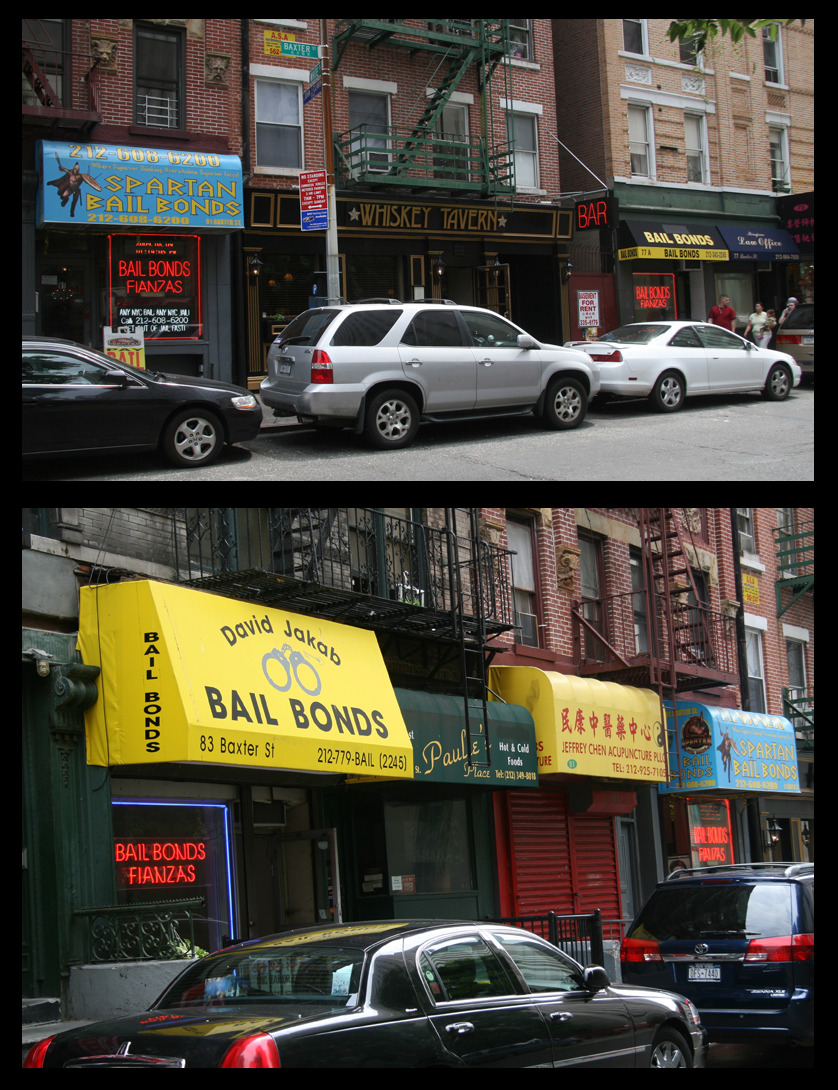
I realize that housing prisoner's in ancient buildings is not a desirable situation for anyone involved.
But, the original Tombs building looked like someone had considered making the exterior something you might want to at least look at. However, the current incarnation, from a visual standpoint, probably tells a better story about what goes on inside.
Hope to never visit the deep, recesses of this brutal looking bunker.
Designslinger – Yes the original looked quite grand and the 1902 version also was quite nice. The current design of the North Towere certainly is foreboding.
I like your unusual posts…
If you ever go to Folsom,Ca – visit the Folsom Prison, you will have a different experience but I could not take pictures either.
Yes, it makes sense that people would need a strong drink to work in that area.
Hi Brian
Wonderful photo.thanks.It seems so oppressive well it is oppressive.
So so sad isn't it that there isn't another solution.
anyway you have a bright day.
cheers from Canada.
agreed about the older versions. I heard it was even refered to as a castle at one point. But I think the pic in front of david jakob is great with the town car in front.
Which makes me wonder…can people visit Rikers Island? I've actually heard of Rikers a lot more than the Tombs but have never seen photos, even of the outside.
Christine
Anon – I have been intrigued by Rikers myself for some time. It appears it is off limits except to those visiting prisoners. And I don't thing cameras are allowed.
Enjoyed examining this, very good stuff, regards . “What the United States does best is to understand itself. What it does worst is understand others.” by Carlos Fuentes.
Have you written any narrative on the inside of the block…did you get to see any cells etc…What’s it like? I’m researching for a book. Good Article!!
I lived in the tombs, briefly, many years ago. I thought the name had something to with the cells and the conditions. I think it is more correct than the historical reference.
Each inmate had his own tiny sliver of a cell with a solid door and not bars. I think the cell was less than 4 feet wide. It was super gloomy and tomb-like. I felt like I was shoved in a drawer in the cemetery. It was many years ago, but it was an experience. There was kind of a built-in table like desk counter along one side that almost turned into sink. The bunk was built into the other side. I think the room may have been less than 4 feet wide. It was dark and without bars or anything, just a solid door that was controlled from somewhere else. One thing, there was a bit of light coming through an opaque window of sorts at the other end from the door. But it was cloudy and almost seemed more like a light than a window. There were several floors, in this section, or cellblock, I guess and I was up quite a few. The space was irregular and narrown and the floor below was where things happened. For some reason, I was in the violent offenders section and the society was very intense. I remeber at the bottom there was kind of a reception desk near the entrance to the galley, I guess, where there was an administrative guard of some sorts, kind of like a person at the desk when you go into a building. She said “you’re not really supposed to be here”. It was sort of like the atrium of some grey mall. I always thought the tombs meant you were shoved into a drawer in some cemetery. It was super depressing. There wasn’t any air circulation or anything when you were in your cell, which was nothing like anything you had ever seen in a book or a movie. It was bleak. Although it was kind of secure when you were in there, just you, alone, without any view, or air, or anything. Tomb-like. It was many years ago and I forget many of the details of life there, but the morbid architectural aspect lingers and I always thought from my experience the tombs meant shoved in a concrete slot and forgotten. That is exactly what it was.
Hello. It is a hot 23jun12 and I guess I’m rather late to the dance, re this article. But these awful, ugly buildings always remind me of the “Best of Soviet Architecture.” Way too many buidlings built in NYC from about 1968-1985 carry that seal. Not just prisons but high-rise apartments (think the Upper East Side). The City of London (their fiancial district) is also filled with these type of buildings. Thank you!
The style of architectural for the Tombs Prison New section is called the “Brutalist” style. The Brutalist architectural style takes its name from the French “béton brut, or “raw concrete!” The person stating that many 1960’s to 1970’s era buildings are of this Brutalist style. Brutakist style buildings are always massive things that defy human scale. The Department of Housing and Urban Development (HUD), Building in and the J Edgar Hoover FBI Building are both in Washington DC are huge examples of Brutalist designs. The funniest description of a Brutalist Building has to go to Jack Kemp former Housing Sec under Ronald Reagan. Jack Kemp was heard to say the all concrete Brutalist HUD Building was like working in offices that looked like 10 floors of basement. The J. Edgar Hoover Building is also hated as a very anti human unwelcoming workspace. The New Tombs Tower is equally a depressing monolithic structure that smacks of the best Soviet era police state monstrosities. I like the tombs it is everything a prison should be. It is ugly and tells the world it is NOT the place nice people ever want to visit for even a second.
Wolf – I have been watching a show called Locked Up Abroad, which has turned me off of the idea of prison even more. You are right – it’s prison, not a resort. It’s unappealing for a reason.
I am a retired NYC Correction Officer, 1969-1989. I worked in the tombs during the riots (1970) andon Rikers island. Words can’t express the horrible conditions for. Officers and inmates alike.
It was always overcrowded, hot in the summer and cold in the winter. Most of the cells had bars. Cells with sliding doors were mainly used for isolation.
Officers were forced often to work 16 hour shifts. Also had to eat there, not allowed to go out or bring food in due to contraband possibility.
Cells meant to hold 2 inmates we housed 4 especially on the nite shift.
There were never enough blankets, etc. We even rationed out appox 4′ of toilet paper per inmate.
Did I mention the noise factor? There were 4 TV’s per floor ali tuned on different stations. Attempt ed suicide’s were normal every shift. Keep in mind the late 60’s and 70’s were the height of the heroin epidemic, before Methadone, so addicts had to kick “cold Turkey”. The riots brought attention to the inhumane conditions. I’m blessed to have survived healthy as many officer’s became alcoholics, divorce rate was high due to stress.