

I just finished watching an episode of Barging Through France in the Ardeche, one of the wildest and most untouched regions of France. Here, villages with thatched roofs can still be found in a land that time forgot.
The program was reminiscent of a series I watched in the 1990s about barging through Europe. Each episode offered a dreamy, kaleidoscopic view of the remote reaches of Europe via its canals. The host and crew traveled by barge and lived in its quarters throughout the journey, making stops wherever and whenever whim and fancy inclined them to do so.
The imagery and music all conspired to give a romantic view of the idyllic countryside and small villages of Europe. Inspired, I did take one barge cruise through Paris and the outskirts. It was not an exploration of remote hinterlands, but, nonetheless, it was a barge, a canal, and Paris. I was accompanied that morning with a group of school children singing songs in French.
In the United States, however, canal typically connotes an image of a waterway and utility. In New York City, the word canal is synonymous with pollution. Perhaps the best example is the Gowanus Canal, once known as Lavender Lake for its technicolor surface. I had been through the area a few times (see here), but recently, I decided to explore the neighborhood of Gowanus, Brooklyn, more thoroughly. I did like the very low rise feel of the area, although the architecture left much to be desired, reminiscent of the South Bronx.
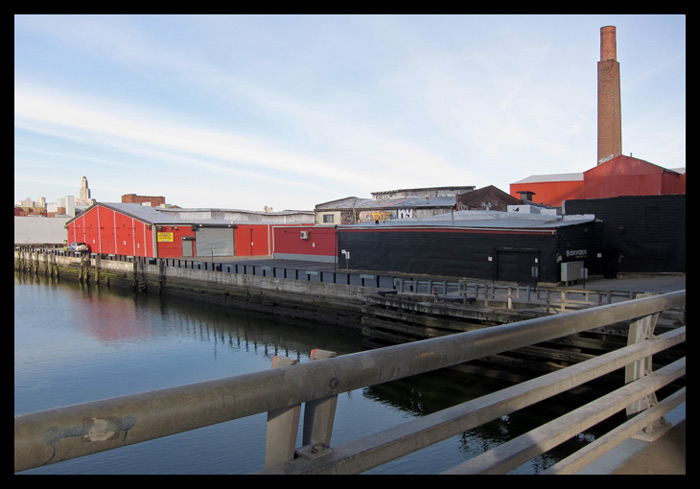
 As I crossed the bridge, I recognized the industrial building complex that housed the space that sponsored a fire performance I attended. For that evening, in a bizarre and unusual transformation, the metal working facility became the Gowanus Ballroom.
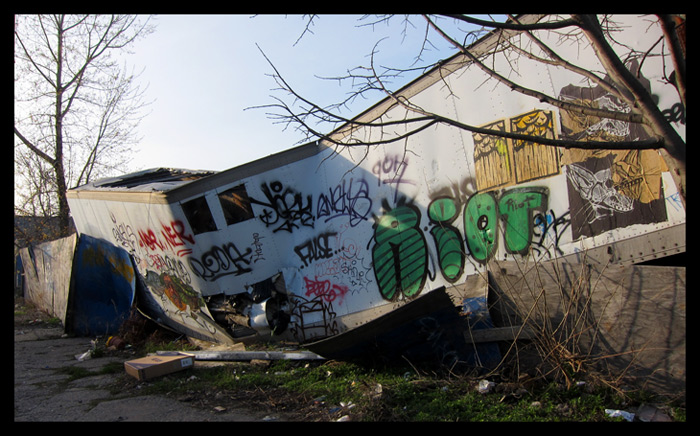
 As I approached the end of the short block, I was welcomed by a wrecked tractor trailer, folded in half and now being used as a canvas for graffiti.
 At the very end of street was an upright rowboat. A banner proclaimed:
Welcome to the Gowanus Canal
Brooklyn’s Coolest Superfund Site.
It was not immediately obvious that the entire area was a boat launch for the Gowanus. However, a poster mounted inside the boat, Canoeing & Superfund Tourism Map, indicated that, indeed, the Gowanus was a Superfund cleanup site (designated by the U.S. Environmental Protection Agency) and this was the 2nd Street Canoe Dock. The map brimmed with enthusiasm and outlined 18 sites for the canoeist to explore.
Looming in the distance across the canal was an enigmatic deserted building. Later, after my visit, I learned that this was the infamous “Bat Cave”, a story in itself.
 While exploring 4th Street, I passed a tiny, charming one-story house, perhaps a lone candidate in all Gowanus that could be called adorable.

A woman was in front, tending to various chores. I assumed she was the owner and asked. She affirmed. I complemented her on her cute, tidy dwelling and asked, “Is this area considered Gowanus?” “Yes” she said. I offered what I had heard for some time in the media: “This area has been referred to as the future Venice of New York.” She laughed and said, “They have been saying that for a long time.” I agreed and canvassed the area one last time, wondering if and when Gowanus and its canal would live up to its promise as Little Venice…
Related: No Pane at All, Europe?, Not Under the Gowanus, Part 1
I for one would not go canoeing on the Gowanus for all the money in the world!
Thanks for the tour of an area that is a mystery to most New Yorkers. Truth is I, like most NYers (I imagine), fool myself into thinking that living in Manhattan is safer, less pouted, than living in the Gowanus Canal area. Realistically living anywhere in the NYC area must be taking years off our lives…but the excitement of NYC is too seductive to give up!
Here’s a write up from the website ‘Curbed:’
It’s been two and a half years since the Gowanus Canal was declared a Superfund site, and the EPA has finally announced how they plan to cleanup the toxic waterway and how much it will cost. The Times reports that price tag will likely be half a billion dollars, ranging from $467 million to $504 million, and the process will require dredging the “ten feet of black mayonaise” from the bottom of the canal. Companies partially responsible for the extreme pollution in the canal—PCBs, lead, cooper, and dozens of other fun things·will pay for the cleanup. This includes National Grid and the former Brooklyn Union Gas company.
The cleanup also includes plans to control and stop raw sewage discharge into the canal from the city, and the whole thing will last until 2020. The canal will be dredged in three segments, which will then be stabilized with a concrete mixture and capped with sand and clay. The Times report does not say where the contaminated gunk will go once its removed, but we hope the dredging digs up something interesting, like a pirate ship or some skeletons.
Wow – thanks for the update, Leslie. Sounds like a massive cleanup effort that will take so long we may never see a positive outcome for eons. Just a good reminder of the impact and consequences of waste disposal.
I love what you guys are usually up too. Such clever work and coverage!
Just desire to say your article is as amazing. The clearness
in your post is simply spectacular and i can assume you are an expert on this subject.
Well with your permission allow me to grab your feed to keep up to date with forthcoming post.
Thanks a million and please keep up the rewarding work.