
I aspired to be a fruitarian and was obsessed with fruit. I had fantasies of finding my own Shangri-La. And I had at last a vacation booked to visit my first tropical island – Puerto Rico, where I hoped at least to find some taste of tropical paradise.
My girlfriend at the time was Hispanic, and she had few relatives who hailed from Puerto Rico. Knowing my passion for all things fruit, her cousin asked if I had ever tasted guanabana. When I responded in the negative, his response was, “Ohhhhhh, guanabana.” When I asked others about this mystery fruit, I got the same response. It became a private joke among us and a comedic refrain, much like Comin’ Up Comin’ Up. I could see that my trip to Puerto Rico was to become a mission to find guanabana. I did finally have guanabana, known as soursop in the United States, which can be found in markets here, particularly those catering to West Indians. It has a quite unique flavor and texture, perhaps an acquired taste.
At the time, I believed that natural sugar was better than refined. I learned that West Indians prepared sugar cane juice. I reasoned that this certainly must be the nectar of the gods, and I lusted for a taste. However, I had never seen sugarcane juice in New York City but I learned that it could be had in Spanish Harlem. I remember the excitement when I saw my first large stalks of sugar cane at a street side vendor. The cane was run through a press and juice came running out below. I purchased a small cup. It was ghastly sweet – virtually undrinkable, even between a number of people. What had I been thinking? It was literally pure sugar and water. Better to stay with fruit.
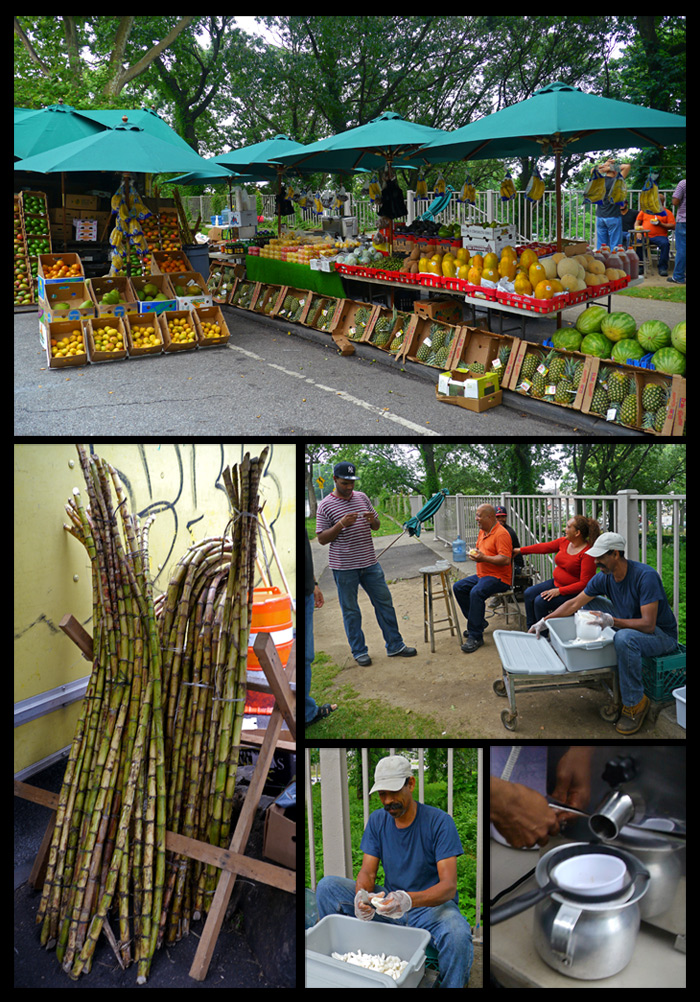
Recently, on a trip to Jamaica Bay, a wrong turn in East New York, Brooklyn, brought me to a fruit stand. It was tidy and pristine-looking, and my companion and I had eaten little. Stopping was de rigueur. The fruit looked phenomenal. Everything appeared to be at optimal ripeness. There was watermelon, papaya, mango, pineapple, cantaloupe, avocado, banana, coconut, and bags of peeled oranges.
The owner, Ulysses, was so congenial and sensed my love of all things fruit. He welcomed my photography and as I explored his roadside domain, I learned that the entire group socializing behind the stand was his family – father, mother, brother, and uncle. His father, Victor, was busy preparing fresh coconut, something rarely found for some inexplicable reason. A small container for $2 was an extraordinary bargain. Papaya, typically a pricey fruit, was selling for much less than typically found in Manhattan. I purchased a large specimen for $6.00.
We spoke of guanabana and the world of fruit. As I surveyed his fruit stand, leaning against a truck were stalks of sugarcane, and as chance would have it, they had a press and were making juice. When I told them that my companion had never had sugarcane juice, they offered a sample with abundant ice, which did some to chill and dilute the sugary drink. But to me, fruit is a virtual metaphor for good, with or without Guanabana 🙂
Ahhhh Guanabana! I remember that so well! Never did see another one since the trip to Puerto Rico when we stayed with Greeny Granny. Nor do I have any memory of what it tastes like. But everyone did have that reaction when it was mentioned. That’s an amazing looking fruit stand. My son is in Ecuador right now with National Geographic and he is probably eating all kinds of great tropical fruits. There is nothing better in life, in my opinion. I’m a big fruit eater, as is most of my family.
¡Aaahhh guanábana! I’m from Puerto Rico and I love guanábana.