• Terrapin Chelsea Art Gallery

    This was Architecture Week with the Open House New York weekend. Terrapin Art Gallery was one of the few private homes in the roster and is the home of Pamela Harvey-Rath and Colin Rath, who, in 2000, transformed two floors of an 1853 Chelsea townhome in to a fantastic artist’s dreamscape.

    Their love of the sea is reflected in the undulating curved surfaces throughout the home. A lit glass stairway leads down to their main room, which features a 2-story-high dome ceiling with a stone fireplace and waterfall that empties into a replica of the Yangtze River in the floor stocked with Koi fish. A child’s bedroom has a reproduction of the sky from Van Gogh’s Starry Night done in marbles. The backyard has a garden, redwood hot tub, stairs with Adirondack style wood railings, and a 3-story glass green house. A brass firepole connects the two floors.

    The home also functions as art gallery and is available for private functions and photo or video shoots. Note that the Rath’s have purchased the building next door (seen in the lower right photo) and are in construction…
  • Hispanic Day Parade

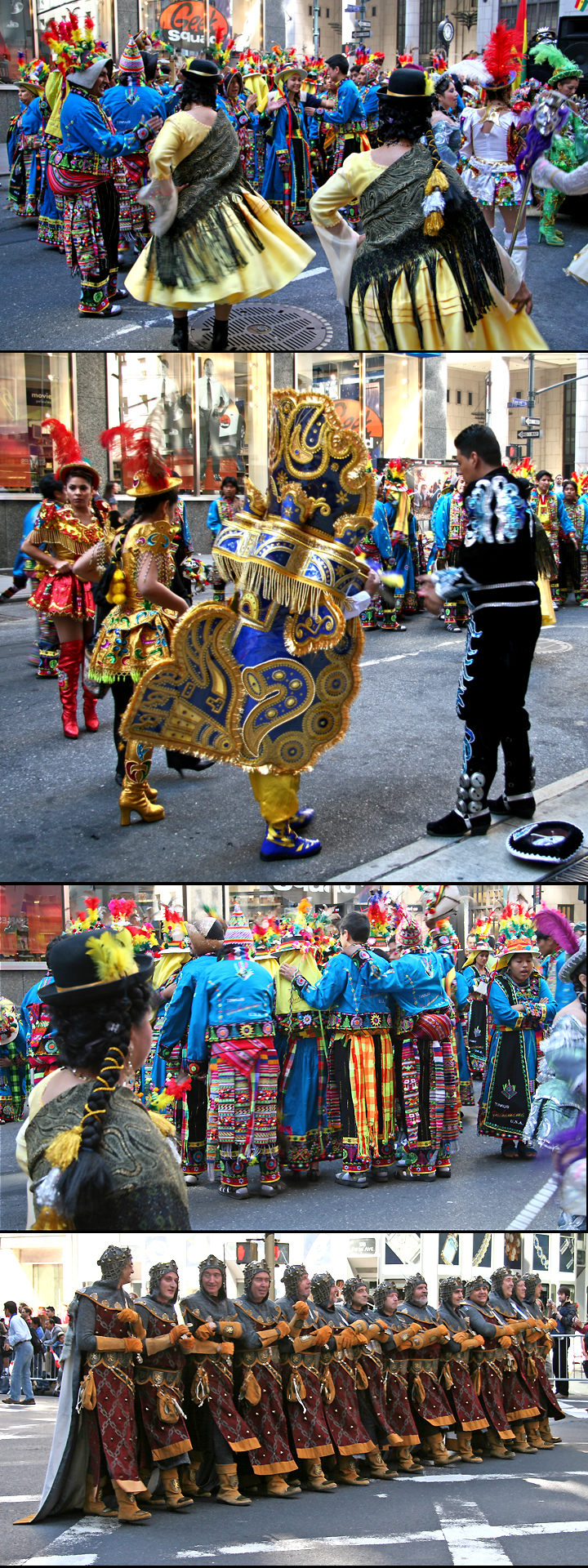
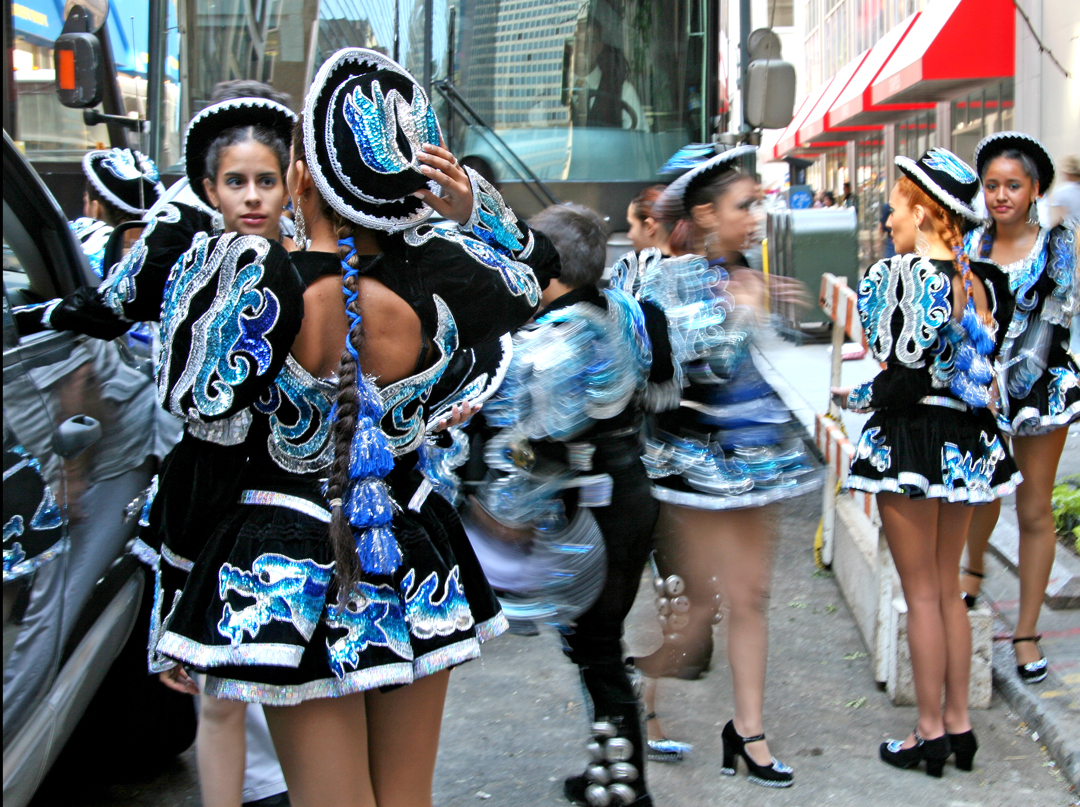
    Sunday, October 8, 2006, saw 5th Avenue closed from 44th Street to 72nd Street for the Hispanic Day Parade, which has been celebrated in NYC since 1965. The parade honors 21 countries, with thousands of marchers and hundreds of thousands of viewers. “This glorious event celebrates the best of all the cultures and folkloric pride of all our Hispanic countries and those who now call New York City their home,” said Jose Leon, president of the Hispanic Day Parade Committee.

    The Latin community is known for their outgoing, vibrant cultures, as seen in their music, food, etc. No better evidence of this is found than in the costumes in this parade, which was a veritable riot of color. See other photos here. I was surprised to learn that Hispanics make up 30% of NYC’s population. We are well reminded that NYC is truly a melting pot of cultures and immigrants…


  • Sky Mirror

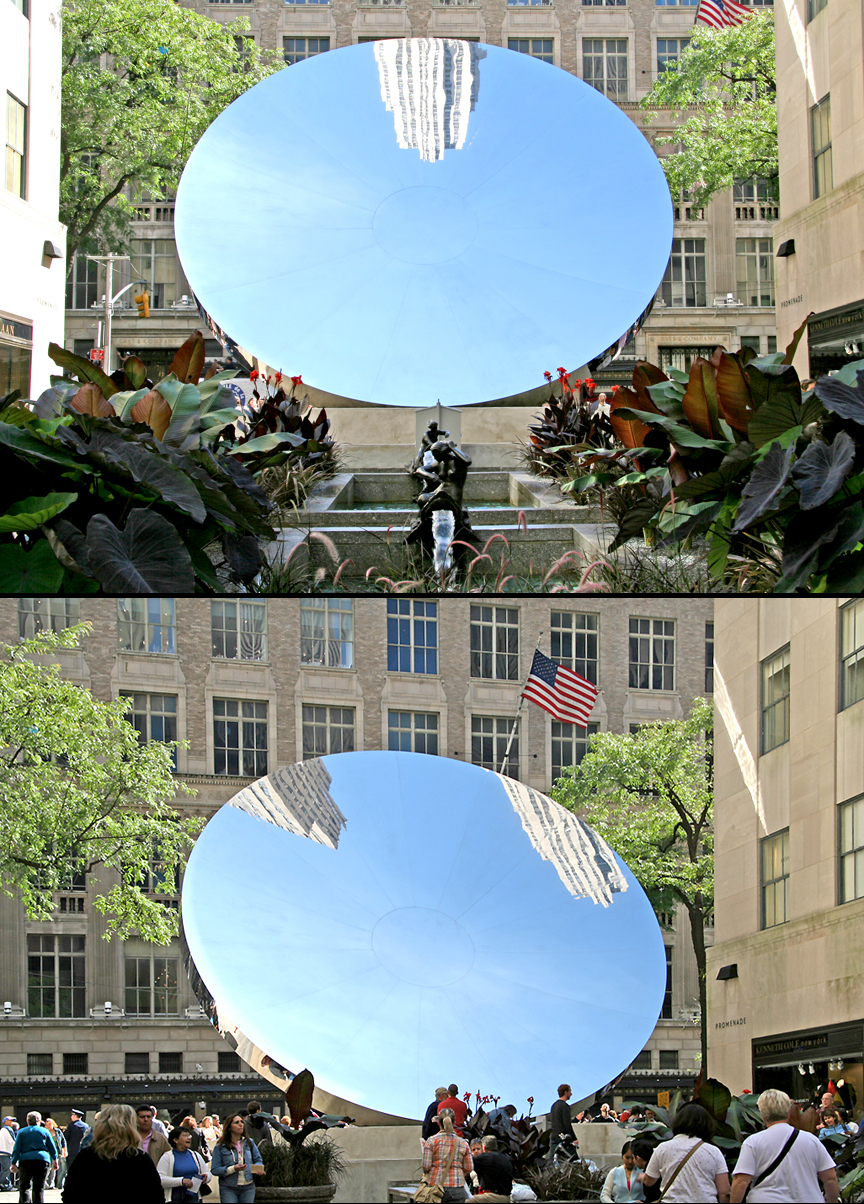
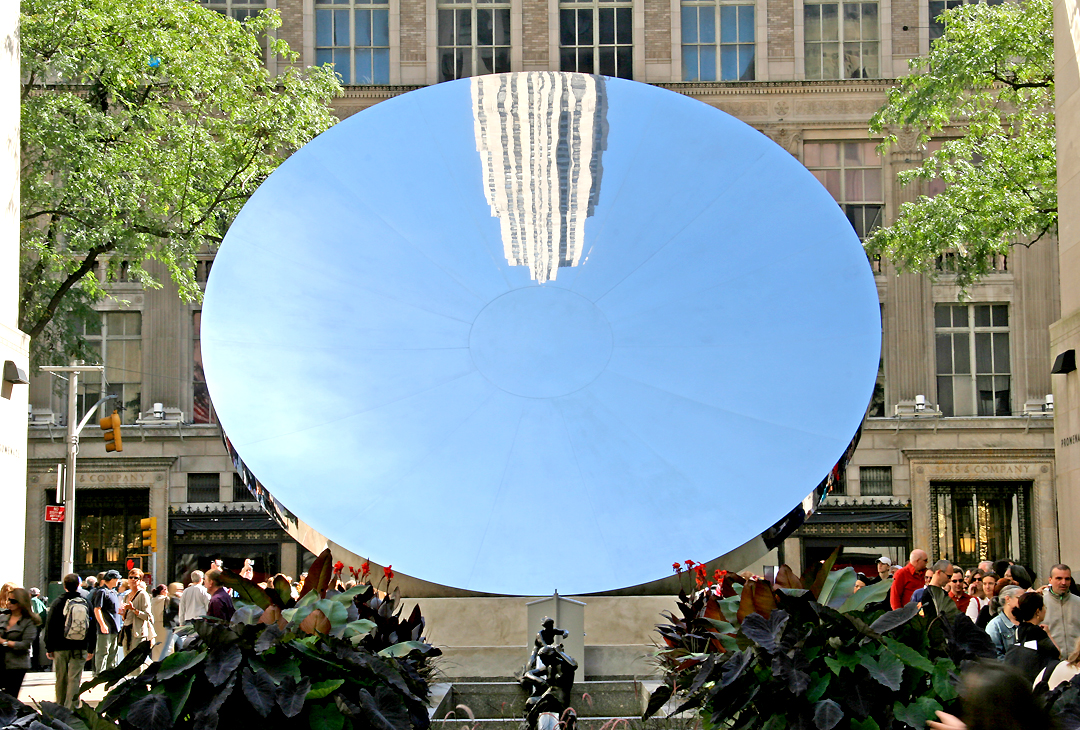
    Sky Mirror is a visually impressive 35-foot diameter concave/convex mirror made of polished stainless steel. This public art project by renowned sculptor Anish Kapoor stands at the entrance to the Channel Gardens at Rockefeller Center. The concave side faces upward and reflects an inversion of the iconic 30 Rockefeller Center building (click here for more photos). The opposite convex side faces downward and reflects viewers in the surrounding streetscape. Click here for a good article in the Gothamist with numerous photos.

    As described in the press release, “This optical object changes through the day and night and is an example of what Kapoor describes as a “non-object,” a sculpture that, despite its monumentality, suggests a window or void and often seems to vanish into its surroundings.” The exhibition is presented by Tumi, organized by the Public Art Fund, and hosted by Rockefeller Center owner Tishman Speyer. The Sky Mirror is on view, free, and open to the public. It is only here for 5 weeks, from September 19th through October 27th, 2006, so there is still time left to see it…


  • Dachshund Octoberfest

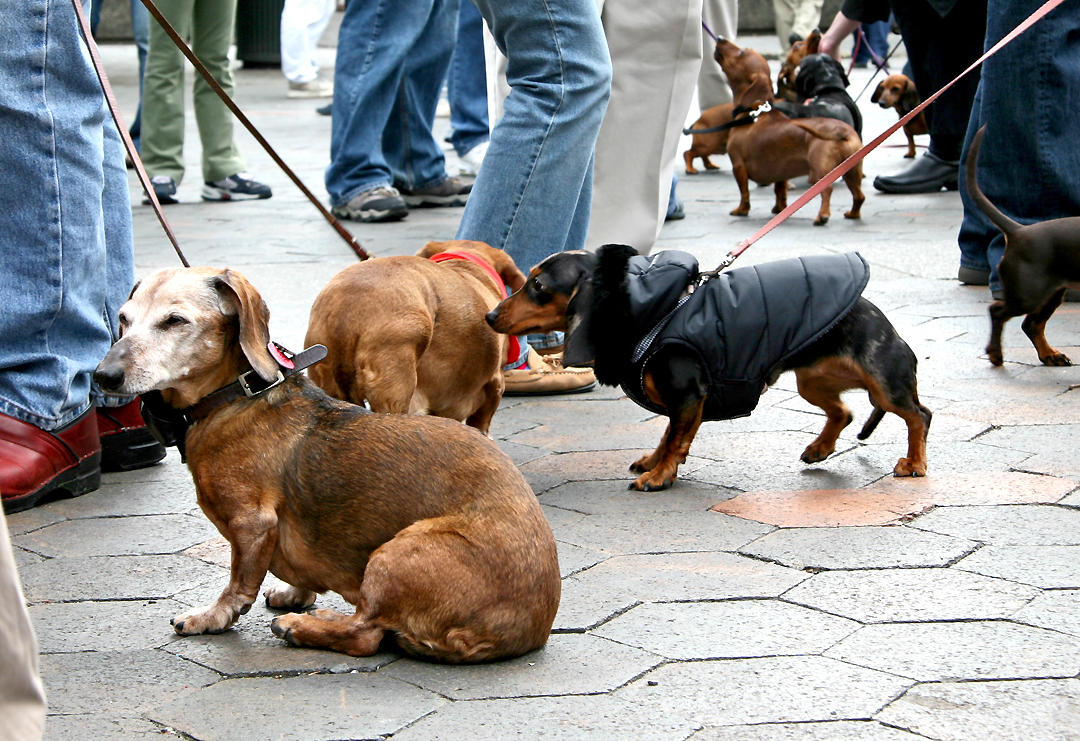
    Yes, this is the Dachshund festival! Twice a year, there are Dachshund festivals in Washington Square Park: the Dachshund Spring Fiesta on the last Saturday in April and the Dachshund Octoberfest on the first Saturday in October. Hundreds of Dachshunds and their owners meet for an afternoon of socializing. More photos here.

    The purpose, as stated by the Dachshund Friendship Club: “Our purpose is to introduce dogs and their guardians to each other and to encourage a friendly interaction between our animal companions and their guardians. The highlight of the festival is the singing of the The Dachs Song, which was written for the club by Paul de Vries and Murray Weinstock.” Some dress their dogs in costumes, but this is not required. The festivals are free, open to all, and non-competitive – just an afternoon of friendly meet and greet…


  • 39 & 41 Commerce Street

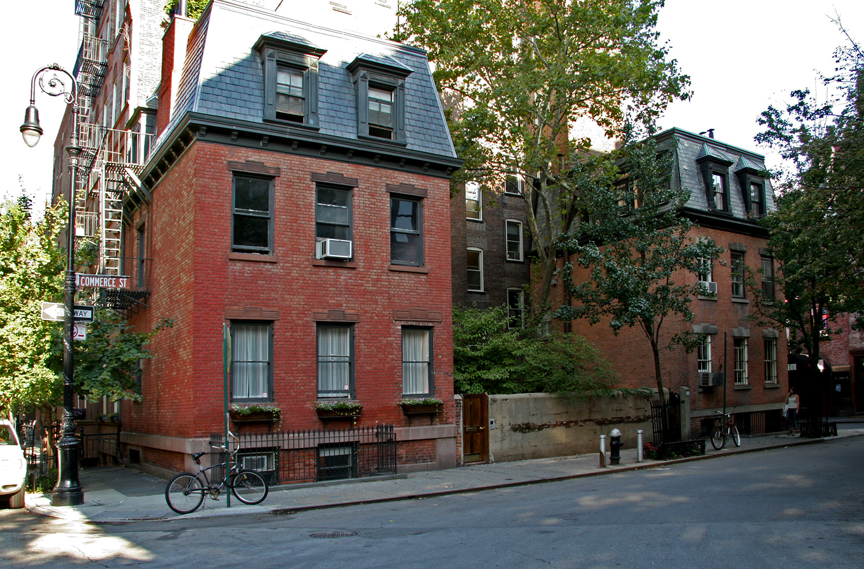
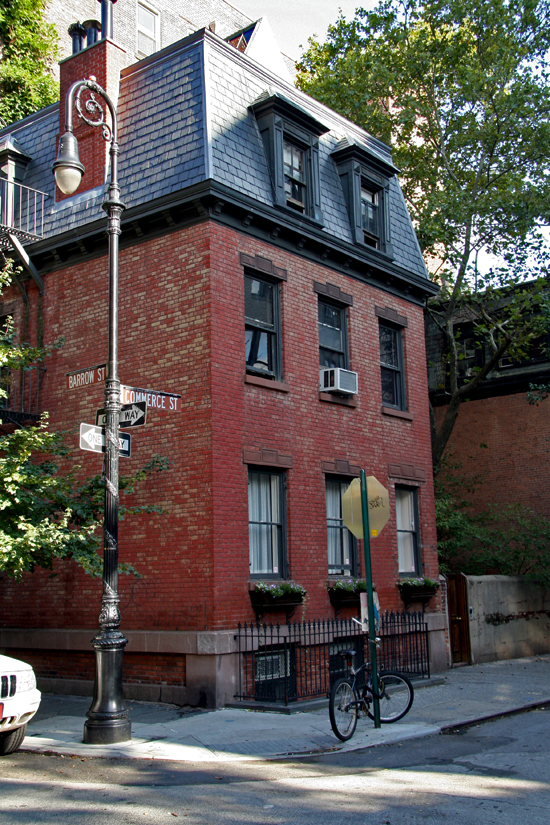
    On one of the most picturesque corners in the city, where Commerce Street meets Barrow Street, are a matching pair of buildings: 39 and 41 Commerce Street. Click here for 2nd photo. Folklore has it that these two buildings were built by a sea captain for his two feuding daughters. In fact, they were built in 1832 as an investment by Peter Huyler, a milkman from Hackensack, New Jersey. A full third story under mansard roofs were added in 1873. What’s unusual is that this pair of buildings shares a very large garden (the entrance doorways are through the garden). One must remember, however, that at the time these were built, Greenwich Village was still a suburb of the city and that most of the houses in the area had small adjacent plots – land did not have quite the premium that it has today.

    The origin of the street name is not clear, but there was never that much commerce – records show only a brewery, woodshop, and factory. Today there is the Cherry Lane Theatre, a restaurant and a bar. By the turn of the century, the area was already home to bohemians, artists, and writers. So, for those of us who bemoan having missed the boat regarding real estate opportunity, rest assured – the boat left quite some time ago…


  • Vilebrequin

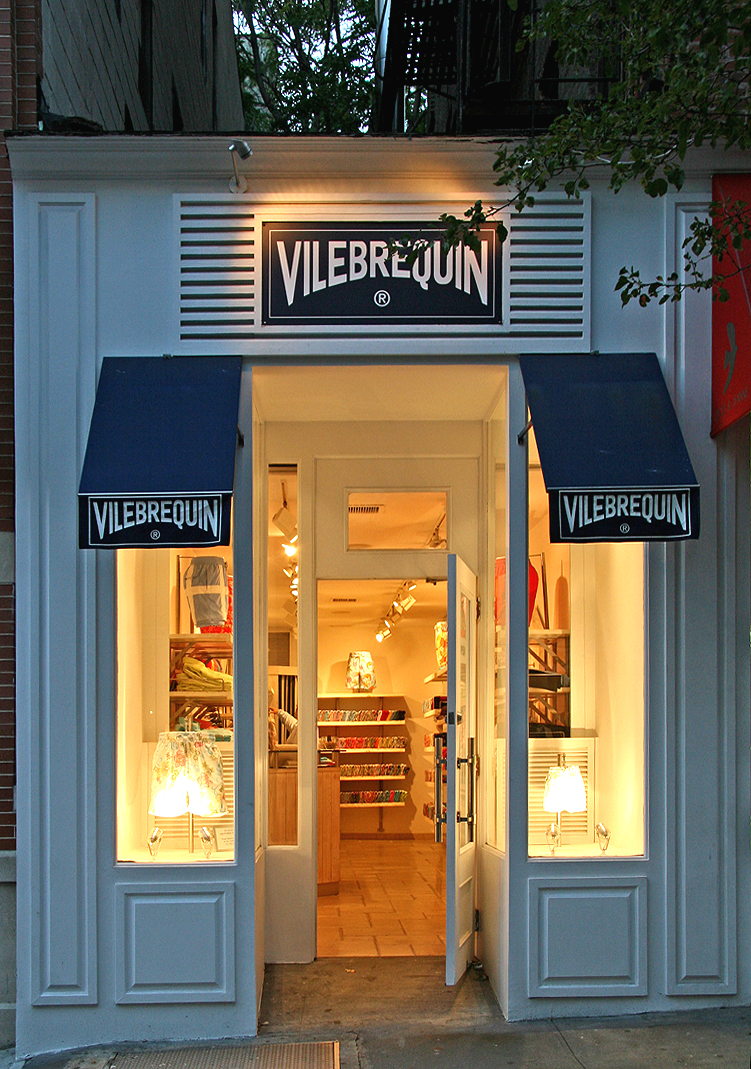
    I’ve always admired this small, exquisite, pristine one-story building in SoHo on West Broadway (actually, I have learned that it is technically an extension of the neighboring building). The white-painted wood exterior, canvas awnings, the atmospheric lighting and the glow in the evening, the beautiful, neatly arranged merchandise in vibrant colors and patterns – the shop feels like a doorway to the South of France.

    In the 1970s, Fred Pryskel, living in St. Tropez, fashioned the first boxer swim trunks from a checkered tablecloth. He then improved on the fabric, using a fast-drying spinnaker sailcloth. The polyamide fabric has a soft, cottony feel. The first store opened in France in 1996; there are now 55 stores worldwide. And, of course, they have a site: Vilebrequin.com. American CEO Thierry Prissert brought the concept to the US, opening the first store in NYC in 1999.

    The pricey clothing line, primarily men’s swimware, has been popular with notoriety and celebrity since its inception (with the Brigitte Bardot crowd) to its current roster – British Prime Minister, Brad Pitt, Hugh Grant, Robert De Niro, etc. By the way, the name Vilebrequin is quite whimsical; Pryskel’s passion for auto racing led to using the word, which means crankshaft in French…


  • Gondola

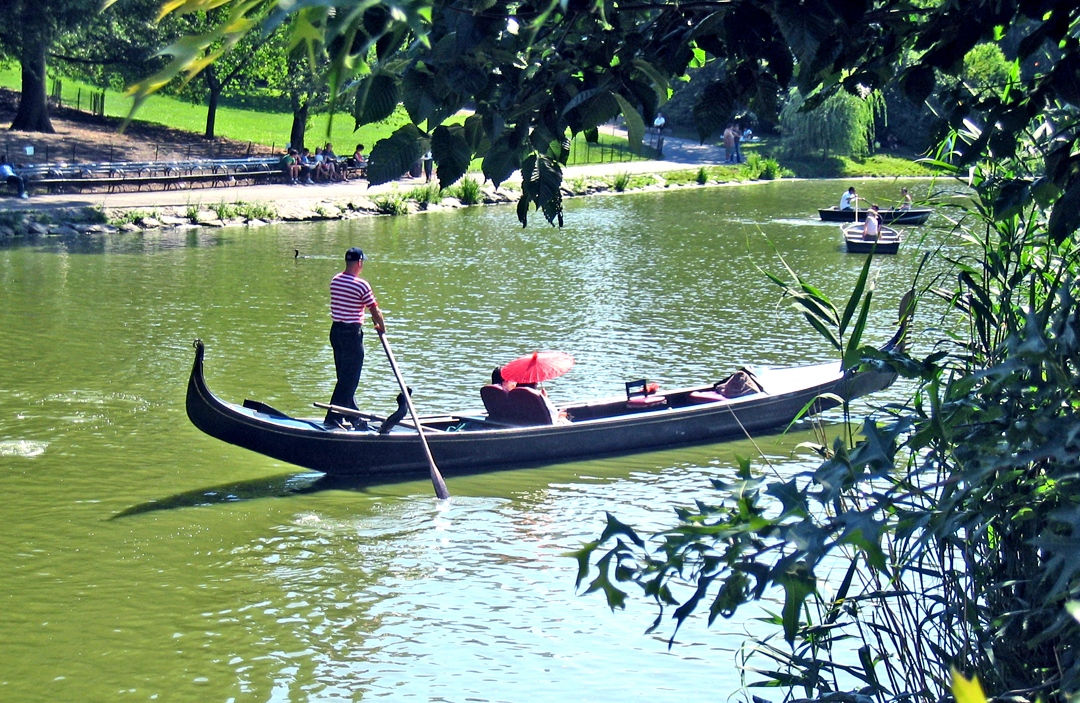
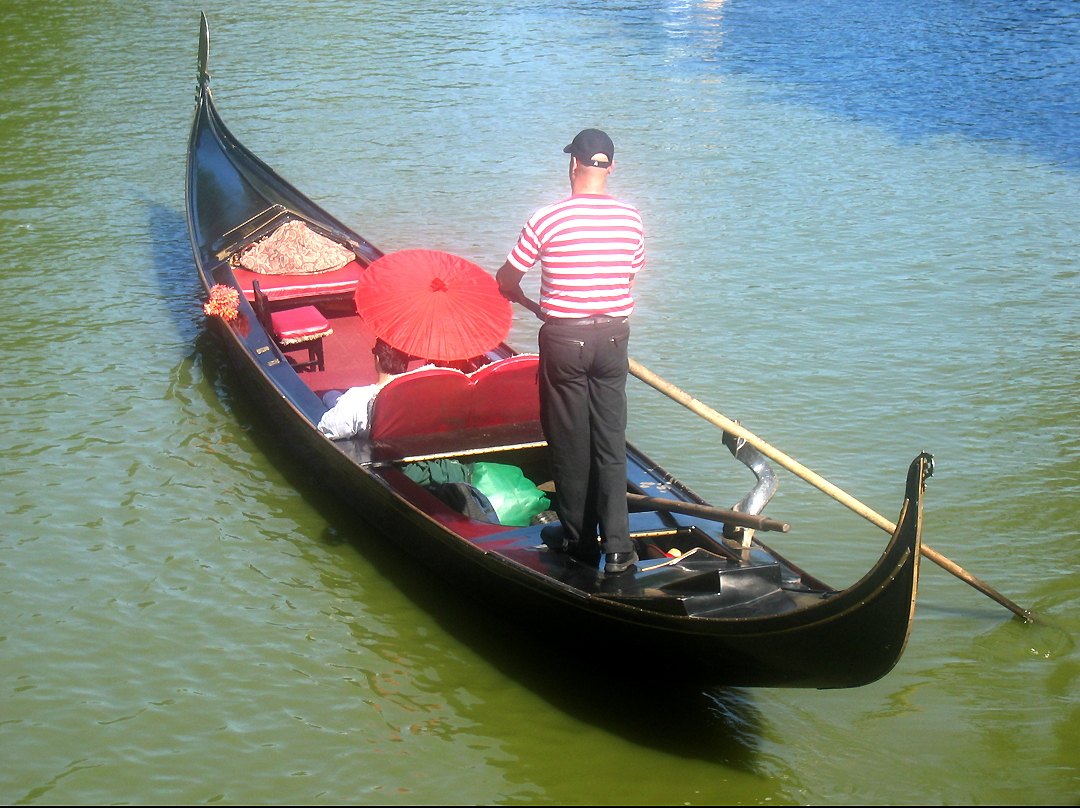
    Central Park has its own authentic handcrafted gondola imported from Venice, called La Fia de Venezia (the daughter of Venice). The 37-foot gondola was donated to the Park Conservancy by NYC philanthropist Lucy Moses. The black craft, oared by gondolier Andreas, was introduced to the waters of the Lake in May 1986 and has been a huge attraction and a source of continued surprise ever since. Click here for another photo. The rides are available during the summer and early autumn from the Loeb Boathouse at the Lake, weather permitting, for $30 per half hour for up to 6 people per boat.

    Rowboats are also available – I was surprised to learn that this activity goes back to the opening of Central Park in the 19th century. And this year, kayaking on the Lake was introduced for the first time. The boating and gondola rides go through October 30, so there’s still time…


  • Street Painting

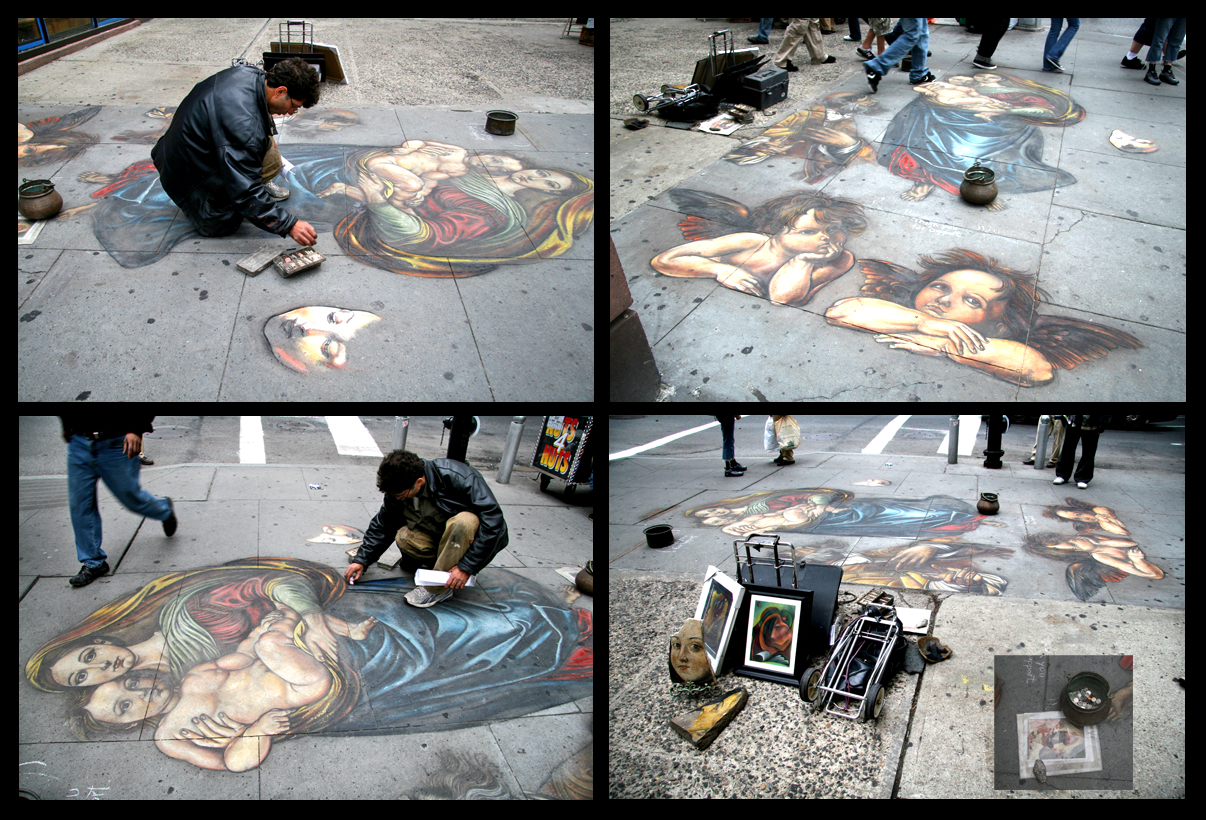
    Hani Shihada has been doing sidewalk street painting in NYC since 1985, having first started in Perugia, Italy, where sidewalk art is a tradition going back to 16th century Italy. In 1972, the Italian village of Grazie di Curtatone hosted the first known festival of street painting. Street painters were known as madonnari because of their work drawing the Madonnas of Raphael. Hani, a Palestinian who was born in Jerusalem and grew up in Jordan, specializes in reproductions of Michelangelo and Raphael, working in pastel chalk. It is estimated there are a few hundred sidewalk chalk artists today, traveling and making a living from their work.

    Although I’m sure that some may see this as crass commercialism or debasement, it does appear that the artists take their work seriously – most work in various media and have had formal art training (some in Europe), such as Kurt Wenner and Mark Cummings (currently residing and studying in Florence). Click here for Mark’s site, which has an excellent history of the artform. Like many of his contemporaries, Hani has done many large-scale commissioned works – sidewalk art, murals, public, and private. Everywhere I look, what appears to be a small, unique, or incidental thing turns out to be a world…


  • One-Man Band

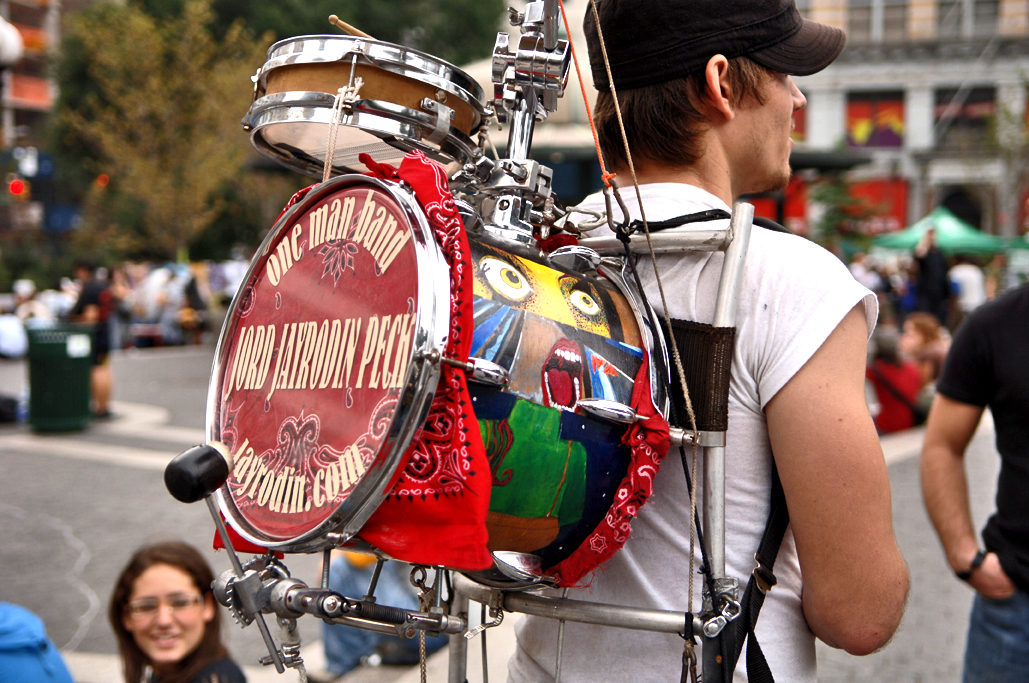
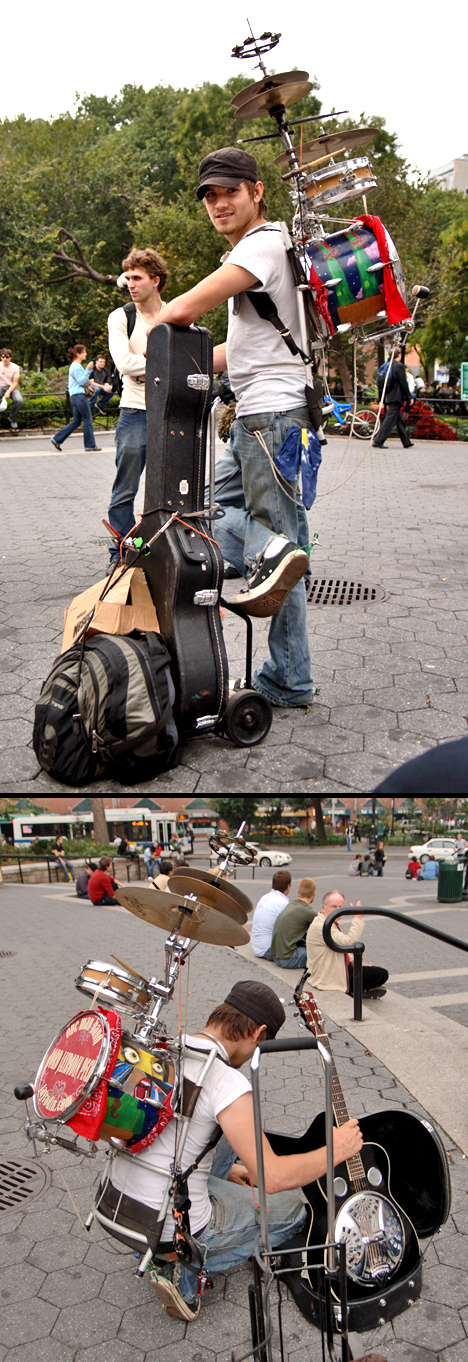
    Jord Jayrodin Peck is an itinerant one-man band. I was fortunate to meet him twice,  the first time at night (with no camera). This photo was taken in Union Square, where he was discussing his run-ins with the law. Click here for more photos. He was prevented from playing, having been told that his drums were amplified instruments (?). It’s sad in the city to see people like this ticketed while drug dealers sell their wares with impunity because they know how to work the system.

    He plays several instruments simultaneously – two drums, each connected to the back of one foot via a cord, cymbal sets from his arm and wrist, harmonica, and guitar. I did get to see his street performance on the first night – everyone was really impressed with his talent. The expectation was that his show would be gimmicky, but his musical interpretation and performance were excellent. I recall a nice rendition of a Dylan song. I was told that his repertoire is somewhat limited – quite understandable. Jord has to work out the arrangement for all of his parts. I wish him luck in his endeavor and that the raw, untamed, unbridled energy of youth will keep him going in the face of adversity…


  • Grace Church

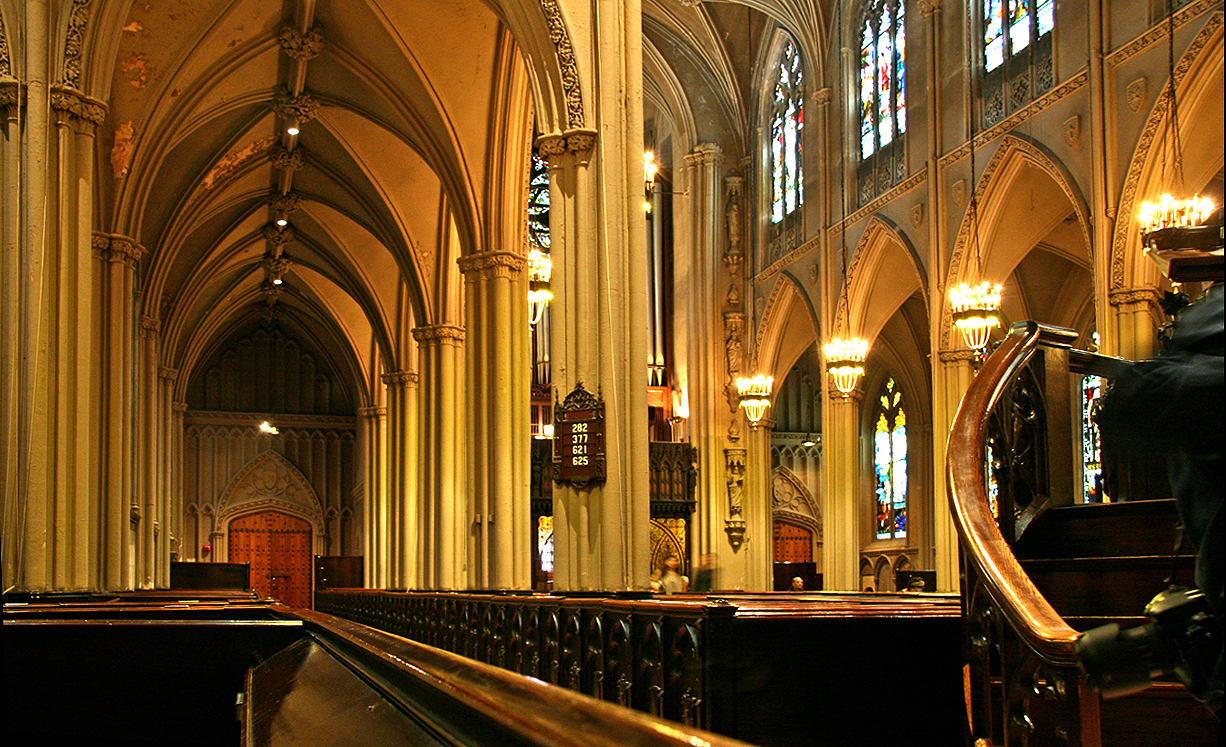
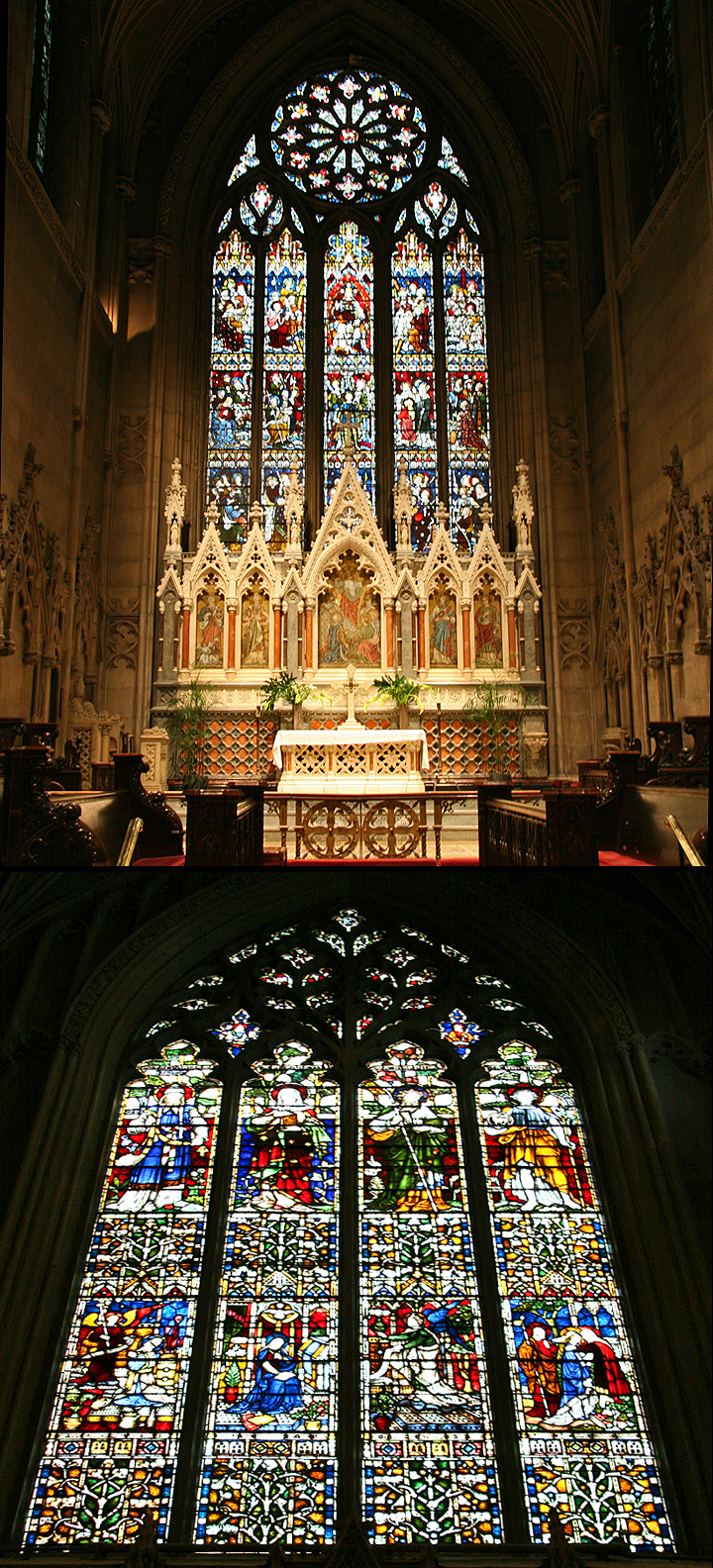
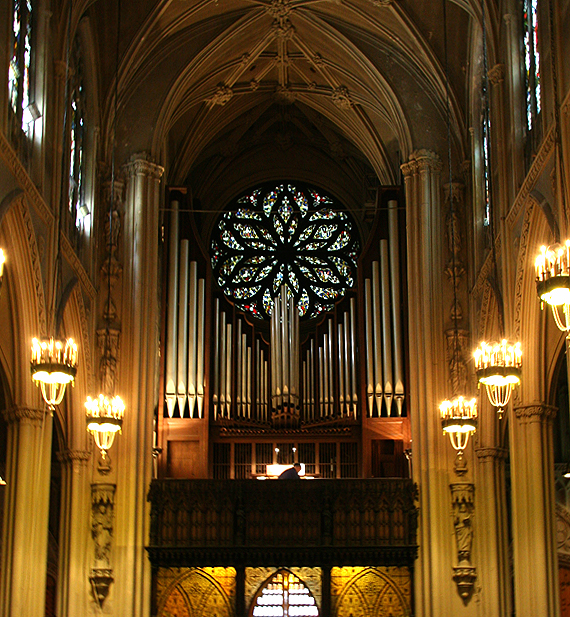
    Grace Church is a Gothic revival masterpiece and one of the “hidden” gems of NYC – off the tourist radar and little known to outsiders. It sits at the last bend in Broadway at 10th Street and dominates the view from the south. Click here for more photos.

    Built in 1843-1846 on land acquired from Henry Brevoort, the Church was designed by 23-year-old architect James Renwick (his first commission), who later went on to design St. Patrick’s Cathedral. Renwick studied the works of the Pugins – great English revivalists. Vestry minutes list as an expense the workers from Sing Sing state prison who cut the stone.

    The church is undergoing exterior renovation work, so I took no photos of the outside. These projects can take some time, however, so I did not want to wait for completion before showing you this structure. For photos of the exterior, I direct you to the Grace Church site with an online tour. The church has extensive music programs: choir recitals, Bach at noon, and Saturday and Sunday organ recitals  click here for info and schedule). Grace has a beautiful organ – click here for a photo and click here for a history. Catching one of their organ recitals would be a great time to visit this historic landmark…


  • Pink Ladies

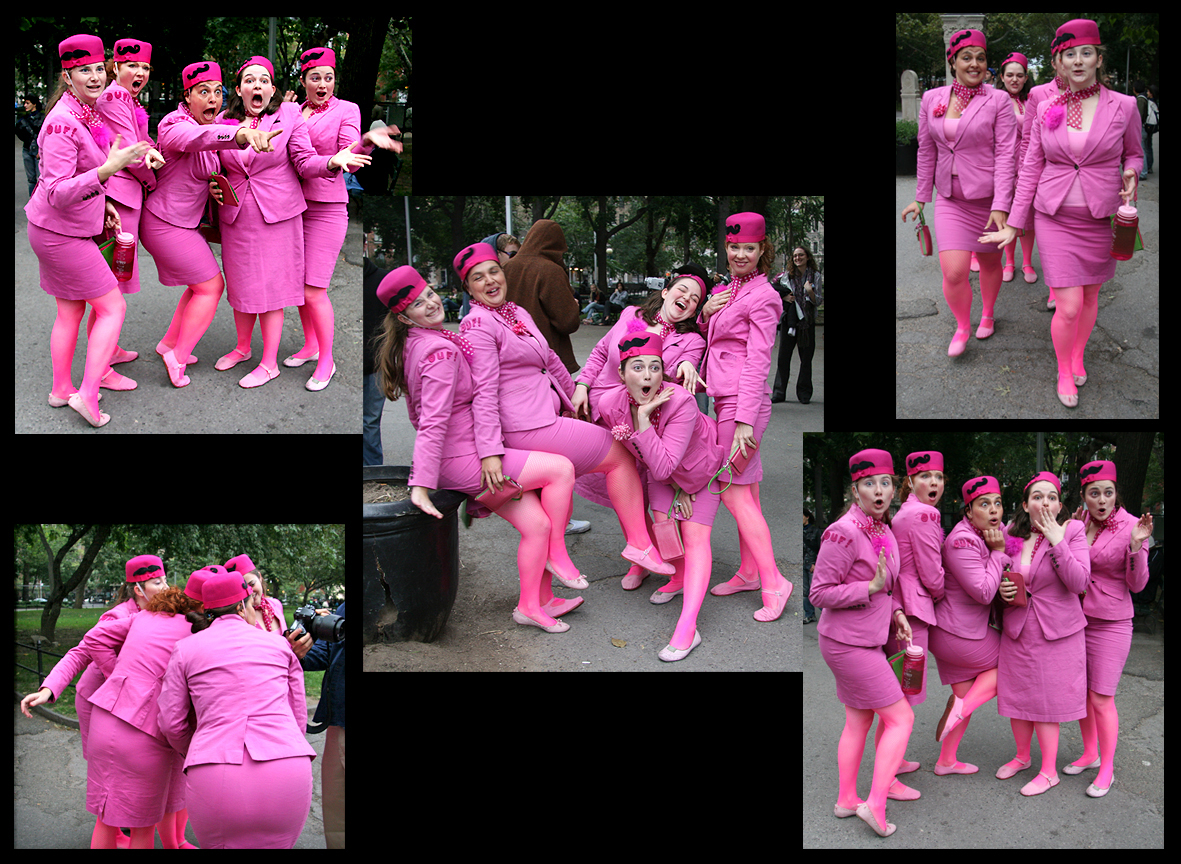
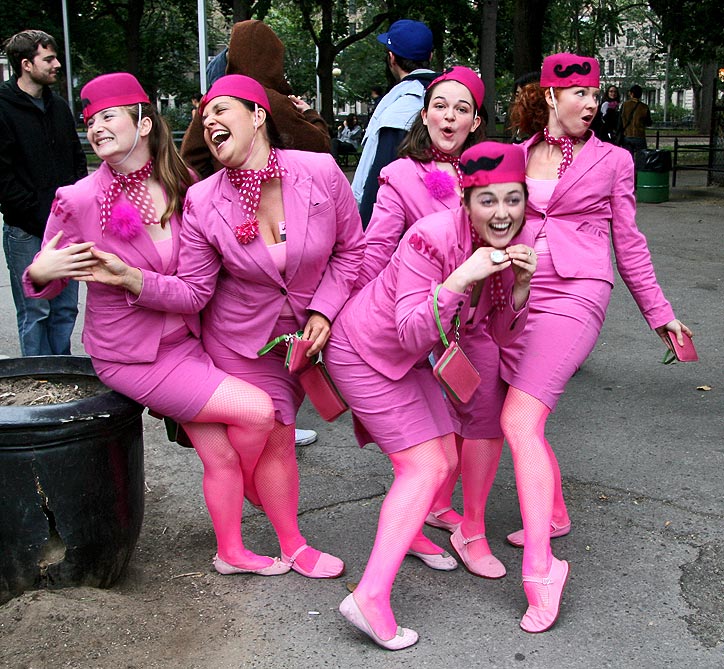
    The Pink Ladies are very pink and draw a lot of attention – I found them very charming. They are part of Theatre OUF!, a New York-based theatre company whose members hail from France, Switzerland, the Netherlands, Canada, and the United States. Click here for another photo. Under the direction of Helene Deme Elzevir, the company devises original works of theatre through improvisation and physical action. The members’ training ranges from the Barnum Bailey Clown College to the Ecole Jacques Lecoq.

    The Pink Ladies declare themselves members of the worldwide PINK ACADEMY, whose mission statement is “to save the world and bring happiness to people all over the planet by spreading fake moustaches.” Their current work is Pinktown, On the Loose on the streets of NYC. Every Saturday from 9/23 to 11/25 (2006), sometime between 3PM and midnight, the Pink Ladies will perform somewhere on the streets of NYC – clues to their location, travel route, and times will be posted every week on their website. I imagine they’ll be easy to spot 🙂


  • Christopher Street Pier

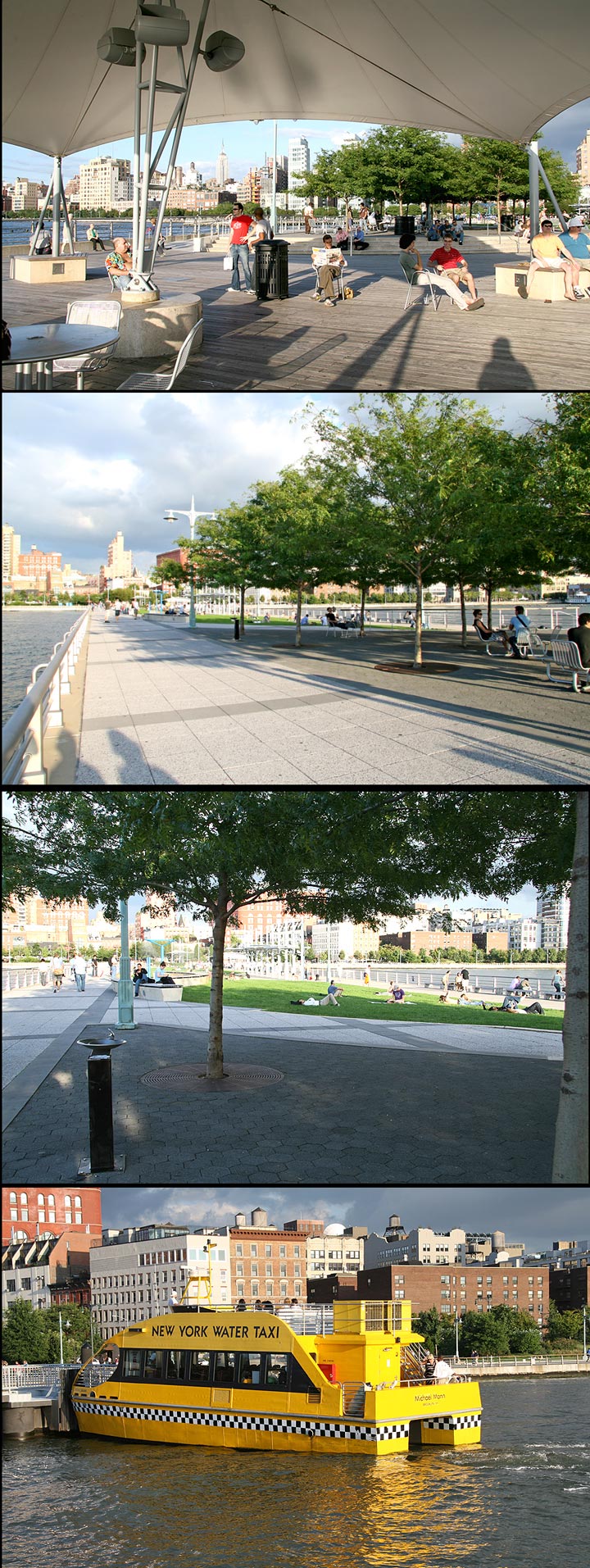
    Christopher Street Pier (officially Pier 45) is part of the Hudson River Park, a 5-mile strip of parks, gardens, and piers interconnected by a pathway for biking/jogging/walking along the west side of Manhattan, the largest park development project since Central Park. By the 1970s, NYC’s role as a commercial port had virtually disappeared, and the waterfront and piers had severely deteriorated. Opened in 2003, Pier 45 was one of the first segments to be reconstructed. The 850-foot long pier includes shade structures, seating, wood decking, grass lawns, and a water taxi stop. The photo was taken from the end of the pier looking towards the city. Click here for more photos.

    The pier and area around Christopher Street, however, have been mired in community problems and battles. The Pier is a mecca for gay youth and creates severe problems for the neighboring community, as individuals spill into the streets after the Pier closes at 1 AM. The articles at the FIERCE site will give you an idea. I do highly recommend a daytime or evening visit – these problems do not manifest until late night – and the views and space are beautiful and relaxing…


  • South

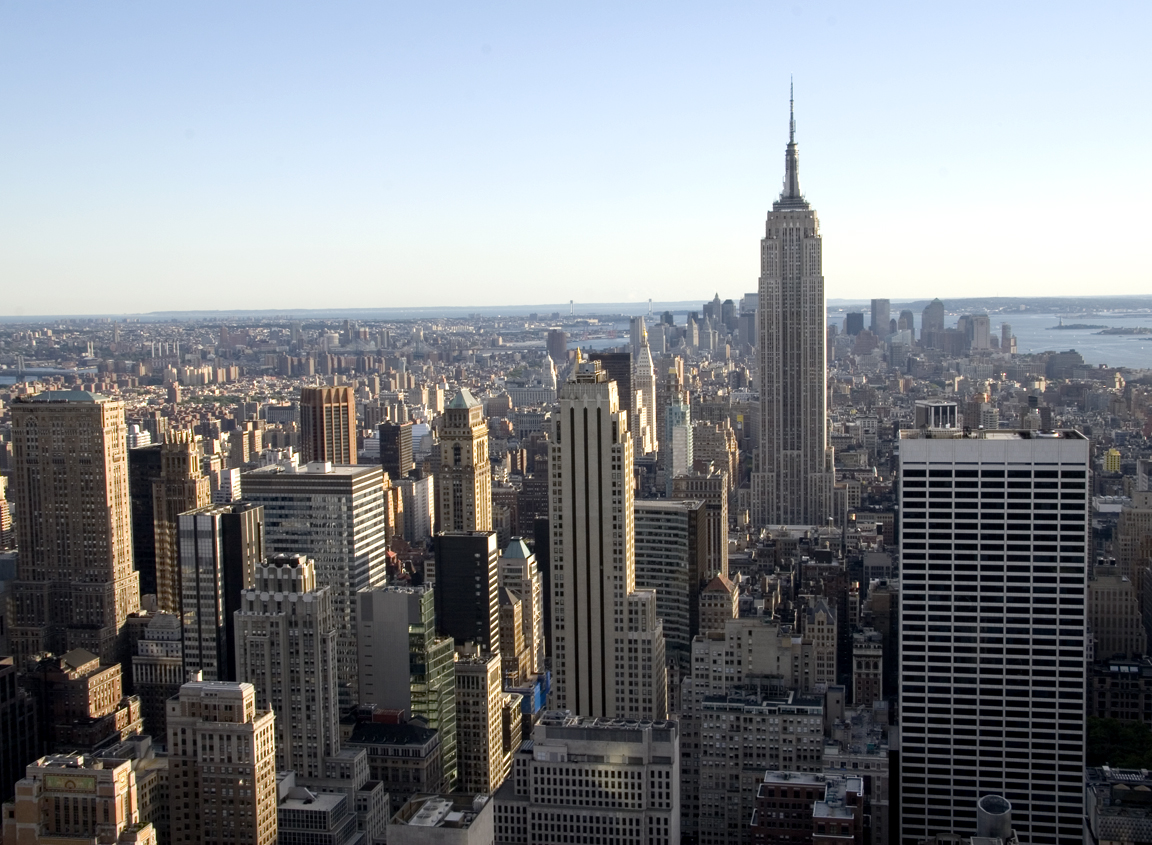
    This photo was taken looking south from the Top of the Rock observatory at Rockefeller Center. This view is of particular interest for a number of reasons. Dominant in the photo is, of course, the Empire State Building, currently NYC’s tallest building, built in 1931 and billed as the Eighth Wonder of the World when it opened. If you look carefully, at center left, you can see the Brooklyn Bridge, and behind it is the Verrazano Bridge; at center right, you can see the Statue of Liberty and Ellis Island. The land masses from left to right are Brooklyn, Staten Island, and New Jersey. The slab skyscraper on lower right is the WR Grace building.

    If you are interested in seeing vistas of the city in other directions, check out East and North. Perhaps when we see the concrete jungle of midtown Manhattan and find it to be a pleasant sight, we are subconsciously agreeing with British zoologist Desmond Morris, who wrote, “The city is not a concrete jungle, it is a human zoo.” After all, most of us love the zoo – at least for a visit 🙂


  • The Garden at Saint Lukes

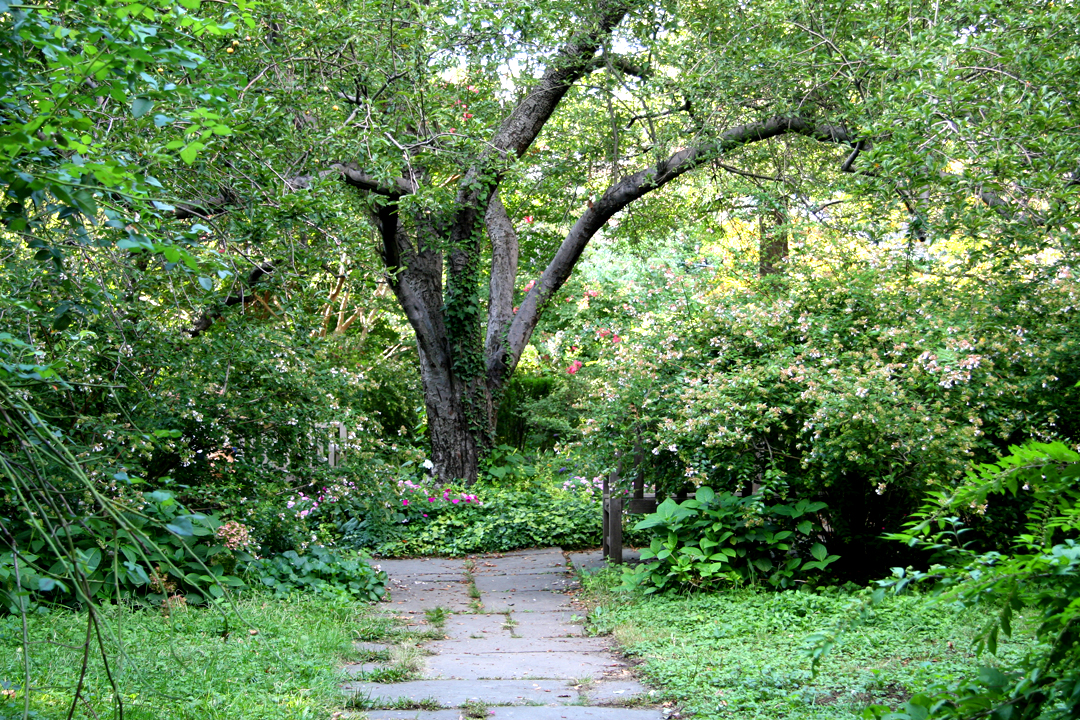
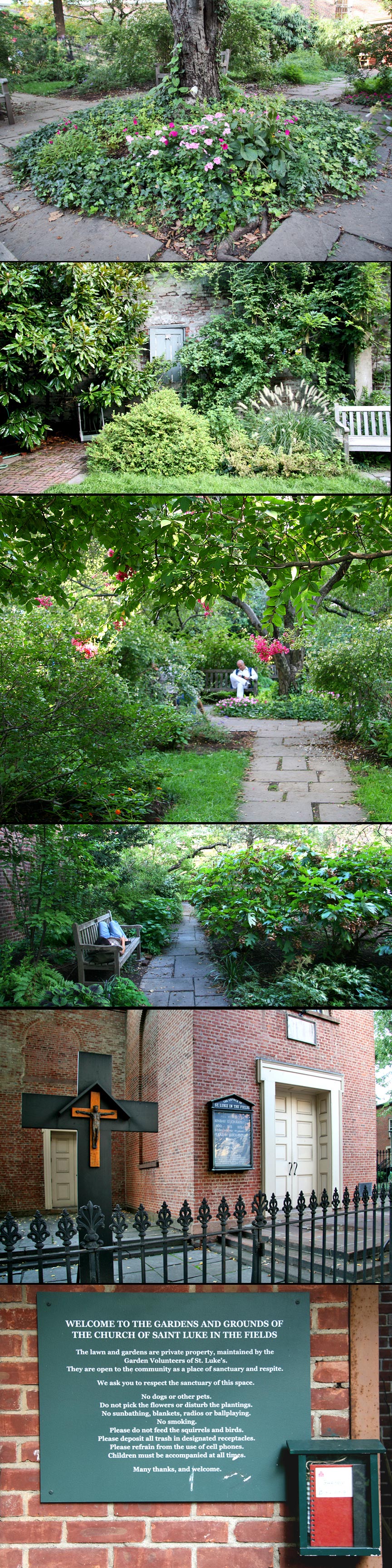
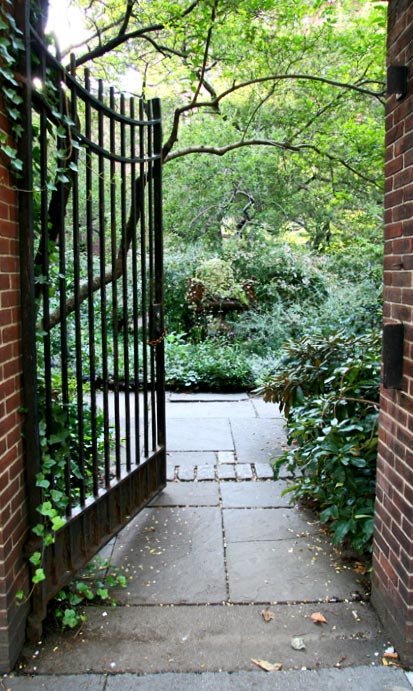
    This small, exquisite sanctuary in the West Village is virtually unbeknownst to outsiders. In fact, in doing this post, I found almost no information online – the official site for the church does not describe it, nor does the Wikipedia article. It was difficult to choose a photo, so please click here to see the entire series.

    Officially known as The Garden of the Church of St.-Lukes-in-the-Fields, the two acres of garden grounds surround the church, which was built in 1821, and are open to the public. Barbara Leighton created the Barrow Street Garden (the core of the garden complex) in 1950. It was expanded from 1985 to 1993. Because of its naturally protected setting and orientation, the garden area has become a microclimate with plants (flowers and fruit) rarely seen this far north. It also lies on the migration route of birds and butterflies.

    The Episcopalian church itself is actually quite unique and progressive, with a choir comprised of an impressive roster of professional singers. Behind the gate lies a real special oasis in the Big Apple…


  • Manhattan Island

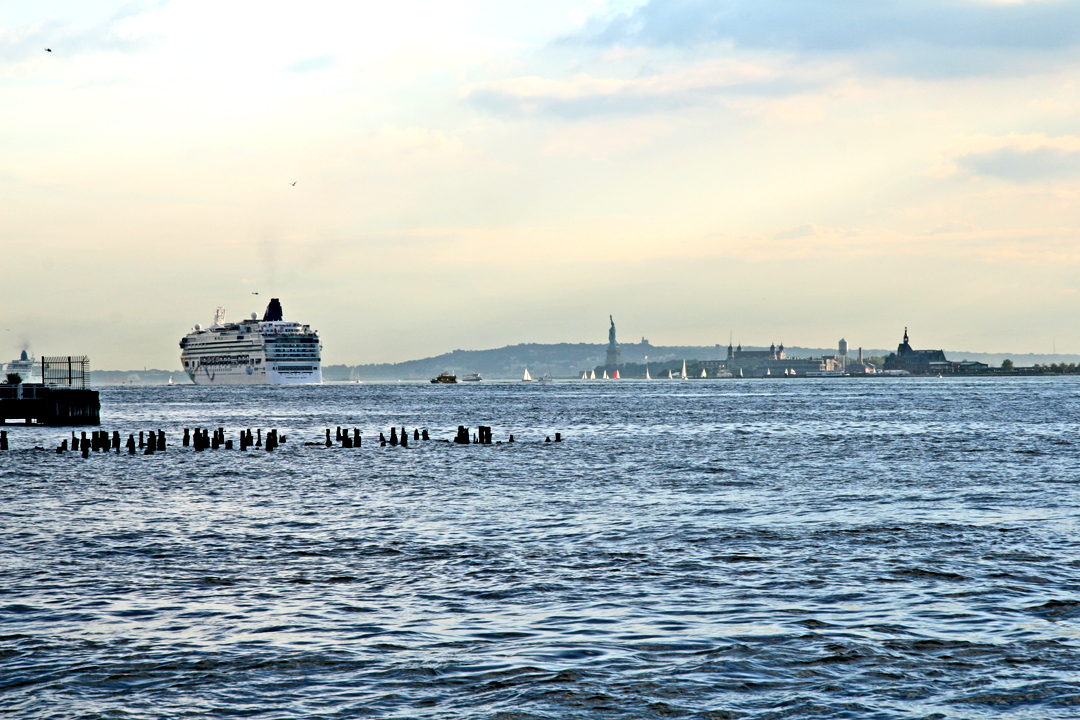
    It is important to note and easy to forget that, first and foremost, Manhattan is an island, and that its role as a harbor is what led it to become the great city that it is. By the early 1800s, after construction of the Erie Canal, NYC was an international port as well as the greatest shipping center between Europe and America (click here for article). Unlike cities such as San Francisco or Portland, Maine, where the maritime presence is very strong, one could easily go weeks, months, or longer in NYC and never see or sense the water. But an island it is, and the urban density is a product of its limited and well-defined space. The five boroughs of New York City have evolved with distinct and unique characters, which, to a large extent, is due to their physical separation by water – all the boroughs are islands or part of islands except for the Bronx. Brooklyn and Queens are both on Long Island (and share a land border).

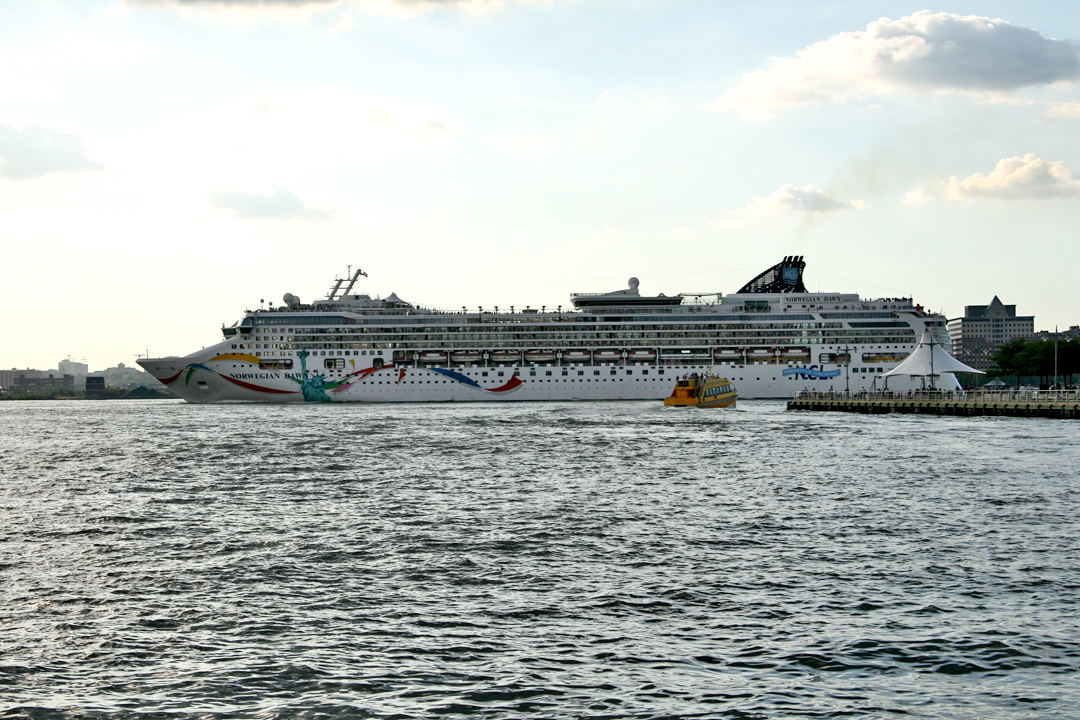
    This photo was taken from Christopher Street Pier looking southwest down the Hudson River to the bay, Statue of Liberty, Ellis Island, and New Jersey. New York services many cruise lines, ferries, and tour boats. The ship is the Norwegian Dawn (click here for a close up photo). Although words such as isolation and vulnerability come to mind, somehow I find great comfort being on this small island…


  • dinamic_sidebar 4 none

©2026 New York Daily Photo Entries (RSS) and Comments (RSS)  Raindrops Theme