• Category Archives Curiosities of NYC
  • Opportunity

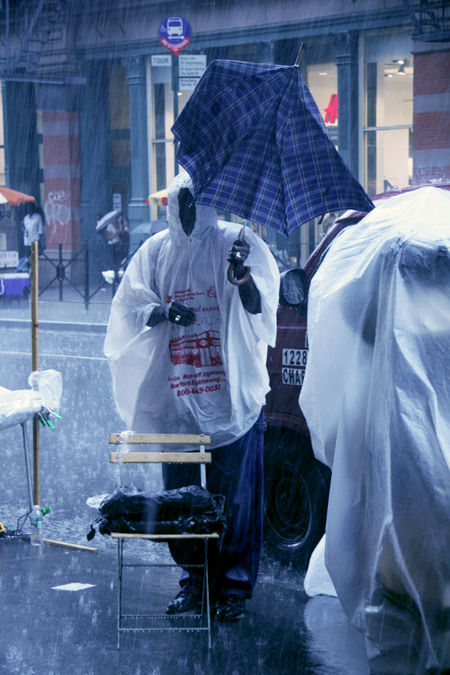
    Lightning and opportunity both strike quickly in New York, a land of opportunity. And there is no opportunity like a sudden unexpected downpour. Umbrella salespeople appear instantly from nowhere and set up quickly, because a rainstorm is an unknown opportunity.

    They appear with umbrellas that most consider disposable and justifiable for the day’s journey. A captive audience has few options. For those who did not prepare, you pay a few dollars or get soaked. The more unexpected the rain, the better the business. In the streets of New York, sympathy is not part of the vendor’s trade.

    Now I understand that in business you need to keep your costs down, but isn’t it bad marketing for an umbrella salesman to peddle umbrellas while using such a badly damaged one? After all, this is the primary complaint and impression of umbrellas sold on the street – that they are virtually useless and break immediately. After a rainstorm, many mangled ones can be seen discarded on the streets.

    A fellow onlooker and I thought the scene was hysterical. But the unfortunate and unprepared bought umbrellas anyway, because in a land of opportunity, at opportune moments, the opportunists win…


  • Distraction

    The original concept of a city daily photo blog was started by Eric Tenin of Paris Daily Photo. The idea was to give readers a slice of daily life in a city. I have gone beyond that initial idea in this website. However, I still often keep that theme that in mind when I create new postings.

    If you saw my posting Interruption, you know that I have been engaging in a renovation project in my home. Because of this, the blog has suffered some here and there in the last week. Perhaps it is bad form to make apologies for anything a person produces for the public, but I have committed to a daily publishing schedule, and it is extremely difficult to work in this environment. I do feel that I want to make visitors here aware that this process is extremely disruptive, as anyone who has lived IN a construction site will attest.

    Right now I am typing this on a laptop in bed, the only place left that is reasonably clean. Everything is in disarray, all my belongings have been in boxes for weeks, and dust is everywhere. Workers will arrive at any moment.

    Rather than make a half-hearted effort and a mediocre posting, I am sharing with you a REAL slice of NYC life in the spirit of Eric’s original concept.

    I hope to get back on track next week with more focus. Thanks.
    Brian Dubé


  • Small Steps

    Posted on by Brian Dubé

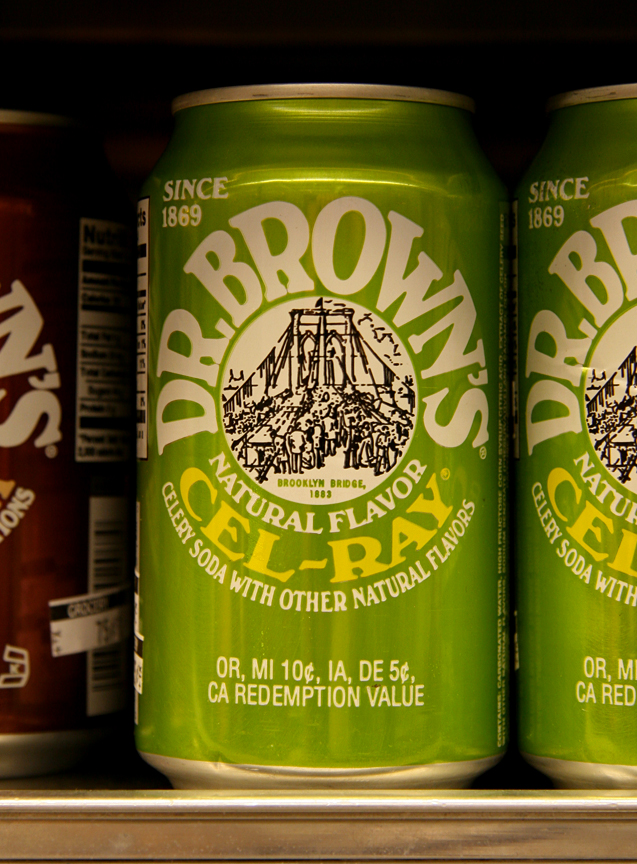
    What does this have to do with NYC? Plenty. Dr.Brown’s Cel-Ray Soda is a specialty item more commonly found in the New York City area. In the 1930s, it was even nicknamed “Jewish champagne.”

    The subject of beverages came up while chatting recently with a number of friends on a hot summer’s evening. We all volunteered our personal favorite flavors and brands: cream soda, root beer, etc. One of our group mentioned celery soda – Dr. Brown’s Cel-Ray. None of us had had one, and we became very intrigued. We were unable to locate one at our local green grocer, so it became a mission for a couple of us.

    There is great satisfaction in achieving goals, but in New York City, where life can be hard, many goals are difficult, so we often must settle for small things. I think this explains the popularity of Sudoku; there is only one solution, and a completed puzzle is a small, perfect achievement.

    In New York City, space is at a premium, so in many instances, we do not have the broad range of consumer items in certain categories, certainly not the type of selection of packaged products seen in a suburban supermarket such as Pathmark or Super Stop & Shop.

    We did not find Cel-Ray at our local green grocer. In a way, I think we secretly welcomed this – it gave us a small team goal. One that would most likely be easily achieved.

    Last night, there was word that Cel-Ray could be found at a neighborhood market. A short pilgrimage confirmed reports, and two of us were able to acquire and sample our first Dr. Brown’s Cel-Ray soda. The flavor was quite good – pungent and spicy – much better than we expected. Finding it was almost like landing on the moon – one small step for two men…

    Posted on by Brian Dubé

  • Anthora

    Posted on by Brian Dubé

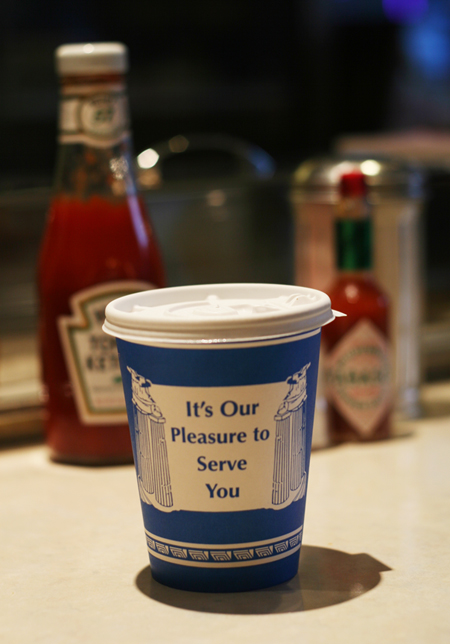
    I love this kind of thing. The New York City where we can find an icon based on something so ordinary that it defies comprehension of how it attained mythic status. Its very ordinariness drives it.

    I think it is a form of defiance. Our sense of self-importance is such that New Yorkers can take something completely mundane, champion it, and say, “This is the definitive coffee cup. Why? Because we say so! We don’t have to pander to outside fashion or fancy cups. We set the rules. And the Greek motif coffee cup is what we choose. We eschew all others.”

    Of course, the entire process is the confluence of many factors, historical, practical, and otherwise. But once something here has been established as a de facto standard, New Yorkers hold on in a tenacious manner.

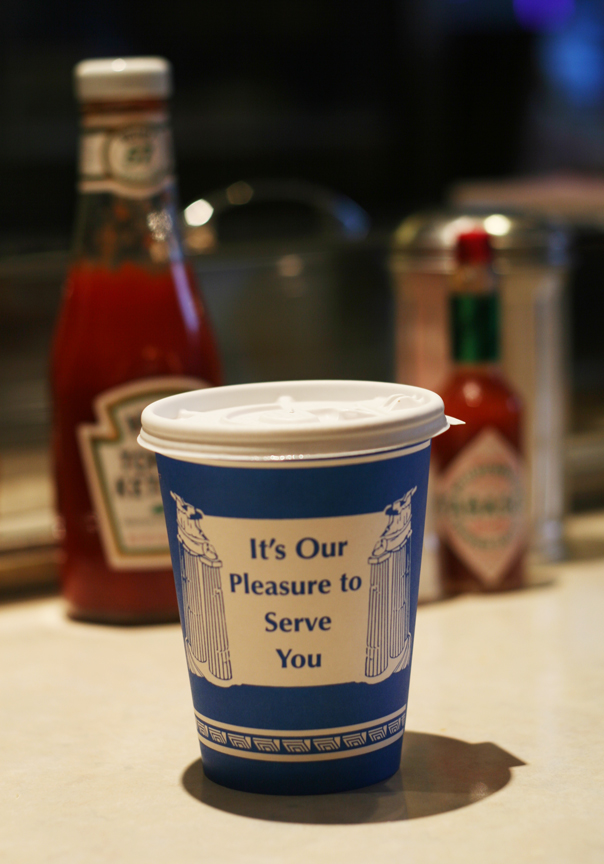
    The classic, Greek-themed, blue and white design – the Anthora – was originally designed by Leslie Buck of the Sherri Cup Company of Kensington, Connecticut, in 1967. The large number of Greek-owned coffee shops in New York City seemed to be a ready target for a themed coffee cup. The name was inspired by an article about a sunken Greek ship laden with Amphora (Greek urns). Anthora is a corruption of the word, based on a misprint in an article. Greek Amphora were typically decorated with geometric designs around the neck; this concept was adapted to the upper and lower rim of the 10-ounce paper coffee cups.

    There are a number of competing brands of the Greek coffee cup, but all have some variation of the original message “We are happy to serve you.” The one in the photo is no. 110 by Premier Paper Manufacturing Corp., circa 1997. A set of Corinthian columns graces the front with the words “It’s our pleasure to serve you” and a discus thrower on the back. The original design is now owned and manufactured by Solo Cup Company. See the link here for a gallery of Greek-motif cups.

    The Greek-themed blue-and-white design is now on sale as a ceramic mug at the Museum of Modern Art. And a whole line of products, like T-shirts, can be found with the Anthora image. It can also be seen in shows like NYPD Blue, where the cup lends a sense of New York City authenticity.

    Some predict that the cup, with its blue-collar associations, is doomed to extinction with the advent of more sophisticated cups, such as those used by Starbucks. Time will tell…

    The photograph was taken courtesy of Joe Jr’s. Diner – the subject of a future story.

    Posted on by Brian Dubé

  • Bleu est Sérieux

    Posted on by Brian Dubé

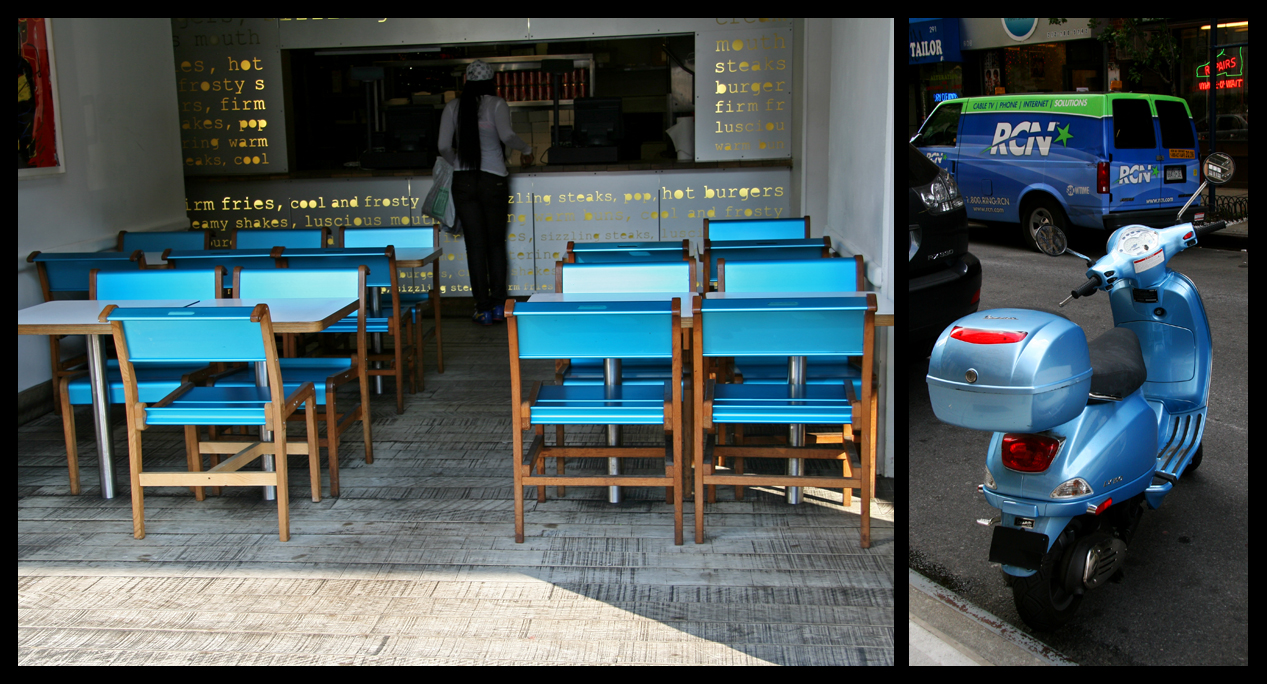
    Take a culture of sensory overload. Then add New York City, and it and is easy to understand how very difficult it is to isolate and notice individual things. There are exceptions, of course, such as the color red, which really screams and is still able to makes its presence known in a crowded, competitive, visual environment. I have written before of red in Who See the Red and That’s Quite a Briefcase.

    But one day, I noticed a concentration of BLUE. It is surprising that it took so long, as blue is my favorite color. Every color has its fan base, but you can make a pretty strong case for the importance and significance of blue and its popularity. Blue is a more subdued color. Relaxing. The color of royalty, the ocean, and the sky. The “B” in RGB. Blue eyes, blue suede shoes, the blues, true blue, blue jeans, blue suits, bluetooth, blue gemstones. Interestingly, as George Carlin pointed out, there is no truly blue fruit.

    If you really want to immerse yourself in the subject, there’s a fascinating book, Blue: The History of a Color, by Michel Pastoureau, professor and specialist in medieval history. He is an eminent scholar affiliated with Sorbonne’s École Pratique des Hautes Études.

    Blue is serious business. Or, perhaps, I should say bleu est sérieux

    Posted on by Brian Dubé

  • Interruption

    Posted on by Brian Dubé

    Regular readers of this site will have observed an interruption yesterday in this online publication for the first time in its 2-and-a-half-year history. This is not a harbinger for times to come or any lessened interested on my part. There is good reason for this interruption, as the photo and the tale to be told will tell. A tale of interruption, disruption, and commencement.

    It is rumored that a particular residential tenant had contracted to perform much-needed repairs in his home. Residents of this city know that the services rendered by landlords can frequently be poor or nonexistent and that unless matters are taken into one’s own hands, one can be forced to live in a manner not too dissimilar from the Dark Ages. I am not an advocate of vigilantism or reckless activity, but at times, one must do what one must do.

    So on Thursday, July 10, 2008, a crew of men was employed to make said repairs when all concerned were suddenly informed by the building management that work must stop immediately.

    Now it was extraordinarily distressing to have materials, a work crew, and money committed and then be told that work must STOP and that a representative of the landlord would be making a personal visit. The mood was quite anxious as nine people alternated between waves of silence and nervous speculation, both positive and negative.

    But good luck prevailed, and for reasons not completely understood but amid much speculation, after conversations with attorneys and the owner herself, work was permitted to continue, with no discussion of money, changes, or other negotiations.
    Now in NYC, this is to be considered nothing less than a small miracle, perhaps even a large one. It goes without saying that doing a blog entry in a construction site and under these conditions is reasonable grounds for interruption…

    Posted on by Brian Dubé

  • Gold Mining

    Posted on by Brian Dubé

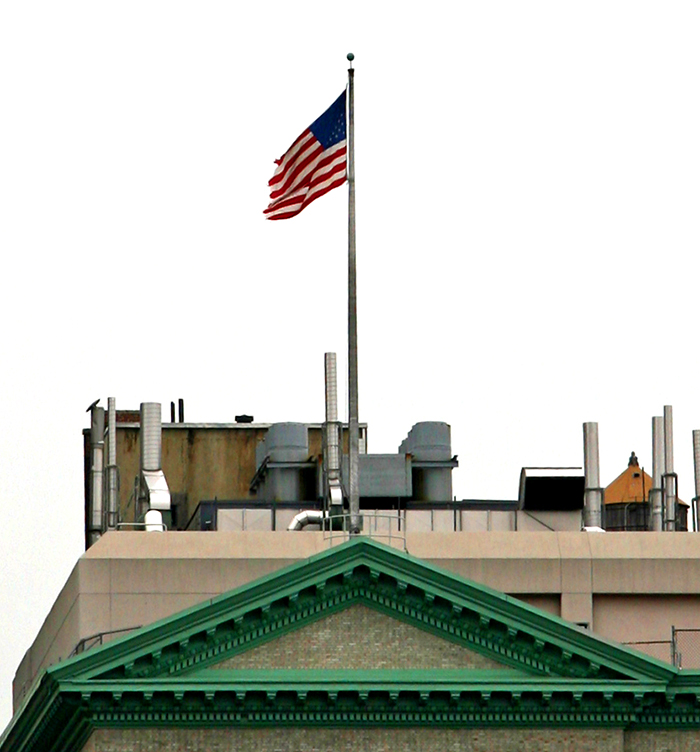
    Today, of course, is July 4th, Independence Day in the USA. I have never been a flag-waving American. In fact, my generation was particularly unpatriotic. I grew up in a time of protest – the Vietnam War, draft card burning, and marches to Washington. But as I have aged and learned, I have a greater appreciation for what this country has to offer.

    I am not blind to the problems here – over emphasis on money and capitalism, extreme ethnocentrism, racism, lack of national medical coverage, exportation of American values and culture, dumbing down of society, decline in educational achievement, and decline of the dollar and rise of the Euro.
    But in the course of my business and personal life, I have met thousands of individuals from across the world, and conversation frequently turns to culture and countries. I get positive impressions of this country from them.

    There is a clamor to get into this country – an average of one half of a million immigration applications are filed each month. Of course, the quality of life is certainly excellent in many other places (some would argue better), and most non-USA citizens are happy to live in their native land.

    I think the biggest thing I have learned is that freedom and opportunity are not hollow words. For the ambitious, skilled, and hard-working, there is opportunity in America. But here, like anywhere else, there is competition, and many outsiders are deluded into thinking that all Americans are wealthy and that the streets are paved with gold. TV, film, and the desire for instant gratification all contribute to these false ideas about the American Dream. There is plenty of gold here, but it has to be mined

    Posted on by Brian Dubé

  • Store Policies

    Posted on by Brian Dubé

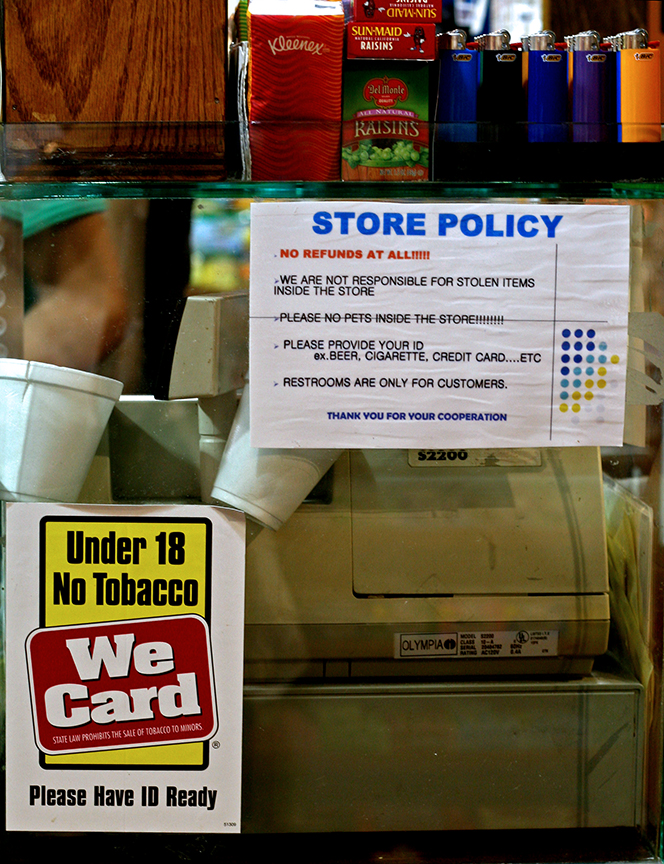
    There was a time in NYC where if you needed to use a public bathroom, you were in deep trouble. The city was harsh – there was no sympathy for body functions.

    Reading magazines or newspapers was also forbidden. Newstands had signs posted that reading was not allowed. Signs like “No Reading. This is not a library” were common. If you wanted to check the time of a movie in a newspaper or magazine, you had to either buy it or suffer some unknown consequences.

    Admittedly, the tremendous volume of tourist traffic, commuters, and the local population, including many homeless, make it difficult to maintain a friendly policy.
    Times have improved, but the bathroom situation is still a problem. Some business establishments actually claim that there is no bathroom, which is ludicrous if there are any humans working there. Others are more honest, like the green grocer whose sign in the photo clearly states that “restrooms are only for customers.”

    Why have things changed? I believe it’s because of the invasion of national chain stores. The more liberal policies of suburban retailers have migrated to the city, along with the stores themselves. Barnes and Noble superstores and Starbucks are two who have had an impact. When Barnes and Noble started carrying magazines, created in-store cafes, and provided extremely liberal reading policies, magazine stands really had no choice but to follow in order to compete.

    Although many bemoan the influx of large national chains into the city and worry that they will destroy the character of New York, I do reluctantly admit that the bits of comfort that these stores offer in a city that can at times be cold and inhospitable are welcome. In the love/hate world that is New York, I embrace these store policies

    Postings of Interest: No Salga Afuera, Cuts One Way

    Posted on by Brian Dubé

  • Post-9/11 World

    Posted on by Brian Dubé

    I remember the first time I heard someone say, “Everything is different now, we’re in a post-9/11 world.”
    At this point in time, the events and impact of 9/11 are not looming so much in the conscious mind but more as an ever-present background tapestry. But it still is there, altering the collective unconscious permanently.

    However, from time to time, there are reminders, typically witnessed as increased security. Some of it appears to function a bit like public pacifiers, such as tight security in relatively small, nondescript office buildings of no import where a terrorist threat seems inconceivable.

    Occasionally, we find national guardsmen with machine guns in subway stations. The most frustrating are the restrictions in areas of interest to visitors, both resident and non-resident. One primary example is the lobby of the Woolworth Building. The lobby was a favorite “secret” of mine. At night, one could visit and see the magnificent vaulted lobby with blue and gold glass mosaics, murals, marble, and the sculptured caricatures. Now, you cannot enter the lobby unless you have specific business in the building. And this type of saga is replayed in various ways and places throughout the city.

    The sentry guards in the photo were on the upper level of the West Side Highway during Fleet Week, near the Kearsarge. Their silhouettes, cutting out shapes in the skyline against a dramatic sunset, was a silent and poignant reminder that we are in a post-9/11 world…

    Posted on by Brian Dubé

  • Let’s Have a Parade

    Posted on by Brian Dubé

    This extraordinary display is typical of a new generation of high-performance LED signage which has virtually replaced all of the older neon of Times Square, a trend which is universal. Like most New Yorkers, I rarely travel to Times Square, and I do so only when there are specific reasons. On a recent trip, I unexpectedly ran across this massive display which is part of the new M&M’s Retail World. See here for the set of photos.

    I am not so fond of over zealous business establishments which are essentially mega-branding and marketing tools. Legacy businesses such as Coca-Cola, Disney, Warner Brothers, and many others have entered this new world of advertising, selling lines of branded products via their own retail stores. But I had to grant that this enormous LED display was just fascinating as I watched it cycle through image after image.

    What can easily be seen as a gratuitous display and waste of money reminds me of a conversation I had with someone many years ago. My friend’s concluding assertion always bothered me, because at one level I didn’t like it, but at another, it rang true. He and I were discussing extravagance and celebrations. I mentioned how, in many cases, money could be better used for any one of a myriad of needy causes. His response was, “Yeah, but you gotta have parades.” This really hit me. People really do occasionally need to express joy and exuberance even if it is not always “practical” or “sensible.” We can’t live life with the souls of accountants. A world without love, flowers, laughter, and parades would be a dreary one.

    So for now, just for a few minutes, let’s put aside aside our criticism, skepticism, and cynicism. Let’s have a parade 🙂

    About the display and store: The 32½-foot-high by 31¼-foot-wide LED panel display was done by Union City, NJ-based D3 LED. The display content was designed by New York-based Show & Tell Productions. Store 25000-sq ft, 3-story design by Ohio firm Chute Gerdeman Retail.

    Posted on by Brian Dubé

  • Insult to Injury

    Posted on by Brian Dubé

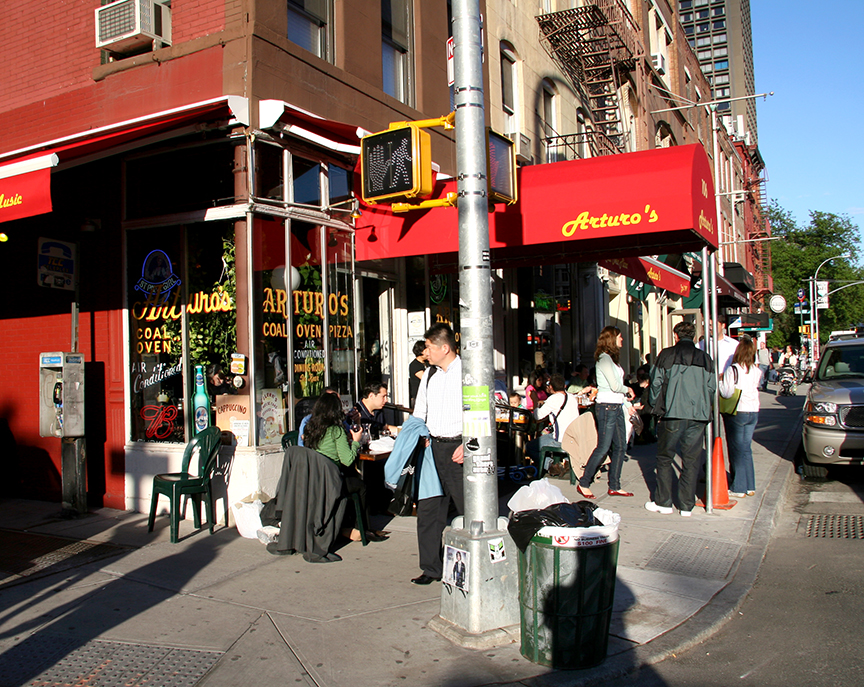
    Let’s try to create the most inhospitable outdoor dining situation imaginable and see if anyone comes. First, let’s pick the largest city in the United States – New York – to make sure we have potential for congestion.

    Second, pick one of the busiest thoroughfares in Manhattan – Houston Street – so it’s like eating on a super highway. Third, we make sure we choose a really crowded area to insure opportunity for the maximum numbers of passersby. Fourth, while we’re at it, provide no separation between diners and those passersby, guaranteeing a complete lack of privacy.

    Fifth, let’s use inexpensive, plastic chairs (the kind you get for a few dollars at a discount shop) so the experience feels really cheap. Sixth, let’s make sure we have a garbage can nearby filled with trash. Add in a fluorescent orange traffic cone for color. Seventh, let’s put some of the tables around the corner next to the kitchen exhaust system for those who really want more ambiance.

    So there you have it. Dining al fresco at Arturo’s, New York City-style. And do we get any customers? You bet, and there are no tables available.

    Oh – I almost forgot – let’s serve wine so we can add insult to injury 🙂

    Related Posts: Piercing Al Fresco, Luna Park Cafe, Esperanto, a la Chien, Paris in New York

    Posted on by Brian Dubé

  • Privileges

    Posted on by Brian Dubé

    I am fortunate to have friends with an extraordinary view of the city and was able to capture a series of photos in the evening sunset light.

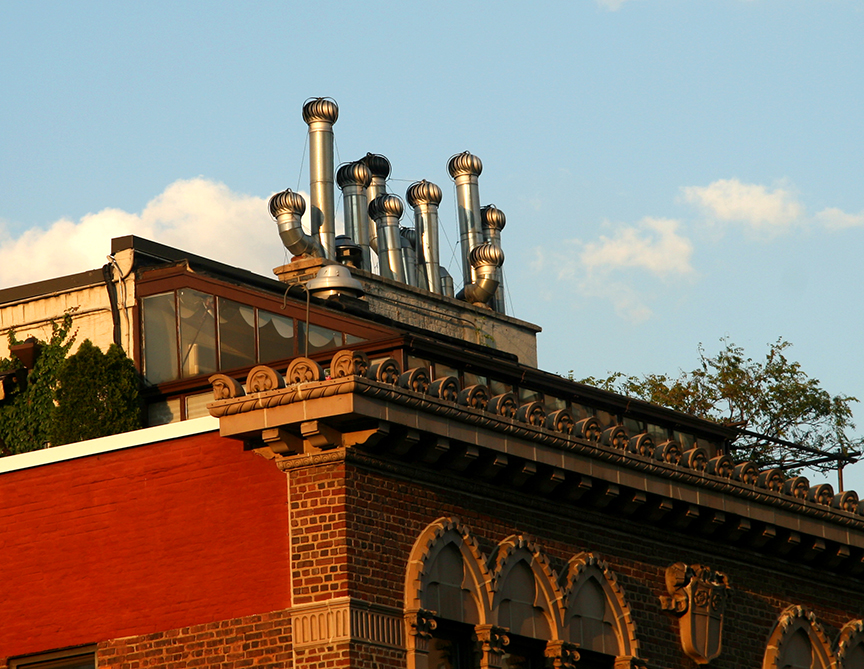
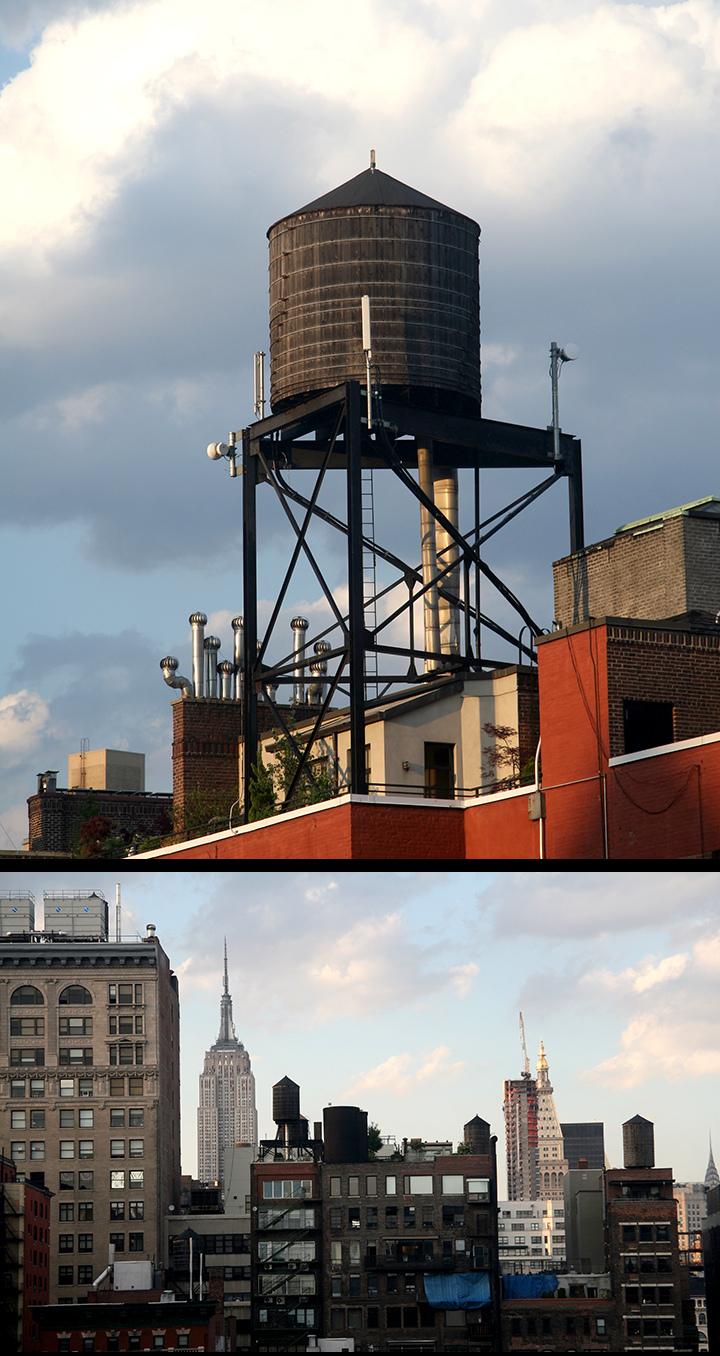
    These rooftop turbine ventilators make a very visual accent on the city’s skyline. They can be seen everywhere in New York, along with the ubiquitous water tanks, which I have previously posted on.

    In this photo, the ventilators are directly above what appears to be a penthouse apartment with a terrace. It may come as a surprise, but there are a number of people in Manhattan who have garden space and actually use landscaping services. These gardens are typically hidden from view – either at ground level in the rear of buildings or annexed to top floor apartments. Of course, a substantial premium is paid for this type of privilege, as is for air and views.

    As I have written here before, I find many of the structural and functional elements of buildings to be attractive, and they offer a myriad of opportunities for photography. These ventilators evoke a number of images for me: people, minarets, chessmen, chef hats. Peering out over the city from above, craning their necks for perhaps a better view or a breath of fresh air…

    Posted on by Brian Dubé

  • No Salga Afuera

    Posted on by Brian Dubé

    I used to know a Puerto Rican woman who roared when I used to demonstrate my limited command of the Spanish language, defined by the NYC experience. My favorite was the recitation of a sign which appeared in the subway cars for as long as I can remember. I used to just recite two lines:
    “La via del tren subterraneo es peligrosa…No salga afuera.” This warning alerted passengers to many dangers, including the the electrified third rail. (See full wording and translation below.)

    My other favorite sign was one I frequently saw in parks: “Aviso. Veneno de Rata.” (Danger. Rat poison). Now I realize that this knowledge will not get me far in conversation in a Spanish-speaking country, nor will it help me charm a Latin American, but in New York City, it may be useful in avoiding premature death in certain situations.

    Every living environment has an effect on its inhabitants, and in New York City, that environment is one that has an element of brutality. New York is a great city and has improved markedly over the years, but this is a harsh place and breeds cynicism, skepticism, and cautiousness. Survival skills. And one of the results is a rather unusual foreign language vocabulary.

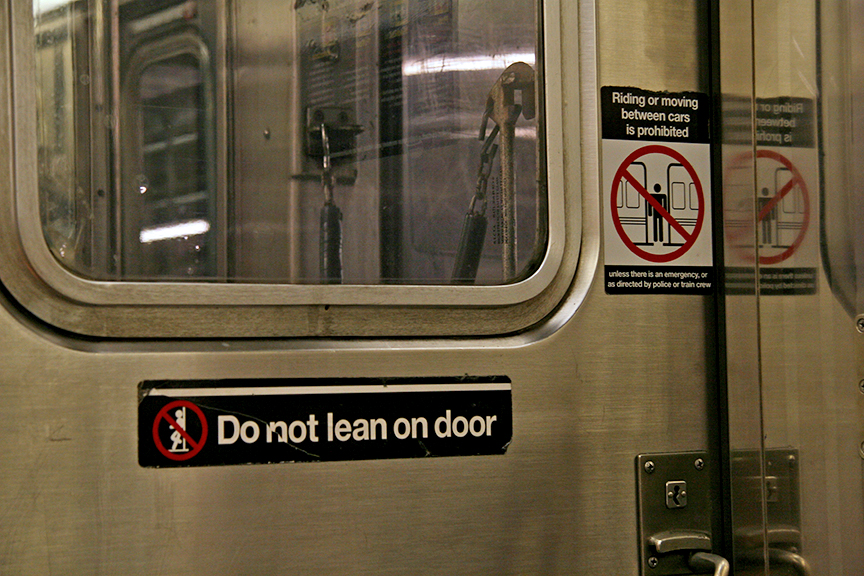
    The photo shows the current signage on subway doors. Many New Yorkers, including myself, have frequently walked between cars to position oneself at the proper end of the train so that you are in the best location when exiting (most doors are locked these days). The experience of walking between cars of a moving subway is not for the faint of heart, but it does make good use of travel time, admittedly at the risk of being killed. But, hey, that’s just makes you feel like a real fearless New Yorker. But I am not recommending this behavior – this posting is for informational purposes only. Just remember, “La via del tren subterraneo es pelgrosa”!

    Note: The original sign in its entirety with translation is as follows:
    “La via del tren subterraneo es peligrosa. Si el tren se para entre las estaciones, quedese adentro. No salga afuera. Siga los instrucciones de los operadores del tren o la policia.”
    “The subway route is dangerous. If the trains stops between stations, do not go outside. Remain inside! Follow the instructions from the operators or the police.”

    Posted on by Brian Dubé

  • View of the World

    Posted on by Brian Dubé

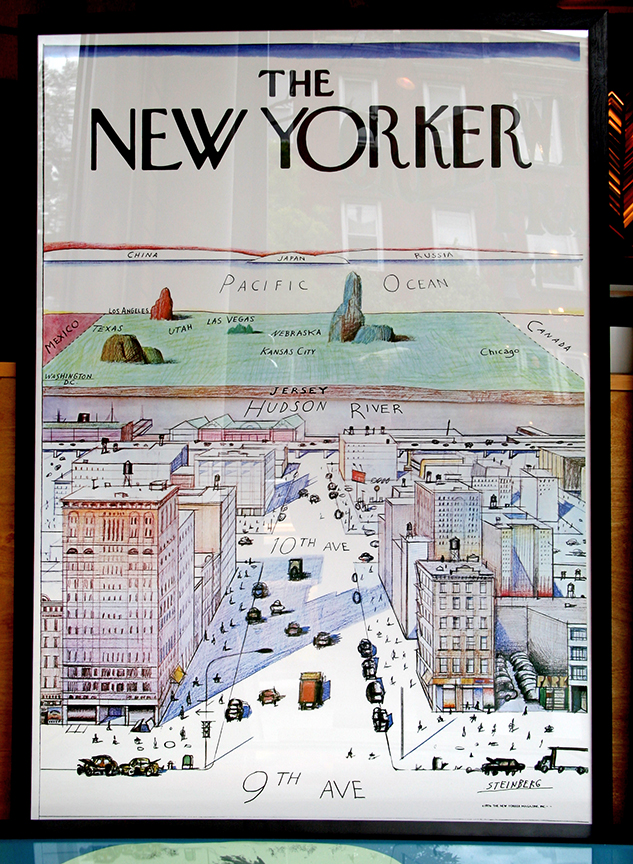
    I hate to use the phrase de rigueur again, but if there ever was a need for it, this is a prime example. Because familiarity with this image, View of the World from 9th Avenue, is de rigueur for every New Yorker and anyone who wants to understand this city’s people. This really is how many of us see New York City. I actually visualize the world much like this at times. When I first saw this work, I was stunned as to how close it was to my mind’s perspective of the world.

    Note how inconsequential things outside the city are depicted. Ironically, the area of Manhattan shown is itself one of the least important, yet it still looms large over other cities, states, and countries.

    The density of people and services is so great here that it really is possible to go quite some time without leaving; many Greenwich Village residents joke about how they never go north of 14th Street for months or even years at a time. Manhattan is literally a world unto to itself and is a center for a myriad of industries. It is very easy to adopt a worldview not too far from this work of art.

    The image itself is a New Yorker magazine cover from March 29, 1976, created by Saul Steinberg, who did 85 covers and 1,200 drawings for the magazine. The photo was taken of a poster hanging in a shop in the Village. I didn’t even have to go to 9th Avenue, seek out the original, or step inside a shop. My view of the world from 9th avenue was had from the comfort of my own neighborhood in a gallery window. Now that’s a New Yorker 🙂

    Posted on by Brian Dubé

  • Very Practical

    Posted on by Brian Dubé

    I once had a customer from Sweden who made a comment that had a lasting impression. I have many international customers, and I am frequently curious about their impressions of the city. So when I asked, “What do you think of New York?” there was a pause, and I could see that he was looking for a very diplomatic answer. “Very practical,” was his response.

    Now I knew immediately what he meant. My mind’s eye raced around the city streets as I visualized those things that could be best described as “very practical” looking – our trash cans, lampposts, heavy chains around bikes, steel-reinforced concrete curbstones, roll down gates – so many things where function triumphs and utilitarian is the operative word.

    Virtually everything on the city streets of New York is designed with the lowest common denominator in mind, and in the biggest city in America, that denominator is very low. The key concerns that define the design and construction of most things accessible on the streets are vandalism and theft (not to mention heavy wear and tear). Don’t be misled by articles and statistics on low crime rates in NYC. Much of this is not due to any inherent improvement in the goodness of people but rather by the actions of law enforcement and protective measures by individuals and businesses. Also, the general increase in the costs of living in the city has changed the demographic – where’s a heroin addict to live?

    One big thing that we residents tend to overlook is not so much what is as what is not – decorative elements and architectural details. These are found primarily in those things which benefit from historical treatment. This can be easily seen if one compares post-war and prewar buildings. With enough time spent here, these decorative deficits and the triumph of the utilitarian become so inculcated that it takes a fresh eye to really notice.

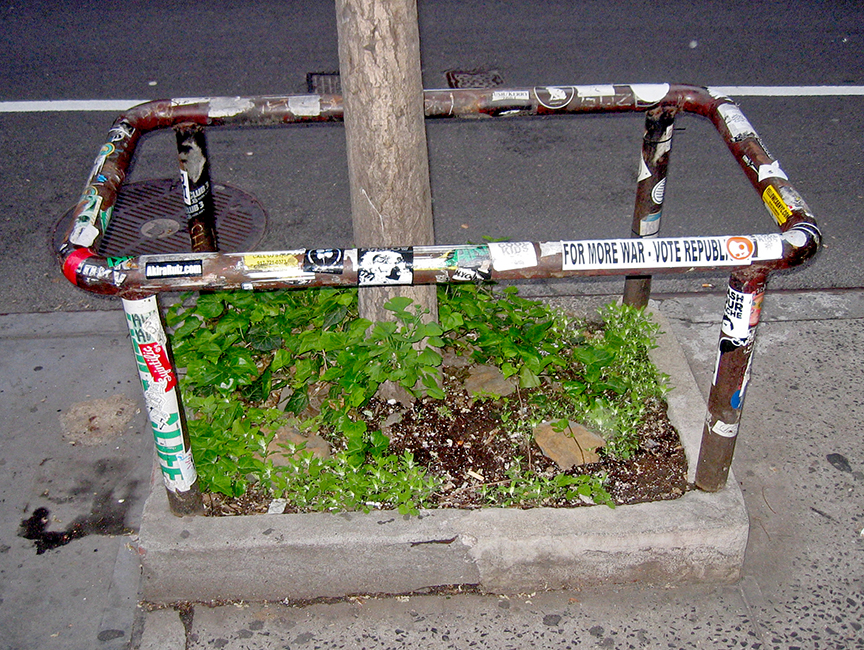
    I found the tree guard in the photo to be one of the most hideous examples of the practical I have ever seen. Even more surprising, it is located in central SoHo, one of the most upscale neighborhoods in the United States. But the tree needs protection. The solution may not be attractive, but it is very practical

    Posted on by Brian Dubé


  • dinamic_sidebar 4 none

©2026 New York Daily Photo Entries (RSS) and Comments (RSS)  Raindrops Theme