• Category Archives Curiosities of NYC
  • Little in the Middle

    More and more, there seems to be less and less of the middle. Certainly a city like New York is a place where people come for the edges and largely leave the middle behind. But now it feels like feast or famine. There are complaints of the loss of the middle class – people seem to be living either in multimillion dollar apartments or on the streets homeless.

    Heat is particularly frustrating – your home or office is either freezing or stifling. It is remarkable at how poor the services can be in a place like New York City, even when you are spending good money.

    In the 1980s, I was renting commercial space in lower Manhattan in a small five-story commercial building. Inadequate heat was a constant battle with management. I recall one occasion where we were absolutely frigid and the superintendent and his helper came by to investigate.

    They arrived wearing insulated winter jackets and, after a few moments, proclaimed that it felt comfortable to them. Of course it is comfortable – you have been active and have winter coats on. Why don’t you try taking them off, sit down, and type for a few hours?

    I am stunned that people would voluntarily sit and dine on the streets in the winter. It is amazing the number of people that to me appear grossly under dressed (or overdressed) for the weather.

    The photo on the left was taken after 9 PM, with a temperature in the 50s. People are in T-shirts. This is not strictly a function of alcohol and the St. Patrick’s Day celebration – I have seen people in shorts, tees, and flip-flops for a couple of weeks now. People in the parks in beach chairs sunning themselves. A quick run across the street to the bank is one thing, but sunbathing in the park or eating al fresco in March?

    The photo on the right was taken today, the following morning at 8:45 AM. The temperature is about 50 degrees, and this man is eating his yogurt and reading on a park bench. At least he has a jacket on.

    Nothing drives people to extreme behavior like the first warm spell in spring. After a winter’s diet of cabin fever, people are just dying to get outside. It would be perhaps more prudent to wait for warmer weather for dining at night al fresco or at least wear warmer clothes, but not in a city where there is little in the middle…

    Related Posts: Spring Fever, Spring Madness, Weather Means Whether

  • Shows Me Here

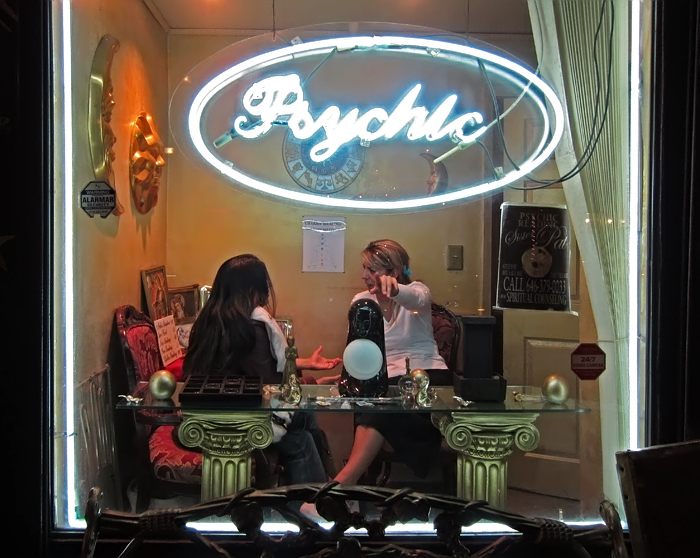
    Although saddled with a less than stellar reputation, storefront psychics, like most other fields of endeavor, span a range of expertise (or perhaps more accurately, familiarity) with the arts of fortune telling.

    In the 1970s, the niece of a friend was rather determined to get a psychic reading, so we obliged. After all, what was the harm of few dollars spent for her satisfaction and our amusement? And, to be honest, I had always been curious myself. So, off we went to find a Gypsy/Roma fortuneteller. This was a simple task – several hundred psychic shops dot the boroughs of New York City, and we knew of one just around the corner.

    What we hoped would at least be an entertaining small indulgence turned out to be a disappointment. Our companion chose palm reading as the road map to her future. The psychic held her hand, palm up, and began to go through a list of questions. Each question/answer/prediction was embarrassingly simplistic and formulaic. “Do you want to be married?” Our companion answered, “Yes.” The psychic pointed to a very general area in the center of her palm and said, “Shows me here you are going to be married.”

    “Do you want to have children?” “Yes.” “Shows me here you are going to have children.” Every one of the psychic’s predictions was prefaced with “shows me here” while pointing to the same vague area in the center of our subject’s hand. No effort at all was made to even remotely use the elements of palmistry. No life, head, heart, sun, mercury, or fate lines.

    Clearly we had not found our way to the top of the profession, but, like many disappointing experiences, a sense of humor can turn these incidents into comic material for years to come. “Shows me here” became a private catchphrase, and when popped unexpectedly at an opportune place in a conversation, it never failed to elicit laughs from our coterie of insiders.

    I was always puzzled as to how psychics working alone could possibly even afford storefront rents, much less make a living. I was surprised to learn that, according to a 1999 New York Times article, fortune tellers at the time made an average of $200,000 per year. How? By reigning in clients, telling them that their problems require special treatment to remove curses or other negative influences. That costs money. Some victims have paid as much as several hundred thousand dollars over a period of time.
    Actually, this activity, practiced this way, is illegal, and the police department has stepped up enforcement. From the Times article:

    Fortunetelling is legal for entertainment — like hiring someone to read tarot cards at a party. But the penal code calls it a misdemeanor when a person ”holds himself out as being able, by claimed or pretended use of occult powers, to answer questions or give advice on personal matters or to exorcise, influence or affect evil spirits or curses.” Those who extract large sums are often charged with larceny, a more serious crime.

    We all like the comfort of any easy repair of life’s problems. However, I am sad to report that it “shows me here” that the local fortuneteller is probably not going to be the fix 🙂

    Other Related Postings: Comin Up, Fit-ty Fi


  • Get a Room

    Having my family from New England, as well as others, visit me in New York City over the last few decades has provided me with perspective. I learned how much outsiders often see the city as a place where anything goes. The Wild West.

    The city is extremely permissive, and outrageous things do occur regularly. But New York is not lawless. I have seen young guys from out of town drinking alcohol in Washington Square Park and being quite surprised when police ask them to pour their beverages out onto the ground and then write them a citation.

    I have a friend from outside this country who, coming from a much more conservative culture, is frequently shocked by various public behaviors, particularly PDAs (Public Displays of Affection). Her frequent comments made me aware at how often people here indulge themselves in public. I defused the occurrences somewhat by introducing some humor and acquainting her with the American phrase “Get a Room”. This, along with the subway announcements “Watch the Closing Doors, Please” and “The Next Stop Is,” became our private jokes and her favorite mantras as she improved her command of American slang and often used phrases, especially ones particular to New York City. It is reminiscent of my Spanish vocabulary, learned from the bilingual signage of the city. See No Salga Afuera here.

    Lest anyone think that we were overly critical concerning what looks like relatively benign behavior (from a city perspective) in today’s photo, please realize that before this photo was taken, the girl had gone through a variety of antics, including pressing her chest up against her boyfriend’s face. The whole scene was over the top – only actual nudity would have upped the ante.

    The couple was definitely getting some serious looks from fellow subway riders, but in the true style of the tolerant New Yorker, nothing was said by anyone. They watched the cavorting in silence. Although the man in the light blue shirt seen behind the couple was doing his best to maintain focus on his writing, being there in person, it was clear that he was disturbed over the entire incident.

    On this occasion, I happened to be traveling with my aforementioned companion, and I asked her opinion. To which she replied, “Get a room?” Apparently, she was learning very quickly. “Yes,” I said, and perhaps “The Next Stop Is” a place for them to “Get a Room” 🙂

    Note: For those unfamiliar with the phrase “Get a Room” – from the Urban Dictionary: Derisive or humorous comment said to couples engaged in heavy-duty PDA that means your wanton lust is making me uncomfortable (or jealous). The implication is you should get a motel room because you’re practically doing it [sex] here.


  • Cozy

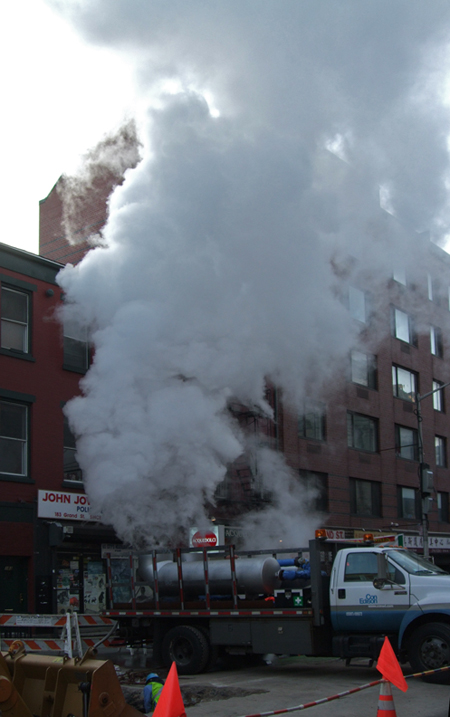
    I’ve lived with steam heat all of my life in New York City, and although the silent or near silent central heating systems of new homes (such as forced air) is vastly superior, the sound of steam on a cold winter’s day gives comfort. I’m like a Pavlovian dog – I have been conditioned to the sound of steam and its association with warmth. Anyone who has been without heat for days knows how the sound of steam rising is literally music to the ears.

    If you wonder why I say that modern systems are vastly superior, take a look at my photo and story, The Dark Ages, here. Steam heat output is controlled in a very primitive manner, with no thermostats to regulate temperature. Often, apartments or offices are blistering hot. Turning off the system is not recommended or not possible, requiring windows to be opened mid-winter. Valves often do not work properly or leak, and radiators bang.

    Most buildings in New York have their own boilers and provide their own steam. However, Con Edison, New York City’s local utility, has the world’s largest district heating system, and provides steam to 100,000 commercial and residential customers in Manhattan, from the Battery to 96th Street. Customers include the Empire State Building, Rockefeller Center, the Metropolitan Museum of Art, and the United Nations. Hospitals, such as St. Vincent, make use of steam for sterilization procedures.

    Steam is produced at five generating plants – three in Manhattan, one in Queens and one in Brooklyn. Water is boiled under high pressure to 1000 degrees F and is delivered at 358 degrees through a 105 mile system of pipes. Read more here.

    Regardless of safeguards, there is inherent risk in such as system. There have been numerous steam pipe explosions in the city with fatalities and spewing debris, including asbestos, into the air. There has been controversy and talk regarding the feasibility of maintaining such a system.

    One of most often asked questions is about the nature of steam rising from the streets of New York City. This steam is typically not from leaks, but from water making contact with the steam pipes and vaporizing. The steam is often vented through cones to prevent it from diminishing visibility for motorists.

    For now, in mid-winter, the sound of steam is always good news to my ears and only spells one word – cozy 🙂

    About the photo: This Con Ed repair truck and crew were located on Grand Street, coincidentally in front of John Jovino Gun Shop.


  • Fit-ty Fi

    I enjoyed Wayne’s World on Saturday Night Live the first times I saw it (for those not familiar with the sketch series, see here). A friend at the time was incredulous that I would find such juvenile humor entertaining. But she missed the point entirely.
    The brilliance of the numerous skits was the accuracy of how they captured the sophomoric humor and thinking of many high school boys. The simple inane things that would be incredibly funny to them. Of course, not every high school student finds the types of anecdotes on the show entertaining. Many are not ridden with an unsophisticated sense of humor. Unfortunately, I was not immune to the plague.

    At the time I was enrolled in the university, we frequented the same all-night deli near our dormitory. There was one particular cashier who had a very distinctive accent and, in a characteristic fashion, would drop the “v” sound in five to become “fi” and drop the “f” sound in “fifty” to become “fit-ty.” So we lived for purchases that had 5 or 50 in the total.

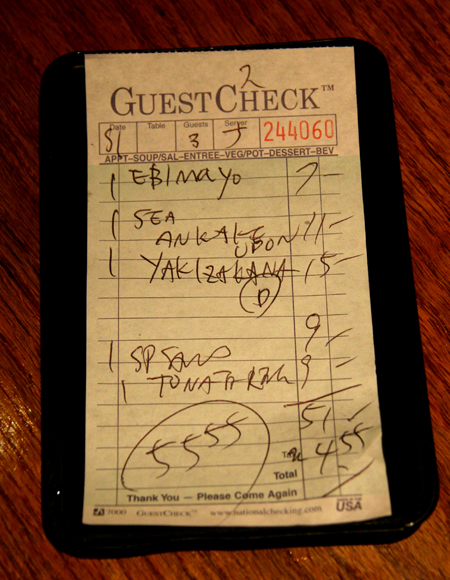
    Of course, a dream total was anything that ended in 55, becoming our beloved “fit-ty fi” – a total of $1.55, for example, was enough cause for jubilation. It had the feel of roulette: place our bets (items) on the counter, wait for the wheel to stop spinning, and see if our numbers came up. We won a single 5 or 50 often – the perfect game for impetuous youth. We were realists, and we never aspired for a dream total such as $5.55 – the odds here were quite poor, and we rarely spent that much. Better to hope for a 5, 50, or 55.

    It has been a very long time since this even entered my mind, and I am proud to state that my sense of humor has become more sophisticated. But recently, at dinner, the total was so stunning that I could not help but think that this was the ne plus ultra of my youthful dreams. The unattainable. A total so perfect, we dared not think or speak it, less we live in perpetual disappointment and frustration. I had to recount this tale, of course, to my fellow dinner companions so they could fully appreciate the miracle that lay before us – a bill for $55.55 🙂


  • Togetherlessness

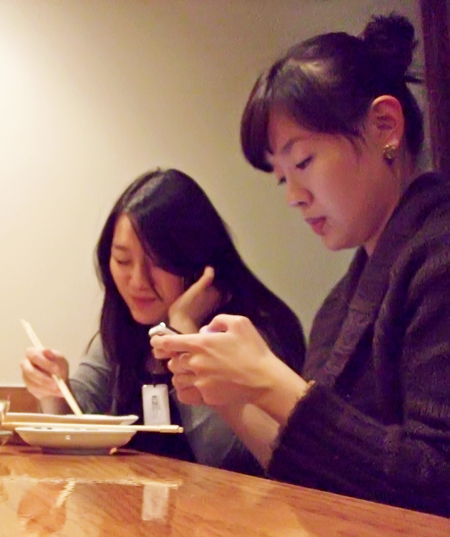
    This scene in a restaurant is far from unique to New York City, but what particularly struck me was the absolute resoluteness and immediacy with which these two women wielded their phones after sitting down. One immediately began texting,  the other speaking on her cell phone. They continued through the entire meal without saying a word to each other.

    Reading through numerous articles and online forums, I was actually surprised to see what appears to be an overwhelming majority who find the use of cell phones at dinner (at home or in a restaurant) rude and unacceptable, including younger people. The reasons cited were many, but most felt that eating is a social activity. Some also made the point that pulling out a cell phone during dinner makes a statement of relative importance – an insult to those who are physically there. Others, however, stated that among teenagers particularly, texting and phoning maintains a continuity of contact with their social circles. The whole phenomenon has created quite a furor, with many individuals seeking counseling.

    A lot has been written since the rise of the Internet and cell phones about the nature of electronic communication technologies and whether they are tools that isolate people or bring them together. Like any other tools, they can be used or abused. There are many individuals who, for any number of reasons, have a limited social circle, and communication technology has allowed them to make new acquaintances. For some, it is difficult, if not impossible, to have much live social contact with others, perhaps due to health issues or living in a remote geographical location. For others, communication with existing friends and family is broadened beyond the time they are able to spend together physically. One could also argue that in aggregate, all the new methods of communication – texting, calling via cell phone, instant messaging, emailing, video calling, voip – have increased communication.

    Personally, I try to limit cell phone conversations at dinner to receiving calls that are extremely important or where the caller would be difficult to contact. Like most things, this is a matter of degree and circumstance. People have answered landline phones during dinner for decades. In the case of these two women, they are both involved simultaneously and look quite happy sharing time together doing something they both enjoy. I’m sure the debate will rage on – whether what we have here is rude, antisocial, or perhaps a new form of social behavior: togetherlessness 🙂


  • Because I’m the Best, Part 1

    Many things were not so great in Olde New York of the 1970s – car windows broken for the theft of radios, vandalized subway trains, sanitation strikes, drug addicts, and perhaps the worst aspect, crime and a heightened sense of danger. I’m doubtful that even the most romantic or nostalgic wishes those things back.

    But there are some things I miss, and one is the character of small shops and the opportunity for nearly anyone with a reasonable idea or craft to stake out his or her claim in the retail environment. There are still a handful of small shops along some side streets, but rents are generally prohibitive for the lone artisan.

    I was involved in the leather craft movement for some years and made routine visits to many small shops, owned and operated by a crafts person(s). Some were my clients, others just acquaintances. Nearly all of these shops are gone. A few artisans still remain in business – Dick Whalen of Native Leather (formerly Natural Leather) at 203 Bleecker Street and legendary sandal maker Barbara Schaum on East 4th Street.

    I have been involved in product manufacture since those days and do pride myself on having some level of expertise using tools. However, some years ago, to perform a simple task at home, I made the mistake of asking a friend for scissors. She was an architect, and I was appropriately reprimanded for not using an Exacto knife or razor blade. I was told that those were tools of precision and that no good crafts person uses scissors for the type of work I was doing. She pointed out that in the architecture firm where she worked at the time, the model-making department used only knives and razor blades and that scissors could only be found in the marketing department.

    This was extremely interesting to me, because one of my most memorable life experiences involved virtually the very same subject, only with a little more drama. I recounted the story for her. For that, however, you have to meet Jim Murnak. And we will do that tomorrow in Part 2…


  • Hearts of Palm


    I didn’t know exactly where I was or the reason for going. But, like many social expeditions in college, we often traveled in packs with an ill-defined leader, led to some unknown location for reasons unclear. Not that any of this information was really withheld. It was just that we really didn’t care, because we had confidence that the outing would be an adventure.

    It was a party of sorts and was most likely somewhere on the Lower East Side, where the problem was never rent, only the decision to live in a war zone. Places could be rented for as little as $60 per month, and yes, even at that time, in those dollars, it was very affordable. That amount of money could be earned in one or two days in an unskilled job, something impossible in today’s market.

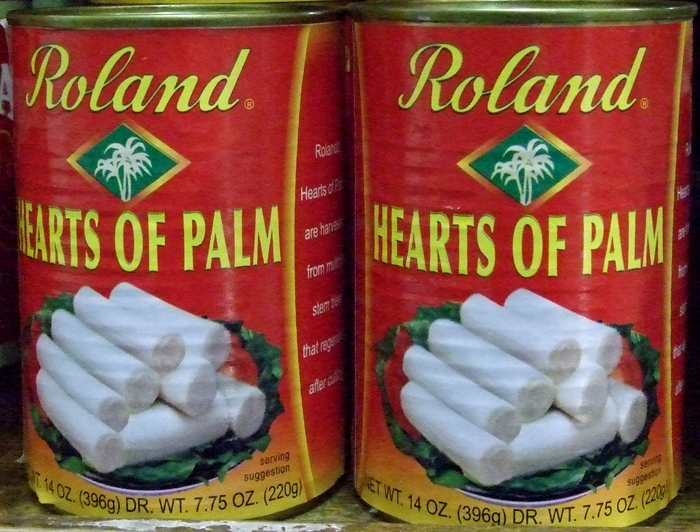
    A woman, who I believe was Brazilian, offered me a long white object from a can. As she slid it out, it reminded me of Vienna sausages, which I ate from a can as a child (and which I loved). These, however, were some type of vegetable, with a texture not so unlike an artichoke.

    But I never knew what they were called, and finding these was not going to be easy. I suspected that they were of South American origin, but at the time, international foods were a relative rarity, relegated to some small section of the supermarket, with each store having what appeared to be a whimsical selection of goods.

    There were no Korean green grocers with all things imaginable. Delicatessens were the convenience stores of choice, and for those of us coming from Anytown, USA, these all-night delis were nothing short of miraculous. We were ecstatic to have places open 24/7. The selection of packaged or canned goods, however was very limited. Fruit would typically consist of a Rome or Delicious apple of unknown age behind glass in the center of a showcase. No one was expected to actually buy it, but at least that food group was represented.

    So it was in this environment that the identity of that smooth, silky, ivory-colored, edible plant remained a mystery for years. A small, nagging, unclosed gestalt. Until I met an older woman from Puerto Rico who, from a loose description, immediately identified the suspect as hearts of palm (or palm hearts).
    Visits to various supermarkets proved successful. There was a bit of sticker shock – these were imported from Brazil and were pricey (I have since learned that they were uncultivated at that time.) But I really had no choice, and I purchased a can. They were as unique and wonderful as I remembered and became a regular (if infrequent) addition to my diet.

    Of course now, hearts of palm are a common ingredient in salads and can be found in virtually any market. For me, seeing a can of these represents closure on a long affair. For everyone else, just hearts of palm 🙂


  • We Got Religion

    When I first met a friend several years ago, in the course of our initial conversation, he referred to himself as a card-carrying atheist. Of course, I never thought he meant this literally, but, in fact, he proceeded to show me his membership ID for the New York City Atheists.

    Incidents like this, as well as the urban environment with its iconoclastic populace, would lead one to believe that the religious in this city must be a much smaller percentage than that found in the United States population at large. Surprisingly, the percentages are not so different. A recent 346-page report, Religious Change Around the World, was released in October 2009 by the National Opinion Research Center at the University of Chicago (if you are interested in perusing the report, you can download the document here.) The massive study – the most comprehensive analysis to date of global religious trends – reveals that religious change around the world is very complex and that no simple conclusions can be drawn.

    The percentage of citizens who regularly attend religious services is typically quoted as 40%, a number gleaned from surveys such as the Gallup Poll. This number is now in question, however, as individuals polled often answer in a way to reflect what they would like others to hear and perhaps believe themselves. Some studies have shown that the real number may be closer to 20%.

    Although it is generally believed that scientists and doctors are less likely to believe in God or be particularly religious, the report shows, surprisingly, that the difference in religious belief between the scientific and non-scientific community is actually not that large. Also, in spite of declining church attendance and religious affiliation, studies show that there has been an increasing number of those who consider themselves to be spiritual. Many faiths are looking to repackage their religious practices to address the changing needs of their communities.

    There are thousands of places of worship in the five boroughs of New York City – churches, synagogues, mosques, etc. A small number are major attractions, such as St. Patrick’s Cathedral and the Cathedral of St. John the Divine. Others, either architecturally and/or by the nature of an unusual amount of free land surrounding them and manicured grounds, virtually demand the attention of passersby. The Gothic masterpiece Grace Church is a good example (see here as well).

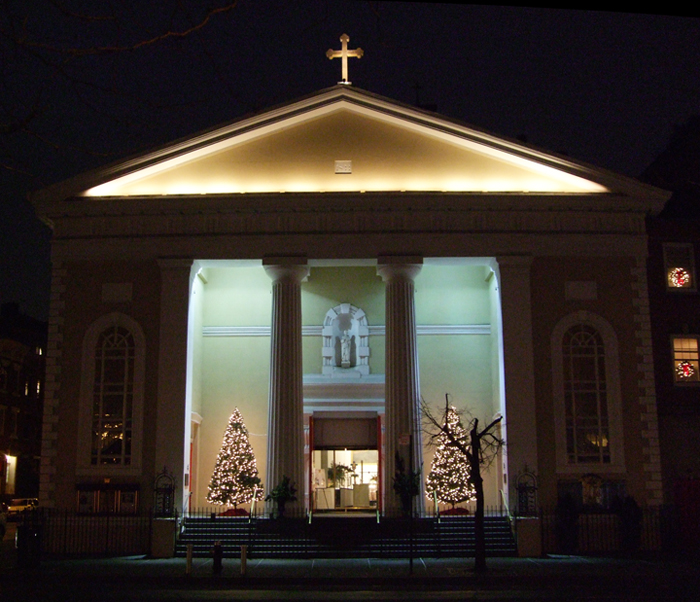
    However, unless the doors are open or perhaps the scene is graced with a spring or summer wedding precession, most houses of worship remained unnoticed, competing as they do with commercial establishments. The church in the photo, although architecturally striking, lies amidst the hustle and bustle of 6th Avenue in the Village. Unusual elements made it particularly photogenic on the night it was photographed: open doors, interior illumination, Christmas trees flanking its massive columns, and everything aglow, including the rooftop crucifix. In spite of changing definitions and practices, in New York City, like the rest of America, we got religion…

    About the Church: St. Joseph’s Church in Greenwich Village is the second oldest Catholic church in Manhattan. The Greek Revival structure was built in 1834. In 2005, NYU merged with St. Josephs, and the church is now known as the University Parish of St. Joseph & the Catholic Center at NYU. The Catholic Center at New York University, previously housed in the Holy Trinity Chapel on West 4th Street, has been demolished. The property, previously owned by the Archdiocese, was sold to NYU.


  • Jungle Lovers

    “What is New York City like?” I asked. My guidance counselor put his hands behind his head with elbows spread wide, leaned back, and with great deliberateness and the authority of a worldly, street-smart, experienced man, answered, “Have you heard of the concrete jungle, kid? Because that’s what it’s like. Between 23rd Street and 59th Street. It’s a jungle. A concrete jungle.”

    With that and some college catalogs, I was supposed to make an informed decision about the merits of attending university in New York City, a decision that would shape my entire life.

    I am not sure if his depiction of midtown Manhattan was intended as a deterrent, a strong warning, or just meant to impress me with his knowledge of this city, but we all know that if you tell a child not to do something, he/she will just be spurred on to do it. I was.

    At 18, a jungle is just what I wanted. After all, I had read numerous African adventure books and even took out a book in Swahili in high school, in the event that I found myself in equatorial Africa. If I couldn’t have vines, monkeys in trees, and tropical birds, then concrete would do fine. And, like the jungle, New York City would be an adventure. That is what I wanted most.

    A jungle is a great, even if overused, metaphor for New York City. It has a density of growth and, at times and places, can appear nearly impenetrable. Scary to some, and exciting to those who like a sense of adventure and the unexpected.

    If you want to truly enjoy NYC, then treat it like a jungle. Just walk with your eyes open. Don’t be afraid to interact with strangers, and you will meet some incredible people. There are many treasure maps, both online and offline, to New York City. Use them, of course, but also cut a swath and blaze your own paths. Enjoy the adventure. Happy New Year, jungle lovers 🙂


  • Childhood’s End

    There are innumerable things that children misjudge, misunderstand, misstate, and misinterpret, often with humorous or hilarious results. If you have never seen Kids Say the Darndest Things, hosted by Art Linkletter, I would highly recommend viewing this classic TV show which ran 27 years. On it, Linkletter interviewed more than 23,000 children from all strata of society with some of the most outrageously funny yet innocent commentaries on countless subjects.

    However, this worldly naivete is not the exclusive domain of children. I knew a young boy who grew up outside the city and had a very sheltered youth, with no exposure to many things so common in the city. Coming to New York City was a profound culture shock in many ways. He was unfamiliar with things such as bagels, delis, Yiddish, con artists, greasy spoons, subways, and skyscrapers. Virtually everything was foreign.

    There are many things in business done the same way for good reason or due to custom, usually for both. Some of the reasons are easy to guess, others are not so easy, and others could perhaps have a number of reasonable explanations. And the lack of life experience and imaginative mind of a child can improvise some crazy explanations.

    Eating in restaurants was a rarity for my family and consisted of the occasional fast food place or, once in a while, a trip all the way to the famed Chicken Coop in Hartford, CT. Growing up out of the city, I never once was privy to seeing a restaurant after closing, so when I first arrived in New York City, the night time ritual of chairs being inverted and left on table tops was quite new to me and puzzling.

    It may or may not have occurred to me that these chairs were placed this way for cleaning, but I had never witnessed such an event. And what really puzzled me was why they would be left like this all night long. With the naivete and wild imagination of a child, I mused that there was another reason, finally concluding that it must be to keep something from crawling up the legs of the chairs, making their way to the table tops.That had to be rats or mice. Most restaurant tables had center pedestals, so without the use of chairs, mice or rats would need to crawl upside down under the table top to complete their journey to the top itself. I was satisfied with this explanation for some time until I finally witnessed floor mopping.

    Although I am still no stranger to foolishness, that was perhaps the last foolish thing that I believed with childlike naivetĂ©. It ended as part of my ongoing education in the university of life known as New York City. When I see chair legs upright on tables at night in the darkened light, I can’t help but think of childhood’s end…


  • Gotham City

    It is harder and harder to find products and shops unique to New York City or any other. The architecture of the city itself, of course, cannot be duplicated.

    But as I endeavor to ferret out things unique about this city, I am often surprised when it comes to merchandise and food. The influences have become a two-way street. Many of the products once exclusive to this city are often available in the suburbs or countryside. And New York City has seen the influx of stores which are now part of the national landscape. Places such as Whole Foods Natural Market are no longer the exclusive domain of the urban dweller. A quick search online will show how many of their stores are now located in the suburbs. I am careful to boast about any services, products, or restaurants that we might have in this city – all too often, the response I get is that “we have that too.”

    The world really is becoming smaller. The Internet and electronic media have leveled the playing field for nearly everything and everyone. New products, information, music, film, and TV no longer take years to seep out from cultural centers in a slow migration. People are instantly informed of anything. I have met people across the world who watch HBO regularly and are familiar with programs such as Sex and the City.

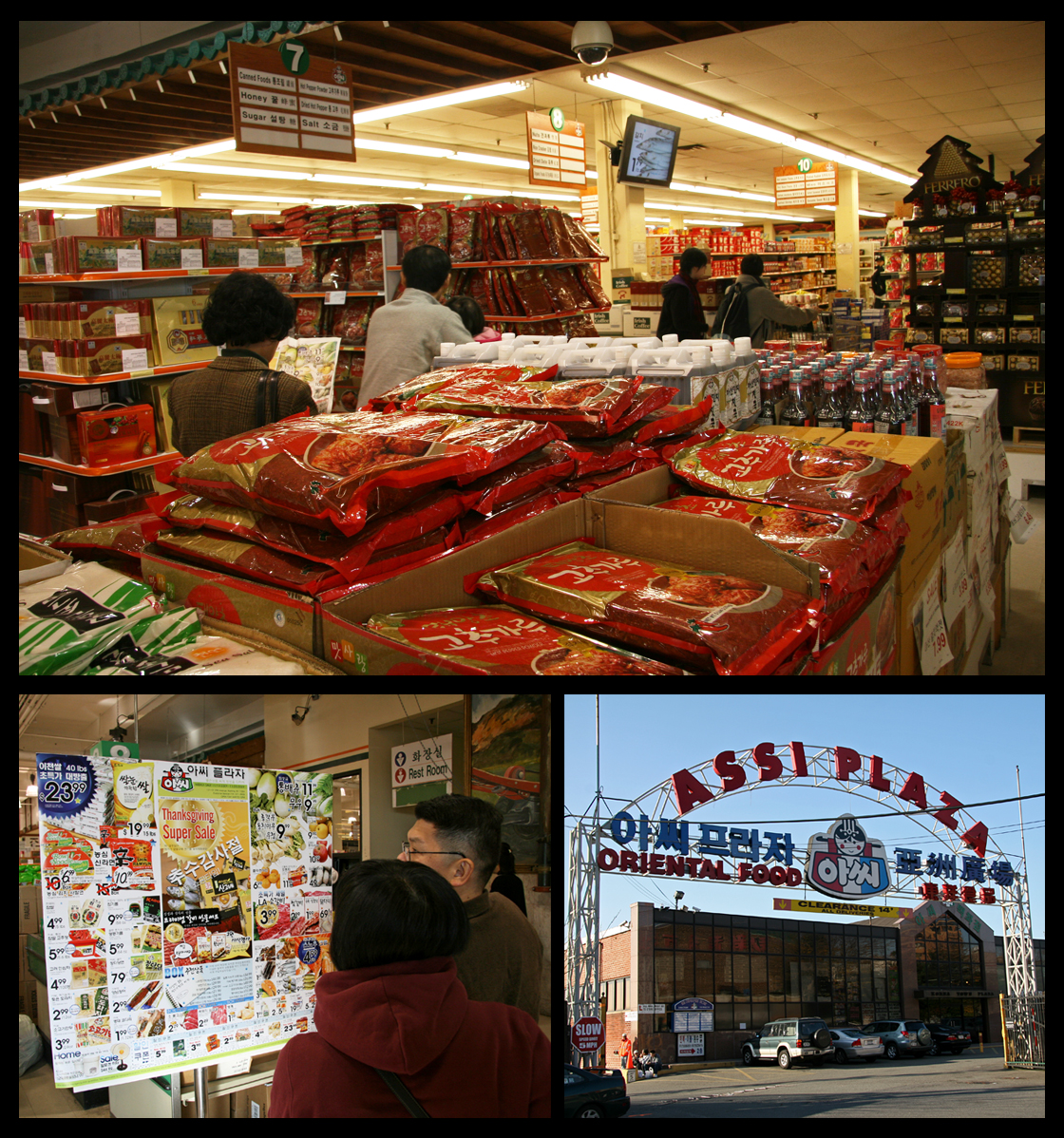
    I thought that this enormous Korean supermarket in Flushing, Queens, Assi Plaza, most certainly had to be something exclusive to New York City or perhaps a city in California. Flushing has a large Korean population, estimated at 10%. However, visiting the Lotte Assi Plaza website shows 13 stores nationwide, with the company having been established in Maryland in 1976. Of course, overall, this is not to say that neighborhoods like Flushing, or even Assi Plaza, are going to be an everyday experience for the average American, but this is everyday life for someone living in the city.

    When you narrow the focus, that’s where New York City shines brightest. But it is still quite a challenge to find food products and restaurants that are very special and unique to this city. Even looking at a very specific ethnic group such as the Korean Americans, I was surprised to find a list of over 200 Korean supermarkets in the United States, not all of them in large cities.

    But I will continue to narrow the focus as tightly as necessary and, in that light, illuminate the unique things I find that either loom large or hide in the cracks and crevices of Gotham City…


  • The Last Taboo

    In New York City, I have been privy to many conversations on a subject that is quite taboo: childlessness, i.e. the adult or couple who, for one reason or another, chooses not to become a parent. At best, one hopes for at least civil tolerance between parents and nonparents regarding the subject. But discussions can become quite hostile, quickly escalating to character assassinations.

    Many are driven to the city to pursue careers and take advantage of an environment where the American Dream looms large. Child rearing is often put on the back burner until later in life. Often, couples leave the city for the suburbs when a decision has been made to raise a family.

    Economics also make it difficult to have a family here. It is doable, but the cost of real estate is extraordinary.
    And there are those who just never wanted children. For these, the city provides a level of social possibilities and a density of human interaction which is hard to find elsewhere.

    There is such a stimulatory environment in New York City that any children that are here almost become lost in a sensory assault of people, places, things, and activities.
    And there are those who actually do hate kids. The childless who like children but have just chosen not to have them often must defend themselves against being child haters. In 2005, the New York Times published an article, Supersize Strollers Ignite Sidewalk Drama.” In it, the discussion of childlessness is described as the last taboo:

    Not having children “doesn’t mean I hate kids,” she said. “But I do hate the parents who somehow have decided that they are superior to everyone else because they have kids.”

    It might help, Ms. Felcher and others said, if parents and nonparents could talk about their feelings toward one another. “It’s the last taboo in this culture,” Ms. Felcher said. “You just can’t talk about it.”
    Ms. Anderson agreed, “We’re a bit afraid of expressing our opinions for fear of being labeled as people who hate children or who do not support women.”

    I neither champion the life of the childless nor dislike children. The negatives of being childless become greater as individuals age. Parents pass away and often, only siblings, if there are any, remain as the only close family. Even a minimal level of care taking or assistance becomes unavailable. Holidays can become times of sadness. Many are terrified at the prospect of aging alone – even with money, a social safety net needs to include people, something money doesn’t buy.

    It is easy to live a life in New York City with virtually no interaction with children at all. Childless individuals and couples are common and easy to befriend. Some may feel that this is an impoverished life. Others see it as merely a lifestyle choice and a realization that not everyone is cut out to be a parent. We should be capable of rational, calm dialogue about the subject without character assaults. It should not be the last taboo…

    Related Postings: Little Burnt Out, Heart Warming, Warm and Fuzzy, Mary Celeste


  • Winter Walks

    Here is something I like best about living in New York City: winter does not subsume us. There are a number of reasons for this. The city is a pedestrian place, and our mobility is not so strongly influenced by seasonal weather. Walking goes on, relatively unfettered by rain, cold, or the occasional snow. We stroll to restaurants and window shop in virtually the same manner all year. Subways run primarily underground, so, there again, we do not deal with Mother Nature. Also, the city which we see daily is primarily man-made, so in many areas and neighborhoods, the appearance of the city changes little or not at all.

    I grew up in New England, and the coming of winter really changes the collective mindset. The visuals change dramatically, with denuded trees and withering grass. Out come the rakes and snow shovels. Snow tires are checked, gutters cleaned, storm windows positioned, deck furniture put away, swimming pools drained and covered – an entire litany of annual rituals and chores indelibly imprinted in our minds, emblematic of the season. And these changes are not reversed in a warm spell – pools are neither filled with water for the day nor are picnics planned. Apartment dwellers do not have to deal with any seasonal preparations or chores. For most of us, we just put on a heavier coat.

    The worst part of New England winters was that feeling of being shut in. There are seasonal activities for those who partake – bike riding, hiking, skiing, apple picking, etc, but after childhood’s end, I found it really too cold to want to do much outdoors.

    I found comfort that I am not alone in these thoughts and feelings; I came across an article in the New York Times, Winter Walks on Country Roads, written in 1879 about New England winters. Here is the first paragraph:

    Even the faintest gleam of sunlight, and the shortest period of freedom, are inexpressibly welcome to a prisoner. Now we are all prisoners; we are shut in doors by an inclement season; we live six months in fear and trembling; we dread the Winter air as we ought to dread the wrath to come. To a certain extent this feeling is justified, for our Winter storms are both disagreeable and exhausting. But we are generally our own jailers in this confinement; for the dread of the bad days lingers over the good ones, and keeps us from the freedom and sunshine that we can safely enjoy during nine-tenths of the Winter days. The injury this confinement works on our national health is certainly worth consideration; and every amusement that tends to bring us out-doors in the Winter should be practiced with persistent enthusiasm. Walking is without question the exercise that is the best, the safest and the most practicable, for everybody. Anybody who can walk can dissipate the gloom of Winter, enliven his blood till it tingles, and secure buoyant health and vigor. In a word, the walker can enjoy all the benefits of out-door life on the snow just as well as on the turf or gravel.
    C.H.F. The New York Times, 1897.

    In New York City, if there is a spate of atypically warm weather in the winter, people respond instantly, and for a brief period of time, it’s like winter never existed. Out come the people in the dress and with the accoutrement of spring and summer. Street performers, vendors, sitting on park benches, sunbathing, picnicking, reading, Frisbee – virtually every warm weather activity can be found.

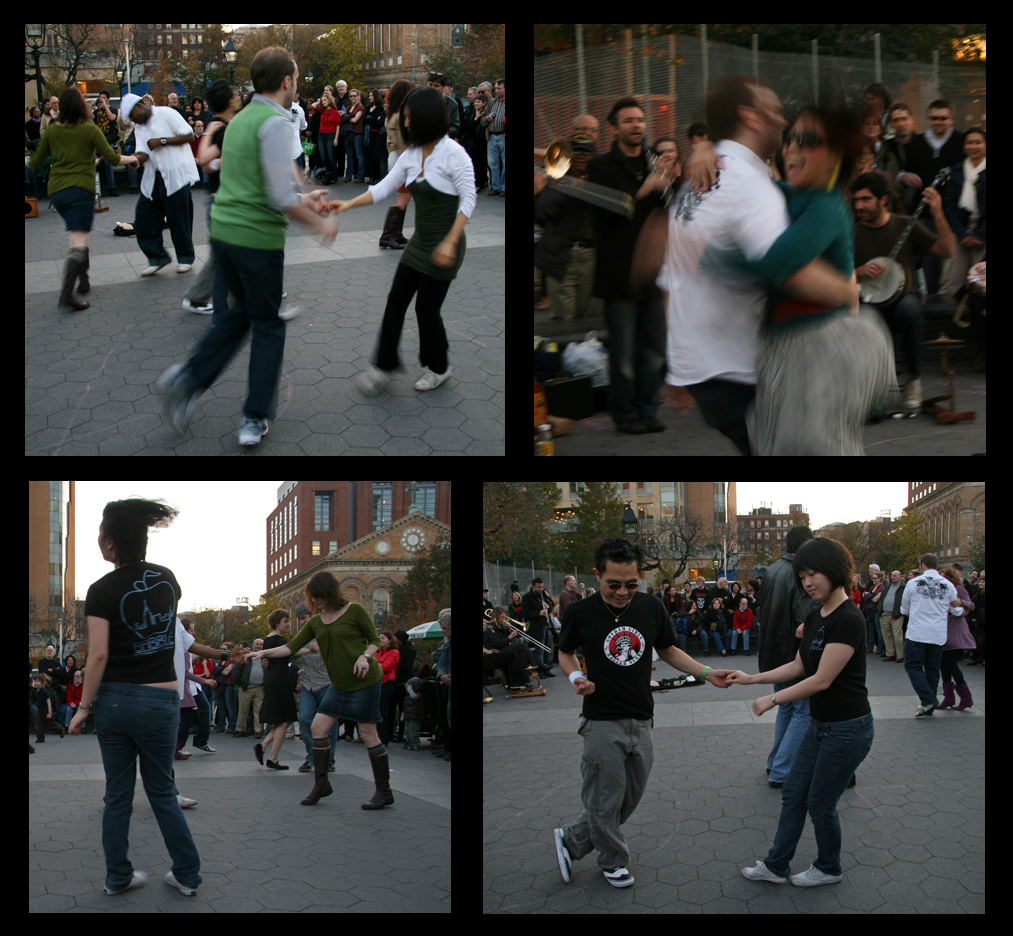
    On our recent run of warm weather last weekend, the Baby Soda Jazz Band appeared, performing their eclectic street jazz with influences ranging from New Orleans brass bands, jug music, southern gospel, and jazz. The music was infectious, and people took to literally dancing in the streets (or in the park).

    Of course, there are wonderful winter activities and holidays, and the prudent person does well to embrace the season rather than resist it. For now, though, I choose to resist as long as possible and join the dancers in the streets 🙂


  • Criminal Suspect

    Why was I being followed by a police vehicle while driving slowly down Main Street? I was not stalling traffic in any way.  In fact, I was the only automobile going down Main Street in Bristol, Connecticut, the town in which I grew up. I was showing a friend, who was an architect, the tragedy that was Main Street in this factory town. The left side of the street had original structures and was actually charming.

    But the right side had been completely ripped down to make way for a small shopping mall, destroying all future possibility of any historic revitalization of this downtown. I expressed my frustration to my companion of how emblematic this was of the type of thinking – to modernize rather than preserve – that one might have found at one time in towns across America. I think that today there are more examples of preservation of older architecture/districts and the value and positive results in doing so.

    The policeman actually followed us into the shopping mall parking lot and watched us leave the car. It was eerie and scary, honestly. I have a theory of why I was followed, part of which is that apparently anyone perusing the architecture in Bristol, Connecticut, is a criminal suspect, particularly someone in a vehicle with New York license plates.

    Being ostracized for thinking differently is one reason why I moved to New York City. Things have changed, of course, and with the plethora of media and the Internet, perhaps one is less of an outcast for being different in the small town today.

    In New York City, however, with time and effort, you can not only be tolerated but also create a persona and become a small living legend by being different. Whether it is Adam Purple, graffiti artist Adam Cost, streetlamp Mosaic Man Jim Power, Tower of Toys builder Eddie Boros, or gender bender and fashionista André, you can turn eccentricity into celebrity. You can take a singular passion or talent and run with it.

    It can be a very singular interest, perhaps decorating a bicycle over a period of 24 years, like that of Hector Robles in the photo. Hector grew up on the Lower East Side of New York City, on 7th Street between Avenues C and D. He currently lives in Staten Island and makes the journey to Manhattan with a combination of bus, ferry, and subway, toting his bicycle the entire way. The vehicle is in a constant state of flux, a work in progress. Hector, who is of Puerto Rican ancestry, is quite religious, as can be seen by the numerous figures and images adorning his bike.

    I don’t think Hector would fare well in Bristol with his bicycle. I am sure he would be tolerated, but I doubt he would be celebrated. And I hope he wouldn’t be treated like a criminal suspect 🙂


  • dinamic_sidebar 4 none

©2026 New York Daily Photo Entries (RSS) and Comments (RSS)  Raindrops Theme