• Category Archives Slings and Arrows of NYC
  • Greasy Spoon

    The same friend who introduced me to bankfacing money is the man who, one morning during my first college days, asked if I wanted to eat at the greasy spoon next door. To which I replied, of course, “What’s a greasy spoon?” I was informed that it was basically a diner and that the term greasy spoon suggested a place where utensils might not be as clean as one might hope for. But I had a sense that this was to be an authentic, edgy, New York experience and another small rite of passage to the city. So we went, and it was fun.

    Memories like these and the desire for simple pleasures can drive one to nostalgize, romanticize the past, and make the mistake of trying to recapture those feelings by recreating the experiences. The new experiences, however, do not often measure up to the past memories, and one wonders whether the past was as good as one remembers (see the great quote from Jill Eisenstadt in my posting Better When).

    Certainly some diners are better than others, and my breakfast with my aforementioned friend at Joe Jr’s on a recent visit of his to the city was fun. And what choice do you have but to eat breakfast at a diner when a Brooklynite comes back to town to visit and he’s the man that introduced you to greasy spoons? This outing, as well as recent postings on Joe Jr’s and the Anthora coffee cup, inspired my recent visits to local diners.

    My expectations of diners are realistic, and I am capable of adjusting my food standards. I have also learned lessons from the past and realize that one should narrow one’s choices to those things diners do best, or should I say those things diners do least poorly, like burgers (which I don’t eat), fries (which I love but try to avoid), and eggs (which I eat rarely). So, I opted for Eggs Benedict. A mistake. Sauces, like hollandaise, should also be avoided in a diner. The whole meal became rapidly unappetizing – eating it became a test of will. Everything was so salty, including the butter on the toast.

    What does all this have to do with New York City? Although we have some extraordinary dining establishments, many like comfort food and diners too. And much of the diner food here is just as bad as diner food elsewhere. I couldn’t even finish that toast…

    Want to know where I had this unappetizing meal? Read more here.

  • Surely You’re Joking

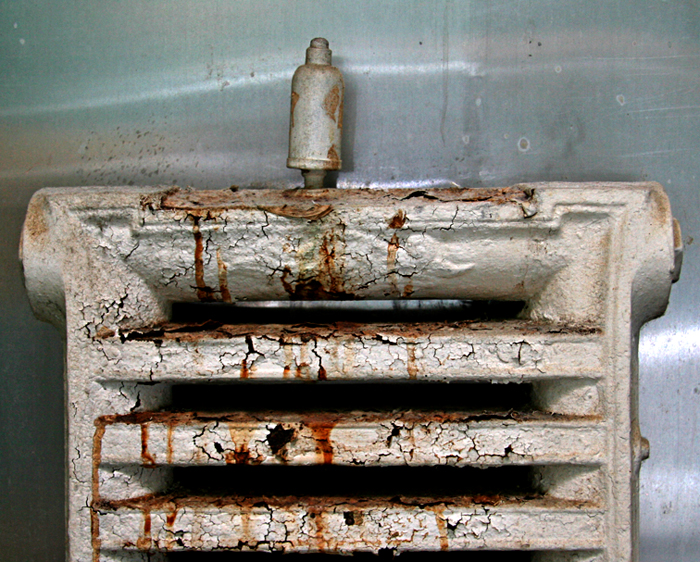
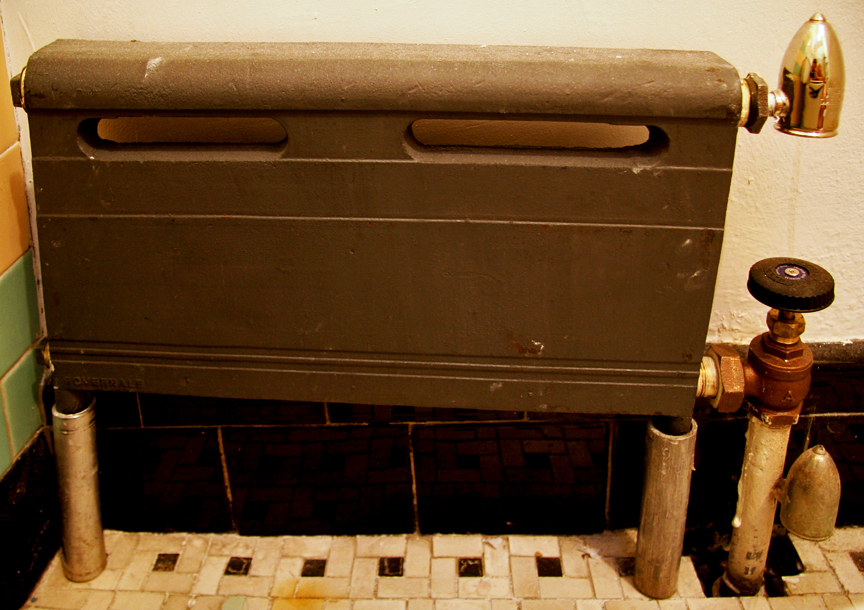
    Most would assume that the expenditure of money is the only thing that separates one from the dark ages and the 21st century. If you read my posting The Dark Ages, you can see the state of a radiator in a certain individual’s apartment (see the renovation here). That individual, thinking as any reasonable person might, expected that spending money and hiring a professional who came highly recommended would easily remedy the situation.

    The photo shows the finished job. The assignment was to remove the old radiator, replace it with a smaller, more compact model, and install it at floor level away from the wall. What I got was the radiator propped up at an angle on two hacksawed pieces of conduit, thus avoiding the work of removing riser pipe. I was assured that the uneven heights of conduit were necessary to create the pitch necessary for water flow in the steam system. The whole arrangement looked like a circus act. I was shocked and awed.

    Now the most common suggestion from others for a simple solution to this type of problem is always to have him come back and fix it or even hold back payment.
    But the real problem is that I made a grievous error in hiring. The contractor was not really capable of doing this plumbing job to an acceptable standard. So what avail is it to have him come back? The work would have to be policed and micromanaged, an extremely stressful process with dubious outcome. No, better to suffer the slings and arrows of outrageous work and hire another to make it right.

    Why do we suffer so? Because New York City has a captive audience for residents, and generally speaking, for these types of services in rental properties, the individual has virtually no consumer leverage. Take it or leave it. I understand that this type of problem is not unique to the city, but it is very exacerbated in New York.

    In hindsight, I think the best response to the completion of the work, had I not been so stunned, would have been, “Surely You’re Joking, Mr. Contractor.”*

    *Note: The book Surely You’re Joking, Mr. Feynman is a collection of anecdotes by the Nobel Prize-winning physicist Richard Feynman. In one story, Feynman makes a serious faux pas at a party, to which he is told, “Surely you’re joking, Mr. Feynman.”


  • American Express

    I have met grown men – secure, strong, worldly men – who are absolutely terrified of cities, particularly New York City. To city lovers like myself, these fears seem completely irrational. I understand the fear, perhaps, of an older person or single woman walking in a dangerous neighborhood at night – this is courting trouble. But a grown person in a vehicle in broad daylight with an entire family in tow? What can really happen? If you get lost, you will eventually get unlost. In my experience, the worst that will happen is that you will be very inconvenienced for some time.

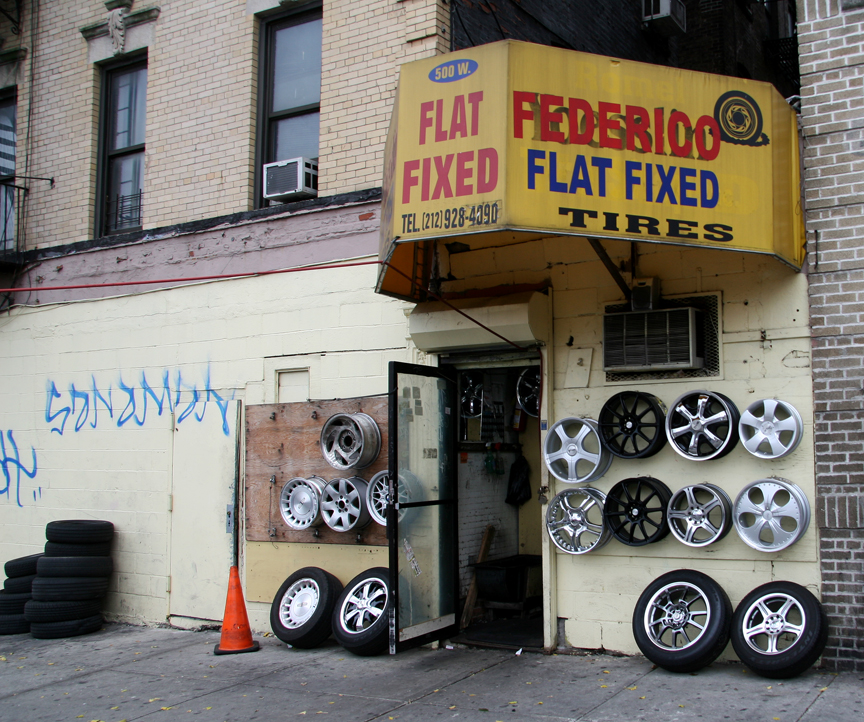
    The worst scenario to me is breaking down in an automobile in the city. Fixing a flat or getting a battery boost, simple acts elsewhere, can be a real headache here. Services are not readily available, and waiting for roadside service on a busy highway in a traffic congested city is certainly not pleasant. And if one would have to overnight in a hotel, that would be mighty expensive or very inconvenient.

    There is no plethora of basic services, such as tire repair. Places like that in the photo are generally found in poorer neighborhoods and in out-of-the-way locations. Unless you know a neighborhood well, these places are destinations – the likelihood of finding them when you need them is rather remote. And escalating rents have conspired to make these places all but non-existent. The scarcity has made this type of subject a popular photo.

    Certainly being lost in a city or having trouble here, like getting a flat tire, is more troublesome than the same problem in the suburbs, and there is perhaps some risk of exploitation by opportunists (although our suburban or country brethren are not immune to this). In most cases, however, a little cash or credit card will be all that is necessary to extricate oneself from virtually any situation. I remember a conversation with a client of mine when I was younger and very inexperienced in travel. She was much older, nearing retirement and planning to settle somewhere on the coast of Italy. At the time, this seemed like such a fantasy and unfathomable to me for a number of reasons, language being one of them. When I asked whether she was concerned about not being able to speak Italian, she replied that she was not at all worried, because “They all speak American Express” 🙂


  • Livid

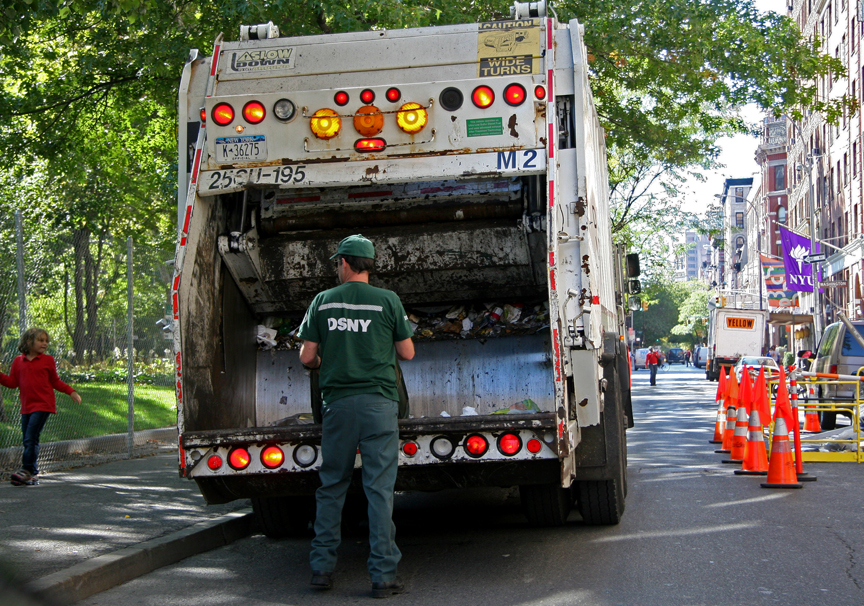
    Here is an infuriating New York City scenario. You are driving a car or in a taxi on an avenue and need to change direction by turning onto a crosstown street. Now in most situations, you have many choices as to which crosstown street, since most of Manhattan is a grid. There are 20 crosstown blocks to a mile, so for most trips, there are dozens of streets you could take. If you are really knowledgeable about traffic patterns, you can narrow your choices, but nearly always, you will still have many equally good options. Your final decision will have an element of whim.

    So you make a turn down a street and, by pure chance, you happen to select the block where a sanitation truck is picking up trash. The street is not wide enough to pass, and sanitation workers will never try to accommodate you in any way. And you know you will be there for quite some time, crawling behind that truck, watching as they go about their business, one can at a time, with no sense of urgency, because this is their job, a job that must be done. And what can you say or do? This is the New York City Department of Sanitation, and you want the city kept clean, right?

    Now if you are a Zen master or one who can take life in stride, perhaps laughing at times like this, then you are fortunate. But if you are in a bit of a hurry or prefer not to spend your life waiting for traffic lights or behind trucks, because you have already spent too much of your life here waiting, then you may find yourself stewing a bit. There are better things to do. As time passes behind that truck, time that passes slowly (it will be a long time to go down that whole street stopping at every building) you can easily imagine having chosen another street. Any other street. You can play out all the scenarios and reflect on the odds that of all the streets in New York, you chose this one. No backing up either, because in this city, it is rare that cars are not immediately behind you.

    You will have time to exhaust all the things you could have done or should have done, because sanitation workers are in no hurry. They are absolutely immune to any belligerent actions – they have experience on a daily basis with all manner of threats and attention-getting tactics. You can pretend you are relaxed, enjoying music, or reading. But if you are a type-A personality or high-strung, you can work yourself into a livid, absolutely furious state. Occasionally, in a city of extremes, livid will be the emotion du jour. 🙂

    Photo note: This photo was taken going south on Washington Square West in the morning, not the classic avenue/crosstown street scenario. There were few trash pickups to be made, little traffic, and some opportunities to pass around the truck. So this was only reminiscent of the real deal, not an authentic ulcer maker.


  • Partial Remission

    If you want to taste neglect over a period of decades, New York City has a good menu selection. I imagine that many beaten-down areas have resistance to change, and wholesale renovations do not necessarily see the type of lasting transformation that was initially planned. There just is enormous inertia when it comes to areas which have had a long history of decline. However, NYC has not really put quality of life or beautification at a priority. Managing this large city and just getting things (such as the subway system) to work is an achievement, and most residents learn to be satisfied with this.

    We have many areas that have deteriorated for decades. Times Square is a perfect example. Although substantial improvements were made, the immediate surrounding area still has a seedy feel to it. It’s just like a cancer with only a chance of partial remission – we irradiate the problem, but cancer just creeps back.

    Time will tell whether we will see the same effect at Coney Island; 2008 saw the final closing of Astroland and other amusements, with big plans for redevelopment.
    Coney Island was a world-class resort at one time, with millions of visitors annually. It was the world’s largest amusement area between 1880 and World War II. There were numerous competing amusements parks – the three largest were Luna Park, Dreamland, and Steeplechase Park. I recommend viewing photos and films of these parks in their heyday; they are shockingly beautiful and spectacular. Luna Park burned down in 1944.

    In my visits over the last several years, I have found Coney Island rather depressing, excepting for the annual Mermaid Parade. This last Saturday, however, I found it pleasant – absolute perfect weather, spectacular blue skies, and good company with three spirited friends, including a former NYC (Brooklyn) resident, all conspired in a great day. See the series of photos here.

    A stop at Nathan’s required a greasy snack – we shared French fries and fried clams. Chain link fences and vestiges of former rides and games made for good photo ops. The boardwalk was pleasant, particularly with the few isolated merchants. They were actually attractive set against wood, sky, and sea. Partial remission?


  • Property Owner

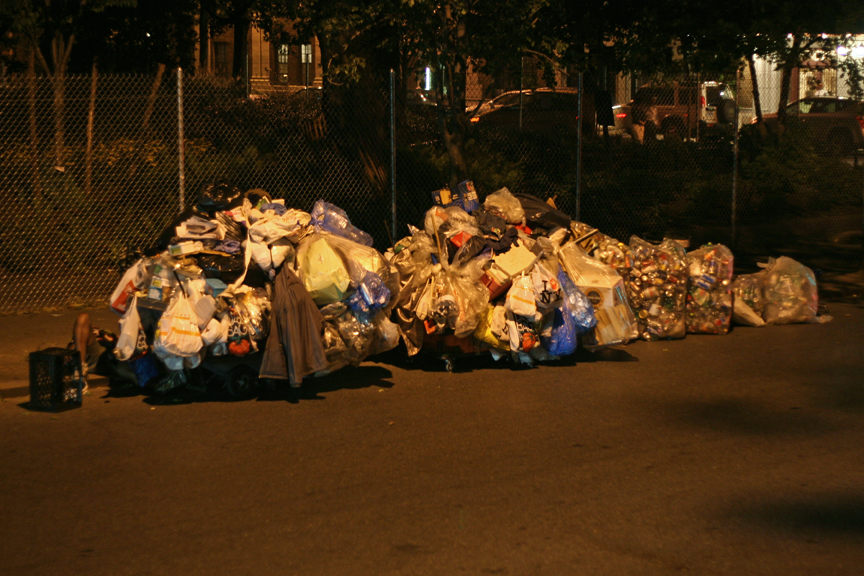
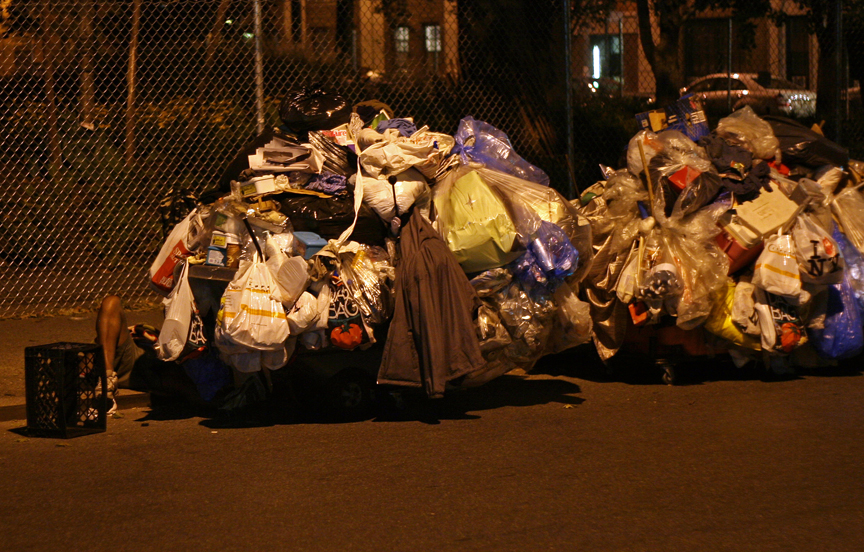
    On April 5th, 2007, I posted Caravan of Dreams, showing a man wheeling a mattress and couch down a busy Village street. But I should have saved that title for today’s posting, because this is what I was really searching for when I used the word caravan. I have seen these processions of trash before, but they are not an everyday occurrence, and my last attempt to photograph one with a small point-and-shoot camera was met with an angry, hostile outburst by the homeless owner, essentially accusing me of exploitation. So I refrained at that time.
    The indignant attitude of those on the fringes of NYC may come as a surprise to some, but this is typical New York Style – pride can been seen at every strata of local society. Although homelessness is not a crime per se, many of the activities of the homeless are, frequently necessitated by the lifestyle. The rights of the homeless and the legality of their activities is the subject of endless debate.

    Last night, I witnessed the caravan in the photo on Washington Square North (the owner can be seen sleeping on the left near the milk crate). See closeup photo here. Early this morning, he was on the move again.

    There is an apparent element of lunacy here – acquiring and moving mountains of what appears to be trash. Plus, tending to this cache is a full-time job. Belongings are affixed typically to shopping or hamper carts. These wagon trains of carts ala trash are then moved incrementally and sequentially – a tedious job. But then again, work can be therapeutic. And much of the booty are bottles to be recycled for cash. Perhaps this monumental nomadic enterprise is exactly what keeps their owners sane, giving their life meaning and making them feel like members of New York society with real property ownership (frequently overnighting in the best of neighborhoods). On the other hand, I’m still just a renter…


  • No Radio

    I have a very strict policy of only using photos taken of or in the 5 boroughs of New York City. And being away on vacation is no excuse to use photos of another locale. I prepare for this in advance.
    However, the mini-event that occurred on Saturday was so outrageous to me, from a New Yorker’s perspective, that I have to break my rules and tell this tale.

    While away this weekend, my two nephews and a friend decided to go for a short canoe ride in a river at my parents’ gated condo community. They asked if I suggested wearing shorts rather than pants in the event that they get wet. My response was that if they were to fall into a river, shorts versus pants would not be a consideration. But I DID highly recommend emptying their pockets of valuables, particularly knowing that they were affluent boys and that the value of the contents of their pockets was probably greater than that of many 3rd world countries. They saw the sense of this and immediately concurred.
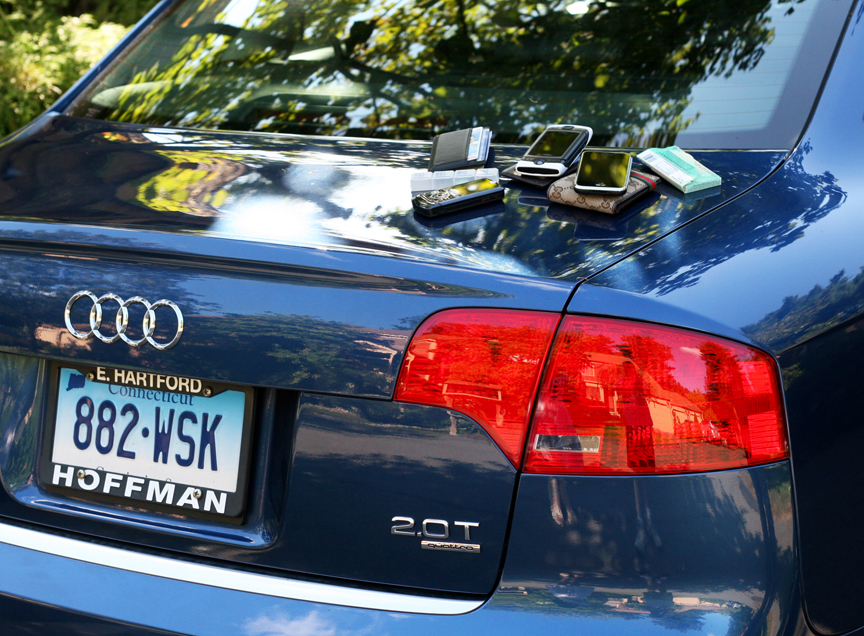
    So out came the iPhones, cellphones, a wallet with credit cards visible, and a Gucci wallet. They placed all of these items on the BACK OF THE CAR IN PLAIN VIEW (appropriately on the hood of one boy’s Audi). I was incredulous. “You guys are going to leave all this outside in plain view?” I asked. They responded, “Whose going to take it? There’s only a bunch of old people here.” That was not strictly true, and I am still absolutely floored by this occurrence.

    Now admittedly, this cavalier attitude was largely due to a lifetime of privilege and never knowing need. And it was a gated community. But there was also an element of TRUST that is just nonexistent in New York City. You cannot leave anything of value unattended. I have heard stories of thefts that are unfathomable; a UPS driver once told me of a man who ran down the street with a large projection television stolen from his truck! The driver was unable to catch him in the ensuing chase.

    In New York City, a vehicle should always be locked, and nothing of value should be in plain view. This process is so automatic to me that it has become a reflex action – I even lock my car in the driveway of my parents’ home in the suburbs.

    Every seasoned New Yorker remembers a time when auto break-ins for radios were common. At one time, I recall seeing broken glass somewhere on the streets on nearly a daily basis – a telltale sign of a recent break-in. Soon the ubiquitous “NO RADIO” signs in the windows of cars started to become a common sight – a plea to the would-be thief that a particular car was not a worthwhile target.

    We live in a time where disposable income seems to be greater with youth, a generation that would never grasp the idea of placing a sign in the window of their car that says “NO RADIO”…


  • Opportunity

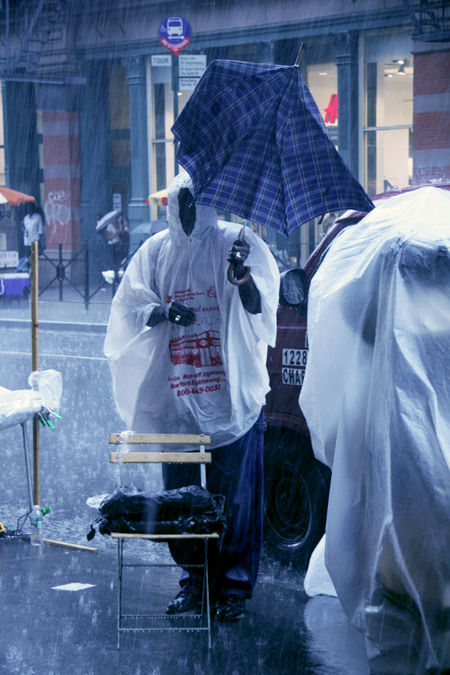
    Lightning and opportunity both strike quickly in New York, a land of opportunity. And there is no opportunity like a sudden unexpected downpour. Umbrella salespeople appear instantly from nowhere and set up quickly, because a rainstorm is an unknown opportunity.

    They appear with umbrellas that most consider disposable and justifiable for the day’s journey. A captive audience has few options. For those who did not prepare, you pay a few dollars or get soaked. The more unexpected the rain, the better the business. In the streets of New York, sympathy is not part of the vendor’s trade.

    Now I understand that in business you need to keep your costs down, but isn’t it bad marketing for an umbrella salesman to peddle umbrellas while using such a badly damaged one? After all, this is the primary complaint and impression of umbrellas sold on the street – that they are virtually useless and break immediately. After a rainstorm, many mangled ones can be seen discarded on the streets.

    A fellow onlooker and I thought the scene was hysterical. But the unfortunate and unprepared bought umbrellas anyway, because in a land of opportunity, at opportune moments, the opportunists win…


  • Store Policies

    Posted on by Brian Dubé

    There was a time in NYC where if you needed to use a public bathroom, you were in deep trouble. The city was harsh – there was no sympathy for body functions.

    Reading magazines or newspapers was also forbidden. Newstands had signs posted that reading was not allowed. Signs like “No Reading. This is not a library” were common. If you wanted to check the time of a movie in a newspaper or magazine, you had to either buy it or suffer some unknown consequences.

    Admittedly, the tremendous volume of tourist traffic, commuters, and the local population, including many homeless, make it difficult to maintain a friendly policy.
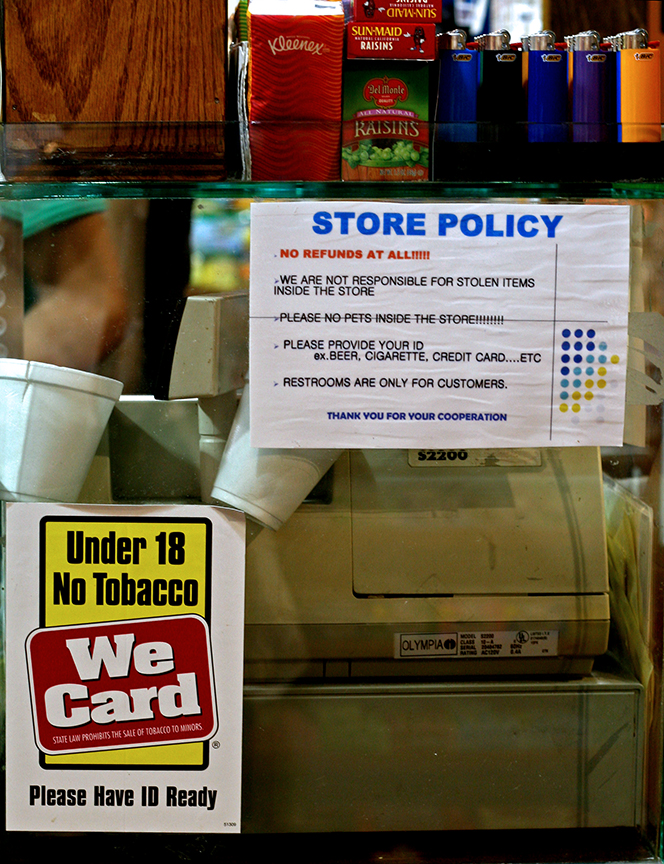
    Times have improved, but the bathroom situation is still a problem. Some business establishments actually claim that there is no bathroom, which is ludicrous if there are any humans working there. Others are more honest, like the green grocer whose sign in the photo clearly states that “restrooms are only for customers.”

    Why have things changed? I believe it’s because of the invasion of national chain stores. The more liberal policies of suburban retailers have migrated to the city, along with the stores themselves. Barnes and Noble superstores and Starbucks are two who have had an impact. When Barnes and Noble started carrying magazines, created in-store cafes, and provided extremely liberal reading policies, magazine stands really had no choice but to follow in order to compete.

    Although many bemoan the influx of large national chains into the city and worry that they will destroy the character of New York, I do reluctantly admit that the bits of comfort that these stores offer in a city that can at times be cold and inhospitable are welcome. In the love/hate world that is New York, I embrace these store policies

    Postings of Interest: No Salga Afuera, Cuts One Way

    Posted on by Brian Dubé

  • Insult to Injury

    Posted on by Brian Dubé

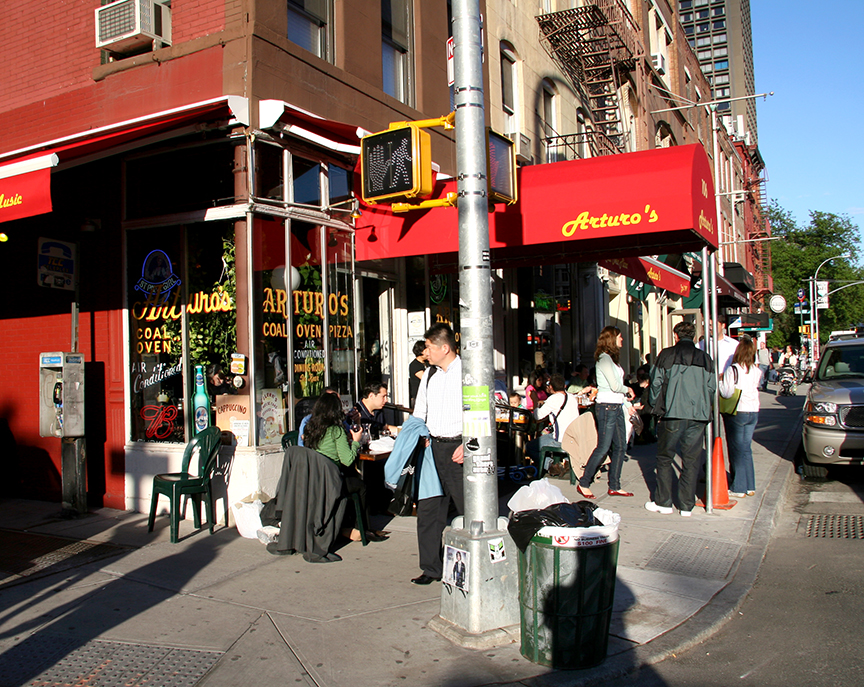
    Let’s try to create the most inhospitable outdoor dining situation imaginable and see if anyone comes. First, let’s pick the largest city in the United States – New York – to make sure we have potential for congestion.

    Second, pick one of the busiest thoroughfares in Manhattan – Houston Street – so it’s like eating on a super highway. Third, we make sure we choose a really crowded area to insure opportunity for the maximum numbers of passersby. Fourth, while we’re at it, provide no separation between diners and those passersby, guaranteeing a complete lack of privacy.

    Fifth, let’s use inexpensive, plastic chairs (the kind you get for a few dollars at a discount shop) so the experience feels really cheap. Sixth, let’s make sure we have a garbage can nearby filled with trash. Add in a fluorescent orange traffic cone for color. Seventh, let’s put some of the tables around the corner next to the kitchen exhaust system for those who really want more ambiance.

    So there you have it. Dining al fresco at Arturo’s, New York City-style. And do we get any customers? You bet, and there are no tables available.

    Oh – I almost forgot – let’s serve wine so we can add insult to injury 🙂

    Related Posts: Piercing Al Fresco, Luna Park Cafe, Esperanto, a la Chien, Paris in New York

    Posted on by Brian Dubé

  • Unkindest Etch of All

    This morning, I have been reading websites like bombingscience and wetcanvas. My head is swimming with grafiiti terminology and threads on the various ways and means of working with Armor Etch, Etchall, bath, etc. Creams are too thick and dips too thin. Mixing with shoe polish or paint. How to apply it. Getting the stuff in markers. And the sites are laden heavily with expletives directed at anyone not in the know and asking “stupid” questions.

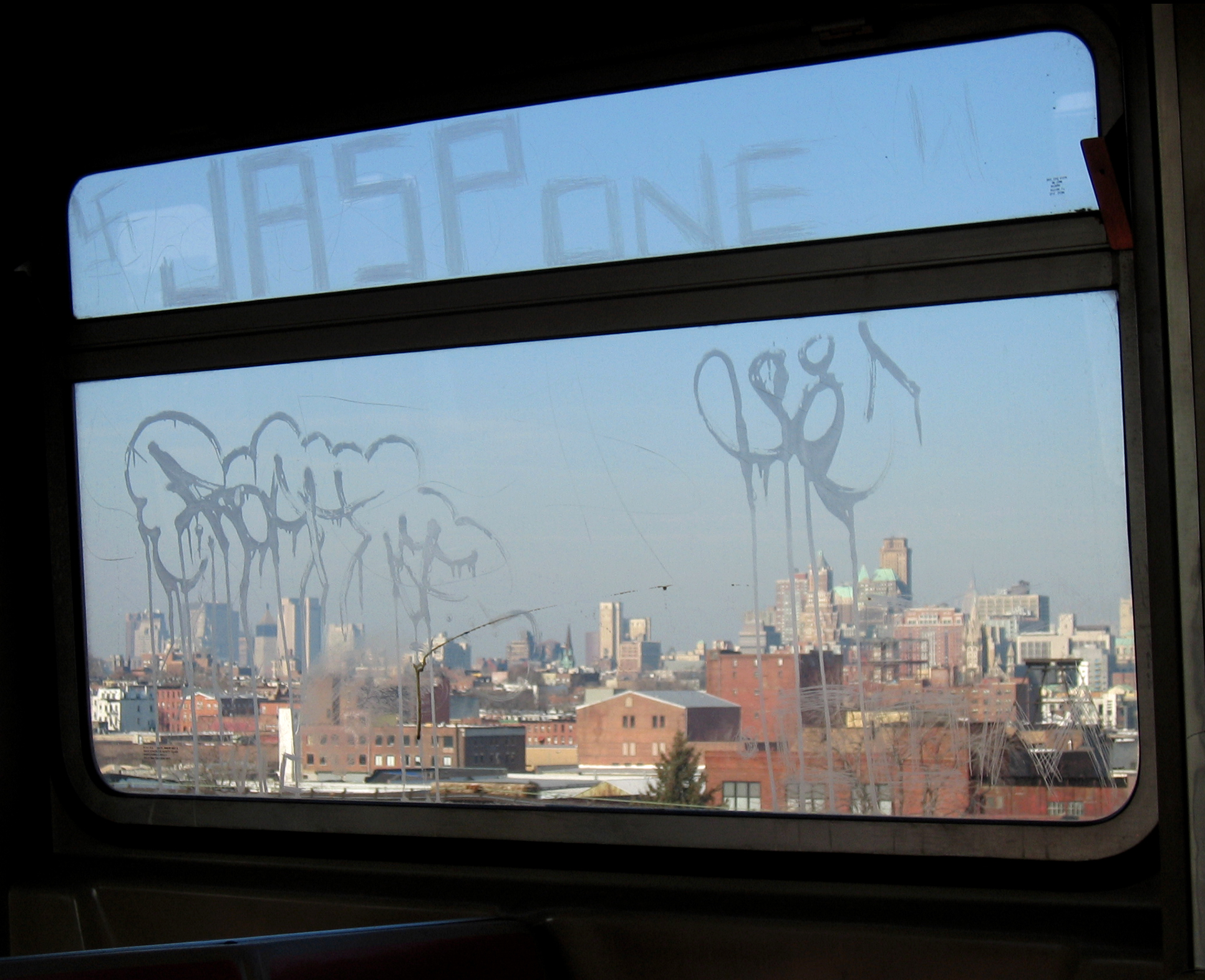
    Technology and ingenuity cut two ways, and in the case of graffiti, purveyors have upped the ante with acid. If you have seen work like that on the subway car window in the photo, this is not the result of scratchiti (scribing), giraffiti, or conventional graffiti, but rather the handiwork of individuals who use acid etching solutions to permanently write on glass. The problem has become epidemic in subways, on retail store windows, and anywhere there is a public pane of glass. There are now laws regarding the purchase of acid-etching materials as well as buying spray paint. Of course, there is controversy regarding legislation and the sale of art materials.

    I wrote about the graffiti phenomenon in March 2007 in an article on the retail shop Scrapyard. I think most people find the whole acid etch graffiti thing quite disturbing once they realize that the damage is permanent and that the entire glass window must be replaced at great cost. Many retailers afflicted with the condition tend to just leave it in place, saving money and not running the risk at having vandals do a repeat performance. For new subway cars, the transit system has availed itself of a 3M product: Scotchgard Anti-Graffiti Window Film,  a Mylar protective film not affected by etching acids.

    Oh, I didn’t tell the whole truth. Conventional wisdom and most articles you will find about acid etch will state that the damage is permanent. Not quite true. It can be removed in a laborious process of grinding and polishing. I once spoke with a worker removing etchings from a retail store on Broadway. There is a company, Unscratch the Surface in California, that does this – you can watch a video of the process on their site. A new industry is born to deal with the unkindest etch of all…

    Photo Note: This photo was taken on the F Train in Brooklyn. For a second shot with the city skyline, click here.


  • Ziggy Plays

    I once read in a travel guide that Key West was home to the indolent and the indigent. I really liked the sound of those two words together – they have both two-letter alliteration and rhyme. Not to be upstaged by Key West, I think NYC can lay claim to top dog when it comes to the numbers of people where less-than-complimentary adjectives (that rhyme and have two-letter alliteration) apply: insolent, insouciant, incoherent, incompetent, indignant, insentient, insistent, indulgent, and, of course, indolent and indigent.

    But, however talented, driven, and ambitious one might be, I think one begins to realize, especially in a big city where the evidence is ubiquitous, that good fortune is an element in one’s life. Anyone can fall between the cracks. I remember a TV program where a son was admonished by his father that one should never speak ill of “man who was down on his luck.” It was said with such gravity that it has stayed with me to this day, making me realize that indigence and indolence do not always go hand in hand.

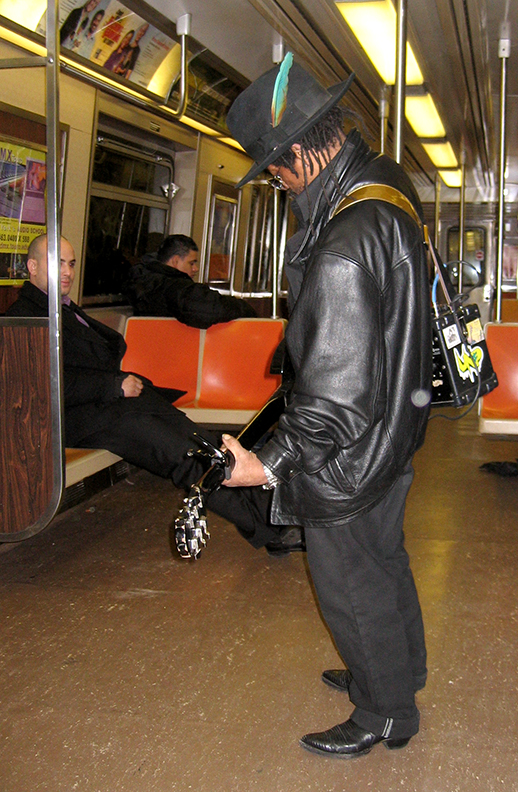
    These were the thoughts that came to mind when I entered the F train from Brooklyn last night and was accompanied by a musician who I had seen and heard before. He wanders from subway car to subway car (exiting and reentering the adjacent car at each stop) and plays a variety of songs with both his electric guitar and miniamp slung around his neck. I really like the feeling he brings to his music and the coarseness of his voice. I gave him a dollar. It suddenly occurred to me that this was a bloggable event, so with only seconds to act, I pulled out my point and shoot camera – all I had with me. As he was exiting the car, it also occurred to me to ask his name. “Ziggy” he replied. “Z, double i, double g, double y, dot com,” he added. I tried to confirm the dot com address with a fellow rider, but he was not sure. So, expecting an Internet fishing trip, as soon as I got home, I typed ziiggyy.com into a browser bar, and Voila! – Ziggy’s myspace site popped up. A feeling of comfort came over me now that he had not just a face but also a name and a place to listen to his music.

    I also started thinking that I should expand my vocabulary a bit. New words came to mind, such as misjudged, tenacious, and hopeful…


  • Disruption

    One of the biggest frustrations of daily commuters or frequent users of the New York Subway System is what feels like the constant disruption in services. Skipping stops, delays, rerouting, stalled trains, and variations. Unlike other cities, New Yorkers really depend on the transit system. For most, there is no other transportation option – few New Yorkers own a car, and travel by car during the business day (with parking costs) is really not feasible.

    I had the opportunity to ask the question “Why?” to two acquaintances – one working for the MTA, the other a retired engineer who had been in management. What I was told makes sense, albeit not satisfying to those who bear the brunt of disruption. Here’s what they said: The primary problem is that the NYC transit system, unlike others, runs 24/7. Hence, repairs and maintenance must be made while the system is operating, not to mention in narrow, tight, confined spaces. There is no parallel system which can be used during repairs.

    Add to this that 1) The system is extremely old and everything about it is antiquated, 2) It is one of the largest systems in the world with hundreds of miles of track, 3) It is one of the most heavily used systems in the world with over 5 million passengers on a work day, 4) Most subway lines are operating at or near maximum capacity, 5) During various periods (1970s-80s), when the city was less prosperous, the system was seriously neglected so now we have to play catchup, and 6) It is a public entity with all the bureaucratic inefficiency and inertia. There is a tendency to do things the same old way.

    With such a massive around-the-clock system, every effort at overhaul or service becomes a big ordeal. My bet (not my wish) is that disruption is here to stay…

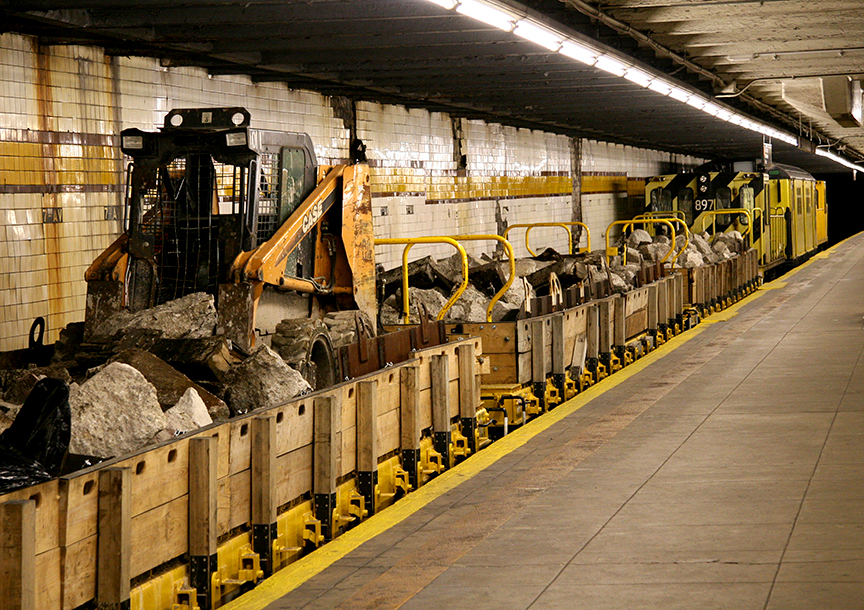
    Photo note: I took this photo at the 7th Avenue stop on the F line in Brooklyn. I thought it would show evidence that work really is being done. I imagine, however, that it could be a decoy, driven and parked throughout the system to make it appear that work is being done 🙂


  • Foolish Crash

    There are different types of crashes: the type which I photographed and posted on this site on May 4, 2007 (Yellow Fever), and the type you see in the photo – a computer hard drive crash.

    And why was there a crash? Because there are different types of fools: the type seen in the Middle Ages who were extremely clever and entertaining, often employed in the royal court and featured in many Shakespearean plays, and the type who, though computer savvy, when tired and things aren’t working properly, start reconfiguring cables of their computer system with reckless abandon.

    And, of course, there are different consequences to such behavior, some rather benign and others quite dire, like a hard drive crash (made worse by not having made proper backups of ALL their work, losing some things forever).

    Lastly, there are different types of people, and they react variously to such occurrences. There are some who take things in stride and others whom it would be advised not to be around when such things happen. And this is why today, you don’t get a wonderful, insightful photo and story on some fascinating, perhaps obscure, part of our wonderful city, but rather a photo of the inside of my G4 Mac when I was replacing its main drive…

    Photo note: For those of you who find today’s photo uninteresting, trust that you would much prefer this photo to one of your author and the state he was in when this occurred and it became clear that the damage was irreparable 🙂


  • The Dark Ages

    This is the time of year when conversation in NYC frequently turns to heating. Ironically, in 2007, in the largest city in the United States where wealth abounds, people paying thousands of dollars per month in rent are still frequently concerned with getting adequate heat. During the heating season (October 1 through May 31), the City Housing Maintenance Code and State Multiple Dwelling Law requires the following:

    *Between 6 a.m. and 10 p.m., heat must register at least 68 degrees Fahrenheit when the outside temperature falls below 55 degrees;
    *Between 10 p.m. and 6 a.m., heat must register at least 55 degrees Fahrenheit when the outside temperature falls below 40 degrees.

    Do you see the problem here? Firstly, most people not from the arctic tundra find these minimum requirements much too low – 55 degrees inside after 10 PM? Fortunately, most tenants get much more than this. Secondly, these indoor temperatures are actually not measured. Boilers typically have basic settings – on and off (based on outdoor temperature); high, medium, low, etc. Unlike a private home where a thermostat regulates indoor temperature, no such mechanism exists in a multi-unit apartment building. So, there is either too much heat or too little. Many run too hot. Add to this that it is generally not a good idea to turn steam systems on and off (in the apartment) and that the shutoff valves frequently malfunction anyway, and it is not uncommon for New Yorkers to open windows in mid-winter. Thirdly, landlords are always looking to cut costs, but in NYC, rent control and rent stabilization laws exacerbate the situation. With rental income regulated (nearly 1 million apartments in NYC are still rent regulated), landlords are much more inclined to hold back services, repairs, and upgrades.

    So, with rats gone wild, dogs (and horses) relieving themselves in the streets, all the city’s trash put out on the streets on pickup days, the homeless living on the streets year round, drafts through old windows, and not enough heat, New York can, at times, feel like the Dark Ages…

    Related Postings: Wildlife Control, Stephanie, Dead to the World, Garbage a la Mode


  • dinamic_sidebar 4 none

©2026 New York Daily Photo Entries (RSS) and Comments (RSS)  Raindrops Theme