• Category Archives NYC’s History
  • Heard It Through the Grapevine


    Many New Yorkers, like many Americans, have a love of things French, and in New York City, as elsewhere, we have imported as much of the culture as we can – the food, wine, language, art, film, fashion, style, and architecture. Our biggest import of all sits in New York’s harbor – the Statue of Liberty.

    In many contexts, the very word “French” is virtually synonymous with class or sophistication. Of course, the French are also a people that many Americans love to hate, a people who can be trying or difficult. When it comes to food, most are happy to put differences aside. French restaurants and pastry shops abound in New York. Casual French styled bistros or cafés, such as French Roast, however, are not as easy to find.

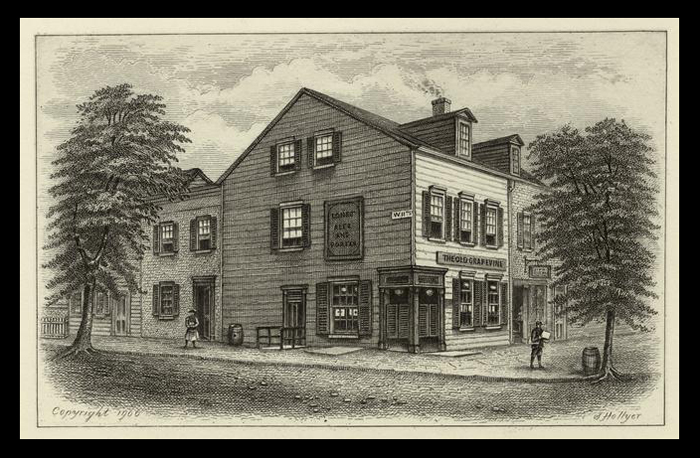
    French Roast has two locations, one located on the Upper West Side, the other, seen in the photo, is in the Village at 78 W. 11th Street. They are open 24/7. One of the most interesting things about French Roast is that it is located on the site of The Old Grapevine Tavern (bottom photo). From the New York Public Library website:

    The three story clapboard roadhouse was built in the 18th century and was located on the southeast corner of 11th Street and 6th Avenue. Originally a private home, it eventually became a saloon known as The Hawthorne. The 11th Street side of the building was covered in a gnarled old grapevine and by the early 1800s the establishment was simply known as the Old Grapevine. It quickly became a favorite destination for those wanting to get out of the hustle and bustle of the city (lower Manhattan) and head north towards into the open country (11th Street).

    During the Civil War it was a popular hangout of Union officers and Confederate spies. Later, when the Jefferson Market Courthouse was built the local lawyers and politicians would gather there to talk business. Artists and actors also met there. It was the ideal place to get news and information, or in the case of spies and politicians, the ideal place to spread rumors and gossip, leading to the popular phrase “heard it through the grapevine”.

    The vine died in 1883 and was cut down. The Old Grapevine Tavern was demolished in July, 1915 to make way for a six story apartment building.

    It was missed after its demise. The New York Times ran an article: “Passing Of the Old Grapevine. Quaint Landmark Known to Artists, Actors and Good Fellows Generally is Torn Down.

    Reviews of French Roast run the gamut. Whether it is food, decor, or service, like France and the French, some love the very things that others hate. I find it a pleasant alternative to the standard diner for breakfast or brunch. From the New York Times:

    These two restaurants are both open 24 hours a day, which means you can get bad food and surly service around the clock. Basically, they are diners masquerading as French cafes.

    Some question the etymology of the grapevine phrase. Some don’t like the French. Others don’t like French Roast. I heard it through the grapevine 🙂

  • Hanging Around


    When I was in grade school, I became intrigued with the hangman’s noose. It was easy to get the attention of fellow classmates presenting such a macabre artifact. It is extremely simple to tie, but its very nature would keep most from even trying. Who would learn to make such a thing and why?

    The entire subject of hanging is fascinating to some and its lure perplexing to others. The facts of hanging, its history, tools, technology, and the anatomical and biological aspects of the condemned are all mired in speculation, exaggeration, mystery, misinformation, and urban myths. The acquaintance I wrote about in my story Power once claimed he had the hangman’s formula – a supposed equation for calculation of rope length based on a person’s body weight. In fact, such a thing does exist as the British Table of drops. The original table of the “Long Drop” or measured drop was worked out by William Marwood in 1872. A revised table was issued in 1913. In is still in use by a few countries to this day. You can read more and see the tables here.

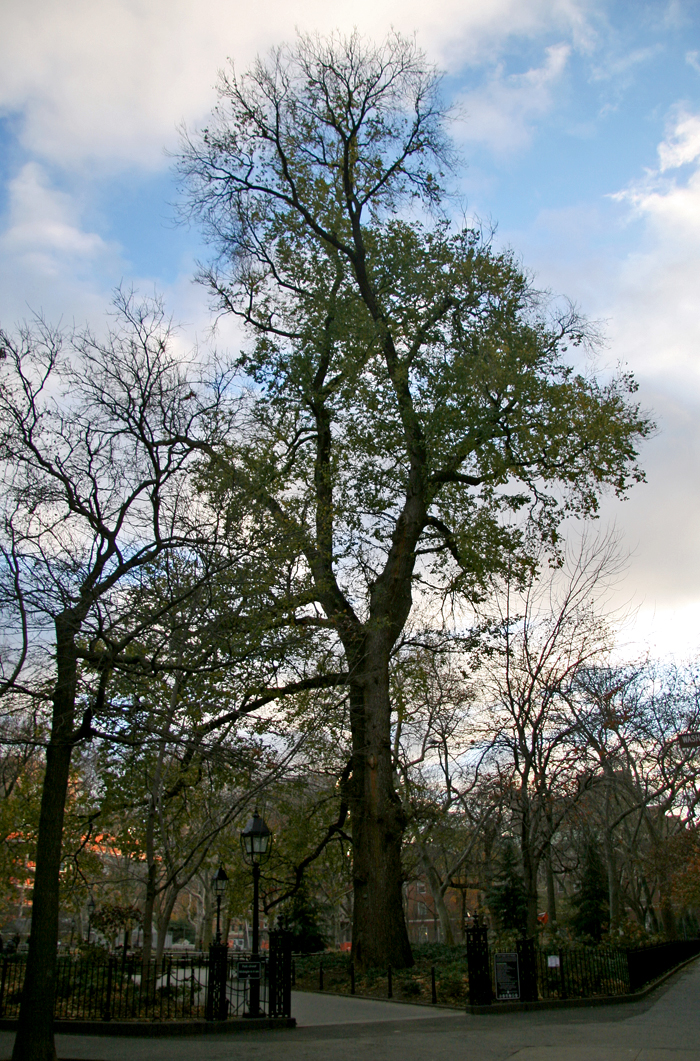
    The best case in point regarding the interest in hanging in New York City is the Hangman’s Elm located in the northwest corner of Washington Square Park which stands 110 feet tall. In 1989, the New York City Department of Parks and Recreation determined that this massive English Elm dates back to 1679, making it over 330 years old and the oldest known tree in Manhattan.

    It is still unclear how many, if any, individuals were hung from this elm in public executions, which did occur in a nearby gallows – the only recorded execution was of Rose Butler, in 1820, for arson. An article in the New York Times sees some hangings there as likely, but other sources cite it all as urban mythology. But the fascination with hanging still exists, and the belief that this elm was used for hanging persists. It all makes for a great sound bite or tour factoid, giving the neighborhood just that much more historical color.

    I have the privilege of seeing this tree from my home daily and much like the cat who brings home the dead mouse as a macabre gift for its owner, I offer my fellow readers this story and photo of the Hangman’s Elm. Whether it’s a tree, a noose, or the Long Drop table, the fascination with this style of execution just keeps hanging around…


  • A Slice of Cheesecake, Part 2

    The Brittany – Temple of the Gods of Debauchery (see Part 1 here)


    It was clear after moving into Brittany Residence Hall and a brief visit to NYU’s primary other residence at the time, Weinstein, that fortune has bestowed us with a better choice.
    The Brittany, as it was known at the time, is located at 55 East 10th Street and Broadway. It is a former hotel, built in 1929. The structure has larger, airier rooms and a prewar ambiance.
    The Brittany penthouse was a speak-easy at one time with many well-known guests such as Walter Winchell, Al Pacino, and Grateful Dead’s Jerry Garcia. The ground floor currently functions as a gallery, Broadway Windows, with displays of student art.

    At the time of my stay there, the Brittany was a truly a temple to the gods of debauchery. It was a coed dormitory, and in many cases, the rooms themselves became coed with couples living together in suites. Drugs were rampant as were drug dealers, even selling to those outside the student body. One evening, while sitting in a hallway, I had a jacket bloodied by someone who, half asleep on the way to the bathroom, had smashed his hand through a glass door and was running and screaming. I was told by a close friend of a first hand account of a group of students in the nude, high on Quaaludes, playing Frisbee in a hallway.

    One of my earliest memories there was visiting a room completely outfitted in UV blacklight for the entertainment of visitors. One fellow student represented himself as a cat burglar and demonstrated his skills by walking on window ledges of this high rise building. Brittany Residence Hall is also where I resided at the time of one of my favorite stories, involving Jimi Hendrix (see Crime Scene here).

    Somewhat controversial, The Princeton Review not only provides its well known university ratings in a Best College guide, but also provides a “Top 20 Party School List.” NYU has typically made the list. Today however, the university is better known for its coveted #1 Dream School status, rising prominence and the strength of many departments – Courant Institute of Mathematics, NYU Law School, the Film School, and Stern School of Business. According to Forbes Magazine, in 2008, NYU was ranked 7th among universities that have produced the largest number of living billionaires.

    I recently visited the dorm for the first time since 1970, escorted by an NYU student currently residing there. There were changes of course, most notably increased security – turnstiles requiring student ID card swipes. Things appeared to be much more subdued. However, I did learn that Brittany Hall is considered haunted, with reports of unexplained music, lights, footsteps, and claims from people who believe that others are watching them. Perhaps the final stirrings of the gods of debauchery…


  • A Slice of Cheesecake

    Part 1 – The Arrival  (see Part 2 here)


    I knew nothing of the world and almost nothing about New York City. I had only visited twice on day trips. I had never spent one night away from home alone. There were no ATM machines, and I had no bank account. Only some cash.
    I had one suitcase and arrived at Port Authority bus terminal, never a beautiful or inviting place for the newcomer. I was excited and scared. This is where I had dreamed of living for some time, but now I was really here, and it was big.

    I was neither homeless nor on the road. It was 1969, I was 18 and had been accepted to New York University. I had chosen a dorm and was very disappointed that my first choice, Weinstein Hall (the most modern), had been rejected. I was to stay at the older Brittany Residence, a former hotel, under renovation and not quite completed. As an interim measure, for a few weeks, we were housed at the Penn Garden Hotel* on 7th Avenue at 31st Street. I was later to learn that the Brittany, with its prewar ambiance and much larger rooms, was actually highly preferable.

    I entered my hotel room and met my roommates. I had never shared a room before either, having grown up with two sisters, so this was another adjustment to be made. We chatted a bit.

    It was evening and I was hungry. I had never eaten out alone, had little money to spend on dinner, and I did not want to stray far from the hotel. I recall going to a place resembling a diner and eating at the counter.
    Things were expensive here. I could not afford a real dinner, so I ordered cheesecake and a soda. Although a poor meal, on reflection, a slice of New York style cheesecake was quite befitting. My first day trips to the city involved more notable restaurants such as the Albert French Restaurant at 65 University Place, dating to 1868 and once a haven for writers including Thomas Wolfe, Nathan’s at Times Square, or Luchow’s on 14th Street. This place, however, was of no import and, as is often the case for a New Yorker, decided on the basis of proximity.

    The identity of the restaurant where I first ate on that evening in 1969 shall remain unknown to me, and assuredly it was not the “best cheesecake in New York City.” But it was only my first night, and there would be plenty of time to ferret out the good, the better, and the bests in Gotham City. Street cred would come in time, and for the newbie in New York, I could have done worse than a slice of cheesecake…

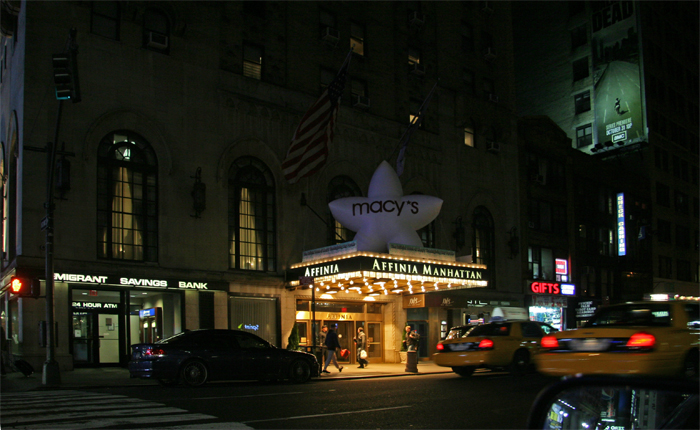
    *The Penn Garden Hotel has gone through numerous incarnations in the last 40 years. The thirty-two story structure was designed by the architects Murgatroyd & Ogden and built in 1929. It was originally called the Hotel Governor Clinton, named for George Clinton (1739-1812), the first governor of New York State. In 1967, the name was changed to the Penn Garden Hotel. In 1971, it became Southgate Tower, and in 2004 the Affinia.


  • Everything Yes


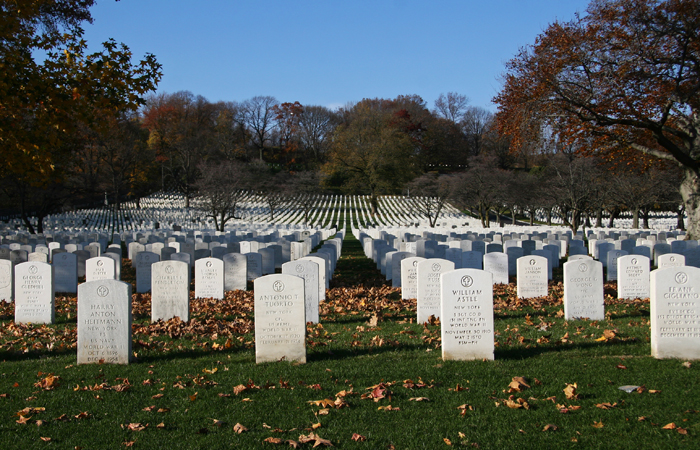
    While driving through Queens, on the way to somewhere else, I happened upon the most extraordinary cemetery. Or, cemeteries. Seventeen cemeteries to be exact, straddling the Brooklyn/Queens border. The first, with its exquisite rows of undulating white headstones, turned out to be a cemetery of tremendous historic importance, the Cypress Hills National Cemetery, one of the original fourteen national cemeteries (top photo).

    Cypress Hills Cemetery was established in 1849 as a nonsectarian burial ground. In 1862, during the Civil War, 2.7 acres were authorized by the private cemetery to be used by the United States federal government as burial spot for Veterans who did in New York City. There are over 21,000 interments in the cemetery. You can read more about it here.
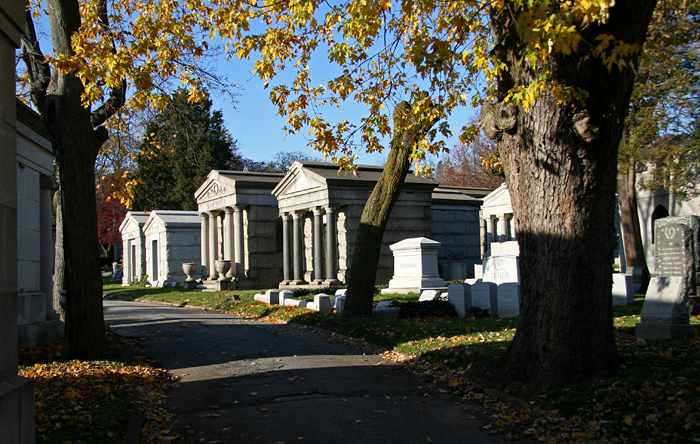
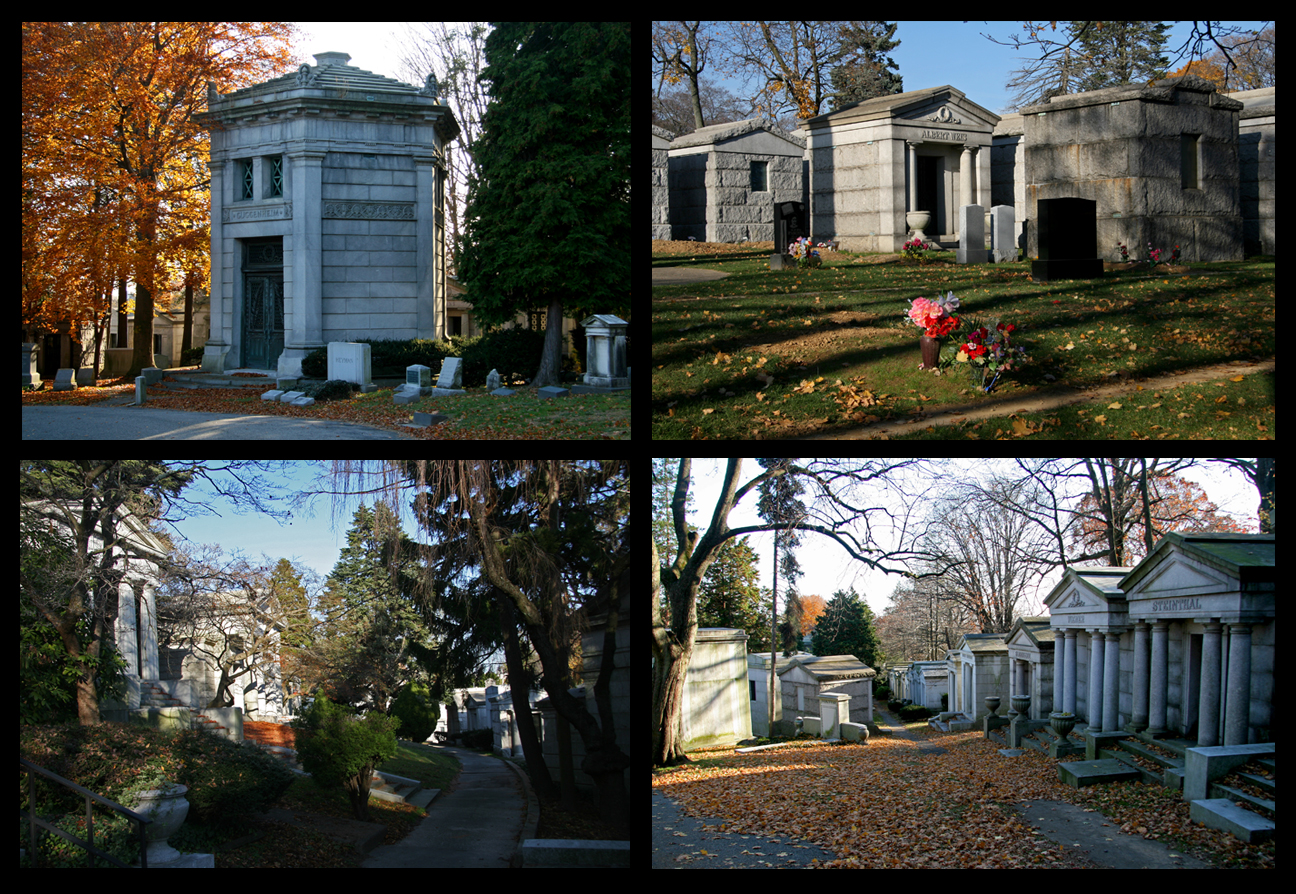
    Abutting these grounds, I noticed a number of very large mausoleums. As I was leaving, I saw that the main entrance at the corner of Jamaica and Hale Avenues was open and unguarded, so, completely unfettered, I decided to drive in. I discovered the most extraordinary cemetery I have ever been in (center and bottom photos). See my gallery of photos here.

    Some of the structures were the size of small homes. Many of the names were quite familiar – Guggenheim, Goldman, Fox, Shubert, etc. Could this possibly be the Guggenheim? The Fox of Twentieth Century Fox? The Shubert of theater fame?
    Yes they are. Salem Fields Cemetery at 775 Jamaica Avenue in Brooklyn, was founded in 1852 by the Central Synagogue and is the resting place for many prominent Jewish families in New York City. Salem Fields has been compared to places like the Père Lachaise Cemetery of Paris. The Guggenheim family mausoleum was modeled after the Tower of the Winds at Athens.

    The weather, with a cool crisp air, was exquisite, the light perfect, the autumn colors beautiful. I was the lone visitor, touring with complete freedom, stopping at every photo opportunity. Unlike many things in New York City, riddled with security procedures, lines, reservations, or admission costs, Salem Fields could well have hung a sign for the day – everything yes 🙂


  • Wherever You Go, There You Are

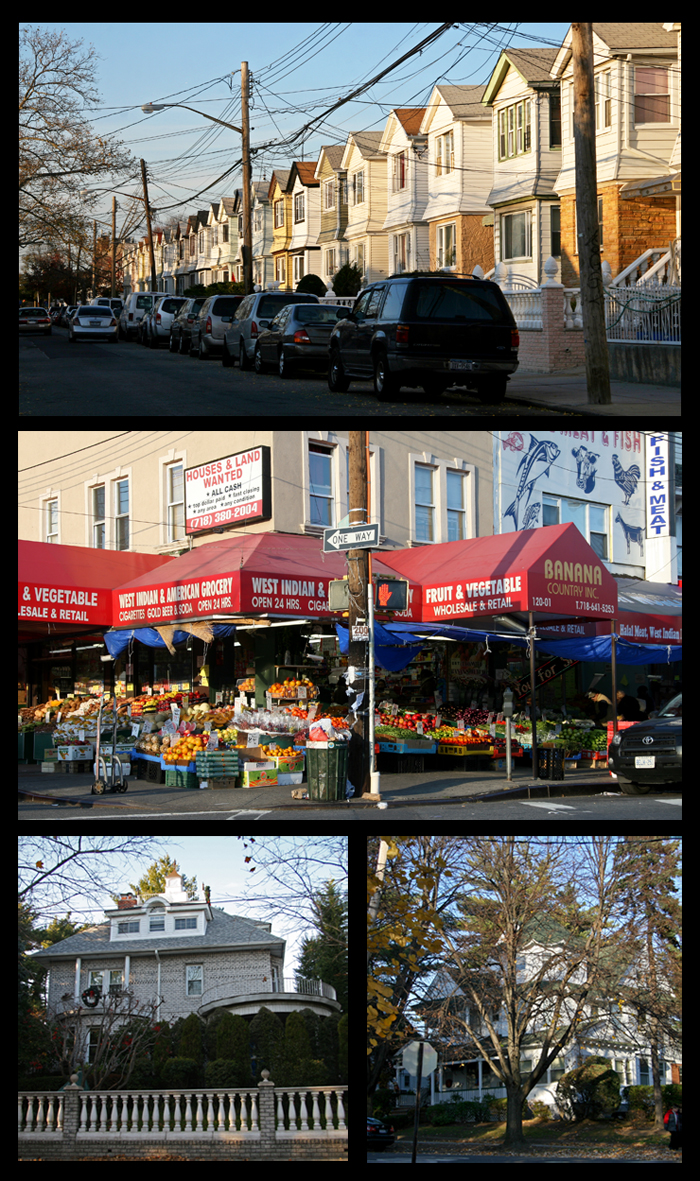
    There are many distinct neighborhoods in the five boroughs of New York City each with its own flavor, architecture, and often a concentration of one or more ethnic groups. Many of these, however, can appear to be rather nondescript and uninteresting to a visitor just passing through. The numbered Streets, Avenues, and Places of Queens connote nothing, and row houses are virtually indistinguishable from one another.

    A little homework, i.e. reading, goes a long way. I always look to the New York Times, which has done a series entitled If You Are Thinking of Living In... on virtually every neighborhood in the city. This is a great launching point, along with some other online reading – Wikipedia typically has an entry for all the New York City neighborhoods.

    The formation of Richmond Hill came about as a result of the 1869 purchase of the Lefferts and Welling farms by one Albon Platt Man, a prominent New York attorney. Cookie cutter row houses dominate Richmond Hill, but the neighborhood has a small number of Victorian homes located in a newly proposed historic district. The neighborhood is home to a large number of Indian immigrants from the West Indies and Guyana, evidenced by the merchants on the main shopping thoroughfares – Liberty, Jamaica, and Atlantic Avenues.

    Ideally, having a native or former native is a great way to get a real feel for a place, and on this journey to Richmond Hill, Queens, I had a friend who had grown up there. So, this expedition was both an exploration for me and simultaneously a walk down memory lane for my friend. There is always such a vicarious thrill taking someone by their old home. The featureless and anonymous comes alive with the recounting of memories of people and activities and gives the lifeless set a cast of characters.

    One of my destinations was to be Jahn’s, an ice cream parlor with several locations – their first establishment was in the Bronx, dating back to 1897. I had assumed that the Richmond Hill location was still in operation. Sadly, however, I discovered that it had closed in 2007.

    A number of notable individuals hail from Richmond Hill. Jack Kerouac lived from 1950-1955 at 94-21 134th Street in Richmond Hill, NY, and also in Ozone Park with his mother where he wrote On the Road. Kerouac included Queens subject matter not only in On the Road, but also in The Vanity of Duluoz.
    The Marx Brothers lived on 134th Street during the 1920s. Fred Gretsch, Jr. manufacturer of Gretsch Guitars, attended Richmond Hill High School, as did comic Rodney Dangerfield. New York columnist and Pulitzer Prize writer Jimmy Breslin attended St. Benedict Joseph Labre School in Richmond Hill. Anaïs Nin, known for her erotic writings, lived in Richmond Hill prior to moving to Paris in 1924. Jacob A. Riis was also a resident.

    Although the value of the cultural breweries of New York City’s well-known neighborhoods such as Greenwich Village or SoHo can not be discounted, a place like Richmond Hill and the notables who lived there demonstrates the diversity of places that not only are home to many, but also from which greatness incubates. Perhaps there is truth in the old cowboy adage – wherever you go, there you are 🙂


  • White House of Ill Repute

    The White House has had its Presidential scandals. Much has been well documented, and the home can be seen in photos everywhere.

    However, there is another White House riddled with much darker doings in the past, located at 177 Benedict Road in Staten Island, NY, the former home of the notorious crime boss Constantino Paul Castellano. I journeyed to Staten Island to see the place for myself, and I believe these are the only photos you will find of this home.

    In 1976, Big Paul Castellano succeeded Carlo Gambino (after his death) as head of the Gambino crime family, the largest Mafia family at the time in the United States.

    Paul was born in Brooklyn in 1915, the youngest of three. He dropped out of school in the eighth grade and learned to be a meat cutter in his father’s butcher business. His life of crime began early – Paul also ran numbers for his father.

    In the 1920s, Staten Island was sparsely populated and isolated – an ideal dumping ground for mafia victims as well as a place for bootlegging, extortion, loansharking, gambling, drug-dealing, and smuggling, activities which emerged on the waterfront. By the mid-20th century, Staten Island became a residential enclave for Mafia dons, providing the seclusion they needed. In the 1980s, law enforcement officials estimated the number of “made” Mafia members living on Staten Island at around 60, with names  such as John Gotti, Aniello Dellacroce, Salvatore Gravano, Frank DeCicco, Thomas Pitera, Costabile Farace, and many others.

    Castellano’s enormous mansion, a replica of the White House of the United States, was built in 1980 in Todt Hill on Staten Island.
    At the time Castellano moved into this estate with his family, a Columbian housemaid, Gloria Olarte, began working. A full-blown love affair between Paul and Gloria developed under the eye of Castellano’s wife, Nina. Although Mafiosi are known to keep a goomatta on the side while married, Castellano’s behavior became more overt and problematic.

    Knowing that Castellano conducted business from his home, the FBI planted bugs in Castellano’s home in 1983 with the help of Olarte, who had been upset with the way her affair with Paul was going. Olarte let an FBI agent into their home, posing as a repairman. Over 600 hours of conversations detailing the Gambino family business were recorded.

    Others in the organization were also not pleased with Castellano and his more mainstream business approach. On Dec. 16, 1985, Castellano and his driver, Thomas Bilotti, were murdered outside of Sparks Steak House at 210 East 46th Street, between Second & Third Avenues in Midtown Manhattan. The hit was ordered by John Gotti, who controlled the family until his 2002 death in prison. The gangland-style murder was particularly shocking, occurring as it did during rush hour, in midtown Manhattan, and in modern times.

    Not to be upstaged, New York City is proud to be home to its own White House of Ill Repute 🙂


  • Living With Legends

    Virtually every New Yorker has heard of the Hotel Chelsea, more commonly known as the Chelsea Hotel. The hotel is most well known for its roster of well known long-term residents – many living at the hotel for years. The hotel has been a home to writers, artists, actors and film directors.

    A short list includes: Mark Twain, O. Henry, Dylan Thomas, Arthur C. Clarke, William S. Burroughs, Arthur Miller, Quentin Crisp, Gore Vidal, Tennessee Williams, Allen Ginsberg, Jack Kerouac (who wrote On the Road there), Simone de Beauvoir, Robert Oppenheimer, Jean-Paul Sartre, Thomas Wolfe. Stanley Kubrick, Ethan Hawke, Dennis Hopper, Uma Thurman, Elliot Gould, Jane Fonda, The Grateful Dead, Tom Waits, Patti Smith, Dee Dee Ramone, Henri Chopin, Edith Piaf, Joni Mitchell, Bob Dylan, Alice Cooper, Janis Joplin, Jimi Hendrix, Sid Vicious, Leonard Cohen, Madonna, Robert Mapplethorpe, Robert Crumb, Jasper Johns, Willem De Kooning, and Henri Cartier-Bresson.

    From the Hotel Chelsea website:

    The hotel has always been a center of artistic and bohemian activity and it houses artwork created by many of the artists who have visited. The hotel was the first building to be listed by New York City as a cultural preservation site and historic building of note. The twelve-story red-brick building that now houses the Hotel Chelsea was built in 1883 as a private apartment cooperative that opened in 1884; it was the tallest building in New York until 1899. At the time Chelsea, and particularly the street on which the hotel was located, was the center of New York’s Theater District. However, within a few years the combination of economic worries and the relocation of the theaters bankrupted the Chelsea cooperative. In 1905, the building was purchased and opened as a hotel.

    Owing to its long list of famous guests and residents, the hotel has an ornate history, both as a birth place of creative modern art and home of bad behavior. Bob Dylan composed songs while staying at the Chelsea, and poets Allen Ginsberg and Gregory Corso chose it as a place for philosophical and intellectual exchange. It is also known as the place where the writer Dylan Thomas died of alcohol poisoning on in 1953, and where Sid Vicious of the Sex Pistols may have stabbed his girlfriend, Nancy Spungen, to death on October 12, 1978.

    Hotel Chelsea is also architecturally significant. The Victorian Gothic red-brick structure with its wrought iron balconies, located at 222 West 23rd Street in the Chelsea neighborhood of Manhattan, was listed on the National Register of Historic Places in 1977. One of the main attractions here is the art that graces the lobby and the 12-story stairway. The stairway is off limits to walk-in visitors (there is a monthly tour), however, the lobby is open to all.

    I cannot speak to the rooms here – I have never been in one, but the place does has a reputation for shabby chic. People stay here for the history and artistic clientele and ambiance, not for the ultimate in luxury or slick room furnishings. At the current time, there are approximately 250 rooms in the hotel – roughly half are still occupied by permanent residents. Long-term residency is no longer granted to newcomers, and as rooms of long-term tenants are vacated, they are converted to hotel rooms.

    The Hotel Chelsea is one of the most unique residences/hotels in New York City, if not the USA. For most of us, its past residents are a who’s who of American culture. For those who were fortunate enough to have stayed there in the past, it was living with legends…


  • Time Travel

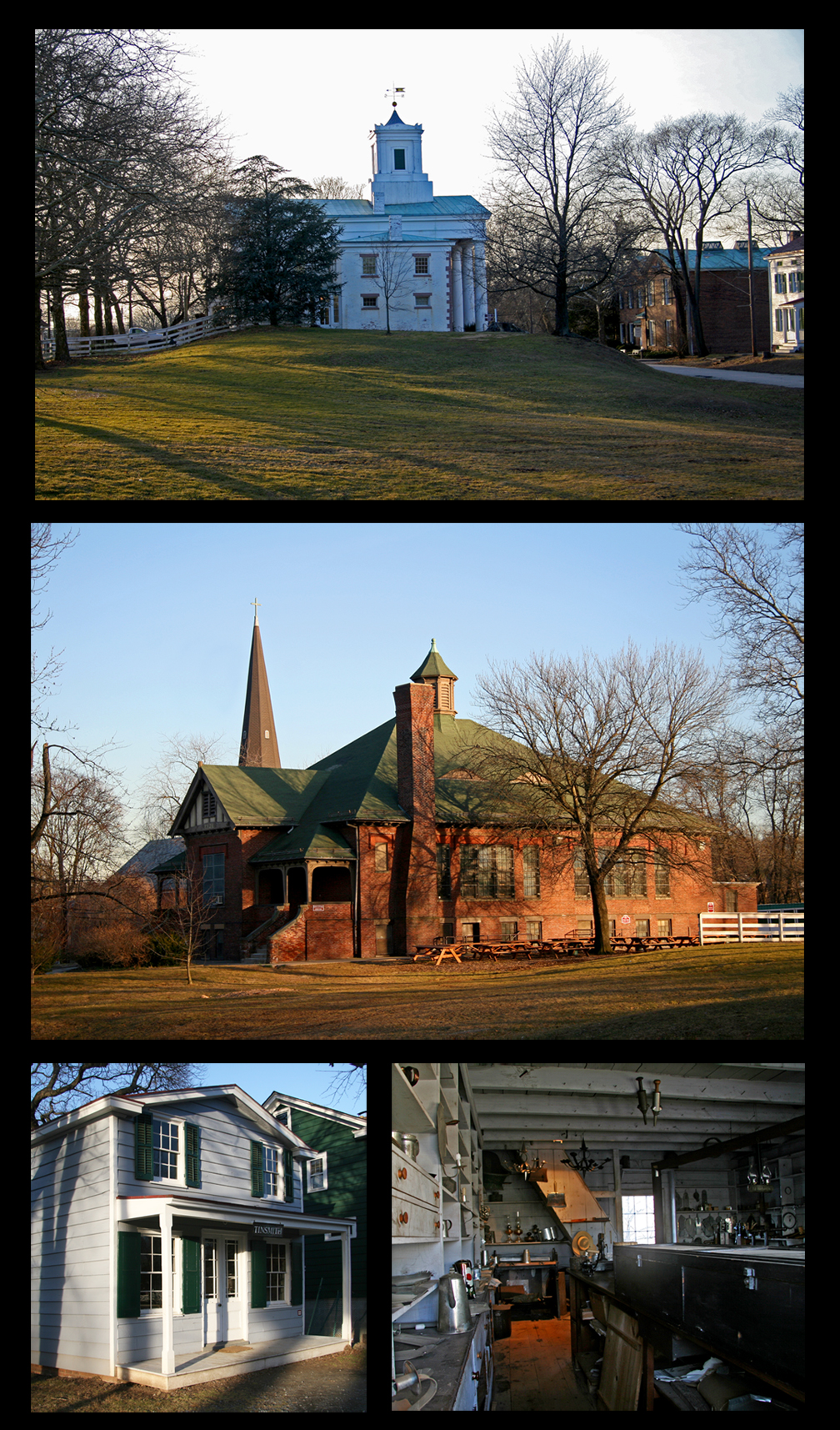
    If I asked if you thought this was colonial New England or the South, of course you would know it was a trick question; this is a website that features New York City exclusively. Nonetheless, it is a shocking set of images to imagine within the five boroughs of New York City, and I hope that, like me, you are scratching your head in amazement and wondering where this could be.

    For daily readers of this site, you may guess that we are in Staten Island – we just crossed the Verrazano Bridge yesterday. And you are correct.

    My real mission here involved a number of destinations, but Historic Richmond Town was unknown to me and was a complete surprise, suggested by a native when I asked if there were any historic areas. I expected to find a nice home or two – some small pocket or enclave.

    I had no idea that Historic Richmond Town (established in 1958) is one of America’s living history museums, like those found in Colonial Williamsburg or Old Sturbridge Village in Massachusetts, where my family visited when I was young. Richmond Town was the former county seat and commercial center of Richmond County (Staten Island).

    The concept of a living history museum goes back to open-air museums that appeared in Scandinavia in the late 19th century. The first was King Oscar II’s collection near Oslo in Norway, opened in 1881. The American style focuses more on lifestyle and generally depicts various trades and activities of the period recreated.

    Historic Richmond Town dates back over 300 years to the 1600s, very old by USA standards. There are 27 buildings in the 25-acre village on a 100-acre site. Some structures are original to the village, while others have been moved from other locations on the island. There are many styles of buildings here, including outstanding examples of Dutch Colonial and Greek revival architecture.

    There are many exhibits that can be seen in Historic Richmond Town – blacksmithing, tinsmithing, basketmaking, coopering, weaving, candlemaking, spinning, etc. There is the oldest standing elementary school in the United States. Here you will find a Dutch Colonial farmhouse, established in 1740, and the Print Shop, established in 1821. Historic Richmond Town houses one of the oldest operating printing presses in America. See their website here.

    When I visited, none of the buildings were open or exhibits operational. When the weather gets warmer and the growth greener, I plan to do a more thorough visit. I’ve always loved Time Travel 🙂


  • Diamonds and Rust

    Perhaps real estate brokers confuse platitudes with beatitudes when they often tell a client, “There are only three things to know about real estate – location, location, location.” * This adage (or some variant) has become more of an irritant than a balm to the property hunter. If you are inclined to retort, tell them of the Hotel Earle on Washington Square.

    The Washington Square area has been one of the most desirable residential neighborhoods in New York City since the early 1800s, yet the Hotel Earle at 103 Waverly Place (at the corner of MacDougal Street) was in serious decline in the 1960s and early 1970s, with a reputation as a very seedy boarding house. No one I knew at that time had even set foot in the place. It took not years, but decades, to become the respectable place that it is now.

    The Paul family purchased the hotel in 1973 and progressively made improvements to the Art Deco-style 150-room hotel. In 1986, the name was changed to the current Washington Square Hotel. In 1992, Judy Paul opened North Square Restaurant, a first-class New York bistro at the hotel. From the Hotel’s press release in 2008:

    The Washington Square hotel was built in 1902 as a residential hotel named the Hotel Earle after its first owner, Earl S. L’Amoureux. The hotel occupied a single, 8 story, red brick building on Waverly Place, in the heart of affluent Greenwich Village, now an historic landmark district. In 1908, L’Amoureux built an identical, connecting building to create a grand apartment hotel, complete with reading rooms, restaurant, and banquet facilities. Four years later he added a ninth floor and, in 1917 he acquired an adjoining three story building, bringing the hotel to McDougal Street, at the northwest corner of picturesque Washington Square.

    Once a staid, affluent community, (as depicted in Henry James’ Washington Square and The Heiress), Greenwich Village was becoming the center of New York’s Bohemian counterculture; reflected by the Beat generation who gravitated to the coffee houses and jazz clubs. The once grand hotel was allowed to deteriorate into a shabby apartment hotel, making it an attractive address for struggling artists, actors, writers and musicians.

    Ernest Hemingway, Dylan Thomas, Joan Baez, Bob Dylan, Barbra Streisand, Bill Cosby, Phyllis Diller, Bo Diddley, P.G. Wodehouse, and the Rolling Stones are among the celebrities who have stayed at the hotel. Patricia Highsmith used the hotel as inspiration for her short story “Notes From a Respectable Cockroach.” Joan Baez stayed in room 305, with Bob Dylan, in the early 60s. In her love song, “Diamonds and Rust,” Baez says, “Now you’re smiling out the window of that crummy hotel over Washington Square.” John and Michelle Phillips of the Mamas and the Papas stayed at the Earle during a visit to New York City (which prompted them to write “California Dreamin'”). Norah Jones worked there previously as a waitress.

    Many former inhabitants of the olde Earle have seen both diamonds and rust…

    For the etymology of the phrase “location, location, location” as regards real estate, see the article here in the New York Times by wordsmith William Safire.


  • Orchards and Tenements

    I have written about many merchants located on the Lower East Side, but I have not focused on Orchard Street, the central artery of the neighborhood running one way for eight blocks between Division and Houston Streets. The street is named for the dirt road that once connected the house of Lt. Gov. James De Lancey with the orchard on his 340-acre farm.

    The neighborhood was first settled in the mid-1800s, was known as Kleindeutschland (Little Germany), and later became a Jewish enclave.
    The street, lined with low-rise tenement buildings with exterior fire escapes, typical of the area, has more recently been best known as a discount shopping district. Blue laws (repealed in the 1970s) prohibited Sunday shopping nearly everywhere in New York City, but, owing to the predominantly Jewish population, Orchard Street was given an exemption since they were closed on Saturday for the Sabbath, giving them a virtual monopoly for Sunday shoppers.

    Some shops are still closed on Saturday. On Sunday, the street is closed to vehicular traffic between Delancey and Houston Streets, transforming the blocks into a pedestrian mall. There is still a bustle of activity, with shops specializing in clothing, shoes, leather goods, fabrics, jewelry, and luggage, intermingled with newer shops, restaurants, boutiques, and bars.

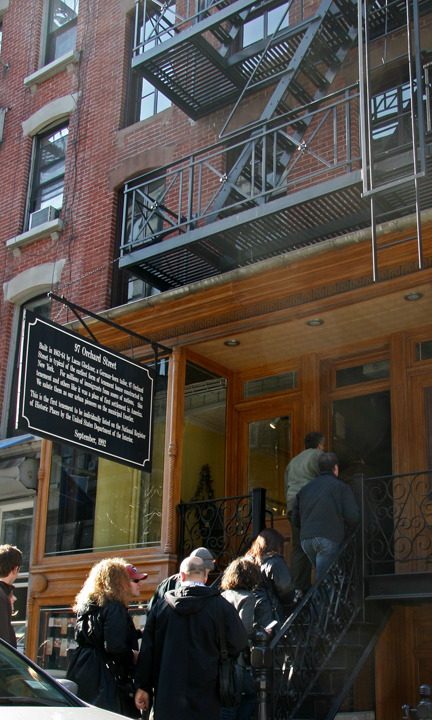
    Orchard Street is home to a very unique dwelling. The building located at 97 Orchard, built in 1863, was boarded up in 1935 and unoccupied thereafter. In 1988,  it became part of the Lower East Side Tenement Museum. This building is a virtual time capsule and a must-see – it is an opportunity to see the city living conditions of a century ago virtually intact.

    Orchard Street and the Lower East Side has been an area in transition, with numerous new trendy shops and upscale residences. Some have argued, however, that this has not been a classic case of gentrification, with older businesses being displaced; the area has been in decline for some time, and the newer merchants have been welcomed, even by many older residents.

    The Tenement Museum is conveniently located next door to the superb il Laboratorio del Gelato (95 Orchard). See you there 🙂

    Related Posts: Crossing Delancey, Go for a ride?, Sunshine Makes You Happy, Economy Candy, Eldridge Street, Doughnuts, Yonah Schimmel, teany, Pickles, Vegan Chic, Bluestockings, Colossal Misbehavior, il Laboratorio del Gelato, Fusion Arts Museum, Arlene’s Grocery, Footprints.

    Photo Note: The archival black and white photo shows Orchard at Rivington Street, circa 1915.


  • The Ear Inn

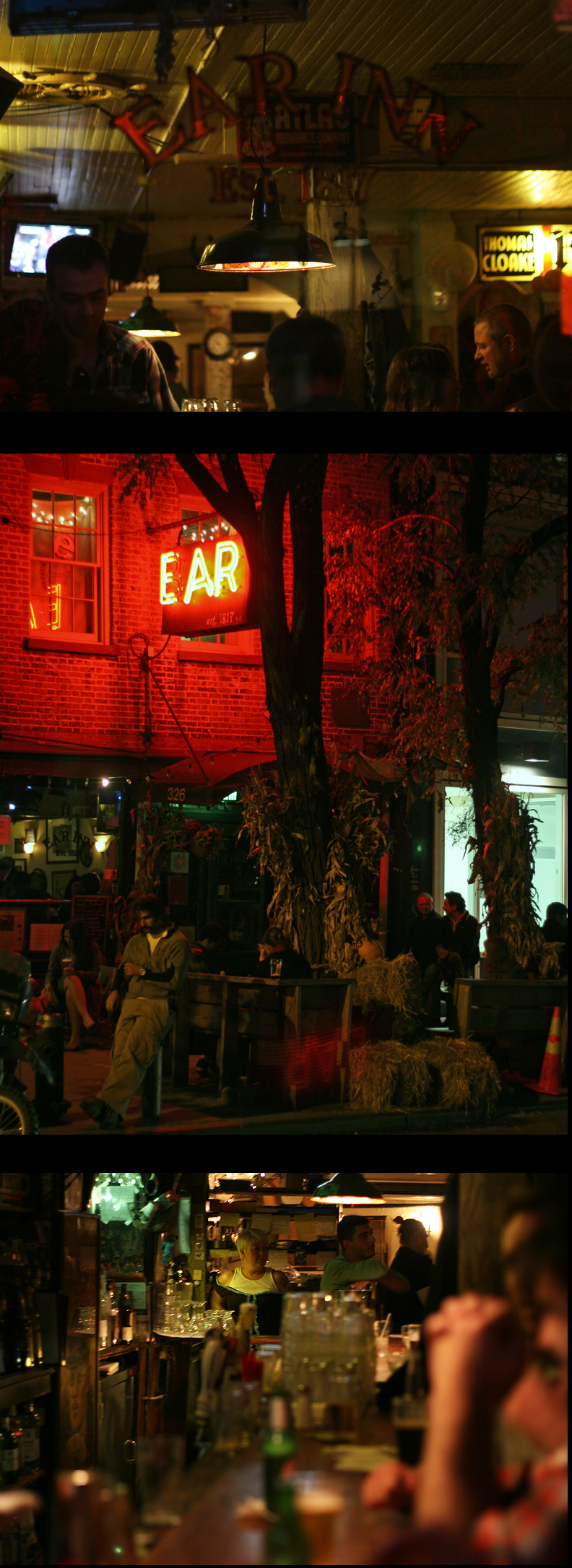
    One of the best ways to experience Olde, intimate, atmospheric New York is to visit its vintage bars. There are a number vying for the title of New York City’s oldest, such as Fraunces Tavern, Pete’s Tavern, and The Ear Inn, located on the ground floor of the James Brown House, a historic landmark listed on the National Register of Historic Places. See more photos here.

    The James Brown House is one of the very few Federal houses left in the city. It is in largely original condition of 2 1/2 stories with dormers, double splayed keystone lintels, and a gambrel roof. The construction is all wood posts and beams set with pegs, with a facade of Flemish bond brick. The restaurant doors and window are late 19th-century. The panel to the right of the main door is a night shudder cover to the original shop window, an 18th-century-style feature unique to this building. Once there were cellar windows and fireplaces in the bar area.
    It was built in 1817 for James Brown, a prosperous African-American tobacco merchant, reputed to have been an aide to General Washington during the Revolutionary War.

    At the time of its construction, the house was only five feet from the Hudson River shoreline. After James Brown’s death, the city was booming with ship traffic. The river was filled out to West Street. New piers were built and rebuilt ever larger. From Spring Street, ships left for California, China, and Hoboken. The proximity to the water made it popular with sailors and longshoremen. It had a brewery that was later turned into a restaurant.

    The property changed hands several times. In 1890, it was purchased by an Irish immigrant named Thomas Cloke. Cloke sold the business in 1919 in anticipation of the Eighteenth Amendment to the United States Constitution, which prohibited the sale of alcohol. During Prohibition, the restaurant became a speakeasy, while the upstairs apartment was variously a boarding house, a smugglers den, and a brothel. Ghosts have been heard and seen, in particular, “Mickey,” a sailor still waiting for his clipper ship to come in. Read more about the bar at its website here.

    One of the most interesting features of this place is the sign. A Columbia University student, Rip Hayman, rented a room in the house in 1973. In 1977, Hayman and friends bought the building and christened it the Ear Inn after a new music journal, The Ear, which was published upstairs. To avoid the Landmark Commission’s lengthy review on changing signage on historic buildings, portions of the letter “B” in the neon BAR sign were painted black to read EAR…


  • Cones

    Artisanal this and artisanal that – but, as Raul D’Aloiso pointed out last night at Cones, the word does mean something. Only a word, but most purveyors of foods wielding this word are taking it seriously and doing their work carefully. The extent to which most food artisans, such as the Doughnut Plant, are going with ingredient selection is extraordinary. Whether the customer is aware of the details or not, the result speaks for itself.

    Gourmet foods are expected in a city like New York, and in the world of ice cream, expectations are not disappointed. Competition has gotten fierce, with more high-quality individuals sampling the products of the serious artisans. Once you have had the best, there is no going back.

    Cones, Ice Cream Artisans, is located at 272 Bleecker Street in the West Village. The shop was started by brothers Raul and Oscar D’Aloiso, Argentinians of Italian ancestry. Oscar worked in the construction trade as a building site manager and was also a professional classical singer. Raul holds a master’s degree in architecture – he worked in the profession both in Buenos Aires and in New York City after his arrival here in 1989. Inspired by the artisanal gelato of Buenos Aires and their disappointment with Häagen-Dazs (which had a flagship shop in Buenos Aires), the brothers decided to introduce Argentinian-style ice cream to New York City.

    According to an article in the New York Times from 2003, New York City occupies an important place in America’s ice cream history. Reasons cited are America’s first ice cream shop in 1777, the patent for the cone-making machine of Wall Street restaurateur Italo Marchiony in 1903, and Reuben Mattus, a Polish immigrant and small-time ice cream maker in the Bronx responsible for Häagen-Dazs (and its short-lived New York-based imitators, Frusen Glädje and Alpen Zauber, made in Brooklyn). Sedutto’s, the nation’s first so-called superpremium ice cream, was founded in New York in 1922.

    More recently, we have the Cold Stone Creamery, Emack and Bolios (from Boston), the Brooklyn Ice Cream Factory, Ciao Bella Gelato, Fauchon, Grom,  Il Laboratorio Del Gelato, and the Van Leeuwen Artisan Ice Cream truck. There are still a handful of ice cream parlors too – Egger’s in Staten Island, Hinsch’s in Brooklyn, Jahn’s in the Bronx (closed), and Eddie’s Sweet Shop in Queens.
    If you’ve read this article, consider your homework done – go out and try some artisanal ice cream at Cones 🙂

    Note about Cones: The shop has focused entirely on quality of product and word of mouth and reviews (they received a 27 food rating from the Zagat Survey). There has been no advertising or marketing, and currently, Cones has no website.


  • Rags and Riches

    I recall speaking to a young architect many years ago, expressing my dissatisfaction with NYU’s hulking Bobst Library on Washington Square South. She explained that from an architectural perspective, the nature of a library demands such an imposing structure. I was not thoroughly convinced that this particular library needed to have such an imposing presence on Washington Square, particularly such an enormous, monolithic, cubic design, but I did come to appreciate that certain types of institutions can instill confidence in their patrons by the nature of their structure. And what would be a better candidate than a bank, home and guardian for our money?
    From an article in the New York Times:

    Why build such evocative Greek temples to begin with? To inspire confidence. When the United States economy collapsed in the Panic of 1893, many people blamed banks for the depression that followed and withdrew their money.
    So, banks built in that era (until the end of the Great Depression, when banks began to demystify themselves with glass-fronted branches) were meant to suggest strength, as if they had been there forever.

    The Bowery Savings Bank, 130 Bowery at Grand Street, is an outstanding structure. It was designed by Stanford White (1853 – 1906) of the firm of McKim, Mead, and White, and built in 1895. The landmark building is adorned with Corinthian columns, Venetian glass, marble mosaic floors, and 65-foot ceilings.

    The Bowery Savings Bank, however, ran into serious financial difficulties and, in 1985, was sold to Richard Ravitch and others. Its current incarnation is Capitale, an upscale events space and popular wedding facility. To see a photo gallery of the beautiful interior spaces, see their website here.

    Equally remarkable is the building’s location on the Bowery, a street/area which, in recent history, has been quite impoverished, known as skid row and home for Bowery bums. Sections of the area have become gentrified. To walk the street is still a very uneven experience, with the lighting district, restaurant supply district, bits of Chinatown, an art museum, and Cooper Union. It is a rags and riches story…

    Note: The roster of works designed by McKim, Mead, and White is extraordinary. In New York City alone, they were responsible for the Harvard Club of New York, Madison Square Garden II, the Cable Building, Washington Square Arch, Columbia University’s Morningside Heights campus, The Morgan Library & Museum, the Manhattan Municipal Building, Bellevue Hospital Center, James Farley Post Office, the Town Hall, Savoy-Plaza Hotel, and the Villard Houses. The existing building replaced the original Bowery Savings Bank building of 1834.


  • Black Cowboys


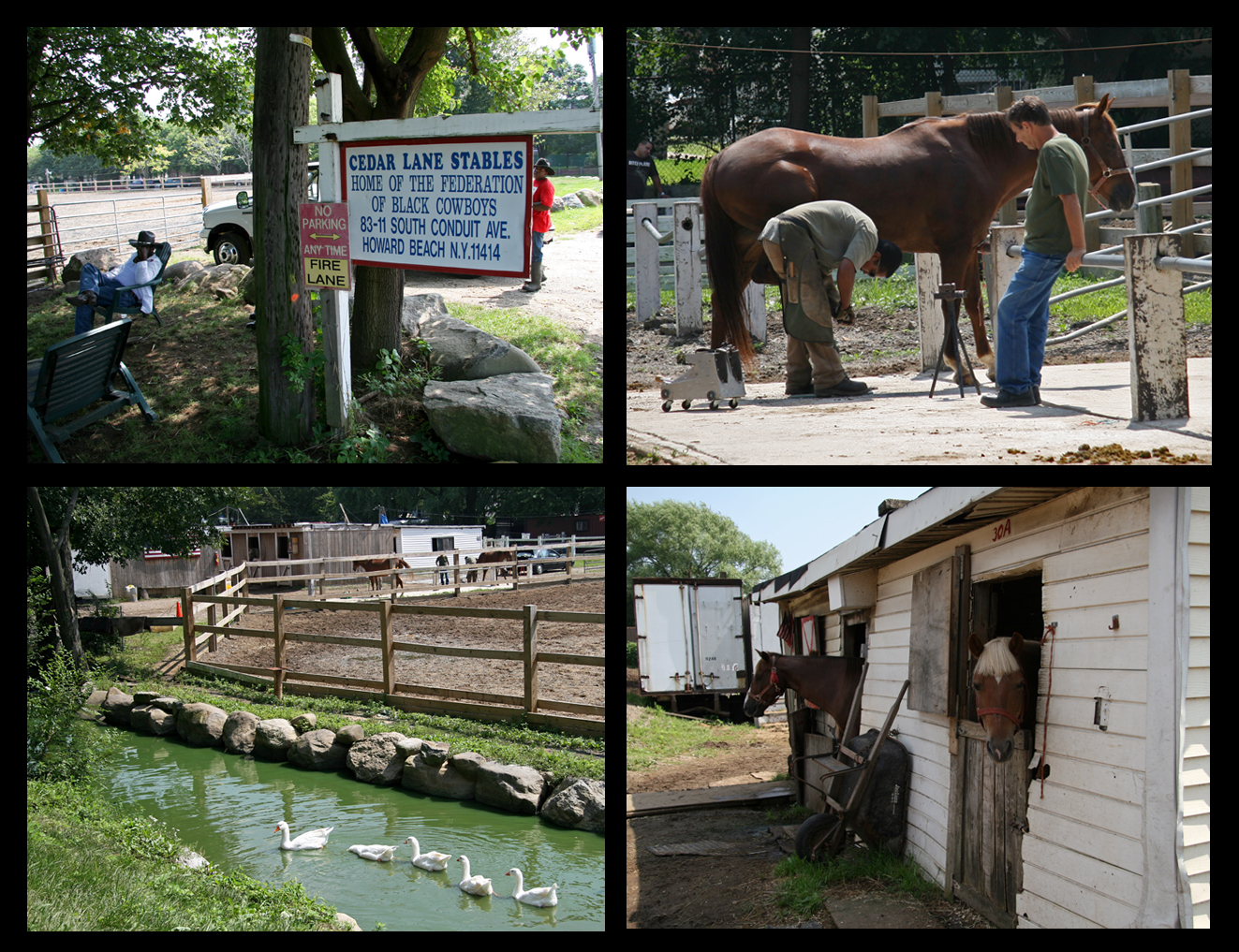
    If you are looking to visit the Federation of Black Cowboys in Howard Beach, Queens, be prepared for some circuitous circumnavigation. Even neighbors showed initial moments of puzzlement when I asked for precise final directions. The street address of 83-11 Conduit Avenue will not help you at all since the facility is on Cedar Lane, with one entrance on Linden Boulevard. (Update: A recent Google map search put the facility at 78-83 South Conduit Avenue.)


    I was quite elated when I finally found the entrance signs; I knew this would not be a typical Sunday afternoon in New York City. And it wasn’t. I was greeted by a handful of men in cowboy gear. Geese were wandering the property and a horse was being shod, while others were busy with various stable duties.

    The Federation of Black Cowboys currently has 34 members and 40 plus horses, stabled on 24 acres leased from the city since 1998. The ranch, Cedar Lane Stables, was part of a larger property, a vegetable farm owned by Herman and John Brockman. From the NYC parks website:

    The Federation of Black Cowboys was formed in 1994 when a group of diverse men came together out of their common love of horses and their desire to share the forgotten legacy of the Black West. African Americans played an immeasurable, yet often forgotten, role in the settling of the American frontier. Many African Americans made the journey west after escaping slavery, while others moved westward in wagon trains after emancipation.

    Many more moved during the exodus of 1879, when many African Americans, convinced that the end of Reconstruction meant the end of their chances for a successful life in the South, relocated to states such as Texas and Oklahoma. By the closing of the American frontier in 1890, there were 500,000 African Americans living in these two states alone. Many of these frontier settlers found employment as cowboys, a position essential to the economies of many western states.

    The non-profit organization, headed by Edward J. Dixon, has a primary goal to expose black children to the art of western horsemanship, the skills required to properly care for a horse, and the historical role of black cowboy in the old West. Read more here (updated 12/9/11). This is done through regular instructional programs, work release programs, prison visitations, parades, lectures, block parties, rodeos, and showdeos 🙂

    Note: I have a relationship with this world beyond photographs and a story. If you are curious about my friends in common, go here and here. My business activities are revealed here and here.


  • dinamic_sidebar 4 none

©2026 New York Daily Photo Entries (RSS) and Comments (RSS)  Raindrops Theme