• Category Archives Architecture
  • The Little


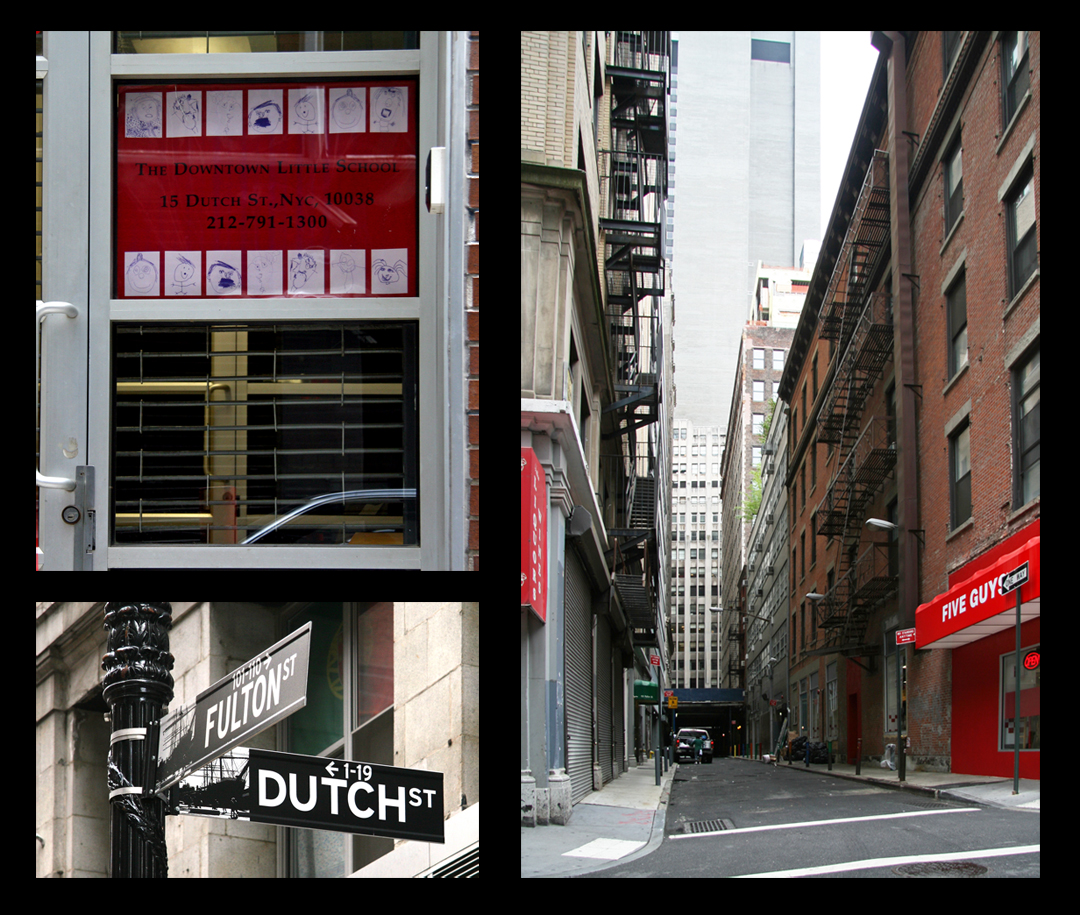
    Here, in lower Manhattan, way under the radar and not touristed at all, I discovered a little school on a little alley. In New York City, this is how I find solace, in the diminutive. A little alley, a little crook in the street, a little shop, a little building, a little garden. Feeling a little tired, because one can never really become exhausted from exploring the little, and if it is a beautiful day, perhaps one may enjoy a little rest and a little snack. This is why I choose to live in Greenwich Village, because the scale is so much smaller and so much more human.

    I have been in many high-rises, and there is nothing quite like the ambiance of a classic prewar building and, if one is so privileged, the views that may come with a residence on an upper floor. Icons like the Waldorf Astoria Hotel or the Plaza just exuded charm. And there is nothing quite so noble as the Chrysler Building at night. But for me, when it comes to a place I call home, I choose the small townhouse.

    I have not been to the new Vegas, and I imagine I will get there at some time. And, like Dubai, I also imagine that there will be some shock and awe. However, living in New York City for the last 40 years, I do not seek out the mammoth or the overwhelming when it comes to man-made environments. And although I live in the country’s largest city, in my business life I have carved out a little niche. It is much easier to succeed in the proverbial small pond.

    At 15 Dutch Street, I was very surprised to find the Downtown Little School. From reading, parents rave about this nursery school, and I think the word Little (like the Little Red Schoolhouse on Bleecker Street) is a signal that this place emphasizes caring, personal attention, and the human touch, embracing all that was good in the old school.

    I was also very surprised to learn that the huge multinational giant, Colgate-Palmolive, had its roots on Dutch Street. In 1806, at 6 Dutch Street, William Colgate opened up a starch, soap, and candle factory, a reminder that not only the good, but also the big germinates from the Little 🙂


  • Brooklyn’s Got Magic


    The bad news is that all the clocktower residences at One Hanson Place have been sold. The good news is that there are still a few residences left on the lower floors, and they will not set you back the $3-6 million dollars that the tower residences would have.

    The Williamsburgh Savings Bank Tower is the major visual icon and arguably the best-known building in Brooklyn. At 512 feet, it towers over the low-rise structures that dominate the borough and is visible from various locales throughout Brooklyn.

    The 1929 landmarked structure is located at one Hanson Place, on the corner of Flatbush Avenue, a major artery. Formerly the home of Williamsburgh Bank, it was designed by the architectural firm Halsey, McCormack and Helmer in a Romanesque-Byzantine style.

    The Williamsburgh Savings Bank Tower features a gilded copper dome, and its signature four-faced clock 27 feet in diameter, with colored hands designed to be visible 30 to 40 miles away. Carved lions, turtles, and birds grace the exteriors granite surface. The major attraction here is the extraordinary marble banking hall on the ground floor, with 63-foot vaulted ceilings, limestone and marble walls with elaborate mosaics, and 40-foot windows containing silhouetted iron cutouts a thrift motif: beehives, squirrels storing nuts, wise owls, Mercury (the god of commerce), and lions whose paws protect the bank’s lockbox. There are two abandoned public observation decks with signage describing the Battle of Brooklyn.

    The building was converted to condominiums in 2006 in a partnership between Dermot Co. and Canyon-Johnson Urban Funds – a joint venture between Canyon Capital Realty Advisors and basketball star Magic Johnson.

    There’s a lot of hype surrounding any real estate development in New York City. But, no borough resident needs to be sold, since they always knew, as everyone else now does, that Brooklyn’s got Magic 🙂


  • Pyramid Power

    New York City is no stranger to the occult or new age practices and beliefs. Samuel Weiser Books, established in 1926 on book row, is the oldest and probably the most famous occult bookstore in the United States. It moved a number of times and is no longer a retail operation. However, I did visit their shop many times in the 1970s, when they were located at 734 Broadway in the Village.

    In the early 1970s, pyramid power became the rage. Claims were made about their paranormal properties – pyramids were said to preserve foods, maintain the sharpness of razor blades, improve health, function “as a thought-form incubator,” trigger sexual urges, and a myriad of other effects. Models were made and sold in a variety of materials. I had one myself.

    One of the seminal forces in this phenomenon, was New Yorker Max Toth, born in 1937. He a background in electroneurophysiology and was one of the first neurosurgical technicians. He built high-gain amplifiers for research purposes for neurosurgeons.
    While living in Bellerose, Queens, Toth began manufacturing foldable cardboard pyramids. In 1976, the highly influential book Pyramid Power, authored by Toth, was published. An estimated 1 million copies have been sold. Other books and other pyramids were manufactured in a variety of materials, becoming a virtual mini-industry.

    Frenchman Antoine Bovis, a pendulum dowser in the 1930s, originated the idea that pyramidal shapes can preserve food. Karel Drbal, a Czech radio engineer, patented a razor blade sharpening pyramid based upon the earlier paranormal experiments of Bovis.
    Sheiler and Ostrander, authors of Psychic Discoveries Behind the Iron Curtain Authors, published in 1970, had met Drbal and devoted a chapter of their book to pyramid power.

    Today, pyramid power and pyramidology are all but forgotten and considered pseudosciences. But whenever I see pyramids, particularly those sitting atop the Zeckendorf Towers (or even the Gothic spire of Grace Church), I can’t help but be reminded of Pyramid Power…


  • Going Through Rehab


    One of the most disappointing features of a post-war “modern” apartment is that in most cases, when you enter, you are typically dumped right into a living room with an an immediate sense of the lay of the land. Cookie cutter and boxy, no foyers, no “frivolous” use of space. There are no surprises around the corner, because there are not many corners or ways to meander.

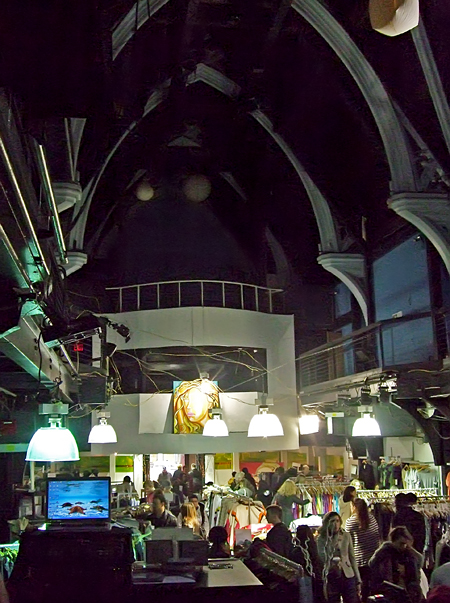
    If you like a labyrinthine experience in a Gothic environment, you may enjoy the Limelight, previously a church built in 1846 and, after 1973, used as a rehab center, various night clubs – most notably The Limelight – and now a shopping emporium.
    A nightclub in a Gothic church should be a dramatic, exciting experience. But it was not. I neglected to mention that some had nicknamed the club “Slimelight.” I visited once in the 1980s, and the novelty of crawling through the maze of chambers in low light wore off quickly. Slimelight it was. I wrote about the sorry state of the Limelight on May 30, 2008 in Model for Decorum.

    Its various reincarnations were not much better. On March 14, 2009, I visited again and found a large flea market of sorts – very disappointing. The photos I took remained unused. You can see an interior photo here.
    After a $15 million dollar renovation, the building reopened in May 2010 as the Limelight Marketplace, a assemblage of over 60 upscale shops, eateries, and outdoor cafe. See my photo gallery here.

    Although some critics are not particularly enamored with this incarnation, and I do not champion the view that commerce heals all wounds, it certainly is refreshing to see the cleanup after going through rehab…


  • Sukkah City


    I have found it remarkable that everyone I have spoken to, including those who grew up outside the United States, has participated in what appears to be one of the most universal past times of children – the building of makeshift structures to hide and play in. An amalgam of anything available – sheets, cardboard, etc. are utilized to make a mini-home or fort. Perhaps it should be no surprise, owing that shelter is such a primal need of every human. Also no surprise that George Costanza of the TV series Seinfeld, in order to impress a woman, lies about his work, claiming that he is an architect.

    Architecture is certainly an endeavor where the ingenuity, brilliance, resourcefulness, and creativity of the human mind can be seen. One needs no further evidence than the recent international design competition, Sukkah City. There were 624 entries from 43 countries.
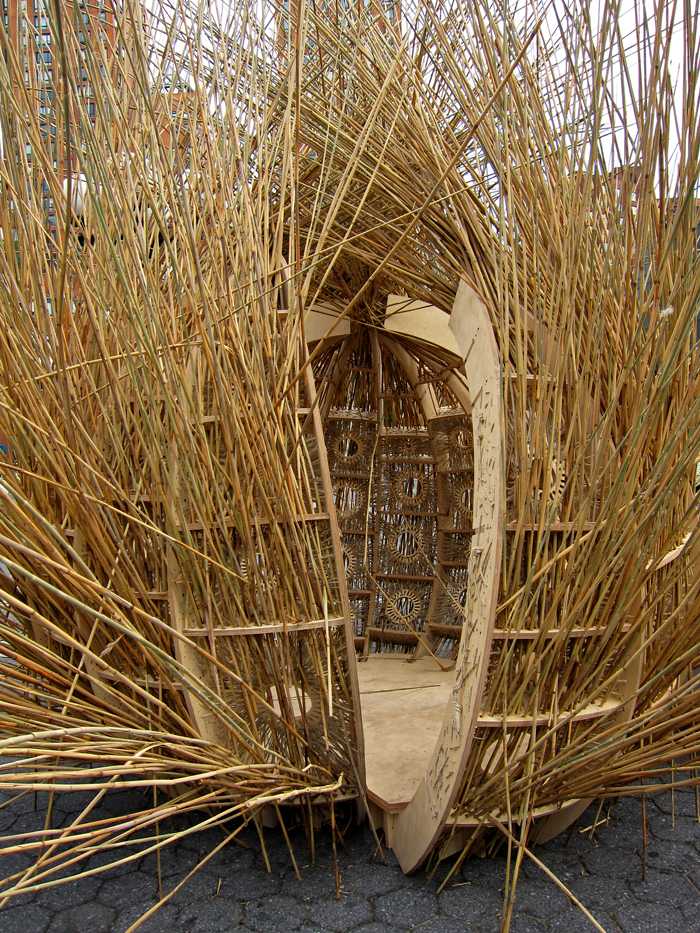
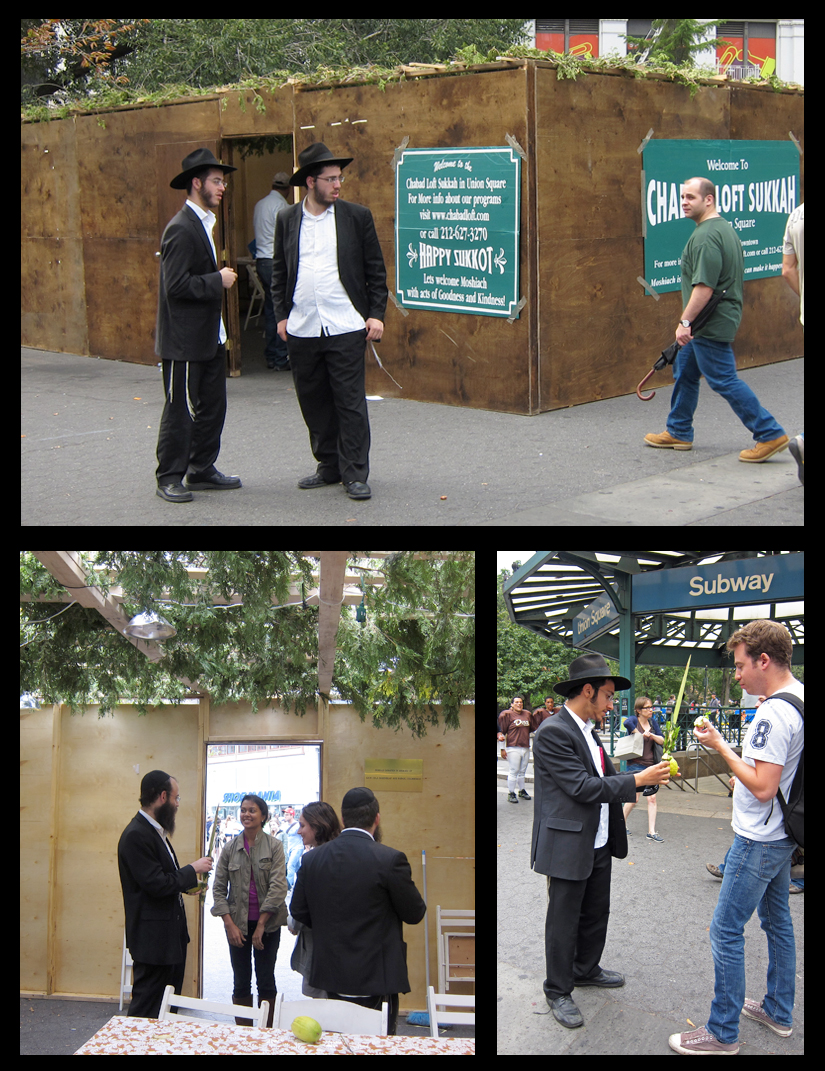
    Every imaginable material and fabrication method was used to build Sukkahs*, as long is they conformed to the rules of construction. Twelve of the finalists were displayed in Union Square for two days (September 19 & 20), and the finalist, shown in today’s top photo, remains there for the entire week of Sukkot. See second photo here.

    The designs are beautiful, evocative, and inspiring. All twelve sukkah finalists are on sale, with proceeds benefiting Housing Works, an organization fighting AIDS and homelessness. For the Jew or non-Jew, those with a home and those without, all can find inspiration in Sukkah City 🙂

    *A sukkah is a temporary “booth” (the Hebrew translation) to live in during Sukkot, a week long festival that commemorates the forty-year period during which Israelites lived in temporary shelters while wandering in the desert after their exodus from Egypt. There are many rules governing the construction and use of the sukkah: It must have two and a half walls (two full and one partial). The roof needs to be made of organic materials and sparse enough to let rain in and preferably to let the stars be seen from inside. Although Jews are required to eat all their meals and sleep in the sukkah, they do not need to do so if they are uncomfortable or during rain. See my photos here of a traditional sukkah typically found during this holiday in various locations around the city.

    Note: The event was sponsored and organized by a number of firms, including the AIA center of New York City, located at 536 LaGuardia Place. A Sukkah City exhibition is on view from September 22, 2010 – October 30, 2010.


  • Goin’ To Lourdes


    Annie Hall: Oh, you see an analyst?
    Alvy Singer: Yeah, just for fifteen years.
    Annie Hall: Fifteen years?
    Alvy Singer: Yeah, I’m gonna give him one more year, and then I’m goin’ to Lourdes.

    This dialogue, from Woody Allen’s film Annie Hall (with Woody playing Alvy Singer), demonstrates the iconic status of the shrine at Lourdes, France, in the Pyrenees. Lourdes has become synonymous with miracles.

    Growing up as a Roman Catholic, Lourdes has always fascinated me. What is most intriguing is the purported healing properties of the water. An estimated 200 million people have visited Sanctuary of Our Lady in Lourdes since 1860. Currently, about 6 million yearly make the pilgrimage. The church has recognized 67 miraculous healings.

    One should be careful to dismiss these as self-delusional or write this off as a case of the Catholic Church’s self-promotion. The claims for miraculous healings actually are put through quite rigorous testing before a Lourdes Medical Bureau, comprised of doctors. Those claims standing up to preliminary examination are referred to the International Lourdes Medical Committee, an international panel of medical experts in various disciplines (not all Roman Catholic, the panel is open to any denomination). Only a handful of claims make it this far, and the entire process takes 5-12 years, ensuring that the cure is permanent. The church itself gives the final approval.

    The Roman Catholic church is actually reluctant and extremely careful to acknowledge miracles or grant sainthood – the repercussions of fraudulent claims would certainly come back to haunt them. See a New York Times article here. The conditions to qualify as a genuine miracle are:

    The original diagnosis must be verified and confirmed beyond doubt
    The diagnosis must be regarded as “incurable” with current means (although ongoing treatments do not disqualify the cure)
    The cure must happen in association with a visit to Lourdes, typically while in Lourdes or in the vicinity of the shrine itself (neither drinking nor bathing in the water is required)
    The cure must be immediate (rapid resolution of symptoms and signs of the illness)
    The cure must be complete (no residual impairment or deficit)
    The cure must be permanent (with no recurrence)

    The waters of Lourdes are available right here in New York City at the Church of Notre Dame, located at 114th Street and Morningside Drive, near Columbia University, with which it has been associated since 1988. The first administrator of the church was Fr. Maurice Reynauld. While in France in 1913, Reynauld affiliated the Church of Notre Dame with the Sanctuary of Our Lady in Lourdes. A special arrangement was made for Lourdes water to be sent directly from the shrine in France to the Church of Notre Dame in New York City. Since that time, water from the Lourdes shrine has been continuously available at the church in New York.

    I am very curious about the whole thing. I’ve been to California. One day, I’m goin’ to Lourdes


  • Men of Steel

    People love urban myths and recounting them, filled as they often are with drama, mystery, romance, and unusualness. The more atypical they are, the better, and if there is an element of truth to them, they are more easily believed. Few will bother to sort out the “nuances,” separating fact and fiction – such “nuances” may undermine the entire story.

    We also have a love of individuals with supernatural or perhaps superhuman abilities, allowing us to triumph over the day-to-day battles we must all endure. Some urban legends explain things inexplicable to us, such as how anyone could work at dizzying heights as an ironworker on skyscrapers.

    The Mohawk Indian, innately endowed with uncanny capabilities, became the explanation as well as an exotic and enticing concept – the American Indian transported and juxtaposed in the most urban environment imaginable: the steelworks of a Manhattan skyscraper.

    Articles such as The Mohawks in High Steel by Joseph Mitchell in The New Yorker (September 17, 1949) did much to foster the mythical attributes of the Mohawk ironworker, using statements such as “It became apparent to all concerned that these Indians were very odd in that they did not have any fear of heights,” and “They seemed immune to the noise of the riveting.”
    However, Kyle Karonhiaktatie Beauvais (Mohawk, Kahnawake) says, “A lot of people think Mohawks aren’t afraid of heights; that’s not true. We have as much fear as the next guy. The difference is that we deal with it better. We also have the experience of the old timers to follow and the responsibility to lead the younger guys. There’s pride in ‘walking iron.’”

    However, Mohawks have been involved historically as ironworkers since 1886, when they were hired to build the Canadian Pacific Railway bridge over the St. Lawrence River between Canada and Kahnawake Mohawk land in New York State. They developed a reputation as top workers and began “booming out” from their native communities to projects in Canada and in New York City to build skyscrapers. In 1915, a large majority of men in the Kahnawake reservation belonged to the structural steel union.

    Many moved to New York City, settling in the Boerum Hill and Bay Ridge neighborhoods of Brooklyn. In the 1940s-50s, as many as 700 Indians lived in Boerum Hill. Mohawk ironworkers have been involved in building the city’s most notable landmarks, such as the Empire State Building, the Chrysler Building, the Triborough Bridge, the George Washington Bridge, the Waldorf Astoria Hotel, the Henry Hudson Parkway, the RCA Building, the Verrazano Narrows Bridge, and in 1961, the World Trade Center. In September 2001, after the collapse of the twin towers, Mohawk ironworkers dismantled the wreckage. After a building bust, some have returned to the city.

    Along with innate abilities, the percentage of American Indians in the trade has also been exaggerated. The classic photo from 1932 (see Lunchtime on a Skyscraper here) shows ironworkers who were predominantly Irish. My understanding is that American Indians have not dominated the ironworkers union.
    The skyscrapers of New York’s skyline are a celebration and tribute to ironworkers who, Mohawk or not, are New York City’s real supermen, our men of steel

    Photo Note: This construction is located at 58 Washington Square South, where the former NYU Catholic Center was located. The site, on Washington Square South and Thompson Street, will be home to NYU’s Center for Academic and Spiritual Life.


  • Toches ahfen tish!

    I cannot tell you what percentage of the population of Bristol, Connecticut, is Jewish. And in a town of over 60,000, I can not locate a temple or synagogue. Growing up in such a place, however, I cannot say that it was riddled with anti-Semitism. With so few Jews, exposure was too limited to really form any opinion. There were a few stereotypes, but no way to corroborate them. Jewish people and culture were an enigma, something I would only experience after moving to New York City.

    My first college roommates were Jewish, my closest friends were Jewish, my first girlfriend in New York City was Jewish. The New England work ethic I inherited was akin to the Jewish work ethic, as was my interest in higher education. All my first and lasting impressions of the Jewish community were positive.

    One out of eight New Yorkers is Jewish – just under 1 million in a city population of 8 million, or 12% (in the late 1950s, the Jews reached a peak of about 2 million, or approximately one fourth of the city’s population). To know New York City, you must be familiar with Jewish culture – it is the fabric of the city. And if your going to be involved with any culture, of course that means learning about their food, language, and religion.

    I grew up with Franglais, an amalgam of French and English spoken in northern Maine, so Yiddish was right up my alley. I was quickly introduced to the requisite Yiddish, which has a wonderful collection of useful words and phrases, many with no good English synonym. Many Yiddish words have been adopted by New Yorkers as well as the general population in the United States.

    Here is a basic list to get you started (you can find Yiddish dictionaries here and here):

    babka, bialys, borsht, bubbellah, bupkis, challah, chutzpah, drek, farklempt, gelt, gesheft, goyem, kasheh varnishkes, kibbitz, knish, kvetch, latke, lox, matzoh, schmuck, schlamiel, schlamazel, shiksa, mazel tov, mensch, mishuggah, mitzvah, nebish, noodnik, nosh, oi vay, putz, schlep, schlock, schmutz, schnoz, schpeel, shabbat, shlub, shlump, shmaltz, shmata, shmear, shmo, shmooze, shnorrer, shrek, shtick, tchatzkah, trombenik, Yarmelkeh, yenta, zaftik.

    When you’ve mastered some of the basic vocabulary and you’re a little tired of academics and want to conclude your studies and put together some phrases, try Toches ahfen tish! 🙂

    Photo Note: This is Central Synagogue at 652 Lexington Avenue at 55th Street. It is one of the oldest in the United States and has been in continuous use by a congregation longer than any other in New York City. It was built in 1872 in the Moorish Revival style, designed by Henry Fernbach after Budapest’s Dohány Street Synagogue. It was designated a National Historic Landmark in 1975.


  • Grisly Business

    Gino Galestro, a member of the Bonanno crime family, ordered Rober McKelvey to be killed. McKelvey had committed crimes with the family but also angered Galestro and owed him money. Former marine Joseph Young was to make the hit, but things did not go well. From the New York Times, 2006:

    The victim was lured to a secluded landmark, a Victorian mansion on a hilltop on Staten Island, but he proved hard to kill. When an effort to strangle him failed, he was stabbed, then dragged to a nearby pond and drowned. His body was dismembered with hacksaws and incinerated in the mansion’s furnace.

    Since that time, all manner of ghostly and poltergeist phenomena have been claimed (and some prior to that murder, where legend has it that a cook killed himself in the kitchen).

    The mansion was built in 1885 as an estate home by New York City brick manufacturer Balthazar Kreischer, a Bavarian immigrant. Two other homes like it were built for his two sons, Charles and Edward, who were partners in the company B. Kreischer & Sons. Only one home remains, shown in the photo and located at 4500 Arthur Kill Road, Staten Island.
    The area, settled by the Androvette family in 1699, was originally known as Androvetteville in the 1700s. It then became known as Kreisherville, a factory town built by Kreischer, who had been attracted by the natural clay deposits in the region*. From the New York Times:

    At the height of its operation in the late 1890’s, B. Kreischer & Sons employed more than 300 workers and turned out more than three million bricks yearly. Kreischer brick, which continued to be produced until the 1930’s, was used on major building projects throughout New York. Kreischer decorative terra cotta was used in the building of Barnard College around 1900.

    The brick factory was built in 1854, destroyed by fire in 1877, rebuilt, and finally closed in 1927. Kreischer brickwork can be seen in neighborhoods as far away as Ridgewood and Astoria, Queens.

    With the anti-German sentiment after WWI, the town name was changed to Charleston, after Kreischer’s son, Charles. In 1996, the home was a restaurant. Currently vacant, there are plans to build a 120-unit senior citizen housing near Kreischer Mansion, which may be used as a center. I hope we are finished with all the grisly business…

    *The 260-acre Clay Pit Ponds State Park Preserve is located on the site that once provided the white kaolin clay in the 19th century for the manufacture of bricks and terra cotta.


  • Bridge and Tunnel

    Whenever I look at or cross the Verrazano Narrows Bridge, I can not help but reflect on the 1977 film Saturday Night Fever, starring John Travolta, who plays the lead character, Tony Manero, a 19-year-old Bay Ridge, Brooklyn, resident. This coming-of-age story is laden with metaphors, with the Verrazano Bridge being, literally, the largest one. It is also the location of a tragic suicide of one of Tony’s friends, Bobby C., who cannot cope with his girlfriend’s pregnancy. In one climatic scene, Tony and his friends engage in a series of acrobatic antics on the Verrazano Bridge. Feeling hopeless and hungering for attention, Bobby C. falls to his death in a final display of one-upmanship.

    The bridge is an apt metaphor for the link between juvenile and adult behavior. The Verrazano also serves as a visual metaphor for the pejorative slang expression, bridge and tunnel, an elitist phrase used by Manhattanites to characterize those as “lesser class,” who commute in from the outer boroughs, New Jersey, and Long Island for cultural or social reasons. Appropriately, this term first appeared in print in the same year as the making of the film, 1977, in the New York Times.*

    In the final scenes of the film, Tony confides in his girlfriend, who lives in Manhattan, that he wants to make a break with his past and move there also. Tony’s recognition of his behavior and redemption is a refreshing break from what at times feels like a monument to misogyny.

    If you have not seen this film, I recommend it. It was both a mirror of and an influence on the culture of the time. The film is steeped in New York City imagery as well as clothing styles, disco, and the Italian American subculture of New York City (specifically Brooklyn) of the time.

    Saturday Night Fever is really quite a dark film, with teenage pregnancy, rape, suicide, and Tony’s brother doing the unthinkable – leaving the priesthood. The year was 1977, and the crowd was bridge and tunnel…

    *”On the weekends, we get all the bridge and tunnel people who try to get in,” he said.
    Elizabeth Fondaras, a pillar of the city’s conservative social scene, who has just told Steve Rubell she had never tried to get into Studio 54 for fear of being rejected, asked who the bridge and tunnel people were.
    “Those people from Queens and Staten Island and those places,” he said.

    Other Posts on the Verrazano Bridge: Del Floria’s, Cooperation, The Total Call, Secede


  • The Carlyle

    Posted on by Brian Dubé

    There are worlds that few will ever know, and one of those is living in a luxury New York City apartment hotel – places such as the Carlyle, the Sherry-Netherland, the Waldorf Astoria, the Pierre, the Stanhope, the Gramercy Park, the St. Regis, the Ritz-Carlton, the Mandarin Oriental, and recently converted Plaza.

    New York is an international city with an enormous number of individuals who own more than one residence. This is one factor which accounts for the gravity-defying Manhattan real estate market.
    For the well-heeled looking for a pied-à-terre, the residential hotel fits the bill perfectly, with the amenities of an apartment and the services of a hotel (at the Carlyle Hotel, for example, there is a full-time staff of 400.) For those wanting to own a place, there are cooperative and condominium apartment hotels.
    These structures typically have a block of rooms which are strictly hotel room rentals, segregated from the privately owned rooms, often with a separate building entrance.

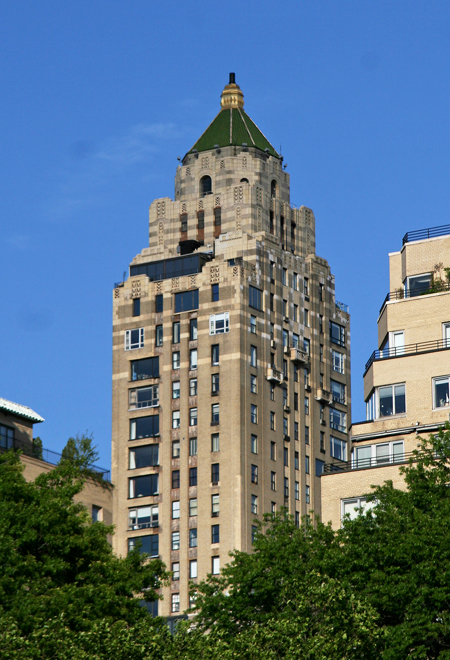
    The Carlyle Hotel has been called the grand dame of this world. The services abound with restaurants, clothing and jewelry boutiques, an art gallery, antique shop, and antiquarian book dealer. The Café Carlyle has featured numerous well-known jazz performers, with regulars such as Bobby Short (1968-2004) and Woody Allen, who has been a Monday night regular there since 1996.

    The Carlyle is renowned for guest privacy and why the New York Times called it a “palace of secrets.” It became best known when President John F. Kennedy owned an apartment there on the 34th floor. From Christopher Gray’s Streetscapes in the New York Times:

    The earliest hotel tenants included Chester Dale, an investment banker and art collector who was later president of the National Gallery of Art. His collection of French 19th- and 20th-century paintings was one of the finest of the mid-20th century. … Senator Kennedy took Dale’s former apartment, 34A. Kennedy held onto it throughout his presidency.

    The Carlyle is where Marilyn Monroe reportedly had a tryst with Kennedy, entering with him via a labyrinth of tunnels. On June 14, 2010, the FBI released a 2,352 page file (see it here). In the file are reports of alleged sex orgies in Kennedy’s suite, naming John, Robert, and Ted Kennedy, actor Peter Lawford and his wife Patricia Kennedy, Marilyn Monroe, Frank Sinatra, and Sammy Davis Jr. as participants. I have read many snarky comments about how this news is so old – who cares? But this is not just any family, this is the Kennedy family, and this is not just any hotel, this is The Carlyle.

    Note: The Carlyle, located at 76th Street and Madison Avenue in Manhattan’s Upper East Side, was built by Moses Ginsberg, designed by Bien & Prince and completed in 1930. The Art Deco residential hotel has 180 rental rooms and 60 privately owned residences.

    Posted on by Brian Dubé

  • Let There Be Light

    Posted on by Brian Dubé

    The New York City subway system is not the place you would associate with natural lighting, but according to a 2002 article by Christopher Gray of the New York Times:

    John Tarantino, chief architect at New York City Transit, said the agency was working citywide to bring daylight back to the subway experience.

    In February 1904, The New York Times noted that ”a speck of dirt would find a difficult resting place” in the new subway stations, which were trimmed with oak, bronze, red granite and decorative tile. Instead of the bare bulbs now common to most stations, the original subway had simple but distinctive globes. Ventilation was closely considered, and an article in World’s Work magazine described the air as ”dry and sweet” and noted that ”glass roofs provide the stations with plenty of light.”

    Vault lights were also heavily used – in 1904, 20 of the 34 underground stations had vault lights. (See my posting, Sidewalk Vault Lights.) In the same article, Gray quotes from the 1904 commemorative book The New York Subway:

    At 20 of the underground stations it has been possible to use vault lights to such an extent that very little artificial light is needed.’ Photographs of stations in those days show great banks of sidewalk vault lights casting natural light onto the platforms directly below; presumably the platforms sent a soft glow to the streets at night, when artificial lighting was used.

    But not long after, most of the vault lights were removed. In 1938, an article by Laurence Bell in The American Mercury magazine entitled The Most Awful Ride in the World deplored the ”murky depths” with ”concrete even filthier than the stairs, a filth that is accentuated by the dim lights whose sole reflectors are the stained walls of once-white tile.”

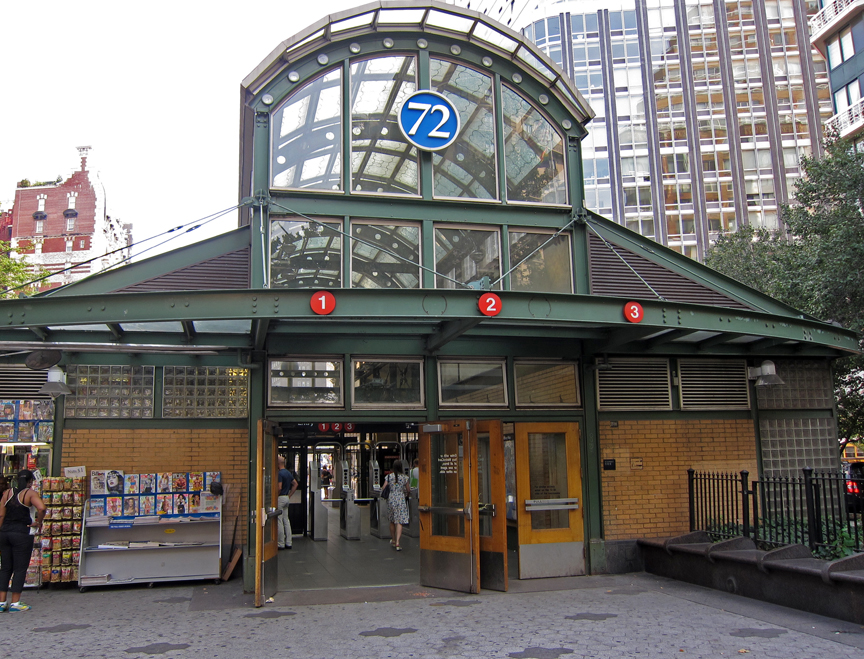
    Street-level station houses were not so well-liked. The well-known and heavily used station house at 72nd Street and Broadway is a particularly egregious example, with platforms and stairways that are unusually narrow. Until completion of the new control house, there was only one entrance to the station, access only via the middle of a traffic island, and no free transfer between the uptown and downtown sides of the station.

    In 2002, construction began on a new control house. The design was a joint venture between architects Richard Dattner & Partners and Gruzen Samton. Inspired by the Crystal Palace at the London Exhibition of 1851, the new structure has lots of glass. See additional photo here. However, although vault lights had been planned, cost-cutting issues and maintenance concerns of the proposed vault lights resulted in their elimination.

    Light is a precious thing, particularly in the New York City subway system, where natural illumination goes a long way to ameliorate the grim and grimy subterranean environment. I am sure I am not alone among New Yorkers when I ask of John Tarantino or any other NYC transit tsar, let there be light 🙂

    Posted on by Brian Dubé

  • Watch the World

    Posted on by Brian Dubé

    On January 12, 2010, I wrote of my first apartment in New York City in Diner Be Aware of the Diner. Living on West 22nd Street in historic Chelsea was a unique privilege, one which I grew to appreciate more and more in hindsight. This was truly a case of you don’t know what you’ve got ’till its gone.

    One of the great pleasures of my short time there was sitting on the stoop on a summer evening with friends and chatting amongst ourselves, with passersby and with neighbors. We had no idea that we were reenacting an historic activity, something New Yorkers have done in many neighborhoods across five boroughs for ages.

    I frequently sit on the stoop of my current residence, a townhouse in Greenwich Village (see Being Trumps Doing here). Unfortunately, my neighbors rarely do the same.

    Stoop sitting still exists in some neighborhoods. In many, however, they have become resting spots for loiterers, visitors, and drug users. Many buildings have installed wrought iron gates as a deterrent. Even though these gates are not locked, most nonresidents will avoid opening a gate.

    The benefits of stoop sitting are many. It provides entertainment, socializing, becoming acquainted with neighbors, crime watch for improved safety, and some fresh air. I have met celebrity chef Mario Batali on a number of occasions taking a break and stoop sitting across from his restaurant, Babbo, on Waverly Place.

    Stoop sitting in New York City was common by the early 19th century. New York City is a place where one finds a lot of running and chasing of people, places, and things. But the savvy urban dweller or visitor will find that much can be seen and learned and people met by just staying in one place (see Taste here). Like the café habitués of Europe have found, people watching is a pleasurable activity unto itself. Find a spot on a park bench or stoop and watch the world go by 🙂

    Photo Note: The stoop on the left is on Washington Square North, as viewed from my stoop (see it here). The stoop on the right is my first NYC apartment residence, located at 431 West 22nd Street. I believe the building may have remained a rental, accounting for its poorly maintained condition – such a pity.

    Posted on by Brian Dubé

  • The Cable Building

    Posted on by Brian Dubé


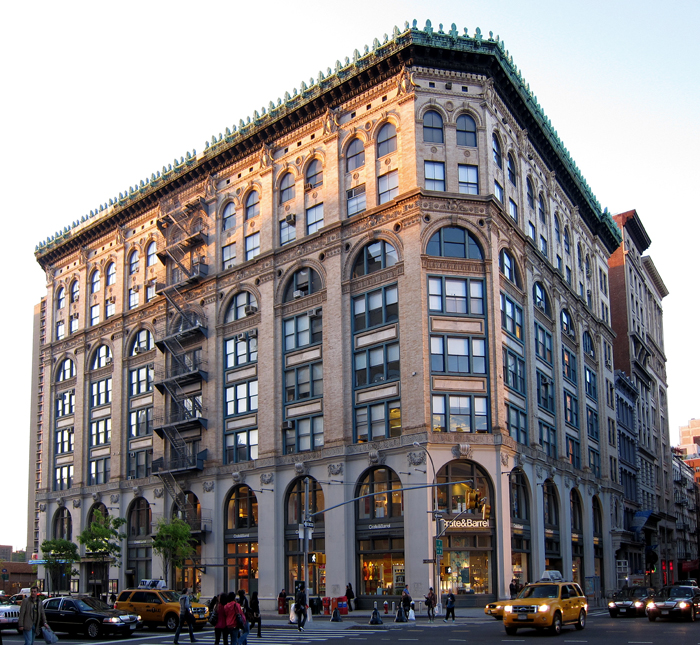
    I hated the Cable Building. It was gray and grim, as were the spaces and long hallways ringing the interior atrium. Everything about it was unappealing to me, even its location at 611 Broadway and Houston Streets, now a prime shopping district.

    But when I needed commercial space, my conversations with brokers invariably led to the Cable Building, where, any day of the week, small spaces were readily available at reasonable rents. The mention of “611 Broadway” made me cringe. The idea of traveling through the building’s long serpentine corridors for use of water and a shared bathroom was very unappealing to me. The only real way of securing these amenities en suite was to rent an entire floor of a building, which I finally did.

    Much as someone who has to work through a childhood fear of dogs, it has taken me decades to shake off my feelings about the Cable Building. All so ironic – anyone visiting today would be incredulous that I would reject or have misgivings about this historic structure.

    One of the most difficult things to communicate to those who have no experience of New York City prior to 1980 is how rough a state this city was in. SoHo was a no man’s land, the East Village uninhabitable. Everyone I know had personal experience with being mugged/robbed. Car alarms provided music. Graffiti-painted subway cars were the norm. Glass shards on the street from auto break-ins would be a daily sighting.

    Running a business in New York City has all the typical expenses – salaries, insurances, holiday and vacation pay, staffing, etc. Operating in New York does, however, present things which make it even more onerous – high rents, problems parking or standing for delivery vehicles or visiting customers, freight which will have to be taken to its destination by elevator – generally only retail stores can afford ground floor space. At one time, ground floor industrial was common. No longer.

    When possible, working from home, sans employees, solves many of these problems. I did this for many years. But time came, as it does for many, that working from home was no longer viable – there were just too many activities inappropriate in a residential building for a business of my nature – receiving supplies, shipping goods, and seeing customers meant excessive traffic and noise. So I was forced to shop for commercial space.

    Moving was not the worst prospect – working at home is not the dream life many think it is. Yes, there is no commuting, but working alone every day takes its toll for anyone with any modicum of social needs. I have met some who are happy to work alone. The question is whether you can do this on a full-time basis.

    One big problem in looking for space is that I had been severely spoiled by working at home. The ambiance of a residential building and the amenities of a home, i.e. a kitchen and private bathroom, are all very different in a commercial building. I needed small space and a building that permitted light industrial use – this is a challenge anywhere, including the suburbs.

    My office is only two blocks away from the Cable Building, and I often visit Crate and Barrel on the second floor, as much to enjoy its beautiful space and views as to peruse the merchandise.

    Try as I may, there’s no getting away. My fate seems to be intertwined with the Cable Building 🙂

    Note about the building: The Cable building was built in 1893 and designed by McKim, Mead & White. Its name hearkens back to its brief history (less than 10 years) as a power plant for a new cable car system in Manhattan, extending from Bowling Green to 36th Street. The basement, 40 feet below street level, houses enormous steam engines, boilers, and winding wheels. Read Christopher Gray’s Streetscapes article from the New York Times here.

    Posted on by Brian Dubé

  • Throw Me a Curve

    I recall battling with my graphic artist over using just her eye to place objects and making other judgements that you could simply do by measurement. I was a believer that if something can be measured, it should be. Nothing else made any sense, and just using the human eye was unfathomable to me.

    I spent hours with toys of my generation – Erector Sets, Etch-a-Sketch, and Lincoln Logs, but there was always something I didn’t like about them. I could never put my finger on it exactly, but at last I think I can. I see it clearly now. Left, right, x and y – my mind has been shaped by the orthogonal toys and the scientific tools and concepts of my youth. Working in this way can dull the mind and artistry. Just look at creative work done by those with a mathematical or engineering approach. Most artists are typically not wired to think and work in these ways.

    Much of Manhattan was designed as a grid (see True North here). Certainly there is justifiable practicality in a grid from many perspectives – just ask any visitors navigating Manhattan’s gridded areas. But not everything should bend to the will of the practical, efficient, most utilitarian, or most cost effective (see Very Practical here).

    The Eiffel Tower was highly controversial at the time of its building. And it is arguable that it has the look of something designed by an engineer. But there is one redeeming feature constant throughout the structure – curves. I can’t imagine how it would look built completely with right angles.

    Sitting in traffic in Long Island City on the approach to the 59th Street Bridge, with a hideous Erector Set above adding insult to injury, it makes me want to roll down a window, stick my head out, and scream, “I can’t wait for the bridge. Please, someone, throw me a curve…


  • dinamic_sidebar 4 none

©2026 New York Daily Photo Entries (RSS) and Comments (RSS)  Raindrops Theme