• Category Archives Scenic NYC
  • Pillowcases


    I have many good childhood memories of Halloween. However, with some, it was a time of opportunity and greed. Some of the kids I knew at the time approached the night as a virtual legalized form of looting, going out very aggressive and focused, on a mission. They were typically much older, and their costuming was minimal – seen only as a necessary nuisance to legitimize their door knocking and collection. After their high-speed tear through the neighborhoods, they bragged to others of booties that were a pillowcase full – that’s a lot of candy.*
    Others of us with more modest goals, counted and compared tallies on number of candy bars collected. Fruit and other assorted sundries were looked down upon. And as the growing number of incidents of fruits and other non-packaged items being laced with drugs, chemicals, or razor blades became greater in number, we had further reason to dismiss these trick or treat gifts.

    It was not until I became an adult living in New York City that I began to experience Halloween as an opportunity for creative costuming, parties, and decorations, with the annual Village Halloween Parade as the pièce de résistance, with millions attending.

    There is a limited amount of door-to-door prospecting for goodies by children in the city, but it does exist. In larger buildings, particularly in Manhattan, children often go trick or treating in their own buildings (or to their friend’s buildings) from apartment to apartment. Often signs will be put on apartment doors indicating whether or not the occupants are participating.

    In the outer boroughs, children still make the rounds to private homes, much as they do in the suburbs or countryside. However and wherever you do it, I hope parents will help children measure the fun in ways other than pillowcases…

    *I found a science project online that proclaimed:

    When it comes to Halloween, greed is most definitely good. And there’s nothing like an old pillowcase – sturdy, voluminous, reusable, and environmentally conscious – to hold your epic stash. But you must have wondered – exactly how much candy could you possibly collect in a standard pillowcase? How many houses would you have to visit and how much ground would you have to cover to achieve that that elusive goal?

    The project went on to calculate not only the amount of candy that would fill a pillowcase (48 lbs, 1690 pieces) but also how much time, area and walking would be needed. In Campbell, California, it was estimated that you would have to visit about 1352 houses to fill a pillowcase, and walk about 11 miles, covering .42 square miles.

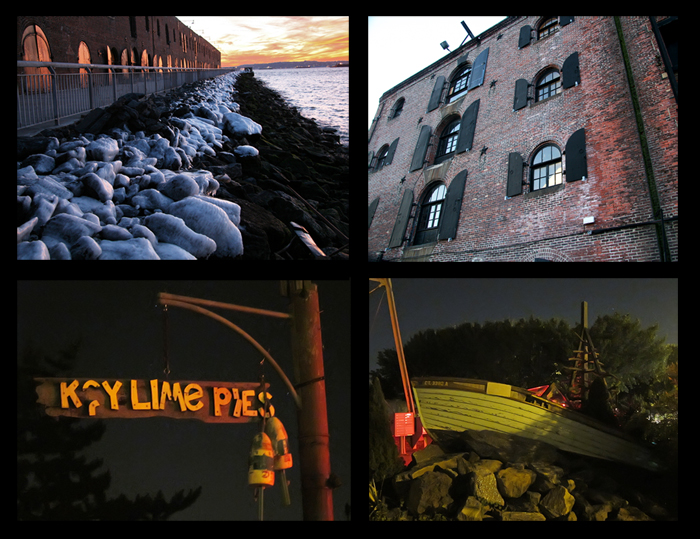
    Photo Note: Today’s photos were taken in Brooklyn Heights, one of the most pristine, bucolic, picturesque, and cloistered neighborhoods in the entire city of New York. See my posting here.
  • The Little


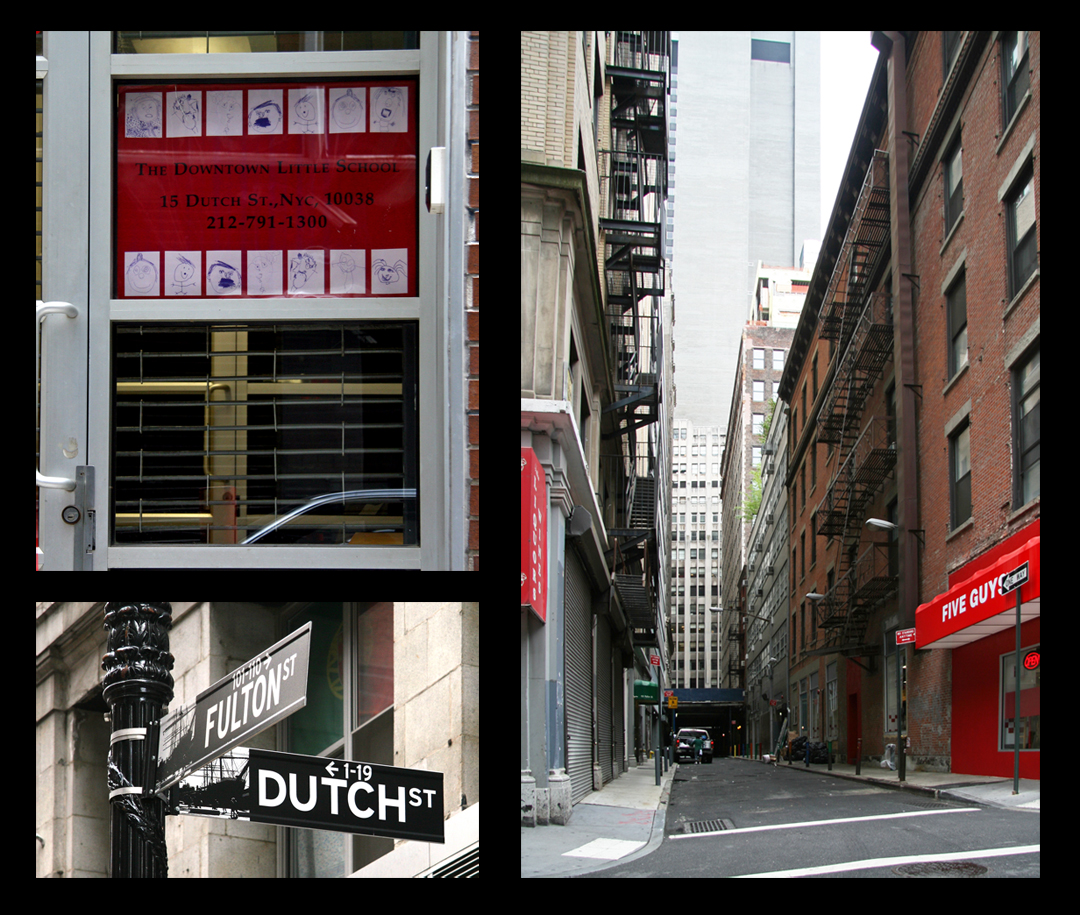
    Here, in lower Manhattan, way under the radar and not touristed at all, I discovered a little school on a little alley. In New York City, this is how I find solace, in the diminutive. A little alley, a little crook in the street, a little shop, a little building, a little garden. Feeling a little tired, because one can never really become exhausted from exploring the little, and if it is a beautiful day, perhaps one may enjoy a little rest and a little snack. This is why I choose to live in Greenwich Village, because the scale is so much smaller and so much more human.

    I have been in many high-rises, and there is nothing quite like the ambiance of a classic prewar building and, if one is so privileged, the views that may come with a residence on an upper floor. Icons like the Waldorf Astoria Hotel or the Plaza just exuded charm. And there is nothing quite so noble as the Chrysler Building at night. But for me, when it comes to a place I call home, I choose the small townhouse.

    I have not been to the new Vegas, and I imagine I will get there at some time. And, like Dubai, I also imagine that there will be some shock and awe. However, living in New York City for the last 40 years, I do not seek out the mammoth or the overwhelming when it comes to man-made environments. And although I live in the country’s largest city, in my business life I have carved out a little niche. It is much easier to succeed in the proverbial small pond.

    At 15 Dutch Street, I was very surprised to find the Downtown Little School. From reading, parents rave about this nursery school, and I think the word Little (like the Little Red Schoolhouse on Bleecker Street) is a signal that this place emphasizes caring, personal attention, and the human touch, embracing all that was good in the old school.

    I was also very surprised to learn that the huge multinational giant, Colgate-Palmolive, had its roots on Dutch Street. In 1806, at 6 Dutch Street, William Colgate opened up a starch, soap, and candle factory, a reminder that not only the good, but also the big germinates from the Little 🙂


  • Urban Night Climbers


    Texte alternatif
    For a full night climbing experience, click and play audio link to accompany your reading.

    Many years ago, in a conversation with a customer, the subject somehow turned to my childhood love of tree climbing. My customer was VERY pleased to hear this, and encouraged me to rekindle this interest, embrace some trees, or perhaps even join him and his friends in their nocturnal sojourns. He was a night climber. Of buildings.

    New York City is a city that never sleeps. We are known for our night clubs, night life, and night people – but night climbers of buildings? I was not aware that there was an underground fraternity of those who practice buildering, aka urban climbing, stegophily, or structuring.

    The press has covered the various climbing spectaculars of the city – Philippe Petit’s legendary walk between the world trade towers on August 7, 1974. George Willig, a mountain-climber from Queens, New York, United States, climbed the South Tower of the World Trade Center on May 26, 1977. Alain Robert is a French rock and urban climber who in 1994 scaled the Empire State Building and on June 5, 2008, climbed the New York Times Building (later that day, Renaldo Clarke also climbed the building). Dan Goodwin, using suction cups and a camming device, climbed the North Tower of the World Trade Center on May 30, 1983.

    But recreational buildering goes back much further than might be expected, at least to Victorian times in England, where students had been climbing the architecture of Cambridge University. Geoffrey Winthrop Young was roof climbing there in the 1890s and published The Roof Climber’s Guide to Trinity in 1900. In 1937, The Night Climbers of Cambridge was written (under the pseudonym Whipplesnaith) about the nocturnal climbing on the town buildings and colleges of Cambridge, England in the 1930s.

    In the United States, two men, George Polley and Harry Gardiner, both nicknamed the Human Fly, pioneered buildering as early as 1905. In 1920, George Polley climbed 30 floors of the Woolworth building before being arrested. Not much, however, is written about current recreational nighttime buildering in New York City, for obvious reasons. In 2008, the New York Times published an article with a little on the activity.

    Apart from legality or prudence, I do understand the lure of urban climbing. Much as the alpine areas of the world are magnets for rock climbers, the buildings and skyscrapers of New York City provide the same challenges and draw in masonry, steel, and glass. Perhaps I may yet get to witness the activities of these urban night climbers…

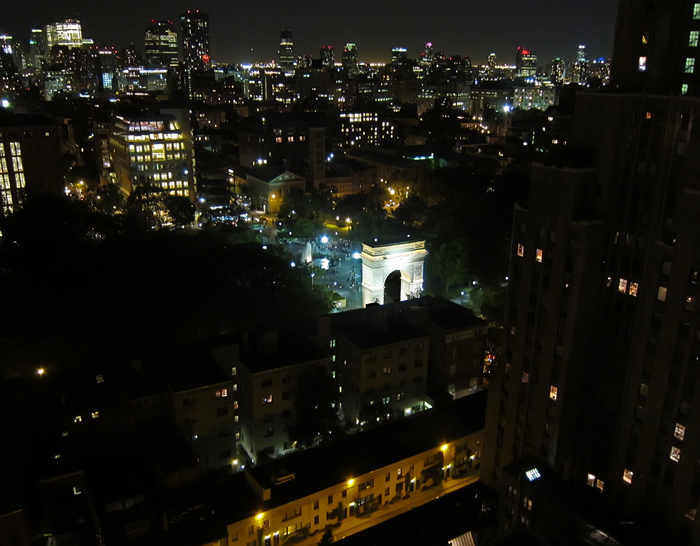
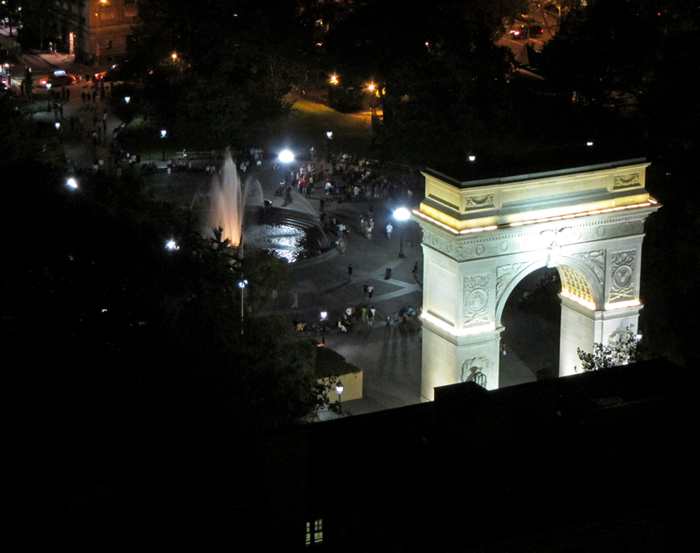
    Photo Note: I was recently privy to access to one of the very few rooftops in the Village affording a direct view of Washington Square Park. The building and friends kind enough to invite me to share the view, will, in the spirit of buildering, remain a secret 🙂


  • Enjoy These Photos

    A visitor or even long-time resident may be puzzled by the reason for nursery or garden centers in Manhattan or for gardening supplies in hardware stores. One of the secrets of New York City, particularly Manhattan, is that there is a lot more green than one might imagine. This world will rarely be seen unless one has access to a view.

    The impression one might get while walking the streets is that the city is a fusing of buildings. The Concrete Jungle is an apt description for much of Midtown Manhattan and the Financial District, where steel, glass, and concrete is the norm. Any green space is limited and in plain view such as pocket parks, atria, etc.
    However, in residential neighborhoods, particularly those dominated with rowhouses such as the Village and Chelsea, gardens spaces are located behind every house. These backyard gardens abut each other, often resulting in unbroken green space for an entire city block from avenue to avenue. The best way to see this is using the satellite view of an online search engine’s mapping feature. Locate a neighborhood such as Greenwich Village (try zipcode 10011, e.g.), zoom in, and pan around. You will see a surprising amount of green space. Note the interior garden spaces behind the buildings.

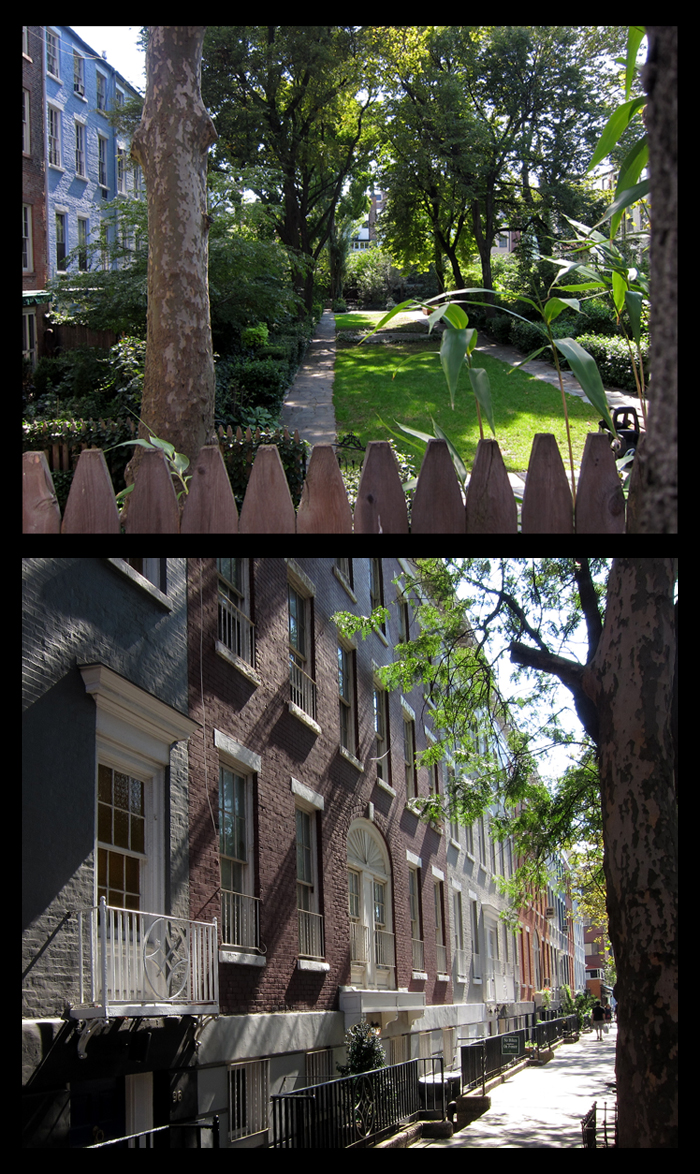
    The lush green oasis in today’s photo is a rare view of the communal greenspace behind the Macdougal-Sullivan Garden District. From the website of the Greenwich Village Society for Historic Preservation:

    This small enclave planned around a private central garden became a prototype for related developments of the 1920s. In 1920 the Hearth and Home Corporation purchased 22 deteriorated Greek Revival Row Houses, built between 1844 and 1850. It commissioned a rehabilitation from the architects Francis Y. Joannes and Maxwell Hyde who removed the stoops and gave the two street facades a Colonial Revival appearance, as well as communal backyards.

    The development served as a model for several other redevelopment projects in the South Village in the 1920’s and 30’s, where older buildings (often tenements) were joined together to create communal spaces and more “modern” appearances for their buildings. This was in many ways reflective of the changes in the neighborhood in the inter-war years: foreign immigration had subsided, but the area was increasingly of interest to Americans of a creative or bohemian bent.

    Older housing, such as rowhouses and tenements were considered by some obsolete. However, this communal style of redevelopment reflected a valuing of the neighborhood’s quaint features, even as landlords and new residents sought modern amenities and collectively enjoyed light, air, and open space.

    These gardens are not open to the public, so unless you have the rare privilege to know a resident, you will have to enjoy these photos 🙂


  • Love is All Around, Part 1


    We are living in a time in New York City where the housing options are becoming more and more grim. The borough of Manhattan is not an option for most newcomers or young people – there are no edgy, affordable neighborhoods. Gentrification is like a big iron, and all the edges and wrinkles have been pressed out.
    Neighborhoods in the boroughs with dramatic buildings and setting, such as DUMBO , have also been gentrified beyond affordability. Areas with historic homes, such as Park Slope and Brooklyn Heights, have been pricey for many decades – certainly nothing that anyone would consider affordable. Willamsburg and Red Hook, with its industrial buildings, are going the way of SoHo.

    For the young and/or the artist desiring to be immersed living among those of like mind and spirit, this can be discouraging. The only options left are extremely blighted or working-class neighborhoods. Places that have no particular cache. This sometimes means living in an ethnic enclave where, although readily accepted, it is easy to feel like an outsider. More and more, I have seen younger people move to neighborhoods where they feel isolated.

    However, many adapt and embrace these areas and welcome the change, new foods, and cultural mix. Some revel, in the absence of the trendy and chic, in places that are real working-class neighborhoods, such as Astoria, Queens, which has has attracted artists for decades. See my photo gallery here. Many looking for reasonable rents and proximity to Manhattan have found a home in Astoria. On October 9, 2009, the New York Times ran a story of how “a thriving hive of comedians has affixed itself to Astoria, perfectly suited to the particular microclimate there.” From the article:

    In 2003, ASTORIA, across the East River from Manhattan on the northwest tip of Queens, always has been a neighborhood of affordable beginnings. William Hallet, a 17th-century English immigrant, is said to have secured his 1,500 riverside acres in exchange for 7 coats, 14 kettles, a blanket and some beads. Waves of Germans, Czechs, Irish, Italians and Greeks followed, working-class folk who bought into the American dream and local real estate.

    Today, the immigrant pool includes Russians, Arabs, Middle Europeans, South Asians, East Asians, Latin Americans and young Midwesterners who think they have discovered Europe in the coffeehouses and bakeries. Few neighborhoods, even in New York City, have such ethnic diversity.

    The slogan ”only 15 minutes from Bloomingdale’s” describes location, not shopping habits. As the essence of a working-class neighborhood in the 1970’s, at the height of Greek immigration, Astoria was home to TV’s Archie Bunker. Despite an influx of young professionals, musicians and actors seeking refuge from Manhattan prices, and a nudge toward the chichi with two Starbucks with wireless connections, shops like Victoria’s Secret and a vibrant night life, Astoria still has blue-collar roots. 

    Best known for its Greek population, Astoria is named after John Jacob Astor, who was persuaded to make a small investment there but never lived in Astoria. Its working-class roots go back to Steinway & Sons, home there since 1853. Astoria is also home to the American Museum of the Moving Image and Kaufman-Astoria Studios. You can read more about the area here and here.

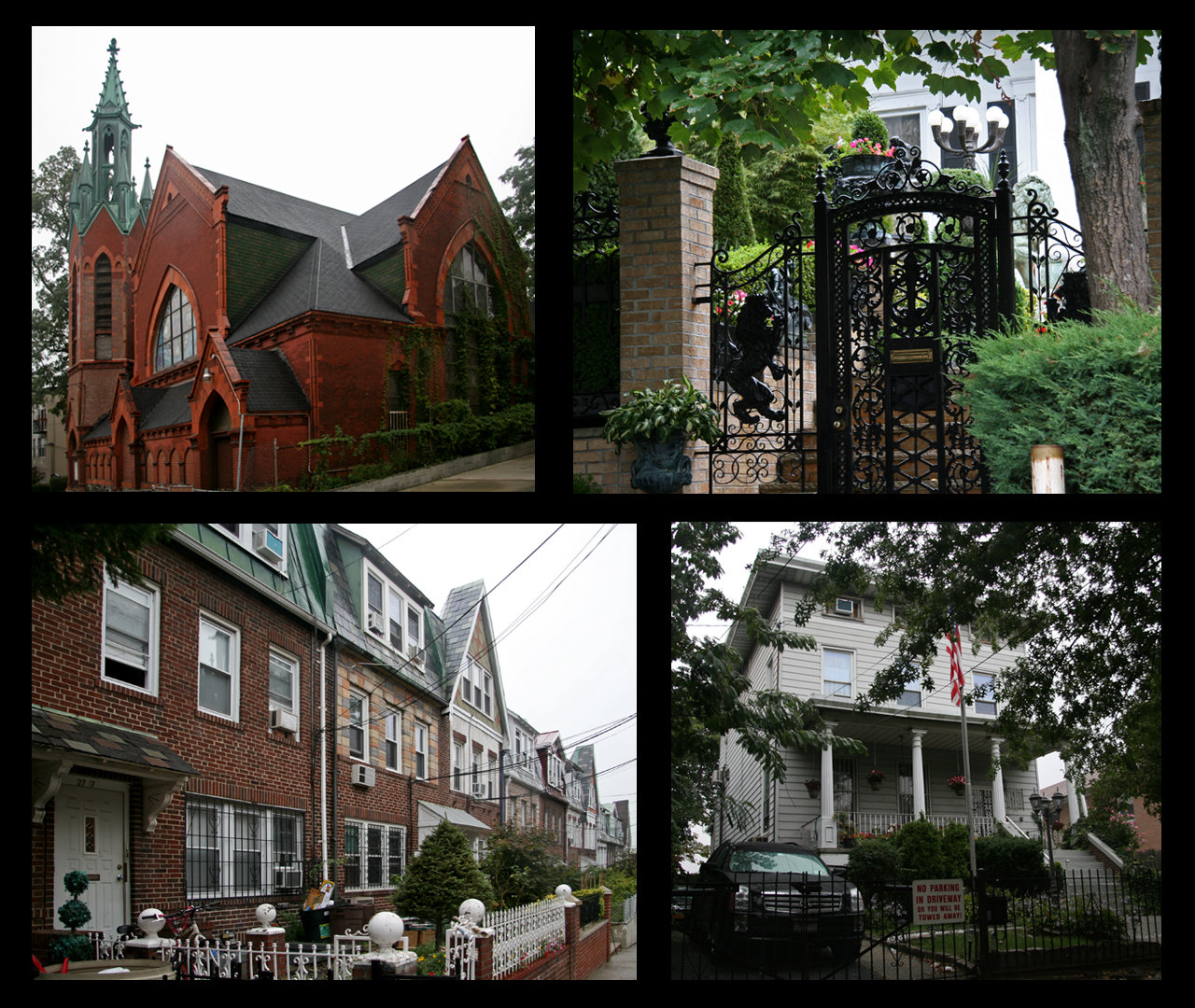
    But be not misled by a working-class neighborhood, a couple of dreary photos, and a few plain looking homes, because in Astoria, as you will see in Part 2, Love is All Around…


  • Drive-by Shooting

    Silvercup Studios, with its huge iconic sign, has been an elusive enemy of mine for some years. On February 7, 2007, I did a story on the studios located at at 42-22 22nd Street in Long Island City, Queens, and its history as a conversion of the former Silvercup Bakery building (circa 1920). However, all the photos from that time were taken from across the river in Manhattan. I had yet to see the sign and studios close up.
    My experience of war and enemies is limited to Avalon Hill board games, such as Stalingrad and chess or Go, both of which I played in high school and where circling the enemy is an effective, if not necessary, strategy. So Sunday, armed with cameras for shooting, flashcards as ammunition, and board games as experience, I hunted that sign down.

    Fortunately, for the inexperienced warrior that I am, Silvercup Studios is a very slow moving target, and a drizzly Sunday is the perfect time to go to Long Island City. The neighborhood is very quiet, essentially deserted. Public transportation will get you there easily, but covering large tracts of the outer boroughs becomes impractical by foot – best is by bicycle or car. If you have the luxury of a car, driving is a breeze, and parking is everywhere to be found on Sunday.

    There are many subjects in New York City that, for any number of reasons, are best photographed from an automobile. Many vistas and vantage points are from roadways – often, stopping is not even an option – so shooting through an open driver’s or passenger’s window, open sunroof, or straight through the windshield becomes the modus operandi. However, if not limited to necessary situations, this can become a dangerous habit, leading to a lazy style of photography which I like to call drive-by shooting.

    There are numerous good vantage spots for shooting the Silvercup Studios sign, and I explored the options, combining the few skills I have and what I know, past and present, about capturing the enemy by circling the building and neighborhood numerous times in my covered wagon for an afternoon of drive-by shooting 🙂

    Note: The ultimate view of the sign is from the on ramp to the upper roadway of the Queensboro Bridge, returning to Manhattan. Here, the road makes a complete 360 degree circle completely around Silvercup, affording close views of the sign from front, back, and side. However, this busy traffic loop is somewhat treacherous to drive one-handed while shooting with the other. Another time, perhaps.


  • Sittin’ on Top of the World

    Manhattan has a coordinated traffic signal system. Avenues run north/south and are generally one way, like the majority of crosstown streets. These avenues have traffic lights that are timed progressively so that traffic can move without stopping. In theory. The lights move in a wave – a green wave of about 5 lights traveling below speed limit, sandwiched between red lights behind and in front of this green wave. Driving these avenues is urban surfing – wait for a wave, catch the wave, ride the wave as long as possible, and don’t get caught in the soup. I have often ridden a wave like this for miles down an avenue.

    On other major avenues that are two way, such as Park Avenue, Central Park West, and 11th and 12th Avenues, lights are timed to change simultaneously. This means that the faster you go, the more lights you can make before stopping.

    I drove a taxi in college, as did nearly all of my best friends. On one occasion, the wildest driver of the bunch asked me how many blocks I could make on Park Avenue. I believe he said he could make somewhere in the vicinity of 27 blocks. Without going through the mathematics, I can assure you – that is some fast driving on city streets, somewhere in the neighborhood of at least 60 miles per hour. Unfortunately, a few of us took this as a challenge, later comparing results. Fortunately, there were no fatalities in this short-lived reckless contest.
    The speed limit in Manhattan is 30 mph. Traveling at 60 plus miles per hour on crowded city streets is lunacy. The reason for high auto insurance for those under 25 is abundantly clear.

    Today’s photo was taken looking north from the last Park Avenue mall. The small park extends from 96th to 97th streets, where the Metro North train tracks emerge from underground to travel on an elevated trestle along Park Avenue. Looking at this now, I realize that I could have challenged my college friend to see if, in French Connection style*, he could outrun a commuter train.

    I, however, will keep away from all temptation that Park Avenue may offer, opting instead for First or Second Avenue with the gentle waves of the progressive lights, where, with good conditions, I can catch a wave and ride it all the way. That thrill makes me feel like the ultimate Beach Boy, because in New York City, if you can catch a wave and ride it all the way, you feel like you’re really sittin’ on top of the world* 🙂

    *The French Connection (1971) has what many consider of the greatest car chase scenes ever filmed. The chase was between a hitman on an out-of-control train on an elevated section of a subway line in Bensonhurst, Brooklyn, and a police officer in a car on the streets below the train. Most of the chase sequence was real and filmed without permission from the city of New York. It includes an accidental car crash, which was left in the film.

    *From the Beach Boys song Catch a Wave, with the refrain: “Catch a wave and you’re sittin’ on top of the world.”


  • Just Around the Corner

    Nooks and crannies are not only the obsession of urban jungle lovers and explorers. They are also big business – Thomas’ has built a $500 million dollar business around the famed nooks and crannies of their English muffins. Chris Botticella is one of only seven people who knows the entire secret process to produce the legendary muffins with signature air pockets marketed as “nooks and crannies.”*

    Finding nooks and crannies in a city like New York is just as delightful as a Thomas’ English muffin. However, unlike the muffin which can be found in any grocer, special pockets of the city are much harder to locate. I have explored many of these on this website.

    The financial district is the oldest area of New York City, and remnants of Nieuw Amsterdam still exist amid the towering structures. In tandem with the areas, extremely narrow streets create a uniquely cavernous feel. The area is largely overlooked by visitors and residents, excepting for the more obvious spots such as South Street Seaport, Ground Zero, and Battery Park.

    It is remarkable that places like Mill Lane and Stone Street were completely unknown to me until Sunday, while combing the streets of the financial district in the rain. Temporary scaffolding on Mill Lane provided the necessary shelter and an opportunity to see a bit of this historic area in a deserted state. Mill Lane is one of the shortest alleys in New York City. It lies between South William and Stone Streets.

    I love turning a corner to a pleasant vista, like coming around a hairpin turn on a mountain precipice that opens to a jaw-dropping panorama. Looking around the corner at Stone Street from Mill Lane was a throwback in time. The restored street is a beauty, what the New York Times called “Turning an Alley into a Jewel.”

    Stone Street was originally known as Brewers Street by the early Dutch settlers. In 1655, when the street was paved with cobblestone, it became known as Stone Street. In the 1980s, the street was divided to make way for the Goldman Sachs building. The short historic block, “a back alley filled with graffiti, a garbage pit; used for low-level drug dealing”, was completely restored with redone buildings, New York bluestone sidewalks, new Deer Isle granite paving blocks, and period street lights. Most of the buildings date to 1836, rebuilt following a fire in 1836. In 1996, the eastern portion of the street and surrounding buildings became protected by the New York City Landmarks Preservation Commission as the Stone Street Historic District. It is pedestrian-only.

    I look forward to going back in better weather. I recommend taking a stroll down the narrow streets of the area, exploring the nooks and crannies, and looking for that surprise just around the corner 🙂

    *Thomas’ was purchased by Bimbo Bakeries USA in 2009. In January 2010, Botticella left the company to work for Hostess Brands, who had been trying to learn the secrets of Thomas’ muffins. Bimbo, however, was successful in getting a court order barring Botticella from taking the new position. See the article here.


  • Roode Hoek


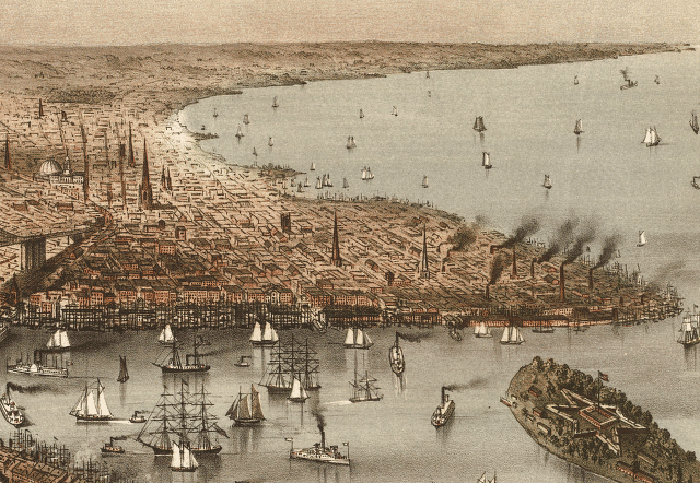
    Red Hook circa 1875I have had so many conversations, ad nauseum, that there is no life after Manhattan and that I did not move to New York City to live in Brooklyn or Queens. I have had many close friends in Brooklyn, the Bronx, and Queens, and I have traveled there hundreds of times.

    I have seen the merits of the boroughs, as readers of this website can attest, yet I have remained steadfast in my resolve that Manhattan is the ne plus ultra of the known universe and that the outer boroughs may be nice places to visit, but I wouldn’t want to live there.

    Until recently.

    This is a city that is still exciting and dynamic, particularly if you are of the generation that has grown up with Blackberries, a six-figure income in your 20s, apartments that sell for over one million dollars or rent for for over $3000 per month, and rapid gentrification of neighborhoods.

    However, Manhattan is losing its character and rapidly becoming the Singapore of the United States. Websites feature forgotten New York, vanishing New York, disappearing New York, and lost New York. For the special and unique, you must dig deeper and look further afield.

    Like Red Hook, Brooklyn.

    Red Hook was settled by the Dutch in 1636 and named Roode Hoek (“roode” for the red clay soil of the area and “hoek” meaning point or corner). The neighborhood is really a peninsula, cut off from the rest of Brooklyn by the BQE and Gowanus Expressways. Public transportation is a vital part of New York City life. Red Hook has no subway service to the neighborhood – this relative isolation is one of the key elements that has kept the neighborhood from developing as rapidly as other areas, such as DUMBO. Even as recently as the 1990s, the neighborhood was considered one of the worst neighborhoods in the USA and the “crack capital of America.”

    On June 18, 2008, IKEA opened an enormous store in the neighborhood, amid huge controversy (replacing a 19th century dry dock) and concerns over an increase in congestion.

    The older warehouses, waterfront vistas, and isolation are exactly what makes the neighborhood so desirable and have attracted artists and small businesses for some time. See my photos and story, Fire and Ice. If you have a chance, visit Roode Hoek…


  • No Sir

    Last evening, I was discussing the disarmingly polite ways of the southern American with a friend who has recently been vacationing there regularly (see my story, Luray Caverns, about my first experience there as a child). When working with customers on the phone, as I have over the years, I have noticed that with men from the South, every question I have asked in respect to their order has been answered with “Yes, Sir,” or “No, Sir.” Perhaps they have not traveled the roadways of New York City, where they may quickly want to trade their polite phraseology for some more appropriate expletives.

    There are vistas common to New Yorkers who travel by car which are not often seen in photos, as they can only be seen by a vehicle on a roadway. The photo was taken in Brooklyn from the Brooklyn-Queens Expressway, heading north with views of the Brooklyn Bridge and Manhattan with the Empire State Building. The Brooklyn Heights promenade (with similar views of the city) looms overhead to the upper right. This view is particularly beautiful at night.

    Prudent or not, I have resorted to shooting while driving to capture images with varying results. Digital cameras with various auto settings and the ability to immediately review shots make getting an acceptable “Hail Mary” possible.

    On a recent excursion to Staten Island, a photographer friend was giving me a first ride in his new Mini Cooper. With its diminutive size, it is a popular car around New York City. My atypical position as passenger and the challenge of shooting overhead with no sunroof begged for at least an attempt at getting an acceptable photo while moving.

    The vista in today’s photo is one known to every Brooklynite or traveler who has plied his or her way between Brooklyn, Manhattan, and Queens, using the infamous BQE. The beautiful views are rare and welcome eye candy and respite from a city plagued with unattractive, utilitarian highways usually snarled with traffic.

    The BQE, the FDR, the Cross Bronx, the LIE, the Van Wyck, the Grand Central, the Prospect, and the Belt. If you live and travel in this city, an acronym or truncated name for a highway is more than adequate to identify these common roadways. Any highway in New York which gives as much trouble to and tries the patience of the traveler, as these roads typically do, does not need to be addressed any more politely than with the shortest possible title. No Sir 🙂


  • Paint by Number

    There is nothing that seems to make an artist bristle more than paint by number* or anything remotely resembling it. It is useful to know what is best left to subjective human judgement. However, it is also good to know what is best done by using numbers, as well as where using numbers is more efficient and does not degrade the human experience.

    I recall a documentary on the illy coffee company of Italy. What really impressed me was the balance between the subjective and objective in their coffee production process. There are things better done using science and technology and things better done by the human senses, and the illy family knows when to use what.

    Numbers lie behind most things, and ultimately, given fine enough resolution, many analog things can be reduced to a digital file with satisfying results. Music is a good example. Most musicians have embraced digital recordings. Whether or not they are absolutely identical to an analog recording and whether there are any audible differences are moot points for most – the digital files communicate well the feelings intended by the composer and performers, the primary feature being the ability for flawless reproduction.

    There are things that appear to resist reduction to digital reproduction and are controversial. Stradavarius, Guarneri, and Amati violins are a good example – these instruments are highly coveted by violinists. However, tests have been done using antique and new instruments, with mixed results as to the ability of some of the world’s greatest musicians and experts to distinguish the old from the new by listening alone.

    Along with music, imaging and photography have been most greatly impacted by the digital process. The fact that a scene like that in today’s photo can be effectively communicated with a digital file is remarkable. I stumbled upon this exquisite little gingerbread cottage while driving through the Lighthouse Hill neighborhood in Staten Island. The home, at 298 Lighthouse Avenue, neighbors the Tibetan Museum and shares the same hillside and vistas (see second photo here). Built in 1899, the house is only 968 square feet. Its diminutive size and idyllic charm is communicated easily, whether you take photos, brush by instinct, or paint by number 🙂

    *About Paint by Number: The 1950s in America saw a rise in prosperity and leisure time. “For critics, the paint-by-number phenomenon provided ample evidence of the mindless conformity gripping national life and culture. The making of the fad is attributed to Max S. Klein, owner of the Palmer Paint Company of Detroit, Michigan, and to artist Dan Robbins, who conceived the idea and created many of the initial paintings. Palmer Paint began distributing paint-by-number kits under the Craft Master label in 1951. By 1954, Palmer had sold some twelve million kits. Popular subjects ranged from landscapes, seascapes, and pets to Leonardo da Vinci’s The Last Supper. Paint-kit box tops proclaimed, ‘Every man a Rembrandt!’ ” Read more here.


  • Todt Hill


    If you enjoy exploring New York City, then Todt Hill is a must. This residential hilltop neighborhood is certainly one of the most, if not the most, exclusive, secluded areas in the five boroughs of New York. Todt Hill, with an elevation of 410 feet, is the highest natural point on the Eastern Seaboard of the United States south of Maine.

    Staten Island is also the least populous of New York’s five boroughs, with under 500,000 residents. This much lower population density and its very hilly terrain create some very rural and remote feeling areas.

    I love hill and mountain tops, and Todt Hill had been on my list for quite some time, having only passed through the area once before a long time ago. On this trip, I explored the backroads and (along with Forest Hills Gardens, Bayside, Queens, and Dyker Heights, Brooklyn) found it to have some of the most extraordinary private homes in New York City – McMansions abound with topiary, bricked semicircular driveways, and fountains. See my photo gallery here.

    Most of Staten Island has a decidedly suburban feel – driving there is more akin to nearby New Jersey than New York City, with much of the developed areas of the borough revealing a plethora of strip malls and other visual clutter.

    Do not be misled, however. Staten Island has some of the most beautiful natural and historic environments in New York City – places like St. Andrews Church, historic Richmond Town, Snug Harbor, the Museum of Tibetan Art, the Kreischer Mansion, The Crimson Beech (residence designed by Frank Lloyd Wright), yacht clubs, waterways, and estuaries, the Latourette House (1836), Staten Island Botanical Garden, and the Fresh Kills landfill. This massive landfill, opened in 1947 and closed in 2001, has been cleaned up and is now undergoing development into a park larger than Central Park – plans include a bird-nesting island, boardwalks, soccer and baseball fields, bridle paths, and a 5,000-seat stadium.

    But, if like me, you really like lofty pursuits, head for Dongan Hills, Grymes Hill, Lighthouse Hill, and Todt Hill 🙂


  • Back to Our Main Feature

    Please understand that I, like most New Yorkers, do love Mother Nature, but the gifts nature bestows and the power she wields often feel secondary in a city like New York.

    Additionally, unlike California, the Rocky Mountains, the Pacific Northwest, the coast of Maine, Florida, or the southwest, where someone might move for quality of life and nature’s bounty, people live in New York City for culture, work, and all the things and opportunities that are man-made.

    Often, nature feels like a corporate perk or, at times, even like an irritant, standing between us and what we want. This is a city on the move, and nothing will stop a New Yorker from getting what he or she wants. Or at least trying until his or her tank is clearly empty.

    Most New York City residents use a combination of walking and public transportation to get around town. Few of us do more to adapt to changing seasons or weather than change wardrobe – this is one of many reasons why the impact of nature is mitigated. We typically do not shovel snow, salt our own walkways, put on snow tires, rake leaves, mow lawns, water the grass, or clean gutters – all the activities that connect humans with nature.

    Unfortunately, New York City is not ideally suited for those who want a comfortable ride in a roomy vehicle. That’s OK – not everyone is a driven Type A or has the need to be. There are many days when I question the prudence of the self-inflicted wounds from voluntary immersion in America’s biggest rat race.

    Last night, there was a brief lightning storm dramatic enough to make many of us look up and say wow. But unlike our country brethren, who may spend a pleasant evening watching shooting stars, we rarely indulge these natural phenomenon for very long. Glancing up to the sky, seeing a spectacular display of lightning complemented by a waxing moon, we acknowledge when nature has spoken. Yes, like any great commercial, we hear you, but now, back to our main feature 🙂


  • Miracle Garden

    In the 1960s and 1970s, the East Village was one of the most dangerous neighborhoods in Manhattan. Even the most brazen college student, carousing with reckless abandon, would think twice before strolling the East Village. Being mugged, even in broad daylight, was not fanciful paranoia; it was reality. I always traveled with at least one other person.

    On one occasion, a very aggressive panhandler, to whom we refused to give money, became extremely menacing, wielding a baseball bat and threatening us. This incident occurred at a pizza parlor on 3rd Avenue and St. Marks Place, a major intersection. Only by begging the shop employee for refuge were we spared a possible battering.

    Alphabet City was truly a no-mans land. The neighborhood was filled with drug addicts – there are only a few ways of feeding a drug habit. Unable to keep a job, most turn to theft or prostitution. For the male heroin or crack addict, a source of income comes down to robbing for money or stealing goods and fencing them. Many Village residents have had their bike stolen, only to see it being sold on the streets of the East Village. Rather than provoke an incident and risk the opportunity of getting it back (by calling the police), some have even resorted to buying their own bicycle back.

    So, in one way, it is surprising to see so many beautiful oases in the form of community gardens in the East Village. On the other hand, it is not surprising at all. This area has had a history of homesteading, squatting, and community takeover of buildings and empty lots. The neighborhood was extraordinarily blighted and largely abandoned by the city. Without the passion, grassroots efforts, and activism of community members, it is doubtful that this neighborhood would have been inhabitable at all. Even with all the gentrification over decades, the East Village still has a decided grittiness.

    Miracle Garden is located at 194-196 East 3rd Street between Avenues A and B. It was founded in 1983. According to New York Songlines, this urban garden was built on the site of a former crack house. What better name than Miracle Garden?

    Note: I have written about and photographed some extraordinary community gardens. See the related links: Shangri-La, Devil’s Playground, La Plaza Cultural Garden, Grapes, Stay Lean Stay Hungry, Urban Oasis, Alberts Garden, West Side Community Garden, Bird Country, Hua Mei Bird Garden, Paraiso


  • The Carlyle

    There are worlds that few will ever know, and one of those is living in a luxury New York City apartment hotel – places such as the Carlyle, the Sherry-Netherland, the Waldorf Astoria, the Pierre, the Stanhope, the Gramercy Park, the St. Regis, the Ritz-Carlton, the Mandarin Oriental, and recently converted Plaza.

    New York is an international city with an enormous number of individuals who own more than one residence. This is one factor which accounts for the gravity-defying Manhattan real estate market.
    For the well-heeled looking for a pied-Ă -terre, the residential hotel fits the bill perfectly, with the amenities of an apartment and the services of a hotel (at the Carlyle Hotel, for example, there is a full-time staff of 400.) For those wanting to own a place, there are cooperative and condominium apartment hotels.
    These structures typically have a block of rooms which are strictly hotel room rentals, segregated from the privately owned rooms, often with a separate building entrance.

    The Carlyle Hotel has been called the grand dame of this world. The services abound with restaurants, clothing and jewelry boutiques, an art gallery, antique shop, and antiquarian book dealer. The Café Carlyle has featured numerous well-known jazz performers, with regulars such as Bobby Short (1968-2004) and Woody Allen, who has been a Monday night regular there since 1996.

    The Carlyle is renowned for guest privacy and why the New York Times called it a “palace of secrets.” It became best known when President John F. Kennedy owned an apartment there on the 34th floor. From Christopher Gray’s Streetscapes in the New York Times:

    The earliest hotel tenants included Chester Dale, an investment banker and art collector who was later president of the National Gallery of Art. His collection of French 19th- and 20th-century paintings was one of the finest of the mid-20th century. … Senator Kennedy took Dale’s former apartment, 34A. Kennedy held onto it throughout his presidency.

    The Carlyle is where Marilyn Monroe reportedly had a tryst with Kennedy, entering with him via a labyrinth of tunnels. On June 14, 2010, the FBI released a 2,352 page file (see it here). In the file are reports of alleged sex orgies in Kennedy’s suite, naming John, Robert, and Ted Kennedy, actor Peter Lawford and his wife Patricia Kennedy, Marilyn Monroe, Frank Sinatra, and Sammy Davis Jr. as participants. I have read many snarky comments about how this news is so old – who cares? But this is not just any family, this is the Kennedy family, and this is not just any hotel, this is The Carlyle.

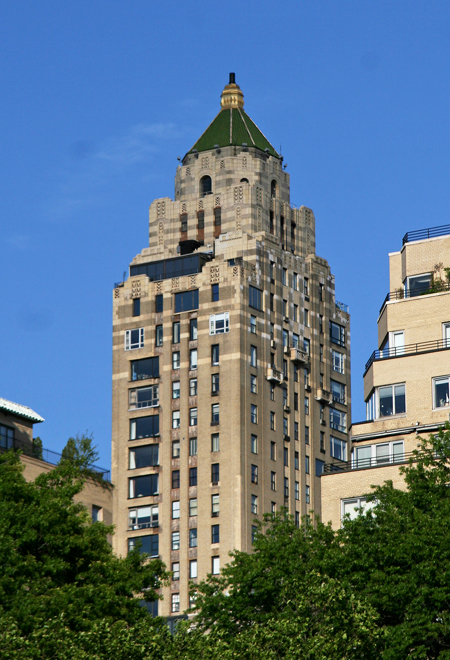
    Note: The Carlyle, located at 76th Street and Madison Avenue in Manhattan’s Upper East Side, was built by Moses Ginsberg, designed by Bien & Prince and completed in 1930. The Art Deco residential hotel has 180 rental rooms and 60 privately owned residences.


  • dinamic_sidebar 4 none

©2026 New York Daily Photo Entries (RSS) and Comments (RSS)  Raindrops Theme