• Category Archives Architecture
  • Back in Time

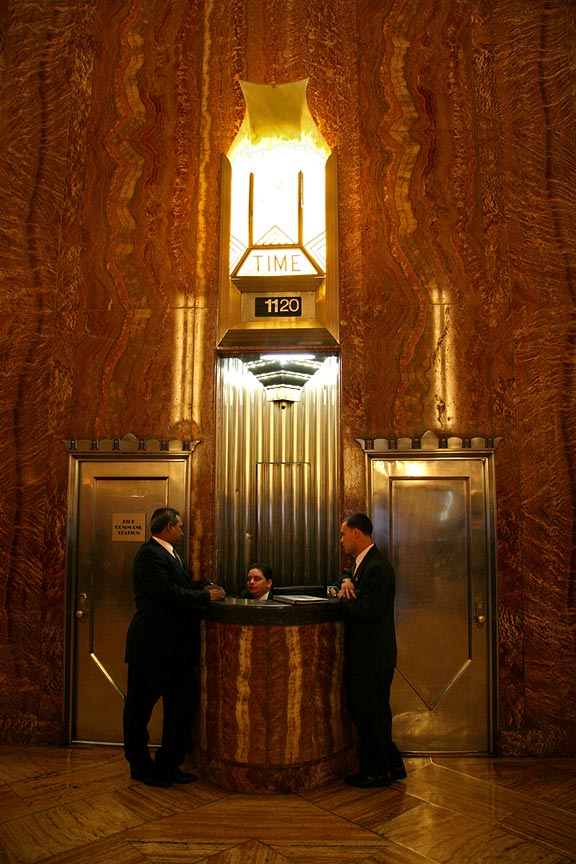
    This is the reception desk with its illuminated clock in the lobby of the Chrysler Building. The 77-story Art Deco masterpiece at 405 Lexington Avenue was designed by William Van Alen and built in 1929. In the dark, warm retro lobby, we find red Moroccan marble walls, yellow Siena marble floors, amber onyx, blue marble trim, and chrome steel.

    I have done several other posts on the Chrysler Building featuring different aspects of the building: the exterior with its gargoyles, the magnificent Lexington Avenue entryway, the stairwells (see here and here), and the adjoining Trylon Towers. Also of note are its renowned elevators and the ceiling murals, which I will cover in the future…
  • Lighthouse Legends

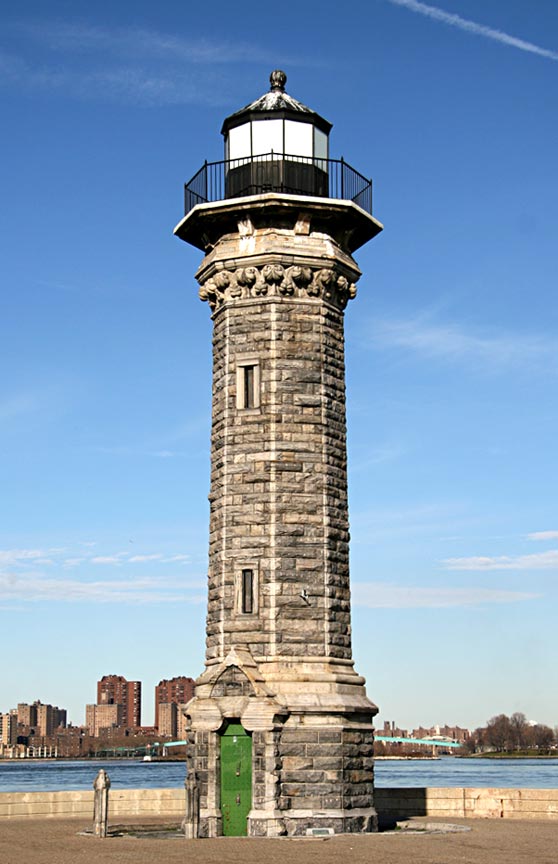
    The Lighthouse on Roosevelt Island is one of the island’s best known landmarks – it is readily visible from Manhattan and Queens. This 50-foot-tall structure built of gray gneiss was designed in 1872 by James Renwick Jr., one of the most successful architects of his time – he designed the Smallpox Hospital on the island as well as many major New York City buildings, such as St. Patrick’s Cathedral and the New York Public Library.

    The Lighthouse, which is not an official Coast Guard lighthouse, is steeped in legend. Lore has it that the lighthouse (likely built by inmates from the neighboring prison) replaced a small clay fort made by a patient from the lunatic asylum who feared a British invasion. The legends and mysteries involve the names John McCarthy and Thomas Maxey (a plaque crediting McCarthy for the building of the lighthouse disappeared in the 1960s.) Read the story here from the Roosevelt Island Historical Society website.

    The Lighthouse sits in Lighthouse Park, a serene spot to perhaps picnic or just enjoy the NYC vistas…


  • The Police Building

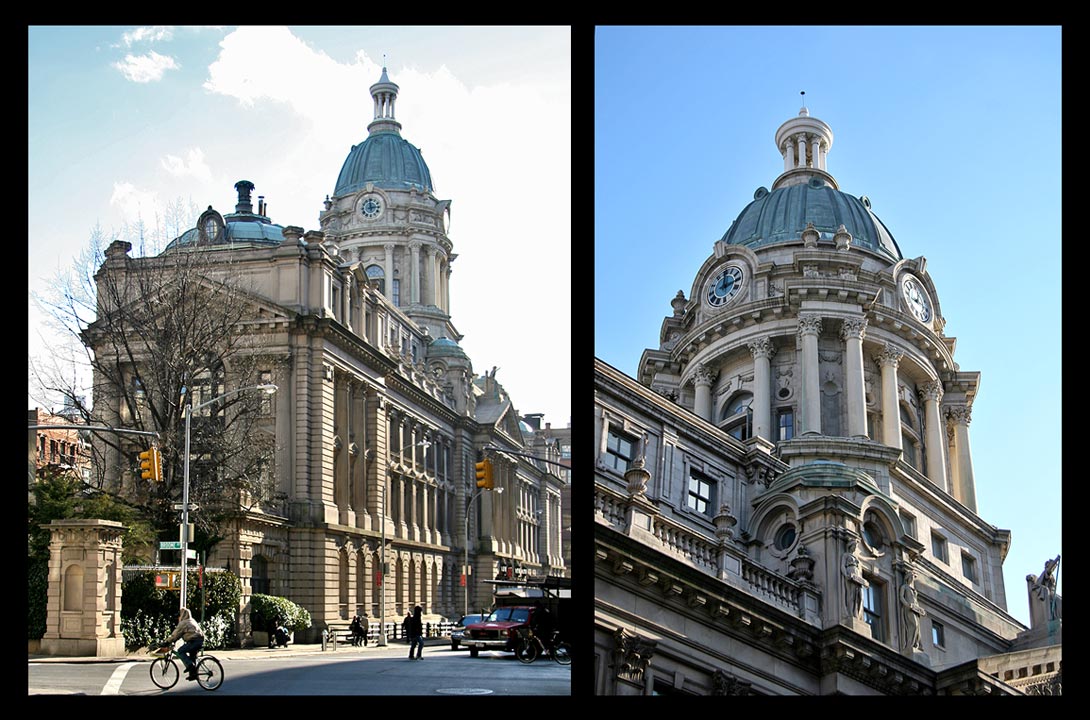
    The Police Building at 240 Centre Street: a “five-story Beaux-Arts palace, designed by the firm of Hoppin & Koen, is a dramatic heap of Baroque- and Renaissance-inspired domes, cupolas, colonnades, pilasters, and pediments, caked with carved ornament and wedged into the narrow block once occupied by the butcher stalls of Centre Market.” That’s a mouthful, but pretty accurate. This place is reminiscent of a Parisian Hotel de Ville, although I think the comment I saw during the sales of units there that it’s something like “finding the Invalides in the middle of the Marais” is a bit of a stretch – this area of Little Italy/upper Chinatown is nothing like the Marais.

    The way this palatial building is tightly integrated into the streets does make it rather startling. The 1909 building was vacated by the police department in 1973. In 1987, it was converted to 56 luxury condominiums. The spaces were newly created – the original interior layout was not suited to residential conversion. Four apartments occupy the central dome (the former radio room, commissioner’s office, and a gymnasium), including a triplex. Steffi Graf owned a tower apartment, which was sold to Calvin Klein in 1998. This is one of the grandest residences in the city, on par with the Dakota. A very unique living experience, I am sure…


  • Prospect Park In Lights

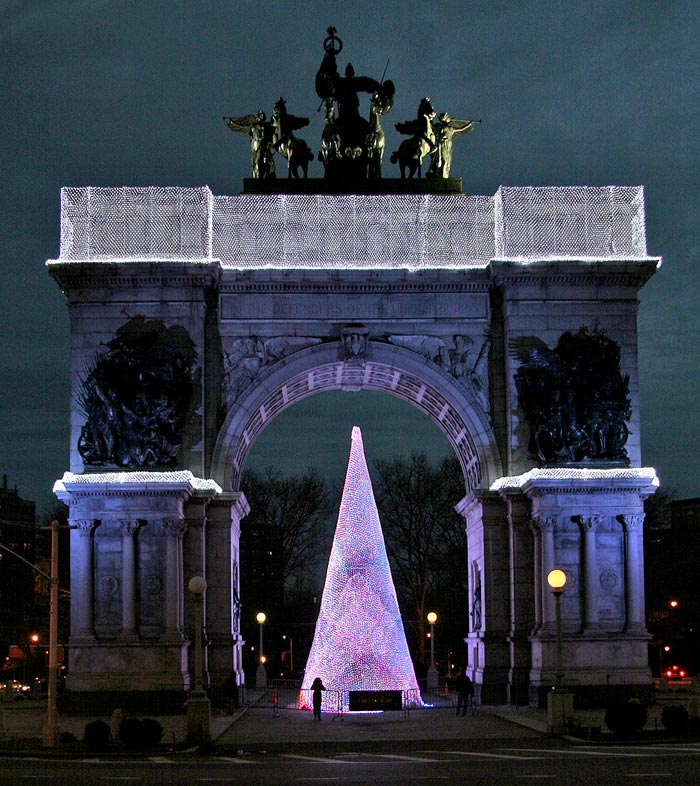
    I feel fortunate to have seen this wonderful display on the last night of its illumination. Prospect Park in Lights was funded by a gift from Mort Zuckerman, publisher of the New York Daily News, to the Mayor’s Fund to Advance New York City. The installation consisted of more than 600,000 LEDs decorating Prospect Park’s four major gateways (Grand Army Plaza, Bartel-Pritchard Circle, Park Circle, and Parkside/Ocean Ave). Click here for more photos.

    The illuminated displays, created by Brooklyn-based lighting designer Jim Conti who also teaches at Parsons, simulate and celebrate different aspects of nature: the look of snowflakes frosting the ledges of the Memorial Arch at Grand Army Plaza, wisteria vines atop the Pergola at Parkside and Ocean Avenues, animated waves for the Bailey Fountain, and, of course, the tree under the arch. Many of the LED lights changed colors and were synchronized with wireless animated controllers. It was stunning…


  • Re-Creation

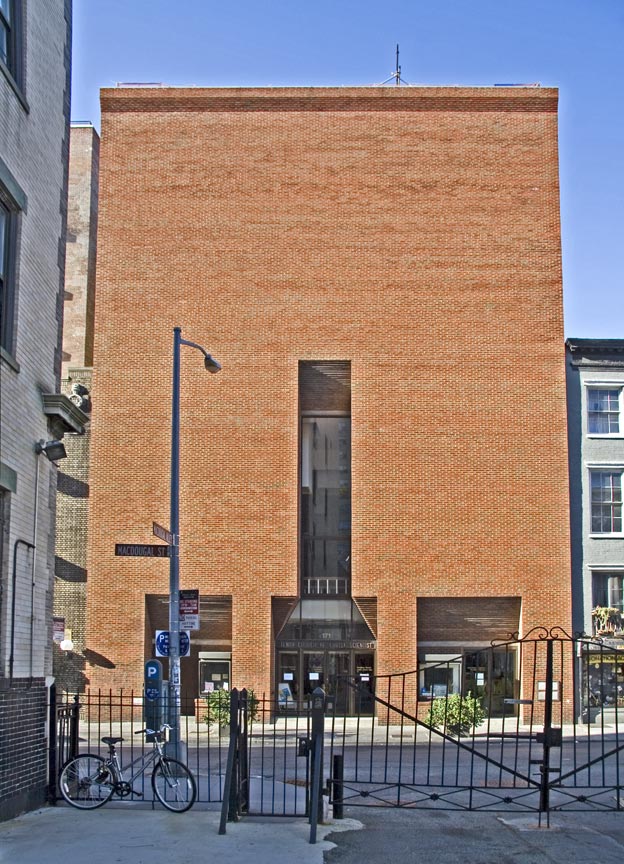
    This is the home of the Tenth Church of Christ Scientist at 171 MacDougal Street as seen from MacDougal Alley. This austere, modernist structure with no windows has always seemed out of place in the heart of the Greenwich Village historic district. As one might suspect, there is more here than meets the eye.

    As it turns out, the building itself was designed in 1890 by Renwick, Aspinwall and Russell. The factory building was acquired by the Church in 1921, and in 1966, the building’s facade was radically altered to its current condition by Victor Christ-Janer & Associates. What’s exciting for the neighborhood is that a proposal was made in April 2006 (and approved in June) to restore the building’s facade to its historic Romanesque-style. There will be three bays of windows, with arched windows on the next-to-highest floor and smaller windows on the top floor. Overall, it’s a huge improvement for such a prominent location and has been applauded by the community. The upper floors (which have been unused since the alteration) will be converted to 9 residential condominiums.
    Unlike most churches with various activities, this building has always been eerily quiet, with rare signs of life. Perhaps with all the new windows, we will finally see what’s really going on in there 🙂


  • The Crown Building

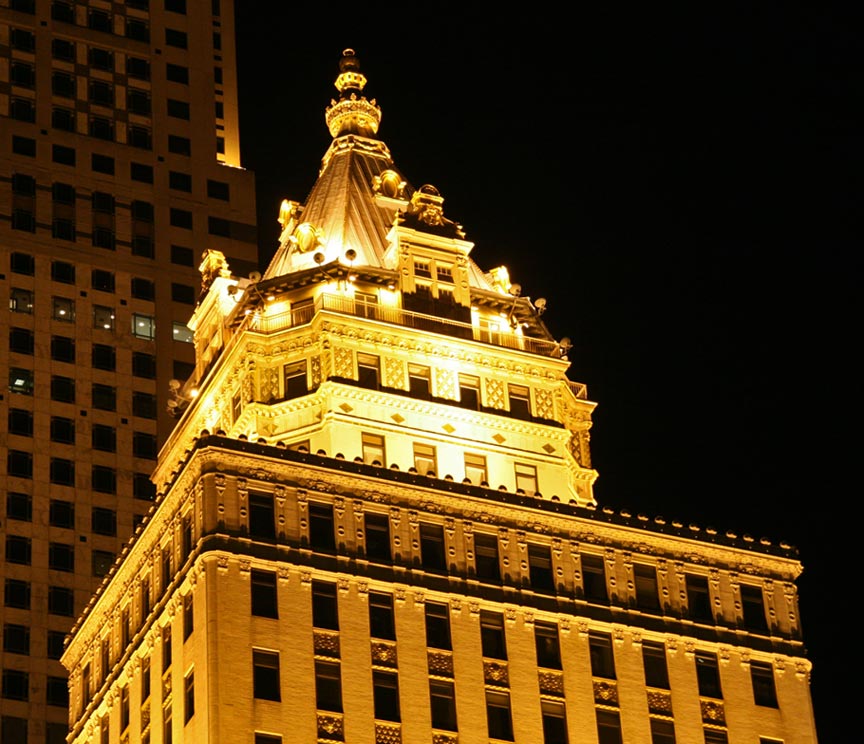
    The Crown Building, at 730 Fifth Avenue and 57th Street, has one of midtown Manhattan’s finest roofs. When seen at night, its illuminated, striking 416-foot high crown with gilded details truly gives it a regal quality, befitting of its name. The French Renaissance octagonal tower section is very striking, with stone/terra cotta, dormers, parapets, and a huge chimney stack. An original weathervane in the form of a rooster was removed in 1942 and melted down as part of the war effort. The best unobstructed view is from the north, where this photo was taken.

    Designed by Warren and Wetmore and built in 1921, it was one of the first buildings to go up after the setback provisions of the 1916 Zoning Resolution. It was originally called the Heckscher Building after its developer August Heckscher, a German immigrant (1867) who made his wealth from mining operations. In 1929, the Museum of Modern Art opened its first gallery here in rented rooms on the 12th floor. In the 1960s, it was known as the Genesco Building, was again renamed in 1983 as the Crown Building, and in the 1980s became one of the properties of the Marcos of the Philippines.

    One of the early commercial developments on the Vanderbilt’s former turf, Heckscher’s vision was quite prescient: “In the last analysis, whoever will not shop on Fifth Avenue and 57th Street will not shop anywhere.”


  • St. Patrick’s Cathedral

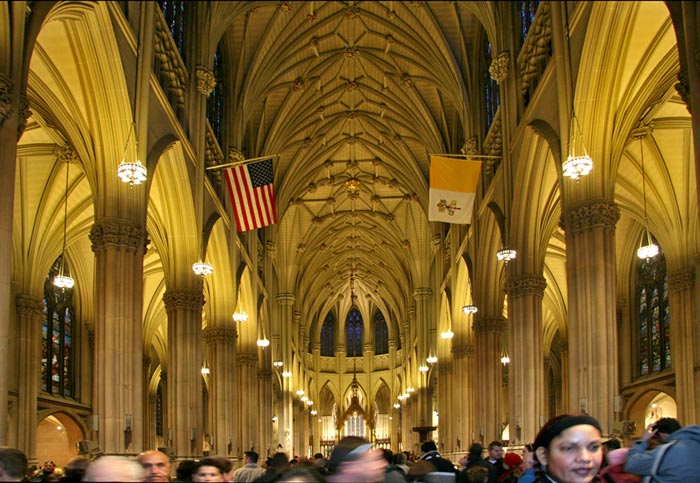
    St. Patrick’s is the largest Gothic Catholic cathedral in the United States. It was designed by James Renwick based on the French Gothic style and built over a substantial period of time, from 1858-1879, with the towers added in 1888. The cathedral and its ancillary buildings occupy an entire city block, spanning from 50th to 51st Street and from 5th Avenue to Madison Avenue.

    Interestingly, at the time of its construction under the stewardship of Archbishop John Hughes, the proposed site was ridiculed as “Hughes’ Folly” because the area was near wilderness, with slaughter houses and cattle yards. Hughes persisted, believing that this site would one day be “in the heart of the city.” A detailed history can be found on the Cathedral’s site.

    The Cathedral is obviously a huge subject with many famed features – its pieta, burial crypt, organs, stained glass, altars, and architectural details. So if you are interested in learning more, I leave it to you to explore online and, of course, to visit in person…


  • Apple and Sherry

    There are many recipes for Apple and Sherry, but this is my favorite:
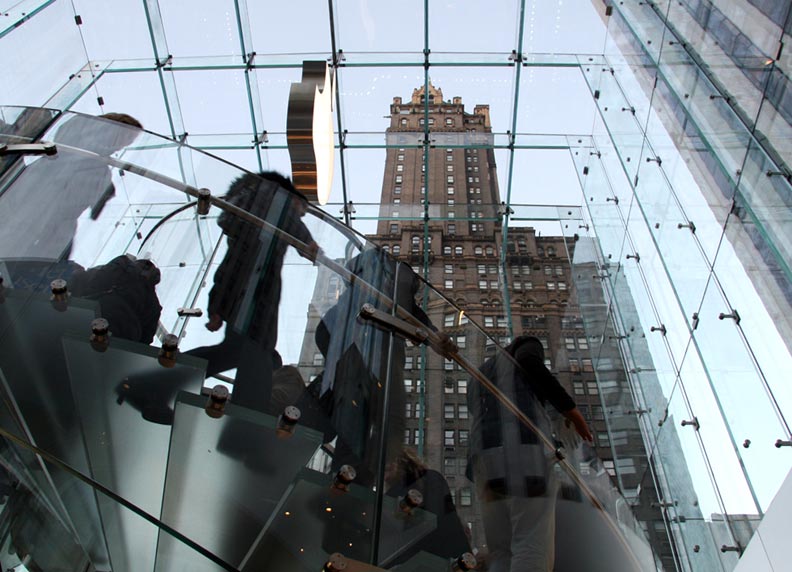
    In this version, we mix the magnificent Sherry Netherland Hotel (built 1927) at 781 Fifth Avenue and 59th Street with the new Apple Store’s spiral staircase (add a pinch of the GM building on the right). This Apple Store, open 24/7, is the subject of a previous post. For more photos, click here.
    Note: Look for ripple in the middle of the photo – that’s the result of stirring…


  • Charles Scribner

    This Beaux Arts masterpiece and designated NYC Landmark at 597 Fifth Avenue was designed in 1912 by renowned American architect Ernest Flagg. It is a 10-story, French-inspired building with a limestone and ironwork facade. Click here for more photos. Flagg, who was married to Scribner’s sister, received this design job as one of his first major commissions from Charles Scribner, who owned the publishing house Charles Scribner’s & Sons. At the time of the building of the 5th Avenue structure, Scribner had reached the summit of publishing with authors such as Edith Wharton, Henry James, Robert Louis Stevenson, Rudyard Kipling, Theodore Roosevelt, Thomas Wolfe, F. Scott Fitzgerald, and Ernest Hemingway. Scribner was friends with many of these authors and brought out many of their seminal works.

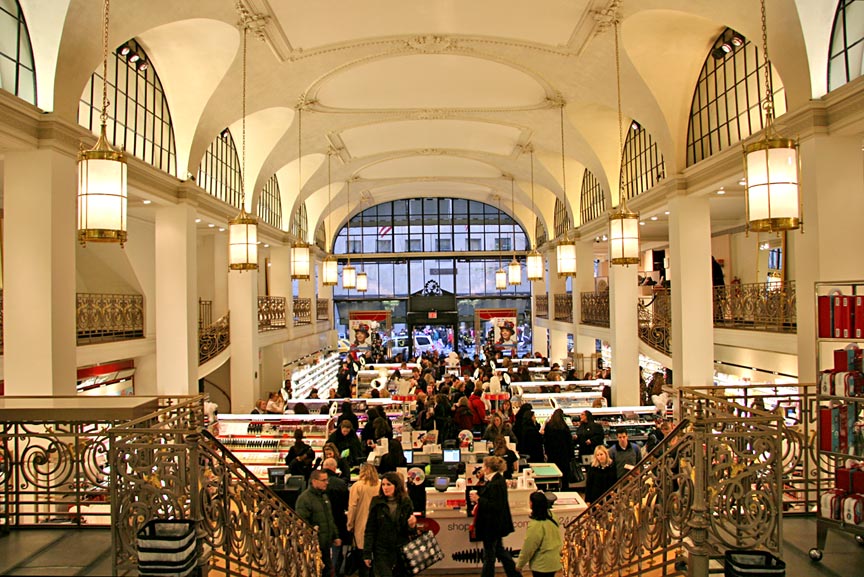
    The space was occupied from 1984-88 by Rizzoli, then by Brentanos Bookshop. In 1996, Benetton took over the space and opened its first U.S. flagship store, completely restoring the space to its former glory with renovations of spiral staircases, Caen stone finishes, glass brick flooring, Carrera marble grand staircase, skylight, etc. It is now occupied by Sephora. The interior vaulted space (with ceilings as high as 30 feet) was designed to feel like a small library. It’s really one of the grandest interior spaces in NYC. Many do miss the bookstore – it was such a grand space for a noble pursuit. I suggest a visit…


  • Life at Night

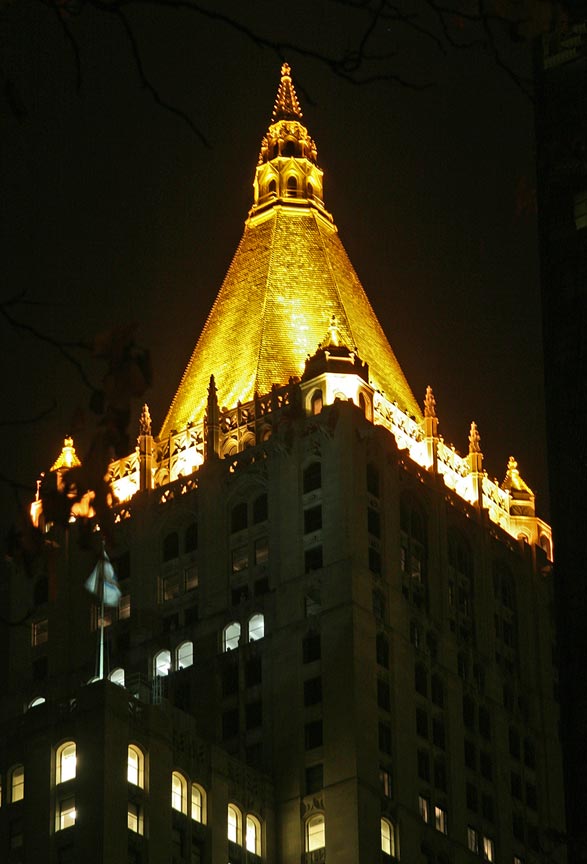
    The New York Life Insurance Building has been described as limestone renaissance at the bottom and birthday cake at the top. This 1928, 40-story structure, which towers over Madison Square Park at 51 Madison Avenue, was designed by Cass Gilbert, who had a love of pyramidal tops on his buildings, which you see in his Woolworth Building. The design is a fusion of Gothic (there are 72 gargoyles at the roof line) with more modern elements.

    The New York Life Insurance was founded in 1845 and is the largest mutual life insurance company in the U.S. The famed gold top was built in 1967 and has been illuminated since 1985 on the company’s 140th anniversary. In 1995, on the 150th anniversary, new gold leaf ceramic tiles were installed. The lit top is one of the major nighttime NYC icons which can be seen and easily identified from afar, along with the Empire State Building, the Con Ed Tower, the Met Life Tower, the Citicorp Building, and a handful of others.
    BTW, the site for this building has a fascinating history – Union Depot, Gilmore’s Garden, P.T. Barnum’s Hippodrome, and the original location for Madison Square Garden…


  • Tongues and Flames

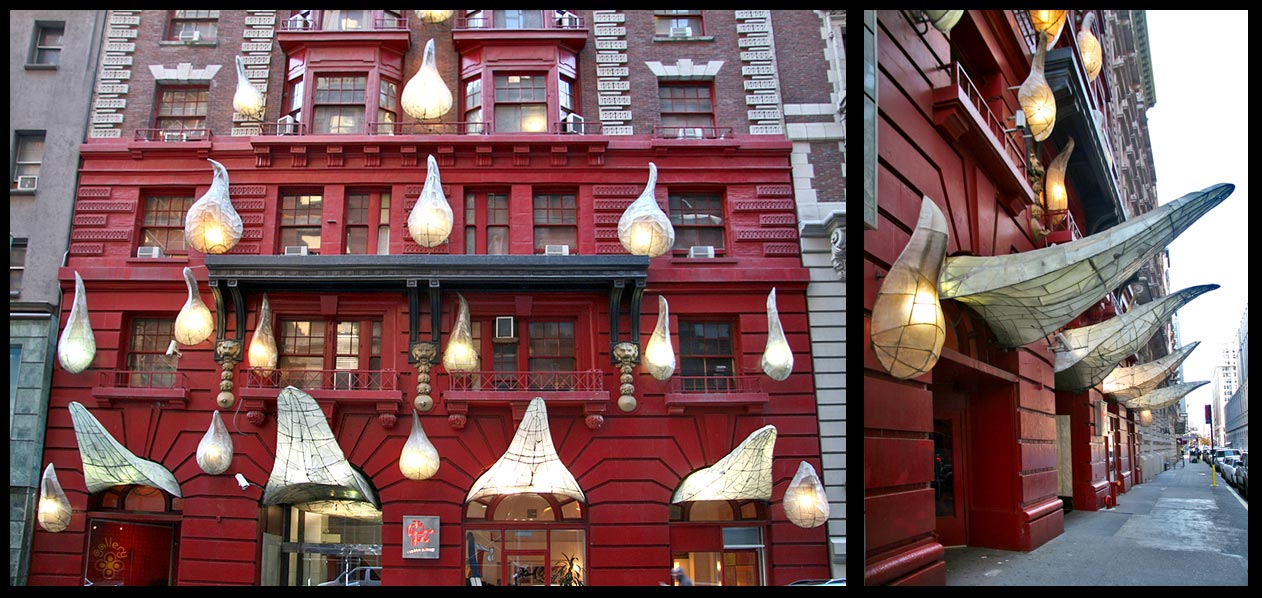
    When a friend and I on a photography shoot ran across this place, our reactions were the same: “WHAT?” Not only is the exterior unusual, but the business concept is also atypical. The Gershwin, at 7 East 27th Street in the historic Flatiron district, is a hybrid hotel and hostel, providing everything from 8-bedded rooms to more standard accommodations, even maintaining two separate websites (gershwinhotel.com and gershwinhostel.com – these now link to the same website as of 2012).

    The fiberglass sconces on the facade were created by Finnish artist Stefan Lindfors, who was asked to create something to distinguish the 1905 building. ”This hotel is always on fire,” said Lindfor, whose piece is called Tongues and Flames. The entire hotel has created has created an atmosphere to cater to the young, chic, arty, and European with the requisite amenities: Internet access, The Living Room featuring jazz and comedy, an onsite gallery, and a pop art-adorned lobby with a signed Andy Warhol soup can…


  • Gargoyles

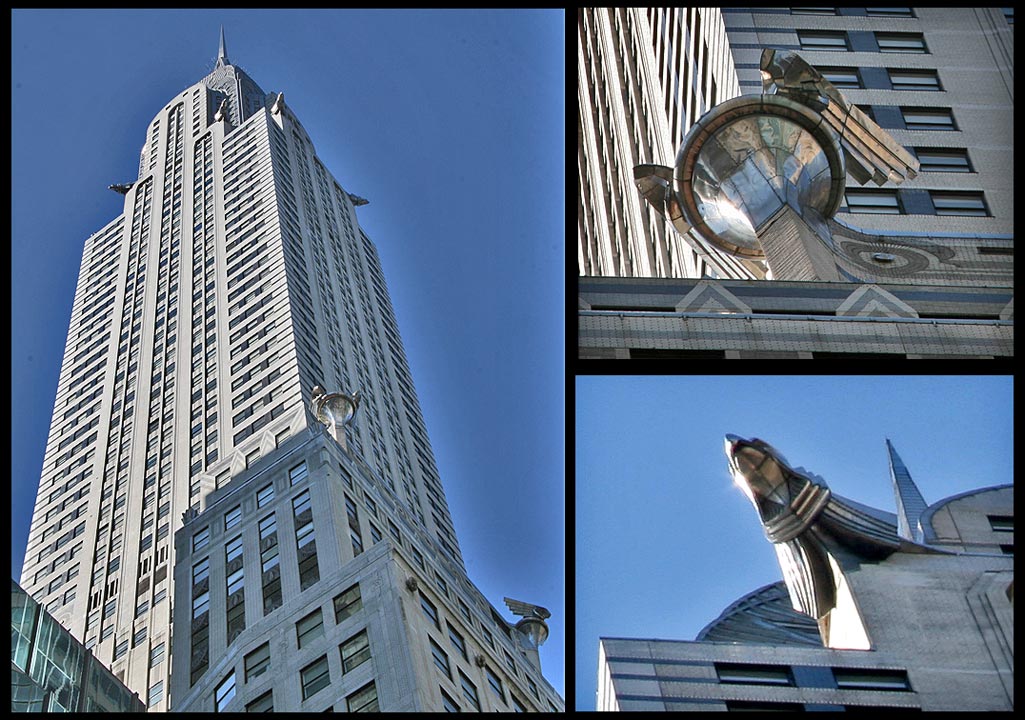
    The most distinctive features of the Chrysler Building’s exterior are the stainless steel-spired crown and the gargoyles based on Chrysler automobile ornaments, built from Krupp Enduro KA-2 Nirosta stainless steel. The gargoyles at the 61st Street floor setback depict American eagle hood ornaments. On the 31st floor setback, there are replicas of the radiator caps used in the late 1920s, modeled after the winged helmet of mercury (see here).

    One of the most striking photographs is of Margaret Bourke-White atop one of the eagle gargoyles. Bourke-White was one of America’s most distinguished photojournalists. There is a tremendous amount of material about her both on and offline – I leave it to you to peruse. The extensive use of metal on the exterior of the building, along with the ornamental references to the automobile, makes the Chrysler Building one of the enduring icons of the machine age…


  • Little Church Around the Corner

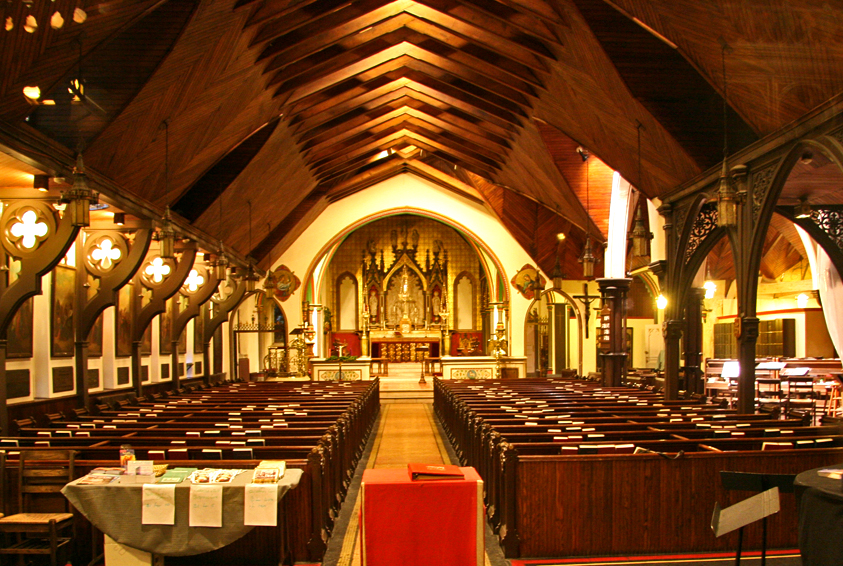
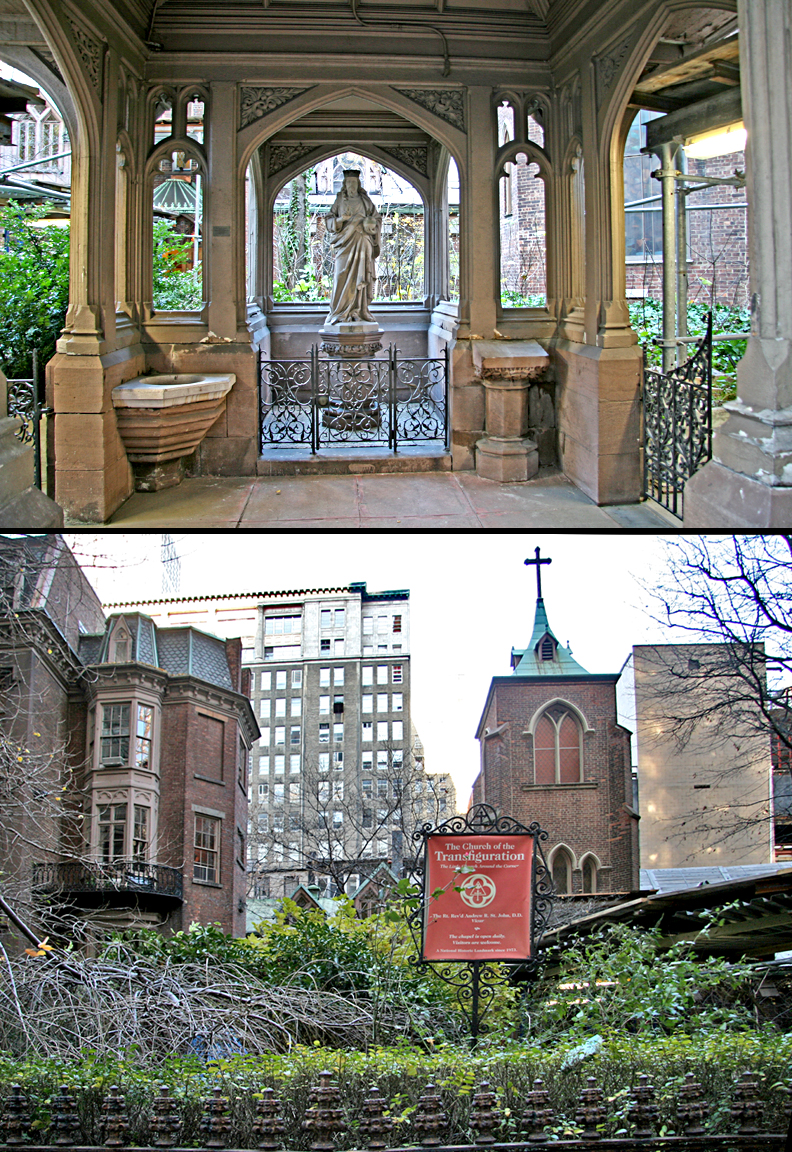
    The Church of the Transfiguration is one of the most famous parishes of the Episcopal Church in the United States, known throughout the country as “The Little Church Around the Corner.” For 150 years, it has been a very visible worshiping community in an urban setting which has welcomed all classes, all races, and particularly all those marginalized by society for whatever reason, as were actors and actresses, who had theretofore been on the fringes of both society and the Episcopal Church. It also has stressed service to the poor and oppressed from its earliest days.

    The founder, Dr. Houghton, sponsored bread lines and worked vigorously for the abolition of slavery and harbored runaway slaves. In 1870, when the rector of a neighboring church refused to perform a funeral for an actor named George Holland, he suggested the “little church around the corner,” where “they do that sort of thing.” Fellow actor Joseph Jefferson, who was trying to arrange Holland’s burial, exclaimed, “God bless the little church around the corner!” and the church began a long-standing association with people of the theater. For more information, including a history, I direct you to their site.

    The church, at 1 E. 29th Street, was built in 1849. The church is set back behind a garden – the atmosphere is one of an English parish church in the countryside. Currently, the property is undergoing extensive renovations. More photos here…


  • Step Softly

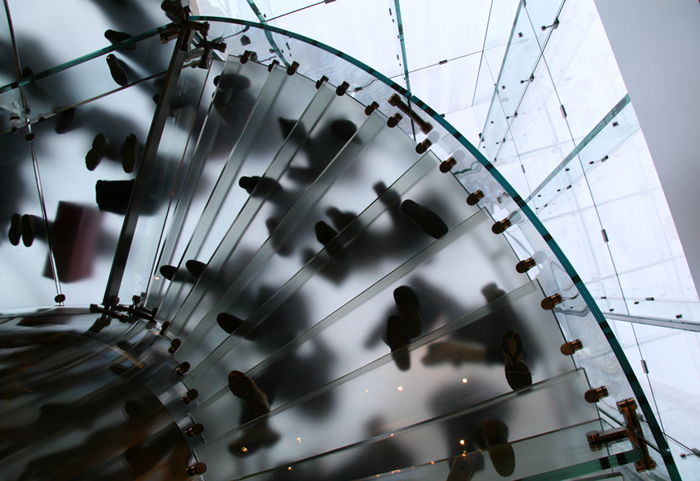
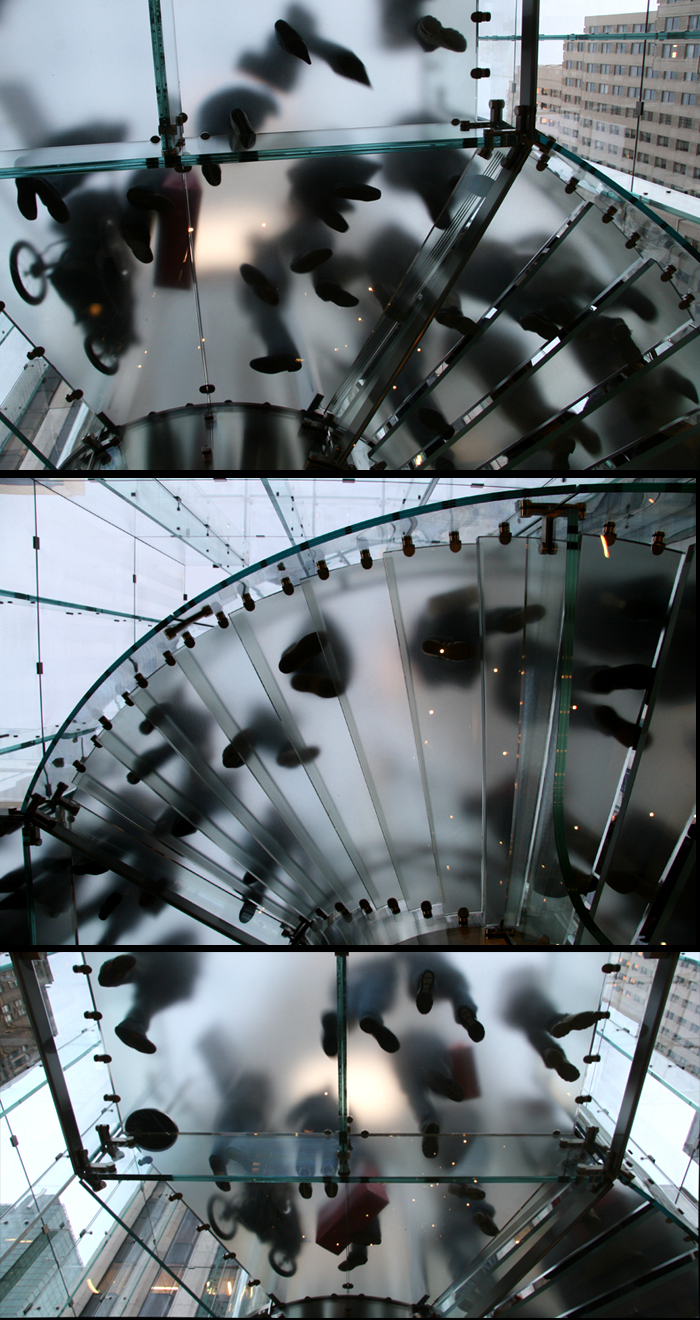
    I was awed by the images created by falling and rising footsteps up and down the spiral glass staircase at the new Apple store at 59th Street and Fifth Avenue. Click here for more photos. This new store opened on May 19th, 2006 with much fanfare, including dozens of celebrities and CEO Steve Jobs himself. People had camped out overnight in the rain on the street for the opening at 5 PM.

    This location is super prime – across the street from the Plaza Hotel and Central Park. A glass cube entrance sits atop the plaza in front of the GM building and FAO Schwartz’s flagship store; the 10,000-square foot retailing space itself is below street level. The store is open 24/7, 365 days a year – a first for Apple. When seen lit at night, this becomes NYC’s own I.M. Pei glass work. In fact, Steve Jobs has worked with Pei in the past and credits the glass pyramid entrance to the Louvre in Paris as being an influence in the store design…


  • Engine Company 33

    Until I began working on this website, I never paid really close attention to the firehouses of NYC. With so many distractions and so much fine architecture, it is easy to overlook things in one’s travels.

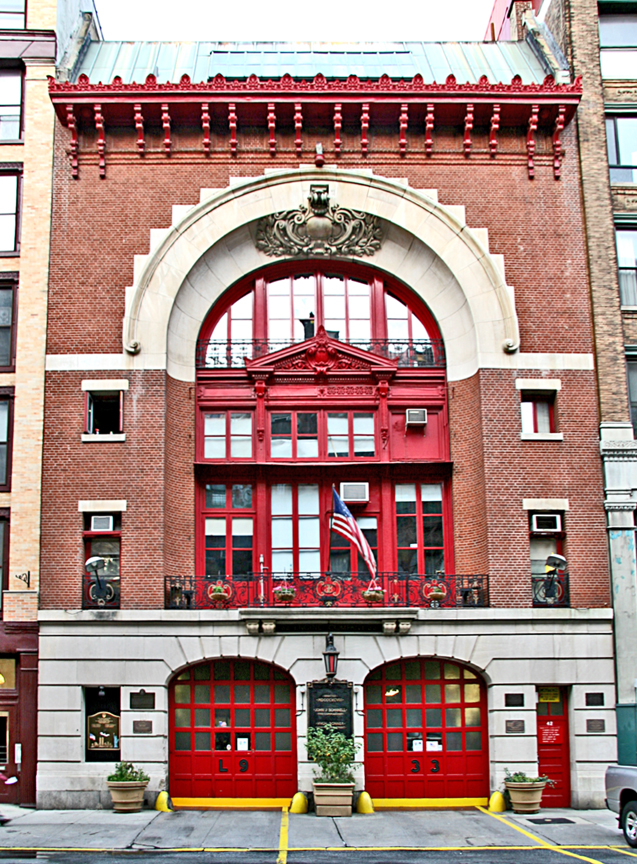
    This firehouse, home of Engine Company Number 33 of the New York Fire Department, at 44 Great Jones Street in the East Village, is spectacular. More photos here. It was built in 1898 and designed by renowned Beaux-Arts architect Ernest Flagg, who did a number of firehouses and other city landmarks. From the Guide to New York City Landmarks: “This Beaux-Arts firehouse is one of the grandest small-scale civic buildings in New York City.” And, like all firehouses and the immediate surrounding area, it is superbly maintained, giving the whole property a crisp quality.
    Engine Company 33 had the unfortunate distinction of losing 10 of the 14 firemen who went out on the 9/11 call…


  • dinamic_sidebar 4 none

©2026 New York Daily Photo Entries (RSS) and Comments (RSS)  Raindrops Theme