• Category Archives Architecture
  • Brooklyn Heights

    Posted on by Brian Dubé


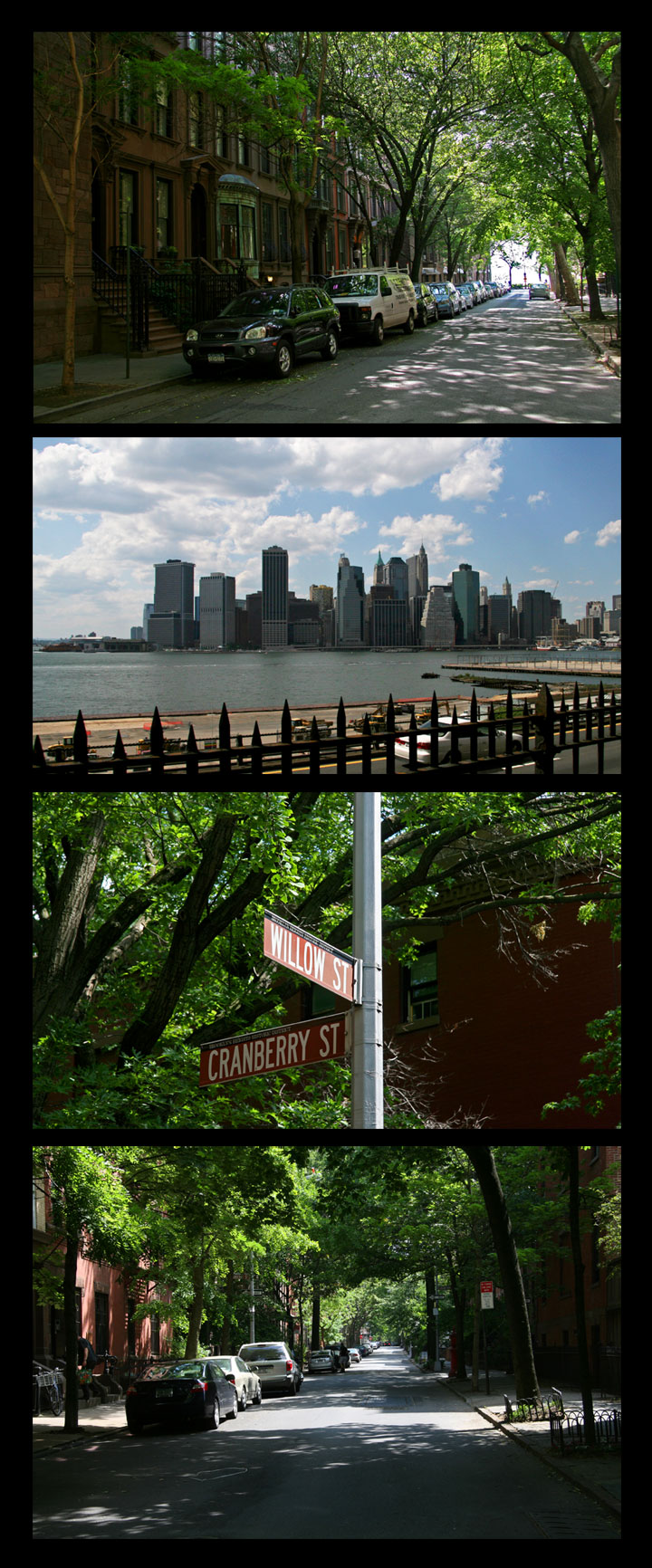
    What is more inviting than a neighborhood with street names like Orange, Pineapple, Cranberry, Willow, Poplar, Grace Court, Garden Place, and Love Lane? Brooklyn Heights is truly a special enclave, buffered from the world on 4 sides by the Brooklyn Bridge to the North, Cadman Plaza to the East, Atlantic Avenue to the South and the promenade/esplanade abutting the East River to the West. The promenade is a huge feature here, one which has brought me back many times. Flanking the entire length of the neighborhood, it affords magnificent views of Manhattan, the East River, the Statue of Liberty, the Brooklyn Bridge, and the Manhattan Bridge. Both daytime and nighttime views are worth a trip. See more photos here.

    This is New York City’s first historic district, established in 1965 as a product of opposition to a Robert Moses plan to run the Brooklyn Queens Expressway through the center of the neighborhood. The rerouting of the expressway to the Western edge of the neighborhood (which sits on a bluff), permitted the building of the esplanade. The neighborhood has virtually no tall buildings and is characterized by blocks of row houses of Federal, Greek Revival, Gothic Revival, Italianate brownstones, and some mansions.

    Brooklyn Heights has also been known for its stable of renowned writers who have lived there: Truman Capote, Norman Mailer, Hart Crane, Andrea Dworkin, Arthur Miller, Walt Whitman, and Thomas Wolfe.
    Genteel, pristine, picturesque, bucolic, charming – hard to imagine that this area was considered somewhat unsafe and undesirable at one time.

    There is essentially no through traffic in the neighborhood, so it is extremely quiet and peaceful. Street scenes as shown in my photos typify day to day life here. And yet, it is an incredibly convenient location – one subway stop from Manhattan and with immediate access to bridges or the expressway. As you have most likely guessed, inexpensive is not one of the features here 🙂
    Posted on by Brian Dubé

  • The Guggenheim

    Posted on by Brian Dubé


    What I find most fascinating about a place like the Guggenheim Museum is that it stands as a supreme example of how virtually anything can be defended, praised, or condemned intelligently with words. Conflicting arguments abound about works of architecture, art, film, music, dance, etc. I once asked an architect after seeing a particularly hideous structure what she would make of a building which every lay person hated but was lauded by architecture critics. The answer she gave: “Then architecture is a failure.”

    I have cited examples in this blog of things which have become iconic in spite of their being considered an abomination by many at the time of completion, such as the Eiffel Tower. The Guggenheim is one of those places – time has softened those aspects that perhaps have offended many.

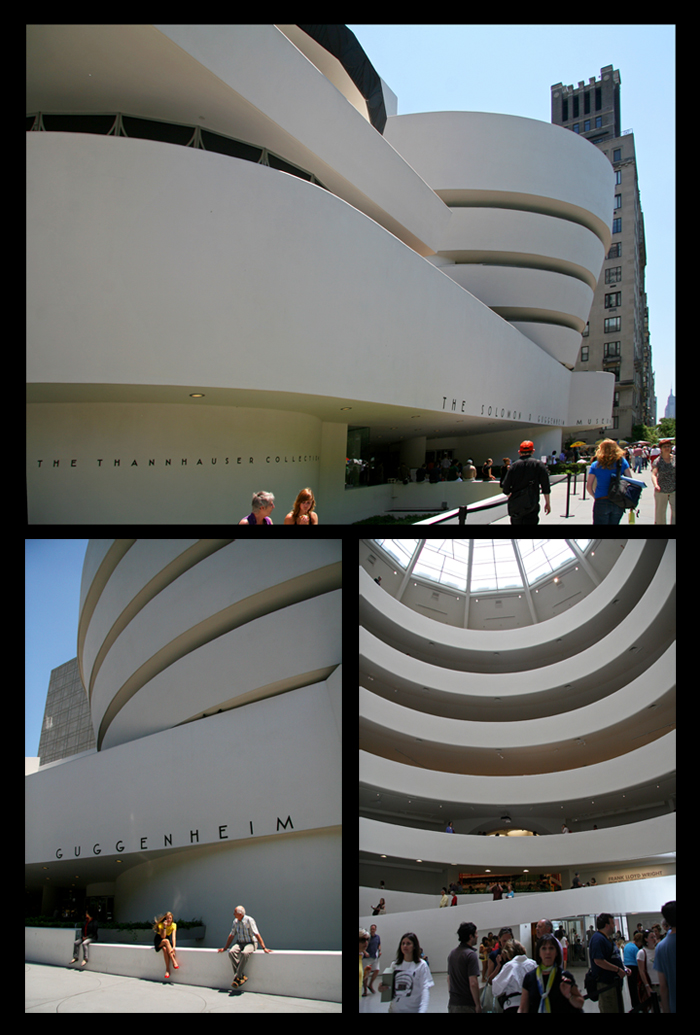
    The Solomon R. Guggenheim Museum, designed by Frank Lloyd Wright and completed in 1959, is considered one of the city’s major architectural landmarks. It is located on in Manhattan’s Upper East Side at 89th Street and Fifth Avenue, overlooking Central Park. Second photo here. It houses Impressionist, Post-Impressionist, early Modern, and contemporary art. The collection was seeded by Solomon Guggenheim, an art collector whose foundation funded the establishment of the museum.

    The building, which looks like a stacked white ribbon, was extremely controversial at the time of its completion. Inside, the main gallery is a helical spiral, rising from the ground level to the top, crowned with a skylit rotunda. Here are some of the conflicting reviews as reported in Time Magazine in 1959:

    “A war between architecture and painting, in which both come out badly maimed,” declared Art Critic John Canaday on Page One of the New York Times; “The most beautiful building in America,” retorted Critic Emily Genauer in the New York Herald Tribune. “A building that should be put in a museum to show how mad the 20th Century is,” editorialized the New York Daily Mirror. “Mr. Wright’s greatest building, New York’s greatest building.” said Architect Philip Johnson, “one of the greatest rooms of the 20th century.” “Frank has really done it,” snapped one artist. “He has made painting absolutely unimportant.”

    The criticisms revolve around several aspects of the building. One is that the museum design is a distraction from the art itself. The sloping ramp provides no level base for a viewer’s reference. The small exhibition rooms off the main spiral are small and windowless – the walls are angled and make hanging paintings difficult. Prior to its opening, twenty-one artists, including Willem de Kooning, signed a letter protesting the display of their work in the museum. Wright replied that the old rectilinear frame of reference was “a coffin for the spirit” and admonished them to wait and see. Paintings were to be tilted backward, “as on the artist’s easel.” Wright had proposed “one great space on a continuous floor.” “An atmosphere of the unbroken wave—no meeting of the eye with angular or abrupt changes of form.”

    When the building opened, Robert Moses said that it looked like “an inverted oatmeal dish.” Wright retorted, “It’s going to make the Metropolitan Museum look like a Protestant barn.” Others referred to it as a “snail,” “an indigestible hot cross bun,” and “a washing machine.”
    Snails, barns, coffins, oatmeal dishes, washing machines, ribbons, unbroken waves – The Guggenheim.

    Posted on by Brian Dubé

  • Secret Discovery

    Posted on by Brian Dubé


    On my first trip alone to New York City with a friend, I recall some mutual back patting of how, in traveling without a group, we were able to avoid the touristy and eat in a place which was our own secret discovery. The place? Nathan’s at Times Square. Rather hilarious looking back on it, but being older has not entirely eliminated naivete.

    I “discovered” this unique building standing alone like a haunted mansion on a hill at 3rd Street and 3rd Avenue in Brooklyn. Silly in retrospect – how could anyone miss this anomaly on a major thoroughfare? No one has. I have read no less than two dozen articles on this building which not only stands as a beacon to passersby but also is the center of controversy.

    The surrounding property (but not the building itself) was purchased in 2005 by Whole Foods Market from Richard Kowalski, who still owns the 2 1/2 story Italianate building at 360 Third Avenue/Street near the Gowanus Canal. The Whole Foods project has been stalled for a number of reasons, including discovery that the property, a floodplain, contained toxic material.

    I found a tremendous amount of misinformation about this property, as bits and pieces of facts were cobbled together over the recent years. I believe its history has at last been clarified.

    The building, built by Edwin Clark Litchfield in 1872-3, became important as part of the history of concrete in America. The New York and Long Island Coignet Stone Company Building was landmarked in 2006.
    François Coignet was a pioneer in development of structural and reinforced concrete. In the late 1860s, a group of Americans trained in Coignet’s techniques in France brought his patents to Brooklyn. From the New York City Landmarks Preservation Commission website in 2006:

    The building originally was part of the New York and Long Island Coignet Stone Company, a five-acre factory complex near the Gowanus Canal that manufactured Coignet — or artificial –stone, a type of concrete invented by Francois Coignet in Paris in the 1850s. The factory supplied the arches and clerestory windows in St. Patrick’s Cathedral in Manhattan, the ornamental details for the Cleft Ridge Span in Prospect Park and the building materials for the first stages of construction at the Metropolitan Museum of Art and the American Museum of Natural History.

    Made entirely of concrete, the 25-by-40 foot rectangular structure was built to showcase the durability and versatility of Coignet’s inventive product, also known as “Béton (French for concrete) Coignet.” The company was reorganized and renamed the New York Stone Contracting Company in the mid-1870s, and continued to manufacture Coignet stone until 1882. Shortly after, the building housed the office of the Brooklyn Improvement Company, which was instrumental in Brooklyn’s residential and commercial development during the 19th and 20th centuries.

    I hope you get a chance to make a secret discovery of this property yourself, if you get a chance to pass by 🙂

    Note: The building has often been referred to as the Pippin building – it once housed offices for Pippin, a radiator distribution company.

    Posted on by Brian Dubé

  • Please Be Gentle

    Posted on by Brian Dubé


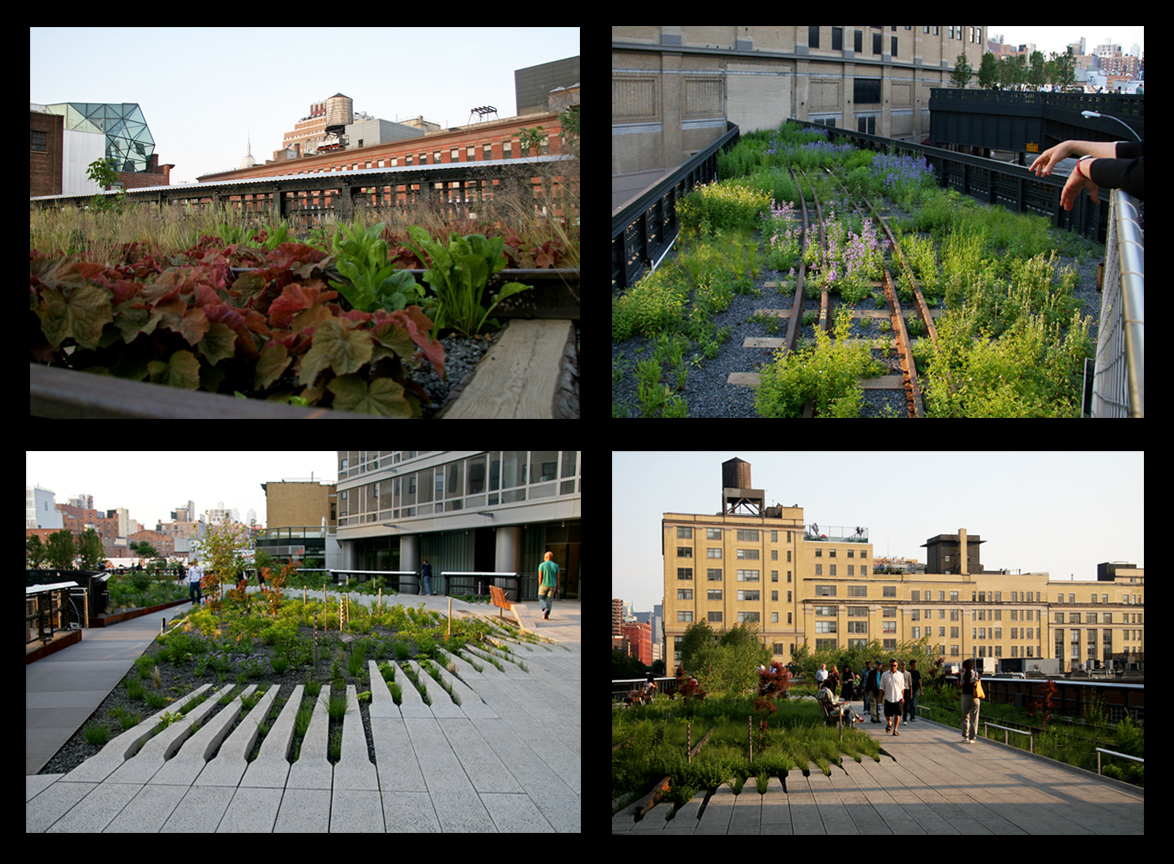
    Yesterday, June 8, 2009, was the highly awaited grand opening of the High Line. All the top officials in city government were there for the ribbon cutting – Mayor Bloomberg; Amanda M. Burden, the city planning commissioner; Adrian Benepe, the parks commissioner; Scott M. Stringer, Manhattan borough president; and City Council speaker Christine C. Quinn.

    This project was in the making for 20 years. The idea to save and restore the abandoned elevated freight railroad was first conceived in 1999 by Joshua David, a writer, and Robert Hammond, a painter. The project, named the High Line, broke ground in 2006 and is now an elevated park converted from a section of the West Side Line, built in the 1930s by the New York Central Railroad and unused since 1980. The railroad actually passed through several buildings – evidence of this still exists. See my entire photo collection here.

    The greenway is similar to the Promenade Plantée in Paris, a 4.5 km-long elevated park in the 12th arrondissement of Paris, France, constructed on an abandoned 19th-century railway viaduct. The High Line consists of three sections – the southernmost currently open runs from Gansevoort Street in the West Village to 20th Street. Upon completion, the entire park will extend to 34th Street.

    Over 30 projects are planned along its route, including a new branch of the Whitney Museum of American Art, designed by Renzo Piano.
    The design itself is the most artfully created public space I have seen in New York City. The High Line was designed by landscape firm Field Operations and architects Diller Scofidio and Renfro.

    Yesterday’s “soft” opening was pleasant, with a small number of visitors. Once its opening is generally known, there is a concern of overuse – the design work is beautiful yet delicate and rather fragile. The parkway is only 30 to 60 feet wide. If necessary, entry to the park may be limited. I recommend visiting – please be gentle…

    Posted on by Brian Dubé

  • Urban Mitts

    Posted on by Brian Dubé

    Cats have been known to fall from as high as a 32-story building and survive in a phenomenon known as high-rise syndrome. I can’t say that this is the reason for the broken glass in the photo, but it does afford an opportunity to introduce this concept to this website. I don’t anticipate being at the exact moment in time to photograph an event like this, and I do not intend to post photos of maimed or dead cats.

    Cats love high places. Factor in their curious nature and inevitably, you will end up with cats, as astute and agile as they are, falling from apartment buildings for one reason or another.
    Remarkably, cats do routinely survive enormous drops. One factor is cat righting reflex, an innate ability which allows a cat that has fallen to reorient itself in order to land on its feet. Popular lore has it that cats actually do better from falls of over 6 stories. It has been proposed that this is the case because cats reach terminal velocity after 5 stories and relax and flatten themselves, much like a flying squirrel, thereby minimizing injury.

    One study often cited is from the Animal Medical Center in 1987. There were 132 cases of high-rise syndrome (average height of fall was 5.5 stories) with a 90 percent survival rate.
    However romantically attractive the notion of cats faring better from higher falls is, as Cecil Adams points out in the Straight Dope, the big flaw in all of this is that cats that don’t survive are not reported or brought into a veterinarian’s office or animal hospital. His thinking was confirmed by a conversation with Dr. Michael Garvey – head of the medical department and current expert on “high-rise syndrome” at the Animal Medical Center in New York City. A study from Croatia from 1998 to 2001 confirms that cats falling from greater heights suffered more severe injuries.

    So much for urban mitts 🙂

    A Personal Experience: I once came home to a note on my building that my cat had jumped and been taken to the vet in my absence. I have many birds who frequent my windows, and I had seen him highly animated on numerous occasions – my theory is that my cat was able to force open a window left slightly open to get to the bird, attack, and fly off the A/C unit. He was taken to the Animal Medical Center and he did survive.

    Posted on by Brian Dubé

  • Storefront

    Posted on by Brian Dubé

    As the world becomes more crowded and technology becomes more advanced, our spaces, places, and things become smaller. Waste and efficiencies are critical issues, particularly in a city like New York.
    Add our economic environment to the mix, and one can see why lavish indulgence is nearly a mortal sin. So what better icons for our time than the iPod Nano or a micro gallery like the Storefront for Art and Architecture?

    Storefront was founded in 1982 by Kyong Park as a nonprofit organization committed to the advancement of innovative positions in architecture, art, and design, with a program of exhibitions, artists talks, film screenings, conferences, and publications.

    This place is easy to miss – it is not only small but also off the beaten path. Storefront is located in a unique triangular ground-level space on Kenmare Street at a nexus of three very different cultural neighborhoods: Chinatown, Little Italy, and Soho. The space is nearly 100 feet long and tapers from 20 feet to 3 feet. Its most striking feature is the unique exterior wall with articulating panels which are rotated to open the space to the street.

    In 1993, Storefront commissioned a collaborative building project by artist Vito Acconci and architect Steven Holl. The project replaced the existing facade with a series of twelve panels that pivot vertically or horizontally to open the entire length of the gallery directly onto the street. The project blurs the boundary between interior and exterior and, by placing the panels in different configurations, creates a multitude of different possible facades. Now regarded as a contemporary architectural landmark, Storefront is visited by artists, architects and students from around the world.

    The Storefront has received many accolades from the media and art community. My posting Performance Z-A depicts a celebration of Storefront’s 25th anniversary in 2007 which was set in the Ring Dome Pavilion…

    Posted on by Brian Dubé

  • Queens West

    Posted on by Brian Dubé

    I was shocked when I discovered this unfamiliar area of Queens with new buildings sprouting everywhere, Gantry Plaza State Park, waterfront vistas of the Manhattan skyline, and the 59th Street Bridge. When investigating the neighborhood behind the photos from my excursion, I was equally surprised to learn of the scale of this huge development going on in my back yard, unbeknownst to me. See my series of photos here.

    This area, now being called Queens West, is essentially the Hunters Point neighborhood of Long Island City, Queens. A large number of high-rise residential buildings are planned (map here). The building in the photo is the Powerhouse. Ground was broken in 1994 for this 74-acre commercial and residential development. Read all the details at the Queens West website here. You can also read the 1994 New York Times article by architecture critic Herbert Muschamp.
    Citylights was the first completed structure in 1998, a 43-story, 522-apartment building designed by renowned architect Cesar Pelli.

    There are so many elements to the success of a redeveloped area – location, transportation, views, housing, and building stock. Architecture critics analyze these elements along with the merits and demerits of the architecture of the buildings built or proposed.

    DUMBO, Brooklyn is a great example of a neighborhood that had all the right elements just waiting to be discovered: one subway stop from Manhattan, views of Manhattan and the bridges, cobbled streets, and great industrial buildings.

    The difference with Queens West, like Battery Park City to which it has been compared, is that all the residential and commercial structures are to be newly built which, like most urban planning, is a highly contentious and risky proposition. With an area like DUMBO, with the architecture already existent, there were no unknowns. People started moving there because they liked what they saw. In the case of Queens West, developers have to create what they hope will be successful, and everyone has a different vision of what that should be. Many planned neighborhoods and cities, even with large budgets and great minds, have been controversial, like Brasilia. Creating an entire environment en masse, rather than a place developing organically, is a great challenge. I hope Queens West is a success. The site is spectacular – I suggest you visit if you can…

    Posted on by Brian Dubé

  • Remembering

    Imagine being 13 and not having seen much of the world at all.
    Imagine also living at a time when technology was on the cusp of the truly fantastic – with mainframe computers, transistors and integrated circuits, the Moog synthesizer designed by Robert Moog, and the A-11 aircraft, capable of sustained flight of 2000 mph being announced. And the biggest technological achievement of our time, as promised by JFK during his 1960 presidential campaign, was soon to come: we were going to the moon, literally.

    1964 was also the year of the British Invasion, with the arrival of the Beatles in the USA. In the world of civil rights, Malcolm X announced his break with the Nation of Islam, the formation of a black nationalist organization, and met Martin Luther King, who won the Nobel Peace Prize. President Lyndon Johnson signed the Civil Rights Act of 1964 into law, abolishing racial segregation in the United States. The Vietnam War was heating up and we saw the first demonstrations. Feminism and the sexual revolution were in full swing, and the Vatican condemned the birth control pill.

    So it was in this time that my family took our first trip to New York City to visit the 1964 World’s Fair. I remember only a little from that trip, but what I do remember was something that was truly fantastic, a spectacle larger and grander than I ever imagined possible. The exhibits were amazing and way ahead of their time. The audio-animatronics used by Disney are still in use today – Disney’s It’s a Small World was unveiled at the Pepsi pavilion. IBM displayed handwriting recognition. General Electric sponsored Progressland, where the audience was seated and revolved around an auditorium with numerous audio-animatronic presentations of the progress of electricity in the home. The General Motors Futurama had visitors moving on seats through an exhibition of the world of the future. The entire fairground was as large as a small city. Fountains were everywhere – it was true pageantry.

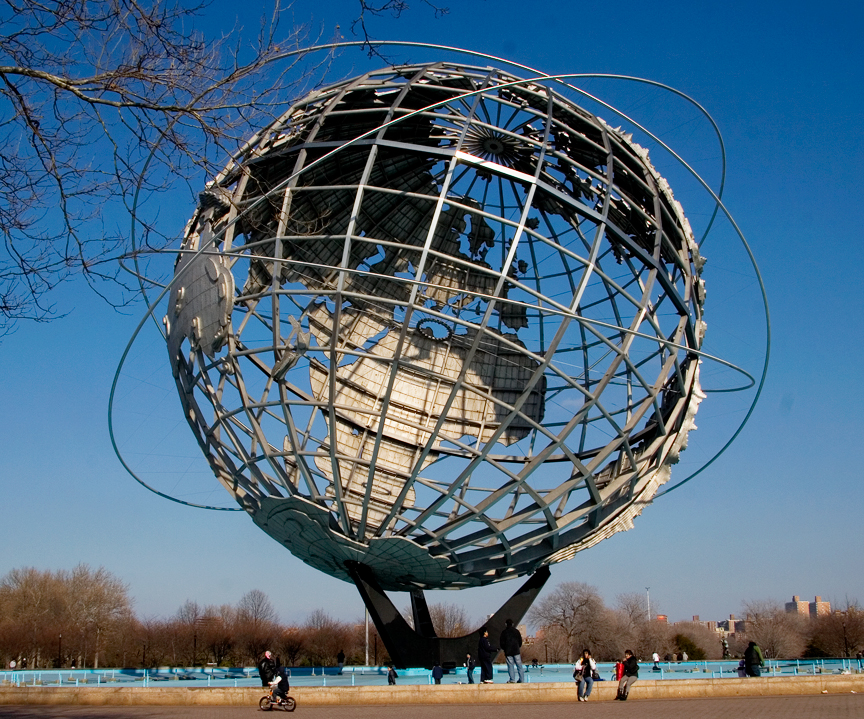
    The most memorable icon for this fair was the Unisphere, which is still standing in Flushing Meadows-Corona Park, the site of the fair (and the previous 1939-40 fair). The theme was Peace Through Understanding, and the Unisphere represented global interdependence. Built to celebrate the beginning of the space age, it was dedicated to “Man’s Achievements on a Shrinking Globe in an Expanding Universe.”
    The Unisphere was built in type 305L stainless steel by the US Steel Corporation and erected on the same structural foundation that supported the 1939/1940 New York World’s Fair’s Perisphere. At 12 stories (140 feet), it remains the world’s largest globe and has become one of the few permanent remaining structures from the fair and an unofficial symbol for Queens.

    I am sorry that those of you unable to attend will have to imagine and that I have the privilege of remembering …

    Note about the fair: The 1964 World’s Fair was actually mired in controversy. In order to be profitable, the fair organizers, headed by Robert Moses, decided that the fair would need to run for two 6 month seasons (1964 & 1965). However, the rules of the BIE (Bureau of International Expositions), headquartered in Paris, stated that an international world’s fair run for one six-month period only and only one exposition per 10-year period in a host country. The USA did not meet these requirements, and a visit by Moses to Paris was not successful. Moses made his disdain for the organization’s decision public. The BIE retaliated by requesting member nation’s not participate. Hence, the roster of participants was primarily smaller nations and a large number of industrial firms.


  • Unconditional Love

    I made an assertion in yesterday’s posting about the Temple of Dendur at the Metropolitan Museum of Art concerning harsh critics. Look at some of the following excerpts from Paul Goldberger, architecture critic for the New York Times. This is from an article which appeared in 1990 at the end of a 23-year construction program with the Museum working with architect and master designer Kevin Roche.

    “Now, 23 years later, Mr. Roche’s work, one of the longest-running and most ambitious construction programs of any museum, is finally done. … It’s not news that most of these efforts have ranged from disappointing to downright awful. Somehow, Mr. Roche and the museum have never quite brought out the best in each other; their relationship has been like one of those marriages that don’t end but don’t soar, either.”

    His critique included the new American Wing and courtyard and the Temple of Dendur. You can read the entire article here. You see what we are dealing with here in New York City?

    I am not a trained architect or critic, but these seem like very harsh words for spaces which everyone I know seems to love, including many educated in the arts.

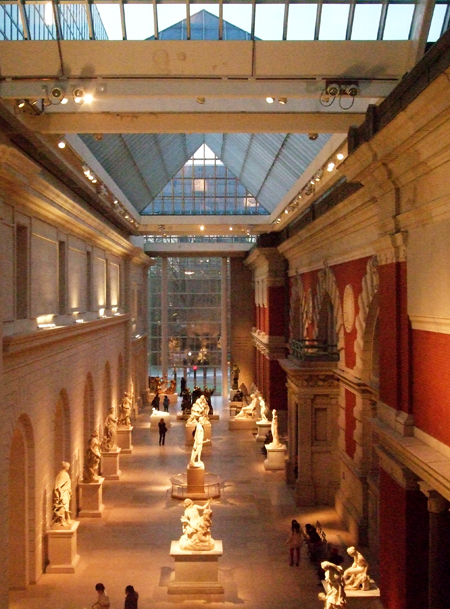
    Today’s photo is one of my favorite spaces in the whole museum – the Carroll and Milton Petrie European Sculpture Court. This also did not escape Mr. Goldberger’s article, but he seemed to love this space:

    “But now, at the end of it all, comes at last an occasion to celebrate. The brand-new sculpture court is an oddly likable place, as close to a magnificent folly as the Metropolitan has ever produced.”

    Of course, compliments from an architecture critic must be filled with caveats, reservations, conditions, and qualifications, so we also find:

    “The sculpture court is rather too tall and narrow, and these wrong proportions make its success all the more fascinating: few things in architecture are more pleasing than watching an architect get away with breaking the rules.”

    How about just an unequivocally good review? A joyous celebration with unrestrained applause? Ok, I don’t have a critic’s reputation to maintain, so, I am not afraid to say that I love that space and all the others in the museum. It’s a joy to walk through the Met and see all the works of art, sculpture, and antiques in the variety of environments created for them. And I say this with unconditional love 🙂


  • Stain Your Soul

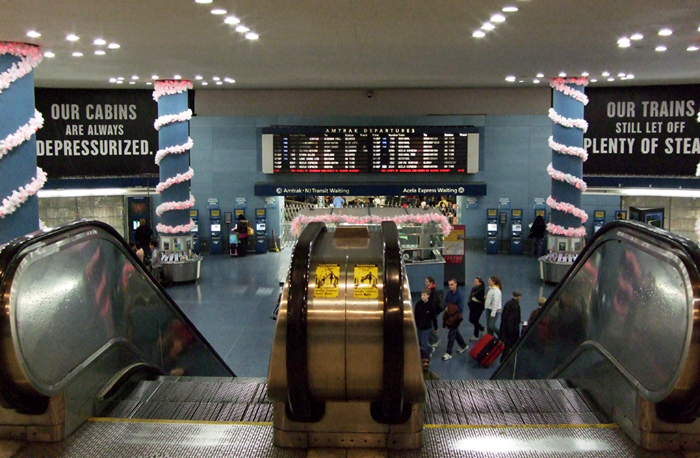
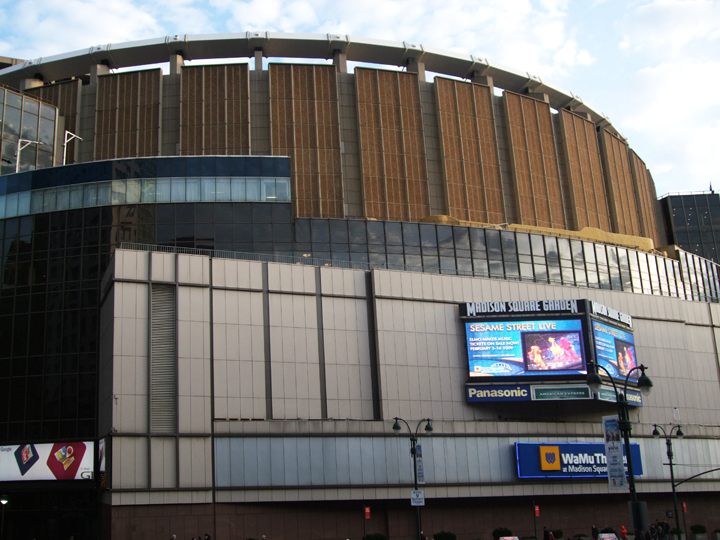
    If you find anything about this photo of Pennsylvania Railroad Station attractive at all, then I am pleased, because this place is one of the least liked in New York City. Perhaps you have to be a native New Yorker or architecture critic to really appreciate this. And I have misled you by using a photo of the interior – the exterior is what really is a visual blight on New York City’s canvas (see here).

    Now, take a look at these photos of the previous magnificent Beaux Arts structure by McKim, Mead & White which was torn down in 1964 to make way for the new building complex. Be forewarned – you will find the experience upsetting and will ask why. Look here if you dare.

    Now you see why New York Times architecture critic Nicolai Ouroussoff calls it the “greatest crime in architectural history.” In an article in the Times, “New York City, Tear Down These Walls,” Ouroussoff says:

    “No site in New York has a darker past than this one. The demolition of the old Pennsylvania Station, the monumental McKim, Mead & White Beaux-Arts gem that stood on this site until 1964, remains one of the greatest crimes in American architectural history. What replaced it is one of the city’s most dehumanizing spaces: a warren of cramped corridors and waiting areas buried under the monstrous drum of the Garden.”

    Ouroussoff’s statements are hardly an exaggeration. In a city like this, it is rather shocking to have a major nexus used by millions to be so underwhelming, particularly since it is many visitors’ first impression of the city. I imagine the utilitarian function of a train station and immediate impact provided by the city around it suffice to distract visitors from the appearance of the Penn Station / Madison Square Garden Complex. Some may feel that it is no worse than many train stations worldwide, which are unattractive and are located in some of the least desirable locations. But this is a world-class destination city. We have standards and options.

    Plans have been made for rebuilding. From the New York Times article:

    “Over the years the city has entertained dozens of proposals to improve the station, but none have amounted to much of anything. A decade ago Senator Daniel Patrick Moynihan unveiled a multibillion-dollar plan to relocate the entrance at the grand old Farley Post Office Building, a McKim, Mead & White treasure on Eighth Avenue which would free up more space underground. But the plan became entangled in New York’s byzantine development politics and fizzled.”

    I certainly share sentiments with Ouroussoff to have this place torn down. If you visit the area, I suggest you do like I do and avert your eyes from what is worthless, lest you damage your eyes or stain your soul…


  • Visceral

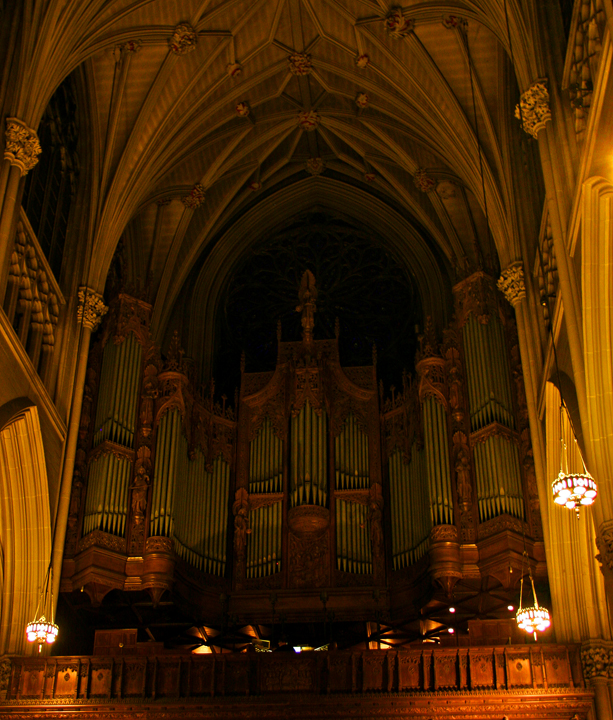
    I do not have any particular religious convictions – it would be fairest to say that I am an agnostic. But I do like inspiration, and the prospect of divine inspiration is extremely attractive if you have wandered in to St. Patrick’s Cathedral and unexpectedly run into an organ recital, as I did recently.

    The experience of listening to an organ like this is so visceral that only a person built of concrete would not be moved. Regardless of your religious preference (or not), I would highly recommend a visit to St. Patrick’s Cathedral, St. John the Divine, or Grace Baptist Church.

    One should be respectful, of course, but the volume of visitors is enormous, and anyone should feel quite comfortable visiting to admire the architecture and pipe organ.

    According to the New York City Guild of Organists :

    The original organ in Saint Patrick’s Cathedral was built in 1879 by Geo. Jardine & Son, one of New York’s organ builders during the later half of the 19th century. In 1926, Pietro Yon was appointed Organist/Director of Music, and plans were initiated to replace the Jardine organ. The St. Louis firm of Geo. Kilgen & Son was contracted to build two new instruments according to designs heavily influenced by Mr. Yon.
    In 1930, the Grand Gallery Organ, with one of the nation’s most glorious wood facades adorned with angels and Latin inscriptions, was completed.

    After more than six decades of continuous daily use, a complete restoration of the chancel and gallery organs was begun in 1993. The combined organs currently contain 12 divisions, 150 ranks, 177 stops, and over 9,000 pipes.

    In perusing the Guild of Organists site, I have found their website to be a tremendous resource. Organ concerts from the NYC metro area are listed for each day on their monthly calendar (see here). My organ concert experience has always been one of happenstance. It is nice to have listings like this available. This is a special time of year with many concerts.
    Bach’s Toccata & Fugue in D Minor or Mass in B Minor anyone?


  • United Palace Theater

    This is the spectacular United Palace Cathedral (aka Palace Theater), occupying a full city block at 4140 Broadway at 175th Street in Washington Heights. The 7-story structure was built in 1930 by Loews and “designed by Thomas W. Lamb in Byzantine-Romanesque-Indo-Hindu-Sino-Moorish-Persian-Eclectic-Rococo-Deco style,” as David W. Dunlap wrote in “On Broadway: A Journey Uptown Over Time” (Rizzoli International Publications, 1990). This place was one of Loews‘s five Wonder Theaters in New York City and was one of the most spectacular palace theaters of the 1920s. The 3,293 seat theater was home to vaudeville and movies. By the 1960s, however, movie places, unable to make expenses, closed.

    The Palace is now home to Reverend Ike’s United Church. I was astounded to learn that Reverend Ike (Frederick Eikerenkoetter) purchased this property in 1969 for a piddling $600,000! What a coup de theatre for them. Recently, in addition to its function as church headquarters, music concerts are also being held at the Palace with names like Neil Young, Annie Lennox, Van Morrison, Bjork, and Iggy Pop. The performances are managed by Andy Felz, who formerly ran the Beacon Theater.

    Reverend Ike himself is quite a controversial character. Rather than maintain a secretive and defensive posture regarding the church’s and the Reverend’s affluence, typical of most wealthy religious organizations, Reverend Ike has made it the cornerstone of his ministry with outrageous actions, such as the “Blessing of the Cadillacs,” where wealthy congregants were invited to drive their luxury cars past the church’s doors for his laying on of hands. The reverend owns a fleet of Rolls Royces appointed in mink as well as multiple mansions, and he flaunts diamond rings and expensive suits.

    I want to see Reverend Ike in action and the interior of this place. I will report back when I do.


  • Circuitous, Sinuous and Serpentine

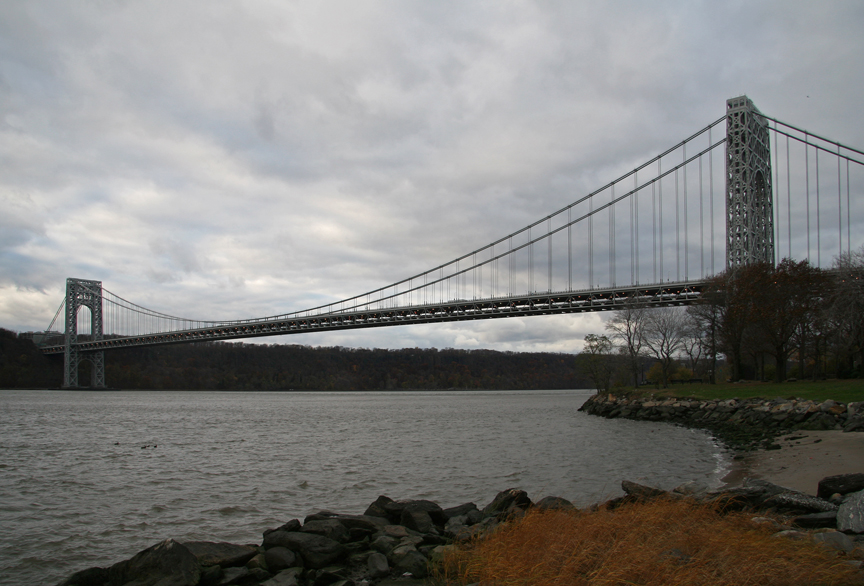
    There is a often repeated quote (1947) by French architect Le Corbusier extolling the George Washington Bridge as the most beautiful in the world. I can’t say whether I agree – I have not seen that many of the world’s bridges – but I certainly find it beautiful. The open steelwork is very distinctive – I recommend seeing it at night with the spectacular illumination created by Domingo Gonzalez Associates, for which an Award of Excellence was won.

    The GW is one of the most important bridges in the city. It is the only bridge spanning the Hudson River in New York City, connecting Washington Heights in Manhattan with Fort Lee, New Jersey. The Harlem and East Rivers are spanned by over a dozen bridges. Manhattan is an island, and its means of egress and ingress are crucial lifelines.

    The George Washington Bridge was built during a busy period in New York City’s history, with completion of the Empire State Building the same year (1931), the Lincoln Tunnel in 1934, the Holland Tunnel in 1927, and the Chrysler Building in 1930. The chief engineer was Othmar Ammann, with Cass Gilbert as architect. When it opened, it had the longest span in the world; it is now the 4th longest suspension bridge in the USA and 16th in the world. The bridge is the world’s busiest. Read more about the bridge here.

    Taking decent photography of a bridge does require being on foot. It is quite difficult to get a good photo while driving an automobile from a moving vehicle – I have tried. So I recently made a pilgrimage to the Washington Heights neighborhood of Manhattan specifically to photograph the bridge. It was windy and cold, but the cloudy, overcast day did make for nice photographic conditions. The bridge has a pedestrian walkway – I walked to the halfway point, which afforded some great vistas of the Hudson River and the city.

    But to get photos of the bridge requires getting off the bridge and finding a good vantage point. Waterfront park land on the Hudson River shoreline was clearly visible from the bridge, but no signage was present to find the way down. So I took a gamble on a path which appeared that it might lead to the water. The path went through various environments punctuated with litter, graffiti, and broken lights.

    The walkway turned out to be one of the most circuitous, sinuous, and serpentine. The investment did eventually paid off. It is here where I discovered the beach which I wrote about on November 17, 2008 (see here)  and where photos of the bridge were taken. It also justified use of words such as circuitous, sinuous, and serpentine 🙂


  • Hell or High Water

    I’m running out of superlatives. Or perhaps, more precisely, I am running out of synonyms for words such as amazed, stunned, astonished, and shocked. Please go here and look at this series of 8 photos. See what I mean? Exploring this city is like going to Paris – you start to bore yourself with superlatives. Like crying wolf, they start to lose their impact when used so often.

    Of course, I could just let the photos speak for themselves. After all, this is supposed to be a photoblog which is typically driven by the images, with minimal or nonexistent text. But this website has metamorphised over time, and the writing has become as important as the photos. I believe that most regular visitors here enjoy reading as much as I enjoy learning and writing. So now there is an expectation.

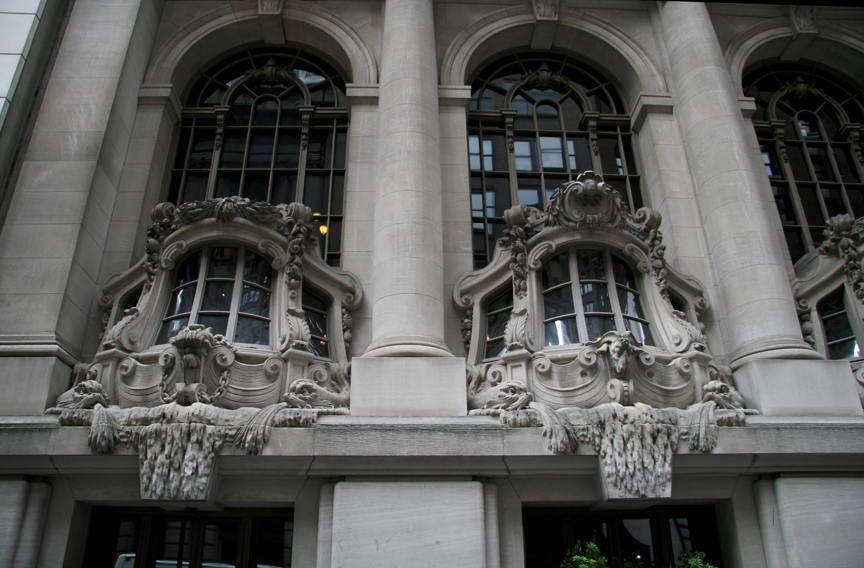
    These photos of the New York Yacht Club were taken whimsically. I did not even know this place existed, however, it was spectacular architecturally. I did enter the premises and was immediately told that no photography was allowed. I had no idea what the interior looked like or whether visitors were permitted to tour the place.

    The New York Yacht Club clubhouse is located at 37 W. 44th Street. It was designed by Warren and Wetmore, the firm also responsible for the exterior of Grand Central Station.

    From Christopher Gray of the New York Times:

    Founded in 1844, the club had several modest headquarters for its first half century. But the activity of yachting became so luxurious that by the 1890’s — with giant steam yachts of 200 feet or more — a new clubhouse seemed in order.
    A competition attracted entries ranging from the boring — R.H. Robertson’s plain design could have been a small-town businessman’s lunch club — to the opulent — Howard, Cauldwell & Morgan’s giant, modern French design with three windows shaped like the prows of oared galleys.
    The winning design was the first major work of the new partnership of Whitney Warren and Charles Wetmore. They produced a rich, five-story limestone front with three windows patterned after the sterns of early Dutch ships and a large terrace at the fourth floor topped by flagstaffs and a giant wooden pergola and trellis.
    It is the model room, though, that will astound the uninitiated visitor. Behind the facade’s three great windows, the model room stretches back almost 100 feet under a giant floral stained glass ceiling. Ringed by a balcony with a galleon railing, the room contains hundreds of full- and half-hull ship models, including one of every defender of the America’s Cup.

    After looking at photos of the interior, I’m going to see those rooms in person, come hell or high water. And if high water comes, what better place to be than the New York Yacht Club? 🙂

    Note: Membership to the New York Yacht Club is by invitation only. To tour the building, you must be accompanied by a member. 

    Related Postings: Transportation, Grand Central, Passing Time, The Oyster Bar, Just Passing Through


  • Enigma

    The butt of many comedic jokes is the cliched man who is afraid to ask for directions or information. I am not that type of man – perhaps lax at times to ask if it is inconvenient to find someone. I certainly value the process of discovery and doing things for oneself, but how far does one want to go to learn things which are already known? How many wheels do you really want to reinvent?

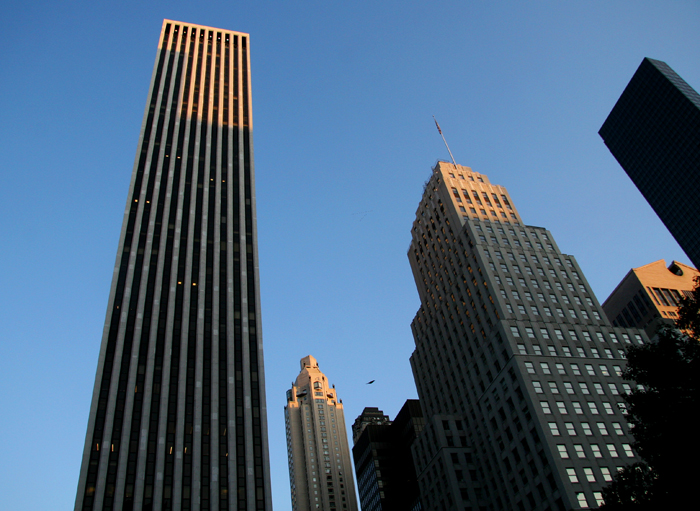
    The building in the center of the photo with the distinctive top has been an enigma for some time. I have an older photo which I wanted to use previously on this website, however, I tired of trying to identify it using online searches and printed references in my library. I resigned myself to a future trip where I would just visit the building itself rather than ferret out its name via GPS or triangulation.

    So I forgot about it until my recent jaunt to the Plaza Hotel, when I saw it haunting me in the distance once more while chatting with the doorman, who had worked there for two decades. This type of person can be a great source of information in the city – seasoned doormen and older taxi drivers have the luxury of meeting thousands of individuals from all walks of life over years of time. They also become acquainted with the details of places and things, with nuggets of info and insider gossip. So as I walked away, it occurred to me that a quick jog back to the doorman and a quick query might easily settle the identity of this building. And it did.

    The Four Seasons Hotel at 51 E. 57th Street was completed in 1993 and designed by world-renowned architect I.M. Pei and Frank Williams. Pei’s resume includes projects such as the glass pyramid at the Louvre museum in Paris. This 54-story building is the city’s tallest hotel. It is clad in French sandstone and capped with the spectacular Ty Warner penthouse, a nine-room suite with 25-foot ceilings and cantilevered glass balconies, which occupies the entire top floor with wraparound 360-degree views of the city. Amenities include a butler, fabrics woven from platinum and gold, a personal trainer, and a private chauffeur with a Rolls Royce Phantom.

    The lobby has marble floors and a soaring, back lit translucent onyx ceiling. If you are in the neighborhood, drop in for a peek…


  • dinamic_sidebar 4 none

©2026 New York Daily Photo Entries (RSS) and Comments (RSS)  Raindrops Theme