• Category Archives Art and Sculpture
  • Good That’s Olde Too

    At one time, modern high-rise buildings were marketed as “luxury.” The apartments were sterile and devoid of character, with the most boring cookie-cutter layouts imaginable. They sported only the basic modcons, nothing luxurious at all. In New York City, luxury really just meant the absence of squalor. Not roach– or rat-infested, not a tenement, not a railroad flat, not dilapidated, not in a ghetto. In short, luxury was about what a place was NOT.

    As I have written in numerous stories, in New York, like anywhere else, old or new is not necessarily better or worse. However, there are many wonderful features in old homes and apartment buildings, things now rarely seen. In New York City prewar apartments, higher ceilings, larger room sizes, and more generous floor plans all hearken back to a time when the human experience was valued above maximizing usable space. By today’s standards, the common elements of prewar construction, if seen in modern construction, are now considered to be luxury.

    Love of the old abounds here, with good reason. There are many neighborhoods where one will find a historic uniformity: row houses in Park Slope, Brooklyn Heights, Carroll Gardens, Greenwich Village, et. al. The aesthetic charm in these areas where there are blocks of antique homes is what makes the areas so well-known and highly coveted. The architectural charm and bucolic nature of the tree lined streets makes these neighborhoods some of the finest living experiences in the five boroughs.

    But new can be great too. A family member just completed a McMansion custom home. The home took 38 months to complete, and I was privy to seeing it go up step by step and in detail what went into its construction. The owner, like myself, is involved in manufacturing and was very particular about every element. The quality of construction, appliances, and materials I see in that house is unsurpassed, new or old.

    And everything WORKS. The modern heating, plumbing, and electrical systems far exceed the typically primitive systems seen in old construction. Where is the quality in age-old single pane glass windows with poor insulation and leaks? My landlord recently replaced my French windows after decades. The new windows with low-e glass, etc. are air tight and a joy compared to the old construction. I have lived with steam heat in New York City for over 40 years and can say nothing good about it other than it supplies heat.

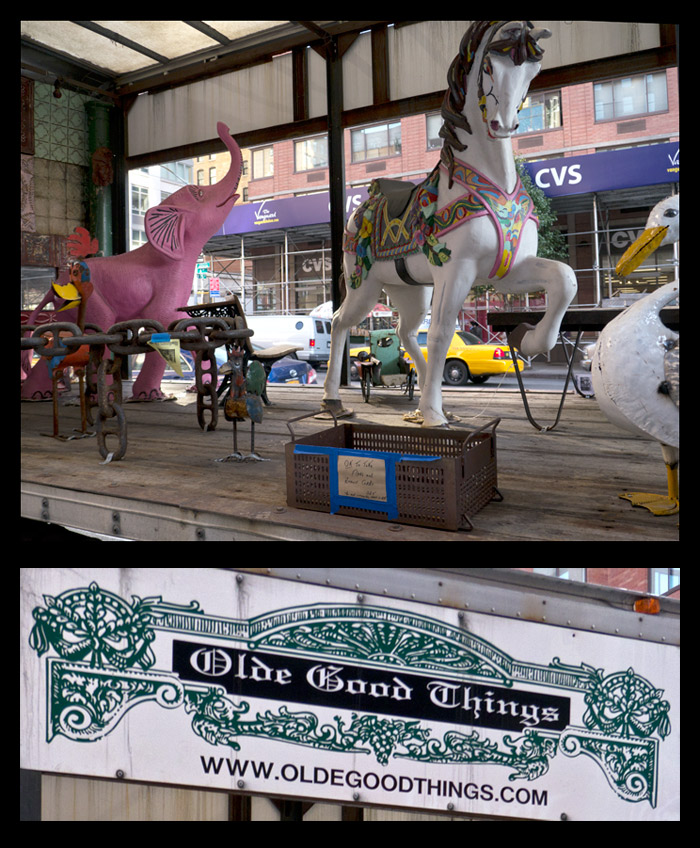
    Recently, I passed a truck on 6th Avenue with a sign: Olde Good Things. The company has a number of retail locations and a warehouse. I don’t know if the business name is an acknowledgement that there are olde bad things too.

    In homes and furnishings, there is a romance with the old. But when someone says they love old houses, old places, and old furniture, good is implied. Good is what ultimately counts, and if you’re predisposed to days gone by and lucky, you can find Good That’s Olde Too 🙂

    Related Posts: Old New York Part 2, Old New York Part 1

  • Leave it to the Critics

    One of my first art “discussions” was regarding a piece of work I saw on the streets in SoHo in the early 1970s. I recall it was a flat surface with an array of bolts – essentially looking like a bed of nails.

    Having done carpentry work, I felt that I did know something about bolts and that someone driving them into a board at different heights did not constitute art.

    However, an artist friend at the time, in a futile attempt to educate my boorish manner, informed me that what made it art was conceptual, not reducing it to its material elements. Like the defense once made by Marcel Duchamps, whom I did not know at the time – it was art because he said so. I was, nonetheless, not impressed – to me, bolts were just bolts.

    This type of installation art is controversial, even amongst those who are schooled and knowledgeable about fine arts. To put it bluntly, coming from someone who was originally a science guy, my question is whether there is any objective criteria for art and, if so, where does artisanship end and art begin?

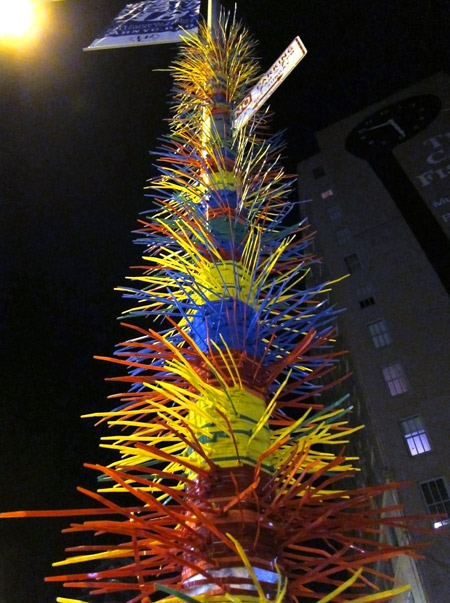
    Recently, I have noticed a number of lamp posts around Astor Place/ Cooper Union bedecked with colorful plastic cable ties. This, like the bed of nails, also challenges my beliefs of what constitutes art, since cable ties are another area of great familiarity to me – we use them regularly in my business.

    During my first exposures, it appeared to be whimsical, but after taking a number of photos, it occurred to me that there might be more to it. Sure enough, this is part of an art installation called Flaming Cactus. The Animus Arts Collective utilized 32,000 fluorescent colored wire ties around approximately 15 lamp and sign posts in Cooper Square. The project was done with cooperation from the Department of Transportation. It is permitted to remain in place until June of 2012.

    One person commented:

    The same art just went up on Spring St and in the Urban Plaza by Trump on Spring. It actually looks very nice in solid colors on the Trump lamp poles.

    However, another said:

    To me it’s cheap looking. It’s simplistic and inane, exactly the sum of its parts–zip ties on a light pole. It would look gaudy in a suburban shopping plaza. If bits of brightly colored cheap plastic brightens up your day then more power to you.

    Bolts, plastic cable ties, art, or craft – I leave it to the critics…

    Related Posts: I’m Really Good at Paper Mache, Surfaces and Surfing, Finger Painting, Acquired Taste, Real? Fake? Why?


  • Shop Class

    I was given the choice of making the pump lamp or a flying horse. I asked about making other things but was told those were the choices. I really didn’t want to make a pump lamp that much, but it was better than a flying horse wall plaque. I understand the need for discipline, training, and honing skills. This was shop class in 8th grade, where no independent thinking or creative expression is allowed. But it’s a shame, because I liked making things and would have gotten more involved in class. Eventually I would become a manufacturer.
    So, yesterday, I was very pleased to get the following email invitation for The Calling, a theater of fire and song:

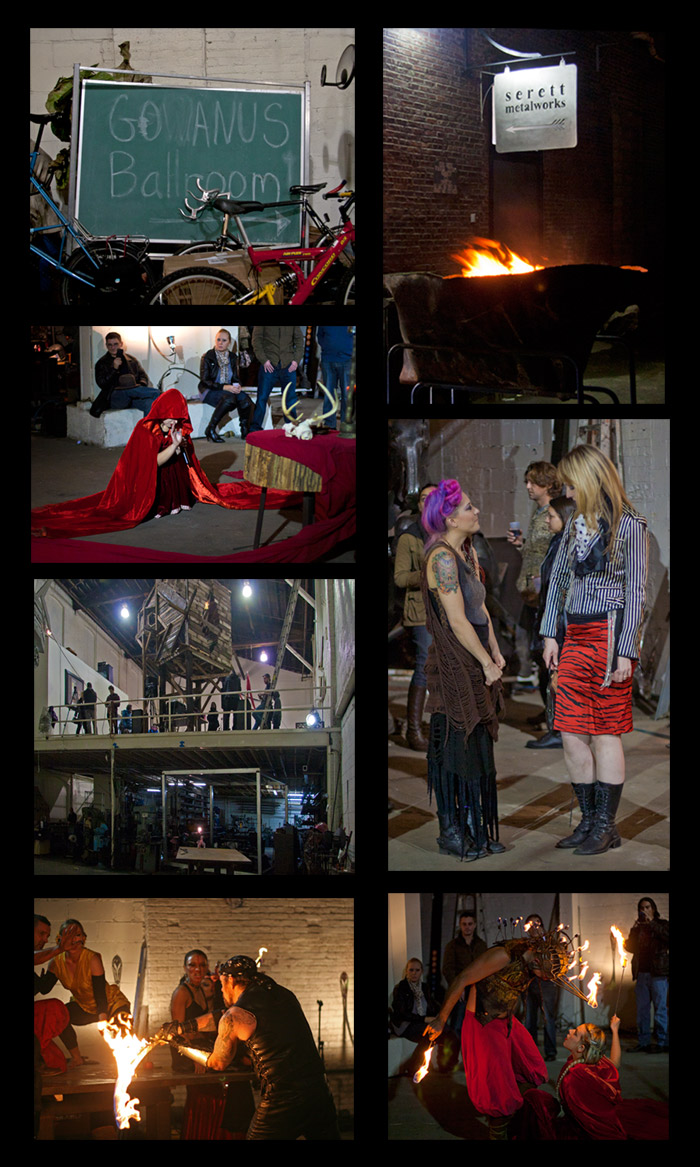
    You are being called to a relatively secret place for a meeting of believers – a ritual for the arising. Out in gritty Gowanus in Brooklyn is an industrial complex down by the canal where much of the sculpted art you see in swanky galleries actually gets created. It’s a vast place, owned by ex-squatters and descended from the renegade forges and welding spaces of the LES of the 90s, and it opens it’s doors to Flambeaux Fire, Kai Altair and to you this coming Thursday. You will see it become a WONDERLAND.
    A landscape of flames, machines, and beautiful women as spiritual guides, set to the live music of Kai Altair, written & directed by Flambeaux and Kai.

    The email invite went on to say:

    Flambeaux presents The Calling, a Fire-and-Song Ritual with siren Kai Altair.
    A Journey into Seduction, Spirit and Transformation with ritual shows by Lady C, Serafina, Fayzah Fire, Ali Luminescent, Flambeaux, Tribal Bellydance by Angelys and Serena. Featuring the sculpture art of Adrian Landon and Doumbek byt Natalia Perlaza.

    What really intrigued me, was the location and venue, The Gowanus Ballroom. Gowanus is a very industrial neighborhood, and it certainly is not the type of place where one would expect to find ballrooms, chandeliers, and formal attire. The invitation also specified Serett Metalworks, so perhaps it would be a ballroom of a different sort. And it was.

    The space was difficult to find, as might be expected. There was no ballroom or 55 9th Street. I saw two women on the street and asked if they knew of this place – they did and directed me. The space was down, around, and behind.

    I never read the email closely enough or thought about it, so I was surprised to find that the ballroom was actually an industrial space along the Gowanus Canal. I was greeted with an open factory space and an open cauldron of fire burning outdoors beneath a sign for Serett Metalworks. I knew we had arrived at the right place when I found Gowanus Ballroom written on a chalkboard.

    Inside was every manner of metalworking machinery along with a variety of metal sculptures, as promised in the email. There was an enormous loft space which afforded viewing from above and a wooden structure reminiscent of the Tower of Toys.

    Chris Flambeaux was busy milling about, making preparations for the show he had written. Performers and attendees began to filter in, dominated by the edgy artistic with the requisite piercings, metal, fanciful dress, dreaded hair, and skin art.

    The show started in a ritualistic, nearly occult manner, setting the tone for the entire night’s performances. Some of the acts I had seen at the QAS. This show, however, had a much more industrial flavor – fork lift trucks were used to deliver acts and even performed on them. One act featured villainous characters aboard a Harley-Davidson motorcycle, driven around the space. See my photo gallery here.

    Space being so precious a commodity in New York, this in not the type of event one would expect in the city. For years I had heard of these types of happenings – somewhat impromptu and unadvertised. I was always desirous to be in the loop and attend. There was drama, fire, seductive sirens, metal, and machinery. These guys should open a real ballroom or run a Shop Class 🙂

    Related Post: Not Of Them


  • Fountains

    Depending on who’s counting, the Palace of Versailles has more than 1,400 fountains. Due to the enormous amount of water required to fuel them, they are turned on infrequently. Even at the time of Louis XIV, the water supply was inadequate to run all of the fountains at once. There was even talk of diverting the River Eure to supply water to the fountains.

    Sunday afternoons from April through October, there is the Grandes Eaux, a musical fountain show in the gardens to the accompaniment of recorded music. Although I have been to Versailles twice, I was not fortunate enough to experience the spectacle. Paris has 350 fountains; to a visitor from the United States, they seem to be at every turn and virtually are.

    New York City has a much less lavish feel to it, as observed by one of my Swedish clients, which I wrote about in Very Practical. Fountains will never be a priority here, although it certainly was for George Vellonakis, architect for the redesign of Washington Square Park. Upon reconstruction, the central fountain was moved to be centered with the Washington Square Arch as viewed coming down Fifth Avenue. George was virtually crucified for this, the cost of which was often misrepresented since the fountain needed to be dug up for plumbing work anyway, with the additional cost of moving being incidental.

    But to me, the entire fiasco and controversy is just indicative of the fixation of Americans on the bottom line, even if at the cost of aesthetics or the occasional jubilant indulgence.
    As I wrote in Let’s Have a Parade, in the light of hardship, it often is hard to justify celebration. After all, there is always a better place to spend money.

    We do not have a large number of fountains in New York City, but there are a handful. Conservatory Garden, the fountain and the gilded statue of Prometheus in the sunken plaza of Rockefeller, the fountain cascade at Rockefeller Center, the fountain at Columbus Circle, the Pulitzer Fountain at 59th and Fifth Avenue, Angel of the Waters Fountain at Bethesda Terrace in Central Park, the Unisphere in Flushing Meadows Corona Park in Queens, Temperance Fountain, Tompkins Square Park, James Fountain at Union Square Park, City Hall Park Fountain, and Washington Square Park.

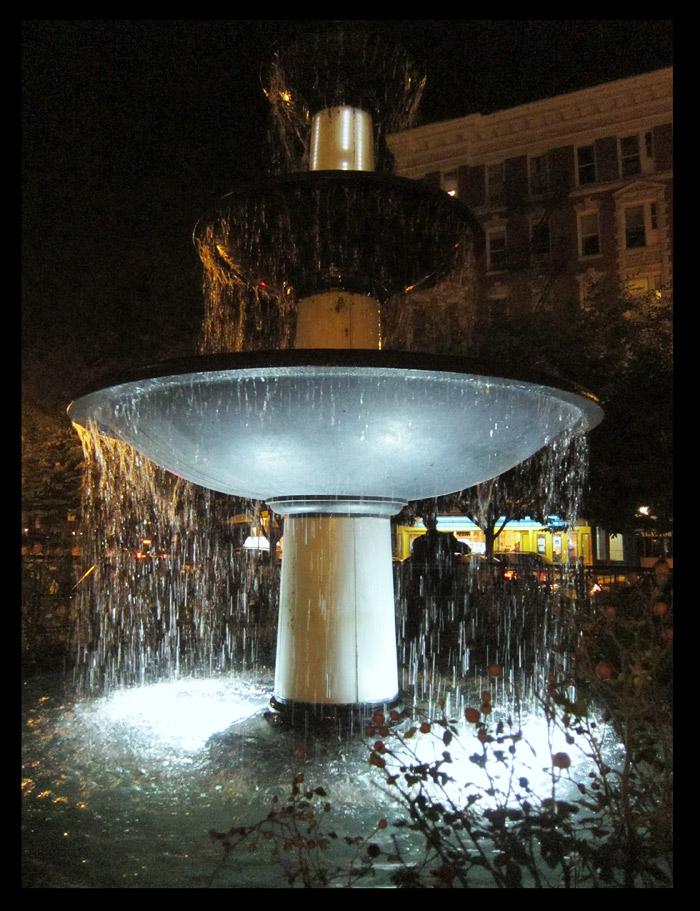
    Here, at Father Demo Square at the intersection of Carmine Street, Bleecker Street, and Sixth Avenue, is a tiny park with a beautiful charcoal gray stone fountain as centerpiece. The park completed a renovation in 2007 and is an ideal resting spot located in one of the most intensely trafficked areas of New York City, surrounded by a plethora of restaurants and shops. It’s ideal for people watching, a rest after dinner, or a place to eat a snack. Or, for those inclined to indulge, enjoy one of New York City’s very few fountains 🙂


  • Off-White by Design

    At the risk of sounding ungrateful, I must tell you that I really don’t like being in my apartment much. I say ungrateful because although I have worked hard like many, I have also been lucky. And to live in an 1837 landmark townhouse on Washington Square is one of the rare privileges afforded very few in New York City.

    Notice that I said apartment rather than home. The reason is simple: my place does not feel much like a home, for which I take full responsibility. It has not been decorated at all. Even the Shaker style, for all its spartan utilitarianism, at least has a style, grace, and aesthetic. I’m embarrassed to say and hate to admit, perhaps my place has devolved into a bachelor pad with a hint of hope.

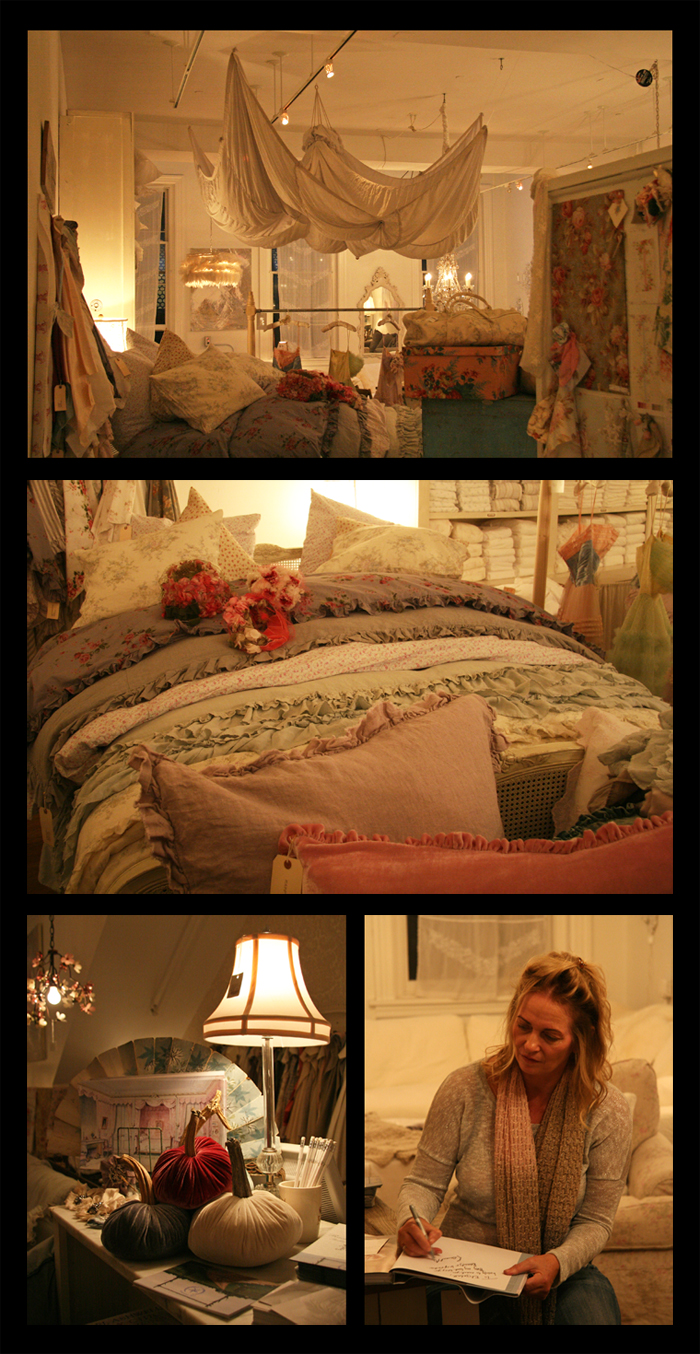
    Recently I was strolling home from my office via Mercer Street. An exquisitely appointed retail interior caught the eye of a friend, who immediately recognized the furnishings as the Shabby Chic style of Rachel Ashwell, a woman whom she much admired and many of whose books she had acquired. She wandered inside. I waited outside at first but soon decided to explore the store myself. The shop had an extraordinary feel. Truly inviting and homey, a place you want to just linger in. And we did. See my photo gallery here.

    I was pleased to learn that Rachel Ashwell herself would be present for a book signing in just a few days, so I discussed with the staff my desire to return for the signing, meet Rachel, take photos, and do a story. The staff was extremely amenable, befitting my entire experience there. I was given a green light, and so, with cameras in tow, I returned last night for the small happening. It amazes me how so many such fetes with notables are going on concurrently in New York City.

    I know nothing of the Shabby Chic style, but it is immediately apparent that although there is a casual nature to the decor, nothing is really left to whim. The messy, mushy, wrinkled, and time-worn comfort is deliberate – every element is given thoughtful consideration, even down to the white pencils, offered free. The lighting in the SoHo shop is soft with a yellow cast. Intrigued about the details of the decor, particularly the colors, I asked about the paint, and, as I expected, the precise shade was known and written down for me as per my request – Winbourne White by Farrow and Ball.

    The turnout was not too large or too small. Free appetizers and wine were made available. Everything seemed just right. I waited in line and met Rachel briefly, telling her of this website. She was charming and cordial. I told her of my intentions and left my card.

    We often like our things crisp and clean with hard edges, particularly in a world ruled by the precision of modern technology. We like bright and bold colors and harsh contrasts. In my lifetime, painting a place white meant a pure white. On November 17, 2009, I wrote White by Design. But that’s white, not off-white. My apartment is now painted Atrium white – a stark, bluish white. I never understood the desire for off-white. Why be so muted? I understand now. The world can be a harsh place at times. Who wants to come home more of that? I have seen the light, and it’s a little yellower. I want to come home to a place that evokes the comfort of a time gone by. A place that is soft and Off-White by Design 🙂

    About Rachel Ashwell: Rachel Ashwell, was born Rachel Greenfield on October 30, 1959, in Cambridge, England and raised in London. Rachel is an author and interior designer who created the Shabby Chic style, opening her first store in 1989 in Santa Monica, California. Her mother restored antique dolls and teddy bears, and her father was a secondhand rare books dealer. While in her teens, Rachel began selling antiques at London outdoor markets, later pursuing a career as in England as a wardrobe and prop stylist for TV commercials and photo shoots. She currently resides in Los Angeles, California.

    Related Posts: White by Design 3, Yellow by Design, White by Desire, Rhapsody in Blue, White by Design 2, Coup de Grace, Soho Treasures


  • In a Different Light

    Generally, the terms shallow or lack of depth are not positive. However, in the world of photography, these words take on a very different meaning.

    Technically, this site started as a photoblog with each posting featuring a photo. Ironically, I have never discussed photography per se or photographic techniques here, but the understanding of depth of field is so critical in photography that I have decided to feature it in today’s post.

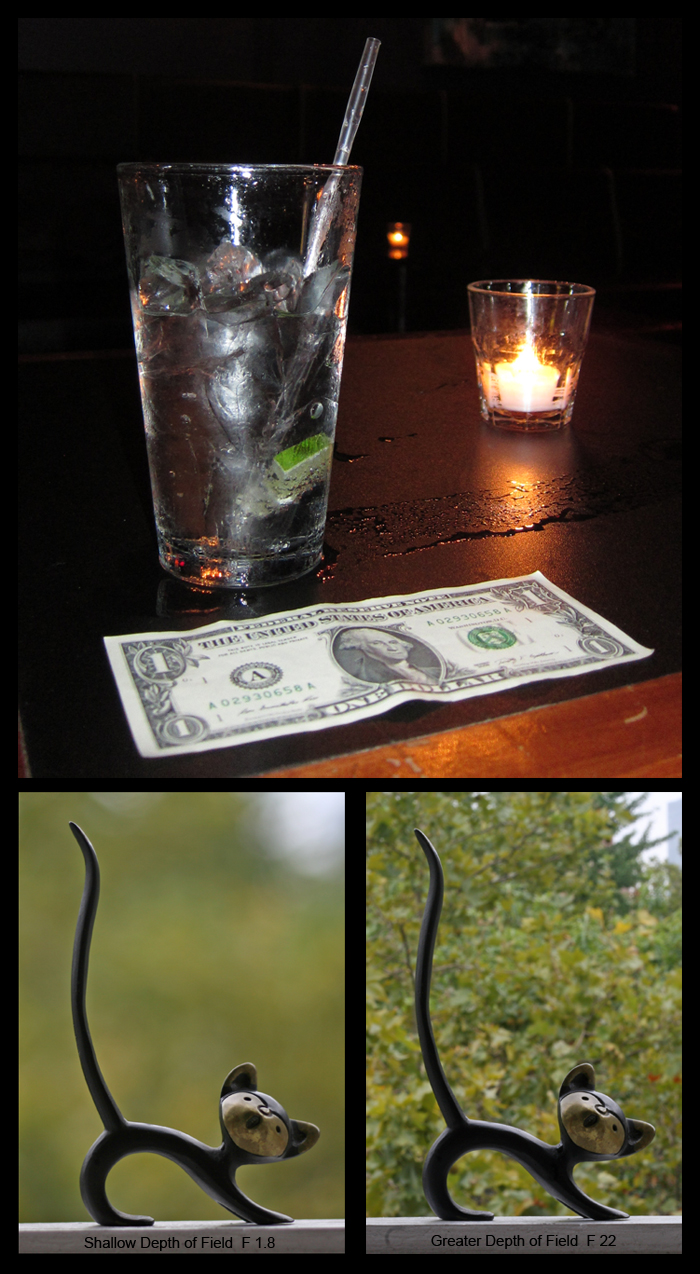
    I was in a local nightclub recently with fellow photographer Bill Shatto. The subject of depth of field came up, as it had many times before. Depth of field (DOF) is the range in distance between the nearest and farthest objects in a scene that appear acceptably sharp in an image. A shallow DOF is where the range of focus is extremely narrow – this is the technique used to create a sharp subject and blurred background. You often hear photographers using phrases such as “throwing the background out” (i.e. out of focus). The decision to use shallow DOF is quite simple – is there a subject that you want to feature/isolate, and how much do other elements of foreground or background distract or enhance the subject?

    Bill specializes in macrophotography of insects, and isolation of subject is paramount to his work (which you can see here). Even different parts of an insect may be in or out of focus. But the importance of DOF extends far beyond macrophotography.

    We revisited an old discussion of how nothing perhaps better distinguishes the photos of a master over that of the inexperienced photographer than the isolation of subject using shallow depth of field. This is true particularly in portraiture work. Also, one issue we both find particularly irritating is to examine our digital images and discover an object in a background ruining a photo by its unplanned and undesired prominence, like a pole appearing to come out from someone’s head.

    The tendency of many is either to pay no attention to depth of field or to strive for maximum sharpness throughout the scene, foreground and background. When I was younger and shot slide film with an SLR camera, I always strove for maximum sharpness over the scene. I was not aware that shallow depth of field could be desirable.

    Of course, shallow depth of field is not always desirable nor possible. In the case where the subject(s) are in the same plane or at a great distance, such as a landscape, depth of field will not be relevant or impossible to control. Also, working with a narrow range of focus requires more care – it is easy to end up with elements out of focus which you want in focus. The work of master photographer Henri Cartier-Bresson shows highly successful images both with and without a shallow depth of field.
    I hope that this short dissertation helps you see shallow and depth in a different light 🙂

    NOTE: How to achieve shallow depth of field. You will need a camera that has an aperture priority mode. With this setting, you will be able to choose aperture, or size of the lens opening. The greater the opening (smaller number) the shallower the depth of field. The smaller the opening (larger number) the broader the depth of field. Many point and shoot cameras have aperture and shutter priority modes. Cellphone cameras do not and will be near impossible to control depth of field – there are some tricks and even apps for some smartphones. Note that DOF also is a function of distance to the subject and the focal length of the lens. The basics are simple, but actually this is a deep subject.

    Photo Note: The lower photos shows the results of different apertures. In both images, the camera is focused on the metal cat. The left shows the result on my 50mm lens “wide open” at aperture F 1.8. The right shows the result at F 22.

    Related Posts: Kind Of, Drive-By Shooting, Window of Opportunity, The Lomo Look, Peter Lik, Risk Not Living, Red Green


  • Mike Fontana

    Posted on by Brian Dubé

    Part 2 – Surrender to the Music (see Part 1 here)


    Immersion took on a new meaning for me when virtual reality technologies were developed and became surrounded by media buzz. The operative phrase became total immersion experience. For something to truly feel real, input to all five senses must reach a level where the user perceives them to be real.

    In on our non-virtual world, I believe we have an analogous situation. When we reach sensory overload and the stimuli are positive, we feel euphoria, exhilaration, or pure joy. We lose the ability to intellectualize, analyze and stand outside the experience as observer. You are fully IN the experience.

    My first meeting with Mike Fontana was short but exciting. Here was a working artist on St. Marks Place between 2nd and 3rd Avenue, the historical nexus of the East Village. A brief moment standing on his 2nd floor balcony connected me with that past. While there, friends dropped in, seemingly unannounced, reminiscent of my childhood, where making rounds visiting relatives (often unannounced) was de rigueur. I was informed by the friend who made the introduction that Mike hosted regular music jams and every first Wednesday of the month, there was a open megajam.

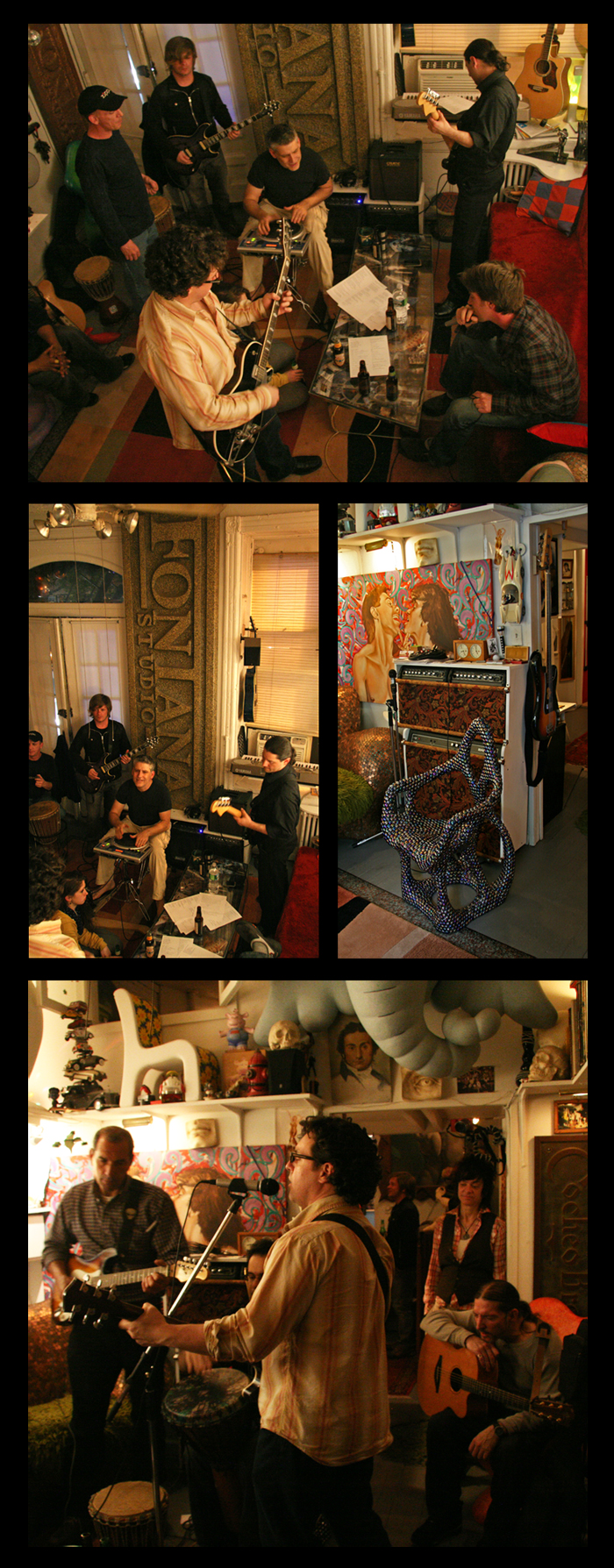
    On Wednesday May 4, 2011, I went to Mike Fontana’s, armed with cameras and camcorder. Mike is disarmingly cordial, convivial and generous. His home is your home. There is an openness rarely found in New York City. He welcomed me to make use of his loft bed which had a windowed opening through a wall, permitting a treehouse view of the living room which was filled with musicians. Many of the photos for part 1 of this story were taken from this aerie.

    In short order, the entire apartment was teaming with musicians. This was a full-fledged rock and roll extravaganza, the likes of which I have never seen in a private home:

    Mike assured me that the neighbors were not always as pleased as the jam participants. The living room is well outfitted with amplifiers – guitarists only need to bring their axes and plug in. Mike was busy on his drum pads with all the enthusiasm of a boy who just unwrapped his first set at Christmas.

    It is easy to get caught up in an urban life filled with agendas and completely lose touch with your own humanity. As I wrote in Duffy , when life’s routines begin to take over, it’s time to recharge your batteries. Grab a surfboard and jump in. Immerse and lose yourself. Take off your armor. Fall in love, head over heels. Find a music jam, sing out and surrender to the music

    Note: You can find Mike Fontana’s website here.

    Related Posts: I Got Caught, New York Is Bluegrass Country, Pockets of Joy, The Conductor Paddy Reilly’s, Park Night

    Posted on by Brian Dubé

  • Mike Fontana

    Posted on by Brian Dubé

    Part 1


    In May, I was asked by a friend if I would be willing to guest host a local access TV program which he will be producing using the facilities at MNN, a local access cable television network based in New York City. This is an exciting opportunity and I readily agreed.

    The show is being put together as a final project for my friend’s training at the network. His plan is a 28 minute program consisting of 2 interviews with two artists. One of those men is Mike Fontana. We agreed to visit Mike together for a preliminary meeting. Mike lives in one those unlikely locations – a street so well known for its shops that the prospect of an artist living on St. Marks Place between 2nd and 3rd Avenue is hard to imagine.

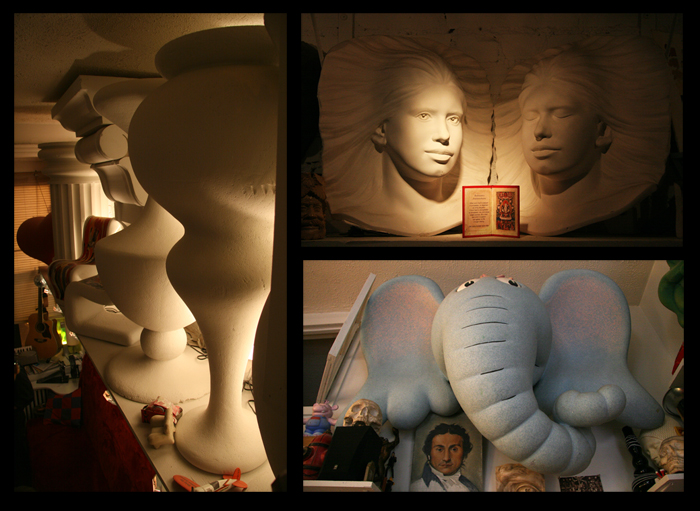
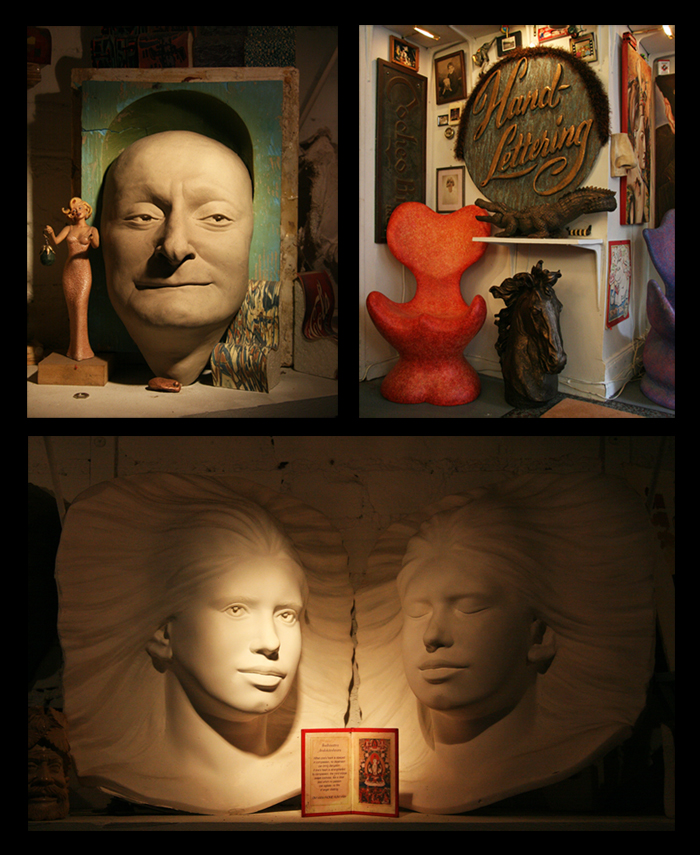
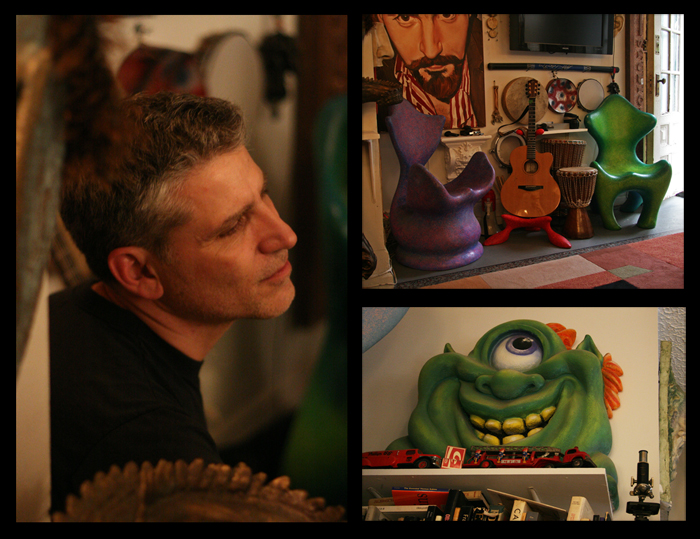
    Mike’s home is a shrine to his sculptural work – every wall, corner, shelf, room, piece of furniture. A small balcony a the front of the building overlooks St. Marks from the second floor.
    Mike is a native New Yorker, born here in 1961. As I typically do with my profiles, I corresponded with Mike by email to learn more about him and his background. Mike spent a semester at SVA and a year and a half at Art Student’s league. There, he was a drawing and anatomy major. Mike says:

    I dropped out of high school to work with my families photographic retouching studio. I’d spent some years in construction, mostly as a carpenter, building houses, apartments, renovation etc… All the while making paintings. Found work with Macy’s Thanksgiving Parade Studio where I ended up becoming Chief Sculptor and Associate designer. Many long stories there. I stayed 12 years. Since then I’ve pursued all kinds of sculpting and design endeavors from props and display to major historical monuments, museum figures, fabrication for major artists ( “I don’t have to finger paint any more.”) and, my own stuff.

    I was amazed to learn about Mike’s family background:

    Father: Illustrious family origin, aristocracy, 700 year old name. Grand father: famous opera star early 20th century. Caruso was my dad’s step father. Dad’s mom: Spanish Countess. Title originally conferred on family by King Ferdinand. That and half a sawbuck gets me on the subway.
    Mother: East European peasant stock but, her mom’s rise to the American dream is quite extraordinary.

    Mike speaks of his interests and the importance of his daughter in his life:

    Interests: Painting, Sculpture, Design, Illustration, Photography, Industrial design and architecture, Music, Film, Animation, Rapid prototyping. It goes on and on. I think that my biggest achievement is the relationship that I have with my daughter. Strip away everything else and she is the center of my everything. I’ve never known a comparable love. Of all of the interesting and or beautiful things that I’ve had my hand in creating, all pales before her. She is my angel.

    But there is another fascinating side to Mike’s life that I had the opportunity to participate in. We will see that in part 2…

    Related Posts: Penny’s From Heaven, I’m Really Good at Paper Mache, Horticulture, traPt, Bovine Love, Koons Balloons, Tower of Toys, Yaffa Cafe, Astor Place Cube, Gem Spa

    Other Interesting Individuals: Mark Birnbaum (see here and here), Ferris Butler (see here and here), Nicole Dubuc (see here and here), Professor Robert Gurland (see here and here), Bex Burton, Gaby Lampkey (see here and here), Jenn Kabacinski (see here and here), Driss Aqil, Walid Soroor

    Posted on by Brian Dubé

  • It’s Perfect

    Posted on by Brian Dubé


    I was once led to visit an artist on Broadway, only a few blocks from my office. Not knowing whether my destination would be of interest, I paid no mind to exactly where I was going or who I was visiting. I have no idea what her name was to this day, but we had a conversation that left an indelible imprint in my mind.

    Her work was quite unique – furniture as art. What particularly struck me was her use of machinist’s tools and equipment. Her work was impeccable – I had never seen anything crafted so perfectly and I told her so. She did not take the complement but instead corrected my choice of words. Precision, she said, not Perfection.

    Touché. A distinction very well made. We had a conversation about it, but she was preaching to the choir. I have reflected on her comment a myriad of times – often when I work or whenever the word “perfect” is used emphatically in praise of a product well made.

    When it comes to man-made articles, it is quite true. Perfection does not exist, only tolerances and precision. Given measuring devices accurate enough, anything manufactured will vary from its specifications. Certainly the eye or hand will be unable to perceive variations within tolerances in a finely crafted article, but the lack of perfection is there nonetheless.

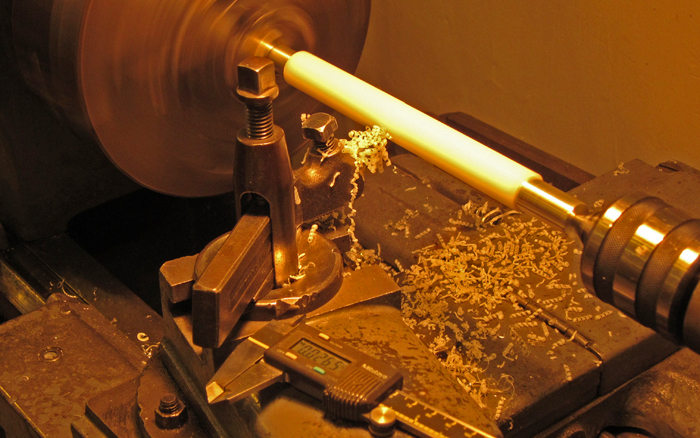
    I’m not sure what surprises people most – what I do for a living or that I do it in Manhattan in a prime SoHo location. I do maintain a machine shop on Broadway. In the photo, I am machining a part on a 1951 LeBlond lathe. The machine is a real workhorse, made at a time when American machinery was built to last. This machine will likely outlive me.

    I often wonder how many lathes are left in New York City, particularly Manhattan. I only know of a couple of machine shops. In the 1990s, there was a small machinist who occupied an entire one story building on Crosby Street around the corner from me. At one time, numerous other small manufacturers dotted the area, even entire buildings were occupied. I never appreciated the luxury of strolling to a machine shop and in minutes discussing a project, leaving drawings and picking up parts in hours or a day. The place is now a carpet shop.

    My lathe was purchased at Grand Machinery Exchange on Lafayette Street in an area once known as machine shop row. There were 40 machinery dealers in the area north of Canal Street. Grand Machinery was the last of these dealers and relocated to Long Island in 2006. I very much would have loved to do a story on them, however, I only learned of their closing a few days after their move. My visit there was only to press my face against dirty windows and peer into an empty industrial ground floor space.

    I do love machining a metal part. It is so satisfying to produce something with a high level of precision in a world of the unpredictable, uncertain or mutable and riddled with poorly made articles. When I take a beautiful gleaming metal part off that lathe, check it with my Mitutoyo digital caliper and find that the diameter is exactly what I wanted, there are no thoughts about that artist on Broadway and the nuances of perfection versus precision. It’s perfect.

    Related Posts: Brawling Over Brands, In Industry, Because I’m the Best Part 2, Because I’m the Best Part 1, Released From Captivity, Space Surplus Metals, Canal Rubber

    Posted on by Brian Dubé

  • Rattus rattus

    Posted on by Brian Dubé

    I am very disappointed to learn that the species of rat most common to New York City is the brown rat or Rattus norvegicus and not the black rat, Rattus Rattus. The repetition of genus and species seemed to fit so nicely with the popular: New York, New York, so nice they named it twice.

    The rat commonly seen in New York is the brown rat (Rattus norvegicus), aka the common rat, sewer rat, Hanover rat, Norway rat, Brown Norway rat, Norwegian rat, or wharf rat. It is one of the world’s most common rats. The name is actually a misnomer as they do not originate from Norway. After human beings, the rat is the most successful animal on the planet, having inhabited virtually every country and land mass. Read more here.

    Rat is also used to characterize New York’s landlords and store owners – see the use of the large inflated rat in my story Attention. For those who want to embrace the rat in order to appear edgy, there are establishments that use the rat for imaging and naming, such as the trendy SoHo shop Yellow Rat Bastard. According to the New York Times:

    When the flagship store opened in 1994, it installed cages with several dozen rats in its front window to create buzz. The rats were eventually removed from the window, but many employees said the rats continued to run around the store and the basement storeroom.

    The shop encouraged graffiti artists to tag the exterior of the shop. Ironically, in 2008, the store agreed to pay $1.4 million to settle a lawsuit over unpaid wages and overtime, paying back wages to more than a thousand employees.

    We have so many rats in New York City, that in a way it is a shame we do not have our own species. It would be so befitting of a city with such a large ego to be able to lay claim to Rattus rattus

    Photo note: I ran across the piece of graffiti in the photo on East 2nd Street in the East Village.

    Related Postings: I have done numerous stories on rats: i’m lovin’ it, Rats Gone Wild, Rats R Us, and Wildlife Control.

    Posted on by Brian Dubé

  • On Parallel Tracks

    Posted on by Brian Dubé

    It is so peculiar and serendipitous that in researching Duke Riley, who created the art in the photo, I found that on September 15, 2010, I had already written about Riley and his exploration of U Thant Island. On further examination, I see that we have many other interests in common, particularly a strong passion for islands and exploring the edges and unknown areas of the New York City. Riley says of his work:

    My work addresses the prospect of residual but forgotten unclaimed frontiers on the edge and inside overdeveloped urban areas, and their unsuspected autonomy.

    Other shared passions include Bequia, a lesser known island in the West Indies neighboring St. Vincent. In the many years and visits I made to the Caribbean islands, Bequia was always on my to go list, but I never made it there. Riley once visited the island, where he became inspired to make boats. He also has an interest in Plum Beach and Dead Horse Bay.

    I discovered Riley’s work in the photo on a recent ride in the E train. The poster was quite long – hence the two photos. The work was commissioned by the MTA Arts For Transit in 2010. It is available as an art card from the MTA website – see here.

    A Brooklyn resident, Riley has a BFA in painting from the Rhode Island School of Design and a MFA in Sculpture from the Pratt Institute. His work is noted for its nautical themes. Riley has also built many seacraft. In 2007, with two companions, he built and launched a small wooden submarine, the Turtle, a replica of a Revolutionary War era craft. They were arrested by the New York City police when they came within 200 feet (without authorization) of the Queen Mary 2, docked at the Red Hook Brooklyn cruise ship terminal. Riley has circumnavigated the city’s waters in a homemade rowboat and built ships for staging a sea battle.

    Although I do not share his love of all things nautical, I still hope to run into him combing Dead Horse Bay or in the subway, somewhere On Parallel Tracks 🙂

    Related Post: Explorin’ Part 1

    Posted on by Brian Dubé

  • I’m Really Good at Paper Mache

    It is slowly becoming abundantly clear to me how artistic abilities are rarely recognized or encouraged in young people. I have a story about a childhood friend so remarkable that we are planning to write and publish a joint memoir as a book. But that’s another story for another time.

    I had another childhood friend, who shall remain nameless, who was quite sarcastic and cynical. Our community was doing a small performance of Alice In Wonderland. I was unaware of this production until it was nearly time for performance – hence, I had no opportunity to audition or perform in the show. I took a last chance to ingratiate myself with the woman in charge and offered my services to make any figures needed from paper mache. I told her in front of my friend, “I’m really good with paper mache and working with wire.”

    Once we were alone, my friend was uproarious and quoted with great pleasure, “I’m really good with paper mache.” Apparently, he found my skill set to be inconsequential and my statement of such, ridiculous. He took every opportunity subsequent to that incident to torture me with that quote. In hindsight, it does smack of a young boy desperately trying to win approval. But what is wrong with a young student who shows a creative interest?

    Supporting a child who has an artistic temperament and abilities is a tough call. On my recent interview with Professor Gurland (see story Part 1 here and Part 2 here), he told me not only of his work as a jazz musician, but also of his son’s interest. He made a deal with his boy – graduate from college and he can do anything he wants as far as pursuing music. A degree will provide a safety cushion for future employment. A reasonable compromise for the concerned parent.

    For myself, it has taken the better part of my adult life to recognize my interest in creative pursuits – writing, photography, and graphic arts. The evidence has been there throughout my life – building a darkroom as a child, crafting various objects and models, origami, and designing products for my business.
    I was, however, steered towards a career in mathematics, as is the case. My life might have been very different however, had someone just recognized that I’m Really Good at Paper Mache 🙂

    Photo Note: Two Too Large Tables are located at Hudson River Park. The two works, designed by Allan and Ellen Wexler, were constructed from stainless steel and ipe wood and fabricated by Polich Art Works. One is comprised of 13 chairs, 7 feet tall, supporting a 16-foot-square plane. The other, also 16-feet-square, is 30 inches tall with integral seating areas. One serves as a shade pavilion and the other a community table.
    “The seemingly random placement of chairs directs and focuses our views of the river, pathways and landscape. Pathways cut into the tabletop lead to clusters of chairs. When people sit they are completely surrounded. Their unconventional placement brings people together in unexpected groupings.”
    Allan Wexler and Ellen Wexler are Chelsea residents and collaborate on public art projects; Allan teaches at Parsons The New School for Design.


  • The Perfect Gift

    In 1978, High Tech: The Industrial Style and Source Book for The Home, written by design journalists Joan Kron and Suzanne Slesin, was published. This and White By Design were two hardcover coffee table books that I frequently saw in bookstores and promised myself I would buy but never did. The raison d’etre of the Hi Tech design movement is seen as an evolution of the scientific and technical advances of the 1970s and abundance of high-tech devices in common use, leading to the appropriation of industrial and technical products in the home. The book was seminal and influential in use of the term Hi Tech – read more about it here.

    As a manufacturer for many decades, I found the use of the Hi Tech products in the home to be appealing for other reasons as well – the generally superior construction and cleaner, simpler design of industrial or commercial products. Those who use products in a commercial environment typically value function over form and durability over anything else. The foolishness of saving a few dollars purchasing equipment quickly becomes apparent when having to stop the wheels of production. Someone in business simply needs products that work well and reliably. And although aesthetics does not typically drive the design of commercial equipment, it does evolve towards the simplest form and construction that does the job properly. Often, this design becomes iconic and attractive from a minimalist perspective. One example is the bullet styled garbage can in stainless steel.

    Industrial elements have other appeals. Around New York City, in the outer fringes and edges, one will often find photo shoots with fashion models superimposed over gritty or industrial urban backdrops. The juxtaposition of the very disparate elements is quite effective in making the subject stand out.

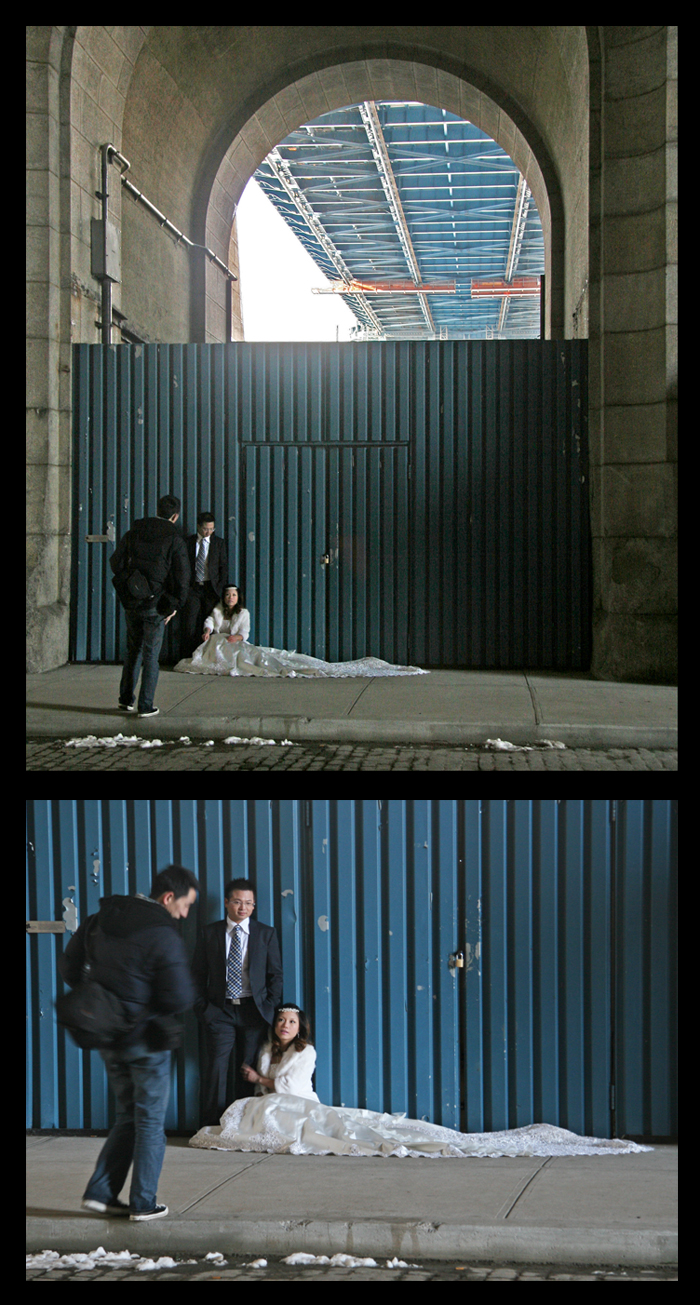
    All this considered, I was stunned to see the couple in today’s photos under the Manhattan Bridge on a freezing cold January day. The wedding is still a rather traditional affair, and this was an extremely radical departure from the ever popular New York City locales used for wedding photo shoots, such as Central Park on a beautiful spring or summer day.

    I wish I was friends with this couple because I have such the perfect wedding gift that I really think they would love: a set of two books – Hi Tech and White by Design 🙂

    Note: For more White by Design, go here and here.


  • Toys "R" Us

    Everyone has their comfort zones, and for most, familiarity breeds contentment, not contempt. But I really have a difficult time with visitors who travel all the way to New York City and seek out the same shops and restaurants they have at home. Like eating at McDonalds after shopping at national chain retailers.

    I am quite guilty myself of frequenting a small group of restaurants in a city with tens of thousands. When my stomach calls for refueling, this is typically not the time I want to become a risk taker. I want the tried and true – to eat the things I know are guaranteed to bring satisfaction. But there are limits to living in the comfort zone.

    When I guide visitors brimming with enthusiasm for those things unique to the city, I am galvanized; when I find myself with someone looking for the places that are familiar to them, I begin to short circuit and lose voltage. On one occasion, I had in my custody a woman who rejected every cuisine I offered. She commented, “At this point, McDonalds is starting to look good.” When we finally agreed on Italian, she rejected every entree. The only pasta she would eat was not on the menu.

    The most frustrating outing was one occasion when visited by my nephews when young. Knowing full well what I was dealing with, I put quite a bit of thought into what kids would want and geared the day towards the big and impressive – things like the Brooklyn Bridge and the new planetarium at the Museum of Natural History. What was requested, however, was a visit to the large Toys “R” Us at Times Square. I’ve been in a bad mood ever since.

    If you are a shopper, you could be visiting places like the Morrison Hotel Gallery. There are two locations – the older at 124 Prince Street in SoHo and the newer (seen in the photos) at 313 Bowery, appropriately, the former location of the CBGB Gallery. In my recent visit, I spent some time chatting with Rick Edwards and Vicki Albanese, sharing stories of music venues and encounters with music legends in the past.

    The gallery represents a bevy of renowned photographers, such as the legendary Jim Marshall, who recently passed away. The Morrison Hotel Gallery was founded in 2001 by former record company executive and producer Peter Blachley, former independent record store owner Rich Horowitz, and music photographer Henry Diltz. In 2008, a deal was made with Sony to sell photos from the archives of Columbia Records.

    The Morrison Hotel Gallery has some of the largest collections in the world of historic rock photos. If you are downtown, I recommend you drop in to browse. If you prefer, I also know of another little known place to visit for a unique New York City experience, located in an off-the-beaten-path location. It’s in an area called Times Square, and the place is called Toys “R” Us 🙂


  • Horticulture

    Sometime in the 1980s, a good customer and I were chatting in my office. In the course of conversation, he mentioned his excursion to visit Lillian Openheimer in Union Square at her Origami center. Lillian is largely credited with introducing origami to the United States.

    My customer was pleased to learn that we shared a mutual interest in origami – I had discovered the Japanese art of paper folding in high school and had made a myriad of creatures, always looking for an opportunity to make a flapping crane.

    At one juncture in the conversation, he showed me paper he had acquired from Lillian’s studio. My first instinct was to take a ruler from my desk and measure it. He was furious, incensed by my act of measuring. Apparently, quantifying or measuring the media was NOT a valid response or way to appreciate the artform. Storming out of my office, my manager at the time managed to calm him down some, explaining that I meant no insult and I was not incapable of appreciating Origami, but rather I had an analytical side.

    You can’t dictate how someone will interpret art or what aspect they will take interest in, often to the chagrin and frustration of artists, whose explanatory and dictatory diatribes fall on deaf ears. A friend who introduced me to Boaz Vaadia, told me of an incident where he was once at the studio of the sculptor who became frustrated that my friend was taking a greater interest in the mechanisms of construction and moving heavy stone than of the art itself  see his work here).

    I was told by a regular reader of this blog about an often photographed crocheted bicycle on the street in the Lower East Side at Elizabeth and Broome Streets ((lower left photo) near the Christopher Henry Gallery. Not realizing there was a connection between the gallery and the bike, I strolled inside to discover an exhibition of the work of Polish artist Agata Oleksiak on the second floor. An entire room and every object in it was crocheted in a riot of colors.

    Olek makes a point (evidenced in the exhibit title – Knitting is for Pus****) to differentiate between knitting and crocheting. From her website:

    A loop after a loop. Hour after hour my madness becomes crochet. Life and art are inseparable. The movies I watch while crocheting influence my work, and my work dictates the films I select. I crochet everything that enters my space. Sometimes it’s a text message, a medical report, found objects. There is the unraveling, the ephemeral part of my work that never lets me forget about the limited life of the art object and art concept. What do I intend to reveal? You have to pull the end of the yarn and unravel the story behind the crochet.

    This may be a valid and crucial distinction in her art, however, I am afraid that the vast majority of observers will make a cursory examination of her work and come to their own conclusions.

    On August 29, 2008, I wrote a piece called Nuance. I think the very essence of many works of art hinges on subtlety and nuance and to miss a fine point or distinction can mean to really miss everything. Often it is not so much the incapacity of the viewer to understand but rather the unwillingness to take the time to see and learn. So much to do and so little time.

    I ran through Olek’s exhibit quickly. It is only through writing this story and reading about her work, her bio, and watching interviews did I become aware of her mission. Perhaps the epigram, attributed to Dorothy Parker, best summarizes: “You can lead a horticulture but you can’t make her think” 🙂

    Note: This epigram is a play on the American proverb: You can lead a horse to water, but you can’t make him drink, dating back to the 12th century: “A man maie well bring a horse to the water, But he can not make him drinke without he will.”


  • dinamic_sidebar 4 none

©2026 New York Daily Photo Entries (RSS) and Comments (RSS)  Raindrops Theme