 One of the most valued things in a city is space, and in New York City, to have it is to have one of our most precious commodities. Indoors, when arranging things in an office, retail store, or home, we often speak of taking up or using valuable real estate. We mean it literally. In many cases we jockey and maneuver things to gain inches. Parking, laundromats, parks, retail shops, sports, recreation, the arts, universities – everything here has a crucial space component. The success or failure of most small enterprises is largely a function of overhead costs, with space rental as the biggest element. When leaving the city, one of the most pleasant things is the relative ease of so many of life’s activities and chores, with space as a primary reason.
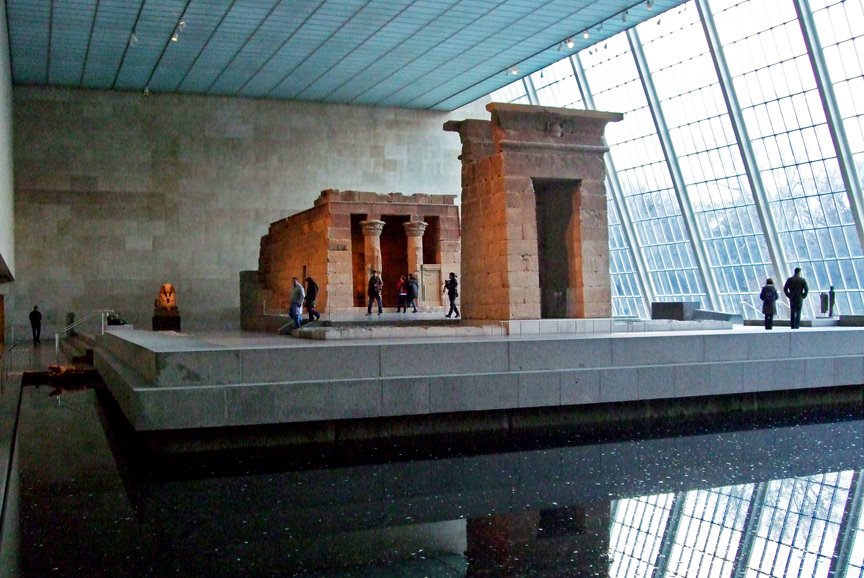
So for me, and I am sure many others, one of the most striking things when entering the Sackler Wing at the Metropolitan Museum of Art is the enormous amount of open space indoors. At the risk of sounding like a rube, this amount of space almost feels like an indulgence, a luxury, a sin against those of us who parse our world and value every parcel.
At some level, the use of personal space in New York City must be justified, or one risks being grouped with our porcine friends. With public space, one must answer to harsh critics, including a body of individuals trained in architecture, design, and urban planning. The larger the space, the greater the justification and good design needed. With an enormous place like this, you had better have a great reason and design for so much space – something, perhaps, in the order of an Egyptian Temple, which is just what we have.
So there is an inner sense of relief when your eye sees and mind realizes what has been done here: the Temple of Dendur has been moved stone by stone from Egypt to the USA and reassembled in this room built exclusively for it. Unquestionably a worthy candidate for its own wing in the Metropolitan Museum of Art at Fifth Avenue and Central Park. A reflecting pool in front of the temple and a sloping wall behind it represent the Nile and the cliffs of the original location. The stippled glass on the ceiling and the north wall diffuse the light and mimic the lighting conditions in Nubia.
The temple had to be removed from its location in Egypt; it otherwise would have been submerged by the rising waters of the Nile behind the new High Aswan Dam. The government of Egypt offered the temple to the United States in 1965 in recognition of the aid America had provided toward saving a number of Nubian temples doomed to be permanently flooded by the construction of the High Dam. A competition for its location included the Smithsonian in Washington, DC and Boston’s Museum of Fine Arts. In 1967, the temple was awarded to the Met. More than 800 tons of stone were moved and shipped in over 600 crates. The temple was installed in the Sackler Wing in 1978. You can read more about the temple here.
From the Museum website:
“On the outer walls–between earth and sky–are carved scenes of the king making offerings to deities … This king was actually Emperor Augustus of Rome, who, as recent master of Egypt, wisely had himself depicted in the traditional regalia of the pharaoh. Augustus had many temples erected in Egyptian style, honoring Egyptian deities. This small temple, built about 15 B.C., honored the goddess Isis and, beside her, two deified sons of a local Nubian chieftain, Pedesi and Pihor.”
The temple is a majestic sight indoors or out at any time. It is a popular photography subject, particularly at night, when it is illuminated and can be viewed from Central Park (where the museum and Sackler wing sit).
Sometimes the human spirit just needs a little extravagance, not defined in practical terms. All the better when done in an appropriate way, as befits the Temple of Dendur. Sometimes we need a parade, and sometimes we need some space…
Related Post: Gratuitous in Nature