• Category Archives Art and Sculpture
  • Oyster Bed

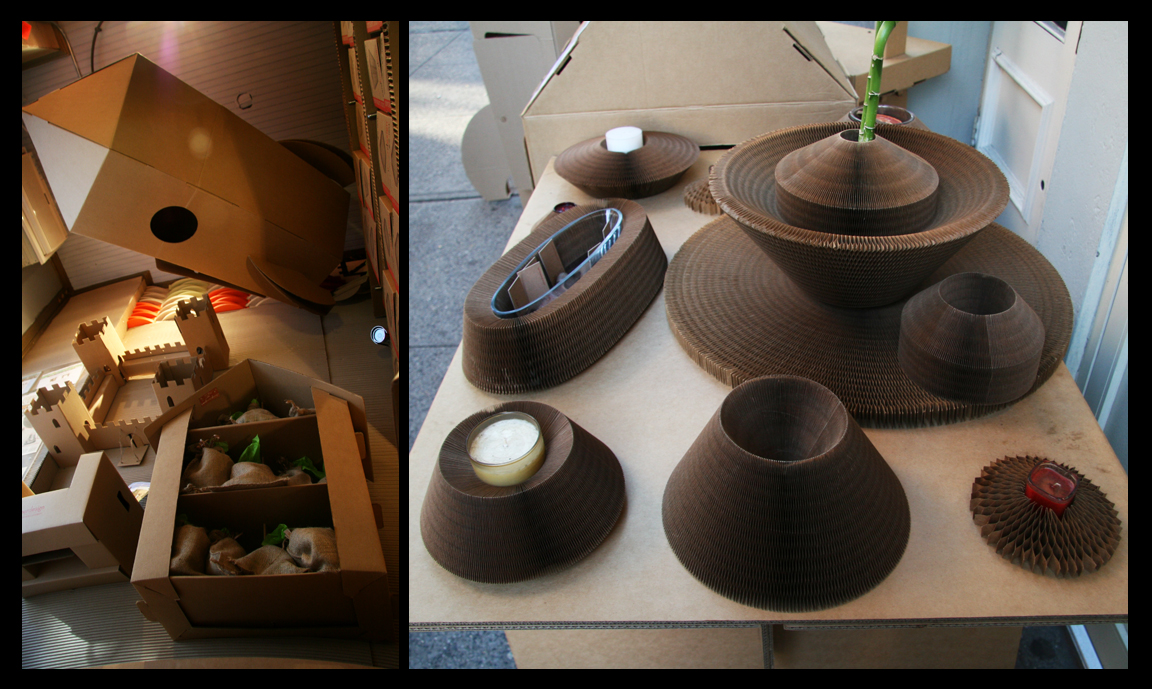
    Can you build a business around cardboard-constructed objects? In New York, yes you can. This place was a surprise because I go by it frequently. The shop itself is tiny, and only because of the outdoor display did it catch my eye.

    They manufacture many products using an accordion-like, honeycomb structure. You just want to touch these things, and of course many do. They have a line called LiquidCardboard, which transforms from one shape to another. They move and articulate, much like a slinky.
    There are also a number of wonderful fantasy constructions for children – a lemonade stand, playhouse, fort, dollhouse, tepee, and a rocket ship, which is a personal favorite. As a child, I dreamed of being on a rocket and, as a high school student, belonged to a rocketry club. I think boys and rockets are almost synonymous.

    The honeycomb cardboard they use is recycled, and the adhesives are natural too. They have an online store (website here) in addition to their retail location in SoHo at 410A West Broadway. These are the types of places that make this city a unique place to peruse. Look twice because you may miss it. New York is like an oyster bed – you just have to look for those pearls…

  • TMNK

    Posted on by Brian Dubé

    This find is courtesy of Corey, an employee at the Apple Store on Prince Street in SoHo. While on a recent visit there, our conversation turned from Macs to photography. Surprisingly, Corey was already aware of this Photoblog and asked if I knew of graffiti artist The Me Nobody Knows (TMNK), aka Nobody. He suggested that it may be a good subject for blogging. The alias Nobody leads to nice wordplays in his art messages, such as Nobody Cares or I am nobody – Art is My Weapon.

    On a subsequent visit to the Apple store, Corey was gracious enough on a work break to take me through nearby streets and point out the various sidewalk works of TMNK.

    Nobody has a multimedia website with the requisite rap music and non-intuitive interface, Myspace page, and ebay store. Since I do not understand the vocabulary and I am not part of this subculture, I will have to let the art, websites, music, and words speak for themselves…

    Posted on by Brian Dubé

  • Redemption

    Posted on by Brian Dubé

    If you are open-minded and social, the people of this city can reveal a world to you that is unique and remarkable. The biggest problem is that some of the most fascinating lurk behind the most unassuming faces and things. I never know where a casual conversation will lead. More times than not, a story unfolds that is woven with extraordinary fabric, and I am so very glad that I did not just pass it by.

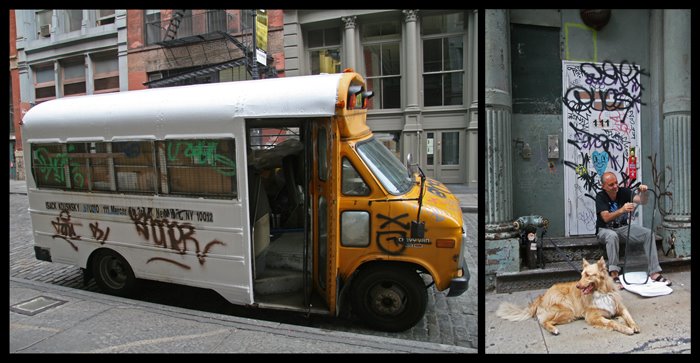
    So this is how I met Isack Kousnsky, an unassuming man cleaning a window in front of what turned out to be his school bus. I stopped to pet his dog, a beauty I wrote about last year in Wolfdog. Isack turns out to be an accomplished photographer/artist with an unusual portfolio of mixed media work (you can see it here). His work is stored in his bus. He has had shows worldwide and is a SoHo resident. He was located in front of 111 Mercer Street, where his studio was formerly located.

    We spoke of the difficulties in working in Manhattan with stratospheric rents. His old studio is now $6000 per month for 1/2 of a floor. He will be most likely relocating to Brooklyn, which, although less expensive, has seen its own very high increases in rents.

    Isack Kousnsky, born in Haifa, Israel, in the ’50s, moved to New York City in the early ’80s. Based in the East Village as a strong artist, he became part of the avant-garde movement. He exhibited in many galleries, such as Sixth Sense Gallery, Now Gallery, and Hilo Project, focusing in painting, sculpture, and installation. During that time, he curated one of the largest exhibitions of the ’80s art movement, including artists Salvador, Rosilio, Luca, and Keith Haring. In 1989, he returned to Israel and built and produced an alternative art center in Haifa. In 1990, he started to produce his artwork in photography and developed a new technique combining painting and photography. In 1993, he returned to the city.

    I have written before about the danger in New York of judging books by their covers. I am one of the worst when it comes to doing this; I am quick to judge, and frequently, I am way off the mark. These articles are my efforts at redemption…

    Posted on by Brian Dubé

  • Statues of Liberty

    Posted on by Brian Dubé

    If you want to do something controversial, it’s easy. Just create a series of themed sculptures and place dozens of them around the city. The last one that I recall was the Cow Parade.

    Everyone seems to have strong feelings about such displays. Being that they are in public spaces certainly gives the populace a feeling of entitlement as to how such space is used. And, of course, the displays are seen by nearly everyone, including many who are not typically art goers.

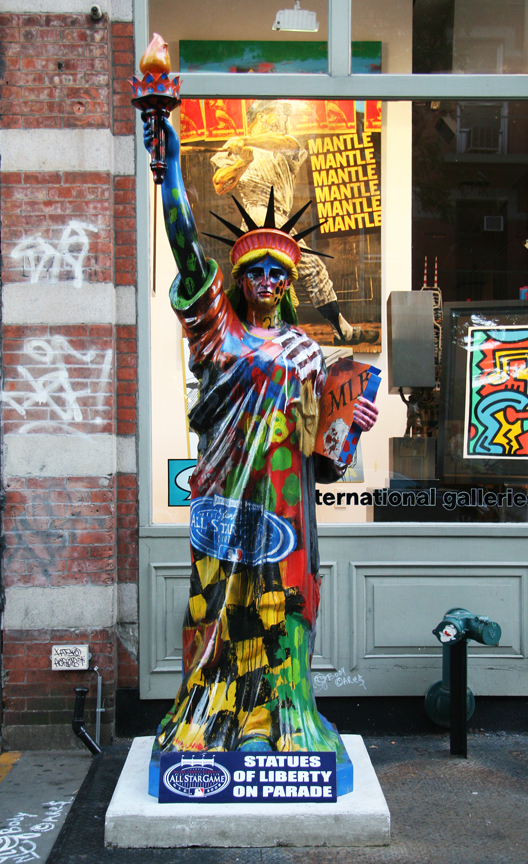
    The statue in the photo is one of 42 around the city, all quite varied in their appearance. To see all of the statues and a description, go to the CBS News link here. From their site:

    “To mark the July 15 All-Star game at Yankee Stadium, 42 baseball-themed Statues of Liberty are on display in New York. The Stephen Holland statue, Pop International Galleries, 473 West Broadway, at Houston Street, in SoHo area of Manhattan, celebrates the artist commissioned to paint them all. Apparently, he was so intent on having 42 to honor Jackie Robinson, he made one for himself.”

    Each statue is uniquely designed with bold graphics and colors featuring each of the 30 Major League Baseball clubs, the Brooklyn Dodgers, the New York Giants, the American League, the National League, four All-Star statues, and statues commemorating the final season of Yankee Stadium and Shea Stadium (this year is the final season of both stadiums). The 8.5-foot tall, 250-pound statues are made of resin and rest on a 530-pound cement base.

    The opinions of this series of sculptures are quite harsh. Many bristled at the appropriation of the Statue of Liberty for this venture. An online search for Statues of Liberty Parade will show you what I mean…

    Posted on by Brian Dubé

  • Promises

    Posted on by Brian Dubé

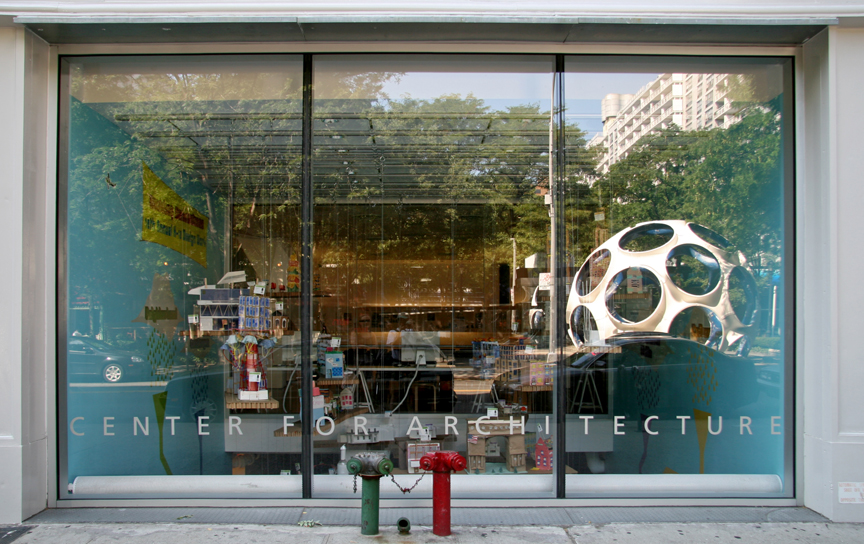
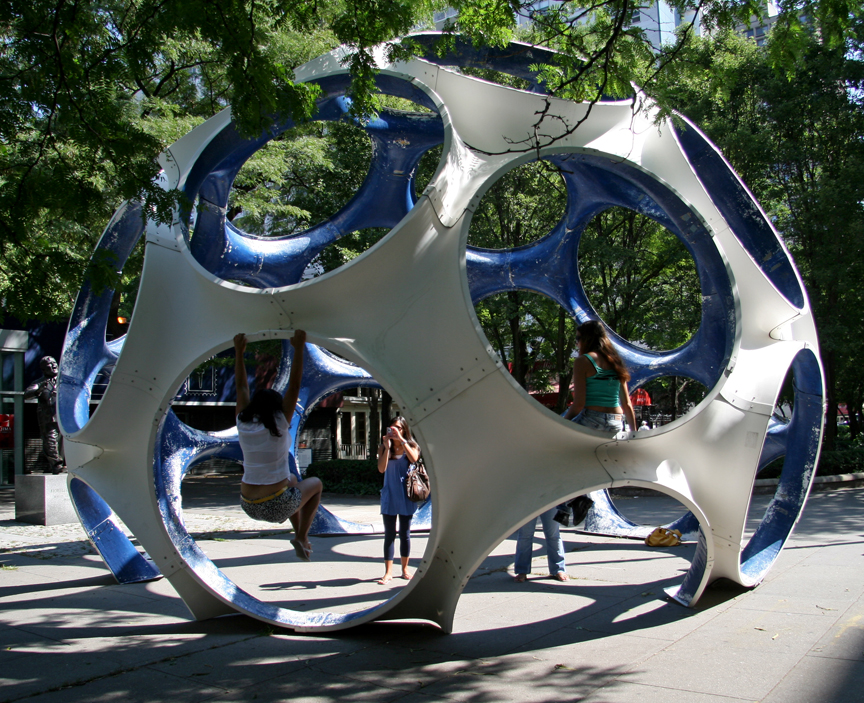
    The 1960s held promises, many which did not live up to expectations, such as drug-induced insights, free love, and geodesic domes. Domes captured the imagination of the youth at the time, as did most things that broke with tradition. In the case of geodesics, the break was visually very obvious. Built from a network of triangles, the resultant structure was aesthetically pleasing. Many were the advantages and benefits. And many were the disadvantages and problems, largely unspoken of at the time but obvious to those who made a commitment to this type of structure for a home.

    Geodesic domes were popularized by R. Buckminster Fuller. They were promoted for their efficiency, strength, stability, light weight, and ability to be built quickly. There was hope that the geodesic dome would become a housing solution. But many problems surfaced – curved rooms with attendant difficulty in design and furniture placement, many seams prone to leaking, higher window costs, triangular panels resulting in more material waste, etc. Their success has now been primarily in its adoption for specialized commercial applications, such as pavilions, auditoriums, weather observatories, and storage facilities.

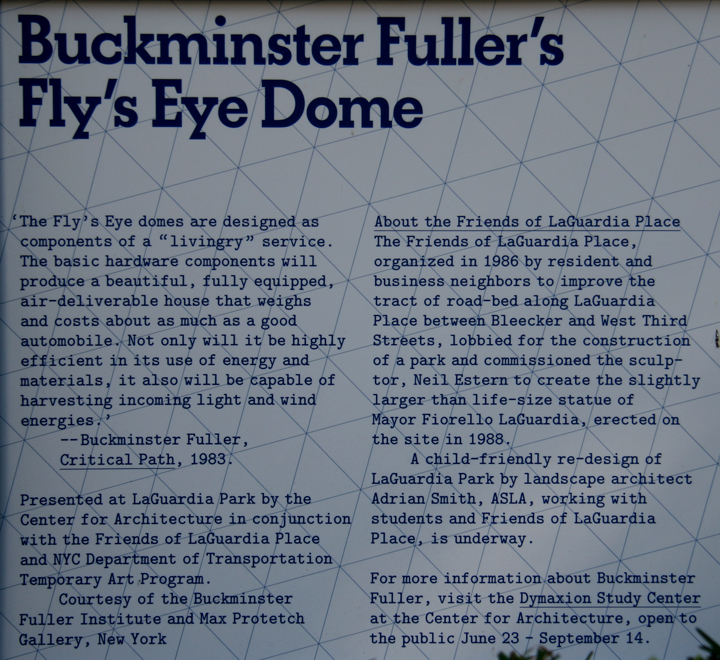
    The one in the photo that can be seen in the window reflection is Fuller’s Fly’s Eye Dome, which has been erected in LaGuardia Park across from the AIA center. Read about the sign here.  See here for photo of dome with a few visitors climbing the structure.

    The window is that of the Center for Architecture, the New York chapter of the American Institute of Architects. Buckminster Fuller and his work is an enormous subject. Read about him here. There is also more information about Fuller at the Dymaxion Study Center at the AIA Center at 536 LaGuardia Place from 6/23/08-9/14/08.

    Posted on by Brian Dubé

  • Keith

    Posted on by Brian Dubé

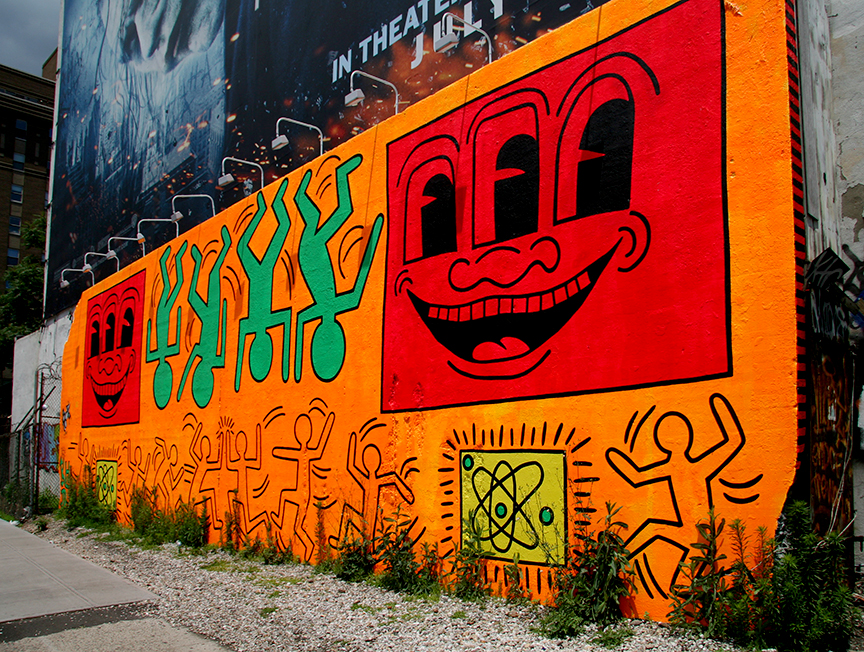
    Keith Haring was a NYC-based artist and sculptor, known for his graffiti art and social activism. In the early 1980s, I had the privilege of meeting Keith numerous times while working on a collaborative business venture. People frequently ask what he was like. My experience was that he was always charming and really knew his Pantone colors. You can read more about him here. The work in the photo is a recreation of a piece done by Keith in 1982. From the Deitch Foundation website:

    “The Keith Haring Foundation, Goldman Properties and Deitch Projects announce the recreation of Keith Haring’s celebrated Houston Street and Bowery mural. The mural became an instant downtown landmark after Keith painted it in the summer of 1982. The mural was up for only a few months in the summer of 1982 before it was painted out but its image remains imprinted in the memory of many people who were part of the downtown artist community in the early 1980s.
    The mural is being repainted by Gotham Scenic using the extensive photographic documentation of the original work. The work will be unveiled on May 4, 2008 the day that would have been Keith Haring’s 50th Birthday.”

    In this photo, you can see some of Keith’s signature images, including his atomic symbol, dancing men, and funhouse characters. I find it apropos that the work is done on a slab of concrete, with weeds growing in front and framed on one side with barbed wire chain link fencing. I think Keith would have approved…

    Posted on by Brian Dubé

  • View of the World

    Posted on by Brian Dubé

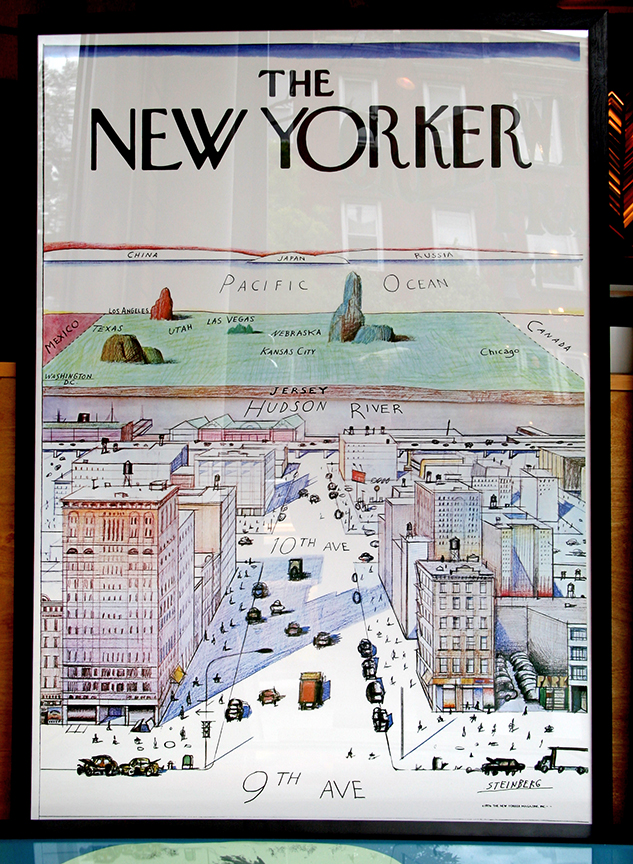
    I hate to use the phrase de rigueur again, but if there ever was a need for it, this is a prime example. Because familiarity with this image, View of the World from 9th Avenue, is de rigueur for every New Yorker and anyone who wants to understand this city’s people. This really is how many of us see New York City. I actually visualize the world much like this at times. When I first saw this work, I was stunned as to how close it was to my mind’s perspective of the world.

    Note how inconsequential things outside the city are depicted. Ironically, the area of Manhattan shown is itself one of the least important, yet it still looms large over other cities, states, and countries.

    The density of people and services is so great here that it really is possible to go quite some time without leaving; many Greenwich Village residents joke about how they never go north of 14th Street for months or even years at a time. Manhattan is literally a world unto to itself and is a center for a myriad of industries. It is very easy to adopt a worldview not too far from this work of art.

    The image itself is a New Yorker magazine cover from March 29, 1976, created by Saul Steinberg, who did 85 covers and 1,200 drawings for the magazine. The photo was taken of a poster hanging in a shop in the Village. I didn’t even have to go to 9th Avenue, seek out the original, or step inside a shop. My view of the world from 9th avenue was had from the comfort of my own neighborhood in a gallery window. Now that’s a New Yorker 🙂

    Posted on by Brian Dubé

  • Left for Dead

    Posted on by Brian Dubé

    The Segway was heralded by inventor and design engineer Dean Kamen as a transport device that “will be to the car what the car was to the horse and buggy.” Go here if you are not familiar with Kamen or the Segway.
    There was tremendous buzz and speculation before its release – Steve Jobs claimed that it would be “as big a deal as the PC.” After the product release and its grandiose claims, I had a gut feeling it would be a failure, at least in urban areas like NYC, for many reasons: cost ($5000), regulations, traffic, weight, and parking (where would you put this thing?). I even emailed Kamen himself, addressing all the problems I saw, along with the biggest issue of all: VANDALISM.

    Kamen spoke of all the sophisticated security devices to prevent theft, but in my opinion, he missed the problem of vandalism, not theft. Perhaps he doesn’t know New York. Why would someone vandalize something that they could not steal? For many reasons (such as taking parts), as well as perhaps one reason not understandable to outsiders: because they can.

    I’m sure that people will take parts they do not know they have use for because they are there.
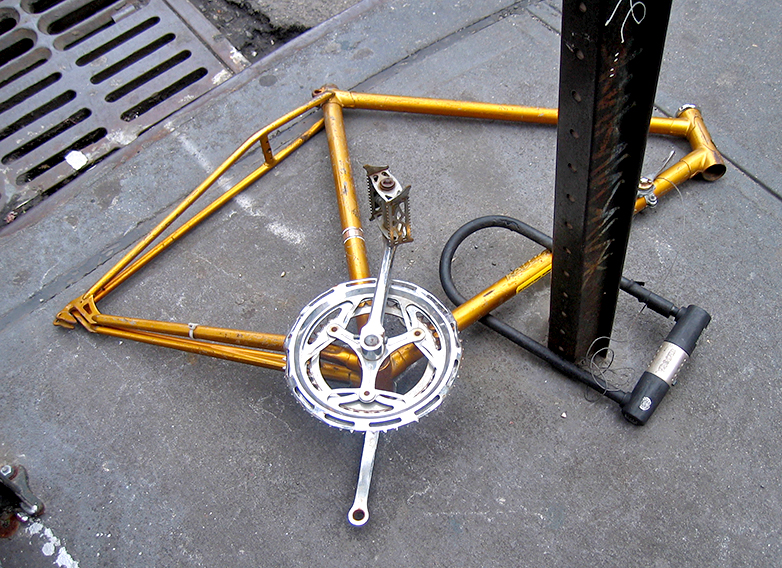
    Manhattan is a graveyard for abandoned bicycles, like the one in today’s photo taken on Spring Street. Many bikes are stolen, even with special locks like the Kryptonite, and if they can’t steal the bike, they will steal unlocked parts (yes, there are ways of locking individual components, like seats).
    When you arrive to see your bike stripped like that in the photo, I imagine it is rather disheartening. What’s the point in taking the frame, and where will you dispose of it anyway?

    In 2005, sculptor David Shapiro did an outdoor exhibit, Left for Dead, at the Socrates Sculpture Park in Long Island City. A melange of twisted abandoned bikes in various states were salvaged from the streets of the city. In the exhibit, Shapiro attached them to sign posts, embedded in the ground. And a thief was found to have attempted to steal a seat from an exhibited bike.

    The whole scenario starts to resemble soldiers who stole gold fillings from corpses in times of war. Even the dead are not safe…

    Posted on by Brian Dubé

  • On a Roll

    Posted on by Brian Dubé

    Success begets success. Much of business success is built on momentum – no one wants to go into an empty restaurant. Certainly there has to be a level of quality to prime the pump, but once things get going, people will beat a path to your door.

    You see this in the arts all the time. A tiny percentage prosper and the rest starve. And I don’t believe that there is a direct correlation between financial success and talent in the arts. There are many in an art genre who are as talented or nearly as talented as those at the very top but just don’t get the accolades, for a variety of reasons; the disparities between talent and income can be huge. Success is a package deal – talent, promotion, image, connections, buzz, whim, and some luck. When those elements work together, momentum builds. The more underlying quality you have, the better your chance of long-term success. Everyone wants the hot thing, not the second hottest thing. It’s like Google search results – most click the first result; not too many go to page two.

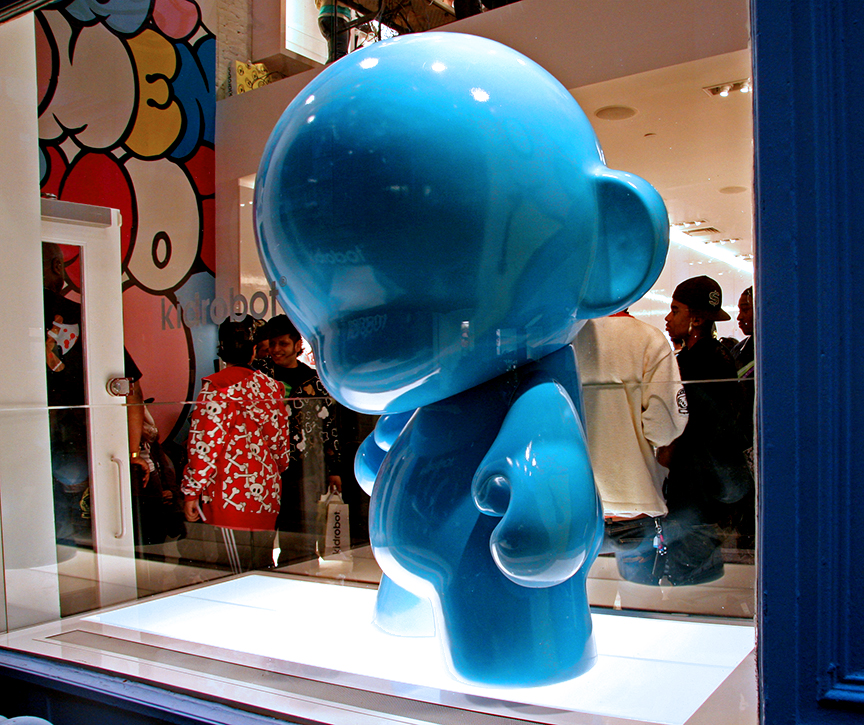
    Kidrobot seems to be one of those places. They have an extremely engaging product line – very creative ideas and well-executed. Everyone seems to love those little figures. See their website here. Kidrobot currently has stores located in New York, San Francisco, Los Angeles, Miami, and Toronto, and their products can also be found at many boutique retailers around the world. Founded by designer Paul Budnitz in 2002, Kidrobot is a designer and retailer of limited edition art toys and apparel. They merge urban street trends, fashion, and pop art. Products feature unique collaborations with top international artists with backgrounds as diverse as graffiti, fine art, fashion, industrial design, graphic design, illustration, and music.

    Many of their artists attain celebrity status; you see evidence of this with frequent crowds at the shop when they have guest artist signings. The event in the photo was a reopening from one store location to their new location at 118 Prince Street in SoHo. I recommend a visit if you are in the area.

    When momentum builds, you’re on a roll. Kidrobot does not need any promotion from me – these guys are on a roll…

    Posted on by Brian Dubé

  • Enigma

    Posted on by Brian Dubé

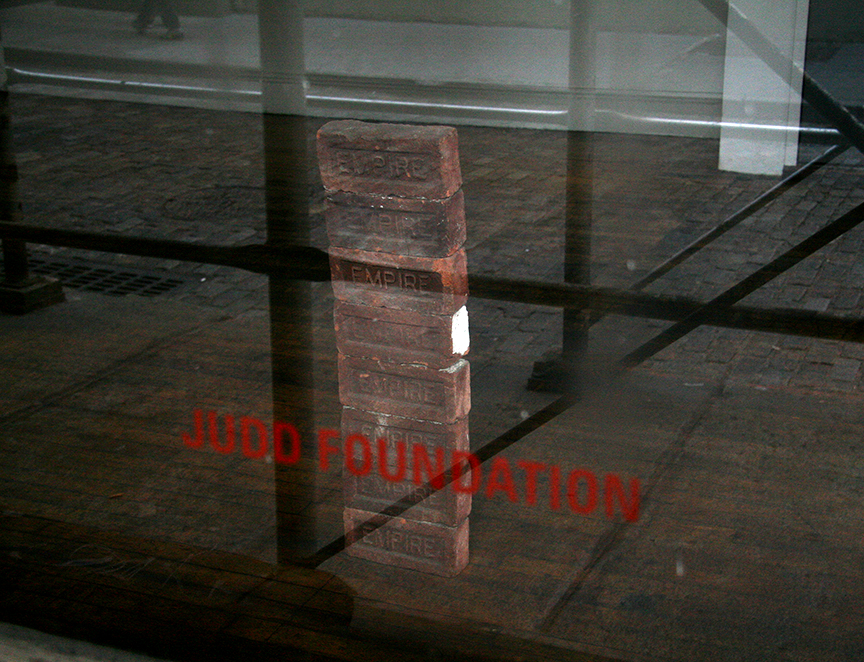
    I have spoken many times of pearls unseen right under my nose, but this is one of the biggest finds yet. I pass 101 Spring Street every day, frequently twice. It is a scaffolded which is in serious need of renovation. On August 14th, 2007, I wrote of a homeless girl, Stephanie, who was camped out in front of this building for some time. In fact, the posting struck a chord – it was one of my most commented.

    Ironically, we are back again. I have observed this mysterious stack of bricks for years, the only occupants of the ground floor of 101 Spring, in one of the most expensive neighborhoods of New York City. See second photo here.

    But if one looks carefully at the side window, in small red lettering you will see Judd Foundation. Ahhh – now the mystery is easily solved. The building is Donald Judd’s previous home. Judd, a renowned sculptor and influential artist, was an early pioneer in SoHo. He purchased the building in 1968 for $70,000, where he lived and worked on and off until his death from lymphoma in 1994.
    The building serves as a house museum with works of Judd and other minimalists. The whole story is fascinating – I recommend this New York Times article.

    How do they do it, i.e. how is this place supported? In 2006, the Donald Judd Foundation decided to auction 36 Judd sculptures at Christie’s and raise a $20 million dollar endowment.

    Oh, and the stack of eight Empire bricks? This is the work of Carl Andre – the piece is known as Manifest Destiny.

    Explanation of the photo: This exposure was taken from the street through the window, with a mixture of interior objects and reflected objects from the street. Note the outside sidewalk superimposed on the interior white wall. The dark braces are reflections of the supports for scaffolding being used in the exterior renovation work. The interior wood floor abuts the reflected image of cobblestone from Mercer Street.

    Posted on by Brian Dubé

  • Small Gestures

    Many cite the popular minimalist refrain less is more. And what better example than the small gesture.
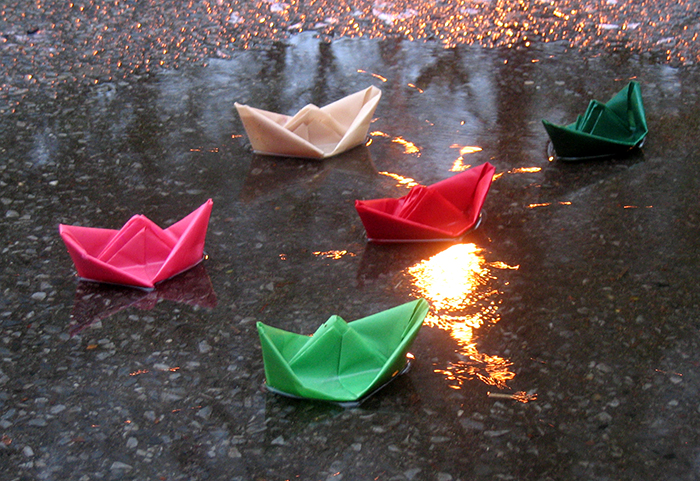
    These colorful origami boats in a puddle in yesterday’s rain were the small gesture of an unknown hand. They garnered quite a bit of attention, as many of us circumnavigated their small ocean and observed them from many vantage points.

    I don’t like a rainy day. Until I have surrendered to the rain. Then I find it quite relaxing. When the mind is in the spirit of surrender and no longer rebels against the elements, you can fully embrace the rainy day. The sunny day is a distant memory, and you can enjoy the impressions that a rainy day brings. Like a child who does not need to go to school on a snowy day, a rainy day gives permission to play and indulge in the small things we often miss or forget. This opportunity can be for a pause for reflection – a welcome moment of respite for the weary New Yorker.

    I photographed in the rain with a friend until we were quite wet – few will make the effort at times like this when the weather is so dreadful. But this is when one can capture some very unique images.

    New York City in the rain becomes transformed with everything cast in a different light. New opportunities abound for photos – a second city is created and with the wetness, and everything familiar becomes new and unfamiliar in some way. But do not be so blinded by the great and spectacular things in New York that you miss the small gesture…


  • A Second Look

    There are many perks in doing a website like this, such as discovering things I never knew and learning new things about those I was familiar with. The most exciting are the big surprises – unexpected stories behind things which appear to be rather ordinary. In a city absolutely saturated with people and things, looking over and overlooking are standard fare.

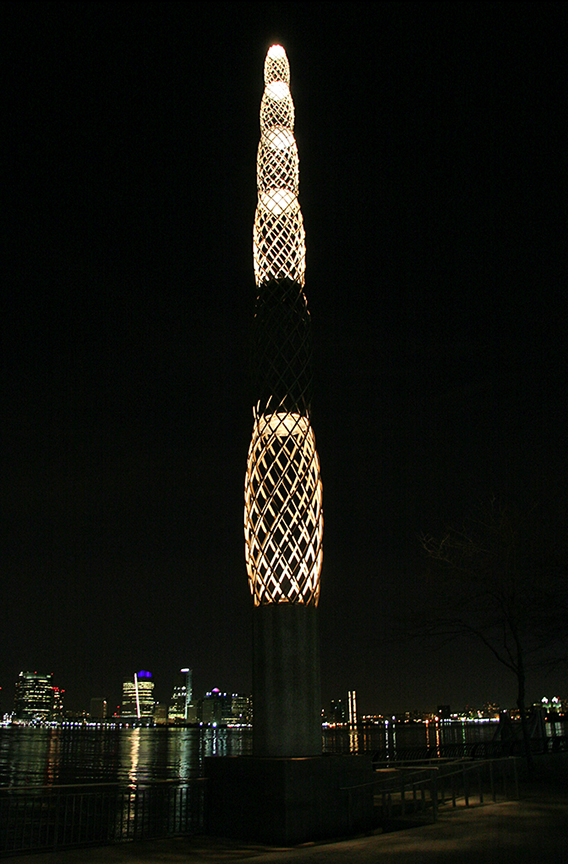
    When I ran across this striking sculptural light form at North Cove Yacht Harbor behind the World Financial Center, I assumed that it was just an above average ornamental light. I thought it would be difficult to identify this sculpture and glean any information about it and its creator. Not at all. This piece and its mate in granite, entitled North Cove Pylons, was created by renowned sculptor Martin Puryear. Read this article in Sculpture Magazine about the work. Puryear has all the makings, training, education, experience, and accolades of a major artist, with feature articles (The New Yorker) a MacArthur grant, and major museum shows such as the 30-year retrospective of his work at the Museum of Modern Art (here is a YouTube video of the exhibit).

    Puryear, who is African American, studied native crafts while serving in the Peace Corps in Sierra Leone, and later studied woodwork and design at the Swedish Royal Academy of Art. On his return to the US, he studied at Yale University, where he received an MFA in sculpture.

    I am finding that works of public art in NYC which I assume are perhaps whimsical, casually placed, and/or created by unknown individuals are often by major artists and go relatively unappreciated.
    So take a second look at the obvious. Or come here and let me do it for you 🙂

    Related Postings: Koons Balloons, Asaf and Yo’ah, Sky Mirror, Sfera con Sfera, Knotted Gun, 11 Spring Street, Sylvette, Night in Bloom, Subway Art, Sink or Swim


  • Orange You Glad

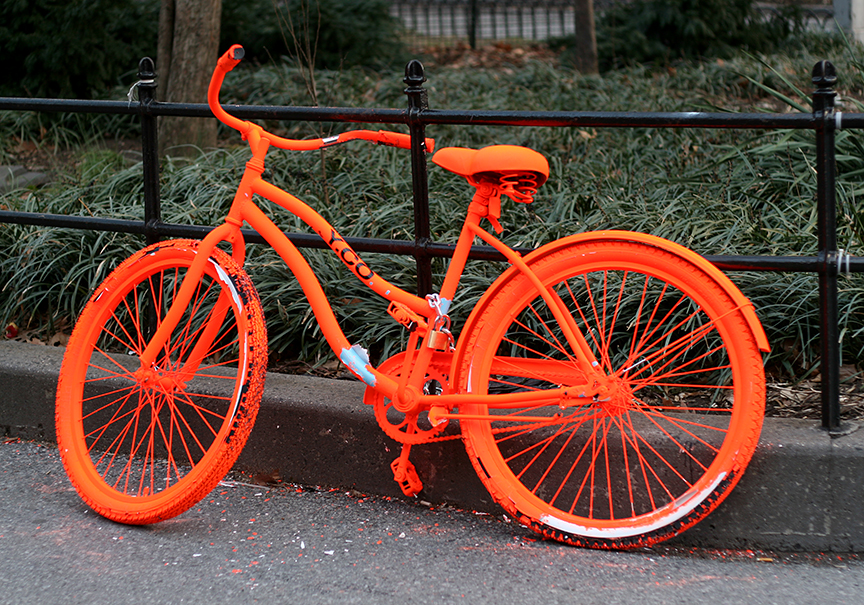
    Orange is usually associated with the warm and positive, but this bright orange bike was part of an enormously controversial campaign. Timed with fashion week, DKNY chained up dozens of these orange bikes (the logo on this one in the photo is only partly readable) around town. According to the DKNY website, this guerrilla marketing campaign was part of an “Explore Your City” program in support of NYC initiatives to help cyclists. You can see a leggy model riding on the handlebars of a bike on their website. The store was offering free maps in their stores and various bicycling links on their site.

    Where’s the controversy? Well, many found it too similar to the national Ghost Bike campaign and considered the whole thing a cheap, tacky, publicity stunt (click here for my previous posting on a Ghost Bike in SoHo commemorating Derek Lake). I’ve skimmed hundreds of comments on numerous blogs and many in the biking community are infuriated (see here). Many of the bikes were illegally chained and confiscated by the police department. The Gothamist ran a number of articles with photos (click here). In one of them, they said, “In our opinion, DKNY has crossed the line from “edgy” to “despicable,” by co-opting grassroot memorials to dead people as a gimmick to peddle clothes.”

    Others, however, feel the campaign was not intentional on DKNY’s part, just poorly thought out. A DKNY rep wrote, “We are very sorry if our well-intentioned ‘Explore Your City’ program offended anyone.”
    Orange you glad not to be DKNY?


  • Koons Balloons

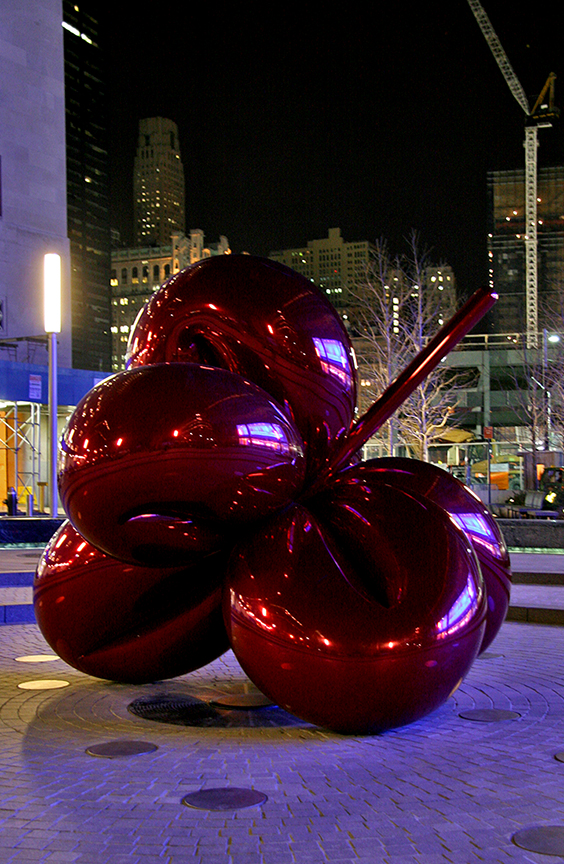
    On May 23, 2006, the new 7 World Trade Center was completed. The developer, Larry A. Silverstein, presided over the ceremonies (which included a free, two-hour concert featuring Lou Reed and Suzanne Vega) and unveiled this sculpture: Balloon Flower (Red) by internationally acclaimed artist Jeff Koons. It sits in a fountain in a small triangular plaza outside 7 WTC, bounded by Greenwich Street, Vesey Street, and West Broadway. The park, designed by landscape architect Ken Smith (surrounded by azaleas, boxwood, and sweet gum trees), overlooks Ground Zero (seen in the background of the photo), where the Freedom Tower is being built.

    Koons has done a number of balloon animal-inspired sculptures. In fact, the one shown in the night photo is identical to three others: a blue version at Marlene-Dietrich-Platz in Berlin, Germany, a silver one in the Max Hetzler gallery, and Balloon Flower (Magenta) at the home of Cindy and Howard Rachofsky in Dallas Texas. Although the 9-foot sculpture is made from stainless steel, the red color and balloon motif gives the work a light, playful feel, intentional on the part of Koons as a counterpoint to the somber nature of the setting…

    Interesting note: For a time, Koons was married to Hungarian-born, Italian porn star Ilona Staller (stage name Cicciolina). She served a term in the Italian parliament (1987-1992), the first hardcore porn star in the world to be elected to a democratic parliament. During their marriage, Koons made a controversial series of paintings, photos, and sculptures entitled Made in Heaven, showing the couple in explicit sexual positions.


  • Wax

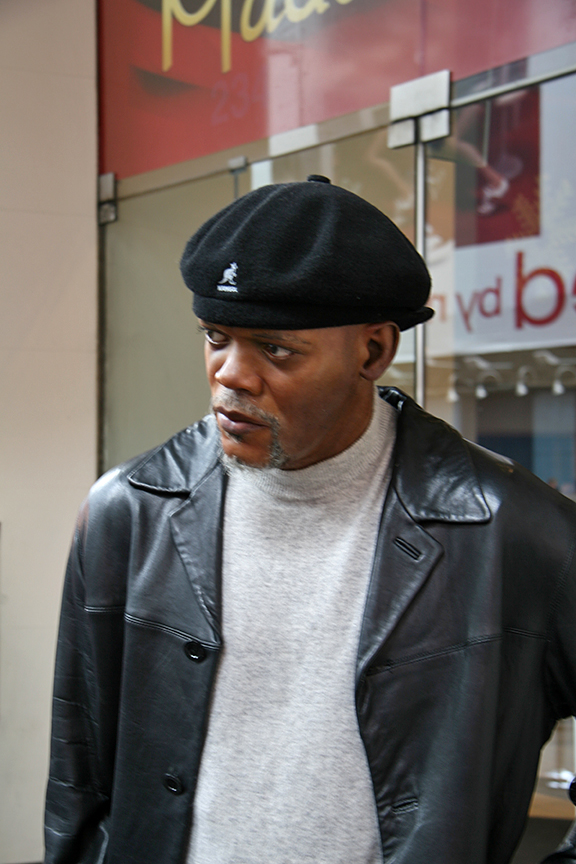
    I have previously voiced my feelings concerning those things which may be viewed by many as too touristy and that, in many cases, such as the Empire State building, offer much of value and warrant a visit. However, in the case of Madame Tussaud’s Wax Museum, I am guilty of not following my own advice and have never visited. In my defense, wax museums in the United States do have a poor reputation, and it is not so unreasonable to avoid them. And, of course, there is also the issue of artistic snobbery – that something merely representational is not worthy of serious consideration, even if it has been done with meticulous accuracy and the results are astonishingly real. This wax figure of Samuel L. Jackson was on 42nd Street outside the museum, a lure to get passersby to go in. It certainly was remarkably lifelike. In reading about these figures and the work, I was impressed at the level of artisanship, and the story of Madame Tussaud was equally fascinating.

    Marie Tussaud (1761 – 1850) was born Marie Grosholtz in Strasbourg, France. She learned her craft from Dr. Philippe Curtius, a physician who was skilled in wax modelling, which he used to illustrate anatomy. Marie lived for a time at Versailles. Suspected of possible royalist sympathies, she was actually in prison awaiting execution with her head shaved. She was saved by her sculpting talents and was employed to make death masks of those executed by guillotine, including Marie Antoinette, Marat, and Robespierre. A traveling showman (with the collection of wax figures left to her by Curtius), she finally settled in London and had her first permanent exhibition on Baker Street in 1835. Read the history here at the Tussaud Museum website.

    The New York incarnation of the famed London museum occupies a five-story building in the Times Square area on the exact site of Hubert’s Dime Museum and Heckler’s Trained Flea Circus (another amazing story). The roster of wax figures reads like a who’s who in themed environments. The figures are created at substantial cost and time, taking months for creation. Celebrities and notables typically pose for a few hours, and likenesses are then created from hundreds of intricate measurements along with photographs. Faces are made from 30-piece plaster molds; hair is inserted strand by strand. I think it’s worth a visit…


  • dinamic_sidebar 4 none

©2026 New York Daily Photo Entries (RSS) and Comments (RSS)  Raindrops Theme