• Category Archives Food and Restaurants
  • Trucks and Things

    We would prefer to believe that the stuff in our lives is magically transported to store shelves. Or perhaps a more romantic vision would be delivery via a Santa-like character directly to our homes. But the reality is that every consumer good, whether it be food, clothing, or lumber, makes all or some of its journey to us by truck. Yet this fact seems to be ignored or, at best, seen as a necessary evil. The vital role trucking provides still has done nothing to enamor them. They are seen as a blight, cursed on highways and city streets as noisy, dirty, the cause of congestion, and an impediment to our travel. Drivers are seen as an integral part of these evil boxes on wheels, so the image of the truck driver is no better.

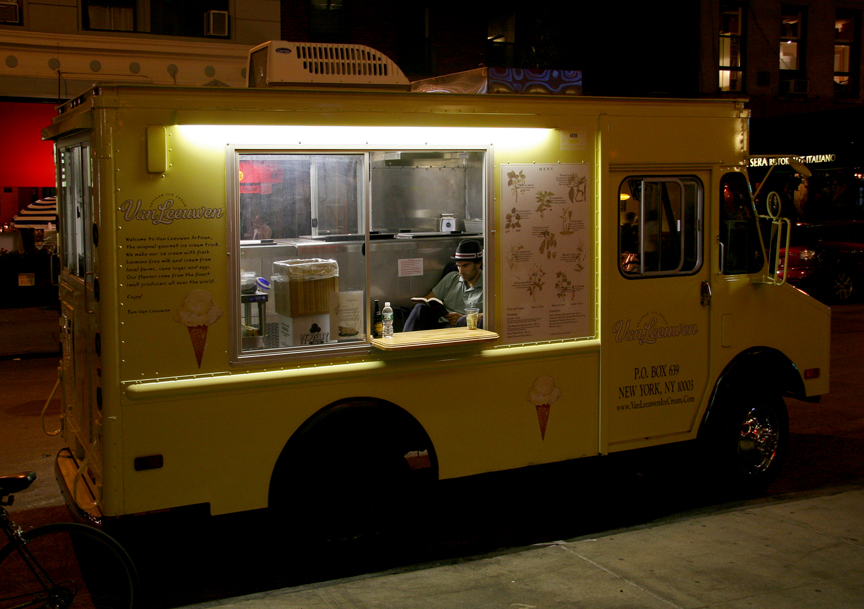
    How to repair the image of the truck? Convert it into a dessert or ice cream delivery vehicle. We now have the Dessert Truck, the Treat Truck, Wafels and Dinges, and Van Leeuwen Ice Cream running around town.

    I love the convenience of street food vendors. The problem is that there are few quality operations out there; I keep a sharp eye out for them, but the good ones are scarce as hen’s teeth and are no secret. Discovery is rapid, and long lines become the rule. I wrote of NY Dosas in 2007. Lines at his food cart can be enormous. The same applies to Calexico in SoHo. And Speedy Gonzalez has disappeared.

    Now we have trucks bringing us confections. I recently wrote of the Dessert Truck, run by a gourmet chef whose vision was to bring desserts to the streets which are of the quality found in the finest French restaurants. And he has succeeded.

    Brothers Pete and Ben Van Leeuwen now bring Van Leeuwen Artisan Ice Cream to the streets of the Village, SoHo, and the Upper West Side in redesigned ice cream trucks. They meticulously craft their ice cream, sourcing ingredients from around the planet to produce their 10 flavors. Pistachio nuts from Mt. Etna, Michel Cluizel chocolate from France, and vanilla beans from Tahitian vanilla orchids grown in Papua New Guinea. Everything about this business shows attention to details – business cards, colors, graphics, and product. They also share an environmental commitment and use disposable goods from renewable sources.

    Now, what was it I didn’t like about trucks? 🙂

  • Ridiculous

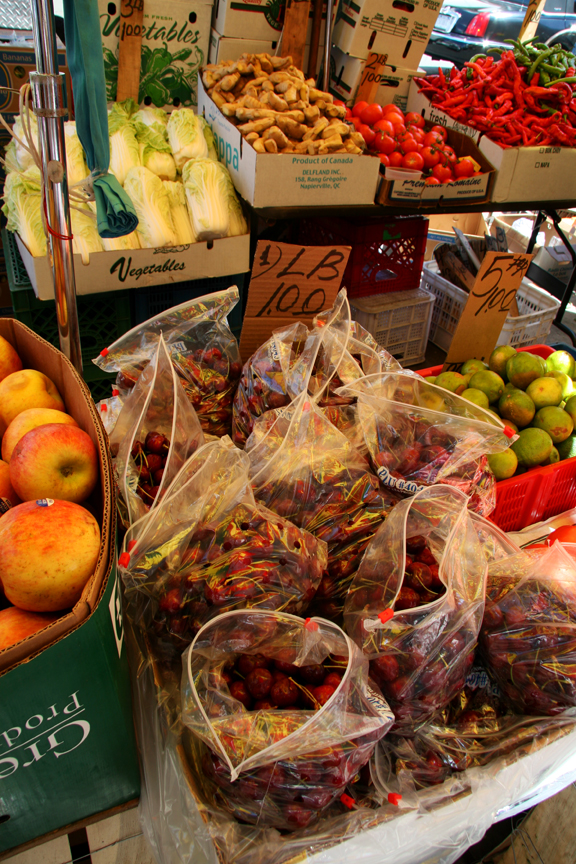
    There are discounts, sales, deals, and competitive pricing. And then there is RIDICULOUS pricing. And if you want to see the ridiculous, go to Chinatown. The Chinese sell and consume a lot of produce, much of it sold on the streets from carts and open air shops. On my last visit, I was absolutely stunned with the pricing on their goods. Can you really sell produce with differences of 200-500% from other vendors? I purchased bing cherries at $1.00 per pound! Mangoes and papayas were being sold in cases of 9 for $9. Nineteen kiwis for $2? I felt like I was buying stolen merchandise. The quality is typically excellent – the turnover is high and everything is quite fresh. Things don’t linger at the bottom of a pile for days.

    Perhaps the issue is not so much that Chinatown discounts so heavily, but that everyone else marks up so much. I have lived in Manhattan for many years and have become accustomed to high prices. I typically never compare with pricing outside the city.*

    In defense of the merchants, rents in Manhattan are extraordinary, and food sellers do not get any particular special treatment. One green grocer I patronize saw their rent go from $38,000 per month to $45,000 several years ago. And their electric bills are $18,000 per month. Unfortunately, the costs need to be passed onto the customer. Outdoor markets and food carts have minimal overhead.

    I once recall being at a New Years Eve party, thrown by a friend who lives in a loft in Chinatown. At one point, we ran out of orange juice, and I was asked to go on a search mission. It was late and I was not shopping for bargains. I made my purchase in the first Chinese deli I came across. I was stunned by the pricing, which was about 50% less than what I saw elsewhere in Manhattan for the same exact item and brand. When I returned and expressed my amazement, my friend only commented in a matter-of-fact way: “When it comes to price, you can’t beat Chinatown.”…

    *Note: I just called my mother, who lives over one hundred miles from the city in a rural area. She confirmed current pricing of cherries at the local supermarket at $4.99/lb and kiwis at 2 for $1. She was flabbergasted at the pricing I gave her. Chinatown rules.


  • Hallmarks & Earmarks

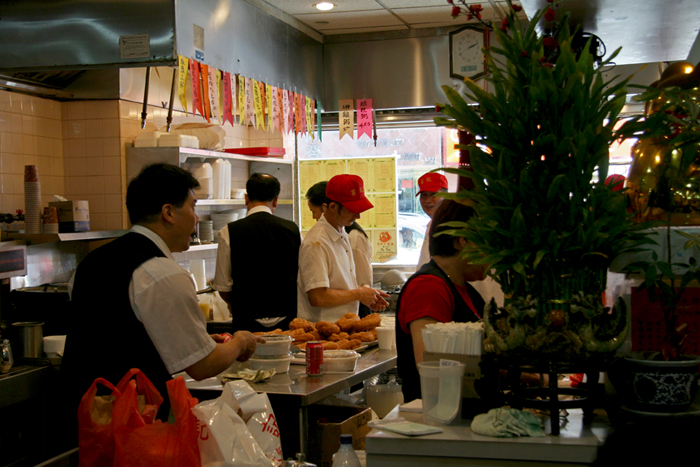
    Welcome to Fu Kee Chinese Restaurant at 128 Lafayette Street. When it comes to Japanese or Chinese food, nearly everyone appears to be an authority in this city. We forever hear the popular refrain “I know a great place for Chinese,” or perhaps, “I know where to get the best sushi.”

    So, given that many of you have heard these types of assertions ad nauseam, I will make no grandiose claims about this place, only that it was recommended by a Chinese woman who knows Chinese food, has eaten in many other Chinatown restaurants, and that this is her favorite. She assured me that this place had all the earmarks of an authentic noodle house – the large tacky, framed, illuminated nature photo, outdated photos of obscure celebrities, and, of course, good food.

    Like most of Chinatown and its denizens, this place is quite utilitarian. No doting on patrons, snobbery, or false pretenses here. Sodas are served à la can, and if it is busy, you may find yourself sharing a large table with strangers.

    They understand the hallmarks of a good business, stripped of any frills. A good meal for a very competitive price – you can’t beat Chinatown for pricing or value. So here’s to hallmarks and earmarks…


  • Small Steps

    Posted on by Brian Dubé

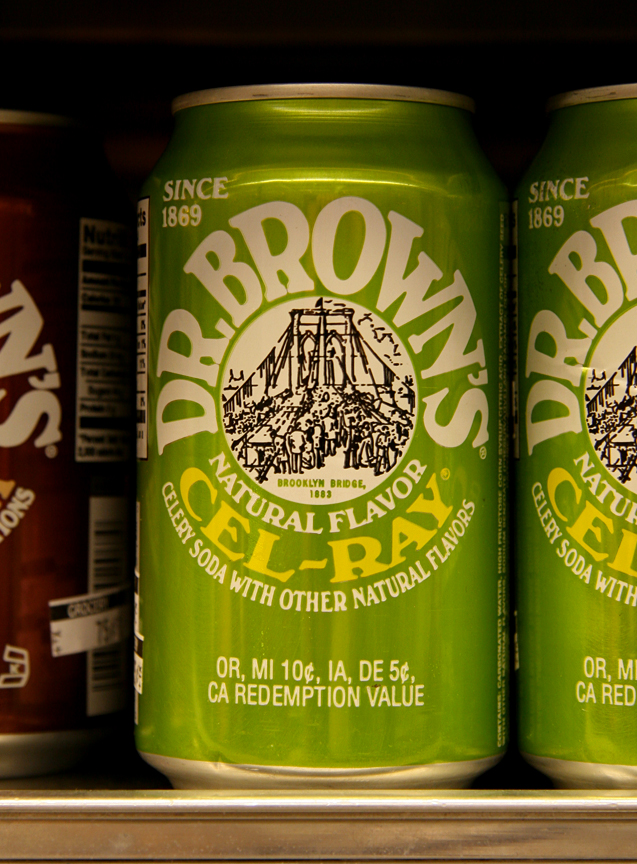
    What does this have to do with NYC? Plenty. Dr.Brown’s Cel-Ray Soda is a specialty item more commonly found in the New York City area. In the 1930s, it was even nicknamed “Jewish champagne.”

    The subject of beverages came up while chatting recently with a number of friends on a hot summer’s evening. We all volunteered our personal favorite flavors and brands: cream soda, root beer, etc. One of our group mentioned celery soda – Dr. Brown’s Cel-Ray. None of us had had one, and we became very intrigued. We were unable to locate one at our local green grocer, so it became a mission for a couple of us.

    There is great satisfaction in achieving goals, but in New York City, where life can be hard, many goals are difficult, so we often must settle for small things. I think this explains the popularity of Sudoku; there is only one solution, and a completed puzzle is a small, perfect achievement.

    In New York City, space is at a premium, so in many instances, we do not have the broad range of consumer items in certain categories, certainly not the type of selection of packaged products seen in a suburban supermarket such as Pathmark or Super Stop & Shop.

    We did not find Cel-Ray at our local green grocer. In a way, I think we secretly welcomed this – it gave us a small team goal. One that would most likely be easily achieved.

    Last night, there was word that Cel-Ray could be found at a neighborhood market. A short pilgrimage confirmed reports, and two of us were able to acquire and sample our first Dr. Brown’s Cel-Ray soda. The flavor was quite good – pungent and spicy – much better than we expected. Finding it was almost like landing on the moon – one small step for two men…

    Posted on by Brian Dubé

  • Anthora

    Posted on by Brian Dubé

    I love this kind of thing. The New York City where we can find an icon based on something so ordinary that it defies comprehension of how it attained mythic status. Its very ordinariness drives it.

    I think it is a form of defiance. Our sense of self-importance is such that New Yorkers can take something completely mundane, champion it, and say, “This is the definitive coffee cup. Why? Because we say so! We don’t have to pander to outside fashion or fancy cups. We set the rules. And the Greek motif coffee cup is what we choose. We eschew all others.”

    Of course, the entire process is the confluence of many factors, historical, practical, and otherwise. But once something here has been established as a de facto standard, New Yorkers hold on in a tenacious manner.

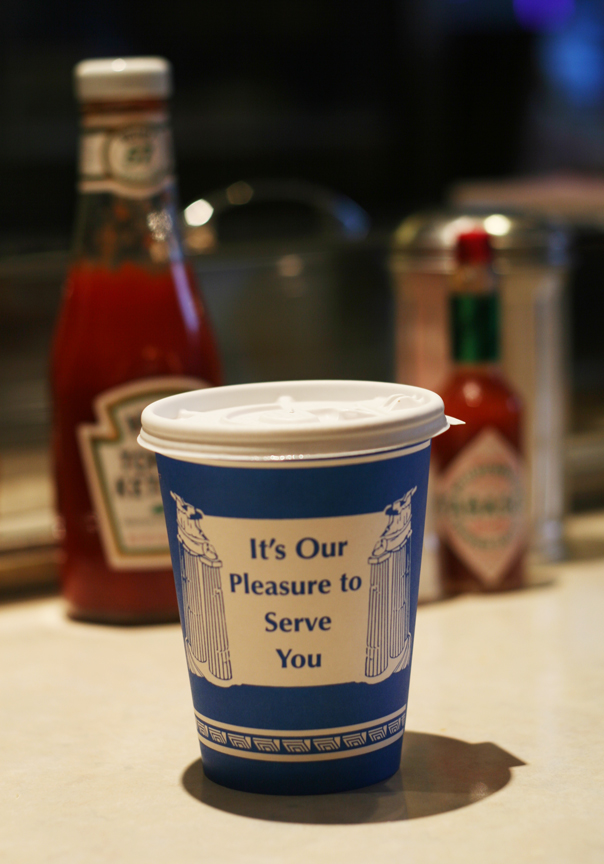
    The classic, Greek-themed, blue and white design – the Anthora – was originally designed by Leslie Buck of the Sherri Cup Company of Kensington, Connecticut, in 1967. The large number of Greek-owned coffee shops in New York City seemed to be a ready target for a themed coffee cup. The name was inspired by an article about a sunken Greek ship laden with Amphora (Greek urns). Anthora is a corruption of the word, based on a misprint in an article. Greek Amphora were typically decorated with geometric designs around the neck; this concept was adapted to the upper and lower rim of the 10-ounce paper coffee cups.

    There are a number of competing brands of the Greek coffee cup, but all have some variation of the original message “We are happy to serve you.” The one in the photo is no. 110 by Premier Paper Manufacturing Corp., circa 1997. A set of Corinthian columns graces the front with the words “It’s our pleasure to serve you” and a discus thrower on the back. The original design is now owned and manufactured by Solo Cup Company. See the link here for a gallery of Greek-motif cups.

    The Greek-themed blue-and-white design is now on sale as a ceramic mug at the Museum of Modern Art. And a whole line of products, like T-shirts, can be found with the Anthora image. It can also be seen in shows like NYPD Blue, where the cup lends a sense of New York City authenticity.

    Some predict that the cup, with its blue-collar associations, is doomed to extinction with the advent of more sophisticated cups, such as those used by Starbucks. Time will tell…

    The photograph was taken courtesy of Joe Jr’s. Diner – the subject of a future story.

    Posted on by Brian Dubé

  • Real Deal

    Posted on by Brian Dubé

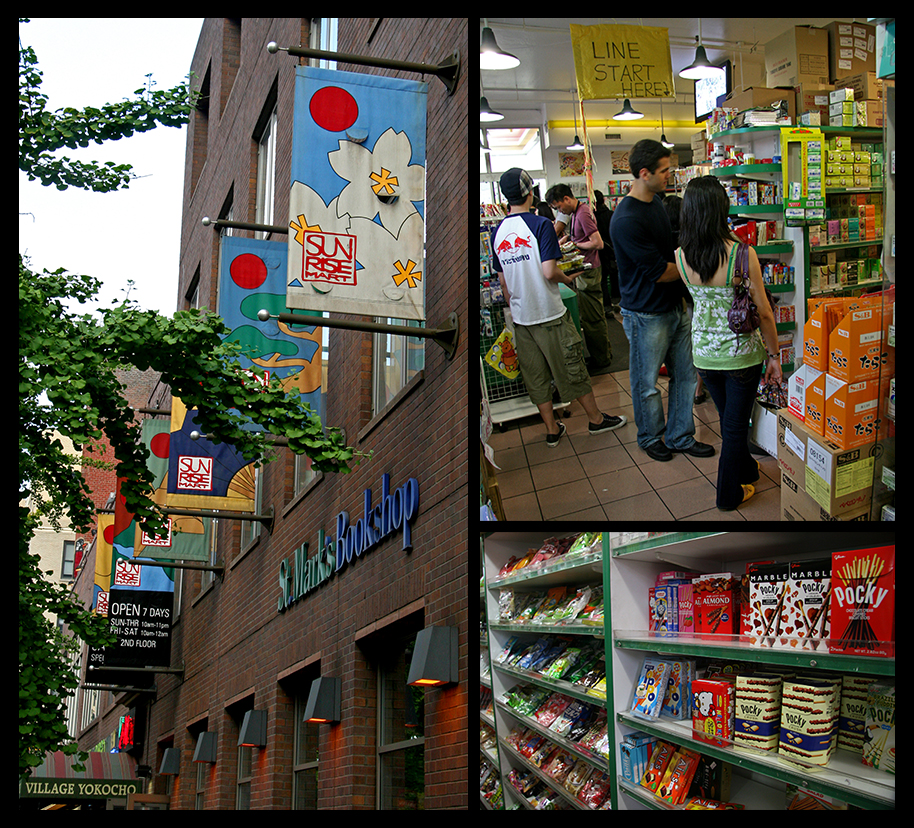
    To me, the phrase real deal is a superlative. And, like any superlative, one must use it judiciously for it to retain its meaning and impact. So when I tell you that Sunrise Mart at 4 Stuyvesant Street is the real deal, you know that I am speaking of a place that is authentic and very serious. No artifice or posing in this place – the kind of place you would only find in New York, Japan, or a very large urban area – if you’re lucky.

    Sunrise Mart is a small specialized Japanese grocery store located in an area of the East Village around St. Marks Place sometimes referred to as Little Tokyo. There’s no pandering to tourists here, although if you are in the area, I would recommend a visit to this very unique shop. The place is located on a second floor above St. Marks Bookshop and goes unnoticed to most except customers. Access is via a small elevator in a rather innocuous doorway. Also, the staff is Japanese, as is most of the clientele.

    The products range from packaged to fresh foods, divided into various departments, including meats, produce, housewares, clothing, and even DVDs. Japanese is spoken here, as one might expect in a place that is the real deal

    Posted on by Brian Dubé

  • Rite of Passage

    Posted on by Brian Dubé

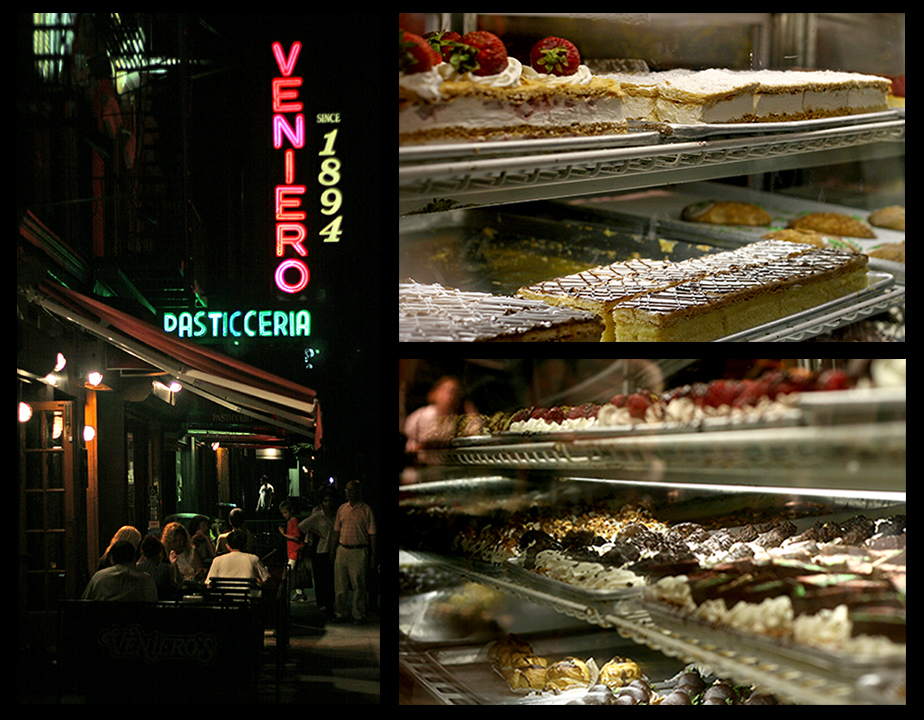
    Now there are people who do not like pastries at all. I have met them. But you won’t find them in line here at 342 East 11th Street, home of Veniero’s Pasticceria & Caffé.
    I won’t claim that desserts at Veniero’s are the ne plus ultra of the pastry world, but they are excellent and well-respected. Veniero’s is a New York City institution, started in 1894 by Antonio Veniero and kept as a family-run business ever since. You can read more about them here. The bulk of the business is takeout and suppliers to restaurants around the city. You can also eat in their café from their extensive menu.

    There are certain rites of passage which I believe every city dweller should go through to be a bona fide New Yorker. After all, imagine being at a social gathering where discussion turns to a discussion of favorite cheesecakes – Junior’s or Eileen’s – and the embarrassment when you have to admit that you have never been to either. Be prepared for the conversational snub and relegation to social Siberia.

    Of course, a rite of passage is not always pleasant, just de rigueur for initiation (or should I say di rigore?). They come in many forms: hazing, breeching, scarfication, baptism, Bar Mitzvah, the aboriginal walkabout, Masonic rituals, and the debutante ball. But here at Veniero’s, your compulsory initiation rite will include requisites like biscotti, miniature pastries, a myriad of cookies, cannoli, tiramisu, sfogliatelle, and my personal favorite: strawberry millefoligie. That’s not such a painful, bad rite of passage, is it?

    Posted on by Brian Dubé

  • Le Figaro Cafe

    Posted on by Brian Dubé

    I remember reading a long time ago in a book that “what draws and keeps so many in California is not so much what the state has as what it suggests.” When I quoted this to a friend at the time who was a recent transplant from New York to the West Coast, he bristled. There certainly are wonderful things about this remarkable state, but I still think that quote still makes a valid point.

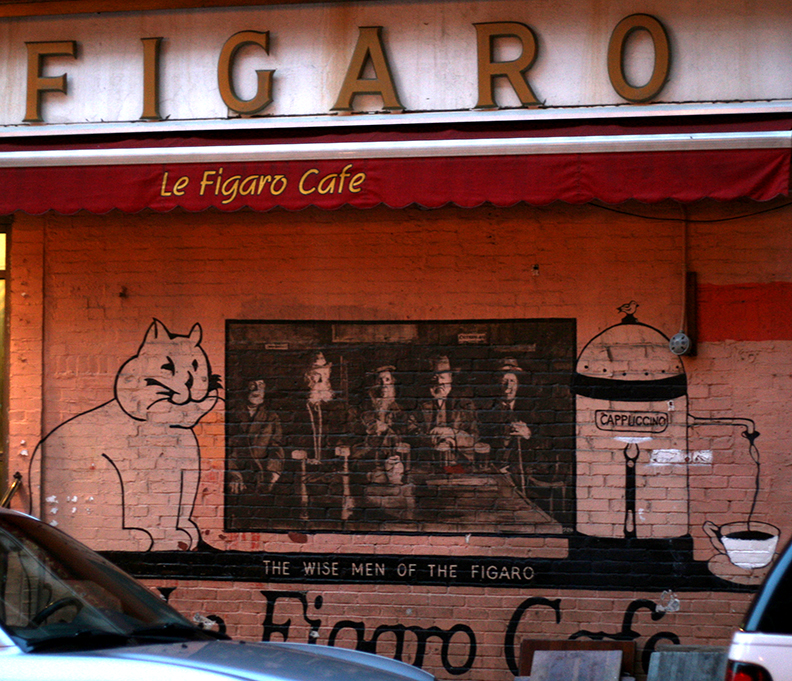
    In the same way, I think this has been the case with Le Figaro Cafe for many years, if not decades. The location and place itself has been a mecca more for what the Village represented than what it has been in recent years. And Le Figaro Cafe was certainly not a window into the history of this neighborhood, steeped in bohemian history – once a hangout for Bob Dylan and Beatniks.

    Recently, Le Figaro Cafe, at 186 Bleecker Street, closed shop after over 50 years in business. It was a bittersweet announcement, but for most, I think their recent Figaro Cafe experience was more bitter than sweet. Many complained of bad service and mediocre food. The place had basically been a tourist draw for eons. This is not surprising, being located at Bleecker and MacDougal Streets.

    The saddest thing about a place like this closing is that we lose a piece of history. And the replacement will most likely be a place that is part of our new, temporal world…

    Posted on by Brian Dubé

  • Two Boots

    Posted on by Brian Dubé

    I really have very little love of classic New York City-style pizza – especially the cookie cutter, formulaic, boring stuff. I have images of harried New Yorkers running down the street with a slice folded lengthwise, excessive cheese and oil dripping off. This is one New York “tradition” which I can easily live without. I have also found that many legendary pizza parlors are highly overrated, yet many experience crowds and lines.

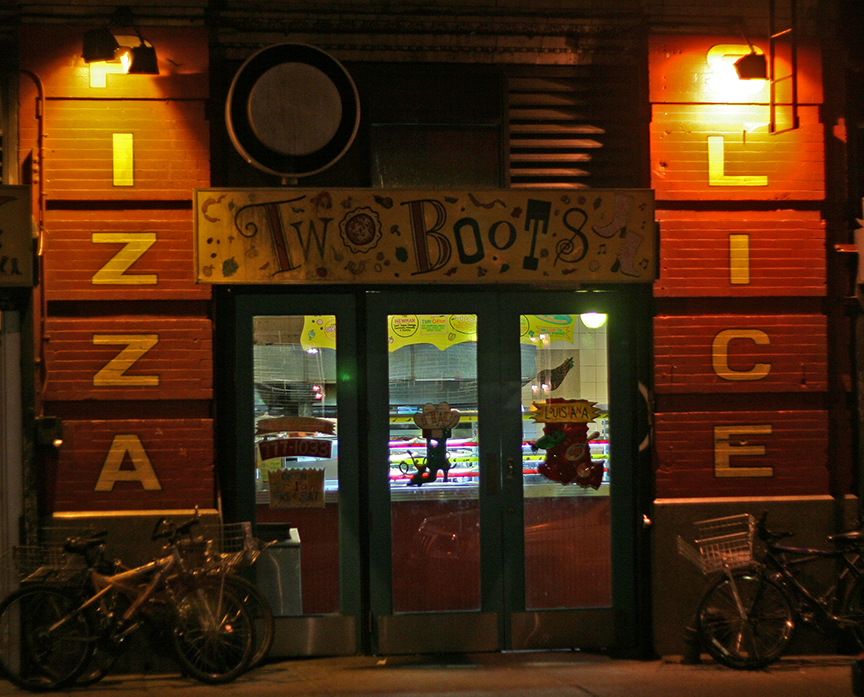
    I personally much prefer a more “gourmet” style pizza. And you can find that at Two Boots. I love their pizza with its unique cornmeal crust. They have created a number of topping configurations with names like Mel Cooley, Tony Clifton, Newman, the Bird, and the Earth Mother.

    The business, named for the shapes of Italy and Louisiana, was started as Two Boots Restaurant in 1987 at 37 Avenue A in the East Village. Original partners Dorish Kornish and Phil Hartman teamed up with local developer John Touhey to create a restaurant featuring Cajun-Italian cooking. In 1989, they opened Two Boots To Go – pizza by the slice and delivery. They currently have 7 locations in NYC, one in Bridgeport, and one in Los Angeles. Of course, there are many quality, more traditional pizza parlors in the city, but if you want a break from tradition, start your adventure at Two Boots…

    Posted on by Brian Dubé

  • Skinny

    Posted on by Brian Dubé

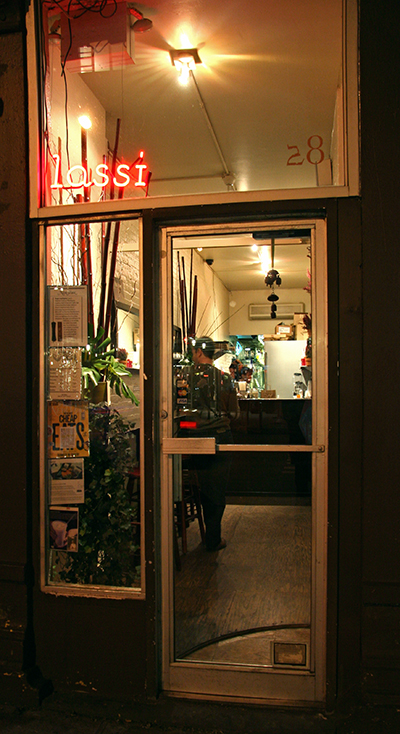
    I love small and/or skinny places., and not just aesthetically. Their very nature leads one to imagine that perhaps this place has been missed by others and is off the beaten path. Or perhaps the place is unusual in other ways – after all, a mainstream business would not typically rent a space only seven feet wide. And the architectural history of tiny or narrow buildings is always fascinating, like 75 1/2 Bedford St. in the West Village, which is only 9 1/2 feet wide, considered the narrowest house in NYC, and occupied in the 1920s by Edna St Vincent Millay. There is a remarkable, very unique, tiny triangular building that houses the restaurant Bite. And I love the beautiful tiny building that houses Vilebrequin.

    Lassi is an Indian restaurant at 28 Greenwich Avenue. This tiny, narrow space is where Heather Carlucci-Rodriguez plies her craft. She was a former pastry chef at L’Impero, Veritas, and Judson Grill, each receiving 3 stars from The New York Times, as well as working for a consultant for France’s Michel Cluizel Chocolat and Domori Chocolate in Bologna, Italy. She has a culinary education from the Restaurant School in Philadelphia and also in France. An unusual pedigree for a restaurant specializing in northern Indian cuisine.

    Lassi is essentially a take-out operation, but there are stools for those who want to eat in. The location was previously an equally interesting restaurant – Thali, a vegetarian restaurant serving only one prix fixe dinner selection per night. Lassi’s menu includes a variety of curries, parathas, and lassis. You can read about them at their website and see the menu here. Just watch yourself if you like skinny 🙂

    Related Postings: 121 Charles, Bomb Factory

    Posted on by Brian Dubé

  • Insult to Injury

    Posted on by Brian Dubé

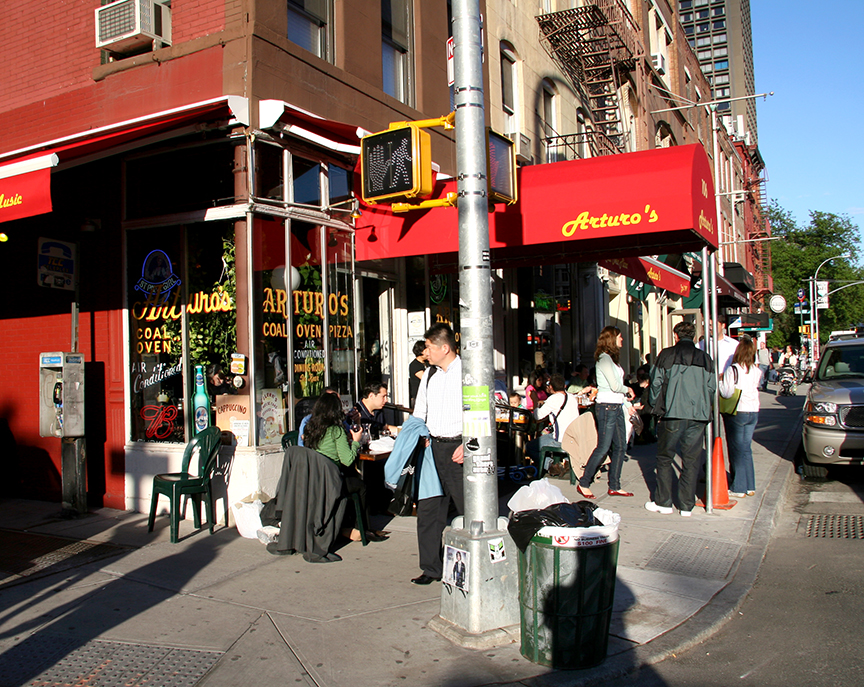
    Let’s try to create the most inhospitable outdoor dining situation imaginable and see if anyone comes. First, let’s pick the largest city in the United States – New York – to make sure we have potential for congestion.

    Second, pick one of the busiest thoroughfares in Manhattan – Houston Street – so it’s like eating on a super highway. Third, we make sure we choose a really crowded area to insure opportunity for the maximum numbers of passersby. Fourth, while we’re at it, provide no separation between diners and those passersby, guaranteeing a complete lack of privacy.

    Fifth, let’s use inexpensive, plastic chairs (the kind you get for a few dollars at a discount shop) so the experience feels really cheap. Sixth, let’s make sure we have a garbage can nearby filled with trash. Add in a fluorescent orange traffic cone for color. Seventh, let’s put some of the tables around the corner next to the kitchen exhaust system for those who really want more ambiance.

    So there you have it. Dining al fresco at Arturo’s, New York City-style. And do we get any customers? You bet, and there are no tables available.

    Oh – I almost forgot – let’s serve wine so we can add insult to injury 🙂

    Related Posts: Piercing Al Fresco, Luna Park Cafe, Esperanto, a la Chien, Paris in New York

    Posted on by Brian Dubé

  • Bagels

    Posted on by Brian Dubé

    When I first moved to New York City to attend college, I had never heard of a bagel or deli. Hard to believe? Not at all. Before the Internet or cable television, life was much more insular and information much more local. Growing up in a small, blue-collar town in New England, I was exposed to very little. Cappuccino was unheard of.
    But it was only minutes after arriving in the Big Apple, however, that I sampled my first New York style cheesecake. And bagels and heros (“grinders” where I came from) were soon to follow in my full immersion in NYC culture.

    Along with the Sabrett hot dog, NY Pretzel, and egg cream, I can’t think of many food items that better epitomize New York City than the bagel.
    My best friends in college were Jewish, and I quickly learned the ways and means of New York from them, with Yiddish expressions: schlamiel, schlamazel, oy vey. The bagel became a staple in my life. Satisfying and substantial. The quintessential NYC breakfast for a New Yorker on the run.

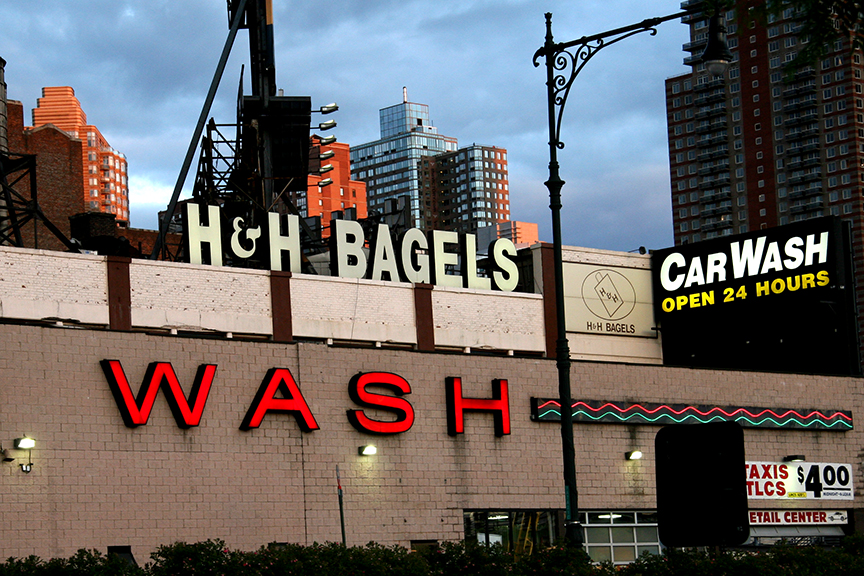
    H&H Bagels is the city’s largest manufacturer of bagels, producing millions per year from their factory on 12th Avenue and 46th Street. The sign, along with the Car Wash, is a familiar site to those who have traveled along the West Side Highway.
    H&H was founded in 1972 by Helmer Toro. You can find them at many locations, including their flagship shop at 2239 Broadway.

    New Yorkers need to always feel on top of the game. We constantly look for ways to shout biggest, best, first, most, and largest. H&H Bagels is one of those NYC icons, a name people love to show and tell. They have been seen in Seinfeld, a Woody Allen film, and Sex and the City – all classic New York and befitting the H&H Bagel…

    Posted on by Brian Dubé

  • Donato

    Posted on by Brian Dubé

    Seems like I am on a strange and lucky roll recently. If you read my posting on the Chess Shop, you know how I just happened to pick the optimum day with the original owner playing chess outside and the current owner inside. And then the story of running into a renowned harmonica virtuoso Will Galison just hanging out in the park.

    Trattoria Spaghetto at 232 Bleecker and Carmine Street is in one of the highest traffic and most touristy areas in the city. Certainly not the little hideaway tucked in on a quiet sidestreet. So one might be inclined to avoid it, as I certainly did for most of my time living in the city. But I finally gave it a try and find the food to be very good Italian fare – a number of my friends now go there regularly and we all like it. The prices are inexpensive, and the ambiance is extremely nice, particularly given the price range. There is also outdoor seating.

    So as I sat one night, I found myself eavesdropping on two gentlemen who have very heavy Italian accents. I get the sense that they may be neighborhood residents, so I think this is a good opportunity to get an opinion from locals to use as background for this posting. I ask if they live in the neighborhood. By now you have guessed – I have accidentally bumped into the owner, Donato DiSaverio. He was friendly and charming. He spoke of his restaurant, where he was born in Italy, etc. I learned that he has a factory in Queens and makes all his own pasta for the restaurant.

    It is the perfect place to take a group of people with different tastes – you can never go wrong with Italian 🙂

    Posted on by Brian Dubé

  • Have a Heart

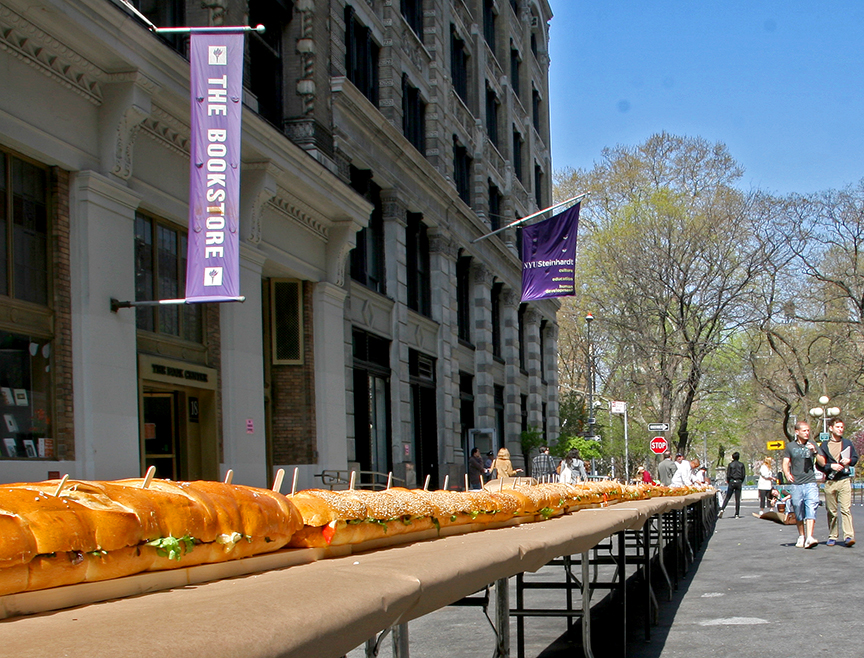
    The university has historically been a place for protest, liberalism, and a forum for current events and activism. So it came as no big surprise as I went by the New York Univesity campus yesterday and saw an Earth Day celebration. What did surprise me, though, was a 180-foot vegetarian sandwich made by Top of the Square Catering. I’m not sure of the tie-in to the day – the sandwich appeared as more of an indulgence rather that a statement of restraint. But everyone has to eat, and I suppose a vegetarian sandwich is a better choice than foie gras or veal for Earth Day.

    NYU has a number of activities (graduation ceremonies and other annual events) that are held in the streets around the university buildings, owing to the fact that they do not actually have a private campus – the streets of NYC and Washington Square Park essentially function as their campus. I have blogged a number of these these NYU events  see the links below).

    I will end this posting with a popular quote which is apropos, attributed to Winston Churchill. Some say it is falsely attributed to him, but I have not been able to substantiate this one way or another. You will also see many slight variations on the quote itself.
    ”If you’re not a liberal at 20, you have no heart, and if you’re not a conservative at 40 you have no head.” I keep this in mind whenever I am witness to student activism, passions, and idealism…

    Related Postings of Interest: Grad Alley, Light on Bobst, La Rentrée, Obama, Danger and Caution


  • Co-op

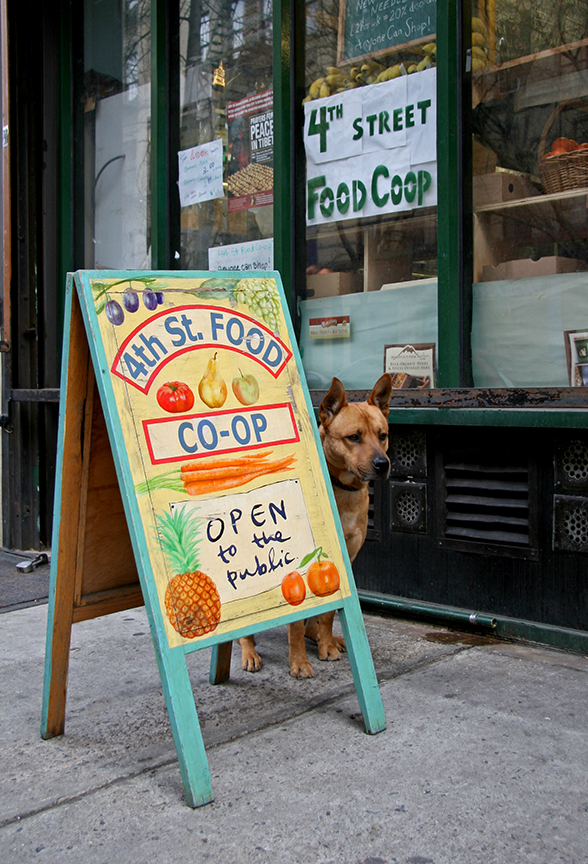
    Many may not be familiar with the concept of the food co-op. The 1960s and early 1970s saw a boom of popularity in the idea. The 4th Street Food Co-op at 58 E.4th Street in the East Village is the last surviving in Manhattan and one of only two in NYC (the other is well-known in Brooklyn).

    The original concept is one of a cooperatively owned food store. I was surprised to learn that food co-ops go back to 19th century England and the cooperative principles set by the Rochdale Society of Equitable Pioneers in Rochdale, England, in 1844.
    The 4th Street Food Co-op is structured to allow for working and non-working members to get products at a discount – typically, non-members can shop at a higher price. The motive is to be essentially a not-for-profit corporation.

    I see two problems with the food co-op for this generation.
    First, the food co-op is run by members, and members are ideally working there. Most individuals these days have too many interests and other priorities to invest time in this manner for a small discount on food. People want convenience, not more work and obligation. Non-working memberships are a way of dealing with this.

    Secondly, I hate to be cynical, but I think that people’s willingness to be politically correct and embrace causes does not include giving up most of the comforts that we have become accustomed to. Scaling them back somewhat, but that’s it. In regards to the food co-op, people want a much broader selection of goods in a boutique environment, such as the rage that is Whole Foods Market, a wildfire spreading across the land. Higher prices, but they are not daunted – the checkout lines are huge. Everyone wants their iPod and toys. All of these manufactured goods have an environmental impact. We may give up the SUV, but not the car…


  • dinamic_sidebar 4 none

©2026 New York Daily Photo Entries (RSS) and Comments (RSS)  Raindrops Theme