• Category Archives War Against Wheels
  • Insults to Injury


    Even the busiest streets of Manhattan have their quiet times. Walking down MacDougal Street (one of the most touristy streets in the city) in the morning is a vastly different experience from the summer or weekend evenings and nights. In this neighborhood in the morning, it is quiet and the traffic is light, so your guard is definitely down. Tuesday was a beautiful day, and as I crossed the intersection at MacDougal and West 3rd Streets in the Village, the last thing I expected was an enormous automobile crash, virtually at my heels.

    This was the largest crash I have ever witnessed and was heart stopping as one vehicle hit another broadside in the intersection. The vehicle impacted by the taxi rolled over completely, coming to rest on its roof. Only a moment lapsed before many bystanders sprung to action, righted the vehicle, and removed its driver, who, surprisingly, looked extremely shaken, but with no outwardly obvious bodily damage.

    Within a few minutes, two police mounted on horseback arrived first, followed by an ambulance, fire trucks, and other emergency support vehicles.
    Ironic insults to injury abounded. First, the taxi driver’s immediate concern appeared to be his future employment rather than the condition of the injured driver lying on the sidewalk. As the taxi driver stepped out of his cab, he exclaimed in shock and disbelief, “Oh, this is not good for me at all.”
    Then, in examining the photos this morning, I noticed the two bumper stickers on the overturned vehicle. One read, “CAUTION Vehicle Makes Frequents Stops,” and the second read, “How’s My Driving? Call 1-800-994-8099”

    In a final insult to injury, the injured driver rested on the sidewalk, surrounded and helped by others as he awaited the ambulance, beneath a sign reading: “The Best Backrub For Men and Women”…

    Related Taxi Stories: Yellow Fever, Jersey Girls, Sea of Yellow, Garden in Transit, Pedicabs


  • Great Minds and Fools

    If you have lived in this city long enough, you find your mind often contemplating the consequences of leaving things of value out in the open. It’s not necessarily the product of a criminal mind, but rather one of seeing too much vandalism and too many break-ins. I lived here through a long period of time when “no radio” signs in car windows were an everyday sight.

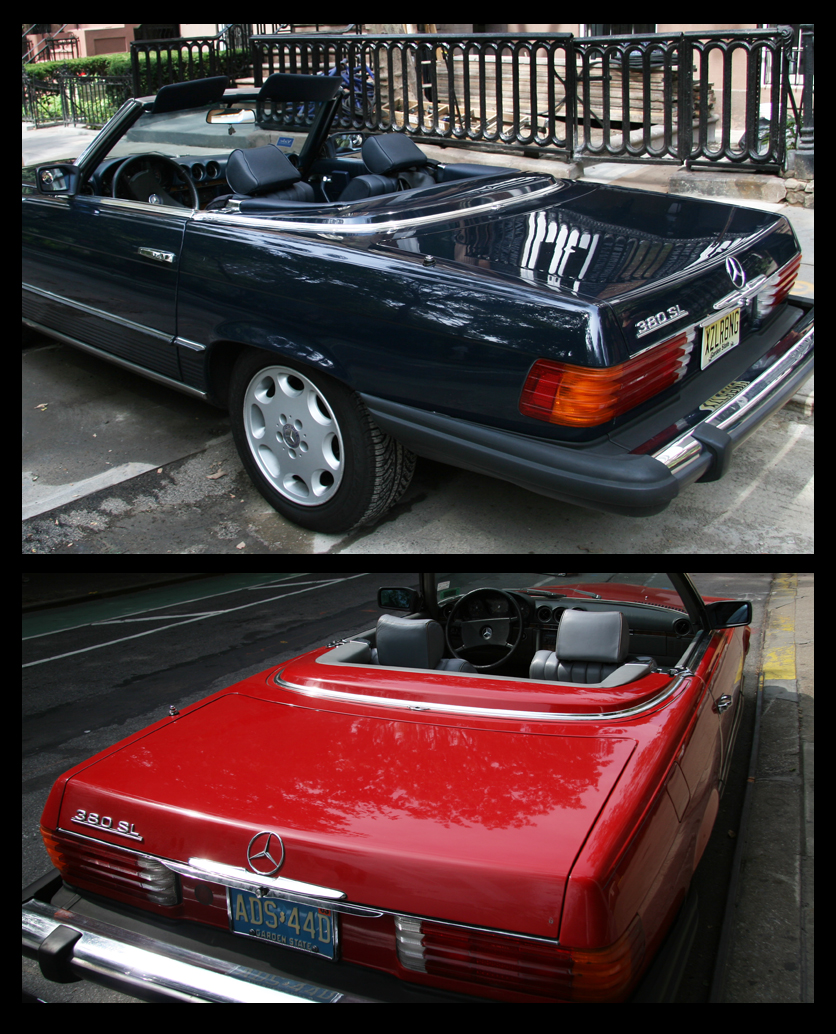
    The inflexible rule of thumb when parking a vehicle in New York City is to leave nothing in plain view in your vehicle at all. On July 29, 2009, I wrote of this in Urban Coral Atoll, as well as that many owners of luxury vehicles may leave their doors unlocked and “convertibles, top down, parked unattended in the streets of New York City, a clear signal to potential miscreants that there is absolutely nothing of value in this vehicle.” Recently, I saw what appeared to be this anti-vandalism effort mirrored.

    Walking along Washington Square North, I saw a Mercedes 380SL convertible with its top down – a perfect photo opportunity to illustrate this proactive anti-vandalism parking approach in action. What was more surprising was that just a short distance away, I found another Mercedes 380SL convertible with its top down. Both bore New Jersey license plates. It seemed likely that the owners were friends who shared a passion for the same vehicle and came into the city together for a romp around town.

    Counter measures notwithstanding, owning a luxury vehicle and street parking it in New York City requires intestinal fortitude and some degree of reckless abandon. I have seen owners of Rolls Royces, Ferraris, and Lamborghinis park on the street, even in front of fire hydrants and other no parking zones. If your vehicle is towed, there is the risk of damage in the towing process. Not to mention, of course, the cost of a parking ticket and towing fee, now $185 plus tax.

    However, no matter how you plan or prepare, vandalism is always a possibility, and to leave a luxury vehicle on the streets of New York City is unfathomable to me. At times, I feel badly and assume that the owner may just be a visitor, naive regarding the realities of the streets of New York. At other times, I imagine that the owner may be a conspicuous consumer, flaunting the sign value of his car, as if to say, “Don’t worry. I have enough money that if I am towed, a few hundred dollars means nothing. If the car is damaged, I’ll just have it repaired. And if is stolen, I will just buy another one.”

    Is parking two Mercedes convertibles with tops down on the streets of Manhattan a case of Great Minds Think Alike or Fools Seldom Differ? 🙂


  • Crossing Delancey

    Subcultures have their own languages, and the art community is no different. Over time, I have been privy to bits and pieces of artspeak, with words such as iconography, a word not often used outside the world of the arts. I say bits and pieces, because the special vocabulary is not wasted on the outsider, and perhaps there is even an element of secrecy, lest we learn enough to do an effective job of posing as one who is knowledgeable in the arts, thereby diminishing the special and exclusive nature of the “club.”

    I recall once trying my hand at creative design for my business. Upon presenting it to an artist friend, I was immediately told, in a very critical way, that my efforts did not have to be so literal – a new use of the word for me.

    I must admit, however, that I liked that use of the word and have added it to my arsenal of word weaponry, to be used when necessary. Recently, while crossing Delancey, the film of the same name came to mind, and it occurred to me that taking a photo would be an opportunity for a literal interpretation of the film’s title. Perhaps an art faux pas, but my photography is not being subjected to an art school group crit (see a New York Times article here).

    Literally crossing the street can be an undertaking – Delancey is a major thoroughfare with eight lanes extending from the Bowery to the Williamsburg Bridge, which crosses the East River to Brooklyn.
    The Delanceys were a rich, pre-revolutionary French Huguenot family. Their large estate became what is now the Lower East Side. Read more about the history of the neighborhood here at the New York Songlines website.

    At one time, until the 1920s, Delancey Street was a high-end shopping district. Over time, however, Delancey fell on hard times, and the character of the businesses changed, becoming the primary shopping district of the Jewish Lower East Side, known for discount merchandise and businesses such as Ratner’s Kosher Restaurant (closed 2002), the Bowery Ballroom, and the Essex Street Market.

    Delancey Street is also the site of one of my earliest postings in 2006 – the Live Poultry Market.There has been some gentrification, and the neighborhood is now a blend of older shops, a smattering of Chinatown and discount merchants, and newer retailers and night clubs.

    The film Crossing Delancey is the story of Isabelle, an Upper West Side Jewish resident, who, matched to a pickle maker on the more ethnically authentic Lower East Side, finds love crossing to the south of Delancey Street, literally 🙂


  • No Fusilli

    Posted on by Brian Dubé

    Things start well enough on Sunday – my mother calls to wish me Happy Birthday, and from my window, I see a partly sunny day. I suggest to my girlfriend that we go to the Bronx Zoo, something which I had not done in years.
    We opt for public transportation – the subway has a zoo stop.  A short distance outside, however, and it is clear that this is going to be a hot and very humid day. But I remain optimistic – trains are air-conditioned, and the zoo is shaded and also has indoor exhibits.

    This trip requires two trains, a local to the express. When we get to Astor Place, however, the local train is not running at all. Out to the street for a six-block walk to Union Square for the express train.
    Signs indicate that the number 5 train is also not running for the weekend. We jump in the first express train which arrives quickly – things are starting to look up.

    But once we arrive in the Bronx, I notice the stops don’t look quite right. That’s because only the number 5 runs to the zoo, not the 4 which we had taken. A brief conversation with a passenger confirms my mistake and that I will have to take a bus across Fordham Road. We exit the train, armed with our Metro Cards, expecting a free transfer.
    However, the bus driver indicates that we need to go back to the machine on the street and purchase reduced price tickets at $1.10 each for this BX12 bus.
    Off the bus. Buy tickets. Back on the bus. The ride across Fordham Road is quite depressing.

    Our stop is Southern Boulevard, and the driver tells me I have a choice of two entrances. I forget the East Fordham Road entrance is the main one, which is quite beautiful. Instead, we traipse nearly twice as far down Southern Boulevard for what feels like an interminable distance in the heat to finally arrive at the side entrance. We see “The Complete Experience” listed for $27 per person, with no posting of general admission prices. This already smells of a zoo sadly doing badly. Being late in the day, we opt for general admission at $15 each.

    The day’s humidity is almost unbearable, even in the shaded areas of the zoo. We quickly learn that many of the best exhibits are part of The Complete Experience and can be purchased ala carte. $6 more gets us into the Congo Gorilla Forest – can’t miss that. We watch a movie, and the screen lifts to a live panorama of gorillas.

    I overhear a disappointed father of a family asking his wife who is reading a map – “No elephants?” (there are only two left which can only be seen from the Bengali Express monorail). We decide to purchase a drink after building up a thirst and $2.75 buys a small bottle of water.

    A zoo employee tells me that the zoo closes at 5:30 PM, so I pace myself for that. However, an announcement at 5PM tells us the zoo is now closed, so we barely get to the gardens and exhibits at the main entrance, which I was saving until last.

    We exit and make our way back to the Fordham Road bus stop. We purchase those silly tickets for the crosstown BX12 and wait at the bus stop, confident that we have the system mastered. The bus arrives quickly, but it stops inexplicably some distance before the stop and we miss it. Not to be fooled, we move, and the next bus stops behind us. A quick jog in the heat with camera equipment in tow, and we just make the bus.

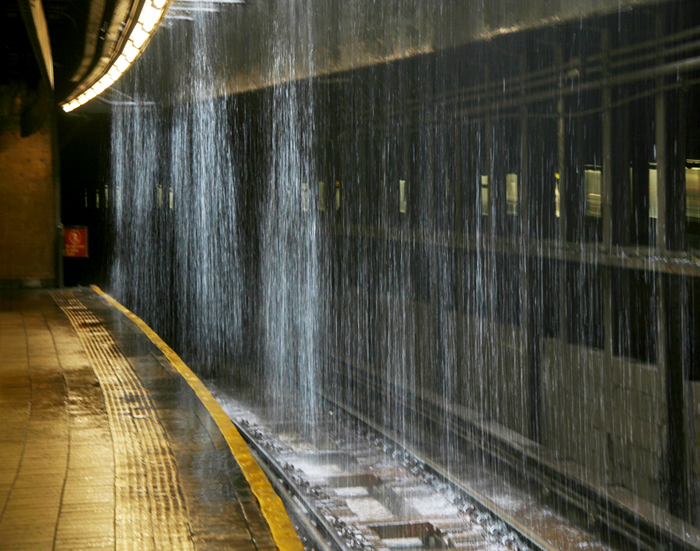
    The train ride itself is uneventful. But at our final stop, I notice a man with a VERY wet umbrella – he confirms a torrential downpour outside. This provides a most amazing photo opportunity and, of course, a wet journey home. The streets are littered with downed tree branches.

    We decide to go Indian for a birthday dinner. The place I frequent is typically nearly empty, but tonight the place is packed, and there are a couple of huge parties. We are seated at one of the few remaining tables. We wait for some time, but I have a bad feeling that this will be a painfully slow process, so we leave as gracefully as possible.

    My spirits pick up as we opt for Trattoria Spaghetto just a few short blocks away. They are also unusually crowded, and the only remaining table is sandwiched between the kitchen and the service exit to the street used by the waiters. Not daunted by eating on a super highway, we sit and get our menus. I do not need to even open mine, because I am ready to order my favorite dish here: Fusilli Puttanesca. However, our waiter informs me that he is sorry, because tonight there is no fusilli 🙁

    Posted on by Brian Dubé

  • Five Dollars

    Posted on by Brian Dubé


    As far as money goes, New Yorkers are like most other Americans – they like a deal, and FREE screams loudest to them.
    People at trade shows collect enormous numbers of brochures they will never read and wait in huge lines for premiums and freebees worth virtually nothing. I have seen adult men and women practically brawl over free T-shirts thrown into an audience at a Macworld convention.
    With free food it is even worse. At the Japan Festival in Central Park on Sunday, people were in lines hundreds deep, waiting in the hot sun for free noodles or a free dumpling.

    When it comes to tunnels, bridges, and other roadway tolls, many seasoned New Yorkers consider it a matter of principle and a source of pride to avoid paying a toll. Ironically, in most other ways, New Yorkers spend huge amounts of money for conveniences – prices for items at a green grocer can be substantially more for identical items at a supermarket a few extra steps away. There are endless examples of this behavior. But put the same people behind the wheel of a car and give them the option to wait in horrendous traffic to avoid paying a toll, and they will.

    If you are coming from the outlying neighborhoods of Brooklyn by car, you will most likely use the Belt Parkway or Prospect Expressway and then a leg of the Gowanus Expressway. If you are heading to Manhattan, you have a big life altering decision to make: do you take the Brooklyn Battery Tunnel for FIVE DOLLARS, or do you cram into the bumper-to-bumper traffic on the BQE (Brooklyn Queens Expressway) and take one of the bridges for FREE?

    By now the answer is obvious, n’estce pas? Any self-respecting New Yorker takes the free road and saves five dollars (perhaps to spend it whimsically soon after at Starbucks). Admittedly, five dollars is quite a bit of money for a short tunnel ride. However anyone driving a car into Manhattan is already indulging in a luxury that most can not afford, so why not spend five dollars and go in style?

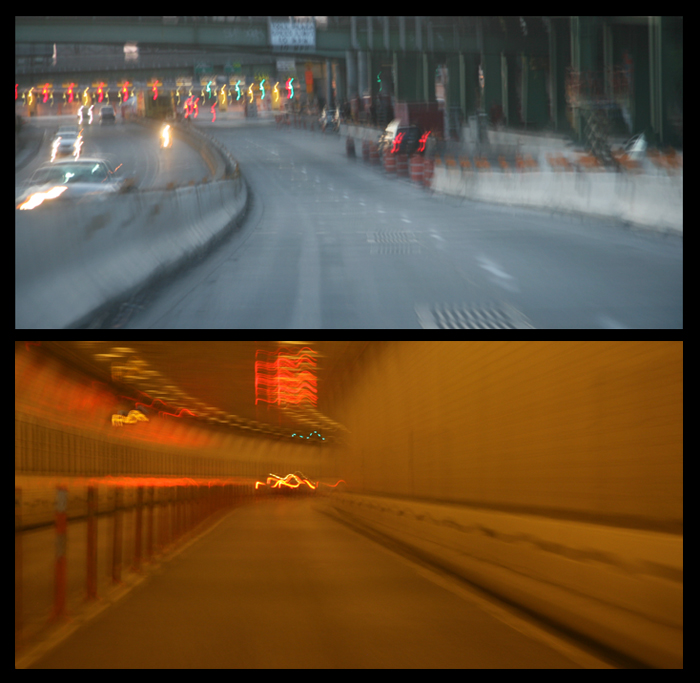
    These were my thoughts on Saturday evening when, coming back from my adventures in Brooklyn after an exhausting day of driving, I decided to do the unthinkable and spend five dollars for the tunnel experience. It was extraordinary. The highway spur to the tunnel (top photo) and the tunnel itself (bottom photo) were virtually empty.
    I was back in Manhattan in a few short minutes, while thousands jammed onto the BQE. Of course, many of these travelers were not headed to Manhattan, but trust me on this – if there were no toll for that tunnel, I would have had plenty of company. And, of course, an extra five dollars…

    Photo note: Against better judgement, these photos were taken one-handed while driving. Camera shake, shutter speed, aperture – no time for these considerations. After spending $5, I was feeling rather reckless anyway 🙂

    Posted on by Brian Dubé

  • WFF ‘N PROOF

    When I was in high school, I used to enjoy a game called WFF ‘N PROOF – The Game of Modern Logic. This 1961 classic, developed by University professor Layman Allen, was said to have the “complexity of chess and the excitement of poker.” Not everyone felt that way, of course, and I must admit that the circle of friends enjoying the game was rather small.

    I liked the study of logic, but I never realized these skills would be necessary to understanding something as mundane as New York City parking regulations. Often, multiple signs are placed on one block with rules of inclusion and exclusion. Some throw up their hands and just take other parked cars as a sign of permissibility. At times, I see nervous visitors puzzling over the arcane and cryptic signs, worried if they are legally parked. Depending on their apparent level of angst, I usually try to throw out my interpretation of the signs to allay their fears. They would be much more worried if they knew the consequences of being towed in New York City: the outrageous costs of the parking ticket and towing (at least $255), not to mention the nightmare of traveling to the car pound and retrieving your vehicle.

    I was surprised and pleased to see this graphic solution to making the parking regulations understandable. This, in tandem with the relatively new Muni Meters (replacing coin-operated parking meters), makes parking less painful than it used to be. However, getting a spot still requires the same set of skills: patience of a saint, luck of the draw, tenacity of snapping turtle, aggressiveness of a badger, and often the skill of a surgeon and understanding of geometry to parallel park in spots only slightly larger than the vehicle itself. I have seen many flustered drivers actually abort and abandon a parking spot which was, in fact, large enough.

    However, these signs only simplify an already daunting and nearly impossible task – parking here will never approach the relative effortlessness found outside the city. When in very rural areas, I never cease to enjoy just parking at the curb wherever I need to go. I stand outside my car and marvel at the ease. Somehow, however, I feel that something is wrong – there must be some local parking ordinance I am violating that everyone knows except me. And where I am to use my skills in geometry or WFF ‘N PROOF?

    Note: You can see WFF ‘N PROOF at their website here.


  • Continental Divide

    Most likely you have never been to Corona, Queens, and most likely you will never visit either. You will not read of any gentrification movements there or of an exodus of disenfranchised Manhattan artists discovering the neighborhood. This is a working-class neighborhood – at one time predominantly Italian and now 75% Hispanic. Like many area of Queens, the neighborhood has a broad ethnic diversity – Mexicans, Dominicans, Bolivians, Ecuadorians, Colombians, Guatemalans, Peruvians, Asians, Pakistanis, and Italians.

    I say you will likely not travel there because the rivers of this city that separate the boroughs are in many ways like the Great Wall of China. A body of water can be a big cultural divide – it separates countries, states, cities, and, in New York City, the boroughs.

    The rivers of New York City are also a tremendous mental impasse. With the exception of commuters, most will rarely cross one even if the distance and travel time is short. Central Park seems nearer to a downtown Manhattan resident than a closer destination in Brooklyn. So there must be a very good reason to leave your borough, and visiting Corona will not usually be a good reason.

    Each borough, and even each neighborhood, is a world unto itself, and many find little reason to leave it except for work. The population density of New York City supports an incredible range of services in a small area. Many Manhattan residents get much of what they need in walking distance of their home – a great luxury and convenience. Step out of your apartment, and there is a universe of goods and services a short stroll away. This is true to a lesser extent in the boroughs, where you have larger tracts of residential housing without commercial establishments. However, every neighborhood is like a small town, and its center typically has its own set of services.

    Many of the neighborhoods in the outer boroughs are dominated by one or more ethnic groups; traveling to these lesser known neighborhoods can be culture shock. There are signs in other languages, unfamiliar foods, and unusual dress. The pace is slower. And here, extravagance is out of place. Money is real and careful husbandry the rule.

    So, with a sudden break from our frigid weather and temperatures in the 50s, Sunday seemed the perfect time to sample the goods without waiting until summer. I am sure I was the only person who drove from Manhattan to Queens to sample Italian ices at the Lemon Ice King of Corona (which is open all year). The ices have been made by Pete Benfaremo for 58 years at the same location.

    It was chillier than expected, and a friend and I found ourselves alone when we arrived at the Lemon Ice King at 108th Street and 52nd Avenue. I felt a little awkward and foolish. The clerk apparently did not share my enthusiasm or spirit of adventure.
    There were few patrons, and I did not know that there was no indoor space for customers. So, after choosing our flavors from a selection of 20 plus flavors at the street counter, we ate our ices standing on a blustery side street while seeking as much sunshine and as little wind as possible. See here for a peek inside.

    And did the ices live up to their legendary status? Honestly, we both found them too sweet, virtually killing the flavors. But perhaps I will try again on a warm summer’s eve and when I am in the mood to travel across a continental divide…


  • Itching and …

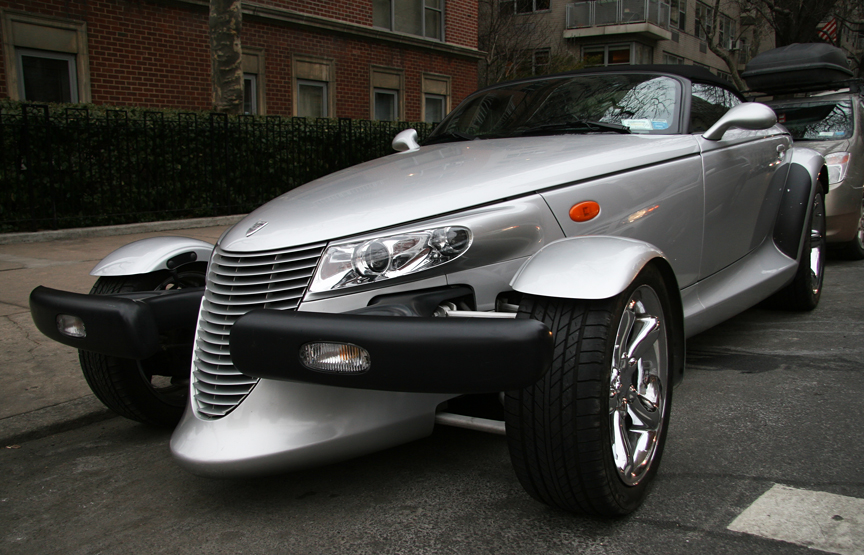
    Two things about this car parked in the streets of Manhattan stand out: it really looks out of place, and it is so pristine.

    There are many unique considerations about owning an automobile in New York as opposed to owning one outside the city. They generally are used less frequently by owners, so the occasions to flaunt them are fewer, and there is no opportunity to display them in your driveway in front of your McMansion. They are often street parked – either on an occasional or permanent day-to-day basis – so they are vulnerable to whomever and whatever. They are much more expensive to maintain here, with parking that runs several hundred dollars per month as well as high insurance costs. And except for the extremely wealthy who may have drivers, a car will still only meet some of your travel needs – trains, buses, taxis, and walking will still be the staple transportation diet around town for residents even with cars. Most will use their automobiles to leave the city. Hence, for most, automobiles in New York City take on a much more utilitarian role – a car here is really a luxury, an indulgence, and a sports car even more so. So a sight like this Plymouth Prowler will turn heads (read more about this car here). When I took this photo, I waited for a group of tourists to finish their photo opportunity.

    When you park a car like this on the streets of New York City, like it or not, you are taking a risk and making a statement. There are chances of dents and dings from parkers and pedestrians. Auto theft. Vandalism. Park a Lamborghini on the streets of New York City, and you are saying you have money to burn.

    And then there is something that I have seen before and is difficult to erase from my mind. That surface is so smooth and shiny, it’s just itching. I don’t want to say it or even think it, but everyone knows what every itch is saying and what Mom always told you not to do – scratch it…

    Photo Note: Cars make a great photo subject – it’s hard to go wrong with a gleaming vehicle like this. I have done a number of postings related to cars and bikes: Hoopmobile, Who See the Red, Machine, Extreme Cadillac


  • American Express

    I have met grown men – secure, strong, worldly men – who are absolutely terrified of cities, particularly New York City. To city lovers like myself, these fears seem completely irrational. I understand the fear, perhaps, of an older person or single woman walking in a dangerous neighborhood at night – this is courting trouble. But a grown person in a vehicle in broad daylight with an entire family in tow? What can really happen? If you get lost, you will eventually get unlost. In my experience, the worst that will happen is that you will be very inconvenienced for some time.

    The worst scenario to me is breaking down in an automobile in the city. Fixing a flat or getting a battery boost, simple acts elsewhere, can be a real headache here. Services are not readily available, and waiting for roadside service on a busy highway in a traffic congested city is certainly not pleasant. And if one would have to overnight in a hotel, that would be mighty expensive or very inconvenient.

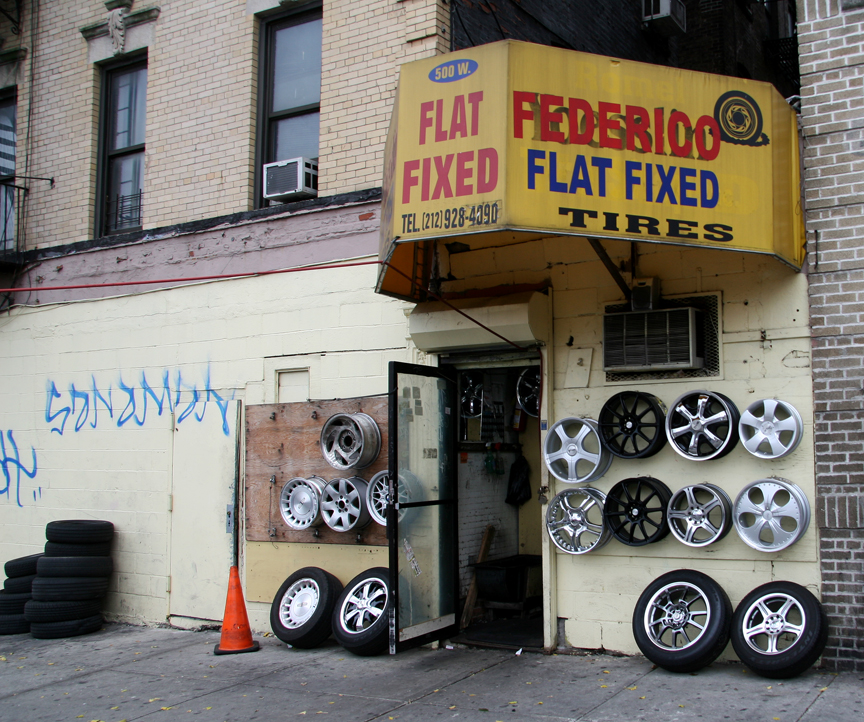
    There is no plethora of basic services, such as tire repair. Places like that in the photo are generally found in poorer neighborhoods and in out-of-the-way locations. Unless you know a neighborhood well, these places are destinations – the likelihood of finding them when you need them is rather remote. And escalating rents have conspired to make these places all but non-existent. The scarcity has made this type of subject a popular photo.

    Certainly being lost in a city or having trouble here, like getting a flat tire, is more troublesome than the same problem in the suburbs, and there is perhaps some risk of exploitation by opportunists (although our suburban or country brethren are not immune to this). In most cases, however, a little cash or credit card will be all that is necessary to extricate oneself from virtually any situation. I remember a conversation with a client of mine when I was younger and very inexperienced in travel. She was much older, nearing retirement and planning to settle somewhere on the coast of Italy. At the time, this seemed like such a fantasy and unfathomable to me for a number of reasons, language being one of them. When I asked whether she was concerned about not being able to speak Italian, she replied that she was not at all worried, because “They all speak American Express” 🙂


  • Livid

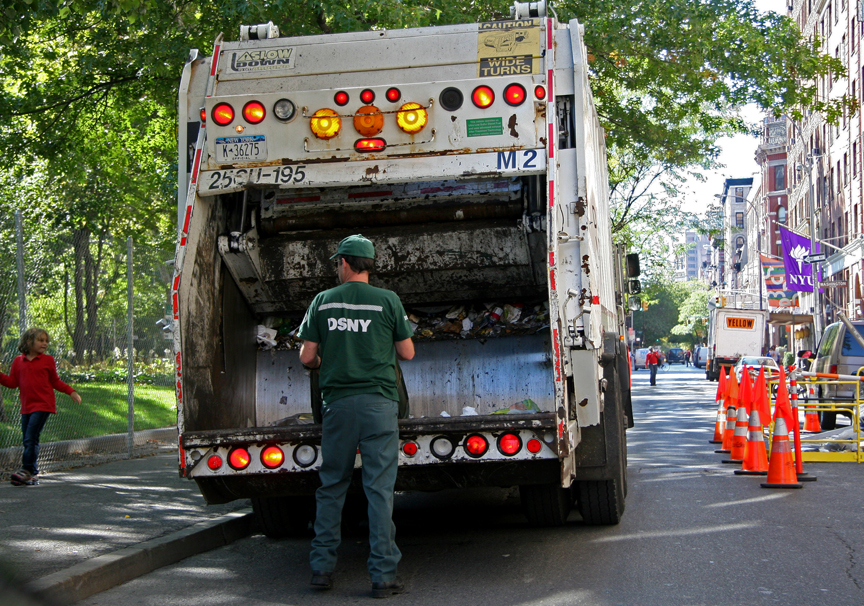
    Here is an infuriating New York City scenario. You are driving a car or in a taxi on an avenue and need to change direction by turning onto a crosstown street. Now in most situations, you have many choices as to which crosstown street, since most of Manhattan is a grid. There are 20 crosstown blocks to a mile, so for most trips, there are dozens of streets you could take. If you are really knowledgeable about traffic patterns, you can narrow your choices, but nearly always, you will still have many equally good options. Your final decision will have an element of whim.

    So you make a turn down a street and, by pure chance, you happen to select the block where a sanitation truck is picking up trash. The street is not wide enough to pass, and sanitation workers will never try to accommodate you in any way. And you know you will be there for quite some time, crawling behind that truck, watching as they go about their business, one can at a time, with no sense of urgency, because this is their job, a job that must be done. And what can you say or do? This is the New York City Department of Sanitation, and you want the city kept clean, right?

    Now if you are a Zen master or one who can take life in stride, perhaps laughing at times like this, then you are fortunate. But if you are in a bit of a hurry or prefer not to spend your life waiting for traffic lights or behind trucks, because you have already spent too much of your life here waiting, then you may find yourself stewing a bit. There are better things to do. As time passes behind that truck, time that passes slowly (it will be a long time to go down that whole street stopping at every building) you can easily imagine having chosen another street. Any other street. You can play out all the scenarios and reflect on the odds that of all the streets in New York, you chose this one. No backing up either, because in this city, it is rare that cars are not immediately behind you.

    You will have time to exhaust all the things you could have done or should have done, because sanitation workers are in no hurry. They are absolutely immune to any belligerent actions – they have experience on a daily basis with all manner of threats and attention-getting tactics. You can pretend you are relaxed, enjoying music, or reading. But if you are a type-A personality or high-strung, you can work yourself into a livid, absolutely furious state. Occasionally, in a city of extremes, livid will be the emotion du jour. 🙂

    Photo note: This photo was taken going south on Washington Square West in the morning, not the classic avenue/crosstown street scenario. There were few trash pickups to be made, little traffic, and some opportunities to pass around the truck. So this was only reminiscent of the real deal, not an authentic ulcer maker.


  • No Radio

    I have a very strict policy of only using photos taken of or in the 5 boroughs of New York City. And being away on vacation is no excuse to use photos of another locale. I prepare for this in advance.
    However, the mini-event that occurred on Saturday was so outrageous to me, from a New Yorker’s perspective, that I have to break my rules and tell this tale.

    While away this weekend, my two nephews and a friend decided to go for a short canoe ride in a river at my parents’ gated condo community. They asked if I suggested wearing shorts rather than pants in the event that they get wet. My response was that if they were to fall into a river, shorts versus pants would not be a consideration. But I DID highly recommend emptying their pockets of valuables, particularly knowing that they were affluent boys and that the value of the contents of their pockets was probably greater than that of many 3rd world countries. They saw the sense of this and immediately concurred.
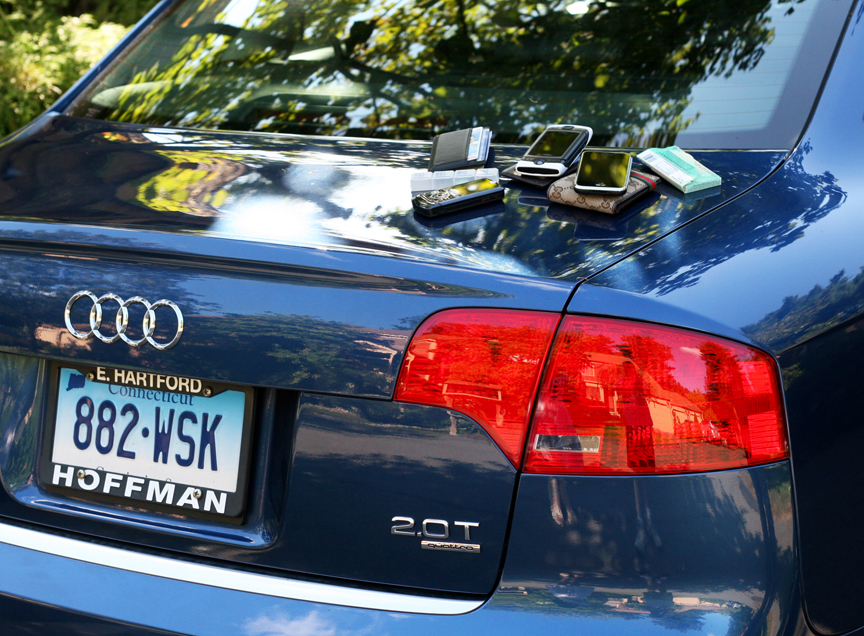
    So out came the iPhones, cellphones, a wallet with credit cards visible, and a Gucci wallet. They placed all of these items on the BACK OF THE CAR IN PLAIN VIEW (appropriately on the hood of one boy’s Audi). I was incredulous. “You guys are going to leave all this outside in plain view?” I asked. They responded, “Whose going to take it? There’s only a bunch of old people here.” That was not strictly true, and I am still absolutely floored by this occurrence.

    Now admittedly, this cavalier attitude was largely due to a lifetime of privilege and never knowing need. And it was a gated community. But there was also an element of TRUST that is just nonexistent in New York City. You cannot leave anything of value unattended. I have heard stories of thefts that are unfathomable; a UPS driver once told me of a man who ran down the street with a large projection television stolen from his truck! The driver was unable to catch him in the ensuing chase.

    In New York City, a vehicle should always be locked, and nothing of value should be in plain view. This process is so automatic to me that it has become a reflex action – I even lock my car in the driveway of my parents’ home in the suburbs.

    Every seasoned New Yorker remembers a time when auto break-ins for radios were common. At one time, I recall seeing broken glass somewhere on the streets on nearly a daily basis – a telltale sign of a recent break-in. Soon the ubiquitous “NO RADIO” signs in the windows of cars started to become a common sight – a plea to the would-be thief that a particular car was not a worthwhile target.

    We live in a time where disposable income seems to be greater with youth, a generation that would never grasp the idea of placing a sign in the window of their car that says “NO RADIO”…


  • Fung Wah

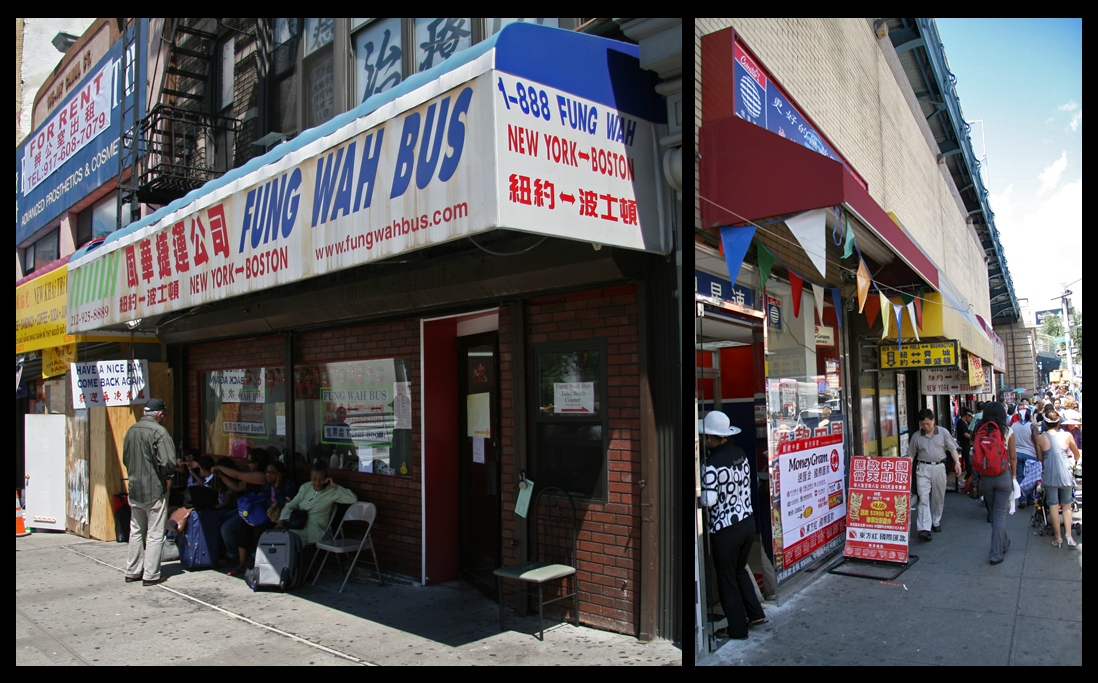
    If you’re going into business, I would not suggest competing against members of the Chinese community. As we saw in Ridiculous, produce can be had in Chinatown at an absurd fraction of going retail prices elsewhere. If you are traveling to Boston or any other number of select cities in the Northeast, the price of a bus ticket from Fung Wah or other competitors makes one wonder, How do they do it? Will I get there alive?

    I was first told about the Chinatown bus phenomenon by a college student, typically a good source of information on the latest in deals and discounts, online and off. Word travels fast in the price-savvy and networked student community, and it was not long before the larger world of New York City became aware of pricing that was, well, just astonishing.

    Of course, like anything deeply discounted, the phrase Chinatown bus connotes different things to different people. To the cost-conscious on a very tight budget, it is a blessing. To the well-heeled it is perhaps a good example of how not to travel and how you get what you pay for.

    Bus travel is the lowest common denominator of the commercial travel options. From the perspective of utility, buses will transport you from here to there at the lowest prices. In 1997, Fung Wah, operating as a local dollar van service, took bus pricing to new lows. The pioneering effort was started by Pei Lin Liang. Liang saw the need for competitive pricing to Boston, where many students were located.

    There are now a number of companies in this cut throat business located on Forsyth Street (photo at right). There are various destinations available, typically other cities with Chinatowns, such as Philadelphia, Washington, D.C., and Boston. Employees hustle anyone who walks the street there, as if price alone will be an incentive to travel. Admittedly, at times I have been tempted to get on board just to take advantage of the extraordinary deals. A one-way ticket to Boston costs a mere $15, with buses leaving hourly.

    Reviews are mixed, with some reports of overworked drivers, poor service, inadequate number of stops (in vans), and above average number of accidents. At these prices, however, most travelers will tolerate a lot. The only expectation is to get to their destination and get there uninjured…


  • Street Cred

    Posted on by Brian Dubé

    The NYC bike messenger epitomizes New York on edge. These people put their lives on the line for little money and no benefits. Of course, a comparison to the Police or Fire Department is unfair – bike messengers are not public servants hired to protect citizens. And it is a for-profit business. But they risk their lives for no glory. An extraordinarily dangerous job with no recognition.

    The job itself demands the ultimate in utility. A whole style of bike outfitting and accoutrement has been spawned by the riders, some of it spilling over to those interested in sporting a street style. Perhaps the most notable item adopted by non-bikers is the messenger bag – the Manhattan Portage.
    Many experienced messengers (like the one in the photo) will use a fixed gear bike (aka track bike). There is a minimum of parts and maintenance. They offer control, light weight, and quick acceleration. There has been an up trend in use and interest in these bikes.

    Also de rigeur is the heavy duty 3-foot bike chain and locks – this is a whole discussion unto itself. Theft is a huge problem here, and virtually every type of innovative lock has been used. In the end, the simple heavy-duty chain and American-style lock have proven most reliable. Thieves have used huge bolt cutters and all manner of tools and techniques to break locks and chains. And it is not unknown for a thief to take the bike and the thing it is locked to if feasible. Or take parts and leave the frame (see Left for Dead here). You can read about these and other matters at the NYMBF (New York Bike Messengers Foundation) website.

    Here are two quotes from their website about the job as told by messengers Hermes and Tone.

    Hermes: “It is a job where you’ll encounter people who’ll attempt to kill you, disrespect you, and unwittingly put your life in danger. You’ll ride in the worst weather imaginable, and deliver heavy, bulky items for an extra $1. You’ll wake up tired in the morning and go to bed defeated. You’ll be bored out of your mind sometimes, just sitting around and waiting.), and you’ll be stressed to the breaking point.”

    Tone: “It is however incredibly dangerous, yet exhilaratingly fun at the same time. I seriously consider it an extreme sport. Imagine running with a pack of wolves made of metal as fast as you can with the wind in your hair, but sometimes the wolves bite and you have to evade them as well as the moving trees, called pedestrians, in this konkrete jungle we call New York. I guess it’s hard. It’s definitely not for the weak hearted.”

    In the final analysis, the job is the ultimate in street cred…

    NOTE: In an amazing happenstance, while shooting this, a messenger approached me, Eugene Carrington. He told me that he was actually known in the messenger world and pulled out a small booklet: Messenger Blues and Other Poems. I bought a copy for $3 🙂

    Posted on by Brian Dubé

  • No Salga Afuera

    Posted on by Brian Dubé

    I used to know a Puerto Rican woman who roared when I used to demonstrate my limited command of the Spanish language, defined by the NYC experience. My favorite was the recitation of a sign which appeared in the subway cars for as long as I can remember. I used to just recite two lines:
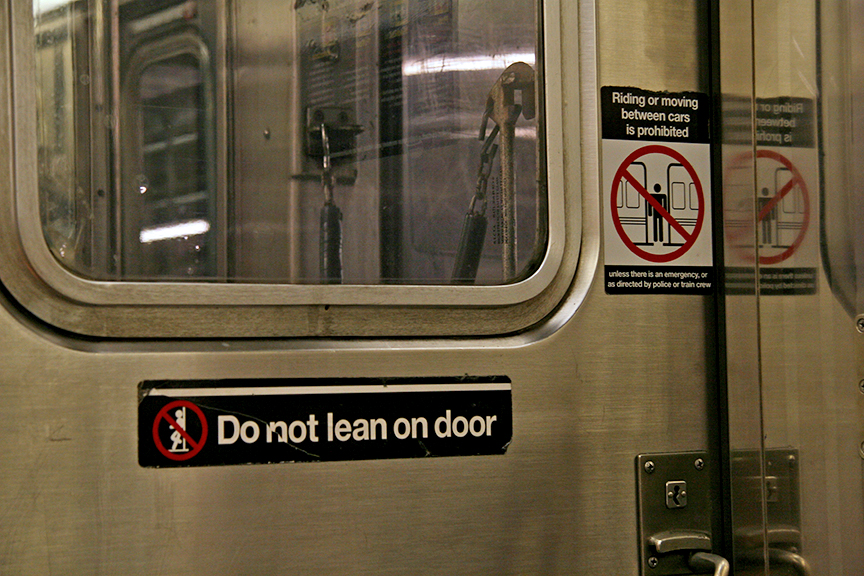
    “La via del tren subterraneo es peligrosa…No salga afuera.” This warning alerted passengers to many dangers, including the the electrified third rail. (See full wording and translation below.)

    My other favorite sign was one I frequently saw in parks: “Aviso. Veneno de Rata.” (Danger. Rat poison). Now I realize that this knowledge will not get me far in conversation in a Spanish-speaking country, nor will it help me charm a Latin American, but in New York City, it may be useful in avoiding premature death in certain situations.

    Every living environment has an effect on its inhabitants, and in New York City, that environment is one that has an element of brutality. New York is a great city and has improved markedly over the years, but this is a harsh place and breeds cynicism, skepticism, and cautiousness. Survival skills. And one of the results is a rather unusual foreign language vocabulary.

    The photo shows the current signage on subway doors. Many New Yorkers, including myself, have frequently walked between cars to position oneself at the proper end of the train so that you are in the best location when exiting (most doors are locked these days). The experience of walking between cars of a moving subway is not for the faint of heart, but it does make good use of travel time, admittedly at the risk of being killed. But, hey, that’s just makes you feel like a real fearless New Yorker. But I am not recommending this behavior – this posting is for informational purposes only. Just remember, “La via del tren subterraneo es pelgrosa”!

    Note: The original sign in its entirety with translation is as follows:
    “La via del tren subterraneo es peligrosa. Si el tren se para entre las estaciones, quedese adentro. No salga afuera. Siga los instrucciones de los operadores del tren o la policia.”
    “The subway route is dangerous. If the trains stops between stations, do not go outside. Remain inside! Follow the instructions from the operators or the police.”

    Posted on by Brian Dubé

  • Sea of Yellow

    Posted on by Brian Dubé

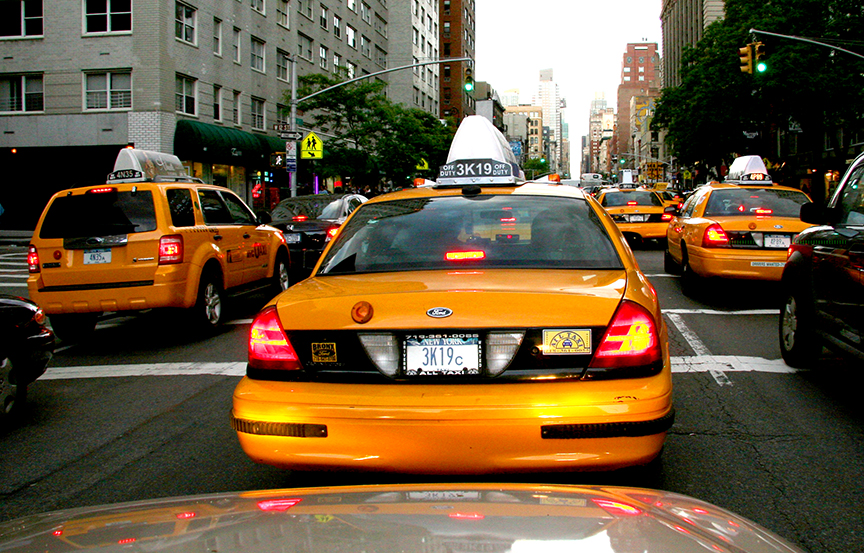
    What was most remarkable about my journey in this vehicle was the comment my friend Joey made while driving me uptown; he referred to what we saw as a “sea of yellow.” That is exactly the phrase I have used many times and what was in my mind as we crept through slow-moving traffic. I shot a number of photos “blind” by raising the camera through his open sunroof. The evening light really enhanced the already yellow hue of the taxis.

    Taxis are part of the fabric of this city. Perhaps fabric is too flattering and some would prefer background noise. But, in either case, there are many times, as seen in this photo, where yellow dominates the street and rules the eye.

    When I was a college student, I drove a taxi for about a year and a half. Those were rough times, and it was the Wild West. It was exciting, though and I learned more about the city more quickly than any other way. It was like orientation on steroids. Although driving is brutal and stressful, it is immediate cash money, so for the student or individual who is living hand-to-mouth, it can be a good source of income. But it is not for the faint of heart. One of my most popular images in the last two years of doing this photo site is of a taxi crash into a post.

    Driving a taxi is a competitive sport – jockeying for position, cursing other players, and fighting for that passenger fare. There are winners and losers. And if you don’t score, just pick yourself up and keep running…

    Posted on by Brian Dubé


  • dinamic_sidebar 4 none

©2026 New York Daily Photo Entries (RSS) and Comments (RSS)  Raindrops Theme