• Category Archives Natural NYC
  • True North

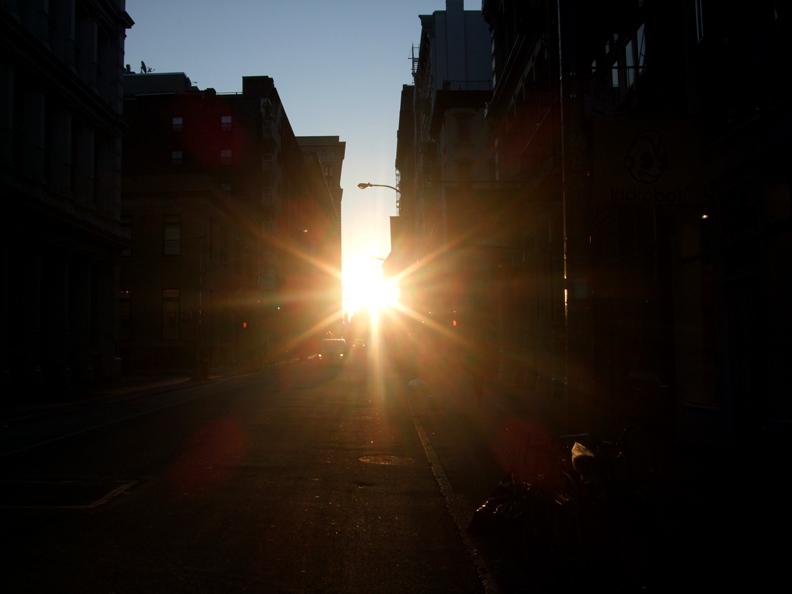
    I am usually up before sunrise, but I am not typically on the streets until somewhat later. With sunrise even earlier much of the year than it is mid-winter, I rarely see a site like that which I witnessed heading east on Prince Street Saturday morning at 7:47 AM.

    Something few New Yorkers know is the angle at which Manhattan deviates from north-south (or that it deviates much at all). New Yorkers believe Manhattan’s avenues run north-south and crosstown streets run East-West, but there is only a casual relationship between true north and the avenues. It is extremely useful, however, to think of orientation in Manhattan in that way.

    With the establishment of the Commissioners’ Plan of 1811, which established an orthogonal grid north of 14th, avenues were run parallel to the long axis of Manhattan, not actually north-south. The deviation from true north is significant: 29 degrees to be exact (read the New York Times article here). This, however, does not prevent seeing sights such as that in the photo. One of the most interesting phenomena in the city is the occurrence of Manhattanhenge, a biannual occurrence where the setting sun aligns with the crosstown streets of Manhattan’s main grid. On these days, the sun fully illuminates every cross street from river to river during the last fifteen minutes of daylight, with the setting sun’s center exactly on the street’s center line. I saw this for the first time on May 28, 2007 (see my photos and article here).

    If you are familiar with View of the World from Ninth Avenue, you know how extraordinarily ethnocentric New Yorkers are. How important is magnetic north really? Perhaps what we have is 29 degrees of irrelevance and we should more correctly say that magnetic north deviates from Manhattan’s center line which, as every New Yorker knows, points true north. 🙂

  • Deep Freeze

    As one of the readers of this website commented on a previous posting, New York City has a climate tempered by its coastal location. I got quite absorbed this morning reading about climate classification systems, with names like Köppen, Strahler, and Thornthwaite. I was somewhat shocked to learn that according to the Köppen climate classification system, New York City is considered humid subtropical (a subclassification of the Temperate group), which is the same classification as most of Florida. Others say this classification is debatable, and some say the term subtropical is a misnomer and a mistranslation of the original German.

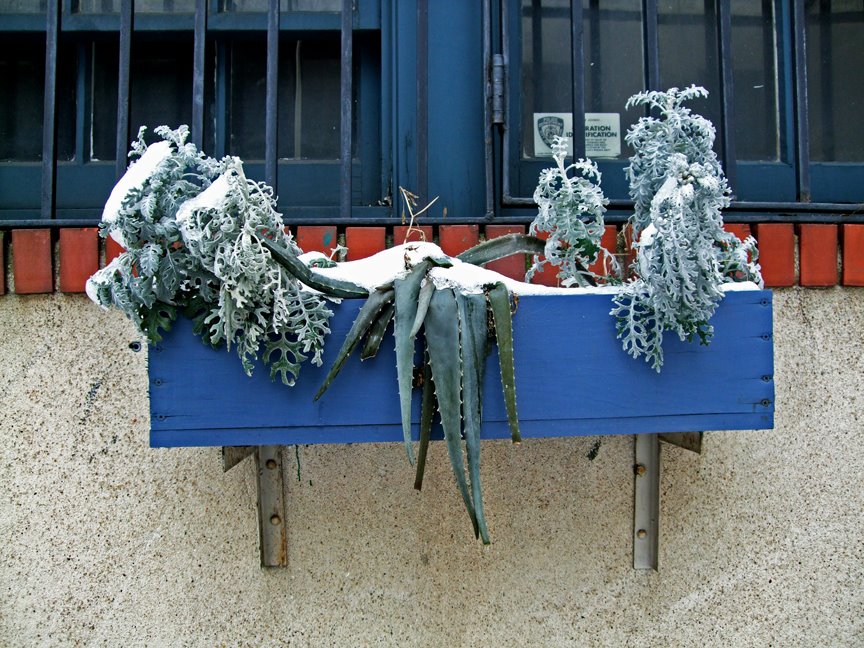
    The classification as temperate is a stretch for me. With summer days often in the 90s and winter days like today of 14° F (without windchill), temperate is not the word that comes to mind. Today’s photo was taken in Washington Mews with what appears to be frozen aloe vera – I have no idea if these plants survive a winter like this.

    Many New Yorkers spend a significant part of their work commute on foot to and from public transportation, or, like myself, have the privilege of walking to work. On non-work days, most of us will find the majority of our needs met and errands to be done in a walking distance within our neighborhoods. So the weather in New York City really affects lifestyles, habits, and decisions regarding activities.

    In my case, I have a 3/4-mile, 15-minute walk to my office. I appreciate this luxury, which on most days is a pleasant way to both exercise and enjoy the city streets. However, in the case of a driving rain or frigid weather with a howling wind, that 3/4 mile can be an unpleasant trek. Juggle some packages and an umbrella simultaneously in a rainstorm, and you can easily become envious of the comforts of suburban car culture with automatic garage door openers. Certainly preferable to a deep freeze…


  • First Flakes

    Snow is a funny phenomenon – bemoaned by most once there is an accumulation, yet beloved during its first flakes. That was the case yesterday, when New York City had its first real snowfall for the winter of 2008 which stuck to the ground. At one point in the mid-afternoon, enormous flakes came down, and there wasn’t anyone that didn’t seem awed by the sight.
    New York is not really a very natural place, so displays by Mother Nature are particularly outstanding. A flood here rather than in a coastal area or a tornado here rather than in Kansas is going to be very dramatic juxtaposed against the urban backdrop.

    Snow brings out the child in many of us, with memories of play, days off from school, sleds, dogs barking, snowmen, and snowball fights. As I wrote in Small Gestures: “Like a child who does not need to go to school on a snowy day, a rainy day gives permission to play and indulge in the small things we often miss or forget. This opportunity can be for a pause for reflection – a welcome moment of respite for the weary New Yorker.” I have witnessed absolutely remarkable things during blizzards, such as people making snow angels in the middle of 7th Avenue and business men in suits cross-country skiing down Broadway to go to work!

    So it is with great pleasure that I observed the final moments of our first snow and the thin white blanket that was cast over Washington Square Park. The scene was reminiscent of photos by André Kertesz, a village resident, who produced many stunning black and white images of the park after a snowfall. Snow softens the city, and watching it can be a mesmerizing and relaxing experience.

    By morning, everything had melted, typical of the city with its warmer infrastructure and climate. Our snows often melt or turn to rain, quickly erasing all traces of childhood indulgences. I awakened to a gray day, reminding me that there’s work to be done…

    Related Postings: Small Gestures, First Snow, Anomalies, Nor’easter, New York Survivor


  • Undiscovered Beach

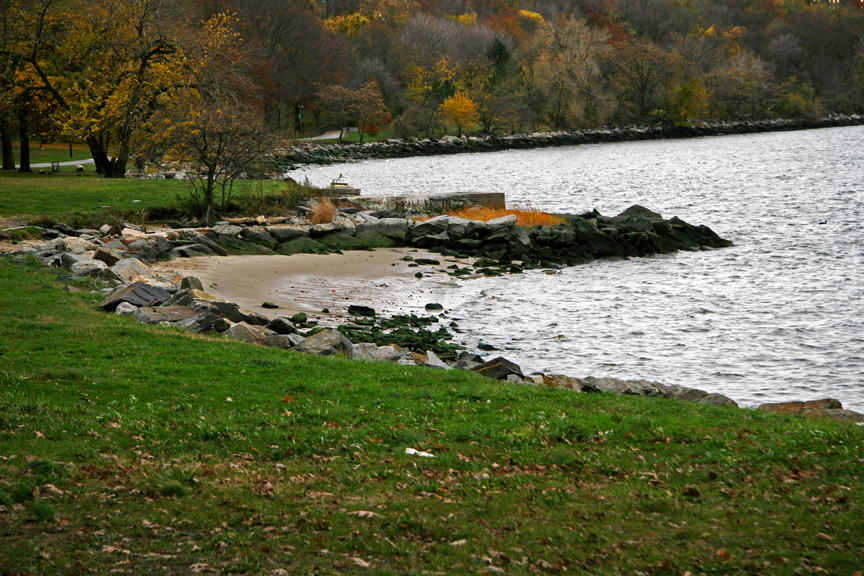
    This is a beach in Manhattan. It is not the palm-fringed beaches of Phuket, the reef-protected lagoons of Bora Bora, or the rocky coast of Maine, but it is a beach, and if I may say so, a rather attractive one. I was really stunned to run across this by accident on an excursion to the George Washington Bridge.

    Admittedly, this beach is in Washington Heights, quite a jaunt from from any place that generally comes to mind when discussing Manhattan. And many would argue that this area is further from midtown Manhattan than many areas of Brooklyn or Queens and that to champion it as Manhattan is only to be technically correct. That’s fair.

    So let me rephrase. This small beach is within the five boroughs and is accessible by subway, only a short ride from midtown Manhattan.

    But there is no need to promote it, for if you find it a little too far, too inconvenient, or out of the way, I am sure its habitués will be quite happy to enjoy this little secluded spot of sand with its rocky outcroppings alone and leave it undiscovered…

    Note about the beach: The beach is part of Fort Washington Park, located on the West Side of Manhattan along the Hudson River. This cove is roughly opposite 171st Street.


  • Camperdown Elm

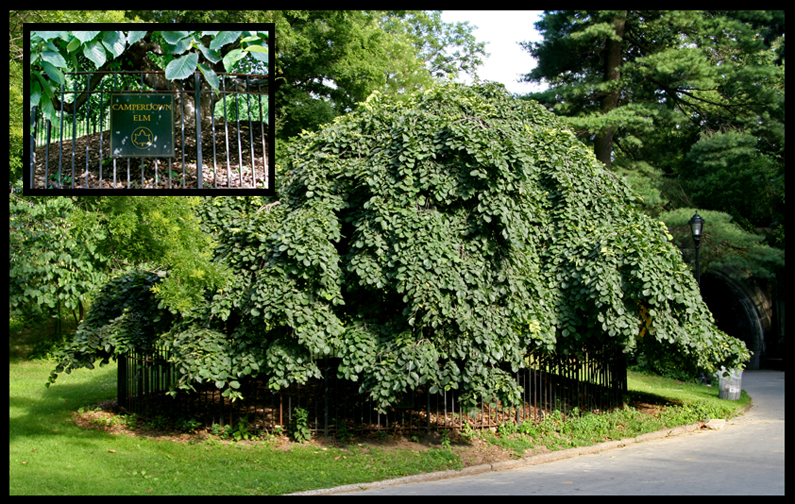
    In New York City, we have a surprising variety of flora and fauna. A myriad of trees introduced from other countries can be found in the major parks, such as Central Park and Prospect Park. Varieties are often identified with plaques (look for these identification plaques on the trees themselves). In Prospect Park, Brooklyn, one can find the notable 136 year-old Camperdown Elm tree. This cultivar can not reproduce from seed. From the Prospect Park website, we have a description of the species, propagation, and history:

    The Camperdown Elm, planted near the Boathouse in 1872, has developed into a stunning specimen. No more than 12 feet high, it resembles an over sized bonsai. It is the most famous specimen tree in Prospect Park. The weeping shape of this elm is extremely attractive and a peek under the canopy reveals an amazing branching structure. The many cavities in the branches and the size of the trunk show that this is an older tree.

    Between 1835 and 1840, the Earl of Camperdown’s head forester, David Taylor, discovered a mutant contorted branch growing along the ground in the forest at Camperdown House, in Dundee, Scotland. The Earl’s gardener produced the first Camperdown Elm by grafting it to the trunk of a Wych Elm (Ulmus glabra) – the only elm species that the Camperdown will accept as a root stock. Every Camperdown Elm in the world is the product of a cutting taken from that original mutant cutting and is grafted onto a Wych Elm trunk, usually 4-6 feet above ground.
    Suffering from severe decay a century after its donation to the Park, the elm’s fifteen minutes of fame arrived in 1967 when Marianne Moore’s poem about it helped raise funds to pay for its treatment. 

    There are park maps and other information available in Belvedere Castle in Central Park and the Boat House in Prospect Park. Both parks are highly recommended any time of year; there are a plethora of environments and activities…


  • Banana Too

    I’ve always had a love affair with the tropics and its icons. I share it with many denizens of temperate climates who, at times, look for transport to a more benign climate – armchair travelers looking for a quick sojourn to the tropics, former citizens reminiscing, or those who fantasize a vacation or perhaps a residence in an idyllic world of perpetual summer. On a cold night during a long winter, the sight and sounds of palm fronds rustling in a balmy wind warms my spirit.

    I feel like I have a radar operating subconsciously, scanning for all things tropical, whether real, such as plants or fruits, images in books, or perhaps a magazine cover reporting on the latest roundup of best-rated island destinations.

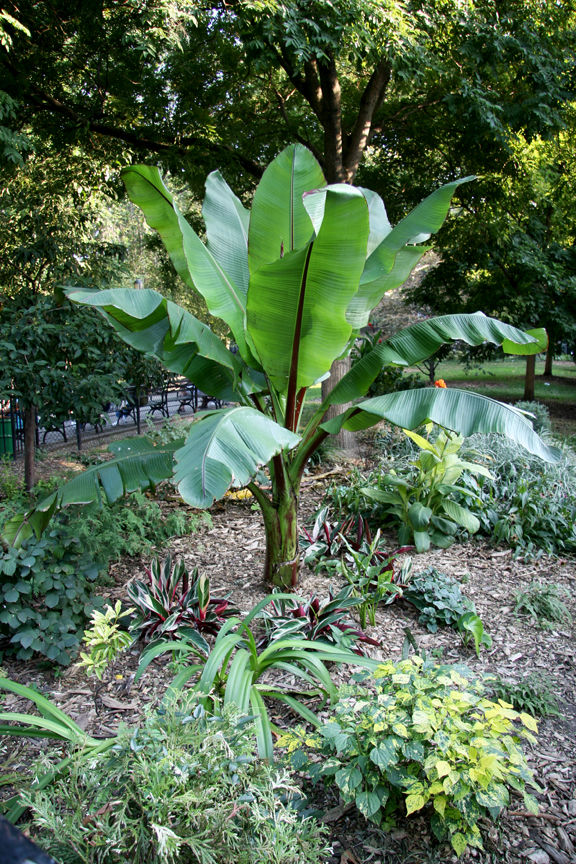
    So I was quite shocked to see this enormous banana plant thriving in Tompkins Square Park as I entered the western entrance to attend the Charlie Parker concert. I was certainly not completely alone in my interest in photographing this anomaly – whether others recognized it as such, I do not know. I asked one woman with a point-and-shoot camera whether she knew anything about banana trees, hoping to get some information regarding the ability of a tropical species to survive a temperate climate. She knew nothing of such matters and did appear to share my penchant for the tropics.

    So I have spent the morning reading about banana plants. However, I cannot report with any assuredness specifically what species of plant this is nor any history as to its planting.
    I did learn, however, that there are non-fruiting ornamental varieties which can withstand winters – Musa Basjoo, Saja, and Ice Cream. The Basjoo can even withstand sub-zero temperatures. Any plant aficionados who want to jump in on this?

    Note: The banana plant is actually not a tree but rather a herbaceous perennial. It is a giant herb of the genus Musa.


  • Back to Boyhood

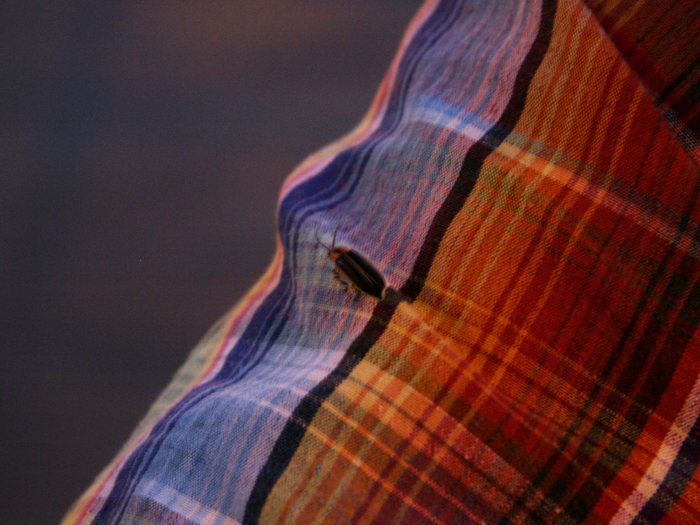
    There are a few things that, to me, that really epitomize the countryside on a summer evening. And two of them are fireflies and cicadas. And, yes, you can find these in the parks of New York City. This one was photographed on the arm of a friend in Washington Square Park. Many nights this month, we were witness to a wonderful light show. I attempted unsuccessfully to capture one glowing. I was reassured, however, by my photographer friend Bill Shatto, who is an expert at insect photography, that capturing this was not an easy feat . You can see his work here on his flickr site.

    There are many fascinating facts about fireflies, such as the light efficiency of bio luminescence – 90% of the energy used is actually converted to light (as contrasted with an incandescent bulb, which is only 10% efficient). The production of light is primarily a tool for mating – males exhibit courting behavior in the form of flashing patterns while flying. Females generally do not fly but respond with flashes. You can read more about them here.

    I like the gentle flashing of fireflies – it is so emblematic of a warm summer’s eve. I immediately enter into a comfort zone, transported back to my boyhood in New England…


  • Opportunity

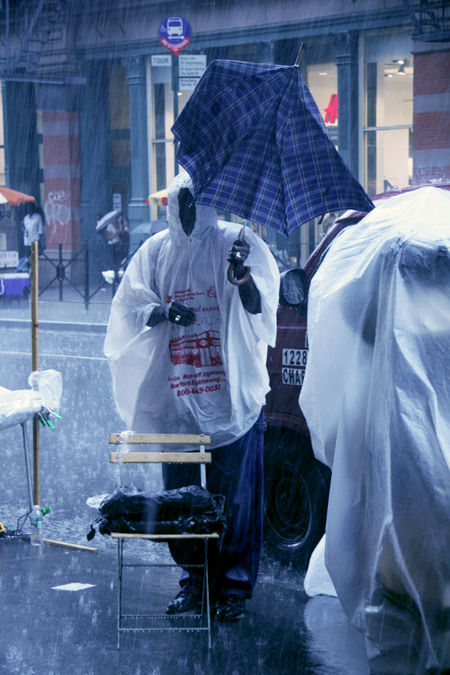
    Lightning and opportunity both strike quickly in New York, a land of opportunity. And there is no opportunity like a sudden unexpected downpour. Umbrella salespeople appear instantly from nowhere and set up quickly, because a rainstorm is an unknown opportunity.

    They appear with umbrellas that most consider disposable and justifiable for the day’s journey. A captive audience has few options. For those who did not prepare, you pay a few dollars or get soaked. The more unexpected the rain, the better the business. In the streets of New York, sympathy is not part of the vendor’s trade.

    Now I understand that in business you need to keep your costs down, but isn’t it bad marketing for an umbrella salesman to peddle umbrellas while using such a badly damaged one? After all, this is the primary complaint and impression of umbrellas sold on the street – that they are virtually useless and break immediately. After a rainstorm, many mangled ones can be seen discarded on the streets.

    A fellow onlooker and I thought the scene was hysterical. But the unfortunate and unprepared bought umbrellas anyway, because in a land of opportunity, at opportune moments, the opportunists win…


  • Mother Nature

    Posted on by Brian Dubé

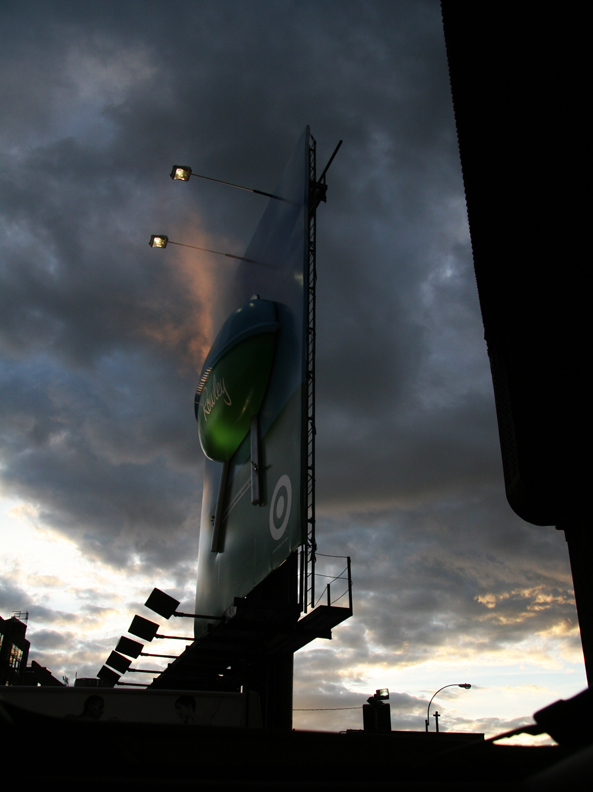
    I have had this photo for some time but knew nothing of the advertiser – Rowley. But the setting was so dramatic that I thought I would share it anyway. After all, we can let things speak for themselves on occasion, can’t we?

    This illuminated billboard was located on the West Side Highway in Chelsea, a neighborhood in the West 20s, abutting the Hudson River and the highway. Chelsea has become somewhat of an art district, as there has been a migration of galleries from areas such as SoHo due to extraordinarily high rents.

    I am not a fan of billboards. I find that they are typically a blight on the landscape. But there can be beauty, particularly dramatic beauty, at times with industrial and commercial subjects. Smokestacks, oil refineries, bridges, power plants, and power lines can all show a striking profile when the lighting conditions are right. I have written of this before in my posting Hell’s Gate.

    I don’t think I want to champion this type of display or give encouragement for more signage and billboards. And I think the credit here goes to Mother Nature, not Rowley…

    Posted on by Brian Dubé

  • Gratuitous in Nature

    Posted on by Brian Dubé

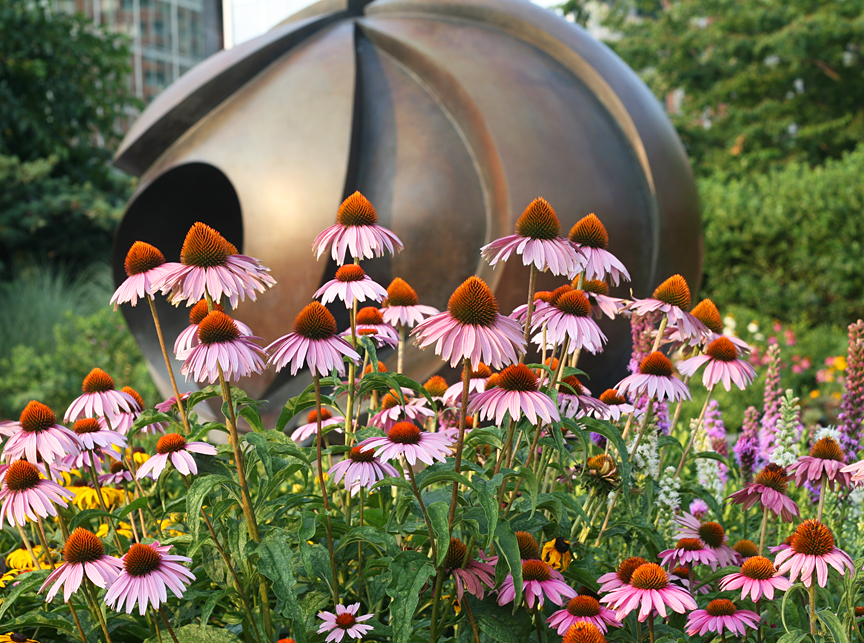
    When I was younger, I did not understand the concept behind cut flowers. As someone interested in the sciences, their purchase made no sense whatsoever. They appeared to have no practical value and to be a poor investment, dying only days after purchase.

    I did not appreciate their beauty enough, either – they may have been fun to identify or interesting from the perspective of analysis and study, but buying them was anathema to me.

    But I have since learned the value of nature’s extravagance and exuberance. In a place like NYC, where utility rules and problems abound, beautification could be seen as a low priority item and a frivolous use of monetary resources. But, as I wrote recently in Let’s Have a Parade, not everything should be reduced to practical terms (see Very Practical here). Quality of life has been a recently articulated public policy, and efforts to make the city more attractive are welcome.

    So a display like that in today’s photo, taken at the Hudson River Park, is true eye candy for New Yorkers. And although flowers maybe gratuitous in nature, that’s a good thing 🙂

    Posted on by Brian Dubé

  • Cooperation

    Posted on by Brian Dubé

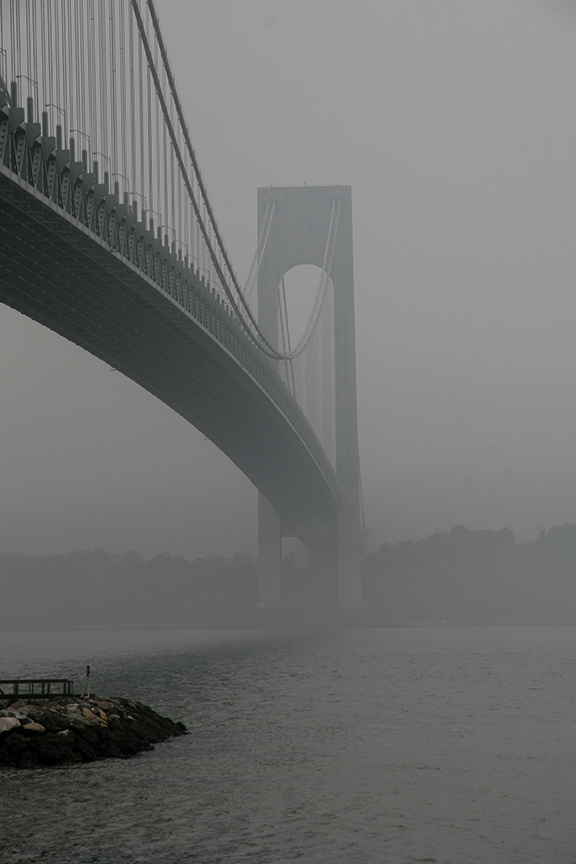
    What an easy and enjoyable thing photography can be when the subject cooperates. I have been planning to do a posting on the Verrazano Bridge for some time, but this requires a special trip and is quite some distance from my home in Manhattan. And one must find a good vantage point, negotiating around the Belt Parkway (a major highway with some limited parking) and the many other thoroughfares: 4th Avenue, Shore Road, Route 278 to the bridge, and a cloverleaf of highway ramps.

    However, I could not have picked a better day. A heavy fog had settled in, just occluding the more distant tower. See here for a series of photos.

    The Verrazano-Narrows Bridge is a relatively modern bridge, only completed in 1964. I have always found its lines rather clean and elegant. The bridge is omnipresent in the NYC skyline and is visible from every borough of the city. It connects Brooklyn and Staten Island. Although controversial during its construction, it is a lifeline, providing a roadway not only to Staten Island but also a connection between New Jersey, Brooklyn, and Long Island.

    At the time of its construction, it was the longest suspension bridge in the world (4,260 feet (1,298 m) and held that position until 1981. It still remains the longest suspension bridge in the United States. You can read more about it here.

    Every opportunity and subject element presented itself – a cargo ship, sailboats, fishermen, jellyfish in tidal pools, rocky outcroppings, a cruise ship, and, of course, fog. Everything just working together in a paradigm of cooperation…

    Posted on by Brian Dubé

  • Dead Sea Scrolls

    Posted on by Brian Dubé

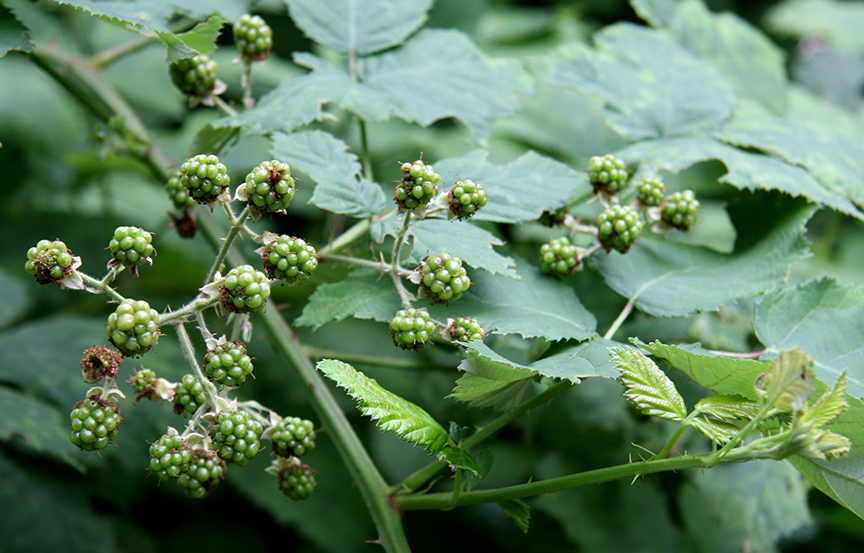
    I’m not saying that this was an ordinary or everyday experience. But yesterday, I was picking wild blackberries and apples in New York City. Finding such things here is exciting, like finding a Dead Sea Scroll.
    What was even more amazing is that the apple trees were in the center of a traffic island, surrounded by ramps and highways, with the blackberries nearby. I had to jump across a trafficked ramp to access the isolated island. I was rewarded with a number of very green, unripe apples. Very sour, but I grew up eating many unripe fruits which I foraged as a child.

    I have learned, however, that blackberries are not the fortuitous find I believed them to be in my youth. Apparently they are quite hardy plants and will grow in the most unforgiving environments – they can survive in poor soil and have been found in building sites, wastelands, and along roadsides. In some areas, they are considered invasive and a weed. And technically, they are not considered true berries.

    But fruit is fruit. Why split hairs over whether these are worthy for consideration? I’m starting to sound like a typical new Yorker who extols the virtues of simple things but, in reality, thinks they must be the right kind of simple, such as a certain brand of pushcart hot dog (Sabrett) or chocolate for a New York egg cream (Fox’s U-Bet). I suppose authenticity is always important when looking for Dead Sea Scrolls…

    Photo Note: The location of these will be revealed tomorrow’s posting on a nearby subject.

    Related Postings: New York Survivor, Grapes, Bird Country, Time Landscape, The Garden at St. Lukes

    Posted on by Brian Dubé

  • Steps From Paradise

    Posted on by Brian Dubé

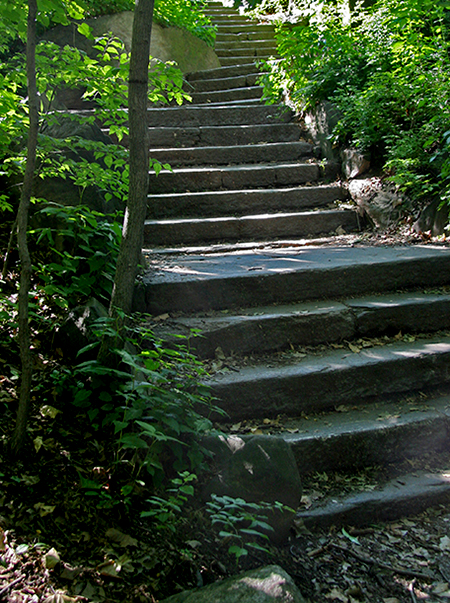
    Do you want to find one of the most idyllic, bucolic areas in Manhattan? One where you feel virtually removed from the city itself? Then step into the Ramble, a 38-acre “wild garden” in Central Park (in the words of Park designer Olmsted) with rocky outcrops, secluded glades, and a tumbling stream called The Gill.

    The designers of the Park literally sculpted the Ramble out of a wooded hillside. One of the first parts of the Park to be built, the Ramble is totally artificial except for its bedrock base. Even the water running in the Gill is turned on and off with a water tap.

    What is extraordinary about the Ramble is how one can be completely secluded in a heavily wooded environment in the center of Manhattan with no visual sense of being in an urban setting. You have to look hard in New York City to find spots of nature which are capable of really acting as a retreat and providing a respite from city life. Some of my favorite spots are the various community gardens (see Shangri-La).

    The Ramble is a major bird-watching area due to its location on the Atlantic flyway (the migration route that birds follow during the spring and fall). It is one of the top 15 birdwatching sites in the entire United States – 230 species have been spotted.

    One aspect of the Ramble, which has kept some visitors away, is its use since the early 20th century for gay encounters. The heavily wooded seclusion which the Ramble affords has made this an ideal location in the city for outdoor gay sex. However, I have been to the Ramble many times over the years, and personally I have never witnessed anything of this nature, so I would not let any of this deter you from visiting this area.

    I am frequently surprised at many people I meet who are unaware of the Ramble’s existence. If you are in Central Park, always remember – you are only a few steps from paradise…

    Posted on by Brian Dubé

  • When Worlds Collide

    Posted on by Brian Dubé

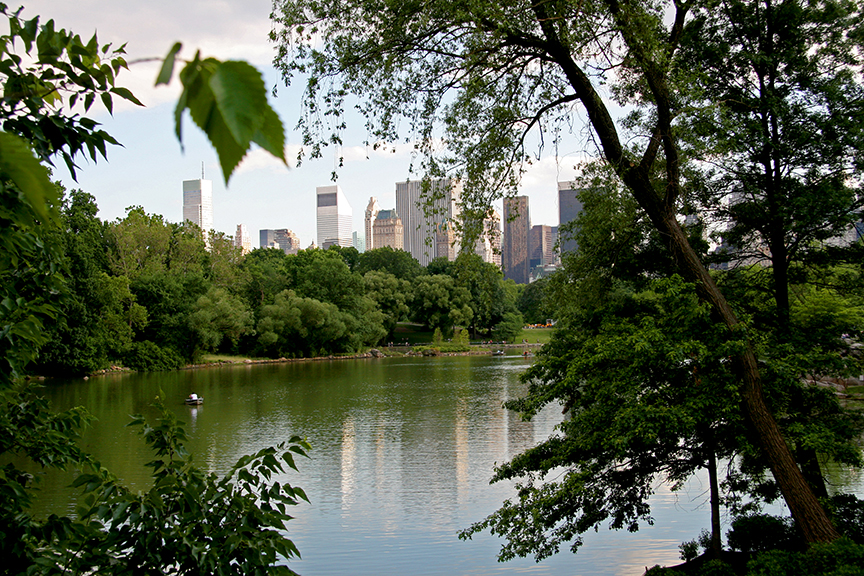
    There are things one never tires of, and for me, Central Park is one of them. What is there to get tired of in this idyllic urban oasis? I place it at the pinnacle of any must-see list for visitors.
    Given the lack of outdoor space for city residents, parks take on a much greater significance – they effectively become our backyards and recreational playgrounds. So the reason for my bias is obvious.

    I can easily be accused of being a one-man campaign for Central Park and taking every visitor I have known there for an obligatory visit. This landmark was designed by Frederick Law Olmstead and Calvert Vaux and was completed in 1873. The landscaping and architectural elements are exquisite. As I wrote in my article on the conservatory water, on a perfect day, I feel like I have been transported to Seurat’s Sunday Afternoon on the Island of La Grande Jatte.

    This 843-acre wonderland is remarkable for many reasons, including its myriad of different environments and areas set aside for a variety of uses (see the list of articles and photos I have done in related listings below). There are extensive walking/running tracks, two ice-skating rinks, tennis courts, the Central Park Zoo, the Central Park Conservatory Garden, a wildlife sanctuary, the Ramble, a 106-acre/billion gallon reservoir (with an encircling running track), ponds, the Lake, a Conservatory for model boats, the Delacorte Theater (which hosts “Shakespeare in the Park”), Belvedere Castle, the Swedish Cottage Marionette Theatre, and the historic Carousel. There are numerous major and minor grassy areas, some used for sports, some are set aside as quiet areas, and there are a number of enclosed playgrounds for children.

    From many vantage points in the park, the city’s skyline is visible – the juxtaposition of the urban landscape and the bucolic is a potent reminder of where you are and how fortunate we are to have both worlds…

    Related Postings: Conservatory Water, Kerbs Boathouse, Bethesda Fountain, The Beresford, Not So Kleine, Belvedere Castle, Red Panda, Feeding at the Zoo, Albino Burmese Python, The Boathouse Restaurant, Alice, Strawberry Fields, The Bow Bridge, The Dakota, Central Park Mall, Going Tribal, Vivid View

    Posted on by Brian Dubé

  • Wake Up Call

    Posted on by Brian Dubé

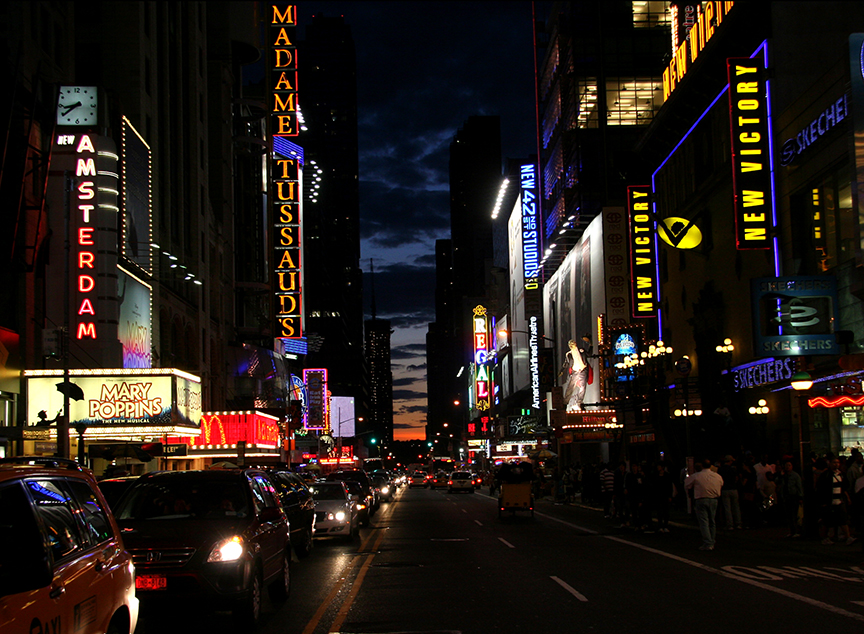
    Wow is all I could say as I stood at Times Square looking west along 42nd Street into one of the most amazing sunsets I have seen. This stretch of 42nd Street is already quite dramatic at dusk or at night. But this sunset was remarkable, with the heavily stratified clouds and beautiful color gradation of orange to deep blue. One could have easily seen the sky as part of the artificial spectacle. Drama added to drama. Perfect for a world that knows no bounds when it comes to sensory overload. It really looked like Batman’s Gotham City.

    One can easily live a lifetime in New York City without hardly a hint of the natural world. With the exception of the sky, occasional tree, squirrels, and birds, we live in a place that is almost entirely man-made. Some are fortunate and have park, river, or garden views. But for most, this is a life of concrete, stone, brick, steel, and glass. We look to other things – culture, business, restaurants, architecture, and human interaction.

    Some seek out nature in the city. It is can be found in promenades, parks, gardens, and waterways. And occasionally, when you least expect it, it slaps you in the face. A wake up call to nature…

    Posted on by Brian Dubé


  • dinamic_sidebar 4 none

©2026 New York Daily Photo Entries (RSS) and Comments (RSS)  Raindrops Theme