• Category Archives Education
  • What You Get

    One of the cornerstones of American culture is the view that You Get What You Pay For. In 2008, I wrote Free Lunch about free activities in New York City that defy aphorisms such as There’s No Free Lunch or You Get What You Pay For. I do empathize with those who use price as a measuring device. It does simplify life to sort by cost and thereby arrive at what must be best and worst in everything that has a price tag, be it medical care, electronics, food, clothing, homes, or education.

    So, where does the quality of college education stand in regards to cost?
    For most, this question is irrelevant. Something as important as a college education is not the time to be testing popular adages. Who wants to when the I Told You So refrain will be waiting to haunt for a lifetime those who have gambled and lost?

    A good test of the price-to-value hypothesis is Hunter, a senior college of the City University of New York (CUNY). Tuition in 2009 runs $9000 (New York State residents) against, say, NYU’s $42,000. These are very significant differences. College tuition today is a very serious matter. It has outstripped inflation and appears to be immune to economic laws – up appears to be the only way it goes. Many graduates of a liberal arts school will find themselves saddled with enormous outstanding debt and facing employment at basic living wages.

    If you look at surveys, articles, and reviews on American colleges/universities, you will find Hunter College in many lists such as Best Value Colleges for 2009, America’s Best Colleges, Best Universities-Master’s, Best Northeastern Colleges, etc. Reviews by students range the gamut, as might be expected. One constant I found interesting, however: all appeared to think highly of the faculty. The criticisms were typically about some of the physical maintenance and particularly the bureaucracy, registration, and other administrative horrors.

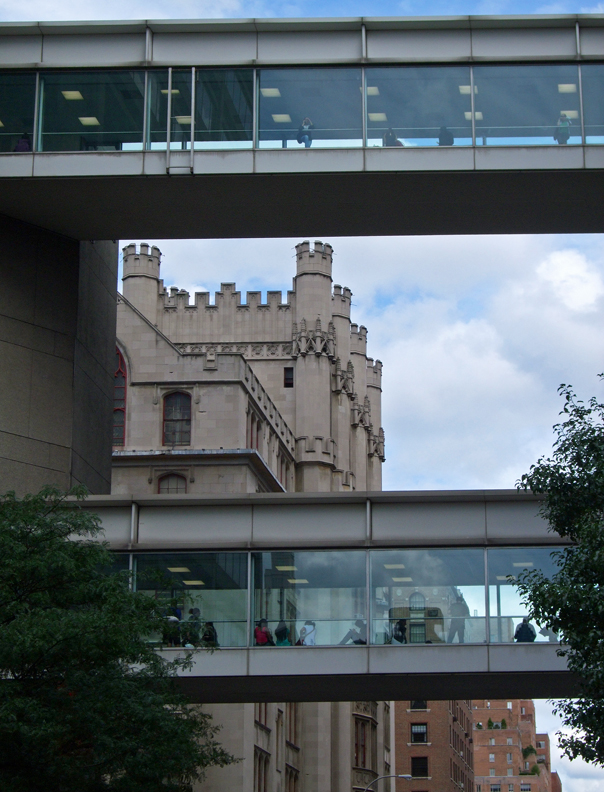
    Hunter College, founded in 1870 as Normal College, is located at 68th Street and Lexington Avenue on the Upper East Side. The urban college occupies 4 buildings all interconnected by skywalks – a very unique feature, providing not only some campus character for a school located in the heart of Manhattan but also sheltered travel between buildings.
    One of the four buildings, Thomas Hunter Hall, is a remarkable structure. This is the turreted structure in today’s photo. You can read about it here in an article by Christopher Gray of the New York Times.

    It is possible to get a good education at Hunter. Graduates have been admitted to the best grad schools in the USA. Many graduate programs are highly regarded. The alumni roster also has numerous notable individuals, including two women who were Noble Laureates in medicine. In the end, I see Hunter College as a good example that it’s not so much “you get what you pay for” as “you get what you put into it”…

  • Mr. Wizard

    As a child, I loved science experiments. If you read this website regularly, however, you know that my efforts were not always successful 🙂
    Source materials were limited to an occasional viewing of Mr. Wizard, books I could cull from the local library, and whatever primitive experiments I could cook up from my own mind. A chemistry set, received as a Christmas gift, was a rare and highly coveted possession.

    Hence, at the time, the appeal of DIY (do-it-yourself) was huge, long before the phrase was co-opted and marketed. To take household items and create novel effects is magic, for a child as well as an adult. Many counter-intuitive results can be had from ordinary ingredients. Let a child do it himself/herself, and you have a formula for wonder and awe.

    Unlike the San Gennaro festival, e.g., many of New York City’s most interesting events do not have a centralized location. You could be in a neighborhood where numerous concurrent events are going on and not even be aware that they are part of a major festival. See Math Midway, part of the World Science Festival, here.

    This scenario replayed itself on Sunday afternoon, when I discovered that the annual 3-day Conflux festival was essentially over. Produced by Glowlab in New York since 2003, “Conflux is an art and technology festival for the creative exploration of urban public space.”
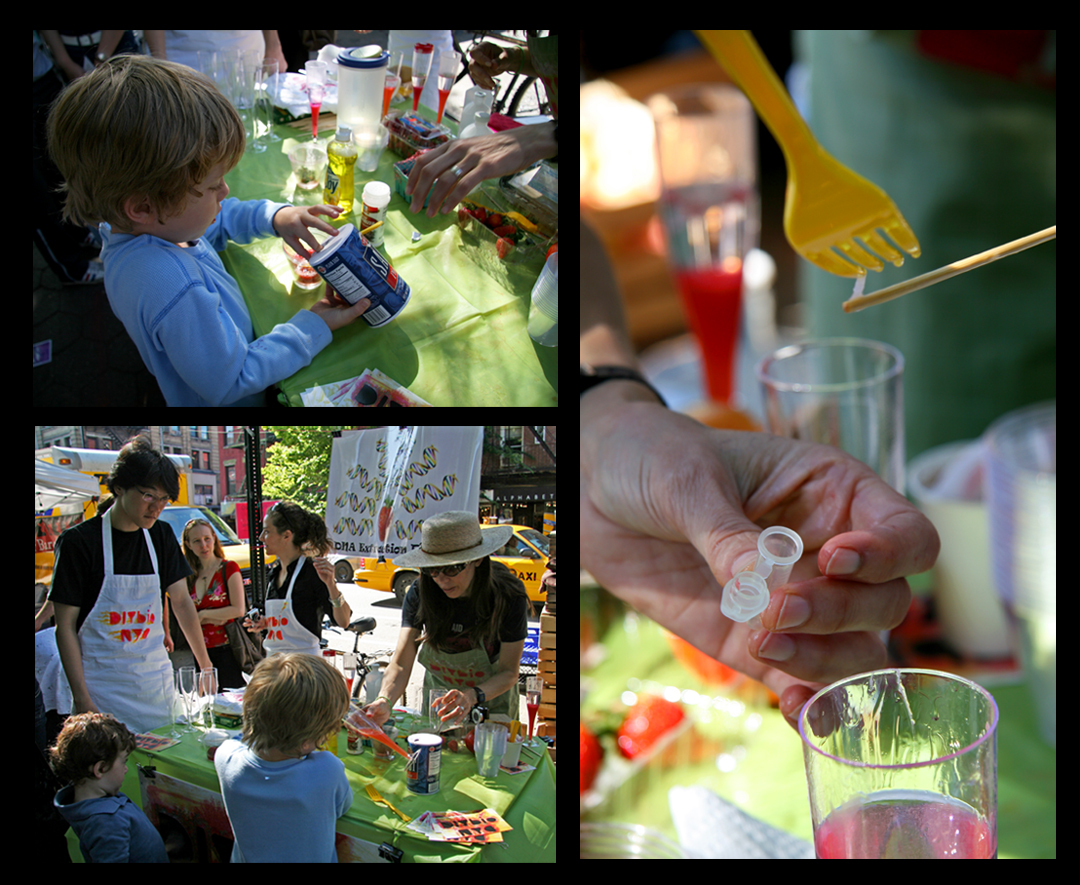
    So I was quite pleased to run into a DNA Extraction Party while strolling through the Tompkins Square Park farmer’s market. I was not aware that DNA could be extracted from fruit (or other living things) using common household ingredients – meat tenderizer, dish washing detergent, salt, alcohol, and a coffee filter. Note the clump of DNA between the fork and chopstick in the photo. This experimental display was produced by DIYBio NYC.

    It is likely that a very young child would not fully appreciate the outcome. In the experiments I did as a child, results were immediately obvious and did not require an understanding of deoxyribonucleic acid, genetic instructions, and a double helix. However, this is 2009, and the bar has been raised. But the spirit of Mr. Wizard lives on 🙂

    Note: Mr. Wizard (Donald Jeffrey Herbert, July 10, 1917 – June 12, 2007),  hosted the Watch Mr. Wizard TV program, which ran on NBC from 1951 to 1965. In 1983, Herbert created Mr. Wizard’s World, a faster-paced show on the cable channel Nickelodeon, running until 1990 and in reruns until 2000.


  • Matters of Opinion


    The Al-Madinah School at 383 3rd Avenue in Brooklyn is in one of the most uninviting locations I can imagine: on a major thoroughfare, Brooklyn’s 3rd Avenue, abutting a Uhaul parking lot, and across the street from the Gowanus Canal – once a busy cargo waterway, now a polluted body mired with environmental concerns.

    In New York City, we make use of what space is available, and one can never judge by a place’s exterior. So I decided to do some reading about this private school. In reading about it, I came across a startling range of opinions in online reviews:

    The quality of academic programs is very good. The teachers are very much involved and enthusiastic about teaching the children.

    Al- Madinah school is the best school. My children first were in public school for six years and then are transferred to Al-madinah school. And I can tell the difference. now they are more behave and responsible and much much much better in Arabic, Quraan and islamic studies, and That all I need …

    Horrible!! never expected an islamic school to be like this..the islamic studies,quraan and arabic are good but other than that no!! this school is best for K-6 ! the students are very rude, mean,spoiled,careless, etc, some students if your lucky are nice! i dont reccomend any1 there..waste of money!
    Al-Madinah school is just not up to New York state standards. The ebviromenft for learning is filthy and tacky.

    The academic level is wary below standard, and the school should be for religioun only.

    Its very clean and Im glad that halal food is prepared on premises. Wonderful

    Al-Madinah is good in the islamic studies, arabic, quran course but it does not supply much in the academic course. I talk from 3 years of experience and I do not think this school is not so great nor good either.

    One thing that has puzzled me for as long as I can remember is how much human opinion can vary. I once remember a university professor asking us to consider for our next class the question, “If someone disagrees with you, do you feel they are wrong or have a different opinion?” This question goes to the heart of tolerance, moral relativism, and absolutism – ideas of enormous consequence, fueling nearly every debate, argument, or war.

    Some years ago, I occasionally spent time watching a fundamentalist Christian who used to proselytize on Sundays in the park. He posed the same type of question routinely: whether the individuals there considered themselves relativists or absolutists. Specifically, did they believe that there existed moral imperatives that were absolute and crossed all cultures? His belief was that most people claim to be moral relativists but in reality are absolutists. He would pose specific examples, and arguments would often flare up, even between couples.

    With the Al-Madinah School in Brooklyn, religious opinion of what is good, bad, right, and wrong is part of the curriculum. Outside their walls, the same opinions are made about the school itself. I leave you with a quote from Mark Twain: “The rule is perfect: in all matters of opinion our adversaries are insane.”

    Note about Al-Madinah: The school occupies a 5-story, 9000-square foot facility (part of it seen in the photo). You can see more, along with information about the school, here at their website. They offer education from preschool through high school.


  • Chefs and Plumbers

    Posted on by Brian Dubé

    Trades in America are largely devalued. However, as big an advocate as I am of higher education, not every one is suited for white-collar jobs, and someone has to do the plumbing. Clerks, drivers, and service jobs cannot all be filled with college students and immigrants, and I am not sure that such a world would be desirable. And these jobs cannot be outsourced or automated.

    In New York City, complaints have been made about taxi drivers for time immemorial. The problem is that there is no serious training for this job. The test for a taxi license is laughable – virtually anyone who can drive can get a license. In London, for example, a cabdriver candidate must complete two years of full-time study. I am fascinated by Les Compagnons, French trade guilds dating back to the Middle Ages. See a New York Times article on the Compagnons here.

    Many find the level of craftsmanship in New York to be deplorable – stories abound regarding the poor workmanship in jobs done. Many have horror stories of their own. The problem is that many individuals doing blue-collar work are not trained or poorly trained. The workers are not professionals, as is the case with many waiters, who are working while pursuing other life goals and careers or perhaps feeling that they have no better options.

    None of this is the case at the French Culinary Institute, located in SoHo at 462 Broadway. This extraordinary school provides an intense training in the culinary arts on a par with schools in Europe – many of the faculty and deans are European, trained, renowned chefs. The school offers a very broad spectrum of classes.

    Employment needs are often cyclical. As need develops for a given skill set, people train for those opportunities. Often, an over supply develops, with shortages in other fields. I often speculated that skill tradespeople may see their time come in a world where manual labor is looked down upon and everyone trains for white-collar work. I have often joked that in a world full of web developers, plumbers may rule.
    I love the scene in the film Moonstruck where we have revenge of the tradesman. A couple, needing bathroom work done and lacking knowledge about construction, are persuaded by contractor Cosmo Castorini to buy the most expensive solution:

    “There are three kinds of pipe. There’s aluminum, which is garbage. There’s bronze, which is pretty good, unless something goes wrong. And something always goes wrong. Then, there’s copper, which is the only pipe I use. It costs money. It costs money because it saves money.”

    The future of technology rapidly evolves – who knows what future generations will need and where the jobs may lie? But most likely, there will always be a need for chefs and plumbers 🙂

    Photo Note: This shot was taken on Grand Street, where French Culinary students were on a break from classes. The sight of so many chefs in classic white uniforms on this street is quite startling. The school also runs a highly regarded restaurant – L’Ecole, located at street level at the same address.

    Posted on by Brian Dubé

  • Math Midway

    Posted on by Brian Dubé

    A Math Midway. What a wonderful concept – “an interactive, hands-on tour of a variety of exciting and surprising mathematical ideas, principles, games, and activities. The individual exhibits within the show will will be presented with a midway/carnival style, and generally concern mathematics related to an event or activity you can find in a typical carnival, fair, or circus setting.”

    The exhibits had clever names and tag lines, such as the Mysterious Harmonigraph. Be hypnotized by “Harmonics; Organ Function Grinder – Make Math the Most of your mind”; “Universal Wheel of Chance – Do you think the odds are even?”; “Ring of Fire – Illuminate the secret shapes within”; “Mathematical Monkey Mat – It’s so great to tessellate”; and the huge centerpiece to the street midway – “Pedal on the Petals – There’s a road for every wheel!”, where children rode tricycles with square wheels on a circular track with catenary curves, the combination giving a smooth ride. With the Organ Function Grinder, you “Grab a number ticket, set the three dials, and create your own function. Each step of the function transforms your number. Can you hear the transformations in the music, too? Turn the crank to compute your value and hear your tune.”

    The Math Midway was beautifully put together in a weaving of colors, demonstrations, performances, signs, brochures, ideas, and people.
    The Math Midway was part of the World Science Festival Street Fair, which was held Sunday, June 14 around Washington Square. This was the last day of the 2nd annual World Science Festival, a five-day science extravaganza with programs scheduled throughout the city. The festival was an immediate success its first year, with sold-out events. Participants not only included science luminaries and Nobel laureates but also stars of theatre, music, dance, film, journalism, and the media. The opening gala at Lincoln Center featured the likes of Yo-Yo Ma, Joshua Bell, Alan Alda, Michael Hogan, and Glenn Close. Co-founder Brian Greene is a professor of physics and mathematics at Columbia University. He is recognized for a number of groundbreaking discoveries in superstring theory. His books are widely read; The Elegant Universe was a finalist for the Pulitzer Prize.

    Their mission is to cultivate and sustain a general public informed by the content of science, inspired by its wonder, convinced of its value, and prepared to engage with its implications for the future. From the WSF website:

    The World Science Festival, an unprecedented annual tribute to imagination, ingenuity and inventiveness, takes science out of the laboratory and into the streets, theaters, museums, and public halls of New York City, making the esoteric understandable and the familiar fascinating.

    This was a huge event – for more information, see their website here and the Math Midway website here.

    I would suggest putting this on your calendar for next year and getting tickets for the event well in advance.
    Full Disclosure – Much like the investment advisor who must disclose his/her holdings, I must confess a love of science and particularly math, which was my favorite subject in school 🙂

    Posted on by Brian Dubé

  • Shalom

    Posted on by Brian Dubé

    What is fascinating is the reaction of newcomers to the city to the enormous Jewish population. Businesses such as B&H Photo, run by Satmar Hasidic Jew Herman Schreiber with hundreds of orthodox Jewish employees donning traditional elements of dress such as payot and tzitzis, come as a curiosity to visitors. The 2001 census shows just under one million Jews in New York City – the largest Jewish population in the world outside of Tel Aviv, Israel. That’s 12% of our city population, 15% of the number in the United States, and 7% of the world’s total. For those of us who have been here a long time, it is something that is such a part of the fabric, history, and evolution of the city that it goes virtually unnoticed.

    My first close friends in New York City were Jewish, and from the very beginning, I developed an enormous respect for a group that has survived and prospered against persecution and hardship.
    The Jewish population has a strong representation in so many professions – law, business, finance, local politics, publishing, medicine, and the arts. The recent Mayors of New York City (Beame, Koch, and Bloomberg) have been Jewish, as is the family that owns the New York Times (Salzberger). But make no mistake – these achievements are based on tenacity, hard work, strong families, and education.

    I remember as a high school student in New England, perusing the World Almanac as I was inclined to do, coming across an entry showing average number of years of education completed by ethnic group. As I quickly scanned the list, I noticed the number one group – Jews. The average number of years of school completed: 16+.

    I reflected on this, recalculating and reconfirming that 16+ meant college graduate. Perhaps I misread, misunderstood, or have misremembered the statistic, but nonetheless, in my entire extended family, many had not even graduated high school, and only one uncle had been to college, so this fact was astounding to me and something I always remembered. When I entered university in New York City, the Jewish emphasis on education and its role in their success became abundantly clear. Of course, like any group, some do fall between the cracks, but my experience here has been that members of the Jewish population are achievers. Shalom 🙂

    Photo Note: This was the annual Salute to Israel Parade, starting at 57th Street and continuing north to 79th Street. More at their website here.

    Posted on by Brian Dubé

  • Warm and Fuzzy

    Posted on by Brian Dubé

    I have very strong memories of school as a child outside the city – carrying books, walking home, erasers with chalk dust, blackboards, recess, homeroom, the cafeteria, homework, lockers, report cards, being called on, tests, passing notes. As I got older, there was the familiar sight and sounds of children in playgrounds with the familiar chatter and laughing.

    I am sure many children growing up in New York City have many of these experiences, but for those of us without children, the world of children and school is virtually invisible. As I wrote in Mary Celeste, schools and playgrounds do exist, but depending on where one lives and typical daily routines, most will never see them or children at play, and even when you do, there is so much competing for your attention that everything is diluted.

    So when you see a cardboard box being toted through the streets of NYC, you pay little attention. However, when you see that it is being carried by a mother and her young daughter, you take notice. And when it is quiet at night and you hear faint squeaking coming from the box, you run after them because – could this be the sound of live animals?
    Yes it was. I found a mom and her girl with a box of young chicks – I was told that it was part of a school project.

    They were quite happy and eager to share their little bundles of joy and offered to let me handle one chick (and grab a couple of quick photos with my point and shoot). I believe this is the first time I have actually picked a baby chick up – ironically, on the streets of Manhattan. I’m glad I stopped them. It was a warm and fuzzy experience and a nice way to end the day – a bit of fur now and then is cherished by the wisest men 🙂

    Note: In May 2008, I welcomed an entire school class on a field trip to my business. It was quite an outing – see Little Burnt Out here.
    There are a number of other posts on children here: Mary Celeste and Heart Warming.

    Posted on by Brian Dubé

  • 1560

    Posted on by Brian Dubé

    I knew that our freelance computer guy, Paul, was a regular crossword doer.
    I subscribe to the New York Times crossword online service – convenient for getting the daily puzzle without having to buy the printed paper. Yesterday, Paul paid us one of his regular visits and worked to day’s end, when I typically download the puzzle. I offered to print any puzzles to his liking. “Perhaps Friday or Saturday?” I taunted. The New York Times crossword increases in difficulty each day, beginning with Monday. The most difficult is Saturday’s (Sunday’s is considered equal to Thursday in difficulty, just larger).
    It was good timing – he had been away for a week and had not done last week’s puzzles. Not daunted by an audience or feeling any performance pressure, he sat at my desk and began to rip through Saturday. I was astounded as he flew through this puzzle in approximately 15 minutes, working in ink with almost no corrections.

    In my opinion, Paul is a genius by any reasonable definition of the word. Now I realize that doing a Saturday New York Times crossword puzzle in 15 minutes does not in itself confer genius. Some may argue that such an ability is something akin to savant syndrome. I would imagine that there are puzzlists who have an extremely narrow skill set, but in my experience, that is the exception, not the rule.

    But I have a lot more evidence than crosswords, and when you put it all together, it becomes difficult to dismiss his talents as a smorgasbord of clever tricks. If you perhaps require elements of a romantic notion of genius, i.e. eccentric behavior or reclusive lifestyle ala renowned mathematician Paul Erd?s, our friend Paul has that covered too. New York City is the perfect environment for the idiosyncratic polymath.

    There was a time when SAT tests were taken without special preparatory courses; if such things existed, none of us knew about it. People just took the test. High scores meant much more. The older SAT (before 1995) had a very high ceiling – in any year, only seven of the million test-takers scored above 1580 (equivalent to the 99.9995 percentile.)

    I had heard through a mutual friend that Paul had done extraordinarily well on his SAT exams, but I never confirmed the scores with him personally. So when I asked yesterday (as he was already completing Friday’s crossword) for the first time about his SAT scores, he thought for a moment and said, “760 Verbal and 800 Math.” You don’t need great math skills to total that in your head: 1560…

    About SAT tests: There is, of course, much controversy about the SAT test. There are bias issues and questions as to the correlation of high scores and intelligence. Some feel that there is too much emphasis placed on the tests, and there is even is an SAT optional movement – a number of prominent small colleges do not require the SAT for college admission. The movement was first instituted by Bates College in 1984.

    Posted on by Brian Dubé

  • traPt

    Posted on by Brian Dubé

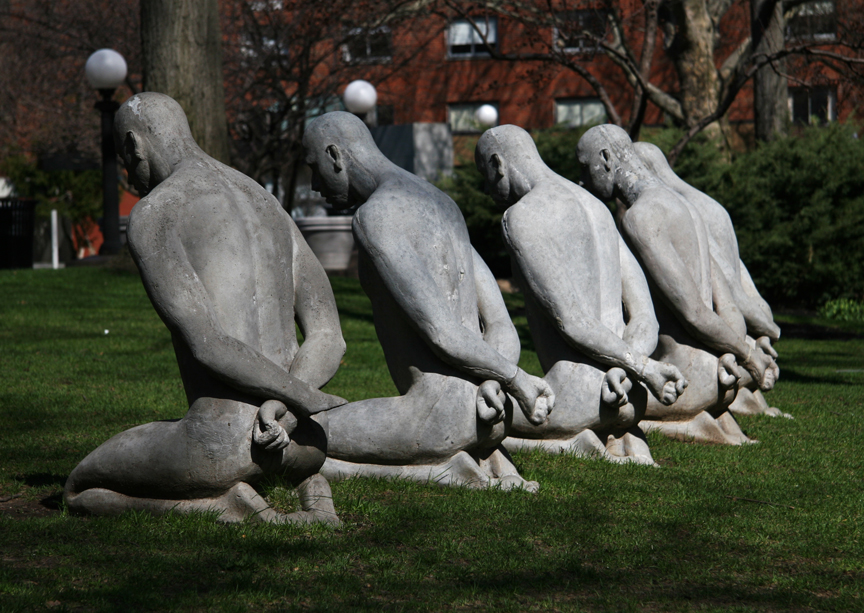
    Pratt Institute is considered one of the finest art schools in the United States, known for its programs in architecture, art, fashion, photography, design, illustration, interior design, and digital arts. Unlike NYU or Hunter College in Manhattan, whose campuses are essentially the city of New York, Pratt is cloistered – the campus is completely closed and gated. Add to this its location in Clinton Hill, Brooklyn, which at one time was one of the most dangerous neighborhoods in the city, and you can appreciate how clever I thought a student’s T-shirt was that he was brandishing some years ago. It read “traPt” – an anagram of the word Pratt which was indicative of how some students have felt. Nearby Myrtle Avenue was nicknamed Murder Avenue in the 1990s.

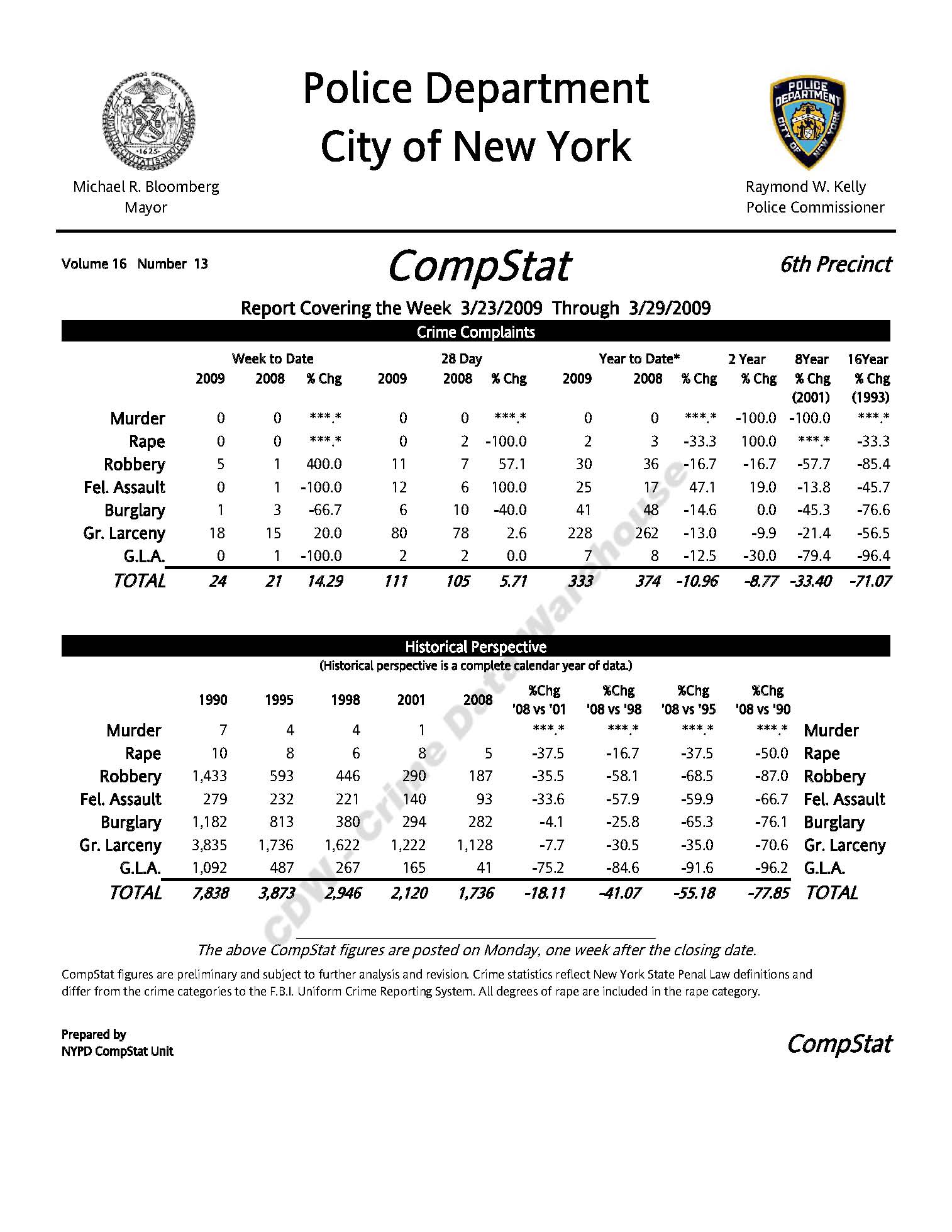
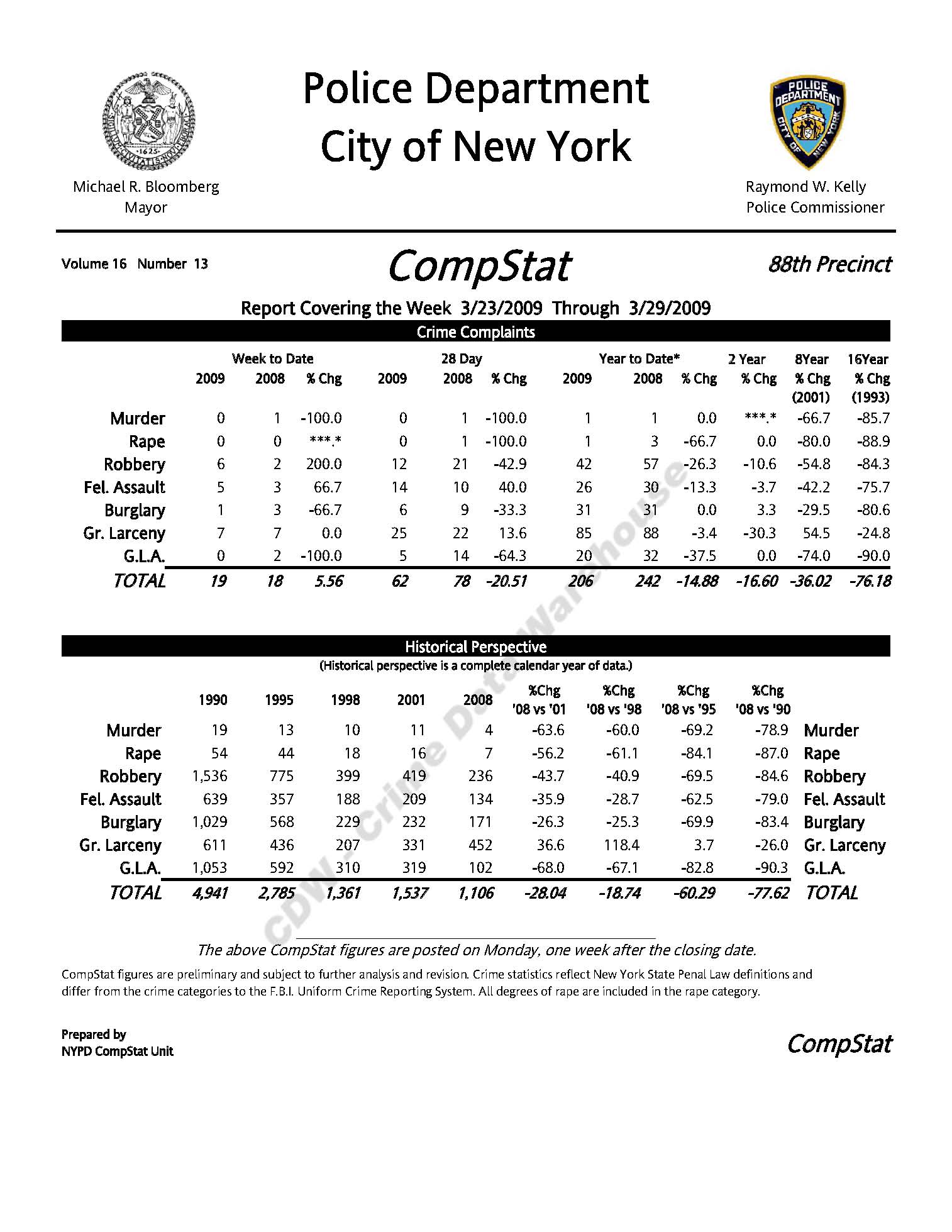
    Certainly the neighborhood has gentrified significantly over the years and has benefited by a tremendous reduction of crime city-wide, attributed to the NYPD’s Compstat program and an increase in the numbers of police officers in NYC, starting in 1990. I was curious about the actual crime statistics in the neighborhood, so rather than rely on perceptions or anecdotal evidence, I decided to go right to the source – the NYPD website – and look at the Compstat statistics for the 88th precinct, which covers Pratt Institute. I compared it to the 6th precinct in Greenwich Village, home of NYU. I expected to see a much greater disparity but was surprised to see that the crime statistics were not that disparate. You can see them here: the 6th Precinct and the 88th Precinct.

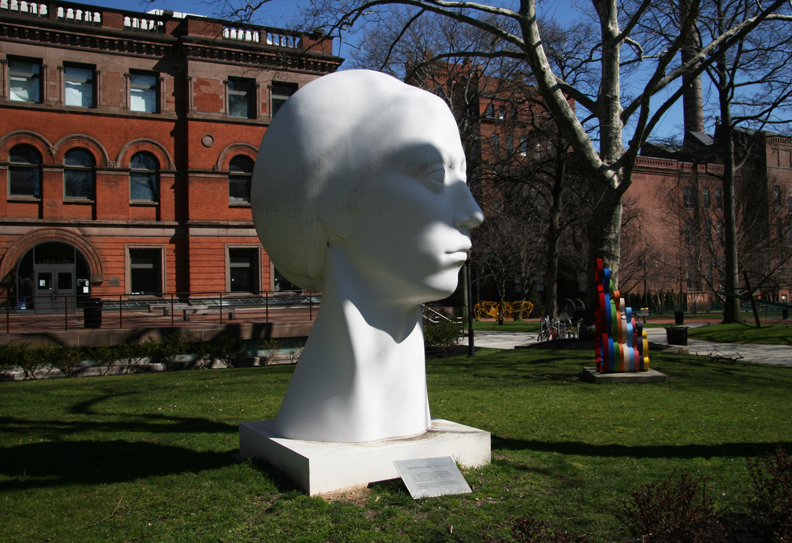
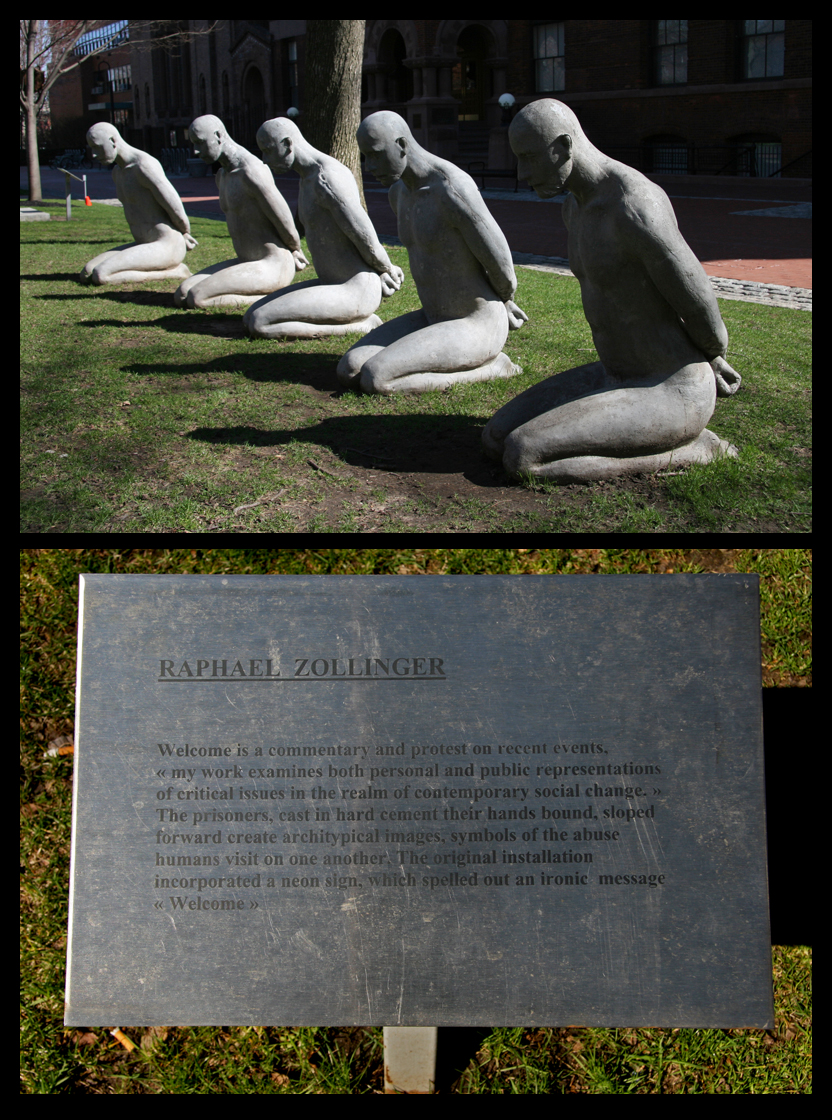
    The atmosphere of a real university campus is quite special in New York City, and Pratt is graced with 25 acres, which includes a sculpture garden featuring a variety of works. The work in the photo, Welcome II by alumni Raphale Zollinger, is one of the most arresting, along with Philip Grausman’s large idealized white female fiberglass head, Leucantha. Welcome II’s 5 naked prisoners are cast in concrete. See front view and read the the plaque here.

    An ironic work for such a beautiful garden – perhaps relics of feeling traPt…

    Posted on by Brian Dubé

  • Flash of Light

    New York Daily Photo started originally as a photoblog, a publishing format where postings are driven by photos rather than text. In time, however, with an interest in research, small descriptions grew to longer articles. With an interest in giving subjects a less clinical and more personal view, I have drawn from anecdotes in my life, and the writing in many postings may be better described as stories and are more about the story than the photo. Now there is an expectation, both on your part and subsequently on mine, of writing.

    I have come to really enjoy the writing of this blog, and recently, in reading about writing short works, I came across an entire genre of fiction which I was completely unaware of: flash fiction, aka sudden fiction, microfiction, nanofiction, micro-story, postcard fiction, or short short story. There are even types of fiction which use exact word counts: 55 Fiction (55 words), the Drabble (100 words), the Drouble (double Drabble or 200 words), and the 69er (as the name suggests). There is no better time for flash fiction with the growth of visual media, competition for everyone’s time, sound bites, and the decline of book reading.

    The bane of nearly every student of English in high school was the dreaded writing assignment where there was a word length requirement. For me, being somewhat verbose, these assignments were not quite as painful, but there still was always the concern that I would not have enough truly meaningful things to say. Certainly there is value in exposition and learning articulation skills, but there also is much to be said for using one’s words sparingly and not padding the writing. I am sure that flash fiction would have been heartily welcomed in my English classes.

    Flash fiction is, of course, not without its critics. In the same way that assignments with minimum word lengths may encourage verbosity, some feel that flash fiction with maximum or exact word lengths is no better, artificially paring a story down where perhaps a few more words may have improved the story. I think there is value, at the very least, to use flash fiction as a writing exercise.

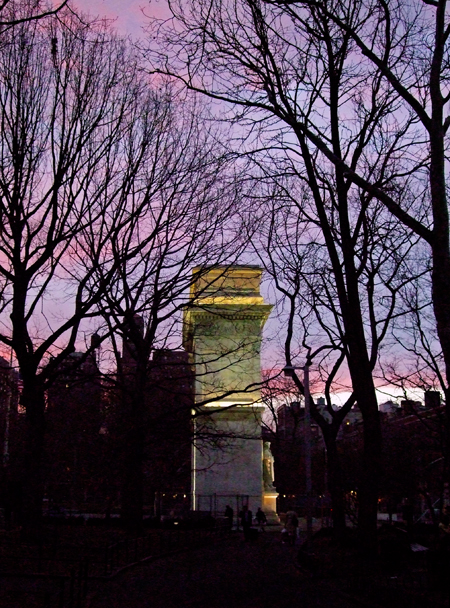
    I hope you enjoyed today’s unnecessary digression because, after all, not only is brevity the soul of wit, but this picture should also be able to speak for itself and be worth at least four hundred and one words 🙂

    PHOTO NOTE: I witnessed this dramatic pink and blue sky framing the Washington Square Park arch on Wednesday evening, March 11, 2009, at 6 PM.


  • Spring Studio

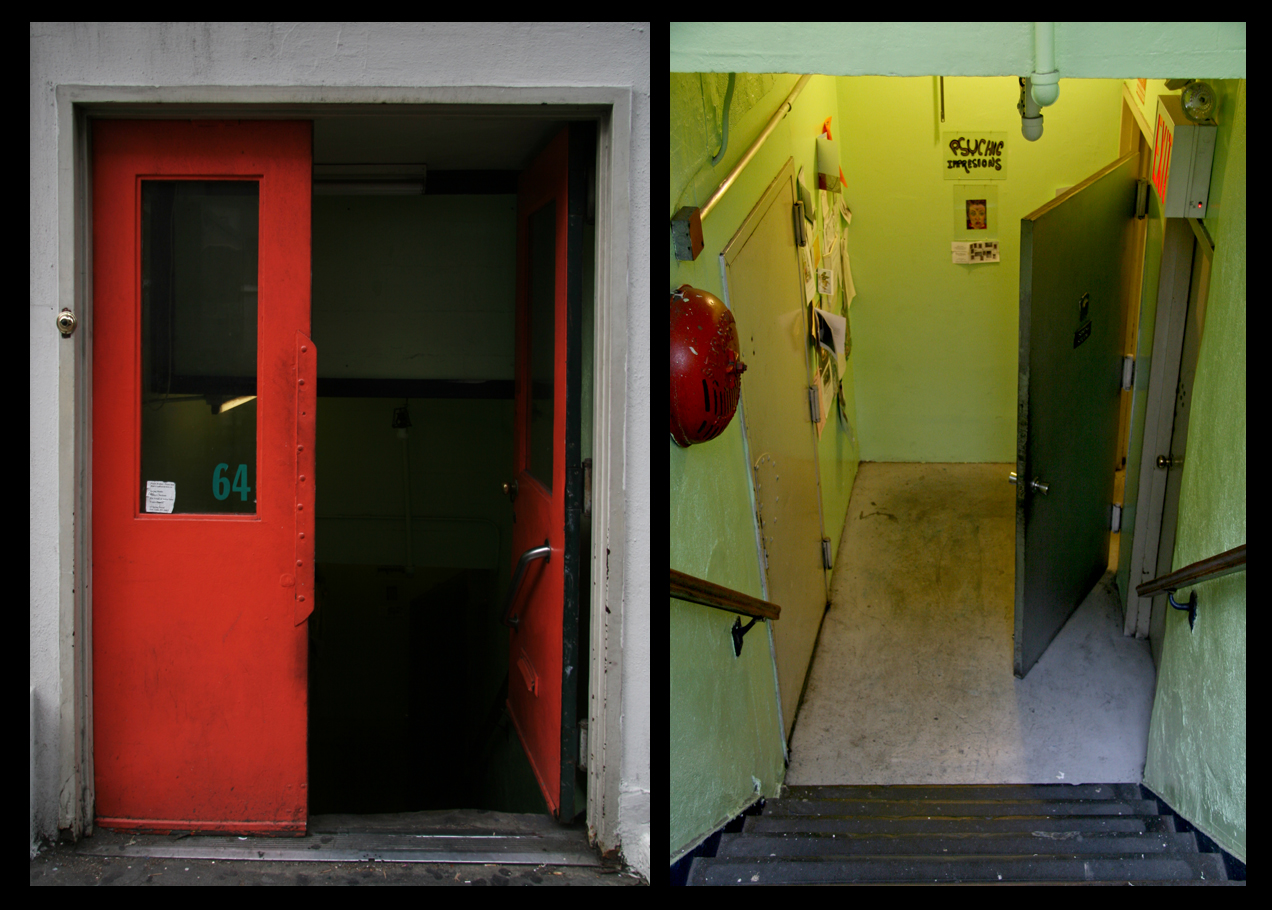
    Thousands walk by this nondescript red doorway everyday with barely a glance. The small bulletin board on the right side is certainly not enough to stop anyone at 64 Spring Street, a central thoroughfare in SoHo (technically 1/2 block east of the historic district), surrounded by places such as Kate’s Paperie, the MOMA (Museum of Modern Art) shop, and Balthazar.

    But then again, Minerva Durham, director of Spring Studio, is not looking for street traffic, and to have a location like this in 2008 is quite a coup. I think it is fair to call SoHo a former art district. There are vestiges – a few galleries and artists remain. Places like Spring Studio are virtually nonexistent here. Essentially, SoHo is an upscale neighborhood and shopping district.

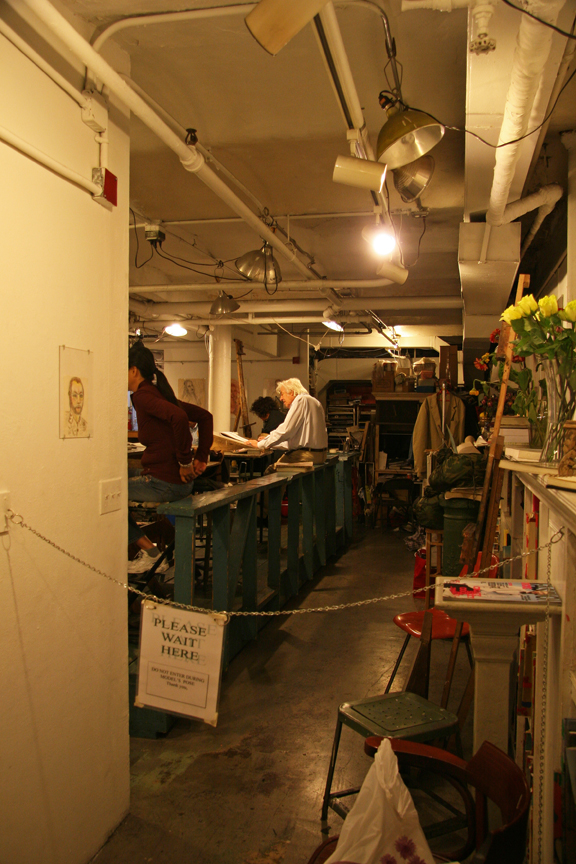
    Spring Studio was started in 1992 by Minerva and offers life drawing and classes 7 days per week. Minerva was cordial and granted me permission to take a photo downstairs, but only when I assured her I would shoot down the corridor to the classroom area from behind a chain and small sign reading “PLEASE WAIT HERE” (see here). Around the corner is a live model, nude or clothed. Students are attentive and focused on their work. Many artists consider this studio to be a great city resource and the best figure drawing studio in New York City. See their website here.

    This is exactly the type of place New Yorkers love to find when looking for those “secret” places. No frills or window dressing – a business driven only by the merit and quality of what it does or offers. A place where the proprietors have reduced the establishment to its essentials and stripped everything else away.

    That is not to say that places of merit must be this way or that places that have created a lavish environment are not places of merit (see Kate’s Paperie). It is partially an issue of economics – how much can an art studio afford to spend on decor (and why should they?). It’s also an issue of style – New Yorkers can be very practical and often champion the practical and the reduction to bare essentials as evidence of authenticity. I wrote of this in my article on Anthora, the famous Greek paper coffee cup, as well as in Very Practical. Having a New York egg cream while standing in a crowded newsstand (Gem’s Spa) just seems more authentic. And painting in a basement after going through an unmarked door and descending an unassuming staircase feels just like the kind of place where an artist should be drawing…


  • Little Burnt Out

    Posted on by Brian Dubé

    Want to feel special? Be the focus of a school field trip with 28 kids. Judy, a previous employee who has gone on to become a school teacher, came to visit me yesterday with her class of 2nd graders from elementary school PS 124 in Chinatown.

    This was a real eye opener for me, and I quickly saw the rewards and joys of teaching children. Certainly a handful of work, of course, but I had it good, like a grandparent. Judy and her associates did all the work of managing the kids; I had all the fun.

    There were squeals, giggles, and screams at every opportunity. And I was the center of attraction as they toured my facility, attentive to my every word and demonstration. They asked questions of me and vice versa. Every one of our staff was quite charmed.

    What is particularly interesting is how kids absorb things. I was asked if I still juggle, and I responded that I enjoyed many aspects of the business but that I was a little burnt out after 33 years. I proceeded to explain what “burnt out” meant. I thought it would be over their heads. I later learned that one of the kids said to the principal of the school, in response to a comment she made, that perhaps she was burnt out and should consider retiring 🙂

    Posted on by Brian Dubé

  • Make No Mistake

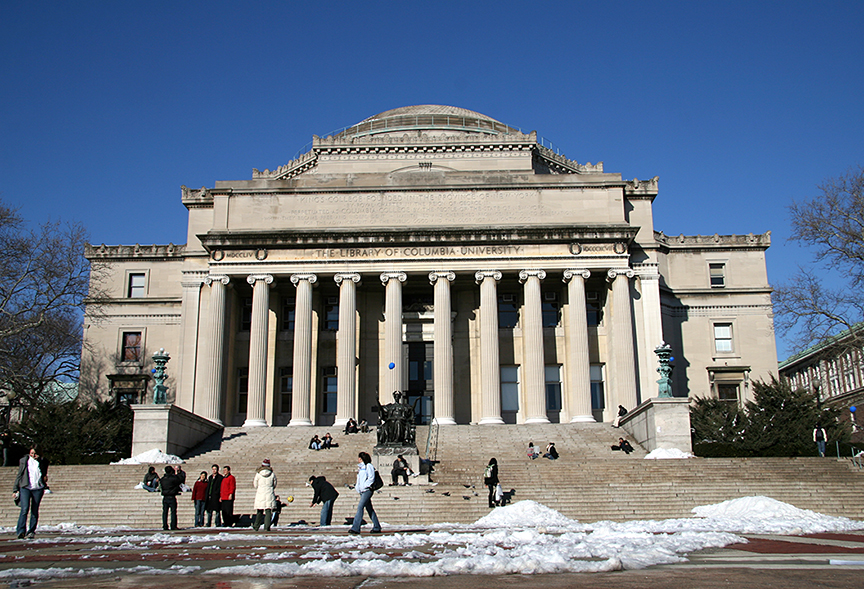
    Rather surprising for Manhattan, isn’t it? Most residents or visitors never get to Columbia University – it’s in its own world, removed from city both geographically (located far uptown in Morningside Heights) and due to its rather unique true campus enclave. Other colleges and schools in the city are typically comprised of a number of buildings acquired over time and located in a helter skelter fashion as close to the main buildings as possible – e.g. SVA, the New School, Cooper Union, Hunter College, and to a lesser extent, NYU. Columbia has a real campus, relatively isolated from the city streets. Rather befitting its status as one of the eight members of the Ivy League.

    Columbia is one of the most prestigious universities in the world, with a long list of firsts and superlatives. Founded in 1754 by the Church of England, this school has 87 Nobel Prize winners affiliated with it. Columbia University is an enormous topic – read more here at their official website.

    The colonnaded structure in the photo, the Low Memorial Library, is the centerpiece of the campus and one of the most universally applauded structures in New York City. Designed by McKim, Mead and White with elements of the Parthenon and Pantheon, it is considered one of their finest works. This was the first building in 1897 at the new uptown campus (it had previous downtown locations). When built, in an area that was cropfields, this grand structure, sitting atop a hill, afforded vistas of Manhattan to the south.

    Unable to get in on Sunday, not only was I disappointed that I would get no interior photos, but I also speculated as to why a university library would be closed midday. Answer: this building has not functioned as a library since 1934 – it now is its administrative center. The interior of the 106-foot-high granite rotunda is spectacular, with solid green Connemara marble columns.

    Make no mistake, there are plenty of books at Columbia, and Low Library would not be large enough to house them all (over 9 million volumes). The main library is Butler Library, located south across the central campus, with sections opened 24/7. I made the same mistake that apparently many newcoming students do. For years, there was a small sign stating, “THIS IS NOT BUTLER LIBRARY.”

    The time to visit is on a warm, sunny day. Stroll the campus ane enjoy the plazas and the green space of the campus, and imagine the privilege of attending this fine university with everything that it has to offer…


  • ICP

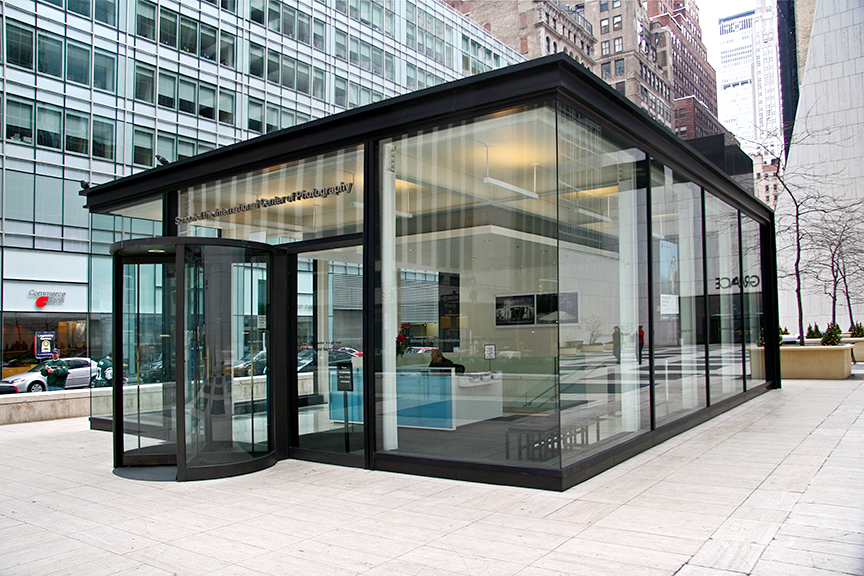
    In yesterday’s post, I featured the controversial W.R. Grace Building. Equally criticized is the rather stark Grace Plaza at the rear of the building with an entrance at 1114 Avenue of the Americas. It is here that in 1974, ICP (International School of Photography) expanded their school, creating a minicampus beneath the plaza. The glass pavilion in the photo (designed by the firm Gensler) serves as the school’s entrance – it houses a small gallery, stairway, and lift to the underground facility.
    The 27,000 square foot space features classrooms, black-and-white and color lab spaces, digital labs with resources for multimedia, digital photography, video editing, and production, a professional shooting studio, a library, student lounge, and exhibition gallery. ICP serves more than 5,000 students each year, offering 400 courses in a curriculum that ranges from darkroom classes to certificate and master’s degree programs. The school has a continuing education program, which is popular for individuals who want to obtain quality instruction in photography without having to matriculate in a full-time university program.

    ICP was founded in 1974 by Cornell Capa (brother of acclaimed war photographer Robert Capa) in the historic Willard Straight House on Fifth Avenue’s Museum Mile. In 1999, the headquarters building at 1130 Fifth Avenue was sold. They moved to 1133 Avenue of the Americas (across from the school) with 17,000 square feet of gallery space (designed by Gwathmey Siegel & Associates Architects), archives of more than 100,000 photos, and a store and cafe. Many feel that the small glass pavilion has done much for the bleak plaza – it certainly provides a much needed focal point…


  • La Rentrée

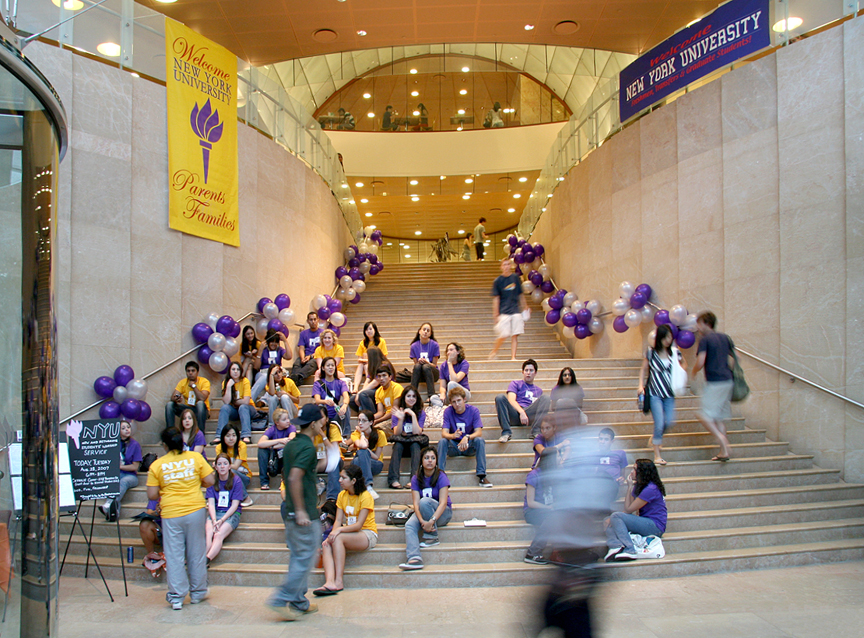
    That back-to-school feeling is in the air, and one can certainly see and feel it at NYU, the country’s largest private university with over 40,000 students (click on any of the six links for previous postings involving NYU: Grad Alley, Cloud Appreciation, Light on Bobst, Waterworld, Offerings, and A Tale of Two Colors). New students and their parents are being welcomed and oriented. There’s the unloading of belongings from cars in front of dormitories. For most of us, regardless of age or whether one is a student or has children, this time of year brings back feelings of getting back to business – summer and summer vacations are over. Labor Day is seen here as summer’s last hurrah.

    In France, where education is a national fever, this time of year is referred to as La Rentrée, “a phrase which alludes to the end of vacations, the return to normal discipline, and a certain obligation to demonstrate that everybody still means business” (from the expatica website) (click here to read more about this French phenomenon). The first day of school is actually referred to as “J” (for “jour”); there is a countdown of days before school, which starts at J-10 (ten days before).

    Of course, there as here, feeling about school’s start is mixed – a time of celebration or one of dread. In NYC, the weather has cooled, the sun is setting earlier, and the march towards fall semester is unmistakable…

    Note: The photo was taken at NYU’s Helen and Martin Kimmel Center for University Life.


  • dinamic_sidebar 4 none

©2026 New York Daily Photo Entries (RSS) and Comments (RSS)  Raindrops Theme