• Category Archives Education
  • They Are Among Us

    As surprising and shocking a revelation as it may seem – yes, they are among us. I am not referring to aliens here on earth, the subject of film, TV, and controversial articles and “evidence” like Santilli’s Alien Autopsy film.
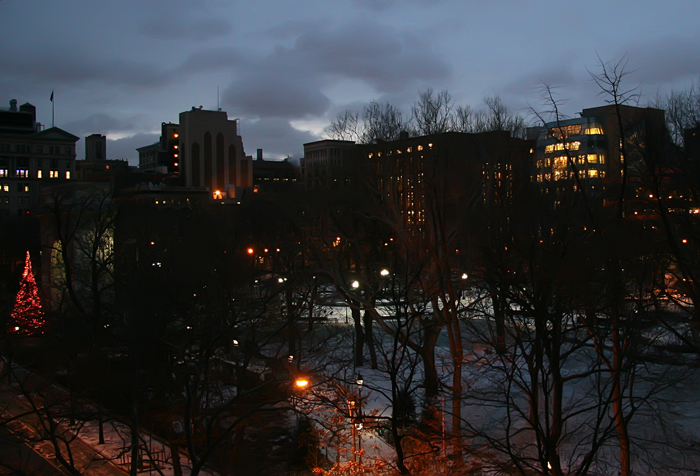
    No, I am referring to sorority sisters – wholesome, perky girls endowed with beautiful smiles and perfect, white teeth. These are the kind of women one might expect to find in Kansas, not in New York City or Washington Square Park, home of the dentally challenged, filthy, mentally deranged, and convicted felons, and where at night, crusties and rats dominate the landscape.

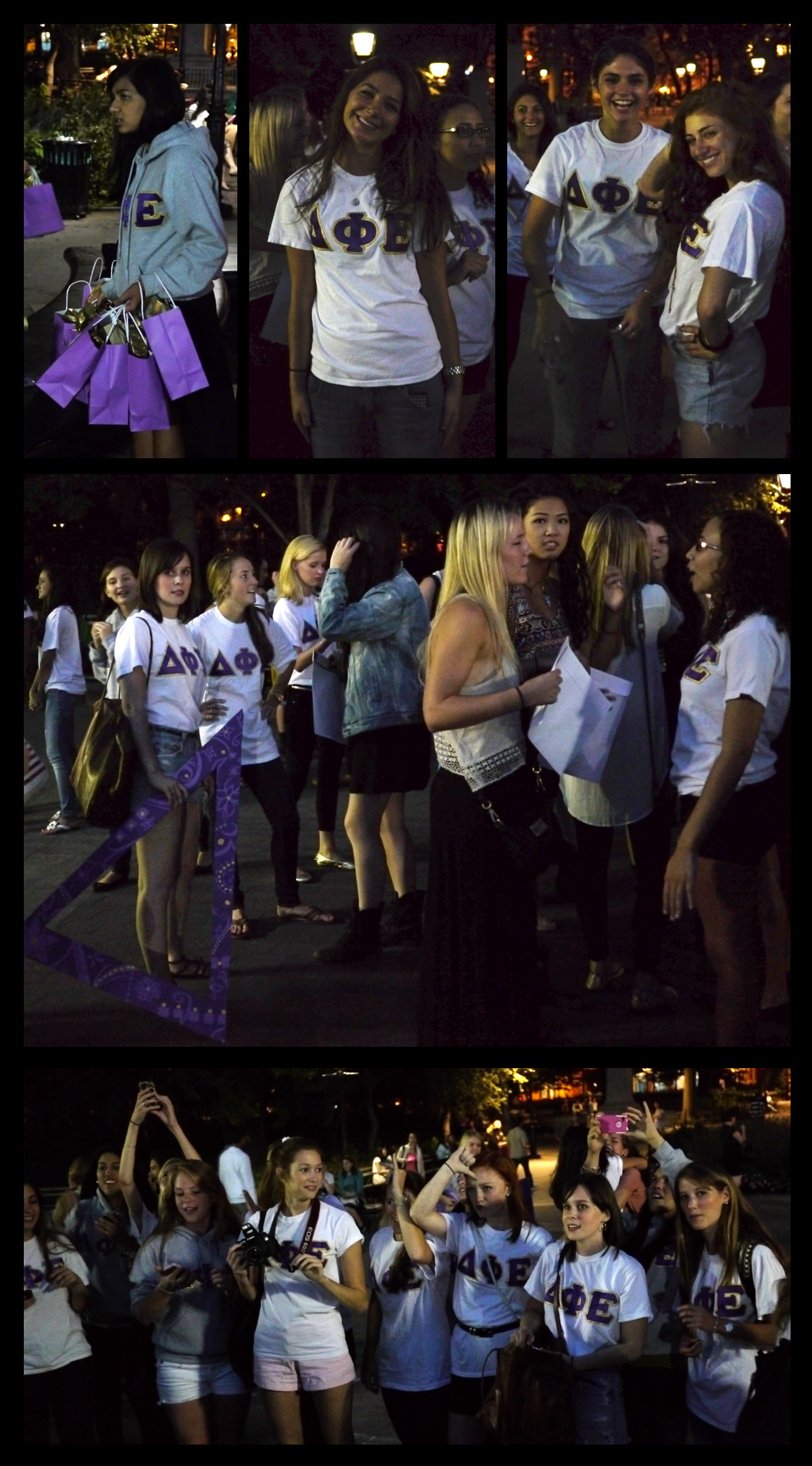
    I recently encountered a sorority celebration of new inductees. This was the first time in memory where I have seen members of the NYU Panhellenic Association. I was told that there are eight sororities at NYU. The group in the park was that of Delta Phi Epsilon, an award-winning chapter established in 1917.

    Sororities and fraternities are certainly saddled with many negative impressions – hazing and drunken revelry prominent among them. However, times change, and I keep an open mind. Although not the lifestyle for many, I am sure there are benefits to the camaraderie and friendships made among students, particularly for those new to New York City, a place the can be an overwhelming, frightening, and lonely environment. This city is a place of extreme diversity, even home to debutante balls and college sororities, such as Delta Phi Epsilon. Without their telltale Greek logo T-shirts, they may travel incognito. But be assured, They Are Among Us 🙂


  • The Engine Room, Part 2

    Posted on by Brian Dubé

    The Pratt Cats (see Part 1 here)

    The Pratt Cats

    As we entered the very first Pratt building, I was greeted by a cat slinking from a classroom into the hallway. A curious sight, I was informed by our guide Leslie that this was one of the Pratt Cats. Pratt Cats? I was intrigued.

    Later, when we toured the Engine Room, we encountered another cat. My attention was drawn to a windowed wall in the engine room where there was an entire display of championship ribbons from the numerous awards won by Pratt cats at cat shows. Nearby was a collage of photos, names, and descriptions of a number of these cats – Nicky, Willy, Higgie, Art School, Teddy, Prancy, Big Momma, and Lestat.

    Chief Engineer Conrad Milster informed that each cat tended to be somewhat territorial, occupying a particular building or area. The cats are fed and tended for privately. As I left the East Building and the Engine Room, I encountered Conrad outdoors, who pointed out the lilliputian Feline Staff Entrance at the base of the building’s exterior wall.

    The naming, championship ribbons, poster, informative article, and the small entrance made it clear that the feline population at the institute is not a loosely associated, changing population of strays. Quite the contrary. These cats are well-known amongst the student population and have names, identities, recognition, and social status. They have a bit of attitude, expected of any New Yorker, particularly when associated with one of the world’s finest design schools. They’re not just any cats, they’re The Pratt Cats 🙂

    More cats: The Catman, Urban Mitts, Lost and Found, Kitty

    Posted on by Brian Dubé

  • The Engine Room, Part 1

    Posted on by Brian Dubé

    A Meeting With Conrad Milster

    I recently spent a day exploring Brooklyn with two longtime friends, Leslie and Greg.  I had desperately wanted to revisit and introduce to others both the Wilburg Cafe and Salerno Service Station, which I recently featured. The cafe offered a great brunch menu, and Salerno Service was one of the most remarkable businesses I have been to in New York City. I now had two victims willing to retrace my steps. On our ride towards Williamsburg, we approached Pratt Institute. Leslie, a regular reader of this blog and subject of the story White By Design, offered a guided tour of some special spots within a few of the buildings. She had spent time as a student doing graduate work at Pratt. Visiting the school at this time of year turned out to be a great suggestion. It was a hot summer day and the campus was quiet with virtually no security, and so, our tour of the interior of some of the university’s buildings went unfettered.

    I have been to Pratt a number of times for the annual juggling festival, and my experience there was limited to the exterior grounds with their sculptures and the ARC Sports Complex. On this outing, I toured the campus, a number of buildings, and the library with its magnificent stairwell. But, in the East Building (bottom photo), there was a treasure known to most students but only to a handful of outsiders – the engine room. I had been told that the room was noteworthy, however, I was quite taken upon actually entering.

    The place exuded old world charm and history. A gallery surrounded the dark-red reciprocating steam engines. The power plant is one of the most historic in the region and has been designated as a National Mechanical Engineering Landmark by the American Society of Mechanical Engineers. The three generators, which burned number 6 oil and produced 120 volts of direct current, were installed in 1900. They were some of the last operating in the United States. The plant ceased generating power in 1977, remaining for standby emergency power until very recently. It is now fully retired.

    At one end of the room, a lit office behind a windowed door beckoned. As I approached, I saw hand lettering on the glass which read: Chief Engineer C. Milster. It was the perfect photo op – an older man sat in direct view framed by the lettering. His demeanor certainly spoke engineer, but given the age of the facility and the door’s typography, it seemed rather unlikely that this man was the very same C. Milster. As I stood outside the office for a moment contemplating, the man waved for me to enter. I went in.

    Conversation ensued, and I quickly learned that my gracious host was, in fact, Conrad Milster, now 76, who has run the facility since 1958. Conrad now maintains the school’s mechanical systems. As we chatted, it became abundantly clear that Conrad was quite passionate about the engine room and answered any and all questions.

    I felt quite privileged to meet him – Conrad is more than an employee. He is a legend and integral part of the fabric of this wonderful antique environment. But I also had noticed that other things were afoot, and I was to learn, as you will in Part 2 of this story, about the curious nature of inhabitants of numerous buildings of Pratt and The Engine Room

    Posted on by Brian Dubé

  • Dennis Is Going to Kill Me

    Posted on by Brian Dubé

    If you have read my story Jungle Lovers, then you know that I was quite unimpressed with the “guidance” I received in high school. There was little to no preparation for anything – no Kaplan tests, no Internet. I had already completed my years at NYU before I even learned what prep schools were. Certainly preparatory schools predate my high school years, and there were many fine examples of such where I grew up in New England. However, such places were certainly not something a working-class family would even be aware of, much less consider for a child’s attendance.

    More disappointing, particularly for someone academically inclined as I was, is to learn the reality of admission to America’s top colleges and universities. It is not strictly a merit-based system. Most applicants to the Ivy League universities are well-qualified to attend. In Crashing Through Knowledge, I recount an incident where an upperclassman I met was so disappointed with his rejection from Harvard.
    There is no question that prep schools send a much larger percentage of their student body to top schools. From a 2010 Forbes Magazine article, “America’s Best Prep Schools”:

    In the past five years, Trinity School sent 41% of its graduates to the Ivies, MIT or Stanford. On average our 20 top schools sent nearly one-third of their graduates to those 10 schools. (In contrast, less than 0.01% of all U.S. high school graduates ended up in those schools in 2008, according to the U.S. Department of Education.)

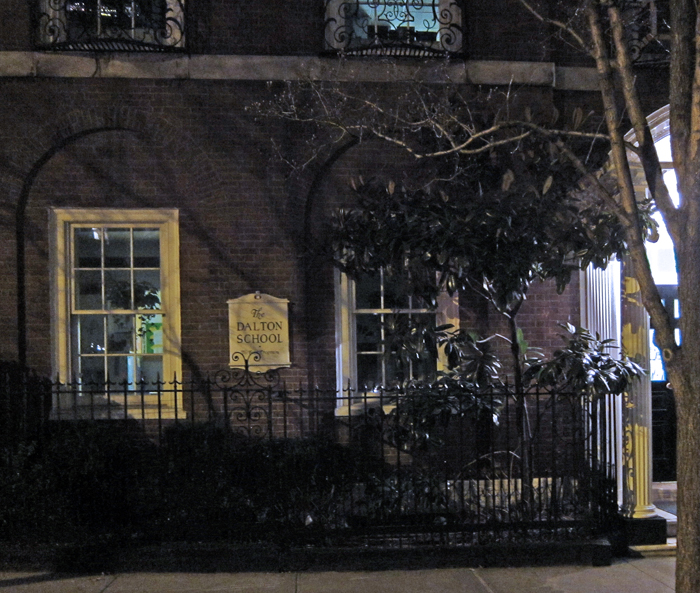
    With this type of track record, the scramble to get into top schools starts as early as kindergarten or earlier for parents fixated on seeing their children on the best career track. The Dalton School, one of the highest rated prep schools in the United States, is located in Manhattan’s Upper East Side. It occupies three buildings, spanning all grades from K-3 (shown in the photo at 53 East 91st Street) and grades 4-12 at 108 East 89th Street.

    The Dalton School was founded in 1919 by the renowned progressive educator Helen Parkhurst. Parkhurst’s visionary Dalton Plan remains the keystone of the school’s progressive educational philosophy and is now the model for over 200 Dalton schools in other parts of the world.

    The school is iconic and has often been referenced in TV and film. A scene in the film Baby Boom with Diane Keaton illustrates the extreme preoccupation that many New York City parents have with getting their children into top schools, even nurseries. Here, at the playground with her child, Diane Keaton overhears a mother bemoaning her fate at having her child rejected from the Dalton School:

    Mother 2: What is wrong with you? You look awful.

    Mother 3: We heard from Dalton, Cosby didn’t get in.

    Mother 1 & 2: (in unison) Oh no!

    Mother 3: I’m so upset, if she doesn’t get into the right preschool, she’s not going to get into the right kindergarten, if she doesn’t get into the right kindergarten, I can forget about a good prep school and any hope of an Ivy League College.

    Mother 1: Honey, that is devastating.

    Mother 3: I just don’t understand it. Her resume was perfect, her references were impeccable. Dennis is going to kill me.

    More on education and schools: Read Between the Lines, Little Red, Meetings With Remarkable Men (Part 1 and Part 2), La Rentrée

    Posted on by Brian Dubé

  • Read Between the Lines

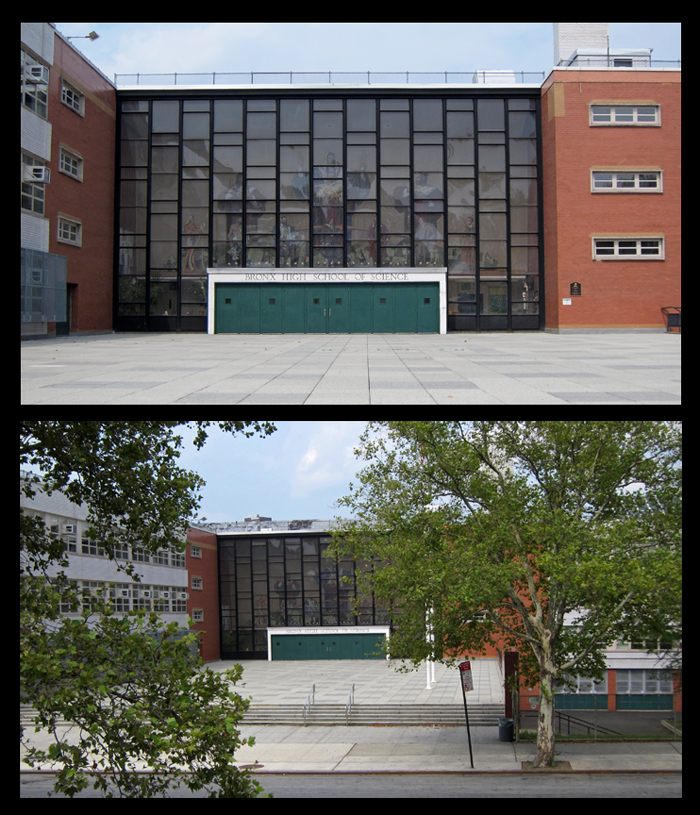
    We had the grounds to ourselves – there literally was not one other person in sight. The city block that fronted the school was entirely free of cars – always worrisome. In New York City, the appearance of numerous legal parking spots (or an entire streets worth) is a warning sign – this typically means you have misinterpreted the signs. I reread the street parking signs carefully several times before parking.

    But on an oppressive, hot, humid Sunday in August, it is understandable that no one is touring a place with all the charm of a prison yard. Nondescript, uninviting, institutional. The grass and trees that were there just seemed to highlight the inhospitable nature of the concrete accretion. A large mural graces the entrance lobby behind the green doors, but I did not even find this to be particularly attractive.
    However, don’t judge this book by its cover.

    Virtually every New Yorker knows the prestigious triumvirate of specialized science high schools for gifted children: Bronx High School of Science, Stuyvesant High School, and Brooklyn Technical High School. I have had a number of friends, acquaintances, and employees who are graduates of these schools. My office manager for 15 years as well as her husband and most of her friends were alumni of Stuyvesant, while my current office manager is a graduate of Bronx Science. One does become spoiled working with young people like this – typically astute, quick, and very smart.

    Admission to these schools is based on an entrance examination, the Specialized High Schools Admissions Test (SHSAT), which is open to all eighth and ninth grade New York City students. Out of the 26,000 students taking the entrance examination each year, only about 700 are admitted to Bronx Science.

    Looking at this place, it seems unimaginable that anything of merit takes place behind those doors. However, Bronx Science is internationally known as one of the best high schools in the United States, public or private. The school is culturally, ethnically, and economically diverse. Seven graduates have won Nobel Prizes, more than from any other secondary education institution in the United States. Six have won Pulitzer Prizes. The school has had 132 finalists in the Intel (formerly Westinghouse) Science Talent Search, the largest number from any high school.

    I expected genius to be oozing from the corridors, but my office manager assures me that school there was like any other – with cliques, gangs, and everything else that typifies high school. In New York City, where Content is King, places like Bronx Science require of us not only to not judge a book by its cover but also, once inside its pages, to go even deeper and read between the lines 🙂

    Related Posts: Little Red, got math?, Keuffel and Esser, Kids


  • Little Red

    Posted on by Brian Dubé

    I’m not sure what they do on the first day of first grade these days – perhaps a review of the principles of recycling and waste management or an introduction to recombinant DNA. My first day of first grade was held in a newly built school. Everything was brand spanking new, including the green chalkboard.

    Our teacher drew a large red apple, filling in the entire thing with red chalk. After successfully identifying it, she erased it. However, no matter how much writing and erasing was done, a hint of that red apple remained on the board for the entire year, much as it has remained in my mind.

    It was a much simpler time, for sure, in a much simpler place but superior to the education of my parents who were educated in a one-room school house with one grade per row. One teacher taught the eight grades simultaneously.

    Now we have pre-school as the norm and parents stressing about their children being admitted to prep schools like the Dalton School with acceptance rates of only 14%. Barely out of the womb and kid’s trajectories are being plotted for Ivy league schools.

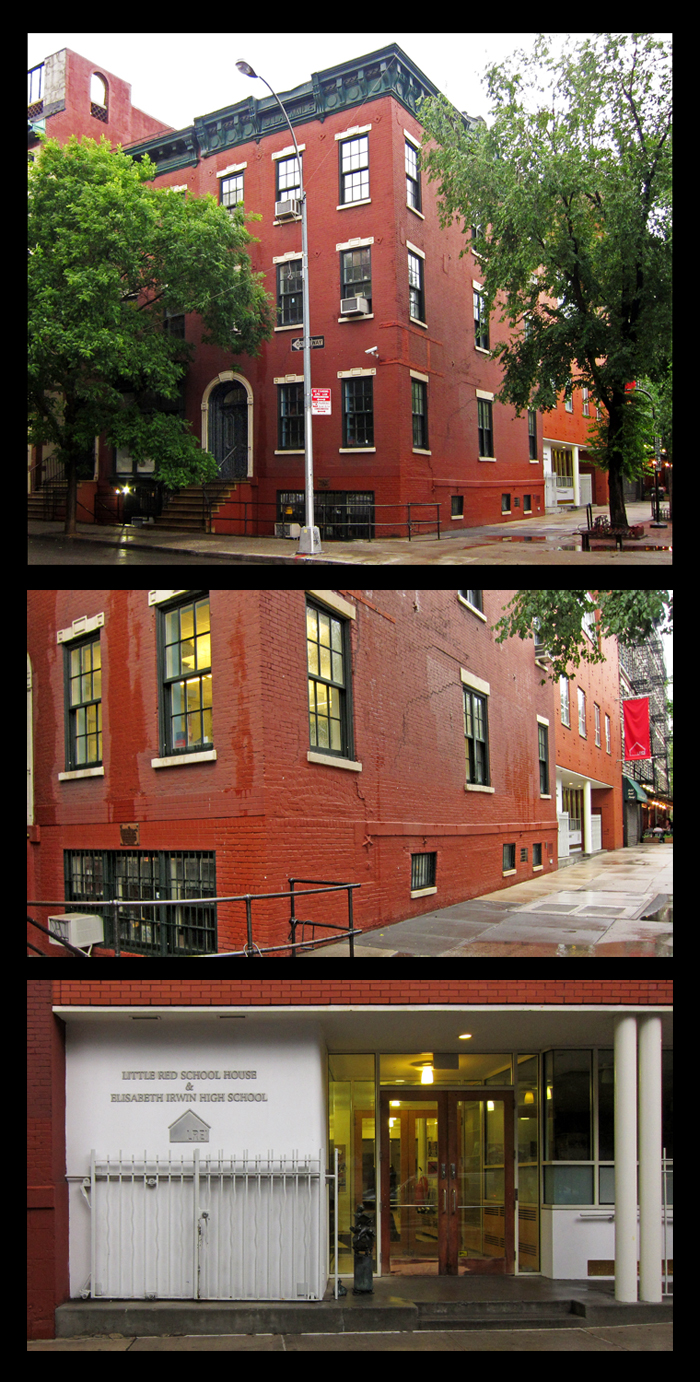
    The Little Red School House has been a fixture in the heart of Greenwich Village for near a century. It occupies two buildings at the corner of Bleecker Street and Avenue of the Americas. Like many establishments in the city, it is easily overlooked – nothing in particular screams school house and the red brick is typical of the structures around it. The Little Red School House is generally considered New York City’s first progressive school. From their website:

    In the early 1900s, Elisabeth Irwin, John Dewey and other progressive educators developed a new educational approach based on active learning instead of passive absorption of facts. “The complacent formalism of schools, its uncritical and therefore uncreative spirit, must be replaced by an honest hospitality to experimentation,” Irwin wrote.

    Elisabeth Irwin founded the Little Red School in 1921 as an alternative public elementary school. Parents and students loved the new dynamic learning community. It was an exciting place to learn, with a palpable spirit of curiosity, creativity and challenge. However, during the Depression, the Board of Education could not afford to keep the school open.

    Parents pledged their own resources, establishing Little Red School House as an independent elementary school. In 1941, the program expanded to include a high school at 40 Charlton Street. For nearly 70 years, we have been a pre-K through twelfth grade school: LREI.

    Red apples on the first day of first grade, red paint on school houses. Good things in education are looking a Little Red 🙂

    Note about red school houses: Red was used traditionally for barns and school houses because of the cost of the paint – it was made out of ingredients that were readily available: iron oxide (rust – giving it the distinctive color) along with skim milk, lime and linseed oil.

    Related Posts: Meetings With Remarkable Men Part 2, Meetings With Remarkable Men Part 1, The Little, Finger Painting, Matters of Opinion, That’s Quite a Briefcase, Who See the Red, The Scholastic Building

    Posted on by Brian Dubé

  • Crashing Through Knowledge

    I don’t remember his name, but he was a senior and the best player in the chess team. However, he had just been beaten by my best friend, a freshman, which had garnered my friend considerable respect. So our upper classman was confiding in us, telling his tale of woe. He had just been rejected from Harvard University and was so frustrated. He wanted to know what more they wanted from him, because as far as he could see, he had delivered it all. He was first in his class. He had perfect SAT scores (1600). He had won everything winnable. But we were extraordinarily naive and none of us were prepared. We were bumbling, fumbling, and stumbling. If you read my story Jungle Lovers, you will get a sense of the poor preparation and guidance we really had.

    In my junior English class, I could not find the word bourgeois when our teacher asked us to go that place in our text because I had never heard the word before and did not know how it was spelled or pronounced. A friend and I were researching schools. I called out the Worcester Polytechnic Institute – he could not find it in a guide because I mispronounced Worcester. It’s hard to find or get into a school if you can’t pronounce its name, and you are not going to benefit from a prep school if you don’t know they exist. That is correct. I did not know what a prep school was or of their existence until well after university admission.

    In mathematics and computer programming, we speak of elegance in a proof or in computer code, as contrasted with brute force, such as the approach computers take to chess, where all possibilities are considered. Those of us made it to college were lucky and appreciative – this was done not through any elegant or efficient process, but strictly by brute force. We were crashing through knowledge recklessly like a runaway train. We loved learning, reading, and academics but had no real guides.

    The prep school is certainly a more elegant solution to preparation for college. The emphasis is on a more well-rounded individual. Classes are smaller and instructors much better qualified with advanced degrees. And I am sure there is much better preparation and guidance, not just a bunch of kids bumbling, fumbling, stumbling, wishing, hoping, and just crashing through knowledge…

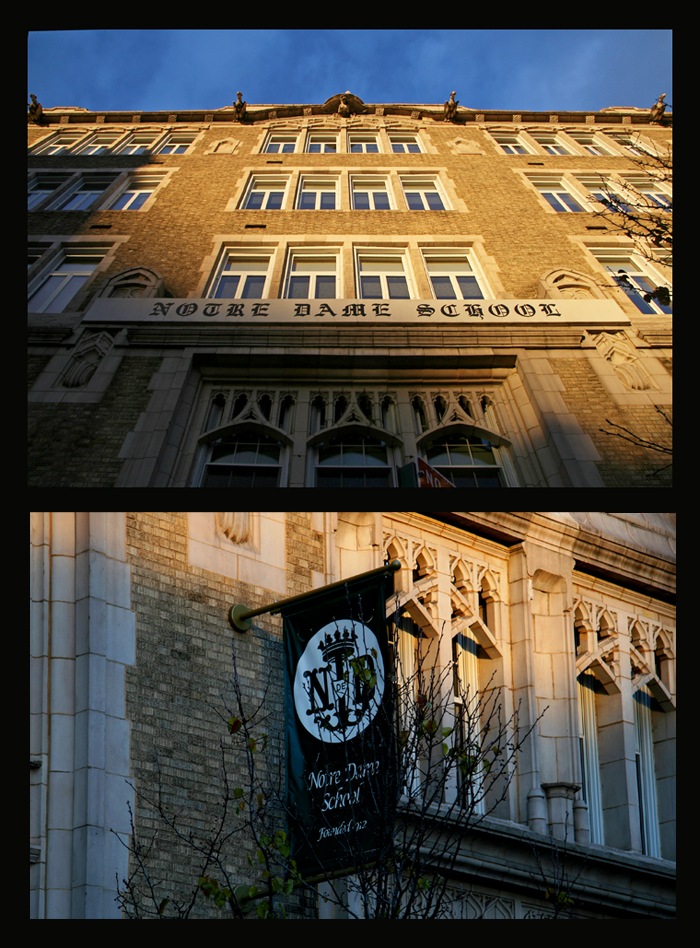
    Photo Note: This is Notre Dame, an all-girl preparatory Roman Catholic high school, founded in 1912 and currently located at 327 West 13th Street in the West Village. There are 300 students with a student-faculty ratio of 13:1. You can read more about it here or at their official website here.


  • got math?

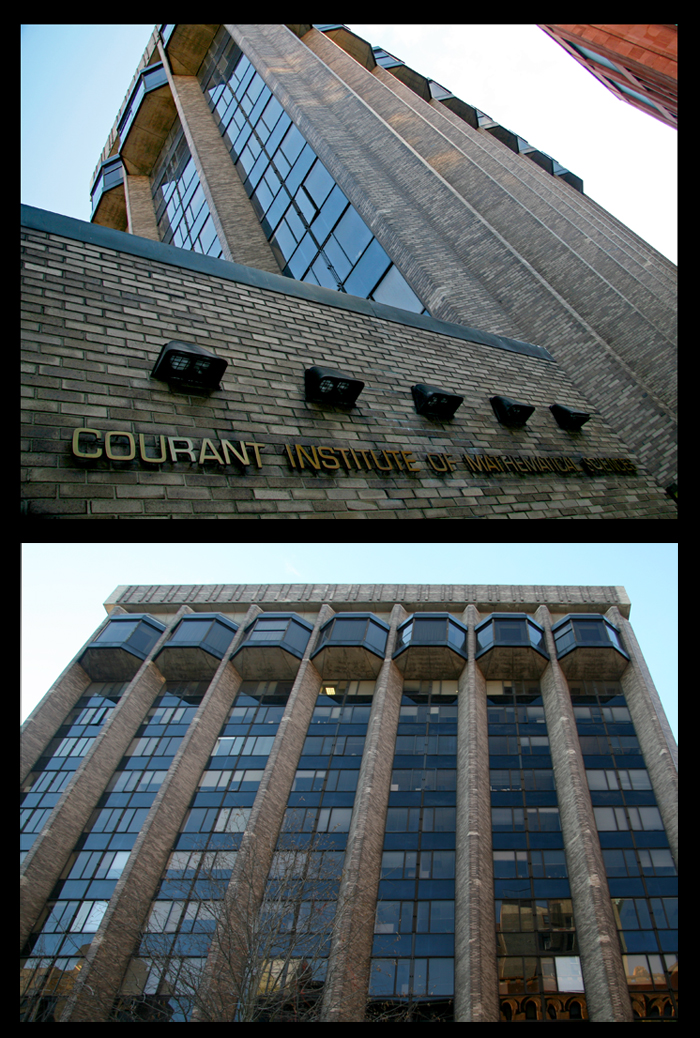
    When I arrived at NYU, a few classes at the Courant Institute cut me down to size rather quickly. This was no longer home for the small town boy, universally applauded for basement experiments ala Mr. Wizard or Bill Nye the Science Guy. No, this was the real world of mathematical minds – the best of breed. My childhood dreams and ambitions of being a mathematician evaporated quickly, and within one year I had switched academic gears.

    Always a lingering and nagging disappointment, I was only comforted decades later by two conversations. One was with a coworker who attended Princeton University and Oxford. When I asked what Princeton was like, he told me there was a lot of drinking and depression. Surprised, I asked why. He informed me that it soon became clear to most students that in every class there was that person that eclipsed the others, and you were not that person. These are the people that would go on to the rarefied heights that all the others had always assumed would be theirs.

    I had a similar conversation with a leading French-American theoretical physicist and Senior Vice Provost at NYU, who received his bachelor’s, master’s, and doctorate from Harvard University. In spite of his obvious brilliance and stellar achievements, the professor told me that when he arrived at Harvard, it was a rude awakening for him also to brush up against others of equal or even greater minds.
    We all learned that we were not in Kansas anymore.

    Mathematics itself is fascinating – the feelings most people seem to have about it range anywhere from just a sense of incompetency to fear, panic, or outright terror. Much has been written about our world of innumeracy and why these things are true.
    Another coworker, a gifted NYU student, could not fathom why I or anyone else would major in mathematics and subject themselves to such a fate voluntarily. Stating that I actually loved mathematics did not help clarify things at all, but only made the whole thing even more perplexing to her. At best, even though some people may have a facility for math, it is typically seen as a tool, certainly not an end in itself.

    One of the reasons I selected NYU was its strength in mathematics. Unfortunately, I did not realize how strong. The Courant Institute of Mathematical Sciences (shown in the photo) at NYU is considered one of the most prestigious and leading mathematics schools and research centers in the world. You can read more about it here and at NYU’s site here.

    I walk by Courant Institute daily, its tower somewhere between torment and a tease for me. It is another one of New York City’s many sirens. This one, however, lures only a few who can hear its call – “got math?” 🙂

    About the Photo: The Courant Institute of Mathematical Sciences is housed in Warren Weaver Hall, a 14-story high-rise at 251 Mercer Street.


  • Meetings With Remarkable Men

    The Story of Professor Robert Gurland, Part 2 (see Part 1 here)
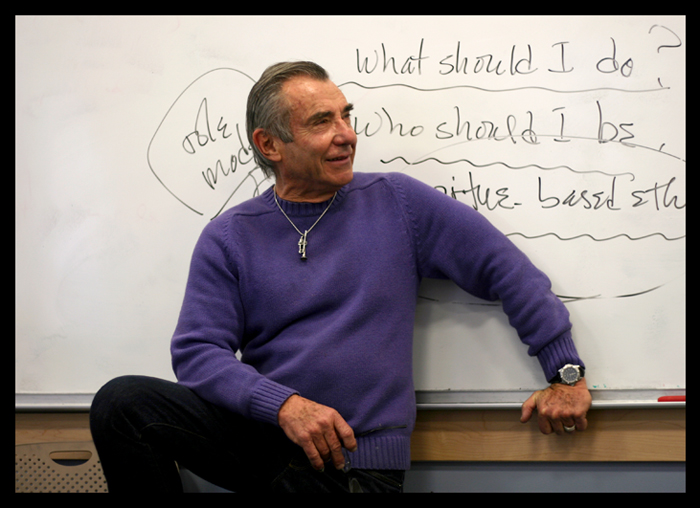
    I was so excited yet frustrated sitting in that class. Didn’t these students know they were with a living legend? Why weren’t they hanging on his every word? It costs big money to attend NYU. Why was one student sleeping and another looking at dresses online and messaging on Facebook? Gurland was discussing the nature of evil – man’s inhumanity to man. On the chalk board were the names Hitler, Stalin, Idi Amin, Pol Pot, and Duvalier. What the hell does it take to galvanize students?

    I was following his presentation and completing some of his sentences in my mind. I was flying. This was education at its best. The man’s ability to communicate is brilliant, with a perfect meld of theater, anecdotes, insight, and passion, making the content accessible and relevant. No wonder he is a superstar educator with the highest student ratings, a cabinet full of letters (see here), and has been referred to as an icon for educators.

    I understand we live in a world of information and sensory overload. However, I would find it extremely disappointing to be a man like Professor Robert Gurland, with all of his accolades, and lose to Facebook. When I expressed my outrage in my second interview in his office, he laughed and said, “When I look at those Apples, I know that they’re looking at a porn site on the other side.”

    The man for this job needs a tough skin and a realization that in this world, you often lose to competing interests in the classroom. Who better to weather this storm of our current times than a tough, New York City Bronx-born Jew grounded in reality and who knows how to take a beating?

    I had taken a class with Robert Gurland circa 1970. Even at 9 AM, his classes were packed with sizes at one time of as many as 450 students. Historically his classes have been so popular that it became a problem in the Philosophy department – no one has wanted to take other courses. In the late 1990s, a part-time employee who was also an NYU student was raving about a professor. I was pleasantly surprised to learn that it was the very same Professor Gurland, who was still going strong in his unique style of teaching and making impressions with his indelible stamp. As the result of a recent inquiry, I discovered Gurland was still teaching at 77 years old.

    I obtained his phone number and had a brief phone conversation – I was amazed that in spite of the fact that he has had over 25,000 students, he remembered my name and the class I was in – Practical Reasoning. I arranged an interview and to sit in on two of his classes. He was extremely gracious and permitted any manner of recording I wanted. I came armed with cameras and video and voice recorders. I interviewed Professor Robert Gurland twice in his office at 726 Broadway, once before and once after the two classes I attended. These were his last classes of the semester. I recorded both classes on video and 78 minutes of our dialog in his office.

    We met in the lobby at 8:30 AM. His office door is open, but Gurland values his privacy, and I appreciated the privilege of spending time with him. As we entered his private office, I felt electricity in the air – I had never been with Gurland outside the classroom. The ensuing conversation was charged.

    In our conversation, I learned many things I did not know about this superstar of university teaching. We discussed his working class roots, his growing up in the Bronx, and his attendance at the Bronx High School of Science, at the time an experimental school. At one point, Gurland showed me a photo of himself at 20 years old as a professional trumpet player. He recounted the litany of jazz legends he played with, such as Krupa and Dorsey. A small trumpet hangs from his neck. We discussed his personal life briefly. Gurland is married with one son who is a full-time professional musician. When younger, Gurland dabbled in photography and won two Eastman contests.

    Now a philosophy professor at NYU, Gurland has served as chair of the department. However, I was also surprised to learn that his first educational degrees were in mathematics, eventually culminating in a Ph.D and a tenured professorship of mathematics at Long Island University.

    Do I over inflate Gurland’s achievements and charisma? Not at all. Gurland has taught at many universities and has won best teacher awards at all of them. He has been awarded NYU’s Golden Dozen Teaching Award numerous times and was the youngest person to get the alumni association great teaching award. He holds three MA degrees and two PhDs.

    For a man like Robert Gurland, these are but milestones on a road that many others have taken but to a destination few will ever reach. There were a few students who lingered after class to say goodbye and express their appreciation for this great educator.

    I am immersed in technology and spend hours online. I recorded Professor Gurland’s classes using two video camcorders, a digital voice recorder, and professional DSLR camera. But these are only tools. I was not distracted from Gurland’s presentation and the special things only a relationship with a human being can bring to our world. I salute him on giving such spirited and impassioned lectures, even to empty classrooms filled with so many students preoccupied with something or someone else. I am having a hard time this morning deleting those images of dresses and Facebook from my mind…

  • Meetings With Remarkable Men

    The Story of Professor Robert Gurland, Part 1

    I came to New York City in 1969, ostensibly to study at New York University. But there would not be much studying, for this was not just any time. Political upheaval and violence was mixed with sex, drugs, and rock and roll. There was extreme distraction.

    The Vietnam War colored and dominated everything. Hanging on my dorm room wall was the iconic anti-Vietnam War poster, And babies, with its horrifying image of the My Lai massacre. Dead soldiers in body bags seemed like a daily sight on television. On the heels of the civil rights movement, Martin Luther King had just been assassinated in 1968. President Richard Nixon, a man seen to be so evil, in 1974 at the apex of the Watergate scandal needed to proclaim to the nation, “I am not a crook”.

    Some of the most seminal and notable music groups of the 20th century flourished at the time. And, of course, there was Woodstock. This was a time of rampant drug use, particularly LSD. Timothy Leary had already commanded America’s youth to “Turn on, tune in, drop out.” There was fallout from these excesses. Music icons were dropping like flies, primarily from drug related causes – Jimi Hendrix, Jim Morrison, Janis Joplin, and Brian Jones.

    Sexual freedom reigned after the introduction of the contraceptive pill in the early 1960s. The spirit of the Summer of Love in 1967 permeated the culture.
    Consciousness was being expanded. Everything was in question. Groups were beginning to vocalize and demonstrate. In New York City, there were the Stonewall riots in June 1969. The women’s rights movement was in full force, on the heels of the birth control pill and Betty Friedan’s revolutionary book, The Feminine Mystique.
    There was the SDS and the Black Panther Party. The Weathermen, a small extreme group of radicals formerly from the SDS, had built a bomb factory in the Village and blew up an entire townhouse.
    We had just landed on the moon on July 1969.

    Study? In New York City?

    It took an enormous draw to get a student into a classroom and keep him or her attentive. In spite of bullets flying in the world outside, there was one man who could do it. A legend in 1970s time and still today. In just a few minutes, across that park and behind those trees, I have an appointment to meet that man again, for the first time in 40 years. I can’t wait. It’s 19 degrees out there, but I won’t feel it. Got to run. See you later. In Part 2, you will meet Professor Robert Gurland 🙂


  • A Slice of Cheesecake, Part 2

    The Brittany – Temple of the Gods of Debauchery (see Part 1 here)


    It was clear after moving into Brittany Residence Hall and a brief visit to NYU’s primary other residence at the time, Weinstein, that fortune has bestowed us with a better choice.
    The Brittany, as it was known at the time, is located at 55 East 10th Street and Broadway. It is a former hotel, built in 1929. The structure has larger, airier rooms and a prewar ambiance.
    The Brittany penthouse was a speak-easy at one time with many well-known guests such as Walter Winchell, Al Pacino, and Grateful Dead’s Jerry Garcia. The ground floor currently functions as a gallery, Broadway Windows, with displays of student art.

    At the time of my stay there, the Brittany was a truly a temple to the gods of debauchery. It was a coed dormitory, and in many cases, the rooms themselves became coed with couples living together in suites. Drugs were rampant as were drug dealers, even selling to those outside the student body. One evening, while sitting in a hallway, I had a jacket bloodied by someone who, half asleep on the way to the bathroom, had smashed his hand through a glass door and was running and screaming. I was told by a close friend of a first hand account of a group of students in the nude, high on Quaaludes, playing Frisbee in a hallway.

    One of my earliest memories there was visiting a room completely outfitted in UV blacklight for the entertainment of visitors. One fellow student represented himself as a cat burglar and demonstrated his skills by walking on window ledges of this high rise building. Brittany Residence Hall is also where I resided at the time of one of my favorite stories, involving Jimi Hendrix (see Crime Scene here).

    Somewhat controversial, The Princeton Review not only provides its well known university ratings in a Best College guide, but also provides a “Top 20 Party School List.” NYU has typically made the list. Today however, the university is better known for its coveted #1 Dream School status, rising prominence and the strength of many departments – Courant Institute of Mathematics, NYU Law School, the Film School, and Stern School of Business. According to Forbes Magazine, in 2008, NYU was ranked 7th among universities that have produced the largest number of living billionaires.

    I recently visited the dorm for the first time since 1970, escorted by an NYU student currently residing there. There were changes of course, most notably increased security – turnstiles requiring student ID card swipes. Things appeared to be much more subdued. However, I did learn that Brittany Hall is considered haunted, with reports of unexplained music, lights, footsteps, and claims from people who believe that others are watching them. Perhaps the final stirrings of the gods of debauchery…


  • A Slice of Cheesecake

    Part 1 – The Arrival  (see Part 2 here)


    I knew nothing of the world and almost nothing about New York City. I had only visited twice on day trips. I had never spent one night away from home alone. There were no ATM machines, and I had no bank account. Only some cash.
    I had one suitcase and arrived at Port Authority bus terminal, never a beautiful or inviting place for the newcomer. I was excited and scared. This is where I had dreamed of living for some time, but now I was really here, and it was big.

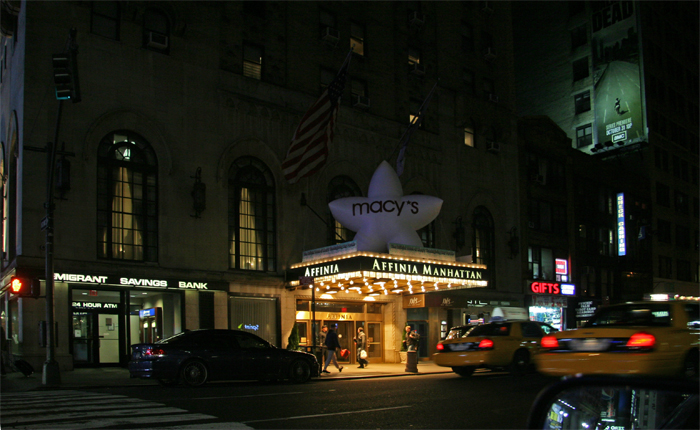
    I was neither homeless nor on the road. It was 1969, I was 18 and had been accepted to New York University. I had chosen a dorm and was very disappointed that my first choice, Weinstein Hall (the most modern), had been rejected. I was to stay at the older Brittany Residence, a former hotel, under renovation and not quite completed. As an interim measure, for a few weeks, we were housed at the Penn Garden Hotel* on 7th Avenue at 31st Street. I was later to learn that the Brittany, with its prewar ambiance and much larger rooms, was actually highly preferable.

    I entered my hotel room and met my roommates. I had never shared a room before either, having grown up with two sisters, so this was another adjustment to be made. We chatted a bit.

    It was evening and I was hungry. I had never eaten out alone, had little money to spend on dinner, and I did not want to stray far from the hotel. I recall going to a place resembling a diner and eating at the counter.
    Things were expensive here. I could not afford a real dinner, so I ordered cheesecake and a soda. Although a poor meal, on reflection, a slice of New York style cheesecake was quite befitting. My first day trips to the city involved more notable restaurants such as the Albert French Restaurant at 65 University Place, dating to 1868 and once a haven for writers including Thomas Wolfe, Nathan’s at Times Square, or Luchow’s on 14th Street. This place, however, was of no import and, as is often the case for a New Yorker, decided on the basis of proximity.

    The identity of the restaurant where I first ate on that evening in 1969 shall remain unknown to me, and assuredly it was not the “best cheesecake in New York City.” But it was only my first night, and there would be plenty of time to ferret out the good, the better, and the bests in Gotham City. Street cred would come in time, and for the newbie in New York, I could have done worse than a slice of cheesecake…

    *The Penn Garden Hotel has gone through numerous incarnations in the last 40 years. The thirty-two story structure was designed by the architects Murgatroyd & Ogden and built in 1929. It was originally called the Hotel Governor Clinton, named for George Clinton (1739-1812), the first governor of New York State. In 1967, the name was changed to the Penn Garden Hotel. In 1971, it became Southgate Tower, and in 2004 the Affinia.


  • Keuffel and Esser


    There was nothing that struck fear in the hearts of many high school students like the slide rule. I could never really understand, because I loved mathematics and my slide rule. But so many seemed terrified. Perhaps it was all those numbers.

    Admittedly, the whole device is rather arcane looking – scales with tiny divisions and numbers completely cover both sides. The slide rule is an analog device, and numbers can be read to only three significant digits without any reference to magnitude. In other words, 123 is the same as 12.3, 1.23, .123, etc. So interpretation of answers requires keeping note of and calculating (often just using memory) the magnitude of the answer, which is only a series of digits – i.e., you need to know where to put the decimal point.

    The slide rule was used for multiplication, division, and for functions such as roots, logarithms, and trigonometry, but not for addition or subtraction. These are precision instruments and require careful use – unlike a digital calculator, answers can vary depending on the skill of the user. Keuffel and Esser introduced them to the United States, and I am proud to own one.

    The Keuffel & Esser Co. was founded in 1867 at 79 Nassau Street by two German émigrés, Wilhelm Johann Diedrich Keuffel and Herman Esser, as importers and jobbers of European drawing and drafting materials.

    Early on, the firm was successful and continually expanded, moving locations several times. 4 K&E tentatively started manufacture and published its first instruments catalogue in 1870; opened its first retail store with a showroom in Manhattan in 1872; transferred its manufacturing to Hoboken, N.J., in 1875; moved its headquarters to 127 Fulton Street in 1878; and constructed a new factory building in Hoboken in 1880-81 (which was expanded in 1884, 1892, and 1900). The firm was incorporated in 1889, with Keuffel serving as president until his death. K&E, which had introduced imported slide rules in 1880, began their first American manufacture in 1891. The company became strongly associated with the product as the nation’s foremost manufacturer, credited with popularizing slide rules in the United States. In 1892-93, K&E constructed a new building at 127 Fulton Street to serve as its retail salesrooms and general offices.

    K&E played a nationally significant role in the technological development of the United States. K&E products, which included measuring tapes and compasses, were used in countless construction and engineering projects, such as the Brooklyn Bridge, of the post-Civil War boom years, and K&E surveying equipment is considered to have been critical to the westward expansion and development of the country.

    K&E’s offices and salesrooms had been located at 127 Fulton Street since 1878. This address was close in proximity to the financial district and the offices of many architects and engineering firms. Over the next 13 years,“business increased, doubling and redoubling in volume, year after year,” leading the firm to require larger quarters. In May 1891, the architectural firm of De Lemos & Cordes filed for a new 8-story (plus basement) Keuffel & Esser Co. Building, to house the company’s primary retail salesrooms and general offices. The nearly 25-foot-wide, fireproof steel-and-cast-iron-framed structure was completed in February 1893.

    By 1930, the K&E catalogue carried over 5,000 items. You can read more about the building, its history, and the company here.
    The 8-story building’s upper stories are clad in buff brick and terra cotta. The base has an historic 2-story cast-iron storefront, framed by colonettes with spandrels bearing small shields, the company’s initials, and representations of its products. K&E vacated the premises in 1961. The property will be converted to residential condos.

    A slide rule was the engineer’s tool and companion, often carried in a leather case which could also be used as a belt holster. You can see my original Keuffel and Esser slide rule and molded leather case in the photo. After reading the history of K&E, I am duly impressed, and I have a newly acquired reverence for that slide rule I have, made by Keuffel and Esser 🙂


  • Slammed

    Posted on by Brian Dubé


    Many will extol the benefits of spending the summer in the city. They will tell you of all of the wonderful events, many free, how much less crowded things are, and how tickets for events are more easily available since many New Yorkers are away. This is all true. But a long wait on a subway platform or a walk in the blistering heat amid concrete and garbage will quickly reveal why so many are away and you have the “city to yourself.”

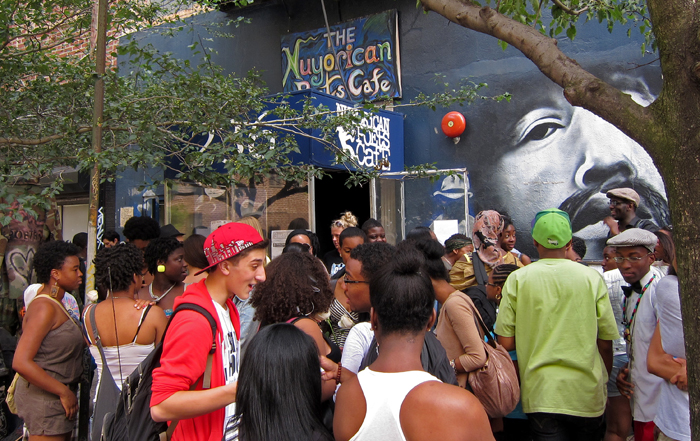
    I was really not very enthused about trekking all the way to 236 East 3rd Street between Avenue B and C in this type of heat and humidity to go to the Nuyorican Poets Cafe, where Urban Word NYC was sponsoring the Regional Teen Poetry Slam. A segment about this event had appeared that Sunday morning on TV. The host, an older white man, was extremely effusive about the poetry of a young person who was part of the event. He read some of his work. I was impressed.

    I respect poetry and I have read things I like, but I do not seek it out. This event looked to be some hybrid between rap and poetry, written about issues germane to kids a fraction of my age. But why not give it a try?

    It was so hot, with the kind of humidity that makes your skin crawl, and a shower is really just a foolish formality – undone the moment you set foot on the street. Surely it would not be crowded. Who is left in the city on a hot summer’s day, and who will venture out to the East Village on Sunday at noon to see poetry?

    We were the first and only ones in line, and although the prospect of waiting 30 minutes in the heat was very unappealing, after making the schlepp, my companion and I decided to wait. Soon, kids began to arrive and fraternize on the street – apparently many were known to each other in this subculture. I met the DJ and took his photo. By 1 PM, when the doors opened, the line had increased sizably.

    The space itself had been reviewed negatively by some online, so I imagined a seedy basement space with no A/C. After paying a nominal $7 admission, we entered the space itself, which was a big surprise – clean, cool, and comfortable. We had a choice of tables and were joined by a couple who were New York City High School English teachers. They had attended many poetry slams here before and had even brought their classes. They assured me that I would be very pleasantly amazed. Soon the room became full, and in no time, every table was taken and people were sitting on the floor or standing.

    My attitude was already changing.

    I thought that after four years of writing this blog that my skills and command of the English language had improved and that I aspired to becoming a wordsmith.
    Until Sunday.

    The command of the English language, the vocabulary, the insights, the creative writing, the rapidity of delivery, the rhymes, the rhythms, the memorization skills, the passion and theater were all nothing short of astounding. I was awed by these teenage kids.

    What really struck me was that, when examined closely, this entire activity was a celebration of the word. The event was sponsored by Urban Word NYC. Linguistic fluency and interest in language and writing is not a common association made regarding inner city youth. This phenomenon is really flying under the radar. It left me slammed…

    Note: Technically, this event was a slam, and like all poetry slams, that means a competition. Winners will go on to Los Angeles for the national competition. However, it was announced early on that the competitive aspect of the event was not the focus. This was a regional event, and teams had come from Connecticut, Boston, Philadelphia, and the home team from New York City. Poetry slams are regularly performed in New York City. The leader in this art form has been the Bowery Poetry Club. You can read my posting about it here.

    Posted on by Brian Dubé

  • Kids

    I was invited to be a speaker for career day at a New York City public school – PS 124, the Yung Wing Public School at 40 Division Street in Chinatown. This was both exciting and harrowing – I had never been in a public school in the city, and I also had never spoken before a class. I had written notes and a rough agenda, which were soon abandoned for a more organic approach.

    The teacher who invited me was a former employee who, in May 2008, brought her class to my business for a field trip. That visit was filled with screams and squeals of joy. It was mutual adoration day. You can see that story and photo here.

    Yesterday was a very different experience. It has been a long time since I have been in any school, and, good students or not, the kind of playfulness I saw on the field trip was reigned in by the school/classroom structure and atmosphere.

    I made 3 short presentations to 4th graders – classes were rotated while presenters were stationed in various classrooms. Afterwards, I stayed and observed one of Judy’s classes with second graders. Maintaining discipline and focus is a daunting task – constant vigilance is needed. Many of the kids were distracted, and controlling the talking seemed to be an unending battle. I can see why teaching children appears to be the domain of the young. Teacher burnout is a well-known phenomenon for many good reasons – poor school resources, low pay, workload, student discipline, and high expectations for test scores and from parents.

    A fascinating piece of technology was the SMART Board interactive whiteboard, which uses touch technology to detect user input and a projector to display a computer’s video output, including Internet access. Digital pens and erasers replace traditional whiteboard markers and erasers. I used it to display one of my blog postings and also to simultaneously write a few words. Judy used the Smart Board in her class to display a countdown clock from the Internet for their 25-minute quiet reading period. The level of sophistication is very high – when I asked if anyone was familiar with Netflix video streaming, almost all raised their hands.
    I was particularly impressed with the children’s poetry work and the list of things that could be found in a poem – you can see it here in my complete gallery of photos.

    I think I was quite unrealistic about my expectations – I suffered the idealism of a new teacher. As I left, I passed by the lunch room – the din was just incredible. It occurred to me that I had forgotten that these were good kids, just doing what kids do 🙂


  • dinamic_sidebar 4 none

©2026 New York Daily Photo Entries (RSS) and Comments (RSS)  Raindrops Theme