• Category Archives fashion
  • Fashion Trash

    I was getting a sewn product from Asia and was looking to do a variety of colors. The prospect of getting samples and small production runs was not good, and I decided to try a novel approach – buy fabric samples in the garment district and get a recommendation for a local sewing factory. Armed with my pattern and fabric, I made a visit to a factory at 38th and 8th Ave.

    The owner quickly assessed the situation, asking for the pattern and fabric and if I had time to wait. I had samples within minutes, something that would have taken weeks sourcing outside the country. I now fully understood the beauty of local sourcing and manufacturing, at least for the sample phase. And in my case, this man’s prices were actually competitive to do production for us.

    Many worry that there is less being created or produced in the United States and that the country is becoming more and more a service economy. With soaring real estate costs, New York is even more in danger of becoming a place defined by tourism, consumption, and little production. Where, as said, we are in danger of becoming a place where we sell one another ice cream cones or rent one another motel rooms.

    Fashion is one of the surviving industries, not just the design, showroom, and sales side, but there are still factories and production in the garment district. New York City is the fashion capital of the world. There are more than 5,000 active showrooms (more than any other city in the world), over 6,000 wholesale and design businesses, 58,000 industry workers, and annual sales of $38.7 billion. There are educational institutions with well-known design schools – Pratt Institute, Parsons New School for Design, and Fashion Institute of Technology (FIT).

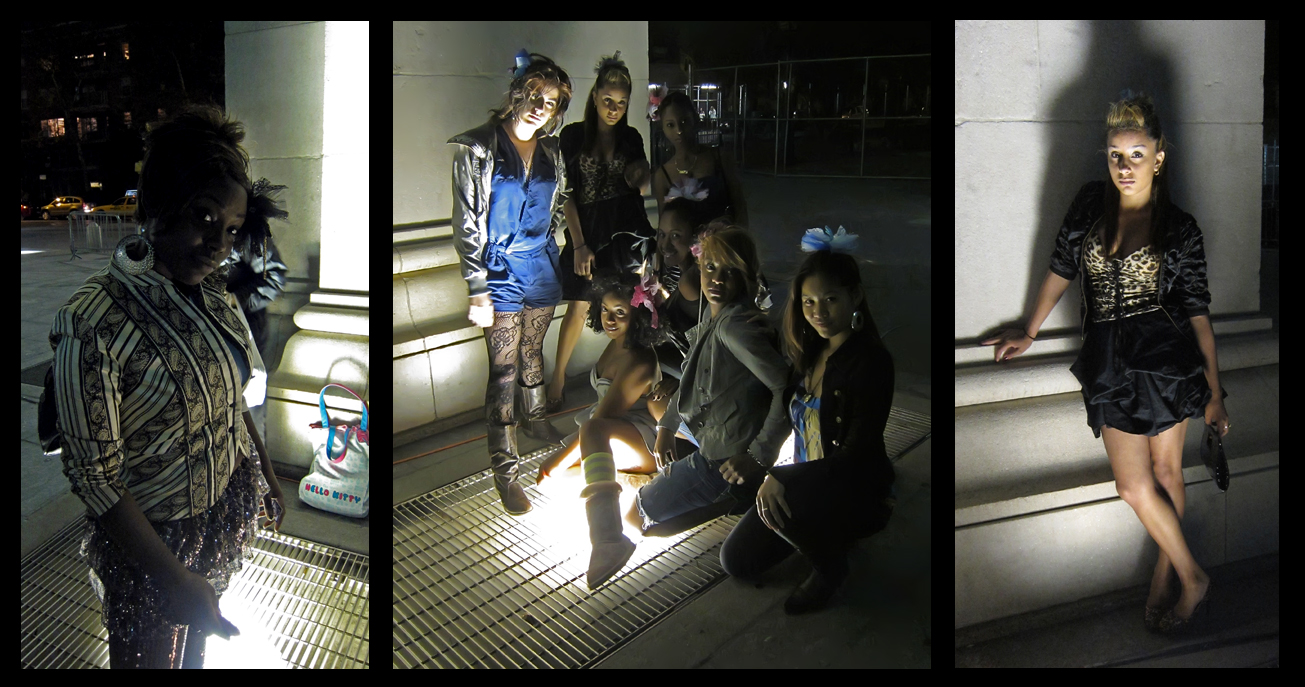
    As I wrote in Creative Expert, I am forever running across people who identify themselves as fashion designers. Recently, I ran across a group of women modeling at night in the harsh spotlights used to illuminate the Washington Square arch. I once posted a story about an amazing couple performing singing bowls under the same light.

    This group was the model entourage of Latesha Pryer, a designer from Jersey City, with her company Fashion Trash and clothing lines such as Dumpster Rags.
    I was encouraged to see young people interested in production of goods, even if they are not the engines of industrial manufacturing. Rather than selling one another ice cream, better to see some Fashion Trash 🙂
  • One Size Too Small

    There may be comfort in old shoes, but not in my old shoes. I have a beautiful pair of white bucks by Cole Haan, one of the few impulsive extravagances of my life. The purchase was encouraged by my sister and her husband on a Madison Avenue shopping spree while visiting New York City. Buy them, they said. You never do anything good for yourself. True, but not a full size too small. What was I thinking?
    The shoes have been professionally stretched several times. To no avail. So, lest I want to become crippled, they will stay in my closet. On another occasion, while trying on a new pair of shoes, a salesman just glancing at me from afar told me that the shoe size I had selected was definitely too small. I purchased them anyway.

    Why would I do such a thing? I am convinced it is a family obsession, inherited from my mother, who was adamant about not wearing shoes that are too big. Pondering this over many years, I have a suspicion that this may have come from being brought up in a poor household and the stigma of hand-me-downs. But I don’t care how tight they are. I’m not giving up those Cole Haans.

    I just read an article: Nobody wants your old shoes: How not to help in Haiti. This had to do with the ineffectiveness of the transport and distribution of goods in a relief situation. However, I am sure the title would be heartily embraced by my family. They are happy donors but, outside of family members, no old shoes for them.

    Many individuals are not enamored with the prospect of wearing other people’s shoes or clothing, but for those who are, there can be tremendous value in shopping for used merchandise. The world of fashion is built around newness. In the case of technology, the quest for the new leaves mountains of yesterday’s products (like CRT computer monitors), often for the taking.

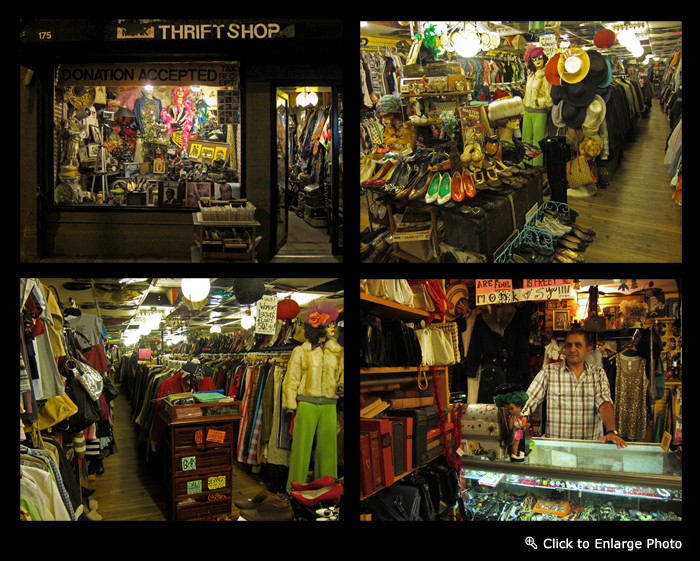
    Although it is a seemingly unlikely place for thrift shops, they do exist in New York City. Salvation Army had a location on 8th Street in the Village which recently closed. Monk, at 175 MacDougal, has been a fixture in Greenwich Village since 1993. One of three stores, it is owned by Tarek from Egypt. All donations are accepted – things not used in the store are donated to churches.
    In Consumption, I wrote of the three Rs of waste management – Reduse, Reuse, Recycle. Unfortunately, in a culture where shopping is a national pastime, the first two Rs are largely ignored, and the third R, recycling, has numerous logistic problems and dubious benefits overall (see Recycling is Garbage from the New York Times).

    I just recently was given a number of beautiful new shoes by my father. The good news is that we are the same size. The bad news, as you probably guessed, is that my father seems to have the same affliction that I have. We have shuffled undersized shoes between us for decades. Family visits and the holidays might be better called The Tight Shoe Exchange.

    While the nation struggles with a mountain of debt, my father and I struggle with a hill of undersized shoes. As long as we keep buying those unwearable shoes, we are making no inroads with that second R of waste management (Reuse). I think my father and I should open a shoe shop. Look for a place called The Tight Shoe Exchange or One Size Too Small 🙂


  • Supercute!


    My first formal exposure to cuteness was an introduction to the website cuteoverload.com by a friend. The mere mention of the website by name, and I knew this had to be successful. I was immediately very irritated or, better said, jealous that I had not thought of it first.
    Kittens, bunnies, snorgling, puppies, and the whole panoply of obvious and non-obvious subjects qualifying as cute populate the blog, which receives over 40,000 visits per day.

    Some may bristle at cuteness, particularly in New York, a city that prides itself on being a center for sophistication and edge, with many self-appointed curators. But cuteness lovers will not be dissuaded, and even in New York City, lovers and embracers of the cute, cuddly, and adorable abound. And what does one do when hyper cuteness becomes deliberate and, in a way, with a splash of self-mockery, redefines what is edgy?

    When a colleague who does the social networking for my business discovered and brought to my attention the indie-pop band Supercute!, I was much more favorable to their brand of cuteness, as was everyone in our office. Was it that they redefined and remarketed cuteness in a novel way, or was it that I recognized the marketing potential of Supercute! for a product we all they were manufacturing, hoops?* Both.

    Learning also that Supercute! were residents of New York City, I immediately asked a staff member to contact them, acting out fantasies of the agent and power broker finding and signing the unknown talent and sleeping giant. Laughable in the age of the Internet, and also since these girls already had presence online and an active career with accolades from the public and press.

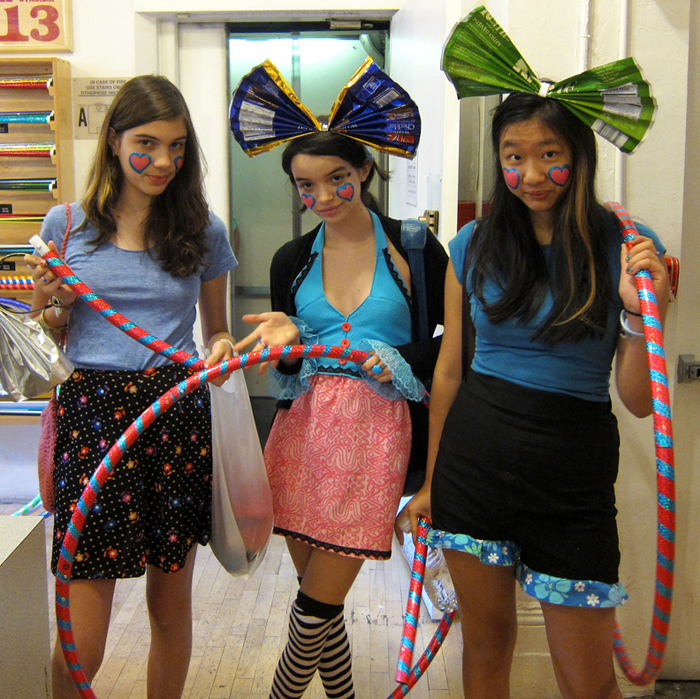
    Supercute! (Rachel Trachtenburg, June Lei, and Julia Cumming) was easily approachable, and a meeting was set up to discuss the possibilities of a mutually beneficial relationship, particularly with their hula hoop song.
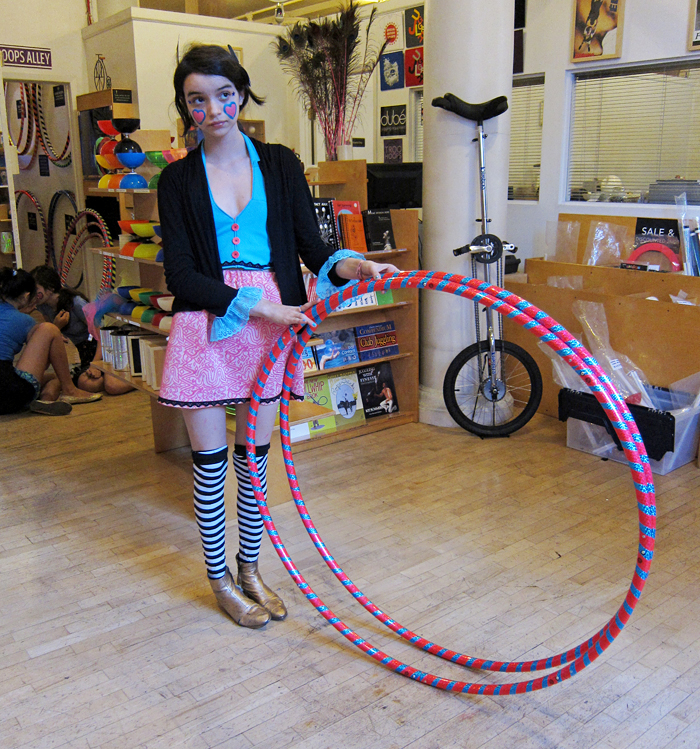
    Seeing them arrive in costume and character was a big and fun surprise. They were accompanied by Rachel’s mother, Tina, and June’s father and photographer, John Lei. The photo was from a recent visit, where we customized a set of hoops for the girls in their signature colors of pink and blue. Always the charmers, the girls arrived again in costume. While waiting for their hoops to be made, the girls busied themselves primping up in our showroom for a performance in a variety show that evening at the Bowery Poetry Club (see photo here).

    Supercute! was formed in 2009 by Rachel Trachtenburg, who has been performing since the age of six with her mother, Tina Piña, and father, Jason, as the Trachtenburg Family Slideshow Players. These girls are getting invaluable guidance from their parents’ professional careers and experience in a world where success is neither easy nor durable, even if you are Supercute! 🙂

    *You can find our website here and here with posts about what I do here: Signature, Juggle This, Spinning, Artiste Extraordinaire, Fish and Ponds


  • Hell. Part 3

    (This is the third and final of a three-part series. Find Part 1 here and Part 2 here.)

    Music has Charms to soothe a savage Breast and Hell has no fury like a woman scorned.*

    We had it all on Saturday – savages, breasts, fury, a scorned woman, music, fury, and a taste of Hell. Just the type of things a jungle lover would expect to find in New York City. And if you are going to enter the jungle smearing blood, you should be prepared for lions and tigers.

    There is no way that you can come to this city, set up in Greenwich Village, sing gospel songs, preach sin and damnation, and not expect a confrontation. The neighborhood is extremely liberal and very tolerant, except of being accused of sin and threatened with eternal damnation for their lifestyle.

    The model, Abigayle, had been provoked – she had been told that she was wicked and had been warned five times. She climbed on the shoulders of a young man, also body painted, and they approached the Mennonite group. It was fair to say that this couple taunted the crowd of Mennonites and the preacher, who launched into a diatribe regarding nudity, hell, and damnation while brandishing his bible. The man in body paint who had shouldered the model read and mocked parts of their leaflet, Boys and Girls & Fornication:

    Whether this confrontation on the part of the model and her supporter was justified was hotly debated. Some were infuriated and saw it as disrespectful and unnecessarily provocative. Others saw it as just desserts or as another circus act to be expected in the Village. At the end, the painted man reconciled with one of the visiting group and shook hands (photo lower right). Perhaps, after all, The road to Hell is paved with good intentions 🙂

    *Heaven hath no rage like love to hatred turned, Nor Hell a fury like a woman scorned. -William Congreve from the Mourning Bride, 1697. Music has charms to soothe the savage breast is also from the same work (the word breast is often misquoted as beast.)


  • Hell. Part 2

    (This is the second of a three-part series. Part 1 is here.)

    At the same time as our Mennonite friends were singing spirituals and preaching to the masses, just a few short steps across the central plaza in Washington Square Park, Andy Golub was busy body painting the nearly nude figure of a woman. See additional photos here.

    Andy is a visual artist who has been body painting men and women in and around New York City for years. You can see more of his artwork and body painting at his website here.

    Although women have the right in New York State to be topless in public, even in New York City, the site of nearly nude men and women in body paint will stop traffic and raise eyebrows. Societal norms have not yet caught up with legislation, and many are angered and perhaps certain that something should be done. Andy and his models, however, are breaking no laws, and even police officers still occasionally need to be educated regarding the legality of toplessness for women in public.

    When the time came and the model moved around the park grounds for various photo settings, a parade of male oglers grew in size, some with cameras, some without, running after her like hungry dogs chasing a rabbit.

    A number of the Mennonites were circulating the park crowds, giving out literature. I happened upon an old friend in the park, and while chatting, I jokingly mentioned that if they were looking to save souls, our model would, from their perspective, need it most.

    My friend took this comment to heart, approaching one of the women from the Charity Ministries and suggesting that she should perhaps consider giving literature to the near naked model – certainly she was the most needful. The leafleteer skirted the suggestion. One of their group referred to her as “wicked,” and another told her that she had been warned FIVE times – apparently there is no salvation for someone who did not heed that number of warnings.

    It became abundantly clear that our model was bound for Hell and eternal damnation, but a very unexpected confrontation ensued; tomorrow we conclude our descent into Hell (see Part 3 here)…


  • Hell, Part 1

    Note: This is Part 1 of a three-part series.

    One of the few family trips I made as a child was to the Amish communities based in rural Pennsylvania. Even coming from a rural area of New England ourselves, the Amish lifestyle, with the shunning of modern conveniences, left impressions that would last a lifetime.

    There is not much that provides a sharper contrast than such a group in traditional clothing in Washington Square Park. This is Charity Ministries*, a group similar to Mennonites. One of the founders, Mose Stoltzfus, was formerly Amish. I have seen them infrequently and was pleased to be able to take photos on this occasion.

    Regardless of any proselytizing or religious creed, there is a gentle and pastoral feeling to a group dressed as they are – the women with light blue and white dresses and the men in light colored khakis. It is as though an Amish farming community was transported through time and space to New York City. And I must say, the voices of the large chorus singing was not at all unpleasant, although hard to be heard above the park din, with competing music groups playing nearby.

    I browsed through and took some of their literature, with titles such as The Sin of Doing Nothing, Improving the Marriage Relationship, Lost in the Church, The Vice of Sexual Immorality, and Boys and Girls & Fornication. A colorful poster on an easel proclaimed Where Will You Spend Eternity? It seemed well-suited for the urban New York City visit, with businesses such as the Pennyless Casino, Abortion Clinic, the Broken Home Night Club, and Divorce Court, all located appropriately near Narrow Avenue and Broadway.

    It is hard to imagine why such a group would subject themselves to such a potentially hostile environment, but I would guess the reasoning is that of an evangelist, Dave, who some years ago used to preach in Washington Square Park on Sundays. When I asked him why he would choose such an inhospitable environment, he answered that he wanted to save souls, and what better place than Greenwich Village? I complemented him on his logic. If you can take the heat, certainly the Village is a great place to rescue the fallen.

    However, the words of this Sunday’s preacher fell mostly on deaf ears. Without knowing specifics, most passersby had a general sense of what this Christian evangelist message was about, and the feeling was not today, thank you. Especially when there is a plethora of competing activities, one that literally made most eyes pop out. There was talk of Love and God and Christ. But as you will see tomorrow in Part 2, we descend into Hell 🙂

    See Part 3 here.

    *Charity Ministries was founded in the 1980s by Denny Kenaston and Mose Stoltzfus and is based in Ephrata, Pennsylvania. They publish a magazine called Heartbeat of the Remnant. You can visit their website here.


  • Urban Road Warrior

    Posted on by Brian Dubé

    I thought I had seen the extremes in high heel elevations in New York City, but in reading various articles, I came across the “armadillo” stiletto claws designed by British fashion designer Alexander McQueen as part of his Spring 2010 Plato’s Atlantis shoe collection. These shoes, which number only twenty-one pairs and range from $3900 to $10,000, were worn by Lady Gaga in her “Bad Romance” video.
    The shoes are a staggering 12 inches tall, perhaps the first where height can be measured using an altimeter. Some models refused to wear them, worrying about potential falls.

    High heels themselves are mired in controversy. They are responsible for a litany of health concerns: foot pain, deformities, sprains, fractures, and degenerative knee joint problems. But their allure remains – heels make a person appear taller, legs longer, the foot smaller, and they make leg muscles and the butt more well defined. They alter the posture for a sexier gait.

    Some see other reasons for their popularity:

    There are many theories about sartorial behavior as an economic indicator. In dark times, hemlines go down. Lipstick sales go up. And high heels grow ever higher, an attempt to lift our collective spirits by elevating women a few extra inches off the ground. – Amanda Fortini, The New York Times, December 13, 2009.

    In New York City, we are walkers, and, unlike the suburbs or countryside, the prospect of using shoes which depend on the wearer being transported by auto to and from destinations is largely not realistic.
    But lack of comfort for extensive walking is not the only impediment to wearing high heels. New York City is mired in land mines for the woman wearing heels and engaging in the daily slalom of potholes, sidewalk grates, uneven sidewalks, and subway stairways. The extraordinarily treacherous pedestrian trails make walking more difficult, and the harsh environment guarantees to eventually tear and damage fine shoes. Solution? Simple – wear flats or sneakers on the streets, and change to heels at the office or function. Some women tote dress shoes in their bags, while others may just keep a pair of heels in the office.

    However, arriving at the office in old flats or sneakers does little for a woman dressing for success or allure. Like the woman in today’s photo, changing on the streets is one way of keeping the wardrobe intact for the urban road warrior 🙂

    Posted on by Brian Dubé

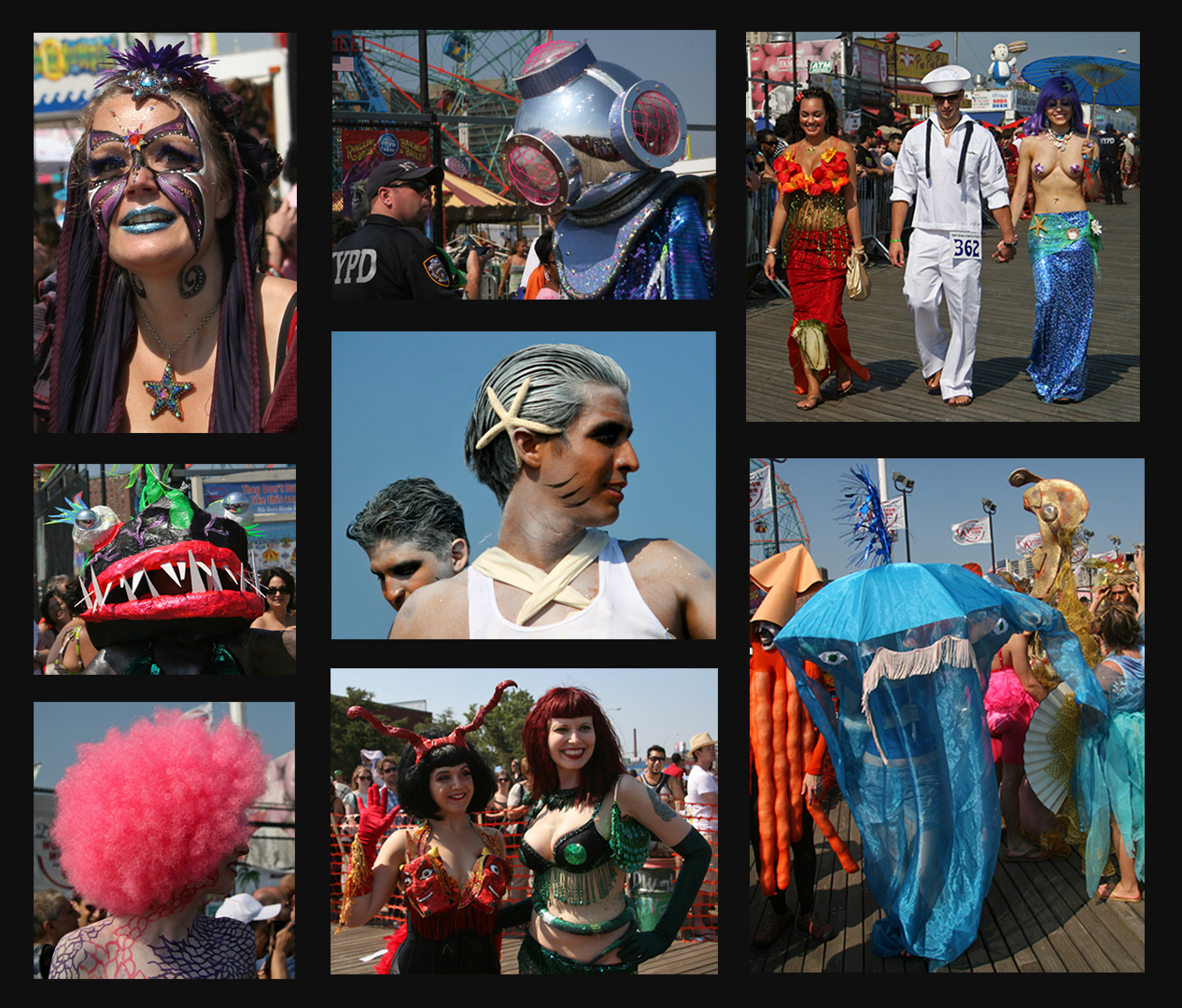
  • Mermaid Parade 2010

    Posted on by Brian Dubé


    I have attended the annual Coney Island Mermaid Parade for the last four years. It is one of the most enjoyable parades in New York City. This year, the weather was extraordinary and the turnout enormous. Please visit my photo gallery of the event here.

    Previous Mermaid Parade posts: Mermaid Parade 2006 P1, Mermaid Parade 2006 P2, Mermaid Parade 2007 Part 1, Mermaid Parade 2007 Part 2, Mermaid Parade 2009

    Posted on by Brian Dubé

  • Lowriders and High Riders

    Posted on by Brian Dubé

    When friends of mine once returned from the Southwest, I was astounded to first learn about Lowriders – vehicles outfitted, some with all manner of hydraulics, to be lowered as much as possible. There are High Riders too. But why would anyone go through all the work to do such things?

    There are many profound mysteries yet to be solved, but on Sunday, my questions were rather mundane. Why were these particular men together? Were they all widowers? What were they chatting about – women, the sorry state of the world, how things used to be better, or how the mores of youth have declined? Why was there one rebel who wore shorts and sported khaki instead of pants and the requisite gray and white?

    Other mysteries abound, particularly, why do so many old men wear their pants so high? Online forums give a myriad of intriguing and plausible reasons with no consensus. The best answer seems to be that the men shrink in old age but continue to wear the same size pants, necessitating that they hike them up to fit. Others cite osteoporosis and the decline of hips, increasing waistlines, and diminishing buttocks. Of course, these men may rightly retort, why are so many wearing their pants absurdly low? Is there something more inherently fashionable about Lowriders than High Riders?

    Amidst all the glam and glitter, the presence of many ordinary things can be easily overlooked in New York City, such as poverty and the aged. Examining the demographics of New York City in the census report reveals how atypical the city population is from the country at large in many respects. In race and ethnicity, 44% of New York City is white (75% in the USA), 27% black (12% US), 10% Asian (3.6% US), and 27% Hispanic (12% US).

    Other statistics, however, show little variation from the United States population – particularly age. About 12% of both New York City (and the United States) is over 65 years of age. That’s a lot of older people – about one million people.

    Many New Yorkers, like myself, have never had a desire to live in Florida. One can never be sure of how the future will unfold and how desires might change, but I also do not aspire to retiring in Miami Beach. Fortunately, if I want to see retired old men congregating near the ocean, I only need to make a trip to the Brighton Beach boardwalk. And if there comes a day when I want to wear my pants real low or I have to hike my pants up, I know I can do it right here 🙂

    Posted on by Brian Dubé

  • Very Resilient

    Posted on by Brian Dubé


    This store, like Crocs themselves, has and will continue to attract critics. The thing that has made this project particularly contentious is that this building at 143 Spring Street, previously the home of Tennessee Mountain Ribs restaurant, was in serious disrepair – work did need to be done. So the criticisms gravitate towards the architectural details of what has been done and, of course, the presence of Crocs in SoHo.

    There have been many articles about the building since Crocs’s acquisition in 2006 and several articles since their opening on Saturday, May 8, 2010.
    Built in 1818, the Federal era 192-year old, three-story structure is listed on the National Historic Register. In the 1970s, it was combined with a 1925 garage building. The reconstruction project was done by architect William J. Rockwell. The exterior wooden clapboards have been replaced and the south face re-bricked (salvaging some of the older brick.) Much of the interior beam work is original.

    Many were perplexed about the lengthy process in development – Crocs acquired the property in 2006. The building has landmark status, which makes any work a formidable and lengthy process, resulting in the appearance of neglect by Crocs in the first couple of years of acquisition before construction began. Crocs, Inc. is not the landlord – the property is owned by Abba 1 Realty LLC, and Crocs, Inc. has a 20-year lease (handled by Robert K. Futterman & Associates, LLC).

    The greater mystery for many is how Crocs remains in business. Their very existence in the marketplace inspires violent outcry from some critics. There is a subculture of haters with blogs and websites decrying Crocs, such as ihatecrocs.com. They have been the object of satire on shows such as The Daily Show and Real Time with Bill Maher. The fashion industry has had its own critics, with many considering the shoes a fashion disaster.

    But Crocs is another success story in the ugly shoe movement – Uggs, Birkenstock, and Crocs have all been massively successful in spite of critics, detractors, haters, websites, and comics. Comfort has been a big factor in the success of all of these brands. In the case of Crocs, their proprietary Croslite foam* is a big feature.

    Adoption by celebrities has fueled the popularity of Crocs. Chef Mario Batali was an early user in 2005 – the waterproof shoe in tandem with its comfort was perfect for working in a commercial kitchen. His bright orange Crocs are part of his signature appearance. Michelle Obama has been seen with them as well. The Niwot, Colorado-based company now sports over 100 shoe styles and has sales averaging $200 million dollars per quarter. They are sold in 125 countries and 6,500 outlets in the USA.

    There is something about that Croslite foam that appears to be very resilient 🙂

    *Croslite is a closed cell EVA foam developed by the Canadian company Foam Creations. The closed cell structure inhibits bacterial and fungal growth and resists odor. The material conforms to the shape of a wearer’s feet, has extraordinary impact absorption properties, and is reported to reduce fatigue and other medical benefits. Scott Semans, George Boedecker, and Lyndon Hanson bought the license for the material and introduced Crocs at the Ft. Lauderdale Boat Show in 2002 (this shoe was an improved model of a boating clog already in production by Foam Creations). In 2004, Crocs, Inc. purchased Foam Creations. They hold four patents and constantly have to defend from “Croc-offs.” The name Crocs was short for crocodile – the shoes, like the reptile, were fit for both land and water.

    Posted on by Brian Dubé

  • Swaggertist in Blue

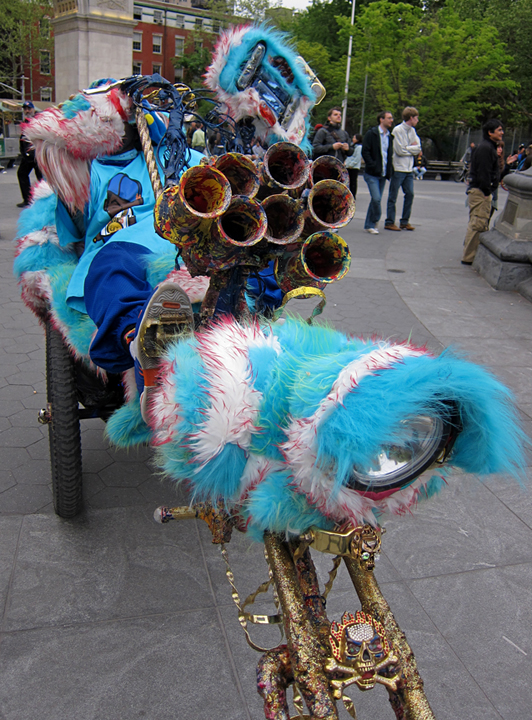
    Where would you find a man who is a roller skater, saxophonist, writer, composer, recording artist, and inline skate trainer, who had a hit single on Billboard for 13 weeks (“Funky Bebop”), has a Masters degree in group therapy (with work done towards a Ph.D), and travels on an outrageous fur-covered trike? In New York City. See additional photo here.

    And, of course, a man with this many incarnations would be expected to have had as many names – Bladie aka Bladie Flowness, Vin Zee, Vinzerelli, Vincent Brown. Now reinvented on his trike as the Swaggertist. I cannot attest to all his claims, but it would be fair to say that the man is a one-man self promotional campaign on wheels.

    Bladie was involved in musifying the roller skating scene in Central Park, what he calls the ultimate dance party on wheels. The New York Times wrote: “There are the old-timers, like Bladie Flowness, who has dreadlocks and a dyed beard and sails against traffic doing tai chi in multicolored Bedouin pants.”

    After meeting Bladie and introducing myself, Bladie gave me one of his music CDs and a DVD compilation of various clips of him. This bike is not his first, and he has been known for colorful dress since his early days on the skating scene.

    However, it takes more that just chutzpah, bright colors, and a turquoise fur-covered trike to become successful or get attention in New York City. Although Bladie certainly gets attention when he cruises the city, park regulars barely give him a glance. After all, he has to compete with Piercing Al Fresco, Hector, André (Out There), Spike, Narcissism Gone Wild, Water Sprites, Wood Nymph, the Misfits, the Dance Parade, Flamboyant, the Krishna Fest, the Dyke March, Singing Bowls, Eight Twenty Five, Twelve Tribes, Penny Farthings, Superheroes, Snake Charmer, Circus Amok, and Fashion Forward.

    And Bladie has plenty of musical talent to deal with. For now, Gershwin has not to worry about the Swaggertist in Blue 🙂


  • BAPE, Wangsters and Hypebeasts

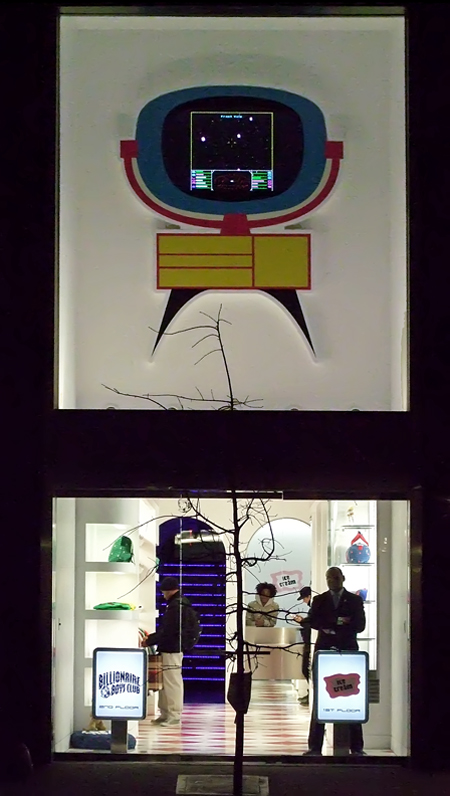
    A story was already forming in my mind as soon as I saw this Billionaire Boys Club shop in SoHo at 456 West Broadway. I was going to write how, in my experience, you can not manufacture or create a cachet, a sense of exclusivity, or a cult following. These things have to develop organically over time, with proven product or content.

    The name of this store reminded me of Members Only jackets and the belief that the mere proclamation of exclusivity was enough to confer it. Ironically, I have learned that there is a cult following for Members Only jackets.

    But perhaps the nature of time itself has changed, as well as the definition of natural evolution. There is a lot of talk online amongst marketers about creating BUZZ – i.e. the very thing that traditionally was something that came naturally as a product, service, or company proved itself over time. But no one has the time or patience for natural evolution. And there is the reality of an extremely dynamic world market with rapidly changing tastes, global competition, love of new things, and technologies to display everything instantaneously.

    Can you brand, market, and, with enough muscle, jump start an image and reputation? It certainly has been tried, with varying degrees of success. One big key, of course, is the leverage applied using notable figures, either as customers or as the company ownership. Another technique is to limit quantities and sell at high prices. These ingredients obviously do not guarantee success, but as a business model, it makes more sense than a me-too approach and competing on price against established merchants.

    Billionaire Boys Club and Ice Cream are two lines of high-end sportswear established in 2005 by Pharrell Williams of The Neptunes and Nigo, designer of the clothing line BAPE and founder of the company in 1993. So, to further complicate this story, we do have some legacy here, not just overnight buzz.

    In reading reviews about the Billionaire Boys Club and Ice Cream, I became lost in an endless chain of hypertext links of brands, products, stores, people, and words unknown to me. A review from Yelp.com:

    Yes folks, this even outdoes the BAPE toilet paper as an all time low. … A virtual ghost town of hypebeast products and overstaffed employees was all I witnessed.

    So I need a new vocabulary. I learned that BAPE, A Bathing Ape, is a clothing line, SoHo store and an adjective, and I learned the meaning of hypebeast, but my education is far from complete. Looking up BAPE in the Urban Dictionary returns seven definitions, including:

    A Played out Brand by Nigo from Japan, rocked by wangsters and hypebeast.

    Now I had to learn what wangsters are. Fortunately, I have review sites, forums, blogs, and the Urban Dictionary. I have a lot of reading to do 🙂

    Note about the store: The ground floor features Ice Cream, and the second floor, which resembles the interior of a space ship, carries the Billionaire Boys Club line. The prices are extremely high – Tees for $80-$100, hoodies for over $200…


  • Surrounded by Fur

    In the 1980s, I was a strict vegetarian. One day, I met a friend and his girlfriend on the street. I am sure my friend’s girlfriend anticipated a chilly comment as I stroked her fur coat and asked what it was. It was not a rhetorical question at all nor meant to be sarcastic. I really had very little experience with fur, and this was the most remarkable thing I had ever felt.

    She told me it was seal. I don’t recall how I responded, but I said very little and tried to be as diplomatic as possible. I am sure that she was well familiar with the the anti-fur sentiment and did not need any education concerning animal rights on 8th Street in Greenwich Village.

    It could be worse. During the same period, I met a woman at a vegetarian restaurant who showed up in a full-length fur. I was aghast – this was the closest I had ever come to testing the limits of free expression. I warned her to be prepared for some form of verbal assault by any of the customers who would certainly find the wearing of fur offensive. Fortunately, and to my surprise, there were no accusations or wars of words.

    Furs and the fur industry are a highly contentious matter. I recently photographed an anti-fur protest outside Max Mara in SoHo, but I decided not to post them on this site because the posters being displayed were so disturbingly graphic.

    Kaufman Furs is located at 232 West 30th Street in the heart of the fur district and is one of the larger and older furriers in the city. On their website, I see a “Dare to Wear” link soliciting models. One way to handle the fur controversy at this point in time, I suppose, is by offering a challenge to models willing to brave public anti-fur outcry. In the August 2008 issue of French Vogue magazine, there was an anti-fur backlash editorial piece called “Fashion Reality,” featuring sexy and semi-nude models in furs, apparently echoing the “fur is back” campaign of the 1980s.

    Some countries, such as the United Kingdom and Austria, have banned fur farming altogether. A lot of fur farming has moved to China, where there are essentially no regulations. Some reports appear to indicate that fur sales are on the rise and are at all-time highs. One way or another, I feel surrounded by fur…

    In 2006, I took a photo of a series of Barbie dolls in furs on Houston street in SoHo.


  • Barbie Girl

    Barbie turned 50 in 2009. According to the New York Times, all 1120 tickets to this year’s celebration in July were sold out within two days after going on sale in July 2008.

    Although officially born in Willows, Wisconsin, I like to think of Barbie as a New York City girl since her birthday is based on her original debut at the International Toy and Trade Fair in New York on March 9, 1959. She attended the fictional Manhattan International High School, based on the renowned Stuyvesant High School.

    The Barbie doll was created by Ruth Handler, the wife of a Mattel co-founder Elliot Handler (Ruth later went on to become President in 1967). Ruth was inspired by her daughter, Barbara, who preferred playing with paper dolls. The design itself was based on a German fashion doll called Bild Lilli (1955-1964), who in turn was based on the German comic-strip character Lilli.

    An icon this huge will, of course, garner its share of controversy, parodies, and comedic spins. Mattel does respond and change her image. Her original physique at 1/6 scale, Barbie would have been 5′ 9″ with measurements estimated at 36-18-33. A 1965 Slumber Party Barbie book entitled How to Lose Weight advised, “Don’t eat.” This gave way to the term Barbie syndrome. In 1997, Barbie’s body mold was redesigned and given a wider waist.

    Barbie is multifaceted. She has had over 40 pets and has owned a wide range of vehicles, including pink Corvette convertibles, trailers, and Jeeps. She also holds a pilot’s license, operates commercial airliners, and serves as a flight attendant. Barbie’s life shows that women can have many careers, including Miss Astronaut Barbie (1965), Doctor Barbie (1988), Nascar Barbie (1998), and an Olympic swimmer.

    In 1997, Mattel filed a defamation lawsuit against MCA Records over the bubblegum pop song “Barbie Girl” by Danish group Aqua. The song was a parody of Barbie and Ken with lyrics loaded with sexual innuendos, such as “You can brush my hair, undress me everywhere.”

    Barbie does keep up with the times. In the most ironic twist ever, Mattel just released its own version of the offending song, renamed The Barbie, using the same melody and some of the same lyrics to promote Barbie Fashionistas – you can see the video here.

    I met the young girl in the photo in August in Washington Square Park. She was sporting an entire Barbie-inspired wardrobe, from head to toe, including a medallion necklace with the letters “BFF” (best friend forever). Now that’s a Barbie Girl 🙂

    Barbie is also an animal rights activist. See my story – Barbie in Furs.


  • Pomp and Circumstance

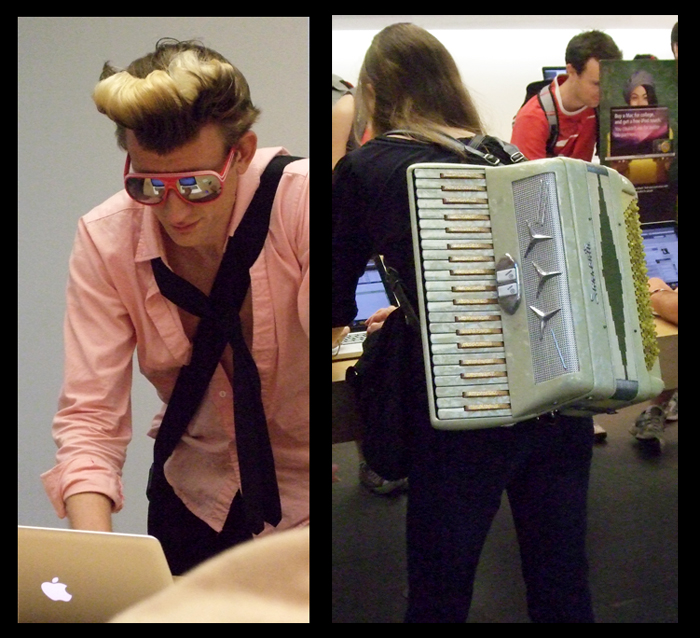
    I have a number of questions when I see people like this, particularly the man with the quiff – questions such as “Where are you going to go looking like that?” and “Where do you work?” Yes, on a Saturday night out or while shopping at the Apple store, you do look cool as hell, but once the novelty wears off at the workplace, who wants to be looking at this day in and day out? Even as a freelance associate or fellow artist, this is going to get old pretty fast. Are you going to be able to hold a conversation with this man and not be distracted by pink glasses, a pink shirt, and a blond-tipped pompadour that looks like the surf’s up at Malibu Beach?

    Now an accordion on your back is much more of a temporal and transitory thing. It’s really just an unusually large accoutrement which is likely not worn this way at home or at the workplace. There is a very good reason this woman is using an Apple computer with an accordion on her back; I just don’t know what it is. She probably was just playing her instrument or will be playing it soon. Or, perhaps she can’t afford a case. Perhaps she doesn’t want a case and finds it more convenient to carry on her back. Perhaps she wants people to know she is an accordionist.

    There are few stores in New York City with as self-assured an attitude (both from the staff and customers) like that of the Apple Stores. Some may bristle at the cult-like atmosphere – there’s a smugness of Apple users as being in the know, using the tool of choice, and willing to pay a premium for it. Iconoclasm has historically been a defining characteristic of both the company and its core adherents.  Apple has had a dominant role in the art community from early on. Under the circumstances, pompadours and accordions fit right in 🙂

    Photo Note: These photos were taken at the Apple Store in SoHo. Both individuals were in the store at the same time. Apple has an extremely liberal attitude regarding use of their computers. All have high-speed Internet access, and no restrictions are placed on use or time. Many stop here to check email or for any other variety of uses.


  • dinamic_sidebar 4 none

©2026 New York Daily Photo Entries (RSS) and Comments (RSS)  Raindrops Theme