• Category Archives Rebels of NYC
  • Hide and Seek, Show and Tell


    There’s a brilliant and frustratingly absurd Monty Python comedy sketch called Olympic Hide and Seek. One competitor is allowed to travel by any means and hide anywhere in the world while the other competitor counts to one thousand, then begins to search. Winning times are over 11 years.

    Whether you are in the real world or that of Monty Python, if you are looking for hide and seek activities which are not mainstream, success is usually found in the geographical edges and neglected fringes. The balloon of conformity and mainstream behavior presses the unconventional and unaccepted into the edges, corners, fringes, and remote hinterlands of the landscape.

    Look at the large gay communities in the United States. Many are located in remote or isolated areas – Key West, Florida, Provincetown, Massachusetts, and the West Village. Even in Fire Island (which is beautiful), the predominantly gay communities are located geographically out of the mainstream – Cherry Grove and Fire Island Pines.

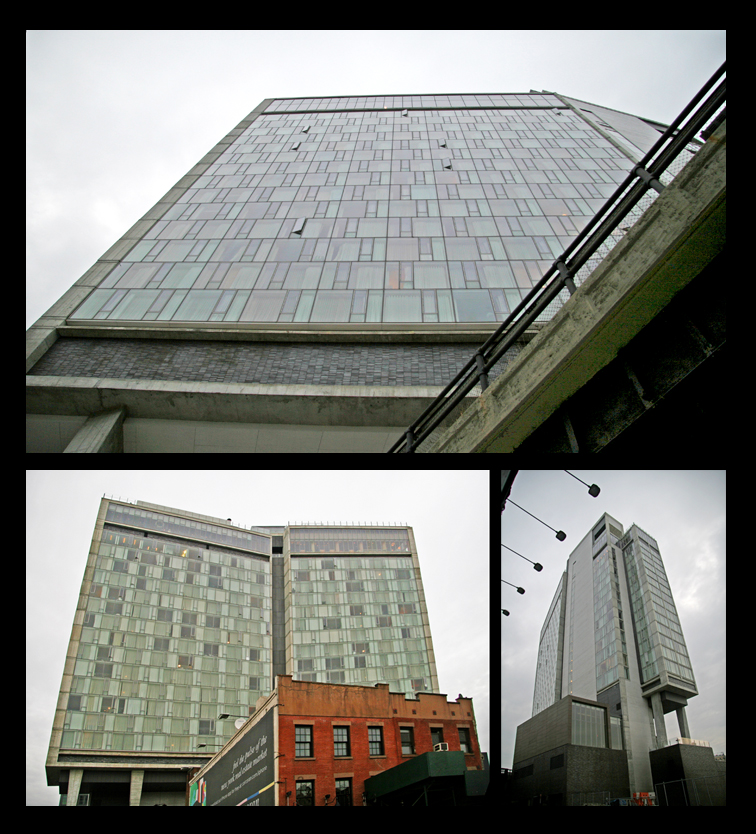
    However, once an area becomes more well known as an enclave for the unconventional, hide and seek often becomes show and tell. And there is no better example than the Standard. This hotel was developed by Andre Balázs and straddles over the High Line, an elevated park created from an abandoned elevated railway, 1.45 miles long, in the west side of Manhattan (see here). The hotel itself is located in the stretch in the far West Village near the meat packing district, what has become one of the trendiest neighborhoods in New York City.

    The place became a scandal with a flurry of media coverage in July of 2009. There were reports of nudity and every manner of lewd activity displayed in the windows of the hotel, including shooting of porn films and couples having sex. The exhibitionist activities were actually encouraged by the management, even putting in writing on their Facebook page:

    “We encourage you to exercise your inner exhibitionist,” and their website asks, “Whatever you do, just make sure the shots are HOT and that you get them to us in whichever way you can. It’s all about sex all the time, and you’re our star.”

    After public and neighborhood outcry over the “peep show”, the hotel removed the explicit encouragements and tried to tone things down. If this is the kind of thing you’re looking for, explore the outer fringes and there is where you will find the world of Hide and Seek, Show and Tell 🙂
  • The Real Peel

    David Peel’s website consists of one page, however, much can be gleaned from a quick read –

    Favorite Band or Musician: David Peel & The Lower East Side
    Favorite TV show: The Simpsons
    Favorite movie: West Side Story
    Favorite book: 1984 by George Orwell
    Favorite sports team: Bonghitters
    Favorite food: Ice Cream

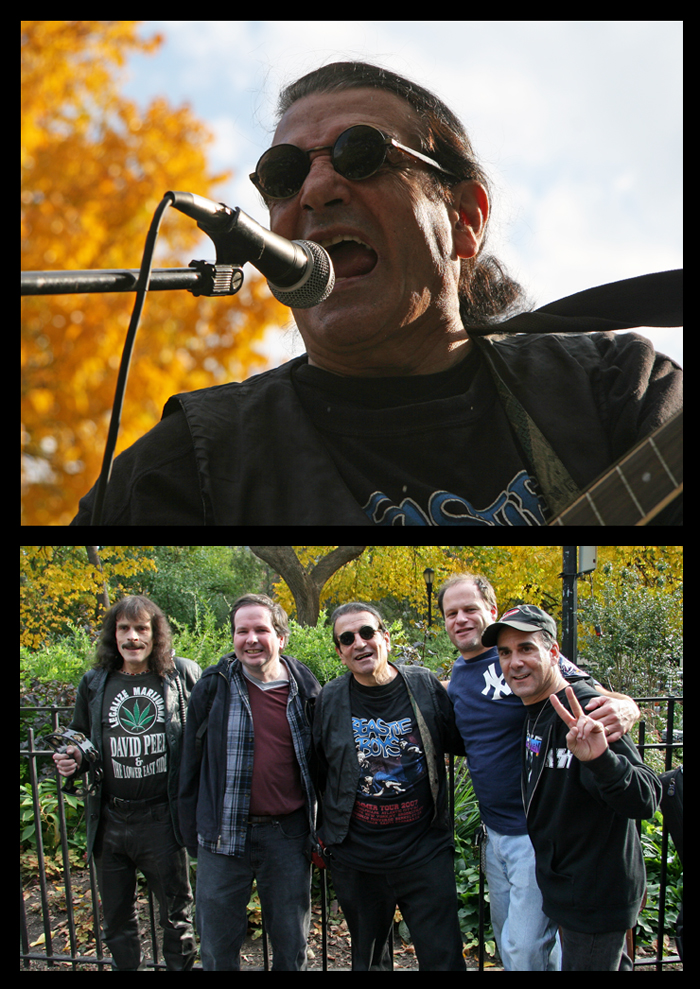
    Take equal parts of self absorption, political activism (with a hint of conspiratorialism), punk rock, marijuana, and maniacal energy, and you have David Peel. Born David Michael Rosario, the New York City-based musician and activist began recording with his group as David Peel and the Lower East Side in the late 1960s. He is credited with being one of the early performers of punk rock. A tireless advocate for the legalization of marijuana, Peel’s first album in 1972 was entitled Have a Marijuana. His discography is over 20 albums. He has been closely associated with the Yippie movement, Smoke-In concerts, and the annual Marijuana March.

    David Peel’s close association with John Lennon propelled him to celebrity status and helped pave the way for him to perform with top acts, such as Alice Cooper, Doctor John, Stevie Wonder, Dave Brubeck, Herbie Mann, Rod Stewart, Emerson Lake and Palmer, BB King, the Chambers Brothers, Joan Baez, Frank Zappa, Iggy Pop, and countless others.

    Lennon recalled first seeing David Peel, and his street assembled version of the “Lower East Side Band,” performing in front of a large crowd in Washington Square Park, in 1971. “He was shouting, why do you have to pay to see stars?” says Lennon. “I was embarrassed. I thought surely he must know I’m here. Yoko and I loved his music, his spirit, and his philosophy of the street.”

    Ignoring the objections by “certain” former members of The Beatles, John and Yoko still signed Peel to Apple Records. Peel’s first effort for Apple was an album entitled “The Pope Smokes Dope,” which immediately set off an international furor. The record was banned in nearly every country of the world, except for the United States, Canada, and Japan.

    In a memorable appearance on the nationally televised “David Frost Show” in 1972, John and Yoko let David Peel and his Lower East Side Band take the spotlight, choosing instead, to perform behind the group. John noted that Peel always wore round sunglasses that were a perfect duplicate of the glasses that had become John Lennon’s trademark, and Lennon took to wearing Peel’s black leather jacket.

    I have known David for years and see him frequently – his is a habitue of Washington Square Park. Always on a rant or rave, Peel’s energy is truly maniacal. His lyrics can be caustic, angry, and often spew hatred. The song he was performing in the top photo had a constant refrain, I Hate You. But do not be fooled by the theater, lyrics, or politics. Underneath you’ll find a warm and fuzzy, benign human being. That’s the real Peel 🙂


  • Urban Night Climbers


    Texte alternatif
    For a full night climbing experience, click and play audio link to accompany your reading.

    Many years ago, in a conversation with a customer, the subject somehow turned to my childhood love of tree climbing. My customer was VERY pleased to hear this, and encouraged me to rekindle this interest, embrace some trees, or perhaps even join him and his friends in their nocturnal sojourns. He was a night climber. Of buildings.

    New York City is a city that never sleeps. We are known for our night clubs, night life, and night people – but night climbers of buildings? I was not aware that there was an underground fraternity of those who practice buildering, aka urban climbing, stegophily, or structuring.

    The press has covered the various climbing spectaculars of the city – Philippe Petit’s legendary walk between the world trade towers on August 7, 1974. George Willig, a mountain-climber from Queens, New York, United States, climbed the South Tower of the World Trade Center on May 26, 1977. Alain Robert is a French rock and urban climber who in 1994 scaled the Empire State Building and on June 5, 2008, climbed the New York Times Building (later that day, Renaldo Clarke also climbed the building). Dan Goodwin, using suction cups and a camming device, climbed the North Tower of the World Trade Center on May 30, 1983.

    But recreational buildering goes back much further than might be expected, at least to Victorian times in England, where students had been climbing the architecture of Cambridge University. Geoffrey Winthrop Young was roof climbing there in the 1890s and published The Roof Climber’s Guide to Trinity in 1900. In 1937, The Night Climbers of Cambridge was written (under the pseudonym Whipplesnaith) about the nocturnal climbing on the town buildings and colleges of Cambridge, England in the 1930s.

    In the United States, two men, George Polley and Harry Gardiner, both nicknamed the Human Fly, pioneered buildering as early as 1905. In 1920, George Polley climbed 30 floors of the Woolworth building before being arrested. Not much, however, is written about current recreational nighttime buildering in New York City, for obvious reasons. In 2008, the New York Times published an article with a little on the activity.

    Apart from legality or prudence, I do understand the lure of urban climbing. Much as the alpine areas of the world are magnets for rock climbers, the buildings and skyscrapers of New York City provide the same challenges and draw in masonry, steel, and glass. Perhaps I may yet get to witness the activities of these urban night climbers…

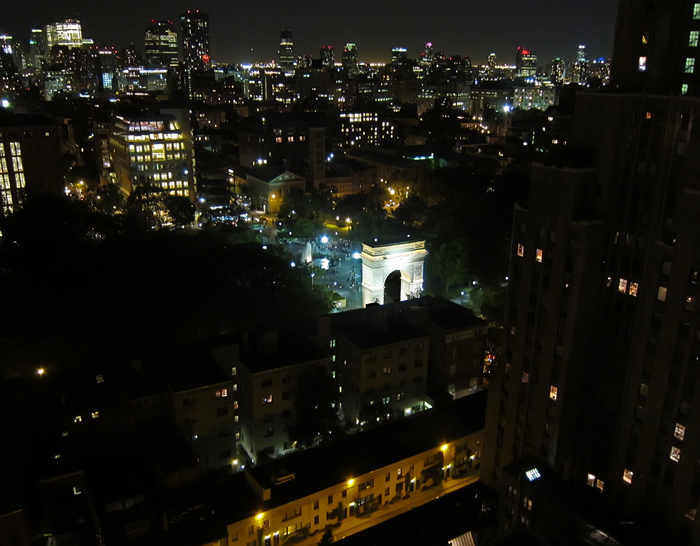
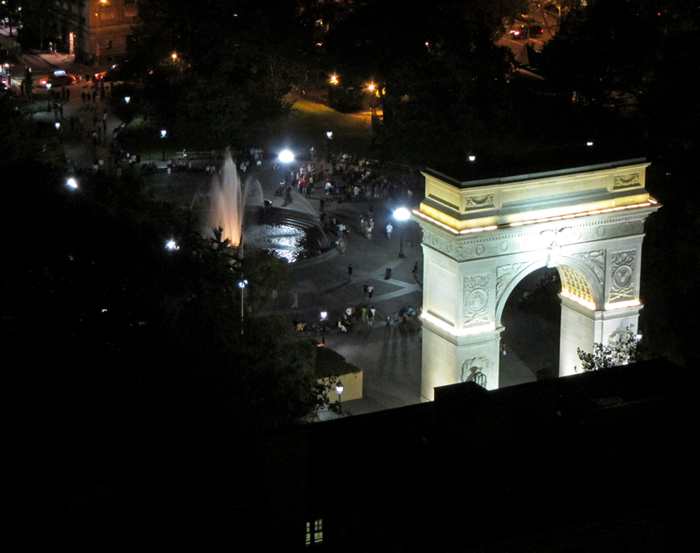
    Photo Note: I was recently privy to access to one of the very few rooftops in the Village affording a direct view of Washington Square Park. The building and friends kind enough to invite me to share the view, will, in the spirit of buildering, remain a secret 🙂


  • Hell. Part 3

    (This is the third and final of a three-part series. Find Part 1 here and Part 2 here.)

    Music has Charms to soothe a savage Breast and Hell has no fury like a woman scorned.*

    We had it all on Saturday – savages, breasts, fury, a scorned woman, music, fury, and a taste of Hell. Just the type of things a jungle lover would expect to find in New York City. And if you are going to enter the jungle smearing blood, you should be prepared for lions and tigers.

    There is no way that you can come to this city, set up in Greenwich Village, sing gospel songs, preach sin and damnation, and not expect a confrontation. The neighborhood is extremely liberal and very tolerant, except of being accused of sin and threatened with eternal damnation for their lifestyle.

    The model, Abigayle, had been provoked – she had been told that she was wicked and had been warned five times. She climbed on the shoulders of a young man, also body painted, and they approached the Mennonite group. It was fair to say that this couple taunted the crowd of Mennonites and the preacher, who launched into a diatribe regarding nudity, hell, and damnation while brandishing his bible. The man in body paint who had shouldered the model read and mocked parts of their leaflet, Boys and Girls & Fornication:

    Whether this confrontation on the part of the model and her supporter was justified was hotly debated. Some were infuriated and saw it as disrespectful and unnecessarily provocative. Others saw it as just desserts or as another circus act to be expected in the Village. At the end, the painted man reconciled with one of the visiting group and shook hands (photo lower right). Perhaps, after all, The road to Hell is paved with good intentions 🙂

    *Heaven hath no rage like love to hatred turned, Nor Hell a fury like a woman scorned. -William Congreve from the Mourning Bride, 1697. Music has charms to soothe the savage breast is also from the same work (the word breast is often misquoted as beast.)


  • Hell. Part 2

    (This is the second of a three-part series. Part 1 is here.)

    At the same time as our Mennonite friends were singing spirituals and preaching to the masses, just a few short steps across the central plaza in Washington Square Park, Andy Golub was busy body painting the nearly nude figure of a woman. See additional photos here.

    Andy is a visual artist who has been body painting men and women in and around New York City for years. You can see more of his artwork and body painting at his website here.

    Although women have the right in New York State to be topless in public, even in New York City, the site of nearly nude men and women in body paint will stop traffic and raise eyebrows. Societal norms have not yet caught up with legislation, and many are angered and perhaps certain that something should be done. Andy and his models, however, are breaking no laws, and even police officers still occasionally need to be educated regarding the legality of toplessness for women in public.

    When the time came and the model moved around the park grounds for various photo settings, a parade of male oglers grew in size, some with cameras, some without, running after her like hungry dogs chasing a rabbit.

    A number of the Mennonites were circulating the park crowds, giving out literature. I happened upon an old friend in the park, and while chatting, I jokingly mentioned that if they were looking to save souls, our model would, from their perspective, need it most.

    My friend took this comment to heart, approaching one of the women from the Charity Ministries and suggesting that she should perhaps consider giving literature to the near naked model – certainly she was the most needful. The leafleteer skirted the suggestion. One of their group referred to her as “wicked,” and another told her that she had been warned FIVE times – apparently there is no salvation for someone who did not heed that number of warnings.

    It became abundantly clear that our model was bound for Hell and eternal damnation, but a very unexpected confrontation ensued; tomorrow we conclude our descent into Hell (see Part 3 here)…


  • Hell, Part 1

    Note: This is Part 1 of a three-part series.

    One of the few family trips I made as a child was to the Amish communities based in rural Pennsylvania. Even coming from a rural area of New England ourselves, the Amish lifestyle, with the shunning of modern conveniences, left impressions that would last a lifetime.

    There is not much that provides a sharper contrast than such a group in traditional clothing in Washington Square Park. This is Charity Ministries*, a group similar to Mennonites. One of the founders, Mose Stoltzfus, was formerly Amish. I have seen them infrequently and was pleased to be able to take photos on this occasion.

    Regardless of any proselytizing or religious creed, there is a gentle and pastoral feeling to a group dressed as they are – the women with light blue and white dresses and the men in light colored khakis. It is as though an Amish farming community was transported through time and space to New York City. And I must say, the voices of the large chorus singing was not at all unpleasant, although hard to be heard above the park din, with competing music groups playing nearby.

    I browsed through and took some of their literature, with titles such as The Sin of Doing Nothing, Improving the Marriage Relationship, Lost in the Church, The Vice of Sexual Immorality, and Boys and Girls & Fornication. A colorful poster on an easel proclaimed Where Will You Spend Eternity? It seemed well-suited for the urban New York City visit, with businesses such as the Pennyless Casino, Abortion Clinic, the Broken Home Night Club, and Divorce Court, all located appropriately near Narrow Avenue and Broadway.

    It is hard to imagine why such a group would subject themselves to such a potentially hostile environment, but I would guess the reasoning is that of an evangelist, Dave, who some years ago used to preach in Washington Square Park on Sundays. When I asked him why he would choose such an inhospitable environment, he answered that he wanted to save souls, and what better place than Greenwich Village? I complemented him on his logic. If you can take the heat, certainly the Village is a great place to rescue the fallen.

    However, the words of this Sunday’s preacher fell mostly on deaf ears. Without knowing specifics, most passersby had a general sense of what this Christian evangelist message was about, and the feeling was not today, thank you. Especially when there is a plethora of competing activities, one that literally made most eyes pop out. There was talk of Love and God and Christ. But as you will see tomorrow in Part 2, we descend into Hell 🙂

    See Part 3 here.

    *Charity Ministries was founded in the 1980s by Denny Kenaston and Mose Stoltzfus and is based in Ephrata, Pennsylvania. They publish a magazine called Heartbeat of the Remnant. You can visit their website here.


  • Pink Flamingos

    Posted on by Brian Dubé

    I was once gifted the book The Encyclopedia of Bad Taste, many parts of which I found hilarious. The writers, Michael and Jane Stern, have selected the most egregious infractions on good taste in American culture. There are chapters on Easy Cheese (in a spray can), Spam, Velvet Paintings, Chia Pets, celebrity death cars, lava lamps, etc. One article highlighted lawn ornaments.

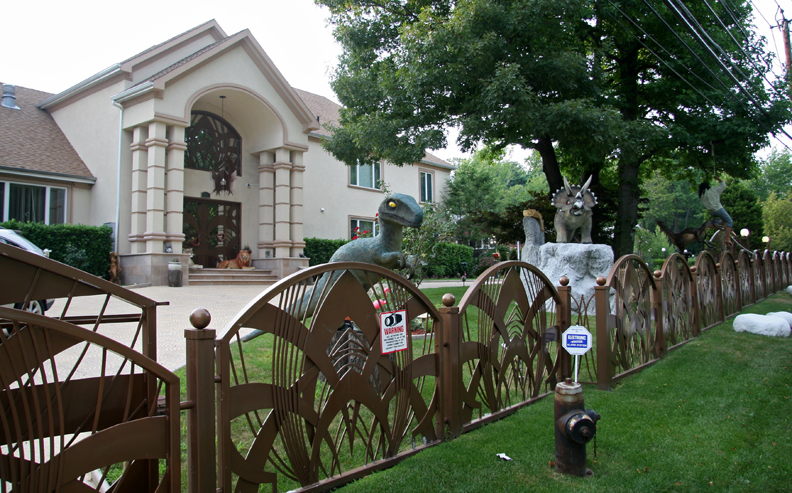
    Most of us have seen a lawn display featuring classics such as the plastic flamingo. I thought I was well-versed in lawn displays (particularly after seeing the Dyker Heights Christmas displays). That is, until I saw the display in front of the mansion of Alla and Alex Shchegol at 724 Todt Hill Road, Staten Island.

    I was happy to find a little information online about the house and the Shchegols, who have been collecting these lawn statues for years. However, I was not prepared to find a small uproar in Dongan Hills/Todt Hill, Staten Island, one of the wealthiest communities in New York City. An article in SI Live voices the concerns some have about the danger of distraction to motorists. It certainly comes as very startling to drive by this property and encounter Tarzan hanging from a tree over a lawn full of statues in a loosely themed jungle and Jurassic Park. There are dinosaurs, jungle animals, and other creatures.

    The many comments to the SI Live article range the gamut – see the article and comments here. Some say the huge ornaments are terribly distracting and dangerous, while other locals say the concerns are exaggerated. The vast majority of naysayers are just horrified at what they consider to be one of the supreme examples of tacky, bad taste.

    Actually, I was very surprised to read about the congeniality of the owners. Apparently, many passersby stop, some even knocking on the door for information about the display. Others ask permission to take photos with their children on the various animals, which the owners typically grant. A number of people, like the Shchegols themselves, just see this as harmless fun and encourage the outraged to lighten up.

    Most will agree, however, that no Encyclopedia (or lawn) of Bad Taste would be complete without Pink Flamingos 🙂

    Posted on by Brian Dubé

  • Skame

    If you want to work in a clandestine manner, don’t hire the CIA. Hire an underground graffiti artist.
    I am astounded at how long some of these individuals have kept their identities secret, even after working for decades, interviews with the New York Times, or having been arrested, as Revs was in 2000. These men are not hiding in the hills of Afghanistan. They are living in the most populous city in the United States and tagging prominent public spaces in high-traffic neighborhoods.

    In the 1980s and 1990s, Revs teamed up with artist Cost, and they became two of the most well-known graffiti artists in New York City. Cost and Revs gave a rare interview in 1993 with New York Times reporter Michael Cooper. In 1995, Cost was arrested and his identity finally became known: Adam Cole of Rego Park, Queens.

    Revs’ identity, on the other hand, even after his arrest in 2000, is still unknown.
    In 2004, in an interview for ArtForum magazine, Revs said, “We think art should be dangerous. Everybody’s into safe art, doing safe things in their studio. We’re bringing danger back into it. It’s got to be on the edge, where it’s not allowed.”
    In 2005, he was interviewed again by Times reporter Randy Kennedy (article here). “To me,” he said in a rare interview, “once money changes hands for art, it becomes a fraudulent activity.”

    The work in the photo is on Canal Street, one of the most trafficked crosstown streets in the city. How access is had and these things are done without being apprehended is a mystery to me. I had hoped to get some information of any sort on the artist who tags himself as Skame, but I could find nothing.

    According to the Urban Dictionary, s.c.a.m.e. is an acronym utilized by the Psyop Community. “It is conducive to ‘counter-propaganda,’ in that, it eludes to source, content, audience, media used, and effect of the propaganda. To s.c.a.m.e. propaganda, refers to one’s attempt to analyze the content of said propaganda using techniques taught at the JFK Special Warfare Training Center.” I don’t know if there is a connection to the tag Skame, and perhaps I will never know…


  • Law School

    If you want to be confused and perplexed, try wading through the regulations regarding vending on the streets of New York City. If you want to be disheartened, try looking at some of the facts and figures regarding the vending of merchandise. And if you want to be discouraged from earning a living this way, look at the costs of vending, fines, confiscation of goods, and the uneven application of the law.
    Welcome to the circle of confusion: the world of street vending, where laws are difficult to understand by both vendors and police alike.

    In this economic climate, jobs are difficult to nonexistent. Street vending is a way to earn a living and, for some, a way into the world of business. The costs involved in setting up a retail establishment are prohibitive in New York for most individuals. Many well-known businesses in New York City started on the streets, such as Bloomingdales, Macy’s, Cohen’s Fashion Optical, and Goldman Sachs.

    There are approximately 12,000 street vendors in New York City. There are four categories of vendors: food vendors, general merchandise vendors, veteran vendors, and First Amendment vendors, who may sell newspapers, magazines, cd’s, books, and art on the street without a vending license. There certainly are abuses with First Amendment vendors – a lot of merchandise is sold under this class to avoid the difficulties in dealing with vendor’s licenses and permits, which are extremely difficult to get and have created a black market.

    It is virtually impossible in New York City to get a general merchandise vendor’s license. In 1979, City Council created a cap of 853 on the number of merchandise licenses. There is such a long waiting list that the Department of Consumer Affairs has not taken new names since 1992.

    Food vendors need a license, on which there is no limit. However, they also need a Department of Health permit, which are limited at about 3,000 city-wide. Lotteries are held every few years to distribute any excess permits, but the average wait is still many years. Many food vendors who do not have their own permits enter into relationships with permit holders to use their permits for a fee. There are no limits on veterans’ permits.

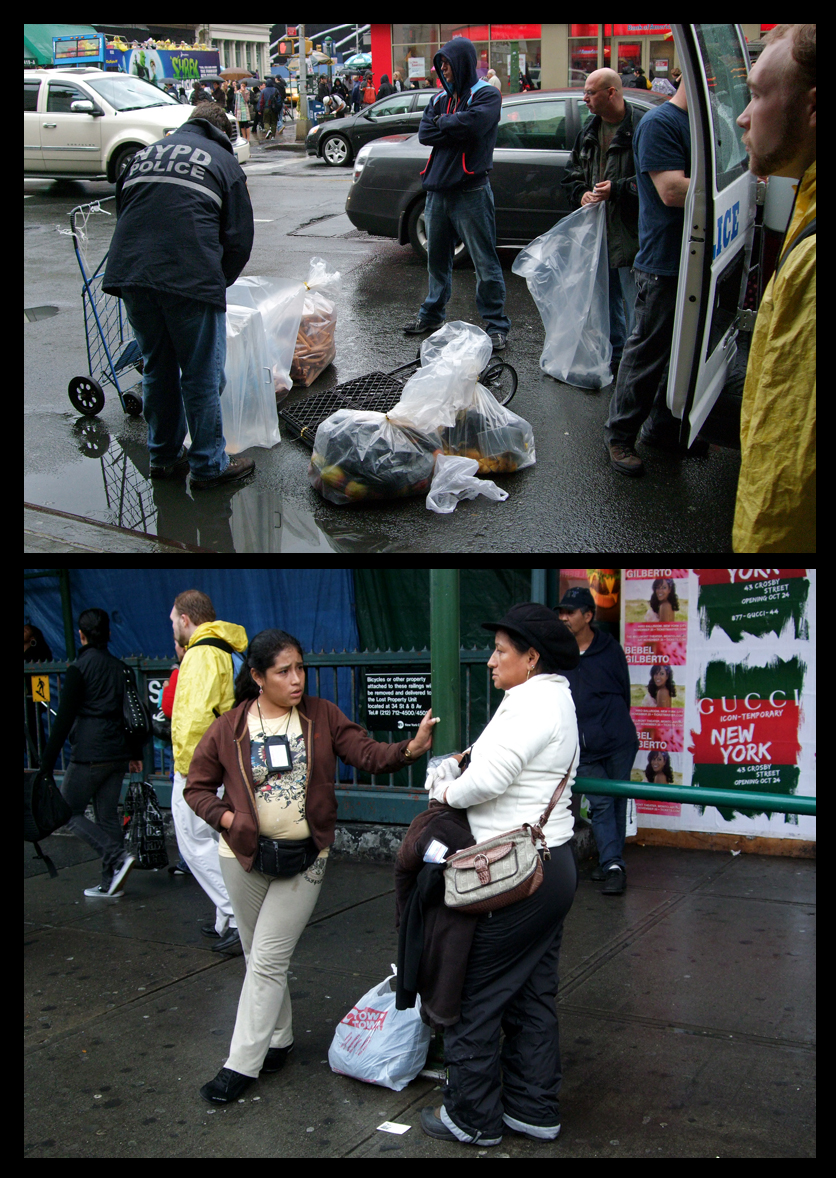
    The women in the photo (on Canal Street) had a vendor’s license but not a food permit to sell fruit. In addition to fines, their merchandise was hauled away by the police. Each year in New York City, approximately 50,000 tickets are issued and 7,000 vendors are arrested. In 2005, the Bloomberg administration raised maximum fines from $250 to $1000.

    There are regulations regarding where and how you can sell: The sidewalk must be at least 12 feet wide (veterans are exempt), and you must be at least 20 feet from any store entrance, 10 feet from a crosswalk, 5 feet from a bus shelter, 20 feet from a sidewalk cafe, and less than 18 inches from the curb. You can not set up over a ventilation grill or touch a fire hydrant or lamp post. There are also regulations regarding the vending table’s size as well as other details. See here for a brochure outlining the facts and regulations.

    Everything considered, a little more money and study will get you a civil service job or admission to law school 🙂


  • Misfits

    It is safe to say that in a wired world, sights of individuals like those in the photo are no longer unusual. It is also a reasonable assumption that in many places, even outside urban areas or college towns, people like these can be found in the flesh.

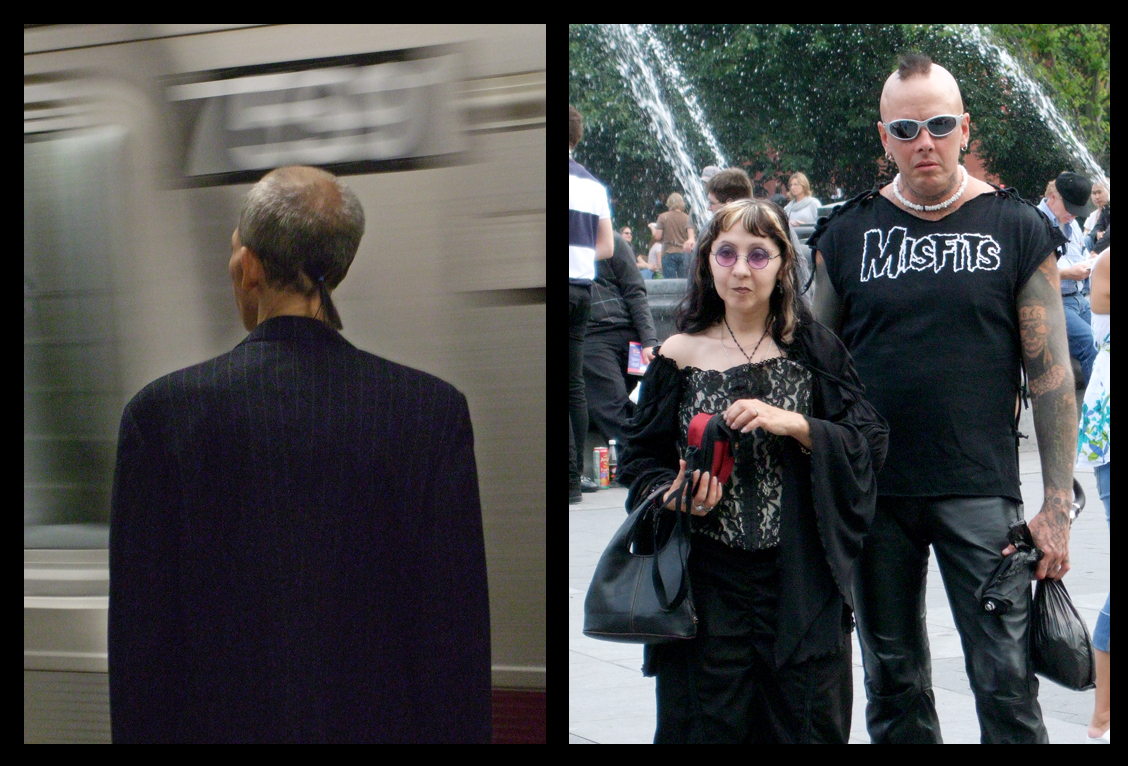
    But I would guess that businessmen in pinstripe suits do not often wear their hair like our subway rider in the photo and that tattooed individuals brandishing mohawks do not usually walk the streets with a t-shirt reading “Misfits.” I imagine that the word is embraced for its dictionary meaning and not just for the punk rock band of that name.

    I have avoided using the word misfit in this blog for a number of reasons, one of which is that the word generally has a somewhat derogatory connotation. But, assuming social misfits exist, New York City is certainly a place to find them. This is an environment where virtually anyone with any manner of dress or lifestyle can feel quite at home. In fact, it is questionable whether the word misfit is really applicable in a city where such a large number of nonconformists exist and where one is often not very far from another.

    A trip to Tompkins Square Park can easily make the societal conformist feel like an outcast or misfit.
    In the case of the individuals in the photo, there is a strong element of exhibitionism. However, I have met many individuals here who, by any reasonable definition, really are social misfits, with extreme and very self-indulgent lifestyles, the nature of which may not be apparent to the outsider at all.

    Such a large number of misfits should come as no surprise in a country which has seen such a upsurge in the radical individualism of youth since the 1960s. The US Army has had to market with campaigns such as “Be all that you can be” and “Army of One.” This is, of course, rather ironic, since the Army never has been and never can be a place for individualism. But the ad campaigns do reveal how systemic and important individualism really is in this country.

    In a society without strong cultural scripting and where individualism and self empowerment are constantly trumpeted to be such laudable personal goals, we must accept the consequences. Here, in a city where there is such a a melange of iconoclasts and misfits, many live unaware of how outside the normal constructs of society they really are. Others are quite aware and proud enough to identify themselves with a t-shirt…

    Related Postings: Out There, Spike, Narcissism Gone Wild, Water Sprites, Wood Nymph, Spring Madness, The Dance Parade, Dyke March, Twelve Tribes, Penny Farthing, Homeless Art, Superheroes, Snake Charmer, Circus Amok, Fashion Forward, Piercing Al Fresco


  • Mad as Hell 2

    Do you want to inflame some New Yorkers? Then set up a 9/11 conspiracy presentation on the street. There are several grassroots organizations involved in promoting 9/11 conspiracy theories – i.e. that the United States Government was responsible for 9/11 and the attacks were either a) intentionally allowed to happen or b) a false flag covert operation actually orchestrated and committed by the US Government itself.
    The alleged motives for such an act? To justify the invasion of Afghanistan and Iraq, increase military spending, and/or to restrict civil liberties. The movements are large enough to have grabbed the attention of mainstream media. You may also have seen “9/11 Was an Inside Job” on t-shirts and bumper stickers.

    We Are Change is one group that has appeared on a semi-regular basis in Washington Square Park on Saturday nights. On a recent occasion, a man who identified himself as an architect (and said his wife was also an architect) was so outraged that a major war of words ensued between himself and one of the presenters. Virtually out of control, the man paced to and fro like a wild animal. When approaching his foe, he asserted, “You’re an idiot. I defend your right to be an idiot, but you’re still an idiot.” He turned and attempted to leave repeatedly, but each time he left he was compelled to come back and repeat his mantra.

    The 9/11 conspiracy joins history’s many hoaxes and conspiracy theories:
    NASA faked the moon landings, Paul is dead, Shakespeare was somebody else, global warming is a hoax, Elvis Presley faked his own death, Diana, Princess of Wales was murdered, Holocaust deniers, Jesus conspiracy (ala the Da Vinci code), the AIDS virus was created in a laboratory, the Illuminati control world affairs, a flying saucer crash in Roswell, New Mexico, JFK assassination conspiracy theories, fluoridation is mass medication, Pearl Harbor was allowed to happen.

    One problem with such conspiracies is that the proponents are armed with a myriad of details that the average person is unfamiliar with and thereby unable to refute on the spot. Without opposing viewpoints, the arguments can be persuasive to some. Another problem is that unexplained facts or anomalies do not necessarily invalidate an accepted theory. From Scientific American:

    The mistaken belief that a handful of unexplained anomalies can undermine a well-established theory lies at the heart of all conspiratorial thinking. All the evidence for a 9/11 conspiracy falls under the rubric of this fallacy. Such notions are easily refuted by noting that scientific theories are not built on single facts alone but on a convergence of evidence assembled from multiple lines of inquiry.

    In the case of the 9/11 conspiracy, there are now numerous websites, magazines, and books which debunk the 9/11 conspiracy theories, point by point (and there are websites and books which attempt to debunk the debunkers).

    When conspiracists appear, I’m staying on the sidelines and letting others get mad as hell…

    Note: For another New Yorker pushed to the breaking point, see Mad as Hell here and here.


  • Pomp and Circumstance

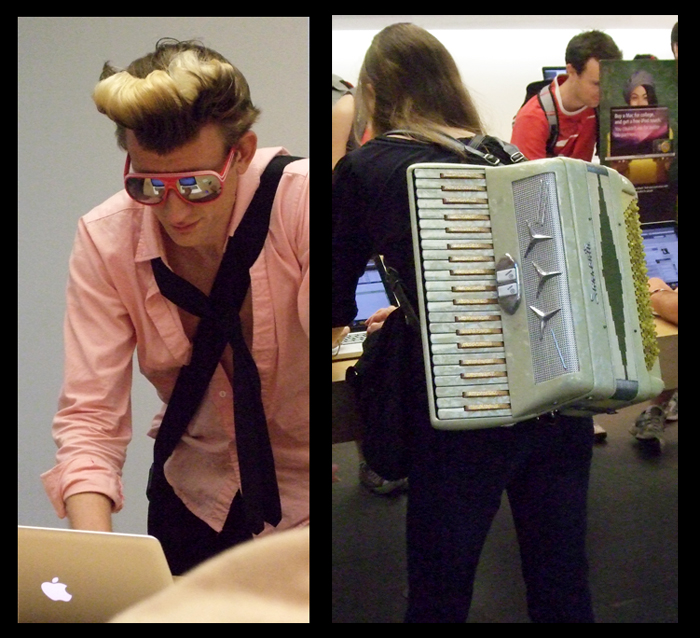
    I have a number of questions when I see people like this, particularly the man with the quiff – questions such as “Where are you going to go looking like that?” and “Where do you work?” Yes, on a Saturday night out or while shopping at the Apple store, you do look cool as hell, but once the novelty wears off at the workplace, who wants to be looking at this day in and day out? Even as a freelance associate or fellow artist, this is going to get old pretty fast. Are you going to be able to hold a conversation with this man and not be distracted by pink glasses, a pink shirt, and a blond-tipped pompadour that looks like the surf’s up at Malibu Beach?

    Now an accordion on your back is much more of a temporal and transitory thing. It’s really just an unusually large accoutrement which is likely not worn this way at home or at the workplace. There is a very good reason this woman is using an Apple computer with an accordion on her back; I just don’t know what it is. She probably was just playing her instrument or will be playing it soon. Or, perhaps she can’t afford a case. Perhaps she doesn’t want a case and finds it more convenient to carry on her back. Perhaps she wants people to know she is an accordionist.

    There are few stores in New York City with as self-assured an attitude (both from the staff and customers) like that of the Apple Stores. Some may bristle at the cult-like atmosphere – there’s a smugness of Apple users as being in the know, using the tool of choice, and willing to pay a premium for it. Iconoclasm has historically been a defining characteristic of both the company and its core adherents.  Apple has had a dominant role in the art community from early on. Under the circumstances, pompadours and accordions fit right in 🙂

    Photo Note: These photos were taken at the Apple Store in SoHo. Both individuals were in the store at the same time. Apple has an extremely liberal attitude regarding use of their computers. All have high-speed Internet access, and no restrictions are placed on use or time. Many stop here to check email or for any other variety of uses.


  • Gallivanting

    When I was young, a popular refrain from my mother was, “No daughter of mine will be gallivanting all over town.” This meant my sister, of course, who was easily bored and quite social and mobile at a very young age, earning herself the nickname “the roadrunner.”

    So I grew up believing that gallivanting must have been an accidental omission in the list of deadly sins or biblical commandments. Certainly there was nothing worse than to gallivant – the mere expression of youthful freedom appeared to be a mortal sin. Let’s not even imagine the things a girl might actually do while gallivanting. Even worse, at night.

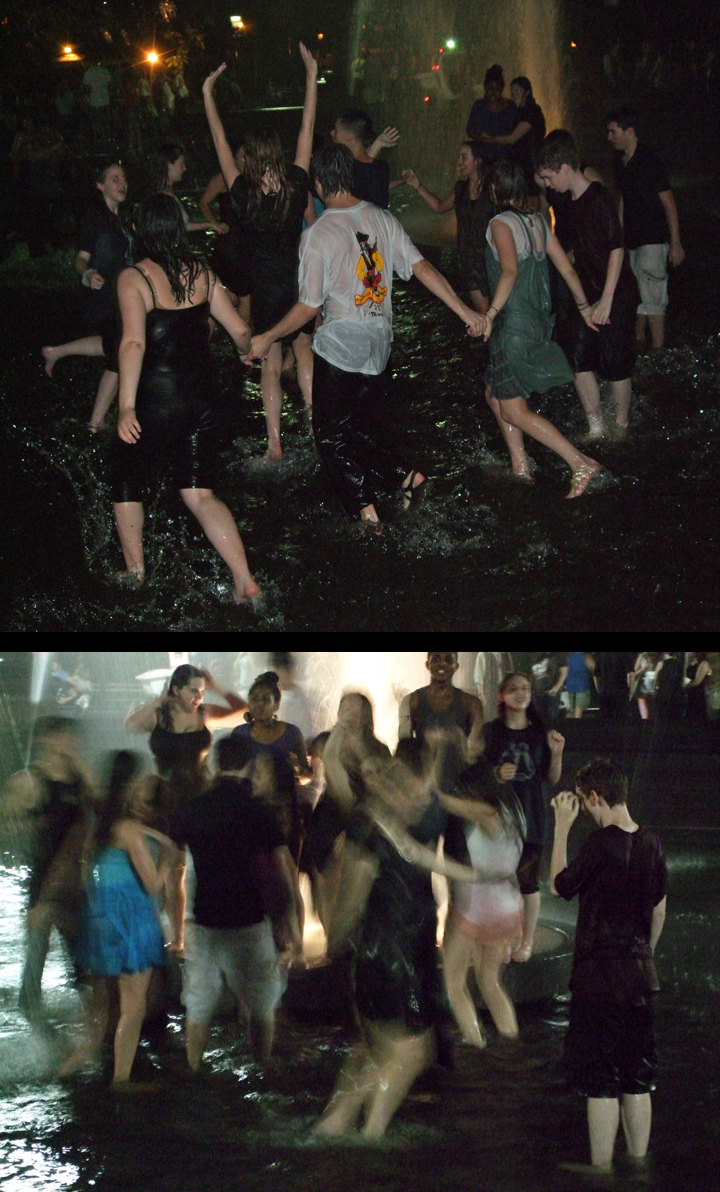
    Without parental controls, what better time and place to gallivant with your friends than New York City at night? With the recent restoration of Washington Square Park, the fountain now sports a massive center plume and powerful side jets and has been a center for late night revelry, virtually without concern for temperature or rain. It has become a theater for bravado – will you take the challenge and go in with your street clothes on? They do, and they get soaking wet, with spectators watching in amusement. I saw a girl moon the audience and a man do a head stand on the steel grate over the center plume. More photos here.

    There is squealing, shrieking, dancing, splashing, and jumping. The cavorting and play appears to be the most fun anyone has ever had. I don’t know whether this is a case of pure joy or if there is an element of the classic “stolen watermelon tastes best.” Some of these girls must know how much their mothers would be disappointed if they knew their daughters were out late at night gallivanting 🙂


  • Cosmetics

    Posted on by Brian Dubé


    What is more unsettling than contact with a crustie? How about a crustie wearing a pet rat? (If you are not familiar with crusties, see my previous posting here). Take a close look at the photo, and you will see that this girl is sporting a white rat under her hair on the back of her neck. A crustie’s dreadlocks typically goes unwashed, so I imagine her hair provides not only a secluded spot for her companion but also a nesting ground for a variety of flora, fauna, and other edibles.

    You expect many strange things in New York City – it is a magnet for the fringe elements of society. But there are things that shock even a seasoned New Yorker. For me, a crustie with a rat around her neck was one of them.
    People know the city is extremely liberal and, most of all, tolerant. There are individuals involved in all manner of activities in public; frequently, authorities and law enforcement just turn a blind eye. Two nights ago, two mounted police officers observed the onset of a fight, one individual wielding a guitar as a weapon. The officers left – no one knows why. The fight escalated, and one individual was knocked unconscious, required an ambulance, and was taken to a hospital. Those of us who witnessed the occurrence are convinced that in any other locale, there is no way that someone that menacing would have been left unchecked.

    One issue is, of course, that many activities which are disturbing or distasteful are technically not against the law, and individuals here are brazen enough to have tested the law many times, risking arrest. Many criminals are quite street savvy and know exactly what is required to be arrested. Even those who are technically engaging in activities for which they can be arrested are a problem; most are released the next day and are back out on the street. My contact with crusties has been rather benign, but they have been a serious problem – see this New York Times article here.

    But what to do with the “undesirables” or homeless? It would seem that outreach programs would make sense, but I rarely see or hear of any efforts like this anymore. Many homeless prefer the freedom of the streets to shelters or programs, so there is resistance to being helped.

    New York City is a center of fashion, and even the homeless often have a sense of style, putting together an outfit from whatever is available. I like our crustie’s earpiece made from a small twig and flower…

    Note: One posting that many readers commented on was about Stephanie, a young homeless woman who lived on Spring Street for quite some time. I saw Stephanie using makeup a number of times – somewhat repellent to watch and sad, but in another way heartening to see that the girl still had human dignity and enough pride to make an effort using cosmetics.

    Posted on by Brian Dubé

  • Facts and Fiction

    Posted on by Brian Dubé

    When someone looks like this, photographers take notice. However, how to proceed? I discussed the dilemma of shooting people at close range in my recent posting, Walid Soroor.

    I pointed this man out to a couple of friends who agreed that this man’s appearance was definitely out there and blog worthy. A suggestion was made to approach him directly and ask his permission. Legally, photos taken in public for non-advertising purposes do not require permission, but cooperation, when you get it, not only makes the process immensely more comfortable but also leads to better photos and some nice side benefits. Like a name, biographical facts about a person, email address, and possibly the raison d’etre for their extreme style.

    Although wild speculation is a lot of fun, the person behind the surface is rarely who you imagine, and often, the truth is more interesting than fiction. I am comfortable approaching strangers, but I do feel that it requires a certain amount of “getting into character,” like an actor, selling myself, and convincing the subject that I am a serious person and that the photos will be used in a respectable manner.
    In this case, a brief introduction, along with a New York Daily Photo business card, sealed the deal, and my subject said, “Fire away.” I relayed the green light to my friend, photographer Bill Shatto, and the impromptu location photo shoot began.

    I learned that our subject, Jim Vehap, was born on the Lower East Side, an authentic New Yorker now living in Milwaukee with family. He is half Albanian and half Italian. His tattoos were done at the time of his 6-year stint in the Marines (Beirut 1983). The shirt was a bicycling jersey, and the origin of the plaid shorts was not discussed. I suggested he might consider modeling – he said others had recommended that he look into this. He asked how he might pursue this, and Bill acquainted him with the Ross Report, a industry publication which includes listings for casting agents, studios, talent agencies, and others in the film and TV business.

    Jim works as a paralegal and had interest at one time in pursuing a masters degree in theology. Quite an amalgam of contrasts. Not the man I thought at all – another case of facts more interesting than fiction…

    Photo Note: Look closely here and you will find an assortment of piercings – nipple, navel, and ears – and closeups of Jim’s tattoos, including ones reading Rare Breed and Rude Boy.

    Related Postings: Out There, Spike, Narcissism Gone WildSuperheroes, Snake Charmer, Circus Amok, Fashion Forward, Piercing Al Fresco

    Posted on by Brian Dubé


  • dinamic_sidebar 4 none

©2026 New York Daily Photo Entries (RSS) and Comments (RSS)  Raindrops Theme