• Category Archives Homes and ‘Hoods
  • With All Due Respect

    On my last visit to Harlem on a Sunday, I witnessed huge numbers of people in fancy clothes getting in and out of vehicles. There were traffic jams in front of churches as vans and cars unloaded church congregation members.

    On January 4th, 2010, I wrote We Got Religion, but in Harlem, they really got religion. For years I have been threatening to see a gospel performance in a Harlem club. But gospel does not have its roots in night clubs. It is Christian-based music sung to express a spiritual belief and finds its home in churches. And in New York City, we find the most well-known in Harlem.

    There is a tourist industry built around visiting the various churches, with buses and groups visiting on Sunday mornings. Harlem is one of the top tourist destinations in New York City. Few New York City residents, however, venture there. Distance from Midtown, downtown, and other boroughs is somewhat a factor – for most residents, Harlem is a destination.
    As pointed out in a New York Times article, this whole phenomenon is controversial:

    A hint of annoyance is sometimes evident as church members complain that they are on display. One Harlem minister admitted to mixed feelings about visitors who tend to behave like members of an audience rather than as worshipers. Few bow their heads in prayer. Fewer still join in as the congregations sing from their hymnals. But, he conceded, language may be a barrier to participation.
    Others point to the reality of contributions from tour companies and individuals that help finance church-based community programs. And there’s some expression of begrudging respect for people who appreciate good music and are willing to venture uptown to find it.

    We have the classic dual-edged sword of tourism – welcomed income and unwelcomed impact that crowds of tourists have on a visited place.

    On my recent excursion to Harlem, I photographed the very striking Mount Neboh Baptist Church. Unbeknownst to me, this is one of the premier church venues in Harlem for gospel music. Others include the Abyssinian Baptist Church, the Canaan Baptist Church, and the Greater Refuge Temple. See article here.

    My understanding is that the church services are extraordinarily spirited and electrifying. I plan on going, with all due respect…

  • Fuggedaboutit

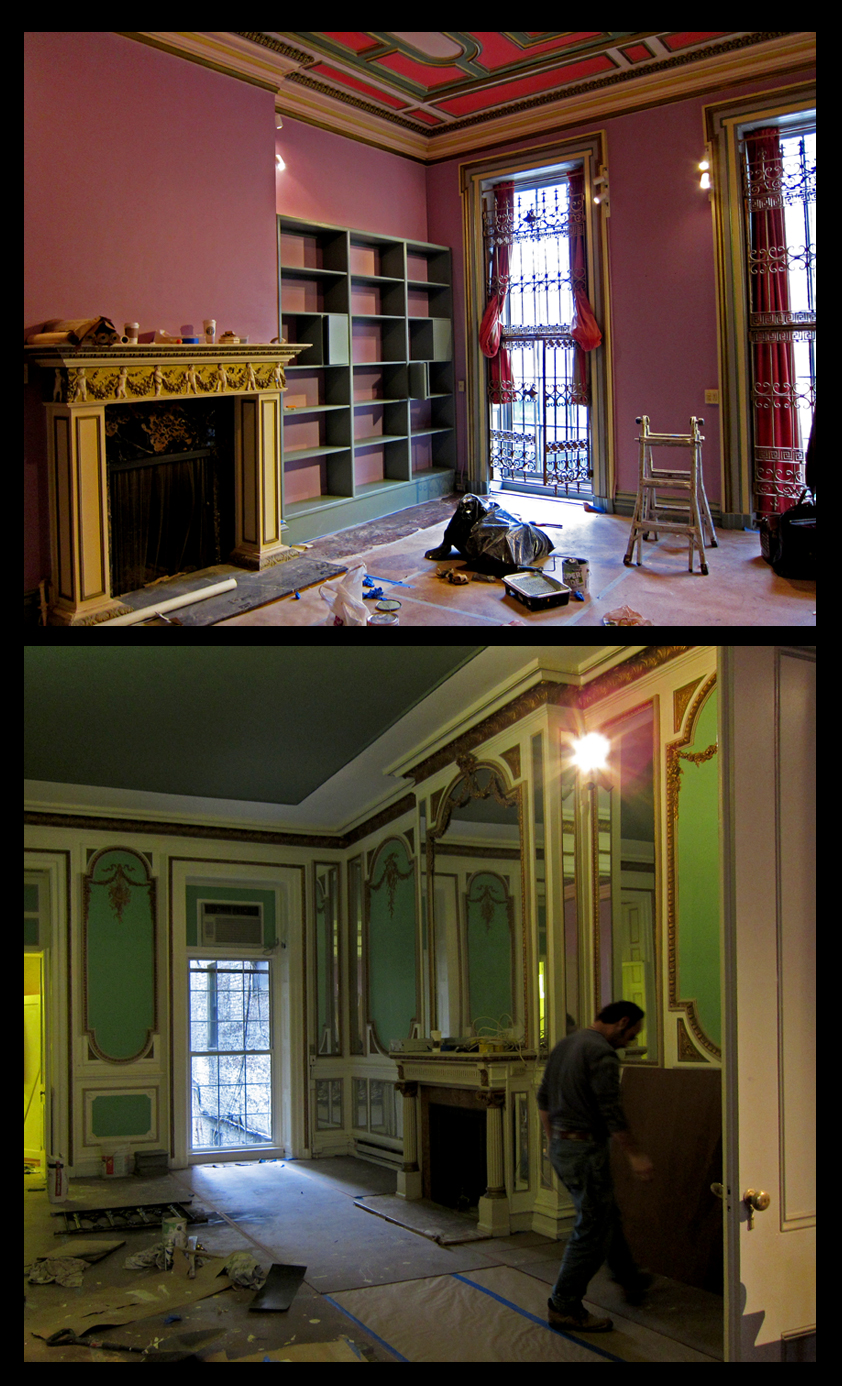
    I have just finished reading through a litany of quotes on patience, thinking that perhaps it would be a good theme for a story about what it takes to get an apartment like the one in today’s photos. Specifically, a duplex that has a full parlor floor and a small bedroom on the lower floor with a small garden space. An apartment located in a historic 1837 landmark townhouse on Washington Square North with windows facing Washington Square Park. There are only three privately owned residential townhouses on the entire park – the rest are occupied by New York University and utilized as offices or residences for university faculty or personnel.

    In reading over lists of quotes on patience and pondering what might be the best suited as appropriate for this real estate dilemma, it slowly dawned on me that, although patience is a virtue, it would really be disingenuous to tell you that the secret to getting a place like this is to have the patience of a saint. Why? Because you might die waiting. Literally.

    This apartment has been occupied by the same tenant for the last 35 years. Super-long tenancy is the same case for two of the three remaining apartments, both over 30 years. Unless you have a secret as to how to stack the odds in your favor for games such as lotto, then it would be best to discount luck also, because being at the right place at the right time to acquire occupancy in a property like this somehow seems to require more than luck. For those who are religiously inclined, perhaps the grace of God would be more apt.

    And for those who believe that money can buy most things and that lots of money can buy almost anything, think again. Because this is the kind of thing that money can’t buy. This apartment is a rental and is not available for sale. Buy the building? No, tenants have approached the owner over past years. The landlord has dozens of mortgage-free properties, does not need the money, and is just not interested in selling. Period.

    So what’s the secret? There is none. Just forget that places like this exist. Or as they say in Brooklynese, fuggedaboutit 🙂

    Note: For another rare glimpse at a spectacular garden space in this building, see Affront to Dignity here.


  • El Barrio

    One defining characteristic of New York City is its ethnic neighborhoods, some indelibly stamped with the signature of one or more ethnic groups.

    And acronyms for neighborhoods are the clearest sign of gentrification. Once you have a catchy name, such as SoHo, you can hear it used as the real estate broker’s refrain. The utterance of all those wonderful little neighborhood nicknames – NoHo, SoHo, Dumbo, Tribeca, NoLita, RAMBO, GoCaGa, BoCoCa, etc.- are meant to give comfort to the prospective property buyer or renter that the neighborhood has arrived and is now officially hip.

    In Spanish Harlem (SpaHa), it is not so clear that the ship has yet come in. This area is still plagued with lack of services and crime, even though there has been an influx of tenants seeking cheaper pastures and the neighborhood is sporting a number of upscale shops. There is a lot of tension here as gentrification threatens low-income and long-time residents. Read an article about the neighborhood here.

    An irony in this city is the abutment of neighborhoods with very different demographics and household incomes. The Upper East Side is one of the wealthiest neighborhoods in New York City and in the United States. Its northern boundary is generally considered to be 96th Street, where, ironically, Spanish Harlem begins. As one approaches 96th Street, you can feel things change quite rapidly, and passing through it is like crossing a continental divide into a very different land. Shops, amenities, foods, and signage cater to the Hispanic community, easily seen once you enter El Barrio…


  • No Squares Down There

    I was so excited as I eagerly awaited my copy of City Planning According to Artistic Principles, by Camillo Sitte, to come up at the main branch of the New York Public Library. I must admit, however, that I really had no intention of reading the whole thing – it was not available for circulation. I just needed to see that it really existed, touch it, and peruse it.

    Sitte was an Austrian architect, painter, art historian, and city planning theoretician. He studied what made a place charming. In his book, he extols the virtues of the irregularity of the medieval city. I have had numerous thoughts and conversations about what makes a city or town interesting. One element for me was the lack of order in the street layout. Nooks and crannies to be discovered, like an old bookshop where, upon entering, you cannot determine its layout, and wandering through it becomes an adventure.

    I relish neighborhoods or towns with the lack of a grid. I love meandering the streets of Florence, Montmartre in Paris, medieval villages of France, or the streets of West Village. Sitte’s book was the validation for everything I loved in a town or city and gave the reasoning behind why I find Greenwich Village one of the most charming areas in the United States.

    The West Village is part of New York City predating the Commissioner’s Plan of 1811 (see here). The maze of streets defy any real order – there are angles, triangles, bends, streets once parallel that now intersect, and even a street that splits and retains the same name (Waverly Place). Perhaps somewhat vexing to the driver or visitor navigating, its character is one of the things which drew me to this neighborhood long ago.
    On top of all this, in 1917, the city cut a swath, 7th Avenue, through the existing neighborhood, shearing sections of over 200 buildings, leaving many triangular shaped structures (see Northern Dispensary and Zena for two examples of triangular buildings).

    We have become the benefactors of yesterday’s victims. In the case of the Village Vanguard, its superb acoustics have been attributed to the triangular space. Some recording engineers and musicians say it is the finest acoustic space they know of.

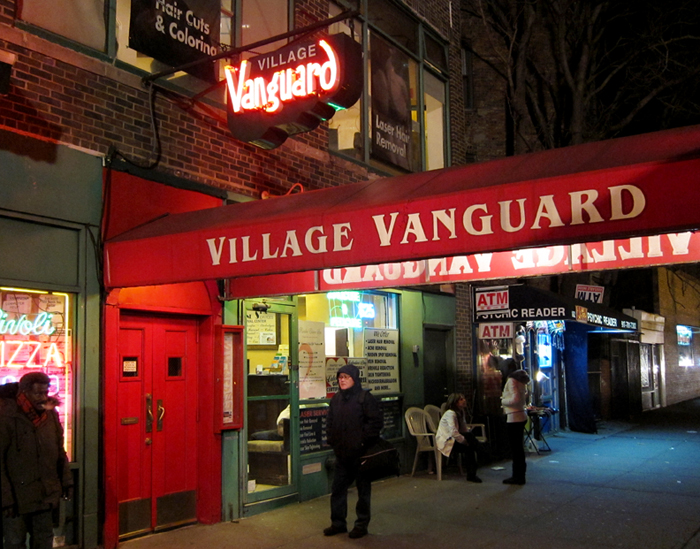
    The Village Vanguard is legendary and, on February 23, 2010, celebrates its 75th anniversary. The club was opened in 1935 by Max Gordon. Originally it featured many other forms of music and entertainment, such as folk music, comedy, and beat poetry. In 1957, it became an all jazz venue. All the jazz greats have performed there – Miles Davis, John Coltrane, Sonny Rollins, Charles Mingus, Keith Garrett, et al. The club is also noted for its Live at the Village Vanguard sessions. The Vanguard still enjoys a reputation as a place to hear the finest jazz in the world. Through the red door and fifteen steps down to the triangular basement space. No squares down there 🙂


  • Martin Luther King, Jr.

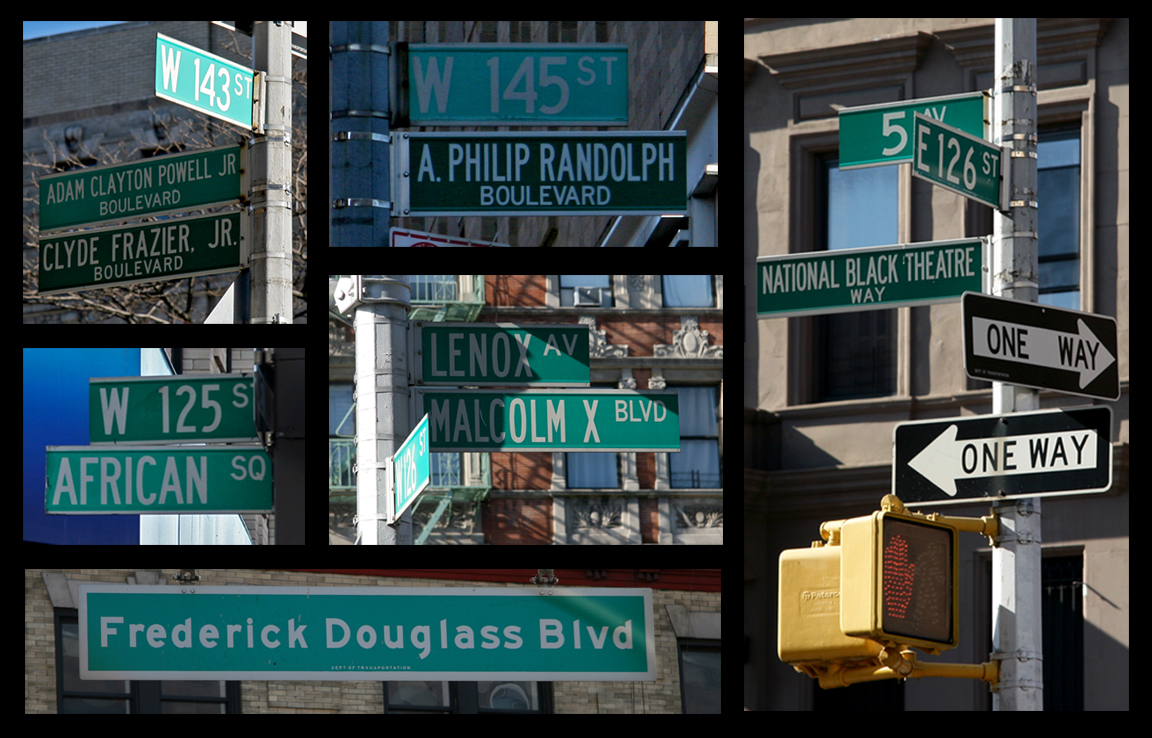
    If you travel through Harlem and observe the street signs, you will notice a number with dual names – an older and more familiar on top and a newer below. The city renames streets for a variety of reasons. Subsequent to 9/11, many streets were renamed to honor those firefighters and police officers who lost their lives in service to the city during that tragedy.

    Other streets are renamed for groups or individuals who are honored for their lifetime accomplishments. This can be most readily seen in Harlem, where many major thoroughfares have been renamed to honor prominent black Americans. These names include major black activists and entertainers. On my recent excursion to the neighborhood, I caught some of the heavyweights and photographed the signs.

    On December 29, 2008, Mayor Bloomberg signed legislations renaming 49 streets and public places in the five boroughs. Some of the prominent blacks include James Brown, Drs. Kenneth and Mamie Phipps Clark, Zora Neale Hurston, Samuel J. Battle, Ella Baker, Charles Hamilton Houston, Billie Holiday, Paul Robeson, Count Basie, A. Philip Randolph, Susan Smith McKinney-Steward, Shirley Chisholm, and Marcus Garvey.

    There is one glaring omission in today’s photo collage. While traveling down 125th Street, Harlem’s main crosstown street, I was distracted while observing all the people, places, and things, and neglected to look up and photograph a street sign conamed with a man virtually synonymous with African-American civil rights: Martin Luther King, Jr.


  • Head for the Hills

    He was a little ungainly and awkward, like Basil Fawlty, John Cleese’s character in Fawlty Towers. But, unlike Basil, who, though incompetent, is basically harmless, my innkeeper had a slightly uncomfortably mysterious side, like Norman Bates of Alfred Hitchcock’s film Psycho.

    The inn, in Southern New England, was perched on a hilltop and had extraordinary views. Most local residents were not even aware that the place existed or that access to this hilltop with such exceptional vistas was possible, much less that an inn was perched atop the mountain. The place was atmospheric and had been hand-built in stone by the owner’s parents with a wonderful flagstone terrace.

    I was compelled to book a room there. I just love the mountains. The innkeeper appeared to be the only one present, and at night, he disappeared to some unseen cottage on the property, or so he said. There were only two rooms in the inn, and on my stay, only my room was occupied. The place was musty. Books were everywhere. At night it was pitch black everywhere and, though intrigued to explore, with my imagination running wild, I decided it best to stay in my room.

    I spoke at length with the innkeeper on one occasion about hill or mountain lovers, and he put it quite succinctly – there are hill people and valley people. If this is how humanity is divided, then I must be a hill person. I do love a mountain drive – the more precipitous, the better. If a Michelin map to a European country I am traveling in indicates a difficult and dangerous road, that’s the road I prefer.
    The hilltop perch is what first drew me to the Tibetan retreat on Lighthouse Hill in Staten Island. Very few visit this remarkable place, and, like my hilltop inn in New England, it is virtually unknown. See additional photos here.

    The Jacques Marchais Museum of Tibetan Art was founded in 1945 and officially opened in 1947 by Jacques Marchais (the professional name used by Jacqueline Klauber), a collector and expert in Tibetan art who acquired the largest collection in the Western world. She never visited Tibet during her lifetime and sadly passed away the year following its opening.

    The rustic complex of fieldstone buildings was designed by Marchais – the architecture, gardens, fish pond, and terraces resemble a Tibetan Buddhist mountain monastery, or gompah. You will also find sculptures on the grounds, as well as bright-hued prayer flags. It was the first Himalayan-style structure to be built in the United States and the first museum in the world devoted exclusively to Tibetan art. The Dalai Lama himself paid a visit in 1991. In addition to the museum’s display of art and objects, there are classes and special programs. My first visit was for a Tibetan festival.

    Of course, the love of mountains as a building site is far from being my exclusive passion – Lighthouse Hill, along with nearby Todt Hill, has some of the most opulent homes on Staten Island. The preference of hills and valleys is replayed around the world by the well-heeled. Some will live in the valleys or by the ocean, while others, with a penchant for drama, danger, and vistas, will head for the hills 🙂


  • Time Travel

    If I asked if you thought this was colonial New England or the South, of course you would know it was a trick question; this is a website that features New York City exclusively. Nonetheless, it is a shocking set of images to imagine within the five boroughs of New York City, and I hope that, like me, you are scratching your head in amazement and wondering where this could be.

    For daily readers of this site, you may guess that we are in Staten Island – we just crossed the Verrazano Bridge yesterday. And you are correct.

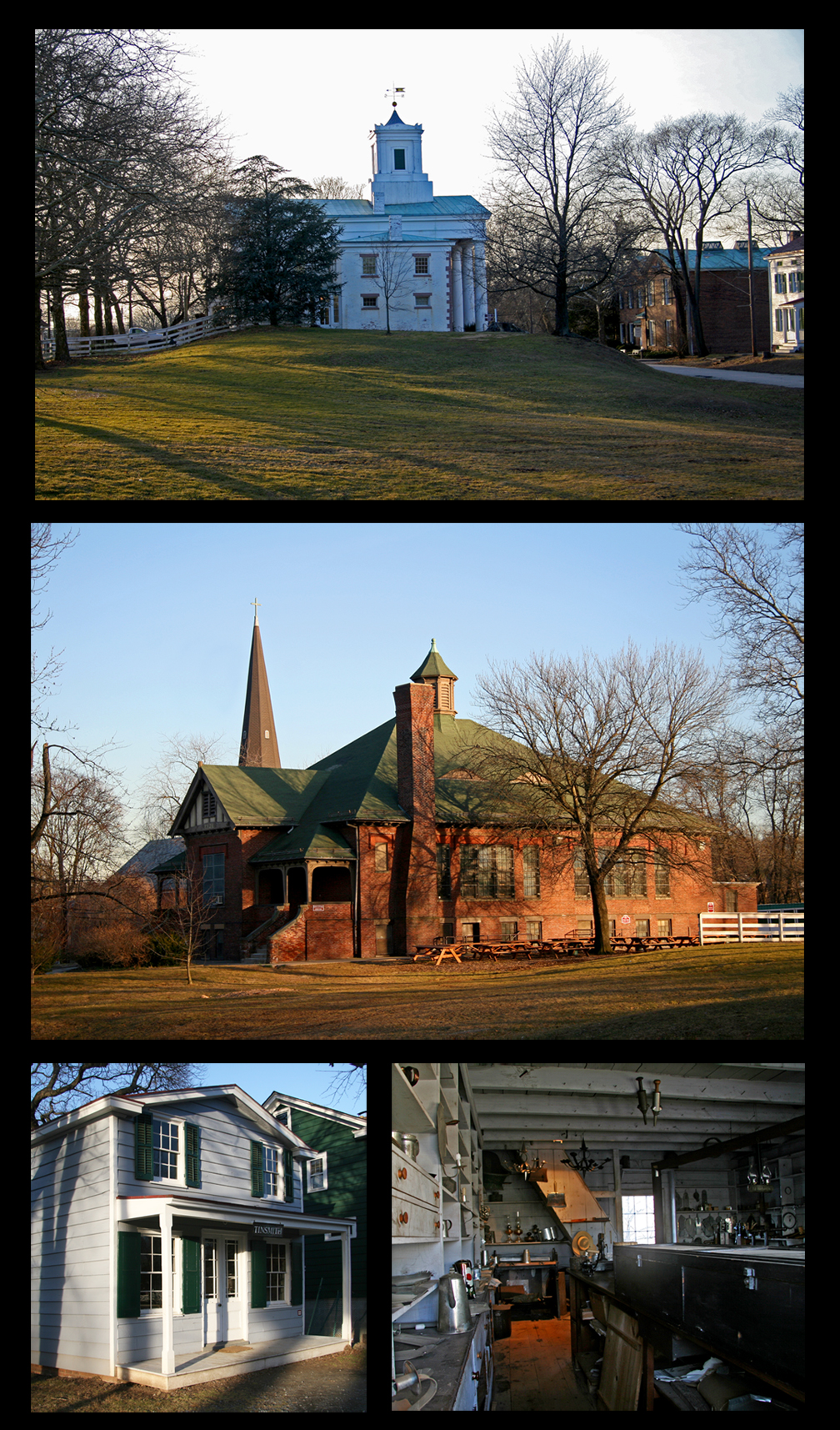
    My real mission here involved a number of destinations, but Historic Richmond Town was unknown to me and was a complete surprise, suggested by a native when I asked if there were any historic areas. I expected to find a nice home or two – some small pocket or enclave.

    I had no idea that Historic Richmond Town (established in 1958) is one of America’s living history museums, like those found in Colonial Williamsburg or Old Sturbridge Village in Massachusetts, where my family visited when I was young. Richmond Town was the former county seat and commercial center of Richmond County (Staten Island).

    The concept of a living history museum goes back to open-air museums that appeared in Scandinavia in the late 19th century. The first was King Oscar II’s collection near Oslo in Norway, opened in 1881. The American style focuses more on lifestyle and generally depicts various trades and activities of the period recreated.

    Historic Richmond Town dates back over 300 years to the 1600s, very old by USA standards. There are 27 buildings in the 25-acre village on a 100-acre site. Some structures are original to the village, while others have been moved from other locations on the island. There are many styles of buildings here, including outstanding examples of Dutch Colonial and Greek revival architecture.

    There are many exhibits that can be seen in Historic Richmond Town – blacksmithing, tinsmithing, basketmaking, coopering, weaving, candlemaking, spinning, etc. There is the oldest standing elementary school in the United States. Here you will find a Dutch Colonial farmhouse, established in 1740, and the Print Shop, established in 1821. Historic Richmond Town houses one of the oldest operating printing presses in America. See their website here.

    When I visited, none of the buildings were open or exhibits operational. When the weather gets warmer and the growth greener, I plan to do a more thorough visit. I’ve always loved Time Travel 🙂


  • Secede


    There are a number of reasons why it has been nearly 4 years and I have not yet featured anything from the borough of Staten Island. It is far and inconvenient, and perhaps I was a little lazy. The photo explains another reason. The current fare going to Staten Island across the Verrazano Narrows Bridge is $11 one way (it is free on the return trip). That two-digit fare is just frightening. The bridge can be spectacular, however. See my posting on it here and an additional photo gallery here.

    Staten Island can be reached via a number of ways. By auto, there are 4 bridges: three from New Jersey and the Verrazano from Brooklyn. There are buses via Brooklyn (and from Manhattan). Access from Manhattan can be had via the Staten Island Ferry (the fare is now free). I have taken the ferry many times, most often just for the vistas, which I highly recommend.

    Staten Island is decidedly suburban in feel compared to the other boroughs, and it is the only borough without a subway system connected to the other boroughs – it is serviced by a fairly extensive bus system. But for real exploration of the hinterlands, it is best to have your own wheels.

    Staten Island has had an interest in secession from the city for some time, and in 1993, Staten Islanders actually voted to secede from New York City. Implementation was blocked in the New York State Assembly. In 2009, a new bill was introduced by state senator Andrew J. Lanza from Staten Island.
    New York City itself has dabbled with the idea of seceding from New York State. The issue of inequitable distribution of revenues back from the State is one of the primary motivations for these secession efforts. For Staten Island, the drama could well be called “If at first you don’t secede.”

    For the time being, Staten Island is still part of New York City, and there are a number of very worthwhile things to see in this borough, as well as a few big surprises. You will see that here this week 🙂

    Toll Note: Those using the E-Z Pass system get a discounted rate of $9.14, and Staten Island residents pay $5.48. There was some outrage in 2009 when the toll was raised, of course, but as we all know, you can’t fight City Hall or secede 🙂


  • Diamonds and Rust

    Perhaps real estate brokers confuse platitudes with beatitudes when they often tell a client, “There are only three things to know about real estate – location, location, location.” * This adage (or some variant) has become more of an irritant than a balm to the property hunter. If you are inclined to retort, tell them of the Hotel Earle on Washington Square.

    The Washington Square area has been one of the most desirable residential neighborhoods in New York City since the early 1800s, yet the Hotel Earle at 103 Waverly Place (at the corner of MacDougal Street) was in serious decline in the 1960s and early 1970s, with a reputation as a very seedy boarding house. No one I knew at that time had even set foot in the place. It took not years, but decades, to become the respectable place that it is now.

    The Paul family purchased the hotel in 1973 and progressively made improvements to the Art Deco-style 150-room hotel. In 1986, the name was changed to the current Washington Square Hotel. In 1992, Judy Paul opened North Square Restaurant, a first-class New York bistro at the hotel. From the Hotel’s press release in 2008:

    The Washington Square hotel was built in 1902 as a residential hotel named the Hotel Earle after its first owner, Earl S. L’Amoureux. The hotel occupied a single, 8 story, red brick building on Waverly Place, in the heart of affluent Greenwich Village, now an historic landmark district. In 1908, L’Amoureux built an identical, connecting building to create a grand apartment hotel, complete with reading rooms, restaurant, and banquet facilities. Four years later he added a ninth floor and, in 1917 he acquired an adjoining three story building, bringing the hotel to McDougal Street, at the northwest corner of picturesque Washington Square.

    Once a staid, affluent community, (as depicted in Henry James’ Washington Square and The Heiress), Greenwich Village was becoming the center of New York’s Bohemian counterculture; reflected by the Beat generation who gravitated to the coffee houses and jazz clubs. The once grand hotel was allowed to deteriorate into a shabby apartment hotel, making it an attractive address for struggling artists, actors, writers and musicians.

    Ernest Hemingway, Dylan Thomas, Joan Baez, Bob Dylan, Barbra Streisand, Bill Cosby, Phyllis Diller, Bo Diddley, P.G. Wodehouse, and the Rolling Stones are among the celebrities who have stayed at the hotel. Patricia Highsmith used the hotel as inspiration for her short story “Notes From a Respectable Cockroach.” Joan Baez stayed in room 305, with Bob Dylan, in the early 60s. In her love song, “Diamonds and Rust,” Baez says, “Now you’re smiling out the window of that crummy hotel over Washington Square.” John and Michelle Phillips of the Mamas and the Papas stayed at the Earle during a visit to New York City (which prompted them to write “California Dreamin'”). Norah Jones worked there previously as a waitress.

    Many former inhabitants of the olde Earle have seen both diamonds and rust…

    For the etymology of the phrase “location, location, location” as regards real estate, see the article here in the New York Times by wordsmith William Safire.


  • Orchards and Tenements

    I have written about many merchants located on the Lower East Side, but I have not focused on Orchard Street, the central artery of the neighborhood running one way for eight blocks between Division and Houston Streets. The street is named for the dirt road that once connected the house of Lt. Gov. James De Lancey with the orchard on his 340-acre farm.

    The neighborhood was first settled in the mid-1800s, was known as Kleindeutschland (Little Germany), and later became a Jewish enclave.
    The street, lined with low-rise tenement buildings with exterior fire escapes, typical of the area, has more recently been best known as a discount shopping district. Blue laws (repealed in the 1970s) prohibited Sunday shopping nearly everywhere in New York City, but, owing to the predominantly Jewish population, Orchard Street was given an exemption since they were closed on Saturday for the Sabbath, giving them a virtual monopoly for Sunday shoppers.

    Some shops are still closed on Saturday. On Sunday, the street is closed to vehicular traffic between Delancey and Houston Streets, transforming the blocks into a pedestrian mall. There is still a bustle of activity, with shops specializing in clothing, shoes, leather goods, fabrics, jewelry, and luggage, intermingled with newer shops, restaurants, boutiques, and bars.

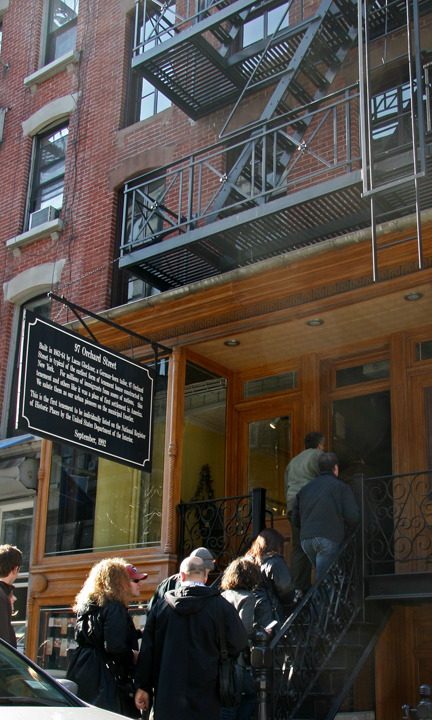
    Orchard Street is home to a very unique dwelling. The building located at 97 Orchard, built in 1863, was boarded up in 1935 and unoccupied thereafter. In 1988,  it became part of the Lower East Side Tenement Museum. This building is a virtual time capsule and a must-see – it is an opportunity to see the city living conditions of a century ago virtually intact.

    Orchard Street and the Lower East Side has been an area in transition, with numerous new trendy shops and upscale residences. Some have argued, however, that this has not been a classic case of gentrification, with older businesses being displaced; the area has been in decline for some time, and the newer merchants have been welcomed, even by many older residents.

    The Tenement Museum is conveniently located next door to the superb il Laboratorio del Gelato (95 Orchard). See you there 🙂

    Related Posts: Crossing Delancey, Go for a ride?, Sunshine Makes You Happy, Economy Candy, Eldridge Street, Doughnuts, Yonah Schimmel, teany, Pickles, Vegan Chic, Bluestockings, Colossal Misbehavior, il Laboratorio del Gelato, Fusion Arts Museum, Arlene’s Grocery, Footprints.

    Photo Note: The archival black and white photo shows Orchard at Rivington Street, circa 1915.


  • Fire and Ice


    I have seen fire and ice, and it was spectacular.

    Sunsets are a bit like Japanese restaurants in New York City – everyone knows the best one. In the case of sunsets, everyone has seen the most spectacular at some special time and place. So I am not going to tell you that I have seen the best sunset ever. However, I will say that this was the most remarkable sunset I personally recall seeing in New York City. While taking these photos, a woman ran out of a neighboring building into the frigid cold with camera in hand to capture the fleeting moments. See my entire gallery of photos here.

    After a day of adventure seeking with a friend, Red Hook, Brooklyn, was on our late-day agenda. We were not looking for a sunset, but as we approached the waterfront at dusk, I had a sense that something good lurked around the low-rise building known as the Beard Pier Warehouse. We explored the southeastern side of the warehouse, which was extremely nice, but I was getting antsy knowing that the sun was rapidly setting on the other side.

    A UPS truck blocked our exit on the narrow roadway which flanks each side of the pier building. Waiting to back out of the one-way street was like watching the sands of time.

    Have you ever driven around a corner or bend in the road where an extraordinary vista is suddenly revealed? This was our experience as we crossed a small alley on to the west facing side on Beard Street Pier and nature’s full glory burst into view. As I scurried to the water’s edge, I was equally stunned to see what at first look appeared to be an array of white glass – they were, in fact, smooth stones covered with a layer of ice. The red-orange sun illuminated the arched cast iron doorways and red brick of the pier building. The whole set looked like an installation art piece entitled Fire and Ice


  • Worth Seeing Again


    A good friend and colleague, well-known for his indulgence in the performing arts, will typically see multiple performances of the same show. I questioned him once about this, and his response was, “Anything worth seeing once is worth seeing again.” He is the dream patron of the arts.

    To some extent, our rituals and customs follow the same logic, and Christmas is perhaps one of the best examples of lavish ritual in this country. New York City is renowned for its Christmas displays and ornamentation, which draws people from around the world to see the tree at Rockefeller Center, the store window displays at Macy’s and along Fifth Avenue, and performances such as the Christmas Spectacular at Radio City Music Hall.

    I have featured many of the window displays yearly on this website. Some, such as those at Bergdorf Goodman, are extraordinary design works and are a must see if you are in the city at this time of year.

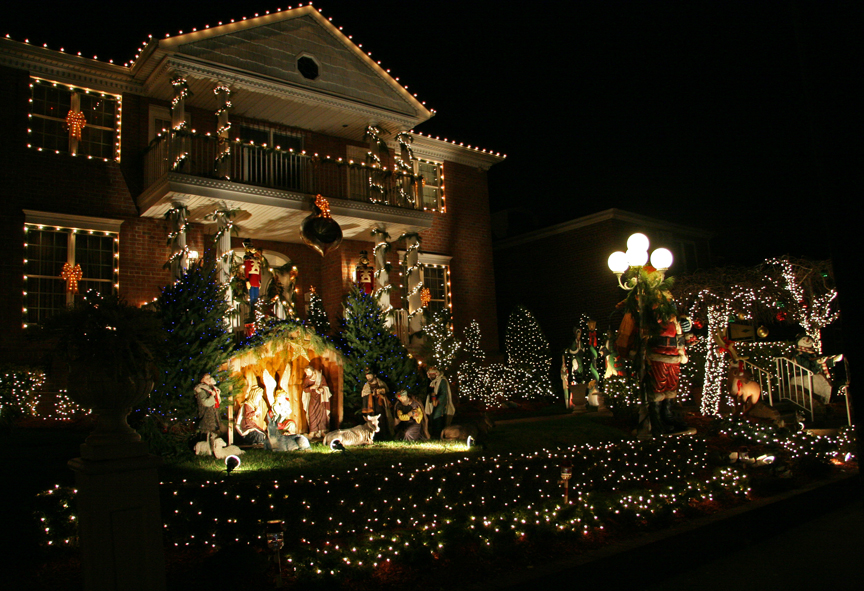
    One of the most lavish displays of Christmas lights is the annual extravaganza in Dyker Heights, Brooklyn. See the article and gallery of photos from 2006 here. The luxury homes, many of which cold be considered min-mansions, are decked like no other neighborhood at Yule time. See my gallery of photos here.

    I have not made it a plan to visit the neighborhood every year at Christmas, but it has turned out that way. I frequent Bay Ridge regularly to visit my favorite restaurant, First Oasis, and it is only a short jaunt by car to Dyker Heights. The lighting displays are typically up from after Thanksgiving until the New Year, affording over one month of opportunity.

    The start of the over-the-top tradition is generally credited to Lucy Spata. The Spatas’ residence is located at 1152 84th Street. This block, 84th Street between 11th and 12th Avenue, is the epicenter of the displays, with the homes of the Polizzottos (Toyland) (1145 84th St.), the Rizzutos (1062 84th St.), the Lambrones (8304 12th Ave.), and Jerry Bonanno.

    Donations are collected for various charities such as St. Anthony’s and the American Cancer Society.
    For those without the means or inclination to go out on their own, Brooklyn native Tony Muia now offers a Christmas Lights & Cannoli Tour, leaving from Union Square every weekend in December. Perhaps I’ll go back – after all, anything worth seeing once is worth seeing again 🙂

    Note: Our patron of the arts, loosely quoted at the beginning of this story, is Hovey Burgess. During the writing of this article, I called to verify the actual language of his statement. He pointed out that his sentiment is that anything worth seeing once is worth seeing repeatedly – i.e. again and again.


  • A Different Dictionary

    I was prepared for the worst. I had been told that Willets Point was what Mayor Bloomberg called “another euphemism for blight” or what Robert Moses once described as an “eyesore and a disgrace to the borough of Queens.”

    But these were understatements of what I saw when I actually paid a visit by car. As I turned onto Willets Point Boulevard from Roosevelt Avenue, I felt like I was entering another world. Willets Point is far and away the worst-looking neighborhood I have seen in the five boroughs.

    I initially also found the place menacing, as I was immediately accosted by gangs of men who blocked my travel, at first not realizing that these were efforts by workers to negotiate deals for auto repairs.
    I was, however, not in need of repairs but of photos. The Hole, which I wrote about in September 2009, was a pastoral sleepy backwater in comparison.

    I pressed onward through the neighborhood – the absolute grit of it all just drew me in, and there was no way to turn around, anyway. The streets are heavily rutted and flooding is common. Even on a sunny day when it had not rained for two days, the potholes were filled with water, making navigation akin to walking a minefield.

    There are no sewers or sidewalks. I saw roosters walking the streets. The area is highly polluted with the buildup of years of oil spills, which has also contaminated Flushing Bay and Flushing River.
    The neighborhood is dominated by 225 auto parts and repair businesses, many of them operating out of shacks built from corrugated metal or cinder-blocks. There are over 1,200 people employed in those businesses. The area is unique in its concentration of vehicle repair shops, and people travel from afar for parts and/or repairs.

    Efforts to revitalize the area have been proposed and thwarted for decades. There is a redevelopment plan for the area, an extensive ten-year project. This will, of course, require relocation of all of the businesses, if suitable places can be found. The most recent plan was also fraught with difficulties and threats by the Bloomberg administration to use eminent domain, if necessary, to remove the businesses. Things appear to be on track now for the project. “After a century of blight and neglect, this neighborhood’s future is very bright indeed,” Mr. Bloomberg has said.

    The area has only one resident, Joseph Ardizzone, who has lived in the area since his birth in 1932. He is opposed to the new plan. I sympathize with Joseph Ardizzone’s nostalgic feelings of his youth growing up in the area, but his claims that blight is not the correct word puzzle me a little. I guess he must be using a different dictionary…

    Note about the areas location: Willets Point is part of Corona, Queens, and is sometimes known as the Iron Triangle. It is bounded on the north by Northern Boulevard, to the west by 126th Street and Citi Field, to the south by Roosevelt Avenue and Flushing Meadows-Corona Park, and to the east by the Flushing River.


  • All the Way…

    Today is Black Friday, the start of that period which most retailers have waited for all year.
    However, dealing with the constant onslaught of customers can be wearing. The vast majority of people are decent human beings, but there is a percentage that can be unreasonable, and that number can test the nerves of even the most patient.

    I had a close friend who was a New York City native and had been in retailing for all of his adult life. His father had also been a businessman. He was a nice person, but, as is typical of many New Yorkers, he was a no-nonsense person who will only tolerate so much. That limit is easily met any day in retail. His conclusive statement to stories of others or his own about the horrors of the business was a sarcastic “Welcome to retail.”

    One thing you learn quickly in business is the sense behind scheduled breaks and lunch. If you don’t take them at preappointed times, you will most likely find yourself eating lunch on the run at 4:30 in the afternoon.

    On a morning sometime in the 1970s, said friend was eating his croissant fifteen minutes prior to the store’s opening in the morning at the health food store he was managing in Queens. Being the seasoned retailer that he was, he had established a firm rule of eating before opening. On this occasion, a woman with an unusual sense of urgency appeared banging at the door, insisting that she be let in before the official opening hour. I don’t recall the specific reason, but she added fuel to her plea with the statement, “But I came all the way from Bayside, Queens.” This refrain was repeated ad nauseum emphasizing the words “all the way from Bayside, Queens.” My friend’s response was, “I don’t care where you come from, lady, I am finishing my croissant and I am not opening this door before 9 AM.” The war across the pane of glass continued and, as you might expect, the door was not open until 9 AM.

    Since that time, I have had the nagging need to visit Bayside and achieve closure. It has been only a small nagging need, however, so it was not until one week ago that on my visit to Flushing, I decided to go all the way to Bayside, Queens, and see what the neighborhood was like.

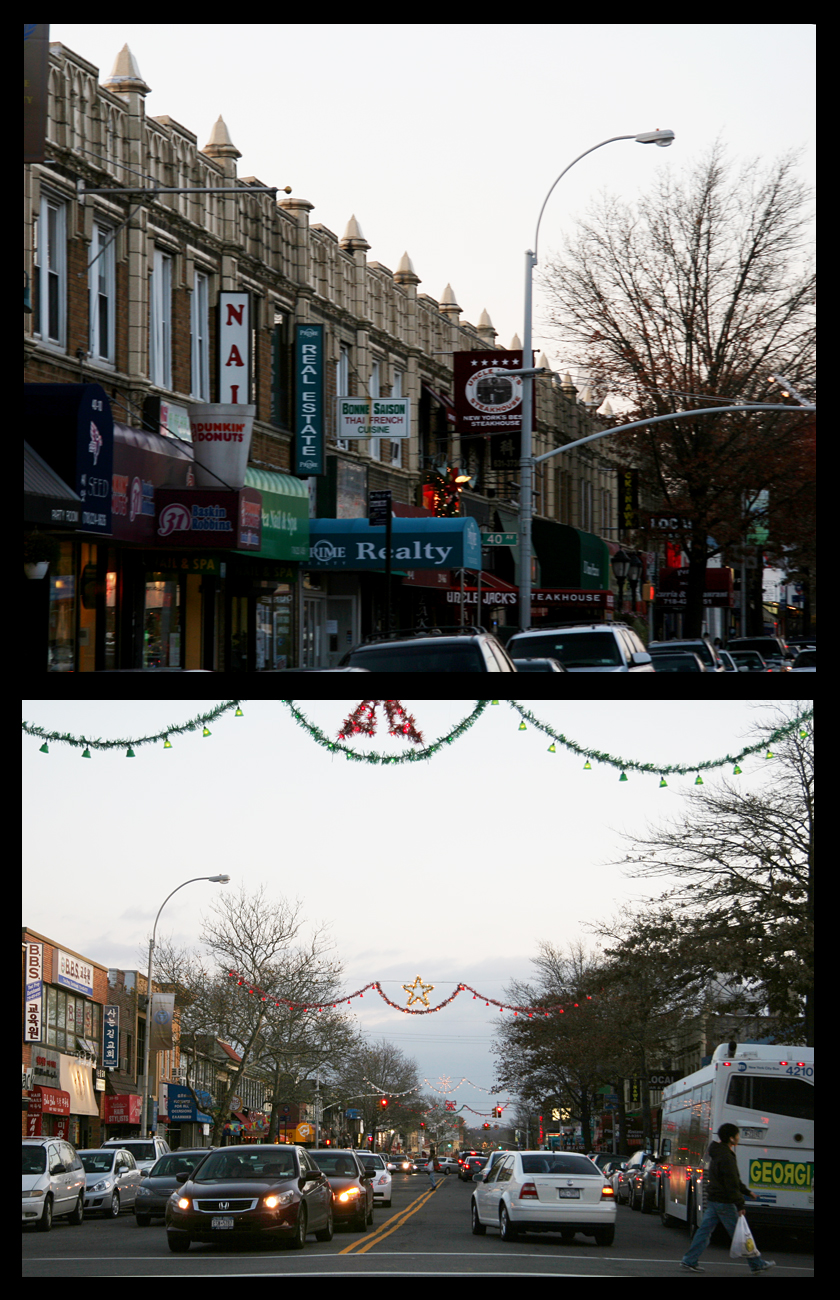
    I really had no expectations, but I was completely astounded at how beautiful much of this neighborhood was. Bayside is in the extreme eastern section of Queens, abutting Little Neck Bay and Nassau County, Long Island. This accounts for the more suburban feel – there are many unattached homes, porches, and yards. Although Bayside is not that familiar to the outsider, it is one of the most expensive housing markets in the United States and is considered one of the most desirable communities to live in New York City, with great schools and a very low crime rate. The main shopping district along Bell Boulevard has a charming ambiance. At one time, many celebrities lived in Bayside and strolled Bell Boulevard. From the New York Times:

    Houses with water views, although separated from Little Neck Bay by the Cross Island Parkway, are likewise one of a kind.One of these is said to have belonged to W. C. Fields, who, like Gloria Swanson, Charlie Chaplin, Rudolph Valentino and Norma Talmadge, lived in the area when Astoria Studios was in its heyday. Miss Swanson is said to have once walked down Bell Boulevard with a pig on a leash.

    So, if you have a car and you are interested in exploring the outer reaches of New York City, perhaps after a harrowing visit to the Hole or Willets Point, try going All the Way to Bayside, Queens 🙂

    Related Posts: I can not so much as hear “Bayside, Queens,” without this incident coming to mind, much like hearing “Kissena Boulevard” or “comin’ up.”


  • Vlissingen

    If you look at the census figures for a place like Flushing, Queens, you will find that, like many areas of New York, this is more of a small city or town than a neighborhood. Flushing has a population of 173,826 and a demographic makeup that is 43% Asian, 19% Hispanic, 6% black, and 39% white. The range of services is broad enough that you could easily never leave the neighborhood, and I imagine that many who live and work in Flushing do not leave often.

    Flushing now rivals Manhattan’s Chinatown as a center for Chinese community, making it the largest (or second largest) in the United States and outside Asia. Flushing, however, unlike a typical Chinatown, has more Asian diversity, both in its residents and businesses/services, with many Asian groups including Korean, Taiwanese, Malaysian, Thai, Vietnamese, and Japanese.

    Flushing has become a model for religious pluralism in America, according to R. Scott Hanson, a visiting assistant professor of history at the State University of New York at Binghamton and an affiliate of the Pluralism Project at Harvard University. There are over 200 places of worship in a neighborhood of only 2.5 square miles.

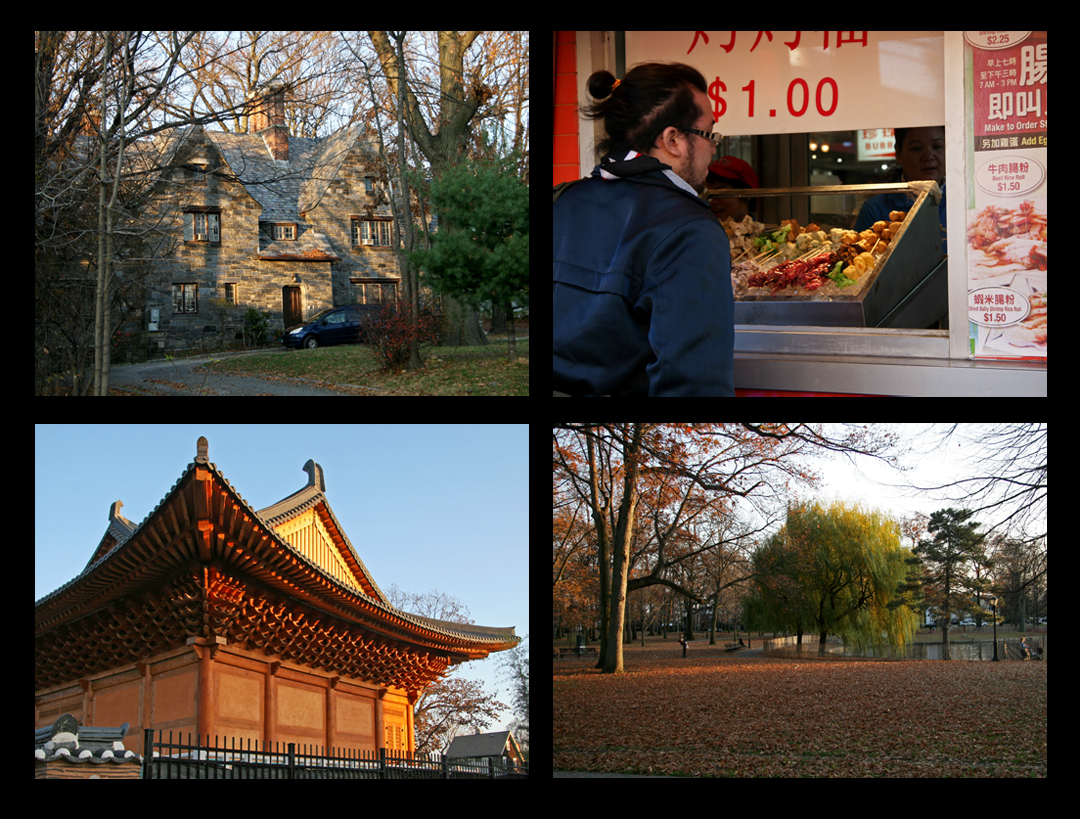
    On my recent excursion, I explored the area by foot and by car and was amazed by the diversity of people, commerce, architecture, and residential enclaves that I found. I was particularly impressed with North Flushing’s absolutely exquisite single family homes, just a short way from the hustle and bustle of Main Street, Roosevelt Avenue, and Northern Boulevard. You can see, for example, the Fitzgerald-Ginsberg Mansion in the upper right of the photo collage.

    There is a botanical garden, Flushing Meadows-Corona Park (site of the 1964 World’s Fair), the Queens Museum of Art, art galleries, tea shops, herbalists, dumpling stands, Queens College, the Old Quaker Meeting House, and the historic Flushing Town Hall (headquarters of the Flushing Council on Culture and the Arts, an affiliate of the Smithsonian Institution). Flushing is home to the Queens Borough Public Library – the Flushing branch is the busiest branch of the highest circulation system in the country.

    I would recommend a visit to Flushing (along with Jackson Heights), both for the New Yorker and the out-of-town visitor. Here, you will get a slice of ethnic life in New York City in a real working neighborhood which caters to its residents and not so heavily to tourists, as in Manhattan’s Chinatown. And there are plenty of restaurants to satisfy and shops to peruse.There’s a vibrant feeling in this place. Flushing is a city on the move…

    Note about the name: From the New York Times: “Flushing’s early settlers were mainly English families who came via Vlissingen, a port city in the Netherlands. In 1645, these folks named their community Vlissingen. The area remained known as Vlissingen until about 1663 when the name was changed to New-Warke or Newark, according to documents from the Queens Historical Society. In 1665, however, the name Flushing, an English version of Vlissingen, was adopted and stuck.”


  • dinamic_sidebar 4 none

©2026 New York Daily Photo Entries (RSS) and Comments (RSS)  Raindrops Theme