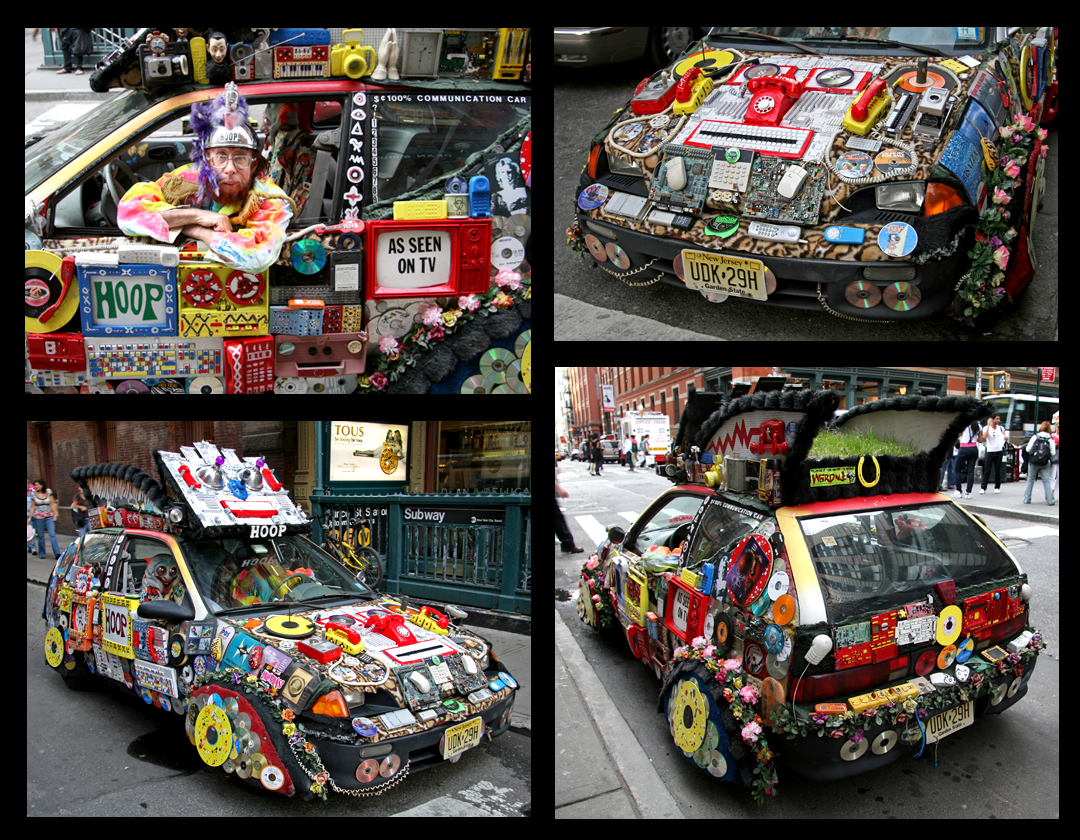
• Hoopmobile

    Welcome to one of Hoop’s many Hoopmobiles and the world of art cars. Hoop refers to this incarnation as Techno Trash – an assemblage which he says represents ”all the transitions we’ve gone through over the years, from a needle on a record to a laser beam on a record.” Steven Hooper, or Hoop (the self-proclaimed King of Art) as he prefers to be called, started doing art cars in the East Village about 20 years ago, when he did hundreds of club performances and parties. His work has been featured in over 40 museums and gallery shows (Fusion Arts, Chelsea Art Museum, MOMA, etc.), television, and the news media. Click here for his story and photos of his vehicles. His motivation is to bring art to the average person on the street, whom he feels can’t name one living artist: “Warhol and Dali were the last of the household name artists.”

    Currently living in Clifton, New Jersey, where he grew up and now cares for his mother, Hoop makes frequent trips to SoHo (one of his old stomping grounds – he once had studios in Union Square and on Prince Street), where he parks and lets passersby ogle his street art.

    The art car movement goes back some time and has seen many incarnations: hippie themed VW buses (such as Furthur), Janis Joplin’s psychedelic Porsche, Lennon’s paisley Rolls Royce, and the Oscar Meyer Wienermobile. There is even a BMW series done by well-known artists such as Warhol and Lichtenstein. The Burning Man festival has had a strong representation. Harrod Blank has made several art cars, written books, and made documentary films on the subject. There are now numerous art car fests nationwide (see here). It’s a virtual industry…
  • Baby And Merlin

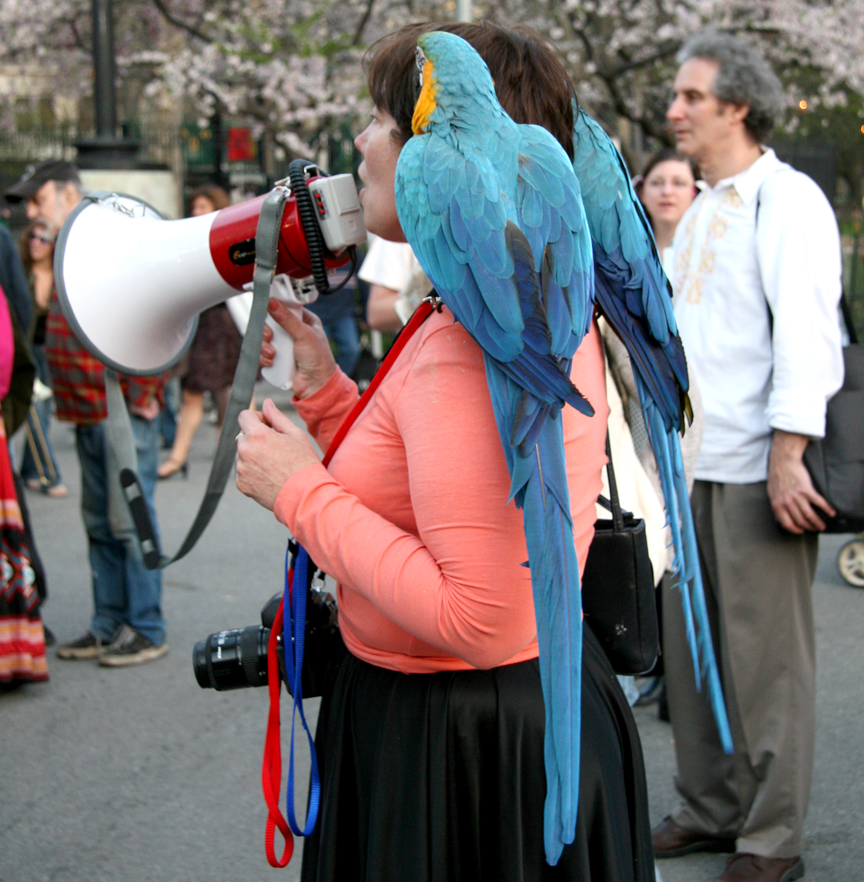
    These are Baby and Merlin , blue and gold macaws with their owner, Gloria Waslyn (more photos here), who describes them as “Peace Parrots, Rainforest Ambassadors and NYC’s Spokes Avians for the Mayor’s Alliance of Animals promoting rescue and shelter animal adoption. … BABY, the outgoing male, and MERLIN, his pretty mate are so well behaved that anyone can hold them. They are quiet, so they do not upstage anyone, are comfortable with anything, and have been on a float in a high-profile and crowded Halloween parade in Greenwich Village of NYC. They have been held by celebrities (Sean Lennon and Yoko Ono), scientists (Nobel DNA prize winner James Watson and co-mapper of the human genome, Frances Collins) and thousands of New Yorkers and people from around the world who visit the city sidewalks of NY.”

    Gloria says that the two 9-year-olds “never bite, play with earrings or hair, and are quite the ‘hams’ without any diva attitude.” The trio were part of one of many NYC Earth Day celebrations yesterday – the birds stole the show at this one with their brilliant blue plumage, huge size, and friendly antics…


  • Pen And Brush

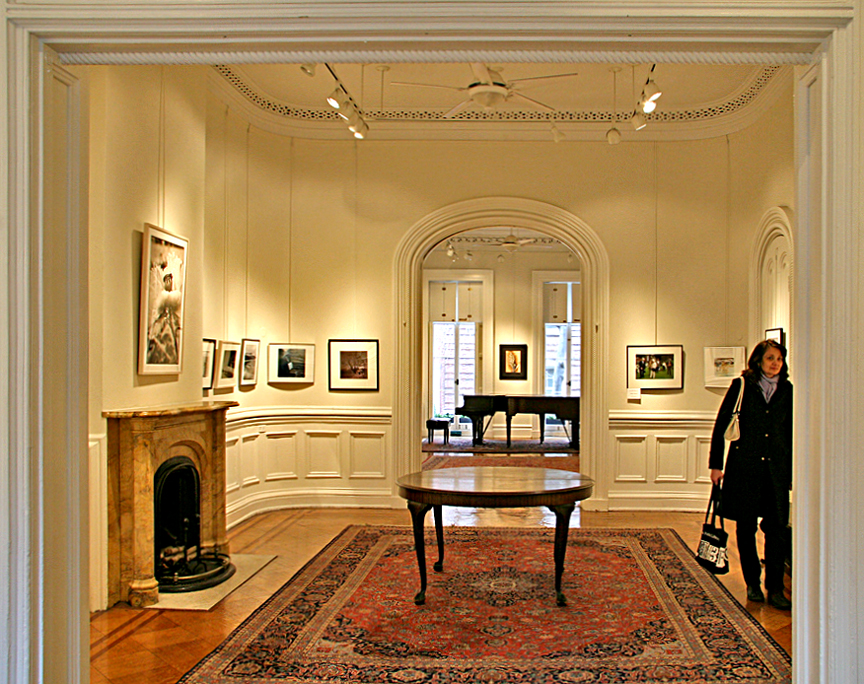
    This is the Pen and Brush Club, which has its home in the exquisite townhouse at 16 East 10th Street. In the 1890s, the arts were dominated by men, but women were beginning to gain prominence – many women artists had studios around the Washington Square area. In 1892, in response to the exclusionary climate towards women (the Salmagundi Club around the corner on 5th Avenue excluded women until 1973), the Pen and Brush Club was formed by painters Janet and Mary Lewis (sisters), who invited three other artists and eight writers to their studio in Chelsea. Early members included journalist Ida Tarbell, first ladies Eleanor Roosevelt and Ellen Axson Wilson, and Pulitzer Prize winner Pearl Buck.

    In 1923, the club purchased the 1848 Greek Revival townhouse which it has occupied ever since. As women became more accepted in the art world, the club became more insular. However, the art world is still relatively dominated by men, and director Janice Sands sees the club’s original mission to be just as relevant today. She has been on a campaign to expand exhibitions to outside non-member artists and recruit new members, shedding its older image and bringing in younger artists.

    The photo shows the exhibit space on the parlor floor with its intricate crown moldings, marble fireplaces, parquet floors, 16-foot ceilings, and its Steinway grand piano (read about the club and its facilities here). Its main rooms are open to the public, and the exhibits are always free of charge…


  • Horsing Around

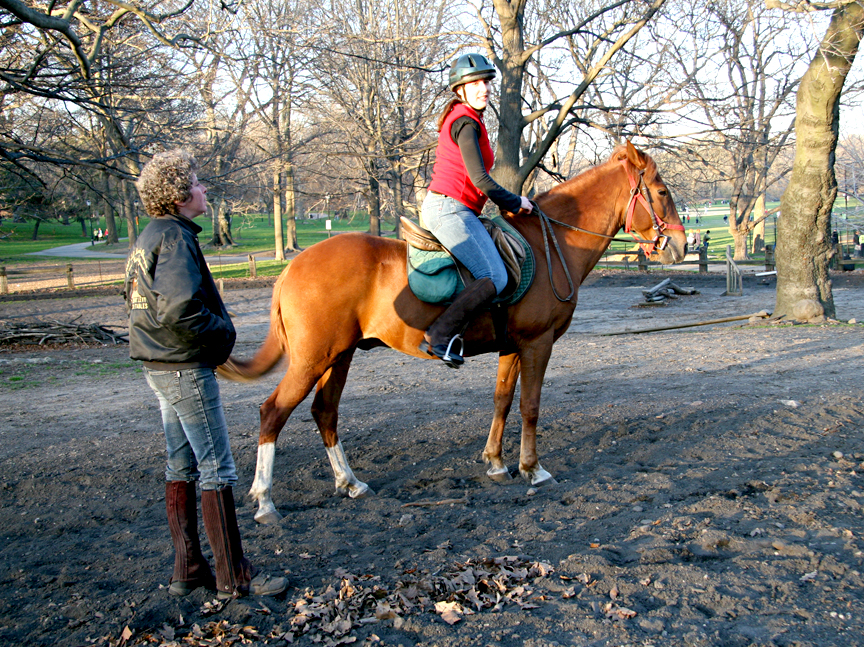
    Many visitors see NYC as a concrete jungle with no respite from a continuous bombardment of stimuli – noise, traffic, and crowding. A nice place to visit, but how could you live here? But that is primarily because visitors generally do not frequent those places (with some exceptions, such as Central Park) or engage in those activities which residents look to for relaxation and recreation. There is a large gamut of activities in NYC which residents partake in that may come as a surprise such as kayaking, tennis, birdwatching, biking, swimming, baseball, volleyball, pétanque, sailing, surfing, sledding, ice skating, gardening, and horseback riding – the photo shows a lesson in a riding ring in Prospect Park, Brooklyn. There are riding trails in every borough, including Manhattan (Central Park).

    One of the biggest surprises is Claremont Riding Academy, the only stable in Manhattan (other than the mounted police). They occupy an entire building in the center of the Upper West Side – a multi-story barn with riding ring. Over 100 horses are stabled there. Seeing horses in the city is always a welcome surprise – horses are large, magnificent animals, and many of us can’t resist the urge to indulge the relatively rare encounter – watching and, if we’re lucky enough, making contact…


  • Virginia Tech

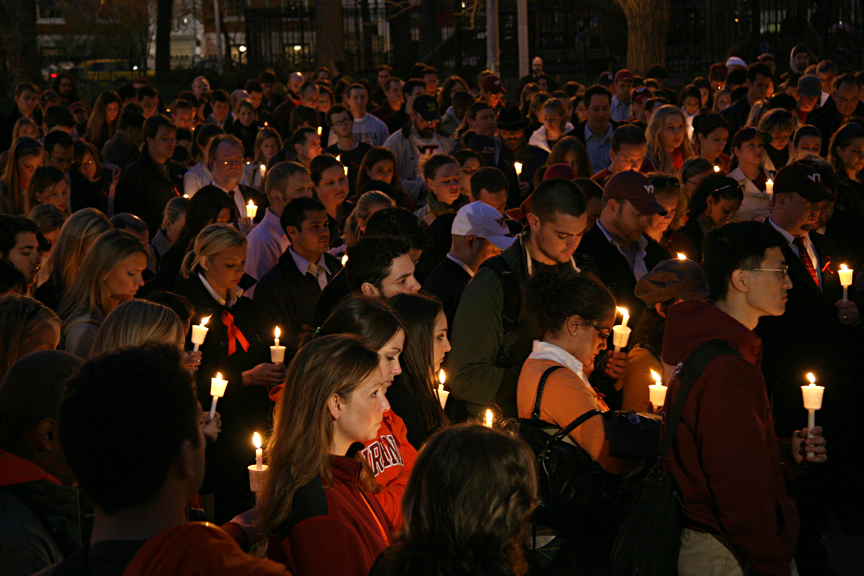
    This is the candlelight vigil which took place last night in Washington Square Park to honor the victims, families, and friends of those affected by the Virginia Tech massacre last Monday. The vigil was organized by the Greater New York City Chapter of the Virginia Tech Alumni Association (Manhattan Hokies). All were welcomed to attend. I will not recount the details of the event, as there are better sources than this site for those interested. My condolences to all those affected by the tragedy…


  • Moustache

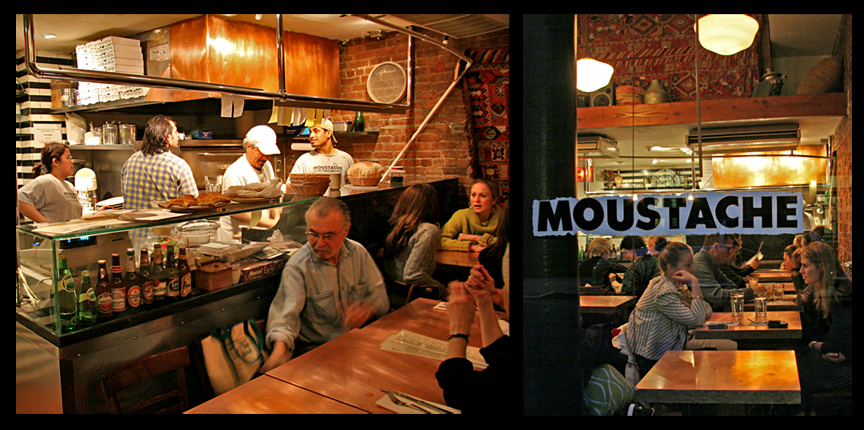
    The typical impression of Middle Eastern food is falafel and hummus. And for the average New Yorker, the knowledge extends to perhaps baba gannouj, tabouleh, kebabs, or shawarma on a spit. But there is much more. The true cognoscenti know of things such as zatter bread, ouzi, ful mudammas, labne, moussaka, Merguez sandwiches, lahambajin pitza, rahib, loomi, and more. And they know of places like Moustache. There are two locations: 90 Bedford Street and 265 E. 10th Street, both owned by Iraqi chef/restaurateur Salam al-Rawi from Baghdad. Salam also owns Mamlouk at 211 E. 4th Street – a unique, very upscale Middle Eastern restaurant with a fixed menu.

    I have only been to the Bedford Street Moustache. This is a little gem of a place, hidden on quiet Bedford Street, with copper-topped tables, an open kitchen with a brick oven, and a very cozy atmosphere. But be forewarned – this place has frequent lines, long waits, and slow and spotty service. But their food is excellent, and in fairness, many of the dishes are made to from scratch (such as ouzi and their pitzas) and take time. Their tag line (proclaimed on T-shirts the wait staff wears) is “slow food establishment.” My favorite is ouzi – chicken, carrots, sweet peas, onions, raisins, almonds, basmati rice, and spices enclosed in filo pastry dough and served with a yogurt sauce (it can be had vegetarian). They are best known for their Pitzas – brick oven-baked pizzas made on their own pita breads. No credit cards, no website, no email address…


  • The Subway

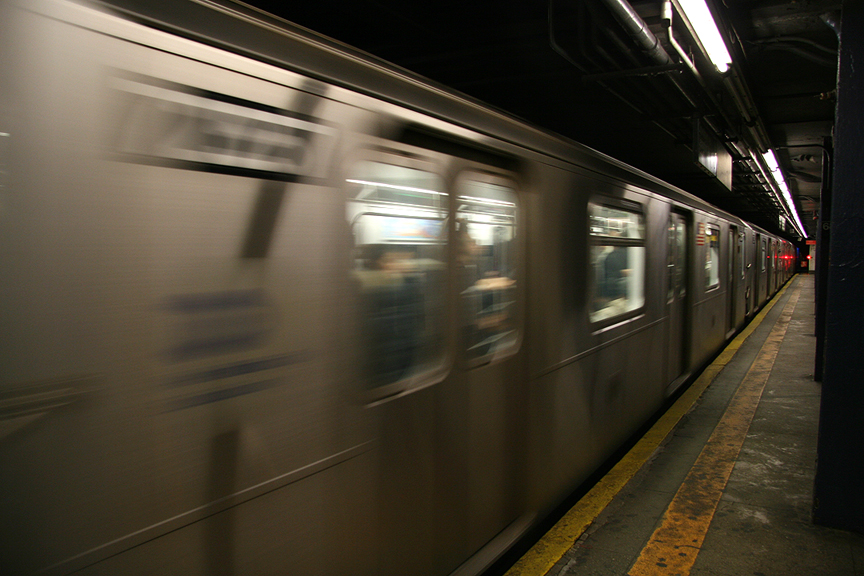
    New Yorkers love to complain about the subway, but actually, the system is quite remarkable, especially allowing for the fact that it services a city that is not known for efficiency. We are all familiar with the negatives: rats, filth, litter, oppressively hot stations in the summer, no bathrooms, crowding, delays, rerouting, etc. After all, the system has to service 1.5 billion riders a year (5 million a day) with the world’s largest fleet of subway cars (6,400).

    But look at some of the positives: it is one of the most extensive systems in the world, with 660 miles of track and 468 stations in four boroughs. In conjunction with buses, one can get reasonably close to any two locations, and that’s an achievement given the area involved. One can travel as far as 31 miles on the A train without a change of trains (207th Street Manhattan to Far Rockaway in Queens). Service is 24/7 – one of the few in the world and a tremendous convenience we take for granted. I remember a trip to Paris and being surprised that their system closed at 1 AM and having to find a taxi.

    Fares are good for trips of any length with free transfers – many other transit systems charge on the basis of distance traveled. Some stations have amenities such as magazine stands and food. Musical entertainment can be found at some of the larger stations. If you are interested in more details, click here for the transit’s official site. I know – I should have written this after being stuck on a train during rush hour or being rerouted on the F 🙂


  • Standpipe

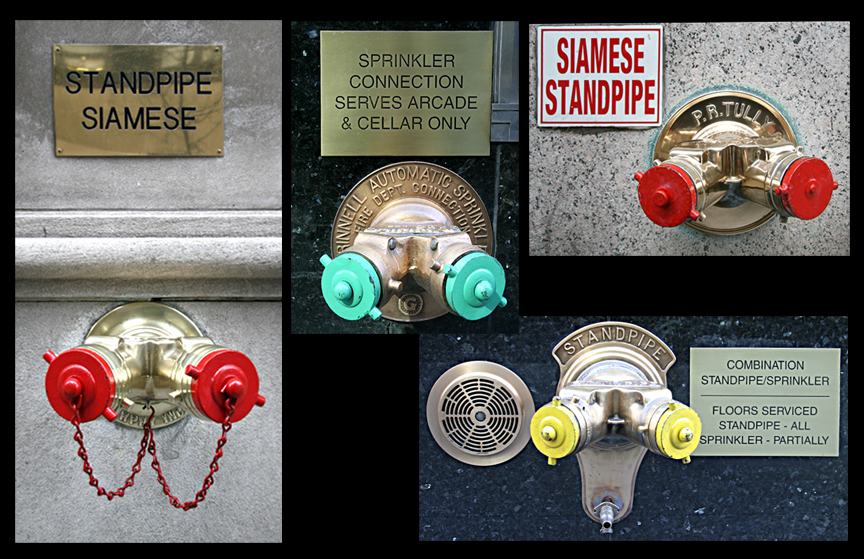
    Standpipes are everywhere in New York City, yet very little attention is paid to them. And what do we really know about them? A standpipe is a rigid pipe which supplies water under pressure to a water supply and/or sprinkler system in the event of a fire. And why do we need them? Because it is not feasible to run hoses from the street up stairwells to upper floors of a tall building in a fire (there are over 1,000 high-rise buildings in NYC). With a standpipe system, water is fed from the street through the vertical piping – hoses are attached from outlets at each floor.

    There are dry and wet types – wet systems contain water at all times, while dry systems contain no water and may have their own source of water or be supplied by a firetruck in tandem with a fire hydrant. Water can be supplied via water tanks, city main, and/or hydrants and fire pumps. Siamese connections (shown in the photo) allow two hoses to be attached for increased capacity and provide backup if one is jammed or malfunctioning.

    There are a variety of styles, of course. Conversation about these between myself and a photographer friend eventually inspired him to go on a photo quest (click here for his collection). A Siamese connection provides ideal seating, but beware of standpipes with sawtooth type projections on top, which I assume acts as a deterrent. BTW, standpipes are needed not just for tall buildings but also for anywhere there is no access to firetrucks or where there is excessive distance to stretch hose lines: shopping malls, theaters, stadiums, arenas, parking garages, bridges, tunnels, highways, piers…


  • Nor’easter

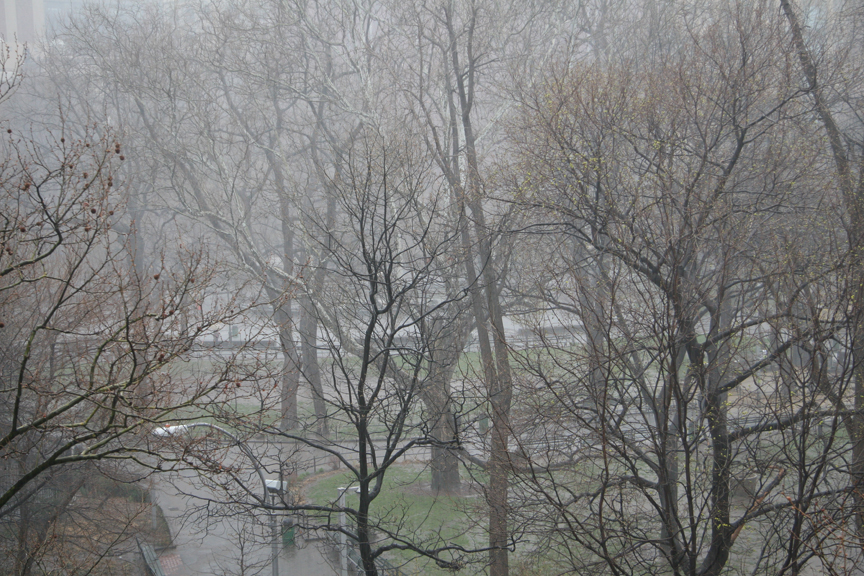
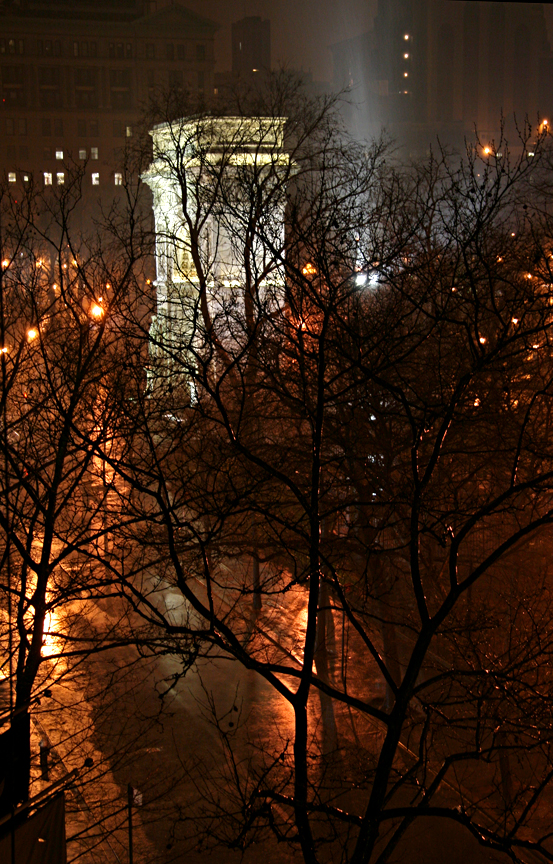
    Until recently, we have had a very sunny early spring, albeit colder than usual. However, this is the northeast, and in its typically unpredictable way, spring has now brought us rain in the form of a nor’easter, with brisk winds, flooding, transportation delays, power outages, leaking roofs, snapping trees, and other havoc. Some areas in upstate NY and northern New England with colder climates are experiencing snow storms. The photo was taken of Washington Square Park (click here for night shot).

    A nor’easter (contraction for northeaster) gets its name from its strong north east winds blowing in from the ocean, causing high seas and coastal damage. The coast of Massachusetts along with Cape Cod and Nantucket have historically been particularly brutalized by nor’easters. Tragically, today is the Boston Marathon, and apparently they are still running…


  • Gay Liberation Monument

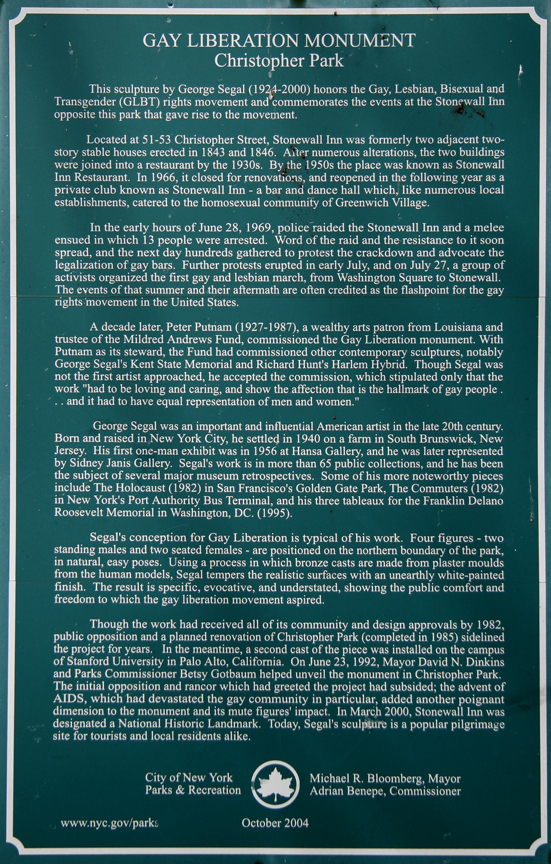
    “This sculpture by George Segal (1924-2000) honors the Gay, Lesbian, Bisexual and Transgender (GLBT) rights movement and commemorates the events at the Stonewall Inn opposite this park that gave rise to the movement.” Thus reads the plaque at the Gay Liberation Monument in Christopher Park in the West Village. George Segal (1924-2000) is a well-known sculptor, and this work was inaugurated in 1992 after a 12-year battle of controversy and opposition (a cast of the sculpture installed on Stanford University’s campus in 1984 faced a decade of vandalism and beatings). The Stonewall Inn is just out of view to the right in the photo. If you are unfamiliar with the Stonewall Riots of July 1969, you can read about them here. Many consider the events of that summer pivotal in the gay rights movement.

    It’s hard to imagine that 38 years ago, men were being arrested, harassed, and beaten by police simply for being gay – many of the arrests were made with charges for indecency. And yet arguments for legalization of homosexuality go back hundreds of years. English scholar Jeremy Bentham wrote an essay as early as 1785, at which time homosexuality was punishable by hanging. Much progress was made from 1860 to 1933 in Europe and Germany, with activists like Karl Heinrich Ulrichs, Magnus Hirschfeld, Ann Rüling, and Helene Stöcke, but most of the gains were lost with the rise of Nazism. Progress in human rights, unlike those in technology, can be very S L O W…


  • AIPAD

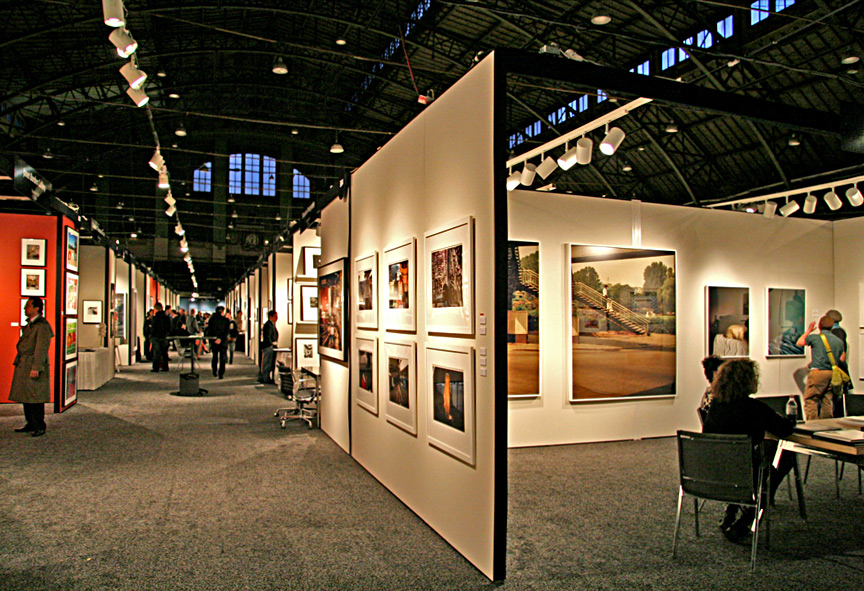
    AIPAD is the Association of International Photography Art Dealers, currently hosting the Photography Show 07. In its 27th year, the show includes more than 90 of the top dealers from around the world who specialize in fine art photography, featuring the earliest to the most contemporary images. Photos from many of the biggest names in photography can be found for sale: Steichen, Weston, Ansel Adams, Minor White, Margaret Bourke-White, André Kertesz, Brassai, Cartier-Bresson, Berenice Abbott, Salgado, and hundreds of others.

    I was accompanied by an artist and photographer – we were impressed and inspired by the quality presented. The show is a rare opportunity to see such a breadth of work all at one time under one roof. The show is held in the 7th Regiment Armory on Park Avenue and 67th Street, a great historic fortress (occupying a full city block) and a great space for this type of event. The exhibit runs from April 12 through the 15th. The $20 admission (which includes a 360-page color catalog) is well worth it…


  • Bleecker Bob’s

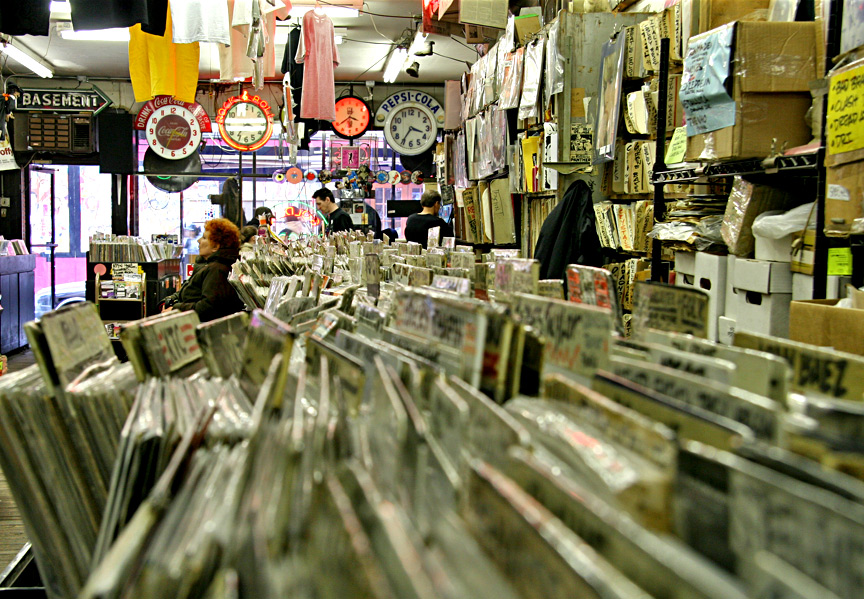
    Bleecker Bob’s Golden Oldies at 118 West 3rd Street in the Village is a destination for buyers and sellers of vinyl LPs. Click here for more photos. It has had several different shop locations in the immediate neighborhood. Bob Plotnik (still the current owner) opened the original store on Bleecker Street in 1967. I have no real opinion of this shop regarding pricing, inventory, or service – I am not a current buyer or seller of vinyl LPs, and my visits there are few. But it is a landmark with its distinctive, homey, funky New York-style decor and ambiance.

    With vinyl experiencing a niche renaissance and the decline of physical CDs due to digital downloads, I believe their chances of survival are much better than stores selling CDs, many of which have closed. While CDs are in decline and catering more and more to a graying market, the market for new vinyl is actually growing. DJs in electronic dance or hip hop music prefer LPs for the direct manipulation of the disc (slip-cueing, beatmatching, and scratching). In the used market, many covet vinyl LPs for their cover art. And there are still some audiophiles who prefer vinyl and claim a sonic superiority over the CD –  a debate which has raged since the beginning of CD production.

    There are also nostalgia and cult factors at work here. In the case of Bleecker Bob’s, I’m sure all of these factors drive customers to them, and I would imagine that many of their customers are looking for music which is not available on CD and perhaps never will be…


  • Glass

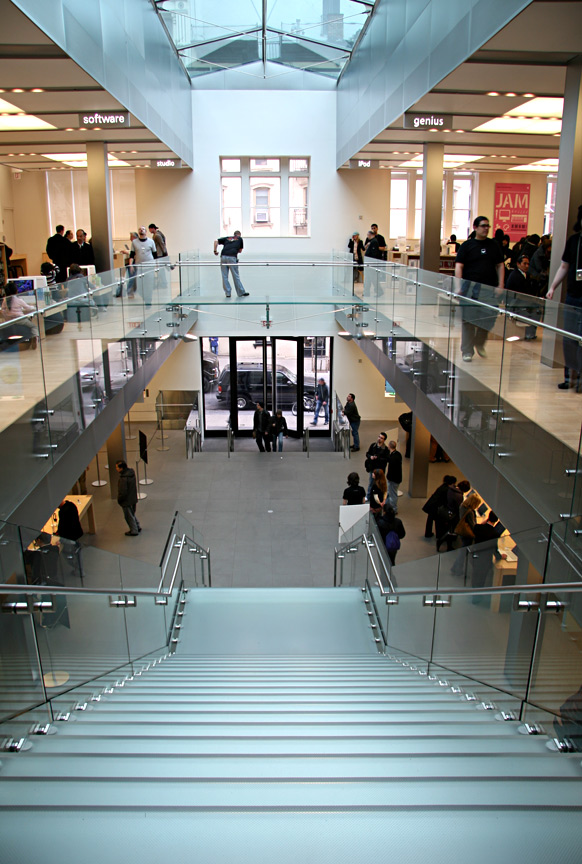
    I’m really quite awed by the design, engineering, material selection, and attention to detail that went into this Apple Store at 103 Prince Street in SoHo. The beautiful two-story neoclassical building was built in the 1920s and occupied by the Post Office until 1999, when Restoration Hardware briefly occupied it until 2001. Apple opened there in July 2002. The importance of design aesthetic to Apple is evident in this store, which received an architectural award in 2003 (as have the design firms involved – Bohlin Cywinski Jackson and Ronnette Riley.)

    The most striking feature of this store (and other Apple Stores) is the use of glass, particularly the 15-foot high glass staircase, with its acid-etched diamond-plate treads. The staircase, which actually received a design patent with Apple CEO Steve Jobs listed (copy of the patent here) was designed by structural engineer James O’Callaghan, now a partner with Brian Eckersley at Eckersley O’Callaghan Structural Design.
    An enormous amount went into the design, with considerations for weight loads, wear, seismic protection, and joinery with titanium hardware. Depp Glass (NY) manufactured the staircase components, the titanium hardware was manufactured by Tripyramid Structures Inc. (Mass.), and the fabrication, installation, and safety tests were performed by Seele GmbH & Co. of Gerthofen, Germany. Click here for a thorough, detailed article. Glass is also used for the stair sidewalls, a bridge (connecting the two sides of the upper floor), and the 70-foot skylight. Lead architect Peter Bohlin explains that glass elements are used not only for structural ingenuity but also because they capture the design of Apple’s products: “From the point of view of the attitude and spirit of the store, it is the pure expression of a quality associated with a company that makes these very beautiful, rather pure products.”

    Glass elements and white Corian fixtures are juxtaposed with wood for warmth – maple is used for benches, tables, counters, shelving, and the backs to the seating in their theater, used for presentations, classes, and events. The unique Pietra Serna stone floor in dark gray is also striking. If you love glass as I do, visit this store along with their Fifth Avenue location, the subject of two previous postings (click here and here)…


  • Minutemen

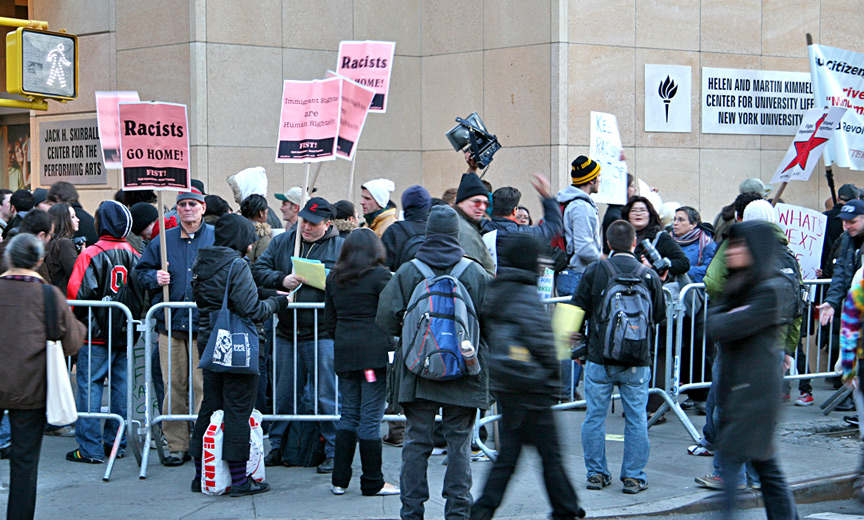
    On Monday evening, Chris Simcox spoke at NYU, an event sponsored by the NYU College Republicans. This was a follow up to their February 22 event, “Find the Illegal Immigrant,” a mock hunt for a student posing as an illegal immigrant. The event drew more than 300 protesters and 12 participants. Chris Simcox, himself mired in controversy, is the cofounder of the Minuteman Civil Defense Corps, an organization of individuals who patrol the Mexico-US border for illegal crossings. The organization states that they do not confront anyone directly but only report incidents to law enforcement. Critics say they are a racist vigilante hate group and claim that they have been charged with various crimes.

    The protest, shown in the photo taken in front of NYU’s Kimmel Center, was sponsored by various groups (College Democrats, the ACLU, etc.). As reported in an article in NYU’s newspaper, one person who came to protest was put off by what she called “the extreme right versus the extreme left.” Others found too many protesters who were not students championing their own causes, such as older socialists. And inside, Simcox’s attempt to speak was also was also a scene…


  • The Question Mark

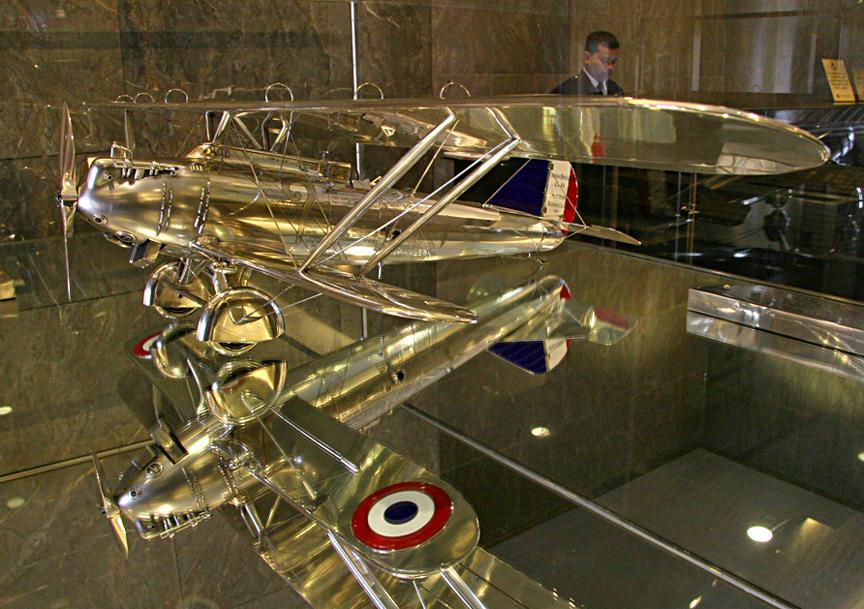
    If you enter the lobby of the French Building at Rockefeller Center from the side entrance (off the central channel gardens), you will find a showcase with a reproduction of a plane in sterling silver made by Cartier. There is a plaque with an inscription which reads:

    REPRODUCTION IN STERLING SILVER OF THE
    “QUESTION MARK”
    WHICH MADE THE FIRST NON-STOP FLIGHT FROM PARIS TO NEW YORK
    IN SEPTEMBER 1930, PILOTED BY THE FRENCH AVIATORS
    COSTES AND BELLONTE
    THIS GOOD-WILL FLIGHT WAS THE RETURN VISIT OF
    LINDBERGH’S HISTORIC FLIGHT TO PARIS IN 1927
    THIS REPRODUCTION, WHICH IS SCIENTIFICALLY CORRECT IN
    EVERY DETAIL, IS THE GIFT OF THE FRENCH GOVERNMENT TO
    ROCKEFELLER CENTER FOR LA MAISON FRANCAISE
    PRESENTED ON NOVEMBER 8, 1933
    BY THE FRENCH AMBASSADOR TO THE UNITED STATES.
    HIS EXCELLENCY MONSIEUR ANDRÉ LEFEVRE DE LABOULAYE
    EXECUTED BY CARTIER


    The plane was a variant of the Breguet 19, a Super Bidon single-engine biplane, which was built specifically for transatlantic flight. On September 1-2, 1930, Capt. Dieudonne Costes and Lt. Maurice Bellonte flew from Paris to New York City (3,852 miles) in 37 hours and 18 minutes, the first non-stop westbound fixed wing aircraft flight between Europe and America. The conclusion of a message to American president Herbert Hoover from French President Gaston Doumergue read, “…in forming one more tie between France and the United States, will contribute greatly to the development of their friendship of centuries.” I guess those were better times as far as American/French relations…


  • dinamic_sidebar 4 none

©2026 New York Daily Photo Entries (RSS) and Comments (RSS)  Raindrops Theme