• The Shore

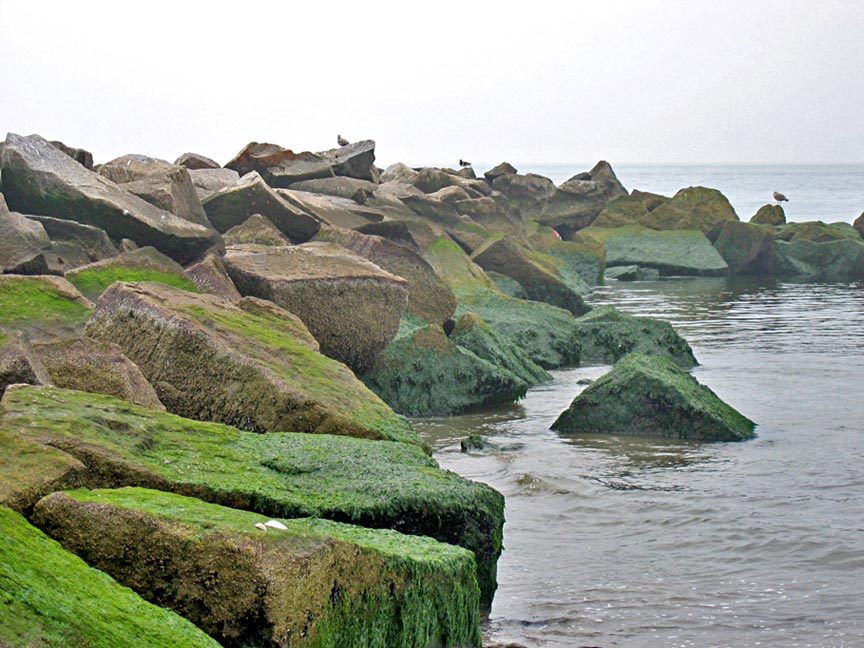
    Not only is NYC surrounded by water, but 4 of the 5 boroughs are islands or part of islands – we’re an island nation. Only the Bronx is attached to the mainland. And, as Brooklyn and Queens residents know, we have some very nice shoreline on the Atlantic Ocean with white sand beaches: Brighton Beach, Manhattan Beach, Coney Island, Riis Park, and Rockaway.

    This photo is of a rock outcropping on a sand beach at Coney Island – click here for an aerial view I took last summer from the Wonder Wheel. These beaches get quite crowded in the summer, with over a million people on a hot summer day. This is also the home of the Iceberg Athletic Club and the Coney Island Polar Bear Club, the oldest winter bathing organization in the United States. Click here for their website. In what may come as a surprise to outsiders, I have met numerous residents of the Brooklyn beach communities who cite the ocean as their primary reason for living there and wouldn’t dream of living anywhere else…
  • Chocolate Bar

    Posted on by Brian Dubé

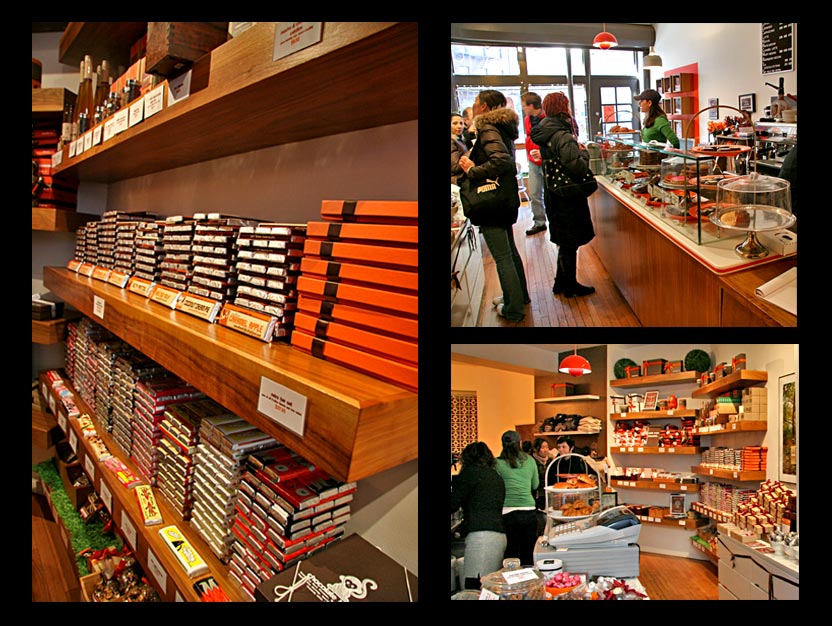
    Love of chocolate is certainly not new, but even popular trends morph and take on a unique character of the time. And the time is right for artisanal, fair trade, organic, and vegan chocolate. Hudson Street/Eighth Avenue is becoming a small chocolate mecca, with Jacque Torres and Li-Lac Chocolates just down the street from Alison Nelson’s Chocolate Bar (seen in the photo).

    Located at 48 Eighth Avenue in the West Village, the shop is a small, pleasant space with an orange and brown decor. Click here for their website. It has been getting accolades from customers and a lot of positive press since its opening in 2002. They work with some of New York’s finest chocolate chefs and offer an extensive range of chocolate delights: there are chocolates, of course (Bon Bons, the Black and White, the Elvis), a signature line of chocolate bars (super dark, orange dark, mint dark, mild chocolate, bittersweet, white lemon), and a retro line (PB&C, Salted Pretzel, Caramel Apple, Key Lime Pie, Coconut Cream Pie, Raspberry Jam). In addition, they offer authentic New York Egg Creams, illy Caffe espresso, coffee drinks, several variations on iced and hot chocolates, fresh cookies, brownies, and morning pastries.

    Chocolate (particularly dark chocolate) is now being promoted as having certain health benefits with its flavonoids and antioxidants. Although studies are far from conclusive and the health risks of chocolate are well-known, the mere suggestion of potential health benefits is more than adequate to please chocoholics and fuel guilt-free consumption…

    Posted on by Brian Dubé

  • Grand Central

    Posted on by Brian Dubé

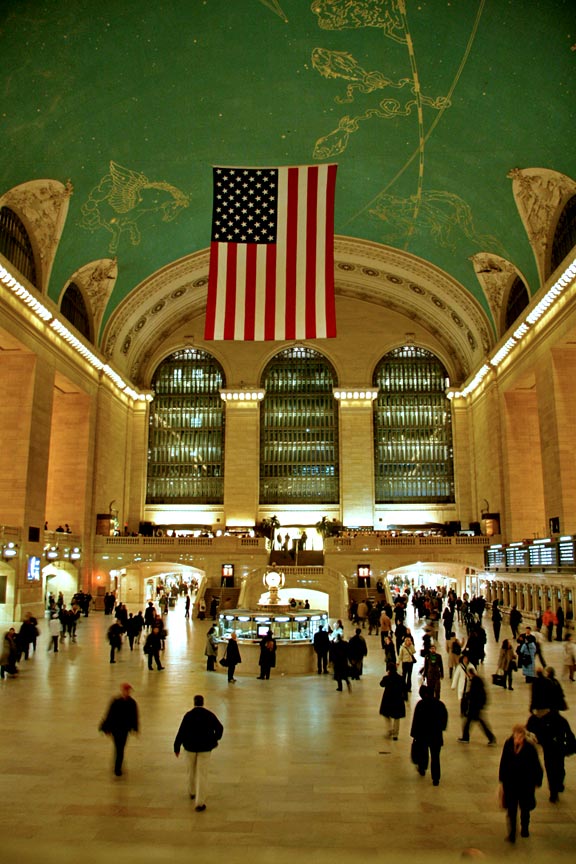
    This is the place whose very name is synonymous with busyness and crowdedness – I grew up outside of the city yet always heard that popular refrain about a place being like “Grand Central Station.” Not an inappropriate reference, since Grand Central is the world’s largest train station.

    Officially Grand Central Terminal, the site has seen three different incarnations of the station, going back to Grand Central Depot in 1871. Amazingly, Grand Central was actually under real threat of various demolition proposals by Penn Central – a decade-long legal fight, with efforts of many including Jacqueline Kennedy Onassis and a United States Supreme Court ruling, succeeded in preservation. In 1976, Grand Central was designated as a National Historic Landmark. In 1998, the terminal completed a restoration, including the renowned ceiling mural with its constellations and beautiful cerulean sky, originally painted by Frenchman Paul Helleu. The large American flag was hung after 9/11. These are in the main concourse as seen in the photo.

    This is much too large a topic to do any justice to in a daily photo blog, so I would recommend various sites for more reading. Click here for the official site, which gives not only a complete history but also provides links for food (restaurants and menus), shops, tours, and events. Here are three previous posts I have done on the terminal: the exterior sculpture, the iconic clock, and the Oyster Bar

    Posted on by Brian Dubé

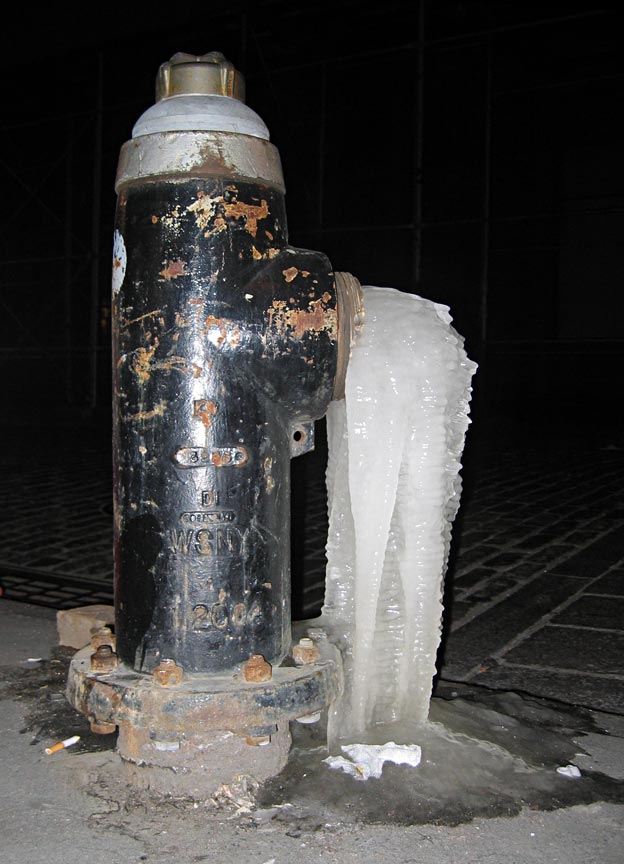
  • Defiant Hydrant

    Posted on by Brian Dubé

    Last night, a photographer friend alerted me to a slow leak in SoHo that he thought might be blog-worthy. (By the way, after conversations last year regarding the curious and ubiquitous standpipe, this friend got on a hydrant/standpipe kick and shot quite a number of excellent photos. Click here to see his gallery.)

    We have been in a cold-snap in NYC the last few days. and at 16 degrees F, water moves quite slowly, hence the photo. In July, of course, we see a different scenario. I suppose a question that comes to mind is why fire hydrants don’t normally freeze in the winter. The answer is that there is no water in the hydrant and the valve is below the frost line. Water is supplied to the hydrant via a riser which is controlled by a valve rod, which in turn is controlled with that special pentagonal nut (using a large wrench and matching socket). Hydrants are also equipped with an anti-siphon valve, so that any water remaining in the hydrant drains back into the ground. This is the theory. In practice, we find defiant hydrants, such as that in the photo…

    Posted on by Brian Dubé

  • Waterworld

    Posted on by Brian Dubé

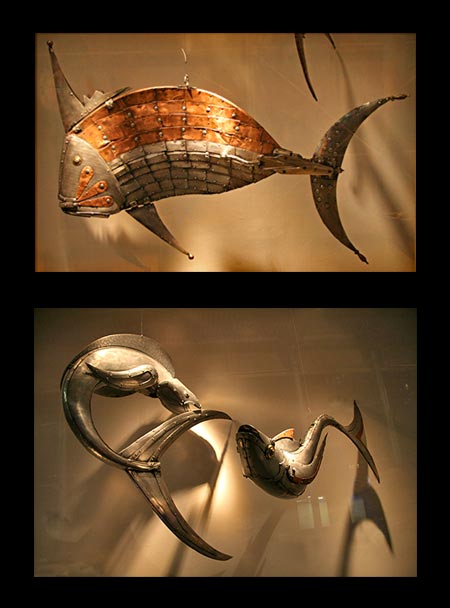
    NYU provides two window galleries for public viewing of art: Broadway Windows and Washington Square Windows (previously featured on this site).  Both spaces are lit 24 hours a day.

    Broadway Windows, located at East 10th Street and Broadway, is currently featuring Waterworld by Bates Wilson. Wilson salvages scrapped metals and abandoned objects to create metal-finned fabricated fish that swim through the imagined waters of an otherworldly urban aquarium. One can find sun-fish, crested sail-fish, and striped flying fish. “These fish are organicistically constructed of sheet metals, found objects, and rivets. They have the feel of Jules Verne and could swim in the oceans of the metropolis. The idea is to make something new out of things old; to take that which is discarded and renew the life that it once had. Art should allow for a continuous evolution of materials and ideas.” It’s a pleasant surprise to happen upon displays of art like this while walking in the city…

    Posted on by Brian Dubé

  • The Patel Brothers

    Posted on by Brian Dubé

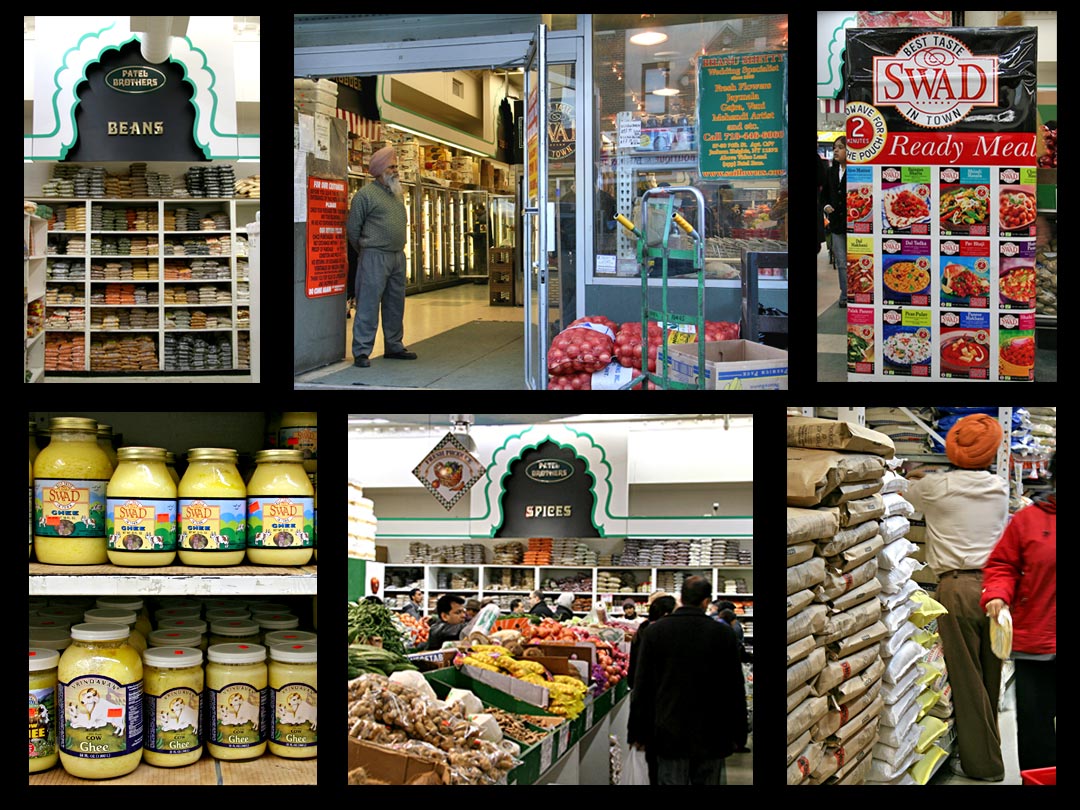
    Welcome to the only Indian food chain in the United States. The Patel Brothers now have 35 stores across the US, primarily along the eastern seaboard, with stores also in Detroit, Houston, and Indianapolis. They distribute Raja Foods and Swad (“taste” in Hindi). In total, they are doing $140 million in sales annually. The business was started in 1974 by Talashi and Mafat Patel when they bought a small Indian store on Devon Avenue in Chicago. Mafat came to the U.S. on an engineering scholarship and worked for Exxon as an electronic engineer, a position he kept until the late 1980s. I always thought of this type of store as unique to NYC, so it is surprising to learn that the Indian community has grown to such an extent to support all these retail locations.

    Indians have been very successful in this country. They are the second-largest Asian group after the Chinese, the second most prosperous group after the Jewish-American, and highly educated – according to the 2000 census, 64% have a bachelors degree or more. The photo is of the Patel Brothers grocery on 74th Street in Jackson Heights, Queens. With 90% of the product line from India or Pakistan, a location in an Indian Neighborhood, and a staff and customers dominated by Indian-Americans gives one an immediate sense of a seriously AUTHENTIC ethnic atmosphere when entering this store. With an entire aisle of rice – more brands than I knew existed – a section devoted to ghee, and, of course, enormous sections for spices and beans, these guys have no competition…

    Posted on by Brian Dubé

  • Juggle This

    Posted on by Brian Dubé

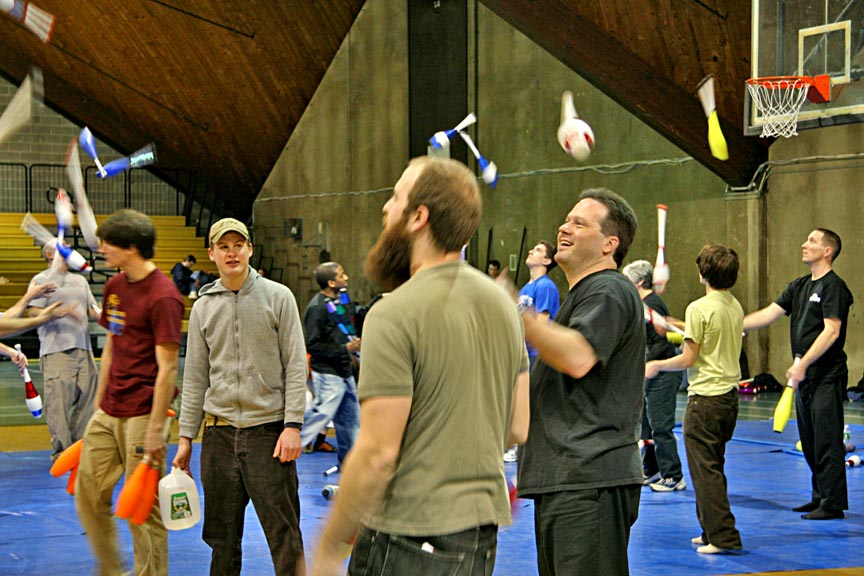
    This weekend is the 6th annual NYC juggling festival, Juggle This, hosted at Pratt Institute in Brooklyn by the local juggling club (Jugglers Anonymous) with support from Manhattan’s own club, the Carmine Street Irregulars (click here for links). Juggling has seen substantial growth in the last 30 years, particularly at the hobby level, with local clubs in high schools and universities nationwide. In addition to an annual national festival, there are numerous regional fests. The Pratt fest activities takes place in their enormous gym, where jugglers of all ages, skill levels, and demographics interact. There is nonstop juggling with workshops, games, vendors, a raffle, and the Show, the highlight of the festival.

    This 2 1/2-hour extravaganza takes place in Pratt’s Memorial Hall theater and features primarily professional acts – many of the performers travel from other parts of the country. Some attendees juggle alone at these events, but most take the opportunity to hone and share their skills with others. In a world where individuals share such a unique passion, social networking has become a big part of the festivals – new friends are made and old bonds renewed. The feel is that of a small, tightly knit family reunion…

    Posted on by Brian Dubé

  • Soot of Armor

    Posted on by Brian Dubé

    This is an archival photo taken on November 26, 2006 on East Third Street opposite the Hell’s Angels clubhouse, where I made several recent visits with the intention of a doing a post. I have been fascinated for years with the Hell’s Angels in NYC and their apparent ability to operate with virtual impunity regarding the law – members have been reported to perpetrate random acts of violence and engage in various criminal activities (click here for New York Times article), yet charges have frequently been dropped due to improper searches, lack of witnesses, etc. And they rule that city block. I had been warned of the potential danger of being caught shooting their building – they have six surveillance cameras. On a previous visit, I asked a block resident for his advice on taking a photo, and he said, “I wouldn’t do it. Don’t be a hero.”

    On my last visit with a friend, I approached a club member going into the building and asked permission to take photos (technically I didn’t need it). He let me know that they owned the building and the sidewalk and that he didn’t want to be on my blog (with a few expletives thrown in). I decided that is was not worth the risk to have a camera wrapped around my head by a Hell’s Angel, so I slunk back across the street where my friend was waiting and took the above photo. It’s interesting that all this occurred just before the recent major incident at the clubhouse – making all the news media (click here for Gothamist’s coverage). So, instead of the Hell’s Angels clubhouse, we have a miniature suit of armor with red horns in a window gate AC cage with skulls hanging from it. I have no idea if there is some hidden meaning here or visual pun. Any ideas?

    Posted on by Brian Dubé

  • Passing Time

    Posted on by Brian Dubé

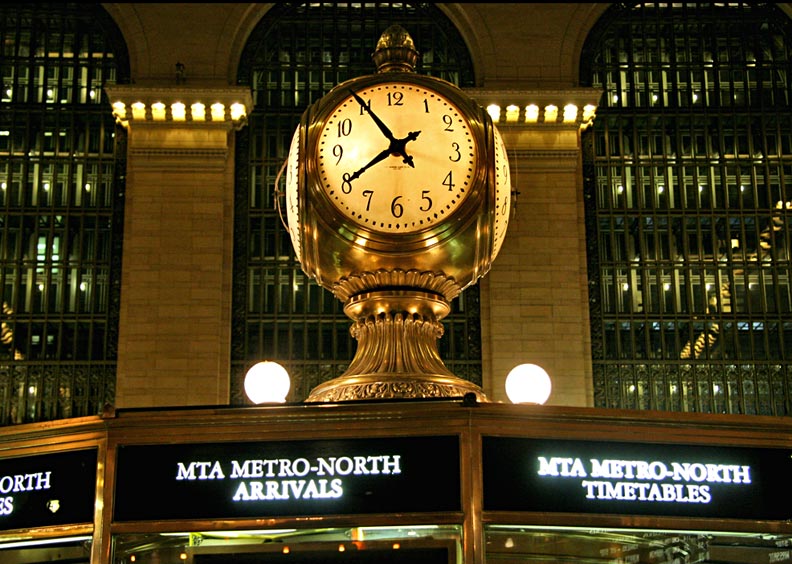
    This is probably the most well-known clock in the U.S. – the ball clock above the information booth at Grand Central Station. Many have used it not only to tell time – its most important function – but it has also served as a meeting place for travelers for nearly a century. The four faces of the brass ball clock are solid opal – Sotheby’s and Christie’s have valued it at between $10-$20 million. It was built in 1913 by the Self Winding Clock Company, a firm started by Charles Pratt (oil tycoon and founder of Pratt Institute) and engineer Henry Chester Pond in a Pratt-owned building at 205 Willoughby Street in Brooklyn, New York (later moved to Varick Street in Manhattan).

    From 1886 to 1957, the company built 50,000 clocks. These clocks were self-powered by dry cell batteries and automatic spring winding and synchronization. When properly maintained, they were highly accurate. Their clocks were used everywhere around the world: the Metropolitan Tower clock, the House of Representatives, battleships, NYC and London subways, railroads, airlines, the Strategic Air Command, stock exchanges, hospitals, schools, hotels, universities, department stores, and broadcasting systems. Over time, however, maintaining accuracy of all these historic clocks was a problem, so recently, all of the more than 55 clocks have been synchronized to a continuous satellite signal sent from an atomic clock at the U.S. Naval Observatory. The clocks are now accurate to within two microseconds. Everything is controlled by the terminal’s master clock, located behind locked doors near Track 117 on the lower level…

    Posted on by Brian Dubé

  • The Oyster Bar

    Posted on by Brian Dubé

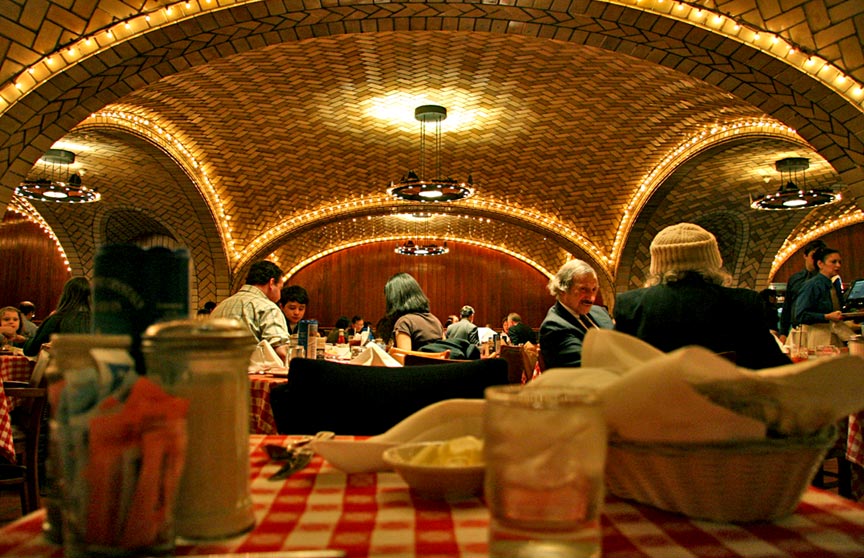
    Legends, institutions, and icons are frequently marketed to death and become tourist traps. It is a real pleasure to find a place that goes back nearly a century and has maintained integrity and standards for that which it became known. This is the Grand Central Oyster Bar and Restaurant, renowned for its oysters (and its doorway and Whispering Gallery). It opened when Grand Central itself did in 1913. All the reviews I have read advise against eating in the main dining room and sticking with the oysters at the oyster bar/counter itself.

    I am not an aficionado of fish, but given all the warnings and my negative predispositions towards the place, I enjoyed my first visit to the Oyster Bar much more than I expected. Their menu of seafood is huge. The main dining room seen in the photo, with its vaulted Guastavino-tiled ceilings, is enormous, roomy, and very comfortable. Although the service was not the warmest, I write off much of this as brusk New York Style. After all, this place is IN Grand Central Station, a place synonymous with congestion and crowds. Finding such a place in Grand Central really brought back feelings of old, classic, quintessential NYC and that some good things endure – and this is one of them…

    Posted on by Brian Dubé

  • The El

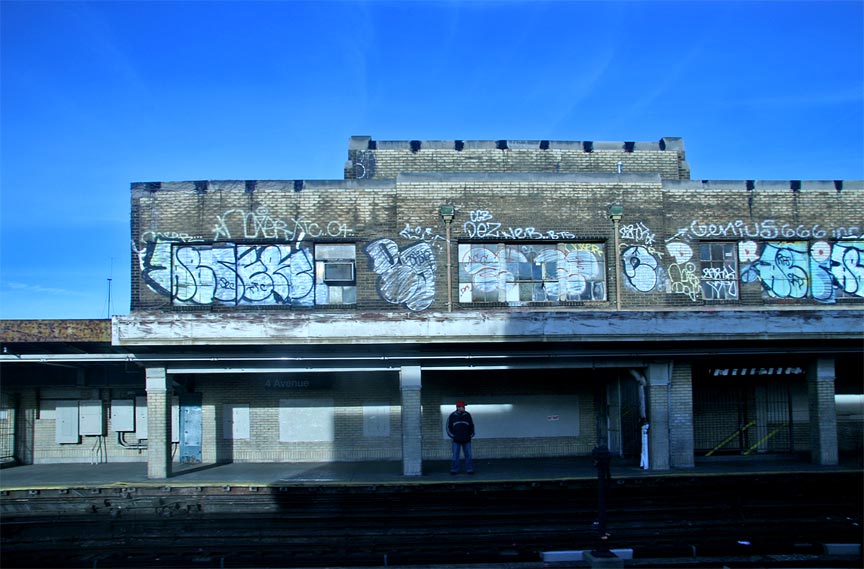
    Although it is referred to as the SUBway, the NYC train system does travel above ground on various lines in parts of the boroughs. These stretches of elevated tracks are frequently shortened to L or el. This photo was taken along the elevated section of the F Train between Brooklyn and Manhattan, at the 4th Avenue stop. This ride across a trestle affords some nice views of the city, particularly if you like the gritty side of urban landscapes. The break from underground travel is welcome, especially on a sunny day. The ride outside also allows wireless access, so it is common to see riders seizing the opportunity to make short calls on their cellphones.

    Riding on the L reminds me of the famous chase scene in The French Connection (1971), which many feel is the greatest car chase ever filmed (the chase was between a cop in a car and a hitman on an out-of-control train on a section of the L in Bensonhurst, Brooklyn). Most of the chase sequence was real and filmed without permission from the city. It includes an accidental car crash, left in the film. Only in New York…


  • Impressionism

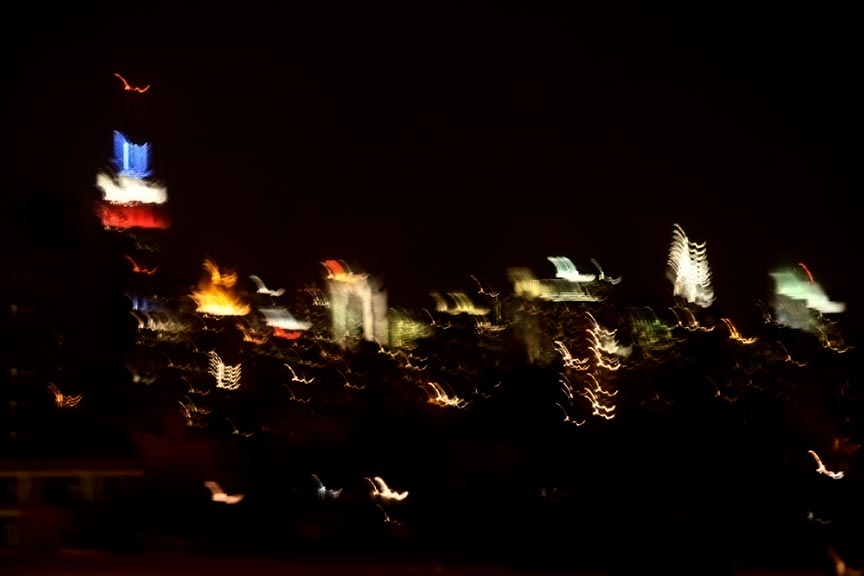
    The best views of the Manhattan skyline are from outside the borough – the Brooklyn Promenade, DUMBO, Queens, New Jersey, the Brooklyn-Queens Expressway, the Belt Parkway, and while traveling on the various bridges by car, subway, or on foot. A trip I often make is over the East River via the Manhattan Bridge. Coming from Brooklyn, there are several vantage points which offer spectacular views of many major building icons all at once – the Woolworth, the Municipal, the Empire State, the Chrysler, the Citicorp, the New York Life Tower, and the Con Ed, as well as the Statue of Liberty and the other bridges.

    Getting a photo is the challenge. I took this handheld at night while driving when traffic slowed to a halt. Even in this impressionistic view, many of the notable buildings can still be identified – the Empire State, Chrysler, Citicorp, and New York Life. In warmer weather, I plan to walk the East River bridges and do some photography. In the meantime, I recommend you take a trip across…


  • Indian Gold

    This photo of filigreed necklace sets was taken on 74th Street in Jackson Heights, Queens. The shop is one among many gold dealers in this neighborhood, where a proliferation has made it a gold district, visited by customers from around the country.

    Gold is big in the Indian community. It is purchased for the birth of a child and various holidays and is an important part of weddings. Of the Solah Shringar (sixteen adornments) that complete an Indian bride, many are comprised of gold jewelry. In Indian culture, there is jewelry for nearly every part of the body: anklets, bracelets and bangles, panja (which covers the back of the hand and held in place by an attached bracelet and rings), rings for fingers, toes, noses (nathni) and ears, tiaras, and tikkas (a piece of gold jewelry that hangs over the forehead and hooks into the hair). In India, Bangladesh, and Pakistan, the bride’s jewelry is an important aspect of the wedding process and is part of the dowry which the bride gets to keep in the event of divorce.

    However, traditions are changing, and as more young people in Asian communities in the U.S. marry here rather than in their home country, gold is becoming a less important part of the marriage. All the gold is 22 karat (91.6% pure), and pieces are sold by weight. When I asked the price of a necklace, the clerk promptly tossed the piece on a scale and took out a calculator…


  • Jackson Heights

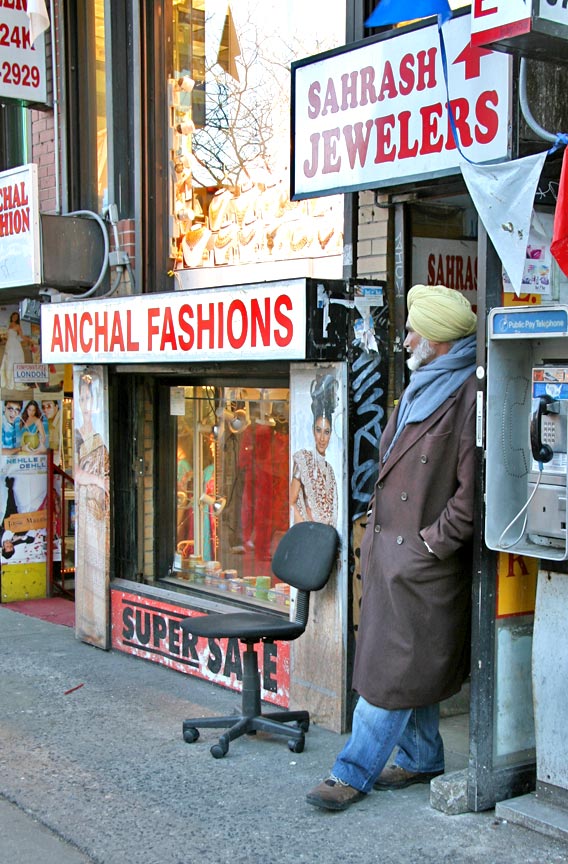
    Queens is definitely off the radar for the tourist or Manhattanite. Yet, for a real slice of New York life, this is the authentic NYC, where 46% of the population is foreign-born. I had heard of Jackson Heights for years, but yesterday I traveled there for the first time with a friend, also a long-time New York resident (Brooklyn) who had never been there. We were both astounded and are still reeling from the experience. Keep in mind, this is coming from New Yorkers who live in one of the most diverse cities in the U.S. We have Chinatown and Little Italy. But Jackson Heights is a whole other world. I have never seen such a ethnically and culturally varied neighborhood – it has been called a “utopia of diversity.”

    From the New York Times: “In the 2000 census report, fewer than 20 percent of the households reported that English was the only language spoken at home. More than half also speak Spanish. And Arabic, Chinese, French (including Cajun and Creole), Greek, Hindi, Korean, Polish, Russian, Urdu, and Yiddish were among the more than 30 languages tallied.”

    The neighborhood, much of it an historic district, is also unique, with its prewar buildings with huge private gardens. This photo was taken on 74th Street’s “Little India.” I will do a future post on our dining and shopping experience there…


  • Mural

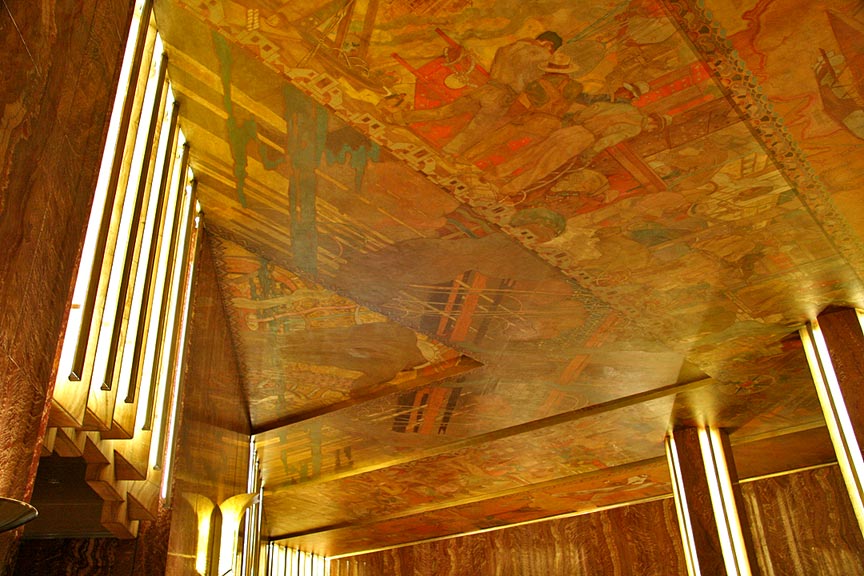
    This is a section of the ceiling mural in the lobby of the Chrysler Building, done by Edward Trumbull in 1930. Click here for second photo. Considered the largest mural in the world, it measures 100 x 96 square feet. Entitled “Transport and Human Endeavor,” it depicts energy and man’s application of it to the solution of his problems. The mural’s central image is a male figure who was described in a 1930s building brochure as a ”muscled giant whose brain directs his boundless energy to the attainment of the triumphs of this mechanical era.” There are images of fire, lightning, electricity, heat and steam, the telegraph, telephone, radio, ocean liners, trains, airplanes, buildings, and scenes of construction workers building the Chrysler Building and from the Chrysler assembly line.

    In the 1970s, the mural was essentially damaged by the application of a polyurethane coating; in addition, recessed lighting was cut into the mural itself. In 1999, a thorough restoration was done with an estimated 10,000 hours of labor. The urethane was removed, the spotlight fixture holes repaired (filled with plaster), new canvas attached, and images recreated using archival photos. In a time when the dumbing down of America is a popular refrain, it is heartening to see the widespread movement of architectural restoration and preservation in this country…


  • dinamic_sidebar 4 none

©2026 New York Daily Photo Entries (RSS) and Comments (RSS)  Raindrops Theme