• Meetings With Remarkable Men

    The Story of Professor Robert Gurland, Part 2 (see Part 1 here)
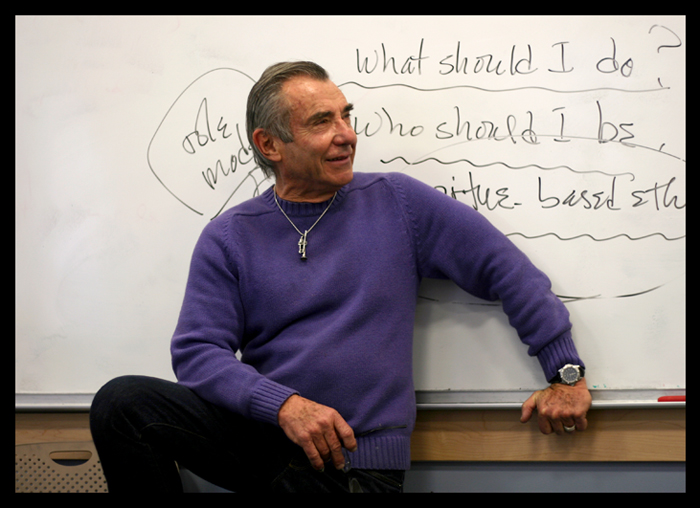
    I was so excited yet frustrated sitting in that class. Didn’t these students know they were with a living legend? Why weren’t they hanging on his every word? It costs big money to attend NYU. Why was one student sleeping and another looking at dresses online and messaging on Facebook? Gurland was discussing the nature of evil – man’s inhumanity to man. On the chalk board were the names Hitler, Stalin, Idi Amin, Pol Pot, and Duvalier. What the hell does it take to galvanize students?

    I was following his presentation and completing some of his sentences in my mind. I was flying. This was education at its best. The man’s ability to communicate is brilliant, with a perfect meld of theater, anecdotes, insight, and passion, making the content accessible and relevant. No wonder he is a superstar educator with the highest student ratings, a cabinet full of letters (see here), and has been referred to as an icon for educators.

    I understand we live in a world of information and sensory overload. However, I would find it extremely disappointing to be a man like Professor Robert Gurland, with all of his accolades, and lose to Facebook. When I expressed my outrage in my second interview in his office, he laughed and said, “When I look at those Apples, I know that they’re looking at a porn site on the other side.”

    The man for this job needs a tough skin and a realization that in this world, you often lose to competing interests in the classroom. Who better to weather this storm of our current times than a tough, New York City Bronx-born Jew grounded in reality and who knows how to take a beating?

    I had taken a class with Robert Gurland circa 1970. Even at 9 AM, his classes were packed with sizes at one time of as many as 450 students. Historically his classes have been so popular that it became a problem in the Philosophy department – no one has wanted to take other courses. In the late 1990s, a part-time employee who was also an NYU student was raving about a professor. I was pleasantly surprised to learn that it was the very same Professor Gurland, who was still going strong in his unique style of teaching and making impressions with his indelible stamp. As the result of a recent inquiry, I discovered Gurland was still teaching at 77 years old.

    I obtained his phone number and had a brief phone conversation – I was amazed that in spite of the fact that he has had over 25,000 students, he remembered my name and the class I was in – Practical Reasoning. I arranged an interview and to sit in on two of his classes. He was extremely gracious and permitted any manner of recording I wanted. I came armed with cameras and video and voice recorders. I interviewed Professor Robert Gurland twice in his office at 726 Broadway, once before and once after the two classes I attended. These were his last classes of the semester. I recorded both classes on video and 78 minutes of our dialog in his office.

    We met in the lobby at 8:30 AM. His office door is open, but Gurland values his privacy, and I appreciated the privilege of spending time with him. As we entered his private office, I felt electricity in the air – I had never been with Gurland outside the classroom. The ensuing conversation was charged.

    In our conversation, I learned many things I did not know about this superstar of university teaching. We discussed his working class roots, his growing up in the Bronx, and his attendance at the Bronx High School of Science, at the time an experimental school. At one point, Gurland showed me a photo of himself at 20 years old as a professional trumpet player. He recounted the litany of jazz legends he played with, such as Krupa and Dorsey. A small trumpet hangs from his neck. We discussed his personal life briefly. Gurland is married with one son who is a full-time professional musician. When younger, Gurland dabbled in photography and won two Eastman contests.

    Now a philosophy professor at NYU, Gurland has served as chair of the department. However, I was also surprised to learn that his first educational degrees were in mathematics, eventually culminating in a Ph.D and a tenured professorship of mathematics at Long Island University.

    Do I over inflate Gurland’s achievements and charisma? Not at all. Gurland has taught at many universities and has won best teacher awards at all of them. He has been awarded NYU’s Golden Dozen Teaching Award numerous times and was the youngest person to get the alumni association great teaching award. He holds three MA degrees and two PhDs.

    For a man like Robert Gurland, these are but milestones on a road that many others have taken but to a destination few will ever reach. There were a few students who lingered after class to say goodbye and express their appreciation for this great educator.

    I am immersed in technology and spend hours online. I recorded Professor Gurland’s classes using two video camcorders, a digital voice recorder, and professional DSLR camera. But these are only tools. I was not distracted from Gurland’s presentation and the special things only a relationship with a human being can bring to our world. I salute him on giving such spirited and impassioned lectures, even to empty classrooms filled with so many students preoccupied with something or someone else. I am having a hard time this morning deleting those images of dresses and Facebook from my mind…
  • Meetings With Remarkable Men

    The Story of Professor Robert Gurland, Part 1

    I came to New York City in 1969, ostensibly to study at New York University. But there would not be much studying, for this was not just any time. Political upheaval and violence was mixed with sex, drugs, and rock and roll. There was extreme distraction.

    The Vietnam War colored and dominated everything. Hanging on my dorm room wall was the iconic anti-Vietnam War poster, And babies, with its horrifying image of the My Lai massacre. Dead soldiers in body bags seemed like a daily sight on television. On the heels of the civil rights movement, Martin Luther King had just been assassinated in 1968. President Richard Nixon, a man seen to be so evil, in 1974 at the apex of the Watergate scandal needed to proclaim to the nation, “I am not a crook”.

    Some of the most seminal and notable music groups of the 20th century flourished at the time. And, of course, there was Woodstock. This was a time of rampant drug use, particularly LSD. Timothy Leary had already commanded America’s youth to “Turn on, tune in, drop out.” There was fallout from these excesses. Music icons were dropping like flies, primarily from drug related causes – Jimi Hendrix, Jim Morrison, Janis Joplin, and Brian Jones.

    Sexual freedom reigned after the introduction of the contraceptive pill in the early 1960s. The spirit of the Summer of Love in 1967 permeated the culture.
    Consciousness was being expanded. Everything was in question. Groups were beginning to vocalize and demonstrate. In New York City, there were the Stonewall riots in June 1969. The women’s rights movement was in full force, on the heels of the birth control pill and Betty Friedan’s revolutionary book, The Feminine Mystique.
    There was the SDS and the Black Panther Party. The Weathermen, a small extreme group of radicals formerly from the SDS, had built a bomb factory in the Village and blew up an entire townhouse.
    We had just landed on the moon on July 1969.

    Study? In New York City?

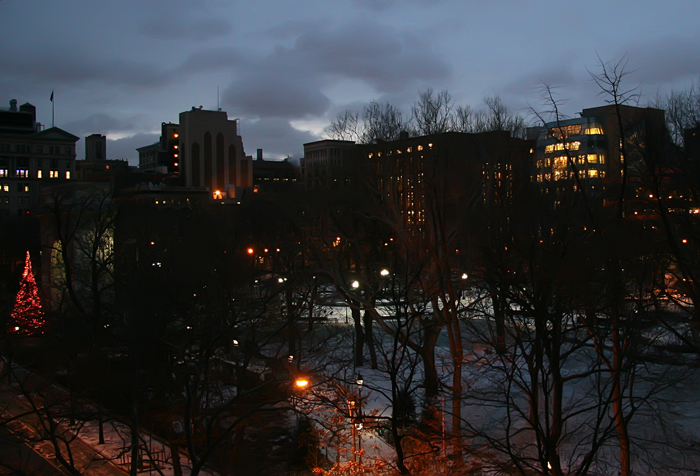
    It took an enormous draw to get a student into a classroom and keep him or her attentive. In spite of bullets flying in the world outside, there was one man who could do it. A legend in 1970s time and still today. In just a few minutes, across that park and behind those trees, I have an appointment to meet that man again, for the first time in 40 years. I can’t wait. It’s 19 degrees out there, but I won’t feel it. Got to run. See you later. In Part 2, you will meet Professor Robert Gurland 🙂


  • Grab a Bite to Eat

    Everyone has their pet peeves, and for me, it is taking too much time to eat when there are “better” things to do. And in New York City, there are always “better” things to do. This may sound very contradictory for a man who extols French culture, quality of life, and the slow food movement. It is. But as a college professor once responded to me, when I detected some dissonance in one of his statements, “People are full of contradictions.”

    My frustration rises to crisis management when I am with people whose priority is eating over all other things and where no experience, no matter how exciting or exhilarating, will distract them from seeking food. I am in deep trouble when I am with these types of individuals in New York City, which is a literal smorgasbord of eateries. And typically, for these comfort seekers, eating on the run is not their preferred modus operandi – sitting and indulging is.

    I had a relative who used to come to the city often and stay weekends. A refrain, which I can hear in my head to this day, was, “Let’s grab a bite to eat.” I became so irritated, because this was typically mid day, long before dinner, and we had an agenda of things to do and places to see. The “grab a bite to eat” always ended up becoming a production of an hour or more. Waiting, ordering, eating, coffee, getting a check, paying, etc.

    When very young, I had limited restaurant experience and thought “a la carte” meant that food was offered on a cart, needing to be snatched quickly while passing by. The reduced service and quality of selections accounted for the lower pricing. This would seem a great option for New York, but there are no carts to snatch from in restaurants (dim sum is close), so there is no way to really “grab a bite to eat.” For the traveler or resident who does have the need to expedite a meal, there are places tailored to a quick bite, the most common being the New York pizza parlor for a slice on the run. There are other places, somewhat less noticeable, tucked into the nooks and crannies of the city’s side streets.

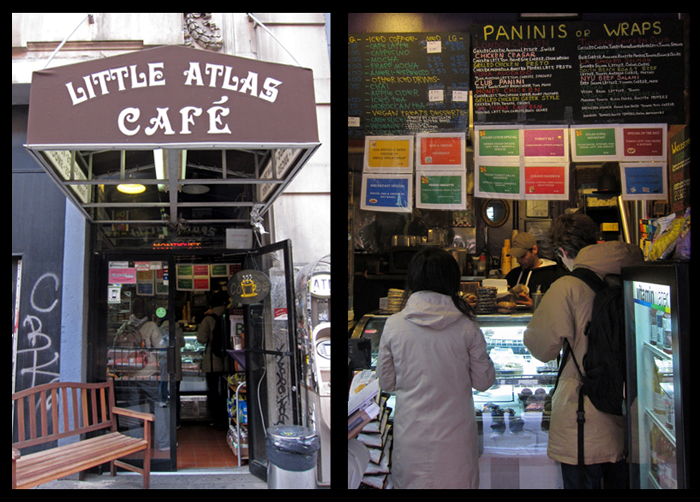
    In the Village, in the heart of NYU country at 6 West 4th Street, there is the Little Atlas Cafe. The place truly befits its diminutive name and is strictly takeout and delivery. There is just barely enough room for a few customers and the staff. The menu is quite extensive. Reviews vary. The place has a large range of vegan offerings, and many of the criticisms are from those who have specific issues with the vegan products. I enjoy their food, and for those on the run, who have no access to a fast moving cart, the Little Atlas Cafe is the perfect place to Grab a Bite to Eat 🙂


  • None For Me, Please

    When I came to this city, there were so many things new to me. 24 hour delis, bagels, ethnic foods other than Italian, tall buildings, subways, men who were openly gay, pizza by the slice, egg creams, Macy’s, and all the other icons I had seen on TV now come to life.

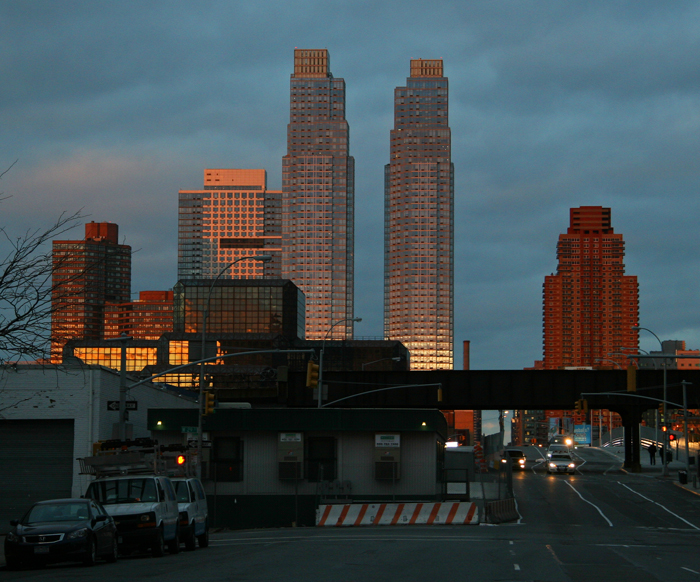
    And prostitutes. This was a big curiosity for me and other friends. That women would openly flaunt their bodies and market their wares on the streets for all to behold. In the desolate area around the Lincoln Tunnel (shown in the photo), street walkers could be seen any evening, openly soliciting and discussing specifics and pricing.

    Sex for money has now moved off the streets of the city. Targeted by the Guiliani administration and contained by Bloomberg, little can be found on the streets. I have been told there is some activity in Hunt’s Point, Bronx, and recently there has also been trafficking in child prostitution. But most activity has gone online to places like the erotic services on Craigslist, escort services websites, Facebook, and Twitter.

    In spite of having lived in a city where such services were readily available, I have never sought out the services of a prostitute. Even though New York City is extremely liberal and permissive, the idea of being with a woman, even a consenting adult, in such an act of intimacy for money has always been disturbing and not right to me and everyone I know. I never have forgotten the one scene in the film Klute where Jane Fonda plays a prostitute. While faking an orgasm, unbeknownst to the man she is with, she looks at her watch – the ultimate graphic depiction of the harsh reality of prostitution and the business of sex.

    On the streets or online, neither arena has been a temptation. Nor have the transgressions of former New York governor Eliot Spitzer with Kristen served as any fuel for justifying this behavior. None for me, please…


  • Everything is Going To Be Alright

    I was surprised yesterday to hear two young coworkers in their 20s listening to and enjoying the holiday tunes of Bing Crosby. I commented on how there was an extraordinary soothing quality to his voice that just made you feel that, no matter what, everything is going to be alright. At my family holiday gatherings, Christmas isn’t Christmas without the White Christmas of Bing Crosby.

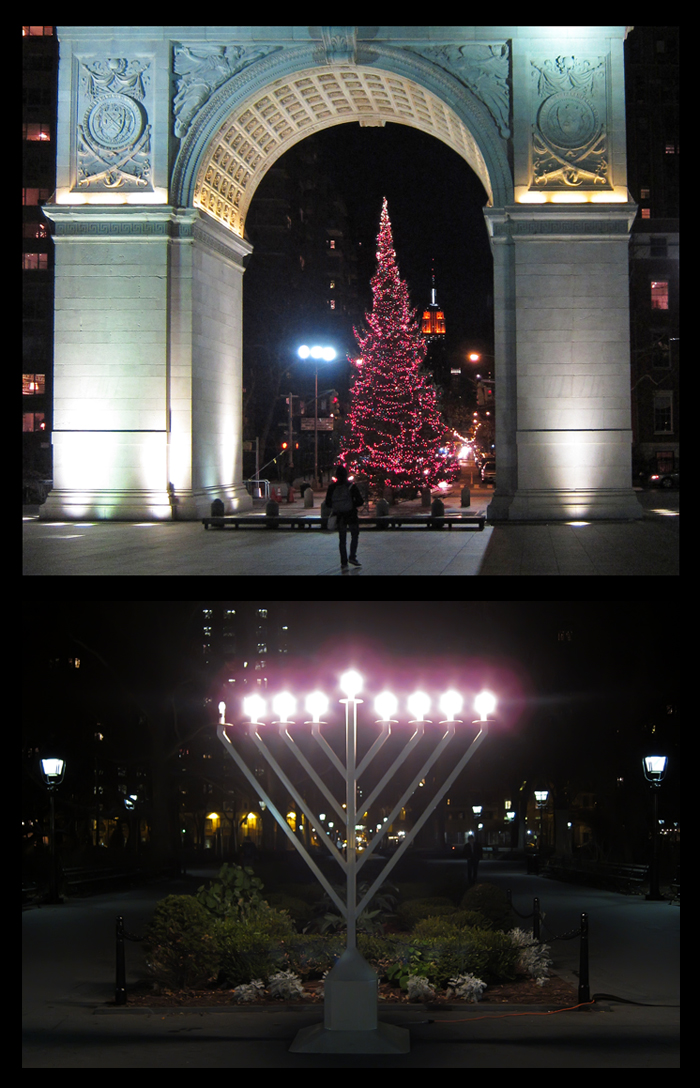
    Whether you see New York City as a melting pot or a salad bowl, pluralism is the reality and tolerance is what holds it together. New York City is where you will find the world’s largest public menorah, located in one of the most prime locations in the entire city – 59th Street and Fifth Avenue, just a few blocks from Rockefeller Center’s national Christmas tree and St. Patrick’s Cathedral. In today’s photos, the Christmas tree at the Washington Square arch (with views of the Empire State Building in the background) is just a short distance from a menorah, also located in Washington Square Park.

    On one hand, pluralism has become much more prevalent in the United States and, in tandem with the doctrine of separation of church and state, it is not unreasonable to revisit the issue of public displays of religious symbols. Bing Crosby or not, we can’t shut our eyes and sweep everything under the umbrella of the “holidays” or the “winter/holiday season” in an effort to obfuscate the very divergent religious practices. Efforts are made to link Christianity and Judaism in an attempt to demonstrate that they are just two sides of the same coin.

    On the other hand, as I wrote in Let’s Have a Parade, celebration is part of the human condition, and to become a curmudgeon during the holidays and dismiss the entire season as nothing but crass commercialism (or to aver how many of the symbols and customs that are associated with Christmas were originally syncretized from pre-Christian pagan festivals and traditions) does nothing to enliven and uplift the human spirit and spread proverbial love and joy throughout the land.

    Managing religious pluralism is difficult. Even the Supreme Court of the United States was very divided in County of Allegheny v. ACLU, where the court considered the constitutionality of the annually recurring displays of a nativity scene (crèche) and a Hanukkah menorah, both placed outside the City-County Building in downtown Pittsburgh, Pennsylvania.

    I don’t want to bury my head in the sand in an effort to oversimplify reality, be disrespectful, and lump everyone together or paint the entire season one color. But for just a moment, please forgive me. I’m just going to relax, let Bing Crosby’s voice wash over me, and feel that everything is going to be alright 🙂


  • Ultimate Dream Machine

    Flying has always been a metaphor for me. In Umbrella and Chevy, I told of my childhood passion reaching the point where I resorted to jumping off my family’s Chevy with an umbrella, hoping for an uplifting experience but only getting a slower descent. Later in life, I did take a few flying lessons, but helicopters remained the impossible dream.

    The helicopter is the ultimate vehicle of transport – they are the most versatile vehicles in existence, giving complete access to three-dimensional space. They can fly virtually anywhere and can hover. However, there is a price to pay. These machines are very complex, difficult to fly, noisy, and require constant maintenance. It is possible for these aircraft to even vibrate themselves apart. In short, they are man’s triumph of brute force over nature. And expensive for all concerned.

    I was only in a helicopter once in Hawaii for a brief flight into the Kalalau Valley on the Island of Kauai. This was the ultimate adventure for the tropics lover – a pristine area of an extraordinary island in the Pacific accessed by man’s ultimate vehicle. The trip was short and expensive but exhilarating. The cliffs of the Na Pali coast on the north shore of Kauai are one of the world’s most beautiful natural spectacles. The only surprise – and disappointment – was the incredible noise. Hearing protective headsets were given to us at the beginning of the flight.

    So what better method of exodus and entrance to the crowded New York City metropolis than by helicopter, the only vehicle that can go from any point outside the city to the heart of Manhattan itself without suffering the slings and arrows of outrageous traffic? I once heard Bill Gates speak in Manhattan. As we waited his arrival, we were informed that he was being delivered via helicopter. Other major VIPs such as Donald Trump and the mayor are well-known for their use of helicopters, the ultimate transportation luxury. When the Concorde was flying into New York City, the flight included transport to and from the airport via helicopter.

    I journeyed to the VIP Heliport with a friend who is the only person I know who has traveled into the city by helicopter. I made a special trip specifically to 30th Street and the Hudson River for this story. Apart from the greenway along the Hudson River, it is rare that anyone would be this far west in this part of the city.

    At times, in spite of my love for this city, I do get island fever, and the island of Manhattan feels like a prison of sorts. At those times, in spite of noise, vibration, and danger of being in a complex contraption built by men using brute force over nature, I still fantasize about being picked up on the roof of my building and swept away in the ultimate dream machine 🙂


  • Afraid of Snakes

    If you have read my story Jungle Lovers, you know how I feel about the importance of guidance and influence of children and how disappointing my own experience was growing up in a blue-collar town, where New York City was feared likes snakes are, the streets were said to be riddled with pitfalls every step of the way, and con men could be found around every corner.

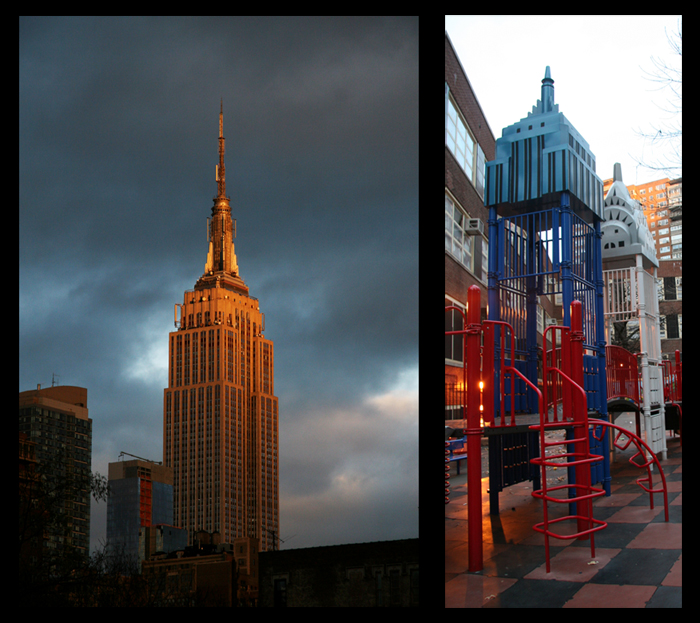
    I do not regret moving to New York City, I have not fallen into any pits that were too difficult to climb out of, and vistas like that in today’s photo are in fact what I have more often seen around many corners. And I like snakes. 

    Icons such as the Empire State and Chrysler buildings are visible from nearly everywhere. From 1931 until 1972, the Empire State Building was the tallest in the world. Although no longer the tallest building even in the United States, the Art Deco skyscraper still has icon status and is a metaphor for TALL (it is now the 3rd tallest in the USA and 15th in the world).

    After a time, any resident or visitor to the city can become inured to the vistas and architecture of New York. However, along with the people, the structures of the city define our metropolis. Interest in architecture itself is often eclipsed by the dynamism of New York’s many other attractions – restaurants, shops, clubs, bars, theater, parks, festivals, and street life. So, it was very uplifting to see this school playground in Chelse,a where models of the Chrysler and Empire State buildings are connected by bridges, decks, ladders, and slides and serve as part of the school’s outdoor recreation area.

    This children’s playground becomes a place to develop a familiarity with and appreciation of the architectural icons of New York City. And to learn that, at least in this jungle, if you’re careful, there is no reason to be Afraid of Snakes 🙂


  • Hanging Around


    When I was in grade school, I became intrigued with the hangman’s noose. It was easy to get the attention of fellow classmates presenting such a macabre artifact. It is extremely simple to tie, but its very nature would keep most from even trying. Who would learn to make such a thing and why?

    The entire subject of hanging is fascinating to some and its lure perplexing to others. The facts of hanging, its history, tools, technology, and the anatomical and biological aspects of the condemned are all mired in speculation, exaggeration, mystery, misinformation, and urban myths. The acquaintance I wrote about in my story Power once claimed he had the hangman’s formula – a supposed equation for calculation of rope length based on a person’s body weight. In fact, such a thing does exist as the British Table of drops. The original table of the “Long Drop” or measured drop was worked out by William Marwood in 1872. A revised table was issued in 1913. In is still in use by a few countries to this day. You can read more and see the tables here.

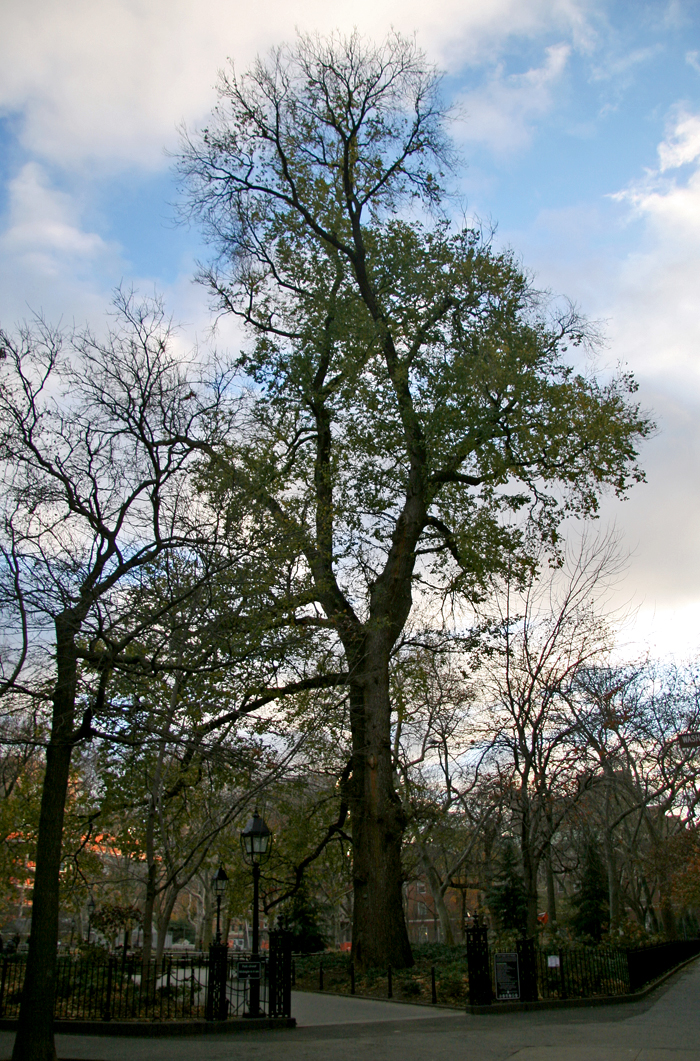
    The best case in point regarding the interest in hanging in New York City is the Hangman’s Elm located in the northwest corner of Washington Square Park which stands 110 feet tall. In 1989, the New York City Department of Parks and Recreation determined that this massive English Elm dates back to 1679, making it over 330 years old and the oldest known tree in Manhattan.

    It is still unclear how many, if any, individuals were hung from this elm in public executions, which did occur in a nearby gallows – the only recorded execution was of Rose Butler, in 1820, for arson. An article in the New York Times sees some hangings there as likely, but other sources cite it all as urban mythology. But the fascination with hanging still exists, and the belief that this elm was used for hanging persists. It all makes for a great sound bite or tour factoid, giving the neighborhood just that much more historical color.

    I have the privilege of seeing this tree from my home daily and much like the cat who brings home the dead mouse as a macabre gift for its owner, I offer my fellow readers this story and photo of the Hangman’s Elm. Whether it’s a tree, a noose, or the Long Drop table, the fascination with this style of execution just keeps hanging around…


  • The Real Peel

    David Peel’s website consists of one page, however, much can be gleaned from a quick read –

    Favorite Band or Musician: David Peel & The Lower East Side
    Favorite TV show: The Simpsons
    Favorite movie: West Side Story
    Favorite book: 1984 by George Orwell
    Favorite sports team: Bonghitters
    Favorite food: Ice Cream

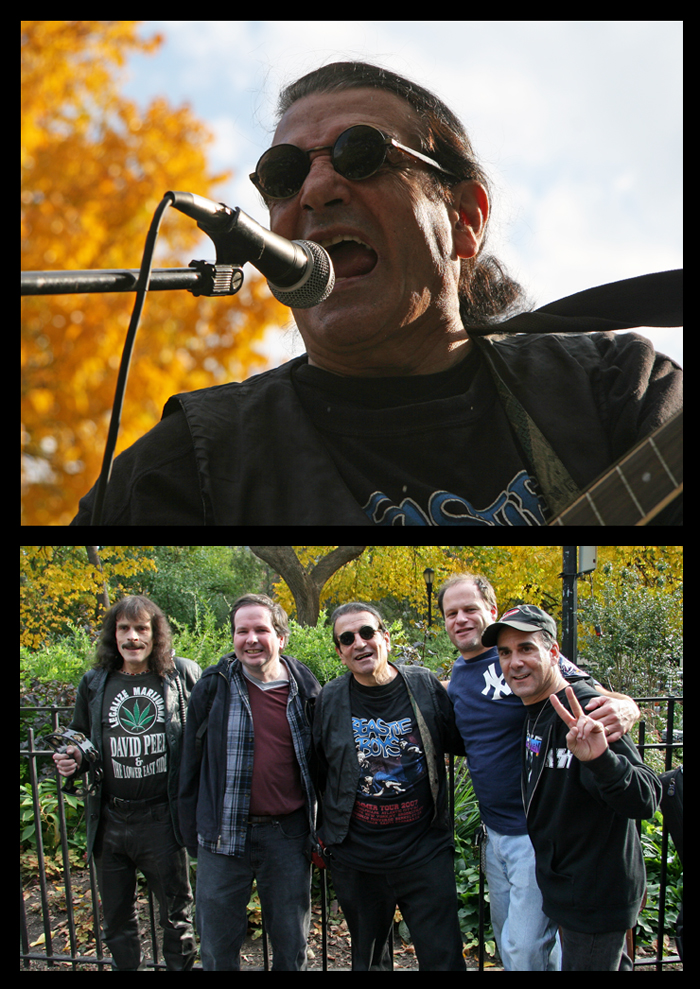
    Take equal parts of self absorption, political activism (with a hint of conspiratorialism), punk rock, marijuana, and maniacal energy, and you have David Peel. Born David Michael Rosario, the New York City-based musician and activist began recording with his group as David Peel and the Lower East Side in the late 1960s. He is credited with being one of the early performers of punk rock. A tireless advocate for the legalization of marijuana, Peel’s first album in 1972 was entitled Have a Marijuana. His discography is over 20 albums. He has been closely associated with the Yippie movement, Smoke-In concerts, and the annual Marijuana March.

    David Peel’s close association with John Lennon propelled him to celebrity status and helped pave the way for him to perform with top acts, such as Alice Cooper, Doctor John, Stevie Wonder, Dave Brubeck, Herbie Mann, Rod Stewart, Emerson Lake and Palmer, BB King, the Chambers Brothers, Joan Baez, Frank Zappa, Iggy Pop, and countless others.

    Lennon recalled first seeing David Peel, and his street assembled version of the “Lower East Side Band,” performing in front of a large crowd in Washington Square Park, in 1971. “He was shouting, why do you have to pay to see stars?” says Lennon. “I was embarrassed. I thought surely he must know I’m here. Yoko and I loved his music, his spirit, and his philosophy of the street.”

    Ignoring the objections by “certain” former members of The Beatles, John and Yoko still signed Peel to Apple Records. Peel’s first effort for Apple was an album entitled “The Pope Smokes Dope,” which immediately set off an international furor. The record was banned in nearly every country of the world, except for the United States, Canada, and Japan.

    In a memorable appearance on the nationally televised “David Frost Show” in 1972, John and Yoko let David Peel and his Lower East Side Band take the spotlight, choosing instead, to perform behind the group. John noted that Peel always wore round sunglasses that were a perfect duplicate of the glasses that had become John Lennon’s trademark, and Lennon took to wearing Peel’s black leather jacket.

    I have known David for years and see him frequently – his is a habitue of Washington Square Park. Always on a rant or rave, Peel’s energy is truly maniacal. His lyrics can be caustic, angry, and often spew hatred. The song he was performing in the top photo had a constant refrain, I Hate You. But do not be fooled by the theater, lyrics, or politics. Underneath you’ll find a warm and fuzzy, benign human being. That’s the real Peel 🙂


  • Not Moving to Florida

    I recall an uncle extolling the virtues of living on Eagle Lake in Maine in the winter, telling me how wonderful it was, about ice fishing, and how you had the entire lake to yourself. Not to offend and retort aloud, I thought to myself – of course you have it to yourself, who would want Eagle Lake in the winter?

    Although not as extreme, the seasons of New York City are never pleasing to me (see Weather Means Whether). I look forward to the spring, the harbinger of all good things to come, but it is always a disappointment. It is often too wet, colder, and windier than I would like. Flying kites or trying to sit on a park bench seems to be an exercise in hand rubbing.

    But not to worry, summer is on the way, certainly the season we wait for and celebrate. Until we have a few unseasonably warm days in late spring and I realize that summer in the city will be oppressive and crowded with tourists and that there is no respite from the heat without leaving – autumn and winter look very appealing now. After all, the solution to cold is quite simple, is it not? Just add more clothing. Summer arrives, and all my worst fears and memories are realized. The teaming masses mixed with high humidity and relentless sun make New York City in the summer virtually unbearable. But summer is actually quite short, and autumn is just over the horizon.

    Autumn, however, is just a tease for what a perfect world might feel like (see Quito here) and a clear reminder that what nature giveth, it also taketh away. Days are often too cool to spend extended periods outdoors, and we now have more of the hand rubbing of spring. Leaves are falling, things are dying, and I am already fearful of the death grip of winter, which is fast arriving.

    Winter arrives, and although we are blessed with little snow in the city, it is more uncomfortable than I remembered. The respite from the heat I wished for in July and August looks foolish now – what was I thinking? The holidays do provide a much needed distraction before the bleak stretch of winter starting in January. Soon I am looking to spring again, only to reflect and reprimand myself for not enjoying what I had last year.

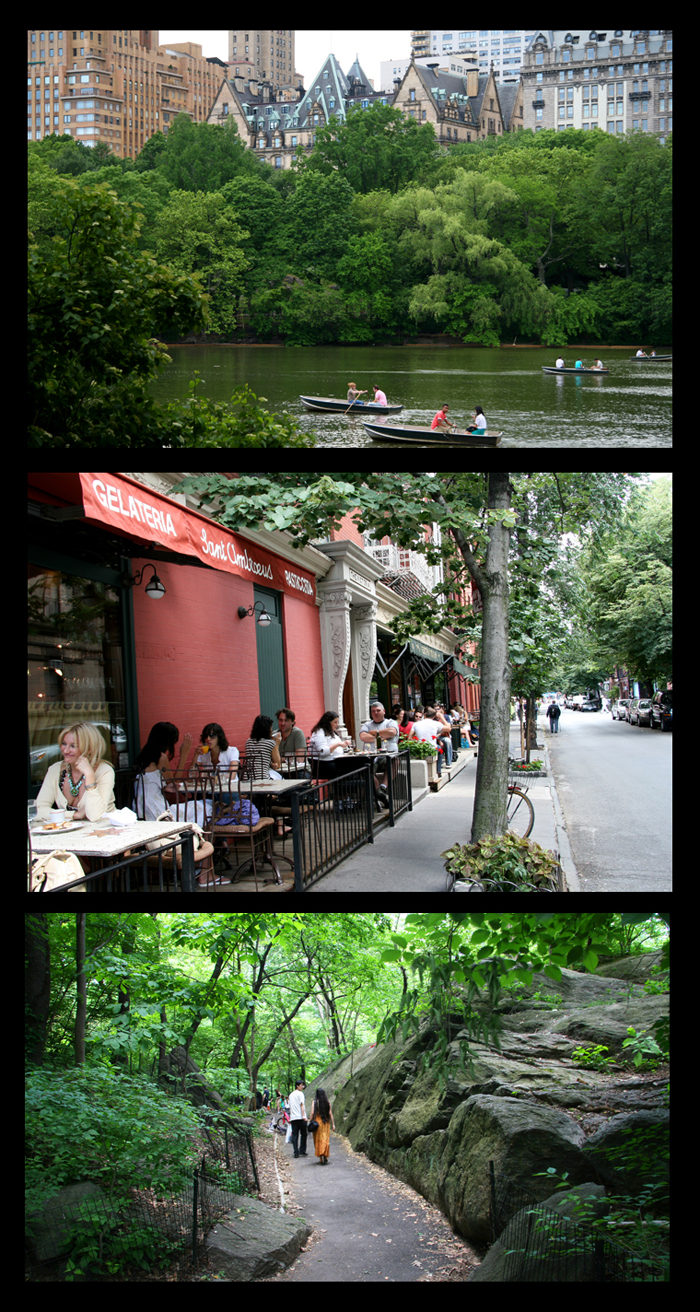
    As winter closes in and I realize that every season in New York City has its shortcomings, the thought of other, perhaps better, places, rather than other seasons, rears its head. But I am a little wiser now. I have been down that road too. No, best I enjoy images of a foliated New York in summer, because, at least for now*, I’m not moving to Florida 🙂

    *Interestingly, my aforementioned uncle, steadfast in his commitment to Maine and its hard winters, eventually became a snowbird and moved to Florida late in life where he lived out his life.

    Photo Notes: Top – The Dakota as seen from the Lake in Central Park. Center – West 4th Street. Bottom – the Ramble in Central Park.


  • A Slice of Cheesecake, Part 2

    The Brittany – Temple of the Gods of Debauchery (see Part 1 here)


    It was clear after moving into Brittany Residence Hall and a brief visit to NYU’s primary other residence at the time, Weinstein, that fortune has bestowed us with a better choice.
    The Brittany, as it was known at the time, is located at 55 East 10th Street and Broadway. It is a former hotel, built in 1929. The structure has larger, airier rooms and a prewar ambiance.
    The Brittany penthouse was a speak-easy at one time with many well-known guests such as Walter Winchell, Al Pacino, and Grateful Dead’s Jerry Garcia. The ground floor currently functions as a gallery, Broadway Windows, with displays of student art.

    At the time of my stay there, the Brittany was a truly a temple to the gods of debauchery. It was a coed dormitory, and in many cases, the rooms themselves became coed with couples living together in suites. Drugs were rampant as were drug dealers, even selling to those outside the student body. One evening, while sitting in a hallway, I had a jacket bloodied by someone who, half asleep on the way to the bathroom, had smashed his hand through a glass door and was running and screaming. I was told by a close friend of a first hand account of a group of students in the nude, high on Quaaludes, playing Frisbee in a hallway.

    One of my earliest memories there was visiting a room completely outfitted in UV blacklight for the entertainment of visitors. One fellow student represented himself as a cat burglar and demonstrated his skills by walking on window ledges of this high rise building. Brittany Residence Hall is also where I resided at the time of one of my favorite stories, involving Jimi Hendrix (see Crime Scene here).

    Somewhat controversial, The Princeton Review not only provides its well known university ratings in a Best College guide, but also provides a “Top 20 Party School List.” NYU has typically made the list. Today however, the university is better known for its coveted #1 Dream School status, rising prominence and the strength of many departments – Courant Institute of Mathematics, NYU Law School, the Film School, and Stern School of Business. According to Forbes Magazine, in 2008, NYU was ranked 7th among universities that have produced the largest number of living billionaires.

    I recently visited the dorm for the first time since 1970, escorted by an NYU student currently residing there. There were changes of course, most notably increased security – turnstiles requiring student ID card swipes. Things appeared to be much more subdued. However, I did learn that Brittany Hall is considered haunted, with reports of unexplained music, lights, footsteps, and claims from people who believe that others are watching them. Perhaps the final stirrings of the gods of debauchery…


  • A Slice of Cheesecake

    Part 1 – The Arrival  (see Part 2 here)


    I knew nothing of the world and almost nothing about New York City. I had only visited twice on day trips. I had never spent one night away from home alone. There were no ATM machines, and I had no bank account. Only some cash.
    I had one suitcase and arrived at Port Authority bus terminal, never a beautiful or inviting place for the newcomer. I was excited and scared. This is where I had dreamed of living for some time, but now I was really here, and it was big.

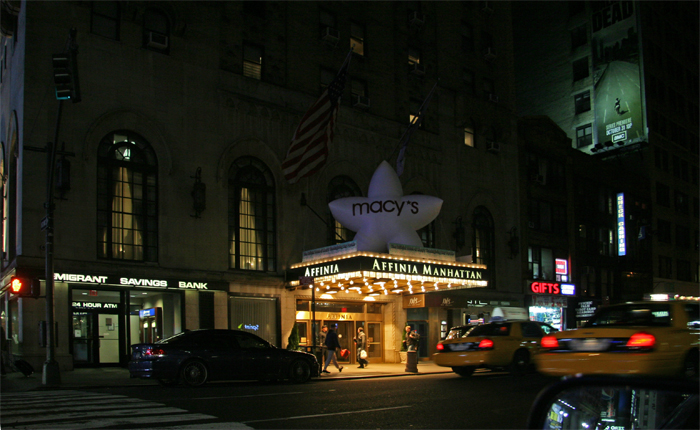
    I was neither homeless nor on the road. It was 1969, I was 18 and had been accepted to New York University. I had chosen a dorm and was very disappointed that my first choice, Weinstein Hall (the most modern), had been rejected. I was to stay at the older Brittany Residence, a former hotel, under renovation and not quite completed. As an interim measure, for a few weeks, we were housed at the Penn Garden Hotel* on 7th Avenue at 31st Street. I was later to learn that the Brittany, with its prewar ambiance and much larger rooms, was actually highly preferable.

    I entered my hotel room and met my roommates. I had never shared a room before either, having grown up with two sisters, so this was another adjustment to be made. We chatted a bit.

    It was evening and I was hungry. I had never eaten out alone, had little money to spend on dinner, and I did not want to stray far from the hotel. I recall going to a place resembling a diner and eating at the counter.
    Things were expensive here. I could not afford a real dinner, so I ordered cheesecake and a soda. Although a poor meal, on reflection, a slice of New York style cheesecake was quite befitting. My first day trips to the city involved more notable restaurants such as the Albert French Restaurant at 65 University Place, dating to 1868 and once a haven for writers including Thomas Wolfe, Nathan’s at Times Square, or Luchow’s on 14th Street. This place, however, was of no import and, as is often the case for a New Yorker, decided on the basis of proximity.

    The identity of the restaurant where I first ate on that evening in 1969 shall remain unknown to me, and assuredly it was not the “best cheesecake in New York City.” But it was only my first night, and there would be plenty of time to ferret out the good, the better, and the bests in Gotham City. Street cred would come in time, and for the newbie in New York, I could have done worse than a slice of cheesecake…

    *The Penn Garden Hotel has gone through numerous incarnations in the last 40 years. The thirty-two story structure was designed by the architects Murgatroyd & Ogden and built in 1929. It was originally called the Hotel Governor Clinton, named for George Clinton (1739-1812), the first governor of New York State. In 1967, the name was changed to the Penn Garden Hotel. In 1971, it became Southgate Tower, and in 2004 the Affinia.


  • Juxtaposition

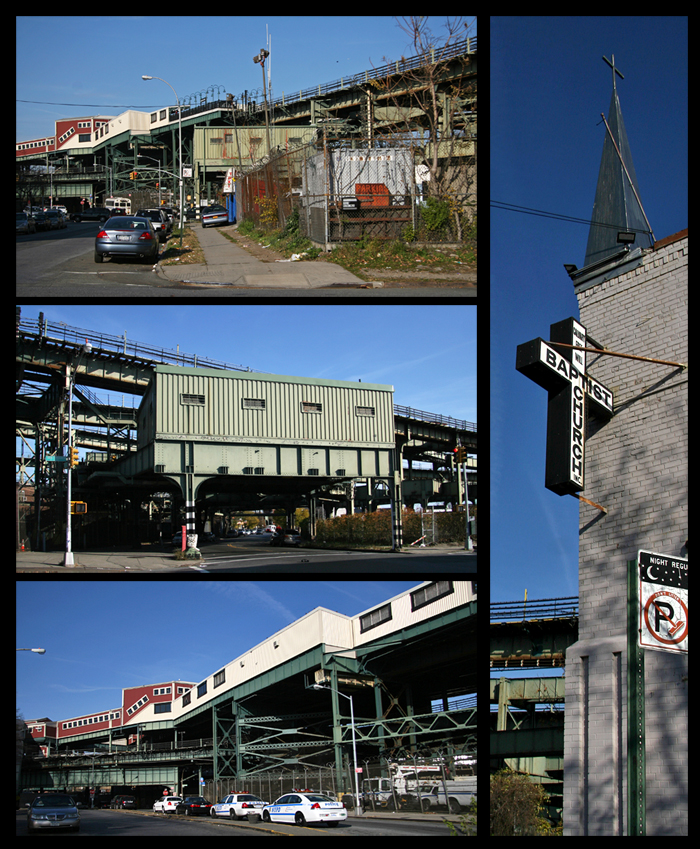
    There are some neighborhoods that the visitor to New York City will likely never see and residents outside those neighborhoods will likely never visit either. Brownsville, East New York, Bedford-Stuyvesant, and Bushwick are among them. These places often serve as bragging rights for those who grew up there. Surrounded by these neighborhoods is Broadway Junction.

    I was literally stopped in my tracks – the tracks of a confluence of trains and a massive, hodgepodge conglomeration of structures with every disparate element imaginable – different colors and materials embellished with chain link fences crowned with barbed razor wire.
    This is Broadway Junction, where East New York Avenue, Broadway, Jamaica Avenue, Fulton Street, and Interboro Parkway pass, along with subway stations for the A, C, J, L, Z, and the Long Island Railroad.

    Nearby, at 1520 Herkimer Street, I happened across the Calvary Free Will Baptist Church. A perfect addition to the ultimate juxtaposition…


  • Everything Yes


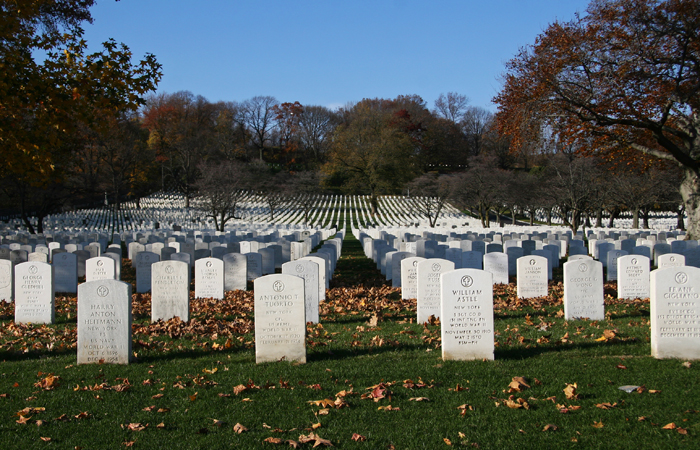
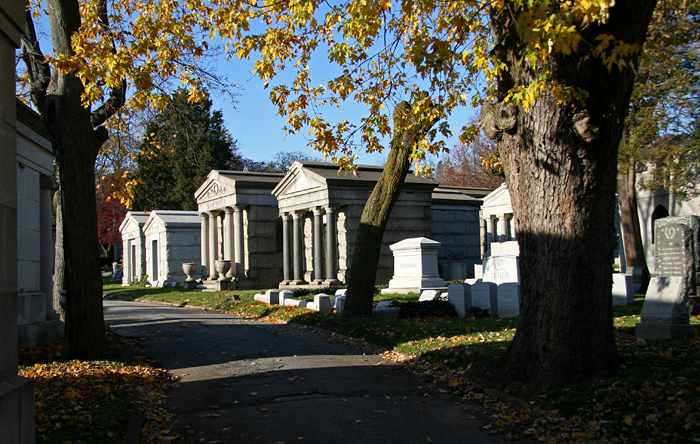
    While driving through Queens, on the way to somewhere else, I happened upon the most extraordinary cemetery. Or, cemeteries. Seventeen cemeteries to be exact, straddling the Brooklyn/Queens border. The first, with its exquisite rows of undulating white headstones, turned out to be a cemetery of tremendous historic importance, the Cypress Hills National Cemetery, one of the original fourteen national cemeteries (top photo).

    Cypress Hills Cemetery was established in 1849 as a nonsectarian burial ground. In 1862, during the Civil War, 2.7 acres were authorized by the private cemetery to be used by the United States federal government as burial spot for Veterans who did in New York City. There are over 21,000 interments in the cemetery. You can read more about it here.
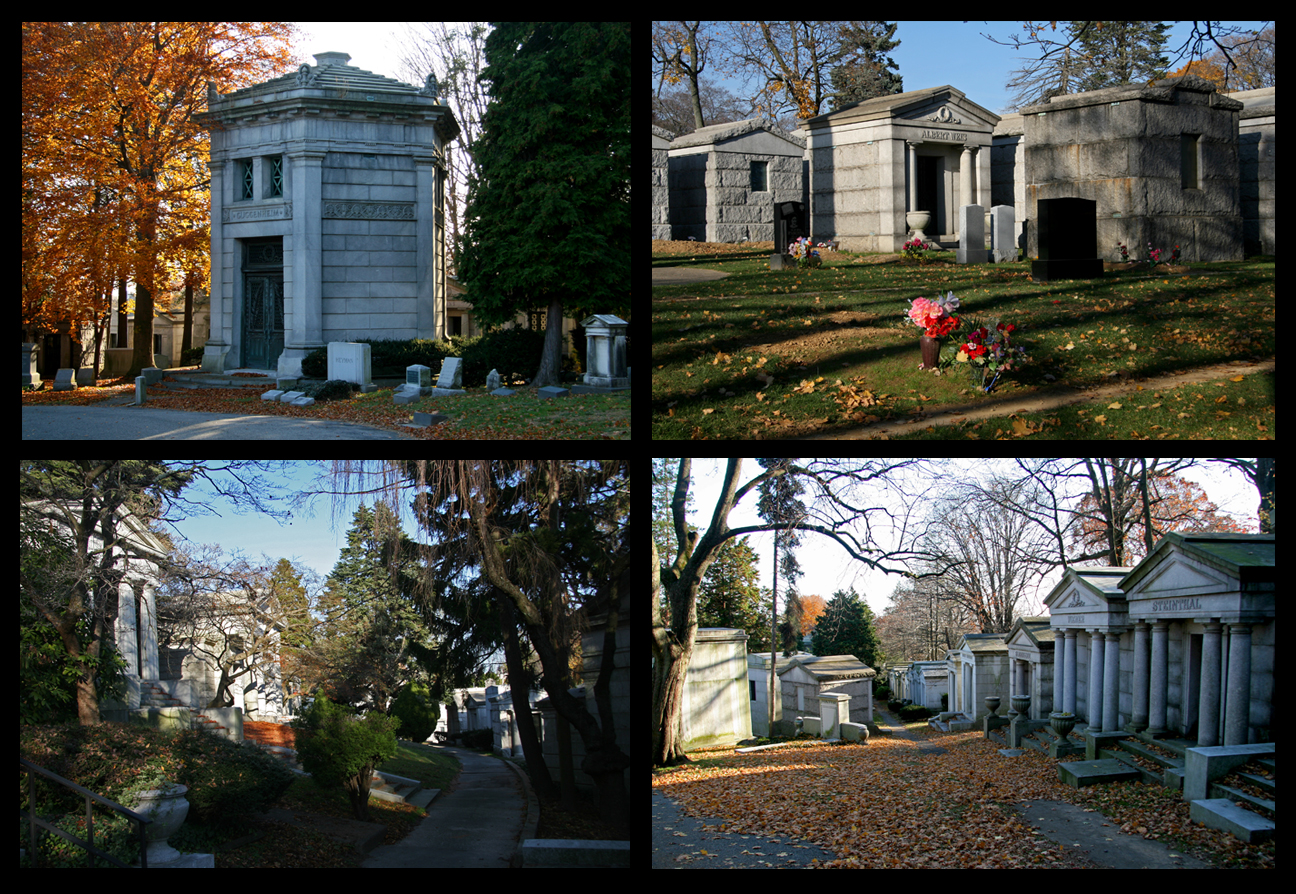
    Abutting these grounds, I noticed a number of very large mausoleums. As I was leaving, I saw that the main entrance at the corner of Jamaica and Hale Avenues was open and unguarded, so, completely unfettered, I decided to drive in. I discovered the most extraordinary cemetery I have ever been in (center and bottom photos). See my gallery of photos here.

    Some of the structures were the size of small homes. Many of the names were quite familiar – Guggenheim, Goldman, Fox, Shubert, etc. Could this possibly be the Guggenheim? The Fox of Twentieth Century Fox? The Shubert of theater fame?
    Yes they are. Salem Fields Cemetery at 775 Jamaica Avenue in Brooklyn, was founded in 1852 by the Central Synagogue and is the resting place for many prominent Jewish families in New York City. Salem Fields has been compared to places like the Père Lachaise Cemetery of Paris. The Guggenheim family mausoleum was modeled after the Tower of the Winds at Athens.

    The weather, with a cool crisp air, was exquisite, the light perfect, the autumn colors beautiful. I was the lone visitor, touring with complete freedom, stopping at every photo opportunity. Unlike many things in New York City, riddled with security procedures, lines, reservations, or admission costs, Salem Fields could well have hung a sign for the day – everything yes 🙂


  • Because It’s Not

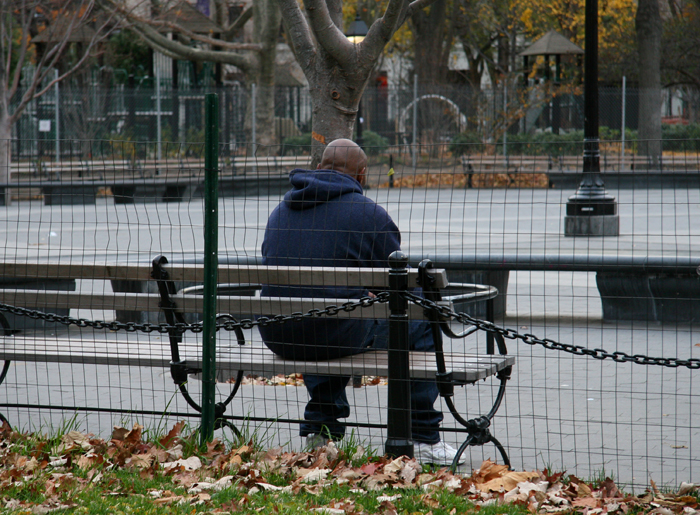
    With luggage in hand, I always walk by or through Washington Square Park on Thanksgiving day as I journey to New England to visit my family. On a bleak, gray morning, I find it particularly saddening, as invariably I see people alone in a deserted space, knowing that for many, this will be how they spend their day.

    When I was much younger, many of us espoused how a holiday or birthday was “just another day” and really meant nothing. Foolish to me now – on the occasions I did have to spend a holiday away from family, I worked hard to dismiss my sadness – who can really swim against a tide of a major national holiday that is defined by the family meal and is so emotionally charged with signs and reminders at every turn? Not I.

    I have featured the classic New York City celebratory events on this website in the past – you can see them here: Macy’s Thanksgiving Day Parade, the inflation ritual before the night of the parade (here and here), natural ornamentation found around the city, and displays of abundant foods. Retail promotions are everywhere to be seen, here in the city as elsewhere. Today, Macy’s opened at 4AM for what is now being called Black Thursday. The tree at Rockefeller Center has been installed, ready for the annual lighting ceremony. This is the New York City we see in the media and the one that visitors expect.

    But not everyone is enjoying the Norman Rockwell Thanksgiving family dinner.
    I left my home this morning at 6:50 AM with camera in hand to see and show a different side.
    A food vendor was already set up with his cart readied for the day. There were partially eaten containers of food and discarded clothing scattered about. Typical early morning sights before the park cleanup staff completes their rounds. I met Yusef, who was resting his feet, sitting alone on a park bench. He asked me about the time of the parade.

    I gave him my card. He noticed and identified the red-tailed hawk. I told him the story of how I came to get that photo. He was familiar with the famed hawks on Fifth Avenue overlooking Central Park. He asked what I was doing today, and I told him of my family and that I would be visiting in Connecticut.

    When I asked about his family, he told me he has only met his father twice and his mother was shot by her boyfriend some years ago. I did not ask what he was doing for Thanksgiving, and I was not going to insult him by telling him not to worry, it was just another day. Because it’s not…

    Note: Today, along with the good fortune I have had in my life, I would also like to thank all readers of this blog for your patronage and uplifting comments. Happy Thanksgiving to all.


  • dinamic_sidebar 4 none

©2026 New York Daily Photo Entries (RSS) and Comments (RSS)  Raindrops Theme