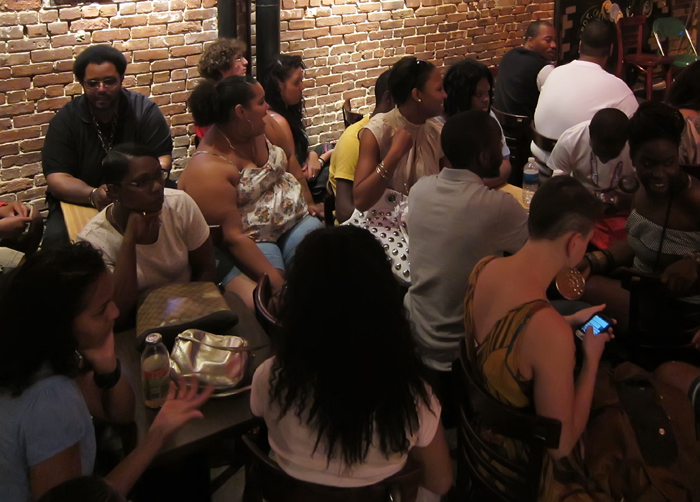
• Slammed


    Many will extol the benefits of spending the summer in the city. They will tell you of all of the wonderful events, many free, how much less crowded things are, and how tickets for events are more easily available since many New Yorkers are away. This is all true. But a long wait on a subway platform or a walk in the blistering heat amid concrete and garbage will quickly reveal why so many are away and you have the “city to yourself.”

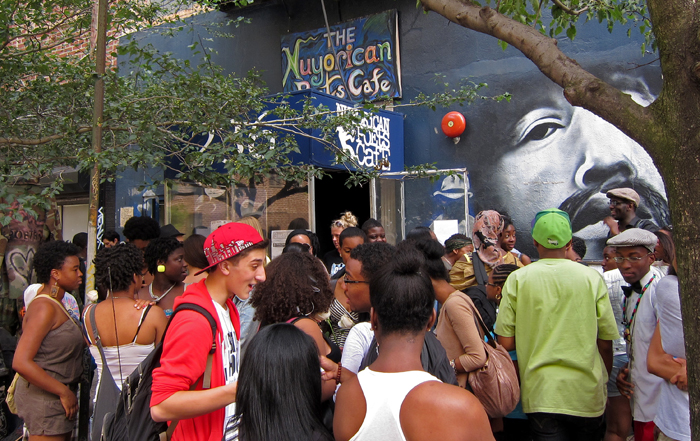
    I was really not very enthused about trekking all the way to 236 East 3rd Street between Avenue B and C in this type of heat and humidity to go to the Nuyorican Poets Cafe, where Urban Word NYC was sponsoring the Regional Teen Poetry Slam. A segment about this event had appeared that Sunday morning on TV. The host, an older white man, was extremely effusive about the poetry of a young person who was part of the event. He read some of his work. I was impressed.

    I respect poetry and I have read things I like, but I do not seek it out. This event looked to be some hybrid between rap and poetry, written about issues germane to kids a fraction of my age. But why not give it a try?

    It was so hot, with the kind of humidity that makes your skin crawl, and a shower is really just a foolish formality – undone the moment you set foot on the street. Surely it would not be crowded. Who is left in the city on a hot summer’s day, and who will venture out to the East Village on Sunday at noon to see poetry?

    We were the first and only ones in line, and although the prospect of waiting 30 minutes in the heat was very unappealing, after making the schlepp, my companion and I decided to wait. Soon, kids began to arrive and fraternize on the street – apparently many were known to each other in this subculture. I met the DJ and took his photo. By 1 PM, when the doors opened, the line had increased sizably.

    The space itself had been reviewed negatively by some online, so I imagined a seedy basement space with no A/C. After paying a nominal $7 admission, we entered the space itself, which was a big surprise – clean, cool, and comfortable. We had a choice of tables and were joined by a couple who were New York City High School English teachers. They had attended many poetry slams here before and had even brought their classes. They assured me that I would be very pleasantly amazed. Soon the room became full, and in no time, every table was taken and people were sitting on the floor or standing.

    My attitude was already changing.

    I thought that after four years of writing this blog that my skills and command of the English language had improved and that I aspired to becoming a wordsmith.
    Until Sunday.

    The command of the English language, the vocabulary, the insights, the creative writing, the rapidity of delivery, the rhymes, the rhythms, the memorization skills, the passion and theater were all nothing short of astounding. I was awed by these teenage kids.

    What really struck me was that, when examined closely, this entire activity was a celebration of the word. The event was sponsored by Urban Word NYC. Linguistic fluency and interest in language and writing is not a common association made regarding inner city youth. This phenomenon is really flying under the radar. It left me slammed…

    Note: Technically, this event was a slam, and like all poetry slams, that means a competition. Winners will go on to Los Angeles for the national competition. However, it was announced early on that the competitive aspect of the event was not the focus. This was a regional event, and teams had come from Connecticut, Boston, Philadelphia, and the home team from New York City. Poetry slams are regularly performed in New York City. The leader in this art form has been the Bowery Poetry Club. You can read my posting about it here.


  • Whet Their Appetites

    For two weeks, ending July 5, 2010, 60 pianos will be located in the public parks, plazas, and streets in all five boroughs of New York City. All are welcome to play. I visited a number of these and witnessed all manner of players, listeners, and playing skills.

    Play Me, I’m Yours is an art installation resented by Sing for Hope. The idea was created by British artist Luke Jerram, who has been touring the project globally since 2008 (London is being presented simultaneously with New York).

    The comments on forums online vary wildly – some individuals are in love with the idea and its efforts to bring music to the people. Others are infuriated or just highly cynical. Why are they located primarily in affluent areas, where they are least needed? What about vandalism? Who will tune them? How will chaining them to a cinder block prevent theft? Why did they allow painting of the keys themselves, which will affect playability? Some see its approval by the Bloomberg administration as posturing to feign support of street artists.

    There are certainly worse things to do with people’s time and money. In the few instances I watched at various locations, there were a number of highly skilled pianists and children with audiences. Learning to play a musical instrument is a long process requiring substantial time on a consistent basis. I wish these could be permanent installations, indoors and out, installed in all communities, particularly where there is a real need. The availability of these instruments would go a long way to making an impact and fostering musical interest.

    For those who can already play, this installation provides for many impromptu performances and summer fun. For those who don’t play, perhaps some moments with all that ivory will whet their appetites 🙂

    More about the installation: The 60 pianos will be available to play across New York City from 9am-10pm each day. The pianos are attended by individuals who lock and unlock the keyboards daily. Plastic tarps are on hand for protection from rain. On July 5th, to celebrate the culmination of the Play Me, I’m Yours, the street piano at Lincoln Center’s Damrosch Park will be brought to life by some of New York City’s most talented artists. A map with locations can be found here.


  • Absolution and Indulgences

    There are things that are fundamentally unpleasant, and apart from death, serious physical injury, or absolute calamity, about one of the most unpleasant experiences you can have in New York City is to have your vehicle towed.

    As bad as going through any city bureaucracy can be, there is typically some sense of accomplishment, even if it is only renewing a license, obtaining a permit, or having a package shipped via USPS. But the entire premise of the towed vehicle adventure is only to have returned to you what is yours to begin with.

    The “tow pound” is located at Pier 76 at West 38th Street & 12th Avenue, along the Hudson River, so the towee has to make a journey to a very inconvenient location. No one is pleased. Not the police, who have been given the particularly ugly job of towing and have to perform this duty for all to watch on the streets of New York City. Nor are the clerks at the tow pound, who often must battle with inflamed vehicle owners, many of whom have some defense which, as they will learn, will never do them any good at all. Not here at the tow pound.

    The premise is very simple – pay your fines in full, or you do not get your car. The clerk does not have the ability to negotiate or reduce fines. I have been to the tow pound once to retrieve a vehicle and witnessed every manner of negotiation, all to no avail. Regardless of their culpability, everyone feels wronged.

    What is astonishing is the cavalier attitude that visitors have about street parking in New York City, erroneously assuming leniency. But this is a low tolerance situation. The risk is just too high – never leave an auto in New York in an illegal parking spot.

    In a twist unfamiliar to me, I recently watched a very puzzling police action. A number of vehicles were towed but only relocated to a neighboring block. The vehicles were parked on a street, legal for that time but superseded by paper “No Parking Sunday” signs tied below street signs for the annual Gay Pride parade. Filming, festivals, events, and parades often require the clearing of streets. The NYPD adds paper signs on sign posts indicating the temporary change in parking regulation.

    This vehicle relocation policy is relatively unfamiliar to many vehicle owners, particularly visitors, and the Police Department website gives virtually no details.

    I have read of one incident where an individual parked legally (at the time he parked) and no special event signs had yet been posted. When he returned to a missing vehicle, he called the police, and no information was available. He was told that if a vehicle was relocated, look in a 5-block radius, and if he could not find it, call them back.

    The city has gotten more congested over the years, and unless you really need to have a vehicle in the city, using public transportation and taxis will go a long way to providing a much more relaxed time here, not fraught with the continuing stresses and worry associated with parking. Especially in a city where no absolution is given and no indulgences are sold 🙂


  • Quito

    At one time, I obsessed over climate and owned a compact little tome published by Pan Am. This travel guide cataloged every country in the world and, most importantly, there were climate tables for every capital city. My mission was simple – to find the place with the “perfect” climate. My search, however, was biased.

    At the time, I had also read books by extreme natural foodists who had similar agendas and whose motives were to find paradisaical environments to live off the land and create their own Edens. One writer, Johnny Lovewisdom*, was one of these aspirants, and his quest for the world’s best climate led him to the Andes outside Quito, Ecuador.

    A quick perusal of my Pan Am guide confirmed that Quito was one of the world’s most unique climates, with an average daily high of 71 degrees and average daily low of 41 (other charts measure the average daily high at 65-67 degrees). These temperatures only fluctuate by one to two degrees over twelve months. Quito, at an altitude of 9,186 feet, is the highest legal capital in the world. The city lies within one kilometer of the equator. This unique location in the Andes and along the equator accounts for a climate which can be truly called eternal spring. Moving to Quito became my dream, or more realistically, a fantasy.

    Now I dream of Quito for another reason. I live in a very special and unique older building on Washington Square North. However, like many apartments, there is no cross ventilation. Perhaps the date of the building’s pre-Civil War construction in 1837 explains why segregation is still practiced in my home and bodies of air inside and outside will not mix. With windows wide open, cold air outside, and warm stagnant air inside just coexist across a climactic Mason-Dixon line.

    Today in New York City, we have a break in the recent heat spell. Temperatures this morning moved from 71 through 77, spanning the averages, means, and other ways of measuring the daily high of Ecuador’s capital. The typical high temperature in Quito at noon is 77 degrees. As I write this, the current temperature in Central Park is 77 degrees. When I stand at my window’s edge, lean out, and feel that cool springtime air, for a moment, I’m in Quito…

    *Prior to the existence of the Internet, accurate information on elusive characters like Johnny Lovewisdom was nearly impossible to find. Now, information is readily available – his age, real name, and other biographical details. See his Wikipedia entry here to read about a man at the extreme edge of dietary movements.

    Related Posts: Miracles in Our Midst, Part 1; Miracles in Our Midst, Part 2


  • With Six You Get Egg Roll

    It was 1968, and I had been told that our family was going to a drive-in movie and that “with six you get eggroll.” We were all very excited, but I was very concerned because our family only numbered five. Anyone could clearly see that. But I trusted that my parents had some strategy – I had never had an eggroll and really wanted to try one.

    The drive-in was created by Richard M. Hollingshead, Jr. in Camden, New Jersey in 1933. In its heyday in the 1950s/60s, there were over 3700 drive-ins in the United States. It was the perfect family outing or place to take a date – an outdoor movie viewed from within your own private environment. Sound was provided via a speaker which could be hung on the inside of the auto’s window. Concessions were a short walk away.

    As my family drove to the entrance of the Drive-In, my heart sank. There it was on the marquis. With Six You Get Eggroll was the title of a film starring Doris Day (I later learned this was her last appearance in a film). No eggrolls for me.
    But once I moved to New York City, closure was achieved – I had many an eggroll. But no drive-ins. However, we have the perfect urban equivalent. For some years, films have been aired around New York City in various parks during the summer. The Bryant Park Summer Film Festival screens films on Monday evenings. The event began in the early nineties and is now sponsored by HBO. What better way to enjoy the season than an outdoor film (or concert)? People bring picnics, chairs, and/or blankets.

    The death of theater has been predicted since the beginning of video and home entertainment systems, yet theater business booms. The numbers of drive-ins has declined dramatically – there are only about 400 nationwide. However, there is an independent revival afoot – groups like mobmov.org and guerilladrivein.org are doing impromptu screenings projected on surfaces like warehouse walls or bridge pillars. One thing missed in many of these fatalistic predictions are social needs. The huge turnouts for outdoor events, sold out theaters, and independent revivals demonstrate this need. People enjoy sharing entertainment with other people, not just from the comfort of their homes.

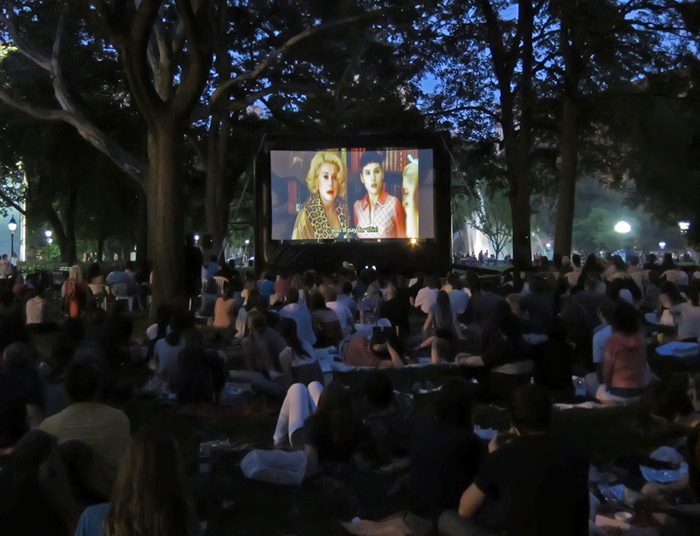
    On Friday, June 18, Films on the Green presented the French Film 8 Women in Washington Square Park, shown in today’s photo. The cast of eight, with Catherine Deneuve, may appear quite large, but not if With Six You Get Eggroll 🙂

    Note: The Films on the Green series of free screenings is jointly organized by the Cultural Services of the French Embassy and the New York City Department of Parks & Recreation for the third year running.


  • CYA

    I was visiting a New York City doctor once, and I queried him as to why a specialist I had been referred to had ordered a number of tests which seemed unnecessary. He quickly and casually responded, “Probably CYA.” Embarrassed that I did not know the meaning of this acronym, which apparently was common knowledge, I was forced to ask what it meant, to which he responded: “Cover Your Ass,” i.e. order the obligatory tests to protect oneself from possible malpractice. CYA is practiced by many organizations and professionals, notably in banking and journalism.

    Eleventh Avenue is one of the twelve numbered avenues in Manhattan.
    The Commissioners’ Plan of 1811 established a grid In Manhattan, between 14th and 155th Streets. As part of this plan, sixteen numbered and lettered avenues were created, running north/south, parallel to the Hudson River: First through Twelfth Avenue. Where Manhattan bulges outward in the East Village, avenues A, B, C, and D (Alphabet City) were created. On the the Upper East Side, Sutton Place/York Avenue was originally an extension of Avenue A.

    Later, two avenues were sandwiched in between originals to the plan: Madison Avenue (between Fifth Avenue and Park Avenue, formerly Fourth Avenue), and Lexington Avenue (between Park Avenue and Third Avenue).
    It is unlikely that the visitor to New York City will ever visit Eleventh Avenue, apart from the Meatpacking district, where Eleventh Avenue starts, or the Jacob Javits Convention Center.
    What’s happening on Eleventh? At one time, it was popularly known as “Death Avenue,” owing to a section where the West Side Line of the New York Central Railroad ran directly along the avenue.

    Today, there are a number of commercial establishments: the CBS Broadcast Center, Comedy Central studios, car washes, but, most notably, the largest concentration of auto dealers in Manhattan. If you are in the market for a Lamborghini, BMW, Jaguar, Mazda, Nissan, Acura, Lexus, Bentley, Rolls-Royce, Spyker, Porsche, or Lotus, this is where to go. There are a couple of architectural gems, such as the striking Gehry-designed IAC building at 18th and Eleventh (see my story Gehry in Gotham here).

    Why, you might ask, would I do a posting on such an innocuous and essentially nondescript thoroughfare which few will visit when there is so much more of inherent interest in Manhattan? Because there are things we must all do, and, although this is not Wikipedia, I would be somewhat amiss if I did not do at least one posting in these pages on Eleventh Avenue. Or, simply, just a case of CYA 🙂


  • Urban Road Warrior

    I thought I had seen the extremes in high heel elevations in New York City, but in reading various articles, I came across the “armadillo” stiletto claws designed by British fashion designer Alexander McQueen as part of his Spring 2010 Plato’s Atlantis shoe collection. These shoes, which number only twenty-one pairs and range from $3900 to $10,000, were worn by Lady Gaga in her “Bad Romance” video.
    The shoes are a staggering 12 inches tall, perhaps the first where height can be measured using an altimeter. Some models refused to wear them, worrying about potential falls.

    High heels themselves are mired in controversy. They are responsible for a litany of health concerns: foot pain, deformities, sprains, fractures, and degenerative knee joint problems. But their allure remains – heels make a person appear taller, legs longer, the foot smaller, and they make leg muscles and the butt more well defined. They alter the posture for a sexier gait.

    Some see other reasons for their popularity:

    There are many theories about sartorial behavior as an economic indicator. In dark times, hemlines go down. Lipstick sales go up. And high heels grow ever higher, an attempt to lift our collective spirits by elevating women a few extra inches off the ground. – Amanda Fortini, The New York Times, December 13, 2009.

    In New York City, we are walkers, and, unlike the suburbs or countryside, the prospect of using shoes which depend on the wearer being transported by auto to and from destinations is largely not realistic.
    But lack of comfort for extensive walking is not the only impediment to wearing high heels. New York City is mired in land mines for the woman wearing heels and engaging in the daily slalom of potholes, sidewalk grates, uneven sidewalks, and subway stairways. The extraordinarily treacherous pedestrian trails make walking more difficult, and the harsh environment guarantees to eventually tear and damage fine shoes. Solution? Simple – wear flats or sneakers on the streets, and change to heels at the office or function. Some women tote dress shoes in their bags, while others may just keep a pair of heels in the office.

    However, arriving at the office in old flats or sneakers does little for a woman dressing for success or allure. Like the woman in today’s photo, changing on the streets is one way of keeping the wardrobe intact for the urban road warrior 🙂


  • Mermaid Parade 2010


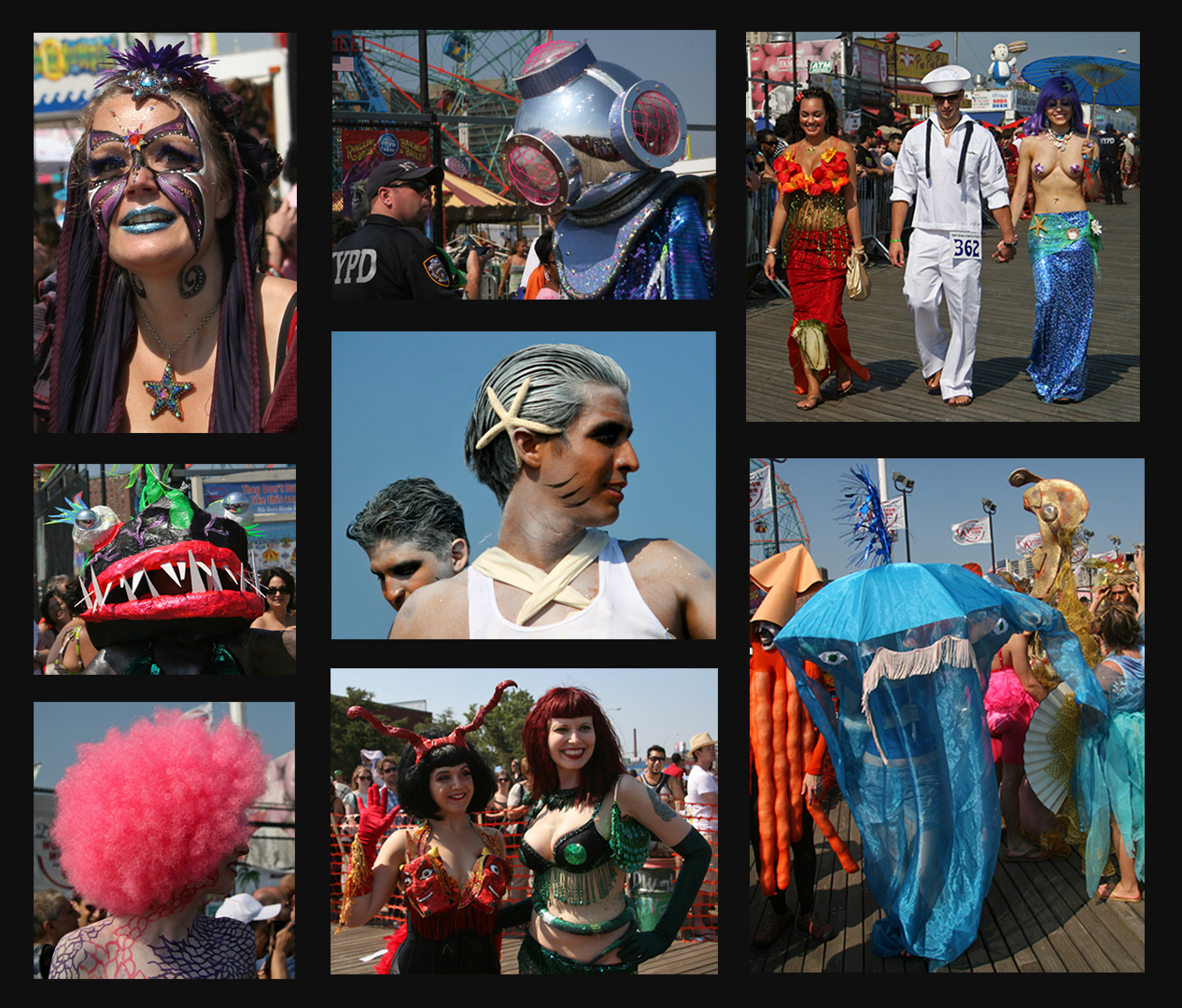
    I have attended the annual Coney Island Mermaid Parade for the last four years. It is one of the most enjoyable parades in New York City. This year, the weather was extraordinary and the turnout enormous. Please visit my photo gallery of the event here.

    Previous Mermaid Parade posts: Mermaid Parade 2006 P1, Mermaid Parade 2006 P2, Mermaid Parade 2007 Part 1, Mermaid Parade 2007 Part 2, Mermaid Parade 2009


  • Everything No

    On April 4, 2008, I wrote Key Privileges, about Gramercy Park – the city’s exclusive private enclave and Manhattan’s only private park. Read the story of the park here. That visit was like that of virtually all New York City residents and visitors – from the outside.

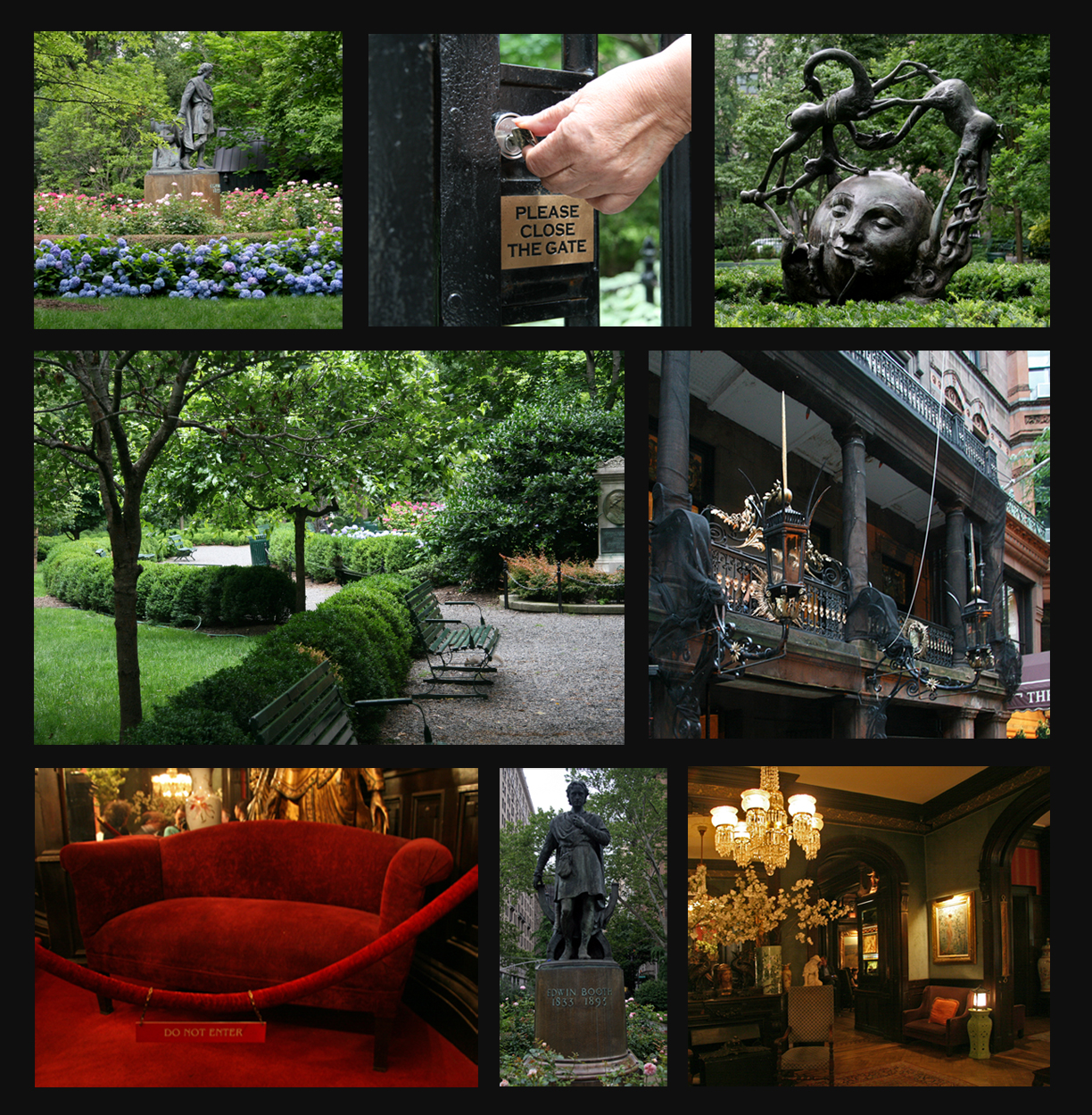
    Recently, a friend, a regular reader of this website and Gramercy neighborhood resident who lives just off the park, let me know that she was in possession of a rare and highly coveted article – a key to Gramercy Park. The key was loaned to her by a friend who was away for a short time, so time was fleeting, and so was my window of opportunity. A number of us were invited for the outing, so we decided to meet at an opening at the National Arts Club on Gramercy Park South.

    The convenient location on the park and a short immersion into the club’s historic structure made it the perfect launching point for our excursion into the park. The National Arts Club, which also abuts the Players Club, is housed in one of New York’s finest mansions, both a designated New York Landmark and a National Historic Landmark. The building, located at 15 Gramercy Park South, is worthy of a visit itself.

    I made a big ceremonial event about the unveiling of the key and the opening of the park gate. Gramercy Park requires a key both to enter and leave. Once inside, we toured the park, spent some time enjoying the extraordinary bucolic ambiance, and alighted on a number of benches for some friendly chatting. See my gallery of photos here.

    All of our group was in agreement, however, that although the park’s landscaping and natural beauty was quite exquisite, the park itself, with its list of don’ts, was rather boring. In fact, the park is not heavily used.
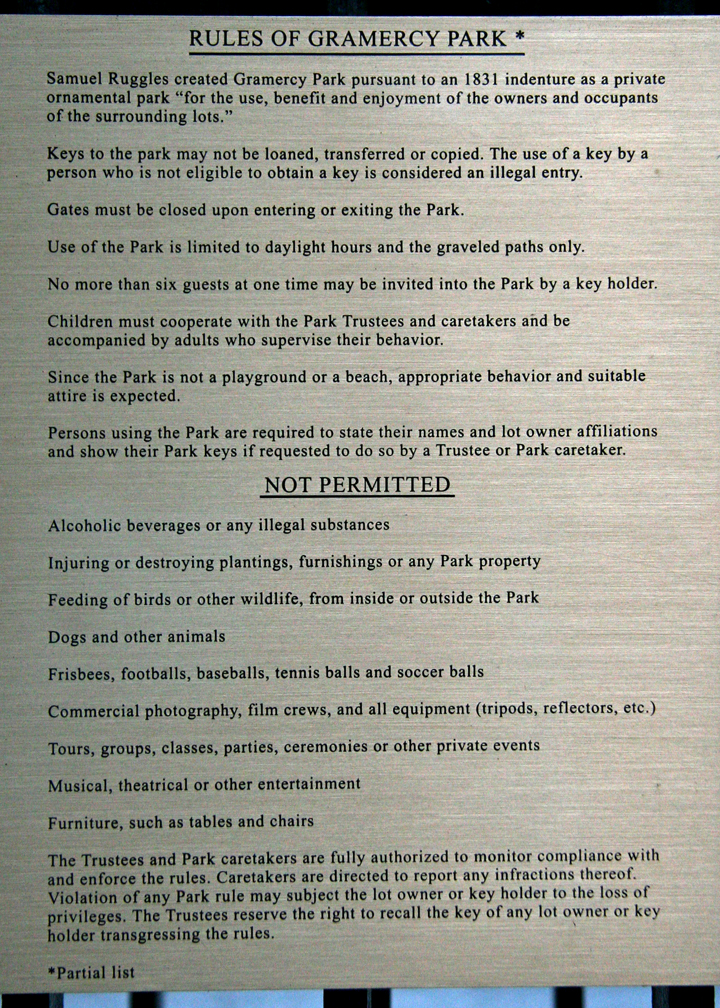
    The list of rules is quite long (see them here). After reading them on our way out and observing a nearby “Please No Pets” sign, one of our group was prompted to comment, “Everything no.” A recent immigrant to the USA, we found her outside perspective and slightly broken English to be a charming, succinct, and not altogether inaccurate characterization of the environment. Smiling, I felt compelled to respond, “Yes, everything no…”


  • Cast Iron Stomach

    I recall my roommate in 1970, telling me that he was moving to a “loft in SoHo.” My first question was, of course, “Where is SoHo?”, the second was, “What is a loft?” and the last was, “Why?” It may be hard to imagine, but when I first moved to New York City, SoHo was quite undesirable – an industrial backwater with little residential appeal.

    Remarkably, I lived in the Village, and SoHo was just a stone’s throw away – south of Houston Street – yet I had never been there. A visit quickly revealed an industrial neighborhood with little charm at all. Regarding the term “loft”, I was told that this term derived from the large, upper floor “lofty” spaces. And the “why” was simple – cheap rents.
    In hindsight, the explanations of why a New York City neighborhood was “discovered” always appear obvious. However, the individual is rare who will recognize this before it is “discovered” – early adopters are often artists who see the merits shining through the demerits, which are typically many.

    Becoming a pioneer of an unpopular neighborhood is now much more difficult – everyone is looking for the next place, and news moves with extreme rapidity.
    More importantly, all the reasons why a neighborhood looks undesirable and shows little promise are what really prevents most from getting in early. Successful stock investors know this well and have the ability to go against human nature and buy when stocks are going down, much as the pioneer, in spite of popular sentiment, moves to neighborhoods that are downtrodden.

    Another huge issue in “buying in on the ground floor” is waiting until an area improves. This could take decades. Worst of all, many areas never fulfill their promise. I have always felt that housing stock was a key element. This is no guarantee either – areas such as Bedford-Stuyvesant, Brooklyn, and Harlem have beautiful row houses yet have not seen the rapid gentrification that other areas have.
    Despite the improvements in these communities, they often continue to be stigmatized by a lingering public perception left from the rougher times of the past.

    If you believe that you are a person who really can see past a place’s obvious detriments, go to Brooklyn and visit the Gowanus Canal. Some tout this as the future Venice of New York City.
    Once a tidal inlet of creeks, marshland, and meadows, Gowanus Canal was built from Gowanus Creek and completed in 1869. The Gowanus Canal became a hub for Brooklyn’s shipping activity to service the factories, warehouses, tanneries, coal yards, machine shops, chemical plants, flour mills, cement factories, and manufactured gas refineries lining its shores. Industry thrived in the area, and with it, pollutants.
    The area has had an acknowledged problem with industrial pollution for over a century, with cleanup discussions going back decades. On March 4, 2010, the EPA announced that it had placed the Gowanus Canal on its Superfund National Priorities List.

    Gowanus Canal and the surrounding neighborhood have a much greater impasse and many hurdles to becoming a viable residential enclave, much less a charming Venetian-like waterway. There is little charm in oil tanks or scrap metal yards, and improving an area like this is a taller order than cleaning up the cast iron buildings of SoHo or the beautiful brick structures of DUMBO, Brooklyn.

    But a bright future could be in store for those with a long vision and, like anyone waiting out the transformation of an industrial neighborhood, a cast iron stomach 🙂


  • Explorin’ Part 2 – Dead Horse Bay

    (see Part 1 here)


    The name Dead Horse Bay is provocative enough, and the place easily lives up to its name.

    A coworker told me about this beach in Brooklyn, along with a requisite piece of information – go during low tide. So, I examined the tide tables for Jamaica Bay, New York City, and timed my trip accordingly. I parked my vehicle at the ranger station at Floyd Bennett Field. A walk across the main thoroughfare and short hike through the beach forest trail opens up to the bay. Surprisingly, none of the rangers had made the hike and were eager to hear my report upon return.

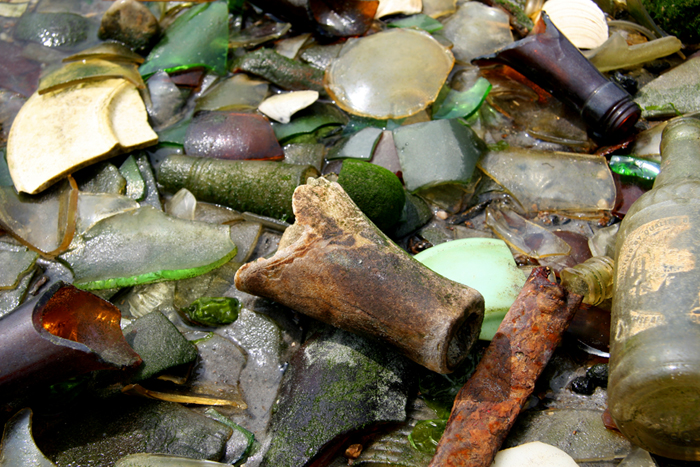
    The beach is strewn with a myriad of artifacts – primarily glass bottles, forming a blue-green carpet of glass. Make no mistake, however – Dead Horse Bay is essentially a beach of trash, albeit very interesting trash. There are dishes, toys, parts of sinks, rusted metal devices, and even mating horseshoe crabs. See my gallery of photos here. The history of this bizarre place is always the first question asked. From the New York Times:

    Dead Horse Bay sits at the western edge of a marshland once dotted by more than two dozen horse-rendering plants, fish oil factories and garbage incinerators. From the 1850’s until the 1930’s, the carcasses of dead horses and other animals from New York City streets were used to manufacture glue, fertilizer and other products at the site. The chopped-up, boiled bones were later dumped into the water. The squalid bay, then accessible only by boat, was reviled for the putrid fumes that hung overhead.

    Once marshland, the area became slowly filled with trash and the landfill capped. The cap burst in the 1950’s, spewing articles from the early 20th century into the surrounding beach water.

    After walking the entire beach, I was prepared to leave. However, the fact that I had seen no evidence of dead horses was nagging at me, so I decided to backtrack and question a woman who, I had noticed earlier, had been combing with the intent of a repeat visitor. Alas, good that I did – Angela pointed out that horse bones were, in fact, everywhere – you just had to know what to look for. Sure enough, once they were pointed out to me and my companion, we saw them everywhere. Angela had found what appeared to be a 32-sided game die and asked if I could take photos for her. You can see it here.

    If you visit Dead Horse Bay, remember to wear good shoes/boots to protect you from all the shards of glass and other sharp objects. Oh, and happy explorin’ 🙂


  • Explorin’ Part 1

    We learned to travel through the forest canopy ala Tarzan (sans vines) by climbing atop young saplings and swinging side to side, gaining enough movement to grab a neighboring tree and cross over. We crossed swamps, jumping from one tufted outcropping to another. We fell from trees and into swamps too.
    We found snakes under hot rocks – we learned that they loved to bask in the heat of the summer sun. We found newts, tadpoles, turtles, and salamanders. We marveled at nature’s iridescence in the damsel fly. We believed in the dangers of a dragon fly sewing your eyes shut, as well as other myths, not knowing they were myths at all.

    My summer days were filled with exploring, from sunup to sundown, until my mother’s call brought me back from the wild. More correctly, I should say explorin’, because that is precisely what we called it – the lack of a “g” conferring a certain sense of casual authority of the experienced adventurer. “Explorin'” was always the answer to the daily “Whataya want to do?”

    Later, I read the wonderful tales of African adventure by Jean Pierre HalletCongo Kitabu and Animal Kitabu. Although my native habitat was not Africa and no real treasures were ever found, it mattered not in the least.
    We made primitive toys and weapons. With crudely fashioned bows that rarely worked, we stalked the woods like Robin Hood. We made kites that would not fly from salvaged fabric and twigs. A string, stick, and small hook was enough to spend a day fishing lost items from below the steps of a basement hatchway. We rolled down hills in reclaimed appliance boxes. There was no particular agenda or mission when explorin’ – just the joy of looking. And we loved the woods best of all.

    These days, although I have yet to travel to the Amazon or Congo, I find New York City serves as a fine place for any Jungle Lover with a hankerin’ for explorin’. There are plenty of woods, beaches, alleys, rivers, lakes, bays, wildlife, and backroads.

    On Saturday, armed with that childhood spirit of explorin’ and on the recommendation of a coworker, I set out to explore a most bizarre place, the result of a strange twist in New York City history. Tomorrow, I will show you what I found on the other side of those dunes in Part 2 of Explorin’…


  • Eyes on the Signs

    As Jerry Seinfeld once pointed out in one of his comedy routines, the beauty of clothing is that adjustments and improvements can always be made. But in the case of nudity, no tweaks are possible. Essentially, the naked person is saying, this is the best that I can do.

    In the classic episode The Apology, the distinction is made between good naked and bad naked – they were not talking about morality, only aesthetics. And when you get a large group who come from the general population and not the world of modeling or body building, you are sure to get plenty of bad naked. I know there are those who defend all bodies as beautiful, but I think in this case, I side with Seinfeld over artistic idealists.

    Appropriate or inappropriate, legal or illegal, good naked or bad naked, public nudity is sure to draw attention, which is just what demonstrators get when “clothing optional” is part of the equation. See more of my photos of this event here.

    However, anyone inclined to this type of strategy to make a political point had better realize that what will be remembered is often only the nudity. Lively discussions will occur during and after such a protest, but mostly over the details of how naked any participants were and how various body parts were covered or decorated. In fact, after the members of this ride left Washington Square Park, I showed a number of friends some of the photos I had taken – there was surprise regarding the rider who had painted “Oil is dead” on his back. Apparently the message and numerous signs regarding oil did not make itself clear.

    Many observers will likely believe that this ride is just an expression of personal freedom or wild reckless abandon. There is an element of that, of course, once an event like this is under way. It is doubtful a ride like this will be dominated by the shy or prudish. The event does become an exhibitionist theater on wheels. However, the World Naked Bike Ride is an international annual event “to celebrate cycling and the human body. The ride demonstrates the vulnerability of cyclists on the road and is a protest against oil dependency.”

    The demonstration went smoothly in the park – there was plenty of reveling in the park’s fountain. The police were quite tolerant, even though many of the male participants were completely nude and technically breaking the law. One officer was making his compulsory rounds, chanting an obligatory “Put your clothes back on.” The event is best served if riders keep their eyes on the road and observers keep their eyes on the signs 🙂


  • Brighton Beach


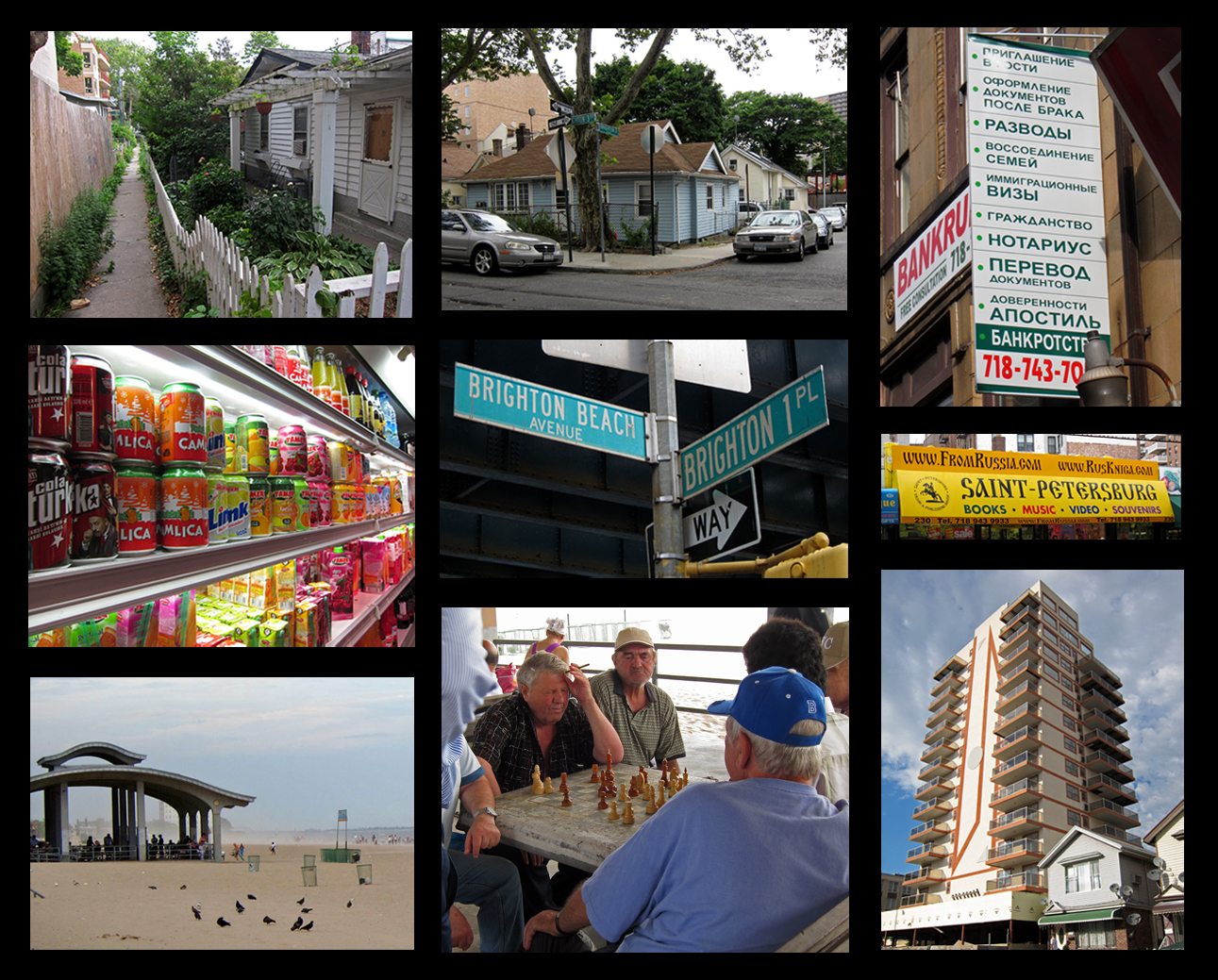
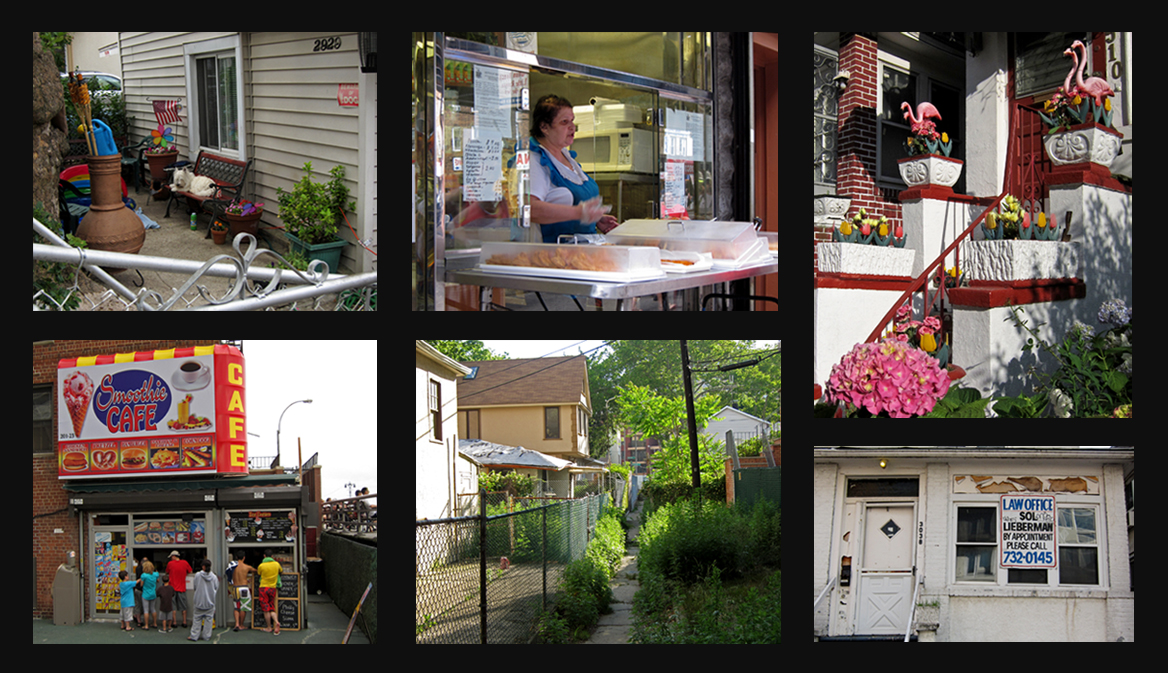
    New York is a city of contrasts. And contrasts within contrasts. Brighton Beach is a community sharing the Coney Island peninsula with Sea Gate, Coney Island, and Manhattan Beach in Brooklyn. See the photo gallery of my recent visit here.

    I took a long walk through the neighborhood and met a long-time local resident having a smoke in his front yard. He was quite friendly and informed me how neighborhood changes have been drastic in the last five years and how he anticipates more of the same. According to him, the biggest change and factor in escalation of real estate prices has been a rapid infiltration of Russian-organized crime. Small bungalows are purchased, leveled, and transformed into large private homes or apartment condominiums. He pointed out developments all around us, sprouting up amidst small homes. This resident was offered $1 million for his small home. Certainly the Russian influence is felt in the shopping areas – many signs are in Cyrillic alone. Many articles have been written on the problem, which goes back decades (see a New York Times article here).

    Cottages, high-rises, condos, luxury homes, gated communities, buildings in disrepair, organized crime, ethnic enclaves, alleys, lanes, weeds, flowers, the boardwalk, and the Atlantic Ocean. That’s Brighton Beach…


  • World Domination

    There is an episode of the Twilight Zone, The Little People, where astronauts William Fletcher and Peter Craig are marooned on another planet. In exploring the planet, Craig discovers a Lilliputian city with miniature people. Soon, Craig becomes an obsessed lunatic and appoints himself as a god over these people, terrorizing them into submission. At one point, he even forces the populace to build a life-size statue of himself. In an ironic ending, Craig himself becomes a victim when two enormous spacemen visit the planet. One of them picks up the ant-sized Craig, accidentally crushing him to death.

    We can easily understand Craig’s dark side – what child (or child within the adult) is not fascinated observing people and cars from extreme heights? Can’t you just hear them remarking to one another how tiny they are and how they look like toys? As if they could reach down and pick them up.

    I recall my first visit to the Empire State Building, where, at the observation deck on the 86th floor, I was able to squeeze my head through the fencing and look straight down, seeing for the first time the toylike world I had only imagined or seen on TV.
    There’s a touch of megalomania in many of us, and viewing the world from atop skyscrapers gives just the vantage point to fantasize our domination over the world below. And what better place to reign than New York City? 

    Many urban jungle lovers (see Jungle Lovers and Urban Safari) relish exploration of the city, following the beaten paths or cutting their own swaths. But from time to time, there comes a desire to see the forest from the treetops. New York City affords a myriad of opportunities to do this via observation decks, bridges, and high-rise apartment and office buildings. Today’s photo is a rooftop view looking straight down from the 26th floor of a luxury high-rise apartment building in Greenwich Village.

    I love the culture, arts, architecture, and people of the city, but from time to time I want to see the little cars and people below. So, next time you get the chance, take a trip to the top of a New York City skyscraper and join Peter Craig and me in a game of World Domination 🙂


  • dinamic_sidebar 4 none

©2026 New York Daily Photo Entries (RSS) and Comments (RSS)  Raindrops Theme