• Every Inch Has a Price

    Posted on by Brian Dubé

    We price apartments and commercial space in dollars per square foot. We pay for loss factors (unusable space not usable but included as rentable space). Messengers squeeze through tiny spaces (see story here). Subways are overcrowded. Cars are jockeyed in lots and garages at extraordinary rates. People have been murdered over parking spots on the street.

    Some store pots and pans in the oven. Why not leave them in the dishwasher? Who has room for a dishwasher? We move the toaster a few inches to make space for the blender to make space for the dish rack.
    Bicycles hang from hooks in the ceiling. Many pay for off site storage. There is typically no room for washer/dryers in apartments, so most carry their laundry to a laundromat. There are very few tennis courts and rates can run to $100 per hour.

    In New York City, every inch is spoken for, and in that type of environment, every inch has its price – a hefty price. Everything is designed around space constraints. We think vertically. Everything is stacked – apartments, businesses, and their contents. Air rights are bought and sold.

    Hot dog vendors pay extraordinary fees to operate outside the Metropolitan Museum of Art. This is the premier spot in the entire city for street vending of hot dogs. Pasang Sherpa contracted for $642,702.19 per year to the New York City parks department for the right to sell hot dogs there (to close shortly after opening). Then, in 2007, disabled Vietnam veteran Dan Rossi set up shop, acting on an 1894 state law that allows disabled veterans to sell in restricted areas. For free. On a recent visit to the Metropolitan Museum steps (see story here), I spoke to Jose Cabrera, who works for Rossi. Jose is also a disabled vet, having served two tours in Iraq.

    Of course, other veterans have followed suit, and the whole situation is a mess. The city claims that there is room for only one vendor. From the New York Times:

    …there is room for only one vendor because of regulations regarding the location of the carts and because bus and taxi boarding zones must be kept clear.

    Two weeks ago, officers began handing out summonses, in most cases saying the carts were too far from the curb. Vendors said they were in a bind: If they were near the curb, they would be ticketed for obstructing the bus and taxi stops, and if they were farther out on the sidewalk, they would be ticketed for being too far from the curb.

    Dan Rossi has weathered the police ticketing and hot dog vendor battles. Recently, however, the city has been looking to diversify the food options outside the Met and has leased vendor space to Cake & Shake of Long Island City, Queens for $659,350 for a five year period. Read the whole New York Times story here.

    I assumed once someone acquired a license to vend on the streets, they would not be hampered by space constraints most New Yorkers face. But even in the great outdoors of New York City, every inch is spoken for and every inch has a price

    Note: The name Sgt. David Gonzales across the top of the cart is not the owner’s name, but rather that of a Vietnam vet killed in action and friend of cart owner Dan Rossi.


    Posted on by Brian Dubé

  • White by Desire

    Posted on by Brian Dubé

    I can’t say that New Yorkers have an exclusive on making impractical choices, but examples do abound that give evidence that it is at least a worthy contender in any competition for foolish choices. Trends and fads drive residents of this city as much as anywhere else, where it often seems that displays of extreme lack of sensibility is its own form of rebellion.

    And what better way for some to display that defiance by sporting a large dog with roots from a climate completely antithetical to that of New York City? Breeds inappropriate in any number of ways for city life, or ones requiring extreme maintenance.

    I recall the 1980s, when the Shar Pei, with its heavily wrinkled skin, was all the rage. Rapid breeding resulted in many health problems, such as allergy-induced skin problems. Many required eye surgery, with some owners seeking the skills of a eye surgeon for people. I rarely see the Shar Pei here any longer. Akitas were also quite popular at one time. Now I often see the Shiba Inu, a small hunting dog from Japan with a cute, foxlike appearance.

    On Sunday, I met Sofie, a beautiful, cheerful, friendly Samoyed – a breed originating from Siberia that is a nomadic reindeer herder. They have a dense double coat, which means lots of hair shedding. They are very youthful, energetic dogs with a desire to pull sleds and a love of the cold. Perfect for the Manhattan apartment resident, n’est-ce pas?

    Their cheerful nature and beautiful white coat, for many, outweigh any practical considerations. The breed’s ear-to-ear smile has given the Samoyed its alternate name, “smiling sammy.”

    In fairness, after speaking to the owner, I found that Sofie is very well cared for. It is possible to keep a dog like this healthy and happy in a New York City apartment with work, and many pet owners are ready, willing, and able to do whatever is necessary.

    Samoyeds are extremely well-insulated. Sofie actually loves sleeping in the snow. In their native environment, Samoyeds kept their owners warm at night by sleeping on top of them. The dog’s owner told me that once it begins to get warm at all, she runs her air conditioning 24/7.

    I was surprised to learn that early Samoyeds also came in black – white has become dominant due to popularity. If not for the constant care and responsibility, I could easily fall for the cheerful charm of the Samoyed. I, like many others, do love that white color, and the Samoyed that we see today, more than White by Design, is White by Desire 🙂

    Note: For lovers of white, see my stories White by Design, White by Design 2, and White by Design 3.

    Posted on by Brian Dubé

  • Sardines

    Posted on by Brian Dubé


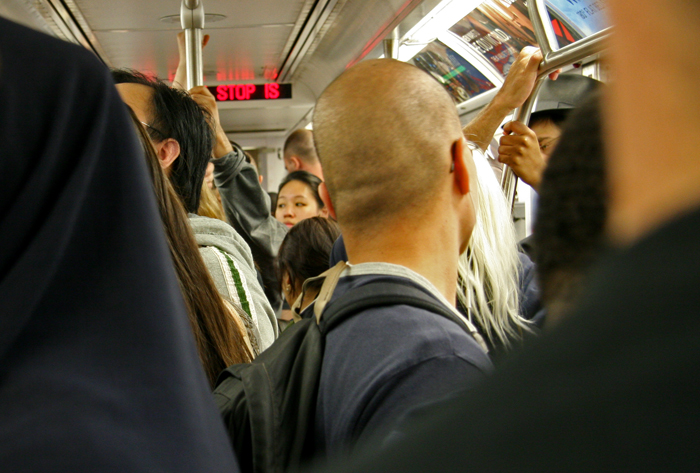
    I’ve been reading a lot about sardines today and the origin of the expression “packed like sardines” – I could think of nothing else on Sunday while traveling on the Lexington Avenue subway.

    This trip to the Upper East Side and, ultimately, Central Park, illustrated beyond a doubt the need for the Second Avenue subway. Construction has finally begun this week on this much-needed subway line – proposals go back over 80 years. The massive boring machine has begun digging and, according to the transit system, will not be shut down until the project is completed (2016).

    The Upper East Side of Manhattan and east midtown is essentially serviced by one subway line – the IRT Lexington Avenue 4, 5, and 6 trains. This line is so heavily used that it has become not only the busiest in the NYC transit system – it is now the most used transit line in the United States, with more riders that the entire transit systems of San Francisco and Boston combined.

    What may come as particularly surprising is the overcrowding on Sundays. The East Side not only has the typical density of residents found in Manhattan but also is home to many attractions, particularly museums along Fifth Avenue, aka Museum Mile, so this subway is heavily used by tourists on weekends.

    This trip was also an experience in extreme diversity. On this one car of the train, there were two Islamic women in black Burkhas. An extremely tall orthodox Jewish man with a wide-brimmed black hat towered over two young black girls. A young Asian woman stood next to me with makeup so heavy that she had the look of a traditional Thai or Burmese dancer. A woman with very striking white hair and surreal skin tone took a seat near a black man completely hunched over listening to music.

    My thinking was that sardines was a convenient metaphor, but I assumed that there was much more variety of humans in that one subway car than in a can of sardines. Now I have learned that sardines are actually several types of oily fish related to herrings, so actually, a fair variety are used. Everything considered, I think it is reasonable to say that we’re still packed like sardines 🙂

    Note: Nothing compares to overcrowding of subways in Tokyo – if you want to see the most outrageous subway packing/stuffing, see a video here.

    Posted on by Brian Dubé

  • Creative Expert

    Posted on by Brian Dubé

    Years ago, I used to spend many summer afternoons in Washington Square Park watching Dave, a Christian evangelist, make a presentation arguing for the existence of God. Anyone was invited to join the discussion, which, at times, became a quite lively debate. On one occasion, in frustration with someone who was making a number of unfounded statements, Dave retorted, “Saying it doesn’t make it so.” This was the first time I had heard this adage, and I liked it. It applied to so many scenarios, particularly regarding assertions made when asking about someone’s livelihood and answering by giving one’s aspirations.

    Pardon my cynicism, but in New York City, I am forever meeting individuals who are self-proclaimed artists, writers, composers, producers, and recently, fashion designers. I say self-proclaimed because saying it doesn’t make it so and in the art world, credentials can be as simple as a proclamation or business card.

    I once met a fellow tenant in my office building who worked for a company specializing in branding. He offered his services and card – below his name was printed “Creative Expert.” Rather incredulous that anyone would not only make such a bold assertion but then commit it to print, I showed my graphic artist the card.

    Unfettered, my friend assured me that many people will believe what you say, particularly if it is printed on your card. She told me of an instance where she was called for a job – the client had been told that she was a Photoshop expert, which she was not. But it had been said. To this day, we use the phrase Creative Expert as a source of amusement in our office.

    So when I met Geary Marcello and he told me he was a fashion designer in the ensuing conversation, I just filed it for future investigation. His business card read, “Creative Director. Couture Women’s Wear Special Occasion and Costume Design.” Now my antenna went up. Creative director. Fashion designer. These are real jobs, not the more incredulous and nebulous Creative Expert. And certainly a man with a septum curl, tongue chain, goatee, and tattoos is not an ordinary man. But none of this saying makes it so.

    Some online searching and a visit to his website certainly showed that Geary was, in fact, who he said he is. I’m giving him the benefit of the doubt. After all, this is New York, center of the American fashion industry and a city whose streets are populated with many exceptional people. This website is filled with examples of celebrated individuals whom I have met in ordinary places. I am reminded of my encounter with Afghan popstar Walid Soroor, whom I met in an Indian restaurant in Jackson Heights, Queens.

    Of course, the eternal cynic sees the Internet as just another incarnation of the devil’s playground – a new place where saying it doesn’t make it so and a forum for the Creative Expert 🙂

    Note: Geary was extremely congenial and happy to pose for passersby like myself. He hails from Los Angeles, California. His long list of clients includes: Lucy Liu, Bill Cosby, Lena Horne, Lindsay Lohan, Jim Carrey, et. al. You can find his website here.

    Posted on by Brian Dubé

  • Philanderers with Fruiterers

    Posted on by Brian Dubé

    There was a fruit vendor on the corner near my office. The fruit and pricing was good and the location very convenient, so my coworkers and I soon developed a relationship as regulars.

    Relationships have certain key elements. Mutual trust, respect, and love. Fulfilling mutual needs. Responsibilities and obligations. A fruit vendor relationship is no different. Often, however, there is a price to pay for the conveniences found in New York City.

    Our vendor was a small and frail man from Pakistan, and we soon referred to him as “the little man.” He was very poor and spent long days in the hot summer sun. We all liked supporting him. Our fondness for him grew. However, like many relationships, there were problems, and the relationship became strained.

    Things were pleasant as long as we purchased the quantity he wanted us to buy. If we wanted a half pound of cherries, too bad – he refused to sell less than a pound. When we asked for a pound, one and a quarter was put on the scale, and it was suggested that we take two. This was four times what we really wanted. And did we want some nice bananas or peaches to go with the cherries? His recommendations were in his hand and being added to our bag, only to be stopped by virulent protest.

    We soon wearied of the daily battles defending our fruit needs and consumption. We could no longer trust him, he had no respect for us, and our love for him had faded. No need for counseling. We were looking for divorce, or at least a trial separation.
    Separation, however, was not so easy. Walk by the fruit man and expect to be greeted, or should I say apprehended. Why didn’t we want any fruit today?

    We were in the worst breakup scenario where, due to circumstances, both parties are forced to continue to make daily contact. Like coworkers or neighbors who have had an affair.
    We found ourselves crossing the streets to avoid him and hiding food purchases from him as best we could. But he was crafty and observant, often hailing us from afar and offering our favorite fruit. But we were steadfast in our avoidance. We had no desire to become like victims of battered spouse syndrome who become trapped in abusive relationships.

    He became angry. Were we seeing someone else? Yes, we were. No use hiding it any longer. He knew our dirty secret. And although the relationship was over for us, in his mind, we were nothing but philanderers with fruiterers 🙁

    About the photo: A real instance of philandering with fruiterers. I patronized this second man for years, however, I now typically shop for fruit with other needs at larger nearby markets. I still buy from him on occasion. I am sure that he knows I am cheating, but he is always pleasant. Some tolerate philandering better than others 🙂

    Posted on by Brian Dubé

  • Color of Money

    Posted on by Brian Dubé

    This appears to be a case of color by number, but no one appears to know what the numbers are.
    One of the most commonly asked questions regarding the Empire State Building is the significance of the lighting colors and how the color schemes are decided. I wrote about the lighting schedule on March 27, 2007 in Equinox. The color schedule and meaning of the colors is easily found at the official ESB website.

    In celebration of the NYU commencement, the color scheme was purple/purple/white (NYU’s school colors are purple and white). The special lighting was further enhanced by the fact that the building could be seen looking up Fifth Avenue from Washington Square Park, NYU’s de facto “campus.”

    The process as to how the decision is made, however, is shrouded in mystery. According to the New York Times, a spokesman for the Empire State Building said that the building “doesn’t discuss the intricacies of the lighting approval process.” Out of curiosity as to what is involved in having your choice of colors for lighting, I downloaded the Empire State Building Lighting Partner application. It is quite simple and straightforward. In the first paragraph, you are told:

    Selection as an Empire State Building Lighting Partner is at the sole discretion of the ownership and management of the Empire State Building Company L.L.C. The Empire State Building is a privately owned building—not owned by New York City or the State of New York—and, therefore, has its own policies. Selection as a Lighting Partner is a privilege, not an entitlement.

    There is, however, no discussion of money, but the phrase “Lighting Partner” would lead one to believe that there is a cost. No crime there – after all, the building is a private enterprise.
    There was some outrage recently when the building was lit red/yellow/red from September 30 through October 1, 2009, to commemorate the 60th anniversary of the People’s Republic of China. Many speculated that it was strictly a decision based on what China was willing to pay.

    NYU certainly has a lot of influence, clout, and its share of controversy (see Gorillas and Cookies here). It also has a lot of money. And, at least for the NYU commencement, purple is the color of money 🙂

    Posted on by Brian Dubé

  • Very Resilient

    Posted on by Brian Dubé


    This store, like Crocs themselves, has and will continue to attract critics. The thing that has made this project particularly contentious is that this building at 143 Spring Street, previously the home of Tennessee Mountain Ribs restaurant, was in serious disrepair – work did need to be done. So the criticisms gravitate towards the architectural details of what has been done and, of course, the presence of Crocs in SoHo.

    There have been many articles about the building since Crocs’s acquisition in 2006 and several articles since their opening on Saturday, May 8, 2010.
    Built in 1818, the Federal era 192-year old, three-story structure is listed on the National Historic Register. In the 1970s, it was combined with a 1925 garage building. The reconstruction project was done by architect William J. Rockwell. The exterior wooden clapboards have been replaced and the south face re-bricked (salvaging some of the older brick.) Much of the interior beam work is original.

    Many were perplexed about the lengthy process in development – Crocs acquired the property in 2006. The building has landmark status, which makes any work a formidable and lengthy process, resulting in the appearance of neglect by Crocs in the first couple of years of acquisition before construction began. Crocs, Inc. is not the landlord – the property is owned by Abba 1 Realty LLC, and Crocs, Inc. has a 20-year lease (handled by Robert K. Futterman & Associates, LLC).

    The greater mystery for many is how Crocs remains in business. Their very existence in the marketplace inspires violent outcry from some critics. There is a subculture of haters with blogs and websites decrying Crocs, such as ihatecrocs.com. They have been the object of satire on shows such as The Daily Show and Real Time with Bill Maher. The fashion industry has had its own critics, with many considering the shoes a fashion disaster.

    But Crocs is another success story in the ugly shoe movement – Uggs, Birkenstock, and Crocs have all been massively successful in spite of critics, detractors, haters, websites, and comics. Comfort has been a big factor in the success of all of these brands. In the case of Crocs, their proprietary Croslite foam* is a big feature.

    Adoption by celebrities has fueled the popularity of Crocs. Chef Mario Batali was an early user in 2005 – the waterproof shoe in tandem with its comfort was perfect for working in a commercial kitchen. His bright orange Crocs are part of his signature appearance. Michelle Obama has been seen with them as well. The Niwot, Colorado-based company now sports over 100 shoe styles and has sales averaging $200 million dollars per quarter. They are sold in 125 countries and 6,500 outlets in the USA.

    There is something about that Croslite foam that appears to be very resilient 🙂

    *Croslite is a closed cell EVA foam developed by the Canadian company Foam Creations. The closed cell structure inhibits bacterial and fungal growth and resists odor. The material conforms to the shape of a wearer’s feet, has extraordinary impact absorption properties, and is reported to reduce fatigue and other medical benefits. Scott Semans, George Boedecker, and Lyndon Hanson bought the license for the material and introduced Crocs at the Ft. Lauderdale Boat Show in 2002 (this shoe was an improved model of a boating clog already in production by Foam Creations). In 2004, Crocs, Inc. purchased Foam Creations. They hold four patents and constantly have to defend from “Croc-offs.” The name Crocs was short for crocodile – the shoes, like the reptile, were fit for both land and water.

    Posted on by Brian Dubé

  • Window of Opportunity

    Posted on by Brian Dubé

    This is a daily photo website, and although it has evolved to become much more story- and text-driven than at its inception (where the text served as more of a caption), I assume that many of you are interested in photography and imaging.

    The advent of digital cameras has brought many more individuals into photography. The Internet and digital media have provided a myriad of online forums, all easily available to the masses. Camera technology has made it much easier for the average person to get very good results. Preview screens provide immediate feedback, providing an excellent learning tool for identifying problems, rather than having to wait for film processing.

    The cost of photos is essentially free, less amortization of the equipment. This means more photos can be taken, important in difficult shooting situations where a number of shots increases the chances of capturing that special moment. Post-processing on a PC with applications such as Photoshop essentially brings the darkroom to the desktop. For me, this is one of the most important tools in the digital photography process.

    So, with all this technology and increasing numbers of photographers, one problem remains – how do you differentiate your photos?
    Subject and setting. If you are interested in color photography, for example, it is going to be difficult to get the kinds of results Steve McCurry gets just by being in India, Kashmir, Tibet, or another exotic locale, and getting such unique subjects and settings.

    However, few have the ability to travel to locations like these very frequently, if at all. It is unlikely that one will find many unique subjects in and of themselves – in a city like New York, nearly everything has been combed over. A rarely seen subject will require research and travel – places such as the Hole, the Black Cowboys, etc.

    One strategy is to shoot familiar subjects from different vantage points (see Dachshund Octoberfest here) and at different times. Although the magic hour (early morning and at sunset) is often celebrated as the optimal time of day for shooting because of the quality of light (see Light on Bobst here), I also see the early morning as a time to capture activities particular to the early morning (such as deliveries to the meat packing district) or familiar subjects in an atypical way – quieter settings free of traffic and pedestrians and subjects illuminated by the sun in a unique way, like today’s photo of the Washington Square Arch with light pouring through it.
    See you in the morning for that window of opportunity 🙂

    Posts taken in the morning: Hawk Fest, Quietude, 23 Skidoo, Homeless Art Scene, You Don’t Say, Out There, Little in the Middle, Kristen, For Whom the Knell Tolled, Hua Mei Bird Garden, Coup De Grace, Eight Twenty Five, Slummin’, Fresh Meat, True North, Snow Play

    Posted on by Brian Dubé

  • Quite Refreshing, Really

    Posted on by Brian Dubé

    I am not sure that I buy the idea that “opposites attract,” a phrase often used to defend the pairing of individuals who go together like salt on a wound. On the other hand, I once had a conversation with a friend which I will never forget.

    This individual was very meticulous in his work – he was known for precision in both his practice routines and performance. I also understood that he was very tidy in his personal life. He had lived in a number of places and was a recent transplant to New York City, a place that did not seem very fitting to his temperament.
    One evening, standing in the vestibule of my apartment building, we did some catching up, and he told me why he had moved to the city – for a woman. We exchanged notes about relationships and the difficulties in people accommodating each others styles. The subject quickly turned to living habits and neatness. Knowing this man’s style, I was assured that his girlfriend was like himself.

    However, I was shocked to learn that she was nothing of the kind. She was, in fact, an absolute mess, disorganized, and forgetful. I asked him how he could possibly tolerate living with a woman like that, and his answer was just riveting – “I find it quite refreshing, really.”

    This had a profound effect on me, and subsequent to that conversation, I noticed how being around someone who was easier about the minutiae of life could often be liberating. This is not always successful, of course. I am reminded of the film The Way We Were, where the ability of two very different people (Robert Redford and Barbra Streisand) to get along is painfully tested and results in a parting of ways. In the end, Redford explains that his decision to separate is due to their different styles.

    Having the ability to let go is of tremendous value in a place like New York City. This is not the most hospitable environment for control freaks or perfectionists who want things just so. The city is built on diversity – the beautiful and ugly, the noisy and serene, the rough and polished, planned and spontaneous events. Anyone hoping for a pristine environment conforming to his or her wishes, obsessions, or compulsions is in for a trying time and neuroses. You will be tested at every turn. Give a little, and whether you are looking at violet Veronicas or in the subway, you might find the city’s diversity quite refreshing, really 🙂

    Confession: Today’s posting demonstrates only a half step to full abandon. At one time, I would have felt compelled to know the exact species of plant in this photo, which I do not. However, I did not feel comfortable letting the photo stand on its own without identifying the flowers, so I did email today’s image to a friend and regular reader of this blog to at least get the genus – Veronica, aka Speedwell. The bed of flowers is located in Washington Square Park.

    Posted on by Brian Dubé

  • Sober Kids in India

    Posted on by Brian Dubé

    One of the great things about New York City is that at any given time, somewhere, some group is celebrating something. And unless your religious or other affiliation prohibits it, you are most likely welcome to join in.

    Religious or secular, many need very little reason to party, as perhaps was the case yesterday evening with the person at the head of the line waiting to get into this bar. When I asked him what the line was for, he had no idea and apparently no interest in finding out. His response was rather perplexing, since both inside and outside the bar it was obviously a Mexican-themed celebration – Cinco de Mayo, to be specific. Confetti was fluttering in the air, and people were outfitted in traditional Mexican costumes. The bar was bursting at the seams and overflowing into the street.

    The bar is located on University Place in the Village, no stranger to partying. Just down the block is New York University, which has had the distinction of making Princeton Review’s “top party school” top 20 ranking.

    Growing up in a poorer and work-oriented environment, at times, there is a tiny nagging feeling that festivals, parties, and parades are capricious and unnecessary extravagances. This is money and energy that might be put to “better” use for those in need. I wrote about this and the need for human celebration on June 13, 2008, in Let’s Have a Parade.

    Growing up as a child, I often heard the cliched “Finish your dinner, there are children starving in Africa.” For some of the celebrants last night, the admonition might better be an analogous one I have seen bandied about: Finish your beer, there are sober kids in India 🙂

    Note: Cinco de Mayo (Spanish for “fifth of May”) is a holiday held on May 5. Not to be confused with Mexican Independence Day on September 16, Cinco de Mayo commemorates the Mexican army’s victory over the French at the Battle of Puebla on May 5, 1862, under the leadership of General Ignacio Zaragoza Seguín. In an unlikely victory, 4,000 Mexican soldiers defeated a much larger (8,000 soldiers) and better-equipped French army. The holiday has very limited recognition in Mexico – it is primarily an American celebration with its roots in California in the 1860s.

    Posted on by Brian Dubé

  • Lost in that Wool

    Posted on by Brian Dubé

    Please click to play the waltz, Lost in the Lonesome Pines, to accompany your reading.
    Want to take a hayride? Mingle with sheep, goats, chickens, cows, horses, peacocks, pigs, and geese? In New York City? No, this is not a petting zoo.

    Welcome to the Queens County Farm Museum, New York City’s largest remaining tract of undisturbed farmland. A working farm dating back to 1697, it encompasses a 47-acre parcel that is the longest continuously farmed site in New York State. The site includes historic farm buildings, a greenhouse complex, livestock, farm vehicles and implements, planting fields, an orchard, and herb garden.

    We had a free tour of the Adriance Farmhouse with our guide, Mister Marty. Flemish-styled, the house dates to 1772 and is the centerpiece of the farm complex.

    And everything is free – tours, hayride, butterfly garden, and cavorting with the animals. This place came as a huge surprise. I had heard vagaries about a farm somewhere in Queens. Actually, this place is right on a major thoroughfare – 73-50 Little Neck Parkway in Floral Park. It is open 7 days a week, all year. There is admission only on days with special events. See the farm museum website here.

    I always relish the opportunity to pet sheep. I had competition with others, however – there was a group of us jockeying for position to get lost in that wool 🙂

    Posted on by Brian Dubé

  • A Stop for Complainers

    Posted on by Brian Dubé

    New York City’s extreme nature leads to a plethora of love/hate sentiments and conflicted feelings. Many threaten to leave and never do – I wrote about this phenomenon in Not Going Anywhere. Having to commute daily using the New York City subway system is, for many, one of the greatest pains they have to endure.

    When under fire, however, the transit system is often defended by its very detractors – just another example of the love/hate relationship New Yorkers have with this city.

    The city’s transit system has much to defend. It is one of the world’s busiest and most extensive. In tandem with the bus system, one can get to virtually any destination within the five boroughs using public transportation alone.
    The subway system runs 24/7, making maintenance and repair an extreme challenge. All track work has to be done while the system operates and thus necessitates frequent service suspension, disruptions, and changes. This is a necessary evil and way of life for the underground rider.

    I have traveled by this train yard numerous times, always by car on the Belt Parkway, and I have been amazed at this vast sea of subway cars. On this particular occasion, traffic was very heavy and gave me an opportunity to take photos while driving, reaching across the passenger side, and bracing the camera as well as I could against the passenger window frame.

    This is the New York City Transit Complex at Coney Island – one of the largest transportation facilities in North America. Opened in 1926, the Coney Island Complex occupies 75 acres of land in the southern part of Brooklyn, New York.
    There are three storage yards which have the capacity for storing nearly 1,800 subway cars. The Coney Island Tower serves as a command center coordinating the moves of subway cars. The car wash cleans the exteriors of over 1,000 cars approximately once a week for a yearly total of 50,000 washes.

    The complex consists of a number of shops:
    Overhaul & Repair Shop. The overhaul shop also works on maintaining and restoring the cars in the fleet of the New York Transit Museum. Within the Overhaul Shop, there are four 30-ton cranes capable of moving entire subway cars from one work station to another.
    There is also: Paint Shop, Wheel, Truck, & Axle Shop, Maintenance/Inspection Shop, Pneumatic Shop, Traction Motor Shop, Small Motor Shop, Shoe Beam Shop, Battery Shop, and training facilities.

    New York City is full of surprises. With all of its miscreants, vandals, abusers, and users, it really is a miracle that all our systems work so reliably – power, water, sanitation, transportation – all managed by civil servants, a group popular for bashing. Perhaps the MTA should make the Coney Island Complex a subway stop for complainers 🙂

    Related Posts: Unkindest Etch of All, The Subway, The El, Subway Art

    Posted on by Brian Dubé

  • Kick in the Shins

    Posted on by Brian Dubé

    Just shortly after enrolling at New York University in the early 1970s, I received an extremely unusual request. A high school history teacher contacted me from my hometown in Connecticut and wanted to make a visit to the city to experience the Village in its turbulent times. I was quite taken aback, but I agreed.
    One of the few incidents I recall was a visit to Mamie’s Ice Cream Parlor, located at 35 West 8th Street. Apparently we were quite a motley crew of hair lengths and generations – the waiter, taking our order, asked, “Can I help you, gentlemen?” adding, “and I use the term loosely.” To which our older companion responded, without hesitation, “Don’t use the term too loosely or I’ll kick you in the shins.”

    How cool to have not only an adult but also a figure of authority on your side. History teachers were never the most popular figures in school, and most students felt at odds with them, groaning and resisting the requisite memorization of facts. Here, at last, a school teacher and students were both on the same team. He appeared to be a bit of a rebel, and what better time and place to exercise his rebellion?

    Ice cream and gelati shops have gone through waves of popularity in New York City. There are always new incarnations with a different spin, but authentic ice cream parlors have slowly died out and are now quite scarce. So I made a visit to Forest Hills with a friend to seek out Eddie’s Sweet Shop at 105-29 Metropolitan Avenue. Eddie’s is one of the last remaining classic ice cream parlors in New York City. The century-old shop has been in continuous operation since 1909, when it opened as Witt’s Ice Cream Parlor. In the 1960s, it became Eddie’s.

    We arrived late in the afternoon – the place looked like it had seen a tidal wave of business. The counter staff definitely appeared to be overworked – an early heat wave had everyone out, with ice cream on the agenda for many.
    Most go to Eddie’s for the ambiance and a menu of all the classics – banana splits, malteds, floats, egg creams, frosteds, and sundaes. And everywhere you look, in one form or another, there’s cream. See the menu and more photos here.

    I’m happy to report that in spite of an overworked help and regardless of a customer’s politics or appearance, no rude remarks were made and there was no need to threaten a kick in the shins 🙂

    Posted on by Brian Dubé

  • Smile

    At one time, nearly all my photos were scenics of some sort. Landscapes or buildings. Streets with no people. I typically waited for people to leave before shooting. The feeling I had was that people would somehow mar the image. Telling this to a friend (an architect), she commented that perhaps I had the soul of an architect – that it has been said that architects love buildings more than people.
    This bothered me, because there was truth to what she said. However, I actually love people and am very social. Since that time, her comment has nagged at me, and I have come to see the value of people in my photography. I have become interested in people and their stories. What are buildings except structures built by people for people?

    I have met many people who are so political that they appear to see everything through glasses colored by their politics. A conversation about bad weather, and they will blame a political party. And, ironically, sometimes the causes take on a life of their own, and activists appear to love the cause more than the people. What are causes except efforts by people for the betterment of people?

    Political and community activism are good things. Many potentially destructive projects have been thwarted by activists, and much that is hideous perhaps could have been averted with more involvement. However, being personally involved with people whose politics dominate their being becomes tedious. Many have no sense of humor whatsoever. I often feel that they worry that laughter will somehow undermine the importance of the lives.

    Not Susan Goren. My first encounter with Susan was her yelling at me over my conversation with a park official about a group of street performers. On my second encounter (at a community board meeting), she approached me and apologized, excusing our original encounter as a product of her political passion for things she had worked on for a lifetime. One thing became extremely clear – this woman valued human relationships.
    And squirrels.

    Susan has been actively involved in rehabbing squirrels – injured or orphaned. I visited her home last night, where she is currently caring for a group of four. Her home is a shrine to her interests in art, reading, and squirrels. She toured me through her home, going over her collection of fine art, photography, squirrel collectibles, and a photo archives on her PC of the various squirrels she has cared for. The Villager recently wrote a front page feature article on Susan – you can find it here.

    Susan is a New Yorker. Born and raised in Manhattan, she is a graduate of New York University with majors in literature and art history. Like myself, Susan has been a Village resident her entire adult life. She worked for NYU for 17 years and has lived a block from Washington Square Park for the last 36 years since her graduation. She is a habitué of Washington Square Park, where I met her a few years ago and where she mothers over the squirrel population. She can identify most of them and has named many. She is often referred to as Susan Squirrel to differentiate her from a number of other Susans who are park regulars.

    Susan is a community activist. A lover of the arts, a lover of squirrels, a lover of people. And she has a sense of humor. You can find her easily – look for the woman with a squirrel, people, red lipstick, and a smile 🙂


  • Throw Me a Curve

    I recall battling with my graphic artist over using just her eye to place objects and making other judgements that you could simply do by measurement. I was a believer that if something can be measured, it should be. Nothing else made any sense, and just using the human eye was unfathomable to me.

    I spent hours with toys of my generation – Erector Sets, Etch-a-Sketch, and Lincoln Logs, but there was always something I didn’t like about them. I could never put my finger on it exactly, but at last I think I can. I see it clearly now. Left, right, x and y – my mind has been shaped by the orthogonal toys and the scientific tools and concepts of my youth. Working in this way can dull the mind and artistry. Just look at creative work done by those with a mathematical or engineering approach. Most artists are typically not wired to think and work in these ways.

    Much of Manhattan was designed as a grid (see True North here). Certainly there is justifiable practicality in a grid from many perspectives – just ask any visitors navigating Manhattan’s gridded areas. But not everything should bend to the will of the practical, efficient, most utilitarian, or most cost effective (see Very Practical here).

    The Eiffel Tower was highly controversial at the time of its building. And it is arguable that it has the look of something designed by an engineer. But there is one redeeming feature constant throughout the structure – curves. I can’t imagine how it would look built completely with right angles.

    Sitting in traffic in Long Island City on the approach to the 59th Street Bridge, with a hideous Erector Set above adding insult to injury, it makes me want to roll down a window, stick my head out, and scream, “I can’t wait for the bridge. Please, someone, throw me a curve…


  • dinamic_sidebar 4 none

©2026 New York Daily Photo Entries (RSS) and Comments (RSS)  Raindrops Theme