• Insults to Injury


    Even the busiest streets of Manhattan have their quiet times. Walking down MacDougal Street (one of the most touristy streets in the city) in the morning is a vastly different experience from the summer or weekend evenings and nights. In this neighborhood in the morning, it is quiet and the traffic is light, so your guard is definitely down. Tuesday was a beautiful day, and as I crossed the intersection at MacDougal and West 3rd Streets in the Village, the last thing I expected was an enormous automobile crash, virtually at my heels.

    This was the largest crash I have ever witnessed and was heart stopping as one vehicle hit another broadside in the intersection. The vehicle impacted by the taxi rolled over completely, coming to rest on its roof. Only a moment lapsed before many bystanders sprung to action, righted the vehicle, and removed its driver, who, surprisingly, looked extremely shaken, but with no outwardly obvious bodily damage.

    Within a few minutes, two police mounted on horseback arrived first, followed by an ambulance, fire trucks, and other emergency support vehicles.
    Ironic insults to injury abounded. First, the taxi driver’s immediate concern appeared to be his future employment rather than the condition of the injured driver lying on the sidewalk. As the taxi driver stepped out of his cab, he exclaimed in shock and disbelief, “Oh, this is not good for me at all.”
    Then, in examining the photos this morning, I noticed the two bumper stickers on the overturned vehicle. One read, “CAUTION Vehicle Makes Frequents Stops,” and the second read, “How’s My Driving? Call 1-800-994-8099”

    In a final insult to injury, the injured driver rested on the sidewalk, surrounded and helped by others as he awaited the ambulance, beneath a sign reading: “The Best Backrub For Men and Women”…

    Related Taxi Stories: Yellow Fever, Jersey Girls, Sea of Yellow, Garden in Transit, Pedicabs


  • Can’t Argue With That

    One thing that comes as a surprise in Manhattan is the occurrence of public gatherings of various Christian groups. I have seen congregations of Mennonites singing gospel in Washington Square Park. We now have two Christian groups that come to the park weekly – one group on Monday nights, the other on Wednesdays. And on a regular but infrequent basis, I see the Quakers in a silent vigil under the Washington Square Arch in the Village.

    In our current society, particularly in a city such as New York, one has to admire any effort to make a statement through silence. This city is just screaming with competition for the eye and ear – what is the likelihood that anyone will pay attention to four Quakers in a silent peace vigil?

    This Quaker group is based in nearby Stuyvesant Square. The brochure being made available is titled Quaker Silent Witness for Peace and Nonviolence. In it, they make their antiwar case with quotes from Gandhi and Martin Luther King, two leaders who were both charismatic enough to effect tremendous change through nonviolent activism. In a violent world, the gentle demeanor and unprogrammed tradition of the Quakers is refreshing and appealing to many.

    I recall seeing a fundamentalist evangelical Christian on a regular basis in Washington Square Park on Sunday afternoons, where he would set up an easel with various pages of information, tables, and charts, building an argument for the existence of God. He came well-armed not only with the Bible but also with books from many spheres of study, including works such as those by evolutionary biologist Stephen Jay Gould. This may come as a surprise, but this man knew that to have any credibility here, he would have to come with a knowledge of contemporary science and skills for lively debate.

    Regardless of preparation, however, he was in the center of an intellectual community and the NYU “campus.” He had his work cut out for him – I saw him battle once with two theology students. (I also once saw a group of Christians who encountered a rabbinical scholar.)

    On one occasion, I approached him, told him I admired his courage, but asked why he would proselytize in an area known for its iconoclasm and extremism – one where he would likely encounter many agnostics, the non-religious, or atheists. Certainly he had chosen the worst place to go. To the contrary, his response was that his mission was to save souls and, in considering where he would be most needed, Greenwich Village would be one of the best places. You can’t argue with that…


  • DUMBO Arts Festival 2009


    “Everything has been done” is a commonly repeated mantra in the art world. The truth in this is often seen in various art forms such as music, where creating new, interesting, and durable work becomes more and more difficult. Occasionally, a prodigy is hailed as the next Mozart and, of course, never is.

    In the world of contemporary art, new technologies, materials, and media are often introduced to create works previously impossible. Availing oneself of these elements does not guarantee success, but sometimes creative applications give pleasing results.

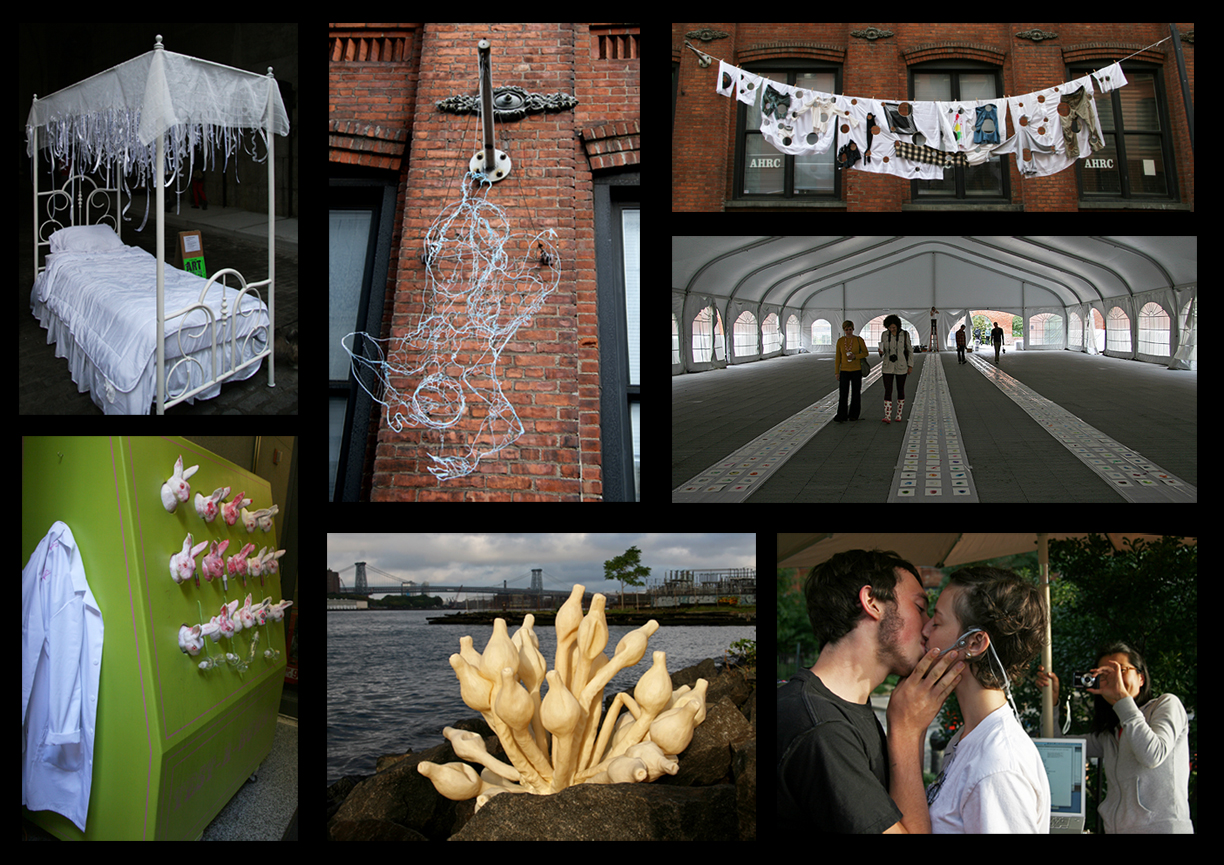
    This weekend was the 13th annual DUMBO Art Under the Bridge Festival:

    The three-day multi-site neighborhood-wide event is a one-of-a-kind art happening: where serendipity meets the haphazard and where the unpredictable, spontaneous and downright weird thrive. The now teenage D.U.M.B.O. Art Under the Bridge Festival® presents touchable, accessible, and interactive art, on a scale that makes it the nation’s largest urban forum for experimental art.

    Art Under the Bridge is an opportunity for young artists to use any medium imaginable to create temporary projects on-the-spot everywhere and anywhere, completely transforming the Dumbo section of Brooklyn, New York, into a vibrant platform for self-expression. In addition to the 80+ projects throughout the historical post-industrial waterfront span, visitors can tour local artists’ studios or check out the indoor video_dumbo, a non-stop program of cutting-edge video art from New York City and around the world.

    The festival itself is somewhat unstructured and unpredictable. Many of the artists on the program map were nowhere to be found (inclement weather may have been a factor), and many of the exhibits required some diligent searching to be found. Typically, the artists creating the work were on hand and were quite approachable, eager to discuss their work. See gallery of photos here.

    One interactive work which many found engaging was Kissing Under the Bridge by Hye Yeon Nam. In this, a couple volunteers to digitize their kissing:

    The Sound of Kiss facilitates an amorous ambiance in which couples digitize their love while kissing. One wears a headset and the other’s tongue is affixed to a magnet. When they kiss, the magnet and the electro-magnetic sensor interact to create spontaneous music. The musical composition depends on how far one’s tongue is away from the other’s lips/tongue and their style of action.

    I empathize with the artist, particularly after working on this website for 3 1/2 years and endeavoring to show the places, people, and things of New York City from a new perspective through the lens of my personal experience.

    When the going gets tough and one’s work is called into question, perhaps an artist should be prepared to defend it using the words of Robert Rauschenberg: “This is art if I say so.”:)

    Related Posts: DUMBO Arts Fest 2006, Sink or Swim, Gallery View, Night in Bloom, One Front Street, DUMBO


  • Commitments

    Even with peer influences, I was never able to bring myself to get a tattoo. I entertained the idea briefly – some tattoo work was and is quite impressive.

    However, there is the issue of an ever present statement being made to others, and then there is the near permanent commitment. That’s the real horror for me – what if I change my mind?
    In a 2008 Harris Poll, 84% of those with a tattoo say they did not regret having a tattoo. That leaves 16% who do regret it, and I’m sure I would be one of those. Laser removal is an option, but with no guarantee of 100% success. Plus, the whole thing is such an ordeal. Better to admire the body art of others and marvel at their bravery (or reckless abandon).

    I recently happened upon this building in the East Village at 324 East 4th Street between Avenues C and D while visiting the community garden El Jardin del Paraiso. I found it stunning. There is much public art in New York City, large and small, both graffiti and sanctioned work.

    What’s unusual here is that we have the face of an occupied residential building in Manhattan fully painted with a mural. One of my first reactions when I saw the facade of this building was, “Wow, that’s a serious commitment.” Of course, unlike a body tattoo, a change can be more easily made – the building’s surface can always be repainted or stripped, but I would guess that this is unlikely in the short term. Nonetheless, a statement and a commitment have been made…

    About the mural and its artists: This mural was done in 2005 by two artists from Chile: Cern and Cekis. Their work can actually be seen all over New York City.
    If you examine the painting closely (click photo to enlarge it), you will notice at its base a cluster of tall buildings with birds, both perched and in flight. At the top, the main figure (with blue toenail polish matching her blouse) appears to be carrying a suitcase, while being watched by a cat. A tree frames the right side of the building, extending onto the cornice. Any interpretations?


  • Fish and Ponds

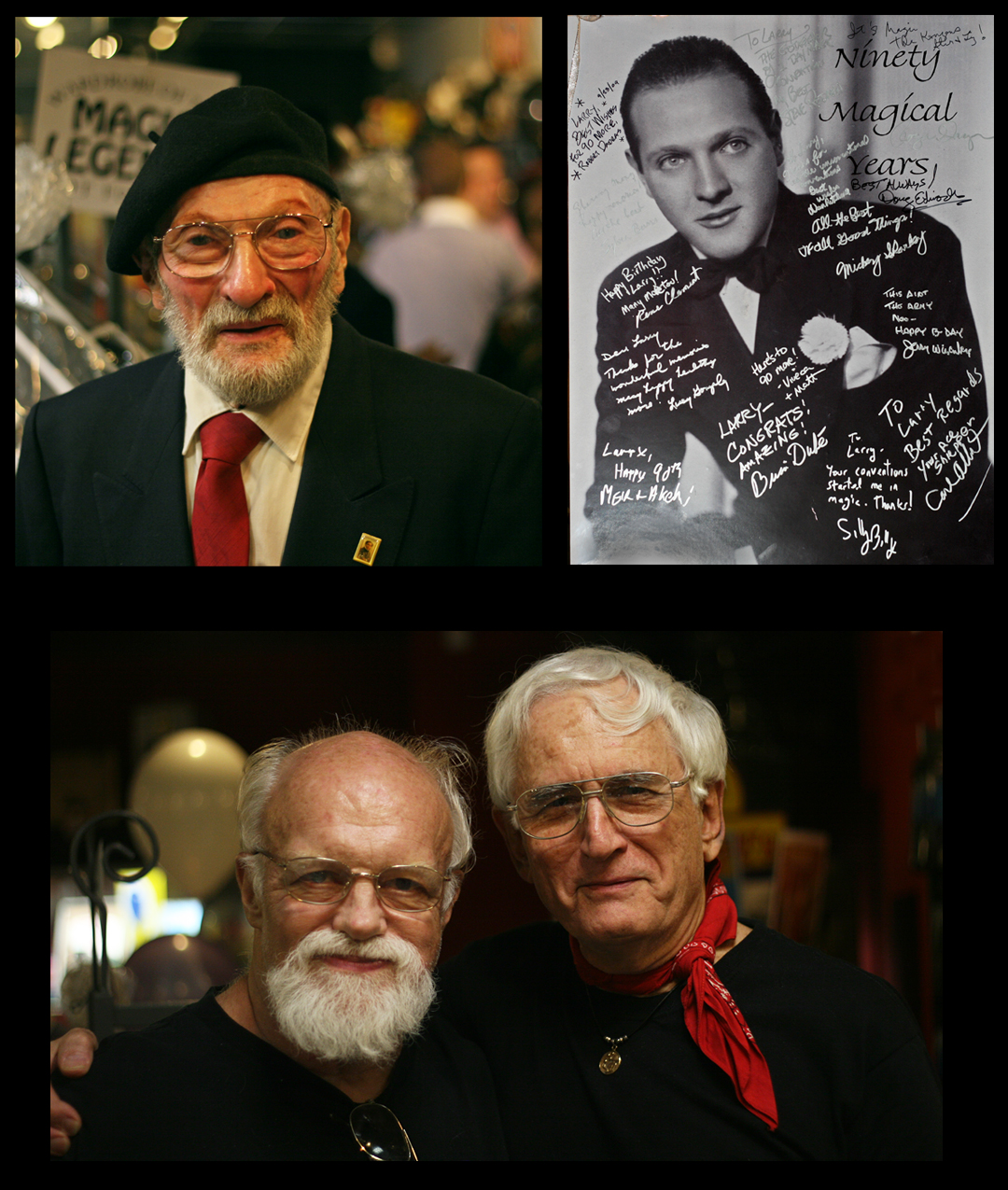
    The nice thing about a small pond is how all the fish, big and small, get to know each other. Like other focused and passionate special interest groups, meetings of magicians have the character of a family gathering. Lest you think I exaggerate to justify the use of a quaint metaphor, note that the largest organization of magicians is IBM, the International Brotherhood of Magicians (with 15,000 members worldwide).

    And so it was last night, when friendly fish gathered at Fantasma Magic to celebrate the 90th birthday of Larry Weeks. The place was abuzz with plenty of nostalgic chatting. Larry was in fine form and astonishing condition for a man his age – lucid and lively.
    I say lively because the world of professional magicians is not populated with what might be considered a normal cross-section of society – this is a world of colorful characters.

    Larry Weeks was both a stage and children’s show magician (and juggler). He also was a magic dealer and manufacturer, producer of a regular magic convention, and entertainment agent. Since his adolescence, Larry has collected magic, juggling, and vaudeville props, photographs, books, films, and other show-business memorabilia. In 1937, Weeks won the Inter-Collegiate Baton Twirling Championship.

    Larry Weeks (Lester F. Weeks) was born in Massachusetts on September 24, 1919. His family moved to New York, where he grew up. Inducted into the U.S. Army during World War II, Weeks was seen by Irving Berlin, who had him transferred to the company performing Berlin’s show, This Is the Army, where Larry performed a juggling act. The show toured military bases worldwide and was later made into a film, in which Weeks did a shortened version of his act.

    Also attending Larry’s party was Jay Green (photo lower right), professional juggler and early pioneer in the development of juggling equipment. Hovey Burgess (photo lower left) is a circus aficionado, performer, juggler, and educator. For over 30 years, Hovey has taught Circus Techniques at NYU’s Tisch School of the Arts.

    The evening featured a stage show with magicians, comics, and a juggling act. When it comes to people, I’ll take a pond over the ocean any day 🙂


  • One Screw

    I knew times had changed when hardware stores stopped selling screws one at a time and began packaging them. No matter that you don’t want or need twenty pieces of a #8 x 3/4″ machine screw – you’re getting them all anyway. These days, we are happy just to find a hardware store.
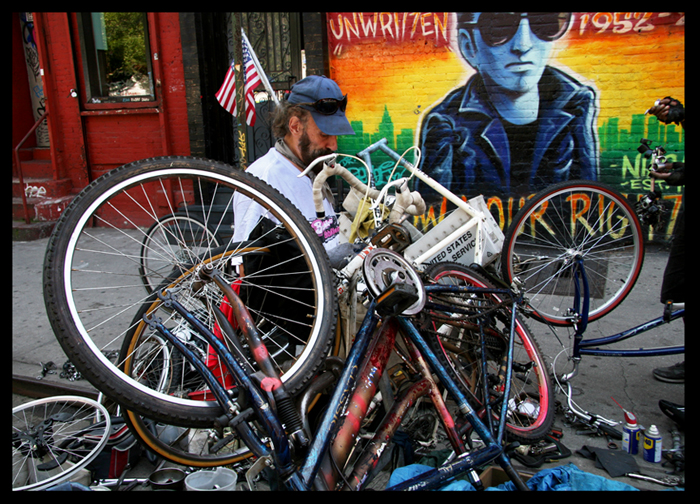
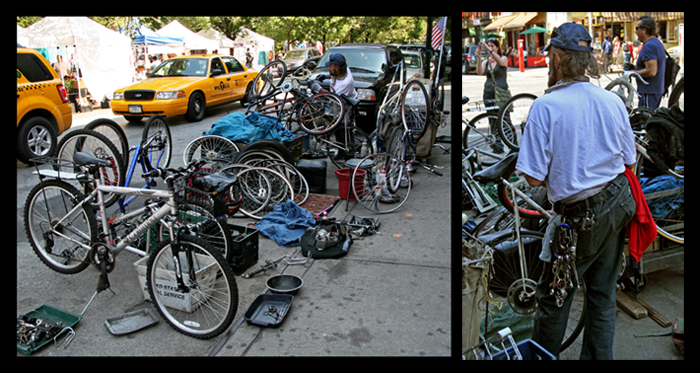
    On the corner of 7th Street and Avenue A, abutting Tompkins Square Park, you will find an outdoor bike repair shop with parts, tools, and bicycles in various states of repair spread curbside on the street. The Bike Man has plied his trade, off and on, in the East Village since the mid-1970s. (He is not alone, however. Natividad Zirate, who hails from California and is homeless, repairs bikes at 2nd Avenue and Houston Street.)

    There are many unanswered questions in New York City, and talking to the Bike Man raises many more. The Bike Man, aka Peter Corbin, is not eager to share many details of his life or background. The New York Times was able to glean a few:

    “At 51, Mr. Corbin is likewise a lifelong bike tinkerer, a vocation that began with his first bike, which he rode for a delivery job when he was a teenager in Springfield, Mass. Unlike Mr. Zirate, he is married, not homeless and claimed to be unaware of any rival shop nearby. His wife Charlotte helps him move his substantial number of spare parts, tools and half-completed jobs to and from their $450 a month apartment on Avenue C to his corner on Avenue A. ‘She works pretty hard,’ he said.”

    Technically, someone like the Bike Man should not be vending without a permit. But permits are virtually impossible to get. There is currently a cap of 853 permits for non-food vendors. The city has a waiting list and is not taking any more names.

    There is often a tolerance and sensitivity by the police in New York City to the character of a community and commonplace activities there. When someone is in violation of the law and the “crime” is essentially victimless, particularly where there is a history of a type of activity, the police may turn a blind eye. And there is great sympathy when someone is working hard and trying to earn a livelihood. Who wants to take someone’s job away?

    A retail shop, paying substantial rent and taxes, is not going to be enamored to compete against street vendors who sell the same goods opposite them, paying no rent, charging no sales tax, and reporting no income. However, New York City has lost many essential services. Who wants Peter Corbin’s work, and who can afford to provide it? Who’s going to sell you that one one screw?

    Note Regarding Vendor Permits from the New York Times: “Veterans are exempt from the permit cap; there are currently 1,678 licensed veteran vendors, according to the city. There is also a First Amendment exception to the licensing process for selling books, art and other speech-related items.” See my story of the Bubble Man here.


  • Magnolia Bakery

    How would you like a business where the only indication of a recession is shorter lines to get in? And sales per customer are limited?
    Welcome to Magnolia Bakery, at 401 Bleecker Street in the West Village. This is Sunday morning and, like any weekend, lines await customers, both inside and out, day and night. An employee strolls outdoors and gives advance instructions to the location of goods inside and the shopping procedure. Purchases are actually limited to 12 cupcakes per person.

    There has been a craze for cupcakes in the city, with a number of retail bakeries specializing in them, such as Crumbs, Cupcake Cafe, Burgers and Cupcakes, and Buttercup Bake Shop. There are many theories as to the success of Magnolia Bakery and cupcakes. Childhood nostalgia has to be a big element – cupcakes are certainly an icon of childhood pleasure. A cupcake is also a very convenient food to eat on the street – each one is a self-contained individual serving. And, of course, there is the chic factor of comfort foods. The shop is located on a section of Bleecker Street with fine boutiques and small shops. It is also only a short walk from the meatpacking district.
    Some feel that the cupcake craze is partially driven by the fact that most New Yorkers do not even know how to bake cupcakes and that people would not wait in line like this in most suburban areas – they would just bake cupcakes themselves.

    Magnolia has gotten its share of exposure on TV and film, which certainly has not hurt. The shop and/or its baked goods have been seen on Lazy Sunday, Saturday Night live, Late Night with Conan O’Brien, Sex and the City, Spin City, and the films Prime and The Devil Wears Prada.

    Magnolia Bakery was started in 1996 by Allysa Torey and Jennifer Appel. The original baker, Kathryn McCann, was raised in the South – you will find a southern influence, with pastry selections such as Hummingbird and Red Velvet Cake. See their website here. The homey, kitcheny decor is as comforting as the old-fashioned baked goods.

    Personal taste spans a wide spectrum, as do the reviews and opinions of the Magnolia cupcake. The cupcake itself is not pure artisanal magic – in fact, the recipe is published in their book and is available online. But none of this will dissuade the passionate Magnolia fans – their minds are made up 🙂


  • Mr. Wizard

    As a child, I loved science experiments. If you read this website regularly, however, you know that my efforts were not always successful 🙂
    Source materials were limited to an occasional viewing of Mr. Wizard, books I could cull from the local library, and whatever primitive experiments I could cook up from my own mind. A chemistry set, received as a Christmas gift, was a rare and highly coveted possession.

    Hence, at the time, the appeal of DIY (do-it-yourself) was huge, long before the phrase was co-opted and marketed. To take household items and create novel effects is magic, for a child as well as an adult. Many counter-intuitive results can be had from ordinary ingredients. Let a child do it himself/herself, and you have a formula for wonder and awe.

    Unlike the San Gennaro festival, e.g., many of New York City’s most interesting events do not have a centralized location. You could be in a neighborhood where numerous concurrent events are going on and not even be aware that they are part of a major festival. See Math Midway, part of the World Science Festival, here.

    This scenario replayed itself on Sunday afternoon, when I discovered that the annual 3-day Conflux festival was essentially over. Produced by Glowlab in New York since 2003, “Conflux is an art and technology festival for the creative exploration of urban public space.”
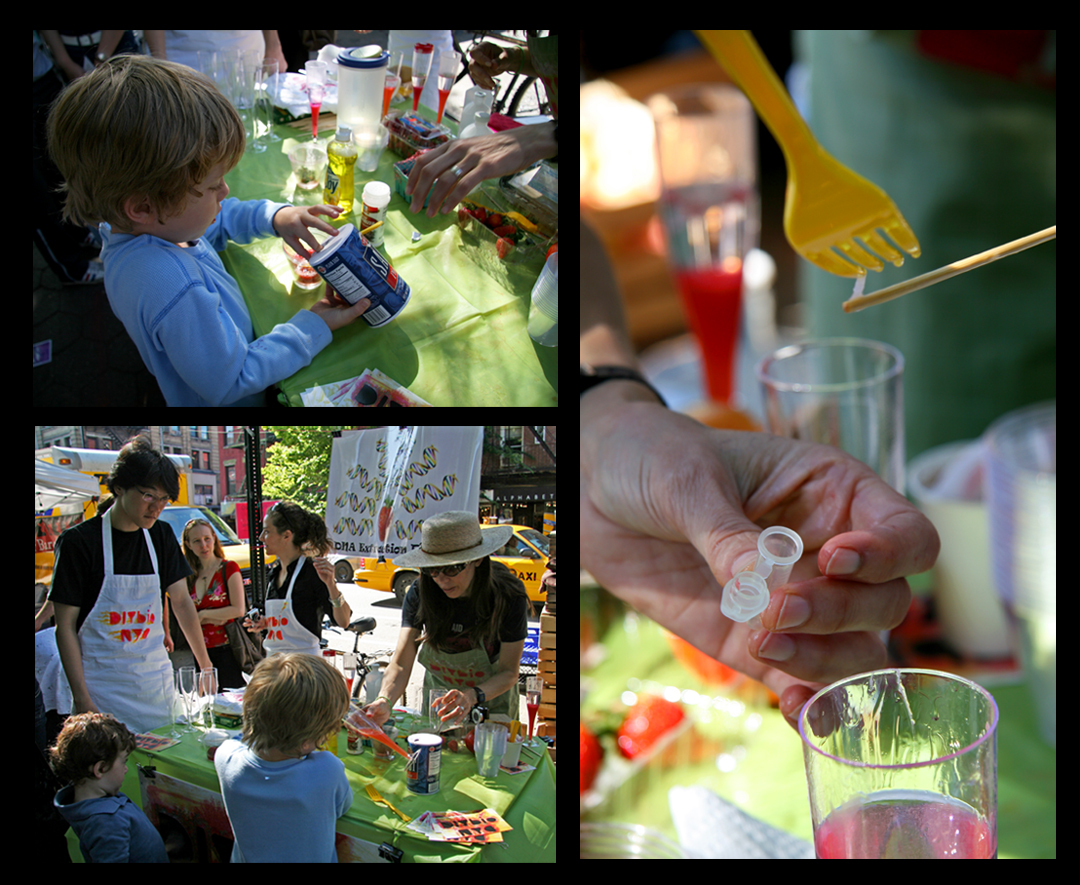
    So I was quite pleased to run into a DNA Extraction Party while strolling through the Tompkins Square Park farmer’s market. I was not aware that DNA could be extracted from fruit (or other living things) using common household ingredients – meat tenderizer, dish washing detergent, salt, alcohol, and a coffee filter. Note the clump of DNA between the fork and chopstick in the photo. This experimental display was produced by DIYBio NYC.

    It is likely that a very young child would not fully appreciate the outcome. In the experiments I did as a child, results were immediately obvious and did not require an understanding of deoxyribonucleic acid, genetic instructions, and a double helix. However, this is 2009, and the bar has been raised. But the spirit of Mr. Wizard lives on 🙂

    Note: Mr. Wizard (Donald Jeffrey Herbert, July 10, 1917 – June 12, 2007),  hosted the Watch Mr. Wizard TV program, which ran on NBC from 1951 to 1965. In 1983, Herbert created Mr. Wizard’s World, a faster-paced show on the cable channel Nickelodeon, running until 1990 and in reruns until 2000.


  • ReWarded


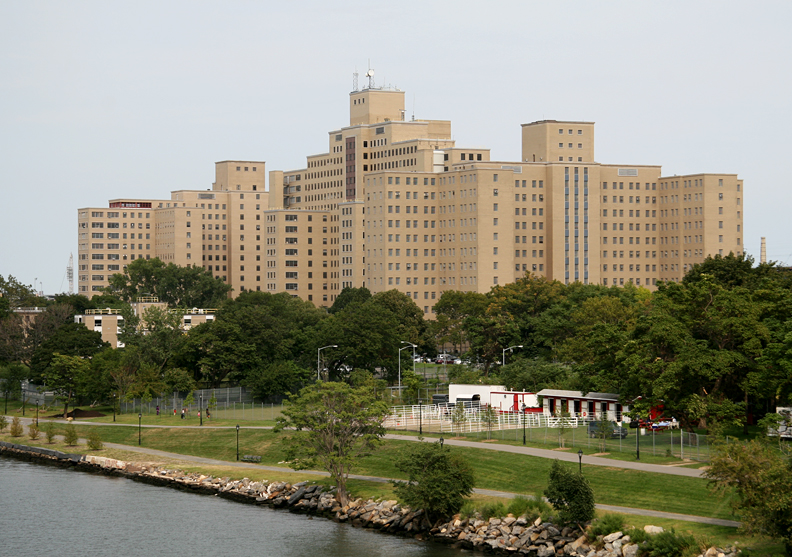
    Traveling over the Ward’s Island Bridge, in sapphire blue and emerald green, leads to an island of contrasts, an amalgam of environments and elements. Here you will find beautiful vistas, Ward’s Island Park, viaducts overhead from the Triborough and Hell Gate bridges, Little Hell Gate bridge (providing vehicular access to Manhattan), ball fields, the Manhattan Psychiatric Center, Kirby Forensic Psychiatric Center (which serves the criminally insane), one of the city’s largest homeless shelters (the Charles H. Gay Center with 960 beds), and a New York City Department of Environmental Protection wastewater treatment plant.

    On February 19, 2008, I wrote Sin of Omission about Ward’s Island Bridge (although I had not yet crossed it). On this occasion, I crossed the bridge and visited the island (see my gallery of photos here). Crossing the foot bridge is a wonderful experience, owing to its very human scale and the complete lack of motor vehicles (open to pedestrians and bicycles only). Your first steps off the bridge bring you to Ward’s Island Park, which wraps around the island along the waterfront. The day I arrived, families were picnicking and barbecuing. Walking the waterfront park affords vistas of Mill Rock Park, Manhattan, Queens, the Harlem and East Rivers, and the numerous aforementioned bridges.

    Leaving the park, however, and making a foray into the hinterlands gives a much different experience. The omnipresent Manhattan Psychiatric Hospital looms and is visible from nearly everywhere. Opened in 1899, it was the largest psychiatric hospital in the world. Knowing the nature of its occupancy was rather sobering. A stroll by the Charles H. Gay center was unsettling. Fenced off, the entrance was guarded by police while I observed a handful of rather threatening-looking individuals. At the time of my visit, I did not know that the facility was a homeless shelter. City buses provide transportation to and from Manhattan. The standard fare for bus is charged for the homeless (see article here).

    If you enjoy exploring the lesser-travelled corners, then Ward’s Island is your place. If not, crossing the Ward’s Island Bridge will provide a unique experience. On this visit, by crossing the bridge and visiting the island, rather than just taking a photo from afar, I found myself well reWarded…

    Note: Ward’s Island (along with Castle Clinton in lower Manhattan) was the original point of entry for immigration into the United States prior to the use of Ellis Island. For a history of the island and park, see the NYC Parks website here.


  • Comic Relief

    There have been numerous television shows which are virtually synonymous with New York City and have achieved legendary iconic status. Many open with recognizable shots of the city. Some, like the Letterman show, even have images of Manhattan as a backdrop to the set.

    New York City has hosted The Tonight Show (with Steve Allen, Jack Paar, Johnny Carson), the Ed Sullivan Show, The Cosby Show, Sex and the City, Law and Order, The Late Show with David Letterman, Seinfeld, The Daily Show, Live with Regis and Kelly, and Saturday Night Live. These shows were not only produced and filmed here but also had New York City as part of its motif.

    Saturday Night Live is a New York City-based sketch comedy show that began in 1975, with Lorne Michaels initially as writer/producer and now as executive producer. It achieved such wide cult status that the 3 letter acronym, SNL, soon replaced the name of the show in conversation and became widely adopted. Watching the program, singly or in groups, became de rigeuer for young people. I recall the regular Saturday night ritual. Excusing oneself from a social gathering to make it home to watch SNL was quite socially acceptable. In fact, it spoke highly of one’s love and dedication to an important part of New York City.

    Many of the cast members launched careers in comedy and film after working on the show: Eddie Murphy, Dan Ackroyd, Bill Murray, John Belushi, Gilda Radner, Chevy Chase, Julia Louis-Dreyfus, Chris Rock, Chris Farley, David Spade, Mike Myers, Dana Carvey, et al.
    Some of the show’s popular sketches also inspired films such as the The Blues Brothers and Wayne’s World.

    The show’s allure has drawn celebrities, who both host the show (starting the opening monologue) and perform in sketches with the cast. The show also features a musical guest. The list of those who have appeared on the show reads like a who’s who of the entertainment world, with hundreds of names. The show has had cameo appearances of political figures such as Barack Obama, George W. Bush, Al Gore, Hillary Clinton, and NYC Mayor Rudy Giuliani.

    In the early years of the program, New York was troubled, and SNL put a welcome and much needed positive spin on a city mired in financial woes and crime. Then, as now, SNL has provided necessary comic relief 🙂

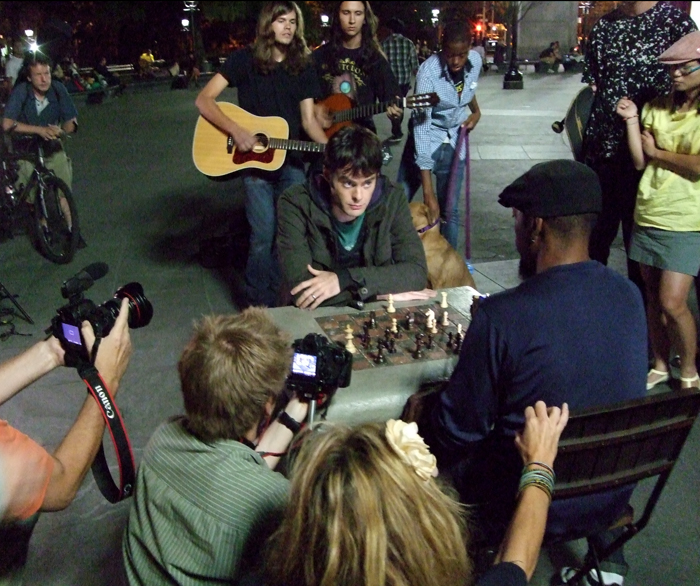
    About the Photo: Tuesday evening in Washington Square Park, a chess table (resembling those in the chess area of the park) was set up in the fountain plaza for filming of what will be used as an opener in the upcoming SNL season. Bill Hader was the star on the set. Hader is an American actor, comedian, writer, producer, and cast member of SNL since 2005. He has won both Emmy and Peabody awards and has appeared in over 20 films. So it was very surprising that the filming was being done with so little fanfare. A small audience gathered around the subjects with no interference from the film crew – their only admonition was “no flash photography.”


  • Paraíso


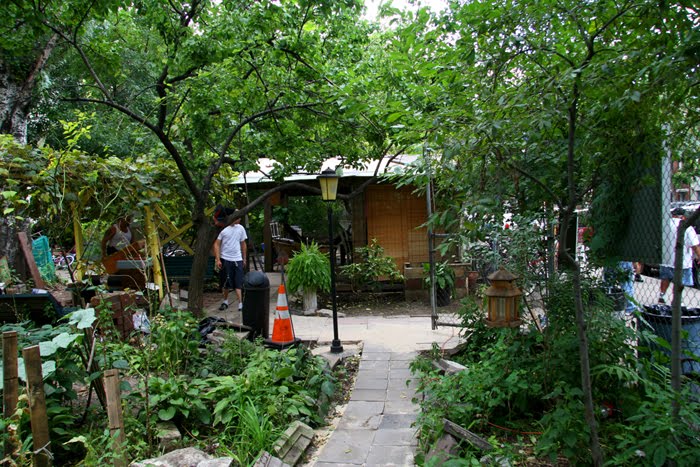
    Where can you find a rooster, chickens, ducks, rabbits, a turtle pond, a dog, herbs, grapes, tomatoes, and other produce being grown locally, with an octagonal tree house built at the base of a willow tree? In Manhattan, at El Jardin del Paraiso on East 5th Street between Avenues C and D.

    Normally, this area, deep in the heart of the very East Village, will be not be visited by visitors or residents of New York City. Even outsiders, slumming in the neighborhood, will not typically venture further east than Avenues B & C.

    The East Village is a mecca for community gardens. Many of these are absolutely extraordinary, idyllic urban oases. Some small, some larger – El Jardin is very large, extending through 5th to 4th streets, with an entrance at both streets. There is an open air cabana with a table, seating, and a hammock. Numerous awards and achievements have been bestowed upon El Jardin del Paraiso, including The National Wildlife Award and the Molly Parnis Dress Up Your Neighborhood Award. Read more at the East Village Parks Conservancy garden’s website here.

    In my tour of the garden, I encountered Cano, a local resident who was taking matters into his own hands. He complained of lack of progress on the part of those who manage the community garden. I have been witness to this type of community infighting and stalled efforts, so my sympathies were with him. He has invested over $10,000 of his own money to date and has recruited a few others to rehab the garden, which is now in a state of disrepair. He did not appear to be a power-hungry local activist spinning information to wrest control of the garden.

    A visit to the Jardin’s website shows a last update in 2006, so I got a sense that whatever visions and projects there were for this plot, momentum and drive do appear to have been lost. There is still a calendar, however, of events/activities in the garden.

    They say paraíso, I say paradise 🙂

    Photo Note: The white bird is a Silkie, a breed of chicken with unique, fluffy feathers. The chicken is known for its docile nature and is often kept as a pet. The flesh is dark blue/black and. although somewhat unappealing to the Western palate, is considered a delicacy in Asia.
    Origin of the Silkie is China/Asia.

    Visit the following related links: Shangri-La, Devil’s Playground, La Plaza Cultural Garden, Grapes, Stay Lean Stay HungryUrban Oasis, Alberts GardenWest Side Community GardenBird Country, Hua Mei Bird Garden


  • Great Minds and Fools

    If you have lived in this city long enough, you find your mind often contemplating the consequences of leaving things of value out in the open. It’s not necessarily the product of a criminal mind, but rather one of seeing too much vandalism and too many break-ins. I lived here through a long period of time when “no radio” signs in car windows were an everyday sight.

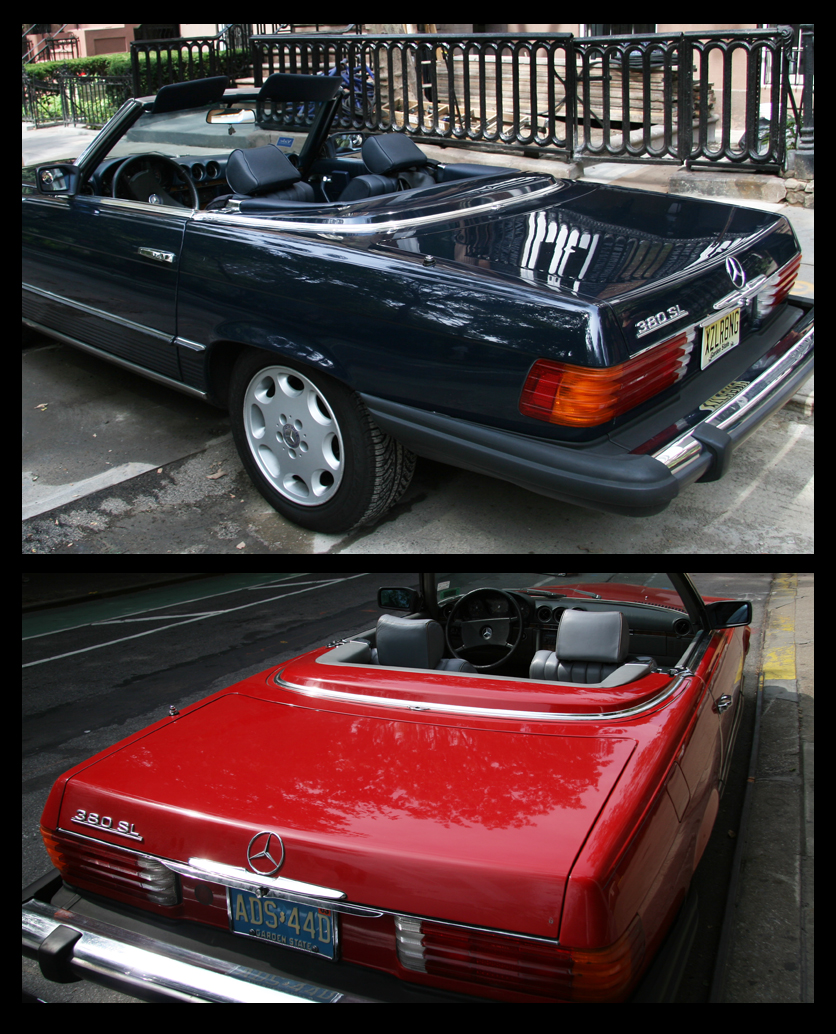
    The inflexible rule of thumb when parking a vehicle in New York City is to leave nothing in plain view in your vehicle at all. On July 29, 2009, I wrote of this in Urban Coral Atoll, as well as that many owners of luxury vehicles may leave their doors unlocked and “convertibles, top down, parked unattended in the streets of New York City, a clear signal to potential miscreants that there is absolutely nothing of value in this vehicle.” Recently, I saw what appeared to be this anti-vandalism effort mirrored.

    Walking along Washington Square North, I saw a Mercedes 380SL convertible with its top down – a perfect photo opportunity to illustrate this proactive anti-vandalism parking approach in action. What was more surprising was that just a short distance away, I found another Mercedes 380SL convertible with its top down. Both bore New Jersey license plates. It seemed likely that the owners were friends who shared a passion for the same vehicle and came into the city together for a romp around town.

    Counter measures notwithstanding, owning a luxury vehicle and street parking it in New York City requires intestinal fortitude and some degree of reckless abandon. I have seen owners of Rolls Royces, Ferraris, and Lamborghinis park on the street, even in front of fire hydrants and other no parking zones. If your vehicle is towed, there is the risk of damage in the towing process. Not to mention, of course, the cost of a parking ticket and towing fee, now $185 plus tax.

    However, no matter how you plan or prepare, vandalism is always a possibility, and to leave a luxury vehicle on the streets of New York City is unfathomable to me. At times, I feel badly and assume that the owner may just be a visitor, naive regarding the realities of the streets of New York. At other times, I imagine that the owner may be a conspicuous consumer, flaunting the sign value of his car, as if to say, “Don’t worry. I have enough money that if I am towed, a few hundred dollars means nothing. If the car is damaged, I’ll just have it repaired. And if is stolen, I will just buy another one.”

    Is parking two Mercedes convertibles with tops down on the streets of Manhattan a case of Great Minds Think Alike or Fools Seldom Differ? 🙂


  • Gravitas

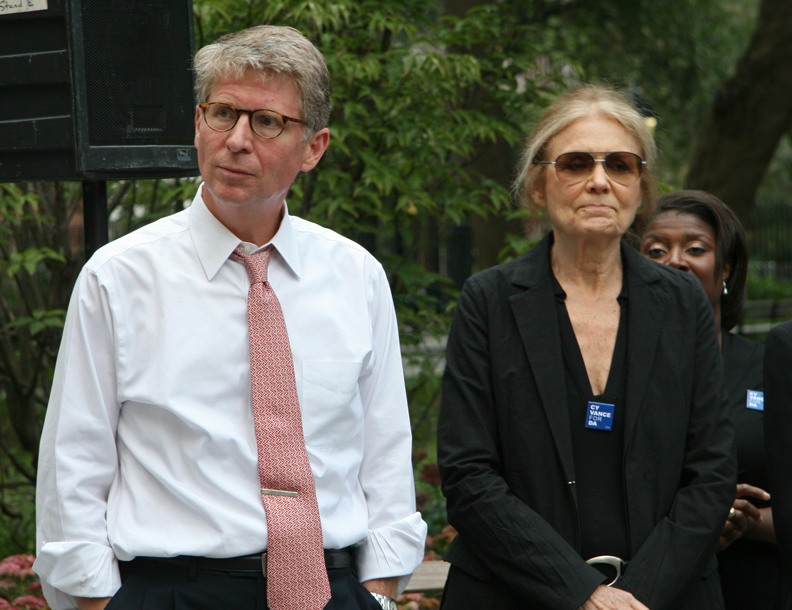
    I don’t typically attend political rallies, but occasionally, when they are in my backyard, I do. Yesterday, I was tipped off by a friend that there was to be a women’s rally supporting the candidate for the Manhattan District Attorney, Cyrus Vance. Scheduled to appear were several luminaries, including feminist/writer Gloria Steinem (seen in the photo) and Caroline Kennedy (who was unable to make it). Steinem’s endorsement was seen as particularly strong, owing that one of Vance’s opponents is a woman, Leslie Crocker Snyder.

    Most striking about Vance at this rally was his serious demeanor and the relative absence of political rhetoric and grandstanding. Vance revealed his family background of four sisters and his wife’s family, also with four sisters, perhaps accounting for his particular interest in women’s rights issues and this rally. He let others do most of the speaking, which I found refreshing.

    Vance has received the endorsement of the New York Times, New York Daily News, New York Post, and retiring DA Robert Morgenthau, who has held the position since 1975.
    An elected position since 1846, I was surprised to learn there have been only 3 elected Manhattan DAs in the last 75 years. The posturing of Vance and his endorsers gave a sense that this position required someone with gravitas. Crime is one of the most important issues in New York City and affects everyone – no one here needs convincing of the importance of the District Attorney’s office.

    During a presidential campaign years ago, there was heavy usage of the word gravitas and whether a particular candidate had this needed virtue or quality. Gravitas was one of several virtues expected of men in Roman society, along with dignitas and pietas.

    Cyrus Vance, Jr. was a graduate of Yale University and received his JD from Georgetown Law School. He has served as Assistant District Attorney in Manhattan. Vance’s father, Cyrus Vance (Sr.), served as Secretary of the Army under Presidents John F. Kennedy and Lyndon B. Johnson, Deputy Secretary of Defense under President Johnson, and Secretary of State to President Jimmy Carter.
    Sounds like a family history of gravitas…


  • Just the Messenger

    These sightseers certainly got to see the sights. Typically the offerings of TV programs such as Cops, residents and visitors of New York City often witness crimes, lunatic outbursts, and other acts requiring police intervention.

    We all have heard about the increase in strength when a person is angry or under stress. Whether or not this is literally true I don’t know, but there certainly is the appearance of such an adrenaline-driven reaction in many police apprehensions. This summer, I saw an altercation where it took three policemen to restrain an uncooperative man, wrestling him to the ground before he could be handcuffed.

    More recently, I saw what might be considered a minor event on Broadway in the middle of a business day. Traffic was completely stopped. When I arrived, the subject was being shoehorned into the rear of a patrol car. The man apprehended was violent and uncooperative, flailing about in the rear of the car – note his foot extending out the window in the bottom photo. An ambulance and additional police arrived – at one point, there were no less than seven police officers on the scene.

    Police are often accused of being overzealous. In some cases they are, but a situation like this gives one an appreciation of the unknowns in dealing with a crazed individual.
    Those of us watching were most concerned with how the officers were going to transfer such an unruly person from the police car to the ambulance. We were surprised to see this go so smoothly. The man was removed from the police vehicle and strapped securely to a stretcher, and off he went.

    His gripe? As the man was carted away, he warned, “Jews will kill you,” repeatedly to the crowd of spectators. Not the kind of thing I expect to hear in New York. I’m just the messenger on this one…


  • Electrical Outlets, Part 2

    (see Part 1 here)

    Electricity is one of the fascinations of many young boys, along with fire, motors, cars, trains, and toy guns. But even a young person can easily intuit the special property of electricity. It can supply power and run things. In yesterday’s story, I told of my early shocking experience with electricity.

    Recently, rather than playing with electrical outlets, I decided to take my interest in electricity to the very top of the power chain and visit the Consolidated Edison power generation plant at 14th Street between Avenues C and D. This behemoth dominates the entire immediate area and can be seen from across the East River in Brooklyn and Queens.
    As may be expected, neighborhood residents have not been pleased with the presence of the power plant. There have been protests and allegations of pollution. A settlement was reached in 2002, with Con Edison agreeing to a transition from oil to natural gas.

    Con Edison has only a small number of power-generating plants in the five boroughs of New York City. This one, in the East Village, provides the majority of electrical power for lower Manhattan. Although power is supplied from outside the city (New York State, Connecticut, New Jersey, and Pennsylvania) due to power grid design constraints, 80% of the power requirements for New York City must be satisfied within city limits. Power consumption here is, of course, enormous; added to the typical needs of any populace, power also needs to be provided for the large number of elevators and the city’s extensive subway system.

    Con Edison and New York City have a special legacy with electricity. On September 4, 1882, Thomas Edison opened his first central power-generating station at 257 Pearl Street. Only a few buildings were supplied with electricity (initially 59 customers), but the event demonstrated the viability of power generation and distribution.

    The power we use and this Con Ed power plant are all daily reminders of our reliance on one of the world’s most critical resources. I know that Thomas Edison, like all inventors, had many trials and tribulations, but at least he didn’t start with with his father’s keys in an electrical outlet 🙂

    Related Post: Big Allis


  • dinamic_sidebar 4 none

©2026 New York Daily Photo Entries (RSS) and Comments (RSS)  Raindrops Theme