• Makes Me Stronger

    Posted on by Brian Dubé

    Generally speaking, steps are a means to an end, not an end in itself. But this is New York City, where the minutiae of life are often elevated to iconic status. New York is the most densely populated city in the United States, and Manhattan, being an island, is a place where every square inch is examined, coveted, utilized, and maximized. So when you have a place as important as the Metropolitan Museum of Art that occupies so much space, you know it will loom much larger than life in every way.

    The Met is the largest museum in the Western Hemisphere, with over 5 million visitors per year – that’s a lot of foot traffic. Add to the formula one of the best locations in the city (Fifth Avenue and Central Park) with an enormous set of steps, and what you get is the stoop of all stoops – the ideal perch or porch for relaxing and/or the watching of people and performers. The steps are legendary, and a sunny Sunday afternoon here is a classic way for a New Yorker or visitor to pass some very enjoyable time.

    For the performing artist, the streets are an ideal venue to hone his or her skills. Many well known entertainers have worked the streets and these steps early in their career. The streets, subways, and parks are ready for immediate work – no agents or bookings required.

    Of course, it is rough and tumble battling the competition, weather, ambient noise, hecklers, property owners, neighborhood residents, and law enforcement. Those who can weather these elements become much stronger performers. They have learned to earn and hold spectators against adverse conditions – no captive audience here.

    I once introduced a much younger coworker to a variety of country music, including some very old recordings of Roy Acuff from the 1930s. This coworker was a very open-minded and tolerant musician, but I feared that this genre, particularly Acuff, might be trying his patience, so I asked him if listening to this music was too irritating. He responded, with a smile, “Don’t worry, it just makes me stronger.” So it is with the steps of the Met – for museum patrons or stoop sitters, it can be a stairway to heaven; for performers, it is a place that just makes them stronger 🙂

    Related Articles: Street Magic, Artiste Extraordinaire

    Posted on by Brian Dubé

  • Krishna Festival 2009

    Posted on by Brian Dubé

    Saturday was the annual Krishna festival. See my gallery of photos here. For complete information regarding the religious movement and its origins. see my 2007 article and photos here. Whether you are an adherent to Gaudiya Vaishnavism or a believer in Krishna or Vishnu, it is no matter – you can still enjoy this festival. The recruitment efforts by the members of the Krishna organization are extremely low-key.

    The pageantry is big here – colors, dress, and chariots. There is also food and entertainment. The music and chanting reaches a fervor, members of the group becoming highly animated.

    The event is part of the Festival of India North American tour – see their website here. In New York City, the chariot parade works its way down Fifth Avenue, terminating in Washington Square Park, where a stage and the various booths are set up for the afternoon. It is a festival of color…

    Posted on by Brian Dubé

  • Math Midway

    Posted on by Brian Dubé

    A Math Midway. What a wonderful concept – “an interactive, hands-on tour of a variety of exciting and surprising mathematical ideas, principles, games, and activities. The individual exhibits within the show will will be presented with a midway/carnival style, and generally concern mathematics related to an event or activity you can find in a typical carnival, fair, or circus setting.”

    The exhibits had clever names and tag lines, such as the Mysterious Harmonigraph. Be hypnotized by “Harmonics; Organ Function Grinder – Make Math the Most of your mind”; “Universal Wheel of Chance – Do you think the odds are even?”; “Ring of Fire – Illuminate the secret shapes within”; “Mathematical Monkey Mat – It’s so great to tessellate”; and the huge centerpiece to the street midway – “Pedal on the Petals – There’s a road for every wheel!”, where children rode tricycles with square wheels on a circular track with catenary curves, the combination giving a smooth ride. With the Organ Function Grinder, you “Grab a number ticket, set the three dials, and create your own function. Each step of the function transforms your number. Can you hear the transformations in the music, too? Turn the crank to compute your value and hear your tune.”

    The Math Midway was beautifully put together in a weaving of colors, demonstrations, performances, signs, brochures, ideas, and people.
    The Math Midway was part of the World Science Festival Street Fair, which was held Sunday, June 14 around Washington Square. This was the last day of the 2nd annual World Science Festival, a five-day science extravaganza with programs scheduled throughout the city. The festival was an immediate success its first year, with sold-out events. Participants not only included science luminaries and Nobel laureates but also stars of theatre, music, dance, film, journalism, and the media. The opening gala at Lincoln Center featured the likes of Yo-Yo Ma, Joshua Bell, Alan Alda, Michael Hogan, and Glenn Close. Co-founder Brian Greene is a professor of physics and mathematics at Columbia University. He is recognized for a number of groundbreaking discoveries in superstring theory. His books are widely read; The Elegant Universe was a finalist for the Pulitzer Prize.

    Their mission is to cultivate and sustain a general public informed by the content of science, inspired by its wonder, convinced of its value, and prepared to engage with its implications for the future. From the WSF website:

    The World Science Festival, an unprecedented annual tribute to imagination, ingenuity and inventiveness, takes science out of the laboratory and into the streets, theaters, museums, and public halls of New York City, making the esoteric understandable and the familiar fascinating.

    This was a huge event – for more information, see their website here and the Math Midway website here.

    I would suggest putting this on your calendar for next year and getting tickets for the event well in advance.
    Full Disclosure – Much like the investment advisor who must disclose his/her holdings, I must confess a love of science and particularly math, which was my favorite subject in school 🙂

    Posted on by Brian Dubé

  • Manhattan Beach

    Posted on by Brian Dubé

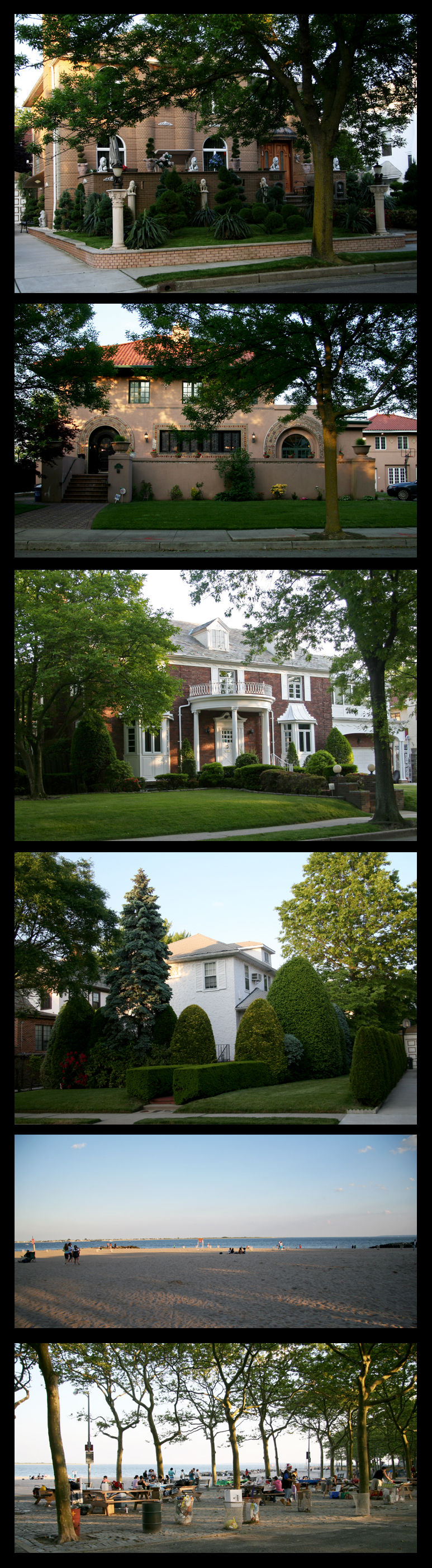
    This is New York City, not colonial Virginia. I was astounded on my recent excursion to the Manhattan Beach section of Brooklyn, which I had never really explored. This stately home is typical of many of the large residences in the area, mostly detached single-family homes with lawns and garages, some even with swimming pools. See my gallery of photos here. The environment feels more suburban than urban – atypical of New York City and unlike most of Brooklyn itself.

    Surrounded by water on three sides, the neighborhood is very much an enclave and one of the most expensive in New York City. Many residents are Jewish and/or Russian immigrants. There is very little shopping in the neighborhood, and on weekends and holidays during the summer season (May 15 to Sept. 15), parking is prohibited on nearly all Manhattan Beach streets, owing to the attraction of the beach. I found the expanse of rocky beach reminiscent of the Maine coast, certainly not typical of New York.

    Manhattan Beach Park offers a baseball field, playgrounds, tennis courts, basketball and handball courts, picnic areas, and rest rooms. Snacks are available from concession stands and pushcarts.
    Another very unique aspect of the neighborhood is that Kingsborough Community College, with a 70-acre campus and their own private beach, occupies the easternmost tip of the peninsula. The school, established in 1963, is part of the City University of New York (CUNY) system and has 30,000 students.

    I recommend a visit of the area, perhaps with Sheepshead Bay as a base for your explorations (subject of a future post). A footbridge crosses the bay, providing nice vistas and a connection to Manhattan Beach…

    Posted on by Brian Dubé

  • The Guggenheim

    Posted on by Brian Dubé


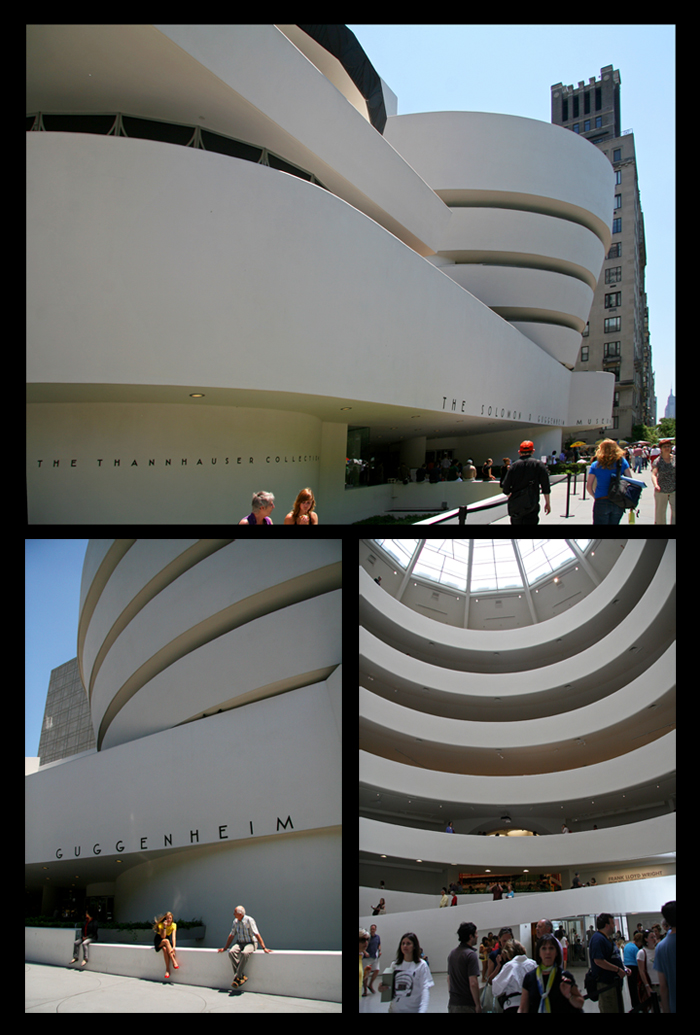
    What I find most fascinating about a place like the Guggenheim Museum is that it stands as a supreme example of how virtually anything can be defended, praised, or condemned intelligently with words. Conflicting arguments abound about works of architecture, art, film, music, dance, etc. I once asked an architect after seeing a particularly hideous structure what she would make of a building which every lay person hated but was lauded by architecture critics. The answer she gave: “Then architecture is a failure.”

    I have cited examples in this blog of things which have become iconic in spite of their being considered an abomination by many at the time of completion, such as the Eiffel Tower. The Guggenheim is one of those places – time has softened those aspects that perhaps have offended many.

    The Solomon R. Guggenheim Museum, designed by Frank Lloyd Wright and completed in 1959, is considered one of the city’s major architectural landmarks. It is located on in Manhattan’s Upper East Side at 89th Street and Fifth Avenue, overlooking Central Park. Second photo here. It houses Impressionist, Post-Impressionist, early Modern, and contemporary art. The collection was seeded by Solomon Guggenheim, an art collector whose foundation funded the establishment of the museum.

    The building, which looks like a stacked white ribbon, was extremely controversial at the time of its completion. Inside, the main gallery is a helical spiral, rising from the ground level to the top, crowned with a skylit rotunda. Here are some of the conflicting reviews as reported in Time Magazine in 1959:

    “A war between architecture and painting, in which both come out badly maimed,” declared Art Critic John Canaday on Page One of the New York Times; “The most beautiful building in America,” retorted Critic Emily Genauer in the New York Herald Tribune. “A building that should be put in a museum to show how mad the 20th Century is,” editorialized the New York Daily Mirror. “Mr. Wright’s greatest building, New York’s greatest building.” said Architect Philip Johnson, “one of the greatest rooms of the 20th century.” “Frank has really done it,” snapped one artist. “He has made painting absolutely unimportant.”

    The criticisms revolve around several aspects of the building. One is that the museum design is a distraction from the art itself. The sloping ramp provides no level base for a viewer’s reference. The small exhibition rooms off the main spiral are small and windowless – the walls are angled and make hanging paintings difficult. Prior to its opening, twenty-one artists, including Willem de Kooning, signed a letter protesting the display of their work in the museum. Wright replied that the old rectilinear frame of reference was “a coffin for the spirit” and admonished them to wait and see. Paintings were to be tilted backward, “as on the artist’s easel.” Wright had proposed “one great space on a continuous floor.” “An atmosphere of the unbroken wave—no meeting of the eye with angular or abrupt changes of form.”

    When the building opened, Robert Moses said that it looked like “an inverted oatmeal dish.” Wright retorted, “It’s going to make the Metropolitan Museum look like a Protestant barn.” Others referred to it as a “snail,” “an indigestible hot cross bun,” and “a washing machine.”
    Snails, barns, coffins, oatmeal dishes, washing machines, ribbons, unbroken waves – The Guggenheim.

    Posted on by Brian Dubé

  • Secret Discovery

    Posted on by Brian Dubé


    On my first trip alone to New York City with a friend, I recall some mutual back patting of how, in traveling without a group, we were able to avoid the touristy and eat in a place which was our own secret discovery. The place? Nathan’s at Times Square. Rather hilarious looking back on it, but being older has not entirely eliminated naivete.

    I “discovered” this unique building standing alone like a haunted mansion on a hill at 3rd Street and 3rd Avenue in Brooklyn. Silly in retrospect – how could anyone miss this anomaly on a major thoroughfare? No one has. I have read no less than two dozen articles on this building which not only stands as a beacon to passersby but also is the center of controversy.

    The surrounding property (but not the building itself) was purchased in 2005 by Whole Foods Market from Richard Kowalski, who still owns the 2 1/2 story Italianate building at 360 Third Avenue/Street near the Gowanus Canal. The Whole Foods project has been stalled for a number of reasons, including discovery that the property, a floodplain, contained toxic material.

    I found a tremendous amount of misinformation about this property, as bits and pieces of facts were cobbled together over the recent years. I believe its history has at last been clarified.

    The building, built by Edwin Clark Litchfield in 1872-3, became important as part of the history of concrete in America. The New York and Long Island Coignet Stone Company Building was landmarked in 2006.
    François Coignet was a pioneer in development of structural and reinforced concrete. In the late 1860s, a group of Americans trained in Coignet’s techniques in France brought his patents to Brooklyn. From the New York City Landmarks Preservation Commission website in 2006:

    The building originally was part of the New York and Long Island Coignet Stone Company, a five-acre factory complex near the Gowanus Canal that manufactured Coignet — or artificial –stone, a type of concrete invented by Francois Coignet in Paris in the 1850s. The factory supplied the arches and clerestory windows in St. Patrick’s Cathedral in Manhattan, the ornamental details for the Cleft Ridge Span in Prospect Park and the building materials for the first stages of construction at the Metropolitan Museum of Art and the American Museum of Natural History.

    Made entirely of concrete, the 25-by-40 foot rectangular structure was built to showcase the durability and versatility of Coignet’s inventive product, also known as “Béton (French for concrete) Coignet.” The company was reorganized and renamed the New York Stone Contracting Company in the mid-1870s, and continued to manufacture Coignet stone until 1882. Shortly after, the building housed the office of the Brooklyn Improvement Company, which was instrumental in Brooklyn’s residential and commercial development during the 19th and 20th centuries.

    I hope you get a chance to make a secret discovery of this property yourself, if you get a chance to pass by 🙂

    Note: The building has often been referred to as the Pippin building – it once housed offices for Pippin, a radiator distribution company.

    Posted on by Brian Dubé

  • Please Be Gentle

    Posted on by Brian Dubé


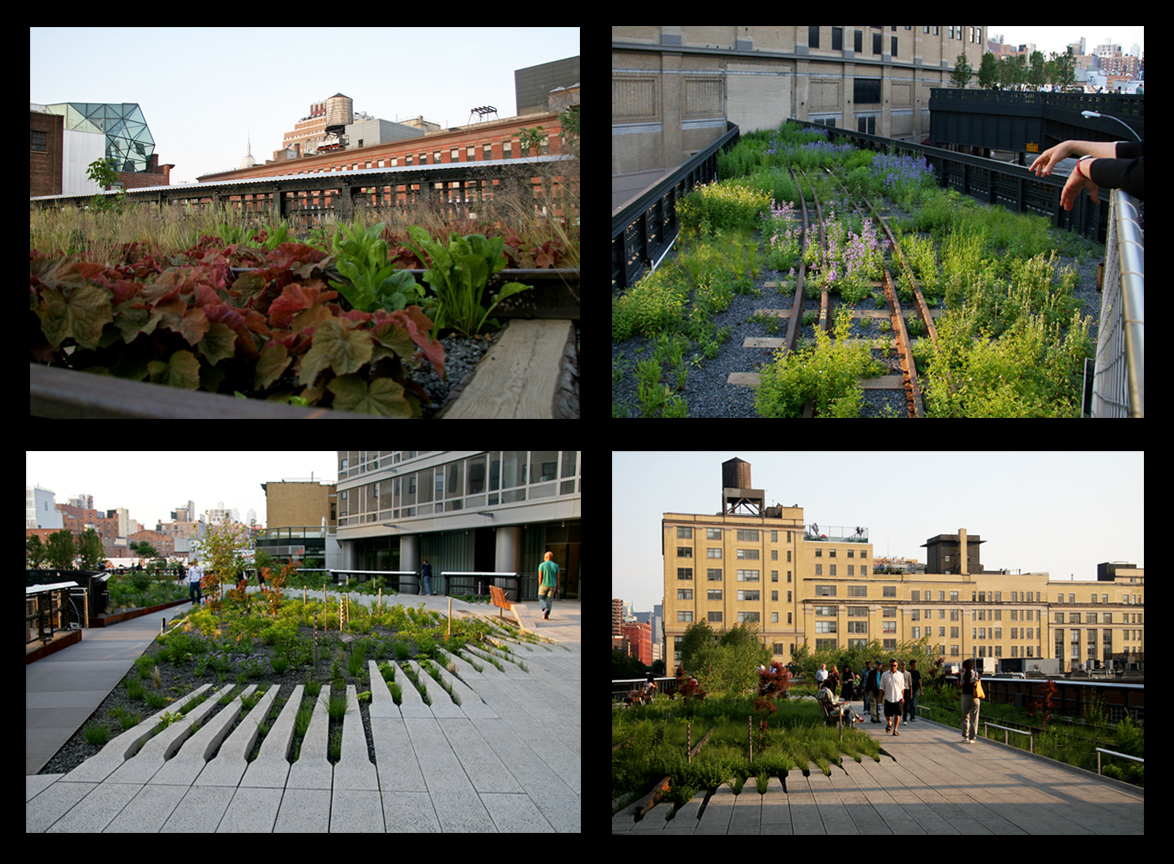
    Yesterday, June 8, 2009, was the highly awaited grand opening of the High Line. All the top officials in city government were there for the ribbon cutting – Mayor Bloomberg; Amanda M. Burden, the city planning commissioner; Adrian Benepe, the parks commissioner; Scott M. Stringer, Manhattan borough president; and City Council speaker Christine C. Quinn.

    This project was in the making for 20 years. The idea to save and restore the abandoned elevated freight railroad was first conceived in 1999 by Joshua David, a writer, and Robert Hammond, a painter. The project, named the High Line, broke ground in 2006 and is now an elevated park converted from a section of the West Side Line, built in the 1930s by the New York Central Railroad and unused since 1980. The railroad actually passed through several buildings – evidence of this still exists. See my entire photo collection here.

    The greenway is similar to the Promenade Plantée in Paris, a 4.5 km-long elevated park in the 12th arrondissement of Paris, France, constructed on an abandoned 19th-century railway viaduct. The High Line consists of three sections – the southernmost currently open runs from Gansevoort Street in the West Village to 20th Street. Upon completion, the entire park will extend to 34th Street.

    Over 30 projects are planned along its route, including a new branch of the Whitney Museum of American Art, designed by Renzo Piano.
    The design itself is the most artfully created public space I have seen in New York City. The High Line was designed by landscape firm Field Operations and architects Diller Scofidio and Renfro.

    Yesterday’s “soft” opening was pleasant, with a small number of visitors. Once its opening is generally known, there is a concern of overuse – the design work is beautiful yet delicate and rather fragile. The parkway is only 30 to 60 feet wide. If necessary, entry to the park may be limited. I recommend visiting – please be gentle…

    Posted on by Brian Dubé

  • Urban Mitts

    Posted on by Brian Dubé

    Cats have been known to fall from as high as a 32-story building and survive in a phenomenon known as high-rise syndrome. I can’t say that this is the reason for the broken glass in the photo, but it does afford an opportunity to introduce this concept to this website. I don’t anticipate being at the exact moment in time to photograph an event like this, and I do not intend to post photos of maimed or dead cats.

    Cats love high places. Factor in their curious nature and inevitably, you will end up with cats, as astute and agile as they are, falling from apartment buildings for one reason or another.
    Remarkably, cats do routinely survive enormous drops. One factor is cat righting reflex, an innate ability which allows a cat that has fallen to reorient itself in order to land on its feet. Popular lore has it that cats actually do better from falls of over 6 stories. It has been proposed that this is the case because cats reach terminal velocity after 5 stories and relax and flatten themselves, much like a flying squirrel, thereby minimizing injury.

    One study often cited is from the Animal Medical Center in 1987. There were 132 cases of high-rise syndrome (average height of fall was 5.5 stories) with a 90 percent survival rate.
    However romantically attractive the notion of cats faring better from higher falls is, as Cecil Adams points out in the Straight Dope, the big flaw in all of this is that cats that don’t survive are not reported or brought into a veterinarian’s office or animal hospital. His thinking was confirmed by a conversation with Dr. Michael Garvey – head of the medical department and current expert on “high-rise syndrome” at the Animal Medical Center in New York City. A study from Croatia from 1998 to 2001 confirms that cats falling from greater heights suffered more severe injuries.

    So much for urban mitts 🙂

    A Personal Experience: I once came home to a note on my building that my cat had jumped and been taken to the vet in my absence. I have many birds who frequent my windows, and I had seen him highly animated on numerous occasions – my theory is that my cat was able to force open a window left slightly open to get to the bird, attack, and fly off the A/C unit. He was taken to the Animal Medical Center and he did survive.

    Posted on by Brian Dubé

  • Comin Up Comin Up

    Posted on by Brian Dubé

    Before the hegemony of the Korean green grocers, there were far fewer dealers of produce in New York City. And then, as now, many immigrants did the heavy lifting in this city. This was the case in the 1970s on Greenwich Avenue near Avenue of the Americas, where there was a very prominent fruit and vegetable store run by Arabic men. As immigrants are inclined to do, these men had acquired a smattering of American colloquialisms, patched together to make what they thought was the salesman’s perfect proverbial call to action. So a passerby was often subjected to their pitch: “Comin up Comin up. Strawberry. Three for a dollar. Who can believe it.” Hear my impression here. Ironic, because, of course, nothing was being prepared, and hence nothing really was really “comin up.” And often, given the quality of the strawberries, three for a dollar was easy to believe.

    Their intonation and sense of urgency was a great source of amusement for many of us at the time, and I have recounted this story to many close friends who now find opportunity at every moment possible to inject “comin up comin up” or “who can believe it” into any situation where it can possibly be justified – there are many, many moments in daily life where either phrase can be easily worked in.
    But where to use such a story for a photoblog of New York? These men and their fruit stand will not be resurrected. So this experience had been filed away in the recesses of my mind, waiting for an opportunity.

    Fast forward one week ago to a street fair on Waverly Place. As I walked by a seller of watermelon in cups, the man behind the table barked, “Watermelon. Two dollar. Helloooooo!” Hear my version here. The use of Hello with an elongated “o” is recent slang, similar in meaning to “wake up and smell the coffee.”
    So there it was – the perfect analog in our time and place to “comin up comin up.” And as I pulled out my camera, the vendor happily obliged and volunteered a smile with two fingers for two dollars.

    So if you think you recognize me around town and see me walking towards you, you now have the secret password. Just say “comin up comin up” and I’ll be sure to respond “Who can believe it!” 🙂

    Posted on by Brian Dubé

  • Free Laura and Euna

    Posted on by Brian Dubé


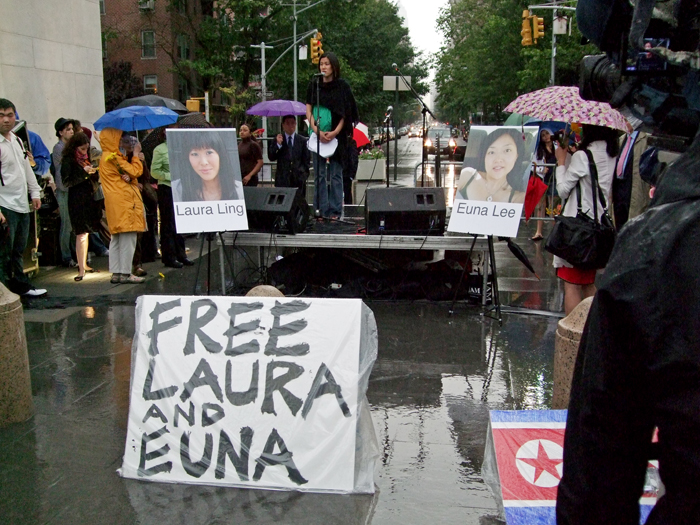
    Last night, I unexpectedly encountered this scene under Washington Square Park’s arch. Something important was obviously afoot, with a small crowd standing in the rain and speakers making statements from a small impromptu stage. Major networks were present, filming and conducting interviews.

    The flyers, speakers, posters, and sign which read “Free Laura and Euna” quickly illuminated the reason for the gathering. This was New York City’s vigil to bring attention to two American journalists who have been detained in North Korea since March 17, 2009 and stand trial today, June 4th.
    The two journalists, Chinese American Laura Ling and Korean American Euna Lee, were captured by the North Korean government and charged with illegal entry of North Korea with “hostile intent.” Working for Current TV (a network co-founded by former U.S. Vice President Al Gore), the women had entered China to interview North Korean refugees along the Tumen River, separating China and North Korea. Little is known about the precise details regarding their activities and alleged crossing into North Korea – the two women have been in solitary confinement since their arrest and have not been permitted contact with the outside world.

    If convicted, they face up to 10 years in prison doing hard labor. Some say North Korea will use the women’s release as a bargaining chip. The incident is particularly frightening, as North Korean prisons have a reputation for torture and brutal treatment of inmates. Families, friends, government officials, and the public remain hopeful for the release of Laura Ling and Euna Lee and their return to the United States…

    Posted on by Brian Dubé

  • Five Dollars

    Posted on by Brian Dubé


    As far as money goes, New Yorkers are like most other Americans – they like a deal, and FREE screams loudest to them.
    People at trade shows collect enormous numbers of brochures they will never read and wait in huge lines for premiums and freebees worth virtually nothing. I have seen adult men and women practically brawl over free T-shirts thrown into an audience at a Macworld convention.
    With free food it is even worse. At the Japan Festival in Central Park on Sunday, people were in lines hundreds deep, waiting in the hot sun for free noodles or a free dumpling.

    When it comes to tunnels, bridges, and other roadway tolls, many seasoned New Yorkers consider it a matter of principle and a source of pride to avoid paying a toll. Ironically, in most other ways, New Yorkers spend huge amounts of money for conveniences – prices for items at a green grocer can be substantially more for identical items at a supermarket a few extra steps away. There are endless examples of this behavior. But put the same people behind the wheel of a car and give them the option to wait in horrendous traffic to avoid paying a toll, and they will.

    If you are coming from the outlying neighborhoods of Brooklyn by car, you will most likely use the Belt Parkway or Prospect Expressway and then a leg of the Gowanus Expressway. If you are heading to Manhattan, you have a big life altering decision to make: do you take the Brooklyn Battery Tunnel for FIVE DOLLARS, or do you cram into the bumper-to-bumper traffic on the BQE (Brooklyn Queens Expressway) and take one of the bridges for FREE?

    By now the answer is obvious, n’estce pas? Any self-respecting New Yorker takes the free road and saves five dollars (perhaps to spend it whimsically soon after at Starbucks). Admittedly, five dollars is quite a bit of money for a short tunnel ride. However anyone driving a car into Manhattan is already indulging in a luxury that most can not afford, so why not spend five dollars and go in style?

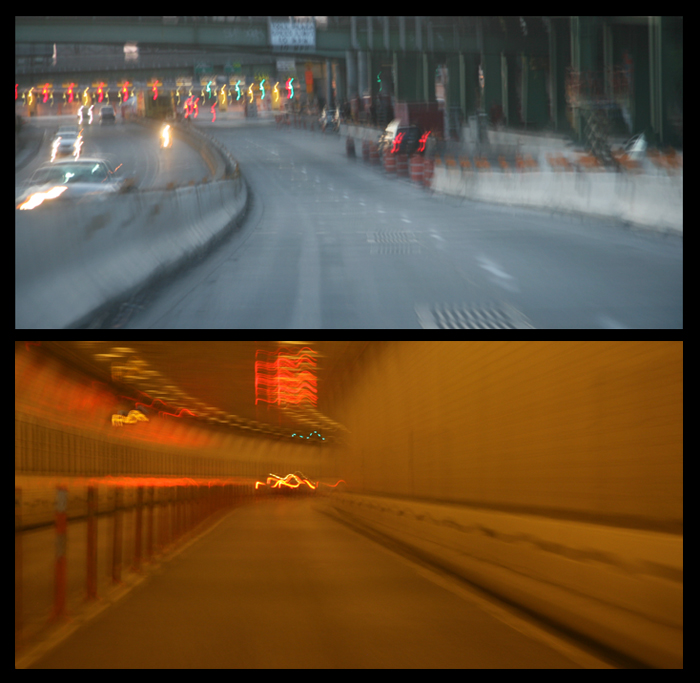
    These were my thoughts on Saturday evening when, coming back from my adventures in Brooklyn after an exhausting day of driving, I decided to do the unthinkable and spend five dollars for the tunnel experience. It was extraordinary. The highway spur to the tunnel (top photo) and the tunnel itself (bottom photo) were virtually empty.
    I was back in Manhattan in a few short minutes, while thousands jammed onto the BQE. Of course, many of these travelers were not headed to Manhattan, but trust me on this – if there were no toll for that tunnel, I would have had plenty of company. And, of course, an extra five dollars…

    Photo note: Against better judgement, these photos were taken one-handed while driving. Camera shake, shutter speed, aperture – no time for these considerations. After spending $5, I was feeling rather reckless anyway 🙂

    Posted on by Brian Dubé

  • Cello Class

    Posted on by Brian Dubé

    Some years ago, I fancied to learn the cello. New York City has some of the finest music schools in the country, and they all offer alumni lists of musicians ready, willing, and able to teach (at very reasonable prices). So, it was with this in mind that I found a great teacher/professional cellist, walking distance from my home, to teach me. This woman was both a Juilliard School and Manhattan School of Music graduate and had extensive performing and teaching experience, both privately and in a well-respected school for children.

    I was, however, somewhat remiss in my studies, barely getting through the lesson material each week. Learning a classical stringed instrument as an adult is a daunting task – practicing as I did at night after a day’s work. On one particular lesson, my instructor was getting rather frustrated with me. She asked what a particular note was as she placed a finger on one of her strings. I said that I did not know. She then asked, if one knew a note on one string (she gave an example), what was the note on a neighboring string? I did not know. Backtracking further, she then asked what was the interval between the strings on a cello? Embarrassed and panicked, I just said I did not know that, either (answer: one fifth apart).
    At this point, she said, “If you were one of my student children, I would insist that you learn this material. However, being that you are an adult, I strongly recommend that you learn it, unless you would rather pay me $25 per hour to learn in class what you should be doing at home.”

    This story came to mind on Sunday afternoon, as I strolled down the tree-canopied sidewalk on Fifth Avenue, flanked on one side by some of the finest residential buildings in the world and abutting Central Park on the other side. A walk here is one of the most extraordinarily beautiful, bucolic, and genteel experiences you will ever have in this city. The extra-wide pathway is shaded by mature trees, arching overhead to form a tunnel of green. Dappled light falls on the cobblestone and hexagonal pavers.

    If you were one of my children, I would insist that on the next warm, sunny day, you accompany me as we promenade down Fifth Avenue. But since you are not one of my children and rather an adult, I strongly recommend that you do this, unless you just want to read about this now, when you should be doing your life lessons outside of class 🙂

    Photo Note: The photo was taken between 94th and 95th Street. The stretch between 96th and 89th Streets is one of the quietest on Fifth Avenue. Parades do not go north of 86th Street. It becomes much busier starting at 89th Street (location of the Guggenheim Museum), followed by the Metropolitan Museum of Art at 82nd Street.

    Related Postings: Free Lunch, Cello, Bargemusic

    Posted on by Brian Dubé

  • Shalom

    Posted on by Brian Dubé

    What is fascinating is the reaction of newcomers to the city to the enormous Jewish population. Businesses such as B&H Photo, run by Satmar Hasidic Jew Herman Schreiber with hundreds of orthodox Jewish employees donning traditional elements of dress such as payot and tzitzis, come as a curiosity to visitors. The 2001 census shows just under one million Jews in New York City – the largest Jewish population in the world outside of Tel Aviv, Israel. That’s 12% of our city population, 15% of the number in the United States, and 7% of the world’s total. For those of us who have been here a long time, it is something that is such a part of the fabric, history, and evolution of the city that it goes virtually unnoticed.

    My first close friends in New York City were Jewish, and from the very beginning, I developed an enormous respect for a group that has survived and prospered against persecution and hardship.
    The Jewish population has a strong representation in so many professions – law, business, finance, local politics, publishing, medicine, and the arts. The recent Mayors of New York City (Beame, Koch, and Bloomberg) have been Jewish, as is the family that owns the New York Times (Salzberger). But make no mistake – these achievements are based on tenacity, hard work, strong families, and education.

    I remember as a high school student in New England, perusing the World Almanac as I was inclined to do, coming across an entry showing average number of years of education completed by ethnic group. As I quickly scanned the list, I noticed the number one group – Jews. The average number of years of school completed: 16+.

    I reflected on this, recalculating and reconfirming that 16+ meant college graduate. Perhaps I misread, misunderstood, or have misremembered the statistic, but nonetheless, in my entire extended family, many had not even graduated high school, and only one uncle had been to college, so this fact was astounding to me and something I always remembered. When I entered university in New York City, the Jewish emphasis on education and its role in their success became abundantly clear. Of course, like any group, some do fall between the cracks, but my experience here has been that members of the Jewish population are achievers. Shalom 🙂

    Photo Note: This was the annual Salute to Israel Parade, starting at 57th Street and continuing north to 79th Street. More at their website here.

    Posted on by Brian Dubé

  • Unemployed

    Posted on by Brian Dubé

    Union Square has been a site for social and political activism since the 1800’s. In 1861, after the fall of Fort Sumter, there was a patriotic rally with an estimated 250,000 people, considered the largest public gathering in North America up to that time. Since that time, Union Square has continued its role as a locus for protests and gatherings.

    On Sunday, May 17, the Veggie Pride Parade ended in the north plaza. At the same time, Reverend Billy appeared at the NYC Plastic Bag Protest. There were various activities – crafts, street theater, advocacy, and petitioning. A number of characters were present, such as the Plastic Bag Monster seen in the photo and No Impact Man.

    I applaud the efforts being made here, as reduction is the biggest key to this problem. As I wrote in White Christmas, substitution of disposable materials or recycling is not an effective solution with the volume of bags being used, which is why complete bans are being enacted worldwide.

    In 2002, Bangladesh became the first country to ban plastic bags. Taiwan prohibits not only plastic bags but also disposable plastic cups, plates, and cutlery used by fast food vendors (threats of fines have resulted in a 70% reduction in the use of plastic bags, and a 25% cut in landfill waste.) A number of African countries have banned plastic bags, such as Uganda, Kenya, and Tanzania. London has banned giving out free bags, and Ireland has levied a tax. Paris has banned them, and France plans to ban them nationwide by 2010.

    In 2007, San Francisco became the first US city to ban plastic bags. Other US cities have followed – Maui, Hawaii, and Westport, Connecticut. New York City is considering its own initiative. The plastic bag problem has really hit critical mass, and the list of countries, states, and cities is constantly changing. I think the Plastic Bag Monster will be joining the ranks of the unemployed soon 🙂 

    Related Postings: The Plastic Infinite, Consumption, Picture New York, Reverend Billy, Union Square, Union Square Greenmarket, Metronome

    Posted on by Brian Dubé

  • Book Wars

    Posted on by Brian Dubé


    To me, the street life of New York City is one of its defining characteristics and is what separates it from any other place in the world. With the growing domination of the retail sector by national and international retail chains, the character of the retail world has become decidedly less unique. Strolling down Broadway in SoHo is very much like strolling the suburban shopping mall – the only big difference is whether you want your mall shopping experience indoors or out.

    Street vendors often provide a food or product which is difficult to vend profitably in a retail store. For those of us who already spend too much time indoors, browsing a street vendor’s wares is also a way to get more outdoor time. Admittedly, there is a plethora of chatchkas and tacky tourist memorabilia. Like anything else in New York, you must pick your battles and be selective – it is difficult to make any blanket characterizations of the merchandise on the streets. There is better or worse in nearly everything here – places like Canal Street are both bazaars and minefields.

    One of the most worthwhile activities on the street is the sale of books. Here, too, there are some vendors of some extremely poor quality magazines and books, where a cursory examination makes it clear that the primary operative is selling merchandise.

    But there is a small world of street booksellers who are extremely literate and knowledgeable about books, often more so than a bookstore staff member. These vendors are people who are not criminals, drug addicts, derelicts, or thieves. They acquire their books from estate sales, thrift shops, remainder bins, foundations, used bookstores, or trash heaps. A perusal of the titles sold by Everett Shapiro at the tables on West 4th Street (in the photo) in the heart of the NYU “campus” will tell you that the selection here is quality, one that a serious reader can take seriously.

    Everett was one of the featured characters in the independent film Bookwars, which won Best Documentary at the New York Underground Film Festival in 2000. The film was made by filmmaker Jason Rosette, who was a NYU film school graduate and became a street bookseller himself. The 1999 book Sidewalk by Mitchell Duneier also examines the world of the sidewalk booksellers.

    Street booksellers (and sellers of art) are protected by the free speech provision of the First Amendment of the Constitution and are allowed to sell on the streets without a license. However, in spite of this, efforts were made during the Giuliani administration as part of his Quality of Life campaign to crack down. The effort was highly contentious, and eventually the police backed off. The numbers of street booksellers has declined, but there are still those who are passionate about books, and they can still be found here and there…

    Photo Note: These are the tables of Everett, located on West 4th Street in front of NYU’s Bobst Library.

    Posted on by Brian Dubé


  • dinamic_sidebar 4 none

©2026 New York Daily Photo Entries (RSS) and Comments (RSS)  Raindrops Theme