• Worlds Unfolding

    When I tell customers or vendors on the phone that my office is on Broadway, lights go on in their heads, literally. They frequently follow up with a question in order to establish if it is that Broadway. I assure them it is that Broadway, but not that part of Broadway (i.e. the Theater District).

    Broadway is the longest street in Manhattan, going from the most southern tip of Manhattan at Bowling Green all the way to to the northernmost neighborhood of Inwood. It then crosses Spuyten Duyvil Creek via the Broadway Bridge, continuing into the Bronx, keeping its signature name. And in that course of 12 miles, you will find some extraordinary variety of architecture and neighborhoods.

    But you don’t need the longest street in New York City to find that kind of change. What is remarkable about Manhattan is the change in character over the shortest distances, without crossing the proverbial railroad tracks. So when it comes to knowing the nature of a street in New York City, you need to know much more than what street; you need to know where on that street.

    Take MacDougal Street, which is only six blocks long. At one end, near 8th Street, you have a quiet block intersecting charming MacDougal Alley. One beautiful home, which I wrote about in Better When, stands there. The is also the location of the controversial Christian Science building. This photo was seen used recently in the New York Times (see here).

    The next block abuts Washington Square Park with a number of tall prewar buildings. Two blocks further and you have one of the dirtiest, most touristy, and most tacky streets in New York City. This is the block where I recently featured Shawarma.

    The very next block becomes very residential, lined by landmark buildings on one side and a number of well-known Italian businesses – Cafe Dante and their restaurant, Villa Marconi, and Tiro A Segno, the private club with a rifle range – on the other side. At the corner is the location of the recently closed landmark cafe Le Figaro.

    Cross Houston on the next block, and we are in SoHo and find a handful of French-inspired cafes and restaurants. This is the block that during Bastille Day is closed for festivities, including the construction of impromptu Petanque courts with competitions. See my posting here.

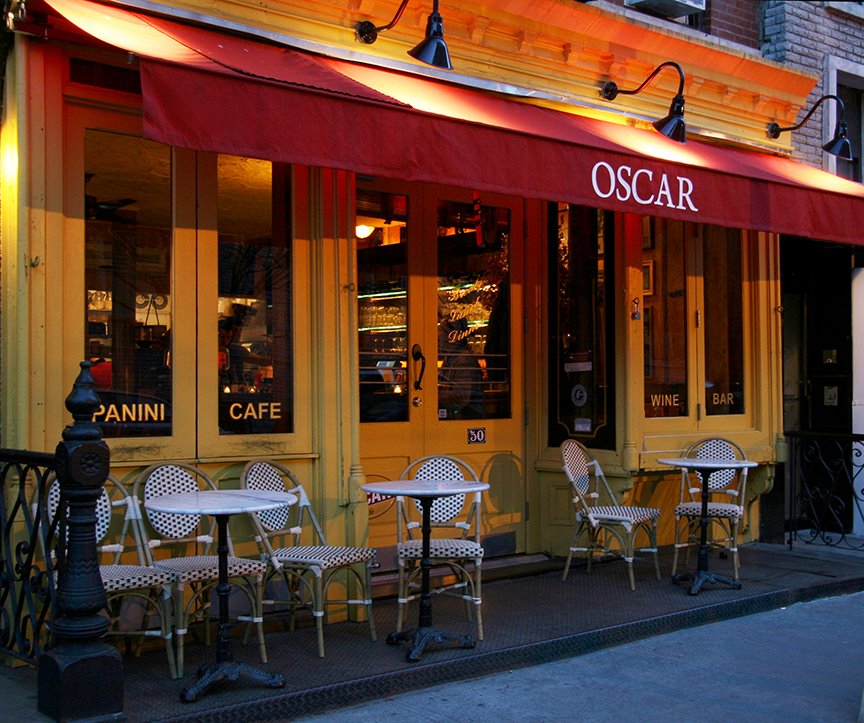
    And this is the block where I took today’s photo of absolutely one of the loveliest Parisian style cafe/bistros in the city – Oscar. Everything is so pristine and well appointed. The colors chosen for their exterior was complemented by the setting sun – it exudes the character of an authentic French cafe. You have to look hard to find this kind of place in such a bucolic setting.

    Rapidly changing landscapes all over the brief distance of one kilometer. This is one of the greatest things about New York City – different worlds unfolding as you walk…


  • Foraging and the Hunt

    In August 2007, I wrote an article, Lunch Limbo, about the perennial dilemma regarding lunch in the city: what to eat. We are spoiled with the plethora of foods here, but in time, we still become bored with the choices: the deli counter, the salad bar, or perhaps the classic New York fall back: a “slice” (of pizza).

    Restaurant delivery is an option, but then you have all that planning, ordering by phone, and the waiting. Bringing your own is an intelligent strategy – you get just what you want the way you want it and without paying wildly inflated prices. This however, requires advance planning, preparation, and the schlepp.

    Often, nothing seems really satisfying without foraging or the hunt in the concrete jungle. Enter the food cart – a great solution that satisfies these desires rather nicely. However, finding a quality food cart is not easy. There was a cap on vendor licenses instituted in the 1980s; permit holders typically have just held on to them, and most vendors sublease their permits.

    In Lunch Limbo, I did mention Calexico’s food cart in the heart of SoHo at the corner of Prince and Wooster Streets. Lines there quickly become extraordinarily long, so my experience with them in 2007 was singular. The cart was opened during the summer of 2006 by three Vendley brothers: Jesse (an ad copywriter), Brian (a graphic designer), and David (a musician). They hail from Calexico, California, where their experience growing up with carne asada inspired the venture. Original plans for a restaurant were derailed by a visit to the Vendy Awards competition, and the Calexico cart was born. In 2008, Calexico won their own Vendy Award.

    They have since opened a second cart at the corner of Broome Street and Broadway. Here, they offer an abridged version of the the full menu of the Wooster Street cart. Although the lines at the new location can also get long, they have a very efficient system of collecting orders and giving you a time estimate. I typically take a stroll of some minutes, return, and voila – my food is waiting.

    I had been critical of the lines and overall hoopla until I started eating there regularly and found out why they won the Vendy award, not the Trendy award. The food is excellent, and the guys have gone the extra mile or two to make a quality product. Their meat is marinated overnight and their rub had been customized by a professional spice mixing company. That’s what their patrons are waiting for. See their website here.

    These photos were taken a short time ago when there was still some snow on the ground. As you can see, frigid weather does not daunt the serious, hungry New Yorker from foraging or the hunt 🙂

    Related Posts: Street Cuisine (NY Dosas), Trucks and Things (Van Leeuwen Artisan Ice Cream), Bon Appetit (the Dessert Truck), No Folding Required (Vinny Vincenz Pizza), Soup Kiosk


  • Kind Words

    As he stepped into my office, I recognized his gentle and polite manner. After exchanging how-are-yous, conversation quickly turned to his last show, Typo, some years ago in New York City at the New Victory Theater. I remarked how I had really liked it, to which he responded, “Yes, and you had kind words.”
    Kind words. Now that’s a phrase I don’t hear often in New York. Not that acts of kindness don’t exist. It’s just that his choice of words has a gentle courteousness about it that left the phrase rolling in my head for days.

    I have always contended that the cliche of a New Yorker stepping over a fallen body (rather than helping) is a bit of an exaggeration. Although New Yorkers can be perhaps harried or brusk, when there is genuine need, many will rise to the occasion. I have seen an attorney on Broadway draw a handgun on two individuals in a knife fight to keep if from escalating, while the crowd waited for the police to arrive.

    I am not, however, likening New York City to a small rural town, where friendliness and helpfulness can often be disarming. I have the privilege of meeting many performers from outside New York City, and their manner is often like a brief visit to another place and frequently a window to a more gentle world.

    Jamie Adkins is an internationally recognized talent with many awards and credits. He started his performing career at age 13 on the streets of San Diego. Jamie currently resides in Montreal, where he has worked with Cirque Éloize in the show Excentricus and with whom he collaborated to create Typo. He has worked with Cirque du Soleil in Wintuk.

    His new one-man show, which I saw Saturday afternoon at the Tribeca Performing Arts Center, is entitled Circus INcognitus. In this essentially silent work, he showcases his many skills – juggling, mime, clowning, hand balancing, slack-rope walking, and his routine with freestanding ladders. You can read more about him on his website here.

    Jamie’s affable character permeates his show, and I am not the only one to notice. From a review of Typo in the New York Times:

    “… throughout this pleasantly casual, mildly daffy homage to old-time acrobatics. The show, aimed at young audiences, gives Mr. Adkins a chance to show off an impressive array of juggling and ladder-walking and slack-wire balancing skills. Just as important, it gives him a chance to show off a breezy likability that can’t help but bring Charlie Chaplin to mind…. The show is so genial that you can’t quite tell if the occasional drop is intentional, and you don’t care anyway.”

    Yes, and those are kind words 🙂


  • Wild West

    There are phenomena in New York City which are the result of the unique confluence of numerous factors – population density, large ethnic groups with their cultural traditions, and what I perceive as a certain lawlessness and laissezfaire attitude regarding victimless crimes in New York.

    It’s really a question of numbers. Any densely populated city affords opportunities not found elsewhere. For example, there is always some need for emergency umbrellas with the onset of an unexpected downpour, but only a place like Manhattan will offer enough potentiality to actually buy umbrellas, set up on the street, and make it a venture, as I wrote about in Opportunity.

    For some time, there were the squeegee men – individuals, particularly in the Bowery area, who worked washing the windows of cars stopped at traffic lights. What started in New York as a annoying “service” eventually became tantamount to blackmail – the windshield washing was done hurriedly without asking permission and was followed by demands for payment. Mayor Rudolph Guiliani effectively eliminated the squeegee men as part of his Quality of Life campaign.

    One activity that remains and can be often seen around the metropolitan area is the sale of flowers on highways. This is obviously a dangerous activity for both the vendors and motorists. Arrests are occasionally made and fines collected. According to a New York Times article, many of these flower vendors are Ecuadorean – you can read the story of one man’s trials and tribulations here: Hard Way to Sell Flowers: Dodging Cars and the Police.

    Turning corners and not waiting for pedestrians, double and triple parking, jay walking, counterfeits of luxury products sold openly on the street, known drug dealers chatting with police officers – all somewhat surprising activities in a first-world city in the 21st century.
    But Americans don’t really like rules. I often think of the wild west as symbolic of the American temperament, with New York City keeping that tradition alive 🙂


  • Peter Lik

    America’s image is synonymous with self-empowerment. However, even in the land of opportunity, there are reasonable limits on what a person can do. It is unlikely that a person in his/her 40s can become a competitive gymnast or that someone with an average GPA will get into Stanford University and become a research physicist. The idea that you can be or do anything in the USA is oversold. Most of the late-night self-improvement televangelists are just not being honest. The world is built on the backs of ordinary people, working hard and doing ordinary things. Starting a business and entrepreneurism is something in your blood. A workshop or book will not turn a company man or woman into a business tycoon. And that’s good – someone has to do the heavy lifting and keep the engine of our country operating.

    Photography is a field where making a living is quite difficult, particularly if one wants to find work other than weddings or functions. There has been criticism of photography educational programs – very few graduates will ever make a living working in the field. And to sell substantial amounts of work is not a small achievement.

    However, it is good to think outside the box and not take the advice of naysayers and self-defeatists to heart. And for the driven, ambitious, talented, and tireless self-promoter, the land of opportunity and streets paved with gold does exist.

    I happened across a new gallery of photographer Peter Lik in the heart of SoHo by accident and was drawn in by what appeared to be work of extraordinary craftsmanship and detail.
    I was told that Lik is the most awarded landscape photographer in history as well as the most financially successful – Peter has leveraged his skill set quite remarkably. I watched a number of videos on his site and was absolutely astounded to learn that Lik has 13 galleries worldwide and grossed $35 million dollars in 2008, with expectations for greater revenue in 2009.

    Peter Lik was born in Australia of Czech immigrant parents. He currently lives in Las Vegas, Nevada, which he uses as a jumping off point for his photographic excursions of the American west. He shoots panoramas with a Linhof 617 Technorama camera, using Fuji Velvia film and a Hasselblad with digital back. He uses drum scans and prints his photos on a Silver Halide Fuji Crystal Archive paper. Careful examination of his work will reveal an astounding level of detail, color saturation, and luminosity. Some have criticized his work for heavy post-processing. In his defense, however, I think one has to judge art photography by the result. Darkroom manipulation of photos has been going on since the beginning of photography. I recommend a visit to one of his galleries; even if you cannot afford his work, it is interesting to see Lik’s photographs in person, and many book collections of his work are available…

    Please note: Comments for this posting have been suspended due to controversy over Peter Lik’s work and his organization.


  • Third Anniversary

    NAVIGATION NOTE: Each of the images below is linked to the original posting.

    Yesterday was the third anniversary of New York Daily Photo – 953 postings and thousands of photos! I have put together a collage of 48 photos from the last 12 months, featuring many favorite postings of mine and of visitors to this site. I have assembled as wide a spectrum of photos as I have on this website – street life, parades, architecture, food, vistas, art, music, nature, local businesses, the unusual, the hidden, and the whimsical. In the last year, I have provided a more personal view in many of my writings, with this site becoming not only a window to New York City but also a window into my soul as well as into how I see the city, with stories and anecdotes from my life both here and and outside of New York. Thanks to all of you for visiting.


  • Snow Temples

    Snow mounds in New York City are like shag carpeting in a cheap motel – better not look too deep inside, because the contents are not pleasant at all. And no need to, because soon, when melted, all will be revealed.

    To some, mounds of snow appear to be a good place to discard all manner of trash and for their dogs to do any business. As if somehow the refuse will take on the properties of snow and melt along with it or, perhaps, seeing dirty piles of snow as sanctioned trash receptacles, permit them to add to it incrementally.

    Whatever the case, when snow accumulates in this city (and it does from time to time) and is shoveled and plowed, remaining piles can become temporary embalming sites.
    For a time, dirty mountains of snow become temples for garbage. Trash pickups are reduced by the city and street sweeping delayed until snow is gone. Bags of garbage accumulate to adorn the mountains of dirty snow.

    Just as autumn leaves require certain conditions for optimal fall foliage color, ideal conditions for large captures within snow temples also exist – amount of snow, length of time on the street, and temperatures during various periods with adequate time where the snow is soft enough to swallow and entomb any trash deposited on it. A nice freeze gives the whole thing the aura of secret treasure until the days of melting. I’m reminded of the 50 cent secret prize of childhood that you could order, guaranteed to be of greater value than 50 cents. That prize, unlike the treasures entombed in the gray snow temples of New York City, was worth waiting for 🙂


  • Flash of Light

    New York Daily Photo started originally as a photoblog, a publishing format where postings are driven by photos rather than text. In time, however, with an interest in research, small descriptions grew to longer articles. With an interest in giving subjects a less clinical and more personal view, I have drawn from anecdotes in my life, and the writing in many postings may be better described as stories and are more about the story than the photo. Now there is an expectation, both on your part and subsequently on mine, of writing.

    I have come to really enjoy the writing of this blog, and recently, in reading about writing short works, I came across an entire genre of fiction which I was completely unaware of: flash fiction, aka sudden fiction, microfiction, nanofiction, micro-story, postcard fiction, or short short story. There are even types of fiction which use exact word counts: 55 Fiction (55 words), the Drabble (100 words), the Drouble (double Drabble or 200 words), and the 69er (as the name suggests). There is no better time for flash fiction with the growth of visual media, competition for everyone’s time, sound bites, and the decline of book reading.

    The bane of nearly every student of English in high school was the dreaded writing assignment where there was a word length requirement. For me, being somewhat verbose, these assignments were not quite as painful, but there still was always the concern that I would not have enough truly meaningful things to say. Certainly there is value in exposition and learning articulation skills, but there also is much to be said for using one’s words sparingly and not padding the writing. I am sure that flash fiction would have been heartily welcomed in my English classes.

    Flash fiction is, of course, not without its critics. In the same way that assignments with minimum word lengths may encourage verbosity, some feel that flash fiction with maximum or exact word lengths is no better, artificially paring a story down where perhaps a few more words may have improved the story. I think there is value, at the very least, to use flash fiction as a writing exercise.

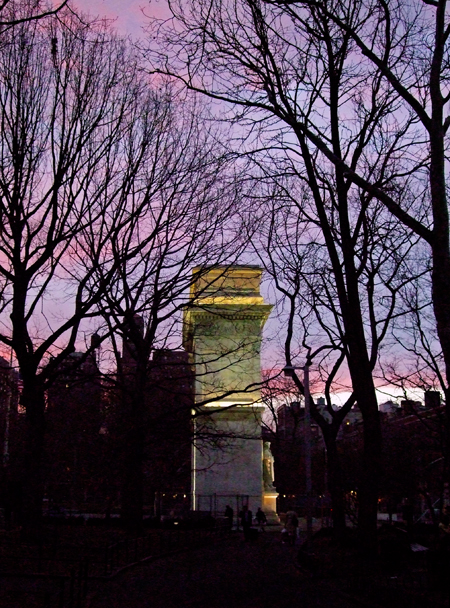
    I hope you enjoyed today’s unnecessary digression because, after all, not only is brevity the soul of wit, but this picture should also be able to speak for itself and be worth at least four hundred and one words 🙂

    PHOTO NOTE: I witnessed this dramatic pink and blue sky framing the Washington Square Park arch on Wednesday evening, March 11, 2009, at 6 PM.


  • Run

    Walk Quickly, Hurry, Run – I am running out of unique words and phrases to convey the urgency to you if you want to see Olde New York before it disappears completely.
    Vesuvio has just closed. This was my first posting on March 17, 2006. The choice of making it a first posting was not whimsical at all – Vesuvio was emblematic of the quintessential small, family-run business. Its images were used everywhere to represent New York City.
    There are many places which have closed since I started this website in 2006. Some I captured before closing, some immediately after, and some I did not get the opportunity to photograph at all.

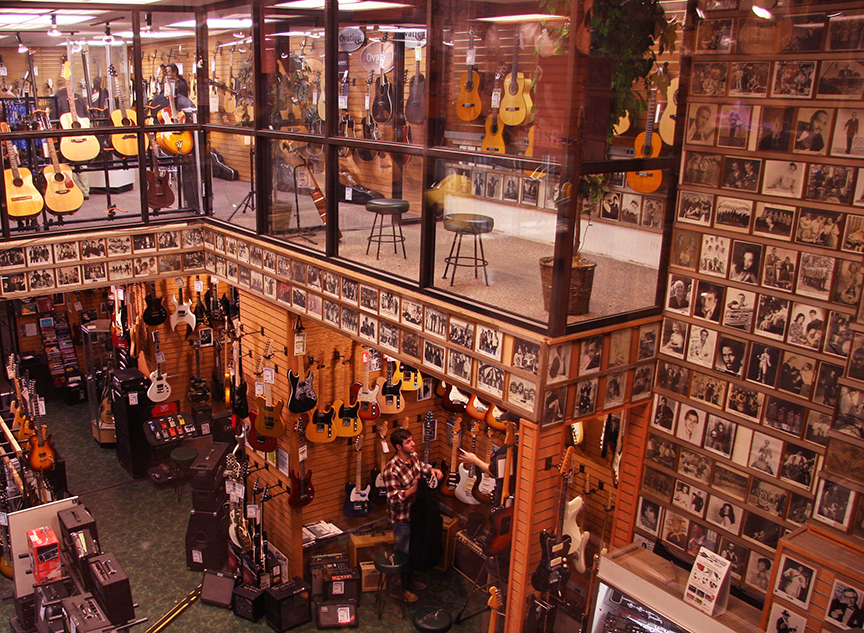
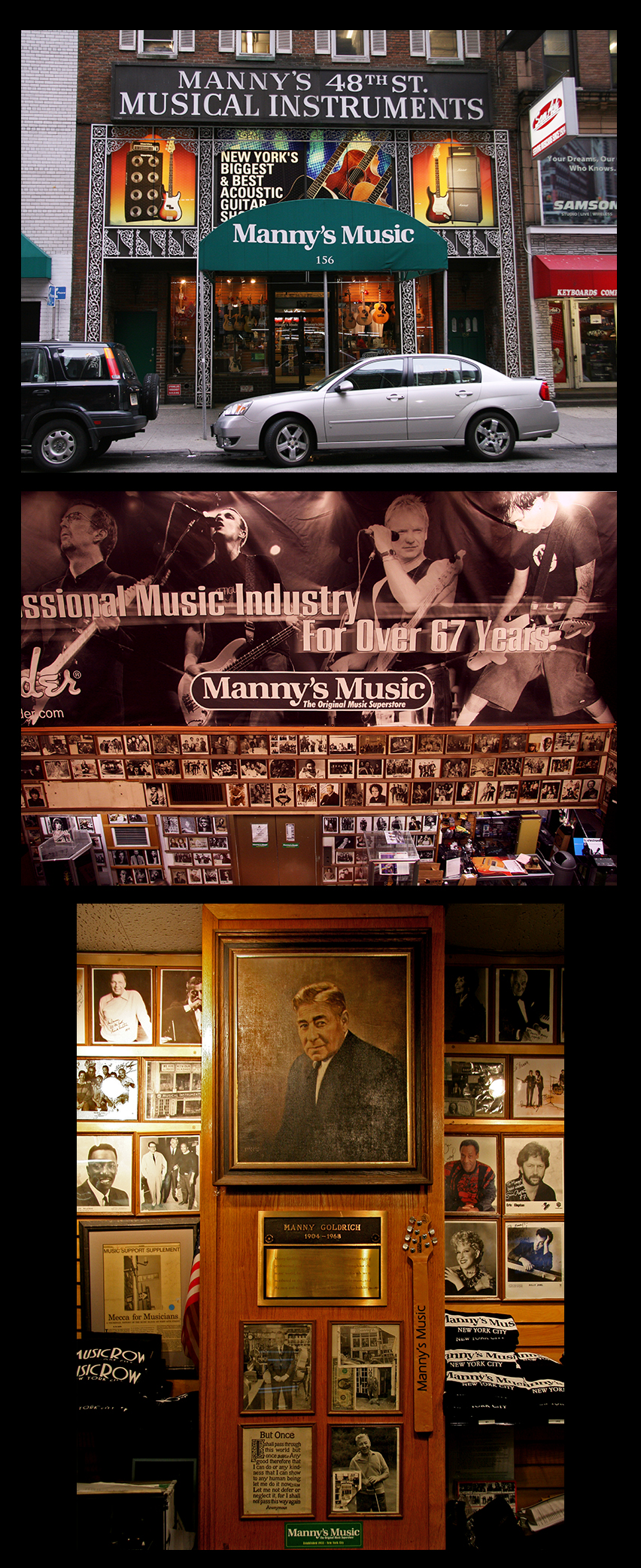
    Manny’s Music at 111 West 48th Street is one of those places that goes beyond nostalgia and providing a basic service. This is a business that had an influence and provided musicians the tools of their trade for 74 years. The business was started by saxophone salesman Manny Goldrich in 1935. He passed it on to his son Henry, who then passed it on to his two sons in 1998. In 1964, Manny died at the age of 64. See more photos of the store here.

    Manny’s is not just a great mom-and-pop store – this establishment is a legacy business with a unique heritage. Over the course of many decades, hundreds of legendary musicians have passed through their doors. Their signed photos cover the walls – Jimi Hendrix, Duke Ellington, Chuck Berry, Buddy Holly, the Rolling Stones, the Beatles, Michael Jackson, Eric Clapton, U2, and Nirvana are just a few among the crowd. This display, known as their Wall of Fame, has been documented by in a book by the same name.

    In 1999, Manny’s was sold to rival Sam Ash, located across 48th street on the block known as music row. The word is, however, that larger business interests are slowly accumulating all the properties on the street and that Sam Ash will also meet its demise.

    So if you have been making a checklist of places to see and things to do in New York, add Manny’s, which is scheduled to close at the end of May 2009. And don’t walk, run…


  • Unpolished

    The best laid plans of mice and men often go awry. I am not against planning, nor do I fully embrace an unbridled, reckless, impulsive lifestyle. However, I do believe that, especially in New York City, being spontaneous can be rewarding and lead to some pleasant surprises. I highly recommend occasionally wandering this city with no agenda. Looking through the postings I have done on this website, the majority of the most interesting experiences were the unplanned. One of the most remarkable was my running into a major street healing with internationally renowned preacher Todd Bentley. Of course, planning the unplanned is itself a tricky proposition and can lead to forced spontaneity, with results perhaps as unsatisfying as overplanning.

    With none of these thoughts in mind, and just meandering the streets on a warmish evening, my steps led me to Terra Blues. I thought I would take a quick peek inside. It was after 11 PM. There is no cover charge at these times, so I walked right in. Typically, this club is quiet on a week night.

    I was rather shocked to find the place jammed, with the feeling of a religious revival meeting. The leader of the band, who I was later to learn was Slam Allen, was walking and working the audience, shaking hands and greeting everyone in the middle of his music set. Extremely amiable – Slam appears to make bonding with an audience the absolute center of his performances. At one point, a woman started singing to him in a voice which, if not trained, was startlingly confident. In New York City, any performer should be prepared for this – I have often seen talent in an audience which is greater than that of the performer.

    Many performers would give something like this a lukewarm reception and patronizing approval, perhaps feeling upstaged. But Slam was wowed, not threatened or competitive at all, and, without hesitation, insisted she join him onstage. They did a number together – the photo is a still image from a short video I took – you can see the one minute clip here. Be forewarned – the quality of the video is rather unpolished, as the spontaneous often is…

    NOTE: Slam Allen is a singer and guitar player who does a blues/soul fusion. His pedigree and career are quite notable, playing with greats like James Cotton.


  • Cabin Fever


    In cities like New York and Paris, where living spaces are smaller and street life is so vibrant, cabin fever and the craving for spring reach a level where people become irrational in their desire for warm weather activities and wardrobe. A hint of spring, and some are dressing for August – at 60 plus degrees, I am seeing flip-flop sandals, shorts, and T-Shirts. And beach goers. You get a feeling that their summer wear is waiting by their doors, lest they risk spending even a second outdoors in clothing even a bit too heavy for the day’s warmest moment.

    I am seeing tables dotting the sidewalks and people with coats on eating al fresco with temperatures in the 50s. The snowstorm of only one week ago is already forgotten.
    Preferences for climate and season are as varied as people themselves, but who is it that is not pleased by a coming spring? And what place is not improved by the onset of spring, a time synonymous with renewal?

    The photo was taken on the rocky beach in Dumbo at the foot of the Manhattan Bridge looking northwest towards Manhattan – you can read about it here with more photos. This area is one of the most scenic in New York City – both the neighborhood itself with buildings, cobblestone streets, the East River waterfront, our trinity of bridges (Brooklyn, Manhattan, Williamsburg), and vistas of the Manhattan skyline. That’s a lot of punch for your dollar, and these people were delighted to spend it 🙂

    Related Postings: Sink or Swim, Night in Bloom, Dumbo Arts Fest, Gallery View, One Front Street, Eagle Warehouse, The Watchtower, Loaded, Cuts One Way


  • Viktoria’s Secret

    To launch a website for a new product line of hoops, we wanted photos that would differentiate us from other vendors. We decided to go for imaging which would have an unmistakable New York City look. What better place than a rooftop with views of water tanks, ventilators, high-rise buildings, and the Empire State Building? Or the waterfront in Brooklyn with the Brooklyn Bridge as backdrop?
    Of course, we needed a hooper who not only had the skills but also was not afraid of heights. We happened to know just the person.

    Meet Viktoria Shvartsman, professional contortionist, acrobat, aerialist, hand balancer, juggler, and hooper. When I asked prior to the shoot, just as a formality, if she was afraid of heights, she laughed and said, “Absolutely not.” Perfect, because we wanted precarious looking stunts. The afternoon photoshoot was split between the rooftop and Brooklyn waterfront in the Dumbo neighborhood in Brooklyn.

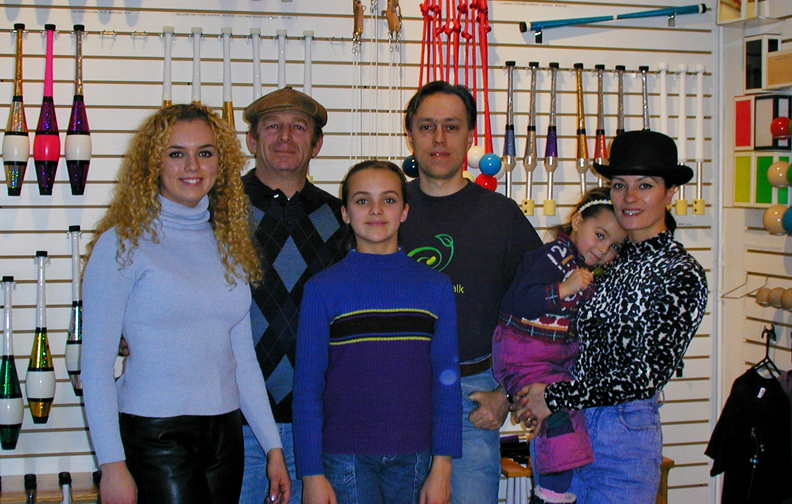
    Viktoria is part of the fifth generation of a circus performing family that dates back to 1912 in Russia. Her older sister Gena and younger sister Maria are also performers, as well as her father and mother. Here is a photo from 2002 of the entire family, including her mother, father, and myself in my studio. If you would like to see a performance montage of her act, you can find it here. (Update 1/4/12: This video has been taken down.)

    Viktoria has acted and modeled. She has been in two international circus competitions, including the world circus competition in Italy and Premier Rampe in Monte Carlo. She has been in various TV shows, including ABC Family’s “Switched,” and has performed in numerous venues: Busch Gardens Tampa, Hannaford, Cirque Du Joir, Ringling Brothers and Barnum and Bailey Circus, Circus Hamid, Circus Circus, Grand Tunica, and Mohegan Sun.

    I have known her since she was a young girl. Like her two sisters, she is extremely pleasant and personable. Very talented and confident yet humble. And now you know Viktoria’s secret 🙂

    NOTE: The story of my business can be found in Signature and Juggle This. The newly launched hooping website can be found here.

    Related Postings:  Artiste Extraordinaire, Spinning, Fire and Drums, Spiegelworld, Titans


  • Lights on Broadway

    [LightsOnBroadway700.jpg]The city daily photo concept was started by journalist Eric Tenin of Paris in March 2005 with Paris Daily Photo. The original idea was to show a daily slice of life in Paris. The idea spread to now include hundreds of cities worldwide. The idea is a noble one, but most readers do not want to be privy to all the mundane chores of everyday living, so Eric’s site, like most of the others, show a side of daily life of interest to outsiders, which includes a spectrum of the more known to the lesser-known.

    There are many things which are both unique and so commonplace in many locales that they are part of the fabric of that city or town but perhaps not blogworthy or worthy of inclusion in a travel guide. The establishments every resident knows and uses. One of those places in New York City is Duane Reade, a local chain of stores that dominates the pharmacy business and is part of the love-hate relationship many New Yorkers have with this city.

    At one time, there were only TWO all-night drug stores in Manhattan. A late-night pharmacy was a huge deal. Now Duane Reade is ubiquitous and New Yorkers are spoiled; we all just assume that a Duane Reade is a few steps away. And they are, with over 240 locations throughout the five boroughs and nearby suburbs, 59 of which are open 24 hours (5 with a 24-hour pharmacy). Two locations offer walk-in medical care.

    However, although on paper these places seem like a godsend, many tend to fall down in service and overall management. Like many discount operations in New York City, getting good help at low wages who will take their jobs seriously is difficult. The experience in this chain tends to be uneven. There is even a blog, I Hate Duane Reade.
    But the situation is really quite similar to the arrival of big box behemoths such as Home Depot or Kmart. While many bemoan their presence, complaining of service and quality of product, many secretly appreciate the pricing, selection, and hours.

    One of the big factors in this equation is the walking nature of the city. In the suburbs, most customer patronage of retail stores is not so much a function of proximity to one’s home or neighborhood. Bad service or better pricing, and customers will just drive elsewhere.
    But in NYC, neighborhood delis and drugstores have virtual captive audiences – most residents will shop at the most convenient location to their home or office. Add competitive pricing and late hours to the mix, and you can see why service is overlooked.

    The quality of the Duane Reade establishments themselves vary quite a bit – some are newer and more spacious than others. I was surprised with this one in the Times Square area, appropriately (but atypically) with neon-framed windows. Quite visible to the person in need, but invisible to the visitor awed by the other lights on Broadway…

    NOTE ABOUT THE NAME: Duane Reade was named after their first location in 1960 on Broadway between Duane and Reade streets.


  • Walk Quickly

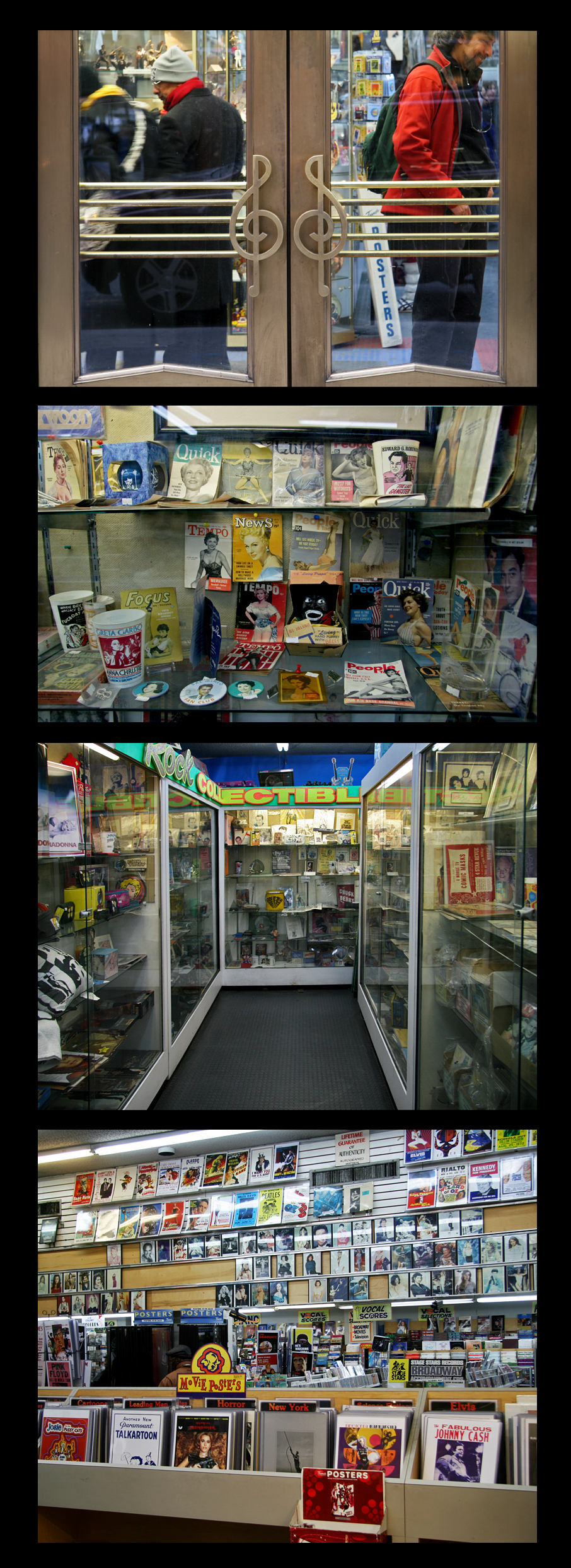
    This is not a story of vanishing New York, fading New York, forgotten New York, lost New York, or the End of an Era. This is the survival of tradition. Olde New York. It does exist. And you can find it at Colony Records. See photos inside here.

    Colony Records was founded by Harold S. Grossbardt and partner Sidney Turk in 1948. Born in Brooklyn, Harold started work after the seventh grade. He was a salesman at Melody Music Shop in Brooklyn and Colony Sporting Goods, located at 52nd Street and Broadway in Manhattan.
    When Colony closed for business, Grosshardt took it over and renamed it Colony Records. In 1970, they moved to their current location in the Brill Building, at 1619 Broadway at 49th Street.
    The Brill Building is its own story. Built in 1931, the building became a center for music publishing. By the 1960s, there were an estimated 165 music-related businesses in the building. Colony Records became a central fixture of Tin Pan Alley. Located here in the heart of the music and theater districts alongside nightclubs such as the Copacabana and Birdland, it was convenient to concertgoers and musical artists. Colony has seen a parade of legendary artists through its shop, including names such as John Lennon, Michael Jackson, and Frank Sinatra.

    I was impressed by Colony’s enormous selection of sheet music – reportedly the city’s largest. They also sell vintage vinyl records, CDs, and karaoke and have an interesting memorabilia selection. They also have posters and photos for sale.
    Of course, the survival of these emporiums is never guaranteed. So if you want to see them, I would not say that you have to run, but perhaps you should walk quickly...

    Note: Obituary from the New York Times: “Harold S. Grossbardt, a founder of Colony Records, the famed collector’s store now on Broadway at 49th Street in Manhattan, died on June 10 (2001) at his home in Aventura, Fla. He was 85. He is survived by his wife, Estelle; two sons, Michael J., of Roslyn, N.Y., and Alan R., of Great Neck, N.Y., who is an owner of Colony Records; a brother, Jerome, of Manhattan; a sister, Dorothy Capobianco, of Delray Beach, Fla.; and a grandson.”


  • Survival Guide

    I intended to tell you what I knew for sure. However, after reflection, I realize that it would only be what I thought I knew. So, I will tell you what I saw.

    What am I talking about? I was drinking a juice on the second floor of Whole Foods Market on Union Square at 10PM. The second floor has tables and has been designated as a space for eating food purchased by customers. It is a very casual cafe type of atmosphere.

    The place was abuzz with nearly every table occupied, even at that late hour. A man who had two overfilled bags knocked into my table while stepping on my foot. His canvas bags were stuffed with all manner of goods, including what appeared to be an empty paper coffee cup.

    The most noticeable thing about this man was his enormous bulk from his layers of coats. He removed his large outer coat and went off briefly, leaving his bags unattended. He returned rather quickly with a paper plate of pasta. However, it felt too quick for him to have gone through the Whole Foods line. So this is where I started to pay attention.

    He took his plate of food to the microwave provided by Whole Foods for reheating of food. I say reheating because a sign was clearly posted that the microwave was for reheating only. After pondering this for some time, I realized that due to the volume of people and with what appears to be no one policing the floor, the space and services offered are most likely used by the homeless – warm places to sit, water fountains, and bathrooms – with some perhaps preparing meals from foods brought from outside.

    The mechanics of survival of the homeless, quasi-homeless, and severely disadvantaged are seen by most of us in sight bites. I am sure that there is an undocumented survival guide known by many of the have-nots who enumerate the soup kitchens, public bathrooms, and best places to pass time, such as bookstore cafes and public spaces (libraries, bus and train stations), places to sleep, and how to get or recycle food. I am reminded of stories I have read of the old Horn & Hardart automats of New York City, where poor writers often made tomato soup from ketchup and hot water or bought tea with bread and made pickle relish sandwiches.

    The man ate and left as quickly as he came. I have made an assumption about him – I could be very close or very far from the truth. I have seen him frequently in public parks. Knowing the source of that pasta would have told me much more…

    Note: The 2nd floor at Whole Foods at Union Square is a superb place to have a snack with great vistas of Union Square Park, all the activities in that area, the Empire State Building, and the Met Life Tower.


  • dinamic_sidebar 4 none

©2026 New York Daily Photo Entries (RSS) and Comments (RSS)  Raindrops Theme