• No Folding Required

    I don’t think I am going too far out on a limb to say I truly have never met anyone who doesn’t like pizza or will not eat it. I can’t say that about any other food. The appeal crosses cultures and countries. Perhaps because every culture has some variation on bread or pasta/noodles, pizza is not so alien. Unlike delicacies such as partially fertilized eggs (southeast Asia), blood pudding, fried grasshoppers, or any one of the variations of animals’ feet, all will take some mental and intestinal fortitude for the uninitiated.

    In many countries, pizza has become the most popular fast food. In New York City, it is a staple and is the perfect food to be eaten on the run. Fold lengthwise and you can eat it one-handed – now you can be easily mistaken for a New Yorker. Pizza is everywhere in this city – it is one of the most durable foods, resistant to the slings and arrows of food fancy and trends. There have been gourmet players such as Two Boots, but basic New York pizza has been remarkably immune to change. The plain slice is still the staple of many, churned out in parlors in every neighborhood in the five boroughs.

    I was quite surprised to see Vinny Vincenz’s mobile operation. Making pizza out of a truck seems like quite an ambitious venture, but Vinny has actually installed a full-sized, gas-fired pizza oven. I did not try a slice, but online reviews seemed quite favorable. Vinny was born in Carrol Gardens, Brooklyn, and has been making pizza since he was a young boy. He started his pizza enterprise with the parlor located at 231 1st. Avenue. His truck can be found on Union Square, where this photo was taken.

    Regular readers of this blog know that I am a big fan of street food, particularly quality operations where ethnic cuisine is cooked on the spot such as New York Dosas, which can be regularly found on Washington Square South.

    Vinny specializes in Sicilian-style pizza, perfect for the New Yorker or visitor on the go – no folding required…

    Related Postings: Two Boots, Street Cuisine, Lunch Limbo, Soup Kiosk, Trucks and Things, Bon Appetit (Dessert Truck)


  • American Express

    I have met grown men – secure, strong, worldly men – who are absolutely terrified of cities, particularly New York City. To city lovers like myself, these fears seem completely irrational. I understand the fear, perhaps, of an older person or single woman walking in a dangerous neighborhood at night – this is courting trouble. But a grown person in a vehicle in broad daylight with an entire family in tow? What can really happen? If you get lost, you will eventually get unlost. In my experience, the worst that will happen is that you will be very inconvenienced for some time.

    The worst scenario to me is breaking down in an automobile in the city. Fixing a flat or getting a battery boost, simple acts elsewhere, can be a real headache here. Services are not readily available, and waiting for roadside service on a busy highway in a traffic congested city is certainly not pleasant. And if one would have to overnight in a hotel, that would be mighty expensive or very inconvenient.

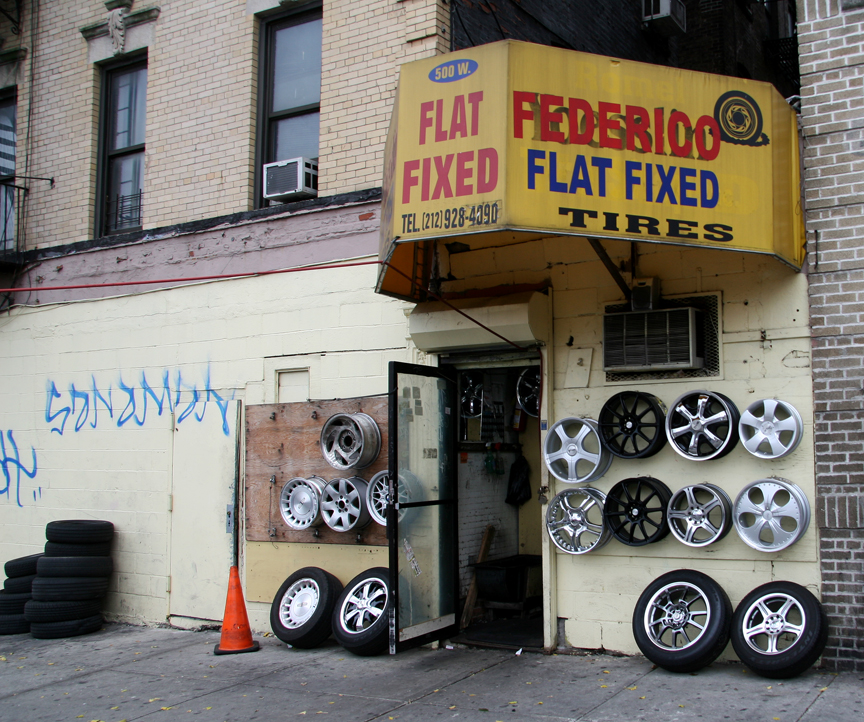
    There is no plethora of basic services, such as tire repair. Places like that in the photo are generally found in poorer neighborhoods and in out-of-the-way locations. Unless you know a neighborhood well, these places are destinations – the likelihood of finding them when you need them is rather remote. And escalating rents have conspired to make these places all but non-existent. The scarcity has made this type of subject a popular photo.

    Certainly being lost in a city or having trouble here, like getting a flat tire, is more troublesome than the same problem in the suburbs, and there is perhaps some risk of exploitation by opportunists (although our suburban or country brethren are not immune to this). In most cases, however, a little cash or credit card will be all that is necessary to extricate oneself from virtually any situation. I remember a conversation with a client of mine when I was younger and very inexperienced in travel. She was much older, nearing retirement and planning to settle somewhere on the coast of Italy. At the time, this seemed like such a fantasy and unfathomable to me for a number of reasons, language being one of them. When I asked whether she was concerned about not being able to speak Italian, she replied that she was not at all worried, because “They all speak American Express” 🙂


  • Undiscovered Beach

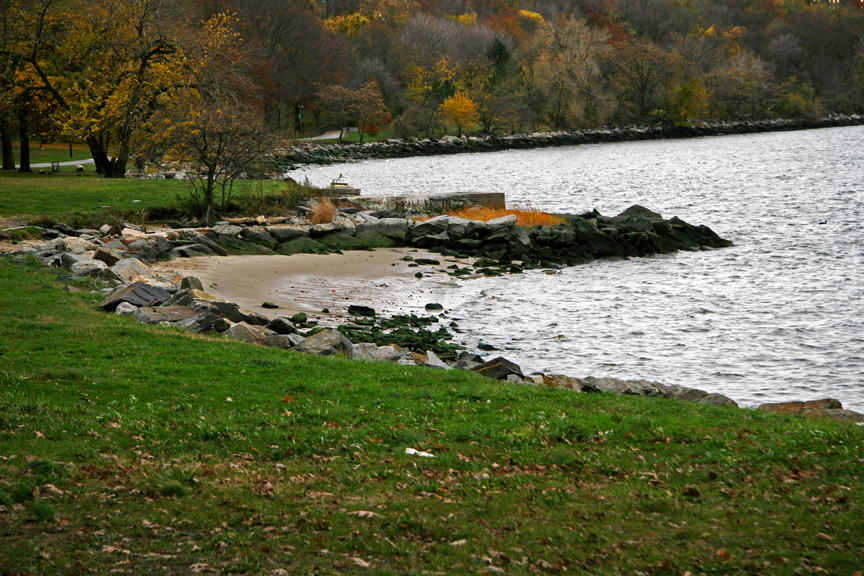
    This is a beach in Manhattan. It is not the palm-fringed beaches of Phuket, the reef-protected lagoons of Bora Bora, or the rocky coast of Maine, but it is a beach, and if I may say so, a rather attractive one. I was really stunned to run across this by accident on an excursion to the George Washington Bridge.

    Admittedly, this beach is in Washington Heights, quite a jaunt from from any place that generally comes to mind when discussing Manhattan. And many would argue that this area is further from midtown Manhattan than many areas of Brooklyn or Queens and that to champion it as Manhattan is only to be technically correct. That’s fair.

    So let me rephrase. This small beach is within the five boroughs and is accessible by subway, only a short ride from midtown Manhattan.

    But there is no need to promote it, for if you find it a little too far, too inconvenient, or out of the way, I am sure its habituĂ©s will be quite happy to enjoy this little secluded spot of sand with its rocky outcroppings alone and leave it undiscovered…

    Note about the beach: The beach is part of Fort Washington Park, located on the West Side of Manhattan along the Hudson River. This cove is roughly opposite 171st Street.


  • Swimming Against the Tide

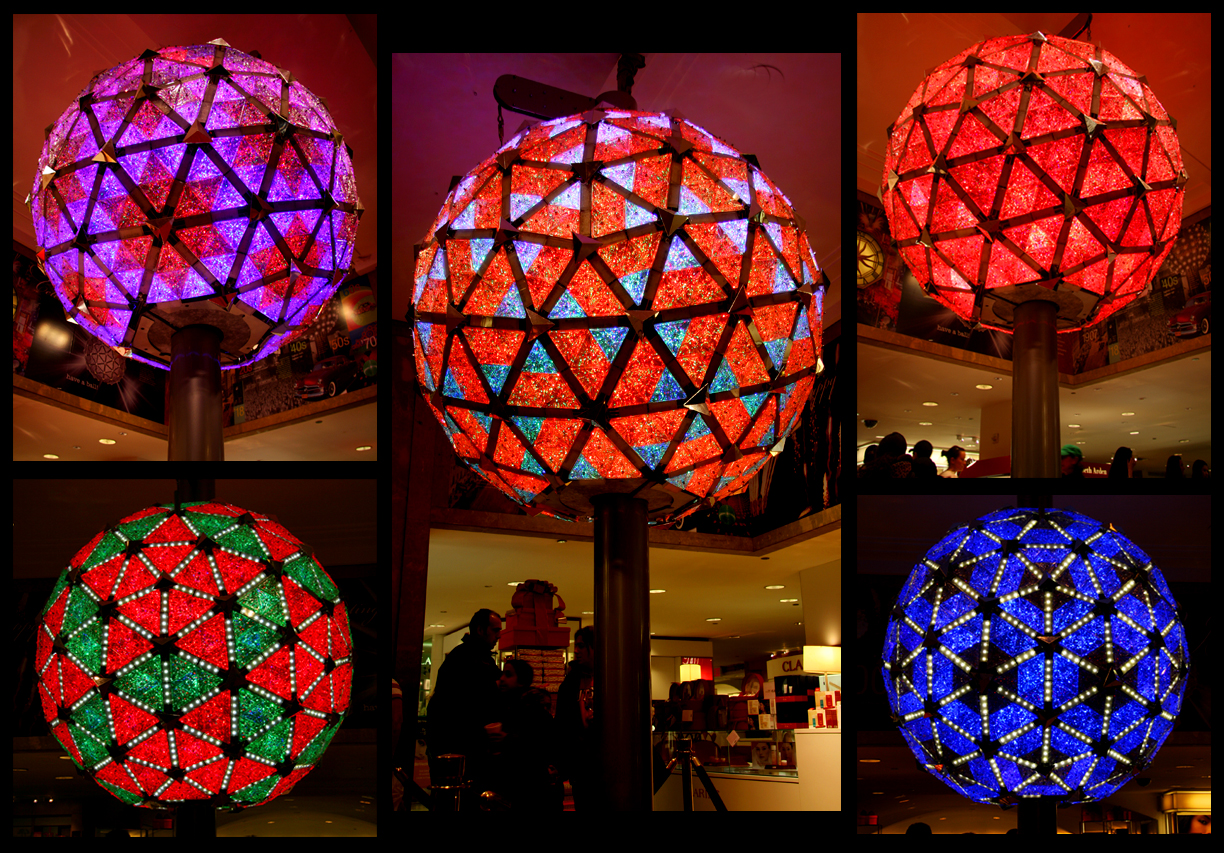
    On New Year’s Eve in 2007, I wrote of the ball drop in Times Square. At the time, I was disappointed to learn that prior to the drop, the ball was displayed at Macy’s, and I did not get a chance to see it closeup. On a recent visit, I was pleasantly surprised to see that the ball was already installed on the main floor and that I had completely forgotten about this recent tradition.

    It feels like Christmas promotions and retail store decorations come earlier every year as the push to maximize holiday business accelerates. At one time, Black Friday was the demarcation point for the start of the Christmas countdown, and even at that time, it seemed rather early to begin preparations over one month in advance. But any retailer has little choice in order to keep up with the competition. It is difficult to swim against the tide – barring some supreme effort, most will be swept by the current.
    This very posting is driven by the same pre-holiday frenzy – the ball is on display early. To write about it later would look like I missed the boat. Even though I do not see this blog as competing per se with conventional journalism, I still feel an obligation to “do” certain stories in a timely manner.

    Additionally, everything moves so much more quickly – in the electronic world, almost immediately. We no longer have the luxury of doing things at our pace. The speed of everything around us often dictates when we must do things. Of course, there are many ways and situations where one can buck the trend. To appreciate things on one’s own terms is a laudable goal and can provide respite from the pressures of living in a technological world.

    But for me, at Christmas time, readers here do not want a rebel, an iconoclast, or a man who swims against the tide. They want to see all the trappings of the holiday season – the windows at Saks or Tiffany’s, the tree at Rockefeller Center, and Santa at Macy’s. And perhaps I do too, for sometimes I tire of swimming against the tide…


  • Waldorf Salad

    I have a relatively restrictive diet these days, so it is hard for me to justify spending $95 on a brunch. But if I did feel that I could take advantage of the offerings, I would certainly try the Sunday brunch at the Waldorf Astoria hotel. I have written of this hotel a number of times before – if you have not been there, I highly recommend a visit. Seeing the public lobby space is a voyage to a time gone by.

    Staying at this grand dame is not as rarefied an experience as one might expect. It has become the hotel of choice for my family’s occasional visits to New York. With Internet discount websites, very good deals can be had on rooms at the Waldorf.

    In the course of my visits there, I have watched the magnificent spectacle that is the Sunday brunch. This minor weekly event is served in the Main Lobby of the hotel, so the nonparticipant can easily see the offerings in what has to be one of NYC’s finest brunches. Diners are seated in the Peacock Alley restaurant (opened in 1931) and private dining salons.

    The sumptuous brunch is put together by French chef Cedric Tovar, who earned his reputation at legendary, Michelin-starred Parisian restaurants such as La Tour D’Argent and Plaza AthĂ©nĂ©e Hotel Paris. I’m impressed that such quality can be maintained in a large, buffet-style meal. Buffets can very frequently become feeding at the trough – selecting food can feel like picking over someone else’s leftovers and quite unappetizing. At a first-class offering like this, however, you can put any of these concerns aside.

    The food choices themselves are, of course, spectacular, both in quality and range. Everything imaginable is available. Not to mention that technically, this is a no holds barred, all-you-can-eat affair with no restrictions. I doubt, however, that this brunch attracts the typical all-you-can-eat urban or suburban forager.
    And yes, unlike Fawlty Towers*, they do serve Waldorf salad…

    *For those unfamiliar, Fawlty Towers was a brilliant British sitcom from the 1970s starring John Cleese. Only twelve episodes were made but a lasting legacy remains. In one episode, “Waldorf Salad,” an American guest is frustrated in his inability to order a Waldorf Salad. Proprieter Basil Fawlty, unfamiliar with the salad or ingredients, feigns knowledge – the skit quickly escalates, with Basil going into an outrageous charade. Highly recommended, as are all the episodes.

    Related Postings: The Plaza, Waldorf Astoria Clock


  • Phoenix Rising

    West Eighth Street is an anomaly is this city. As one New York Times writer said, this one block seems to be defying the laws of gentrification. The center Village is one of the most expensive and desirable neighborhoods in New York City with multimillion dollar apartments as the norm, yet West Eighth Street’s merchants are a motley crew of businesses that cater primarily to tourists. Once known as the “shoe block,” the street sported dozens of shoe stores. Only a handful remain.

    The most telltale sign of trouble are the closed stores. Depending on the day, it is possible to see as many as 20 plus stores vacant on one city block.
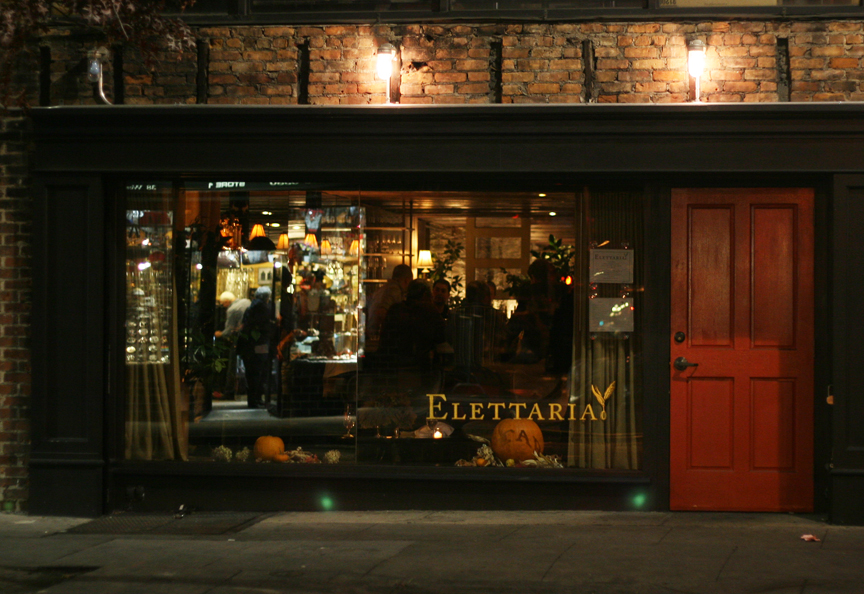
    But lately, there have been signs of hope that West Eighth Street may rise again, with the opening of two cafes, a winebar, and Elettaria at 33 West Eighth Street.

    We residents hope for this, not because we embrace gentrification and rising rents, but because we would like to see quality businesses, at least some of which provide useful services to the neighborhood.
    Elettaria does not exactly fit this description, but it could be one of the first signs of a break from the type of retailers this street has seen for as long as one can remember. The restaurant has had a lot of buzz and media coverage. It is extraordinarily upscale and chic for the street, albeit even a little intimidating. Until recently, it didn’t even post a menu in the window. The food reviews are generally quite good, with articles appearing this year in both the New Yorker magazine and the New York Times. The menu is unique: an Indian/Filipino/American fusion. Chef Akhtar Nawab and partner Noel Cruz have pedigrees that include the Gramercy Tavern, French Culinary Institute, and Craftbar. Negative reviews appear to be primarily leveled at the service.

    There was a time where Eighth Street and its environs actually had the types of places emblematic of its artistic heritage. The original Whitney museum was here, as was the New York Studio School of Drawing, Painting, and Sculpture (still operating). In the early 1900s, the area was already an established art district (see my posting on MacDougal Alley). From 1900-1950, there was a community of some 200 artists who lived and worked in the two blocks north of Washington Square (see Left Bank New York). Elettaria’s space was formerly a club, the 8th Wonder, where Hendrix and others played in the 1960s. Hendrix’s Electric Lady Studios is still in business on the block.

    One neighborhood activist I know predicts that Eighth Street will rise again. I hope so…

    Note about the restaurant: The name Elettaria is a species of cardamom, one of the world’s most expensive spices. You can visit the restaurant’s website and menu here (Update 1/9/12: Link no longer works).


  • Hell or High Water

    I’m running out of superlatives. Or perhaps, more precisely, I am running out of synonyms for words such as amazed, stunned, astonished, and shocked. Please go here and look at this series of 8 photos. See what I mean? Exploring this city is like going to Paris – you start to bore yourself with superlatives. Like crying wolf, they start to lose their impact when used so often.

    Of course, I could just let the photos speak for themselves. After all, this is supposed to be a photoblog which is typically driven by the images, with minimal or nonexistent text. But this website has metamorphised over time, and the writing has become as important as the photos. I believe that most regular visitors here enjoy reading as much as I enjoy learning and writing. So now there is an expectation.

    These photos of the New York Yacht Club were taken whimsically. I did not even know this place existed, however, it was spectacular architecturally. I did enter the premises and was immediately told that no photography was allowed. I had no idea what the interior looked like or whether visitors were permitted to tour the place.

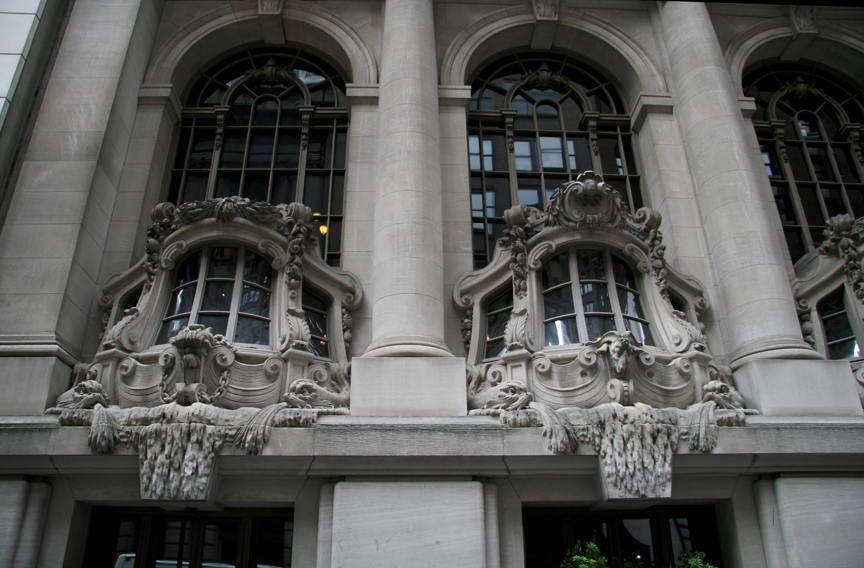
    The New York Yacht Club clubhouse is located at 37 W. 44th Street. It was designed by Warren and Wetmore, the firm also responsible for the exterior of Grand Central Station.

    From Christopher Gray of the New York Times:

    Founded in 1844, the club had several modest headquarters for its first half century. But the activity of yachting became so luxurious that by the 1890’s — with giant steam yachts of 200 feet or more — a new clubhouse seemed in order.
    A competition attracted entries ranging from the boring — R.H. Robertson’s plain design could have been a small-town businessman’s lunch club — to the opulent — Howard, Cauldwell & Morgan’s giant, modern French design with three windows shaped like the prows of oared galleys.
    The winning design was the first major work of the new partnership of Whitney Warren and Charles Wetmore. They produced a rich, five-story limestone front with three windows patterned after the sterns of early Dutch ships and a large terrace at the fourth floor topped by flagstaffs and a giant wooden pergola and trellis.
    It is the model room, though, that will astound the uninitiated visitor. Behind the facade’s three great windows, the model room stretches back almost 100 feet under a giant floral stained glass ceiling. Ringed by a balcony with a galleon railing, the room contains hundreds of full- and half-hull ship models, including one of every defender of the America’s Cup.

    After looking at photos of the interior, I’m going to see those rooms in person, come hell or high water. And if high water comes, what better place to be than the New York Yacht Club? 🙂

    Note: Membership to the New York Yacht Club is by invitation only. To tour the building, you must be accompanied by a member. 

    Related Postings: Transportation, Grand Central, Passing Time, The Oyster Bar, Just Passing Through


  • The New Yorker

    When you find at a place with a name and location like this, you assume that it has a rich history and many a story to tell. However, as is typical with many things in New York City, a little investigation will reveal much more than you ever imagined.

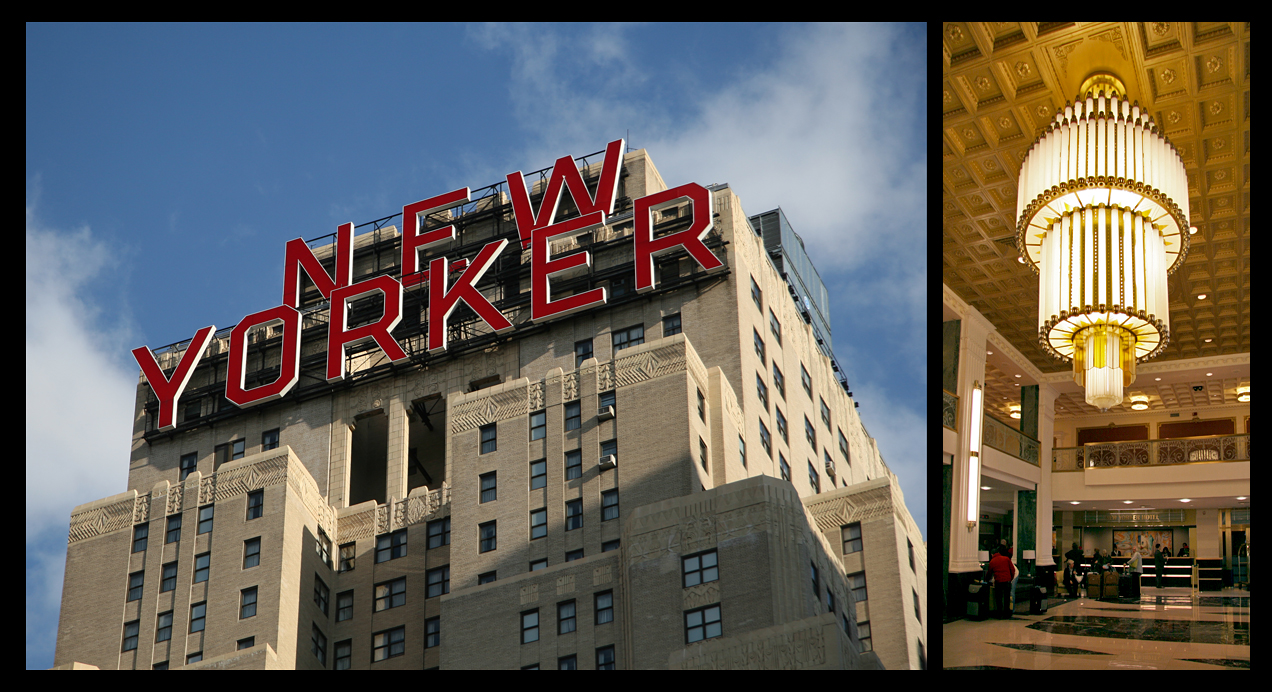
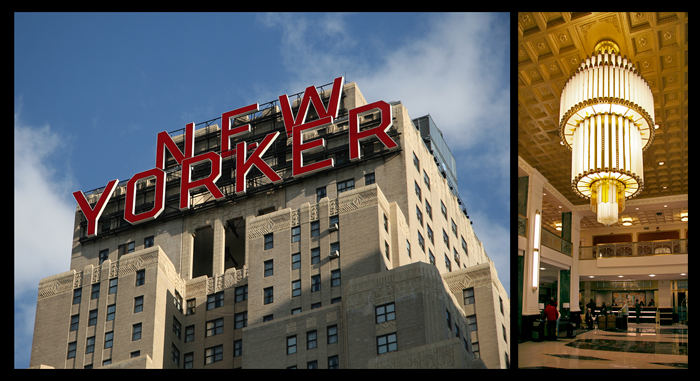
    The New Yorker Hotel, 481 Eighth Avenue at 34th Street, clearly outdid my expectations. The exterior signage in the photograph looked much too new to be original to the structure – some reading confirmed my suspicions and led to some fascinating reading. Designed by Sugarman & Berger, the New Yorker opened in 1930. The building’s art deco architectural style with tower set backs resembles the Empire State Building (which lies 3 blocks east and was completed in 1931).

    Names, dates, and figures, the bane of many a history student, are often necessary to give a true feeling for a place. Many specifics are easily forgotten, but hopefully the impression remains that this was quite a place – the facts about this place are truly amazing. Of course. its central location in midtown is a big plus – walking distance from Port Authority Bus Terminal, Macy’s, and the Javits Center, with Penn Station across the street.
    The New Yorker Hotel, a marvel of its day, was the largest hotel in New York with 2,500 rooms. In addition to the ballrooms, there were ten private dining “salons” and five restaurants employing 35 master cooks. The barber shop was one of the largest in the world, with 42 chairs and twenty manicurists.

    There were 92 telephone operators with 3200 phones and 150 laundry staff washing as many as 350,000 pieces daily. This was all supported by America’s largest private power plant, which the New Yorker had installed down in the sub-basements. There was a ten-room hospital, a theater ticket office, and a transportation department. Some of the rooms had private sky terraces or roof gardens.

    With the arrival of the Big Bands, the stage was set for the “heyday” of the New Yorker Hotel. The famous bands of the day played at the New Yorker, including Benny Goodman, both of the Dorseys, and Woody Herman. This atmosphere not only drew in business travelers and tourists but also attracted the elite of society, as well as political figures and business leaders. The Brooklyn Dodgers, with Manager Leo Durocher, headquartered here for the 1941 World Series, and Joe DiMaggio lived here when the Yankees were in town. The 1950’s – 60’s did not turn out to be as prosperous as previous years, and the New Yorker closed its doors in 1972.

    A less savory piece of history is its decline and closing in 1972 and purchase by Sun Myung Moon’s Unification Church in 1975. The building was used by the church until 1994, when it reopened as a hotel (since 2000 it has been part of the Ramada franchise) and has gone through extensive renovations. It will maintain the classic Art Deco style but will see many upgrades to bring the hotel up to contemporary standards, with amenities such as flat-panel HD televisions and free Wi-Fi.

    Its roster of residents included one of my personal favorites: the eccentric electrical genius Nikola Tesla, who spent his last 10 years in near-seclusion in Suite 3327, largely devoting his time to feeding pigeons and meeting dignitaries on occasion. He died there in January 1943…

    *If you are not familiar with Tesla’s life and work, I would highly recommend reading about this cult figure. Tomes have been written both off and online. Here is a good starting point.

    NOTE ABOUT THE PHOTO AND SIGN: The iconic, bright red “New Yorker” sign on the top of the hotel is part of the New York City skyline. Even though the New Yorker Hotel is currently undergoing a $65 million renovation, the red sign will remain a fixture of the New York City skyline, preserving the impressive view, far into the future. The sign was installed in 1941 and went dark in 1967. The new bright red sign is a six-story LED banner and the largest of its kind in North America. It is also the highest off the ground for any LED sign, as it is affixed to the top four floors of the New Yorker Hotel facing the West Side of New York. It can easily be seen from as far away as New Jersey, as it stands out in midtown New York.


  • Crime Scene

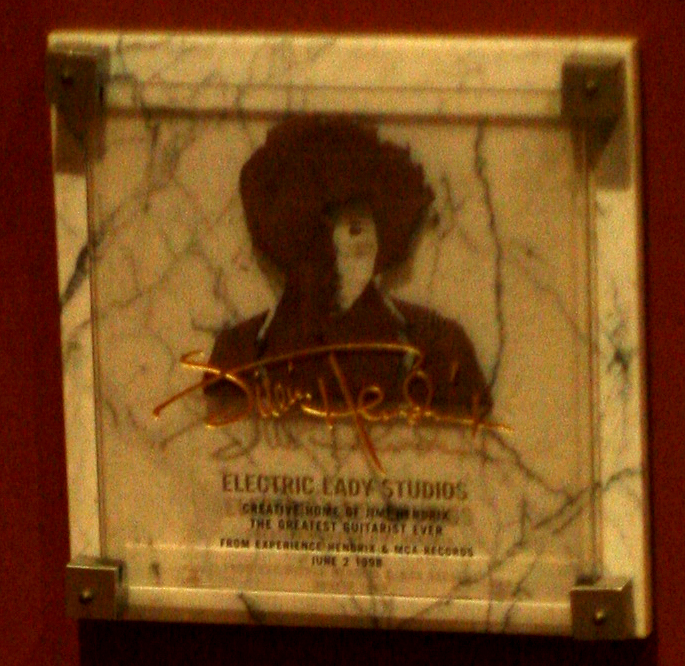
    I have a very special relationship with this place, Electric Lady Studios at 52 West Eighth Street. A regret of what could have been and what should have been. If you were here with me in person, I would hold my forefinger and thumb as close together as humanly possible without actually touching, leaving the tiniest sliver of light to pass through. And I would tell you, “That is how close I came to meeting Jimi Hendrix.” Not just meeting him, but spending a night with him and one other jamming on guitar.
    Now these were college days in a time of recklessness and excess. Everything from that period was chaotic and disjointed. Some of the details are foggy in my mind, so the story goes something like this:

    It was 1969. A winter’s night at approximately 4 AM, with a snowstorm blowing outside. A fellow NYU dormitory resident whose name I do not remember (perhaps not even a resident – it could have been an interloper, common at that time) said he was heading over to Electric Lady Studios to jam with Jimi and did I want to go? A stunned yes was the proper response, and with an electric guitar slung over his neck, we walked from the dorm down Eighth Street in the snowstorm. He buzzed when we arrived, announced his identity via intercom, and asked if Jimi was in. The response was that he was not. He typically was. So, disheartened, we made the short trek back.

    The following day, I asked someone who knew this man well and asked if my friend really knew Hendrix and played with him before and whether we would have actually been admitted to jam with Hendrix had he been at the studio. The answer was yes, yes, and yes. I was assured that my friend did know him and, had Jimi been there, we would have been admitted.

    Now this may not seem like much, but consider that this was an opportunity missed to have spent some hours with a living legend, James Marshall Hendrix. Not to see him in a concert or perhaps see a fleeting visage on the street, but to spend time with him in a private setting. These were days when legends and gods were approachable, a time when things and people did not become so overexposed, hyped, and marketed as to make them completely inaccessible. I missed other opportunities to see Jimi in concerts at the Fillmore East and his jams at a small club called Ungano’s.

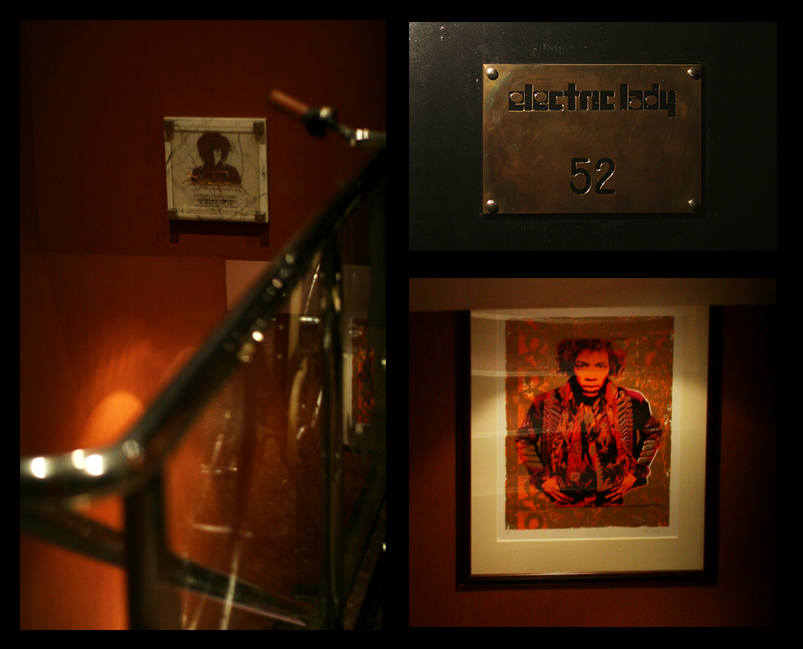
    I have wanted to do a piece on Electric Lady Studios since the start of this blog, but the exterior is rather plain and uninteresting. But last night an opportunity made itself available. I saw someone leaving the studio and, for the first time, realized that the door to the entrance vestibule is not kept locked. Opening this door afforded a shot of the brass plaque in the photo. However, upon stepping into the vestibule, I was immediately warned that photography was not allowed.

    I also never realized that the studios were in the basement, accessed by a stairway which can be seen from the street if you peek through the crack in the curtains just right. I was able to see a marble plaque and a framed poster of Jimi in the stairwell. I was surprised to be able to get a couple of decent photos by squeezing my camera and head against a wall and shooting through a glass window at night into a dimly lit stairwell. If you go here, you can see an enlargement of the plaque and poster – the text of the plaque is actually legible.

    The history of this studio is just amazing, and rather than retell it here, I suggest you read it here at the Electric Lady Studios website. The studio was established in 1970, designed by John Storyk. It is still considered one of the finest recording studios in the world, and the roster of clients who have recorded there has to be one of the most astounding who’s who in music.

    Now I really want a tour of this place. And I had better do it soon, lest it becomes the second of life’s major regrets around the same place – like two crimes at the same scene…


  • Livid

    Here is an infuriating New York City scenario. You are driving a car or in a taxi on an avenue and need to change direction by turning onto a crosstown street. Now in most situations, you have many choices as to which crosstown street, since most of Manhattan is a grid. There are 20 crosstown blocks to a mile, so for most trips, there are dozens of streets you could take. If you are really knowledgeable about traffic patterns, you can narrow your choices, but nearly always, you will still have many equally good options. Your final decision will have an element of whim.

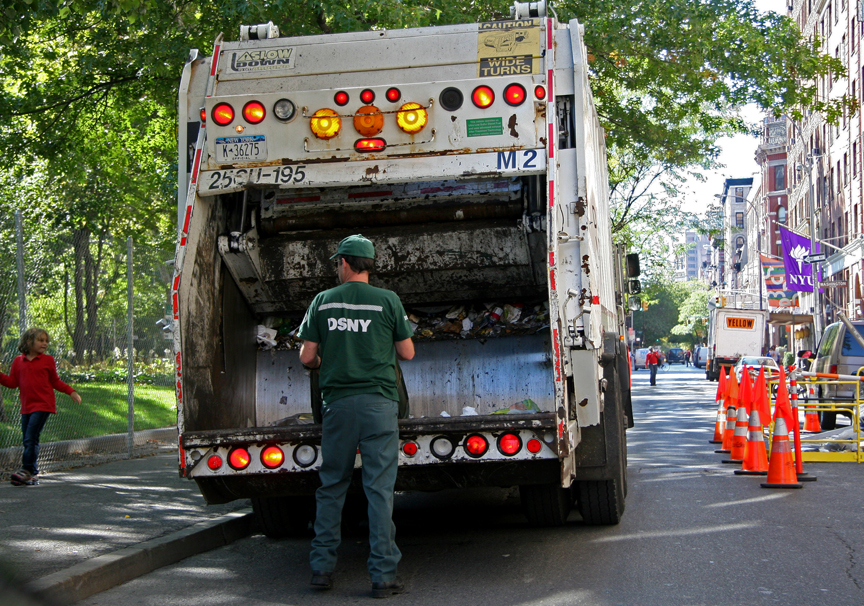
    So you make a turn down a street and, by pure chance, you happen to select the block where a sanitation truck is picking up trash. The street is not wide enough to pass, and sanitation workers will never try to accommodate you in any way. And you know you will be there for quite some time, crawling behind that truck, watching as they go about their business, one can at a time, with no sense of urgency, because this is their job, a job that must be done. And what can you say or do? This is the New York City Department of Sanitation, and you want the city kept clean, right?

    Now if you are a Zen master or one who can take life in stride, perhaps laughing at times like this, then you are fortunate. But if you are in a bit of a hurry or prefer not to spend your life waiting for traffic lights or behind trucks, because you have already spent too much of your life here waiting, then you may find yourself stewing a bit. There are better things to do. As time passes behind that truck, time that passes slowly (it will be a long time to go down that whole street stopping at every building) you can easily imagine having chosen another street. Any other street. You can play out all the scenarios and reflect on the odds that of all the streets in New York, you chose this one. No backing up either, because in this city, it is rare that cars are not immediately behind you.

    You will have time to exhaust all the things you could have done or should have done, because sanitation workers are in no hurry. They are absolutely immune to any belligerent actions – they have experience on a daily basis with all manner of threats and attention-getting tactics. You can pretend you are relaxed, enjoying music, or reading. But if you are a type-A personality or high-strung, you can work yourself into a livid, absolutely furious state. Occasionally, in a city of extremes, livid will be the emotion du jour. 🙂

    Photo note: This photo was taken going south on Washington Square West in the morning, not the classic avenue/crosstown street scenario. There were few trash pickups to be made, little traffic, and some opportunities to pass around the truck. So this was only reminiscent of the real deal, not an authentic ulcer maker.


  • Voice of Change

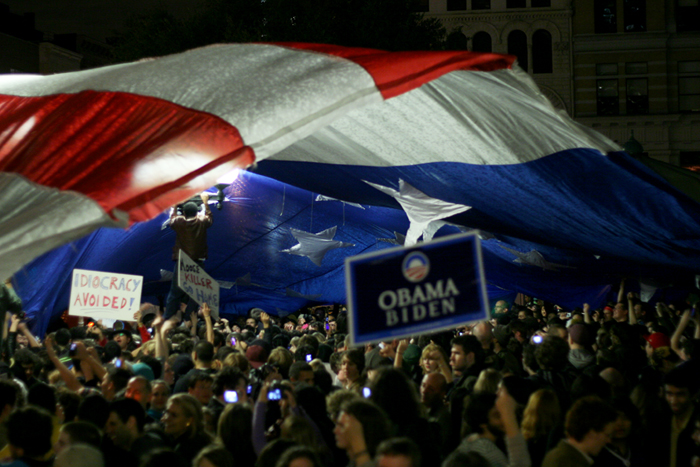
    I really didn’t want to put my clothes back on and go out again at 11PM. But the yelling and screaming was so compelling that I just had to see what was going on, lest I miss a photo opportunity I might later regret. I live in the heart of New York University, so a moment’s reflection was all that was needed to assess that the hoopla had to be over an announcement that Barack Obama would be the 44th President of the United States and that there was an end to the 8-year Republican hegemony.

    So out into the night with camera in hand. It was quite amazing on the streets. I don’t recall ever witnessing this kind of fanfare over a presidential election. There was all manner of revelry, including the occasional firecrackers. I was fortunate to overhear a directive from one of the students: “Let’s head to Union Square.” A brilliant idea, since Union Square would most likely be a downtown nexus for celebration.

    One block from Union Square on University Place, I overheard someone say, “They have no idea what they’re in for when they turn that corner.” And right he was – an enormous crowd had already gathered, and an impromptu tent had been created with a huge American flag. The general feeling in Union Square and the streets was quite exuberant. I overheard one young person conclude a conversation on his cell phone, “I’m so happy, Mom. I love you.”

    Leaving blame aside, there has been a malaise over this nation and desire for change. The unpopular Middle East policies and the recent banking debacle and resultant market crash are adequate reasons to galvanize the public. This was a vote for change. From today’s New York Times:

    The election of Mr. Obama amounted to a national catharsis — a repudiation of a historically unpopular Republican president and his economic and foreign policies, and an embrace of Mr. Obama’s call for a change in the direction and the tone of the country.

    Optimism and hope for a renewed America and improved policies and international relations was echoed in the media around the world. I do hope that the change will be good for this country and that President Obama proves to be an able captain.

    For a time, the voice of change should buoy the spirits of our ailing country. And time will tell if Mr. Obama can deliver on the promises of hope…


  • Halloween Parade 2008 Part 2

    (See Part 1 here)

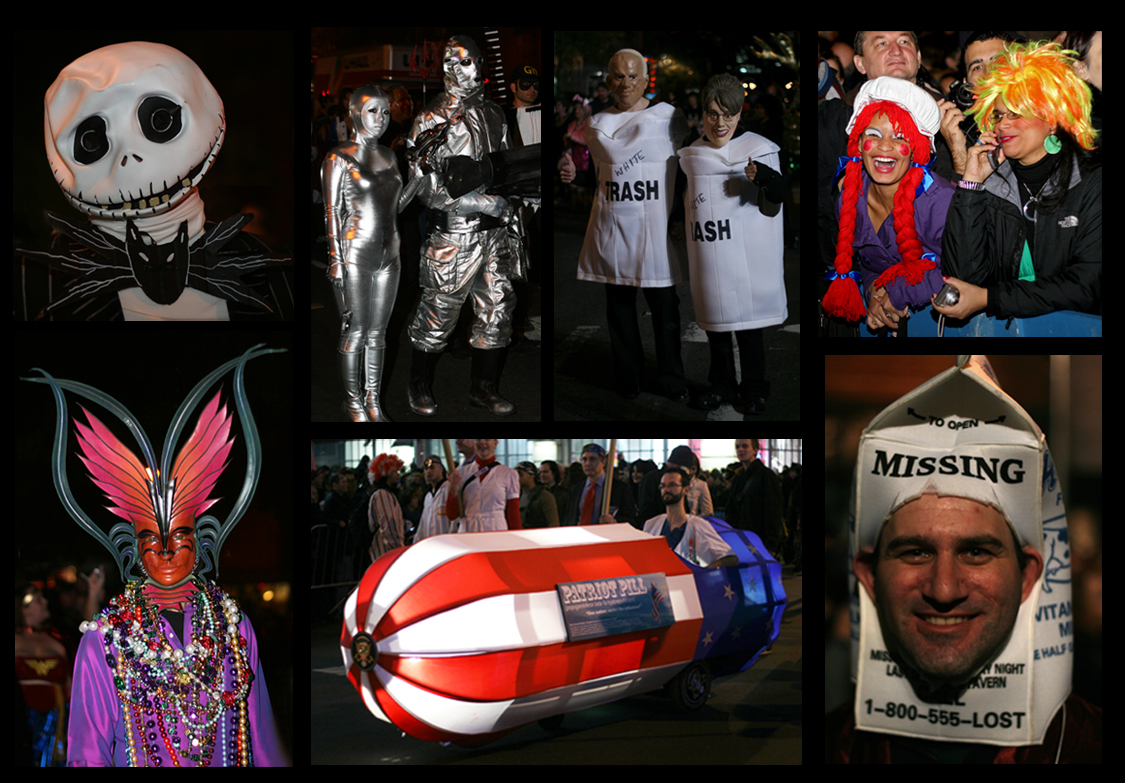
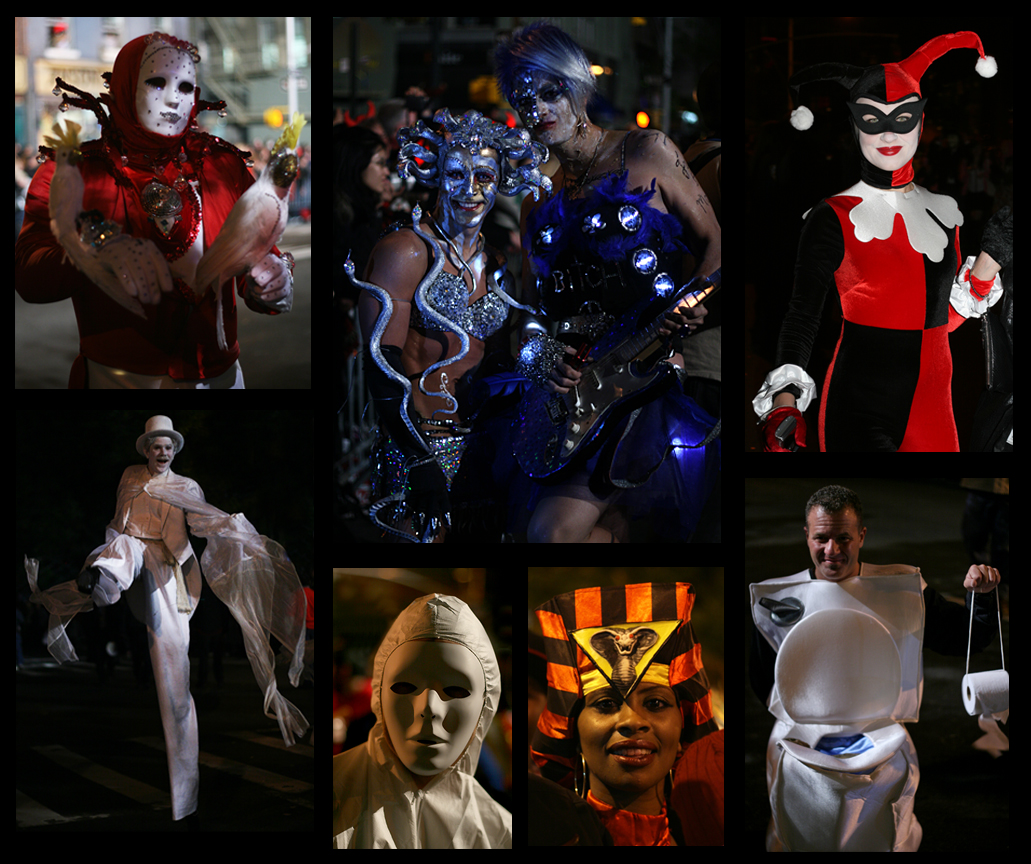
    Here is Part 2 of the annual Village Halloween Parade – make sure to click the photo to enlarge the image.

    As promised, here is the gallery of over 40 photos on my Flickr site.


  • Halloween Parade 2008

    I have attended the annual Village Halloween Parade for many years, battling the crowds. Unless one arrives very early and jockeys for a good viewing position, it is virtually futile to attend. Nearly all the side streets on both sides of 6th Avenue for the entire parade route (of nearly 1.5 miles) overflow with people and are cordoned off early by the police. Like myself, most city residents I know have essentially given up on attending. I now typically just peruse the streets after the parade ends; costumed participants continue to mill around until the wee hours of the morning.

    However, since the inception of this blog, I have obtained a press pass, allowing me to roam freely among the paraders. This privilege is extraordinary, as the parade has become virtually unmanageable with the enormous number attending – estimated at 2 million. The history of this parade is an artistic one, so the costuming is particularly creative. Many plan for this in advance with enormous amounts of preparation. There are floats and very elaborate displays. The standards are high and the number of participants is huge; it is difficult to see more than a small fraction of the outstanding costumes. Tomorrow I will post another collage as Part 2 and a gallery of photos on my Flickr site…

    NOTE: A history of the parade, with links and photos from the past two years can be found on my previous postings: Halloween Parade Preview 2006, Halloween Parade 2006, Village Parade 2007 Preview, Village Halloween Parade 2007, Village Halloween Parade 2007 Part 2


  • Barometers

    There are barometers and signposts. Things that tell you about a place. If you can find constants that you are familiar with, they can tell you much. Like independent bookstores or natural food stores. I used to visit as many as I could when traveling – the differences would tell me a lot about the people and the community.

    And then there are things which are unique about a place, like San Francisco’s cable cars. The New York City subway system is one of those places that lets you know without question where you are. Something virtually unique in the USA, certainly so extensive and heavily used and depended on by millions daily. Here, everything that is good and bad about the city is concentrated, literally and metaphorically. More of everything, whether rats, garbage, graffiti, people, hustlers, or opportunists.

    Looking over that list and reflecting on it makes me want to amend my former statement. In fairness, it really isn’t too accurate to say that all the good of New York is concentrated here. There are not an inordinate number of smiles or acts of kindness down below. This is really about the business of getting where you want to go, and like visiting a dentist, most patients just want to expedite the process.

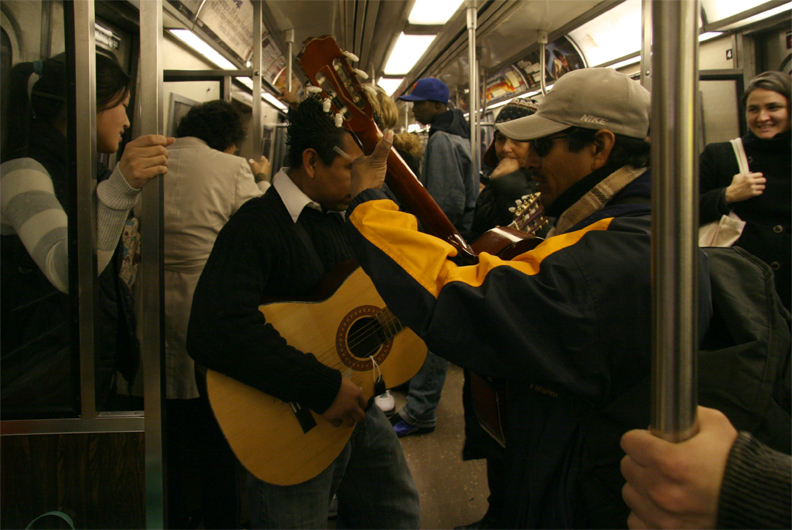
    So when a good thing happens, it really warms my heart. Melts the ice that separates us and brings a moment of humanity to an underground world of steel, concrete, and noise. What better thing than music to fit the occasion? Many see the wandering minstrels of the subway as an intrusion – a violation of space which is already a toxic overload of sensory stimuli. But for me, a little good music is a welcome break on a short ride.

    Perhaps if I was encamped (i.e. comfortably seated) with a good book on a long ride, as many commuters are, I would find the sudden appearance of musicians nearby to be an unwanted and unwarranted irritant, like secondhand cigarette smoke. And, of course, if you are a musical snob, there is the issue of quality – you will not find concert-level musicianship here, so your standards do have to be appropriately scaled.

    On this ride, I found the two Latin guitarists with their singing to be just the antidote for the crowded conditions. And my $1 contribution to the arts was well received…


  • Fisherman’s Widow

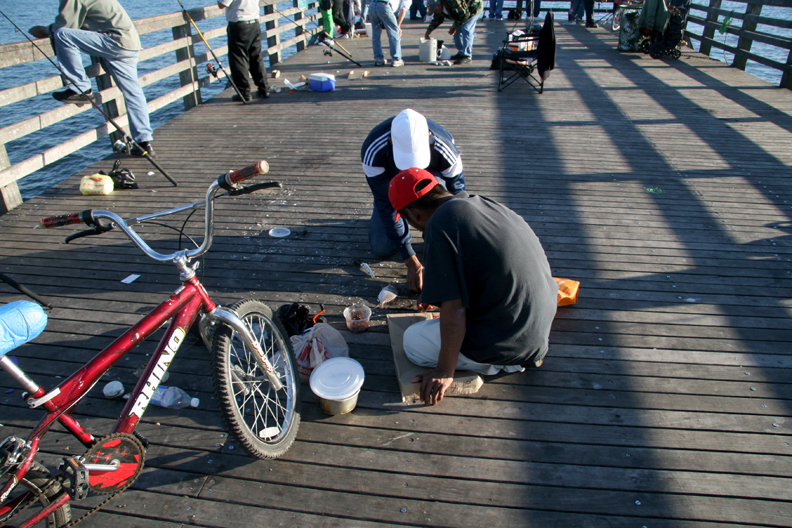
    Yes, this is New York City, and yes, we have fishing, too. On my recent excursion to Coney Island, we made the requisite trip to the pier from the Coney Island boardwalk (I have seen it referred to as Steeplechase Pier).
    There are actually many spots around the city, even Manhattan, where fishing is permitted, and with the waterways becoming progressively cleaner, much of the fish is now edible. This catch of Porgies was being sold for $10.
    I see that it is a relaxing way to spend a beautiful day amidst the natural elements – sun, sand, sky, water, and fresh sea air.

    Although the sight of dying fish is not the most pleasant one, this is perhaps more shocking to the city dweller who is very divorced from the entire process of bringing fish and meat to the dinner table. After all, fish don’t just appear filleted on a dinner plate – they need to be caught, cut, and cleaned. Many urbanites have probably never even witnessed anything other than fish being cooked and served. Baiting is part of the process, too, and the pier was dotted with fishermen cutting fish for bait or putting their catches into plastic pails (see here).

    I am not a fisherman, but my father was, and over time I have learned to understand the passion for this activity. For some, it becomes an obsession, occupying virtually all of a fisherman’s mind. I recall traveling with my family and seeing some beautiful vista which had a body of water, and my father’s first thought and immediate comment was that there was probably good fishing to be had there. At one extreme, there are men so addicted to fishing that many of their estranged wives have become known as “fisherman’s widows”…


  • dinamic_sidebar 4 none

©2026 New York Daily Photo Entries (RSS) and Comments (RSS)  Raindrops Theme