• Claremont

    Posted on by Brian Dubé

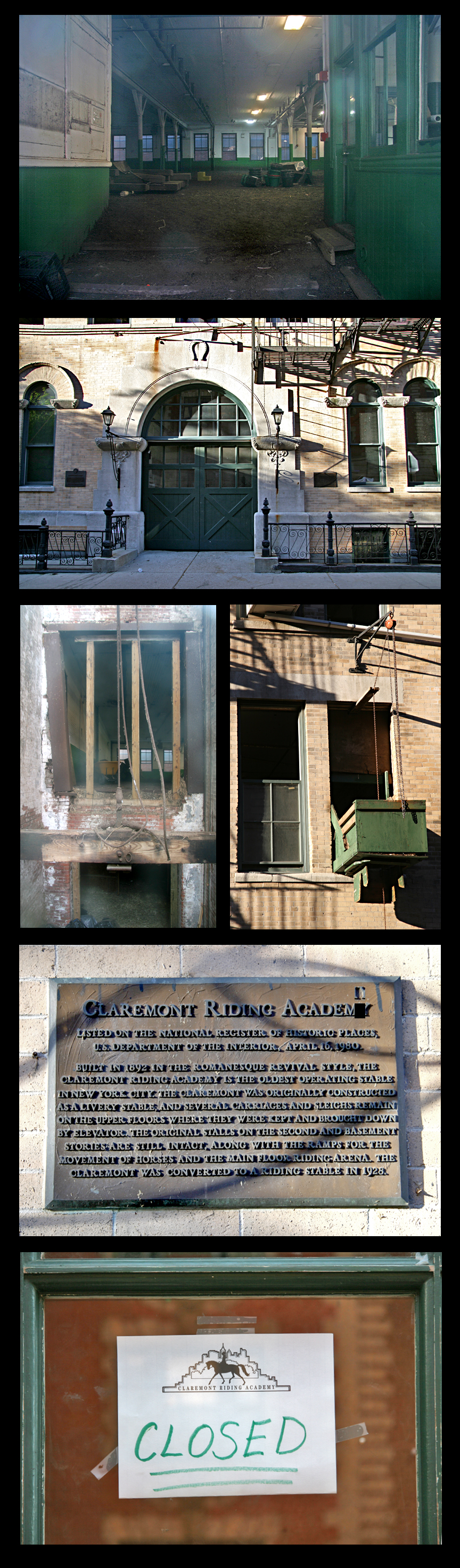
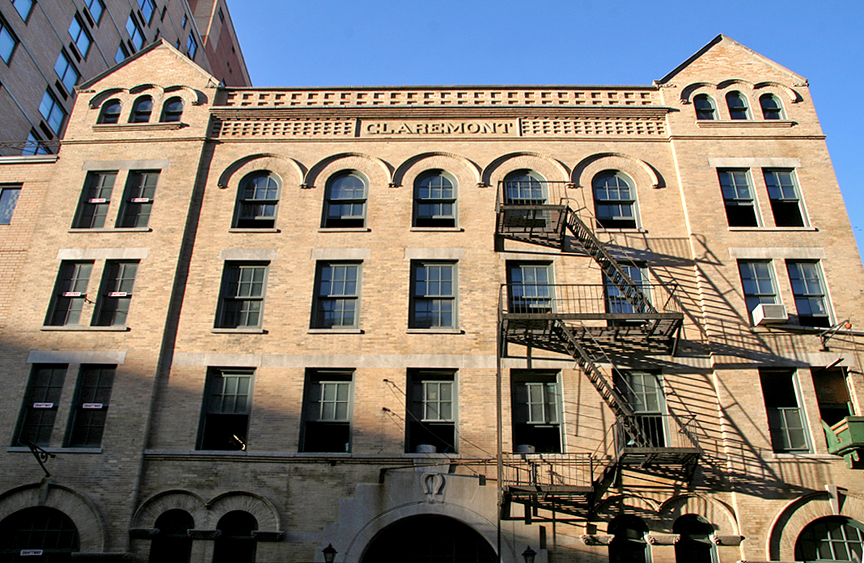
    I wanted to call this the End of an Era, but I don’t want to overuse the phrase. Everywhere you go, look, or read, there’s the last of something or a NYC icon closing – CBGB, Grand Machinery Exchange, etc. Claremont Riding Academy, located at 175 W. 89th Street and less than two blocks from Central Park and its bridle path, was a real riding school and working horse stable, the oldest in NYC and the country. It was amazing to walk down this quiet residential block on the Upper West Side and see an urban barn with hay, horses, a wooden ramp, and a riding ring. Click here for more photos, including a peek inside.

    The five-story Romanesque revival building (on the National Historic Register) was designed by Frank Rooke and built by Edward Bedell in 1892. Bedell had built a number of stables in the neighborhood – Cedarhurst Stable at 147 W. 83rd, and three on this block at 167-171 W. 89th. Ownership passed to Charles Havemeyer, Emil Wellner (who in 1928 changed the name from Claremont Stables to Claremont Riding Academy), Irwin Novagrad in 1943, and finally to his son Paul, who closed the operation on April 30, 2007. Paul Novograd cited a number of reasons for the closing: financial difficulties and declining ridership in part due to increased crowding of the Central Park Bridle path with joggers, cyclists, dogwalkers, etc. Encountering the occasional horses with their riders going to and from Central Park and the stables down city streets was truly an experience. The fate of Claremont is mourned by many, and sadly, horseback riding will no longer be available in Manhattan…
    Posted on by Brian Dubé

  • Waterworld

    Posted on by Brian Dubé

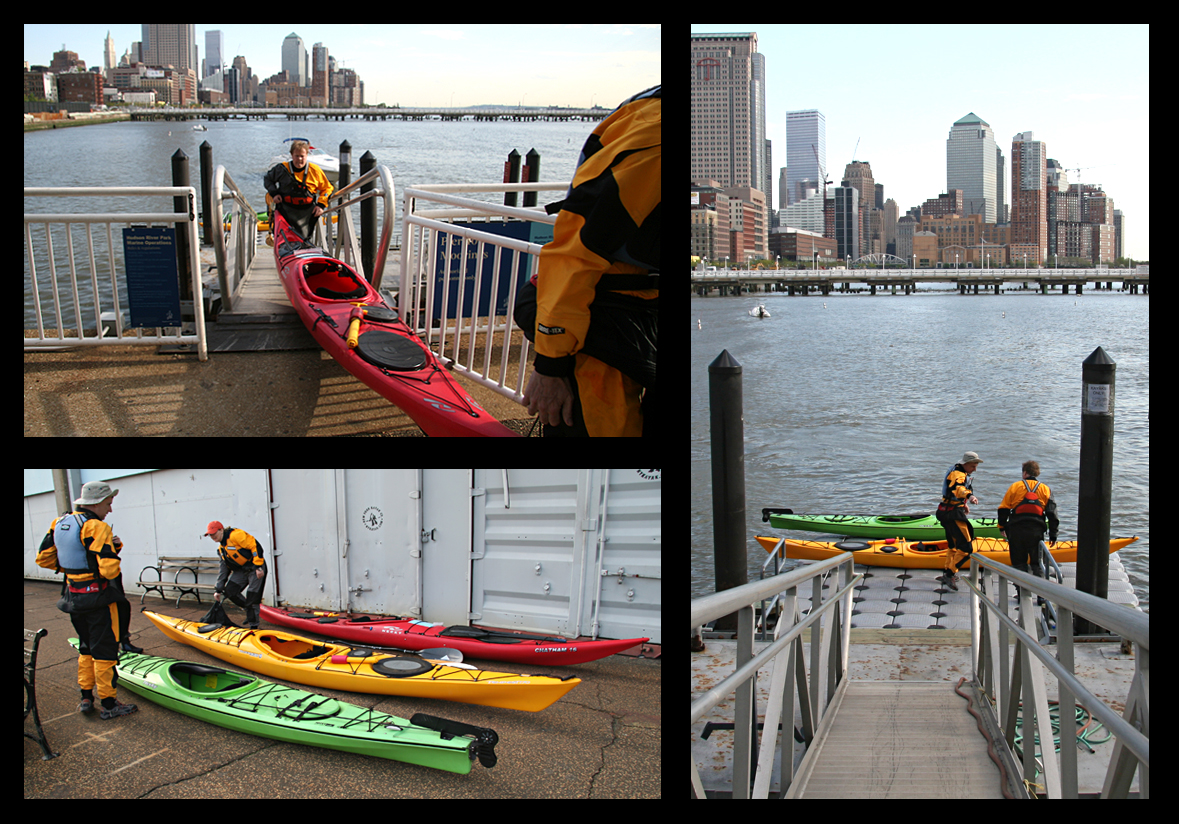
    Manhattan is not known for water sports – until very recently, our waterfronts have been relatively unused for recreational activities. Atypical, given that water frontage is generally such a huge asset in most locales worldwide; surprising, since everything in NYC has been developed and exploited. But the waterways are finally seeing their day. Fishing, boating, sailing, kayaking, and even some swimming (under certain conditions) are now all commonplace. The Hudson River, once seen as a garbage dump, has become cleaner than anytime in the last 100 years; fish and other aquatic life have returned.

    The photo is of members of the New York Kayak Club, which provides a kayak launch, storage, locker rooms, instruction, guided tours, and a shop. They are situated at Pier 40 at West Houston Street and the West Side Highway. There are a number of kayaking facilities in the city (click here for a list with links).

    Cautionary Note: NYC is one of about 800 cities in the U.S. which uses a combined sewer system – storm water and sewage are combined. When it rains, the system can become overloaded, and the sewage and polluted stormwater are dumped into the waterways. Over 27 billion gallons are discharged untreated annually via combined sewer overflow (CSO) outfall pipes (there are about 450 in NYC harbor). The problems of this antiquated system are being addressed. Until then, beware of NYC waters after a rainstorm…

    Posted on by Brian Dubé

  • Marumi

    Posted on by Brian Dubé

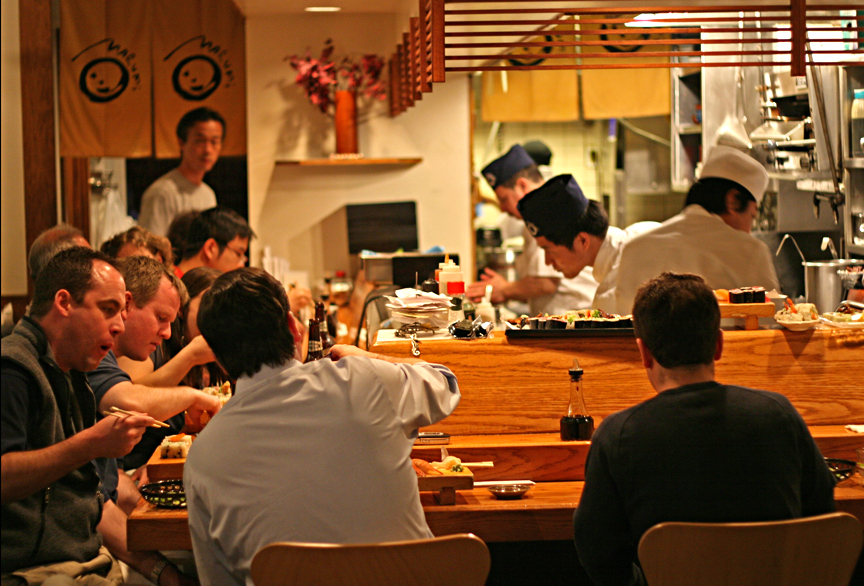
    This is Marumi at 546 LaGuardia Place – my favorite Japanese restaurant. It’s kind of a cliche – have you ever noticed how everyone in NYC seems to know “a place for great Japanese” or “the best Japanese restaurant”? Apparently it’s a necessary credential for being a New Yorker. I won’t make any comparative claims here; when I found Marumi, I essentially stopped looking.

    One thing I really like is that the owner, Takashi Sando, is on site (that’s him in the back left of the photo). He is no-nonsense and runs this place very efficiently and like a well-oiled machine. Everything is very consistent and fresh (of paramount importance with raw fish). The service is excellent – in several years of going there, I don’t recall one mistake. Marumi is reasonably priced (inexpensive for Japanese) and in the heart of New York University country, so students abound. The ambience is very social, pleasant, and casual. The place gets crowded; most nights there are lines (which move fairly quickly). Much of the clientele is Japanese and local regulars – a good sign. It has been in business for 16 years.

    On a refreshing note, this place is about the food. Alcohol is available, but never pushed; dessert is typically not even offered. Get there before 7:15. Try a Bento box or broiled salmon. Best kept “secret”? Their spicy sashimi salad…

    Posted on by Brian Dubé

  • Cappuccino & Tattoo

    Posted on by Brian Dubé

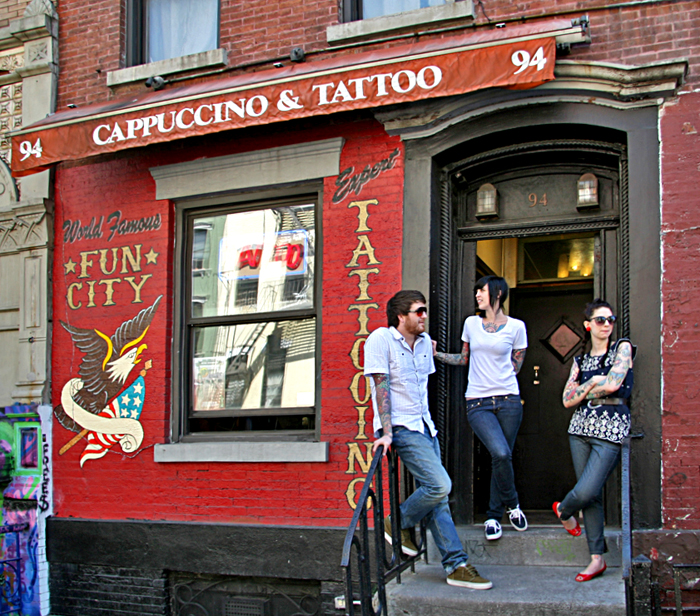
    This is Fun City Cappuccino & Tattoo, a unique fusion of two extremely popular things, both with a long and international history. Tattooing is certainly not new or uniquely New York – it can be traced back thousands of years, and the term itself is Polynesian. Tattooing was banned in the city from 1961 (when an outbreak of hepatitis B was traced to a tattoo parlor) to March 27, 1997, when it was re-legalized. But, ironically, the American-style tattoo was born here in Chatham Square (Chinatown) at the turn of the century. Later, in the 1920s, with the advent of electronic tattooing, the practice moved to the ports of NYC (Coney Island and the Brooklyn Navy Yard), catering to sailors. The period when tattooing was banned here was the time it became the mainstay of hippies and bikers. Tattooing went underground in the city and was eclipsed by other cities, such as San Francisco. Since the re-legalization, NYC has been playing catch-up.

    One of the early practitioners was Jonathan Shaw (whose father was the bandleader Artie Shaw), original owner of Fun City Tattoo, the oldest tattoo parlor in the city dating back to 1976 (as a private studio) (read the history here at their website – click on the “Press” link). The photo is of the business’s public incarnation at 94 St. Marks Place, dating back to 1991. Michelle Myles is the new owner – she also runs Daredevil Tattoo on Ludlow Street.

    Tattoos have certainly shed much of their criminal, outlaw, or bad boy image – it is now popular in the burbs as well as in cities. Estimates are that 16% of the population has a tattoo. No person in the United States is reported to have contracted HIV via a commercially-applied tattooing process. Still not interested? Perhaps a beautiful temporary henna (Mehandi) tattoo. Or perhaps just a cappuccino…

    Posted on by Brian Dubé

  • Jeopardy

    Posted on by Brian Dubé

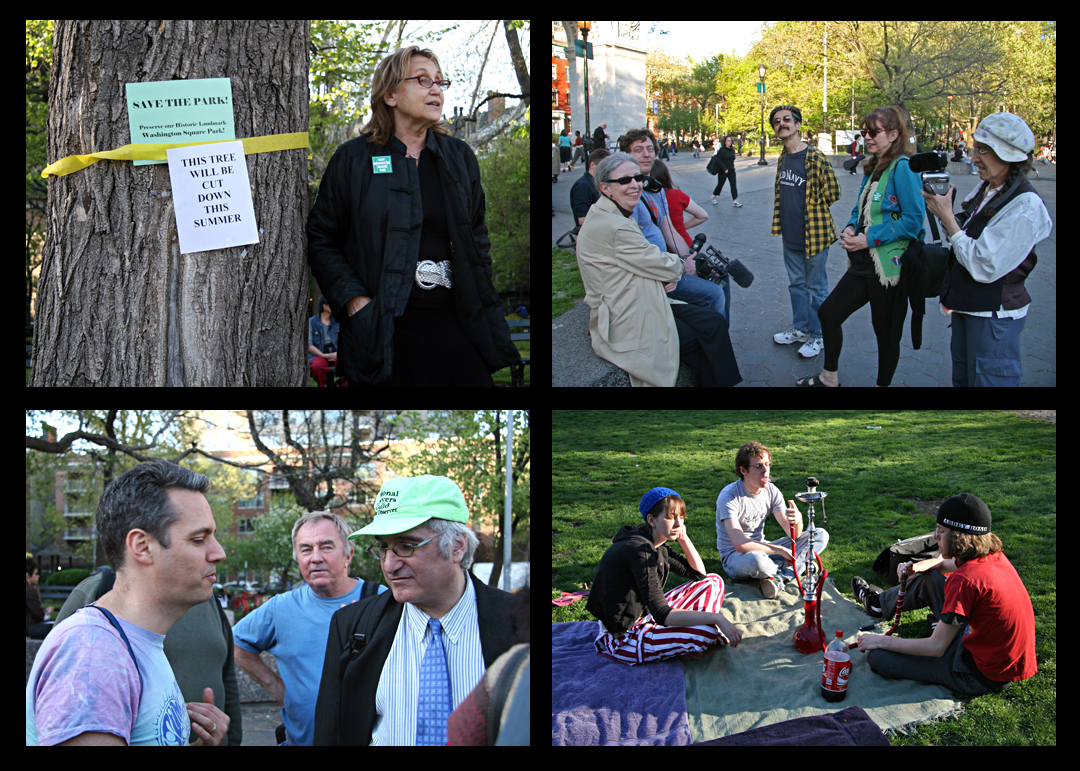
    One of the biggest local disputes is over redesign versus renovation plans for Washington Square Park. Everyone agrees on one thing: that the park is in serious disrepair and this process has delayed much-needed work. Organizations have been formed, such as OpenWSP and Preserve Washington Square Park (now closed). Lawsuits have been mounted (Kupferman, Greenberg, Harris) in opposition to a plan for what is alleged to be a fairly major wholesale redesign (by landscape architect George Vellonakis) which calls for a perimeter fence, some tree cutting, a realignment of the fountain, and a reduction and leveling of the plaza area. There are those, however, who favor the redesign, seeing the current design as not being of historical significance or necessarily optimal. Of course, the Village has been a magnet and breeding ground for political activism for eons, with battles such as Jane Jacobs vs. Robert Moses, so this debacle should come as no surprise. Space does not permit fair coverage here of the issues involved. Here’s one thread of postings which will give you a flavor of the debate.

    The whole affair has become very politicized and has started to take on a life of its own. One factor in the equation is the fear of change and the unknown. Many regulars love the park, with its planned and unplanned activities, social networking, and overall culture – one can find chess, music, scrabble, street performers, petanque, concerts, debates, artists, political demonstrations, festivals, filming, dog runs, and relaxing all in 9.75 acres. The photos are from yesterday’s “Be-In” organized by Jonathan Greenberg. My biggest fear is the timetable for whatever is decided. Two years have been projected, but the memorial arch in the park saw a chain link fence around it for 14 years (due to lack of funds) before restoration was completed. A similar fate for the park would leave visitors and locals without use of one of the world’s premier playgrounds…

    Posted on by Brian Dubé

  • Yellow Fever

    Posted on by Brian Dubé

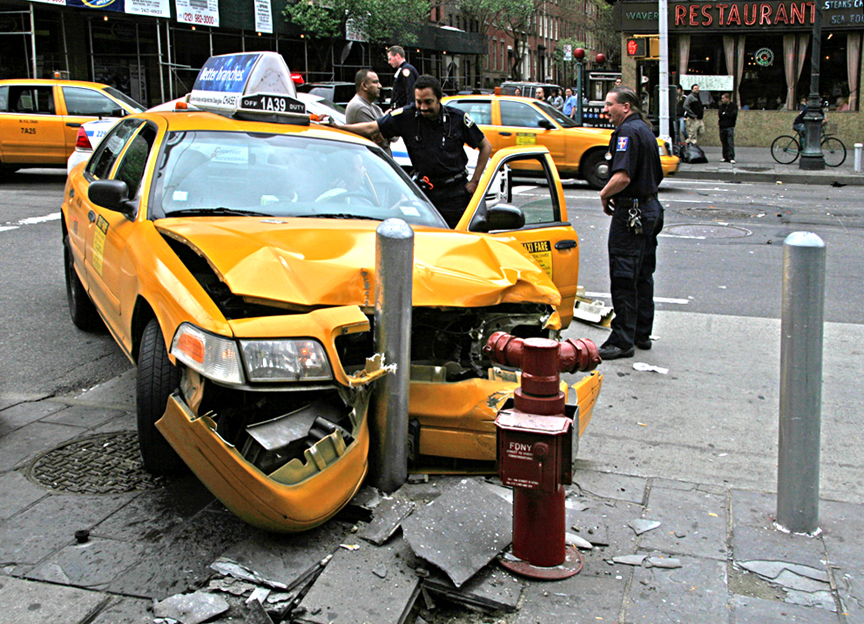
    In 2005, there were 71,167 automobile accidents in NYC, with 328 fatalities: 101 drivers killed, 46 passengers killed, 159 pedestrians killed, and 21 bicyclists killed (and 1 “other”). 25-30% of accidents involve one vehicle striking objects, like that seen in the photo. I’m not sure what happened here, but I would guess that avoidance of a vehicle or pedestrian was likely. It appeared that no one was injured.

    There are 12,779 taxis in NYC, and many are involved in accidents. Unfortunately, since business is involved, what is best for making money is not best for safety. Taxi fares are based primarily on distance (idle time meter charges are much less profitable than distance). So, the faster you get there, the more money you make. Add long hours, many inexperienced drivers, and road rage, and the picture is not good.

    The good news is that after huge increases in taxi and livery accidents in the 1990s, regulations became much stricter, and rates have actually come down. Click here for a Taxicab Fact Book. Contrary to public perception, it is actually safer to ride in a taxicab than in other vehicles (crash rates per million passenger miles are less for taxis – click here for article). It appears that, at least for the time being, yellow fever has been contained…

    Posted on by Brian Dubé

  • Taschen

    Posted on by Brian Dubé

    This is Taschen’s NYC flagship store at 107 Greene Street in SoHo. Taschen is an art book publisher started by Benedikt Taschen in 1980 in Cologne, Germany, as Taschen Comics. His esoteric comic book company was saved when Taschen purchased and sold 40,000 remaindered books on Rene Magritte. With the profits, Taschen then ventured into art and photography books, first publishing a book of the photography of Annie Liebowitz. For a fascinating history of the company, click here.

    Now, Taschen publishes works on art, architecture, design, fashion, film, fetishistic imagery, photography, and erotica/sex – what’s unique is to see explicit sex sitting alongside mainstream art books. Their books are unique in many other ways. Helmet Newton’s SUMO is the largest book published in the 20th century. It’s so big, in fact, that it comes with a special table designed by Philippe Starck. And then there is GOAT – Greatest Of All Time (a book about Muhammad Ali) – which sells for $12,500 (collector’s edition). Yet they also pride themselves as a publisher which brings forth quality art books at popular prices; many of their books sell for only $10, befitting the the word “pocket” (translation of the German “taschen“).

    The store, with its concrete floors, was designed by Frenchman Philippe Starck; wall murals were done by the Brazilian artist Beatriz Milhazes. There are floating bookshelves with hi-def video monitors along the top. The rear of the store has a staircase to a lower gallery/event space. From their myspace site: “I have a quiet gallery space with furniture by Tenriero, some sleek Eames chairs, and a buttery leather Arne Jacobson Egg chair.” A must-visit. I look forward to their upcoming book signing with Santiago Calatrava!

    Posted on by Brian Dubé

  • Twist and Shout

    Posted on by Brian Dubé

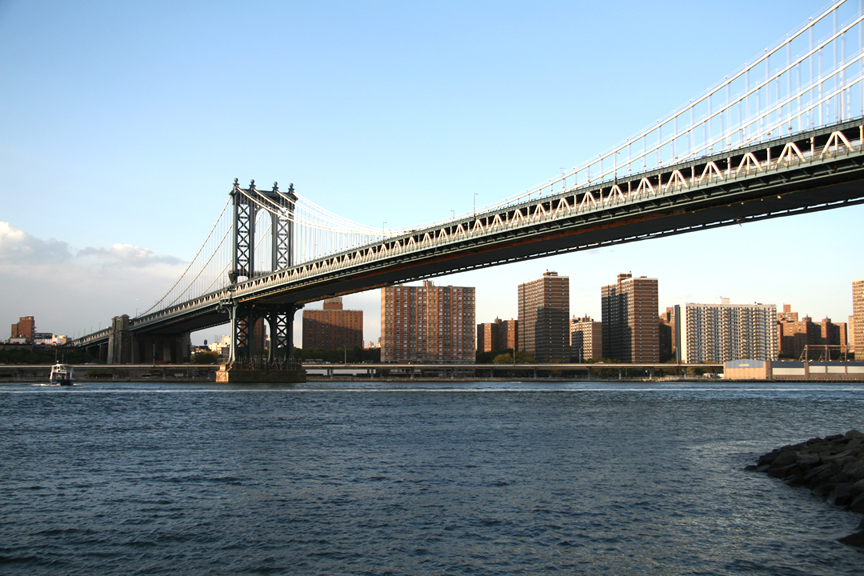
    The Manhattan Bridge was the last of the three great suspension bridges built across the East River (the other two are the Brooklyn and the Williamsburg). The bridge connects lower Manhattan (Canal Street) with Brooklyn (Flatbush Avenue). The photo is from the Brooklyn side in DUMBO. The bridge, completed in 1909, carries tremendous traffic: two roadways, upper and lower, with 6 lanes of vehicular traffic, subway tracks, a walkway, and a bikeway. It has, however, been plagued with problems from its inception, which were neglected until recently.

    The bridge designer, Leon Moisseiff, located the subway tracks on the outer sides of the roadway rather than in the center. The design flaw was discovered soon after construction: the bridge twisted whenever a train passed. The problem got worse; movement in the roadway (as much as several feet up and down) caused cracking. Crying out for repairs, the bridge was neglected with the NYC fiscal crisis in the 1970s. A major reconstruction finally began in 1982 and will only see completion in 2013 at a cost of $829 million.

    It is interesting that Moisseiff, known for his work on deflection theory allowing for lighter and more graceful structures, was engineer for the Benjamin Franklin Bridge, consultant for the Golden Gate Bridge, one of the designers for the San Francisco-Oakland Bridge, and primary designer for the Tacoma Narrows Bridge, which Moisseiff called the “most beautiful bridge in the world.” However, the bridge collapsed in a windstorm only four months after opening, leaving a damaged legacy…

    Posted on by Brian Dubé

  • The Plastic Infinite

    Posted on by Brian Dubé

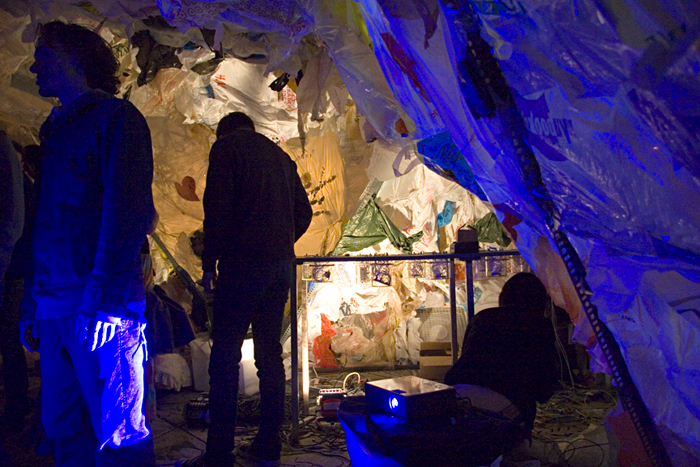
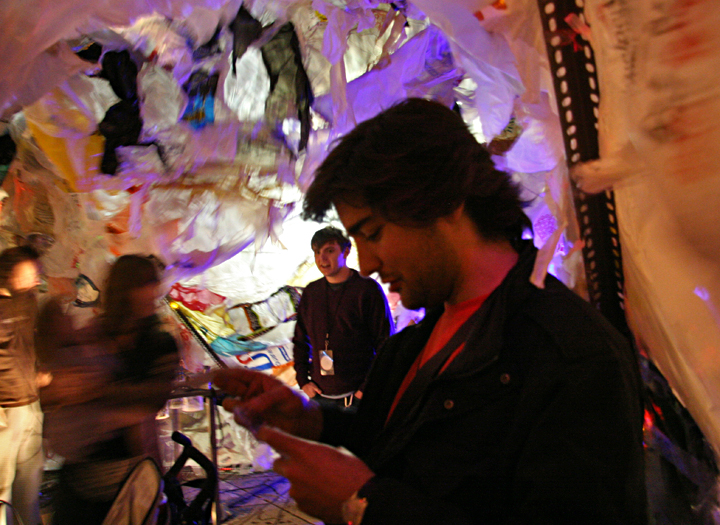
    A friend alerted me yesterday to some goings on in Washington Square Park. Activities are not well-covered here, so it took some involvement to find out what was going on. What initially appeared to be a trash heap of plastic shopping bags over tetrahedral frames, turned out to be an architectural project conceived by U.K. architect Usman Haque, who has created many interactive installations and mass-participation performances. More photos here.

    Initially titled Project Unspecified: “The NYU Program Board Performing Arts Committee has invited architect Usman Haque to design and oversee the construction of The Plastic Infinite. Members of the public are invited to come together to design, construct and inhabit a temporary inflatable structure in Washington Square Park, New York City. In the tradition of “barn raising”, where members of a community gather to build a structure for a new family, The Plastic Infinite is a collaborative event for the city. The park will be transformed into a playground for creative exchange.”

    In addition, Tali Hinkis and Kyle Lapidus of LoVid added video to the installation. It actually was quite a bit of fun getting inside the structure – people were coming and going all day and night. The space became a place of social interaction. Inside while shooting, I struck up a conversation with someone who, initially unbeknownst to me, was the architect himself. I found him very approachable, congenial, and down to earth – we had an interesting conversation about architects and architecture…

    Posted on by Brian Dubé

  • Raffetto’s

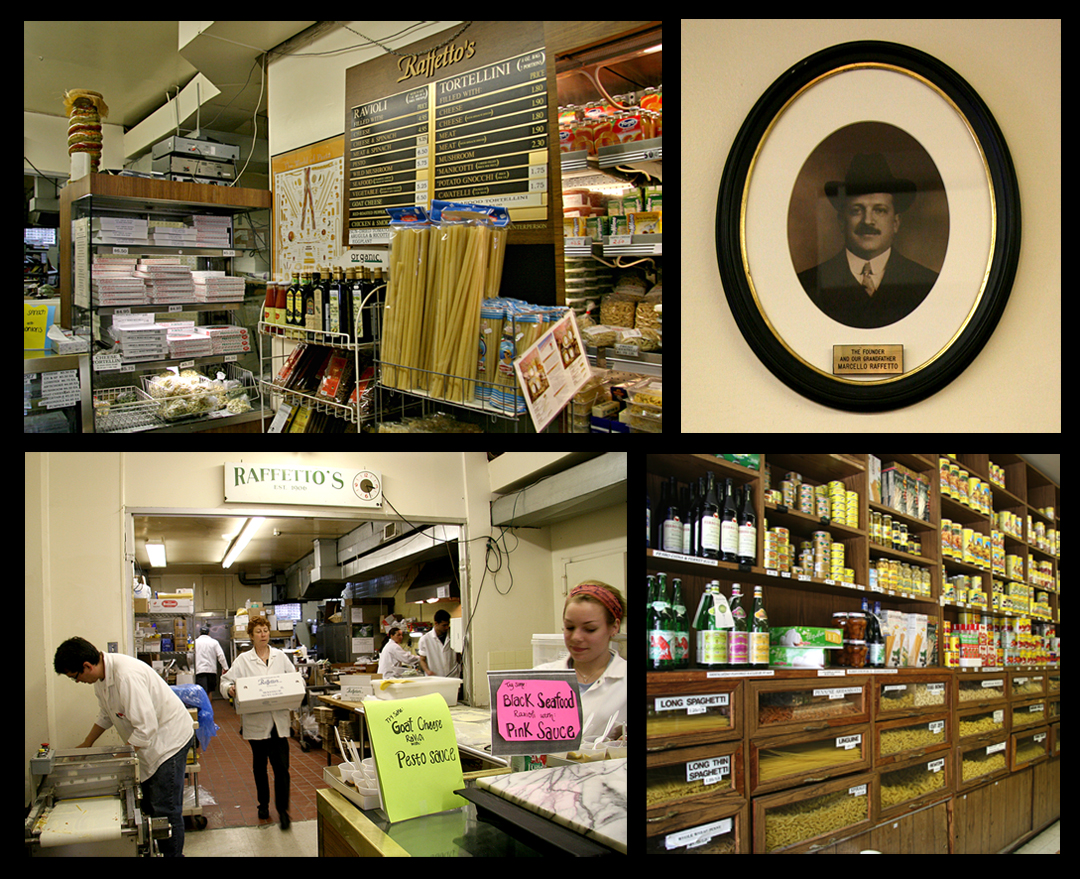
    This shop may be small in size but not in stature – one of those special little NYC “secrets” that everyone wants to find and frequent. Remarkably, Raffetto’s at 144 West Houston Street has been in business since 1906 – 101 years at the same location. The business is a 3rd generation family-owned and -run operation. It was started by Marcello Raffetto and continued by his son Gino (born in the same building as the shop in 1922) and now brothers Andrew and Richard with their mother Romano.

    The focus here is on the products, not glitz – they are low-profile. Some long-time residents of the neighborhood I have spoken to were not even aware of its existence. This place is old-school. They do not have a website, take no credit cards, and are closed Sunday and Monday. Pasta is their raison d’etre, along with prepared foods and a few other essentials, such as homemade sauces, oils, spices, and condiments. They make their pasta right on the premises, with 20 types of ravioli and tortellini plus 15 varieties of plain egg pasta. The bulk of their business is wholesale; they sell to about 300 of the finest restaurants, hotels, and gourmet shops in the city, such as Gotham Bar and Grill, Il Mulino, Fairway, Zabar’s, and Dean and DeLuca.

    The shop’s atmosphere is cozy, social, and friendly. In my short visit there for this post, I met the owner and two professional photographers. Everything is excellent and highly recommended. My favorite is the goat cheese ravioli with pesto…


  • Flora

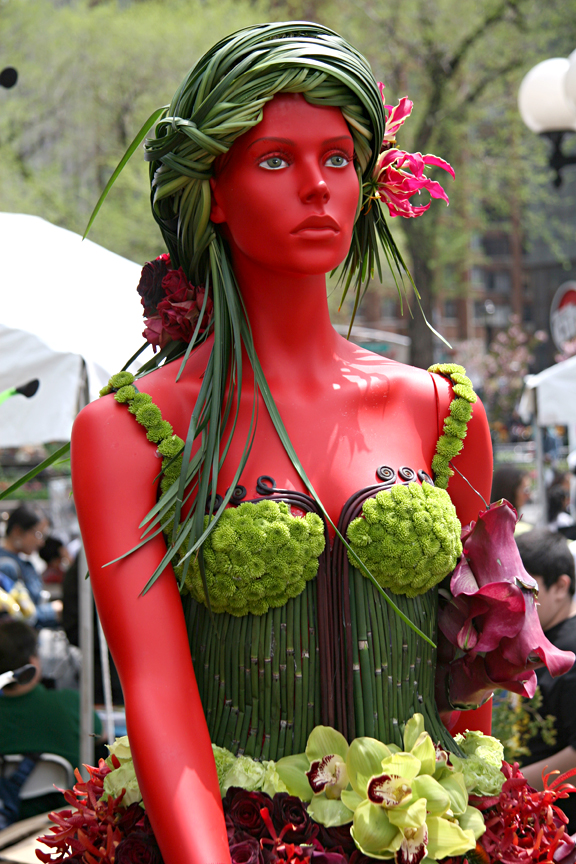
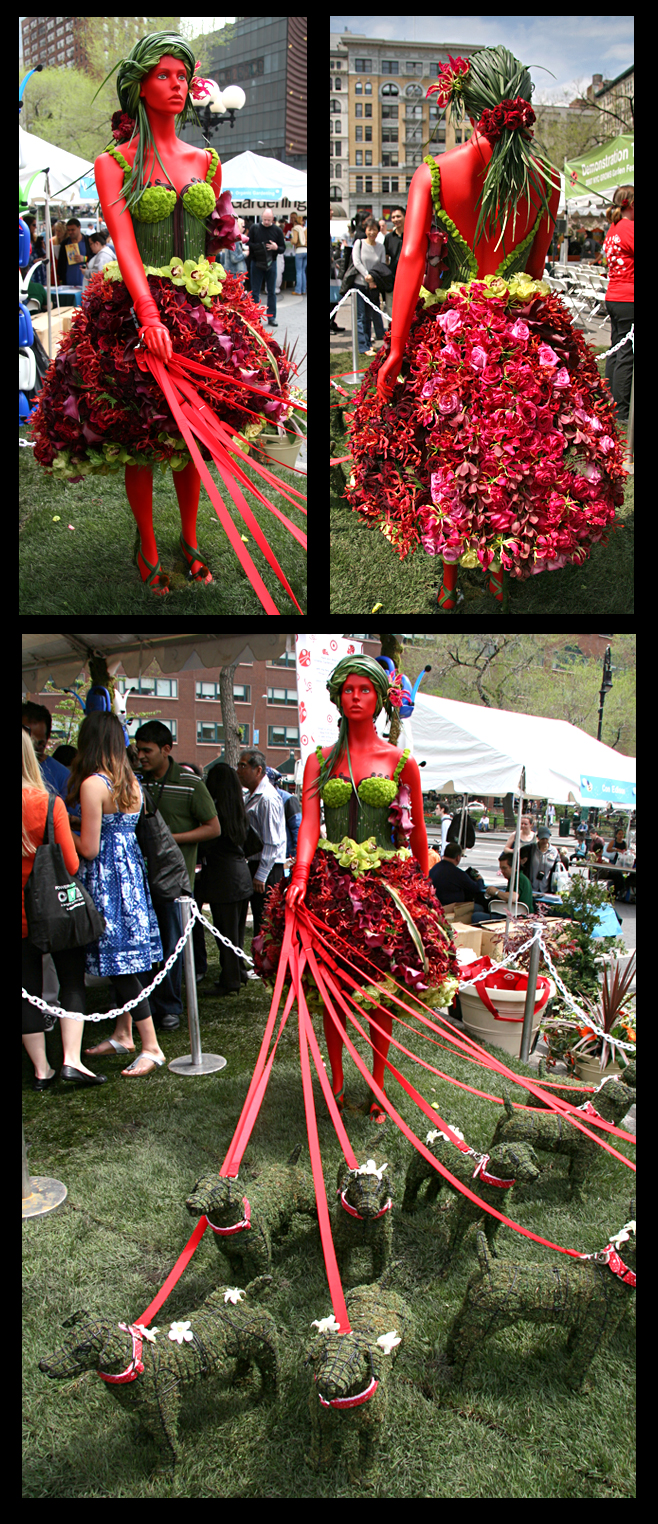
    Yesterday was the NYC GROWS Garden Festival, which was held in Union Square. This event was NYC’s celebration of National Garden Month. Our lady in the photo was created by Target, who sponsored the event. She was a big hit, with visitors taking photos of each other with her as backdrop. I thought she was beautifully done, with all manner of plants/flowers so cleverly used and her bevy of topiary dogs. Click here for more photos.

    I am not a gardener, but I can understand the benefits of being connected to something as important as plant life and seeing living things grow. In a time where everything is about speed and immediate gratification, gardening is a useful antidote by teaching patience – involvement in a process that can’t be rushed, where one MUST wait for results. A useful metaphor, for many of the things of value in life take time to come to fruition. I asked a Target rep if she had a name, and sadly, she did not. After considering many options this morning, I thought Flora might be an appropriate choice…


  • Fantasies

    Sex shops, tattoo parlors, body piercing – these are not the things which first come to mind regarding NYC in 2007, when gentrification and reduced crime have become the hallmarks of the city. But in the Village, there has been a proliferation of these types of shops in the last few years, making the strip along 6th Avenue in the Village (shown in the photo) feel more like the old Times Square, to the displeasure of many residents. Many feel that the extremely permissive, “anything goes” spirit of the neighborhood has largely been responsible, particularly with some tourists who see the Village as a place to party (e.g. weekends have seen motorcycle gangs from out-of-town descend on the neighborhood, or gay youths at Christopher Street Pier).

    There have been many efforts to close these shops and reduce their numbers. In 1998, a “60/40 law” was passed during the Giuliani administration. The law required a minimum of 60 percent non-X-rated merchandise for a store to operate outside adult entertainment zones. Of course, stores find loopholes, displaying racks of non-X-rated videos and other products alongside their porn. Aggressive efforts are made by the city to find health code and fire violations, but store owners are resourceful and tenacious, always finding ways to comply and stay open. Neighborhood residents are tolerant – those who object to these shops do so not so much because of the content but more due to the number of them clustered together, their garish lights, and their explicit window displays. Older shops, such as the Pleasure Chest (with a much more discreet window) and even the Pink Pussycat Boutique, have done well to coexist with residents…


  • The Brooklyn Museum

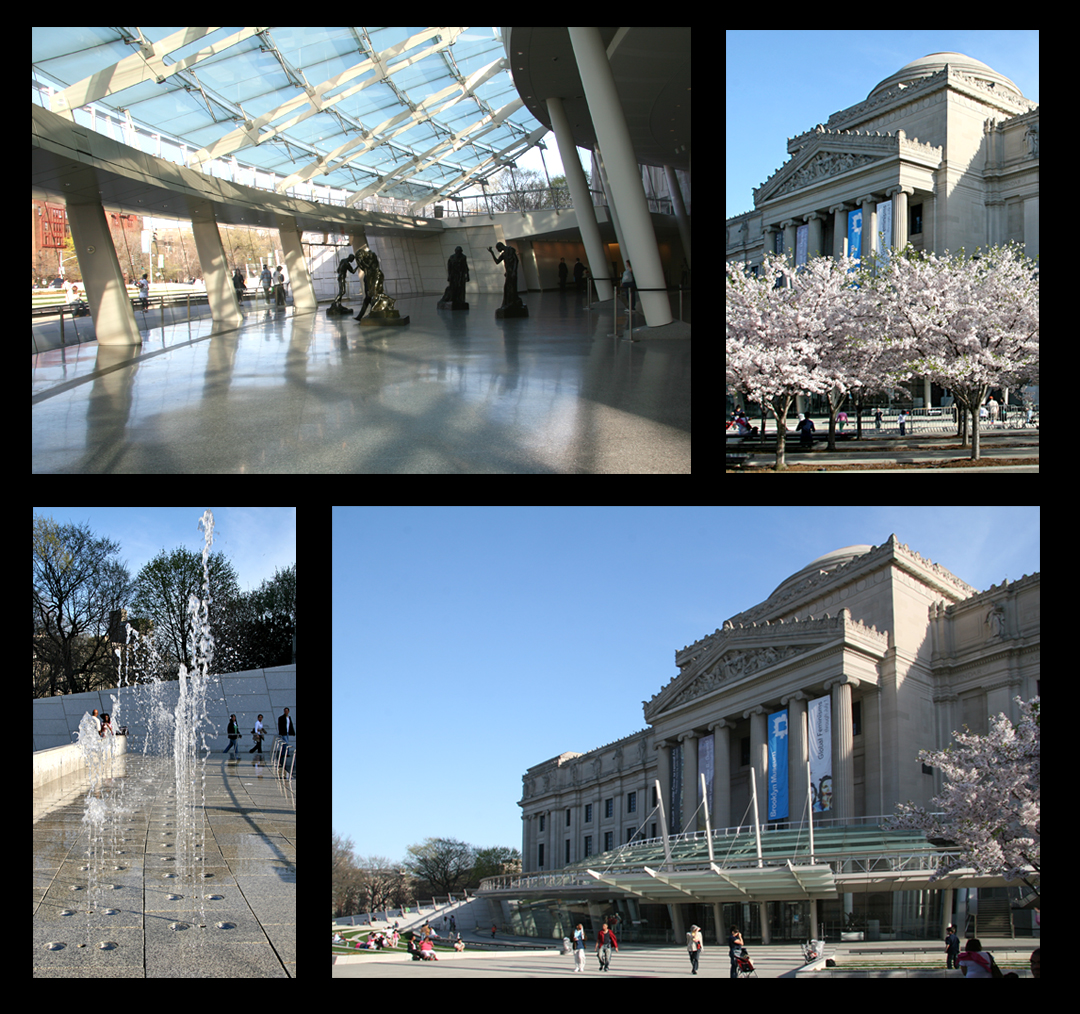
    For most visitors and many residents, New York City is Manhattan. And with all there is in Manhattan, Brooklyn can be easily overlooked. But this borough, the largest of the 5 that make up the city, is a world unto itself, with many treasures, both large and small. The Brooklyn Museum is one of the largest and most comprehensive art museums in the country. With permanent collections of more than a million objects, its holdings include objects ranging from ancient Egyptian masterpieces to contemporary art and represent almost every culture.

    The Museum is housed in a 560,000-square-foot landmark Beaux-Arts building designed by McKim, Mead & White. It is located in central Brooklyn, a half-hour from midtown Manhattan, with its own subway stop. The Brooklyn Museum is set on Eastern Parkway, one block from Grand Army Plaza, in a complex of parks and gardens conceived in the 19th century, that is also home to Prospect Park, the Brooklyn Botanic Garden (with which the Museum shares a parking lot), the Prospect Park Zoo, and the central branch of the Brooklyn Public Library. In 2004, a $63 million dollar renovation was completed. The museum also has very diverse exhibits atypical for an art museum, which I believe makes it more accessible to a broader audience. Even if you are not an art museum goer, I highly recommend a visit…


  • Little Lady Liberty

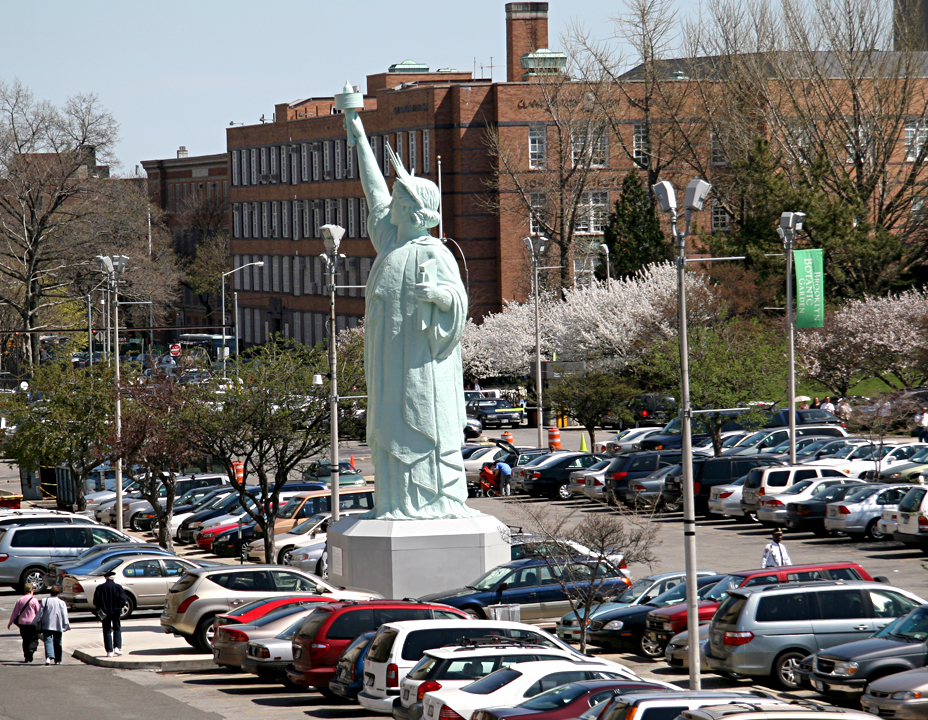
    While at the Brooklyn Botanic Garden for Hanami (cherry blossom viewing), I noticed the most bizarre sight – a huge replica of the Statue of Liberty in their parking lot. I took a photo, not really intending to use it, but investigation led to the most fascinating story.

    The statue was built and installed in 1902 by William H. Flattau, a Russian-born auctioneer who, proud of his newly adopted country, wanted a replica of the 151-foot original (created by the French sculptor Frédéric-Auguste Bartholdi) to grace the roof of his eight-story Liberty Warehouse. The warehouse, located at 43 W. 64th Street, was built by Flattau in 1891. The statue, galvanized steel over an iron framework, was made in Akron, Ohio, cut in half (to ship through the railroad tunnels), and rewelded. Until 1912, visitors could climb a circular staircase to an opening at the top of the statue’s head (much like the original on Bedloe Island), affording views of the area.

    The statue sat on top of the building for over 100 years until 2001, when the Athena group announced plans to develop the building into coop apartments, adding 4 floors and removing the 30-foot statue. In 2002, it was donated to the Brooklyn Museum of Art in honor of the police officers, firefighters, and other emergency workers killed on September 11, 2001. Conservation work has been completed. And that’s how it got where it is…


  • Sakura

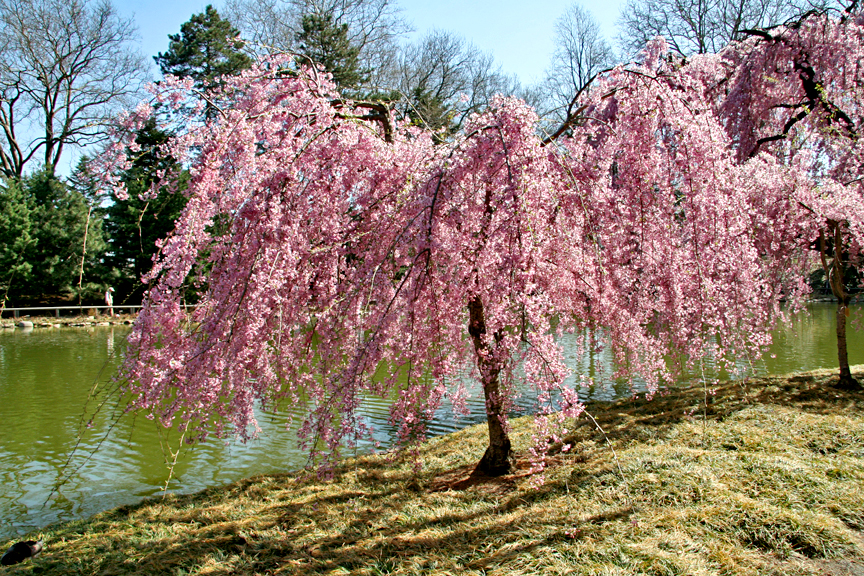
    One of the most beautiful phenomena in nature is the flowering of cherry trees in the spring. I remember one of my first family trips to Washington, D.C. to see the Cherry Blossom Festival and the display around the tidal basin. However, one does not have to travel that far – the Brooklyn Botanic Garden has their own display and festival (considered one of the world’s finest displays outside of Japan). Trees can be found at the Cherry Walk and Esplanade and in the Japanese Hill and Pond Garden.

    There are two cherry tree events going on: Hanami and Sakura Matsuri. Hanami (April 7 – May 6) is “the Japanese cultural tradition of viewing and cherishing each moment of the cherry blossom season—from the first buds to the brilliant blossoms to the petals falling like pink snow.” Sakura Matsuri is the Cherry Blossom Festival, which will be held this coming weekend (Saturday, April 28, and Sunday, April 29, 10 a.m.–6 p.m). There are over 200 trees in bloom with over 60 Japanese cultural events and performances over the entire weekend: pop concerts (happyfunsmile, ZAN, & hip-hop artist Akim Funk Buddha), a taiko drum concert, history of geisha, traditional music and dance, ice sculpture, ikebana, origami, kirigami, samari sword, bonsai, Go, tea ceremonies, craft demonstrations, and workshops. I highly recommend it – I think I may go again for the Festival…


  • dinamic_sidebar 4 none

©2026 New York Daily Photo Entries (RSS) and Comments (RSS)  Raindrops Theme