• Bohemian Flavor of the Day

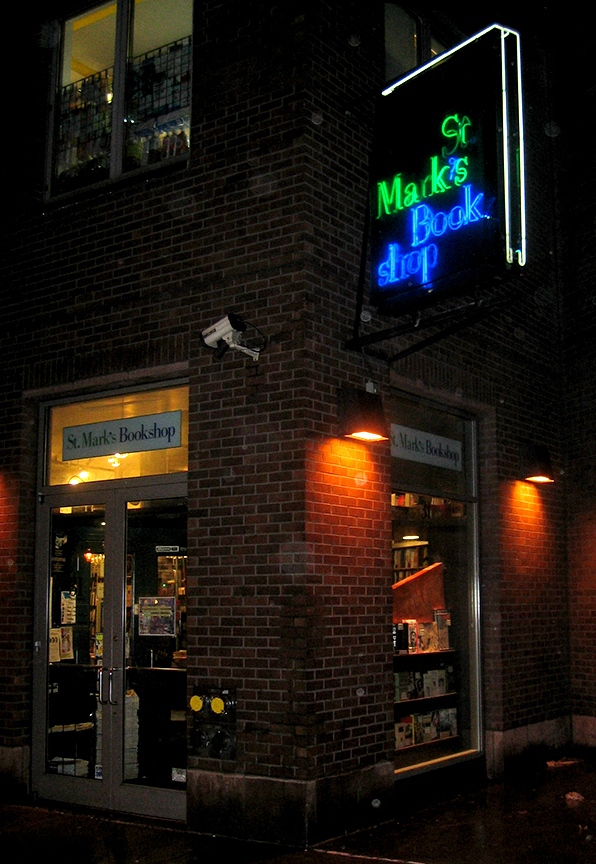
    You could almost create a website just around St. Marks Place. A few short blocks of this street have one of the most dynamic histories in the city. As I wrote in my posting, Physical Graffiti, on June 14, 2007, “The street has been home to hippies, yippies, punks, political activists and protest marches, renowned bookstores, music stores and clubs (e.g. Electric Circus), graffiti artists, cafes, clothing shops, restaurants, bars, theaters, gangsters, and St. Mark’s Church – physical graffiti well describes the street itself.” St. Marks Place reflects the Bohemian flavor of the day.

    When I first moved to New York, the East Village was one of the most exciting places on the planet. Admittedly there were other locales where the violent transformation of the time was evident, but who cared? There was so much here that we could barely keep up.
    The sociopolitical upheaval of the late 1960s and 70s was, like any other, driven by ideologies. And print media, i.e. books, newspapers, and magazines, was the method to record and disseminate the ideas.

    In a pre-internet world, bookstores (and libraries) were the centers of information and had a very special, important role, and their presence said a lot about a neighborhood or community. At one time, on 8th Street in the Village, one could find several bookstores on one block, including the famous Wilentz’s Eighth Street Bookstore. Bookstores were also typically independently owned, so each had a distinct character, and in many cases, a specialty.

    St. Mark’s Bookshop is very unique and is one of the last remaining bookstores from that time. It was established in 1977 at 13 St. Marks; from 1987 to 1993, they moved across the street to 12 St. Marks. Their current location is around the corner at 31 Third Avenue and Stuyvesant Street. They have more than 40,000 volumes specializing in poetry, literature, art, film cultural/political theory, philosophy, and small presses – they carry many things that can not be found elsewhere. They are open every day until midnight. The owners, Terry McCoy and Bob Constant, have been with the bookstore since it opened in 1977…
  • Other Worlds

    One of the great things about New York is its cultural diversity. I don’t mean just seeing an occasional person or persons who hail from another land. I’m talking about enclaves, neighborhoods, or business establishments where one is fully immersed in another culture’s world. If you want to, you can find places in this city that cater to their own and where there is not even one iota of pandering to outsiders at all. This can happen here because there are many ethnic groups (and neighborhoods) so large in the city that one can have a viable business just servicing his or her own community. I encourage you to to peruse my four postings on Jackson Heights, an absolutely fascinating neighborhood in Queens with one of the most diverse communities in the world: Indian Gold, Jackson Heights, The Patel Brothers, The Jackson Diner

    Of course, there is a spectrum, and there are other places which are equally authentic but whose products appeal to a broader clientele. Sunrise is a Japanese supermarket in the East Village where one can find serious Japanese shoppers along with others who also enjoy authentic Japanese goods. Myers of Keswick caters nearly exclusively to people of British ancestry.

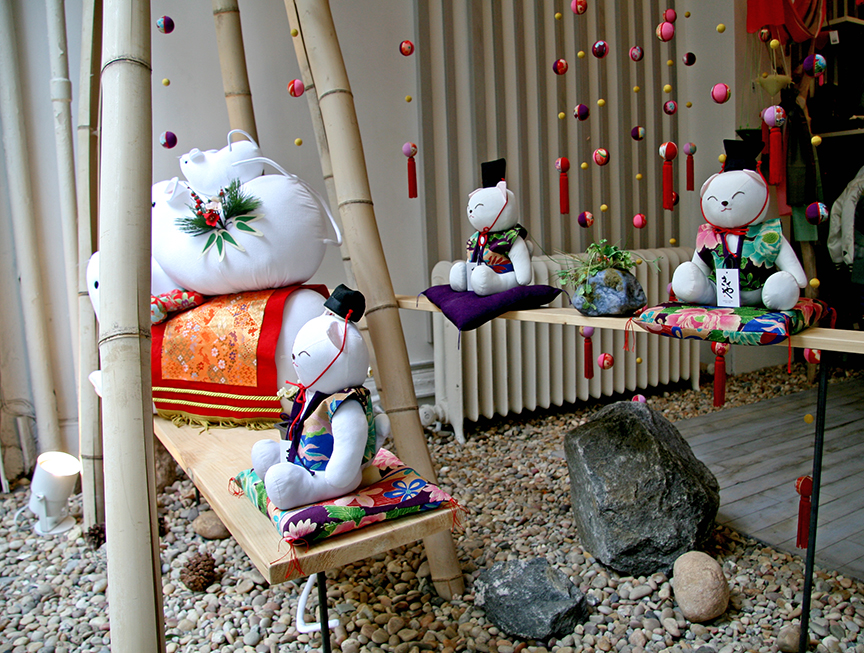
    When I went by Kiteya in SoHo with a friend, we were immediately drawn in by the window display. The shop appeared to be a doorway to anther world. Once inside, our first impressions were proven correct. Everything was slightly alien – usually a good sign of authenticity. The store, displays, and products were all done with a classic Japanese sensibility. The staff also was very authentic, as evidenced by their heavy accents. They were brimming with enthusiasm, particularly once I told them I might do a small article on the shop. The manager started reading my business card aloud and was extremely animated.
    Kiteya, which means “come visit us” in Japanese, was created by a mother & daughter team, Keiko and Yumi Iida. Their products are created by five Kyoto-based artisans.

    I’ve always admired Japanese artisanship and arts. Everything seems to be done with such attention to detail, whether it’s cuisine, clothing, martial arts, writing, or the arts. Things like Ikebana, Bonsai, Origami, Shoji, Futon, Tatami, Kimono, Zen, Sushi, Sake, Anime, Haiku, etc. So highly evolved and refined over millenia, it’s no surprise how much of their culture has found its way into ours…


  • Be My Valentine

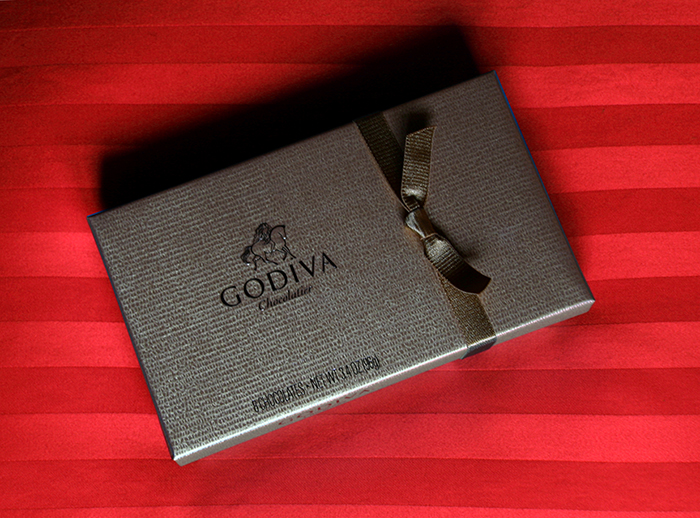
    When I was in elementary school, we all were asked to spend time making and giving each other Valentine’s Day cards in class. I always thought this was the norm everywhere, but speaking to others about it as an adult, I found that, apparently, it is not a universal practice. Looking back on it, this was a nice tradition – everyone was included. Even though the intention was not a romantic one, this must have been a nice day for those who perhaps were not so popular or were outcasts for any number of reasons.

    A little later in life, this day became the perfect opportunity to give someone whom you fancied a card with the classic message, “Will You Be My Valentine?” or the more assured “Be My Valentine.” If there were any prospects or interest at all, this would certainly seal your fate. Who could resist this offering on the quintessential day of romance?
    Happy Valentine’s Day 🙂


  • Bad Hair Day

    Imagine a bad hair day when you are not looking so good, but unfortunately, you are on display for all to see in this way in perpetuity. This happens routinely to architects and is why today, you might reconsider being, or having wanted to be (as I have), an architect. You design something which becomes literally etched in stone and await accolades or public humiliation. The stain is hard to wash off, with dirty laundry always out on the clothesline. Want to see what I mean? Here are excerpts from a book written in 1979 by Paul Goldberger (then architecture critic for the New York Times) regarding Lincoln Center:

    “These are for the most part, banal buildings, dreary attempts to be classical that took the form that they did not out of any deep belief in the values of classicism, but out of fear on the part of the architects that their clients, the conservative boards of directors of the center’s constituent organizations, would not accept anything else.”
    “The Juilliard School is probably the best Building at Lincoln Center, but one says that reluctantly, because here, too, architecture is being graded on a curve.”
    “Harrison’s Metropolitan Opera House is merely a pompous and simplistic form, made tolerable by a pair of Chagall murals.”
    “What is wrong with these buildings is not that they are classicizing, it is that they are so bad at it – they are mediocre and slick classicism, with a heavy-handedness of form and vulgarity of detail.”

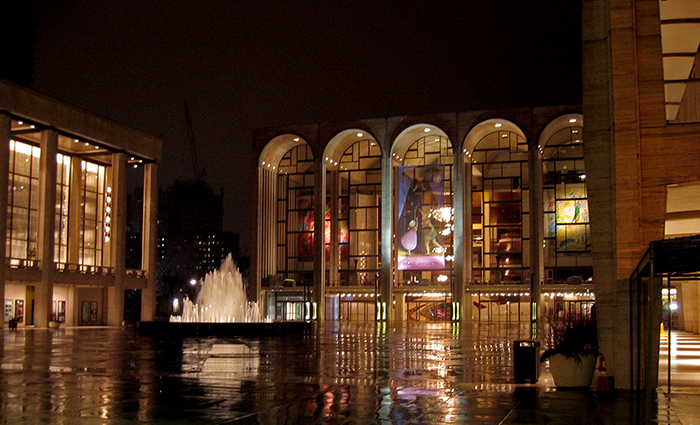
    Are you feeling better now? Fortunately, the quality of performances is top-notch, and the public enjoys the central plaza and its fountain, one of the most notable in the entire city.

    For a glimpse into my writing process, here is what I started to write today and abandoned, when any enthusiasm I had was lost after reading architecture critiques. I also planned to feature the fountain as one of the few major ones in NYC, contrasting that to Paris or Rome. The working title was The Sun Also Rises:

    Somethings loom so large or are so regular that we forget about them. Like the sun or Lincoln Center. This 16-acre complex of 8 buildings with nearly a dozen theaters is the prototype for cultural centers everywhere, and its tenants are like a who’s who of the arts: Juilliard School, The Metropolitan Opera, New York City Ballet, New York City Opera, New York Philharmonic, and the School of American Ballet. The “travertine acropolis of music and theater” was built in the 1960s and is located at one of the most strategic locations in NYC – between 62nd and 66th Streets near Broadway, Columbus Circle, and Central Park. You can read about it here or at the Lincoln Center website

    About the Photo: The New York State Theater is on the left, the Metropolitan Opera house in the center, and Avery Fisher Hall on the right.


  • At Arm’s Length

    We like our fish served on a plate, beautifully filleted with decorative garnishes – a presentation where there is no hint of the necessary reality behind the process of getting an animal to the dinner table. No matter how humane the process is, most people would find a visit to the best of slaughterhouses, poultry farms, and perhaps some of the markets in Chinatown to be unsettling.

    One of my first postings on this website was a live poultry house on the Lower East Side – cages of birds stacked floor to ceiling with slaughtering done on site. I was just fascinated that such a place existed. No big deal for some people, but to a city dweller like me, this was a real eye opener.

    With overcrowding of residents, a concentration of immigrants, restaurants, and limited space, Chinatown is teeming with sights, smells, and customs alien to most outsiders, such as the sale of live frogs, birds, turtles, and fish. Walking down Mott Street with a friend, we watched a fish flop its final throws as a worker was tossing live fish onto ice. No mollycoddling innocent eyes here.

    There is a problem with all the the garbage from all these fish markets, which includes the various remains from the myriad the fish sold. This is not the place to spend a steamy August day. Community efforts are being made to improve the situation, but it is a tough situation.

    In a bizarre and surprising twist, one person has found a way to reuse animal parts. A recent story in the New York Times tells of artist Nate Hill, who conducts “Chinatown garbage taxidermy tours.” He and a group forage through garbage in Chinatown for fish parts. His A.D.A.M. Project (A Dead Animal Man) is a sculpture of a human built entirely from animal parts. Thirteen species are included in the finished human being: chicken, conch, cow, crab, deer, dog, duck, eel, fish, frog, lobster, rabbit, and shark. If you see the exhibit, let me know about it. I’ll be keeping it at arm’s length…


  • Year of the Rat

    Chinese New Year is a two-week long celebration, and 2008 is the Year of the Rat. In most areas of the country, Chinese New Year goes by without notice, but in NYC, most natives are aware of the holiday, even if they do not participate. We have a very large Chinese American population and 5 Chinatowns, with the one in Manhattan being the best known (and largest in the Western Hemisphere).

    A friend and I decided to make a short pilgrimage to Chinatown and ran across a celebration in front of Pearl River Mart (click here for a previous posting on this large Chinese department store). We arrived just in time to see the traditional dragon and lion dance, accompanied by a snow shower.
    Our final destination was Mott Street, Chinatown’s central artery. Major festivities had just finished – the street was still closed with street cleaners sweeping confetti.

    After my reading today, I am rethinking my views towards rats. The rat is the first sign of the Chinese zodiac, and the list of attributes includes many traits not to be ashamed of: leadership, pioneering, conquerors, passionate, charismatic, practical, hardworking, organized, meticulous, intelligent, cunning, ambitious, strong-willed, energetic, and versatile. So perhaps when some business owners and landlords are characterized as rats, the inference is not as negative as what I had originally thought 🙂


  • Orange You Glad

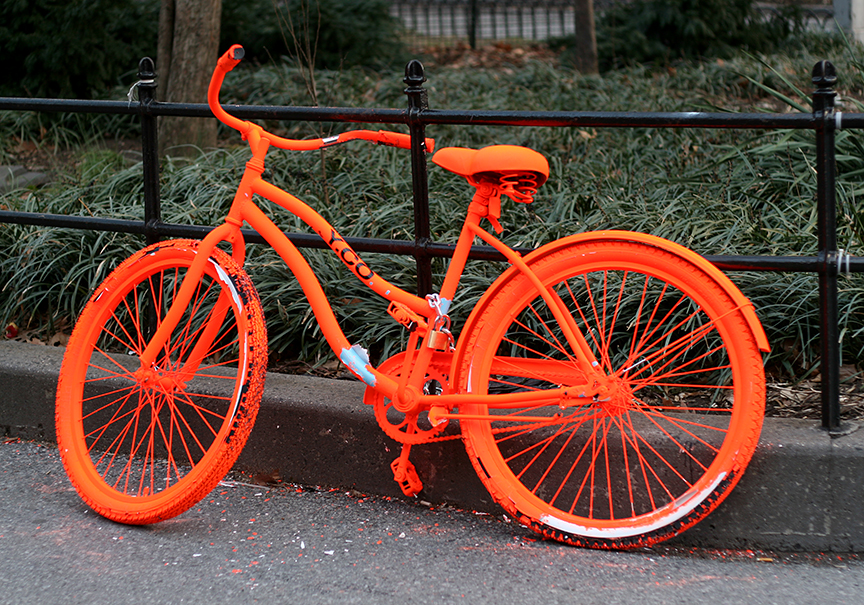
    Orange is usually associated with the warm and positive, but this bright orange bike was part of an enormously controversial campaign. Timed with fashion week, DKNY chained up dozens of these orange bikes (the logo on this one in the photo is only partly readable) around town. According to the DKNY website, this guerrilla marketing campaign was part of an “Explore Your City” program in support of NYC initiatives to help cyclists. You can see a leggy model riding on the handlebars of a bike on their website. The store was offering free maps in their stores and various bicycling links on their site.

    Where’s the controversy? Well, many found it too similar to the national Ghost Bike campaign and considered the whole thing a cheap, tacky, publicity stunt (click here for my previous posting on a Ghost Bike in SoHo commemorating Derek Lake). I’ve skimmed hundreds of comments on numerous blogs and many in the biking community are infuriated (see here). Many of the bikes were illegally chained and confiscated by the police department. The Gothamist ran a number of articles with photos (click here). In one of them, they said, “In our opinion, DKNY has crossed the line from “edgy” to “despicable,” by co-opting grassroot memorials to dead people as a gimmick to peddle clothes.”

    Others, however, feel the campaign was not intentional on DKNY’s part, just poorly thought out. A DKNY rep wrote, “We are very sorry if our well-intentioned ‘Explore Your City’ program offended anyone.”
    Orange you glad not to be DKNY?


  • The Honest Boy

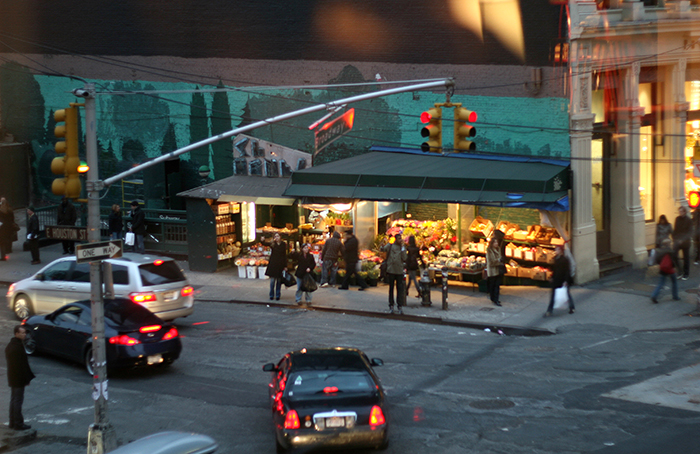
    I really wanted to get a photo of this place with the full original sign, THE HONEST BOY, before a canopy went up and blocked BOY (unfortunately, this blog was started after that). The sign, which originally wrapped around two sides, has the most unusual block lettering – virtually unreadable. Most people whom I have pointed it out to don’t even realize it is a series of letters. You can still read some of it (TH_ HONES) (click here for a closeup).

    Most people look for stability in a world of change, and the older they get, the more they dislike change. We want things we can count on, such as relationships, jobs, product quality, and landmarks. A lot of nostalgia is driven by this. In New York City, you have tremendous dynamics at hand – rapid change along with the classic, iconic, and durable. Many will fight to preserve and save any vestiges of the past; others welcome the bulldozers and see renewal as progress. And, of course, all of this leads to controversy, battles, and conflicted feelings.

    All those elements are here in this little fruit and vegetable stand at Broadway and Houston Street, which has been a fixture for decades. It occupies a triangular wedge of land (of about 1000 square feet) abutting a subway station entrance. It is owned by the MTA (Metropolitan Transit Authority). In 1980, it was taken over by Louis and Carmen Arenas. In 1992, the MTA had plans to erect an electrical substation but abandoned them due to community protests.

    Since 1990, I have been a frequent customer of The Honest Boy. Until recently, they had tremendous buys – bags of good quality fruits and vegetables for $1. The Arenas ran it until 2005, when Louis Arena (due to poor health) transferred it to Pan Gi Lee. Since then, the goods have become pricier. No more bags of peppers, tomatoes, lemons, and potatoes…

    I have read several articles today, and a long thread of comments regarding new plans by the MTA to build a two-story glass, steel, and aluminum building would incorporate one of the entrances to the Broadway and Lafayette subway station. It’s interesting that on one website, all were in favor of the demolition and considered it a pathetic shack or shanty. They complained of rats, the homeless, the stench of urine, and an impossibly crowded corner to shop. Perhaps I have been in New York too long – what was the problem again? 🙂

    Photo Note: A good vantage point with poor conditions. This photo was taken across the intersection from the second floor of Crate and Barrel at an angle through a glass window.


  • Galvanic Response

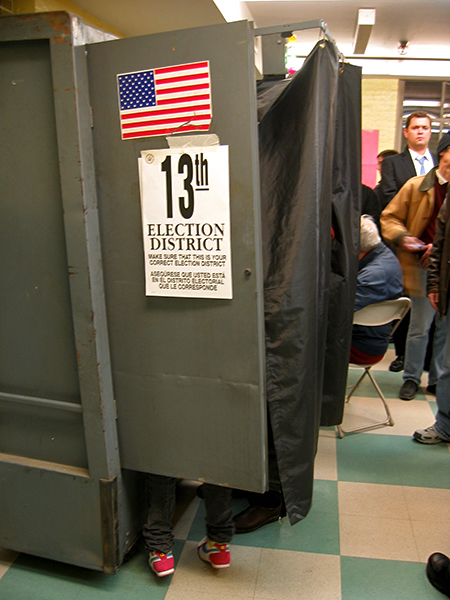
    Yesterday we had a triad of Super events in the city: Super Tuesday with voting in the Democratic primary, a ticker tape parade for the winning of the Super Bowl by the New York Giants, and “Fat Tuesday” (the day before Lent).
    I think that regardless of party affiliation, one has to admit that there is a pall hanging over the current Bush administration. The Iraq War has been highly contentious, with members of the Republican Party itself coming out against it.

    But this is not a political forum, and I am not a pundit by any means. My point is that there is much dissatisfaction, the country has become isolated globally, and people are looking for a breath of fresh air. There is a stable of good candidates. I like what appears to be a lesser focus on partisanship and more on issues; this lack of partisanship has actually alienated McCain from some of his party.

    Many see the populace as highly galvanized in this election year. We have the first serious woman and African American candidates and a Republican who looks more like an independent.

    I was curious about the term galvanized used in this way. I have always associated the term with galvanized metal, the process of electrodeposition which is the coating of steel with zinc to provide a protective barrier. But this is the more modern meaning.
    The term galvanize originally comes from the Italian Luigi Galvani and his discovery in 1783 that a frog’s leg could be made to move by applying an electric current, hence the term galvanism. This theme was picked up by Mary Shelley in Frankenstein, with the monster being animated using electricity.

    I’m glad we didn’t have to rely on Luigi Galvani, Volta, Tesla, or Mary Shelley to galvanize the public this year – I’m not sure we have the technology (yet) to resurrect them 🙂


  • Ray of Light

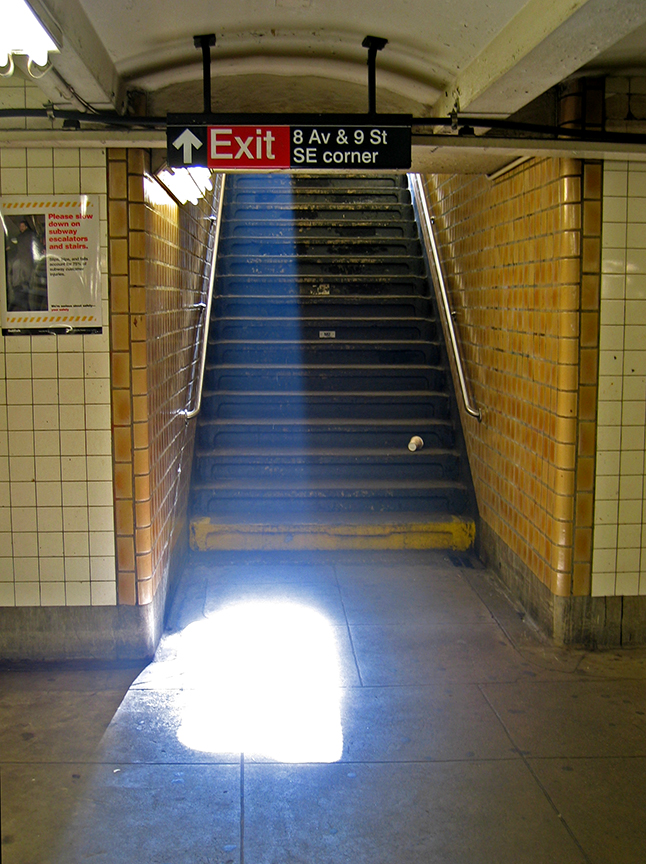
    I just tore my camera out on this one – it was like a religious experience. A friend who lives in Park Slope says that she has been up and down that stairwell hundreds of times over many years and has never seen anything like it. If you have ever really watched the sun or moon closely, you know how quickly conditions like this change. I think there was a tiny window of opportunity at this stairwell and I was there.

    But the larger point here is that the opportunity to find beauty and joy is ever present. If you have ever spent time around an eternal optimist, then you have witnessed this first hand. Many individuals indulge in the dark side and equate this with being real. They see people who are very positive as fluffy. But I think they do secretly wish they had the ability to live an easier and happier life. There is a great scene in Woody Allen’s Annie Hall where Alvy (played by Woody) runs across a beautiful, happy-looking couple on the street:

    Alvy Singer: Here, you look like a very happy couple, um, are you?
    Female street stranger: Yeah.
    Alvy Singer: Yeah? So, so, how do you account for it?
    Female street stranger: Uh, I’m very shallow and empty and I have no ideas and nothing interesting to say.
    Male street stranger: And I’m exactly the same way.
    Alvy Singer: I see. Wow. That’s very interesting. So you’ve managed to work out something?

    At the end of the day, being a cynical, skeptical, overly serious individual can be wearing. There are a lot of whiners in the world, and New York City has plenty of them. Life here is very hard and stressful, and it is a very easy place to get into the trap of being negative and thinking that things would be better somewhere else or with different means or circumstances. Most of us have all the preconditions for happiness here and now. A sense of humor helps. At the risk of being preachy or new-agey, I would suggest looking for that ray of light. Happiness is more a choice than a condition…


  • Unkindest Etch of All

    This morning, I have been reading websites like bombingscience and wetcanvas. My head is swimming with grafiiti terminology and threads on the various ways and means of working with Armor Etch, Etchall, bath, etc. Creams are too thick and dips too thin. Mixing with shoe polish or paint. How to apply it. Getting the stuff in markers. And the sites are laden heavily with expletives directed at anyone not in the know and asking “stupid” questions.

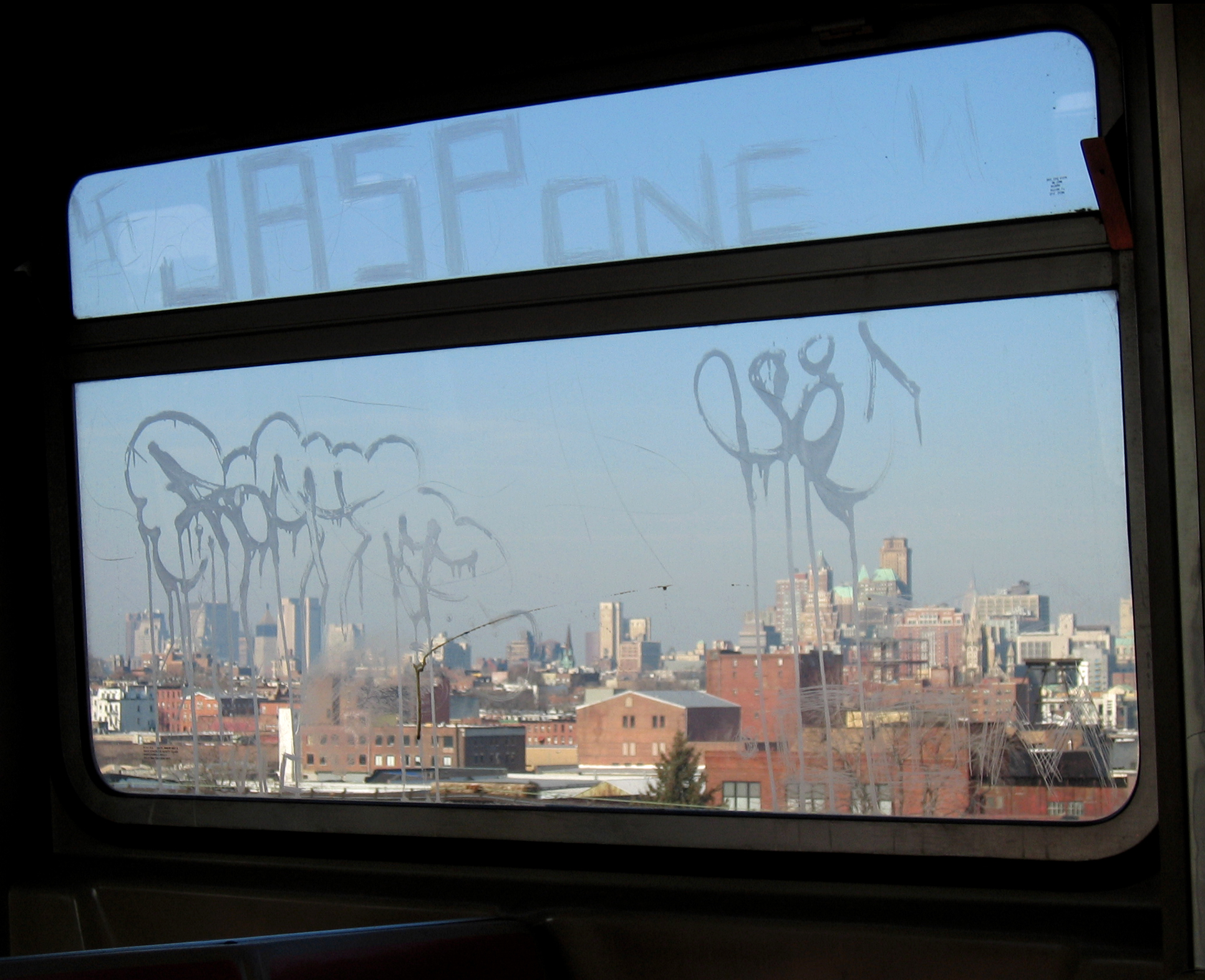
    Technology and ingenuity cut two ways, and in the case of graffiti, purveyors have upped the ante with acid. If you have seen work like that on the subway car window in the photo, this is not the result of scratchiti (scribing), giraffiti, or conventional graffiti, but rather the handiwork of individuals who use acid etching solutions to permanently write on glass. The problem has become epidemic in subways, on retail store windows, and anywhere there is a public pane of glass. There are now laws regarding the purchase of acid-etching materials as well as buying spray paint. Of course, there is controversy regarding legislation and the sale of art materials.

    I wrote about the graffiti phenomenon in March 2007 in an article on the retail shop Scrapyard. I think most people find the whole acid etch graffiti thing quite disturbing once they realize that the damage is permanent and that the entire glass window must be replaced at great cost. Many retailers afflicted with the condition tend to just leave it in place, saving money and not running the risk at having vandals do a repeat performance. For new subway cars, the transit system has availed itself of a 3M product: Scotchgard Anti-Graffiti Window Film,  a Mylar protective film not affected by etching acids.

    Oh, I didn’t tell the whole truth. Conventional wisdom and most articles you will find about acid etch will state that the damage is permanent. Not quite true. It can be removed in a laborious process of grinding and polishing. I once spoke with a worker removing etchings from a retail store on Broadway. There is a company, Unscratch the Surface in California, that does this – you can watch a video of the process on their site. A new industry is born to deal with the unkindest etch of all…

    Photo Note: This photo was taken on the F Train in Brooklyn. For a second shot with the city skyline, click here.


  • More or Less

    I’ve always loved tall buildings and big cities. My first experience was Washington, D.C., on a family trip, where I immediately became obsessed with the Washington Monument, memorizing its important facts (like its height, of course). You can easily guess my first stops in Paris (Arc d’Triomphe and the Eiffel Tower). NYC was overwhelming – I knew I had found my home.

    It’s not that I don’t appreciate nuance or subtlety or realize that bigger isn’t necessarily better and that less can be more. But these monuments are architectural assertions of what we can do. As I wrote in Beacon of Hope, a tall building, for me, is an inspiration and a metaphor for our aspirations, dreams, and hopes, frozen in time and space.

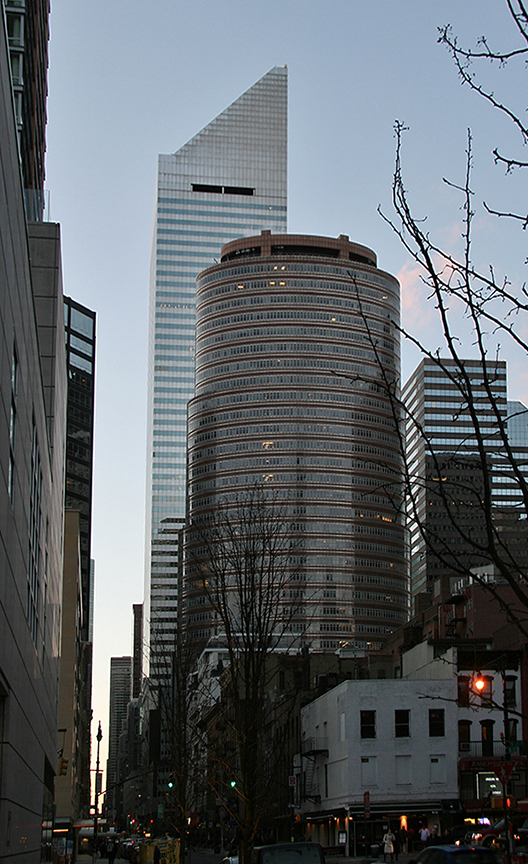
    In this photo, looking west along 53rd Street, we have the Lipstick building in the foreground and the Citicorp building behind. The Lipstick Building (1986), at 885 3rd Ave. was designed by John Burgee Architects with Philip Johnson. The building acquired its epithet Lipstick owing to the elliptical shape and telescoping tiers. The Citicorp Building has a fascinating story.

    Of course, not everyone is enamored with tall buildings, Here is a caustic condemnation I ran across online written by a Londoner:

    “My impression, based on experience of living in New York and Chicago among other things, is that tall buildings generate extra street traffic, create shading problems and downdraughts, increase the nocturnal light levels, create problems of social sustainability, tend to fall foul of planning guidance, are constructed without proper regard for the needs of existing residents, compromise the built heritage and historic fabric of the city (in London’s case, sites like St Paul’s, the Houses of Parliament and Tower Bridge), and are obvious targets for terrorism.

    Moreover, they are often built for reasons of status rather than with much regard for architectural quality and development efficiency. The aesthetic of many tall buildings is corporate and brutalist; today’s aesthetic preference may be tomorrow’s aesthetic nightmare. Expensive tall buildings also have a marked impact on the demographic of an area.”

    Ouch…


  • Full Circle

    Times Square has never been able to fully shake off its tawdry, sleazy character. But if you missed it in the 60s and 70s, you ain’t seen nothin’. This area was a shrine to every negative stereotype of the city. I mean it was really bad. I once met someone in the 1970s who used to associate with people that hung out in Times Square, sizing up potential victims, assaulting them, and stealing their coats.

    You were cheated, mugged, or robbed on the streets. It wasn’t much better indoors, where many of the stores were essentially dens of liars, thieves, and hustlers. If you haven’t seen Midnight Cowboy starring Dustin Hoffman, I highly suggest that you rent this film. It’s not only a great work, but it also portrays very well this time period and gives an authentic look at and feel for the area.

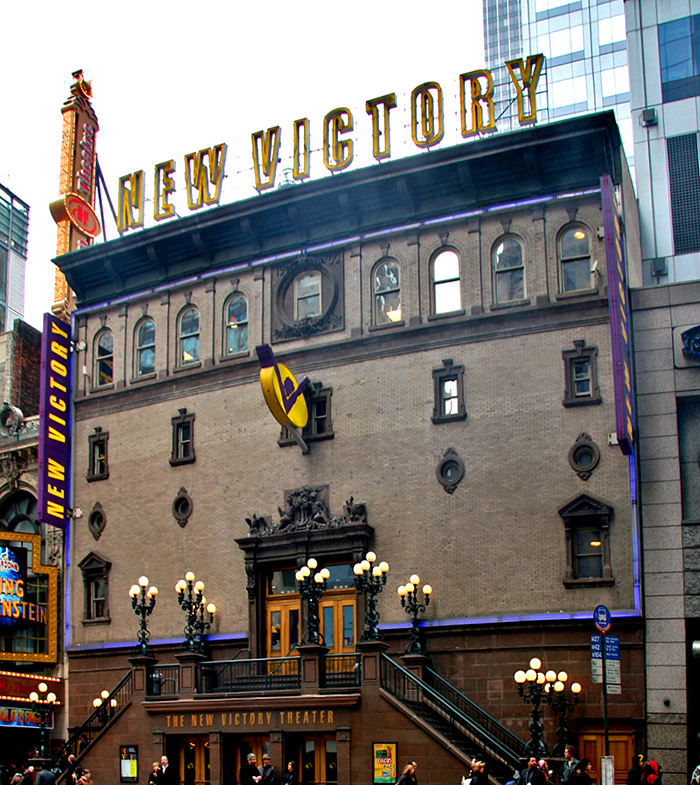
    Apart from the Broadway theaters and neon lights, the neighborhood has been best known for its porn – prostitutes, porn shops, peep shows, and porn theaters. Sadly, the Victory was part of this landscape. It’s hard to imagine the early days of this theater.

    Built for Oscar Hammerstein in 1900, it claims many superlatives and firsts, making it both famous and infamous. It is NYC’s oldest active theater and has gone through a truly remarkable number of incarnations. It became the Belasco Theater when David Belasco took it over in 1902, a burlesque house in 1931 when taken over by Billy Minsky until 1937, when burlesque shows were banned by Mayor LaGuardia, and a movie house (the Victory) through the 1970s, when it became the block’s first XXX-rated movie house.
    In 1990, it was taken over by the city as part of the New 42nd Street, Inc. in an effort to revitalize the area. It underwent an $11.4 million renovation headed by the architechtural firm of Hardy Holzman Pfeiffer Associates.

    In 1995, it reopened as The New Victory Theater, New York’s first theater for kids and families featuring theater, dance, circus arts, comedy, music, and puppetry. The theater is small (only 499 seats) affording everyone a good view and intimate connection with the performers. I highly recommend it. It’s a New York success story – rise, fall, and rise, making a Full Circle…


  • Ziggy Plays

    I once read in a travel guide that Key West was home to the indolent and the indigent. I really liked the sound of those two words together – they have both two-letter alliteration and rhyme. Not to be upstaged by Key West, I think NYC can lay claim to top dog when it comes to the numbers of people where less-than-complimentary adjectives (that rhyme and have two-letter alliteration) apply: insolent, insouciant, incoherent, incompetent, indignant, insentient, insistent, indulgent, and, of course, indolent and indigent.

    But, however talented, driven, and ambitious one might be, I think one begins to realize, especially in a big city where the evidence is ubiquitous, that good fortune is an element in one’s life. Anyone can fall between the cracks. I remember a TV program where a son was admonished by his father that one should never speak ill of “man who was down on his luck.” It was said with such gravity that it has stayed with me to this day, making me realize that indigence and indolence do not always go hand in hand.

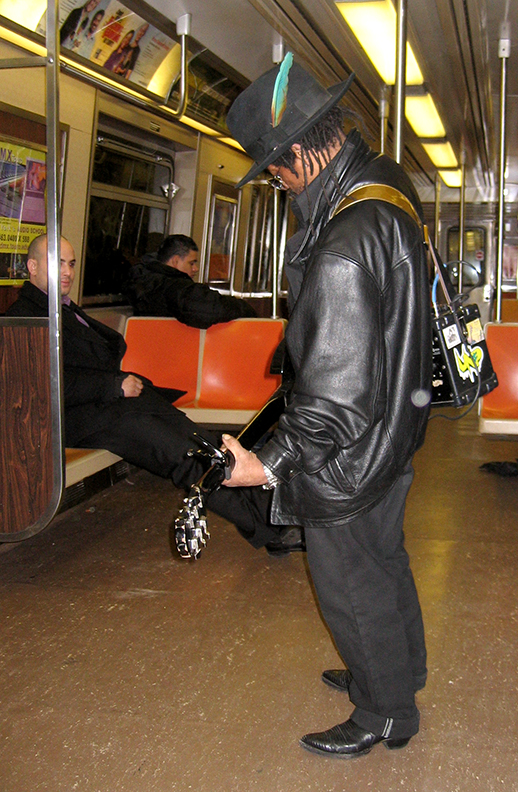
    These were the thoughts that came to mind when I entered the F train from Brooklyn last night and was accompanied by a musician who I had seen and heard before. He wanders from subway car to subway car (exiting and reentering the adjacent car at each stop) and plays a variety of songs with both his electric guitar and miniamp slung around his neck. I really like the feeling he brings to his music and the coarseness of his voice. I gave him a dollar. It suddenly occurred to me that this was a bloggable event, so with only seconds to act, I pulled out my point and shoot camera – all I had with me. As he was exiting the car, it also occurred to me to ask his name. “Ziggy” he replied. “Z, double i, double g, double y, dot com,” he added. I tried to confirm the dot com address with a fellow rider, but he was not sure. So, expecting an Internet fishing trip, as soon as I got home, I typed ziiggyy.com into a browser bar, and Voila! – Ziggy’s myspace site popped up. A feeling of comfort came over me now that he had not just a face but also a name and a place to listen to his music.

    I also started thinking that I should expand my vocabulary a bit. New words came to mind, such as misjudged, tenacious, and hopeful…


  • Roof Gem

    Having tremendous wealth does confer great privileges – an ability to indulge in a lifestyle all but inconceivable to most. NYC is no different except in the types of privileges it confers. Like being able to own an entire building for sole occupancy. This is common for most non-urban dwellers, but in New York, even tremendous money usually means just a much bigger and fancier apartment.

    Of course, once the bar has been raised and you are in rarefied territory, there is still competition for premium properties. You may have the resources to buy anything, however, the type of property you want may not be available. Many superstars have been rejected from coop boards. Even the mega-rich have frustration and disappointment.

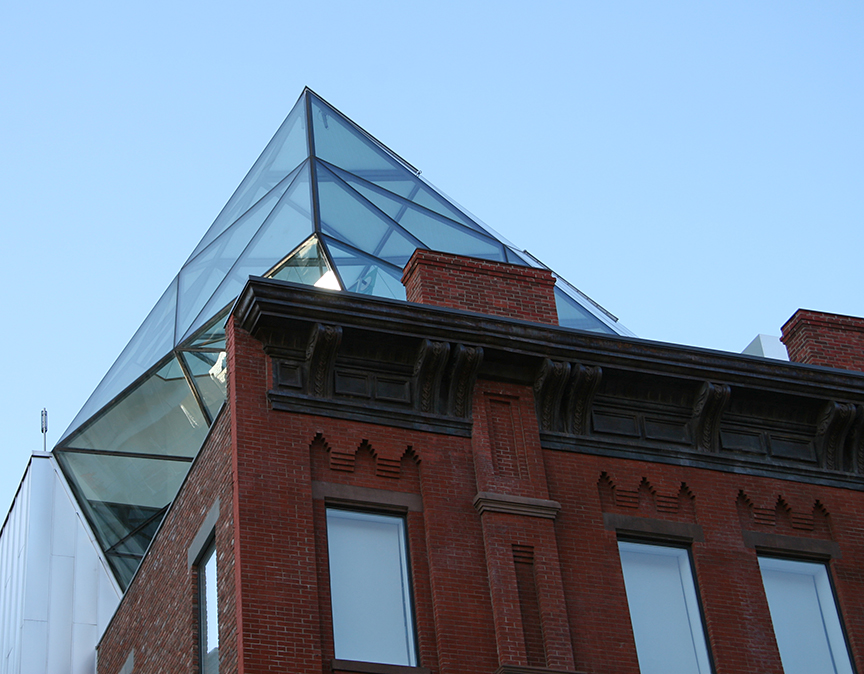
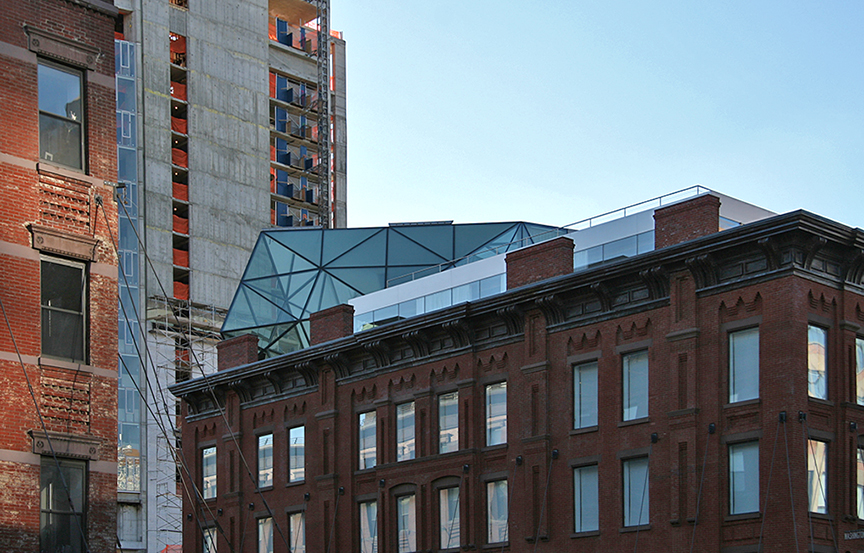
    This brings us to 440 West 14th Street in the meatpacking district. I love the anomalies of the city, so the glass structure atop this building immediately caught my eye. Click here for a photo showing a view of the structure set against its surroundings. A little digging revealed that this 25,000-square-foot historic building was purchased by Diane von Furstenberg in 2004 after sale of her properties in the West Village. According to the Villager:

    “von Furstenberg unloaded her three-story 1850s former stable and blacksmith’s shop at W. 12th St. — which served as her store, studio and pied-a-terre — to a 19-year-old Russian heiress, Anna Anismova, in September. She garnered a reported $20 million in the deal, more than three times what she paid for the property seven years ago.”

    The building was was originally built by the estate of John Jacob Astor in 1887 as workers’ living quarters for the nearby piers. It was occupied for 50 years by the Gachot & Gachot meatpacking company.
    The glass prism-like roof structure provides illumination for von Furstenberg’s penthouse/design studio; the structure is modeled after a piece of jewelry she designed for jeweler H. Stern. The building itself, which she restored to its former 19th-century appearance, will be used for manufacturing and commercial use. It is very atypical these days to see a conversion to non-residential use. Approval of the design was quickly had – most applauded and welcomed the restoration. Some, of course, disliked the prominence of the rooftop prism.

    Perhaps the adage “you can’t always get what you want” does more to comfort those who have less by distracting us from the fact that those with wealth and/or power do often get what they want. It does appear that Diane got what she wanted here…


  • dinamic_sidebar 4 none

©2026 New York Daily Photo Entries (RSS) and Comments (RSS)  Raindrops Theme