• Where’s the Special

    I’ve been worried that special is over. I don’t mean special like a sale, I mean special – something unique, different, and unusual. Special is what many people look for in people, places, and things. That’s why you come to this site. This is the reason people often line up. There is frequently an element of the creative in the special, and there is typically a shortage of creative to go around. Of course, there are also many, perhaps most, who find great comfort in the ordinary, regular, or usual. Creatures of habit and lovers of routine. There’s a piece of this in most of us. But this story is about the special.

    At one time, Zabar’s, along with Balducci’s and Dean & Deluca’s downtown, were truly special, very unique places. The quintessential gourmet food emporiums and meccas for residents and visitors. But now, many of these products can be found in national chains such as Whole Foods, with enormous selections of specialty items.
    Zabar’s, located on the Upper West Side, was started in 1934 by Louis and Lillian Zabar, who were renting an Appetizing Counter in a Daitch Market. Over the years, they took over the Daitch Market. Louis died in 1950. Saul and Stanley Zabar took over running the business. Today, the store is over 20,000 square feet – almost a city block long – at 80th and Broadway, serving over 35,000 customers per week. It is still a family-owned and -operated business.

    Perhaps it’s not that special is exactly over. It’s that it is fleeting – appropriated and co-opted at lightning speed or hidden in the nooks and crannies. There are things in and things about Zabar’s, as well as their ilk, that is still special. So, if you want the special, act quickly and/or look in the corners and edges. I’ll see you there…

    Footnote. Perhaps there is nothing so great about special anymore and that I am just romanticizing the past. I see a new generation that appears to be happy with the ubiquitous. Luxuries and specialties have become very common – do we need the special?
  • Kalustyan’s

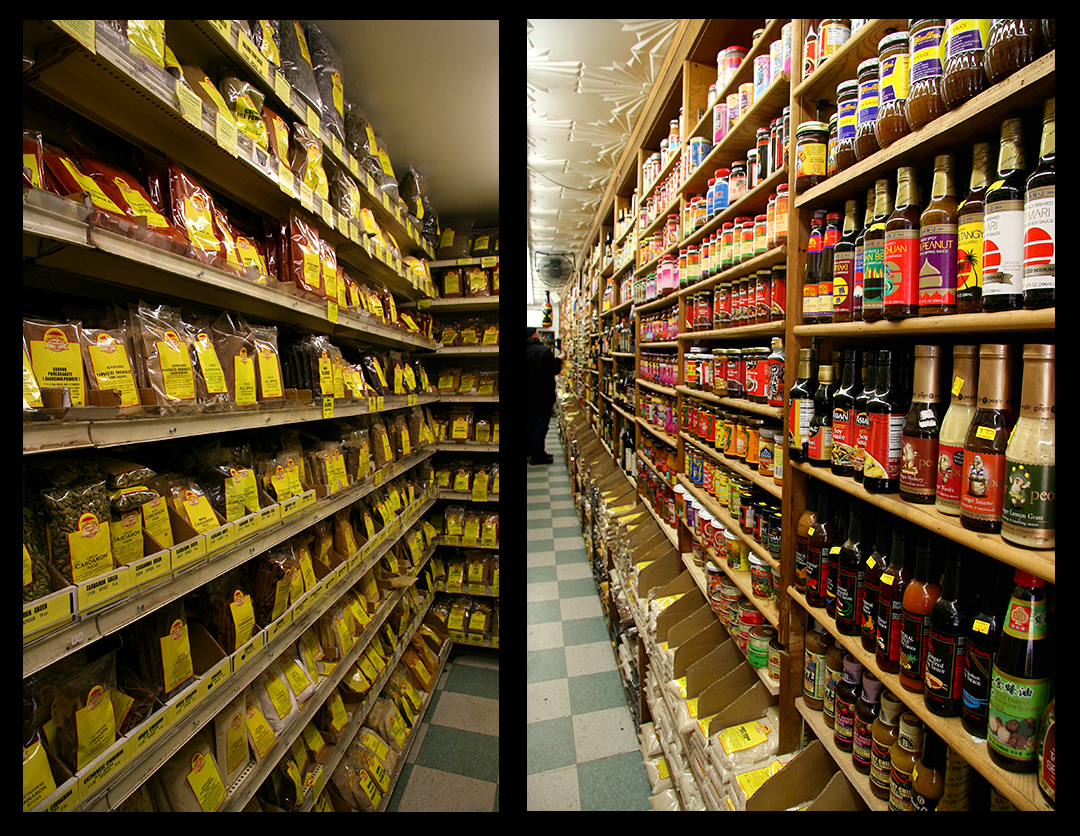
    Kalustyan’s website has 45 pages of spices – 1,322 items. Perhaps you are interested in choosing from a selection of 41 varieties of coconut or over 100 types of lentils or dal. If you want this breadth and depth of selection, you had better have a large number of patrons – your casual visitor or curiosity seeker is probably not interested in tamarind paste or an extensive selection of ghee. NYC delivers the patrons.

    It is unlikely that you will find a selection like this anywhere else. Kalustyan’s, at 123 Lexington Avenue, was established in 1944 by K. Kalustyan and is now owned by Sayedul Alam and Aziz Osmani, who have expanded the selection to create an international specialty food market, with a concentration of Middle Eastern and Indian food. They have thousands of varieties of food items – herbs, spices, teas, coffees, pastries, baking products, oils, nuts, seeds, breads, beans, chutneys, etc. Upstairs, there are cook wares and a small deli with prepared foods and a couple of tables.

    Another nice thing about visiting Kalustyan’s is that it is in the heart of an Indian district (one of two in Manhattan). This is the destination if you are interested in having dosas – try any number of places specializing in them, such as the Dosa Hut. Also, you can visit Foods of India next door.
    Kalustyan’s is my favorite ethnic market. It’s pleasant to shop in and is truly exotic, with a selection that is wide and deep…

    Related notes and postings:
    If you are interested in ethnic neighborhoods and food, I would highly recommend a trip to Jackson Heights, Queens. I made a pilgrimage there last year and did 4 postings on various merchants and aspects: Indian Gold, Jackson Heights, The Patel Brothers, The Jackson Diner

    If you like Middle Eastern food, you really need to try an authentic Ouzi and Ful Mudammas. I recommend First Oasis in Brooklyn for either dish (or Moustache in the Village for Ouzi).


  • Claims and Hooks

    In a competitive and crowded marketplace, many a business, product, TV program, or even political candidate needs a hook to distinguish itself. An idea, a claim, or an exclusive feature. In the case of bars, oldest is nice to be, and in NYC (like other places), the claim is sometimes made by more than one. After all, the prize of being first or oldest can be leveraged, so the battle of claims and counterclaims can be fierce. Adding a qualifier is a clever twist. This way, more than one establishment can take title to the same prize, a variation like oldest in continuous operation. For marketing, the qualifier can be dropped.

    Ray’s Pizzas are probably the most infamous in the city, with numerous pizza shops all using Ray in the name and some superlative or combination of superlatives – Original, Famous, Famous Original, etc. – and claiming to be first. The Ray’s Pizza name has actually involved lawsuits. We also had a rather serious war over Guss’ Pickles.

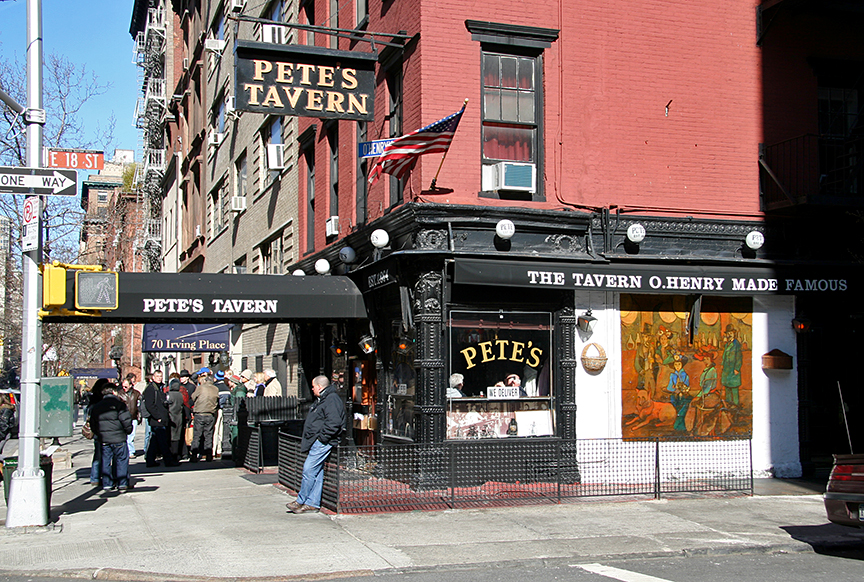
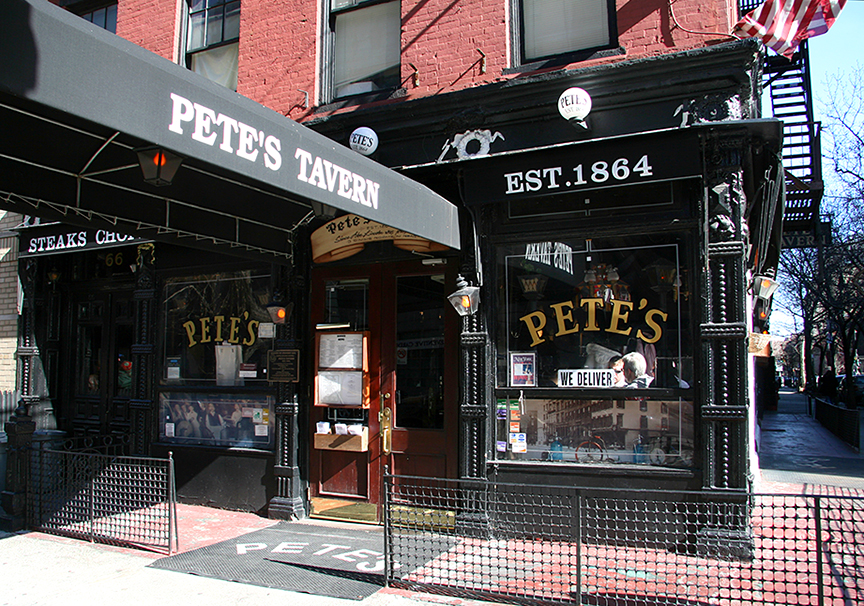
    In the world of oldest bars in NYC, we have several contenders, including Pete’s Tavern, the Bridge Cafe, and McSorley’s Ale House. Pete’s Tavern, located at 66 Irving Place at 18th Street, claims to be the longest continuously operating bar and restaurant in New York City (see 2nd photo here). They also say that “its most celebrated regular, O. Henry, wrote the classic Gift of the Magi here at his favorite booth by the front doors, in 1904.” Richard McDermott, a historian who has done a lot of digging, has cast doubts on all of these claims, including the O. Henry one. He has found that the Bridge Cafe is the oldest.

    But the facts, particularly a newly revised history, typically don’t stick in people’s minds. Once something has been accepted as “fact”, it is frequently repeated and believed forever.
    I find that when so much emphasis is placed on claims, sight of what’s important gets lost – the content and quality of the product or place. And, ironically, many of the places fighting over these things are not the best; they are frequently touristy spots hanging on to crumbs of questionable history to lure in customers. In the case of Pete’s Tavern, I can’t speak to the quality of the food or ambience – I have not spent time inside.

    We are all barraged and saturated with messages. Unfortunately, to get our attention, businesses must frequently resort to pulling out all the stops and relentlessly hammering a simple claim with hope that it hooks…


  • Little Comforts

    The longer you live in this city, the more you begin to appreciate the comforts that others have and take for granted, such as being able to drive places and park easily at your destination, or doing laundry in your home (not that many of these comforts can’t be had in the city, given the will and substantial money.) In time, even the little things start to become a treat, especially the unexpected – free gift wrapping of a package, delivery, a bike path, a dog run, or an unoccupied park bench on a sunny day.

    New York is a city of walkers. If you don’t like walking, this is not the best place to live or visit. Walking is nearly always the most reliable mode of transportation – rarely fraught with delays, traffic, rerouting, or any other myriad of problems with subways, buses, or cars. And for most New Yorkers, walking is an enjoyable activity in itself, with all there is to see in the vibrant, constantly changing landscape of this city. Of course, the biggest downside is braving the elements, particularly the unexpected, like getting caught in a rainstorm with no umbrella. At these times, a welcome comfort to the walker is a little shelter – an overhang, canopy, or pergola.
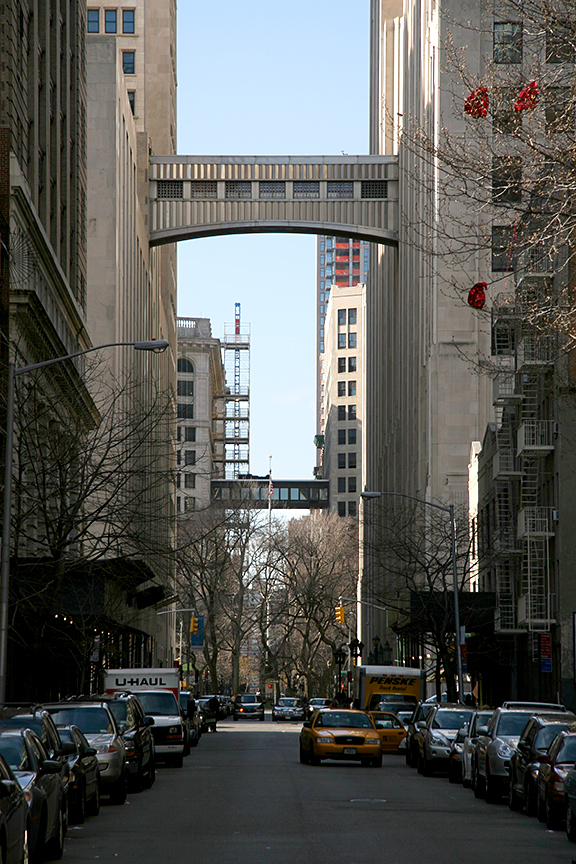
    So what better little comfort can one imagine than an enclosed pedestrian walkway (a.k.a. skyway or sky bridge) between buildings? I was startled at the sight of two while walking along Lexington Avenue and peering westward down 24th Street. It was a photo begging to be taken.

    I think if I worked in either of those buildings and could find reasonable excuses, I would pass through that little skyway as often as possible, particularly on a cold and rainy day, admiring the views and fully enjoying the little comfort of not having to step outside or grab an umbrella 🙂

    NOTE ABOUT THE BUILDINGS AND PHOTO: The closer of the two skyways in the photo connects the 10th floor of 1 Madison Avenue (on the left) to the 8th floor of 11 Madison Avenue (right). One Madison Ave is home to the Metropolitan Life Insurance Tower (previous posting here). Credit Suisse First Boston occupies the office spaces that this walkway connects.
    The second walkway in the background connects the buildings at 200 Fifth Avenue (left) and 1107 Broadway (right). These were formerly known as the Toy Center Buildings and served as offices for toy manufacturers; the American International Toy Fair has taken place there since the early 1900s. The buildings were recently sold (1107 Broadway is being converted to residential condos). The treed space in the center, separating the pairs of buildings, is Madison Square Park.


  • Holdout and Holdup

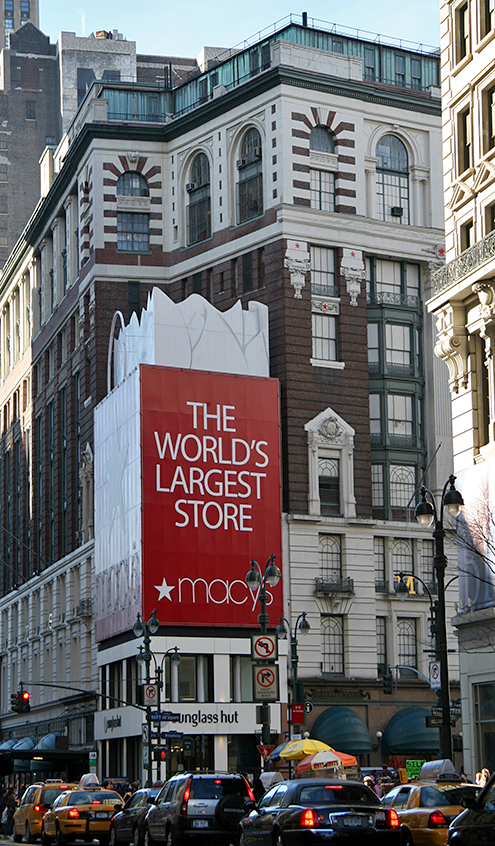
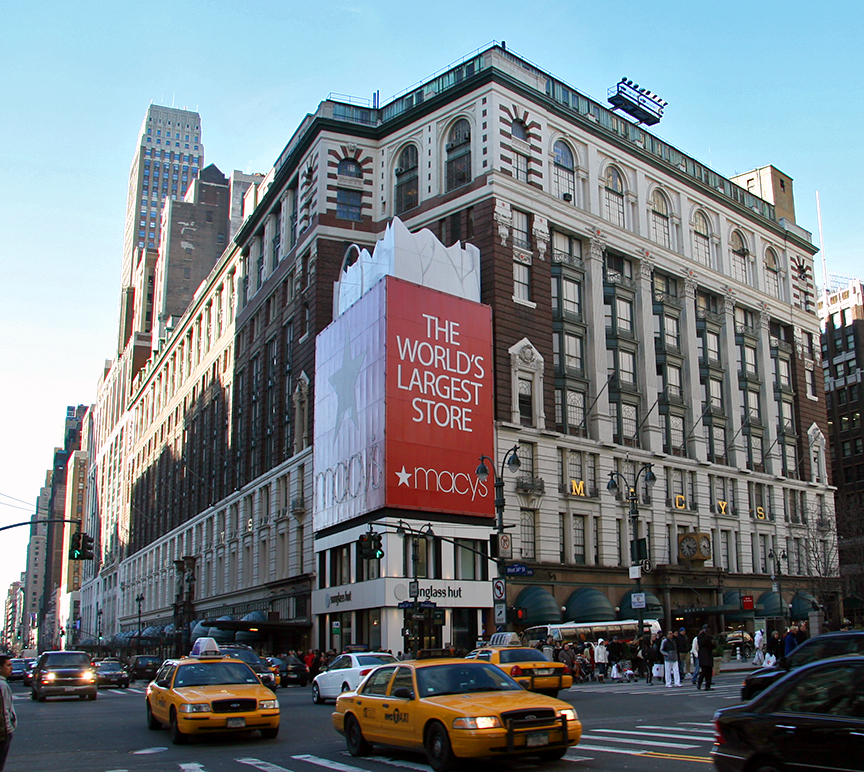
    The story of the notch in Macy’s has been told before, but to find it, you need to know that there is a story to be told. Most pass by this intersection at Herald Square, one of the busiest in the city, never suspecting that the enormous sign proclaiming Macy’s to be the World’s Largest Store is the subject of a small drama. See a photo of the entire block here.

    The strange tale is about the quintessential Holdout – in real estate parlance, someone unwilling to sell a key property standing in the way of development. ‘Tis the dream of many that through pure happenstance and good fortune, one has an apartment or property which is crucial to a large project and holds out for an enormous sum of money, securing one’s financial status ever after.

    In the late 1890s, Macy’s decided to expand from its 14th Street location to 34th Street. It secretly began buying property there, but word leaked out. Robert Smith snatched the property for $375,000. Escalating from holdout to holdup, the hope was to use this property to negotiate with Macy’s and get occupancy of their 14th Street location (and some of the Macy’s original customers).

    However, Macy’s did not take the bait. It built around the building and continued to hold the 14th Street property vacant until the end of the lease.

    They opened at Herald Square in 1902. The following year, the corner building was torn down and replaced with a new 5-story structure – the one you see here today (it was first leased to the United Cigar Store Company for $40,000 a year).

    Much later, after 1945, Macy’s started to rent advertising space, covering the entire building. Although there have been opportunities to buy the property, to this date, Macy’s has not. They continue to rent advertising space for the 70-foot sign. Sadly, many of the retailers at this corner building have been tacky, unattractive establishments. Currently there is a Sunglass Hut – a step up in appearance.

    So if you dream of holdouts and holdups, keep in mind, they may only be pipe dreams…


  • You’re Not in Kansas

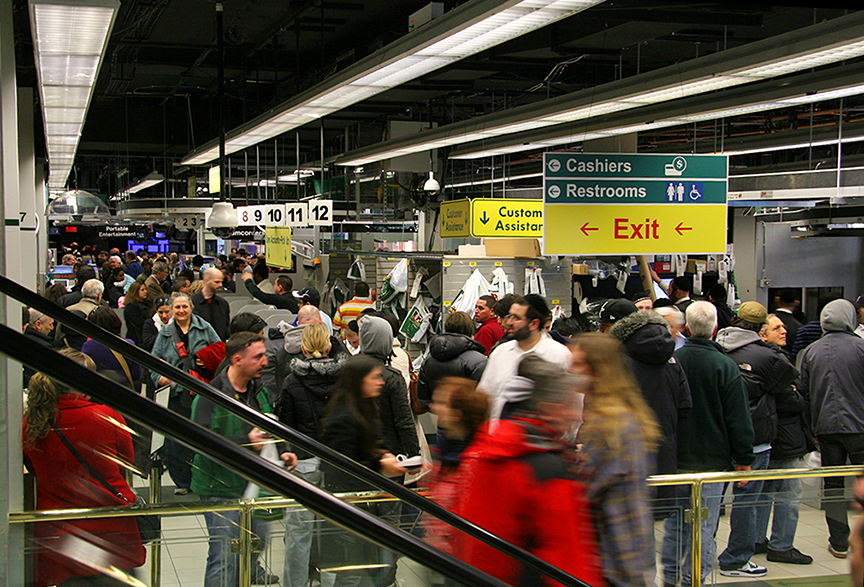
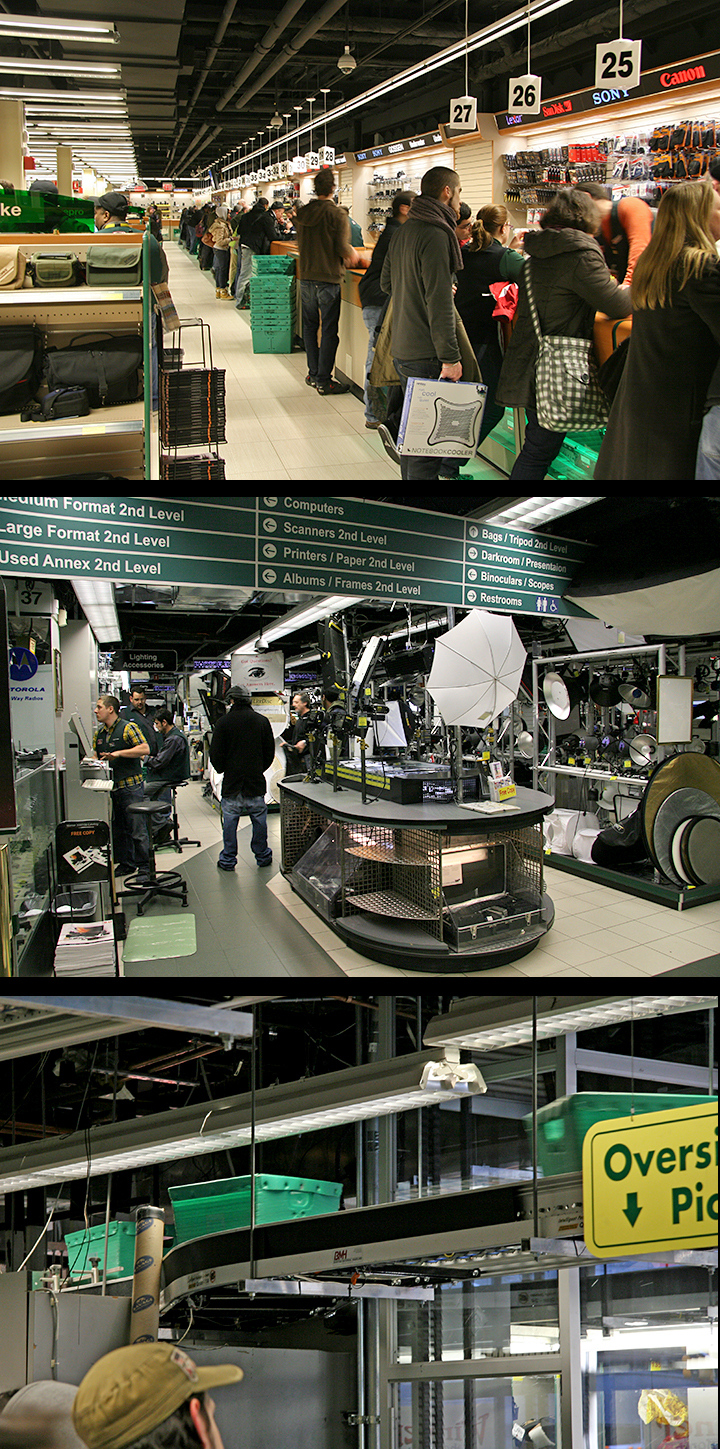
    I love this place – if you want the feeling of commerce with beehive activity, this is the place to go. Hustle and bustle, from busy to packed, B&H Photo Video sees over 10,000 customers per day. This is the country’s largest photo supplier – they have everything. But whether you are a photographer or not, it is a must-visit.

    The store was founded by Herman Schreiber and his wife Blimie (hence B and H) on the Lower East Side in 1973. It relocated to 17th Street in the photo district, where it remained until 1997, when it expanded and moved to its current space at 34th Street and 9th Avenue. They occupy 70,000 square feet, not counting corporate offices nearby and a large Brooklyn warehouse.

    Everything is a study in organization and good business management. After a purchase is made, goods are sent from a basement stockroom to the pickup area via overhead conveyers with green bins (see photo #3 here). The huge checkout area moves quickly, with dozens of clerks taking payment. Take a few final steps to product pickup, and voila, your items are already awaiting you!

    Many retailers in NYC have become international icons, such as the Fifth Avenue gold coast retailers – Cartier, Tiffany, Saks, Bergdorf, and others, such as Macy’s. These stores all have a rich history, with many being founded in the mid-1800s. Their mythic proportions are made more indelible by the historic properties they inhabit in prime locations.

    B&H Photo shares none of these attributes but has achieved iconic status in its own unique, New York way. Although large, the single location provides for the focus and expertise not typically found in a chain store. And B&H is no stranger to competitive pricing; they built their reputation on supplying professionals with equipment at rock-bottom prices. So the Internet has not thrown them – they aggressively market and sell online. There is ZERO pressure to buy – none of the salesman are on commission. The return policy is very generous.

    Visiting here is also a cultural experience. B&H is staffed predominantly by orthodox Jews – bearded men with white shirts, black pants, many with payot (sidelock hair curls), and tzitzis (white cords hanging from the waist). For many visitors, the site of this entire spectacle serves as a good reminder that You’re Not in Kansas Anymore 🙂


  • Chiuso and Costruzione

    On my first trip to Italy, I learned two very important words as a visitor: chiuso and costruzione (closed and construction). In fact, it started to become a private joke – everywhere we went, we encountered some variation on the theme of closed and/or under construction. Admittedly, with such a density of ancient architecture and sculpture, the repair and maintenance of places such as Florence, Venice, Rome, etc. will, of necessity, be a perpetual enterprise.

    In America, as a much newer country, this is a novel concept, and repairs taking place repeatedly or over long periods of time are usually viewed as tragic or a sign of incompetence.
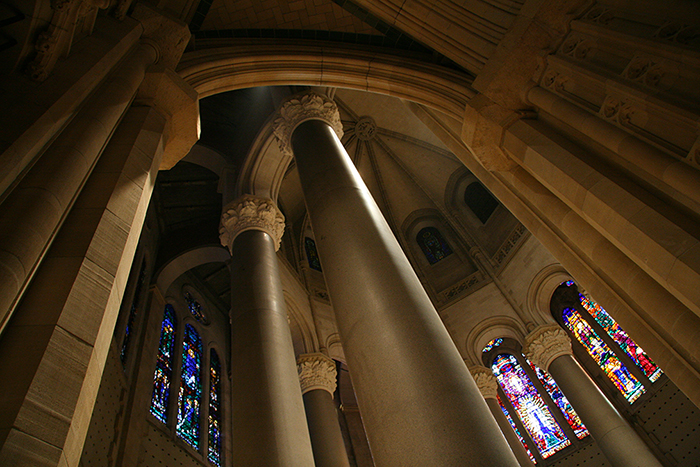
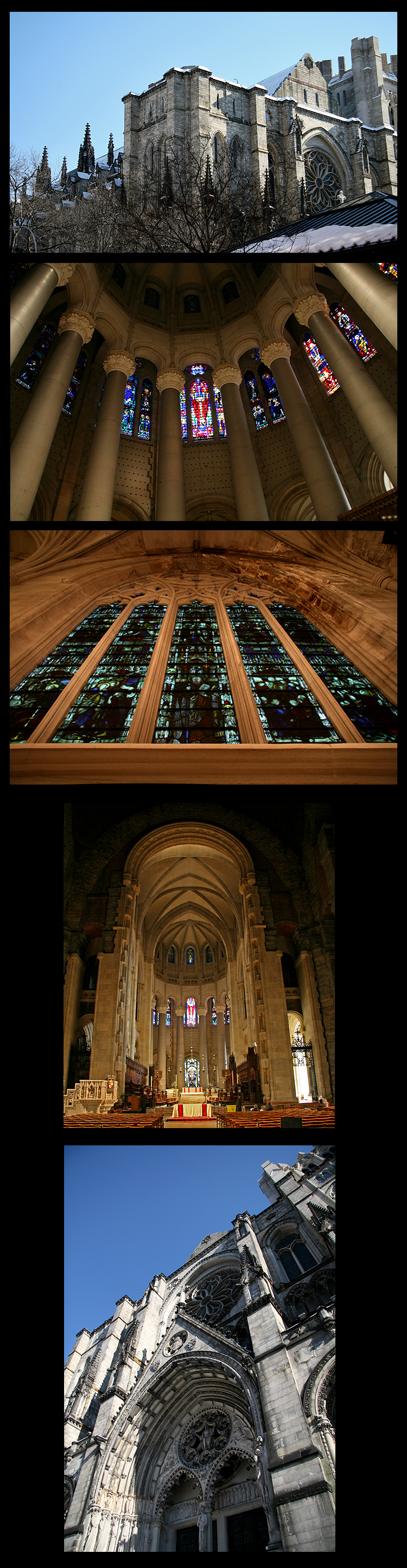
    With the Cathedral Church of Saint John the Divine, we have our own shrine to chiuso and costruzione. A tour around the 11.5-acre property reveals metal sheds, barbed wire fences, and until 2007, scaffolding. See more photos of the interior and exterior here.

    In some rather unfortuitous twists and turns, the construction of this cathedral has been proceeding in fits and starts since its inception in 1892 and, in fact, is still not completed. Bad luck, World War, running out of endowment money, long periods of stagnation. And, to add insult to injury, a fire in 2001. An early change in architects resulted in the mixture of architectural styles we see today – Romanesque and Gothic. This is a long and complex tale (read about it here).

    But there are other things of a more positive nature. This cathedral is enormous – 601 feet long with an interior height of 124 feet. It is one of the largest cathedrals in the world. The Statue of Liberty could fit inside. There is a magnificent pipe organ. The place inspires awe.
    Although most churches are involved in community and charitable work, St John has gone much further than most, with a wide range of performing and visual arts programs, concerts, workshops, educational work, and a plethora of outreach programs.

    Memorial services, celebrations, and speakers by and for people of all walks and faiths have been seen here – St. John’s really stands out in this eclectic, nondenominational way. Philippe Petit has performed there and was an artist in residence. Many notables, such as the Dalai Lama and Desmond Tutu, have spoken at Saint John. There is even a triptych by Keith Haring (The Life of Christ).

    A fervent mission is now at hand to finally complete the work – the Eastern portion, where these photos were taken, has been finished. I was told that full completion of the interior will be done by November 2008 (with celebration and fanfare I am sure), so I would pencil this in on my calendar…


  • Make No Mistake

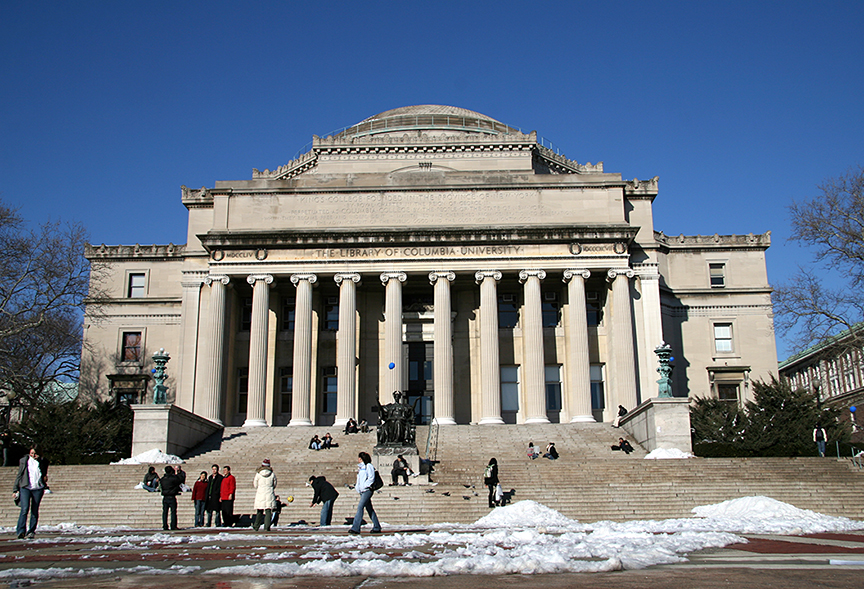
    Rather surprising for Manhattan, isn’t it? Most residents or visitors never get to Columbia University – it’s in its own world, removed from city both geographically (located far uptown in Morningside Heights) and due to its rather unique true campus enclave. Other colleges and schools in the city are typically comprised of a number of buildings acquired over time and located in a helter skelter fashion as close to the main buildings as possible – e.g. SVA, the New School, Cooper Union, Hunter College, and to a lesser extent, NYU. Columbia has a real campus, relatively isolated from the city streets. Rather befitting its status as one of the eight members of the Ivy League.

    Columbia is one of the most prestigious universities in the world, with a long list of firsts and superlatives. Founded in 1754 by the Church of England, this school has 87 Nobel Prize winners affiliated with it. Columbia University is an enormous topic – read more here at their official website.

    The colonnaded structure in the photo, the Low Memorial Library, is the centerpiece of the campus and one of the most universally applauded structures in New York City. Designed by McKim, Mead and White with elements of the Parthenon and Pantheon, it is considered one of their finest works. This was the first building in 1897 at the new uptown campus (it had previous downtown locations). When built, in an area that was cropfields, this grand structure, sitting atop a hill, afforded vistas of Manhattan to the south.

    Unable to get in on Sunday, not only was I disappointed that I would get no interior photos, but I also speculated as to why a university library would be closed midday. Answer: this building has not functioned as a library since 1934 – it now is its administrative center. The interior of the 106-foot-high granite rotunda is spectacular, with solid green Connemara marble columns.

    Make no mistake, there are plenty of books at Columbia, and Low Library would not be large enough to house them all (over 9 million volumes). The main library is Butler Library, located south across the central campus, with sections opened 24/7. I made the same mistake that apparently many newcoming students do. For years, there was a small sign stating, “THIS IS NOT BUTLER LIBRARY.”

    The time to visit is on a warm, sunny day. Stroll the campus ane enjoy the plazas and the green space of the campus, and imagine the privilege of attending this fine university with everything that it has to offer…


  • Hurry

    I have done business with places like this for decades. They were always just places. Get in, get out. Get your business done. Maybe a friendly chat. Nothing much to admire. Could really use a little sprucing up, actually.
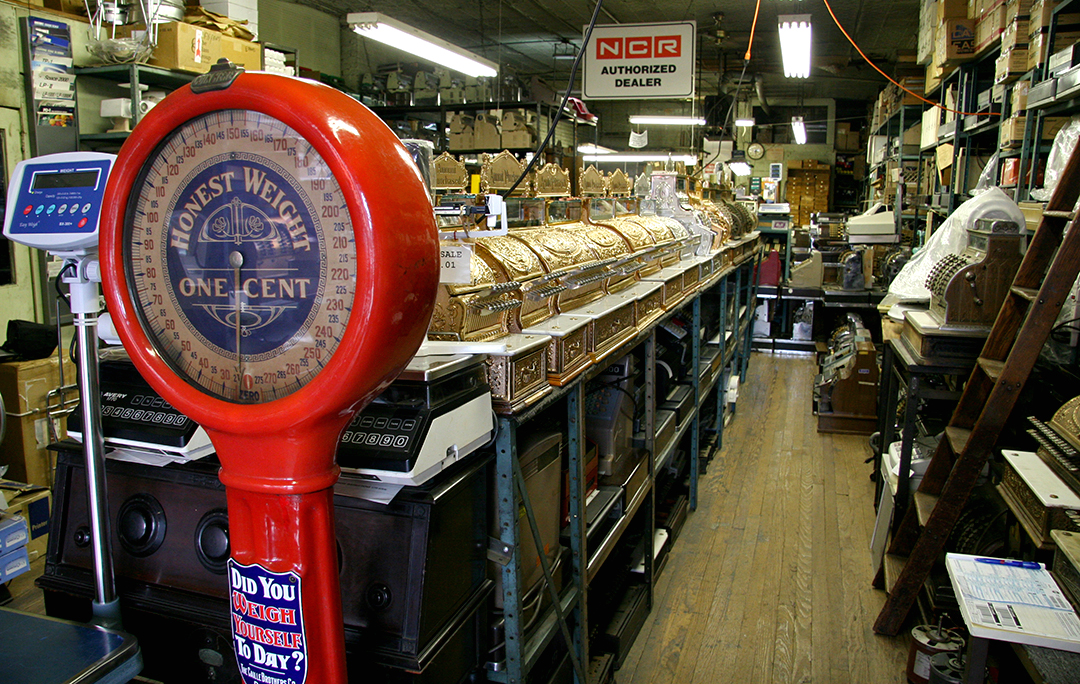
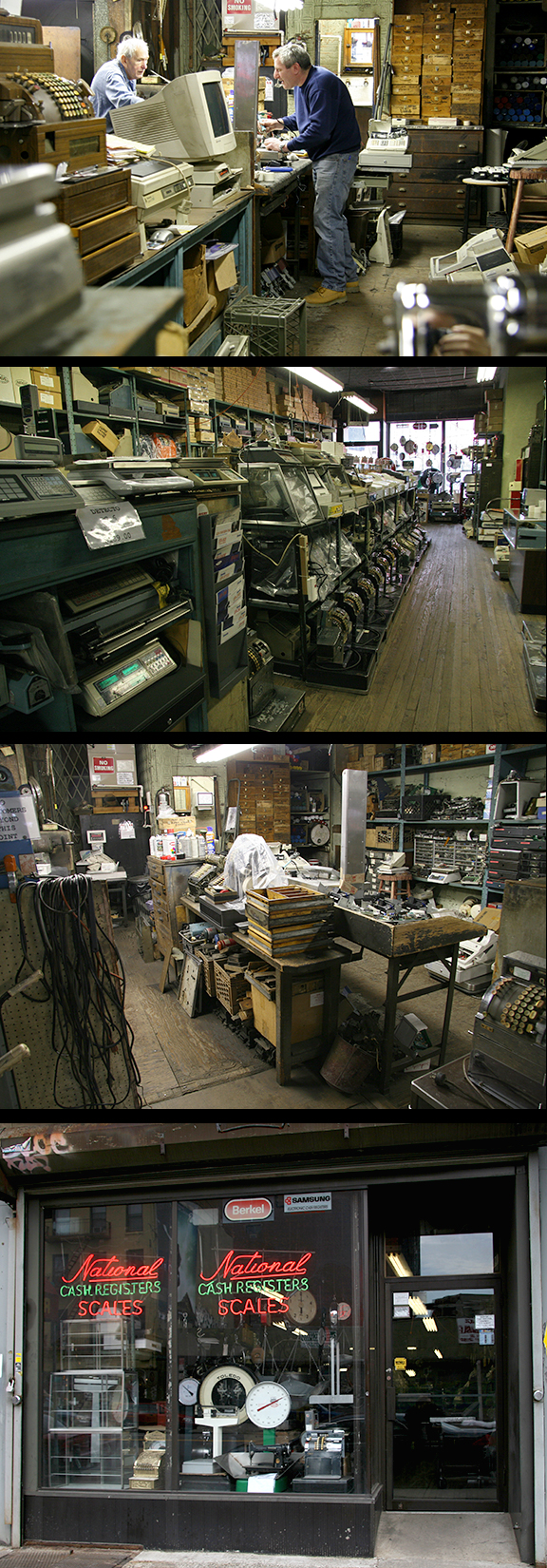
    Times have changed. Now I realize that this really is the end of an era – right here at 159 Bowery. Real, living history. You don’t have to read about it or travel to Europe. You can walk in now and meet Brian and his father tinkering in the back. Two generations of a three-generation business started in 1910 by Brian’s grandfather. More photos here.

    Faerman’s offers good, knowledgeable service, New York Style. What does that mean? Well, it means we’re busy, perhaps a little harried (we’re not overstaffed with incompetents), and we need to get to the point quickly. Like a surgeon in ER. Competent, quick. Cut to the chase. No graduates from charm school here. No frills or slick corporate beatitudes like “How may I serve you today?” which, unfortunately, is typically code for “I can only recite this line and not really do much to help you.”

    When you go to a place like Faerman Cash Register, you are dealing with the quintessential New York family-run business. People who know what the hell they are doing and talking about. The same people answer the phone. No layers between you and tech. A place that’s real. And I love the humanity of it all – I miss that.
    Of course, you can get all manner of scales and cash registers, both new, used, and antique at Faerman. But I imagine you’re not reading this for scale- and cash register-buying recommendations 🙂

    Am I over romanticizing? Not at all. Go see for yourself. Tell Brian I sent you. Don’t overstay your visit – they’ve got work to do. And hurry, because I can really feel history slipping right between my fingers and it’s a little sad…

    Footnote: In the time I have started this website, I have already seen some disappearing acts. CBGB was just down the street from Faerman and is now closed. Space Surplus Metals is out of business.
    Related: See my stories on Economy Candy and Eileen’s Cheesecake.


  • Every Move They Make

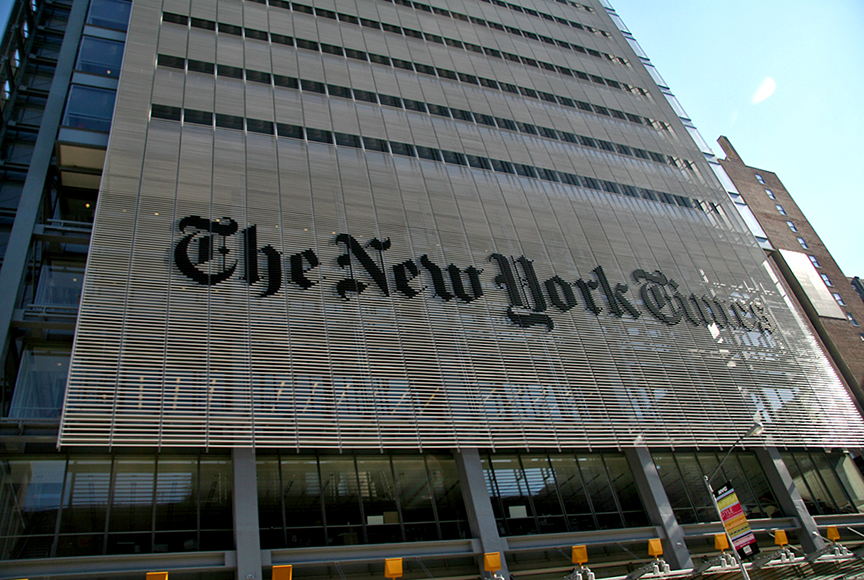
    Major NYC events just slip right by me. Maybe I should try reading the New York Times thoroughly on a regular basis. Then I would be better informed of things like the brand new New York Times Building, which is now tied with the Chrysler Building as 3rd tallest in the city and 7th in the United States (52 stories, 1046 feet).

    Designed by the Renzo Piano Building Workshop, it was completed in November 2007 and is located on Eighth Avenue in the Times Square area, across from Port Authority Bus Terminal. This historically unattractive area of midtown is finally seeing revival.

    The building itself is cutting edge and quite remarkable. It is the first building in the US with a ceramic rod curtain wall sunscreen. It is considered a green building, with features such as a power co-generation plant, low iron glass, mechanized shades, underfloor air distribution, and an interior garden.

    This photo was taken through the open passenger window of my car while I was driving (stopped at a light). Not realizing the significance of this building, I felt that it was too inconvenient to try and park somewhere and get photos of the entire structure. I intended to use this photo as a segue into the controversy about the article written in the Times recently concerning presidential candidate John McCain’s alleged inappropriate or romantic involvement with and favors for lobbyist Vicki Iseman (8 years ago). You can read the article, editorial response, and over 2400 comments here.

    Why is any of this important? Because the New York Times is considered the national newspaper of record – it is relied upon as the authority for news in the United States. Established in 1851, it is the largest paper in the US and has received 95 Pulitzer Prizes. Every move they make is of consequence…


  • Free Lunch

    We all know very well the aphorisms There’s No Free Lunch and You Get What You Pay For. The real subtext is, of course, that better always costs more and that anything of value at least costs something. Which is not always true. I shop at B&H Photo, e.g., where one gets the best pricing, good service, a knowledgeable staff, and a great return policy.
    Of course, there is also the popular adage The Best Things in Life are Free. Much of this comes down to one’s definition of value, better, best, things, payment, and even free, but I digress…

    Some of the real secrets of a city are the things that are free, for two reasons: 1) Since people believe that the best costs more and the worthwhile costs something, the free is often dismissed or overlooked. 2) There’s no money in marketing, promoting, or brokering the free. So free, quality activities can slip in under the radar.
    Like concerts at music conservatories in NYC.
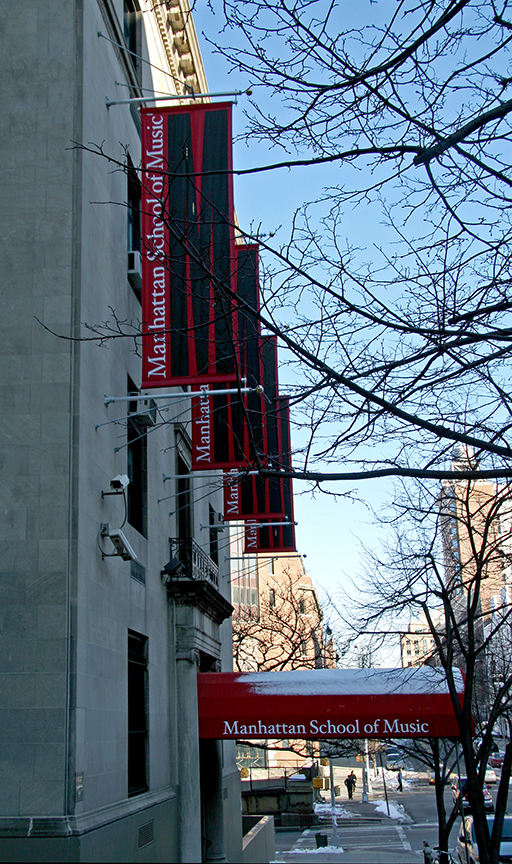
    We have some of the best music schools in the world here in Manhattan, such as Juilliard School, Manhattan School, and Mannes School, and they all offer free concerts – hundreds of them per year in nice theaters and recital rooms. And although they are performed by those who are “only students,” these are TOP students, and many will soon be performing at a theater near you for money.

    The photo is of the Manhattan School of Music, founded in 1917, at 122nd St and Claremont Avenue, on the very Upper West Side in Morningside Heights near Columbia University.
    If you want a taste of the inner workings of conservatory life, I would suggest you attend a Master Class. These are free and are also scheduled. In a master class, a student works on a piece of music with an instructor (frequently a well-known performer) in front of an audience of peers. Often, the public is allowed. Their playing is critiqued, suggestions and demonstrations are made, and the piece is replayed by the student. I once saw Yo-Yo Ma give a master class in Cello (wonderful) and Josef Gingold give one in violin. Gingold was considered one of the greatest violin teachers in history – it was an honor and amazing to see him work with a student. It was quite a free lunch.


  • Sleepy Backwaters

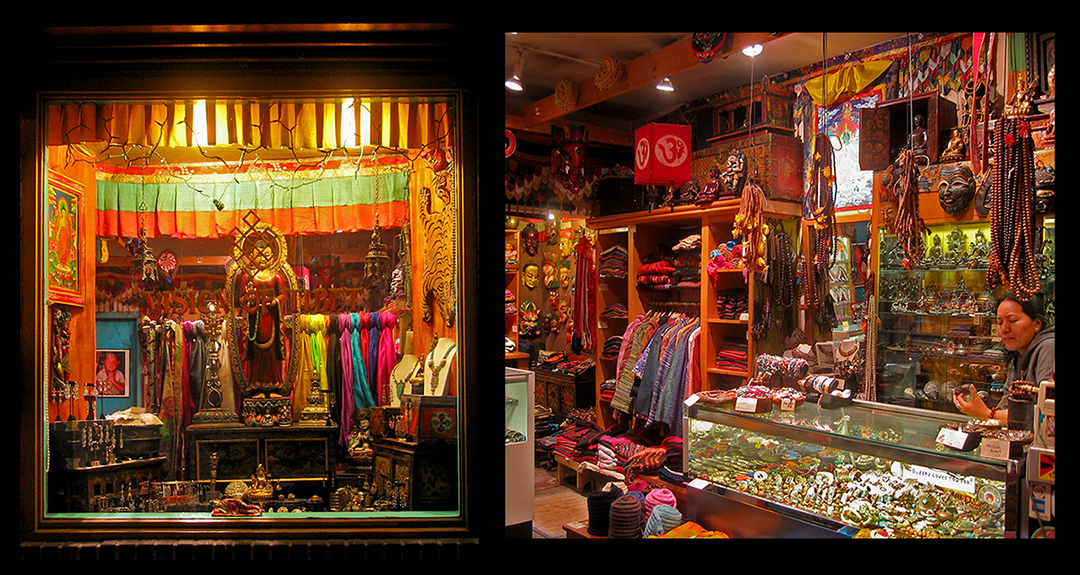
    It felt a little lonely, perhaps appropriate for a Tibetan store. A cold February weeknight and I was the only one in the tiny shop. Not far away in tres chic SoHo, we have places just bursting with customers like the Apple store, which sees thousands of customers per day and where it’s hard to get the attention of a sales person for more than a few minutes. The streets are now dotted with the likes of Louis Vuitton, Prada, Armani, Bulgari, and the less stratospheric places like Crate and Barrel, Pottery Barn, Victoria’s Secret, etc.

    But further west along Thompson, Sullivan, and MacDougal Streets, near Houston Street, there are small neighborhood stores – restaurants, boutiques, food specialty shops, and some virtual institutions. Places like Joe’s Dairy, Raffetto’s, Rocco, Tiro A Segno New York Rifle Club, and Alidoro. Along MacDougal, south of Houston, there are a handful of French restaurants and cafes – Bastille Day is celebrated here annually with a closing of the block. Along Thompson, you have two chess shops on one block – miraculous occurrences allowing for the retail and rental climate of the day. The very small retail spaces, occupying the tenement-style buildings of the area, are a factor in preventing major development by the large high-end retailers seen in the cast-iron district of central SoHo.

    Vision of Tibet typifies many of the small mom-and-pop businesses found in this immediate area. Started in 1987, it is the oldest Tibetan shop in the city, selling handicrafts from Tibet, Nepal, and India, whenever possible made by Tibetan artisans and almost always from family-run businesses. Not surprisingly, they carry no items made in China. The owner, Sonam Zoksang (who is also a photographer), was born in Tibet. His sister, Tenzin Chodon, manages the shop.

    If you want to experience an unadulterated NYC, take a stroll here. This area is truly a sleepy backwater – for now…


  • Tea Time

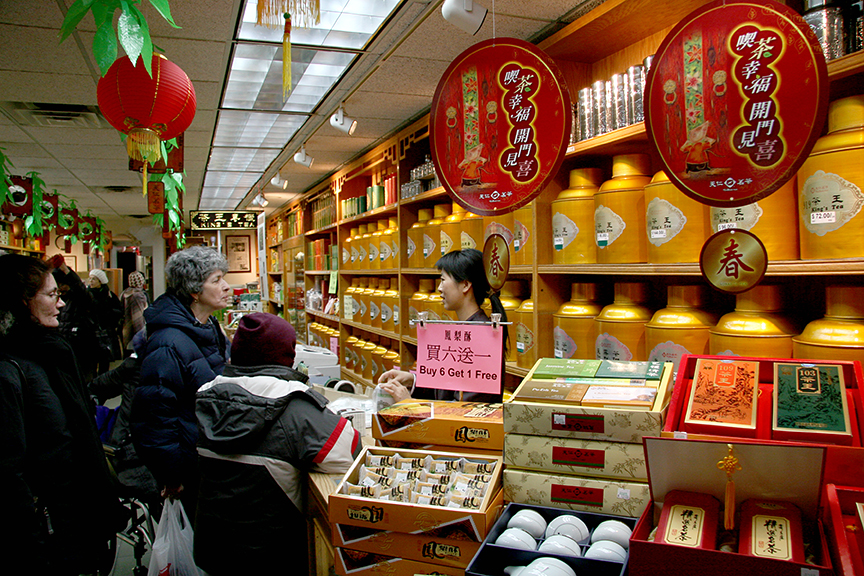
    I suppose it was naive to think than Ten Ren Tea and Ginseng Co. was my own little discovery. After all, it is on Mott Street in the heart of Chinatown. But I had no idea how large this company was. It has not just one store but over 100 worldwide, with 20 in the USA. And the company is 55 years old, founded in Taiwan in 1953. They are now one of the largest tea importers in the world. A photo on their website shows a former president and other notables having tea in their various stores. So they are far from the undiscovered secret I was hoping to bring you. Ten Ren is the largest Chinese tea emporium in the city; the New York stores are run by Ellen and Mark Lii.

    The health benefits of green tea, both validated and not, have been well-circulated in the various media, with much attributed to their antioxidant properties of catechins present. Claims have been made that it reduces blood pressure, decreases the risk for heart attacks, stroke, and cancer, reduces cholesterol, enhances digestion and the immune system, increases fat oxidation, reduces cavities and gingivitis (green tea contains fluroide), and aids rheumatoid arthritis, Alzheimer’s, Parkinson’s, and multiple sclerosis.

    However, none of this means that you should not put Ten Ren on your must-visit list. The calming, pleasant atmosphere is a nice antidote to the melee that is Chinatown. The walls are lined with an array of urns holding over 100 varieties of loose tea from a few dollars to over $100 per pound. Tea is also available in bags and gift boxes. Free tea samples are offered…


  • Durian

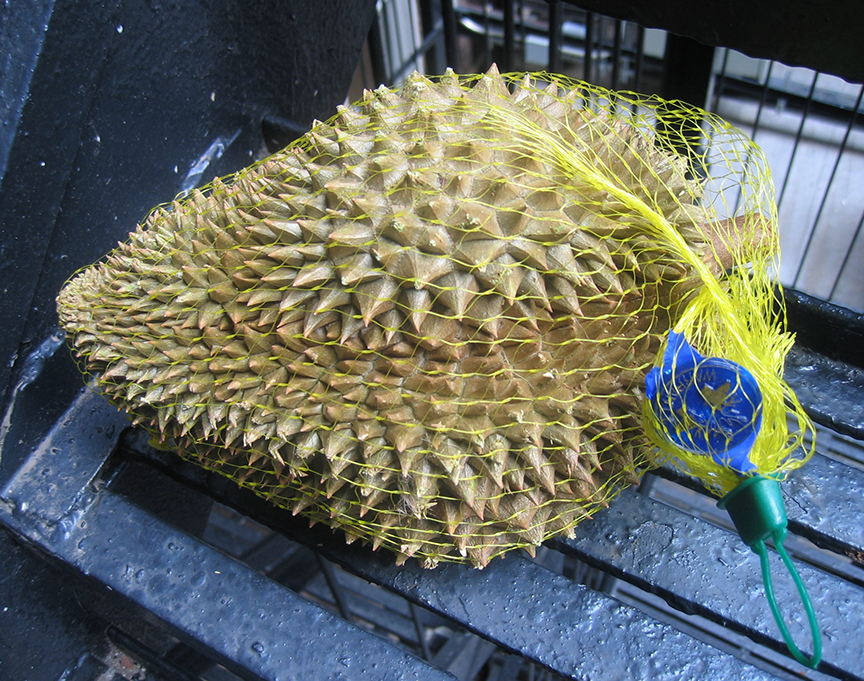
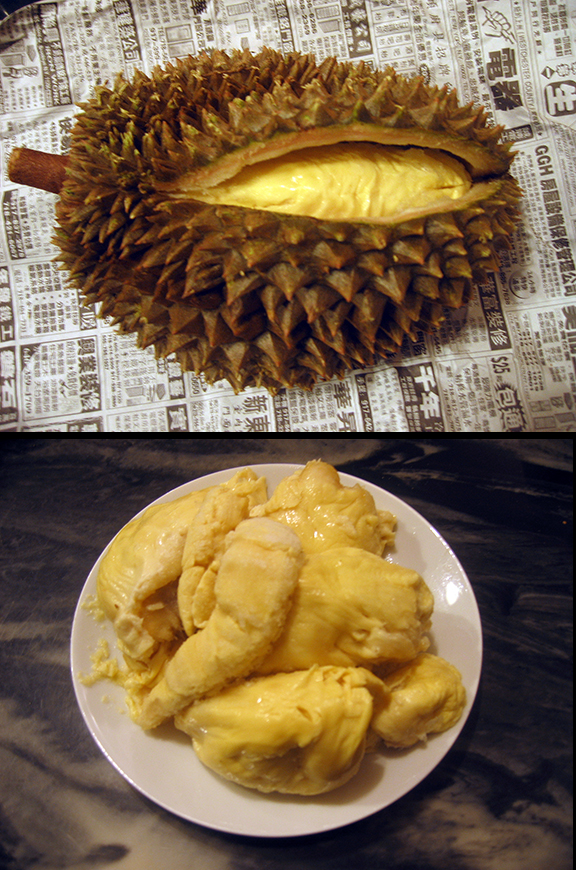
    No, I’m not lying – the smell of durian has been described as that of turpentine and onions, gym socks, civet, sewage, stale vomit, skunk spray, used surgical swabs, garbage, moldy cheese, rotting fish, and dead cats. Even where the fruit is popular in Southeast Asia, it is actually banned from some establishments such as hotels, subways, and airports. The scent is so strong that it can be picked up by animals half a mile away. The husk is incredibly spiky and dangerous to handle – mine was wrapped in newspaper before bagging. And I am not particularly enamored with the look of the flesh, which has been described by some as custardy in consistency – that’s being generous. Click here for photos of the fruit cut open and its flesh.

    The fruit is still relatively unknown in America, where it is found primarily in Asian markets. I purchased mine in Chinatown for $7 – it is not inexpensive. Durian is strictly tropical, originating from Indonesia and Malaysia, with Thailand now the primary exporter. In Asia, where it is hailed as the King of Fruits, the smell is prized – the smellier the better. Many eat it every day. Durian goes back to prehistoric times and is the subject of legend and myth. There is a virtual world surrounding this fruit (click here for an in-depth article).

    I’ve planned on writing about this fruit for sometime. Yesterday I finally purchased one and brought it back to the office for all to share. I can still see and taste this thing this morning, but I’m really giving it a second and third chance, hoping it grows on me. The first time I tried to eat durian, I was absolutely revolted, so this time I was better prepared. For those not used to it, Durian is truly an acquired taste. I’m going to try some again today. Wish me luck…

    Footnote: In an interesting twist, a no-stink variant was developed in 2007 in Thailand by scientist Dr. Songpol Somsri. After working for decades and crossing 90 varieties of durian, he has created Chantaburi No. 1. It reputedly has an odor as mild as a banana.


  • Sin of Omission

    I’m always looking for nooks and crannies, but like Italian hill towns, finding hidden gems in a densely populated and/or heavily visited place is extremely difficult. Most often, the hidden or undiscovered in NYC is remote, literally at the ends and edges of the boroughs, far from where any resident or visitor would typically go.

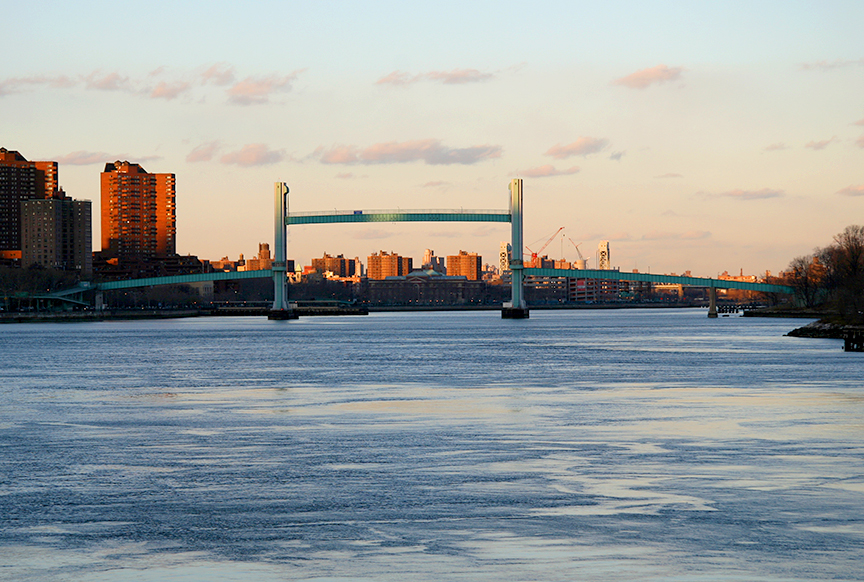
    This is the case with the Ward’s Island Bridge, which spans the Harlem River between East 103rd Street in Manhattan and Ward’s Island, giving access to Ward’s Island Park, with wonderful views, biking paths, and athletic facilities (the island is also home to a psychiatric center, homeless shelter, and a wastewater treatment plant). Read more about the island here.

    The bridge is unique – it is the only bridge in NYC, spanning a major river, which is open to pedestrians only (bicycles are also permitted). Only 12 feet wide, it is a lift bridge – the center section (100m) lifts to accommodate tall ships. A wooden drawbridge spanning the river was built in 1807 by Bartholomew Ward to aid his cotton business on the island. It was destroyed by a storm in 1821. Ward’s Island Bridge was built in 1951 and designed by Othmar Hermann Ammann. The bridge is closed during the winter months (November through March), when it is left in the raised (closed) position.

    I love the colors of this small bridge – a pleasant improvement on the typical gray. In 1976, it was painted brighter colors – blue-violet towers, vermillion trim, and yellow walkways. It was later repainted to its current, more subdued scheme, with a blue span and blue and green towers.

    I admit to a sin of omission; I’ve never been to Ward’s Island or taken the Ward’s Island Footbridge. I plan to redeem myself soon and go there one it opens in the spring…


  • dinamic_sidebar 4 none

©2026 New York Daily Photo Entries (RSS) and Comments (RSS)  Raindrops Theme