• Father Demo Square

    Posted on by Brian Dubé

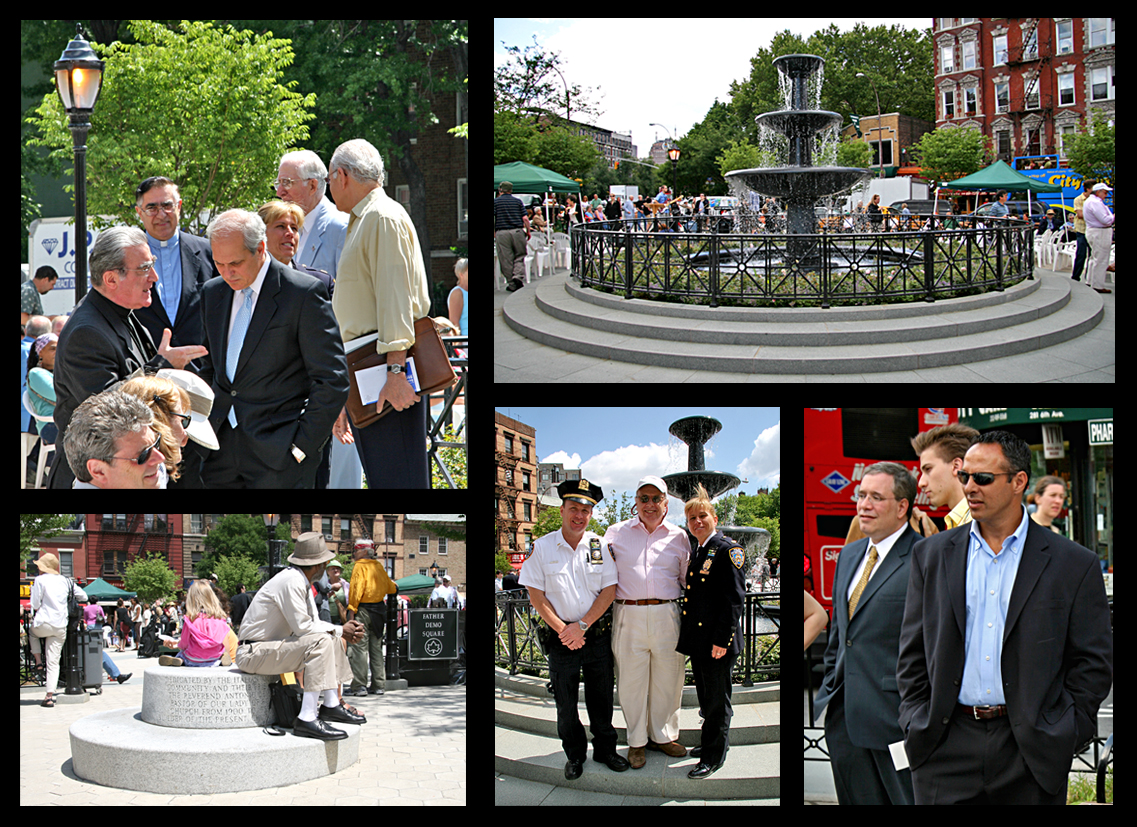
    This was the ceremony for the eagerly awaited reopening of the newly renovated “vest pocket” park at Father Demo Square. Although this park space may appear small and inconsequential, park spaces, large or small, are very important to the fabric of the city – these urban oases provide the only outdoor space most New Yorkers ever see. The park is also at a very strategic location – one of the busiest intersections in the Village. The triangular park is bounded by 6th Avenue (Avenue of the Americas), Bleecker Street, and Carmine Street. The square is named after Father Antonio Demo (1870-1936), who was pastor of the neighboring Our Lady of Pompeii Church in 1935.

    Residential buildings also flank the park. Many visitors forget that there are residents who live amidst all this, so apart from the physical deterioration and much-needed repair, one of the concerns was crowd control. Historically, people were in this park all hours; the homeless started setting up home, performers attracted enormous audiences, and noise, revelry, and fights were common. Hence the decision to include a 3-foot-high perimeter fence to the design. The renovations were overseen by the Parks Department (with George Vellonakis as the landscape architect) and David Gruber, local resident, real estate developer, and president of the Carmine Street Block Association. The renovation included decorative tiles, a new fountain, trees, and flower beds. The $1.3 million dollar project took somewhat longer than anticipated – there were additional issues involved since the park was located over the 6th Avenue subway lines.

    The ceremony, which included live music, was presided over by David Gruber. Attending were Borough Park president Scott Stringer, the pastor of neighboring Our Lady of Pompeii Church, NYPD sixth precinct commander Theresa Shortell (the sole female police precinct commander in New York), and the general contractor for the project. I also recognized a number of local community activists. For reasons unknown, the Parks Commission decided to cancel their attendance at the last minute. Word has it that they are planning an official ribbon cutting in a couple of months…
    Posted on by Brian Dubé

  • Fête de la Musique

    Posted on by Brian Dubé

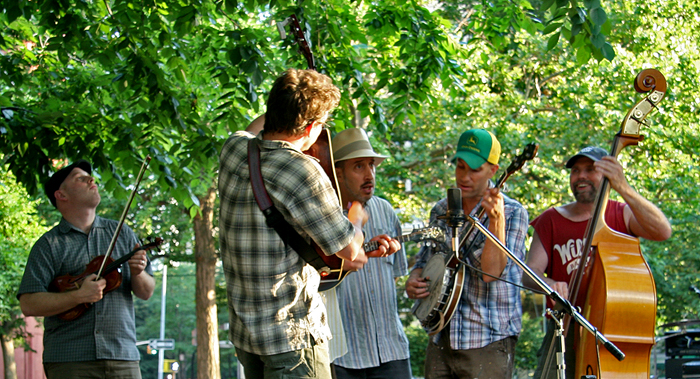
    One of the most amazing things about living in New York City is that you can easily miss a major event. Like this one. I learned about this from a coworker in my office at the end of the day (and caught two performances – one in the photo). Make Music New York was NYC’s participation in the international Fête de la Musique, which is celebrated in 340 cities around the world. On the first day of summer, public spaces in all five boroughs become informal musical stages for all New Yorkers, amateurs and professionals, to perform for friends, neighbors, and passers-by, turning the city into a festival of live music making.

    The idea germinated in France in 1982, when a memo was sent from Maurice Fleuret, Director of Music at the Ministry of Culture, to his advisor, Christian Dupavillon, and lamented the fact that the French owned more than 4 million musical instruments, most of them in storage unused. A concept was born to encourage individuals to bring out these instruments, and professionals and amateurs alike would play everywhere, completely freely, indoors and out – in public squares, under porches, on covered walkways, in areas of school playgrounds, in hospital gardens, at entrances to music academies, or under café awnings just for the sheer pleasure of playing. Read about it here.

    This was New York’s first annual celebration. Schedules were available and printed in various publications and on the web. New York was a little late to get on board – I hope that it becomes successful in the coming years. I love the quote from Berthold Auerbach: “Music washes away from the soul the dust of everyday life”

    Posted on by Brian Dubé

  • Signs of Summer

    Posted on by Brian Dubé

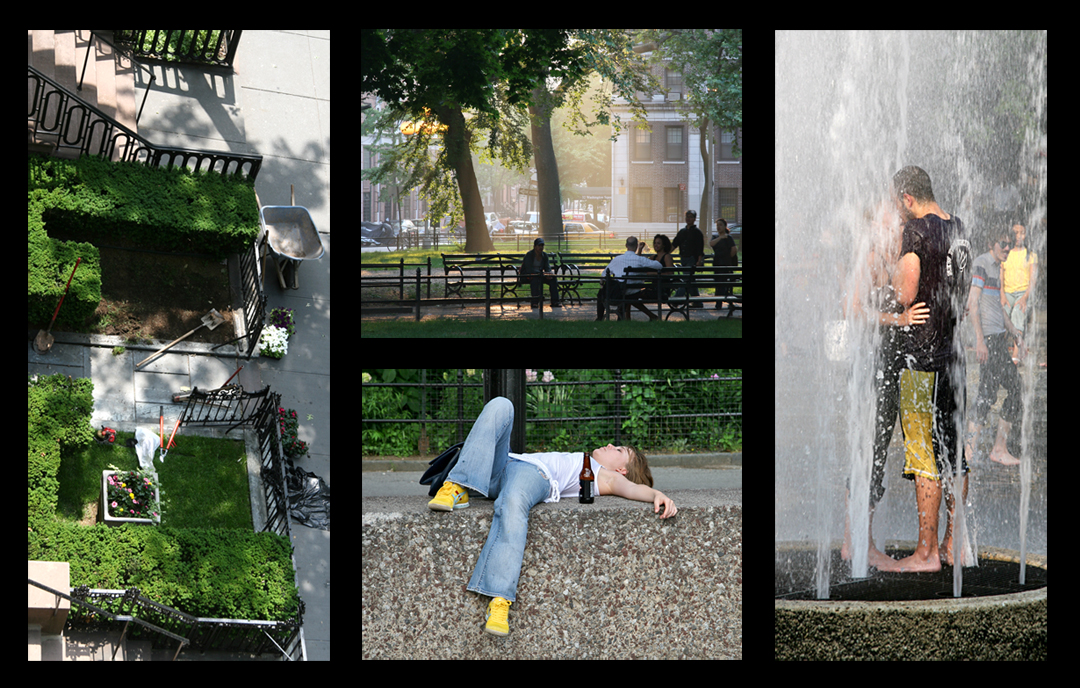
    These are signs that summer was coming, which I have witnessed over the last 2 weeks. Starting with the photo on the left, we have gardening on Washington Square North. It is surprising how much gardening goes on in NYC, much of it out of view behind buildings. In the top photo, we have a day that was a real steam bath. The humidity was so heavy, you could easily see it as this afternoon haze – it looked like the deep South. At the far right, we have two lovebirds in a PDA, but this time in the fountain (click here for last summer’s frolic in the fountain). Kind of fun if you don’t mind getting your clothes soaking wet. At the bottom, we have a young woman sleeping – she was out cold. But not inebriated (the beverage was soda, not beer).

    Today is the solstice and first day of summer in the Northern Hemisphere (and the first day of winter in the Southern Hemisphere). This is the day where the sun is furthest north, or at highest point in the sky, and takes the most time to cross the sky. This means it’s the longest day of the year. The days actually start getting shorter from here, so please enjoy your summer…

    Posted on by Brian Dubé

  • Gummed Up

    Posted on by Brian Dubé

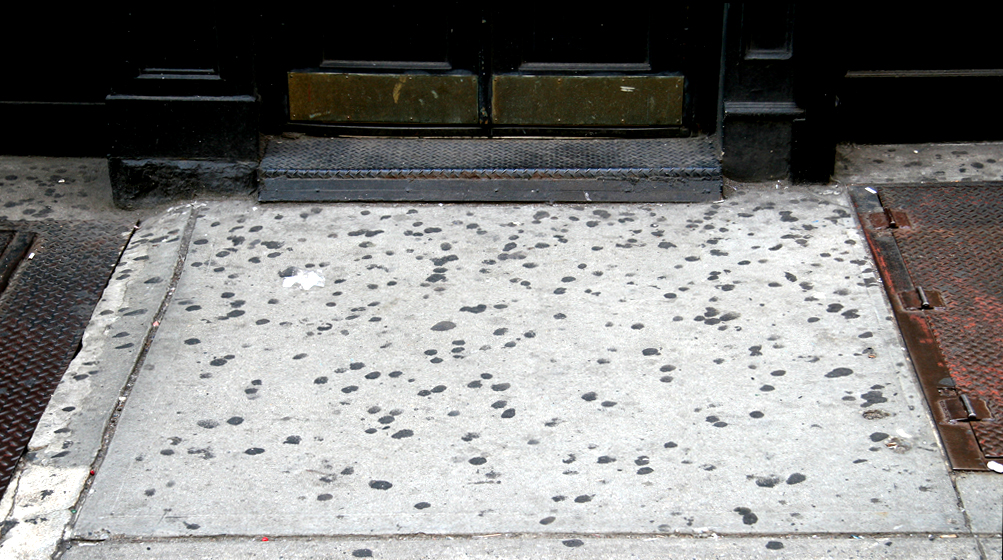
    I’m embarrassed to admit that I had lived in the city for many years before realizing what all those black splotches on the sidewalks and subway platforms were. I’m feeling a little better learning that this is the case with other New Yorkers I have spoken to; in fact, many whom I questioned were still not aware, thinking that the splotches may be part of the concrete, asphalt, etc. Gum on the streets is not a new problem; Mayor Fiorello LaGuardia ran an anti-gum littering campaign in 1939 with the slogan “Don’t Gum Up the Works” and pressured gum manufacturers to print requests on the wrappers that they be used for proper disposal of the gum. The NYC problem is particularly interesting in that New York is home to invention of the chicle-base chewing gum by Thomas Adams and the world’s first chewing gum factory, circa 1876, on Vesey Street: Adams Sons & Company.

    In spite of the fact that throwing out chewing gum on the ground is a violation of the littering law and costly to remove, I think the problem is one of those quality of life issues which is very low on the priorities scale. Many do not notice or find it a problem, and the rest of us become inured. On an encouraging note, GumBusters International B.V., a Netherlands-based company, has developed technology – steam equipment and a benign solvent – that easily removes the gum in seconds. They have divisions and franchises worldwide. The franchisee in New York, Gumbusters of NY, has been busy cleaning the streets for a myriad of businesses and was featured on the Discovery Channel’s Dirty Jobs. Perhaps we should adopt the thinking of Lee Kuan Yew, former prime minister of Singapore, where chewing gum is banned (precipitated by gum vandalism), who remarked, “If you can’t think because you can’t chew, try a banana.” 🙂

    Posted on by Brian Dubé

  • New York Stock Exchange

    Posted on by Brian Dubé

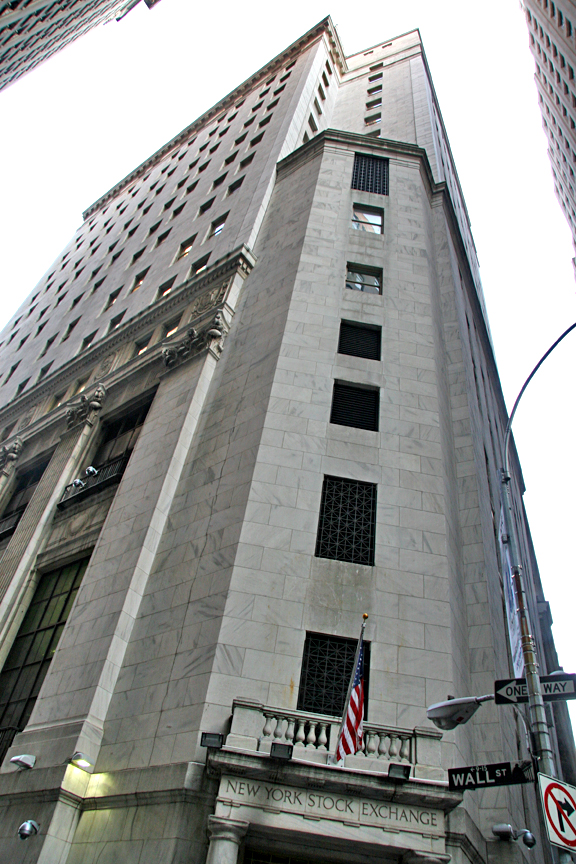
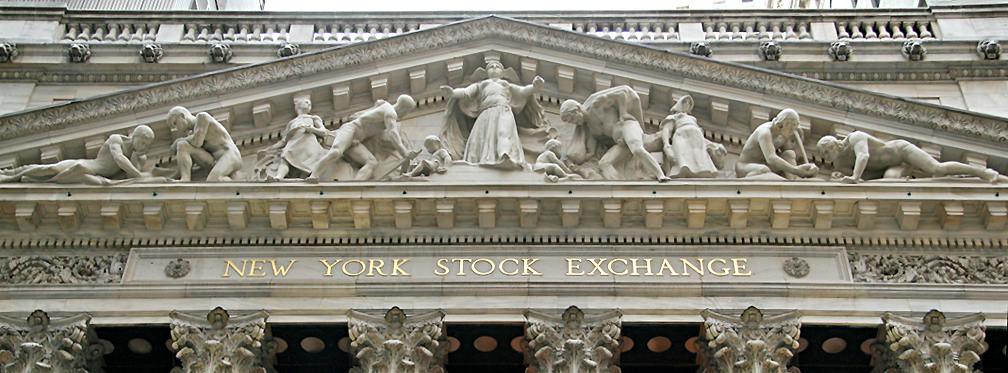
    The first thing to know about the New York Stock Exchange building is that it is not located on Wall Street (click here for photo) but rather around the corner at 18 Broad. The New York Stock Exchange (the world’s largest) traces its origins to 1792, when 24 New York City stockbrokers and merchants signed the Buttonwood Agreement outside 68 Wall Street under a buttonwood tree. In 1817, they drafted its first constitution. By the late 1800s, larger facilities were needed, and 8 NYC architects were invited to participate in a design competition for a new building. George B. Post’s neo-classical design won, and in 1903, the new Exchange building, with its six massive Corinthian columns, opened to fanfare and festivity, recognized from the first as an example of masterful architecture (the flag was draped in front of the building after 9/11).

    Among some of its marvels (from the New York Stock Exchange website): The trading floor was one of the grandest spaces in the nation. It measured 109 x 140 feet and its marble walls rise 72 feet to meet the ornate gilt ceiling. The window wall: The entire front of the building is glass, making practically one stupendous window, 96 feet long and 50 feet high. Another window of the same size forms the New Street front. Skylight: The trading floor is surmounted by a vast skylight, 30 feet square. Air conditioning: The Stock Exchange building was one of the first structures in the world to employ it. There is even an emergency hospital with a physician in constant attendance. The great figural sculptures in marble on the NYSE building’s facade were designed by John Quincy Adams Ward and are among the building’s most recognizable features (click here). Entitled “Integrity Protecting the Works of Man,” the classical design depicts the 22-foot figure of Integrity in the center, with Agriculture and Mining to her left and Science, Industry, and Invention on her right, representing the sources of American prosperity. The waves on either extreme of the pediment symbolize the ocean-to-ocean influence of the Exchange (the pediment required replacement in 1936).

    In 1967, Yippie founder and activist Abbie Hoffman threw dollar bills on the trading floor to proclaim the Death of Money. It never came to pass 🙂

    Posted on by Brian Dubé

  • Feeding at the Zoo

    Posted on by Brian Dubé

    This is feeding time for the penguins at the Central Park Zoo. The public seems to be endlessly fascinated with penguins – their upright walk, lack of fear of humans, and tuxedo-like plumage has endeared them to the public worldwide. They have become a virtual mascot of cuteness. Wikipedia even has a separate entry, “Penguins in popular culture.”

    The penguin and puffin house is one of a handful of habitats in the Central Park Zoo, one of the oldest in the United States, which originated in 1864 as the Central Park Menagerie. In more recent times, the trend has been to move away from the older menagerie style of zoo, where animals are caged for collection, exhibition, and entertainment purposes. By the 1980s, the Central Park Zoo was in very poor shape; a 1981 New York Times opinion called for closing of the zoo (Let’s Do Away with Central Park Zoo by Alice Herrington). In 1983, the zoo closed for complete renovation and reopened in 1988.

    The new design, which was applauded, featured more natural habitats – the trend in North American and European zoos. The focus is now more on conservation of endangered species, research, and education, and secondarily for entertainment of visitors. Of course, these natural habitats are still quite limited in size; the Central Park Zoo is small and does not permit the type of environments seen in places like the Bronx, Philadelphia, or San Diego zoos. But it is a dramatic improvement – I had the unfortunate privilege to see the zoo in its former incarnation. Fortunately, my memories of it are quite indistinct…

    Posted on by Brian Dubé

  • Waldorf Astoria Clock

    Posted on by Brian Dubé

    There is nothing that quite epitomizes the luxurious, elegant, classic, and iconic New York like the main lobby of the Waldorf Astoria Hotel. It’s a study in comfort, with soft lighting from table lamps, dark wood, potted palms, and sumptuous seating – I could sit in those beautiful Art Deco chairs for hours watching the ebb and flow of people. Visitors feel like they have sneaked into the world of the privileged, and in a way, they have. Dominating this lobby is the famed, ornately carved, bronze Waldorf Astoria clock, set on an octagonal base made from marble and mahogany and topped with a Statue of Liberty. It is well-known enough to have become a meeting place, much like the clock in Grand Central Station.

    A small plaque below the clock reads:

    “The Waldorf Astoria Clock was executed by the Goldsmith Company of London for exhibition at the Chicago World’s Fair in 1893. It was purchased by the Waldorf Astoria and was the focal point outside the Rose Room of the original hotel at Fifth Avenue and 34th Street. This clock weighs approximately two tons and stands nine feet tall. Around the eight sides of the base are likenesses of Cleveland, Harrison, Washington, Grant, Lincoln, Franklin, Jackson, and Queen Victoria. Under these are bronze plaques depicting various sports and scenes. Westminster chimes ring on the quarter hour.”

    There is a feeling of safety and stability here – the lobby is deep in the center of the city block edifice, and the place just feels like it’s been there forever and will go on unfettered by the changing times…

    Posted on by Brian Dubé

  • Limbo

    Posted on by Brian Dubé

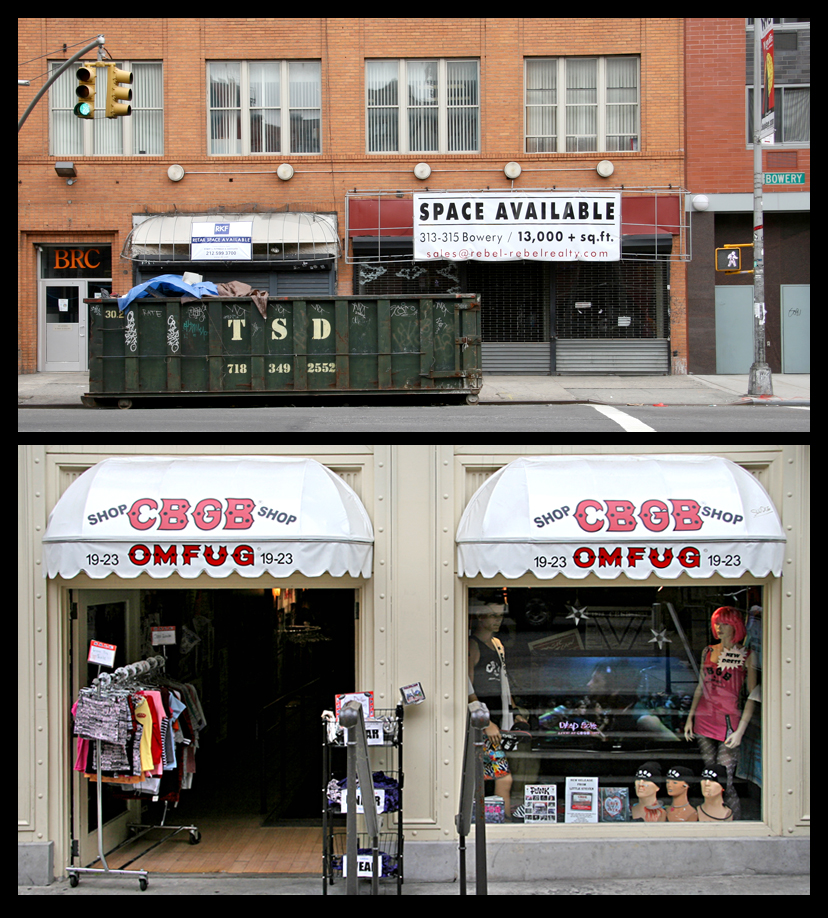
    Last fall, I posted twice regarding CBGB and their closing in October 2006, with numerous shots of the interior (click here and here). Of course, the closing of such a legendary club after 33 years was a big story and was controversial – some felt that the club should have been given landmark designation in order to save it, while others felt that the club had become more of a tourist mecca and no longer lived up to its original reputation. I thought I would take a final opportunity to photograph the club’s original location while vacant, before a new tenant takes over the space.

    The media, in numerous stories and interviews, has reported that Hilly Kristal, the owner, has intentions to move the entire club to Las Vegas and take as much of the original club as he could: “I intend to take everything out of there that represents CBGB. We’re going to take the bars, the toilets, the urinals, even the doors. We want to re-create the essence of the club.” There have also been suggestions of franchises of the club other than Las Vegas. In the interim, a CBGB store has opened at 19-23 St. Marks Place (bottom photo), which also serves as the interim location for their fashion/merchandise line and their wholesale and online operations. I have not found any confirmation yet of their move to Las Vegas…

    Footnote: CBGB & OMFUG stands for “Country Bluegrass Blues and Other Music For Uplifting Gormandizers,” which reflects the owner’s original intention for the type of music to be featured – the club ended up becoming the birthplace of American punk and a venue for rock.

    Posted on by Brian Dubé

  • Blue Man Group

    Posted on by Brian Dubé

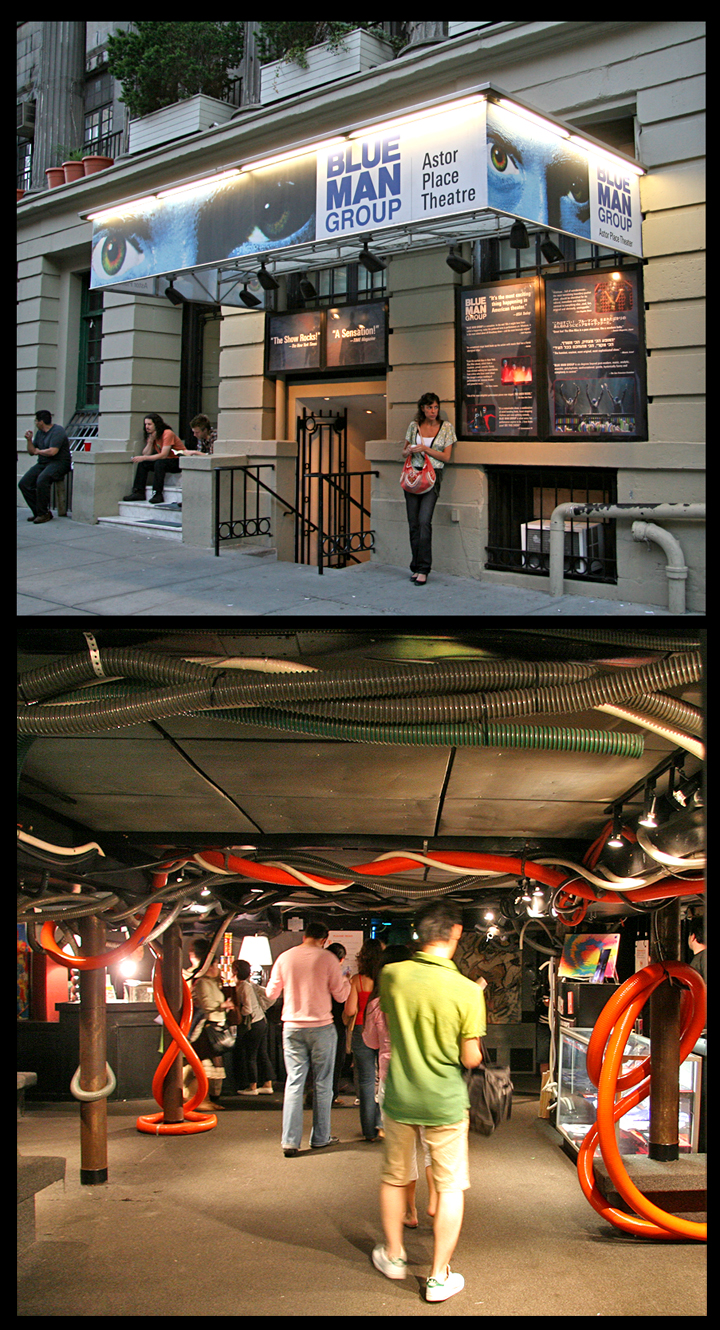
    I have not done any theater on this site; photography during a theater performance is taboo, and exteriors of most theaters themselves are not the most visually compelling. Plus, the shows themselves are quite well-marketed and reviewed by those better qualified than myself. However, Blue Man Group has become more than a show (click here for their website). They are an institution and an industry, with performances in New York, Boston, Chicago, Las Vegas, Berlin, London, Amsterdam, Oberhausen, and Orlando. They have several CDs, DVDs, an online store with a plethora of merchandise, and two musical toys developed for children. They have done film and TV scoring, commercials, television programs (like Scrubs and Arrested Development), and a children’s museum exhibit, Making Waves, which is currently touring the country. Their appearance in the Intel commercial campaign in 2000 brought them international visibility.

    The group itself was formed in 1988 by Matt Goldman, Phil Stanton, and Chris Wink, motivated by an interest in creating a show which involved audience collaboration. Their first theater performances were at La MaMa in the East Village; in 1991, they moved to the Astor Place Theater (seen in the photo). The characters are three mute Blue Men (played by rotating cast members), their faces in blue grease paint and wearing nondescript black clothing. The extraordinarily unique performance art show, called Tubes, is heavily music-oriented – numerous unique instruments were created by the group, such as the tubulum, drumbone, and airpoles. Comedy, satire, social commentary, irony, painting, percussion, clowning, and sophisticated lighting effects are all there, along with numerous substances (including food and paint) thrown and ejected, some of which may hit audience members – the first few rows are provided with plastic ponchos…

    Posted on by Brian Dubé

  • Physical Graffiti

    Posted on by Brian Dubé

    Physical Graffiti is both the name of a small vintage clothing boutique at 96 St. Marks Place shown in the photo and a Led Zeppelin album which used the very same building and the adjoining building at 98 St. Marks Place for the album’s cover (click here for photo). The building was also used as backdrop for a Rolling Stones music video for Waiting on a Friend. This shop abuts the subject of a previous post, Cappuccino and Tattoo, part of which can be seen on the right. Is this an obsession with St. Marks Place on my part? Not really. New Yorkers know that St. Marks Place has been NYC’s (and one of the country’s) epicenter of a number of counter-cultural movements. Dominated by retail, the concentration of shops on St. Marks Place reflects the current flavor. The street has been home to hippies, yippies, punks, political activists and protest marches, renowned bookstores, music stores and clubs (e.g. Electric Circus), graffiti artists, cafes, clothing shops, restaurants, bars, theaters, gangsters, and St. Marks Church. Physical graffiti well describes the street itself.

    Footnote: Let the (Internet) reader beware. Misinformation has always been a problem, but the ease of copying text using the Internet has caused viral proliferation. In researching this post, I found numerous references (including Wikipedia) that the Anarchist Switchboard was previously located at 96 St. Marks Place – an interesting tidbit for this posting, except that it appears to be incorrect. The New York Times misreported this on Feb. 18, 2007 and printed a correction on March 21. I also found a number of references to the building’s address for the album cover as 97 St. Marks Place instead of 96 & 98 (97 is on the opposite side of the street – on east-west streets in Manhattan, even numbers are on the south side, odd numbers are on the north). Rolling Stone has the addresses as 94 & 96. You will probably find these erroneous pieces of info everywhere in perpetuity now when doing online searches…

    Posted on by Brian Dubé

  • Shona Gallery

    Posted on by Brian Dubé

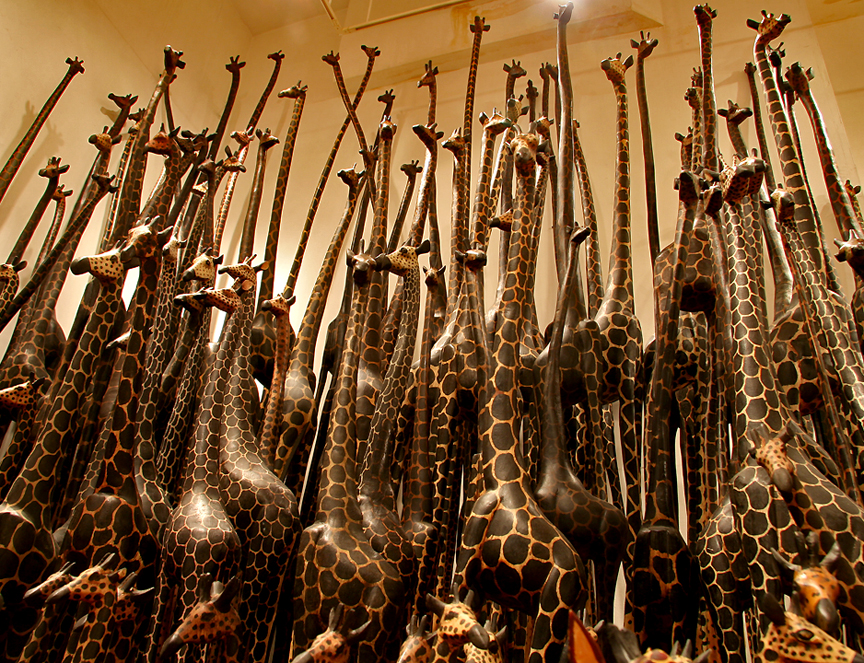
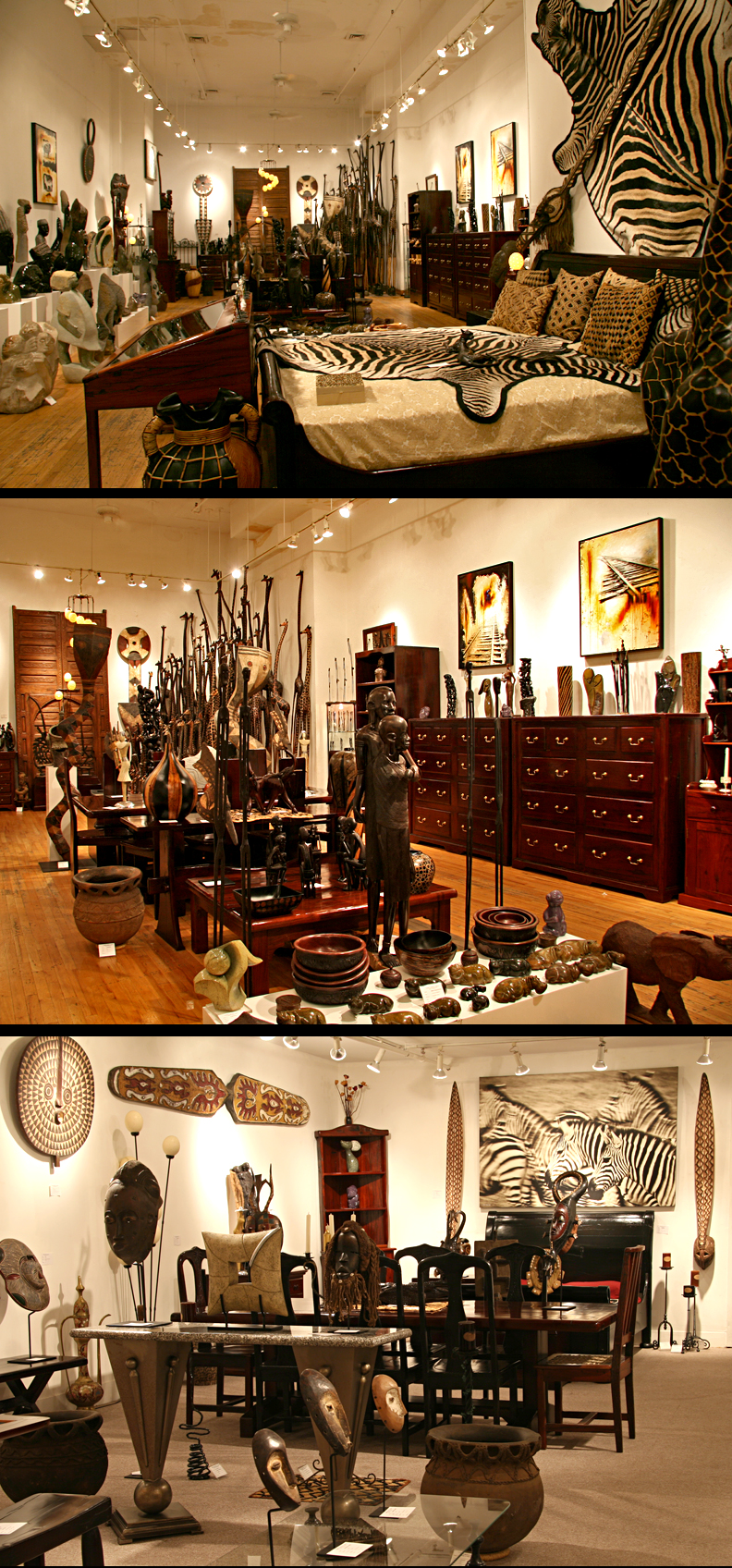
    For years I have passed by York’s Shona Gallery at 99 Spring Street and enjoyed seeing a large group of carved teak giraffe towering in their window – who doesn’t love giraffe? The window display is now different, but the giraffe (from one to 14 feet tall) can now be found in the main gallery, along with other African art objects. Click here for more photos of the gallery. The owner, Michael Ahuja, hails from New Delhi. His has been in this business since 1978 and opened the gallery at its current location in 1985.

    Shona houses an impressive collection of imported African art works from places like Zimbabwe, South Africa, and Kenya: paintings, fabrics, masks, jewelry, instruments, crafts, and iron and wooden sculptures. And an array of furniture carved from recycled African railroad sleeper bunks – these pieces are made from Jarrah, a species of Eucalyptus unique to the southwest of Western Australia. I love the furniture made from this spectacular hardwood known for its remarkable durability, extreme density, and warm, deep mahogany-red color. Once seasoned, Jarrah is very tough (impossible to work with regular tools) and has been used for bridges, wharves, railway cross ties, ship building, and telegraph poles. There are other reclaimed sources for the wood besides African railroad sleepers. Also, a small supply of regrowth Jarrah is logged from a 5 million-acre farm owned by the Australian Government and carefully controlled by the Department of Conservation and Land Management. The volume of timber harvested annually is closely monitored…

    Update: Shona Gallery closed in October of 2010.

    Posted on by Brian Dubé

  • New York Central Building

    Posted on by Brian Dubé

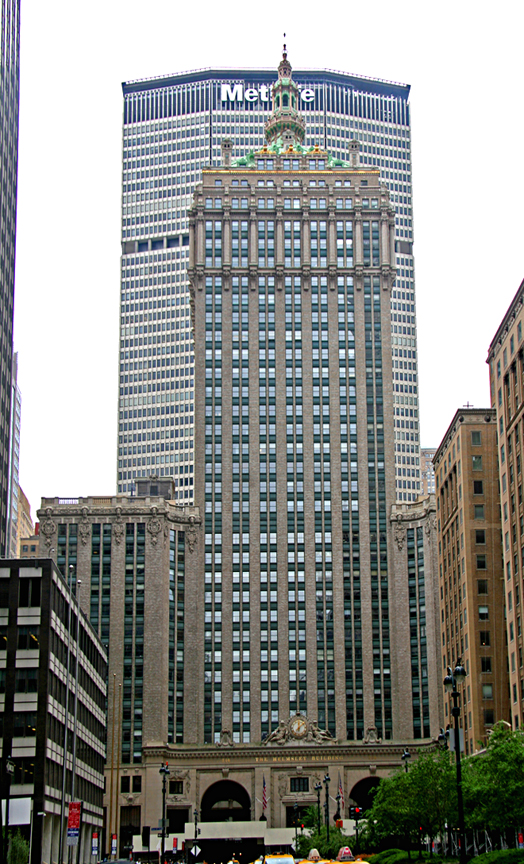
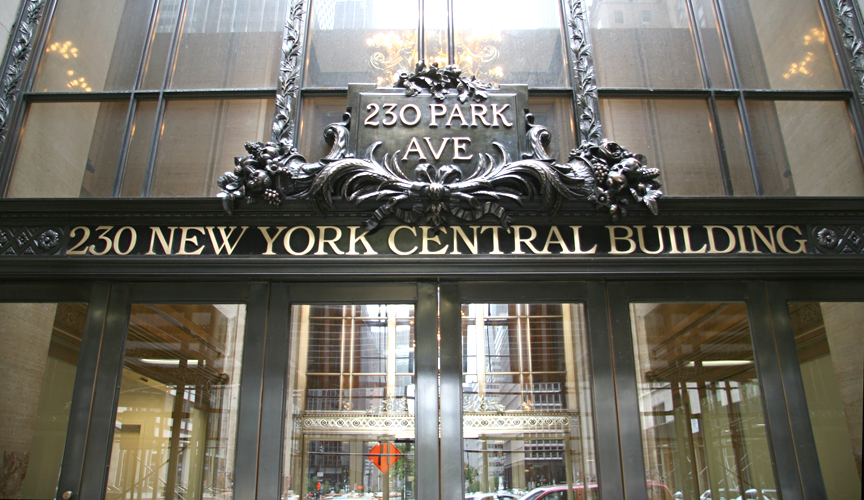
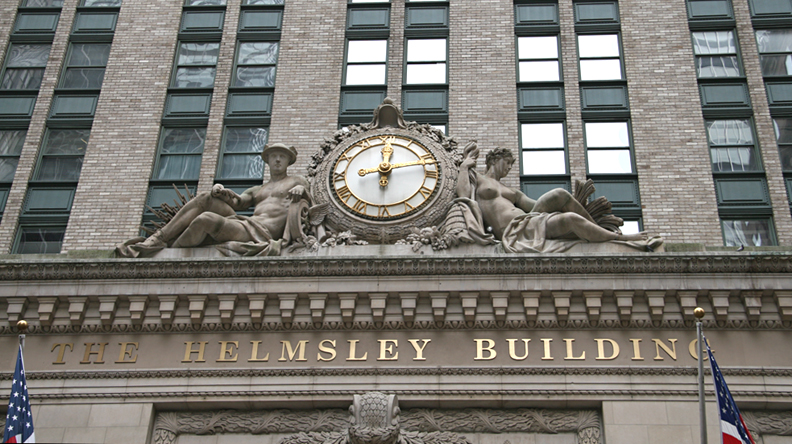
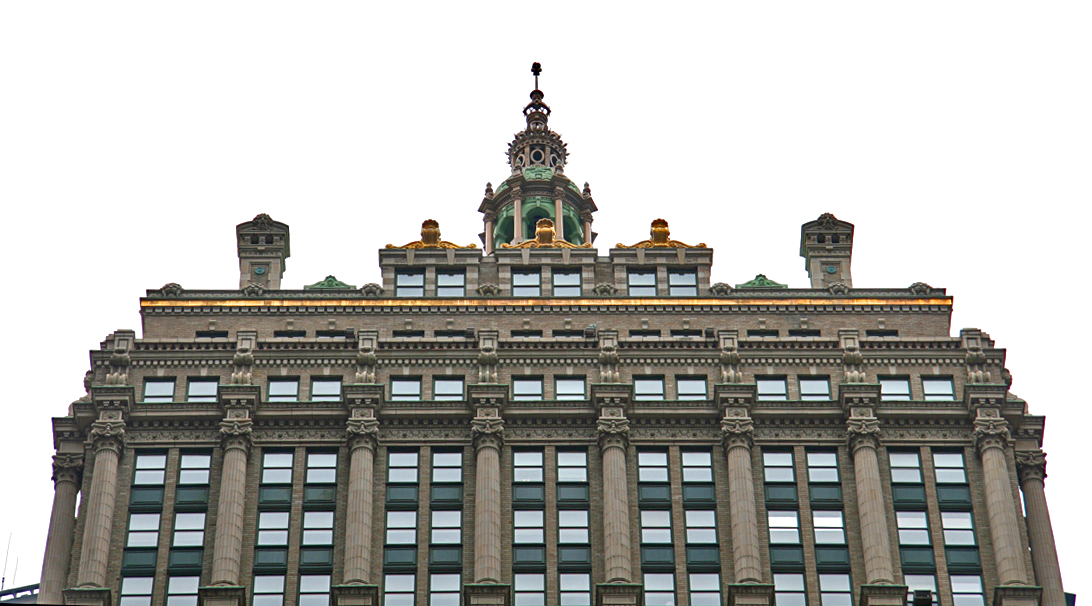
    What is perhaps most striking about this building is its superimposition over the MetLife building. Before construction of the MetLife (then the Pan Am) Building in 1963, the New York Central Building (now the Helmsley Building) at 230 Park Avenue (34 stories/560 feet) reigned supreme over the neighborhood and prestigious Park Avenue. It was the tallest structure in the Grand Central Terminal complex. Built in 1929 by the New York Central Railroad Company and designed by Warren and Wetmore, the building sits over the northern end of Grand Central and the southern end of Park Avenue at 46th Street.

    Traffic was beginning to become a problem at the time of its planning, and New York Central Railroad negotiated leases and easements for construction of the building. In exchange, they wove both lanes of Park Avenue through the building (and over Grand Central), creating a mini-raceway from 46th to 40th Street connecting to Park Avenue South and making it NYC’s favorite drive-through building. The large, cavernous openings for the two tunnels can be seen flanking the entranceway to the building, with an opulent, detailed lobby. The design echos elements of the Grand Central facade (click here) with ornamental clock and sculpture (click here). The chateau-like pyramidal roof is its most distinctive feature, with round dormer windows and crowned with a lantern cupola and spire…

    Posted on by Brian Dubé

  • Mosaic Man

    Posted on by Brian Dubé

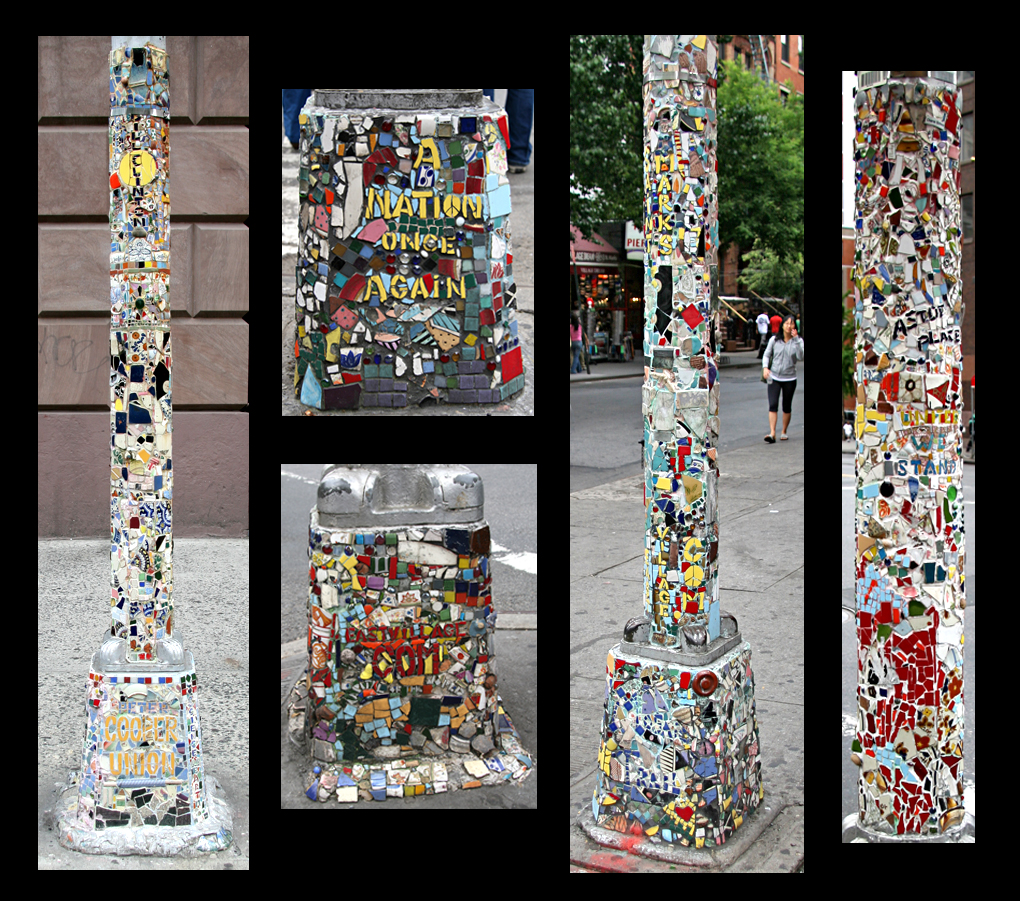
    This story about Jim Power, aka Mosaic Man, has been told and retold. In fact, a paper was written by Eric Miller, Ph.D candidate in folklore and folklife at UPenn (click here). In 2004, he won a City Lore People’s Hall of Fame Award. Power is part of the fabric of the East Village – he has also been an activist artist. His first foray into public mosaic work was in 1985, when he made mosaic planters around tree trunks in Astor Place. He began decorating lampposts with mosaics in 1988. After an altercation with the police, Power negotiated a settlement with the Department of Transportation which permitted him to do 80 lampposts. Last count, there are 67 which can be found in a loop – starting at 8th Street and Broadway, across St. Marks Place to Avenue A, down Avenue A to 4th Street, across 4th Street, and back up to 8th Street. The lamppost mosaics are themed, many of which commemorate events.

    Power came to the US from Waterford, Ireland. After a two-year stint in Vietnam, he held a number of positions – blues/jazz guitarist, Con Edison worker, carpenter, and stone mason – as a stone mason, he earned as much as $2700 per week. His interest in art and injuries from his prior work led him to pursue this passion and give up his livelihood. He has since lived on the fringes of society accompanied by his dog, squatting and crashing in a variety of locales, including the Cave collective. There are typically thousands of tiles on a lamppost; it takes as long as 3-4 months to complete one. The tiles themselves are a medley of ones purchased and donated. Although I remember some controversy and range of opinions regarding his approach initially, I think time has done well for his work. In a period where there is substantial gentrification and influx of store chains and mass merchandisers, the mosaics provide a break in the homogeneous direction the city has been moving in…

    Posted on by Brian Dubé

  • Krishna

    Posted on by Brian Dubé

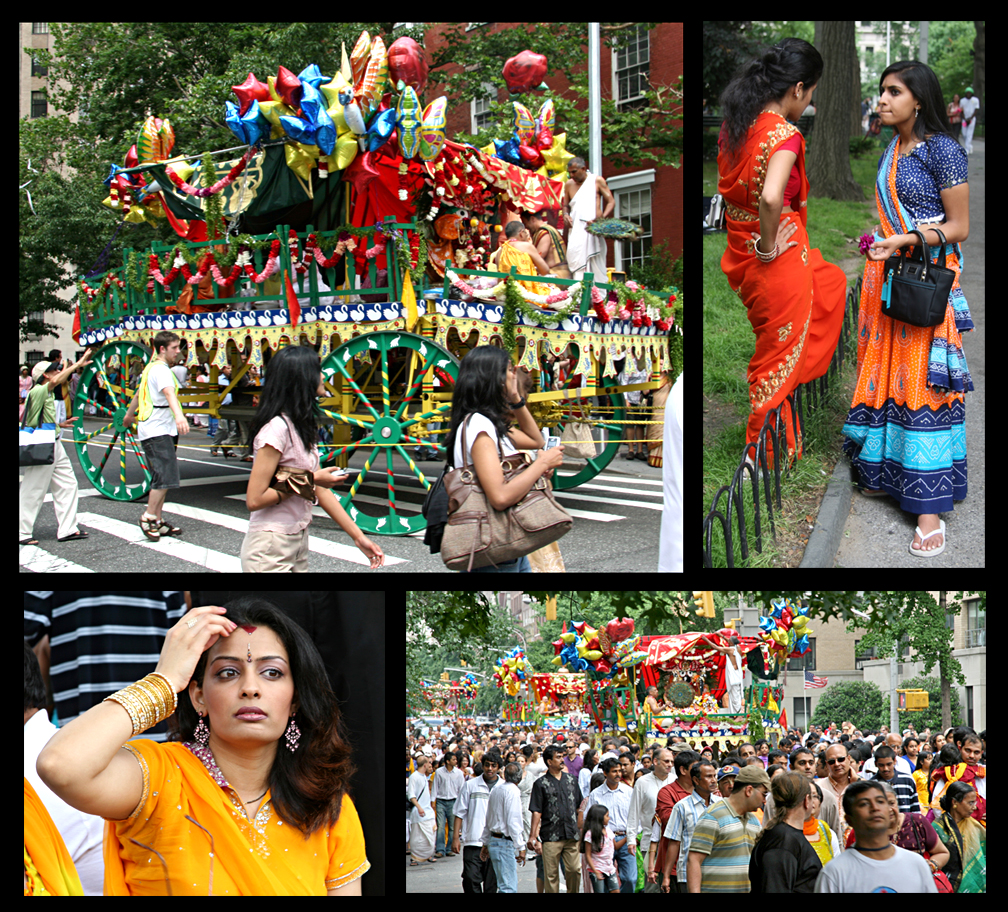
    The Hare Krishna Parade starts at 59th Street and works its way down Fifth Avenue, with devotees pulling three chariots (with wooden figures of Jagannath, Balabhadra, and Subhadra). It ends in Washington Square Park, where booths are set up for the all-day Festival of India. A stage is set up for entertainment, showcasing Indian cultural and spiritual performances. There’s free food and display booths of books on bhakti yoga, meditation, information on vegetarianism, and Krishna consciousness. It was a very colorful event – those saris were beautiful. Click here for last years posting.

    Technically this is the Lord Jagannath’s Ratha Yatra Parade, Hare Krishna’s celebration of Ratha Yatra, a 5000-year old Hindu festival associated with Jagannath, a deity form of Krishna – the supreme god of Hinduism. If all of this sounds a little complex, it is. Hinduism has many scriptures and incarnations and deities of God – it has elements of monotheism, polytheism, pantheism, and monism. It is generally seen as henotheistic, a belief in a central God with other manifestations of God.

    The Krishna movement (International Society of Krishna Consciousness – ISKCON) in this country is relatively new but is based on Gaudiya Vaishnavism and the practice of bhakti yoga. The American movement was founded in in NYC 1966 by Swami Prabhupada. He led a group of followers to Tompkins Square Park, where under an American elm tree they began to chant the distinctive 16-word mantra: ”Hare Krishna, Hare Krishna, Krishna Krishna, Hare Hare, Hare Rama, Hare Rama, Rama Rama, Hare Hare.” The tree was considered sacred by the Krishna adherents, and in 2001, NYC’s Parks Department officially recognized the historical significance of the Hare Krishna Elm tree…

    Posted on by Brian Dubé

  • PDA

    Posted on by Brian Dubé

    Many years ago, I became acquainted with the acronym PDA – no, not Personal Digital Assistant, but Public Display of Affection. According to the 17th revised edition of Emily Post’s Etiquette (which is up to date with sections on cell phone behavior, Internet behavior, drugs, etc.), “In public, holding hands and exchanging pecks on the cheek with your significant other can be charming, but prolonged and passionate embraces and soul kisses are always inappropriate.” Although views of this behavior vary considerably across various cultures (in France we have “démonstration publique d’affection”), generally it is frowned upon. In some countries, it is outlawed.

    Although some are OK with this behaviour, most of my reading on the subject saw words and phrases such as yuck, ick, disgusting, tacky, not cool, and the ever popular suggestion “get a room.” This couple in the photo was going at it for a minimum of 2 hours, barely coming up for air (Click here for a previous post of a different romantic encounter). I had reservations of posting this photo and opted for a deliberately processed photo to minimize recognizability of our two lovebirds. I hope you like the result…

    Posted on by Brian Dubé


  • dinamic_sidebar 4 none

©2026 New York Daily Photo Entries (RSS) and Comments (RSS)  Raindrops Theme