• Category Archives Curiosities of NYC
  • Crossing Over

    I vividly recall a statement made by my uncle, a voracious reader of the classics. The subject of hopelessness came up, and he quoted from the inscription in Dante’s Inferno over the gate of hell – “Lasciate ogne speranza, voi ch’intrate”, or “Abandon all hope, ye who enter here.” My uncle ruminated how he could imagine nothing worse than a life without hope. Over the years, I have reflected many times over his statement and that hope is indeed the fuel that keeps the human spirit running in the face of adversity and misfortune.

    Nothing frightens me more than the idea of prison. Here, with this fate, we have at least two abhorrent conditions – number one, taking away a fundamental right of a human being, something that most individuals hold most dear: freedom, the cornerstone of American society and government. And, number two, given a serious crime and a lifetime sentence without parole, is the prospect of experiencing Dante’s promise here on earth – a life without hope. I have watched numerous prison documentaries on television, hoping to get an understanding of how a prison inmate can get through day to day life, knowing that there is no hope of regaining the freedom they once had and that the average citizen enjoys.

    Recently, Gothamist ran a story on the relatively unknown Vernon C. Bain jail barge – a prison floating in the East River off the South Bronx. I read the article, perused the photos, and located the prison via an aerial map view online. The Department of Corrections built the barge in 1992 for $161 million to deal with overcrowding in the Rikers Island jail complex. The jail barge houses approximately 800 inmates, medium to maximum security. There are 100 cells within 16 dormitories, a law library, recreation rooms, and a basketball court on top of the barge’s deck. The place seemed fascinating, so I corralled a friend to join me on an excursion to see the place firsthand with the hopes of getting a few photos.

    When we arrived near our destination in the Bronx, my map indicated only one street leading to the prison – Halleck Road. It did not appear that one could park on this street, which reached a dead end at the prison entrance gate. So, we chose to park around the corner on Ryawa Avenue and walk down Halleck Street towards the prison.
    On the way, we met a man sitting alone at the side of the road, who introduced himself as Glenn Mercado. I asked if he was familiar with the prison and any possible restrictions regarding photography. He had been inside – he was there to visit an inmate he knew. He assured me that it was permissible to walk to the fence and take a photo of the prison.
    We also learned that Glenn had intimate first hand knowledge of prison life. He had served 15 years from age 13 to 28. I was very heartened to learn that he had, however, turned his life around. He was now married with a family and employed as a union carpenter making a substantial wage. We bid our farewells and continued walking towards the end of Halleck Road.

    I pressed my camera against the chain link fence. Unfortunately, I was very close to the entrance/exit gate and security booth. The attending police officer was not pleased with my behavior and barked at me from afar that I was not to take photos, adding, “That camera has got to go.” I was not sure of the exact meaning of his statement, quite worried that perhaps he was threatening confiscation of my equipment.
    I was also terrified that my activity might lead to arrest and that I would no longer have to watch programs on prison life but I would learn first hand what a place like the Vernon C. Bain jail barge was really like. My friend and I scurried away from the fenced area without any response to the corrections officer. Silence was my only prayer. Unlike psychic mediums such as John Edward, I was not interested in learning what was on the other side by Crossing Over 🙂

    More prisons: The Tombs


  • Sounds of Summer

    It is just after sunrise at 6:00 AM as I write this with an open window facing Washington Square Park. Incredible as it may seem, in the most densely populated city in the United States, apart from the occasional auto passing, the dominant and only sound is a chorus of crickets. This is one of the many joys in store for the early riser in New York City, or perhaps for those who have yet to sleep. Yes, even in Manhattan, amidst concrete, glass, and steel, we got insects. Many a night I have been plagued by mosquitoes, both in parks and even in my apartment.

    One summer evening in Washington Square Park in 2006, I was curious as to what insect it might be that was making a particular clicking sound that I had heard many times before. Friend Bill Shatto, an avid photographer of insects, told me he was relatively sure that it was a katydid. I had heard the word, but was completely unfamiliar with its appearance or anything else about it. In the most miraculous and serendipitous moment during that very discussion, a large green insect lighted in the central plaza of the park, away from any foliage, and sat unfettered. Using online images, we confirmed that it was a katydid (lower photo) – the only one I have seen in my entire life. It appeared to be injured – one leg was missing. It was capable of flying yet seemed uninterested in such. In fact, Bill was actually able to pick it up and place it more strategically on his hand. I took a number of photos, which have laid in my archives for the last 6 years.

    Recently, conversation turned to a much louder insect which as a child we commonly referred to as heat bugs. The cicada. The lone buzzing song, increasing in volume, was never pleasant to me as it typically dominates the air waves on hot, humid summer days in July and August.* The sunnier, hotter, and more blistering the day, the louder the cicada seemed to buzz. Recently, in the very same park, a conversation ensued about a very audible background noise which I recognized and confirmed with my friends was assuredly the sound of the cicada. As miraculously and serendipitously as six years before, a large insect lighted on the central plaza. A cicada. Seemingly unbothered by our presence as we approached it, I was able to get a number of photos, even with supplementary illumination using an iPhone. Even in Manhattan, a shrine to concrete and the manmade, here and there at the right time and place, if you listen closely, you can hear the Sounds of Summer 🙂

    *Male cicadas have loud noisemakers called “tymbals” on the sides of the abdominal base, using to produce a mating song. Some cicadas produce sounds up to 120 dB (SPL), among the loudest of all insect-produced sounds. Their song is technically loud enough to cause permanent hearing loss in humans, should the cicada sing just outside the listener’s ear. Conversely, some small species have songs so high in pitch that the noise is inaudible to humans. Species have different mating songs to ensure they attract the appropriate mate. In addition to the mating song, many species also have a distinct distress call, usually a somewhat broken and erratic sound emitted when an individual is seized. A number of species also have a courtship song, which is often a quieter call and is produced after a female has been drawn by the calling song.

    More insects: Guessing Game, Back to Boyhood


  • Quality Under the Hood

    Posted on by Brian Dubé

    I once handcrafted leather products. It was at this time that I met Jim Murnak, someone who invoked such awe that I featured him in a two-part story (see Part 1 here and Part 2 here). I sold my wares to a number of retailers, some with an upscale clientele. One husband and wife team owned two locations in the West Village, each managing their own shop. The husband, Walter, hailed from Great Britain and was a mentor of sorts to me. I was young, very impressionable, and knew nothing about the world. My mind was like a sponge for all the wisdom he could impart.

    I would make deliveries of product in person to the wife’s shop, and often, I would take the opportunity to visit Walter’s shop around the corner. I looked forward to my visits with great anticipation, as invariably we would become engaged in some conversation regarding craftsmanship, quality, or international travel, of which I knew nothing. He often contrasted the American versus the European mindset. He did much to foster the concept of the ugly American, the archetype that I profiled in So Where’s David? One day, he made a statement which echoes to this day. “Brian, you are seeing the first generation grow up that does not know quality because they have never seen it.”

    A bit harsh perhaps, but with some elements of truth. In an age of branding, merchandising, marketing, and with a tidal wave of product, who can really understand materials and design and, hence, know quality? Who would recognize elements of shoddy design, like the use of sheet metal screws in plastic, machined metal versus castings, or brass plated versus solid brass buckles? The degradation and cheapening of product is well illustrated by wood veneers, where the surface layer has gone from 1/8″ thick to 1/64″ or even less, giving the very word veneer an unwarranted bad name.

    Saddest to me are those with buckets of money, particularly the nouveau riche, who suddenly have the means to purchase anything they desire. I recall a TV tour of a rap star’s home where an extraordinary kitchen had only drawers of candy and a refrigerator with shelves of soda and beer. For these nouveau riche, quality is frequently defined strictly by brand and what costs more. Conspicuous consumption is the order of the day. I find it sad, because as a manufacturer, I see that those with extraordinary means often seek the “best” with little regard or knowledge of what it really means, often just parroting back some key buzz words regarding the product specifications. Manufacturers fine tune down to minute detail, yet most goes without care or appreciation, only to be tossed aside for the next new toy. However, I suppose there is no need to look under the hood of a car if you don’t know understand what you are looking at.

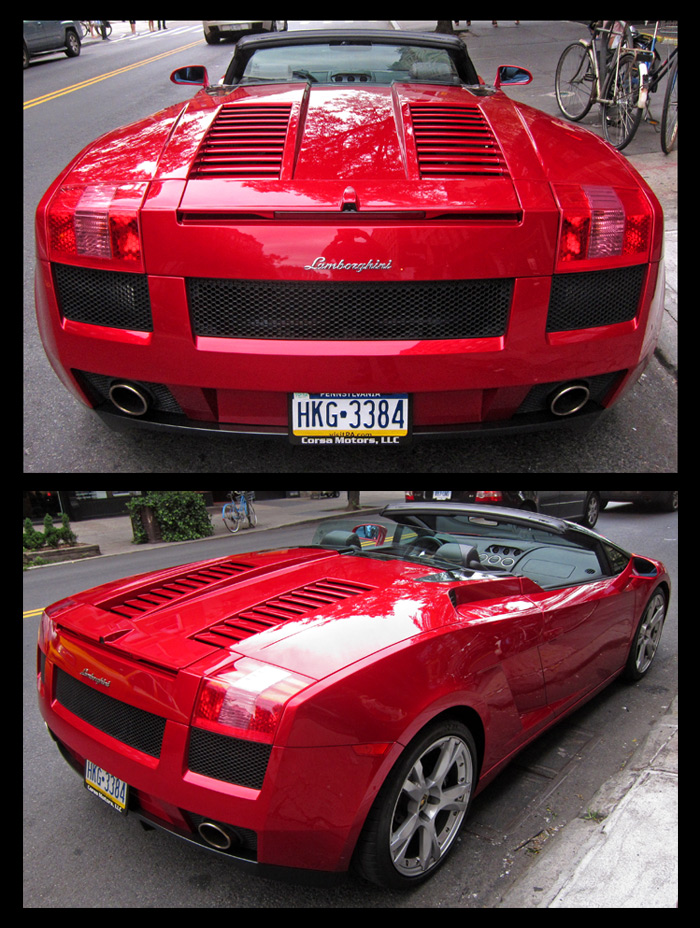
    There are things whose mere existence scream finest and most expensive, such as the Lamborghini, costing hundreds of thousands of dollars. Even in New York City, the sight of one of these vehicles raises eyebrows. In a virtual sequel to my story, “Who See the Red”, I spotted the bright red Lamborghini in today’s photo on West Broadway in the heart of SoHo. Heads turned, and some even had photos taken of them with the vehicle.

    For the New Yorker, it is also perhaps the audacity and the height of deliberateness to park a Lamborghini in the streets – even a convertible left open. It not only says the obvious, that someone can afford such a luxury, but also that the owner is so cavalier about money that he or she is perfectly comfortable leaving an asset of this size on the streets of New York City, subject to theft or vandalism.

    But here perhaps, beyond image and panache, there at least may be some good news. I want to believe that a Lamborghini is a product that is more than just an expensive brand and that there is real Quality Under the Hood

    More cars: Boom Boom, Itching and…, Nice and Olds, Hoopmobile, Mint Condition

    Posted on by Brian Dubé

  • The French Connection

    Posted on by Brian Dubé

    I had read that it was the dream of many Parisians to retire in Aix-en-Provence in the south of France, sometimes referred to as the city of a thousand fountains. It is also a city known for its many educational institutions. Its idyllic Mediterranean climate befits the Cours Mirabeau, the central artery running through the town. The wide street is beautifully shaded with double rows of plane-trees and flanked by elegant mansions built by nobility in the 16th, 17th, and 18th centuries.

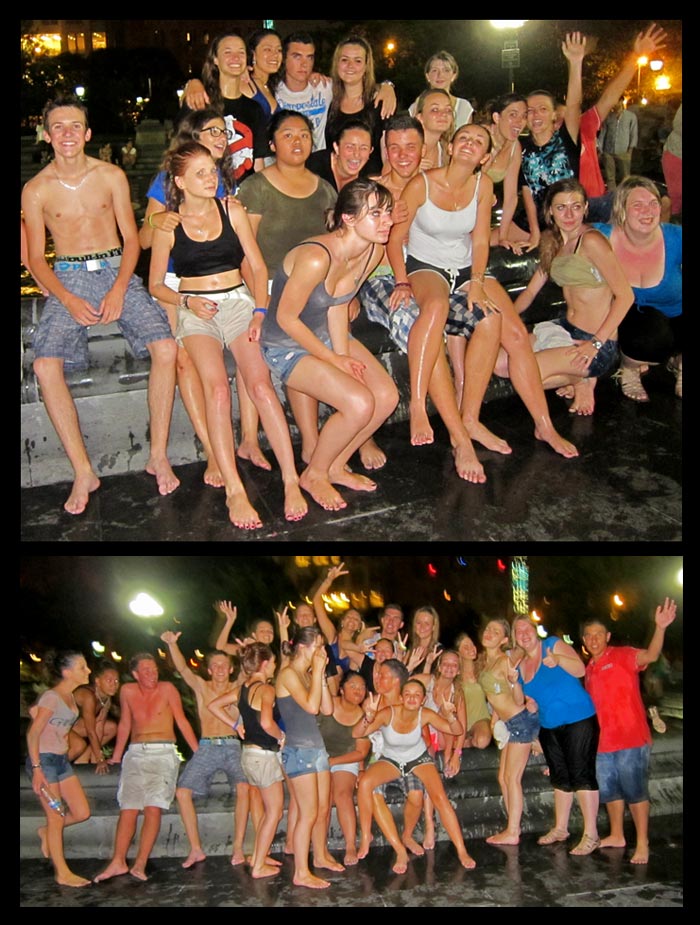
    This tunnel of greenery is accented by fountains and lined with cafes. It was here, on one visit to France, that I witnessed what I told was a tradition in town among students. A group of recent grads was cavorting along the Cours near a fountain. Soon it became a virtual water park, with boys grabbing girls, shrieking and writhing, and dowsing them in the fountain pool. I had mixed feelings about the entire happening, which tasted a bit like involuntary fraternity hazing. Were they really having fun or bending to peer pressure? But I make an effort to be as non-critical as I can of cultural differences when traveling, lest I become another ugly American, like the man I featured in So Where’s David?

    The last two days have been intolerably hot, with daytime temperatures near 100 degrees. There is little escape from summer heat in the city – New Yorkers find themselves shopping or staying indoors until the heat passes. Many, whether owing to lack of air conditioning or cabin fever, take to the streets and parks, invariably gravitating towards water. Such was the case last night in Washington Square Park.

    I was taken by surprise to see an enormous group of teenagers replaying the Aix tradition. Although cavorting in the fountain in Washington Square Park becomes de rigueur during heat waves, I have rarely seen instances of forced dunking and certainly not like Thursday night. Soon, dunked or not, virtually everyone was soaking wet.  I was also surprised that in 2012, it was still a guy-gets-girl thing, owing perhaps to France’s greater tenacity to customs rather than cultural change.

    I was intrigued at the grouping and asked a number where they were from. I was told Monaco. I learned, however, that this was said as a matter of convenience, since they expected few to know the smaller town they were actually from. I met Christophe Boule, a teacher of English, who was one of the four adults supervising this group of high school students. The students had finished their academic year and were on a class trip to New York City – an annual tradition for their school. They were staying at the youth hostel in Manhattan on the Upper West Side. They were in fact not from Monaco but from Menton, near the Italian border. Menton is a delightful small city on the coast which boasts the warmest climate in France. I had passed through it once and always wished to attend their annual lemon festival.

    When I initially approached Christophe and the other adults, they were understandably reticent and suspect of a stranger in New York City asking many questions. Their fears became slowly assuaged – my business card did a lot to establish credibility as a writer and photographer. After all, these things are often claimed by miscreants looking to get over on the innocent. One adult noticed that my last name was French. I confirmed that heritage. Now the attitude was rapidly changing.Our discussion turned to my enthusiasms about France, particularly my obsessions with medieval perched villages in the south. Now I appeared to be sérieux and truly interested in French culture.

    Soon, all was well. The Cours Mirabeau in Aix, the customary fountain dunkings, my passion for all things French, my obsession with French villages, my visit to Menton. How serendipitous and fortuitous. New York City is such a befitting set for a remake of The French Connection 🙂

    Posted on by Brian Dubé

  • That Last Ball

    I moved to New York City in 1969 to attend NYU as a mathematics major. It took very little time to realize that a career as a mathematician would be a high road, reserved for the crème de la crème and not for a boy from a small town in Connecticut who fancied himself to be a math whiz. I dabbled in other curricula, and in my third year, disillusioned, I dropped out.

    I did various odd jobs, and by 1975, I was very underemployed. And bored. My Siamese cats were bored also. I purchased three small hollow plastic golf balls sold as cat toys. My cats, as they are prone to do, showed no interest in commercial cat toys, preferring to play with anything else, particularly things verboten.

    Frustrated with my useless purchase, I decide to try and JUGGLE the three balls, but to no avail, reminiscent of my childhood, when I would occasionally try to juggle batteries taken out of a toy. But I was curious and decided to put closure to this childhood fascination. I purchased the only book in print on juggling at the time. In its pages, I was informed that a juggling ball needed proper size and weight and that, in a pinch, even the clichéd oranges would suffice. A trip to the refrigerator, and voila – my efforts at learning three were met with an immediate improvement.
    Soon, I located the only juggler listing himself in the yellow pages: Jay Green, a jewelry engraver and professional juggler. I visited his studio in midtown Manhattan. There, he demonstrated his extraordinary juggling talents.  Right there, on that day, my love and romance for the art of juggling began.

    Before leaving, he informed about an ongoing workshop in Wall Street. I attended the workshop regularly and discovered that there was a dearth of readily available equipment for juggling. I began making for myself, and soon a business was born. You can read the entire story here.
    In a way however, I find that success stories, including my own, can be a bit boring; behind every success, there is always a story, and unless one comes from money, traced back far enough, behind every example of someone with more, there was a time with less, usually much less – Warren Buffett delivering newspapers, or Steve Jobs as an adopted child and college drop out.

    In New York City, there are many failures, infinitely more than the successes. The city is built atop business failures. The plethora of retail store closings boggles the mind. Heartbreaking efforts, determination, and stamina against all odds with closures and bankruptcies nonetheless. Millions invested, millions lost. Beautiful retail spaces created, only to be ripped out months later. I see it every day. Often, the road to failure is as interesting and harrowing as that to success. But people need inspiration, not discouragement, and the details behind the failures, unless part of a longer road to success, largely remain untold.

    Recently, rummaging through my desk at my office on lower Broadway, I found one of the original cat toy balls, shown in the photo. Sadly, it is the only one remaining of the original set of three, the other two lost or misplaced and not seen in years, a reminder that material success and personal good fortune are fragile and fleeting, as easily lost as gained. Perhaps a metaphor for tenacity and good luck in business, I have been hanging on tight to That Last Ball

    More on my juggling business: Luck of the IrishSmile by Fire, Not Of Them, Please Rub Off on Me, Just Like Steve Mills, Think Big, On the Road, Really Smart Guys, Fish and Ponds, Kind Words, Signature, Spinning, Juggle This


  • Listen for the Drone

    This street sign was pointed out to me by a fellow friend and photographer. It has created a small stir and is the perfect fuel for those who like to believe that the age of Orwell’s Big Brother is coming soon or has already arrived. Civil liberties advocates are running with this, and the Internet is abuzz with articles and comments/opinions as to the seriousness of this intrusion into the privacy of civilians by the use of UAVs (Unoccupied Aerial Vehicles).

    However, it is not clear that these signs are actually the work of the NYPD, and the stir is going as planned. According to an article in the New Yorker on January 23, 2012 by Nick Paumgarten, the signage is the work of a 28-year-old photographer in Manhattan who had served in Iraq as a geospatial analyst for the army. He’d worked with satellite and drone images to provide maps for troops on the ground.

    After his discharge from the Army, he became a radical art school student who was dismayed with the Army’s use of drones to kills militants in Afghanistan and Pakistan which were being tested on home soil. From the article:

    He found a municipal sign manufacturer in a state far from New York, so as not to raise any alarm, and ordered a series of drone-alert parking sings that he’d designed to look as if they’d been issued by the NYPD. Very late on several nights a few weeks ago he set out with a crew of five to install the signs in SoHo, the West Village, Chelsea, Dumbo, and Williamsburg. Two of them did the installing, the others were on the lookout. The had walkie-talkies and, since they were on an open frequency, communicated in military code.

    Eleven such signs were installed – some have disappeared quickly, while others remain. References to the New Yorker article populate the Internet alongside assertions that the signs and threat of the use of drones for civilian monitoring is real. Comments are dominated by alarmist reactions, as would be expected.

    If the work is not that of the NYPD and by an activist, I am puzzled as to why these signs would remain prominently posted. I called the local precinct, and they seemed unaware of the signs and not particularly alarmed. The community affairs officer said that if the sign bothered me, I should take it down. When I asked regarding the legality of posting signs appearing to be those of the NYPD, she mentioned freedom of speech. I have no intention of attempting to remove a sign prominently located on Washington Square North and 5th Avenue and test the law. But I will occasionally look up and Listen for the Drone 🙂

    More signs: $57.50 (Part 1 and Part 2), Eyes on the Signs, Asbestos Sticks, Martin Luther King, Jr., No Students After 1, WFF ‘N PROOF, Small Achievements, ArtKraft Strauss, Dead or Alive, Store Policies, Advertising Gone Wild, Colossal Missbehavior, Pepsi-Cola in Neon, Vintage Mural, One Hour


  • See Chuckles Make The Rounds

    Posted on by Brian Dubé

    There is an invisible persona in New York City that I don’t like at all who is named Chuckles. He can be found in smug company, briefly possessing each individual. Have you witnessed deliberate and merciless humiliation of one person by a group and the ensuing laughter? Then you have been privy to See Chuckles Make the Rounds.

    There is a kitchen scene in the film Diary of a Mad Housewife with a husband, wife, and two daughters who live in Manhattan. The husband, brilliantly acted by Richard Benjamin, plays the quintessential arrogant, pompous ass. His wife, who makes an innocent slip while speaking, is made fun of in the cruelest of ways – her husband repeats the slip to the daughters, encouraging them to laugh at and mock their mother along with him. Just a movie and inconceivable in the real world? Not at all. This was only to be my first introduction to the world of the smug, where I would See Chuckles Make the Rounds.

    I was at the home of a girlfriend’s family during a holiday season. Her sister was not as academically inclined as her husband or his family. During the dinner, there was talk of birds and birding, something which the husband and his family were particularly interested in. The wife, in a genuine and social spirit, pointed out a bird, visible through the dining room window. She had, however, misidentified it and was immediately mocked by her husband and his family as they took turns laughing at her in front of a table full of people, including their children. It was excruciating to see her humiliated so openly. I felt so badly for her. Unfortunately, it would not be the only incident in that family where she would be made fun of and where I would See Chuckles Make the Rounds.

    It is a particularly painful memory for me as the incident was much too close to the scene in that film, forever burned in my mind, now reinforced by a live reenactment. To this day, someone identifying a bird brings back this incident, as does any interaction of parents and children laced with smugness. I wonder what the impact of such behavior will be on children who are subjected repeatedly to arrogance, abuse, or any other socially unacceptable behaviors by their parents. Are not the parents role models to learn from?

    There is no better place than New York City to find pompous asses – the arrogant, elite, super-rich, overachievers, over-educated, super-successful, overconfident, and smug. And sadly, here, perhaps more than anywhere else, we have a large number willing to wield their enormous talents and achievements as tools in executing the most despicable behaviors aimed at humiliating others. To be expected in a city where it feels like everyone is an Ivy League school graduate and working as an attorney, medical doctor, or in finance at Goldman Sachs.

    Recently, I sat adjoining the table of a family in a neighborhood restaurant (seen in today’s photo). Although not at the level of the film scene or my birding incident, the interaction was disturbing nonetheless. It barely resembled a dinner – it was more like a meeting of the urbane sophisticates.

    The preteen daughter was much too sophisticated, fully acting as a mature adult. When her father arrived, she put her arm awkwardly around his SHOULDERS, and asked how his day was. She did this like a wife or business colleague, not as his child. As they chatted, she listened attentively. Movements and etiquette were proper, with an air of unnecessary formality. The entire meal seemed to be an exercise in properness and one-upmanship.

    Her mother recounted for her husband their daughter’s misstep in referring to something as Medieval that was clearly was not of that time period. I felt badly for the daughter who had to maintain the standards and composure of an adult and worse, be made fun of by her parents. Our invisible friend had arrived. I was not pleased to See Chuckles Make the Rounds 🙁

    Meet another pompous ass in Meetings With Annoying Men (Part 1 and Part 2).

    Related Post: Anything Except First Place Is…

    Posted on by Brian Dubé

  • Titillation of the Day 2

    Posted on by Brian Dubé

    The Anonymous Shoe

    Perhaps I should have a rule: if something in New York City is enough to stop me dead in my tracks, no matter how trivial it may appear, it is worthy of a photo and story. After all, it would be rather stingy to seek out photo ops and then, when something truly piques the interest of denizens of the city, share it only with other fellow New Yorkers, would it not?

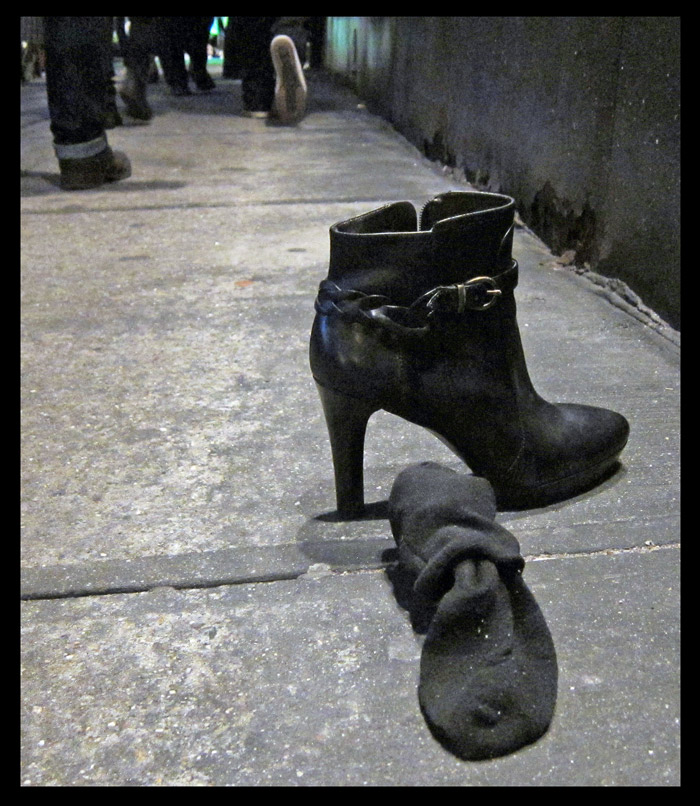
    Yesterday, during the evening rush hour, on a highly trafficked intersection of Spring Street and Broadway, I encountered this woman’s dress boot and sock. Thousands just walked by it, leaving it completely undisturbed. But it was very, very perplexing. It seems unlikely that someone would lose one shoe and one sock. It seemed equally unlikely that someone would discard one shoe and sock.

    This was not a monumental occurrence but rather something so deliberate that it begged for attention. Was this another example of Lost and Found – the Hanukkah star cat I discovered in 2008 which appeared to be more deliberately placed than lost? If lost and left for the owner, it was in the least likely of places, New York City, where the prospect of finding or recovering lost articles, seems about as remote as humanly possible (see Area Code 714, Part 1 and Part 2). On March 15, 2011, in Titillation of the Day, I wrote:

    On December 26, 2008, in a story called Lost and Found, I told of my experience in Paris, where lost articles were often repositioned prominently in near where it was found, in hopes the original owner will return via that route and find it. Since that time, I have noticed this practice on the streets of New York City. It may come as somewhat surprising, but the more aware you are of this practice, the more likely you will notice it.

    I approached a woman nearby purchasing a cupcake at the Melissa window bakeshop and asked her opinion. She appeared to be equally confused. Another passerby commented that someone was trying to make a statement. When I remarked that it may be the subject of a story, he suggested “The Anonymous Shoe.”

    Related Posts: Front Window, One Size Too Small, Urban Road Warrior

    Posted on by Brian Dubé

  • People Watcher’s Paradise


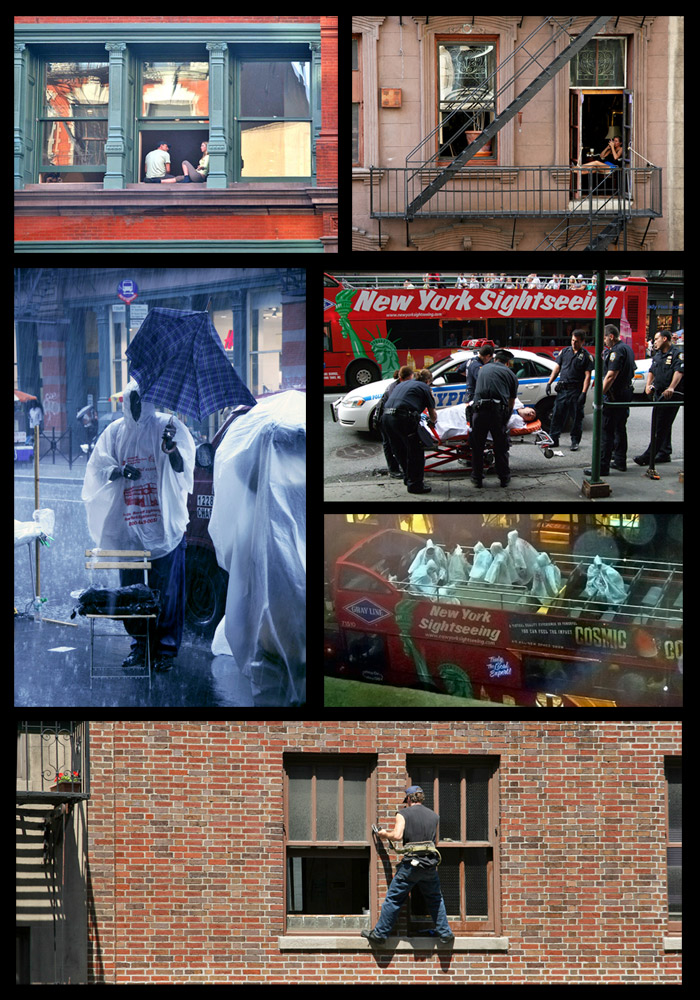
    On April 21, 2009, I wrote Rear Window, referencing the Hitchcock classic film set in New York City and my similar voyeuristic opportunity. I have the privilege of my office windows facing Broadway, and over the 21 years I have been located there, it has been a virtual Time Machine experience as the neighborhood changes, stores come and go, residential tenants move in and out, various dramas play themselves out, and marches use Broadway as the thoroughfare of choice to make their way to City Hall or the financial district.

    However, unlike the vista of Jimmy Stewart in Rear Window, a Broadway view for two decades is going to deliver a lot more material than one apartment. It is here that I photographed and wrote about a man who SNAPPED and had to be taken away in an ambulance, tourists caught in a rainstorm atop a tourist bus, a couple enjoying an early spring day precipitously perched on a ledge, an old-school window washer, and an umbrella opportunist. (See these stories by clicking the individual photos in the collage.) SoHo is also a neighborhood where I have shared many experiences and photo ops, which I wrote about in Street Cred and Dead Man Walking.

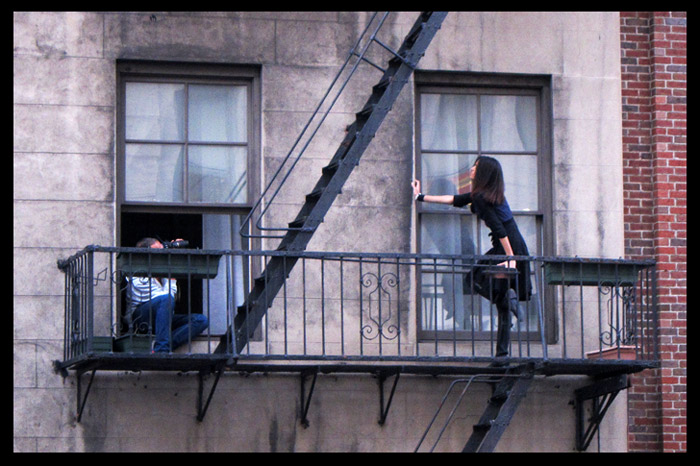
    You can see the rich fodder that I am privy to from just one single New York City perch. In today’s photo (top), I caught a fire escape photo shoot. At the end of the shoot, in an ironic twist, the photographer and model noticed that I was photographing them as well. They smiled and waved approvingly in reciprocal voyeurism.

    The patient observer will be most rewarded. Over time, from a good perch, one can see a changing and varied world go by with an endless parade of characters, many hard to imagine to be found anywhere else. This is New York City, a People Watcher’s Paradise 🙂


  • I’ll Take It


    There are big celebrities and small ones. If you’re big, perhaps you will have your name in lights on Broadway, on a movie theater marquee, the front page of the tabloids, magazines, your hand or footprints on Hollywood Boulevard, or a long page in Wikipedia.

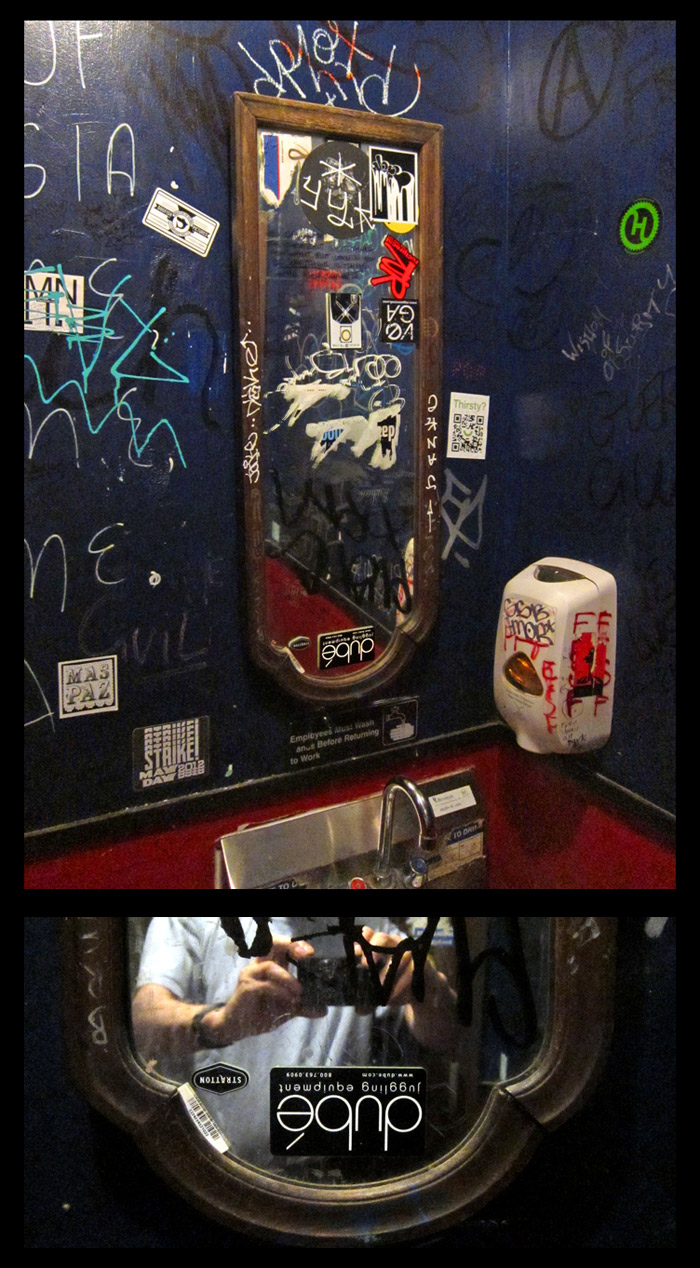
    If you’re a small celebrity or a big fish in a small pond, you take what you can get. If you are lucky, like I was, you may be asked to do a small indie documentary film (which remains in limbo). Or, you may find, like I did last night, your name on the mirror, upside down, in a dirty, graffiti-laden bathroom of a local cafe.

    Yesterday, I agreed to meet a friend and photographer at Boyd Thai for dinner. I left 520 Broadway, where my office and factory are located, and walked through SoHo. On West Broadway, Peter Lik and his gallery struck a troubled chord. I crossed Houston Street – the setting for many photos I have taken and many stories I have written: The Honest Boy, The Wall, The Cable Building, Angelika Film Center, the traffic island where I first chatted with Mark Birnbaum, Time Landscape, St. Anthony’s Church (with its Christmas nativity), Raffetto’s, and Arturo’s.

    Through the South Village, I crossed Bleecker Street – legendary and a destination in itself. I arrived at Boyd Restaurant, featuring Thai cuisine, where we had the early-bird specials. As is often the case, I was given a complementary dessert. After dinner, we agreed to extend our evening out and head for a regular haunt – Think Coffee.

    Leaving Boyd, we strolled up Thompson Street, passing by the renowned Chess Shop. Heading east, we flanked Washington Square Park, a world unto its own. We passed by Kimmel, the new NYU student center, and the massive Bobst Library. Across from Courant Institute of Mathematical Sciences on Mercer Street, we arrived at our destination, Think Coffee, where we always find No Negativity.

    Just before leaving, my friend used the bathroom. On his return, he told me that my name was stickered on a mirror, which was upside down over the sink. I was assured he was joking, but he assured me that he was not. I entered the bathroom to see for myself, and sure enough, a dubé sticker had been affixed to the mirror. In spite of being framed by graffiti and litter, I was pleasantly surprised. It certainly did not dominate an airspace like T for Trump, but it will likely give me at least 15 minutes of fame. I’ll Take It 🙂


  • Des Moines

    It is no secret that New Yorkers top the list when it comes to arrogance and xenophobia. Perhaps one of the best visual representations is View of the World from 9th Avenue – if you are unfamiliar with it, see the photo and my story here. Even within New York City itself, you will find individuals who rarely go outside their neighborhood. For Village residents, there is a cliche: I never go north of 14th Street.

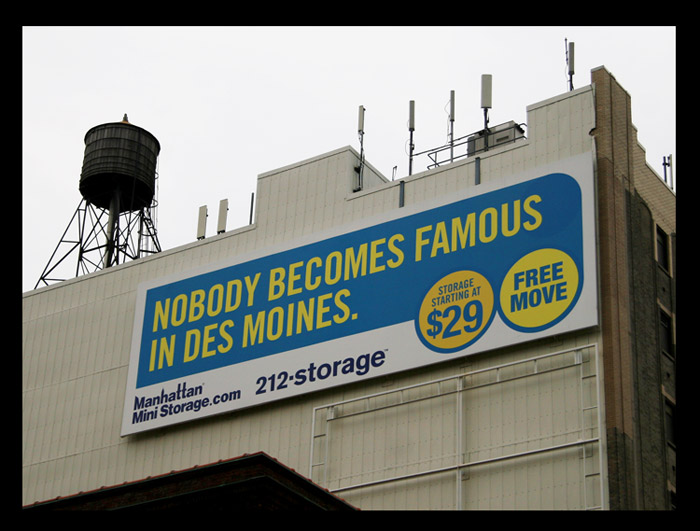
    In today’s photo, you can see an example of this thinking in an ad by local storage giant Manhattan Mini-Storage. In a crowded marketplace, the company has been successful in creating provocative ads that actually get talked about. Here are some samples:

    “Remember, if you leave the city, you’ll have to live in America.”

    “Oh, yeah, you’ll fit right in in Connecticut.”

    “Your closet’s so shallow, it makes Paris look deep.” [re: Paris Hilton]?”

    “In my father’s house, there are many rooms.” – John 14:2.  Clearly, Jesus was not a New Yorker.

    And from today’s photo: “Nobody becomes famous in Des Moines.” Slamming another city will certainly get attention, although the effect is most likely on the other city’s residents than on New Yorkers, who already believe that there is no other place worth living in, certainly not Des Moines, Iowa.

    I found a response to the ad and comments on a blog called Des Moines is NOT Boring with a story title: Really New York!? As one would expect, the readers of the blog were not pleased with the ad. The writer of the story states, “Apparently, closest [sic] space is at a premium in New York, yet the relation to becoming famous and Des Moines is still pretty unclear.” I agree with the writer that the precise thinking behind the statement is somewhat hazy, but I surmise that the implication is that there is plenty of storage space outside New York City, but it would do one no good to live there. Des Moines was a good target since many see the Midwest as a place of pleasant, mild-mannered people but quintessentially BORING.

    It is ironic that a blog and name would be predicated on a statement that Des Moines is not boring. Self-proclamations are typically indicative that the opposite is true. People who profess to be easygoing rarely are. And people who have to make preemptive defensive statements usually are what they claim to not be. When is the last time you saw a billboard stating that New York is NOT Boring or that Paris is NOT ugly?

    I do respect the quality of life that must exist in small cities. I have often fantasized about moving to a place like Boulder, Colorado, San Francisco, or Portland, Maine. But once you live in New York City, it’s hard to scale back. Most of us are here not just for the lure of opportunity but are also trapped by the Sirens of Convenience. It matters not whether anyone becomes famous in New York City or in Des Moines 🙂

    Related Posts: Uptown, Goin’ to Jersey


  • World of Waiting


    It may be hard to understand why anyone 12 years old would covet a book on calculus, but I did. I loved books and reading in general, but I also loved mathematics and was intrigued by the meaning of the long S of integral calculus. My eighth grade teacher explained succinctly that it meant sum. Not particularly satisfied, I desired the book to have for my own, however, I was told by my parents that if I wanted it, I would have to earn the money and buy it myself. It was $2.95 and published by Barnes and Noble. I saved my money and, in time, came to purchase that book. I still have it.

    And so it is that I can never hate Barnes and Noble. And after all, they are a legacy business, founded in 1873, not an empire built on the latest fashion or frivolous merchandise. It is fashionable to hate Barnes and Noble, which is understandable. I do imagine that they have put many small independent book retailers out of business. However, I am doubtful that destroying small booksellers is corporate policy at Barnes and Noble but rather the unfortunate natural fallout when such a large retailer moves into an area.

    But in New York City, as elsewhere, the consumer has become very spoiled. Although many bemoan the fate of the small independent retailer and demonize the retail giants/chains, we all want huge selection, late hours, 7-day operations, low prices, liberal return policies, and a plethora of convenient locations. Who but the giants can offer such a thing? Comedian Todd Barry does material on the ironies of the attitudes of New Yorkers towards the corporate behemoths. You can read it here.

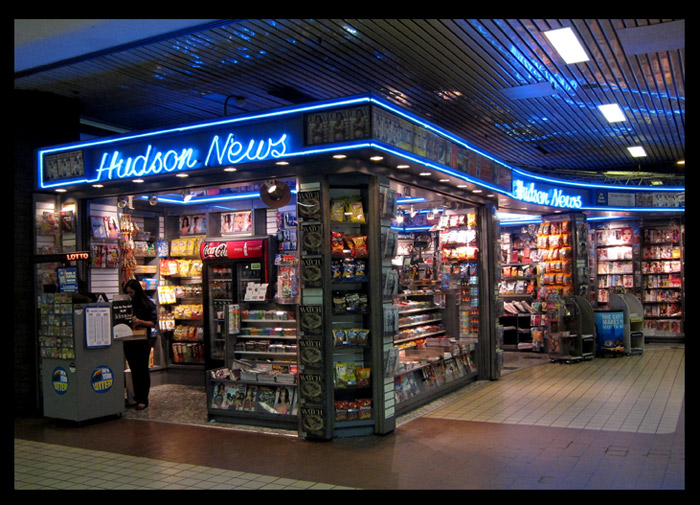
    My interest in books went beyond that first tome on calculus. I have always been comforted by books, magazines, and the stores selling them. So when I began discovering Hudson News shops in the airports and bus and train terminals around New York City (and eventually outside the city), I always found their neon signs a welcome beacon to reading materials.

    I was shocked and fascinated to learn that Keith Richards of the Rolling Stones, known for a life of excess, was an avid reader. His personal library has been featured in a book of libraries. He once remarked how surprised he was that Americans read so little. He discussed the reality of touring and how much waiting and down time there was between concerts and how he filled much of his time with reading.

    There’s a lot of waiting and down time in New York. In a city where most travel by public transportation, many fill their travel time with reading. Perhaps if I am lucky, someday I may meet Keith in Barnes and Noble or Hudson News as we fill our time in a World of Waiting.

    Related Posts: Who Can Believe It?, We Read at Night, Book Wars, The Strand


  • The Loneliest Number

    Is one still the loneliest number? New Yorkers should know best – I was shocked to learn that 50.6 % (27% nationally) of Manhattan households are occupied by a single individual. Of the 3,141 counties in the United States, New York County (Manhattan) is the leader in single-individual households. The marriage statistics also deviate from the norm: in Manhattan, 25.6% of households are married, whereas the national average is 49.7%.

    But, given the tenuous nature of relationships and the transient nature of the city, perhaps it should not have come as a surprise. And, the evidence is at my fingertips – on reflection, the vast majority of my friends and acquaintances are in single households.

    The first thought upon hearing such a statistic is that of LONELINESS. However, a number of books, articles, and research are doing much to dispel the idea that living alone means lonely. I have excerpted below parts of a 2008 New York Magazine article. I recommend the article – the comments alone provide a broad insight into the thinking and experience of many New Yorkers who live alone.

    Alone Together

    Manhattan is the capital of people living by themselves. But are New Yorkers lonelier? Far from it, say a new breed of loneliness researchers, who argue that urban alienation is largely a myth.

    “In our data,” adds Lisa Berkman, the Harvard epidemiologist who discovered the importance of social networks to heart patients, “friends substitute perfectly well for family.” This finding is important. It may be true that marriage prolongs life. But so, in Berkman’s view, does friendship—and considering how important friendship is to New Yorkers (home of Friends, after all), where so many of us live on our own, this finding is blissfully reassuring. In fact, Berkman has consistently found that living alone poses no health risk, whether she’s looking at 20,000 gas and electricity workers in France or a random sample of almost 7,000 men and women in Alameda, California, so long as her subjects have intimate ties of some kind as well as a variety of weaker ones. Those who are married but don’t have any civic ties or close friends or relatives, for instance, face greater health risks than those who live alone but have lots of friends and regularly volunteer at the local soup kitchen. “Any one connection doesn’t really protect you,” she says. “You need relationships that provide love and intimacy and you need relationships that help you feel like you’re participating in society in some way.”

    New York State is tied for the fifth-lowest divorce rate in the nation.  New York City’s suicide rate says something even more profound: New York State’s suicide rate is currently the third lowest in the nation.

    Many have made the same allegations about the Internet’s alienating effects, but this has also been challenged. Some see the Internet as analogous to a large city like New York with positive social impact:

    The idea that you’re isolated when you’re online is, to me, just wrong,” says Keith Hampton, a sociologist at the University of Pennsylvania who did an extensive ethnography of “Netville,” a new, 100 percent wired community in suburban Toronto. “It’s an inherently social medium. What starts online moves offline, and what starts offline goes online.” Which explains why the people with whom you e-mail most frequently are your closest friends and romantic partners. “Online and offline life are inherently connected,” he says. “They’re not separate worlds.”

    New York, like the Internet, also offers a rich network of acquaintances, or what sociologists like to call “weak ties.” There are sociologists who will argue that weak ties are the bane of modern life. We are drowning in a sea of them, they’ll say—networking with colleagues rather than socializing with friends, corresponding online with lots of people we know only moderately well rather than catching up with our nearest and dearest on the phone.

    There is even evidence that weak ties simply make us feel better. According to Loneliness, the advice your mother gives you when you’re depressed—Get out of the damn house, would you?—turns out to be right. For most people, being in the simple presence of a friendly person helps us reregulate our behavior if we’re feeling depressed in our isolation. We are naturally wired not just to connect with them but to imitate them—which might be a good idea, if our impulses at that moment are self-destructive.

    Hampton says he views the Internet as the ultimate city, the last stop on the continuum of human connectedness. I’d argue that New York and the Internet are about the same …. what the Internet and New York have in common is that each environment facilitates interaction between individuals like no other, and both would be positively useless—would literally lose their raison d’être—if solitary individuals didn’t furiously interact in each. They show us, in trillions of invisible ways every day, that people are essentially nothing without one another. We may sometimes want to throttle our fellow travelers on the F train. We may on occasion curse our neighbors for playing music so loud it splits the floor. But living cheek-by-jowl is the necessary price we pay for our well-being. And anyway, who wants to ride the subway alone?

    Connectedness takes on many forms, both old and new, and in many places, whether online or in New York City. We can no longer make assumptions based strictly on number. One may no longer be the Loneliest Number 🙂

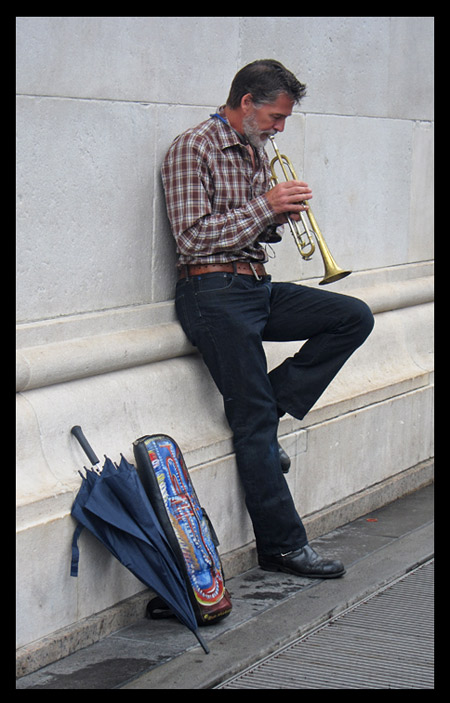
    Photo Note: I happened upon this trumpet player one rainy morning, playing alone in Washington Square Park, shielded from the rain under the arch. See him play in the video above.

    Related Posts: Guardian Angels, Lonely in a Crowded Room, Because It’s Not, The Last Taboo


  • Nice Camel Sweater

    When you grow up under a very tight reign, acts of rebellion are small and narrowly focused. For me, it manifested in the rejection of all things light brown. On my yearly pre-school clothes shopping trips, I would invariably be steered towards clothing that would be in the light brown family – beige, tan, camel, etc.*

    I suspect that the palette was being pushed at me because it spoke calmness, safety, moderation, or neutrality. But I didn’t want to be calm or neutral. I didn’t want to be in a blue-color factory town. I didn’t want to be in the suburbs. I wanted to be in the big city. Bright neon lights and bold colors.

    So in time, I grew to hate the family of light brown – it symbolized parental authority and all things boring. As if they were not only neutral enough, the color names were invariably prefaced with the very unnecessary “nice.” So “recommendations” always took the form of “why don’t you get that in a “nice camel” color.”

    I hated sweaters, too. I felt confined, uncomfortable, and restricted in them, just as I did in my hometown. However, a sweater is a sensible article of clothing and, like the beige family of colors, is another element in the wardrobe of the moderate. So, the sweater became another irritant in my life, something forever being sold to me by family and clothing salesmen. Put all the elements together, and the worst offense imaginable was a family member promoting something like a “nice, camel sweater.” You know what not to buy me as a gift.

    Recently, while eating dinner with a friend at the Olive Tree Cafe, I spotted a group of women awash in the color of my youth – every variant of beige, tan, cream, light brown, and camel was represented, even in their hair.

    My dining companion that night is an NYU student and team member working on this blog. Inexperienced in the ways and means of the city, she respects the wisdom I have gleaned and trusts my insights based on nearly a half century of observation and study of the peoples of New York. So she listened intently as I began to dissect and analyze this group of women for her and explain how it was obvious that these women were clearly from the suburbs.

    Not only were they wearing every shade of light brown known to humankind, their entire demeanor cried out-of-towners – they were so gentle and benign-looking, with no edge anywhere to be found. I pointed out how one woman wore her bag slung around her neck while eating – the classic fearful tourist. I explained how one of the key elements in identifying visitors is that everything they wear, from footwear to headwear, is about COMFORT, often at the expense of style. And look – one was even sporting a nice, camel-colored sweater.

    Before we left, I wanted to corroborate my theory. In as polite a way as possible, I would tell them that I was a curious New York blogger and ask them where they were from. I would then return to my dining companion with evidence of my superior skills in observation.

    They were quite approachable and friendly, as visitors often are. I introduced myself and gave them my card. “Why are you here?” I asked. “To celebrate a birthday,” they answered. “Where are you from? “We’re native New Yorkers. Upper West Side, Manhattan.” I knew it. What gave it away was that Nice Camel Sweater. 🙂

    *Note: To make matters worse, I love blue, however, when I was in high school, jeans were not allowed.


  • Instincts

    I was a little uneasy writing this story. As a small business owner, I have a very strong feeling as to the key reason for entrepreneurial success. However, I have been reading pages and pages without seeing any validation. I did not find studying the key reasons businesses succeed or fail very useful – if you can think of any reason(s) at all, you will almost certainly find it somewhere in any one of numerous lists of key factors in failure or success. None will come as a surprise – right location, management, adequate capital, cost control, knowledge, luck, persistence, vision, customer service, growth plan, marketing, key vision, etc. With such an enormous number of factors, managing their interplay becomes an impossible task for any human being. How will anyone learn all of the key ingredients and the balancing act necessary to succeed?

    Then I finally found exactly the single word I was looking for in an article on David Geffen in a Stanford School of Business newsletter:

    David Geffen Says Good Instincts Play Better for Him Than Good Plans

    A self-made billionaire, Geffen told Graduate School of Business students that he relies instead on his instincts, his keen eye for talent, honesty, and a knack for surrounding himself with smart people.
    “I wish I could give you a better answer. I didn’t have a clue about managing business. I never went to business school. I was just bumbling through a lot of my life,” said Geffen. “I was like the guy behind the curtain in The Wizard of Oz.”

    The operative word I was looking for was INSTINCTS. Successful business owners have business instincts – an innate sense of what people want or need and how to address those needs. Of course, as a business grows, many of those key factors in the litany of ingredients of success do come into play, but the best strategy is finding talented individuals and delegating.

    In my experience meeting business entrepreneurs, they just seem to be different. You can sense it and see evidence of it even at a very early age. This instinct seems to be the most common thread among  success stories. Most of the great successes I have met have little or no business schooling. Many have been high school graduates or college dropouts.

    Of course, luck is a factor, but opportunity abounds. The entrepreneur not only recognizes opportunity but also seizes that opportunity and capitalizes on it as well. An estimated 80% of restaurants fail in New York City within five years. If learning the key factors of success was the secret, we would not see such an enormous fatality rate.

    Every day in New York City, I see restaurants bulging with customers in lines spilling into the streets. A few doors away, I will often see another neighboring restaurant, even with with identical cuisine, virtually empty. In post game analysis, it is easy to pontificate, analyze, speculate, and theorize as to why some fail and others succeed. Reams have been written. However, reading the Tipping Point or Freakonomics is not going to help the business owner identify the myriad of factors to success and properly deploy and manage them. All of those factors are part of the equation. But to me, the most important is Instincts…

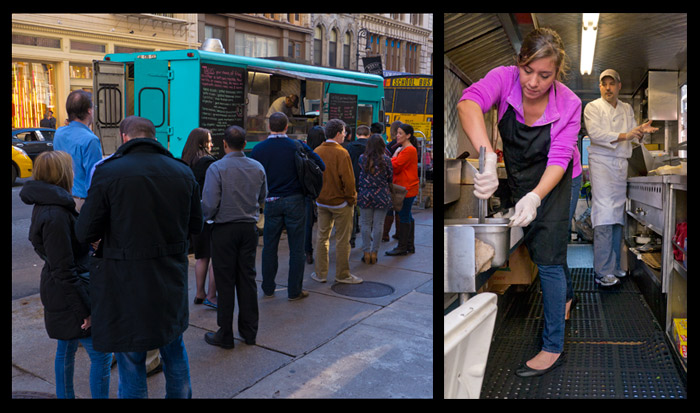
    Photo Note: This is the further incarnation of the food cart I wrote about on August 3, 2007. The cart is now the Tribeca Taco Truck. The truck is owned by Percy, but on this occasion, his daughter Alycia (seen in the photo) informed me that he was purchasing a second, larger truck – one will remain stationed at the original location (Broadway between Prince and Spring Streets) while the other roams. Tenacity is also a key ingredient to success, and Percy has stuck with his endeavor for some years. He now has long lunch lines every day. Get there early and tell him I sent you. Percy and crew are wonderful and will treat you like family.

    Related Posts: Not Enough Dough, Brawling Over Brands, Trucks and Things, You’re Not in Kansas, Pearl Paint, End of an Era, Canal Rubber, Space Surplus Metals


  • dinamic_sidebar 4 none

©2026 New York Daily Photo Entries (RSS) and Comments (RSS)  Raindrops Theme