• Category Archives People
  • Dave

    Posted on by Brian Dubé

    I want to tell you about a man named Dave. He was a New Yorker, and for a time, I and a number of friends would see him daily in Washington Square Park. He was a gentle person and one of the most considerate individuals I have ever met. His concern was always for others, and at one point, when I was going through a trying time, he consoled me daily, always asking for a update the moment he saw me.

    He had a comforting aura about him. At a surface level, Dave looked quite ragtag, very poor, and eccentric. His wardrobe was very limited, and he wore threadbare shirts and torn belts. He was always overdressed, often with sweaters and a down jacket, even in warm weather. He carried old and worn plastic shopping bags that were stuffed – I have no idea what he was carrying. At times, he could be mistaken for someone homeless.

    He had a job, although he never spoke of his work or home. One of our group of friends said that he was told by Dave that he was a clerical worker in a hospital. He lived alone, had no family and, other than his park forays, was a recluse.

    I introduced him to the New York Times crossword puzzle, and we sometimes did them together. Although he was not a native English speaker, he did well. It became very clear to me over time that this man was very intelligent and well-read. I just had a gut feeling that there was much more to this man than met the eye.

    Over time I began to learn a few details of his life. He was a Russian Jew and had served in the Israeli army. On another occasion, while discussing classical music, he told me that he had studied music formally for seven years. Discussing specific pieces such as the Chopin Etudes, e.g., it was clear that these claims were not likely to be fabrications, and I hoped to hear him play some time.

    One day, we learned that he had a stroke. He was never to be the same again. Speaking to him on the phone was quite upsetting, as he was barely able to converse at all. Soon after, we were told that he had a brain tumor. Our belief was that he had known about this for some time yet carried the burden silently.

    A friend told us that he had learned the most astounding thing. While visiting Dave in the hospital, he met two of his coworkers, who informed him that Dave was much more than a clerical worker. In fact, Dave was a research scientist with two PhDs in Pharmacology. The last time I saw him was in his room at Mt. Sinai, when I went to visit him with a friend. It was particularly sad seeing him with a shaved head and surgical scars everywhere. He was unable to say anything other than yes or no to questions asked. I asked him if it was true that he had two doctoral degrees. He said yes.

    Dave died on November 4, 2009. I attended his memorial service. One story followed another from his coworkers about his selflessness and humility. I also learned that in addition to his research work, his interest in music was not casual at all – he performed as a concert pianist. He may have had no family or close personal friends here, but he is missed and loved by all whose lives he touched…

    Note about the photo: Mount Sinai Hospital was founded in 1852 and is one of the oldest and largest teaching hospitals in the United States. In 2009, it was ranked as one of the best hospitals in the United States by U.S. News & World Report in 11 specialties.
    Posted on by Brian Dubé

  • Smile

    At one time, nearly all my photos were scenics of some sort. Landscapes or buildings. Streets with no people. I typically waited for people to leave before shooting. The feeling I had was that people would somehow mar the image. Telling this to a friend (an architect), she commented that perhaps I had the soul of an architect – that it has been said that architects love buildings more than people.
    This bothered me, because there was truth to what she said. However, I actually love people and am very social. Since that time, her comment has nagged at me, and I have come to see the value of people in my photography. I have become interested in people and their stories. What are buildings except structures built by people for people?

    I have met many people who are so political that they appear to see everything through glasses colored by their politics. A conversation about bad weather, and they will blame a political party. And, ironically, sometimes the causes take on a life of their own, and activists appear to love the cause more than the people. What are causes except efforts by people for the betterment of people?

    Political and community activism are good things. Many potentially destructive projects have been thwarted by activists, and much that is hideous perhaps could have been averted with more involvement. However, being personally involved with people whose politics dominate their being becomes tedious. Many have no sense of humor whatsoever. I often feel that they worry that laughter will somehow undermine the importance of the lives.

    Not Susan Goren. My first encounter with Susan was her yelling at me over my conversation with a park official about a group of street performers. On my second encounter (at a community board meeting), she approached me and apologized, excusing our original encounter as a product of her political passion for things she had worked on for a lifetime. One thing became extremely clear – this woman valued human relationships.
    And squirrels.

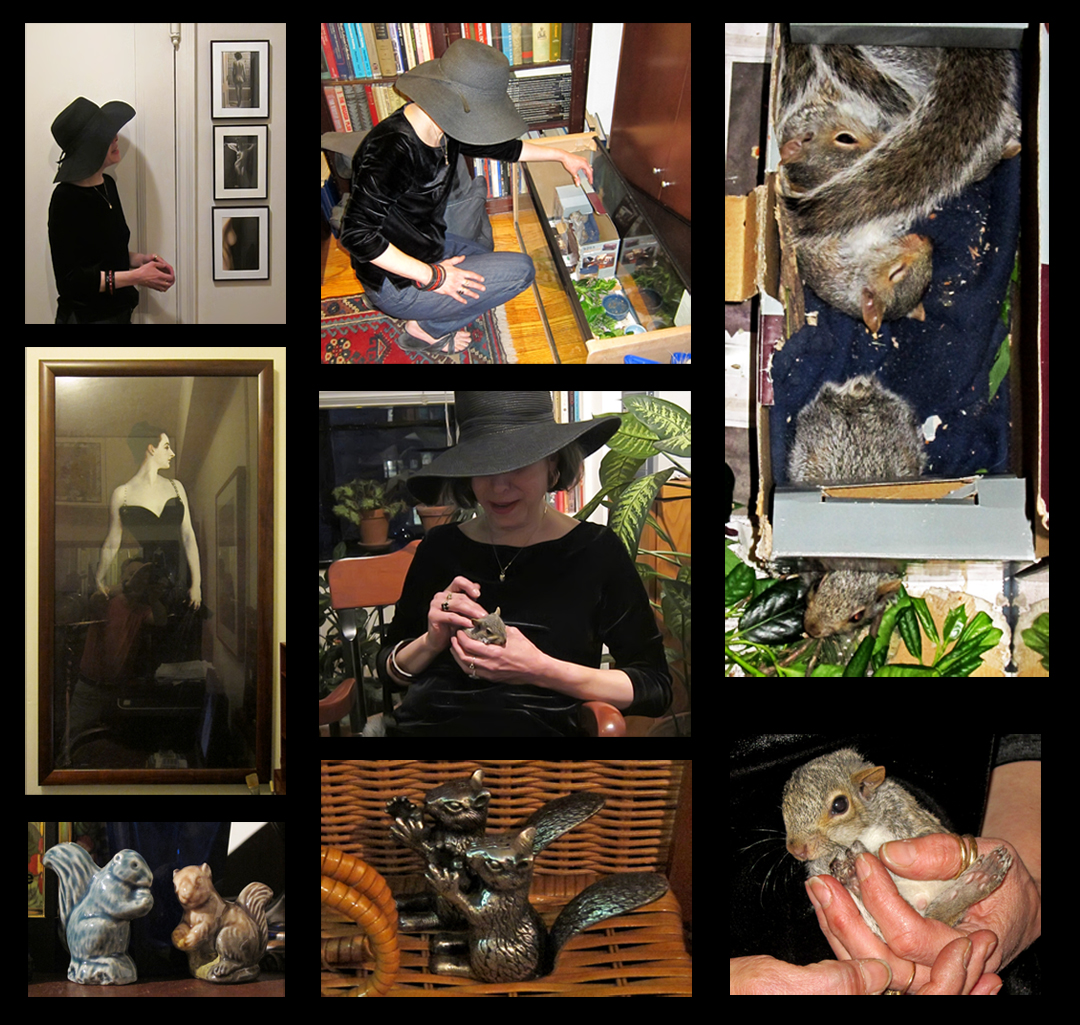
    Susan has been actively involved in rehabbing squirrels – injured or orphaned. I visited her home last night, where she is currently caring for a group of four. Her home is a shrine to her interests in art, reading, and squirrels. She toured me through her home, going over her collection of fine art, photography, squirrel collectibles, and a photo archives on her PC of the various squirrels she has cared for. The Villager recently wrote a front page feature article on Susan – you can find it here.

    Susan is a New Yorker. Born and raised in Manhattan, she is a graduate of New York University with majors in literature and art history. Like myself, Susan has been a Village resident her entire adult life. She worked for NYU for 17 years and has lived a block from Washington Square Park for the last 36 years since her graduation. She is a habitué of Washington Square Park, where I met her a few years ago and where she mothers over the squirrel population. She can identify most of them and has named many. She is often referred to as Susan Squirrel to differentiate her from a number of other Susans who are park regulars.

    Susan is a community activist. A lover of the arts, a lover of squirrels, a lover of people. And she has a sense of humor. You can find her easily – look for the woman with a squirrel, people, red lipstick, and a smile 🙂


  • Swaggertist in Blue

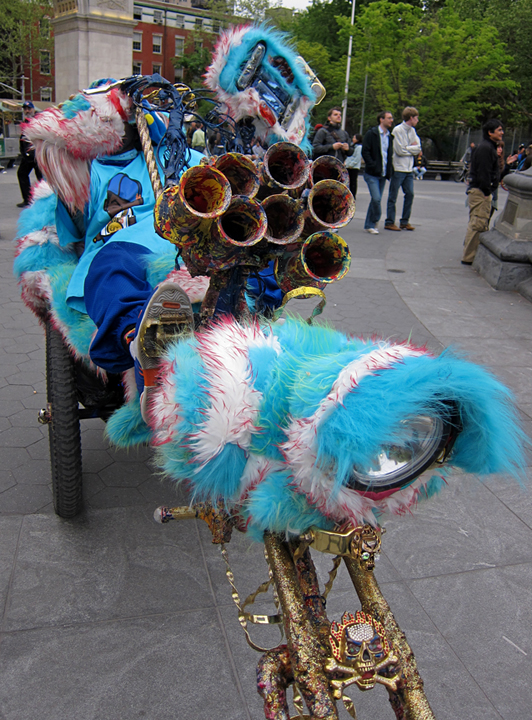
    Where would you find a man who is a roller skater, saxophonist, writer, composer, recording artist, and inline skate trainer, who had a hit single on Billboard for 13 weeks (“Funky Bebop”), has a Masters degree in group therapy (with work done towards a Ph.D), and travels on an outrageous fur-covered trike? In New York City. See additional photo here.

    And, of course, a man with this many incarnations would be expected to have had as many names – Bladie aka Bladie Flowness, Vin Zee, Vinzerelli, Vincent Brown. Now reinvented on his trike as the Swaggertist. I cannot attest to all his claims, but it would be fair to say that the man is a one-man self promotional campaign on wheels.

    Bladie was involved in musifying the roller skating scene in Central Park, what he calls the ultimate dance party on wheels. The New York Times wrote: “There are the old-timers, like Bladie Flowness, who has dreadlocks and a dyed beard and sails against traffic doing tai chi in multicolored Bedouin pants.”

    After meeting Bladie and introducing myself, Bladie gave me one of his music CDs and a DVD compilation of various clips of him. This bike is not his first, and he has been known for colorful dress since his early days on the skating scene.

    However, it takes more that just chutzpah, bright colors, and a turquoise fur-covered trike to become successful or get attention in New York City. Although Bladie certainly gets attention when he cruises the city, park regulars barely give him a glance. After all, he has to compete with Piercing Al Fresco, Hector, André (Out There), Spike, Narcissism Gone Wild, Water Sprites, Wood Nymph, the Misfits, the Dance Parade, Flamboyant, the Krishna Fest, the Dyke March, Singing Bowls, Eight Twenty Five, Twelve Tribes, Penny Farthings, Superheroes, Snake Charmer, Circus Amok, and Fashion Forward.

    And Bladie has plenty of musical talent to deal with. For now, Gershwin has not to worry about the Swaggertist in Blue 🙂


  • Lemonade Maker

    This story was going to be called Switchin’, but on reflection, I realized that this would do a disservice to our subject. Let me explain.

    One day, in the 1980s, I found myself with a California real estate broker in his luxury automobile. He was showing off his hands-free cell phone mounted to the interior of his car – a big deal at the time. He received a call from his office regarding a particularly difficult situation with a client. Not to worry, he said, because he was adept at turning lemons into lemonade.

    It was the first time I had heard this old saying, and I loved it. The broker could be perhaps better characterized as someone who could sell refrigerators to Eskimos, but nonetheless, turning lemons to lemonade became a popular code phrase in my office when help was needed in dealing with a particularly difficult customer situation. When these calls were forwarded to me, I liked the challenge of making lemonade.

    Subway service disruption is one of the most frustrating things that NYC commuters face on weekends. You can read about the reasons for this here. On Saturday evening, a friend and I decided to travel to Bay Ridge, Brooklyn, by subway (rather than drive) to eat at First Oasis Restaurant, which is conveniently located on a subway line. Weekend travel on the train can actually be relaxing. However, no sooner had we started our journey that the service disruption monster raised its head, with a litany of arcane and sometimes unintelligible instructions barked from a poor speaker system over the ambient din.

    Our fellow rider seen in the photo (who we learned on parting was Reverend Branch) immediately volunteered a translation and interpretation. He was going our way, and soon we were taken under his wing. He was a warm, avuncular human being and we took to him immediately. He parsed all the subway speak and disruption details and informed us of every train change and switching option. Switching trains (local to express and vice versa, etc.) from one track to another across station platforms is a common strategy used by experienced riders to save travel time.

    At one point, the Reverend proposed running across the platform to catch another train that was pulling in, and we happily followed. Soon we were criss-crossing platforms, with the Reverend explaining every possible scenario and station detail. Where many would groan about disruption, the Reverend was turning lemons into lemonade, and we were drinking as fast as we could. This was actually fun.

    Never believe what you hear about New Yorkers. Reach out when the opportunity presents itself, and I will guarantee that most often you will find warm humans and, if you are lucky, a Lemonade Maker 🙂

    About Reverend Branch: The Reverend is Community Liaison for the High School of Sports Management Celebrity/Charity Softball Game.

    Note: I certainly do not want appear insensitive to those commuters who have to put up with subway service disruption on a regular basis. I know that our journey was not fraught with the anxiety of getting to work or another destination in a timely manner.


  • Sieve of Darwin

    Have you ever seen a film about New York City that really plays up the artistic world of old? Where it seems that everyone is a writer, dancer, musician, or painter? Perhaps the sound of typewriter comes wafting out onto the street as an actor strolls down some charming Village lane. Or frenetic singers bump into each other in a hallway somewhere in the theater district on the way to an audition. And someone is banging on their ceiling with a broom because a neighbor is hammering away at their piano at some god awful hour.

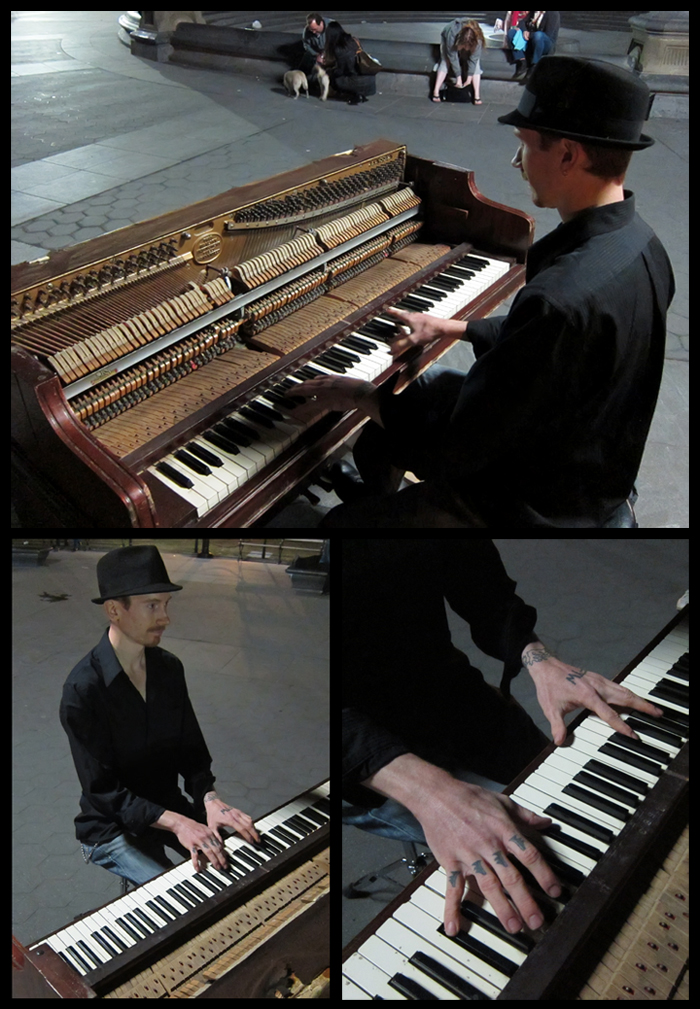
    Romantic folly and Hollywood nonsense? Not completely. Because as I was reading for this story last night after 10 PM, I could actually hear Colin Huggins in my apartment through my open window (see here and here), playing his piano in Washington Square Park.

    I can’t imagine anywhere else where I could enjoy this privilege – my hair stood on end. Some days the city really feels like the promised land – everything I had hoped for when I moved here. A place where I could find a man like Colin Huggins, dragging one of his many pianos onto the street using dollies.

    Colin is a classically trained pianist, has worked as a dance accompanist, and is music director for the Joffrey Ballet. He keeps his pianos at various storage facilities in Manhattan near his performance spots. I have seen him in Washington Square Park and Father Demo Square. He also can be found in the subway system. Huggins believes he is the only person to bring a piano to the subterranean depths – no small accomplishment (he uses a subway elevator – there are a handful of them in the city). In 2007, feeling he was getting a bit too much into a work grind, Huggins tried bringing a real piano into Washington Square Park. From Colin’s website:

    I’ve been a dance accompanist for five years in New York now. And even though I enjoy it, it started to make me feel like the old man behind the piano. When I began to lose sleep every night and found myself irritable everyday, I knew without a doubt, it was time to figure out how to feel like a rock star instead.

    So last summer (2007), for fun, I tried bringing a real piano into Washington Square Park, and honestly, I’d never felt so good about an activity in my entire life. I made money, played songs that I really enjoyed, and made a lot of other people happy too. No matter what age or cultural background the listeners were, I could figure out something to play that would make them smile. It’s a challenge I’m really excited about. So although it may seem like I’m going down on the totem pole of career choices and stability, I feel so much better about myself and so much more connected to the community here and the arts in general.

    When I asked Huggins for his contact information, he handed me his card, which said:
    Colin Huggins / Pianist Rock Star / World’s Happiest Man / www.thecrazypianoguy.com

    You will still find thousands of working artists in New York City. Although I do fear for their survival, as many are squeezed into the most inhospitable neighborhoods in the outer boroughs, I am hopeful that those with resourcefulness and tenacity (and perhaps day jobs) will survive the sieve of Darwin 🙂

    An inspiring note: As I write this, I am listening to the Chopin Nocturnes and Waltzes played by Artur Rubinstein, considered one of the greatest pianists of the 20th century. I am absolutely astonished reading about Rubenstein. A prodigy at age 4, Artur was fluent in 8 languages, had perfect pitch and a photographic memory, keeping most of his repertoire in his head. From Time Magazine:

    In 1903 he caused a sensation in Warsaw by performing Paderewski’s Sonata in E Flat Minor the day after it was published; he learned Cesar Franck’s complex Symphonic Variations on the train en route to a concert hall in Madrid. He can commit a sonata to memory in one hour, and he can play as many as 250 lieder. His friends used to play a kind of “Stump Artur” game in which they would call out titles—excerpts from symphonies, operas, Cole Porter scores—to see if he could play them. “Stumped Friends” would have been a better name for it. “Rubinstein,” says Conductor Edouard van Remoortel, “is the only pianist you could wake up at midnight and ask to play any of the 38 major piano concertos.”

    “When I play, I turn the pages in my mind,” he explains, “and I know that in the bottom right-hand corner of this page is a little coffee stain, and on that page I have written molto vivace.”

    But Rubenstein was not just a brilliant technician. He was the consummate artist:

    On stage, I will take a chance. There has to be an element of daring in great music-making. These younger ones, they are too cautious. They take the music out of their pockets instead of their hearts.


  • Miracles In Our Midst, Part 2

    Posted on by Brian Dubé

    (see Part 1 here)

    At one time, Greenwich Village and SoHo had a large number of independent natural food stores, virtually all of which have closed. Whole Foods (no relation to the existing national chain Whole Foods Market), at 117 Prince Street, stood for 3 decades, from 1970 to 2000. This and a second Upper West Side location were owned by Charles Rosenblum. The Prince Street location was the largest natural foods store in New York City in dollar sales and became a mini mecca of sorts. My own business was located only a few short blocks away and my walk to work took me by the shop daily, so I frequented it often over many years.

    It was here in the early 1990s that I met David Miller, a man who worked the vitamin department. He was extraordinarily and curiously knowledgeable – the reason became immediately apparent once I learned that his intention was to enter medical school. At a later point, while in medical school, the demand for his expertise became even greater for David in vitamins at Whole Foods.

    David appeared to have a West Indian accent, so I inquired as to his background. I was stunned when he told me he was from Dominica. If you have read Part 1 of this story, you know of someone rather obsessed with this island nation. The tiny population of the island made it unlikely that I would ever meet a native by chance in New York City, so this discovery was a major event. Of course, I told him of my romance with the island, but words are cheap, and it is easy to imagine that I might be perhaps trying to ingratiate myself with him.

    How was I to demonstrate the sincerity of my special interest in Dominica? Quite simple – exhibit A from Part 1 of this story should do rather nicely, so I announced to David that I would return the following day with something special that I assured him he would never see in New York City.

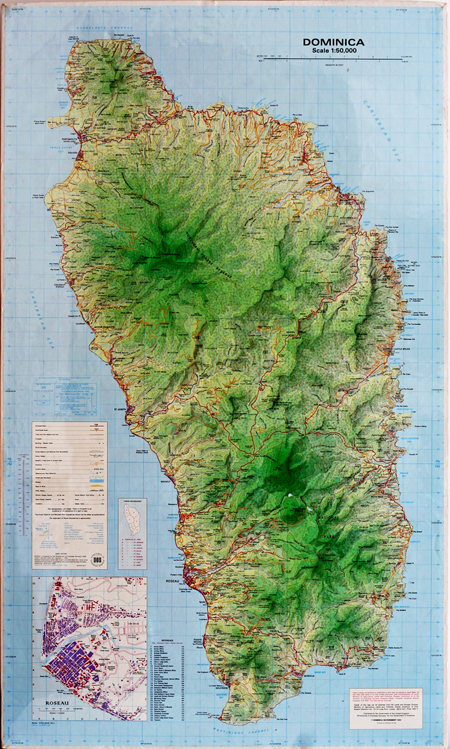
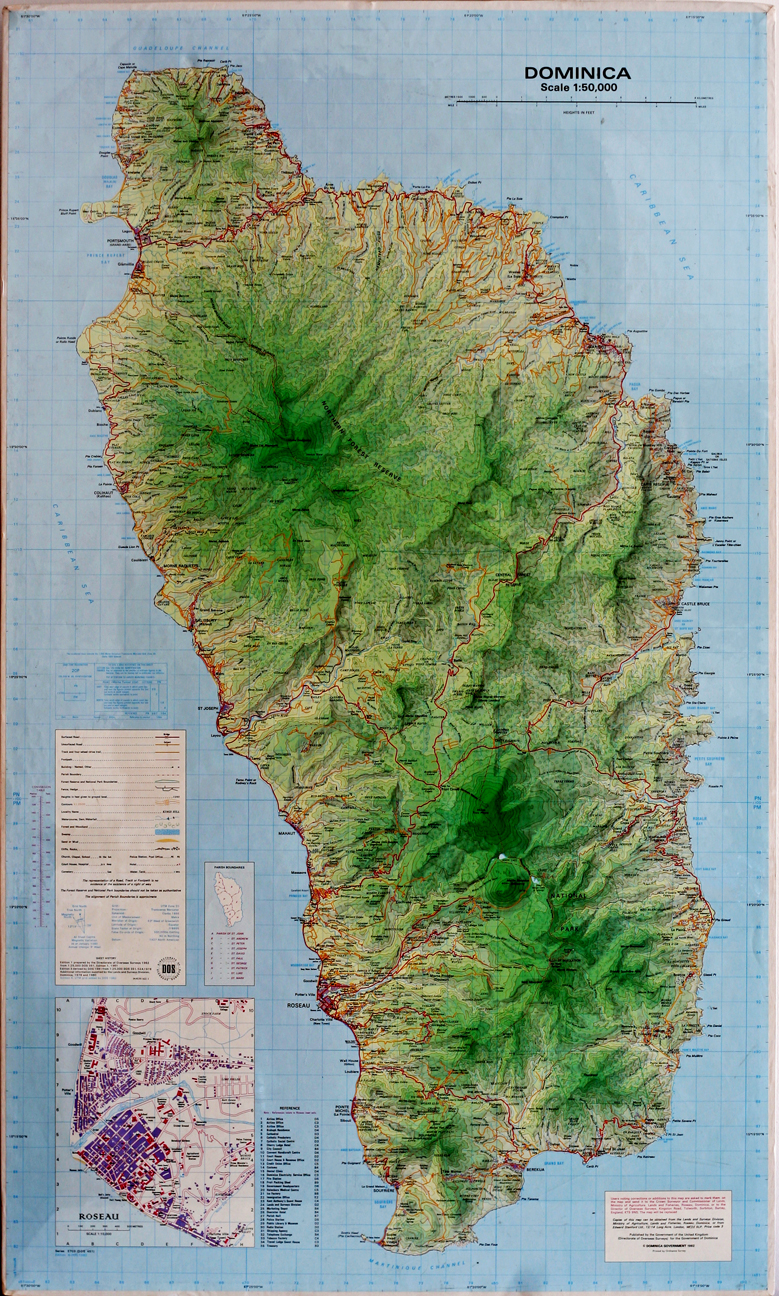
    The next day, I strolled buoyantly down Prince Street with my 24″ x 41″ British Ordinance Survey map of Dominica and showed it to David. He was astounded and said he had not seen a map like that outside of the classroom when growing up on the island. That day cemented our unique connection.

    Recently, after 10 years of losing contact, I ran across David in a white lab coat with his stethoscope at Lifethyme, a natural foods shop in the Village. I was pleased to learn that he is now Dr. David I. F. Miller, M.D., a graduate of Ross School of Medicine in Dominica, and is currently looking for a residency. David works at the shop several days per week, helping hundreds of individuals who query him on every imaginable ailment.

    In the time I was in the shop to take photos of him, I spoke with a long time devotee who championed David as no less than a miracle worker, having helped him through ailments. He detailed to me his medical treatment at Memorial Sloan-Kettering and the improvements he saw with David’s recommendations. He knew of many others who had similar experiences.

    In an amazing twist, David told me of a recent discovery in Dominica. There are 22 centenarians out of the island’s almost 70,000 population – three times the average incidence in developed countries. The reasons for this phenomenon are the subject of current research at the Ross University School of Medicine.

    Perhaps this was the island Eden I was searching for. But with a doctor from Dominica dispensing free advice, why look so far from home when we have miracles in our midst? 🙂

    Note about David: Dr. David I. F. Miller, M.D. was born in Roseau, Dominica in 1966. After the devastating Hurricane David of 1979, David lived for a time in Montserrat, West Indies. He moved to the US in 1987 and returned to Dominica, where he attended Ross School of Medicine from 2004-2008. He currently is married and living in Brooklyn, New York.

    Posted on by Brian Dubé

  • Miracles In Our Midst, Part 1

    Posted on by Brian Dubé

    Part 2 of the story is here.

    In the 1970s, New York City was not particularly hospitable to the vegetarian or natural foods devotee. Granted, it was better than the suburbs, where anyone with such a dietary regime was regularly cross examined as to the reasons why. Vegetarianism did not have the cache it does today, where Hollywood stars adopt it as the latest fashion, like a pair of Birkenstocks or Buddhism.

    Natural food stores and a handful of vegetarian restaurants existed, but outside of these outposts, natural foods did not permeate the fabric of the American culture the way is does today. Soy milk, tofu, brown rice, whole grain cereals, bottled smoothies – these items are common today in virtually every grocery shop and deli in New York City, but at that time, they were hard to come by and had to be ferreted out, tantamount to panning for gold.

    There were books such as Survival Into the 21st Century (over 1 million copies sold) by Viktoras Kulvinskas and Man’s Higher Consciousness by Hilton Hotema, which became nearly biblical with the vegetarian community and members of the health food movement. The authors espoused various dietary philosophies such as fruitarianism, mucusless diets, liquidarianism, sproutarianism, raw foodism, veganism, and even breatharianism. On occasion, one of these gurus might visit the city for a presentation of sorts. There were health expos at the convention centers.

    This environment, along with the idealism of youth and a desire for an idyllic Eden, led to my long obsession with tropical islands, where I dreamed a person might live on the fruits of nature. Stories of dietary extremists such as Johnny Lovewisdom and his attempt at recreating a paradisaical life in the Andes of South America were the inspiration for many.

    Cold, dreary New York City winters seemed antithetical to visions of tropical paradise, and soon I needed to claim my own Eden, even if for only 10 days at a time. However, my flavor of Eden included hot showers, air conditioning (or at least fans), and flush toilets. So, I opted for tropics close to home with some modcons – the West Indies. I visited many of these islands over several years, but none had the impact of Dominica (not to be confused with the Dominican Republic). This lush island was home to rain forests, rare birds, waterfalls, daily rainbows, and mountains – Morne Diablotins rises to 4,747 feet – quite dramatic for an island of only 291 square miles.

    It was the botanic garden I had been searching for, and I made three visits. I had the island virtually to myself – the scarcity of beaches is one of the primary reasons that the island is little known and the least visited of the Caribbean islands (around nearly the entire island, green covered mountains plunge to the sea). You can read more about this remarkable little island gem here.

    Is there a stronger connection between Dominica and New York City than my ruminations and obsession? Yes, there certainly is, but for that, you have to meet David Miller. We will do that tomorrow in Part 2 🙂

    Photo Note: This is a British Ordinance survey map of the island, dated 1982. I purchased this large map (24 in. x 41 in.) on one of my visits to the island and, on my return, had it mounted on foam core.

    Posted on by Brian Dubé

  • Get a Room

    Having my family from New England, as well as others, visit me in New York City over the last few decades has provided me with perspective. I learned how much outsiders often see the city as a place where anything goes. The Wild West.

    The city is extremely permissive, and outrageous things do occur regularly. But New York is not lawless. I have seen young guys from out of town drinking alcohol in Washington Square Park and being quite surprised when police ask them to pour their beverages out onto the ground and then write them a citation.

    I have a friend from outside this country who, coming from a much more conservative culture, is frequently shocked by various public behaviors, particularly PDAs (Public Displays of Affection). Her frequent comments made me aware at how often people here indulge themselves in public. I defused the occurrences somewhat by introducing some humor and acquainting her with the American phrase “Get a Room”. This, along with the subway announcements “Watch the Closing Doors, Please” and “The Next Stop Is,” became our private jokes and her favorite mantras as she improved her command of American slang and often used phrases, especially ones particular to New York City. It is reminiscent of my Spanish vocabulary, learned from the bilingual signage of the city. See No Salga Afuera here.

    Lest anyone think that we were overly critical concerning what looks like relatively benign behavior (from a city perspective) in today’s photo, please realize that before this photo was taken, the girl had gone through a variety of antics, including pressing her chest up against her boyfriend’s face. The whole scene was over the top – only actual nudity would have upped the ante.

    The couple was definitely getting some serious looks from fellow subway riders, but in the true style of the tolerant New Yorker, nothing was said by anyone. They watched the cavorting in silence. Although the man in the light blue shirt seen behind the couple was doing his best to maintain focus on his writing, being there in person, it was clear that he was disturbed over the entire incident.

    On this occasion, I happened to be traveling with my aforementioned companion, and I asked her opinion. To which she replied, “Get a room?” Apparently, she was learning very quickly. “Yes,” I said, and perhaps “The Next Stop Is” a place for them to “Get a Room” 🙂

    Note: For those unfamiliar with the phrase “Get a Room” – from the Urban Dictionary: Derisive or humorous comment said to couples engaged in heavy-duty PDA that means your wanton lust is making me uncomfortable (or jealous). The implication is you should get a motel room because you’re practically doing it [sex] here.


  • Because I’m the Best, Part 2

    (see Part 1 here)
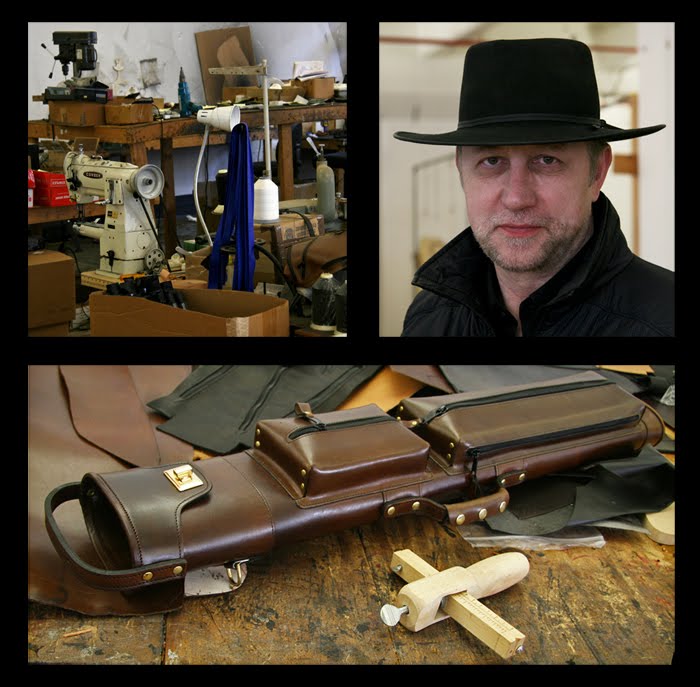
    Jim Murnak is originally from Pittsburgh, PA. His interest in leather goes back to when he was 13, working with Tandy leather kits. Some university, including studies in advertising at SVA, led to his work as an art director at Ogilvy and Mather. After a large employee layoff, Jim began his career as a leather craftsman. A retail shop on Sullivan Street was followed by a number of loft spaces, where he manufactured and sold to the trade.

    I occasionally dropped in on Jim in the 1970s at a number of his Manhattan locations. On one visit, I was stunned at the level to which he had advanced, taking on products which were really unheard of for a self-taught artisan. I watched him build leather-covered wood attache cases – Jim was constructing the wood frames, covering them with leather, and installing brass hardware and locks.

    At the time, there were a small number of leather artisans in New York City. Most knew each other, and it was clear to all of us that Jim had reached the pinnacle of success, selling to the top retailers in the city – Bloomingdales, Crouch and Fitzgerald, and Abercrombie and Fitch – at the time, the most expensive retailer of goods in the city (Jim told me that Chinese imports essentially killed this business for USA manufacturers).

    On another occasion, I found him lining handbags – standard for high-quality finished goods, but an unthinkable “waste” of leather for those of us making leather products by hand. When I questioned him about what appeared to me to be rather indulgent, he said that he was not making hippie stuff and that his clients demanded this type of product finish.

    Tracking him down was a simple find online. He has since settled in the Dumbo neighborhood of Brooklyn, where he has been for many years and where I caught with him recently. He was congenial and welcoming as always and permitted photos and a follow-up phone interview.

    I was not surprised to see that he had found a few new high-end niche markets: custom manufacturing gun holsters, pool cue cases, and archery quivers. A passion and experience in an activity will always give an equipment manufacturer the inside knowledge and edge needed – Jim’s father was a professional pool player, and Jim has had serious interests in pool and in target archery.

    Unfortunately, Jim also acquired an insider’s guide to handguns after being held up at gunpoint in the subway in the 1990s. After obtaining a gun and permit, Jim found the quality of holsters to be sub-par and began to make them. He can custom craft a holster for nearly any handgun using one of his forms. He has also worked in Cordura nylon for some years making police training suits. Jim does business as Fist, Inc. – see his website here.

    In the 1970s, there were a handful of suppliers to the leather craft trade in Manhattan, including Great Jones Leather. It is here that one day I ran across Jim, who had come in for a pack of industrial razor blades. The salesman, who was also a leather craftsman, appeared to be stunned that someone else knew his secret for precision cutting. “Wow,” he said, “I use razor blades too. Why do you?”
    To which Jim replied, quite confidently and as a statement of fact, “Because I’m the best.”


  • Because I’m the Best, Part 1

    Many things were not so great in Olde New York of the 1970s – car windows broken for the theft of radios, vandalized subway trains, sanitation strikes, drug addicts, and perhaps the worst aspect, crime and a heightened sense of danger. I’m doubtful that even the most romantic or nostalgic wishes those things back.

    But there are some things I miss, and one is the character of small shops and the opportunity for nearly anyone with a reasonable idea or craft to stake out his or her claim in the retail environment. There are still a handful of small shops along some side streets, but rents are generally prohibitive for the lone artisan.

    I was involved in the leather craft movement for some years and made routine visits to many small shops, owned and operated by a crafts person(s). Some were my clients, others just acquaintances. Nearly all of these shops are gone. A few artisans still remain in business – Dick Whalen of Native Leather (formerly Natural Leather) at 203 Bleecker Street and legendary sandal maker Barbara Schaum on East 4th Street.

    I have been involved in product manufacture since those days and do pride myself on having some level of expertise using tools. However, some years ago, to perform a simple task at home, I made the mistake of asking a friend for scissors. She was an architect, and I was appropriately reprimanded for not using an Exacto knife or razor blade. I was told that those were tools of precision and that no good crafts person uses scissors for the type of work I was doing. She pointed out that in the architecture firm where she worked at the time, the model-making department used only knives and razor blades and that scissors could only be found in the marketing department.

    This was extremely interesting to me, because one of my most memorable life experiences involved virtually the very same subject, only with a little more drama. I recounted the story for her. For that, however, you have to meet Jim Murnak. And we will do that tomorrow in Part 2…


  • Mad as Hell 2

    Do you want to inflame some New Yorkers? Then set up a 9/11 conspiracy presentation on the street. There are several grassroots organizations involved in promoting 9/11 conspiracy theories – i.e. that the United States Government was responsible for 9/11 and the attacks were either a) intentionally allowed to happen or b) a false flag covert operation actually orchestrated and committed by the US Government itself.
    The alleged motives for such an act? To justify the invasion of Afghanistan and Iraq, increase military spending, and/or to restrict civil liberties. The movements are large enough to have grabbed the attention of mainstream media. You may also have seen “9/11 Was an Inside Job” on t-shirts and bumper stickers.

    We Are Change is one group that has appeared on a semi-regular basis in Washington Square Park on Saturday nights. On a recent occasion, a man who identified himself as an architect (and said his wife was also an architect) was so outraged that a major war of words ensued between himself and one of the presenters. Virtually out of control, the man paced to and fro like a wild animal. When approaching his foe, he asserted, “You’re an idiot. I defend your right to be an idiot, but you’re still an idiot.” He turned and attempted to leave repeatedly, but each time he left he was compelled to come back and repeat his mantra.

    The 9/11 conspiracy joins history’s many hoaxes and conspiracy theories:
    NASA faked the moon landings, Paul is dead, Shakespeare was somebody else, global warming is a hoax, Elvis Presley faked his own death, Diana, Princess of Wales was murdered, Holocaust deniers, Jesus conspiracy (ala the Da Vinci code), the AIDS virus was created in a laboratory, the Illuminati control world affairs, a flying saucer crash in Roswell, New Mexico, JFK assassination conspiracy theories, fluoridation is mass medication, Pearl Harbor was allowed to happen.

    One problem with such conspiracies is that the proponents are armed with a myriad of details that the average person is unfamiliar with and thereby unable to refute on the spot. Without opposing viewpoints, the arguments can be persuasive to some. Another problem is that unexplained facts or anomalies do not necessarily invalidate an accepted theory. From Scientific American:

    The mistaken belief that a handful of unexplained anomalies can undermine a well-established theory lies at the heart of all conspiratorial thinking. All the evidence for a 9/11 conspiracy falls under the rubric of this fallacy. Such notions are easily refuted by noting that scientific theories are not built on single facts alone but on a convergence of evidence assembled from multiple lines of inquiry.

    In the case of the 9/11 conspiracy, there are now numerous websites, magazines, and books which debunk the 9/11 conspiracy theories, point by point (and there are websites and books which attempt to debunk the debunkers).

    When conspiracists appear, I’m staying on the sidelines and letting others get mad as hell…

    Note: For another New Yorker pushed to the breaking point, see Mad as Hell here and here.


  • Can’t Argue With That

    One thing that comes as a surprise in Manhattan is the occurrence of public gatherings of various Christian groups. I have seen congregations of Mennonites singing gospel in Washington Square Park. We now have two Christian groups that come to the park weekly – one group on Monday nights, the other on Wednesdays. And on a regular but infrequent basis, I see the Quakers in a silent vigil under the Washington Square Arch in the Village.

    In our current society, particularly in a city such as New York, one has to admire any effort to make a statement through silence. This city is just screaming with competition for the eye and ear – what is the likelihood that anyone will pay attention to four Quakers in a silent peace vigil?

    This Quaker group is based in nearby Stuyvesant Square. The brochure being made available is titled Quaker Silent Witness for Peace and Nonviolence. In it, they make their antiwar case with quotes from Gandhi and Martin Luther King, two leaders who were both charismatic enough to effect tremendous change through nonviolent activism. In a violent world, the gentle demeanor and unprogrammed tradition of the Quakers is refreshing and appealing to many.

    I recall seeing a fundamentalist evangelical Christian on a regular basis in Washington Square Park on Sunday afternoons, where he would set up an easel with various pages of information, tables, and charts, building an argument for the existence of God. He came well-armed not only with the Bible but also with books from many spheres of study, including works such as those by evolutionary biologist Stephen Jay Gould. This may come as a surprise, but this man knew that to have any credibility here, he would have to come with a knowledge of contemporary science and skills for lively debate.

    Regardless of preparation, however, he was in the center of an intellectual community and the NYU “campus.” He had his work cut out for him – I saw him battle once with two theology students. (I also once saw a group of Christians who encountered a rabbinical scholar.)

    On one occasion, I approached him, told him I admired his courage, but asked why he would proselytize in an area known for its iconoclasm and extremism – one where he would likely encounter many agnostics, the non-religious, or atheists. Certainly he had chosen the worst place to go. To the contrary, his response was that his mission was to save souls and, in considering where he would be most needed, Greenwich Village would be one of the best places. You can’t argue with that…


  • Gravitas

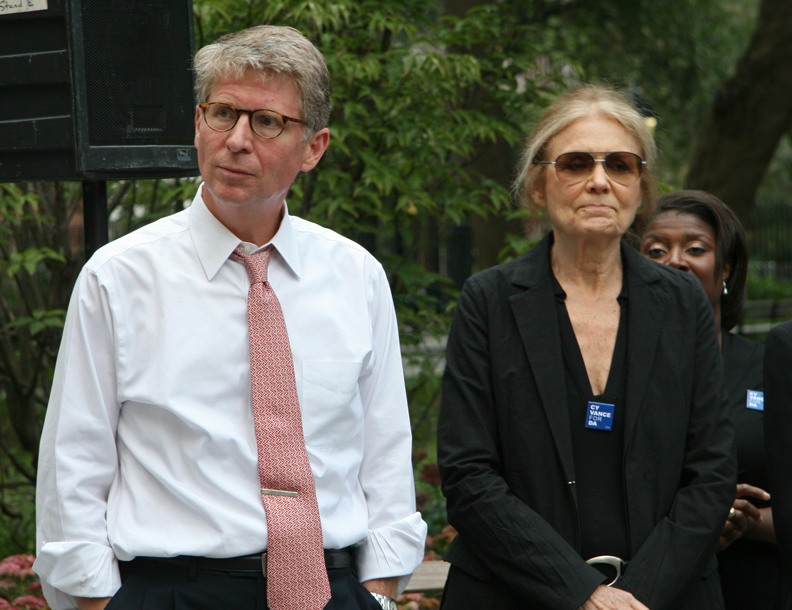
    I don’t typically attend political rallies, but occasionally, when they are in my backyard, I do. Yesterday, I was tipped off by a friend that there was to be a women’s rally supporting the candidate for the Manhattan District Attorney, Cyrus Vance. Scheduled to appear were several luminaries, including feminist/writer Gloria Steinem (seen in the photo) and Caroline Kennedy (who was unable to make it). Steinem’s endorsement was seen as particularly strong, owing that one of Vance’s opponents is a woman, Leslie Crocker Snyder.

    Most striking about Vance at this rally was his serious demeanor and the relative absence of political rhetoric and grandstanding. Vance revealed his family background of four sisters and his wife’s family, also with four sisters, perhaps accounting for his particular interest in women’s rights issues and this rally. He let others do most of the speaking, which I found refreshing.

    Vance has received the endorsement of the New York Times, New York Daily News, New York Post, and retiring DA Robert Morgenthau, who has held the position since 1975.
    An elected position since 1846, I was surprised to learn there have been only 3 elected Manhattan DAs in the last 75 years. The posturing of Vance and his endorsers gave a sense that this position required someone with gravitas. Crime is one of the most important issues in New York City and affects everyone – no one here needs convincing of the importance of the District Attorney’s office.

    During a presidential campaign years ago, there was heavy usage of the word gravitas and whether a particular candidate had this needed virtue or quality. Gravitas was one of several virtues expected of men in Roman society, along with dignitas and pietas.

    Cyrus Vance, Jr. was a graduate of Yale University and received his JD from Georgetown Law School. He has served as Assistant District Attorney in Manhattan. Vance’s father, Cyrus Vance (Sr.), served as Secretary of the Army under Presidents John F. Kennedy and Lyndon B. Johnson, Deputy Secretary of Defense under President Johnson, and Secretary of State to President Jimmy Carter.
    Sounds like a family history of gravitas…


  • The Conductor

    Posted on by Brian Dubé

    Meet Benjamen Denham, conductor. This man has, for 11 years, shown up in Washington Square Park and silently conducted many planned and unplanned musical gatherings. However, he is, in fact, conducting no one. Because Mr. Denham, armed with two drinking straws with paper intact, conducts for his own enjoyment.

    This man has been an enigma for as long as he has been frequenting the park. Seen as extremely eccentric but quite benign, he is largely ignored, as are many other unusual characters in this city. He, like others, just becomes part of the tapestry of New York City, woven from some individuals from every walk of life imaginable.
    Upon meeting and conversing with people over the years, I have found that many are extremely remarkable, and I have been pleasantly shocked more often than I have had any misgivings confirmed.

    I have met so many individuals in this city with extraordinary backgrounds and histories, both past and present, disguised as ordinary mortals – editors of prestigious magazines, internationally known musicians, academics with degrees from Ivy League schools, engineers with multiple degrees, attorneys (one who  argued a case in the U.S. Supreme Court), grads from Wharton School, scientists, politicians in NYC government, prominent real estate developers, actors, and former corporate execs.
    In the 1970s, I met a man who had left a position as mechanical engineer for Farberware to work in a leather shop on Bleecker Street. Why? To escape the rat race and “let his hair down.” Although less true now that the Village has severely gentrified, this was, at one time, the reason why many ended up in Greenwich Village after a productive career.

    Rumor had it that any attempts to engage our conductor Benjamen in conversation was met with indifference; apparently no one had ever had any substantial conversation with him in all the years he frequented the park. When I decided to approach him, for some inexplicable reason, he was quite forthcoming. We spoke for some time – he seemed eager to share details of his life.

    I learned that he loved music and that he felt he could learn any instrument easily. He said he wanted to author 100 books and showed me a notebook filled with coupons and rebate offers – his current project is a book on the subject. When asked if he had ever had a story done about him, he answered affirmatively and showed me an old article from the New Haven Register, which I did not have the opportunity to read. Regarding his livelihood, he told me that he had operated 13 shops in his lifetime, each one ending in bankruptcy – he attributed his 13 failures to various cyclical recessions. He currently lives in Brooklyn, New York. Upon returning to my seat, I was greeted with excitement by others who saw the conversation as a watershed event.

    Our little girl in the photo was accompanying a group of musicians that Ben was conducting. When on a break, she at times looked at her mother for approval and at other times shared our wonderment with The Conductor 🙂

    Posted on by Brian Dubé

  • Facts and Fiction

    Posted on by Brian Dubé

    When someone looks like this, photographers take notice. However, how to proceed? I discussed the dilemma of shooting people at close range in my recent posting, Walid Soroor.

    I pointed this man out to a couple of friends who agreed that this man’s appearance was definitely out there and blog worthy. A suggestion was made to approach him directly and ask his permission. Legally, photos taken in public for non-advertising purposes do not require permission, but cooperation, when you get it, not only makes the process immensely more comfortable but also leads to better photos and some nice side benefits. Like a name, biographical facts about a person, email address, and possibly the raison d’etre for their extreme style.

    Although wild speculation is a lot of fun, the person behind the surface is rarely who you imagine, and often, the truth is more interesting than fiction. I am comfortable approaching strangers, but I do feel that it requires a certain amount of “getting into character,” like an actor, selling myself, and convincing the subject that I am a serious person and that the photos will be used in a respectable manner.
    In this case, a brief introduction, along with a New York Daily Photo business card, sealed the deal, and my subject said, “Fire away.” I relayed the green light to my friend, photographer Bill Shatto, and the impromptu location photo shoot began.

    I learned that our subject, Jim Vehap, was born on the Lower East Side, an authentic New Yorker now living in Milwaukee with family. He is half Albanian and half Italian. His tattoos were done at the time of his 6-year stint in the Marines (Beirut 1983). The shirt was a bicycling jersey, and the origin of the plaid shorts was not discussed. I suggested he might consider modeling – he said others had recommended that he look into this. He asked how he might pursue this, and Bill acquainted him with the Ross Report, a industry publication which includes listings for casting agents, studios, talent agencies, and others in the film and TV business.

    Jim works as a paralegal and had interest at one time in pursuing a masters degree in theology. Quite an amalgam of contrasts. Not the man I thought at all – another case of facts more interesting than fiction…

    Photo Note: Look closely here and you will find an assortment of piercings – nipple, navel, and ears – and closeups of Jim’s tattoos, including ones reading Rare Breed and Rude Boy.

    Related Postings: Out There, Spike, Narcissism Gone WildSuperheroes, Snake Charmer, Circus Amok, Fashion Forward, Piercing Al Fresco

    Posted on by Brian Dubé


  • dinamic_sidebar 4 none

©2026 New York Daily Photo Entries (RSS) and Comments (RSS)  Raindrops Theme