• Category Archives Scenic NYC
  • ‘Tis a Sight to Behold

    I have made another secret discovery.

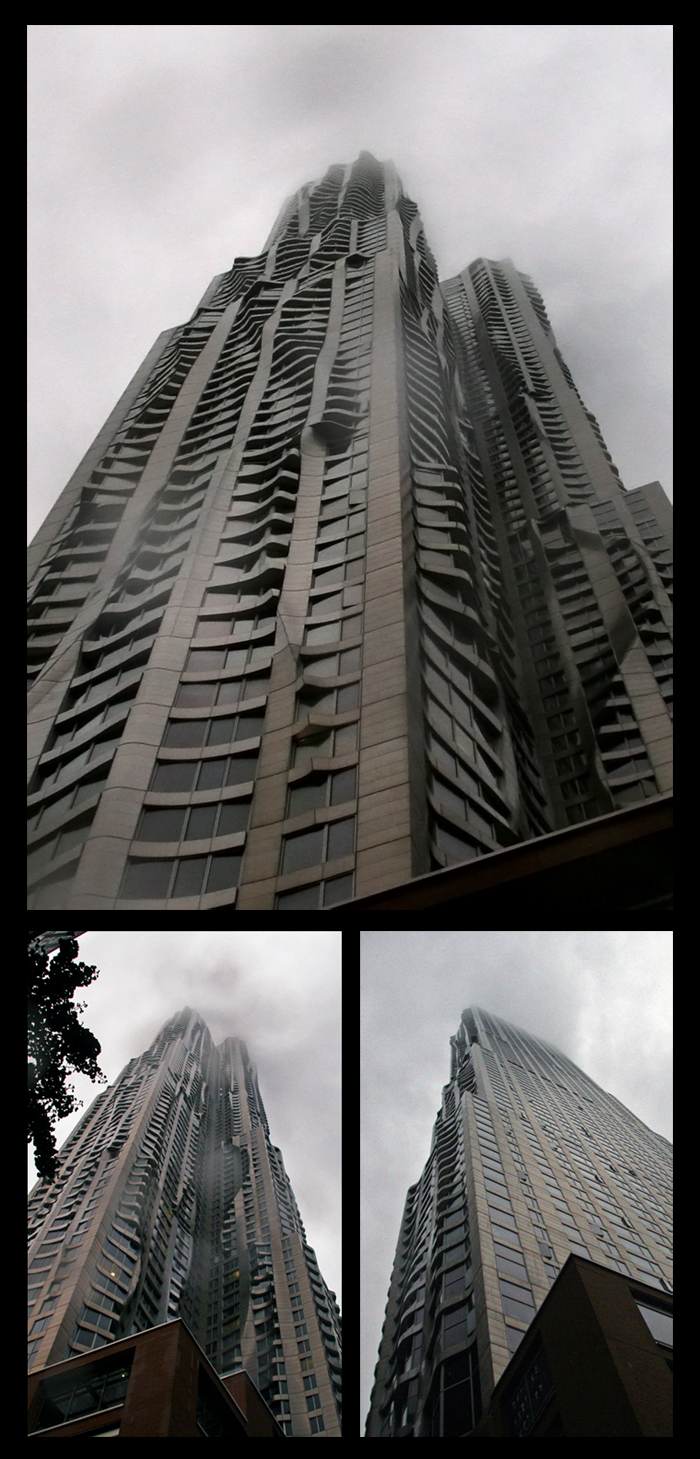
    You could easily find millions of New Yorkers who have no idea that this spectacular structure at 8 Spruce Street exists or that it is the tallest residential structure in the Western Hemisphere. I would be included in that group. However, as I approached the building, I began to recall the media attention surrounding this highly applauded residential tower, formerly the Beekman Tower and currently known as New York by Gehry, designed by renowned architect Frank Gehry.

    I made this secret discovery on a foggy Sunday evening while cruising lower Manhattan – one does not have to look hard to find a 76-story, 867-foot building. A foggy, stormy night is a great time for observing New York City’s skyscrapers. With their heads in the clouds, these towers provide all of the ambiance and drama of Batman’s Gotham city.

    New York Times architecture critic Nicolai Ouroussoff called it “the finest skyscraper to rise in New York since Eero Saarinen’s CBS building went up 46 years ago.” New Yorker magazine’s Paul Goldberger described it as “one of the most beautiful towers downtown.” Goldberger compared Gehry’s tower to the nearby Woolworth Building, completed in 1913, and said that “it is the first thing built downtown since then that actually deserves to stand beside it.” These are extraordinary accolades from New York City’s premier architecture critics who are hard to please and prone to dissect and crucify. But the accolades are justified.

    I circumnavigated it at nearby street level. However, I highly recommend seeing this tower from various vantage points, since one of the primary distinctions about this structure is its changing form when viewed from different perspectives. From the New York Times:

    … once you see the tower in the skyline, a view that seems to lift Lower Manhattan out of its decade-long gloom. The building is particularly mesmerizing from the Brooklyn waterfront, where it’s possible to make out one of the deep setbacks that give the building its reassuringly old-fashioned feel. In daylight the furrowed surfaces of the facades look as if they’ve been etched by rivulets of water, an effect that is all the more dramatic next to the clunky 1980s glass towers just to the south. Closer up, from City Hall Park, the same ripples look softer, like crumpled fabric.

    The building’s exterior is made up of 10,500 individual steel panels, almost all of them different shapes, so that as you move around it, its shape is constantly changing. And by using the same kind of computer modeling that he used for his Guggenheim Museum in Bilbao, Spain, more than a decade ago, he was able to achieve this quality at a close to negligible increase in cost.
    But Mr. Gehry is also making a statement. The building’s endlessly shifting surfaces are an attack against the kind of corporate standardization so evident in the buildings to the south and the conformity that it embodied.

    ‘Tis a sight to behold 🙂

    Other buildings and skyscrapers: New York Rockies, I’ve Got a Feeling, Where Sleeping Giants LieAll of These Pleasures, Color of Money, Trump Soho, Beacon of Hope, Towers, Pan Am Building, Crisis at Citicorp, Hearst Tower, Trumped Again, Time Warner Center
  • You Always Find Something

    Posted on by Brian Dubé

    Some years ago, I was visited by a customer who was quite complementary to the manner in which I ran my business and the quality of my products. He had vocalized this on the internet. I thanked him. It is always heartening to hear complements in a world of high expectations.

    Conversation ensued, and I was very surprised to learn that the man was a military helicopter pilot. I have no idea of what it takes to earn such a position, but I was reasonably sure that this must be a highly coveted and competitive job for the very skilled with the right stuff. This was an easy opportunity to return a complement, which I did. He did not deny my observations.

    On a subsequent visit, he returned with his girlfriend, also a military helicopter pilot. Wow. Certainly this must be a rarity for a woman in the armed forces. I was awed really and so impressed. What an unique couple.

    The man offered to tour me privately around a military installation in Brooklyn, where they were based. But I was forewarned that as a civilian, as much as he would like to, I would not be allowed to fly in a military helicopter. I understood and had expected that.

    I told a close friend who was fascinated with military technology about this encounter. I invited him to come along in the event I were to take this man up on his offer and visit the military base. He was ready to go at a moment’s notice. I pointed out to my friend however, that we would of course not be able to board or fly in a helicopter. To which he replied, with no equivocation, that it was no problem because even at a dog show, you always find something.

    This statement was so poignant – I could not agree more. It was just a restatement of something I had always said – things are not boring, people are boring. It’s what you bring to the table or experience.

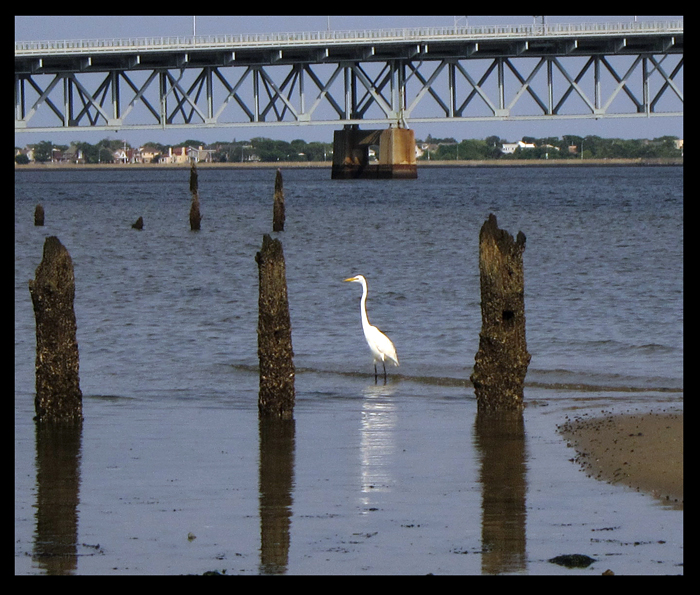
    New York City’s table is already filled with a staggering array of goods. But if you really want to mine the gold here, don’t just settle for what’s already on the table. Take an interest in the cracks and crevices. Talk to strangers, the homeless, and crusties too. Go to The Hole and Dead Horse Bay, where you may sight an egret, like that in today’s photo. Explore Far Rockaway, a place few want to visit.  If your lucky, you will meet Walid Soroor in a Jackson Heights restaurant, Mark Birnbaum strolling in his signature cadence, Ferris Butler wandering the streets a bit confused and even André, who, I am sure you will agree, is a bit OUT THERE. In the park, you may sight a Nymph. Come to these pages for ideas and inspiration.

    If you’re feeling a little bored or perhaps do not have the time to venture far afield, just look at little harder. Bring your attention to the city around you. Investigate how graffiti artists etch glass in the subway or marvel at the chewing gum on the streets. Because even at a dog show, you always find something 🙂

    Related Posts: Mark Birnbaum Pt. 1, Ferris Butler Part 1, Gaby Lampkey Part 2, Fashion Forward

    Posted on by Brian Dubé

  • This Is Not New Mexico

    Posted on by Brian Dubé

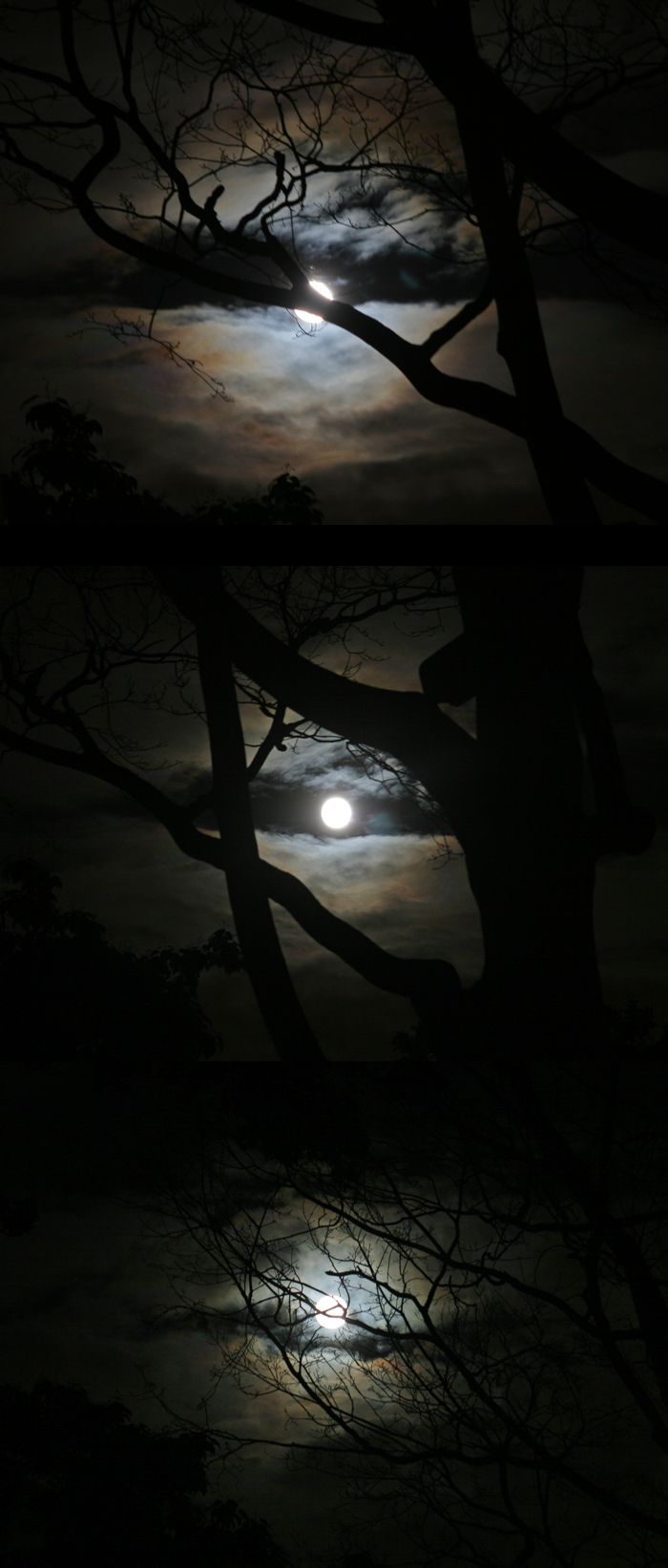
    The sun and the moon are two of the few natural constants we have in New York City and the moon is one of the very few celestial bodies we can see reliably at night – with the powerful ambient urban light, we do not often have nights where many stars and planets are visible. Such is city life.

    Today is the full moon. Last night saw some stormy weather and at the tail end, as skies began to clear, we had some spectacular conditions with fast moving billowy clouds providing a constantly changing canvas.

    At times like this it is not unusual to see amateur and professional photographers shooting away. A number of us found a choice spot in Washington Square Park where a few leafless trees provided perfect outlines to frame the moon. It’s not the Moon Over Hernandez, but hey, I’m not Ansel Adams and This is Not New Mexico 🙂

    Related Posts: Dot My I, Back to Our Main Feature, Sun, Moon and Stars, Hell’s Gate, Full Moon, Gothic Night

    Posted on by Brian Dubé

  • Close Encounter of the New York Kind

    Posted on by Brian Dubé


    New Yorkers take things seriously. The populace is large enough to support subcultures of every interest imaginable. Interests become obsessions. What better obsession than the things we have so little of – wildlife. Wildlife in a city like New York is limited and dominated by pigeons, rats, mice, squirrels and common birds. So when real wildlife of a different kind appears, it’s BIG news.

    Perhaps one of the biggest wildlife stories in recent years was the nesting of red tail hawks at 927 Fifth Avenue. The first to make home there was Pale Male in 1991. The nearby boat pond in Central Park was an ideal viewing spot and became a birder’s paradise. See my story here. The lineage continues to this day. The interest has spawned international press coverage, films, websites. To this day, 10 years later, birders are still found regularly on location with the requisite telescopes.

    On February 7, 2007, I photographed a red-tailed hawk feeding on the remnants of a pigeon on my air conditioner overlooking Washington Square Park. At this rare opportune moment, I was able to capture a photo through my window from only inches away. The photo received tremendous traffic as would be expected. See the photo and story Hawk Fest here.

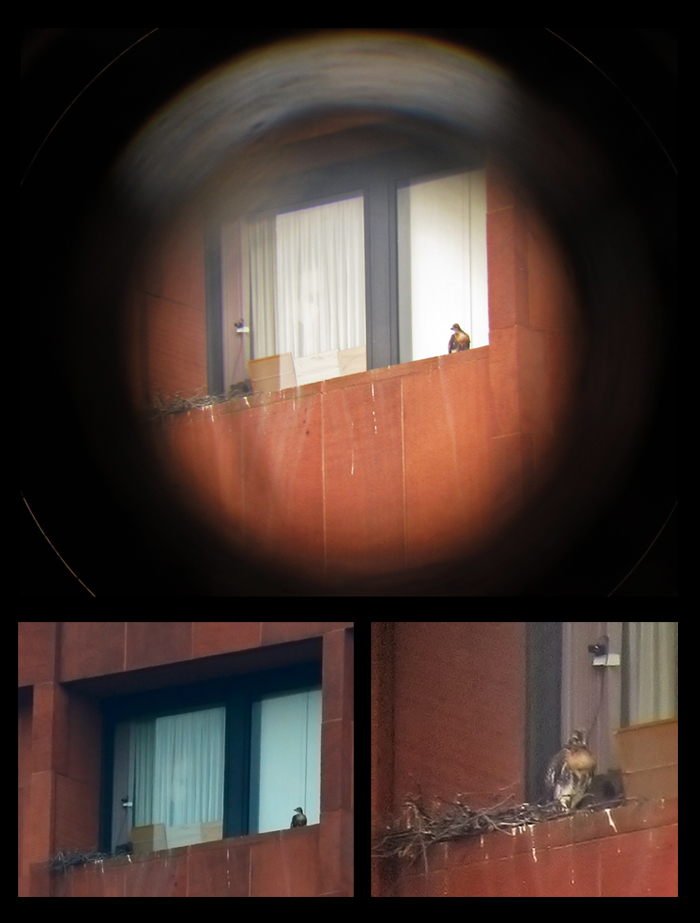
    Since that time a number of red-tailed hawks have been sighted around the park. The coup de grâce, however, was the recent nesting of a hawk on the windowsill of the Bobst Library building. The window chosen was none other than that of the president of New York University himself, John Sexton. Many speculate the roost was chosen for the same reason it is the location of the president’s office – the 12th floor perch affords sweeping views of the entire park, perfect for a bird of prey.

    The real story here however, is the nesting and mating of Violet and Bobby (violet is the official NYU color and Bobby after the Bobst library) and the birth of offspring. Yesterday, during a Be Fit NYC event, the parks department had set up a telescope for viewing of the hawks. I was able to capture a photo with a camera up against the scope.

    The New York Times set up a webcam to keep an eye on the family. The cam provides a live stream, free and 24/7. Check it out here for a Close Encounter of the New York Kind 🙂

    Related Posts: That Should Cover It, Peregrine Falcons, Light on Bobst

    Posted on by Brian Dubé

  • Serenity, Tranquility, Peace

    Posted on by Brian Dubé


    Although technically in the borough of Manhattan, I have always felt it was almost a little undeserving for any New York borough to take claim to something so special as the Cloisters – it is located at the northernmost end of the island, as far as one can get from Uptown, Midtown, Downtown or any other area of that one would typically associate with New York City. Apart from the small number of residents in Washington Heights/Inwood, this area is really a destination for New Yorkers and visitors alike.

    The Cloisters is a museum of medieval art and architecture, a branch of the Metropolitan Museum of Art. Everyone loves this extraordinary complex – it’s a close as you are going to get to genuine French architecture in the city. Germain Bazin, former director of the Musée du Louvre in Paris, described the Cloisters as “the crowning achievement of American museology.”

    The museum buildings were designed by Charles Collens and constructed from elements salvaged from five cloistered abbeys in France: Saint-Michel-de-Cuxa, Saint-Guilhem-le-Désert, Bonnefont-en-Comminges, Trie-en-Bigorre, and Froville. The sections used were disassembled brick-by-brick, shipped to New York City and reassembled between 1934 and 1938. From the Cloisters website:

    Three of the cloisters reconstructed at the branch museum feature gardens planted according to horticultural information found in medieval treatises and poetry, garden documents and herbals, and medieval works of art, such as tapestries, stained-glass windows, and column capitals. Approximately three thousand works of art from medieval Europe, dating from the ninth to the sixteenth century, are exhibited in this unique and sympathetic context.

    Located on four acres overlooking the Hudson River in northern Manhattan’s Fort Tryon Park, the Cloisters is a world apart from the glitter, glamour, hustle bustle and frenetic energy of the city. For most New Yorkers, Fort Tryon Park and the Cloisters is a country getaway, a mini vacation. Visit the Cloisters if you want a small vacation from the city and Serenity, Tranquility and Peace 🙂

    Related Posts: Down to the Cellular Level, Le Petit Chambord, Fire and Ice, Affront to Dignity, Paraiso, Steps From Paradise, Belvedere Castle, Devil’s Playground

    Posted on by Brian Dubé

  • Uptown

    Posted on by Brian Dubé

    The territory north of 14th Street truly is a world apart. There is much behind the downtown mantra, I never go north of 14th Street. There is a stoic pride and conviction that virtually anything one needs can be found downtown and it is not far from the truth.

    I cannot speak for other downtown residents, but I go north for specific purposes and so infrequently that going uptown is like a small vacation. I literally feel like a tourist. I walk a neighborhood, often craning my neck and standing in wonderment at the massive stone, steel and glass edifices built on the island’s bedrock of Manhattan schist.

    The advent of the Internet had greatly facilitated price shopping for most products and services, including New York City hotels. Since that time, my family has been able to snag deals at the Waldorf Astoria Hotel, which has become their residence of choice when visiting the city. I enjoy traveling and visiting the hotel during their occasional stays.

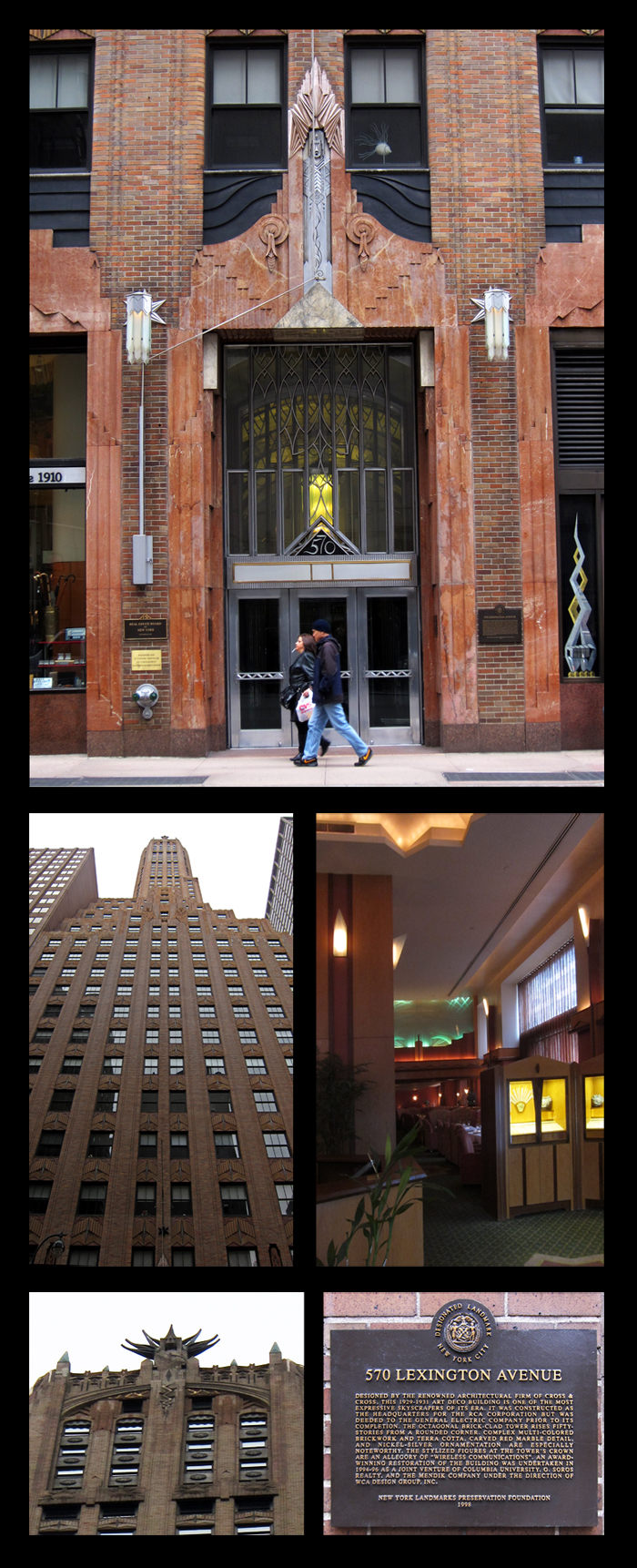
    Next door to the Waldorf Astoria Hotel is the General Electric Building. The building is sometimes referred to as 570 Lexington Avenue to avoid confusion with the GE Building built later at 30 Rockefeller Plaza. The 50-story, 640 foot Art Deco masterpiece was designed in 1931 by John W. Cross of Cross and Cross. Unable to lease the building profitably, in 1993, GE donated the building to Columbia University, gaining a $40 million tax deduction. Find more on the building here.

    The base contains elaborate masonry, figural sculpture. On the corner above the main entrance, a conspicuous corner clock with the curvy GE logo and a pair of silver disembodied forearms. On August 25, 2006, I featured the lobby of the building – you can see it here.
    Christopher Gray of the New York Times describes the building as a “suave fantasy of polished marble and modern metals.”

    Its signature crown of lacy radio-wave figures is a well-known midtown landmark, but the decoration of the lower floors is just as startling. Here a shrouded mechanistic figure huddles in a modernistic cloister, there an armored fist grabs an electric bolt. The entire facade is of a lightly variegated orange brick, which plays to St. Bartholomew’s Church next to it on the Park Avenue corner.
    See my photos of the church here.

    When I visit the area, I am never able to resist stepping into Mr. K’s restaurant, an upscale Chinese establishment located at 570 Lex. The plush banquette seating, the lush art deco interior, soft lighting all seem so befitting of the building it is in. For a little vacation, I just take the 6 train. Uptown.

    Related Posts: The Last to Know, A Bottle of Schweppes, Cello Class, Ice Skating in October, The Plaza, Stamp of Approval, When Worlds Collide, 23 Skidoo, The Sherry, Saks Fifth Avenue, St. Patrick’s Cathedral, Life at Night, Met Life Tower, St. Patrick’s from the Rock, ESB Straight Up

    Posted on by Brian Dubé

  • Old New York, Part 2

    Posted on by Brian Dubé

    (see Part 1 here)
    The good news is that Greenwich Village is extraordinarily unique. The bad news is that if you want a piece of its history, good luck. The housing stock is very limited. And if you are like I am and attracted to row houses, the selection of available units is even more limited. Over the decades, I have from time to time looked at apartments to buy but rarely found anything I really liked, and if I did, the cost was extremely high.

    I am forever asked why I am a renter and have not purchased a home after living in New York for over 40 years. The market in New York City is very different from anywhere else. There are over 2 million apartments for rent in the city with 65% rent regulated in some way. These regulations provide for below market rents and are a strong disincentive to move. The longer you remain in a regulated apartment, the greater the spread between your rent and the open market non-regulated places becomes – it is not uncommon for the difference to be 100% or more.

    This anomaly in pricing just exacerbates the problem – tenants never move with a resultant lesser supply and higher prices for the free market apartments, whether rentals or purchases. If you are fortunate enough to rent an apartment in an historic building, it is unlikely you will ever find a place like it at any price, for rent or sale. In my own building, 3 out of four residents have lived in their apartments for over 30 years. Often, rentals in regulated apartments are no more than the cost of maintenance fees on a similar unit for sale. So why buy? Many analyses have been done demonstrating that in New York City, it can be more prudent to rent than to buy.

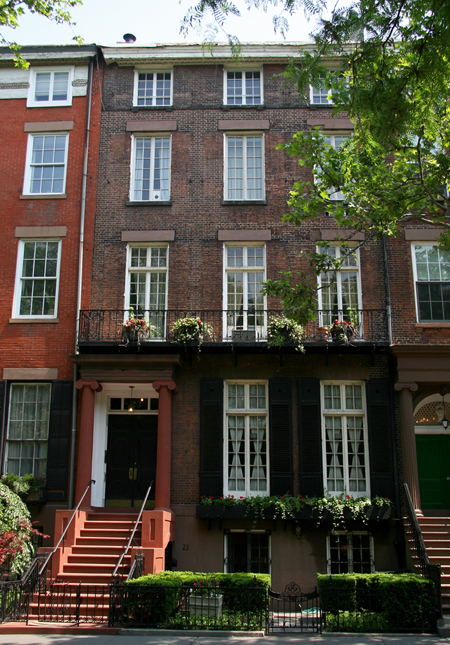
    The 1830 Greek Revival townhouse at 23 Washington Square North has not been available for sale for half a century. It can be yours, however, the asking price is $25 million dollars. The size is 8,528 square feet or a cost of $2,931 per square foot. There are only 7 apartments on 5 floors. Do the math and you will see the problem – if this building were converted to units for sale, the cost per apartment including carrying charges would be stratospheric. Many buildings like this will often sell to one individual who will convert it to a single family home.

    The rentals in this property illustrate what happens in this marketplace. A one bedroom was asking $4,775/month with the penthouse for $8,900 in 2010 and $12,500 per month in 2011. If you would like to get the flavor of what a parlor floor can look like in this type of historic building, see my photos here on the interior of number 24 next door, which one reader described as “real estate porn.”

    By day or night, looking out or peering in, the extraordinary historic charm is available in this rare window of opportunity to own a piece of old New York’s Washington Square. Spare $25 million anyone?

    Other Related Posts: The Feeling Passes, Overused and Abused, Bomb Factory, Left Bank New York

    Posted on by Brian Dubé

  • Old New York, Part 1

    Posted on by Brian Dubé


    There are things you can’t have in New York City. Many things. You can’t watch the sunrise from a mountain top, hear the wind blow through alpine forests, or see the black of night. Much of what nature giveth, New York City taketh away.

    The sound levels are very different here. I spoke to a friend recently from the suburbs who spent a night down the block – on the very same street where I live with the identical exposure. He said he could not sleep at all with the noise of constant traffic. The sounds of the city are only a familiar song to me – I sleep easily without window shades drawn and with all the city’s ambient light and noise.

    Here and there one can find tiny corners, places, culs de sac, alleys, parks, beaches, lakes, rivers – little pieces of the other world, the world outside cities. These special and often little known places in New York City provide magic carpets, that for brief moments can provide transport to a quieter, gentler city. I have shared these places with you over the years in this website.

    I do love the city – the energy, vibrancy, and stimulation are extraordinary. But the problem is that you can’t turn it off. So for those times when I need respite and do not have the opportunity or inclination to leave the city, I seek solace in those special spots that hearken to a time gone by or a world apart.

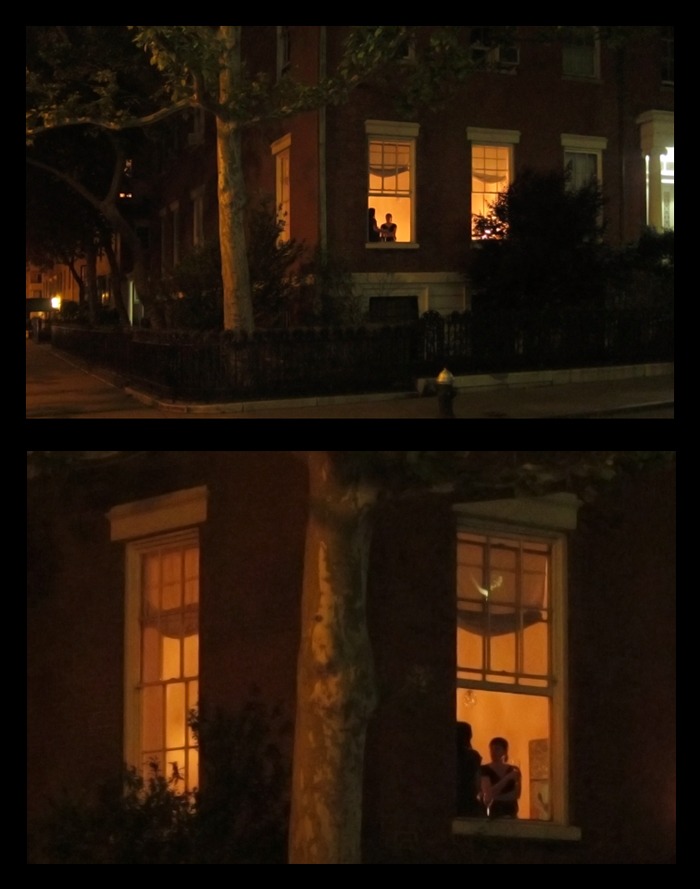
    The Greek Revival houses of Washington Square North evoke the gentility of a bygone age. Here, at the corner of Washington Square North and Fifth Avenue is a row house where I have often seen windows open, lights on and a handful of people milling about. This is the world of Henry James, 1881, setting for his novel Washington Square.

    A couple relaxes with glasses of wine, one resting on the sill, complemented by the exquisite air of warm evening, which has, after a long wet and cool spring, arrived at last. There’s a canopy of trees overhead and the yellow-orange glow of lamps. Everything is soft. Pause on this corner with me and enjoy the soul of old New York…

    Note: If you want a piece of Old New York at Washington Square, see Part 2.

    Posted on by Brian Dubé

  • Let’s Share a Drum


    Have you ever been seasick? My first experience with this was a return ferry ride of two hours from Nantucket. We had rough seas at night and I quickly became very queasy. I had only one thought – get me off this boat. Being at the lower level with odors of fuel was not helpful so I decided to move to the rear and go outside. Here I found a man with his girlfriend – she was in a similar, but more advanced state.

    I was surprised to learn that he was a Norwegian sailor, so at least I had the benefit of well seasoned companionship. He invited me to join his girlfriend who now had her head over a 55 gallon drum serving as a garbage can. I had nothing against her, but the prospect of both of our heads in the same oil drum was not what I had in mind, because I was not really ready to vomit – I was holding on at all costs.

    Our sailor could sense this and gave me advice that made a lasting impression. He said that the key to this situation was DONT FIGHT IT. GO WITH THE BODY. He repeated this many times. No, I don’t want to go with the body. I don’t want to vomit – I hate that feeling. Forget it.
    He elaborated, repeated and also informed me that eventually, being sick at sea catches up with every sailor. This surprised me. He said given enough time and extreme weather conditions, every sailor has his day. This was my day and I was not enjoying it at all. I can still hear him with a Norwegian accent – go with the body.

    His admonition, however, seemed well suited outside the world of sailing, seasickness, nausea and vomiting. Go with the body was tantamount to the old adage, go with the flow. Many unpleasantries are worsened by resisting circumstances beyond one’s CONTROL. This is the secret to dealing with stress in New York City – rush hour crowds, horrendous traffic, long lines, etc. Visitors, often coming from the suburbs where the logistics of life are easier, are perplexed at how New Yorkers can tolerate the stress of the city. The key is not just to pick your battles but not to engage in battle at all. Don’t’ fight it – go with the flow.

    I dislike rainy days like today. I find them so dreary and rather than embrace them, like the nauseous seafarer, I fight them, hoping and waiting for signs of clearing, wishing for the sun to peek through. But here, as elsewhere, rain can be comforting. It can be an opportunity to refocus and participate in things better suited to a rainy day. Stay indoors to work on some overdue projects. Relax and read, go online, watch a movie or TV. Perhaps dress appropriately, go out and enjoy the glistening city. When seasick, don’t fight it, go with the body. In New York City, don’t fight it, go with the flow. And if we find ourselves together, let’s share a drum 🙂

    Related Post: Landlubber


  • Dot My I

    Posted on by Brian Dubé

    Poor surfaces. So often maligned. One should always look below the surface. See what lies beneath the surface because there is more than what meets the eye. On the surface of it, beauty is only skin deep.

    Sometimes we love a surface – so smooth and shiny. It may be important to restore the surface, polish the surface or resurface.

    Most of the world we see is surface. We admire and appreciate it, yet if we learn that what lies beneath the surface is somehow less than we expected, we are disappointed and it diminishes the surface itself.

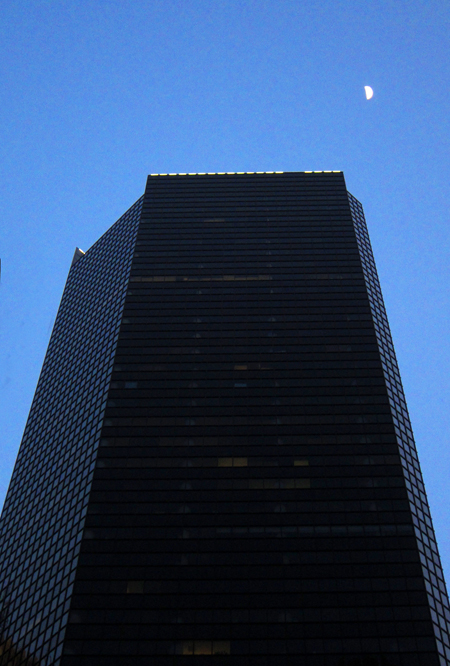
    New York City is a place of buildings, so we have lots and lots of large surfaces, looming over us daily. Here at 101 Park Avenue is a 49 story, 629 foot skyscraper. Eli Attia Architects designed the building, completed in 1982. It is the 64th tallest in New York.
    Park Avenue and 41st Street is prime real estate, only steps from Grand Central Terminal. The building has its own Wikipedia page and has been used in film and television – in the 1990 film Gremlins 2, in Seinfeld as the site of George Costanza’s office and as Dudley Moore’s office in the film Crazy People. It affords, as would be expected, spectacular views. You can see a gallery of photos of the building here.

    Uniquely shaped, strikingly positioned at 45 degrees to the street grid and glistening with reflective glass, 101 Park Avenue makes an impressive statement on the Manhattan skyline. The day I photographed it, there was an evening moon strategically located. Looking up at that surface, everything was so perfectly placed in a scene of urban penmanship, not forgetting while I crossed the streets to dot my I 🙂

    Posted on by Brian Dubé

  • Down to the Cellular Level

    Posted on by Brian Dubé

    A friend once so aptly said: everything is a competition, right down to the cellular level. All is poised, the net result of competing forces. In the world of physics, chemistry and biology it makes so much sense. In the world of human/animal relations however, it’s often a bitter pill to swallow, and I don’t really like the idea much better than anyone else. I always hate seeing that springbok losing to the lioness.

    I don’t like to see everything as a contest, however I don’t believe things can really be win-win either. Resources are limited, particularly money and time, so how can everyone win? Or win as much as they would like. I hate to say it, but life feels like a zero-sum game. Whether it is shopping, dating prospects, jobs, admission to a great college, sports, games, vacation choices, ranking in your class, what you will read, the blogs you visit, what you will do with your spare time, or who you will call, choosing something is not choosing something else. We are besieged with unending decisions and we must choose (or be chosen) from the competing options.

    I am a competitive person by nature and so my worldview is tainted by wearing those glasses. I do love working with a team, but honestly I work best when the team is on my side. I am a poor loser so I avoid direct competition as much as possible, particularly contests I know I will likely lose. I did not know growing up that I was a biggish fish in a small pond. Like many, I had a lot to learn about the size of fish and ponds.

    I came to New York City in 1969. At that time, this city was the best to me – the biggest, fastest, and most amazing place I could imagine. It had the most and best of everything – restaurants, buildings, people, opportunities, culture, money, street life, intellectual stimulation, merchants. As far as places go, it won the contest, and I wanted to be with the winner.

    Of course I have learned much over the years – the merits of other places and other cities, the relative meaning of best and that New York City is not the end all and be all. Even in the realm of cities, it is arguable whether New York is the greatest city in the world. Places like Paris eclipse New York in many ways.
    Some tire of the urban grind (see Dwanna, Duffy, and I Know). Most of my friends, many born in the city, have left and with no regrets. There are quality of life issues here – so many things that are undeniably easier and better in the country, suburbs, or smaller cities. For most, even if they have the means, New York will always be the stereotypical “it’s a nice place to visit, but I wouldn’t want to live there.”

    New York City is not for the faint of heart. The stakes are higher, the costs are greater, competition much fiercer, and the penalty for failure more severe. New York City is a magnet, attracting some of the world’s best competitors, from gladiators in the ring right down to the cellular level…

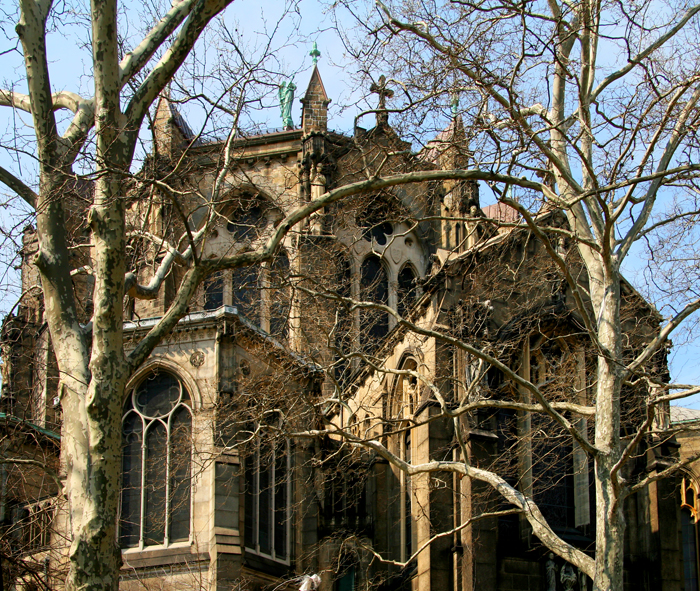
    Photo Note: New York City is not usually thought of as a city with a plethora of cathedrals and churches, as is Europe. However, surprisingly, New York City is home to the world’s largest church – the Cathedral of St. John the Divine. This photo was taken from the rear. You can see more photos of the interior and the story here.

    Posted on by Brian Dubé

  • Fort Schuyler


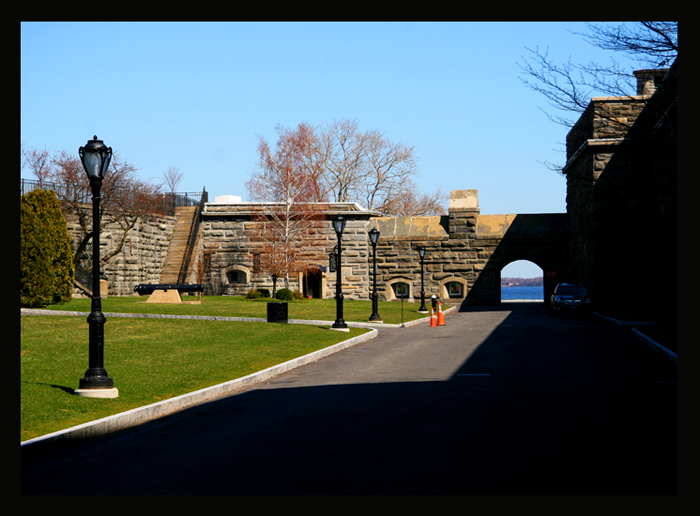
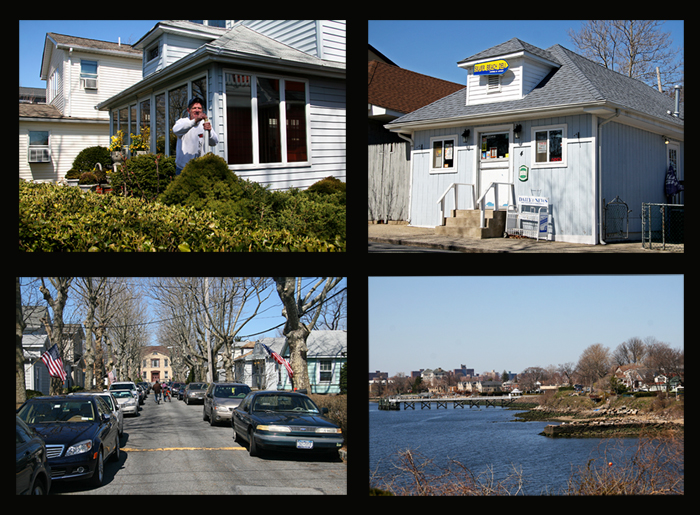
    There are not a lot of forts in New York City, and you certainly do not expect to run across a huge one, unbeknownst to yourself. It is unlikely you will ever run into this one by accident – Fort Schuyler and the Maritime College are not on the way to anywhere – they are destinations, located at the very tip of the Throgs Neck peninsula in the Bronx. On my recent excursion to the area, my intention was to explore Silver Beach. It is here by accident, that I discovered Fort Schuyler and the State University of New York Maritime College, founded in 1874 and the first of its kind in the United States.

    I met a couple of cadets, and like all the military men I have encountered, they were very approachable. They answered a number of my questions regarding the Maritime College and explained the reason for small sailboats – there was a regatta under way, with the boaters undaunted by the cold weather. They also informed me that the entire area was open to visitors with the entrance way nearby.

    I was surprised at how free and easy I was able to tour the area with no restriction and virtually no other visitors. Post-9/11, virtually everything in New York City has an added layer of security, including some of the most innocuous office buildings requiring photo ID. Places like the lobby of the Woolworth Building, one of my favorite spots to take visitors, is, sadly, completely off limits unless you have specific business in the building. As far as Fort Schuyler, however, I suppose a man in a small automobile armed only with cameras, poses little threat to a massive fort with military presence.

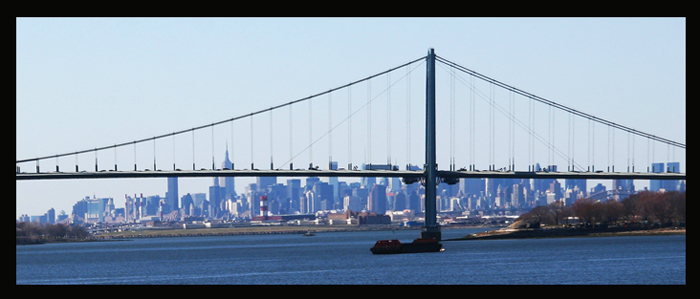
    The location of the fort and college is at the very tip of the peninsula, where Long Island Sound meets the East River, affording sweeping vistas including Long Island, the Bronx, Queens and a panorama of the Manhattan skyline (essentially the same as that of Silver Beach). The Throgs Neck Bridge is ever present, juxtaposed against nearly every structure as can be seen in many of my photos of the excursion – see the full gallery here.
    Fort Schuyler was one of many forts built along the east coast of the United States after the War of 1812, when it became apparent that the U.S. coast was poorly defended against foreign invasion. The French Style fortification was dedicated in 1875. The site also has a maritime museum, open to the public. Read more here.

    Everything was pristine and immaculate – the grounds, buildings, roadways and artifacts. It was quite chilly, but this is the best of weather conditions for seeing New York City outdoors – crisp air, clear blue skies and greater visibility. Although the warmer months are preferable for walking and touring, the heat of summer also usually means hazy skies with poor visibility and, if you are taking photographs, poorer results. If you’re looking for something truly off the beaten path, try the Throgs Neck peninsula with Silver Beach and Fort Schuyler 🙂


  • The Outer Limits


    Wandering and meandering without a clear destination is a noble activity. When I am exploring in a small or local area, I do this regularly – setting out with no agenda. Traveling further, however or by vehicle, the risk of disappointment becomes an issue as well as time used.

    So I turn to maps. I do love maps and always use them wherever I travel to get a lay of the land and a sense of breadth and compass. Even in New York City where I have lived for 40 years, when traveling by car, a five borough street map is always at my side. GPS is great, however, if you want a large and detailed overview of an area, only a full size map will do the job.

    I have been amiss in exploring the Bronx and have very few stories in this website. So, it was time to look at a map and see what might have potential. I love the tips and edges, i.e. the outer limits, where often one finds exceptional features, views and unique villages. Looking at the Bronx section of my street map of New York City, my eye was drawn to a peninsula with an area marked “Silver Beach,” situated between the Throgs Neck and Bronx-Whitestone Bridges. A little reading looked like this would be just the place to satisfy my wanderlust.

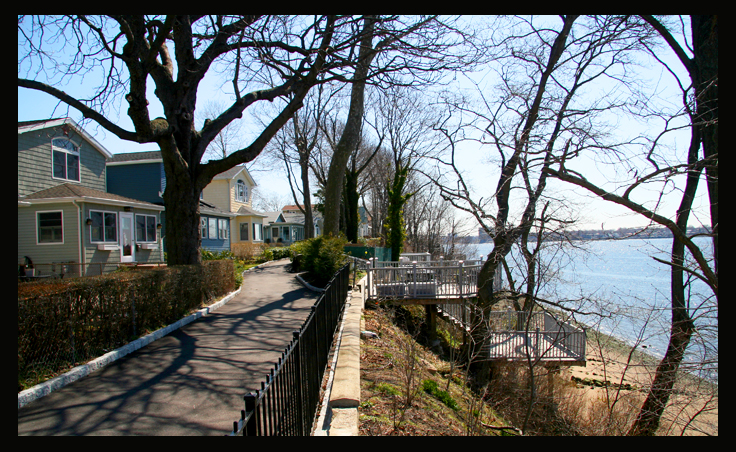
    What started out as a whimsical choice of a travel destination ended up being one of the most remarkable residential enclaves I have seen in the five boroughs. Sitting on a bluff, 50-60 feet above the river, Silver Beach Gardens is a network of small lanes and 451 homes, established as cooperatives – residents own their homes and lease the land from owners’ collective. To buy, applicants must have three letters of recommendation from current residents. In the early 1900s, the neighborhood developed from summer waterfront bungalow colonies on large estate to the neighborhood it is today. See my photo gallery here.

    The highlight of the day was my walk on Indian Trail, a narrow footpath flanking the edge of the bluff with beautiful vistas of the beach below, the river and the skyline of Manhattan framed by the Bronx-Whitestone Bridge. The homes had decks perched on the cliffs, with the beach is accessible by stairways.
    It was here that I met Paul and his wife, busy with springtime yard work. He was extremely friendly, having greeted me first. When I told him that I would be doing a story, he told me how the community was displeased over an article in the New York Times which reported a lawsuit based on racial discrimination in real estate sales.

    Properties for sale in Silver Beach Gardens come very infrequently and typically sell by word of mouth. A small community like this with privately owned single family homes, extremely low turnover, remotely located, little known to outsiders and with strong ethnic history will be slow to change and see the diversity found in a much larger community with rentals and large multi-unit apartment buildings. Silver Beach Gardens is predominantly Irish, German, and Italian. I was reminded of Broad Channel, another extraordinary residential enclave situated on an island in Jamaica Bay. See my story and photo gallery here.

    So, for a little change and some pleasant surprises in your exploring, pull out a map and whether city or state, look for those Outer Limits 🙂


  • A Bottle of Schweppes


    Generally speaking, finer things cost more money, with surcharges for cachet, panache, name, and convenience. Some will say that these are not premiums but rather part of what makes them finer. However, these views are often held by those who find the greatest comfort in the greatest price and believe that quality is always measured in dollars. For those that feel this way, any world-class city will be a good choice to divest of some cash. New York City comes highly recommended.

    In most of the world, outside of large cities, if you have enormous wealth, you will find it difficult to spend enormous amounts of money on ordinary goods and services. So if you would like to spend $8 for an eight ounce bottle of Schweppes Ginger Ale or five dollars for a small bag of potato chips in a hotel room where rates range from $975 to $16,000 per night, I suggest a visit to the Peninsula Hotel.
    These minibar prices seem a little high. But ultimately, this is only a New York City hotel renting rooms for the night, and there is only so much luxury that one can offer. So, in a place where everything needs to be special, perhaps everything has to be priced this way, even a bottle of Schweppes.

    Admitttedly, the location of the Peninsula New York at 700 Fifth Avenue at 55th Street cannot be beat. The location on Fifth Avenue, often heralded as the world’s most expensive street, is neighbor to many of the most recognized flagship stores, including Cartier, Tiffany’s, De Beers, Fendi, Armani, Prada, Saks, Bergdorf, and Abercrombie & Fitch. The Peninsula is also located near many well known attractions such as Rockefeller Center, St. Patrick’s Cathedral, Radio City Music Hall, and Central Park. The hotel has a 3-floor spa, outdoor terraces, and a glass-enclosed swimming pool.

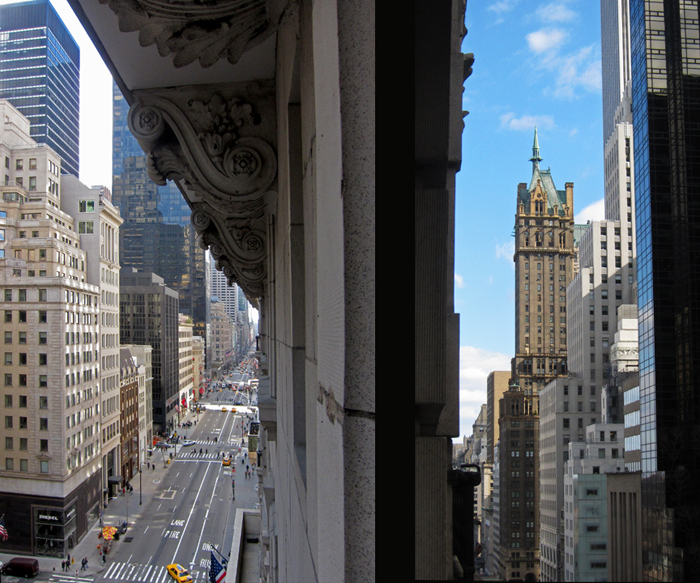
    I was privy to see a room facing Fifth and able to free a window, open it wide, stick my head out, and get some spectacular views, up and down Fifth Avenue. As I turned back towards the elegantly appointed room, I glanced at the minibar, where on top lay an unfinished ginger ale. No matter how I tried to justify it, there’s still a thrifty New Englander inside, and it bothered me to see that bottle of Schweppes…


  • I Know

    There are a number of life scenarios where someone expresses the sentiment that he/she just knows. I have often heard this regarding house hunting – something like, “As soon as we walked in, we knew.” Some feel this way about their belief in God. That it is not the result of any cognitive process – they just know that God exists.

    And many, of course, feel this way about their significant other, even on first meeting – it was love at first sight – they just knew. Of course, there is always the possibility of over exuberance or self-delusion. Nonetheless, valid or not, the conviction of a strong, knowing feeling does give a person direction and focus and not squander energy on hapless searching. The middle way can be no way. Take it from someone who, in many ways, has been a perennial fence sitter.

    I cannot say that I have often had a strong feeling that I just knew something was right, except when I arrived in New York City for the first time. I will admit, of course, that at that age, in tandem with being starved for culture and stimulation, perhaps I would have had that feeling about any city. That I cannot know.

    There is an episode of the Andy Griffith Show where the lead character, Andy, a sheriff in a small town in North Carolina, tries to reconnect with an old high school girlfriend at a class reunion. She, however, has moved to the big city, Chicago, and the episode revolves around their bittersweet attempt at reconnection. It becomes clear why their relationship never was successful – they are just fundamentally different people.
    There is a scene in the episode which is particularly poignant to me and really captures the essence of people attracted and repelled by cities. Andy’s friend is frustrated by his apparent lack of need to go to the big city to broaden one’s horizons and explore beyond the bounds of his small rural hometown. She cannot fathom how he can really and truly be happy with what he has if he has never been to the big city to see what he does not have. To this, he responds that he just knows.

    To me, that is an extraordinarily profound statement of the utmost self-confidence and awareness. Some may say it is extraordinarily naive. However, I have met many intelligent, educated, sophisticated, and worldly people who are content to live their lives in a rural environment, even in the small town they grew up in.
    The urbanite often sneers at the country bumpkin, seeing him or her as unsophisticated. But perhaps the differences between people has more to do with different styles. I wrote of this in my story, Quite Refreshing, Really:

    I am reminded of the film The Way We Were where the ability of two very different people (Robert Redford and Barbra Streisand) to get along is painfully tested and results in a parting of ways. In the end, Redford explains that his decision to separate is due to their different styles.

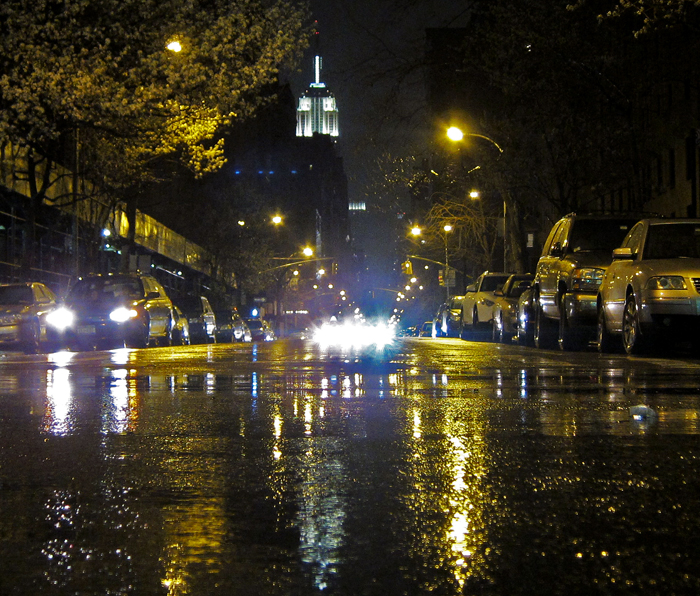
    I have questioned the value of living in New York City and bearing its hardships, one of the dilemmas most New Yorkers face (see Dwanna). I have toyed with leaving many, many times in the four decades I have lived here. I have entertained the country, other cities, and other countries. However, although it has taken some time, I can, at last, peer into my soul and see what lies inside. And lest I need any reminder, I can look up at a vista, like that at 42nd Street and Park Avenue, and I know.


  • dinamic_sidebar 4 none

©2026 New York Daily Photo Entries (RSS) and Comments (RSS)  Raindrops Theme