• Category Archives Scenic NYC
  • World of Sheep

    I once dated a woman just after college for a short time. A very short time. Actually, if I recall, it may have been only one date. This woman had been highly affected by her readings of the existentialists. I can’t say I liked her much, and I remember very little, except her assertion that “people were sheep.” She suggested, “Let’s do something different,” as if difference, in and of itself, insured a better experience. I vaguely recall her quoting some French philosopher, a role model of hers I imagine, to substantiate her negative views of humankind and extemporaneous living as the only antidote.

    Had it been 2010, her life would be considerably more difficult, if not near impossible. She would be a very unhappy camper for sure. Flash mobs, Twitter, email, texting, Facebook, satellite TV, blogs, ezines – everything conspires to disseminate information, literally at the speed of light. Whether it’s the latest, greatest neighborhood, product, or event, no stones are left unturned. Nothing of any interest to anyone remains secret for very long.

    In 2007, when I first heard about the biannual solar event coined Manhattanhenge by astrophysicist Neil deGrasse Tyson, I really felt privy to a very special near-secret event. And although I was not the lone photographer my first time seeing this spectacular New York City occurence, the experience I had in midtown Manhattan did not have the flavor of a feeding frenzy fueled by electronic networking or the feeling that one was part of a flock of sheep.

    I created a photo triptych which I posted along with my article on this blog on May 21, 2007. The photo collage was picked up and featured by Gothamist online. This year, I see a massive amount of imaging online – it is doubtful now that any given photo would be easily singled out for a media feature as mine was in 2007. B & H Photo now organizes an annual Manhattanhenge Gathering for photographers. On the photosharing website Flickr.com, there are two special photogroups for Manhattanhenge alone (2009 and 2010), and a search of images returns over 3000 results. Websites abound with stories, photos, and information about this natural occurrence.

    I have, of late, become very enamored of sheep – they are wonderful animals that do really appear to love the company of people. They may not be known as independent thinkers, but perhaps they are the new paradigm for our fast-moving world. I have not given up completely on creative or independent work, but I am preparing for the future and learning as much as I can now about the world of sheep 🙂

    Photo Note: I stumbled across this year’s Manhattanhenge unknowingly. The photo was taken just before sunset, looking west down 23rd Street.

  • Fire Island


    With only one exception, all the photos on this website were taken in one of the five boroughs in New York City. I do not vacation or travel out of the city or post photos and stories of my exurban adventures or vacations.

    But Fire Island is a special case, and if you don’t include it in your discussions about New York City, then you do not have a complete picture of this city. Like the Hamptons and Montauk, Fire Island is a summer playground dominated by New Yorkers, particularly Manhattanites. There is a level of urbane sophistication – if you spend time there, you quickly get a real sense that this is a virtual microcosm of New York City.

    Fire Island is a barrier island, only half a mile wide and 31 miles long, off the south shore of Long Island. It is accessible by bridge at either end with public beaches – Robert Moses State Park at the western end and Smith Point County Park at the eastern end.

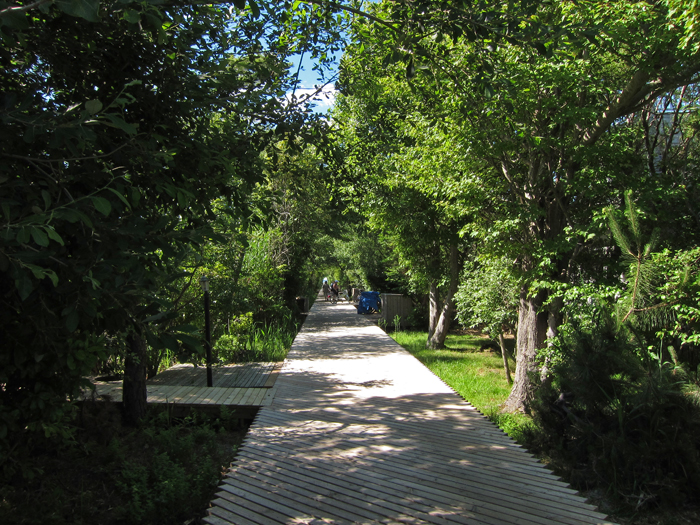
    However, the real allure are the 22-some odd private communities that dot the interior of the island, which are only accessible by ferry from Long Island. These communities span an entire range of environments and people, from conservative to wild. Point of Woods has the character of a New England town, while Fire Island Pines has roller coaster boardwalks tunneling through trees. Cherry Grove is dominated by the gay community, with a party atmosphere. Seaview is sedate. Ocean Bay Park sees many vacationers sharing homes. Water Island has the character of a remote outpost. See my photo gallery here.

    My romantic love affair with Fire Island started on a day trip in the early 1970s. I immediately was swept away. There are many charms to Fire Island – the pristine beach and dunes, protected as Fire Island National Seashore, Sailors Haven, the Sunken Forest, and the Fire Island Lighthouse. But there is one big factor that defines everything – there are no automobiles.

    This is an extraordinary world where streets are often wooden walkways, transportation is by foot or bicycle, and goods are frequently carted by wagons left in town. Here, you can find the occasional little girl with a stand selling shells. Deer roam freely and can be easily hand fed. Less than 40 miles from New York City, and the quiet is just shocking.

    Sound like paradise? Yes it is. If you have a chance, visit Fire Island 🙂


  • Rocket Man

    Note: Please click and play audio link to accompany your reading.

    I recently discussed with my cousin the fireworks displays we saw as children in Pope Park, Hartford, Connecticut. These Fourth of July outings were all-night affairs – our families arrived early with blankets and picnics, staking out ground for a display which seemed like it lasted forever. Perhaps the childhood memory of this spectacular event looms larger than it really was for both of us, but we agreed that it lasted nearly one hour and was the best thing we had ever seen.

    As I grew up, I was no stranger to the boyhood love of pyrotechnics. This followed me into high school, where I became involved in the rocketry club. In my early years in New York City, we managed to put on our own bottle rocket displays for the Fourth of July.

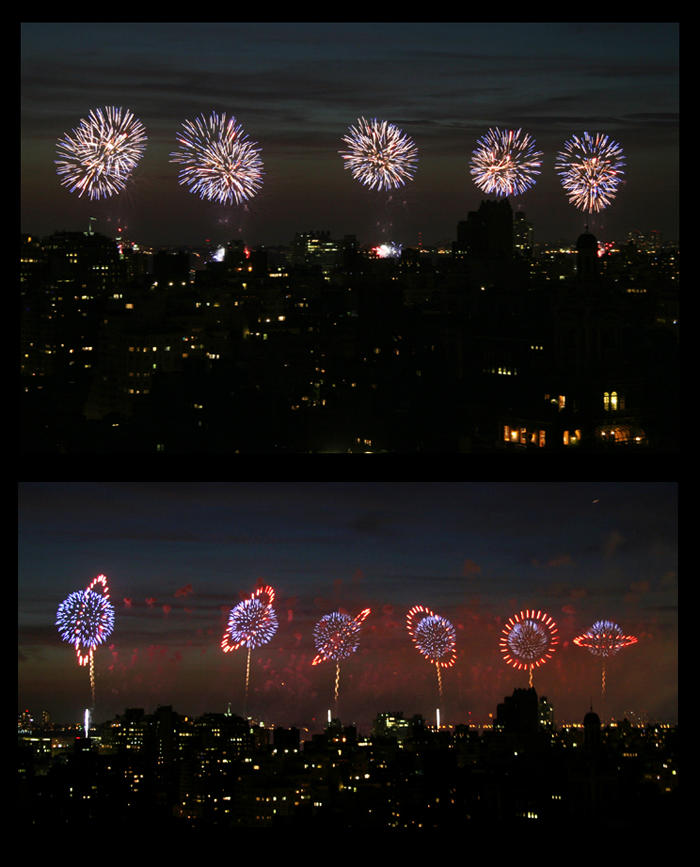
    Of course, little compares to Fireworks by Grucci or Pyro Spectaculars by Souza, which has been putting on the annual Macy’s fireworks display since 1982. Last night’s display was beautiful as always, with many new pyrotechnic effects.

    This year, my spectating experience was particularly pleasant. Rather than battle the masses on the west side of Manhattan for Hudson River views, I was invited by friends to the 26th floor rooftop deck of their apartment building. We were joined by a small number of building residents for a pleasant, trouble-free bird’s-eye view.

    In a extraordinary twist of fate, I learned today that Pope Park was designed by the Olmsted Brothers Landscape Architects in 1898. This company, the nation’s first landscape architecture company, was founded by Frederick Law Olmsted, designer of Central Park and Prospect Park in New York City. Olmstead’s sons, John Charles Olmsted and Frederick Law Olmsted, Jr. inherited the firm from their father. This company has an enormous portfolio of projects to their credit, including Pope Park. I have been unknowingly following the footsteps of the Olmstead Brothers.

    I am pleased to have echos of pyrotechnics and the Olmstead legacy here in New York City, because leaving my home and childhood behind is the fate of any Rocket Man 🙂


  • Signs of Summer

    Imagine the perfect summer day. If you find that difficult at all, please join me in looking out my window – today is that day.

    Summer can be extremely unpleasant in the city – the grime and edge is exacerbated by the heat and humidity. Many areas look extremely unattractive. The impact of tourists, excess trash, and hot subway platforms does nothing to improve the experience.
    The iconic sights, sounds and smells of summer are largely unavailable in New York – butterflies, open fields, lawn mowers, cookouts, crickets at night, cicadas.

    Many prefer to leave the city on weekends, for extended vacations or for the entire summer. Neighborhoods like the Upper East Side are virtual ghost towns on a summer weekend. The well heeled have options, and spending the dog days of August in Manhattan is not high on their list. Not unique to New York, the summer exodus of urbanites has been replayed in cities around the world over history.

    Those that remain in the city will find many things to do and enjoy – summer concerts, festivals, parades, programs, the parks, botanic gardens, community gardens, promenades, the rivers, beaches, sampling fabulous gourmet ice cream/gelato, and, perhaps best, just strolling the city streets by day and night. Adjust and adapt to New York City’s brand, and you will easily recognize our own signs of summer…

    Photo Note: This is the fourth of a series of photos, one per season, taken from my window looking out to Washington Square Park. Today’s photo completes the cycle of seasons. Here are the links for Spring (Enchanted April), Fall (Wood, Glass, Brass and Trees), and Winter (White By Design 2).


  • Everything No

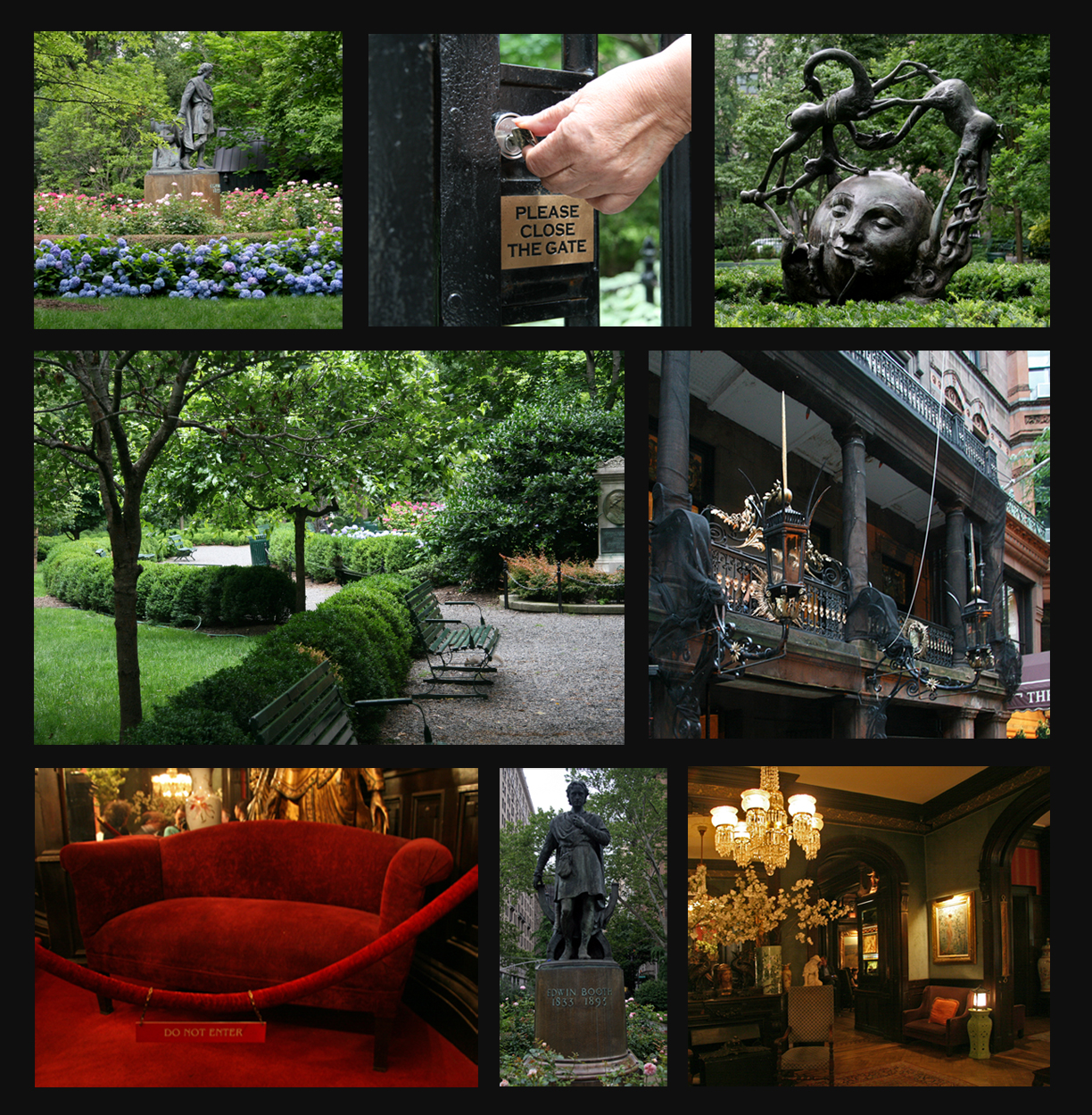
    On April 4, 2008, I wrote Key Privileges, about Gramercy Park – the city’s exclusive private enclave and Manhattan’s only private park. Read the story of the park here. That visit was like that of virtually all New York City residents and visitors – from the outside.

    Recently, a friend, a regular reader of this website and Gramercy neighborhood resident who lives just off the park, let me know that she was in possession of a rare and highly coveted article – a key to Gramercy Park. The key was loaned to her by a friend who was away for a short time, so time was fleeting, and so was my window of opportunity. A number of us were invited for the outing, so we decided to meet at an opening at the National Arts Club on Gramercy Park South.

    The convenient location on the park and a short immersion into the club’s historic structure made it the perfect launching point for our excursion into the park. The National Arts Club, which also abuts the Players Club, is housed in one of New York’s finest mansions, both a designated New York Landmark and a National Historic Landmark. The building, located at 15 Gramercy Park South, is worthy of a visit itself.

    I made a big ceremonial event about the unveiling of the key and the opening of the park gate. Gramercy Park requires a key both to enter and leave. Once inside, we toured the park, spent some time enjoying the extraordinary bucolic ambiance, and alighted on a number of benches for some friendly chatting. See my gallery of photos here.

    All of our group was in agreement, however, that although the park’s landscaping and natural beauty was quite exquisite, the park itself, with its list of don’ts, was rather boring. In fact, the park is not heavily used.
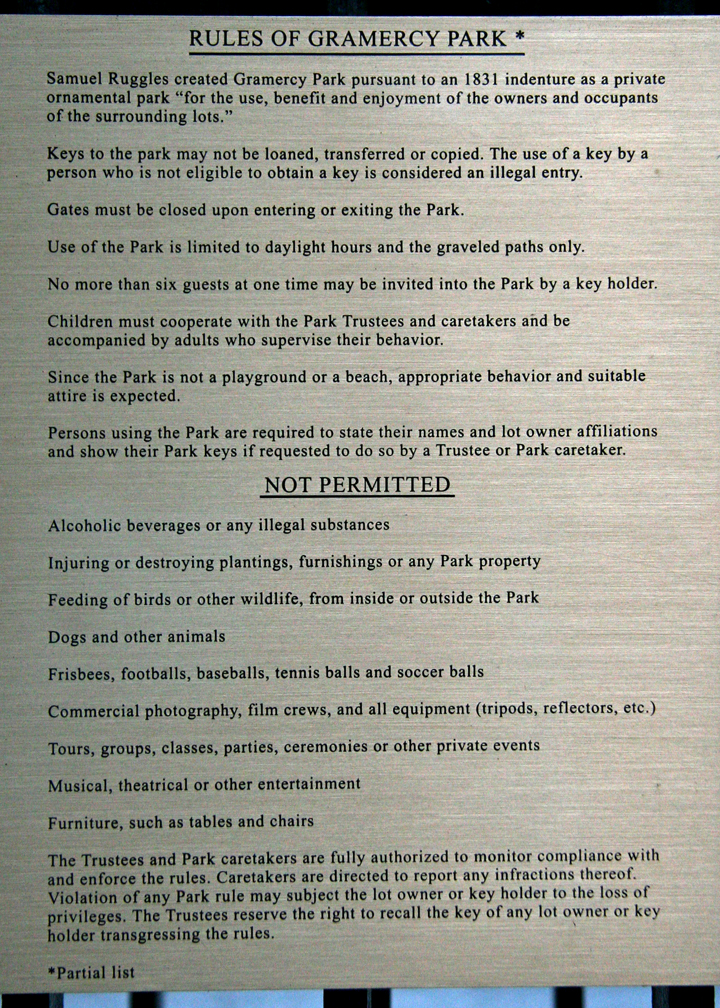
    The list of rules is quite long (see them here). After reading them on our way out and observing a nearby “Please No Pets” sign, one of our group was prompted to comment, “Everything no.” A recent immigrant to the USA, we found her outside perspective and slightly broken English to be a charming, succinct, and not altogether inaccurate characterization of the environment. Smiling, I felt compelled to respond, “Yes, everything no…”


  • Brighton Beach


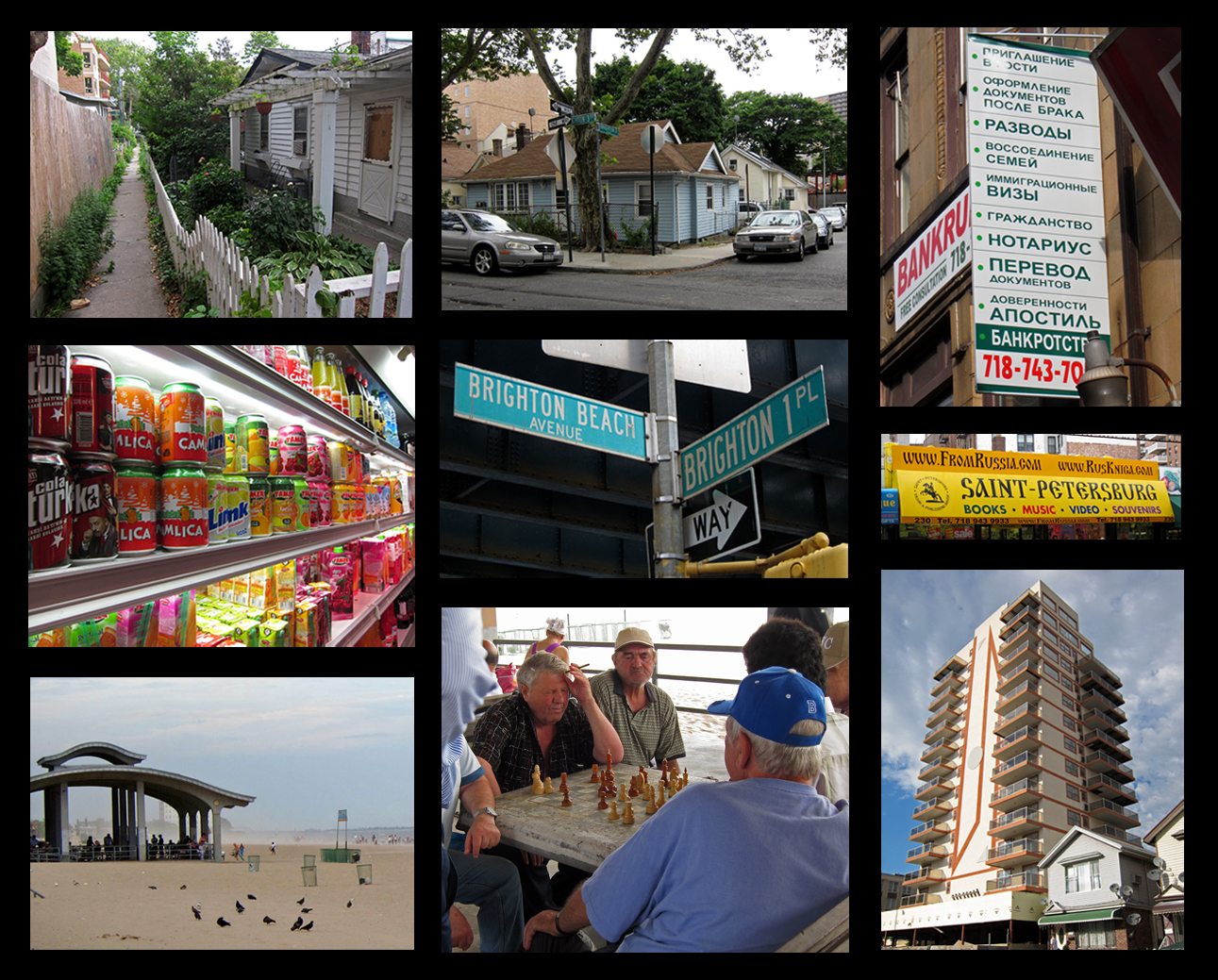
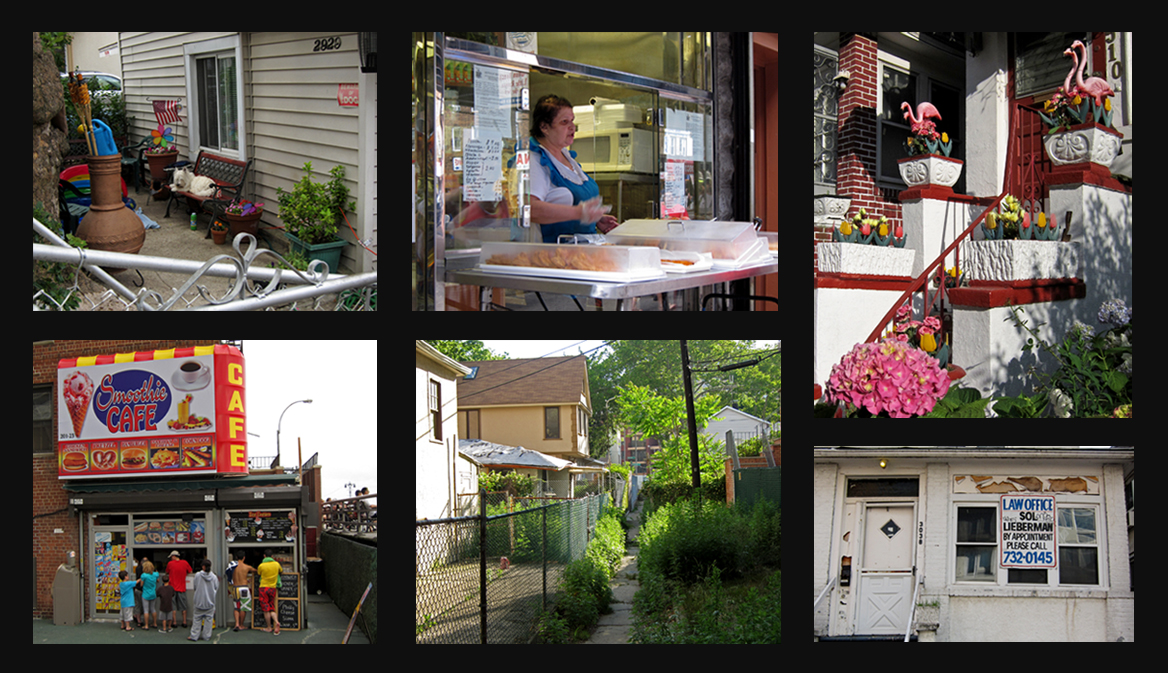
    New York is a city of contrasts. And contrasts within contrasts. Brighton Beach is a community sharing the Coney Island peninsula with Sea Gate, Coney Island, and Manhattan Beach in Brooklyn. See the photo gallery of my recent visit here.

    I took a long walk through the neighborhood and met a long-time local resident having a smoke in his front yard. He was quite friendly and informed me how neighborhood changes have been drastic in the last five years and how he anticipates more of the same. According to him, the biggest change and factor in escalation of real estate prices has been a rapid infiltration of Russian-organized crime. Small bungalows are purchased, leveled, and transformed into large private homes or apartment condominiums. He pointed out developments all around us, sprouting up amidst small homes. This resident was offered $1 million for his small home. Certainly the Russian influence is felt in the shopping areas – many signs are in Cyrillic alone. Many articles have been written on the problem, which goes back decades (see a New York Times article here).

    Cottages, high-rises, condos, luxury homes, gated communities, buildings in disrepair, organized crime, ethnic enclaves, alleys, lanes, weeds, flowers, the boardwalk, and the Atlantic Ocean. That’s Brighton Beach…


  • World Domination

    There is an episode of the Twilight Zone, The Little People, where astronauts William Fletcher and Peter Craig are marooned on another planet. In exploring the planet, Craig discovers a Lilliputian city with miniature people. Soon, Craig becomes an obsessed lunatic and appoints himself as a god over these people, terrorizing them into submission. At one point, he even forces the populace to build a life-size statue of himself. In an ironic ending, Craig himself becomes a victim when two enormous spacemen visit the planet. One of them picks up the ant-sized Craig, accidentally crushing him to death.

    We can easily understand Craig’s dark side – what child (or child within the adult) is not fascinated observing people and cars from extreme heights? Can’t you just hear them remarking to one another how tiny they are and how they look like toys? As if they could reach down and pick them up.

    I recall my first visit to the Empire State Building, where, at the observation deck on the 86th floor, I was able to squeeze my head through the fencing and look straight down, seeing for the first time the toylike world I had only imagined or seen on TV.
    There’s a touch of megalomania in many of us, and viewing the world from atop skyscrapers gives just the vantage point to fantasize our domination over the world below. And what better place to reign than New York City? 

    Many urban jungle lovers (see Jungle Lovers and Urban Safari) relish exploration of the city, following the beaten paths or cutting their own swaths. But from time to time, there comes a desire to see the forest from the treetops. New York City affords a myriad of opportunities to do this via observation decks, bridges, and high-rise apartment and office buildings. Today’s photo is a rooftop view looking straight down from the 26th floor of a luxury high-rise apartment building in Greenwich Village.

    I love the culture, arts, architecture, and people of the city, but from time to time I want to see the little cars and people below. So, next time you get the chance, take a trip to the top of a New York City skyscraper and join Peter Craig and me in a game of World Domination 🙂


  • Yellow By Design


    Yellow, along with red, is typically a color used to draw attention. The high visibility properties are utilized in warning signs, highway construction vehicles, school buses, and the New York City taxicab.
    However, once outside the world of safety, caution, and signage, bright yellow is not so often seen. Among automobiles, it is one of the least popular colors and is sure to draw attention.

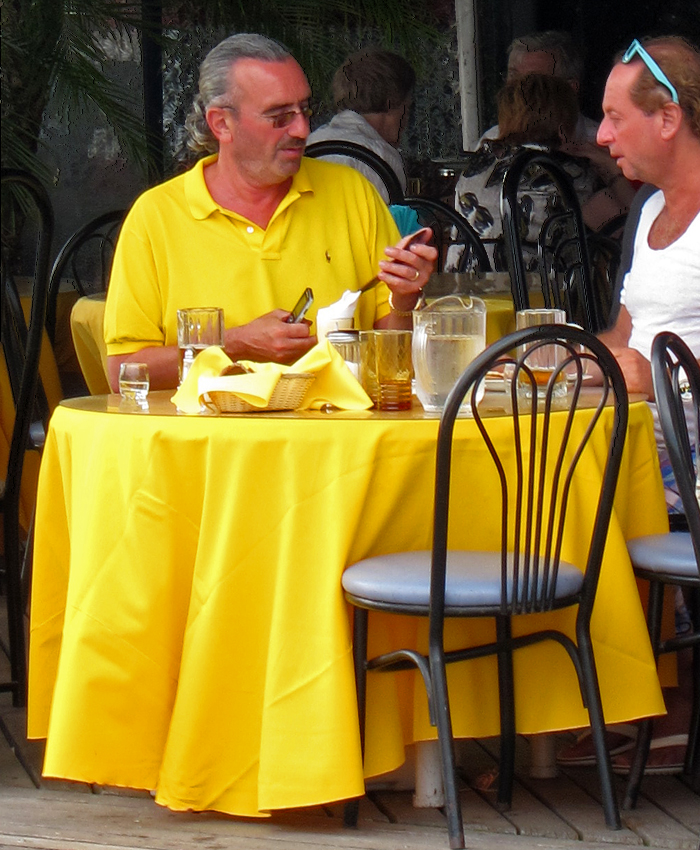
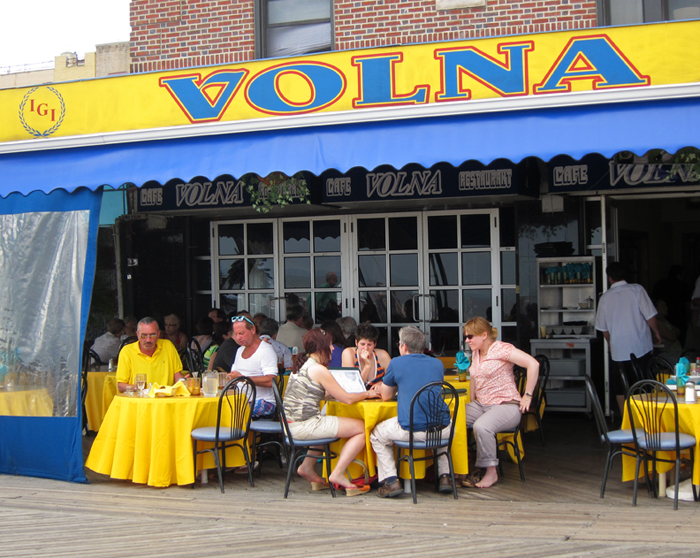
    While strolling on the boardwalk in Brighton Beach, Brooklyn, the amazing assemblage of yellow in today’s photo just jumped out – a diner with a bright yellow Polo shirt, a near perfect match with the solid bright yellow table covering, a yellow cloth in the bread basket, a bright yellow sign color, and a muted yellow apartment building in the rear.

    The color yellow’s use for taxis has a bit of a muddied history. It is frequently attributed to John Hertz, founder of Chicago’s Yellow Cab Co. in 1915. Hertz reputedly chose yellow on the basis of a University of Chicago survey, which found the color highest in visibility. This may have been the case, however, yellow cabs were already in use in the United States and attributed to Albert Rockwell.

    I was astonished to learn today that Albert Rockwell, founder and General Manager of the New Departure Manufacturing Co. of Bristol, Connecticut, was also a director and major stockholder of Yellow Taxicab Company, incorporated in 1912 by Bristol Engineering, a subsidiary of New Departure. I grew up in Bristol and had many relatives who worked for New Departure – a major employer in the town. Had I lived in the early 1900s, perhaps I too could have staked my claim for the choice of color of the New York City taxicab and become a contributor in the world of yellow by design 🙂

    Related Colorful Postings: Coleur du Jour, That’s Quite a Briefcase, Who See the Red?, A Colorful Life, Building Gone Wild, White By Design, Tale of Two Colors, Color Brigade, Eye Candy, White By Design 2


  • All of These Pleasures

    In the film The Producers, which is set in New York City, Leo Bloom (Gene Wilder), an innocent accountant, is lured by Max Bialystock (Zero Mostel) into a fraudulent money making scheme. In one scene, Max tempts Leo atop the Empire State Building, enumerating all the wonderful things money can buy in New York City which are laid out before them, whispering over his shoulder, “All of these pleasures can be yours.”
    And, for most, one of these pleasures will be a decent home.

    Conversations in New York City are dominated by apartments and jobs. The cost of an apartment, rental or purchase, is the most difficult financial hurdle to living in this city, particularly for new transplants.
    You will hear and read that prices are up or, on occasion, down slightly. Then up. Average prices, median prices. This year over last. This quarter over same quarter last year, etc., etc.

    Let me simplify. No matter what you read or hear, prices are still high. Very high. Even if prices plunged, they would still be very high. In spite of the economic malaise, apartments in New York City are fetching big numbers. Prices of Manhattan apartments have risen in 2010 over the same period in 2009 – the average one-bedroom is now $1.3 million dollars, typically with a maintenance of over $1000 per month.
    For that money, you get one privilege and only one: to live in New York City in a habitable place. However, views like those in the photos are far from typical, and for that you will pay a premium. Prices in high-rises typically increase as you move up to higher floors with better views.

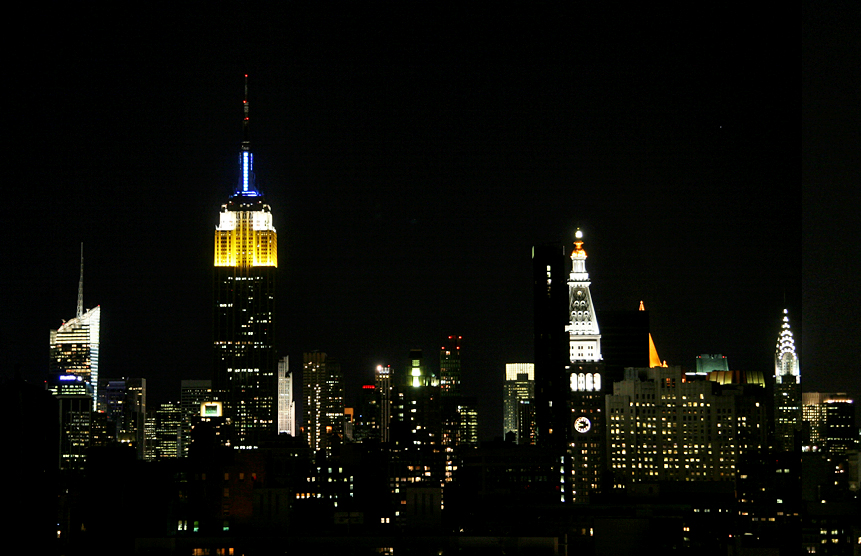
    The vista in the photo is looking north from the rooftop of the Brevoort East at University Place and 9th Street in the Village. Friends who live in the building (and have virtually an identical view on a lower floor) gave me roof access recently. Atop the roof, looking out at the spectacular view in the brisk clear night time air, I could feel Max Bialystock at my shoulder whispering, If you have the money, all of these pleasures can be yours 🙂


  • Trapped in Paradise


    Heaven may not be what you hoped for if you are unable to relax, let go, and appreciate the seraphim and cherubim. Otherwise, you may find yourself like Woody Allen in a taxi in Manhattan – “You look so beautiful I can hardly keep my eye on the meter.”
    I felt very conflicted sitting in the Conservatory Garden – I had an loose agenda for the day, but sitting in this garden just made it nearly impossible to entertain leaving. I was truly trapped in paradise.

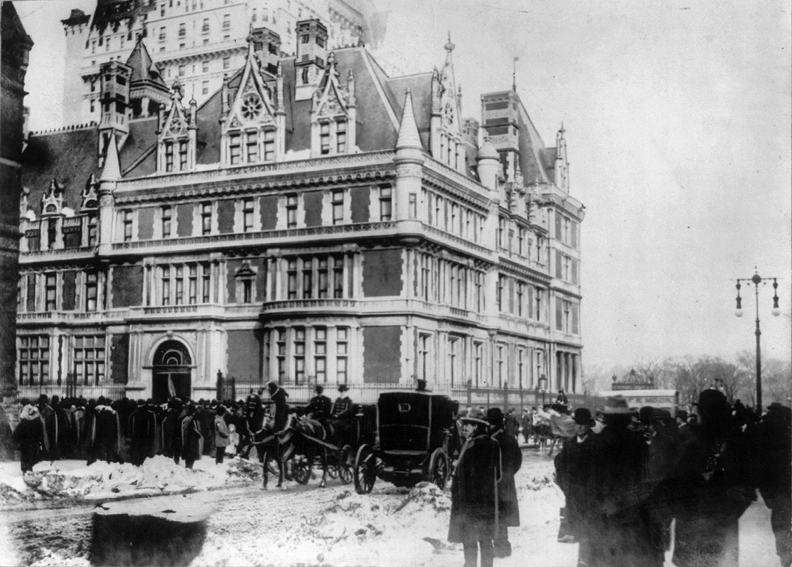
    This is one of New York City’s “secrets” – few will make it this far north on Fifth Avenue. The formal garden was designed by Gilmore D. Clarke, the landscape architect for Robert Moses. The main entrance is through the Vanderbilt Gate at Fifth Avenue and 104th Street. The gate once served as an entrance to the chateau of Cornelius Vanderbilt II, the grandest of the Fifth Avenue mansions (see photo here). It stood at 58th Street and Fifth Avenue near the Plaza Hotel. It was demolished in 1927. The gardens are divided into 3 styles – French, Italian, and English. From the Central Park website:

    Conservatory Garden began as a large, E-shaped greenhouse, or conservatory in 1898. It featured an indoor winter garden of exotic tropical plants and outdoor decorative Victorian flowerbeds. In 1937, the deteriorating structure was demolished and this six-acre formal garden was designed in its place.The Central Park Conservancy began its restoration of the area in 1981, starting with the Garden’s fountains.

    Conservatory Garden is divided into three distinct styles – French, Italian, and English.The northern French-style garden features an ellipse of meandering boxwood and pansies, and showcases spectacular seasonal displays of tulips in spring and chrysanthemums in autumn. In the center is the charming Three Dancing Maidens fountain by German sculptor Walter Schott.The central Italian garden features a wisteria pergola, a large lawn surrounded by clipped hedges of yews, a 12-foot-high jet fountain, and two exquisite allées of pink and white crabapple trees. On the walkway under the wisteria pergola are medallions inscribed with the names of the original thirteen states. The Italian garden serves as a backdrop for hundreds of wedding photography sessions.

    I hope you visit. I’m sure you will enjoy being trapped in paradise 🙂


  • Window of Opportunity

    This is a daily photo website, and although it has evolved to become much more story- and text-driven than at its inception (where the text served as more of a caption), I assume that many of you are interested in photography and imaging.

    The advent of digital cameras has brought many more individuals into photography. The Internet and digital media have provided a myriad of online forums, all easily available to the masses. Camera technology has made it much easier for the average person to get very good results. Preview screens provide immediate feedback, providing an excellent learning tool for identifying problems, rather than having to wait for film processing.

    The cost of photos is essentially free, less amortization of the equipment. This means more photos can be taken, important in difficult shooting situations where a number of shots increases the chances of capturing that special moment. Post-processing on a PC with applications such as Photoshop essentially brings the darkroom to the desktop. For me, this is one of the most important tools in the digital photography process.

    So, with all this technology and increasing numbers of photographers, one problem remains – how do you differentiate your photos?
    Subject and setting. If you are interested in color photography, for example, it is going to be difficult to get the kinds of results Steve McCurry gets just by being in India, Kashmir, Tibet, or another exotic locale, and getting such unique subjects and settings.

    However, few have the ability to travel to locations like these very frequently, if at all. It is unlikely that one will find many unique subjects in and of themselves – in a city like New York, nearly everything has been combed over. A rarely seen subject will require research and travel – places such as the Hole, the Black Cowboys, etc.

    One strategy is to shoot familiar subjects from different vantage points (see Dachshund Octoberfest here) and at different times. Although the magic hour (early morning and at sunset) is often celebrated as the optimal time of day for shooting because of the quality of light (see Light on Bobst here), I also see the early morning as a time to capture activities particular to the early morning (such as deliveries to the meat packing district) or familiar subjects in an atypical way – quieter settings free of traffic and pedestrians and subjects illuminated by the sun in a unique way, like today’s photo of the Washington Square Arch with light pouring through it.
    See you in the morning for that window of opportunity 🙂

    Posts taken in the morning: Hawk Fest, Quietude, 23 Skidoo, Homeless Art Scene, You Don’t Say, Out There, Little in the Middle, Kristen, For Whom the Knell Tolled, Hua Mei Bird Garden, Coup De Grace, Eight Twenty Five, Slummin’, Fresh Meat, True North, Snow Play


  • Quite Refreshing, Really

    Posted on by Brian Dubé

    I am not sure that I buy the idea that “opposites attract,” a phrase often used to defend the pairing of individuals who go together like salt on a wound. On the other hand, I once had a conversation with a friend which I will never forget.

    This individual was very meticulous in his work – he was known for precision in both his practice routines and performance. I also understood that he was very tidy in his personal life. He had lived in a number of places and was a recent transplant to New York City, a place that did not seem very fitting to his temperament.
    One evening, standing in the vestibule of my apartment building, we did some catching up, and he told me why he had moved to the city – for a woman. We exchanged notes about relationships and the difficulties in people accommodating each others styles. The subject quickly turned to living habits and neatness. Knowing this man’s style, I was assured that his girlfriend was like himself.

    However, I was shocked to learn that she was nothing of the kind. She was, in fact, an absolute mess, disorganized, and forgetful. I asked him how he could possibly tolerate living with a woman like that, and his answer was just riveting – “I find it quite refreshing, really.”

    This had a profound effect on me, and subsequent to that conversation, I noticed how being around someone who was easier about the minutiae of life could often be liberating. This is not always successful, of course. I am reminded of the film The Way We Were, where the ability of two very different people (Robert Redford and Barbra Streisand) to get along is painfully tested and results in a parting of ways. In the end, Redford explains that his decision to separate is due to their different styles.

    Having the ability to let go is of tremendous value in a place like New York City. This is not the most hospitable environment for control freaks or perfectionists who want things just so. The city is built on diversity – the beautiful and ugly, the noisy and serene, the rough and polished, planned and spontaneous events. Anyone hoping for a pristine environment conforming to his or her wishes, obsessions, or compulsions is in for a trying time and neuroses. You will be tested at every turn. Give a little, and whether you are looking at violet Veronicas or in the subway, you might find the city’s diversity quite refreshing, really 🙂

    Confession: Today’s posting demonstrates only a half step to full abandon. At one time, I would have felt compelled to know the exact species of plant in this photo, which I do not. However, I did not feel comfortable letting the photo stand on its own without identifying the flowers, so I did email today’s image to a friend and regular reader of this blog to at least get the genus – Veronica, aka Speedwell. The bed of flowers is located in Washington Square Park.

    Posted on by Brian Dubé

  • Rhapsody in Blue

    Have you ever tried to hide an obsession? Perhaps a strong color preference where, when asked for a color suggestion, you feign to weigh and carefully consider options, but as long as it can even be vaguely justified, your choice is always that special favorite color?
    Of course, these maneuvers will become transparent to close friends and family, as I wrote in White by Design.

    Years ago, I had a friend who was a distributor for my products and accompanied me to trade fairs. When discussing colors for products, I would inevitably suggest turquoise blue, often just using color examples to avoid my obvious preference for blue. To no avail – he saw through me like blue-colored glass. Finally, in frustration, he suggested, “Why don’t you buy a house and paint the whole thing turquoise blue?”

    I am happy to learn that not only was George Gershwin a Brooklyn-born native New Yorker, but also the title of his composition, originally American Rhapsody, was changed to Rhapsody in Blue. This highly effusive piece of music was used by Woody Allen in the opening sequence to his film Manhattan (see my story Connections here).

    For those fellow lovers of turquoise blue, I am pleased to know that Pantone, the global authority on color and provider of professional color standards for the design industries, announced:

    PANTONE® 15-5519 Turquoise, an inviting, luminous hue, as the color of the year for 2010. Combining the serene qualities of blue and the invigorating aspects of green, Turquoise evokes thoughts of soothing, tropical waters and a languorous, effective escape from the everyday troubles of the world, while at the same time restoring our sense of well being.

    In 1999, Pantone announced Cerulean Blue as the Color of the Millennium. And, interestingly, Pantone, Inc. founder Lawrence Herbert is also from New York.

    I am far from alone in my love of blue – according to Pantone, blue is the favorite color of 35% of the American public. The official colors for New York City are orange and blue – coincidentally, the color of the Empire State Building the night the photo was taken was orange.

    Regardless of shade, and whether an official New York City color, musical composition, NYPD uniform, or Pantone Color of the Year or the Millennium, even the sky reflects that for many of us, New York is a Rhapsody in Blue 🙂

    Related Colorful Postings: That’s Quite a Briefcase, Who See the Red?, Coleur du Jour, Tale of Two Colors, A Colorful Life, Color Brigade, Eye Candy, White By Design 2


  • Enchanted April


    Please click and play audio link to accompany your reading.

    I will never forget one particular scene in the film Enchanted April. Four women from England in the 1920s decide to leave the damp and rainy climate of home for a vacation on the coast of Italy, only to arrive to a rain more hellish than what they left behind.

    However, one morning, unbeknownst to them, the rain has finally stopped, and when they throw open the shuttered windows, they are just flooded with light and witness the most stunning scene of natural beauty imaginable. I recall seeing this in the theater, seated relatively close to the screen and nearly having to shield my eyes from the brilliant light after my eyes had adjusted to the dark, dreary, and rainy start of the film.

    One of the banes of New York City life is the window unit air conditioner. In a city with such an inventory of older buildings, window units are the norm, even in very large multi-story buildings. Look up when you are walking the city, and you will see an abundance of these unsightly, ungainly, and noisy metal boxes hanging from windows everywhere. Tying up windows with air conditioners is particularly egregious in the city since most of us have few windows to begin with and spend most of our time in one or two rooms.

    Also, the vast majority of windows in New York City are the standard up/down double hung style. French windows are a rarity, even in smaller historic townhouses. I am extremely fortunate in this regard. However, my windows were in extreme disrepair, and two out of three were encumbered with window unit air conditioners. Recently were my windows replaced and my window A/C units removed. I have full access to all the sashes and can open my windows completely.

    So if you want to reenact and relive that scene with me, let me throw my windows open for you today and give you a peek at a New York style Enchanted April 🙂

    For other views of the seasons outside my window, see White by Design 2, Wood, Glass, Brass, and Trees, and Signs of Summer.


  • La Vie En Rose

    Note: Please click and play audio link to accompany your reading.

    One of my fondest memories was seeing the Cherry Blossom festival in Washington, D.C. as a child. This was my first big family vacation, and to be in Washington on a perfect spring day with pink blossoms everywhere and a parade with all the stately buildings in marble as backdrop was just exquisite.

    Pink is not a color typically associated with New York City – the color pink has had a large number of associations in the course of history.  At one time, pink was considered to be a color associated with boys and blue for girls. More recently, pink has been associated with negative gender stereotypes, so a city that prides itself on being edgy, dynamic, and fast-paced is not going to embrace pink as the school color. If you had to choose a color to represent New York, black would come to mind before pink.

    But what can elevate the human spirit more than flowers and pink blossoms on a spring day? What can be a better palliative for what can at times be a hostile and caustic environment?
    Not to worry, however. New York City has pink if you want it. See my story and photos here about the Pink Ladies.
    If you want pink blossoms, you can find them here too. On April 25, 2007, I wrote about the Sakura Matsuri cherry blossom festival (May 2 & 3), a weekend celebration, and Hanami, a month celebration of the Japanese cultural tradition of enjoying each moment of the cherry blossom season (April 3- May 2). See more information here.

    Secretly, I think many New Yorkers love pink but posture to only show a passing appreciation for perhaps a blossom or flower. One solution is to deliberately wear pink in spite of any consideration that it may be too benign – in itself an act of rebellion. However you have to do it, why not, at least for now, enjoy La Vie en Rose? 🙂


  • ©2026 New York Daily Photo Entries (RSS) and Comments (RSS)  Raindrops Theme