Please Click and Play Audio Clip to Accompany Your Reading:
Today I’d like to share with you what it’s really like here. Not some sanitized, candy-coated, pretty, inspiring view of this city with false promises.
What’s it like to live in New York City? As Professor Gurland would agree, you’re gonna get bruised. It’s an abusive relationship, but in this case, there’s no one to call for professional help.
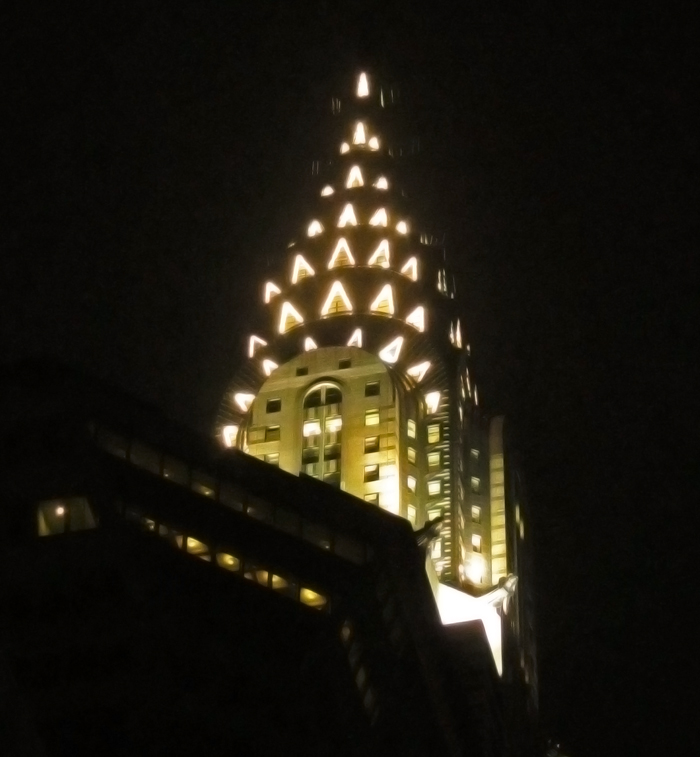
You’re going to have to look at scenes like that in today’s photo. Why do I say “have to”? Because on some days, you’re going to feel inspired by things like the Chrysler Building, a glorious living testament in steel and stone of what man can achieve. But at other times, you’re going to be asked, do you measure up? Do you have what it takes to live here?
Giants are everywhere you turn. There’s nowhere to hide. They tower above. You’re silently being judged. Can you make it? Don’t be deluded by Lady Liberty in New York Harbor. Yes, she’s welcoming of all, but she’s a siren, ready to send you back as fast as you got here. The exit door is bigger than the entryway.
Does it sound angry? Arrogant? I’m sorry, yes it is. Overachievers dominate the landscape. Genius is around every corner. I didn’t make the rules.
But it’s not hopeless, and the prize is worth being a contestant. If you need encouragement, look a little more closely at Lady Liberty – there may be a wink and a smile.
My father used to find news coverage of snowfall in Connecticut to be comical. Coming from northern Maine, one of the most inhospitable winter environments imaginable, the warnings, preparations, and particularly the news coverage of snow seemed rather ridiculous in comparison.
On Saturday at Union Square, I had an encounter with a woman of similar mind – originally from Florida, she considered the concern to be overblown.
Admittedly, the city is a complex web of services and systems with an enormous population and businesses. For a natural disaster to occur in New York City, the financial impact as well as human suffering is tremendous. So it is prudent to prepare.
The problem, however, with “better safe than sorry” is that the cost of preemptive measures is very high and would seem like a huge waste if a storm proves to be much less damaging than expected. The Mayor Bloomberg administration was criticized for its lack of adequate preparation for the blizzard of December 26, 2010. Deputy Mayor Stephen Goldsmith told the City Council, “We owe you and all New Yorkers for that lack of performance our administration’s apology and my personal promise not to let it happen again.”
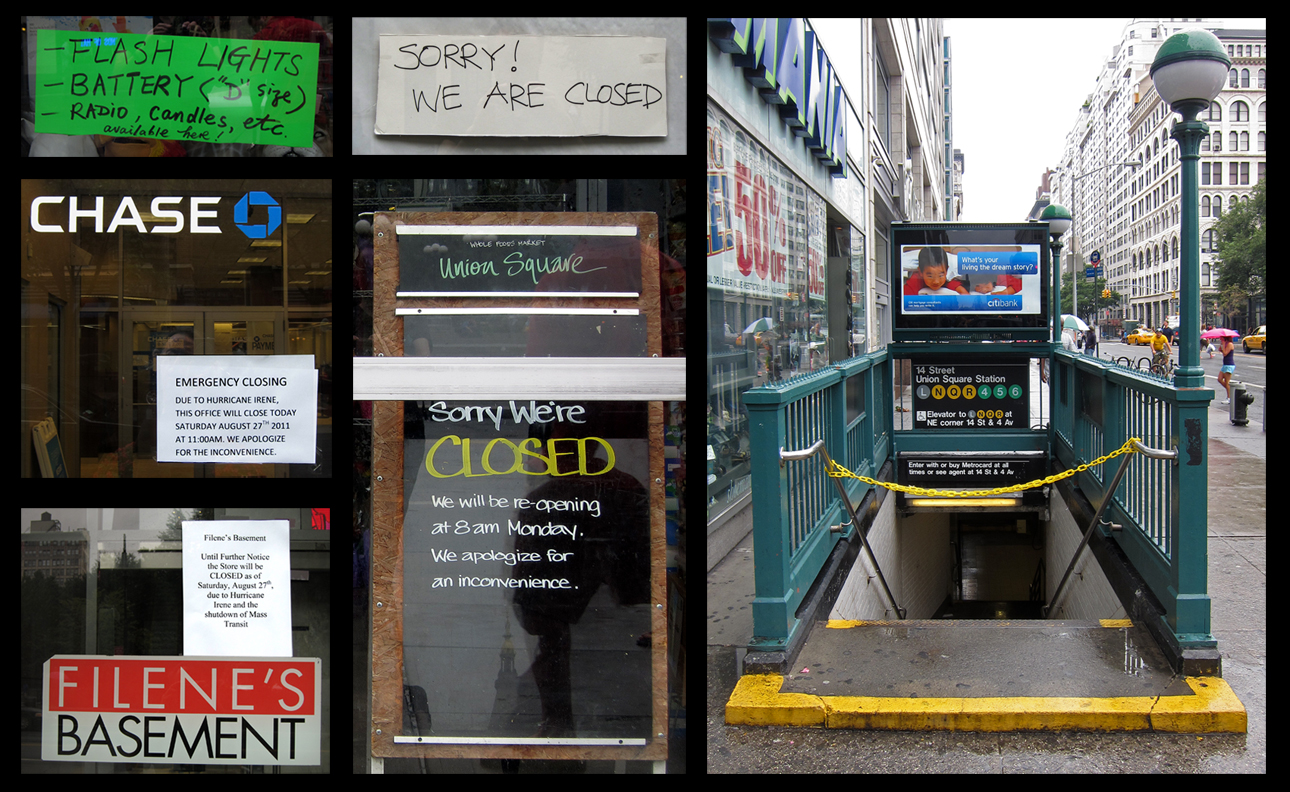
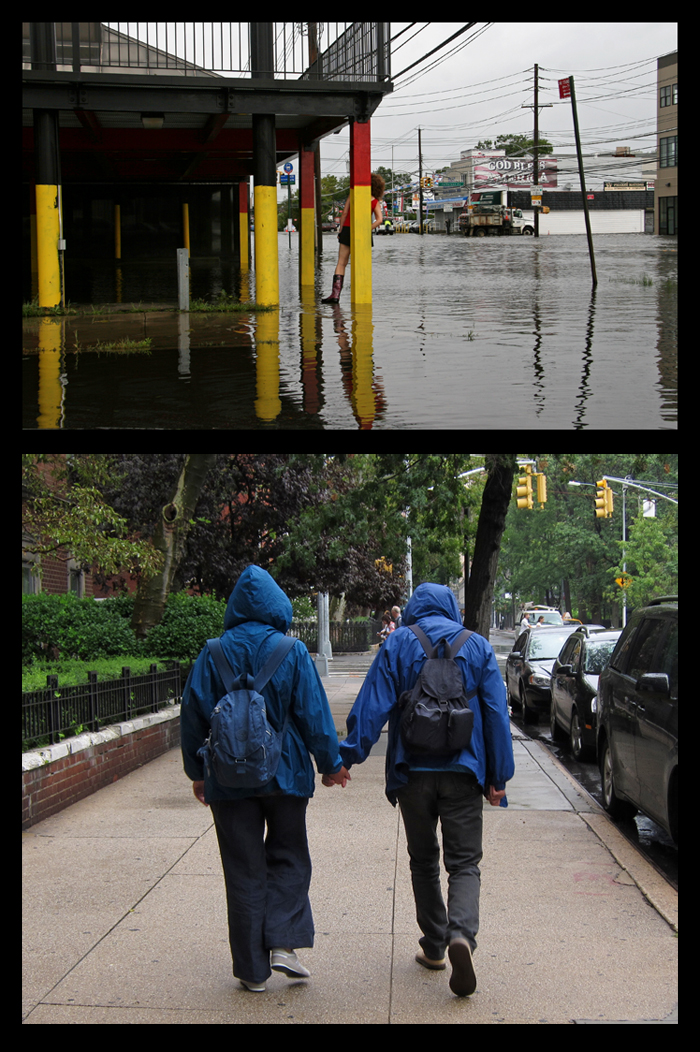
The city came well prepared for this storm, although many felt that the level of preparation was overdone. Subways and buses were shut down. 370,000 residents were placed in mandatory evacuation zones. By Sunday, the city was the quietest that I have ever seen. With workers without public transportation, business openings were impossible.
Not to minimize the real damage that the storm caused or the personal misfortune, but in hindsight, where vision is 20/20, Irene has blown over and looks overblown…
Photo Notes: Top – various locations around Greenwich Village. Center – Hylan Boulevard in Staten Island. Bottom – Washington Square North.
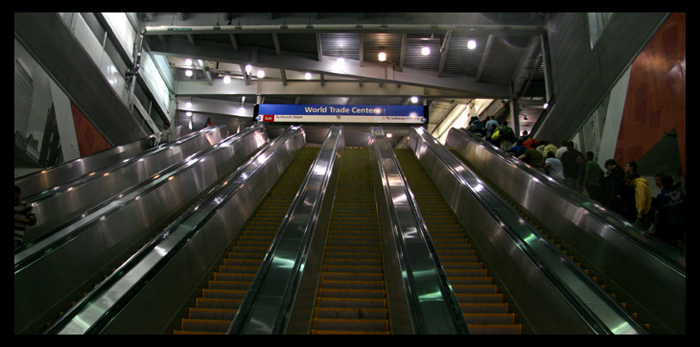
Time flies, and nothing better illustrates that in New York City than the realization that it has been 10 years since 9/11. It seems much more recent.
I go to Ground Zero very infrequently – progress and visible change have been very slow. The entire project of rebuilding was mired in controversy and battles, right from the initial design phase. Authority and control of the design and construction have been jockeyed around. Through various negotiations and contortions, the reconstruction is now overseen by architectural firm Studio Daniel Libeskind, the Port Authority of New York and New Jersey, Silverstein Properties, and the Lower Manhattan Development Corporation.
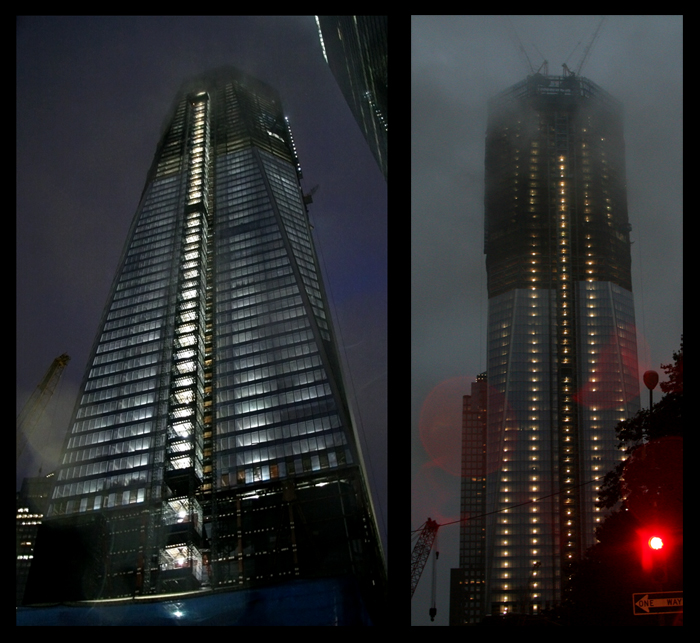
I visited recently on a drizzly, foggy evening and saw the current state of One World Trade Center, which will rise to 1362 feet, the height of the original South Tower. An antenna will rise to the height of 1,776 feet, symbolizing the year in which the United States Declaration of Independence was signed. The completion date is 2013.
Like many, I have my own distinct memory of what I was doing on the day and time of the attack. My home has unobstructed south views to the tower, but I did not look out my window that morning, as I was rushing to a dental appointment for a root canal.
On my way to the subway entrance at Waverly Place, I saw a number of people staring south. As I looked down 6th Avenue towards the World Trade Center, I saw smoke pouring from the North Tower minutes after it was hit. Not knowing the severity of the disaster, I descended to the subway. When I arrived at 57th Street and my dental procedure began, I watched the horror on a TV monitor which my endodontist had mounted for his patients. I occasionally tugged on his shirt to direct his attention to the TV screen as various incidents in the disaster unfolded.
Soon, it was evident that this was a monumental, unprecedented event in American history. Remarkably, my dentist remained focused on the exacting procedure throughout, including when the Pentagon was hit. When I suggested that perhaps many patients would cancel, he told me that his staff had already cancelled all appointments for the day. I was his first, last, and only patient…
Comfort Zone: Range of minimum and maximum exposure or risk within which an entity can operate without coming under undue stress.
For many, living in New York City would be outside their comfort zone. What many visitors or non-residents do not see, however, is that those of us who live here do not live continuously in the world of the visitor. We do not spend large blocks of time checking in and out of hotels, dealing with airport security, fighting crowds in Times Square, waiting in line for various attractions, or packing in an inordinate number of activities in one weekend. Also, consider that only 20% of residents live in Manhattan and that many neighborhoods in other boroughs have a much more relaxed atmosphere.
Of course, all that said, life in New York City is not as comfortable as suburban or rural life can be. Even the stalwart New Yorker needs a break from time to time. To cope, we seek out and find respite in places, routines, our loved ones, and friends. If you are lucky, perhaps you have a quiet apartment in a peaceful neighborhood. In the last five years, I have shared many of the special or lesser known places that provide escape from the city’s stressors.
For many, Sunday in New York City is a day of rest. Or, perhaps better said, a little more rest than usual. To find a comfortable spot and relax. And for comfort, nothing beats breakfast or brunch in a charming cafe in a quiet neighborhood on a tree-lined street on Sunday.
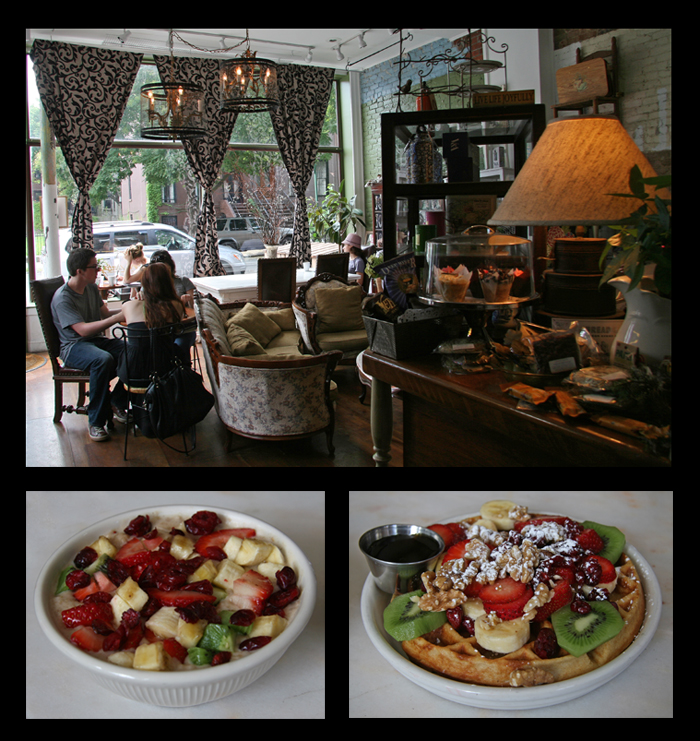
Like the Urban Vintage Boutique and Cafe at 294 Grand Avenue in Clinton Hill, Brooklyn. Here, the ambiance is like that of a 19th-century French salon.
Urban Vintage sports a plush interior, with comfy upholstered seating, soft lighting, dark woods, and well appointed touches throughout. The food is very good, and it would be an injustice to call it “comfort food,” as comforting as it may be. My companion who introduced me to this cafe/boutique touted the oatmeal as “the best,” and it certainly was wonderful, as were the Belgian waffles.
Places like this are small worlds that stand apart from the hustle and bustle of New York City. When entering a place like Urban Vintage, I am reminded of the introduction to the TV series The Twilight Zone, but with a different twist:
To go through their door is to enter another dimension. Not just a dimension of sight and sound, but a dimension of mind. A journey into a soothing land. You’ve just crossed over into The Comfort Zone.
Although well acquainted with Webster Hall, in 40 years of living in New York City, I had yet to step inside the place.
Webster Hall is one of New York City’s most historically and culturally significant large nineteenth-century assembly halls. The building, at 125 East 11th Street, was designed by architect Charles Rentz, Jr. and constructed for Charles Goldstein in 1886-87, with an eastern Annex in 1892.
Webster Hall was the first nightclub in the United States. It has gone through numerous incarnations since its construction and currently serves as a nightclub, concert hall, corporate events center, and recording venue. It has a capacity of 2,500 people.
My first visit was on Sunday for the QAS – Quarterly Art Soirée. This extravaganza takes places on all four floors of the space over the course of an entire day, from 3PM to 11PM. There were visual artists throughout the space, along with performances on the stages and in the lounges – music, dance, singing, aerial acts, burlesque, and a big finale by Flambeaux Fire.
I was particularly impressed with the dress of many of the attendees and also with the masks of Stephan Keating – beautifully designed and crafted. The space was extremely comfortable, with attendees milling about, exploring the various art installations and performances. Overall, the event has a very festive feel. At one juncture, one of the staff members decided to wallow in a glitter spill on the floor, rubbing it over his face and rolling it, much as a rhino rolling in mud 🙂
Have you ever been assaulted by greatness or arrested by talent? In a city where greatness is everywhere you look, one must use superlatives sparingly, lest one robs them completely of any meaning. But everywhere you look, excellence abounds, often hidden behind unassuming exteriors. It may be a homeless person versed on every subject imaginable, or a man so eccentric-looking he literally stops traffic but has a Ph.D in music composition from Columbia University (see Part 1 here).
Perhaps you have spent summers on park benches with Dave, a gentle, kind and humble man who, you learn only on his deathbed, has two doctorates in pharmacology. We chat often with a physicist who regularly spends evenings on a park bench, as does park architect George Vellonakis. I once found myself staring in awe at a man who not only played guitar well but learned to play a lap steel on his first encounter, only to learn that the man was Will Galison – a well-known musician who has a Wikipedia entry and has played with greats such as Barbra Streisand.
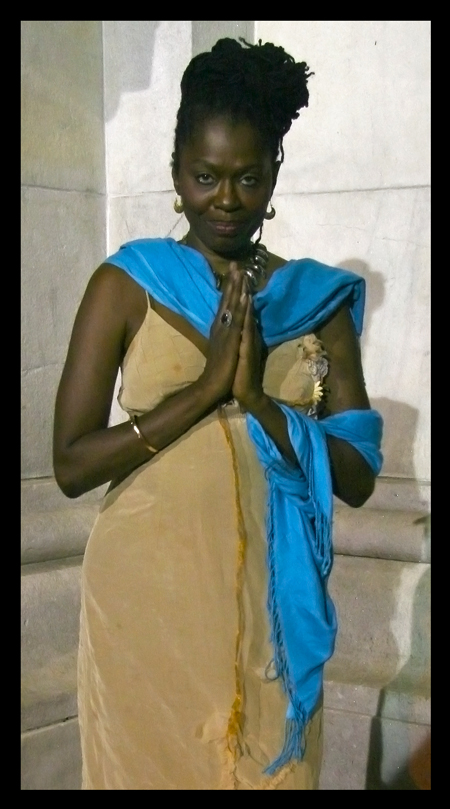
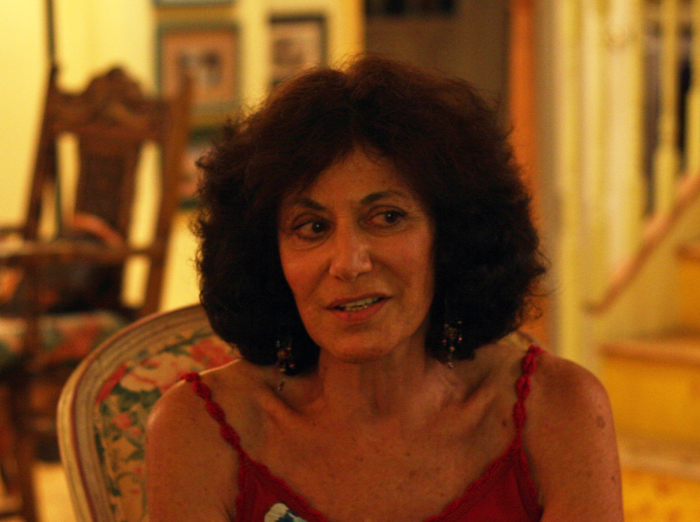
Last weekend, an unknown woman dropped by Washington Square Park very late on a quiet Sunday night. I met her eating a salad, sitting elegantly on the granite benches with her agent, Lisa Williams. I had seen her sing the previous Friday and was enthusiastic about speaking to her personally.
I introduced her to Scott Samuels, the reigning guitar wizard of Washington Square. There was a feeding frenzy within moments as virtually everyone in hearing radius scurried to see what the winds of good fortune had blown in. In an extraordinary coup d’etat, park regulars were treated to a number of classics, sung by Mzuri Moyo and accompanied by Scotty:
We love beatitudes and platitudes, simplifying life’s complexity – sayings such as you can’t have it all. For those who believe such a myth, meet Mzuri Moyo, a woman who has talent, charm and great looks. Her sincere delivery was transparent to all, and every song was met with cheers and whistling.
Lorraine Theresa Pope was born in Passaic, New Jersey, and was a graduate of Eastside High School, known for its transformation in the mid-1980s under the leadership of principal Joe Clark (the school and Clark were the subject of the 1989 film Lean on Me, starring Morgan Freeman). Mzuri is a Registered Nurse, a field she worked in for 6 years.
Mzuri speaks of her family: I have 2 brothers. I am the oldest. My oldest brother is very musical he writes and sings. He wrote one of the songs on my Christmas CD, I’ll Be Home For Christmas. The title of the song is Maybe We’ll Find Christmas Love. My father was a painter and he loved music. He was a distant cousin to James Brown. My mother had a beautiful voice – she sang in the church choir.
Her influences: The greatest influence on my life is having lived in Europe, traveling to Africa and Asia, and meeting all kinds of people. That is why I relate to everyone when I’m singing I feel them and I feel as though they are a part of me.
Her goals and aspirations: My goal is to keep music and my artistic ability honest and to make a great living at it. I also would like to bring peace and love into the world with the music I sing. I love yoga. I am a vegetarian. I love languages – I speak a little French and Spanish.
From her website: A writer since childhood, Mzuri has performed in a variety of venues including colleges and universities. Her recent concert debut at Lincoln Center was widely acclaimed. In 2002, Mzuri won the Audelco Award for Best solo performance. A star of both stage and film, a critic once wrote of her, “when Ms. Mzuri sings, God smiles, and angels flap their wings.”
In this one-woman show, Mzuri presents… Ms. Fannie Lou Hamer, up close and personal. This presentation in word and song, captures a little known but very important moment in history and lays it at your feet.
Make no assumptions. Investigate closely. Don’t move through the New York City streets so quickly that you miss an opportunity to be arrested by talent when someone like Mzuri sings 🙂
See Mzuri’s website and additional performances here and here.
On Wednesday, June 28, 2008, I wrote Insult to Injury. I had found what was to me one of the worst insults in the New York City dining experience – I enumerated 7 points outlining the transgressions.
But there is always room for improvement.
MacDougal Street is my least favorite street in the Village. It has a distinctly touristy feel and is gritty, dirty and congested. The shops typically cater to the lowest common denominator. There are a few things worthwhile, such as the Olive Tree Cafe and Mamoun’s. But dining al fresco is an abomination and unthinkable.
In fact, it is highly debatable that al fresco dining can actually take place on MacDougal Street. Unless you redefine al fresco to mean putting one table between the entrance to a restaurant and the exit of a comedy club in a space not even wide enough for the table alone.
But strangely, there is a comfort in all of this. Why?
Well, you’re in New York City, arguably one of the most dynamic places in the world. The streets are pulsing with energy and you can just feel it everywhere you go. It’s creeping from every crack and crevice. You know you are at the epicenter of the civilized world.
There are people everywhere. Too many people. But we are gregarious, and although we bemoan the crowds, I see no mass exodus to the countryside. We want to be around people.
A lot of food in New York is authentic ethnic cuisine, even at the lowest prices – something virtually impossible to find outside the city. We have tremendous selection.
So many things are operating at the highest levels of sophistication in the least expected places. Hence the series of articles I have done – Abandon All Preconceived Notions Ye Who Enter Here. Where will you find homeless with degrees from Columbia University, brilliant eccentrics like Mark Birnbaumwalking in 8-inch silver platform shoes (see Part 1 here), or geniuses like Paul Kachur lurking about the dive bars of the East Village? Park regular and friend David Hoffman, who looked essentially homeless; we only found near the time of his death had two PhDs in pharmacology.
In Bristol, Connecticut, where I grew up, there are no places to eat outside at all. When I walk down MacDougal Street and think hard, I realize that here, even the worst is good…
Most people are too self-conscious or shy to dance publicly, or for that matter, even privately. But it’s healthy and on occasion, dancing can be seen on the streets and in the parks of New York City. Dancing’s cathartic release is the central theme to a very funny comedy sketch by Dane Cook.
In the following excerpt, a man speaks to his male friends about dance clubs, women, and dancing: We don’t go there to dance. Women go there to dance. They get all ready and in the mirror with their friends.
“I just need to go I just need to dance! I’m serious tonight – no guys! … I’ve had a rough week and I just need to just dance it out! I just wanna stand in a circle around our pocket books and shoes and just DANCE! DANCE!”
You will never ever hear a guy say to one of his buddies – “Mike, Mike Mike ! Just listen buddy tonight bro, I gotta dance dude … I gotta DANCE!”
That is certainly not the case with Zev. I first saw Zev some years ago for the first time while in Union Square, in the midst of a drumming circle. Everyone who has witnessed his vigorous, convulsive style of dancing is stupefied, often just staring in disbelief as he goes on and on, sometimes for HOURS. On the 15th of July, I caught Zev in Washington Square. I took a number of video clips spanning some of his time there. By nighttime, his face was red and flushed. I worried that that the man may suffer a stroke or heart attack. A counterpoint was provided by a woman, an extremely confident dancer who had style and knew how to move.
A mutual friend learned a little about Zev. He was angry and displeased with life. I overheard him assert that Americans are not free. When asked where they were free, he replied, “nowhere.”
Watch the short video to get a sample of Zev in action. Keep in mind he often keeps this up for hours. Perhaps there is no worry – his zombie-esque appearance and lack of any signs of pleasure may be a clue that he is no longer alive, only animated. See it to believe it.
I have a friend, Paul Fryd, who is an attorney in New York City and, on occasion, over the years, has provided phone advice in difficult situations. His initial mantra to any question was predictable, even irritating – because he was right and I usually did not want to hear it. When I presented the details of any problem, his first response was, “What do you want first – the legal answer or the practical answer?”
I rarely liked the practical, sensible business answer. Like settling with someone who was clearly wrong, yet paying them anyway to expedite the matter and move on, rather than wasting more time and money in legal fees to see “justice” being served.
Freedom and exercising it can be equally frustrating. Legally, we do have freedom of expression, but in practice, these freedoms are not always so easily exercised. There are many ways to effectively eliminate or subdue people who act and think differently in a community, including police intimidation (see Criminal Suspect here).
The Statue of Liberty stands in Upper New York Bay as an icon to American freedom. Within the context of the United States, for many, New York City stands as a place to chase their dreams and also to exercise freedom to express themselves in any manner they choose without fear of ostracism. Here, New Yorkers are extremely tolerant, even embracing and nurturing eccentricities that elsewhere would be untenable. In the case where behaviors are even technically illegal but benign, laws are often not enforced.
Unfortunately, money is also part of the freedom equation, and the economics of living in New York City is closing the window of opportunity for many who would like to live here and exercise various lifestyle choices unfettered. However, for those who are tenacious and adequately driven, living in New York City for the person of average means is still possible, albeit requiring some resourceful thinking and a willingness to compromise a lot.
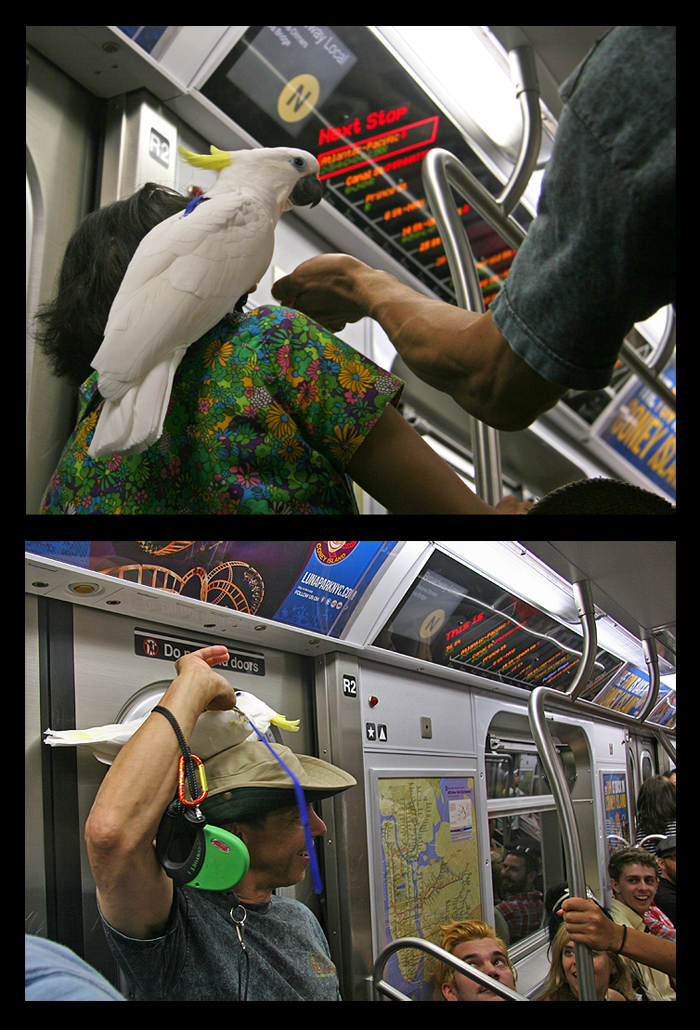
Why be a martyr on Main Street in Anytown, USA, when in New York City, riding the N train from Coney Isand with a cockatoo will be met with either indifference, amusement or delight? I have seen a wide range of very unusual pets in public in New York City, many of them illegal to own. Can you ride the subway in New York City with a cockatoo? What do you want first – the Legal Answer or the Practical Answer? 🙂
“In New York City, one’s net worth of social currency is based not so much on who you know, but how you can get seated in the most important restaurants.” – Myra Smolev
In this tale of unmitigated nerve, Myra tells of how she got a table at the River Cafe for friends arriving from Milan who had heard that this was the place to eat. However, at the time, typical of popular restaurants, it was IMPOSSIBLE to get a reservation.
But Myra, a New York City born aggressive and successful Jewish woman, succeeds with a little drama, creative thinking and classic Chutzpah 🙂
I have written before about the prominent role of Yiddish in New York City (see here). One word that well describes a character trait often needed for success here is chutzpah. Chutzpah derives from the Hebrew ?u?pâ (????????), meaning audacity – someone who has overstepped the line of acceptable behavior with no shame. In Yiddish, the word has broadened in meaning and now has a more positive connotation, i.e. a gutsy attitude which serves admirably to achieve an end. If you live here, you will hear it often.
Leo Rosten in The Joys of Yiddish defines Chutzpah as “gall, brazen nerve, effrontery, incredible ‘guts,’ presumption plus arrogance such as no other word and no other language can do justice to.” The word has been used over 200 times in legal opinions, including a US Supreme Court case.
Recently, at a friend’s home, Myra Smolev told a tale of chutzpah so outrageous, that I asked if she would retell it, allow me to video tape it, audio record it for podcast and post it as a story here. She agreed and on the 4th of July, at a small party at her home, Myra told her story of Chutzpah. It will be revealed tomorrow 🙂
I am very disappointed to learn that the species of rat most common to New York City is the brown rat or Rattus norvegicus and not the black rat, Rattus Rattus. The repetition of genus and species seemed to fit so nicely with the popular: New York, New York, so nice they named it twice.
The rat commonly seen in New York is the brown rat (Rattus norvegicus), aka the common rat, sewer rat, Hanover rat, Norway rat, Brown Norway rat, Norwegian rat, or wharf rat. It is one of the world’s most common rats. The name is actually a misnomer as they do not originate from Norway. After human beings, the rat is the most successful animal on the planet, having inhabited virtually every country and land mass. Read more here.
Rat is also used to characterize New York’s landlords and store owners – see the use of the large inflated rat in my story Attention. For those who want to embrace the rat in order to appear edgy, there are establishments that use the rat for imaging and naming, such as the trendy SoHo shop Yellow Rat Bastard. According to the New York Times:
When the flagship store opened in 1994, it installed cages with several dozen rats in its front window to create buzz. The rats were eventually removed from the window, but many employees said the rats continued to run around the store and the basement storeroom.
The shop encouraged graffiti artists to tag the exterior of the shop. Ironically, in 2008, the store agreed to pay $1.4 million to settle a lawsuit over unpaid wages and overtime, paying back wages to more than a thousand employees.
We have so many rats in New York City, that in a way it is a shame we do not have our own species. It would be so befitting of a city with such a large ego to be able to lay claim to Rattus rattus…
Photo note: I ran across the piece of graffiti in the photo on East 2nd Street in the East Village.
A New York comic: “Are any of you here from out of town? Yes? For those of you unfamiliar with the subway, it’s an underground system of urinals connected by trains.” Perhaps I should add, “patrolled by rats.”
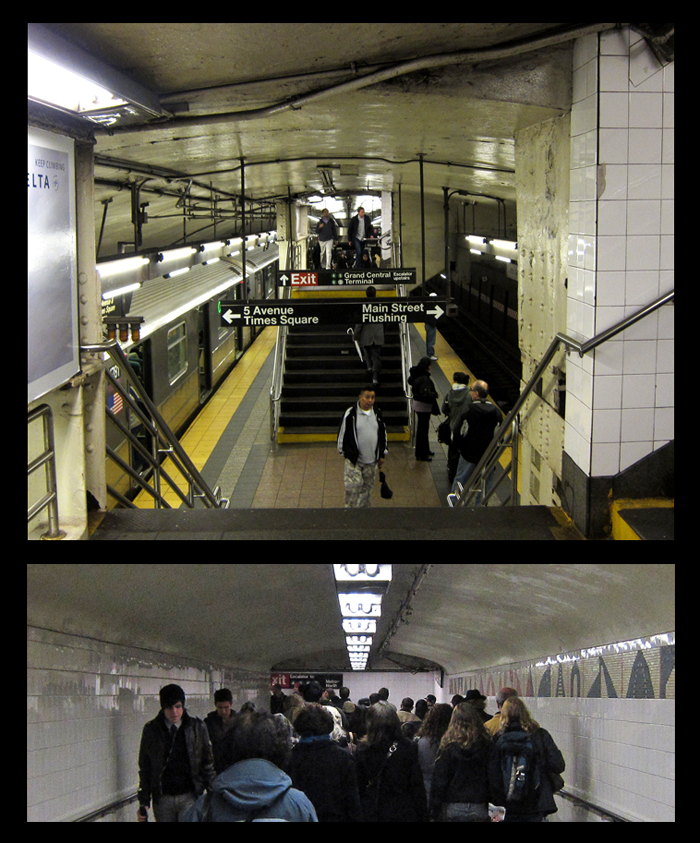
There is little that says New York like the subway system, lying just beneath the city’s surface, acting as its central nervous system. Trains and train service is a highly contentious subject, often maligned and frequently praised. Its failings are many as are the reasons for the problems. One reader response to a subway article on Gothamist says:
The NYC subway system is evocative of some third-world country. All you need are some goats and chickens in the subway cars to complete the picture.
Perhaps the most common word used in explanations regarding things that ail New York residents and visitors is TOO. Many have commented as I have over the years of how nice it would be to have subway trains with rubber tires as do many other cities. However, a transit authority spokesperson said it was not possible – too much wear and our trains are too heavy.
The enormous number of people in a non-heterogeneous mix is one of the key factors to make New York what many tout as the greatest city in the world. Of course, population size alone does not insure greatness, but it certainly is a contributing factor, providing support for a seemingly endless number of services, businesses and cultural opportunities. How else could you support the world’s only 24 hour subway system? But there are numerous serious issues, not the least of which is that it is literally deafening – noise levels in the Spring Street station running the Lexington Avenue line having been measured at 105 decibels (see article here). Noise at this level for one or two minutes each day can do permanent hearing damage over time. For now, too bad.
The New York City subway is one of the world’s cheapest rides. Many feel that cost and the 24/7 service trump all negative concerns. But for others, the TOOs are a deal breaker: too dirty, too loud, too hot in the summer, too dilapidated, too outdated, too smelly, too crowded, too many stairs, too confusing, too many shutdowns and reroutings and too few attended token booths. Got to go now. I hear a train coming and it’s screaming TOO TOO New York 🙂
I grew up in a quite conservative New England environment – a place and a time where homosexuality was completely invisible. However, once moving to New York City in 1969 and settling in Greenwich Village, I was immediately exposed to a relatively open world of gays. At first, it was shocking and a little unsettling. See my story No Red Faces here. However, in a short time, I was educated at Sidewalk University and came to see homosexuality as just a fact of life, a part of the human condition, across cultures, and going back as long as humans have been on planet earth. My education came from many sources, including association with gays and my employment of a number of gay individuals in my business. What is puzzling is the continuing hostility towards gays and the struggle for gay rights.
Anyone exposed to members of the gay community knows that the breadth of personalities mirrors that in the straight community. Yes, there are gays who are quite outlandish in their dress and manner, however, just examining the stories in the website alone should be ample evidence that the flamboyant is not the exclusive domain of either the gay or straight community. The annual gay parade, like any parade, is self selective – many parade participants will be that small number who are more exhibitionistic by nature. I would hope the straight community is not judged by the drunken revelry found in the annual Santacon.
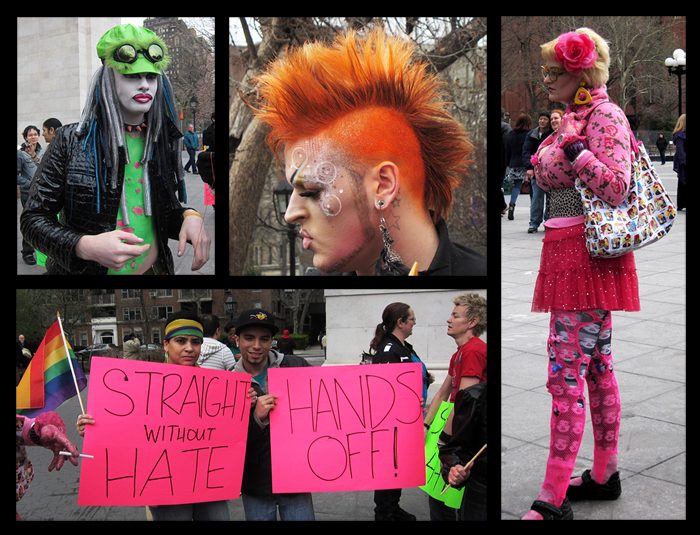
However, even at this juncture in time in New York City, I still see a fair amount of polarization of the straight and gay communities with minimal involvement of one group within the other. Some are concerned, and rightly so, that being an advocate of one lifestyle implies hostility towards the other. The small group of marchers who met in Washington Square Park on Sunday, Straight without Hate, were a new twist on sexual orientation advocacy.
In my own large extended family, we have, like most, learned over recent years of a number of gays. Only one cousin has been open with me about this. The last I spoke to him, he had moved to Manhattan. The rest still live in a shroud of secrecy and embarrassment with quiet gossip. Sad, as I am sure this is stressful and a heavy cross to bear for them, their families and friends.
No reason to resist, because as always, the times they are a-changin’…
One of my favorite childhood toys was the homemade periscope. With this, one could spy, i.e. see other people secretly in a candid state. Media often tries to provide a periscopic look at the world with the investigative report, the behind the scenes inside look, and with programs such as 20/20 or 60 Minutes.
We want to see people, places and things in their natural setting. We want it all and we want it unadulterated, unexpurgated, uncensored, uncut. We want to see what’s behind the curtain or that closed door.
There is a New York City guidebook called Not For Tourists Guide to New York City, as well as a little tome I really enjoy from 2002: City Secrets – New York City. There are numerous websites promising to show you the hidden side of New York City: forgotten-ny, vanishing new york, Lost City, Ephemeral New York, Undercity, and Overheard in New York.
In this website, I have endeavored to show you New York City in as real a light as possible. I am not a particularly private person and have revealed to you many aspects of my personal life, work, family, background, and interactions with others, as well as my personal perspectives and experiences in the city.
Whether visitor or native, we grasp at all the things promising to show us the secrets because we want to see the Real New York – unvarnished, unsanitized, and uncolored by the Curse of Trade. The city we have read about, heard about, dreamed about, and portrayed in film. We want to see what lurks behind the shadows and fog and experience The Real New York…
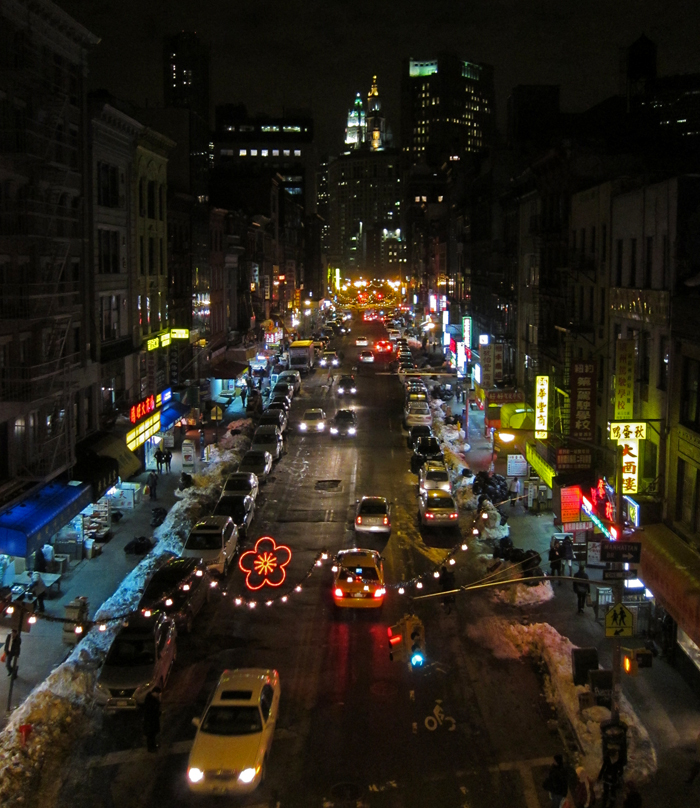
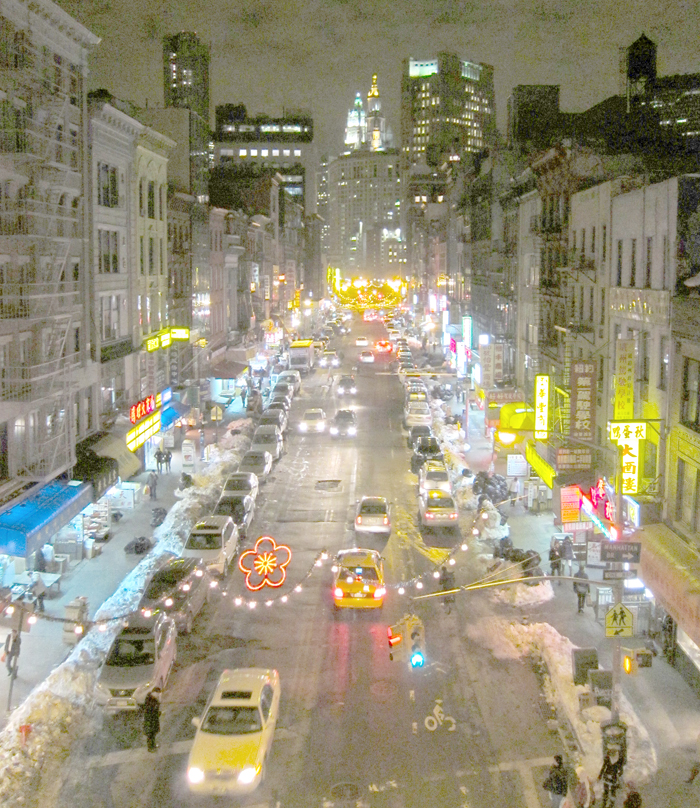
Photo Note: this is a view looking south along East Broadway from the Manhattan Bridge. The two illuminated towers in the rear center are the Woolworth and Municipal Buildings. The photo effect was achieved using a Photoshop filter to remove the shadows and reveal all.